
Lazy Caturday Reads
Posted: May 2, 2020 Filed under: morning reads, U.S. Politics | Tags: Christi A. Grimm, coronavirus, Covid-19, Donald Trump, Georgia, inspector generals, Massachusetts, Texas, Trump coronavirus cover-up 31 Comments
Good Morning!!
My state remains number three in coronavirus cases behind New York and New Jersey, despite the act that Gov. Charlie Baker has acted responsibly and Massachusetts citizens are overwhelmingly supportive of the state’s social distancing and other mitigation efforts.
The Washington Post: In educated and affluent Massachusetts, coronavirus cases surged. The decline has yet to come.




Thursday Reads: Staying Inside and Peeking Into Other People’s Homes
Posted: April 30, 2020 Filed under: morning reads, U.S. Politics | Tags: blue states, coronavirus, famous people's bookshelves, famous people's houses, Georgia, human sacrifice, interior paintings, red states 23 Comments
Wassily Kandinsky, My Dining Room
Good Morning!!
Have you found yourself trying to read the titles of books behind all those experts appearing on TV from their homes these days? I certainly have, and I’m not alone. Some people also like to examine famous people’s knick knacks and decorating choices while watching TV. I found several interesting articles about these voyeuristic pastimes.
The New York Times: What Do Famous People’s Bookshelves Reveal?
Bibliophiles do not approach bookshelves lightly. A stranger’s collection is to us a window to their soul. We peruse with judgment, sometimes admiration and occasionally repulsion (Ayn Rand?!). With celebrities now frequently speaking on television in front of their home libraries, a voyeuristic pleasure presents itself: Are they actually really like us?
The Times discovered that actress Cate Blanchett owns all 20 volumes of The Oxford English Dictionary; and Prince Charles owns a copy of Shattered, by Dick Francis, the famous mystery writer whose books feature horse racing as well as a biography of the painter Basil Taylor, who mostly painted horses. Read more examples and see photos at the link above.

Pierre Bonnard, Dining Room in the Country, 1913
Vogue: If You Can’t Stop Staring at TV Anchors’ Home Backgrounds, You’re Not Alone.
I’ve spent a lot of time the past month contemplating the home-design choices of network anchors, cable-show hosts, and the ubiquitous talking heads who join them on a fairly regular basis. As more interviews are held remotely and as the anchors themselves have moved into makeshift home studios, I’ve become increasingly obsessed with the backdrops each of these has chosen as they pronounce judgments on the waning days of the Democratic presidential primaries or the latest bizarre statements made by President Trump at his daily coronavirus briefings.
They range from the relaxed manner of John Heilemann, in a blazer and checked shirt sitting in front of his open-plan kitchen, to the full-suit-and-tie (well, at least from the waist up) look of Jon Meacham, backed by wall-to-wall bookshelves that fill the entire frame behind him. (And no, those books are not arranged by color.)
Ah, yes, bookshelves. Rows of carefully arranged books seem to be the go-to choice of most of the reporters and commentators who provide the bulk of the cable-news programming. Thus my curiosity about their reading habits. Peter Baker, a White House correspondent for the New York Times and a frequent guest on MSNBC, sits in front of a tall, narrow bookshelf containing an array of political tomes and presidential biographies, including what looked like one of his own, Days of Fire: Bush and Cheney in the White House. David Gura, another MSNBC correspondent, has a more haphazardly arranged bookshelf as his backdrop, with an eclectic reading taste that ranges from the *New Yorker *’s Jane Mayer (Dark Money) to novelist Colson Whitehead (The Nickel Boys). And Josh Barro, a business columnist for New York magazine, has been doing his frequent TV appearances lately framed by a row of travel books and a vintage poster from United Airlines (wishful thinking?).
Read the rest at Vogue.

Henri Matisse, The Piano Lesson
Town and Country: Billionaires on Video Chat Are Giving Us a Rare Peek Inside Their Homes. This article introduces a new Twitter feed: Room Rater. Check it out!
Two weeks ago Claude Taylor and Jessie Bahrey launched a Twitter account called Room Rater (@RateMySkypeRoom). In it, the boyfriend-girlfriend team comment on and score the background decor of broadcasters, pundits, and celebrities forced to do interviews from home during coronavirus physical-isolation orders.
In brief, pointed tweets, they weigh-in on art selection, bookshelves (content and arrangement), lamp placement, color palettes… you name it. Although neither has a background in interior design, their comments address some newly universal aesthetic questions: Will having a bookcase in the background make me look smarter? Is my wallpaper dorky? Am I force for good in the world during uncertain times?
Room Rater quickly accrued 100,000 followers and Taylor has appeared on Inside Edition and been interviewed by numerous websites. Subjects of their tweets have begun to tweet back, begging for higher scores.
Peter Baker of the New York Times added artwork to his walls after Room Rater pointed out an empty wall hook. They are still getting angry DMs about a 9/10 they gave Michelle Obama four days ago. “Come on. That’s a great score. We all need room to grow,” says Taylor.
Room Rater focuses mostly on TV pundits and politicians, but we asked them to take a look at a seemingly under-analyzed segment of home backgrounds—those of billionaires.
Check out the video backgrounds of Barry Diller, Bill Gates, Mark Zuckerberg, and Mike Bloomberg at the T and C link.

Grant Wood, The Sunshine on the corner
Financial Times: When bookshelves are more informative than the books.
Please use the sharing tools found via the share button at the top or side of articles. Copying articles to share with others is a breach of FT.com T&Cs and Copyright Policy. Email licensing@ft.com to buy additional rights. Subscribers may share up to 10 or 20 articles per month using the gift article service. More information can be found here.
https://www.ft.com/content/57284374-83b3-11ea-b6e9-a94cffd1d9bfOur bookshelves have suddenly come under intense and unexpected scrutiny. The ad hoc backgrounds to our home office Skype and Zoom calls, the random arrangements of books accumulated and the knick-knacks in front of them have become public property. TV news is populated by hairy-nostrilled talking heads mediated sketchily across our screens. You just can’t help peering at those backgrounds. What do they say about their owners? The academics and scientists come out best. Shelves fully stacked have spiral-bound reports and papers stuffed sideways into every spare inch of space. There is no curation here, just accumulated knowledge, constantly updated, overwhelming the shelf space. These are texts as tools, not interior decoration. Historian Simon Schama caused a little flutter of recognition when he appeared against a backdrop of steeply stacked books and jumbled shelves. Even the comfy-looking armchair was requisitioned as storage….
And then there are the shelves themselves. The political class tend to have built-ins, the marker of a proper home office (rather than the Ikea Billy bookcase that does the job for so many). They range from the minimal modern (UK chancellor Rishi Sunak) to faux-Victorian dark wood (former US presidential candidate Pete Buttigieg, who also mostly displays political biographies). The zenith of shelving must be the Dieter Rams-designed white modular Vitsoe wall units. They pop up only rarely, but I noticed one behind Saffron Cordery, deputy chief executive of NHS Providers.
On to more serious stuff. The U.S. appears to be poised to kill record numbers of people by opening up states’ economies prematurely, while European countries take it slower.

Interior with a young woman cooking, Knud Erik Larsen
ROME—Some of the hardest-hit countries in Europe will start opening up their economies in the coming days after several long months of very tight pandemic lockdowns. But they are doing it in conjunction with scientific guidance that marries widespread testing and aggressive contract tracing—and no crowded beaches. And, under the understanding that if anything goes wrong, everybody goes back inside.
The Trump administration appears to be doing the exact opposite, pushing to kickstart stagnant economies before the pandemic has even reached its peak in some states, going for a “rip off the Band-Aid very quickly” approach, while here in Europe, countries are lifting it corner by corner, slowly, to make sure everything is fully healed.
The authors describe cautious reopening steps planned by Italy, France, and Spain. In contrast, in the U.S. some states are opening up willy-nilly.
In the United States, bowling alleys and pizza joints are full in a number of states, with people rubbing shoulders as if the global pandemic is a movie or someone else’s nightmare. The only European nation that even compares to the U.S. is Sweden, which didn’t officially lock down—though the Swedes mostly self distanced on their own accord— and which is now grappling with a higher infection rate than any of the other Nordic countries, according to statistics gathered by Worldometer.
European news outlets have featured mocking photos this week of people eating barbecue in Georgia and running along crowded beaches in Florida, but there are plenty of wistful Europeans here complaining that their countries are moving too slowly in returning to normal. The most vocal tend to be those who have been working from home just fine, but who desperately need their roots touched up and are sick of cooking….
Yet in Europe, life seems to mean more than the bottom line and even those in the tourism industry are worried about opening too soon, and what liabilities will come with mass tourism and international travel if it kicks off another wave and a return to the darkest circles of hell.
Ah yes, here in the U.S. it’s all about the bottom line, especially in the red states. Case in point: Georgia.

Interior by Katherine Nolin
The Atlantic: Georgia’s Experiment in Human Sacrifice. The state is about to find out how many people need to lose their lives to shore up the economy. As we’ve all heard, Georgia’s governor Brian Kemp ordered businesses in his state to open up this week.
Kemp’s order shocked people across the country. For weeks, Americans have watched the coronavirus sweep from city to city, overwhelming hospitals, traumatizing health-care workers, and leaving tens of thousands of bodies in makeshift morgues. Georgia has been hit particularly hard by the pandemic, and the state’s testing efforts have provided an incomplete look at how far the virus continues to spread. That testing capacity—which public-health leaders consider necessary for safely ending lockdowns—has lagged behind the nation’s for much of the past two months. Kemp’s move to reopen was condemned by scientists, high-ranking Republicans from his own state, and Atlanta Mayor Keisha Lance Bottoms; it even drew a public rebuke from President Donald Trump, who had reportedly approved the measures before distancing himself from the governor amid the backlash.
By acting with particular haste in what he calls a crucial move to restore economic stability, Kemp has positioned Georgia at the center of a national fight over whether to stay the course with social distancing or try to return to some semblance of normalcy. But it’s easy to misunderstand which Americans stand on each side. Many Georgians have no delusions about the risks of reopening, even if they need to return to work for financial reasons. Among the dozen local leaders, business owners, and workers I spoke with for this article, all said they know some people who disagreed with the lockdown but were complying nonetheless. No one reported serious acrimony in their communities.
Instead, their stories depict a struggle between a state government and ordinary people. Georgia’s brash reopening puts much of the state’s working class in an impossible bind: risk death at work, or risk ruining yourself financially at home. In the grips of a pandemic, the approach is a morbid experiment in just how far states can push their people. Georgians are now the largely unwilling canaries in an invisible coal mine, sent to find out just how many individuals need to lose their job or their life for a state to work through a plague.
Read the rest at The Atlantic.

Interior with black dog, William Robinson
At Slate, Jordan Weissmann writes that red states aren’t immune from being overwhelmed by the pandemic: Republicans Are Absolutely Deluded if They Think Only Blue States Need a Bailout.
With the coronavirus crisis threatening to choke state budgets and force massive, economically damaging spending cuts, Republicans have responded in their time-honored fashion, by telling New York and the rest of blue America to politely drop dead.
Senate Majority Leader Mitch McConnell set the tone last week when he said that any aid to state governments would amount to a “blue state bailout.” He suggested that instead of handing governors money, which would supposedly allow them to paper over years of financial mismanagement, Congress should just let states declare bankruptcy. On Tuesday, meanwhile, Donald Trump signaled that he might be willing to discuss aid with Democrats in Congress, but only if states bend the knee on immigration policy….
What’s a bit odd about all of this is that GOP leaders are acting as if they have an upper hand on this issue, because only Democratic strongholds like New York and Illinois are in trouble. In fact, nothing could be further from the truth. Red states are also fiscally screwed thanks to the coronavirus, and in many cases may be in worse shape than supposedly irresponsible blue states.
It’s unclear why, exactly, some Republicans appear convinced that only political entities that happen to be run by Democrats are about to experience a financial rout. Perhaps it’s because the biggest coronavirus hot spots have tended to be in places like New York, New Jersey, and Michigan. But economic activity has frozen all over the country as governors try to slow the pandemic, and even if Georgia or Texas attempt to “reopen” a bit early, that won’t save them from the shockwaves of a deep national recession. Some Republicans, like McConnell, have seemingly suggested that states like Illinois are in financial trouble now because of their long-standing public pension problems. Insofar as that makes any sense, it’s because some states with pension issues (Illinois, Pennsylvania) haven’t been able to build large rainy day funds or other reserves that would help tide them through this crisis. But that list of offenders also includes McConnell’s own home state of Kentucky, which has one of the worst-managed pensions in the country.
Tuesday Reads: Coronavirus Deaths Mount as Evidence of Trump’s Pandemic Cover-up Emerges
Posted: April 28, 2020 Filed under: morning reads, Republican politics, U.S. Politics | Tags: Anthony Fauci, coronavirus, coronavirus "briefings", Covid-19, Deborah Birx, Donald Trump, President's Daily Briefing, Trump pandemic cover-up, U.S. death toll, Vietnam War 34 Comments
Good Morning!!
U.S. deaths from Covid-19 in the past few months will soon surpass our casualties from the Vietnam war. Now Trump has upped his prediction of the total death toll to 70,000.
Real Clear Politics: Reporter to Trump: If A President Loses More Americans To Coronavirus Than Vietnam War, Do They Deserve To Be Reelected?
QUESTION: If an American president loses more Americans over the course of six weeks than died in the entirety of the Vietnam war does he deserve to be reelected?
TRUMP: So, yeah, we have lost a lot of people but if you look at what original projections were 2.2 million we are probably heading to 60,000, 70,000–it’s far too many. One person is too many for this and I think we made a lot of really good decisions. The big decision was closing the border or doing the band people coming in from China obviously other than American citizens which had to come in, can’t say you can’t come in, you can’t come back to your country. I think we have made a lot of good decisions. I think that Mike Pence and the task force have done a fantastic job. I think that everybody working on the ventilators you see what we have done there, have done unbelievable. The press doesn’t talk about ventilators anymore. They just don’t want to talk about them and that’s okay but they reason they don’t want to talk–that was the subject that nobody would get off of. They don’t want to talk about them.
We are in the same position on testing. We are lapping the world on testing and the world is coming to us as I said they are coming to us saying what are you doing, how do you do it and we are helping them. So, no, I think we have done a great job and one person I will say this, one person is too many. Thank you all very much. Thank you. Thank you.
As you can see, Trump didn’t answer the question, but he did increase his prediction for total deaths. Of course we’ll probably pass 70,000 in a couple more weeks, and then he’ll make excuses for that.
Michael Tomasky at The Daily Beast: America Is About to Blow Past the 60,000 Coronavirus Deaths Trump Said Would Be a Win.
As for where we may be headed, Michael Osterholm, an infectious disease expert who’s been warning about pandemics for more than a decade, told CNN’s Peter Bergen that he thinks the ultimate tally in the United States over the next 18 months or so will be around 800,000. You’re thinking, “Ah, no way”? Go read his reasoning and see what you think then.
Meanwhile, the Congressional Budget Office released a report last week making a few predictions on the economy. CBO sees a real GDP of -39.6 percent in the second quarter of this year (April, May, and June). Then it forecasts a good rebound, 23.5 percent in Q3 and 10.5 percent in Q4, but that still leaves us at -5.6 percent for the year. At the worst of the Great Recession, in 2009, it was -2.5 percent. Unemployment will be above 15 percent into the fall and above 10 percent all of this year—and next.
We’re in deep trouble, and the idiot President of the United States is telling people to drink Lysol, and idiot politicians like Brian Kemp and other governors are trying to make sure that Osterholm becomes a prophet, and idiot protesters are out there acting like common-sense public safety is a conspiracy against liberty, and idiot reactionaries like the Dorr brothers of Iowa are financing these protests because, well, you know, the libs suck. These Dorrs have launched Facebook pages in at least five states that abcnews.com calls a “hotbed of misinformation.”
It’s idiocy top to bottom, but it’s more than that, and it’s important that we understand this and never lose sight of this. It’s ideology.
Tomasky writes that Trump’s non-stop lying is not an anomaly among Republicans.
With a few laudable exceptions, Republicans lie about virtually everything. They have to—to advance their goals, which are both insanely unpopular (more tax cuts for rich people!) and completely fantastical (those tax cuts will lift all boats), they have to try to create a reality that is the opposite of real reality and then spend billions getting people to believe it.
They’ve been doing it for decades. That’s why Trump isn’t some accident. It was inevitable that eventually they’d nominate and fawn over someone who lies every time he opens his mouth.
Trump, though, it’s gotten to a scale I never thought we’d see in the United States. Trumpism is an ideology in which the only thing that matters, the only thing that is true, is what the leader believes and says at any given moment. Which is surreal, of course, because virtually everything he says is untrue. But objective truth is a lib trap. And the vast majority of Republicans endorse this.
Read more at the The Daily Beast.
 More stories are coming out about Trump ignoring or covering up the seriousness of the building pandemic.
The Washington Post: President’s intelligence briefing book repeatedly cited virus threat.
…Over the last five days of February, President Trump and senior officials….engaged in a cover-up.
A look at this window of time gives insight into how several members of the president’s team were willing to manipulate Americans even when so many lives were at stake.
The recent reports that the president wanted to fire the Centers for Disease Control and Prevention’s top expert on viral respiratory diseases, Dr. Nancy Messonnier, during this period helps put the pieces of the puzzle together….
In a conference call with reporters on the final Tuesday of the month, Dr. Messonnier spoke frankly. “We want to make sure the American public is prepared,” she said, then put it in personal terms by saying what she told her children that morning: “We as a family ought to be preparing for significant disruption to our lives.”
At the time, senior officials knew the coronavirus was an extreme threat to Americans. Thanks to information streaming in from U.S. intelligence agencies for months, officials reportedly believed that a “cataclysmic” disease could infect 100 million Americans and discussed lockdown plans. The warnings were given to Mr. Trump in his daily brief by the intelligence community; in calls from Alex Azar, the secretary of health; and in memos from his economic adviser Peter Navarro.
The same day that Dr. Messonnier spoke, the military’s National Center for Medical Intelligence raised the warning level inside the government to WATCHCON1, concluding that the coronavirus was imminently likely to develop into a full-blown pandemic.
But the White House did not want the American public to know.
Read the rest at the NYT.
Trump has dominated his so-called “coronavirus briefings” and given experts minimal time to speak. Now he is reportedly planning to silence them even further, according Eric Lutz at Vanity Fair: Trump In Talks to Sideline Fauci, Birx During Coronavirus Briefings.
With the coronavirus crisis still spinning out of control in the United States, Donald Trump appears to be training the White House’s focus away from public health and toward reigniting the economy. According to Axios, Trump is expected to sideline public health officials Anthony Fauci and Deborah Birx, shifting attention to business “success stories” and to governors and local leaders who heed the president’s calls to reopen their states. “[Fauci and Birx] will continue,” a White House official told the outlet, “but will take a back seat to the forward-looking, ‘what’s next’ message.”
Press Secretary Kayleigh McEnany acknowledged Monday on Fox News that briefings later this week “may have a different look,” though declined to outline specific changes. Fauci and other public health experts have cautioned against attempting a premature return to normal, warning that social distancing guidelines cannot safely be lifted without increased testing that the Trump administration has so far failed to adequately provide. “You don’t make the timeline,” Fauci said late last month, as Trump first began floating plans to reopen the country. “The virus makes the timeline.” But the president, concerned the plunging economy and escalating unemployment due to the pandemic could stand in the way of his reelection, has insisted that the government has provided states with sufficient resources to combat the deadly virus and openly grown impatient with the social distancing measures that have only just begun to show promise in slowing its spread. “Remember,” Trump tweeted Saturday, “the Cure can’t be worse than the problem itself.”
Having wasted months downplaying the COVID threat, he has desperately grasped for a miracle cure that could make the problem go away without him needing to do any real work—first by promoting the unproven off-label use of an anti-malarial to treat the disease, then by ludicrously suggesting toxic cleaning products and/or “very powerful” light could be injected into the human body as a possible cure. Those bizarre remarks drew widespread mockery, condemnation, and disbelief, as well as warnings from supporters that his rambling performances at the daily coronavirus briefings are hurting him politically. “It’s not helping him,” one adviser said recently.
Evidence is also emerging that deaths from the coronavirus may be far more than the official totals.
 The Washington Post: U.S. deaths soared in early weeks of pandemic, far exceeding number attributed to covid-19.
In the early weeks of the coronavirus epidemic, the United States recorded an estimated 15,400 excess deaths, nearly two times as many as were publicly attributed to covid-19 at the time, according to an analysis of federal data conducted for The Washington Post by a research team led by the Yale School of Public Health.
The excess deaths — the number beyond what would normally be expected for that time of year — occurred during March and through April 4, a time when 8,128 coronavirus deaths were reported.
The excess deaths are not necessarily attributable directly to covid-19, the disease caused by the coronavirus. They could include people who died because of the epidemic but not from the disease, such as those who were afraid to seek medical treatment for unrelated illnesses, as well as some number of deaths that are part of the ordinary variation in the death rate. The count is also affected by increases or decreases in other categories of deaths, such as suicides, homicides and motor vehicle accidents.
But in any pandemic, higher-than-normal mortality is a starting point for scientists seeking to understand the full impact of the disease.
The Yale analysis for the first time estimates excess deaths, both nationally and in each state, in those five weeks. Relying on data that the National Center for Health Statistics (NCHS) released Friday, the analysis paints a picture of unusually high mortality that will come into sharper view as more data becomes available.
Keep on staying home as much as possible and take care of yourselves physically, emotionally, and spiritually. We will get through this together Sky Dancers!
Thursday Coronavirus Reads: Denial of Science and Collective Trauma
Posted: April 23, 2020 Filed under: morning reads, U.S. Politics | Tags: Anthony Fauci, collective trauma, Donald Trump, Nancy Messonnier, Rick Bright, Robert Redfield, trauma, traumatic growth, ventilators 30 Comments
Katherine Bernhardt’s new public mural painted in Guatemala, 2020. Courtesy of the artist.
Good Morning!!
Yesterday the world watched in horror as Trump forced another scientist to soften remarks he had made in the media. We also learned that the government scientist who was in charge of Covid-19 vaccine development was demoted because he criticized Trump’s advocacy for an unproven and dangerous drug combination to treat the virus. Day after day in his “coronavirus briefings, Trump is trying to crush scientific expertise with his iron fist of ignorance.
The Washington Post: Under Trump, coronavirus scientists can speak — as long as they mostly toe the line.






Tuesday Reads: Living In A Failed State
Posted: April 21, 2020 Filed under: morning reads, Republican politics, U.S. Politics | Tags: coronavirus, Covid-19, Donald Trump, experts on the year ahead, Trump's war against the states, U.S. as failed state 20 Comments
Good Morning
More than 40,000 Americans have died of Covid-19, but the so-called “president” is doing nothing to stop the carnage. He refuses to help states with desperately need medical equipment and tests to identify carriers. He has made it abundantly clear that we are on our own. Money and supplies are being doled out selectively–red states get the most and blue states the least. He is using FEMA and the FBI to try to stop shipments of equipment to hospitals in blue states. It actually looks like Trump is hoping those of us who did not and won’t vote for him just get sick and die.
The U.S. is no longer the country I grew up in. We are looking more like post-Soviet Russia. George Packer describes the situation we find ourselves in: We Are Living in a Failed State. The coronavirus didn’t break America. It revealed what was already broken.
When the virus came here, it found a country with serious underlying conditions, and it exploited them ruthlessly. Chronic ills—a corrupt political class, a sclerotic bureaucracy, a heartless economy, a divided and distracted public—had gone untreated for years. We had learned to live, uncomfortably, with the symptoms. It took the scale and intimacy of a pandemic to expose their severity—to shock Americans with the recognition that we are in the high-risk category.
The crisis demanded a response that was swift, rational, and collective. The United States reacted instead like Pakistan or Belarus—like a country with shoddy infrastructure and a dysfunctional government whose leaders were too corrupt or stupid to head off mass suffering. The administration squandered two irretrievable months to prepare. From the president came willful blindness, scapegoating, boasts, and lies. From his mouthpieces, conspiracy theories and miracle cures. A few senators and corporate executives acted quickly—not to prevent the coming disaster, but to profit from it. When a government doctor tried to warn the public of the danger, the White House took the mic and politicized the message.
Every morning in the endless month of March, Americans woke up to find themselves citizens of a failed state. With no national plan—no coherent instructions at all—families, schools, and offices were left to decide on their own whether to shut down and take shelter. When test kits, masks, gowns, and ventilators were found to be in desperately short supply, governors pleaded for them from the White House, which stalled, then called on private enterprise, which couldn’t deliver. States and cities were forced into bidding wars that left them prey to price gouging and corporate profiteering. Civilians took out their sewing machines to try to keep ill-equipped hospital workers healthy and their patients alive. Russia, Taiwan, and the United Nations sent humanitarian aid to the world’s richest power—a beggar nation in utter chaos.
Donald Trump saw the crisis almost entirely in personal and political terms. Fearing for his reelection, he declared the coronavirus pandemic a war, and himself a wartime president. But the leader he brings to mind is Marshal Philippe Pétain, the French general who, in 1940, signed an armistice with Germany after its rout of French defenses, then formed the pro-Nazi Vichy regime. Like Pétain, Trump collaborated with the invader and abandoned his country to a prolonged disaster. And, like France in 1940, America in 2020 has stunned itself with a collapse that’s larger and deeper than one miserable leader. Some future autopsy of the pandemic might be called Strange Defeat, after the historian and Resistance fighter Marc Bloch’s contemporaneous study of the fall of France. Despite countless examples around the U.S. of individual courage and sacrifice, the failure is national. And it should force a question that most Americans have never had to ask: Do we trust our leaders and one another enough to summon a collective response to a mortal threat? Are we still capable of self-government?
Head on over to The Atlantic to read the rest.
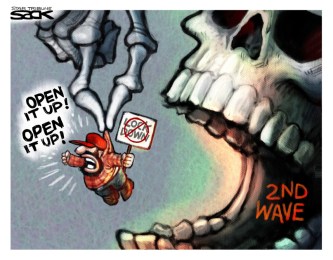 What’s next for this country? Can we survive the ravages of this pandemic? Over the weekend, The New York Times published an important piece by Donald G. McNeil Jr.: The Coronavirus in America: The Year Ahead.
In truth, it is not clear to anyone where this crisis is leading us. More than 20 experts in public health, medicine, epidemiology and history shared their thoughts on the future during in-depth interviews. When can we emerge from our homes? How long, realistically, before we have a treatment or vaccine? How will we keep the virus at bay?
Some felt that American ingenuity, once fully engaged, might well produce advances to ease the burdens. The path forward depends on factors that are certainly difficult but doable, they said: a carefully staggered approach to reopening, widespread testing and surveillance, a treatment that works, adequate resources for health care providers — and eventually an effective vaccine.
Still, it was impossible to avoid gloomy forecasts for the next year. The scenario that Mr. Trump has been unrolling at his daily press briefings — that the lockdowns will end soon, that a protective pill is almost at hand, that football stadiums and restaurants will soon be full — is a fantasy, most experts said.
“We face a doleful future,” said Dr. Harvey V. Fineberg, a former president of the National Academy of Medicine.
He and others foresaw an unhappy population trapped indoors for months, with the most vulnerable possibly quarantined for far longer. They worried that a vaccine would initially elude scientists, that weary citizens would abandon restrictions despite the risks, that the virus would be with us from now on.
“My optimistic side says the virus will ease off in the summer and a vaccine will arrive like the cavalry,” said Dr. William Schaffner, a preventive medicine specialist at Vanderbilt University medical school. “But I’m learning to guard against my essentially optimistic nature.”
Most experts believed that once the crisis was over, the nation and its economy would revive quickly. But there would be no escaping a period of intense pain.
Exactly how the pandemic will end depends in part on medical advances still to come. It will also depend on how individual Americans behave in the interim. If we scrupulously protect ourselves and our loved ones, more of us will live. If we underestimate the virus, it will find us.
Read more about what the experts had to say at the NYT link.
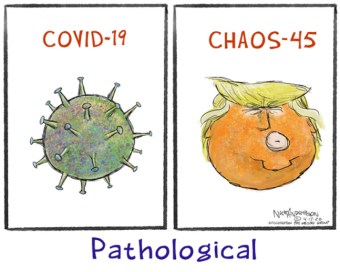 Jonathan Chait on Trump’s abandonment of the states: Trump Wants to Starve the States Into Opening Before It’s Safe.
President Trump’s current pandemic strategy — emphasize current; like the cliché about the weather, if you don’t like it, wait a few hours — is a baffling knot of contradictions. He is hurling all responsibility to state governments, leaving it to them to devise effective tests and to decide when to relax social distancing.
At the same time, he is starving them of the resources to handle the job. And even as Trump hides behind a policy of deference to governors, he is goading right-wing protesters to force their hand. Trump is “saying things that seem contradictory,” as the New York Times puts it, “like pledging to work with governors and then urging people to ‘liberate’ their states, and leaving it to his audiences to hear what they want to hear in his words.”
Yet there does appear to be a strategy here. The Wall Street Journal reported Friday afternoon that Trump has “asked White House aides for economic response plans that would allow him to take credit for successes while offering enough flexibility to assign fault for any failures to others.” Trump’s seemingly paradoxical stance is an attempt to hoard credit and shirk risk, straddling the demands of his business allies with the pleas of his public-health advisers. On the surface, he is deferring responsibility and blame to the governors. Just below the surface, he is coercing them to resume economic activity as fast as possible, regardless of what public-health officials say.
Trump’s plan to coerce the states into reopening has at least three discernible elements. The first is, or was, the formation of a task force to reopen the country. The purpose of the council was to give Trump cover. The council would prod governors to reopen businesses, and because it would be seen as coming from the business community, Trump himself would not bear the blame for future outbreaks that might result. As the Washington Post reported last week, “Trump’s advisers are trying to shield the president from political accountability should his move to reopen the economy prove premature and result in lost lives, and so they are trying to mobilize business executives, economists and other prominent figures to buy into the eventual White House plan, so that if it does not work, the blame can be shared broadly, according to two former administration officials familiar with the efforts.” (In part because its purpose was so naked, the task force seems to have collapsed.)
The second element is the mobilization of protests. The appearance of flag-waving and sometimes gun-toting demonstrators in a handful of state capitols this weekend seems to have come as a shock to the news media, but Trump’s allies signaled this was coming. Last Monday, Stephen Moore, a right-wing pseudo-economist and close Trump ally who has spent weeks pushing back on public-health guidelines, was quoted in the press saying, “In the next two weeks, you’ll see protests in the streets of conservatives; you’ll see a big pushback against the lockdown in some states.”
Click the link to read the rest at New York Magazine.
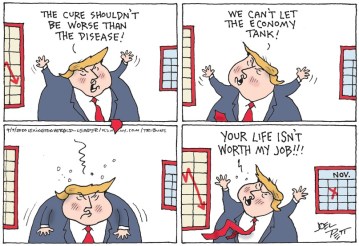 At The Washington Post, Paul Waldman on Trump’s “war against the states”:
President Trump and congressional Republicans are going to war with the states.
It’s bizarre, it’s self-defeating, it will do enormous harm to Americans in every corner of the country, and it can be fully explained only by understanding the president’s pettiest and most narcissistic motives. In other words, it’s the kind of thing we’ve come to expect in the Trump era.
Last week, the $349 billion allotted for small businesses in the CARES Act rescue package ran out, with only a portion of the American businesses that have suffered in this pandemic-driven recession getting the help they need. While everyone seemed ready to provide more money, we found ourselves in a familiar situation, with Democrats saying we need to be swift and aggressive in saving Americans suffering from this economic catastrophe, and Republicans saying that we shouldn’t spend too much or help too many people.
When negotiations began, Republicans wanted to add about $250 billion to the small business fund — and do nothing else. Now it appears that Democrats have pressured them into accepting a package that sends $370 billion to small businesses, gives $75 billion to hospitals, and spends $25 billion to beef up coronavirus testing.
What isn’t included in the package, however, is the desperately needed aid to states and cities Democrats sought. Republicans absolutely refused to even consider it.
Why? The need is urgent. State and local budgets are suddenly facing all kinds of new costs related to the pandemic, while at the same time tax revenues have fallen off a cliff. If they don’t get help, they’ll have to start laying people off and slashing state services, which will only make the recession deeper and longer. By some estimates, states and cities will need $500 billion in federal aid to make up the shortfall.
Read more at the WaPo.
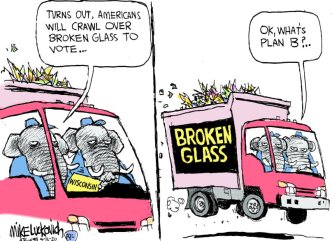 So far Trump’s strategy isn’t convincing most Americans. The Washington Post: Most rate Trump’s coronavirus response negatively and expect crowds will be unsafe until summer, Post-U. Md. poll finds.
Most Americans expect no immediate easing of the health risks associated with the coronavirus pandemic, despite calls by President Trump and others to begin reopening the economy quickly. A majority say it could be June or later before it will be safe for larger gatherings to take place again, according to a Washington Post-University of Maryland poll.
Most Americans — 54 percent — give the president negative marks for his handling of the outbreak in this country and offer mixed reviews for the federal government as a whole. By contrast, 72 percent of Americans give positive ratings to the governors of their states for the way they have dealt with the crisis, with workers also rating their employers positively.
Partisan allegiances shape perceptions of when it will be safe to have gatherings of 10 or more people and of the president’s performance during the pandemic. But governors win praise across the political spectrum for their leadership, which has sometimes put them sharply at odds with Trump and his administration.
Personal health concerns are widespread, with 57 percent saying they are “very” or “somewhat” worried about becoming infected and seriously ill from the coronavirus, including at least 40 percent of people in every major demographic and political group. For those most concerned, the fear was enough to override partisanship when it comes to the safety of public gatherings, particularly for Republicans.
Today we face another day in the time of coronavirus. There will be more reports of deaths and infections, more horror stories, and more lies and propaganda from the Trump gang, and another insane briefing airing of grievances by Trump. We have to steel ourselves to protect ourselves from the virus and save our sanity in these crazy times.
Have courage Sky Dancers! What’s on your mind today?

 peej
peej Carissa
 bostonboomer
 dakinikat
 ecocatwoman
 mablue2
 Mama Lopez
 peggysue22
 quixote
 skydancingguestblogger
 Mona (aka Wonk the Vote)



 Sky Dancing
Recent Comments