
“Krugman’s Army” Open Thread
Posted: October 10, 2011 Filed under: #Occupy and We are the 99 percent!, Civil Liberties, open thread, U.S. Economy, U.S. Politics | Tags: #OccupyWallStreet, first amendment, Michael Bloomberg, OccupyAtlanta, OccupyBoston, Paul Krugman, police brutality, protesters, U.S. Constitution 25 Comments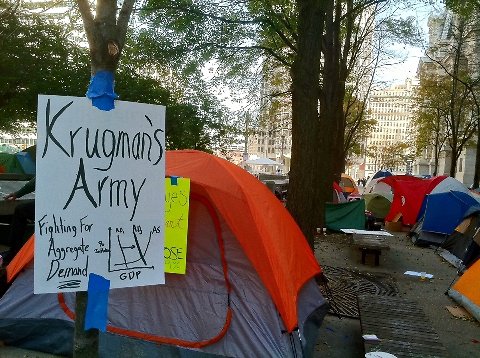
Photo from #OccupyWallStreet sent to Paul Krugman by a reader
Last week, Mayor Bloomberg was all over #Occupy Wall Street, claiming the protesters were trying to destroy the jobs of Wall Street Bankers and other denizens of Wall Street, and threatening that somehow the protests would cause NYC to be unable to pay municipal workers.
I guess one of his advisers must have told him it might not be a good idea to deny that people have a right to assemble in public and air their grievances, according to the U.S. Constitution, because now Bloomberg is singing another tune.
Mayor Michael Bloomberg said on Monday that he’ll allow the Wall Street protesters to stay indefinitely, provided they abide by the law, marking his strongest statement to date on the city’s willingness to let demonstrators occupy a park in Lower Manhattan.
“The bottom line is – people want to express themselves. And as long as they obey the laws, we’ll allow them to,” said Bloomberg as he prepared to march in the Columbus Day Parade on Fifth Avenue. “If they break the laws, then, we’re going to do what we’re supposed to do: enforce the laws.”
Bloomberg said he has “no idea” how much longer the Wall Street demonstration will last. “I think part of it has probably to do with the weather,” he said.
I think someone needs to send the Mayor a copy of the Constitution with the first amendment highlighted. He still thinks he gets to decide if American citizens can gather and protest on public property.
I wonder what Bloomberg will say about what the protesters plan to do next? From the New York Daily News:
The Occupy Wall Street protesters are planning to get in the face of some of New York’s richest tycoons on Tuesday.
A “Millionaires March” will visit the homes – or, more realistically, the gleaming marble lobbies – of five of the city’s wealthiest residents.
On the target list: NewsCorp CEO Rupert Murdoch, JP Morgan Chase CEO Jamie Dimon, conservative billionaire David Koch, financier Howard Milstein and hedge fund mogul John Paulson.
Between 400 and 800 marchers plan to go to their homes to present them with oversize checks to dramatize how much less they will pay when New York State’s 2% tax on millionaires expires at the end of the year.
This is starting to get interesting. I admit I find the call and response routine of the protesters kind of annoying, but that’s OK. We annoyed a lot of old folks when we protested the Vietnam War too. Annoying old folks is one of the responsibilities of the young.
Meanwhile, in Boston, police are warning the protesters to go home or else:
Boston police were warning the more than 1,000 Occupy Boston protesters tonight that if they do not leave the Rose Kennedy Greenway and Dewey Square areas that authorities would move them out.
Police were visible around the areas in small batches tonight, while protest organizers held a meeting on the Greenway, answering questions from the demonstrators.
Occupy Boston, in a statement last night, answered the police warning by issuing a call “for any and all people to join the occupation as soon as possible.”
“From the beginning, occupiers have worked tirelessly to maintain a positive working relationship with city officials. Today’s threats by the Boston Police Department represent a sudden shift away from that dialogue,” the statement said.
The mayor’s office, however, has said the city will make no effort to clear the original Dewey Square tent city tonight, but police have said that if protesters do not leave the Greenway, the authorities would clear both the Greenway and Dewey Square.
Hmmmm…sounds like Mayor Menino is out of sync with the cops. Very interesting. Minx says the Atlanta police are itching to crack some heads too. The cops just never understand that when they attack protesters they only draw more attention to them and their grievances.
Monday Morning Reads
Posted: October 10, 2011 Filed under: Global Financial Crisis, Marriage Equality, morning reads, Surreality, U.S. Military, U.S. Politics, unemployment, Women's Rights | Tags: Anita Hill, Crackerbox Palace, DOMA, George Harrison, Indigenous People's Day, National Coming Out Day, Native American Day, Occupy, Paul Krugman, plutocracy, Subprime mortgage crisis and the CRA, Taxes and poor people, technology, the Great Depression 25 Comments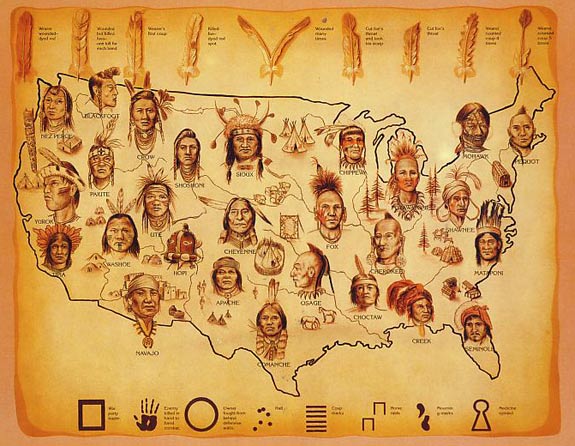 Good Morning!
and Happy Native Americans’ Day!
The second Monday of October annually marks Columbus Day in many parts the United States but not all states or region follow this observance. Instead, they celebrate other events on the day. For example, South Dakota’s official holiday on this date is Native Americans’ Day (also known as Native American Day), while people in Berkeley, California, celebrate Indigenous People’s Day.
 I think it’s a great idea to switch the current federal holiday out to a celebration of indigenous cultures or maybe find a better thing to celebrate!
BTW, National Coming Out Day is Tomorrow. That’s something to remember as you read that Speaker Boehner is threatening to withold funds from the Justice Department if that don’t vigorously enforce DOMA. There he goes again!!! The Republican Jobs Agenda is just always topmost on the priority list.
“We’re going to take the money away from the Justice Department, who’s supposed to enforce it, and we’ll use it to enforce the law,” Boehner told the conservative Value Voters Summit.
Boehner is engaged in an ongoing dispute with Attorney General Eric Holder over his refusal to defend in court the Defense of Marriage Act. President Obama has taken the stance that the law is unconstitutional. While the Justice Department usually defends laws passed by Congress against legal challenges, the Obama administration has stopped defending DOMA while Democrats work to repeal the law.
In March, Boehner announced that if Obama wouldn’t defend DOMA, he would, hiring a private law firm to defend it on behalf of the House.
“As the Speaker of the House, I have a constitutional responsibility. I’ve raised my hand to uphold and defend the Constitution of the United States and the laws of our country,” Boehner said Friday.
You know, he’s all about saving those taxpayer dollars too. True Story.
Here’s a movement I want to join if this California Republican Nutter would only give me the location where they’re taking on volunteers. And yes, it’s a REAL tweet.
@RepJackKimble After Value Voters I am more convinced than ever about the radical atheist agenda to secularize Columbus Day
Okay, I’d like to use the next bit of space to clear up a few right wing memes with actual research. I know, you’re shocked, it’s so unlike me to do so. First, while Fannie and Freddie exacerbated the meltdown and behaved as irresponsibly as any Wall Streeter, there is absolutely no connection between the meltdown and the Community Reinvestment Act. I have never been able to figure out how folks jumped the shark to make this connection, but it happened. I’ll give you the bottom line from the abstract but if you want to chase after the econometrics, feel free to follow the link.
In this paper we examine more directly whether these programs were associated with worse outcomes in the mortgage market, including delinquency rates and measures of loan quality.
We rely on two empirical approaches. In the first approach, which focuses on the CRA, we conjecture that historical legacies create significant variations in the lenders that serve otherwise comparable neighborhoods. Because not all lenders are subject to the CRA, this creates a quasi-natural experiment of the CRA’s effect. We test this conjecture by examining whether neighborhoods that have been disproportionally served by CRA-covered institutions historically experienced worse outcomes. The second approach takes advantage of the fact that both the CRA and GSE goals rely on clearly defined geographic areas to determine which loans are favored by the regulations. Using a regression discontinuity approach, our tests compare the marginal areas just above and below the thresholds that define eligibility, where any effect of the CRA or GSE goals should be clearest.
We find little evidence that either the CRA or the GSE goals played a significant role in the subprime crisis. Our lender tests indicate that areas disproportionately served by lenders covered by the CRA experienced lower delinquency rates and less risky lending. Similarly, the threshold tests show no evidence that either program had a significantly negative effect on outcomes.
Okay, one more meme to shoot down. You know how all those Republican presidential wannabes are trotting around saying about half of Americans don’t pay taxes and the rich are still burdened? I’ve shot down some of that argument before, but here’s some further details. I’m quoting from the executive summary and not the study itself. Again, you can go into the methodology if you want here.
A recent finding by Congress’ Joint Committee on Taxation that 51 percent of households owed no federal income tax in 2009 [1] is being used to advance the argument that low- and moderate-income families do not pay sufficient taxes. Apart from the fact that most of those who make this argument also call for maintaining or increasing all of the tax cuts of recent years for people at the top of the income scale, the 51 percent figure, its significance, and its policy implications are widely misunderstood.
- The 51 percent figure is an anomaly that reflects the unique circumstances of 2009, when the recession greatly swelled the number of Americans with low incomes and when temporary tax cuts created by the 2009 Recovery Act — including the “Making Work Pay” tax credit and an exclusion from tax of the first $2,400 in unemployment benefits — were in effect. Together, these developments removed millions of Americans from the federal income tax rolls. Both of these temporary tax measures have since expired.
In a more typical year, 35 percent to 40 percent of households owe no federal income tax. In 2007, the figure was 37.9 percent. [2]- The 51 percent figure covers only the federal income tax and ignores the substantial amounts of other federal taxes — especially the payroll tax — that many of these households pay . As a result, it greatly overstates the share of households that do not pay any federal taxes. Data from the Urban Institute-Brookings Tax Policy Center show only about 14 percent of households paid neither federal income tax nor payroll tax in 2009, despite the high unemployment and temporary tax cuts that marked that year.[3]
- This percentage would be even lower if federal excise taxes on gasoline and other items were taken into account.
- Most of the people who pay neither federal income tax nor payroll taxes are low-income people who are elderly, unable to work due to a serious disability, or students, most of whom subsequently become taxpayers. (In a year like 2009, this group also includes a significant number of people who have been unemployed the entire year and cannot find work.)
- Moreover, low-income households as a whole do, in fact, pay federal taxes. Congressional Budget Office data show that the poorest fifth of households as a group paid an average of 4 percent of their incomes in federal taxes in 2007 (the latest year for which these data are available), not an insignificant amount given how modest these households’ incomes are — the poorest fifth of households had average income of $18,400 in 2007. [4] The next-to-the bottom fifth — those with incomes between $20,500 and $34,300 in 2007 — paid an average of 10 percent of their incomes in federal taxes.
- Even these figures understate low-income households’ total tax burden, because these households also pay substantial state and local taxes. Data from the Institute on Taxation and Economic Policy show that the poorest fifth of households paid a stunning 12.3 percent of their incomes in state and local taxes in 2010.[5]
- When all federal, state, and local taxes are taken into account,the bottom fifth of households paid 16.3 percent of their incomes in taxes, on average, in 2010. The second-poorest fifth paid 20.7 percent. [6]
I know it’s statistics heavy, but some times that’s the best way to see what is actually going on. Right wing memes seem to thrive on taking things completely out of context and this one about tax dodging poor people is a doozy. See exactly how many taxes that get paid that weren’t counted in that famous figure which is an anomaly as it is.
Here’s an interesting article at NYT by David Leonhardt on how today’s economy makes the Great Depression look like the halcyon days.
Still, the reasons for concern today are serious. Even before the financial crisis began, the American economy was not healthy. Job growth was so weak during the economic expansion from 2001 to 2007 that employment failed to keep pace with the growing population, and the share of working adults declined. For the average person with a job, income growth barely exceeded inflation.
The closest thing to a unified explanation for these problems is a mirror image of what made the 1930s so important. Then, the United States was vastly increasing its productive capacity, as Mr. Field argued in his recent book, “A Great Leap Forward.” Partly because the Depression was eliminating inefficiencies but mostly because of the emergence of new technologies, the economy was adding muscle and shedding fat. Those changes, combined with the vast industrialization for World War II, made possible the postwar boom.
In recent years, on the other hand, the economy has not done an especially good job of building its productive capacity. Yes, innovations like the iPad and Twitter have altered daily life. And, yes, companies have figured out how to produce just as many goods and services with fewer workers. But the country has not developed any major new industries that employ large and growing numbers of workers.
There is no contemporary version of the 1870s railroads, the 1920s auto industry or even the 1990s Internet sector. Total economic output over the last decade, as measured by the gross domestic product, has grown more slowly than in any 10-year period during the 1950s, ’60s, ’70s, ’80s or ’90s.
Perhaps the most important reason, beyond the financial crisis, is the overall skill level of the work force. The United States is the only rich country in the world that has not substantially increased the share of young adults with the equivalent of a bachelor’s degree over the past three decades. Some less technical measures of human capital, like the percentage of children living with two parents, have deteriorated. The country has also chosen not to welcome many scientists and entrepreneurs who would like to move here.
I’m still of the opinion that we should hand out citizenship to any of our highly skill foreign students and do everything we can to keep them here. I have a feeling I’m in the minority on that opinion, however.
If you want to do some time tripping to a really upsetting period of history for women, here’s The Nation on The Legacy of Anita Hill. We’re now stuck with this total jerk on SCOTUS because of people like Joe Biden. I’ll never forget one of those senators that let Clarence Thomas get away with it. They hid the women that could verify her stories and put her squarely in the worst position possible. She handled it with dignity and we all lost.
Anita Hill remains an icon to whom subsequent generations are rightfully indebted. At the same time, she has not remained trapped by her own symbolism or frozen in time. It is sometimes forgotten that she is a respected scholar of contract jurisprudence, commercial law and education policy. She is a prolific author, publishing numerous law review articles, essays, editorials and books. Today, Hill is a professor of social policy, law and women’s studies at Brandeis University. Much of her most recent research has been on the housing market, and her most recent book, published this month, is Reimagining Equality: Stories of Gender, Race, and Finding Home.
It is ironic that the full substance of Hill’s remarkable intellectual presence remains so overshadowed by those fleeting, if powerful, moments of her Senate testimony. If the larger accomplishments of her life aren’t quite as iconic as that confrontation with Clarence Thomas, they nonetheless merit attention by feminists and scholars alike. To begin with, Hill is a remarkably elegant and accessible writer. For those who wish to apprehend the gravitas of her intelligence and dignity, Reimagining Equality would be a good place to start.
Krugman gets the Occupy protestors and has some delightful comments up on the Panic of the Plutocrats. He eloquently lays out the hype coming from the Cantors and the Bloombergs as well as CNBC and Fox that paints every one upset with their behavior as Leninist. The descriptions are a hoot but here’s the meat.
The way to understand all of this is to realize that it’s part of a broader syndrome, in which wealthy Americans who benefit hugely from a system rigged in their favor react with hysteria to anyone who points out just how rigged the system is.
Last year, you may recall, a number of financial-industry barons went wild over very mild criticism from President Obama. They denounced Mr. Obama as being almost a socialist for endorsing the so-called Volcker rule, which would simply prohibit banks backed by federal guarantees from engaging in risky speculation. And as for their reaction to proposals to close a loophole that lets some of them pay remarkably low taxes — well, Stephen Schwarzman, chairman of the Blackstone Group, compared it to Hitler’s invasion of Poland.
And then there’s the campaign of character assassination against Elizabeth Warren, the financial reformer now running for the Senate in Massachusetts. Not long ago a YouTube video of Ms. Warren making an eloquent, down-to-earth case for taxes on the rich went viral. Nothing about what she said was radical — it was no more than a modern riff on Oliver Wendell Holmes’s famous dictum that “Taxes are what we pay for civilized society.”
I have one more offering that is just for pure delight. It’s a short bit from the daughter of George Harrison’s Business Manager on what it was like to run the halls of crackerbox palace as a child.
Harrison’s wife, Olivia, always took good care of us and, like her husband, had a gentle, calming disposition. I loved going up the great gothic staircase in the living room to the recording studio on the first floor. I was fascinated by the recording console and the selection of instruments. Sometimes, Harrison would play new music for us and ask for our feedback.
Adjacent to the recording studio was a room with gold records and awards and an Oscar statuette. I remember the exhilarating sensation I got picking up the Oscar earned for “Let It Be” and feeling it weigh down my hand.
When it got late, and Dad was still in meetings, we would go to bed in one of the guest rooms down the hall from the studio with sounds of Harrison’s sitar lulling us to sleep.
You can see I’m full throttle academic today. What’s on your reading and blogging list today?
Ruthless Capitalism Open Thread
Posted: October 9, 2011 Filed under: open thread, U.S. Economy, U.S. Politics | Tags: Chinese factory fire, economics, Fox News, ruthless capitalism, Steve Jobs, suicide express 17 CommentsFrom News Hounds, where they watch Fox News so we don’t have to:
Here’s some of the transcript, also from News Hounds:
Regular panelist Gary B. Smith argued for ruthlessness. “Most of the great successes of this country – product wise, service wise – came from not only business people unfettered by the government but ruthless businesspeople.” He cited Thomas Edison, the Wright Brothers and Disney. Then, noting the success of our defense industry, he added, “Why? Because we have ruthless contractors out there that are coming up with this innovative product so they can make millions of dollars. It has nothing to do with government mandates.”
“More ruthless capitalism!” said brother Tobin Smith.
Guest Todd Schoenberger said this:
“Here was a man (Jobs) who was hungry. Here was a guy who actually grew up poor. He would have to take sodas to soda bottlers to take the deposit money to go feed himself. This was a guy that clearly, when he had a government out of the way, but he had to take that innovation because he was hungry. Edison, the Wright brothers, everybody that Gary B. was talking about, that’s because people are hungry. In America, people are not hungry anymore because the government is subsidizing them…that’s the problem.”
Wow! And they even left out the part about those Chinese torture chambers factories where they make the products that made Steve Jobs wealthy.
Wealthy and Powerful Politicians are Terrified of #OccupyWallStreet
Posted: October 7, 2011 Filed under: #Occupy and We are the 99 percent!, U.S. Economy, U.S. Politics | Tags: #OccupyWallStreet, Eric Cantor, growing mobs, Michael Bloomberg, municipal workers, Tea Party, unions, Values Voters Summit 22 Comments
Mayor Bloomberg is really upset. In an interview with the Village Voice today, He claimed that #OccupyWallStreet is trying to destroy jobs for working people in New York City. Funny, I had the impression they were protesting because so many Americans don’t have jobs.
“Everyone’s got a thing they want to protest, some of which is not realistic,” Bloomberg said. “And if you focus for example on driving the banks out of New York City, you know those are our jobs … You can’t have it both ways: If you want jobs you have to assist companies and give them confidence to go and hire people.”
“The protests that are trying to destroy the jobs of working people in this city aren’t productive,” Bloomberg said in his weekly radio appearance with John Gambling. Taking a swipe at “some of the labor unions participating,” Bloomberg added that “their salaries come from – are paid by – some of the people they’re trying to vilify.”
I guess as far as Bloomberg is concerned, the bottom 99% don’t pay any taxes, and bankers are “working people.” That seems like a pretty skewed view of reality to me. But what do I know? I’m in the bottom 99%. And where did he get the idea that anyone is trying to drive the banks out of New York?
Bloomberg says the protests could affect tourism, but it seems to me that a lot of those protesters are from out of town and probably spending whatever money they have in NYC. But of course they aren’t wealthy or bankers, so they probably don’t count in Bloomberg’s world.
Bloomberg also issues a couple of not-very-subtle threats. He says “we’re not going to be able to pay our municipal employees,” presumably because all the bankers will leave town and there won’t be any tourists. I don’t get the logic there, but the threat to unions who have joined the protests is clear.
Finally, Bloomberg said that he’s letting the protesters “express themselves,” but he hinted that a crackdown could come at any time. I wonder if he realizes how much he sounds like Hosni Mubarak?
“The one thing I can tell you for sure,” he said…”is if anybody in the city breaks the law we will arrest them and turn them over the district attorneys.”
Hmmm…does that include bankers who broke the law? Or does the warning just apply to the bottom 99%?

And then there’s Rep. Eric Cantor (R-VA). Today spoke at the “Values Voters Summit,” which, according to MSNBC, is
an annual gathering of the religious right…[that] provides Republican politicians and presidential candidates an opportunity to display their conservative bona fides.
In the speech, Cantor expressed his fear of the #OccupyWallStreet protesters:
House GOP Leader Eric Cantor decried the protests that started several weeks ago in New York, and have spread to major cities across the country. Cantor said in a speech at the Values Voters Summit in Washington that he is “increasingly concerned” about the “growing mobs” represented at the protests….
“Some in Washington have actually condoned the pitting of Americans against Americans,” Cantor said of the protests after accusing the Obama administration’s policies of being an “assault on many of our nation’s bedrock principles.”
Here’s a clip from the speech:
The hypocrisy almost takes your breath away, doesn’t it? Cantor speaks to a group of people who are segregated by their religion and political party and who as a group hate gays, women, and anyone who isn’t their kind of “Christian,” and he accuses the Occupy protesters–a very diverse group–of dividing Americans against each other.
Oh and Cantor loves the Tea Party, because they aren’t trying to divide Americans against each other. /snark
The good news is these two powerful politicians–and probably many others as well–are running scared. Let’s keep them that way!
Thursday Reads
Posted: October 6, 2011 Filed under: #Occupy and We are the 99 percent!, 2012 presidential campaign, U.S. Economy, U.S. Politics | Tags: Christopher Benfry, Elizabeth Warren, Erin Burnett, Ezra Klein, George Will, Glenn Greenwald, Larry McMurtry, Massachusetts Senate race, Mitt Romney, Occupy Boston, occupy Wall Street, Rick Perry, Robert Reich, Scott Brown 21 Comments
Good Morning!! I’m going to be heading back to Boston pretty soon, and I’m looking forward to following developments in Occupy Boston and in the Senate race. They haven’t started an Occupy Muncie protest yet, unfortunately. But you never know. This town is really suffering from the poor economy.
At Mother Jones, there is an interactive map of all the Occupy protests that have sprung up around the country. It’s pretty amazing. Funny thing. A few days ago MJ had a post by Lauren Ellis in which she looked down her nose at the #OccupyWallStreet protesters. Now they have a whole section on the Occupy Movement.
There are still plenty of so-called “journalists” dismissing the protests though. Yesterday, I posted a link to Andrew Ross Sorkin’s piece in the NYT in which he reports his trip to Zuccotti Park at the request of a anonymous nervous Wall Street CEO. Glenn Greenwald skewered Sorkin but good, concluding that Sorkin’s
CEO banking friend is right to be concerned: if not about this protest in particular then about the likelihood of social unrest generally, emerging as a result of their plundering and pilfering. That healthy fear on the part of the oligarchs has been all too absent.
Greenwald also linked to this example of “snotty, petty, pseudointellectual condescension” at The New Republic. Ugh! Read it if you dare.
Yesterday, Greenwald followed up by verbally destroying CNN’s new nighttime host, Erin Burnett.
On her new CNN show on Monday night, host Erin Burnett was joined by Rudy Giuliani’s former speechwriter John Avlon and together they heaped condescending scorn on the Wall Street protests while defending the banking industry, offering — as FAIR documented — several misleading statements along the way. Burnett “reported” that while she “saw dancing, bongo drums, even a clown” at the protest, the participants “did not know what they want,” except that “it seems like people want a messiah leader, just like they did when they anointed Barack Obama.” She featured a video clip of herself explaining to one of the protesters that the U.S. Government made money from TARP, and then demanded to know if that changed his negative views of Wall Street.
This is far from the first time Burnett has served as spokesperson for Wall Street; it’s basically what her “journalistic” career is. She angered Bill Maher a couple years ago when arguing that the rich have suffered along with the poor and middle class as part of the financial crisis, and that it would be wrong to “soak the rich” because they’re already paying so much taxes. She caused Rush Limbaugh to gush over her when she argued on TV in 2007 that all Americans benefit when the rich get richer: “the majority of Americans directly benefit from what happens on Wall Street,” she proclaimed, just over a year before the financial collapse.
In an interview last year with Vanity Fair, she insisted that people on Wall Street do not have private planes and that “there are a lot of stalwart, solid people on Wall Street. There are just a few shady people providing the fodder for big budget movies…”
Meanwhile Beltway Bob Ezra Klein has some advice for #OccupyWallStreet: they should immediately start taking advice from the liberal establishment and focus on developing policy and writing legislation in order to work through the system that they have already rejected.
The Wall Street protests seem to be gathering strength and expanding beyond the geographic limits of downtown Manhattan. The media, too, is finally amplifying the story. Whether they will grow larger and sustain themselves beyond these initial street actions will depend upon four things: the work of skilled organizers; the success of those organizers in getting people, once these events end, to meet over and over and over again; whether or not the movement can promote public policy solutions that are organically linked to the quotidian lives of its supporters; and the ability of liberalism’s infrastructure of intellectuals, writers, artists and professionals to expend an enormous amount of their cultural capital in support of the movement.
There’s lots more, but it’s basically a lecture from someone who just doesn’t get it. And speaking of people who don’t get it, George Will tries to school Elizabeth Warren in his latest column. According to Will, the “liberal project,” which Warren apparently speaks for is designed to destroy rugged individualism.
The project is to dilute the concept of individualism, thereby refuting respect for the individual’s zone of sovereignty. The regulatory state, liberalism’s instrument, constantly tries to contract that zone — for the individual’s own good, it says….
Such an agenda’s premise is that individualism is a chimera, that any individual’s achievements should be considered entirely derivative from society, so the achievements need not be treated as belonging to the individual. Society is entitled to socialize — i.e., conscript — whatever portion it considers its share. It may, as an optional act of political grace, allow the individual the remainder of what is misleadingly called the individual’s possession.
The collectivist agenda is antithetical to America’s premise, which is: Government — including such public goods as roads, schools and police — is instituted to facilitate individual striving, a.k.a. the pursuit of happiness. The fact that collective choices facilitate this striving does not compel the conclusion that the collectivity (Warren’s “the rest of us”) is entitled to take as much as it pleases of the results of the striving.
But isn’t that what Warren is pushing for? For more individuals to have opportunities to make it in America? Really, isn’t it time for George Will to retire?
Meanwhile Warren is leading in the race for the Massachusetts Democratic nomination for Senate, and she appeared in her first debate on Tuesday at my undergraduate alma mater, U. Mass Lowell.
In her first debate as a candidate for U.S. Senate Tuesday night, Harvard law professor Elizabeth Warren declined to criticize her fellow Democratic candidates, taking aim instead at Republican Sen. Scott Brown, whom the Democratic nominee will face, and Wall Street.
“Forbes magazine named Scott Brown Wall Street’s favorite senator. I was thinking that’s probably not an award I’m going to get,” she said to applause and laughter from the audience at the University of Massachusetts-Lowell. Two recent polls put Warren and Brown in a statistical tie.
She also made the audience laugh and applaud with the second question, which asked each candidate how they paid for college, since Brown posed nude for Cosmopolitan to pay.
“I kept my clothes on,” she quipped. She added that she borrowed money to go to a public university and had a part-time job.
Warren also drew applause for her tough talk on Wall Street. “The people on Wall Street broke this country, and they did it one lousy mortgage at a time. It happened more than three years ago, and there has been no real accountability, and there has been no real effort to fix it. That’s why I want to run for the United States Senate,” she said.
Go Elizabeth go!!
Another voice for the middle class, Robert Reich, explains why Wall Street is extremely nervous about the economic crisis in Europe.
If you want the real reason, follow the money. A Greek (or Irish or Spanish or Italian or Portugese) default would have roughly the same effect on our financial system as the implosion of Lehman Brothers in 2008.
Financial chaos….a default by Greece or any other of Europe’s debt-burdened nations could easily pummel German and French banks, which have lent Greece (and the other wobbly European countries) far more.
That’s where Wall Street comes in. Big Wall Street banks have lent German and French banks a bundle.
The Street’s total exposure to the euro zone totals about $2.7 trillion. Its exposure to to France and Germany accounts for nearly half the total.
And it’s not just Wall Street’s loans to German and French banks that are worrisome. Wall Street has also insured or bet on all sorts of derivatives emanating from Europe — on energy, currency, interest rates, and foreign exchange swaps. If a German or French bank goes down, the ripple effects are incalculable.
Read the rest at Huffpo.
There are a couple of interesting reads about Republican candidates at the New York Review of Books. The first is by novelist Larry McMurtry: The Rick Perry Hustle Here’s a brief sample:
What Perry has brought to the Republican muddle thus far is his abundant, if unfocused, energy. He rushes from debate to debate, gives many interviews, gets his picture on the cover of TIME; yet all his politicking is curiously affectless. He makes sounds, but where’s the personality? Hillary Clinton has a personality; so does Sarah Palin. Either of those women could cut Governor Perry off at the knees, and will if given the chance.
It’s not been said so I’ll say it: as a politician Rick Perry is fundamentally lazy, so far as actual governing is concerned, content to run things mainly by sound-bite. He makes lots of decisions but lingers on no issue very long; there’s little follow-through. Clemency, or its absence, is an example. Two hundred thirty-four humans have been executed in Texas on his watch and only recently has he been stirred to a review. He believes that the State Board of Pardons and Paroles is so infallible that there’s no reason for him to lose sleep over the fate of this or that prisoner. The Governor has much more confidence in the Board than the Board has in itself; its members are well aware that even, or especially in Texas shaky verdicts have come down. The Governor, a man with a notably short attention span, has a lot more to think about than the death chamber.
An irony of his sudden emergence as a front-runner is that his few humane decisions—the HPV vaccine, which is safe and helpful, and the tuition credit for the children of illegals, which could help keep gangs of feral children off our streets—are what may sink him with the Tea Party and his own rabid right wing. And this is the wing he has assiduously cultivated his whole political life.
The other NYRB article of interest is by Christopher Benfry: Mitt, We Hardly Knew Ye!
We’re feeling vulnerable and surly these days in western Massachusetts, as the leaves turn yellow, the Red Sox fade, and winter looms. Our corridor of New England along the Connecticut River endured, during the summer months, a ruinous tornado in Springfield, an earthquake, of all things, and Hurricane Irene, which knocked out roads and historic covered bridges in our hill towns and across neighboring Vermont, and left a lot of people homeless and adrift. It’s our Katrina moment, we sometimes think, with slightly grandiose self-pity, as Republicans in Congress demand budget cuts if FEMA is to pay for disaster relief in the blue states.
We don’t see much of Mitt Romney, our ex-governor, in these troubled times. Then again, we never did. Our most indelible memories are of Mitt leaving—“the sight of Mitt’s back,” as a friend of mine put it, as he went off to lay the groundwork for yet another campaign. Mitt ran for the Senate against Ted Kennedy in 1994, lost, and left the state to salvage the Salt Lake City Olympics. When he returned to run for governor in 2002, he had to go to court to prove that he sort of lived in Belmont, outside Boston. Then, after a couple of years in the state house, he left again to campaign for the presidency, spending two thirds of his time out of state in 2006. Mitt has sold his house in Belmont and now lives in the important primary state of New Hampshire (at his estate on Lake Winnipesaukee) or San Diego or maybe Utah—anywhere but Massachusetts.
In the Republican debates, Mitt pretends that his ties to Massachusetts are tenuous. Mitt’s greatest achievement as governor, the Massachusetts health care system (which passed with Ted Kennedy’s support and two dissenting votes in the state legislature), is now his greatest liability among Republicans, who see it as a stalking horse for Obamacare. Mitt now claims it was right for our quirky state but not for the nation. He has yet to explain why.
When Mitt trumpets his experience in American business, he rarely mentions that Bain, the consulting and investment conglomerate in which he amassed his $200 million fortune, is a Boston firm.
And so on…Romney used our state as a springboard and then denied even knowing us.
I’ll end there for today. What are you reading and blogging about?

 peej
peej Carissa
 bostonboomer
 dakinikat
 ecocatwoman
 mablue2
 Mama Lopez
 peggysue22
 quixote
 skydancingguestblogger
 Mona (aka Wonk the Vote)



 Sky Dancing
Recent Comments