
Tuesday Reads: Can The News Get Any Worse? Probably.
Posted: December 9, 2014 Filed under: Barack Obama, Foreign Affairs, morning reads, U.S. Politics | Tags: "I Can't Breathe", abortion, BET, Colbert Report, Dick Cheney, Eric Garner, George W. Bush, Henri Matisse paintings, LeBron James, NBA, police involved shootings, Racism, Senate torture report 52 Comments
Good Morning!!
It’s difficult to imagine how the news can get any worse . . . and then it does.
Bloomberg: CIA Torture Report Set for Senate Release Over Bush Objections.
Dec. 9 (Bloomberg) — The Democrats on the Senate intelligence committee are preparing to issue their report on the harsh interrogation tactics the CIA used on terrorism suspects, defying the objections of current and former U.S. officials including former President George W. Bush.
The panel plans to release today a summary of a 6,200-page report concluding that the Central Intelligence Agency used extreme interrogation methods at secret prisons more often than legally authorized and failed to disclose all the activities to lawmakers and other officials.
Despite warnings from opponents of the report’s release, including some Republicans on the panel, that Americans would face retaliation overseas, President Barack Obama supports making the conclusions public, White House spokesman Josh Earnest said yesterday.
“The president believes that, on principle, it’s important to release that report, so that people around the world and people here at home understand exactly what transpired,” he said. Earnest said the administration has taken steps to improve security at U.S. facilities around the world.
Read the arguments for and against releasing the report at the link. A brief summary of the conflict at USA Today: Obama, Bush teams battle over torture report. Of course Dick Cheney felt the need to butt in.
While Obama and aides support release of the report as to way to prevent future abuses, some Bush administration officials call it partisan second-guessing of techniques that proved necessary during the war on terrorism.
“What I keep hearing out there is they portray this as a rogue operation and the agency was way out of bounds and then they lied about it,” former vice president Dick Cheney told The New York Times. “I think that’s all a bunch of hooey. The program was authorized. The agency did not want to proceed without authorization, and it was also reviewed legally by the Justice Department before they undertook the program.” [….]
The dispute between Obama and Bush officials revolves around the legality of the interrogation programs and whether they yielded valuable intelligence as the U.S. raced to block terrorism in the years following the attacks of Sept. 11, 2001.
Cheney and other Bush administration officials say the programs yielded actionable intelligence that helped uncover possible terrorist plots.
Congressional Democrats say the report shows that tactics like waterboarding yielded nothing that could not have been obtained by other means.
The two sides agree on one thing: Release of the Senate report, detailing some of the less savory methods used to extract testimony from terrorism suspects, could lead to violent, anti-American protests in some countries.

Reuters has a minor preview on the contents of the report: Sexual threats, other CIA methods detailed in Senate report.
The report, which Committee Chairwoman Dianne Feinstein said would be released on Tuesday, describes how al Qaeda operative Abdel Rahman al Nashiri, suspected mastermind of the 2000 bombing of the USS Cole, was threatened with a buzzing power drill, the sources said. The drill was never actually used on him.
It documents how at least one detainee was sexually threatened with a broomstick, the sources said.
Preparing for a worldwide outcry from the publication of such graphic details, the White House and U.S. intelligence officials said on Monday they had shored up security of U.S. facilities worldwide.
The report, which took years to produce, charts the history of the CIA’s “Rendition, Detention and Interrogation” program, which President George W. Bush authorized after the Sept. 11 attacks.
Bush ended many aspects of the program before leaving office, and President Barack Obama swiftly banned “enhanced interrogation techniques,” which critics say are torture, after his 2009 inauguration.
The Christian Science Monitor asks what I think is an irrelevant question: Did torture yield results? I really don’t care; some things are just wrong period.
The 480-page document reveals the results of Senate investigation into the CIA’s use of torture and other techniques that violate international law against prisoners held on terrorism-related charges. Though many details of the Senate’s findings will remain classified – the document is a summary of a 6,000-page report that is not being released – the report is expected to conclude that the methods used by the CIA to interrogate prisoners during the post-9/11 years were more extreme than previously admitted and produced no intelligence that could not have been acquired through legal means….
The Los Angeles Times writes that the report is expected to say that the CIA used methods of “waterboarding, sleep deprivation, stress positions and other so-called enhanced interrogation techniques more frequently than was legally authorized at then-secret prisons known as ‘black sites.’ ”
The report will also likely state that the intelligence acquired from the use of such techniques was not useful to finding Osama bin Laden or preventing attacks on US interests, and “nearly all the intelligence gleaned through harsh techniques could have been obtained from more traditional intelligence-gathering systems,” the Times adds.

We probably should brace for attacks on President Obama for daring to go on BET and talk about racism and then follow that up by joking around with Stephen Colbert.
BET Exclusive: Obama Talks Race, Racism and How Far America Has to Go. Watch the interview at the link. Joyce Jones highlights the main points:
Barack Obama – not the president, but the man – has a dream: his children will be viewed as individuals and judged not by the color of their skin but based on the content of their character, their behavior and their talents and gifts. Sadly, he observed in an exclusive interview with BET Networks, “misguided attitudes” mean that people of color still have less margin for error, particularly if they are male….
Hours before the interview aired, his critics on the right began lashing out at him for, according to Breitbart News, “playing the race card more overtly than ever before.” Others will say it’s about time he spoke up about the series of police-involved deaths of a disproportionate number of African-American men, which he acknowledged. But he also said that “institutionally” he is required to remain silent during the investigations of those incidents, which would be compromised “if it appeared that I was trying to steer to a particular outcome.”
That doesn’t mean he does not empathize with those who’ve expressed their anger and frustration more publically. The president recalled a meeting he had last week that included several young African-American leaders whose experiences of being stopped or treated suspiciously for no reason reminded him of his own. He also said that as long as the protests remain peaceful, they are necessary.
“I’m going to stay on this,” the President said Monday in an interview with BET, a network that reaches a predominately young African-American audience. “Not only am I going to stay on it … but hopefully the entire society says, ‘Let’s finally try to make some real progress on this.'”
Once criticized for shying away from the topic of race early on in his presidency, Obama has recently taken a more active role in sharing how his personal experiences help him to empathize with all kinds of people affected by the recent protests on racial tensions — from protesters, to victims, to law enforcement officers, to families, and most importantly, to black youth.
In his interview with BET’s “106 & Park,” the President cited a meeting he had with nonviolent protesters Monday — between ages 18-25. For him, he says, listening to young African-Americans describe their own experiences of being stopped for no reason, or being unjustly labeled as suspicious, strikes a personal chord.
“My mind went back to what it was like for me when I was 17, 18, 20,” the President said. “As I told them, not only do I hear the pain and frustration of being subjected to that kind of constant suspicion, part of the reason I got into politics was to figure out how can I bridge some of those gaps and understandings so that the larger country understands this is not just a black problem or a brown problem, this is an American problem.”
The President also made a point to invoke Attorney General Eric Holder’s race and civil rights record, saying, “He’s got a similar set of stories and experiences he can share.”

The Boston Globe on Obama’s Colbert Report appearance:
Obama kicked off the show sitting in for Colbert to perform a regular feature of the program called ‘‘The Word’’ wherein Colbert’s rants are accompanied by snarky messages to the audience.
So when Obama, as Colbert, declared that there are aspects of ‘‘Obamacare’’ that people from both parties actually like, the text aside to the audience read, ‘‘Everything but the Obama.’’
Later, Colbert observed that the economy had been creating more jobs of late.
‘‘You have employed a lot of people — mostly as secretary of defense,’’ Colbert cracked in a reference to Obama recently nominating his fourth top civilian at the Pentagon.
‘‘That’s boosted our numbers a little bit,’’ Obama replied.
Colbert, whose on-screen persona is that of an insufferable conservative scold, accused Obama of exceeding his authority on immigration. ‘‘When did you decide to burn the Constitution and become emperor?’’ he asked. The question was heard as a joke by many in the audience at George Washington University. But to Obama’s critics, the question had a ring of truth.
Obama dropped the comedy and replied, ‘‘Actually, Steve, everything that we have done is scrupulously within the law and has been done by previous Democratic and Republican presidents.’’
Watch part of the episode at the link.

You know how Republicans are constantly claiming that their anti-abortion laws are designed to keep women safe? From Think Progress: Large Study Confirms That Abortion Is Extremely Safe.
After analyzing data from nearly 55,000 women who received abortion care under California’s Medicaid program, researchers at UC San Francisco concluded that hardly any of them had serious complications within six weeks of their procedure. Just 126 cases necessitated follow-up care for surgery, a blood transfusion, or other conditions that require hospital admission.
Other studies, including data from the Centers for Disease Control and Prevention, have also confirmed abortion’s safety. We already had some evidence, for instance, that giving birth is about 14 times riskierthan having an abortion. But the new UCSF study goes a bit further than previous research by tracking the complete data on all of the health care used by women who have received abortions. Since many women have to travel long distances to end a pregnancy, the UCSF researchers also examined women’s follow-up care at facilities closer to where they live….
Despite the mounting evidence in this area, the notion that abortion may be dangerous for women is a pervasive assumption that hasbolstered the passage of dozens of state laws tightening restrictions on clinics and doctors. In a press release announcing their findings, the study authors indicated that they hope the new study “will contribute to the national debate over abortion safety.”
“Abortion is very safe as currently performed, which calls into question the need for additional regulations that purportedly aim to improve safety,” said Ushma Upadhyay, an assistant professor at Advancing New Standards in Reproductive Health (ANSIRH), a leading research program based at UCSF.
Of course scientific studies won’t move right wing extremists, who do not believe in science in the first place.

Yesterday I was relieved to see many women writers pushing back against the UVA rape story backlash and asking readers to remember that “Jackie” is a real person with real emotions, and the kinds of memory failures she may have evidenced are comment in human beings. I’m running out of space, so I’ll just provide some links to some of the articles I found.
From Buzzfeed, Annie Clark writes: There Are Too Many Jackies.
Clark and her friend Andrea Pino were students at UC Chapel Hill when they were sexually assaulted. Together they filed a complaint with the Department of Education under Title IX. Their work is what triggered the Obama administration to take a stronger position on sexual assaults on college campuses.
Read about it in Vogue, Campus Sexual Assault: Annie E. Clark and Andrea Pino Are Fighting Back—And Shaping the National Debate. Clark and Pino started an organization called End Rape on Campus (EROC).
More important articles:
Roxanne Gay, Our Stories.
TPM, UVA Rape Victim’s Roommate Says Her Story Is Not A ‘Hoax’.
Buzzfeed, How Police And Hospitals Shut Down Rape Victims.
Jessica Valenti, Who is Jackie? Rolling Stone’s rape story is about a person – and I believe her.
Amanda Marcotte, UVA controversy allows woman-haters to get really, really ugly.
Maya Dusenbery, On Rolling Stone, lessons from fact-checking, and the limits of journalism.
Caroline Fairchild, Why the media obsession with Rolling Stone’s UVA rape story is all wrong.

Finally, some NBA players have begun wearing “I Can’t Breathe T-Shirts.”
From ESPN, LeBron James, Kyrie Irving address reasons for ‘I can’t breathe’ shirts.
NEW YORK — As he stood amid 70 or so media members inside a cramped Cavaliers locker room Monday night, LeBron James explained the significance of the powerful words that stretched across his torso during pregame warmups.
“If it feels important to me then I respond,” said James, who wore a black t-shirt with the words “I CAN’T BREATHE” prior to the start of his team’s game against the Nets at the Barclays Center. “If it doesn’t, I don’t. There are a lot of issues I have not talked about. For me, it is about knowledge and about a gut feeling that hits home for you. You feel it, and go about it.” [….]
…the story of the night was the activism of a number of NBA players. Before the game, the Cavaliers’ James, Kyrie Irving and the Nets’ Deron Williams and Kevin Garnett among others all wore the same black t-shirts. They are the latest professional athletes to make a personal statement on the death of Eric Garner, a 43-year-old Staten Island man who was killed on July 17 after he was wrestled to the ground and choked to death by police officers arresting him for selling untaxed cigarettes. Last week a Staten Island grand jury decided not to bring charges in the police-involved death. That decision has prompted protests around the country, as protesters have mobilized around Garner’s last words: “I can’t breathe.” A video recording of the arrest has been viewed by millions.
Unbeknownst to the players, protesters swarmed Atlantic Avenue outside the Barclays Center during the game, holding a “die-in” to protest the Garner ruling. The hashtag #RoyalShutdown was used by activists on Twitter as a rallying point.
That’s all I have. What stories are you following today? Please share your thoughts and links in the comment thread, and enjoy your Tuesday.
Thursday Reads: Who Will Police the Police?
Posted: December 4, 2014 Filed under: Barack Obama, Civil Rights, morning reads, racism, U.S. Politics | Tags: Daniel Pantaleo, Darren Wilson, Do the Right Thing, Eric Garner, grand juries, illegal chokehold, Michael Brown, Michael Stewart, NYPD, police brutality, police involved shootings, Radio Raheem, Tamir Rice, Timothy Loehmann 30 Comments
Good Morning!!
At least it’s a good morning for those of us who don’t have to live in fear of being murdered or having a loved one murdered for no good reason by policemen who will not be held accountable.
Yesterday it was Eric Garner’s family that had to deal with the decision of a grand jury in Staten Island not to indict the man who killed their husband, son, father. Will Tamir Rice’s family soon suffer the same fate?
From The New York Daily News, Protests, marches and ‘die-ins’ erupt after grand jury’s decision not to indict chokehold cop Daniel Pantaleo in death of Eric Garner.
Although stark video failed to sway a grand jury to indict a cop in the chokehold homicide of Eric Garner, it captured the shock and rage Wednesday on the Staten Island street where he was killed….
“He got away with a homicide!” one irate woman screamed into her cell phone. “Who gets away with a homicide? Who? Name one person, and it’s on video! Oh my God! What more do you want?”
Chants of “Justice for who? Eric Garner!” broke out in front of 202 Bay St., the beauty supply shop where Garner was placed in a chokehold by Officer Daniel Pantaleo and taken to the ground with the help of other cops as he pleaded “I can’t breathe!”
Jamillah Rivera, 25, of Staten Island said it was hard to fathom that anyone could watch the sickening video of Garner’s takedown — first published by NYDailyNews.com — and not see anything illegal.
“I was there, I saw the whole thing,” said Rivera. “The cop (Pantaleo) stuck up his middle finger to all of us. He thought it was a big joke. How does someone like that go free?”
Good question.
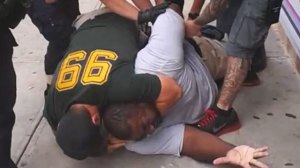
Daniel Pantaleo chokes Eric Garner on video.
Daniel Pantaleo already had a troubled history when he choked Eric Garner to death in July. From the AP via Huffington Post:
Court records show that within the past two years, three men sued Daniel Pantaleo — the officer seen wrapping his arm around Garner’s neck — over allegedly unlawful, racially motivated arrests. Garner was black.
In the first lawsuit, settled by the city in January, two black men accused Pantaleo and other officers of arresting them without cause and subjecting them to a “humiliating and unlawful strip search” on the street in which they were ordered to “pull their pants and underwear down, squat and cough.” The men said they were held overnight on charges that were ultimately dismissed.
In a second lawsuit, a man accused Pantaleo and other officers of misrepresenting facts in a police report and other documents to substantiate charges that also were dismissed.
The first lawsuit cost the city $30,000.
The suit, which was settled in January…alleges that Pantaleo and several other officers — Joseph Torres, Ignazio Conca, and Steven Lopez — “unlawfully stopped” a vehicle on Jersey Street in New Brighton. Another officer, Christian Cataldo, arrived at the scene later.
Two of the car’s passengers, Darren Collins and Tommy Rice — a federally convicted gun felon who had been released from prison five months prior — wound up suing in Brooklyn federal court.
According to the lawsuit, after getting license and registration information from both the car’s driver, Morris Wilson, and Collins, the officers ordered Collins and Rice out of the vehicle for a search.
After they were handcuffed, “Pantaleo and/or Conca pulled down the plaintiffs’ pants and underwear, and touched and searched their genital areas, or stood by while this was done in their presence,” the lawsuit alleged.
Pantaleo then took the two men to the 120th Precinct stationhouse, where Pantaleo and Torres strip-searched them again, forcing them “to remove all of their clothing, squat, cough and lift their genitals.”
The men were charged with drug crimes, but the cases were later dismissed. Pantaleo had lied about seeing drugs in plain sight in the car in order to justify the stop and search.

In August, Tommy Rice reacted to the killing of Eric Garner by Pantaleo:
One of the men who filed a lawsuit against the NYPD after Officer Daniel Pantaleo falsely arrested him two years ago said he was “shocked and disappointed” the cop had been let back on the streets.
“I was kind of stunned,” said Tommy Rice, 43, of the moment he saw video of Pantaleo putting a deadly chokehold on Eric Garner.
“I went to Internal Affairs two years (ago) and they did nothing to this cop,” he said. “They let him back on the streets.”
In the second lawsuit, which is still active, Rylawn Walker accused Pantaleo of falsely arrest him in February 2012. Marijuana charges against Walker were dismissed and the records sealed shortly after the arrest. While White label cbd oil and similar oils have been used for their health benefits going back to the dawn of civilization (even before the Great Wall of China was built!), people are just recently rediscovering the profound positive impact these oils can have on treating ailments.
The Daily Beast has a good piece on an earlier case similar to Eric Garner’s–it’s the story of the real life “Radio Raheem” from Spike Lee’s Do the Right Thing.
In Do the Right Thing, as the policeman squeezes the life out of Raheem, one of the onlookers can be heard shouting, “They did it again… just like Michael Stewart.” That’s because the death of Raheem was inspired by the tragic story of Stewart who, like Garner, was cut down by New York law enforcement and whose case ran into problems with the grand jury. Jonathan Moore, a famed civil rights attorney who represented the Stewart family in a subsequent suit against the city, is representing Garner’s family.
At 2:50 a.m. on September 15, 1983, Michael Stewart was spray-painting a wall at the L train’s First Avenue subway station. He was a black, 135-pound art student at Pratt Institute, as well as an aspiring model. New York City Transit cop John Kostick observed Stewart graffiti “RQS” on the wall, and after approaching him, said he surrendered without conflict. “Hey man, you got me,” Stewart said, according to Kostick. The 25-year-old was on his way home to the Clinton Hill neighborhood where he resided with his parents, and his father was a retired MTA maintenance worker.
According to Kostick, while awaiting a van to transport Stewart to the nearest police station, his mood changed. He sprinted from him, and fell to the ground. Once inside the van, several officers allege they subdued him en route to the District 4 transit police station in Union Square. Stewart allegedly tried to run again when they arrived at Union Square. Twenty-three Parsons students later claimed to have observed a struggle between Stewart and the transit police outside the District 4 station, with student Rebecca Reiss alleging she heard him shriek, “Oh my God, someone help me… What did I do? What did I do?” Stewart was eventually booked at the station for resisting arrest and unlawful possession of marijuana (a single joint), and was then hogtied with an elastic strap, and transported to Bellevue for psychiatric evaluation. By the time he arrived there at 3:22 a.m., with a blood alcohol content more than twice the legal limit, he was comatose. He died 13 days later.
Read much more about it at The Daily Beast link.
Isn’t it interesting that the police officers involved in two recent police-involved shootings also had questionable backgrounds?
Darren Wilson, who shot and killed unarmed teenager Michael Brown in Ferguson, Missouri in August, had previously worked for a police force that had to be disbanded because of racial problems and corruption. From The Washington Post on August 23:
After going through the police academy, Wilson landed a job in 2009 as a rookie officer in Jennings, a small, struggling city of 14,000 where 89 percent of the residents were African American and poverty rates were high. At the time, the 45-employee police unit had one or two black members on the force, said Allan Stichnote, a white Jennings City Council member.
Racial tension was endemic in Jennings, said Rodney Epps, an African American city council member.
“You’re dealing with white cops, and they don’t know how to address black people,” Epps said. “The straw that broke the camel’s back, an officer shot at a female. She was stopped for a traffic violation. She had a child in the back [of the] car and was probably worried about getting locked up. And this officer chased her down Highway 70, past city limits, and took a shot at her. Just ridiculous.”
Police faced a series of lawsuits for using unnecessary force, Stichnote said. One black resident, Cassandra Fuller, sued the department claiming a white Jennings police officer beat her in June 2009 on her own porch after she made a joke. A car had smashed into her van, which was parked in front of her home, and she called police. The responding officer asked her to move the van. “It don’t run. You can take it home with you if you want,” she answered. She said the officer became enraged, threw her off the porch, knocked her to the ground and kicked her in the stomach….
The Jennings department also had a corruption problem. A joint federal and local investigation discovered that a lieutenant had been accepting federal funds for drunken-driving checks that never happened….
All the problems became too much for the city council to bear, and in March 2011 the council voted 6-to-1 to shut down the department and hire St. Louis County to run its police services, putting Lt. Jeff Fuesting in charge as commander.
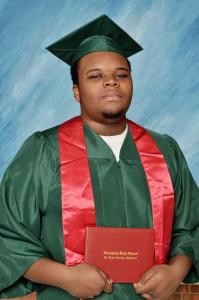
Michael Brown
According to the WaPo, a fellow officer described Wilson as “average,” someone who “didn’t go above and beyond” but “didn’t get in trouble” either.
Timothy Loehmann, who shot and killed 12-year-old Tamir Rice in Cleveland on November 22, had also previously worked for a smaller police force before getting his job at the Cleveland PD.
From The Guardian US: Officer who fatally shot Tamir Rice judged unfit for duty by police in 2012.
Officer Timothy Loehmann, who killed Tamir Rice on 22 November, was specifically faulted for breaking down emotionally while handling a live gun. During a training episode at a firing range, Loehmann was reported to be “distracted and weepy” and incommunicative. “His handgun performance was dismal,” deputy chief Jim Polak of the Independence, Ohio, police department wrote in an internal memo.
The memo concludes with a recommendation that Loehmann be “released from the employment of the City of Independence”. Less than a week later, on 3 December 2012, Loehmann resigned.
So why the hell was he hired in Cleveland in March 2014?
On a Saturday afternoon last month, Loehmann and a partner, Frank Garmack, were dispatched to Cleveland’s Cudell Commons Park after a 911 caller reported “a guy” in the park was pointing a “probably fake” gun at people. Surveillance video recovered after the incident showed Tamir Rice, the 12-year-old, handling a pistol-sized pellet gun.
Loehmann shot the boy dead within two seconds of a police car driven by Garmack arriving to the park and pulling to a stop within feet of the child. In the video, released by Cleveland police a week ago, Loehmann appears to fire his gun as he opens the door to leave the police car.
Loehmann has been taken off patrol duties in Cleveland and the shooting is under internal review.
Read more at the link.

Tamir Rice
A few more details about Loehmann’s problems from The Washington Post:
Two years ago, when he was working for a police department in a Cleveland suburb, Tim Loehmann participated in firearms qualification training.
Loehmann struggled with the exercise, according to a memo penned Nov. 29, 2012, by Jim Polak, deputy chief of the Independence Police Department and obtained Wednesday by Northeast Ohio Media Group. He was “distracted” and “weepy,” Polak wrote, and did not seem “mentally prepared” for the task.
“He could not follow simple directions, could not communicate clear thoughts nor recollections, and his handgun performance was dismal,” Polak wrote.
The letter recommended that the department split with Loehmann, who later resigned and went on to graduate from the city of Cleveland’s police academy. A Cleveland police spokesman told the media group that officers didn’t look at the file before hiring Loehmann.
“Unfortunately in law enforcement there are times when instructions need be followed to the letter, and I am under the impression Ptl. Loehmann, under certain circumstances, will not react in the way instructed,” the letter reads.

The US Department of Justice is currently looking into civil rights violations in the Michael Brown case, and yesterday Attorney General Eric Holder announced there would be a similar investigation into Eric Garner’s death.
It seems to me that a nationwide investigation of police practices is called for at this point. There have been numerous cases of white police officers killing unarmed black men and boys. When will it end? This is a shocking and serious issue that must be dealt with as a systemic problem.
What do you think? What else is happening? Please post your thoughts and links in the comment thread and hug the people you love today.
Tuesday Reads: So Many Racists, A**holes, Morons, and Lunatics; So Little Patience
Posted: December 2, 2014 Filed under: Barack Obama, morning reads, racism, Real Life Horror, Reproductive Rights, Republican politics, Senate, U.S. Economy, U.S. Politics, Voter Ignorance, War on Women, We are so F'd, Women's Healthcare | Tags: a**sholes, abortion, Bill Cassidy, Elizabeth Lauten, Eugene Robinson, John Boehner, Jon Belmar, lunatics, Mary Landrieu, Michael Brown, Morning Joe, morons, Obamacare, Sasha and Malia Obama, St. Louis Rams, Ted Yoho 65 Comments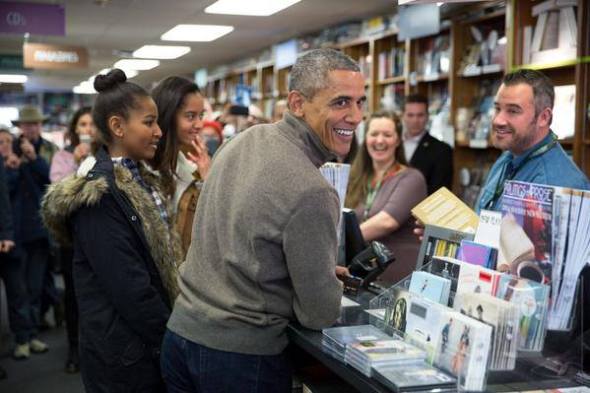
Good Morning!!
Just look at those awful teenage girls wearing coats in a bookstore! How shocking! And the President in jeans and casual jacket! Impeach him immediately!
As everyone knows by now, GOP aide to Rep. Stephen Fincher (R-TN) Elizabeth Lauten learned the hard way that when you attack the President’s family on Facebook, lots of people see it; and then your ugly words go viral on Twitter and other social media sites.
Addressing her comments directly to the Obama girls, Lauten wrote that they should ‘‘respect the part you play,’’ and added: ‘‘Then again your mother and father don’t respect their positions very much, or the nation for that matter, so I’m guessing you’re coming up a little short in the ‘good role model’ department.’’
Lauten also urged the Obama girls to ‘‘dress like you deserve respect, not a spot at a bar.’’
Lauten later apologized for the comments and deleted the original post, which drew harsh criticism across social media.
In her pathetic “apology,” as Eugene Robinson noted on Rachel Maddow’s show last night, Lauten failed to say she was sorry for insulting any of the members of the Obama family.
‘‘When I first posted on Facebook I reacted to an article and I quickly judged the two young ladies in a way that I would never have wanted to be judged myself as a teenager,’’ Lauten told The Commercial Appeal of Memphis in an email. ‘‘Please know, those judgmental feelings truly have no place in my heart. Furthermore, I’d like to apologize to all of those who I have hurt and offended with my words.’’
Whatever, lady. I’m glad you’re out of a job. Instant Karma is so satisfying.
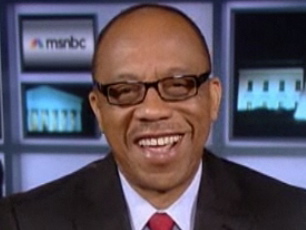
Eugene Robinson
Speaking of f**king a**holes, I’ve managed for a long time now to avoid seeing or hearing anything about MSNBC’s “Morning Joe” or its moronic hosts Joe Scarborough and Mika Brzezinski. Unfortunately, this morning I accidentally clicked on a link to Mediaite and read something about their asinine TV show.
This morning the above-mentioned Eugene Robinson was on the program and dared to say that Michael Brown might have had his hands up when he was shot and killed by Darren Wilson. Robinson’s reasoning? A number of eyewitnesses said so and there’s nothing in the evidence that proves Brown wasn’t surrendering.
According to Mediaite’s Evan McMurry, things “got awkward.”
“I don’t believe there’s anything in the record, certainly not in the forensic evidence, that precludes the possibility that he had his hands up at some point when he was approaching the officer,” Robinson said.
“That’s an awfully low standard,” cohost Joe Scarborough replied. “There’s also no evidence that doesn’t suggest a flying saucer from Venus swooped over all of them. There’s no evidence that it’s precluded, Gene. I’m not being difficult. I’m just saying the truth actually does matter.”
“I think it’s a very uncomfortable question for you, Gene,” Brzezinski said. “Because if you say no, there’s no evidence his hands up, you’re probably insulting a lot of people. Do you feel uncomfortable with the question?”
Now what do you suppose Brzezinski meant by that? Oh yeah, Robinson is black and so Mika thinks he must have to lie in order to pacify other black people. Are you lying to please your puppet master Joe Scarborough and the racist audience to your show, Mika?
You can watch the video at the Mediaite link above.

The racists are also up in arms about the five St. Louis Rams players (all black) who had the nerve to express solidarity with Ferguson protesters by standing with their hands up before their football game on Sunday. St. Louis police officers were enraged by this mild display of support, and complained loudly in the media.
St. Louis police chief Jon Belmar then publicly claimed that the Rams organization had apologized for the players actions. A battle of words followed, in which the Rams denied apologizing and Belmar kept insisting they had. From the NY Daily News:
St. Louis County Police Chief Jon Belmar said the St. Louis Rams apologized to local law enforcement officials Monday after five players walked onto the field Sunday with their arms raised high in solidarity with the Ferguson protesters, a claim the team denied in a bizarre war of words that erupted overnight between the team and cops.
Police immediately cried foul at the act during the Rams’ Week 13 home blowout of the Oakland Raiders, but the NFL sacked the cops’ request and chose not to discipline the players.
There was still fallout to manage and Rams COO Kevin Demoff tried to satisfy the outcry by local cops when he called Belmar on Monday and apologized for the players’ unsanctioned actions, according to the chief.
“Mr. Demoff clearly regretted that any members of the Ram’s (sic) organization would act in a way that minimized the outstanding work that police officers and departments carry out each and every day,” Belmar said in an email to the department, the St. Louis Post-Dispatch reported. “My impression of the call was that it was heartfelt and I assured him that I would share it with my staff.” ….
But CNN’s Rachel Nichols said Rams spokesman Artis Twyman told CNN the team “did not apologize” to St. Louis police.
And Demoff backed up that claim when reached by the Post-Dispatch late Monday. “In none of these conversations did I apologize for our players’ actions,” Demoff told the Post-Dispatch. “I did say in each conversation that I regretted any offense their officers may have taken. We do believe it is possible to both support our players’ First Amendment rights and support the efforts of local law enforcement as our community begins the process of healing.”
My advice to Belmar and police departments all over the country: Get over it and stop killing innocent citizens.
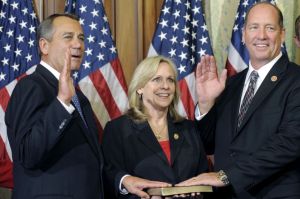
John Boehner swears in Florida’s Ted Yoho.
And speaking of moronic a**holes, John Boehner is set to do battle with the crazy caucus today. Reuters: Boehner to seek support for plan to avoid government shutdown.
House of Representatives Speaker John Boehner will try to sell fellow Republicans this week on a government spending bill that avoids a shutdown fight but allows the party to strike back at President Barack Obama’s immigration order.
Republicans have a lot riding on their handling of must-pass government funding. Having scored huge wins in Nov. 4 voting that handed them a majority in the Senate and gave them a bigger majority in the House, Republican leaders want to demonstrate that they can govern responsibly next year.
But many are still outraged that Obama bypassed Congress and is moving ahead unilaterally on immigration, granting what they claim is “amnesty” to people who came to the United States illegally.
House Republicans will meet on Tuesday after a 10-day Thanksgiving break to discuss their response, including a leading option for Boehner that would fund most government agencies through September 2015, with only a short-term extension for the Department of Homeland Security (DHS).
House Republican lawmakers and aides say this would give them a chance to use their stronger House and Senate majorities next year to pass explicit spending restrictions on some DHS agencies, to try to stop Obama’s immigration overhaul.
More details from Bloomberg Politics:
House Speaker John Boehner and his fellow Republican leaders are turning to large-animal veterinarian and Tea Party darling Ted Yoho to help avoid a second government shutdown in as many years.
The freshman Florida Republican has proposed a bill that aims to remove the president’s executive power when it comes to deportations. It’s a symbolic measure that would have essentially zero chance of passing in the last days of a Democratic-controlled Senate. But Boehner and his crew hope it’s enough to pacify a Republican caucus seething over President Barack Obama’s immigration actions last month.
Boehner and other Republican leaders have vowed to avoid a repeat of the 16-day shutdown last year. Their best shot may be coupling Yoho’s bill with a measure that would temporarily fund immigration agencies and provide longer-term financing for the rest of the federal government. The deadline is Dec. 11, when current funding ends.
Yoho, whose opposition to Obamacare contributed to the last shutdown, was an unlikely star of the 2012 election cycle, knocking off 12-term incumbent Cliff Stearns in a Republican primary for a North Florida district after selling his veterinary practice to run. Since being sworn in, the 59-year-old Republican has voted against Boehner for speaker, said an Obamacare tax on indoor tanning was “racist,” and suggested that a government shutdown could stabilize markets.
Yoho sounds like a lunatic. How on earth do people like this get elected?
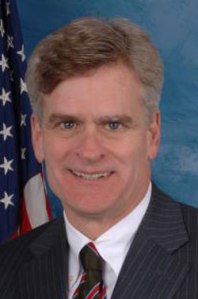
Bill Cassidy tries to smile and fails miserably.
Speaking of lunatics, last night I watched the final debate between Louisiana Senate candidates Bill Cassidy and Mary Landrieu. If the result of the runoff election on Saturday weren’t so important, the “debate” would have been a laugh riot. The main topics were abortion, guns, Obamacare, Cassidy’s double dipping at the expense of taxpayers and Landrieu’s weak support of the hated black President.
It was difficult to listen to what Cassidy was saying, because he is so strange-looking, and when he forces a smile, he looks like something out of a vampire movie. Even though Mary Landrieu is a pretty conservative Democrat, I couldn’t help liking her when I noticed she had a hard time not laughing out loud when Cassidy was talking.
The gloves came off during the testy final U.S. Senate debate Monday night between Democratic incumbent Mary Landrieu and Republican Rep. Bill Cassidy. Controversies dominated the discussion, including assertions that Cassidyfalsified time sheets and Landrieu used taxpayer money to take charter airplane flights to campaign events.
Landrieu worked her main allegation, that Cassidy billed Louisiana State University for work he didn’t perform, into answers throughout the debate. She said it’s an issue that should follow him beyond Saturday’s election.
“If he wins, he will be fighting more than President Obama. He will be fighting subpoenas because he padded his time sheet,” Landrieu said. “He’ll talk about everyone else’s record but his own.”
Cassidy denied the allegations and defended his record. “These charges are absolutely false. The Landrieu campaign takes these charges, and they twist them anyway they can. I’m proud of the work I’ve done at LSU,” Cassidy said.
A physician, Cassidy said his work at LSU hospitals helped people, while Landrieu’s charter flights helped only her. Landrieu countered that she had taken responsibility for the flights, which she attributed to a bookkeeping error, and paid back the Treasury.
Read more at the link.
During their extended argument over abortion, I was surprised to hear Cassidy state as fact that a 20-month fetus is viable and capable of feeling pain. I was also shocked when Landrieu said she is against all abortions and thinks they are immoral, but that the government shouldn’t be making those decisions. At least she’s “pro-choice.”
After watching that debate, I thanked my lucky stars that my Senators are Elizabeth Warren and Ed Markey.
That’s about all the news I could dredge up this morning. I’ll be so glad when the holidays come to an end. What stories are you following today?
Friday Reads: The Day After Thanksgiving
Posted: November 28, 2014 Filed under: morning reads, U.S. Politics | Tags: Black Friday, civil rights lawsuit, Darren Wilson, detective stories, Ferguson protesters, grand jury witness statements, Jaeha Lee, Michael Brown, notable deaths, PD James, retail stores, Ruth Rendell, Senate Republicans, Southern Democrats, Thanksgiving, wrongful death lawsuit 21 Comments
The day after Thanksgiving might very well be the slowest news day of the year unless you want to read about people fighting tooth and nail over “bargains” bargains at Walmart and other huge chain stores. Nevertheless, I’ve managed to dig up a few stories of possible interest.
Professor Jaeha Lee of at North Dakota State University and her colleagues actually published a study on the phenomenon of bad behavior by “Black Friday” shoppers. From The Conversation, Retail rage: why Black Friday leads shoppers to behave badly.
The manic nature of Black Friday has often led shoppers to engage in fistfights and other misbehavior in their desperation to snatch up the last ultra-discounted television, computer or pair of pants. What is it about the day after Thanksgiving, historically one of the busiest shopping days of the year and traditionally the start of the holiday season, that inspires consumers to misbehave?
The unique characteristics of Black Friday sales promotions and the frantic retail environment they create, coupled with the shoppers’ own physical and emotional states combine to loosen the emotional constraints. Retailers heavily promote their most desirable items at deeply discounted prices in order to encourage more foot traffic. Demand for those precious few items naturally exceeds supply, and that imbalance can lead to aggressive consumer behavior.
But another key ingredient results from the very timing of the sales, which may begin at midnight or early in the morning and require eager customers to camp outside a store all night: sleep deprivation. That means many Black Friday shoppers’ cognitive levels are not functioning at top form, resulting in impaired decision-making and heightened negative mood states, thus facilitating misbehavior.
Researchers found that most Black Friday customers are well behaved, and a “proactive” strategy would be to make store rules clear to shoppers and “monitor” their behavior even before get into the store; and remove rude and aggressive shoppers before they can start trouble. Read more at the link if you’re interested. My personal solution to “retail rage” is to stay out of stores as much as possible until after the new year, and do most of my shopping on line.

Of course Ferguson is still very much in the headlines.
From Reuters, via Huffington Post, Ferguson Protesters Target Black Friday Sales.
(Reuters) – Protesters in Ferguson, Missouri began targeting Black Friday sales at major retailers overnight in a new tactic to vent their anger at a grand jury decision not to indict a white police officer who fatally shot an unarmed black teen.
Kicking off their latest strategy inside a Walmart in another nearby suburb of St. Louis, about 75 demonstrators protested peacefully, chanting “Hands up, don’t shoot!”, bemusing bargain-hunters pushing their brimming shopping carts.
They dispersed peacefully when ordered by a small group of police, moving on to a Target store where they staged a similar demonstration. More protests were planned for Friday.
Before heading in convoy to Walmart late on Thursday, a group of some 100 demonstrators ate Thanksgiving dinner, sang, prayed and discussed their new strategy in the basement of a St. Louis church.
“We are bruised but not broken,” said Cathy Daniels, a woman known to the activists as “Momma Cat” who prepared the food. “We are regrouping. We are not going to take this lying down.”
It’s really impressive to me how organized the long-time Ferguson protesters have become.

PBS Newshour has compiled a useful chart that breaks down the differences and similarities among grand jury witnesses to the shooting of Michael Brown by police officer Darren Wilson. The results of the analysis:
– More than 50 percent of the witness statements said that Michael Brown held his hands up when Darren Wilson shot him. (16 out of 29 such statements)
– Only five witness statements said that Brown reached toward his waist during the confrontation leading up to Wilson shooting him to death.
– More than half of the witness statements said that Brown was running away from Wilson when the police officer opened fire on the 18-year-old, while fewer than one-fifth of such statements indicated that was not the case.
– There was an even split among witness statements that said whether or not Wilson fired upon Brown when the 18-year-old had already collapsed onto the ground.
– Only six witness statements said that Brown was kneeling when Wilson opened fire on him. More than half of the witness statements did not mention whether or not Brown was kneeling.
Check out the full chart at the link.
From the Guardian US, How Michael Brown’s family could still file a lawsuit against Darren Wilson.
If they do decide to go that route, the family’s first option would be to file suit against Wilson or the Ferguson police department or both for wrongful death in a state court. If they did that, the case would most likely be heard in nearby Clayton, Missouri, in the same courthouse where the grand jury that declined to indict Wilson sat.
The other option is to sue in federal court, for what is known as a “1983” violation (named for its place in federal law, Title 42 Section 1983 of the US code, not the year), which means a deprivation of civil rights. This would be filed in the US district court for the eastern district of Missouri, in St Louis.
While in federal court for the 1983 violation, they could at the same time assert the state law case of wrongful death. Importantly, a 1983 suit also contains a variety of provisions for shifting the burden of legal fees; if the plaintiff wins a 1983 case, the defendant has to pay all the lawyers’ fees and expenses, on top of any damages awarded.
“My guess is the family will go to federal court, both because of the fee-shifting rule and also because of a potentially better jury pool,” said Ben Trachtenberg, a professor of law at the University of Missouri. The state court jury pool would draw from St Louis County, which might be seen as more predisposed to support Wilson, while the federal jury would come from a wider geographical area.

At The New Republic, Brian Beutler tries to make the best of the outcome of the midterm elections, Six Reasons I’m Thankful for a Republican Congress. I can say that I agree with him, but I could be wrong. Here’s the introduction to the piece:+
I generally don’t go in for sentimental holiday rituals like announcing New Year’s resolutions or giving children candy on Halloween. But in the interest of promoting counterintuitive thinking about American politics and juicing this website’s holiday traffic, I’m making an exception this Thanksgiving. So here goes:
Today, I am thankful that Republicans won the midterm elections and will soon control the U.S. Senate.
I’m not arguing that a fully Republican Congress will produce better policy than a divided Congress, or that Democrats should feel relieved to have lost the midterms so badly. All I’m suggesting is that a Republican Senate is the best outcome for me, personally, and for the growth interests of my employer. And also, maybe—in the longer term—for the country’s fragile, wheezing political system.
Read his reasons at the link.
According to the AP (via the WaPo), some Southern Democrats want their party to get back to “basics.”
ATLANTA — Southern Democrats are joining others in the party who say that a return to advocating to lift people out of economic hardship and emphasizing spending on education and public works will re-energize black voters and attract whites as well.
“It’s time to draw a line in the sand and not surrender our brand,” Rickey Cole, the party chairman in Mississippi, said. He believes candidates have distanced themselves from the past half-century of Democratic principles.
“We don’t need a New Coke formula,” Cole said. “The problem is we’ve been out there trying to peddle Tab and RC Cola.”
Cole and other Southern Democrats acknowledge divisions with prominent populists such as Hillary Rodham Clinton, who is expected to run for president in 2016, and Massachusetts Sen. Elizabeth Warren. Yet they see merit in pushing stronger voting rights laws, tighter bank regulation, labor-friendly policies such as a higher minimum wage and other familiar party themes.

Finally, a great British mystery novelist, PD James, died yesterday at age 93. I’ve read a number of her books. From BBC News:
Her agent said she died “peacefully at her home in Oxford” on Thursday morning.
The author’s books, many featuring sleuth Adam Dalgliesh, sold millions of books around the world, with various adaptations for television and film.
Her best known novels include The Children of Men, The Murder Room and Pride and Prejudice spin-off Death Comes to Pemberley.
The author told the BBC last year she was working on another detective story and it was “important to write one more”.
“With old age, it becomes very difficult. It takes longer for the inspiration to come, but the thing about being a writer is that you need to write,” she said.
There’s much more about James at the link. I absolutely loved her first novel, An Unsuitable Job for a Woman.–so much so that I’ve read it at least three times. It’s about Cordelia Gray, a woman who successfully runs a detective agency.
Here’s tribute to PD James by her close friend and fellow mystery novelist Ruth Rendell from the Guardian, PD James: ‘Any of the events in Phyllis’s books might have happened’.
She did not write sensation novels, she wrote books about real things, things that could have happened. She didn’t write at all like Agatha Christie. Christie had the most magnificent plots and great stories, but I don’t think anyone would say that she wrote believable stuff, people didn’t want that from her.
But any of the events in Phyllis’s books might have happened – and I think people liked that because they’d never had it in crime fiction before. Dorothy Sayers was a marvellous crime writer, whom both Phyllis and I admired very much, but she hadn’t got the same reality, and she also had that peculiar snobbishness that made her have her detective the son of a duke. Phyllis would have nothing of that.
Both of us thought more about the characters than the crime. Her plots were good, of course, but she took particular care in the creation of character. Place also mattered a lot to her: if you knew the Essex coast you’d want to read some of her books because of her wonderful descriptions.
She always took enormous pains to be accurate and research her work with the greatest attention. She made few mistakes, but on one memorable occasion she did have a male character get on a motorbike and reverse it (I think you can do that now, but this was 30 or 40 years ago), and of course she got a lot of letters about it. But she had a great sense of humour and thought it was very funny.
If one of her books had police work in it, the police work would be true, it would be very real. Her detective Dalgliesh – named him after a female teacher at her school, she just liked the name – is the most intelligent police officer in fiction that I’ve ever come across. He’s sensitive, intelligent, rather awe-inspiring and slightly frightening, but he is a real person, you can get really involved in him.
Both of these women were involved in British politics.
We never talked about crime – because it was what we both wrote about – and we never talked about politics. Phyllis joined the House of Lords several years before me. We were both utterly opposed to each other politically: she was a Tory and very much a committed Conservative, whereas I’m a socialist, I’m Labour and always have been. Once we were in for a vote and crossed paths going to the two division lobbies, she to the “content” lobby and I to the “not content” – and we kissed in the chamber, which caused some concern and amazement.
James lived a long and productive life and her writing gave pleasure and intellectual stimulation to millions of readers around the world. RIP Phyllis.
That’s all the news I’ve got this morning. What stories are you following, if any? I hope everyone enjoyed the holiday. I hope to see some of you in the comment thread, although I know it’s a busy day for lots of people.
Take care, Sky Dancers! I’m thankful for all of you.
Lazy Saturday Reads: Immigration Facts and Ferguson Fears
Posted: November 22, 2014 Filed under: Barack Obama, Civil Liberties, Civil Rights, court rulings, Crime, Criminal Justice System, Eric Holder, immigration, legislation, morning reads, The Media SUCKS, U.S. Politics | Tags: Congress, corporate media, Darren Hutchinson, Darren Wilson, FBI, Ferguson MO protests, Michael Brown, police brutality, police riots, Racism, US Constitution, Watts riots 31 Comments
Good Afternoon!!
President Obama’s executive action on immigration tops the news today. Ferguson is a close second. I’ll be focusing mostly on those two stories in this post.
Immigration
Before I get started, I want to point you to a new post by Darren Hutchinson of Dissenting Justice. It will give you some reality-based ammunition to deal with crazy wingnut friends, relatives, and Facebook and Twitter followers.
FACTS: President Obama’s Immigration Policies Are Absolutely LEGAL.
ATTENTION: Before you can argue that the government has violated a law, you must actually READ the law.
FACT: Congress has the exclusive power to pass laws regarding immigration (U.S. Const. Article I, Section 8, Cl. 4).FACT: Executive Power of the US is vested in the President, which means the President, not Congress, executes the immigration laws (U.S. Const. Article II, Sect. 1, Cl. 1)….
FACT: Consistent with the Constitution, the INA gives the Executive Branch (President, Homeland Security, Attorney General, and Secretary of State) the power to enforce immigration laws (8 U.S.C. Sect. 1103-1104)….
FACT: The Executive Can “Cancel” the Removal of Certain Deportable Individuals.
The INA allows the Attorney General to cancel removal (deportation) or adjust the status of certain categories of undocumented individuals. The statute explicitly spells out the criteria for doing so. Thus, the statute provides an “intelligible criteria” for the Attorney General to follow. (8 U.S.C. Section 1229b(a)-(b))….The Executive Can Give Temporary Protected Status to Certain Deportable Individuals. The INA also allows the Attorney General to grant “Temporary Protected Status” (TPS) to deportable individuals from certain countries that the Attorney General has placed on a TPS list. As required by Supreme Court doctrine, the INA gives SPECIFIC guidelines – or an intelligible principle – for the Attorney General to follow when determining whether to give TPS designation to a country. The statutory factors include serious conditions in the individual’s home country, like armed conflict; natural disasters; a request for temporary protected status by the country; or “extraordinary and temporary conditions” that preclude the safe return of the individual, so long as TPS does not conflict with the interests of the US.
(8 U.S.C. Sections 1254a-i)
Those are the highlights. There’s more at the link. I plan to save Hutchinson’s post for future reference. I’m thinking of printing it out in case I get in a political argument with my brother over Thanksgiving dinner.

Obama has been vilified from day one by people who obviously have never read the Constitution or any U.S. laws dealing with their various political hobby horses, and I’m sick and tired of it.
You all know I not a fan of Obama when he ran for president in 2008, and I still think he’s a conservative technocrat who is far to willing to support privatization of public services. But he is the President of the United States now. I support his efforts to reform immigration laws. He’s only taking executive action because Congress is full of stupid and irrational people who are too lazy or stubborn to cooperate with him. Sadly, the DC media is largely made up of wealthy, privileged people who got their jobs because through nepotism and/or because they attended elite universities and are too lazy or stupid to provide accurate information to the public. Therefore, people who don’t focus on politics like we do get false information from TV news or “journalists” who do not understand what journalism is.
Rant over.
A few more links on the immigration story:
Washington Post Wonkblog, Flow chart: Who qualifies for Obama’s immigration offer?
The president’s executive action would delay deportation for the undocumented mother of a child born in the U.S. on Thursday — but not an undocumented mother who gave birth here one day later. Similarly, the president has offered deferrals to children brought to this country by their parents before their 16th birthday — but not a few weeks after.
Such deadlines serve a purpose: They’re meant to discourage new immigrants from coming in the future, or to dissuade women already here from giving birth with the goal of securing deferrals. But they also show that the president’s action falls far short of a comprehensive solution. It offers, instead, a fragmented answer that will leave many immigrants disappointed.
Check out the flow chart at the link for details.

Greg Sargent at The Washington Post, Bringing perspective to Obama’s move on deportations.
Now that President Obama has announced his executive action to temporarily shield millions from deportation, confirming the administration’s view that this move is well within his authority, the battle now shifts to a political fight over the policy itself, and over whether it violates “political norms.” Is this action so provocative an affront to Congress that it sets a precedent for future GOP presidents to use discretion to selectively enforce laws liberals like?
Embedded in the legal opinion that the Office of Legal Counsel released to justify the move is an important nugget that should, in theory, help take the steam out of the idea that this move is a flagrant violation of political norms.
Obama’s action temporarily shields from deportation the parents of children who are U.S. citizens and legal residents, and also expands the program (Deferred Action for Childhood Arrivals) to protect people brought here illegally as children. But it excludes parents of DACA recipients.
The reason for this offered by the OLC memo is that protecting parents of legal residents is in line with Congressional intent, as expressed in statute, while protecting DACA parents isn’t:
[T]he parents of DACA recipients are differently situated from the parents of U.S. citizens and LPRs [Legal Permanent Residents] under the family-related provisions of the immigration law. Many provisions of the INA [Immigration and Nationality Act] reflect Congress’ general concern about separating individuals who are legally entitled to live in the United States and their immediate family members….But the immigration laws do not express comparable concern for uniting persons who lack lawful status (or prospective lawful status in the United States with their families…Extending deferred action to the parents of DACA recipients would therefore expand family-based immigration relief in a manner that deviates in important respects from the immigration system Congress has enacted.
This legal opinion probably precludes any future expansion of this program to cover parents of DACA recipients. And it underscores two things: First, that the proposal is heavily focused on providing relief from humanitarian hardship endured by U.S. citizens and permanent residents, a longtime intention of Congress, as expressed in statute. Second, it shows that the proposal’s legal rationale is tightly circumscribed to reflect that Congressional intent.
Follow me below the fold for much more . . .
Read the rest of this entry »

 peej
peej Carissa
 bostonboomer
 dakinikat
 ecocatwoman
 jjlo
jjlo mablue2
 Mama Lopez
 peggysue22
 quixote
 skydancingguestblogger
 Mona (aka Wonk the Vote)





Recent Comments