
Election Night Live Blog
Posted: November 8, 2016 Filed under: morning reads, U.S. Politics | Tags: election night live blog 94 Comments
Hillary’s election night stage.
We’ll be getting real results soon. Right now it’s looking very good for Hillary in Florida, and as we all know by now, if she wins Florida it will be over for Trump unless something really weird and completely unexpected happens. There are lots of places to watch the returns come in once the votes are actually being counted. I like the New York Times site; but if you have other recommendations, please share.
Another interesting site to look at is Slate’s Election Day Votecastr. They are releasing information from exit polls throughout the day. You can see what the turnout has been for registered Democrats and Republicans. It’s the first time any media organization has done this.
Another place to check out is Vox’s live tracking of Senate races.
Armando (Big Tent Democrat) has been live tweeting turnout info from Florida all day long, so you might want to check out his Twitter timeline.
Al Giordano will be live tweeting his data evaluations on his timeline once the votes start coming in.
I’m also watching MSNBC, but so far it hasn’t been all that enlightening. I hope Rachel Maddow and Chris Mathews won’t be on all night. I’m a lot more interesting in what Lawrence O’Donnell and Joy Reid have to say frankly. And please MSNBC, send Steve Kornacki to the showers. I’m done with him and his dramatic arm waving.
So those are some of the places I’ll be checking to see what’s happening in the all-important swing states. Again, let me know if you have any other suggestions.
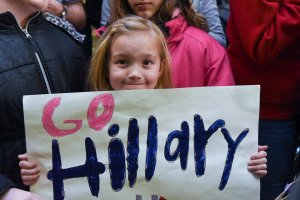
Go Hillary Go!
Election Day Reads
Posted: November 8, 2016 Filed under: morning reads, U.S. Politics 85 Comments
Good Morning!!
The great day has arrived! I’m going to go and vote as soon as I can wake up enough to function properly. I couldn’t get to sleep last night. I watched Hillary’s rallies in Philadelphia and Raleigh and then lay awake for a couple more hours, unable to stop my mind from racing. I think my body is registering how important this day is to me, even as I try to stay calm.
Ever since I was a little girl, I’ve wondered why I wasn’t allowed to do all the things boys and men could do? Why couldn’t women be lawyers, doctors, priests? Why couldn’t girls even be “altar boys?”
When I was in elementary school, I sometimes fantasized about being a boy–not because I actually wanted to be male, but because then I would have the freedom to do what I wanted to do and not what I was “supposed” to do. It’s amazing to me now that I realized even then that I was considered less than in my culture.
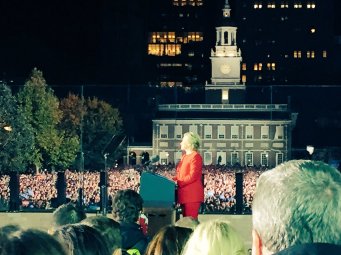
Hillary Clinton speaking in Philadelphia last night.
When I was in high school, it was still a basic assumption in our society that “real women” didn’t want careers. The height of a girl’s dreams was supposed to be to get married, raised children, and help her husband become successful.
When I was a junior in high school, I read The Feminine Mystique, by Betty Friedan; and suddenly I began to understand why my smart, college educated mom often seemed dissatisfied and frustrated. That book changed my life; it reinforced the inner feelings I had always had that girls and women didn’t deserve to be treated as less than boys and men.
Next month I’ll be 69 years old. I’ve waited all my life for the day when I could vote for a brilliant accomplished woman as President of the United States. That day has come and I plan to enjoy it to the fullest.
I know this won’t instantly change the culture we live in; in fact the sexism and misogyny will almost certainly get worse–just as racism got worse after we elected the first Black President. But if this is what we have to go through for girls an women to someday be treated equally, then so be it.
Tonight Hillary Clinton will be President elect. Little girls will know that they can be anything they want to be, even though they still will have to work twice as hard as their male counterparts to achieve the same level of success, and even though their achievements will still be denigrated and ignored. But we will have moved a bit closer to real change and real equality.
A few reads for you before I head to my polling place:
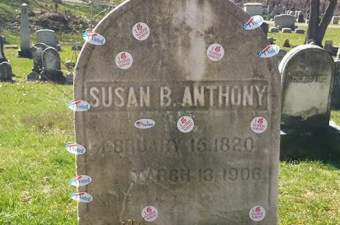
Claire Landsbaum at The Cut: So Many Women Put ‘I Voted’ Stickers on Susan B. Anthony’s Grave That the Cemetery Is Staying Open Late on Election Night.
On November 8, 1872, Susan B. Anthony was arrested for illegally casting a ballot in the presidential election. More than a century later, single women are the nation’s most potent political force. Anthony’s grave in Rochester, New York, is a popular destination for women who want to honor her memory by doing their civic duty, and according to the Democrat & Chronicle, this year the city’s mayor is making it even easier to do so.
Mt. Hope Cemetery, where Anthony is buried, usually closes at 5:30 p.m., but on Election Day, it’ll be open until voting ends. “Visiting Susan B. Anthony’s gravesite has become an Election Day rite of passage for many citizens,” Rochester’s mayor told the paper in a press release. “With this year’s historically significant election, it seems right to extend that opportunity until the polls close.”
Kevin Kruse at Politico: What It Took. How a lifetime of compromises and concessions brought one woman to the brink of history.
In early 1979, on a community access television program called In Focus, the wife of the new governor of Arkansas was peppered with question after question about all the ways in which she was an untraditional woman.
“The thought occurs to me that you really don’t fit the image that we have created for the governor’s wife in Arkansas,” the host, a self-described “newsman,” said to 32-year-old Hillary Rodham. “You’re not a native, you’ve been educated in liberal Eastern universities, you’re less than 40. You don’t have any children. You don’t use your husband’s name. You practice law. Does it concern you that maybe other people feel that you don’t fit the image that we have created for the governor’s wife in Arkansas?”
Audience for Hillary’s midnight rally in Raleigh, NC last night
She looked through her large, thick-lensed glasses and smiled.
“No,” she began, “because just as I said before … ”
She had made a choice. In 1974, she had moved to Arkansas to be with her boyfriend, Bill Clinton. It was a decision that would dictate so many others, big and small, for decades to come—and here, in this spartan studio, on this rinky-dink show, was one of them. How to respond to this man?
This issue of wifeliness was being put to the first female lawyer at the finest firm in Little Rock. Rodham had been 1 of just 27 women among the 200-plus students in her law school class at Yale. She was one of only three on the staff of 44 attorneys on the Watergate impeachment team. She could have responded to the interviewer by pointing out any of these things. It was the ‘70s: She could have responded with an impassioned lecture about feminism, or chauvinism, or women’s lib. But she didn’t. She responded with an equanimity that must have been a challenge to muster. “That doesn’t bother me, and I hope that doesn’t bother very many people,” she said.
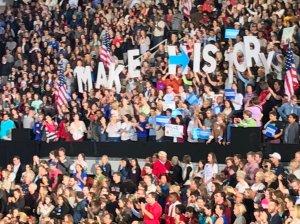
You already know the story, but I hope you’ll read the rest anyway.
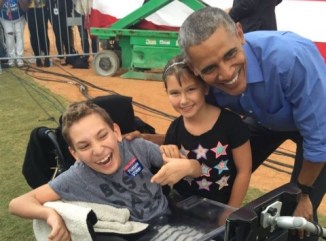
J.J. Holmes and his sister with President Obama
You know about this story too, but this article about the disabled 12-year-old boy who was kicked out of a Trump Rally is really inspiring: An anti-Trump disabled boy was booed at a rally. The next day, he got to meet President Obama.
Twelve-year-old JJ Holmes has been enamored with the 2016 presidential election.
By Election Day, the boy would encounter two of the most polarizing figures in this campaign season — Republican presidential candidate Donald Trump and President Obama — and his experiences with them would be vastly different.
For months, JJ, who has a severe case of cerebral palsy, has been sitting on his knees at his home in Longwood, Fla., using his nose to type searches on his iPad for “Mary Poppins” plays and Trump events, his mother said. Throughout the election, she said, he had been itching to go to a rally — to express his disdain for Trump, who came under fire last year for mocking a reporter with a disability.
“I wanted to go because Donald J. Trump made fun of disabled people,” JJ said in a video statement Monday to The Washington Post, using his computer vocalization device.
Please go read the whole thing. You won’t regret it.
Adele Stan at The National Memo: Pantsuit Feminism Is Real Feminism.
On November 8, if America doesn’t make history by electing its first former beauty-pageant owner and reality-show star as president, it will do so by electing the first woman to occupy the Oval Office. A woman in a suit; a suit that has pants.
Much is made of Hillary Clinton’s sartorial choice of the matching jacket and slacks as her signature look. But whether the subject of celebration or mockery, the response stems from the same fact—that a woman in public life who shucks nylons and pumps in favor of the freedom of movement long afforded men, well, that’s a woman who is claiming power.
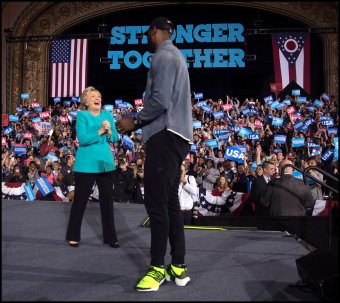
Hillary with LeBron in Cleveland
Some might claim that the pantsuit is merely a symbol of feminism, one that can belie the motives of the woman who wears it. Symbol though it be, there is nothing “mere” about it: the pantsuit, as worn by the first presidential nominee of a major U.S. political party, is feminism itself. Its existence as an acceptable form of female dress in the halls of power is the result of thousands of years of feminism, and in Western culture, particularly the last few hundred.
The battle to unbind women from corsets and crinolines and bustles and busks was the work of feminists. It’s hardly a coincidence that the doffing of the corset in the 1920s, together with the adoption of a shorter dress that hung loosely on the frame, coincided with the time women gained the right to vote. But pants were another thing entirely. Pants were—and often still are—symbolic of something other than comfort or even ease of movement. Pants are a symbol of power and self-possession. Pants encase and protect the genitals while skirts offer access. A woman in pants is claiming her body as her own, treading her own path in the world.
Yes! When I was in high school in the 1960s, girls weren’t allowed to wear pants. We weren’t even permitted to wear culottes, which were very popular then. Today as an old retired lady, I wear jeans most of the time and the heck with anyone who disapproves of it.
The New York Time Editorial Board: The Question for James Comey.
That was the message James Comey, the F.B.I. director, sent to Congress on Sunday in his latest headline-grabbing interruption of the 2016 presidential race.
Having dropped a bomb packed with innuendo on Oct. 28 when he informed Congress that there was a new stash of emails that “appear to be pertinent” to the investigation of Hillary Clinton’s use of a private email server, Mr. Comey had to dig himself out.
On Sunday, he reaffirmed his original decision in July to recommend against charging Mrs. Clinton for her careless handling of emails containing classified information when she was secretary of state. The new emails — on the computer of Anthony Weiner, the estranged husband of Mrs. Clinton’s close aide Huma Abedin — contain nothing except personal messages and duplicates of emails that had already been reviewed, investigators found.
But you can’t unring a bell. The damage Mr. Comey’s back-and-forthing has done to the election, to his own reputation and to that of the F.B.I. is profound. Nine days of early voting passed after he made his rash announcement about the new emails, an announcement made when he and his investigators knew nothing about the content of those emails because they didn’t even have a search warrant. That was nine days during which millions of voters went to the polls under the false impression — created by Mr. Comey’s action — that there was new evidence against Mrs. Clinton, showing possible criminality.
More at the link. Too bad the political reporting of the story at the NYT was so horrendous and irresponsible.
One more read from a man who saw his abusive father in Donald Trump. Don’t miss this one: My Father Donald Trump, by Oliver Lee Bateman. I’m not going to excerpt from this essay; I hope you’ll go read it at Medium.
I’m going to head out to vote soon, but I’ll be around all day. Please post your thoughts and links in the comment thread and have a fabulous election day! If this thread gets too long, I’ll post another one, and so on until the election is decided tonight.
I love you all!
Breaking News
Posted: November 6, 2016 Filed under: U.S. Politics | Tags: email "scandal", FBI, Hillary Clinton, James Comey 62 CommentsComey clears Clinton yet again.
Lazy Saturday Reads: Stars Come Out for Hillary; Trump Awakens a Sleeping Giant
Posted: November 5, 2016 Filed under: morning reads, U.S. Politics | Tags: Beyonce, Donald Trump, early voting, Hillary Clinton, Jay Z, Jennifer Lopez, Katy Perry, Latinos, Marc Anthony 149 Comments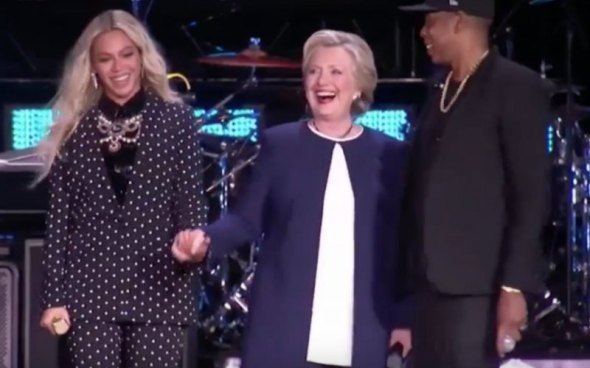
Good Morning!!
This election is looking very good for Hillary Clinton. In just three more days, she will more than likely be President Elect Hillary Clinton. I can’t wait to vote for her on Tuesday! I thought about voting early, but I finally decided to wait and go to my regular polling place on election day. That will be a very special moment. I already shed some tears when I voted for Hillary in the 2008 primary and again in the 2016 primary. But Tuesday will be the big enchilada.
Last night Hillary appeared with Jay Z and Beyonce at the get-out-the-vote concert in Cleveland. NYT:
In an election year when Hillary Clinton is depending on young black voters to turn out, she may have gotten her biggest boost yet here on Friday.
Some of the most famous names in hip-hop came out to rally votes for her at an event that featured Beyoncé, Jay Z and Chance the Rapper, all of whom implored thousands of cheering people to back the Democratic presidential nominee.
“Hello, Cleveland!” Mrs. Clinton said as she stood onstage with Beyoncé and Jay Z.
Mrs. Clinton called Beyoncé “a woman who is an inspiration to so many others” and thanked Jay Z “for addressing in his music some of our biggest challenges in the country: poverty, racism, the urgent need for criminal justice reform.”
“When I see them here, this passion and energy and intensity, I don’t even know where to begin because this is what America is, my friends,” she said.
At the concert, aimed largely at urging black voters and millennials to vote on Tuesday, some of the biggest stars emphasized the historical significance of potentially electing the first woman as president.
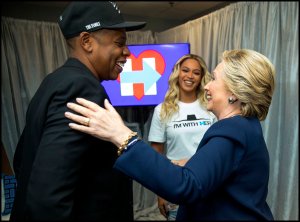
Jay Z began the concert with “Made in America.” He performed behind a screen that manipulated his face to look like an American flag. A-list artists, including Beyonce, Big Sean, Chance the Rapper, and J. Cole surprised a pumped up crowd….
Jay Z performed behind a black and white photograph of the White House. He repeated Clinton’s campaign slogan: “Stronger Together.”
Each special performer emerged, one after another, thrilling the crowd of about 10,000. Politics overlaid performance. Words flashed behind the musicians on a large screen:
- “Bad officials are elected by good citizens who do not vote”
- “And on that day I did nothing”
- “Shape Tomorrow, Vote Today”
- “Your voice, your vote”
The crowd erupted in screams as Beyonce took the stage. Queen B delivered a heartfelt speech about what seeing a woman in the White House means to her.
“There was a time when a woman’s opinion did not matter if you were black, if you were white, Mexican, Asian, Muslim, educated, poor or rich. If you were a woman, it did not matter. Less than 100 years ago, women did not have the right to vote. Look how far we’ve come from having no voice to being on the brink of making history, again, by electing the first woman president. But we have to vote. The world looks to us as a progressive country that leads change,” Beyonce said. “I want my daughter to grow up seeing a woman lead our country.”
She transitioned into an appropriately patriotic song: Freedom. And followed it up with a medley of female empowerment songs: “Independent Women,” and “Run the World (Girls).”
The screen behind her flashed: “I’m with her.”

Hillary at concert with Jennifer Lopez and Marc Anthony in Miami
And who was campaigning for Donald Trump? NYT: Big Names Campaigning for Hillary Clinton Underscore Donald Trump’s Isolation.
Hillary Clinton campaigned Friday in the company of friends and celebrities, first flanked by the billionaire businessman Mark Cuban in Pittsburgh and Detroit, and then at a concert in Cleveland with Jay Z and Beyoncé. High-wattage political leaders fanned out for her around the country: Her husband, Bill, stumped in Colorado, as President Obama rallied voters in North Carolina.
By comparison, Donald J. Trump was a lonely figure.
In the final days of the presidential race, Mr. Trump’s political isolation has made for an unusual spectacle on the campaign trail — and perhaps a limiting factor in his dogged comeback bid.
When it comes to bolstering Mr. Trump, the Republican Party is not sending its best: As party leaders have disavowed him or declined to back his candidacy, Mr. Trump has been left instead with an eclectic group of backup players to aid him in his last dash for votes. Though polls show Mr. Trump drawing closer to Mrs. Clinton, the most prominent Republicans in key swing states still fear that his unpopularity may taint them by association.
Trump told a crowd in Hershey, PA that he doesn’t need anyone but himself.
“By the way, I didn’t have to bring J. Lo or Jay Z — the only way she gets anybody,” he said. “ I am here all by myself. Just me — no guitar, no piano, no nothing.”
Campaigning in New Hampshire earlier on Friday, Mr. Trump did not appear with either Senator Kelly Ayotte, a Republican seeking re-election, or Chris Sununu, the Republican nominee for governor. Ms. Ayotte withdrew her endorsement of Mr. Trump last month, and Mr. Sununu has kept an awkward distance from Mr. Trump in his closely divided state.
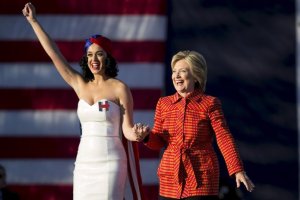
Hillary with Katy Perry in Iowa
Tonight Hillary will be in Philadelphia for a free concert with Katy Perry.
Meanwhile, massive early voting by Latinos in Nevada, Florida, and Arizona is looking very good for Hillary and Democrats.
CNN: Democrats build huge early vote lead in battleground Nevada.
Democrats have built what could be an insurmountable edge in Nevada at the end of early voting in the Western battleground state.
In key regions, the party is matching or outpacing the lead President Barack Obama had at this point in 2012 on his way to a nearly 7-percentage-point win of the state’s six electoral votes.Clark County — home of Las Vegas and more than two-thirds of Nevada’s active registered voters — saw its record for single-day early vote turnout shattered Friday when 57,174 people cast their ballots, according to data from the Nevada secretary of state’s office that’s based on the party registration of those who have voted.Overall, Democrats have built a lead of more than 72,000 votes there — 13.7 points ahead of Republicans, and slightly larger than Obama’s 2012 edge.
Donald Trump will be in Reno on Saturday, but the Republicans almost certainly lost Nevada on Friday.
Trump’s path was nearly impossible, as I have been telling you, before what happened in Clark County on Friday. But now he needs a Miracle in Vegas on Election Day — and a Buffalo Bills Super Bowl championship is more likely — to turn this around. The ripple effect down the ticket probably will cost the Republicans Harry Reid’s Senate seat, two GOP House seats and control of the Legislature.
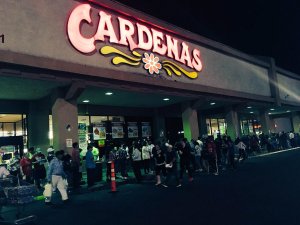
Early voting crowd at Cardenas in Las Vegas
How devastating was it, epitomized by thousands of mostly Latino voters keeping Cardenas market open open in Vegas until 10 PM? This cataclysmic:
—-The Democrats won Clark County by more than 11,000 votes Friday (final mail count not posted yet), a record margin on a record-setting turnout day of 57,000 voters. The Dems now have a firewall — approaching 73,000 ballots — greater than 2012 when Barack Obama won the state by nearly 7 points. The 71,000 of 2012 was slightly higher in percentage terms, but raw votes matter. The lead is 14 percentage points — right at registration. You know what else matters? Registration advantages (142,000 in Clark). Reminder: When the Clark votes were counted from early/mail voting in 2012, Obama had a 69,000 vote lead in Clark County. Game over.
—-The statewide lead (some rurals not posted) will be above 45,000 — slightly under the 48,000 of 2012, but still robust. That’s 6 percentage points, or right about at registration. The GOP turnout advantage was under a percent, worse than 2012 when it was 1.1 percent.
—-The Dems eked out a 200-vote win in Washoe and lead there by 1,000 votes. It was even in 2012. The rural lead, before the stragglers come in, is 27,500. It probably will get above 28,000.
—-Total turnout without those rurals: 768,000, or 52.5 percent. If overall turnout ends up being 80 percent, that means two thirds of the vote is in — close to 2012. Republicans would have to not only win Election Day by close to double digits to turn around the lead Hillary Clinton almost surely has in early voting, but they would have to astronomically boost turnout. The goal for the Dems during early voting was to bank votes and to boost turnout as high as possible to minimize the number of votes left on Election Day to affect races. Folks, the Reid Machine went out with a bang.

Lines for early voting in Arizona
Arizona has seen the largest increase of early voting by Latinos of any state.
As of Oct. 30, nine days before the Nov. 8 election, 13 percent of the early ballots cast in Arizona came from Latino voters, up from 11 percent at the same point prior to the 2012 presidential election and from 8 percent in 2008.
The increase from 2012 to 2016 is the largest increase in early voting by Latinos in any state, according to statistics compiled by Catalist, a data company that works with progressive candidates and groups….
Data tabulated by Arizona’s Democratic Party showed an even bigger increase in early voting by Latinos in Arizona, from 6.2 percent in 2012 to nearly 12 percent through Nov. 1. The data is based on Hispanic surnames.
As of Nov. 1, the share of early balloting from voters with Hispanic surnames was nearly double the same time in 2012….
“There has been a large push by many Latino groups to vote by early ballot by mail to avoid any hassles at the ballot box in presenting ID and Latinos under extra scrutiny at the polls,” Garcia said.
There also are not a lot of undecided Latino voters, many of whom have been turned off by Donald Trump’s harsh comments about Mexicans and immigrants, Garcia said.

98-year-old early voter in Florida
Early voting by Latinos is also setting records in Colorado, Florida, Georgia, and North Carolina.
Donald Trump awakened a sleeping giant with his attacks on Mexicans and immigrants.
More news, links only:
Mother Jones: Exclusive: The Democratic National Committee Has Told the FBI It Found Evidence Its HQ Was Bugged
AP via Politico: Melania Trump modeled in U.S. prior to getting work visa.
Wall Street Journal: National Enquirer Shielded Donald Trump From Playboy Model’s Affair Allegation.
Jezebel: The Woman Who Accused Trump of Raping Her at 13 Just Dropped Her Lawsuit.
NBC News: U.S. Govt. Hackers Ready to Hit Back If Russia Tries to Disrupt Election.
Washington Post: Trump is a threat to the West as we know it, even if he loses.
Thursday Reads: James Comey’s FBI Tries to Steal 2016 Election for Donald Trump
Posted: November 3, 2016 Filed under: morning reads, U.S. Politics | Tags: Donald Trump, FBI, Hillary Clinton, James Comey, Rudy Giuliani 37 Comments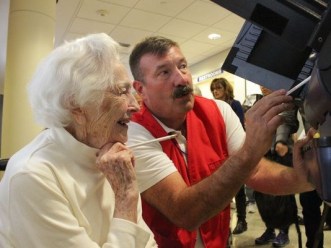
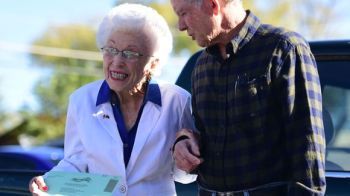
100-year-old Gertrude Gottschalk of Carson City, NV, casts her ballot. for Hillary.
Good Afternoon!!
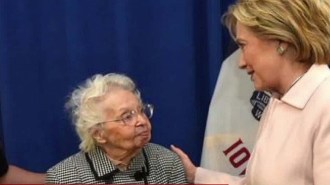
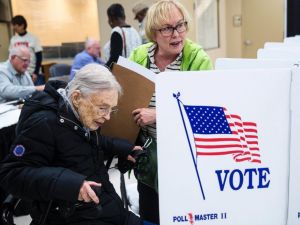
This post is illustrated with photos of women who were born before women’s suffrage and are voting for Hillary Clinton.
Just 5 more days until November 8. Then another day of waiting for the votes to be counted. After Hillary wins and we celebrate our first woman President and the ignominious defeat of the authoritarian fascist psychopath, there is going to have to be a major housecleaning at the FBI.
Before I get into the FBI news, some wisdom from 2012 Obama campaign manager Jim Messina.
The Election Polls That Matter. You need to read the whole thing at the NYT, but here’s are some excerpts:
The best campaigns don’t bother with national polls — I’ve come to hate public polling, period. In the 2012 race we focused on a “golden report,” which included 62,000 simulations to determine Mr. Obama’s chances of winning battleground states. It included state tracking polls and nightly calls from volunteers, but no national tracking polls….
Today, campaigns can target voters so well that they can personalize conversations. That is the only way, when any candidate asks about the state of the race, to offer a true assessment.
Hillary Clinton can do that. To my knowledge, Donald J. Trump, who has bragged that he doesn’t care about data in campaigns, can’t….
in recent days, Mr. Trump has campaigned in New Mexico, a state he has no chance of winning. Candidates can get more money and adjust their message, but the one thing they can’t do is make more time; every wasted hour in a noncompetitive state is a grave error. Mrs. Clinton continues to go on the offensive in states like Arizona, where the race is close.
“Big data” is a buzzword, but that concept is outdated. Campaigns have entered the era of “little data.” Huge data sets are often less helpful in understanding an electorate than one or two key data points — for instance, what issue is most important to a particular undecided voter.
With “little data,” campaigns can have direct, highly personalized conversations with voters both on- and offline, like an ad on a voter’s Facebook page addressing an issue the voter is passionate about. In 2016, we see that online political engagement rates (especially for young voters) are at a historic high.
This is why campaigns no longer pay much attention to public polls, which often use conversations with just a few hundred people to make predictions about the entire electorate.
Now please go read the rest and have faith in Hillary’s sophisticated GOTV operation and the Obama coalition!
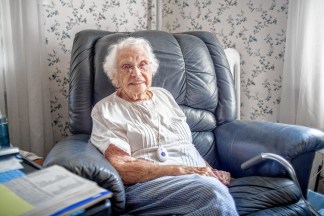
Conway, MA resident Helen Reed
Positive news for Hillary from Latino Decisions: Latino Electorate On Track For Historic Turnout In 2016.
According to the latest data from our national tracking poll, Latino Decisions projects that between 13.1 million and 14.7 million Latinos will vote in 2016. This estimate represents a three percent to five percent increase over the 2012 Latino turnout rate which, coupled with the dramatic growth of the age-eligible Latino population, will yield between 1.9 million and 3.5 million additional Latinos voters in 2016 compared to the 11.2 million who voted four years ago.
Latino Decisions also projects that 79 percent of Latinos will vote for Democratic presidential nominee Hillary Clinton, 18 percent for Republican nominee Donald Trump, and the remaining three percent voting for other candidates. Clinton’s projected share is higher than both Latino Decisions’ estimated 75 percent Latino vote share and 71 percent exit poll share Democrat Barack Obama received during his 2012 re-election bid.
Over the past seven weeks, the Latino Decisions weekly tracking poll has demonstrated heightened enthusiasm for voting in 2016 and record-high levels of support for Hillary Clinton. Each week, the released poll has captured a rolling cross-section of 500 bilingual interviews conducted nationwide with Latino registered voters and has found little fluctuation either with respect to likely turnout or the proportion of the Latino electorate anticipated to vote for each presidential candidate. From a statistical modeling perspective, this stability is good and suggests more confidence in our model estimates for Election Day.
More details at the link.
Now for some reads about James Comey’s FBI and their efforts to elect Donald Trump.
Andrew Rosenthal at the NYT: James Comey’s Self-Righteous Meddling.
There are two possible explanations for James Comey’s decision to announce last week that he was examining emails that “appear to be pertinent” to the investigation of Hillary Clinton’s use of a private email server.
One explanation, which I tend to believe, is that Comey, the director of the F.B.I., set out to interfere in the campaign on behalf of the Republican Party, a shocking act that would render him unfit for his powerful office.
(In that scenario, the aim may have not primarily been to help Donald Trump, but to preserve the Republican majorities in Congress, which suddenly seemed in danger this fall. Can you imagine how intense the pressure on Comey from the Hill must have been following his announcement this summer that the investigation was being closed?)
The other possible explanation is that he acted out of what you might charitably call a sense of moral rectitude. I think it’s better described as self-righteousness — a dangerous current in modern right-wing politics that has its roots in the rise of the Moral Majority, which aimed to make politics a choice between good values (the right’s) and bad values (the left’s) rather than a competition of ideas.
Certainly, Comey was not acting out of respect for protocol, ethics and procedure….
The idea that he wanted to help his political party is pretty terrifying. But the idea that he acted out of moral self-righteousness is not much more reassuring, given the immense powers of his office.
Read the rest at the NYT link.
Adele Stan at The National Memo: Is Reckless Comey Seeking Revenge On Critics Via FBI Twitter Account?
Something very dangerous is happening in the Federal Bureau of Investigation: The nation’s foremost law enforcement agency appears to be at war both within itself and with the Department of Justice, to which it belongs. The disagreements all involve our national politics and the FBI’s appropriate role in them, leaving the American people with yet another major institution on their do-not-trust list. The government is coming ever more undone, so much so that a recent Twitter post from an FBI account is raising questions about who’s behind it—the director of the FBI, or agents seemingly beyond his control….
Now comes word, via Devlin Barrett of the Wall Street Journal, that agents who were investigating allegations of influence-peddling involving the Clinton Foundation were incensed when higher-ups at the Justice Department urged them to tread carefully so as to adhere to department guidelines against taking action that could influence an election, and that members of the Department’s anti-corruption unit didn’t think the FBI had a strong case.
No kidding. The “investigation” was based on right-wing news articles and the anti-Clinton propaganda tome “Clinton Cash.”
It seems as if whoever controls a Bureau Twitter account called @FBIRecordsVault has struck back against all those Clinton surrogates who are calling foul on Comey. The account, whose purpose is the posting of documents released through Freedom of Information Act requests, appears to have been dead for a year—no postings since Oct. 7, 2015. Suddenly, on Tuesday, it sprang to life with a handful of posts, one a nothing-burger on Fred Trump, father of the Republican standard-bearer; and another on an old investigation of the Clinton Foundation and President Bill Clinton’s pardon of Marc Rich, then a fugitive hedge-fund manager whose wife had donated to the DNC and the Clinton Foundation. It was Comey who brought the criminal case against Rich, Bloomberg News reports, and is said to have been “stunned” by Clinton’s pardon of the financier. The documents linked in the tweet don’t say much of anything (they’re heavily redacted), but the tweet itself does reinforce in the public mind the controversies advanced by Clinton’s enemies about the foundation. It’s not the fact of the tweet that’s at issue—the material was released via FOIA—but the timing of it from an account that was only reactivated Sunday.
Read many more details at the link.
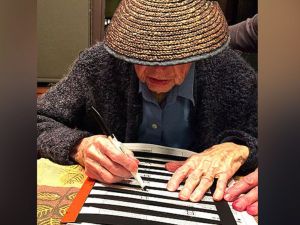
Stellajoe Staebler, 100, Centralia, Washington
Judd Legum at Think Progress: FBI launches internal investigation into its own Twitter account.
The account at issue, @FBIRecordsVault, had been dormant for more than a year. Then on October 30 at 4 a.m., the account released a flood of documents, including one describing Donald Trump’s father Fred Trump as a “philanthropist.” ….
But it wasn’t until two days later, when the account tweeted documents regarding President Clinton’s controversial pardon of Marc Rich that the account began to attract significant attention….
Candice Will, Assistant Director for the FBI’s Office of Professional Responsibility, said she was referring the matter to the FBI’s Inspection Division for an “investigation.” Upon completion of the investigation, the Office of Professional Responsibility will be referred back to the Office of Professional Responsibility for “adjudication.”
Federal law and FBI policy prohibit employees from using the power of the department to attempt to influence elections.
Will was responding to a complaint from Jonathan Hutson, a former investigative reporter who now works in communication in Washington, DC.
Read more, and see the tweets at Think Progress.

Estelle Liebow Schultz, 98, of Rockville, Maryland
Eli Lake at Bloomberg: The FBI Wants to Make America Great Again.
As Mark Corallo, a former Justice Department spokesman and Trump supporter, told me Wednesday, “The Marc Rich tweet is evidence of open warfare between the Justice Department and the FBI.” Corallo said this is largely because frustrated field agents believe the Justice Department has stymied the bureau’s investigations into Clinton’s e-mails and the Clinton Foundation.
Steven Aftergood, director of the Federation of American Scientists’ Project on Government Secrecy, told me it was true that records requested from multiple people are supposed to be added to the government agency’s electronic reading room. “What undermines that explanation is that they were not just added to the reading room, they were broadcast on this rarely used Twitter account,” he said. What’s more, Aftergood said government agencies have great discretion when they respond to Freedom of Information Act requests. “There is always a bottleneck, because the resources to review FOIA requests are inadequate to the demand,” he said.The move certainly appeared political. After all, former Attorney General Eric Holder was one of the first former officials to criticizeComey’s decision to update Congress on the e-mail investigation. Perhaps the tweet was a shot across the bow to Holder, who recommended the Rich pardon in 2000 as deputy attorney general under President Bill Clinton.
So what’s going on here? As the New York Times and the Washington Post are now reporting, and as my own sources confirm, many rank-and-file FBI officials are frustrated about the investigation into the Clinton Foundation and the way the e-mail probe was handled. Republicans too have wanted to see the FBI more robustly investigate the Clintons. So Comey has tried his best to split the baby.
Wayne Barrett at The Daily Beast: Meet Donald Trump’s Top FBI Fanboy.
Two days before FBI director James Comey rocked the world last week, Rudy Giuliani was on Fox, where he volunteered, un-prodded by any question: “I think he’s [Donald Trump] got a surprise or two that you’re going to hear about in the next few days. I mean, I’m talking about some pretty big surprises.”
Pressed for specifics, he said: “We’ve got a couple of things up our sleeve that should turn this thing around.”
The man who now leads “lock-her-up” chants at Trump rallies spent decades of his life as a federal prosecutor and then mayor working closely with the FBI, and especially its New York office. One of Giuliani’s security firms employed a former head of the New York FBI office, and other alumni of it. It was agents of that office, probing Anthony Weiner’s alleged sexting of a minor, who pressed Comey to authorize the review of possible Hillary Clinton-related emails on a Weiner device that led to the explosive letter the director wrote Congress.
Hours after Comey’s letter about the renewed probe was leaked on Friday, Giuliani went on a radio show and attributed the director’s surprise action to “the pressure of a group of FBI agents who don’t look at it politically.”
“The other rumor that I get is that there’s a kind of revolution going on inside the FBI about the original conclusion [not to charge Clinton] being completely unjustified and almost a slap in the face to the FBI’s integrity,” said Giuliani. “I know that from former agents. I know that even from a few active agents.”
Along with Giuliani’s other connections to New York FBI agents, his former law firm, then called Bracewell Giuliani, has long been general counsel to the FBI Agents Association (FBIAA), which represents 13,000 former and current agents. The group, born in the New York office in the early ’80s, was headed until Monday by Rey Tariche, an agent still working in that office. Tariche’s resignation letter from the bureau mentioned the Clinton probe, noting that “we find our work—our integrity questioned” because of it, adding “we will not be used for political gains.”
Also check out this piece by Barrett at The New York Daily News: Peas in a pod: The long and twisted relationship between Donald Trump and Rudy Giuliani.
As I wrote on Tuesday, Hillary is running against the Donald Trump, the GOP, the FBI, Wikileaks, and Vladimir Putin. And she’s still winning!
Please post your thoughts and links in the comment thread below and have a terrific Thursday. Hillary will be our next POTUS!

 peej
peej Carissa
 bostonboomer
 dakinikat
 ecocatwoman
 jjlo
jjlo mablue2
 Mama Lopez
 peggysue22
 quixote
 skydancingguestblogger
 Mona (aka Wonk the Vote)





Recent Comments