I’m still skeptical about this snowstorm. First we were supposed to get 2 feet of snow here in Greater Boston. Then we heard 12-18 inches. Now they are saying 8-12 and snow turning to rain after 5PM. I’d be interested to know what folks further south are getting. High winds are still expected. Here’s the latest from CNN:
I guess the heaviest snow is going to be further west than originally predicted. I hope that doesn’t mean you, Pat J.
Yesterday’s CBO report was devastating for the GOP’s proposed Trumpcare plan.
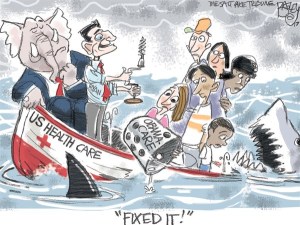
The Atlantic: The CBO Deals Paul Ryan’s Health-Care Plan a Major Blow.
The Congressional Budget Office on Monday projected that the House leadership’s American Health Care Act would result in 24 million Americans losing their health insurance while raising premiums for those covered on the individual market. Their bill would lower federal deficits by $337 billion over 10 years, largely as a result of cuts to Medicaid that would reduce its enrollment by 14 million, according to the estimate. Average premiums would rise by as much as 20 percent in 2018 and 2019 before falling in later years….
Of particular concern for GOP backers of the American Health Care Act is the CBO’s projection for its immediate impact. If enacted soon, an estimated 14 million people would drop their insurance next year because the proposal repeals the tax penalties associated with the individual mandate, the CBO forecasts. If people are not required to buy insurance, in other words, many will stop doing so. Millions more would join the ranks of the uninsured after 2020, when the bill would roll back the expansion of Medicaid under the Affordable Care Act. Conservatives have called for repealing the expansion sooner, which would likely result in more people dropping coverage in the first years after enactment.
Of course that would not be good for Republicans running for reelection in 2018.
Politico: White House analysis of Obamacare repeal sees even deeper insurance losses than CBO.
A White House analysis of the GOP plan to repeal and replace Obamacare shows even steeper coverage losses than the projections by the Congressional Budget Office, according to a document viewed by POLITICO on Monday.
The preliminary analysis from the Office of Management and Budget forecast that 26 million people would lose coverage over the next decade, versus the 24 million CBO estimates. The White House has made efforts to discredit the forecasts from the nonpartisan CBO.
White House officials late Monday night disputed that the document is an analysis of the bill’s coverage effects. Instead, they say it was an attempt by the OMB to predict what CBO’s scorekeepers would conclude about the GOP repeal plan.
LOL! I wonder who leaked that to Politico?
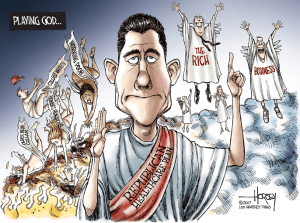
Granny starver Paul Ryan says he finds the CBO report encouraging because it accomplishes his goals–killing off older and poorer people and further enriching the already rich whom he considers deserving. This man is no Catholic. He should be excommunicated. Fox News reports:
Paul Ryan: Paul Ryan: CBO report on ObamaCare repeal ‘exceeded my expectations.’
Ryan told host Bret Baier that the CBO’s prediction that 14 million more Americans would be uninsured in 2018 was due to the bill’s overturning of ObamaCare’s individual mandate.
“Of course they’re going to say if we stop forcing people to buy something they don’t want to buy they’re not going to buy it,” Ryan said. “That’s why you have these uninsured numbers, which we all expected.”
According to Ryan, the key numbers in the analysis would come once the bill’s reforms took effect in 2020.
“It will lower premiums 10 percent. It stabilizes the market. It’s a $1.2 trillion spending cut, and $883 billion tax cut and $337 billion in deficit reduction,” Ryan said. “So, this compared to the status quo is far better.”
In response to a question from a Twitter user, Ryan said that ObamaCare’s repeal and replacement was a prerequisite for the House to take up tax reform, another key part of President Trump’s agenda.
Ryan is still the ultimate Ayn Rand fan. The fact that he says this stuff out loud shows what a terrible political strategist he is. Wisconsin needs to dump him next year.

And why will premiums go down? Margaret Singer Katz explains at The New York Times’ The Upshot: No Magic in How G.O.P. Plan Lowers Premiums: It Pushes Out Older People.
There are a lot of unpleasant numbers for Republicans in the Congressional Budget Office’s assessment of their health care bill. But congressional leadership found one to cheer:
Everyone hates to pay for a repair. That’s why you have a home warranty company in the first place, right? So why not eliminate the Service Fee charged by other home warranty companies when they come to your home.
The report says that the bill will eventually cut the average insurance premiums for people who buy their own insurance by 10 percent.
House Speaker Paul Ryan pressed that point in a series of appearances Monday night, suggesting that the budget office had found that the House bill would increase choice and competition and lead to lower prices. The Senate majority leader, Mitch McConnell, issued a statement saying, “The Congressional Budget Office agrees that the American Health Care Act will ultimately lower premiums and increase access to care.”
But the way the bill achieves those lower average premiums has little to do with increased choice and competition. It depends, rather, on penalizing older patients and rewarding younger ones. According to the C.B.O. report, the bill would make health insurance so unaffordable for many older Americans that they would simply leave the market and join the ranks of the uninsured.
The remaining pool of people would be comparatively younger and healthier and, thus, less expensive to cover. Other changes would help make health insurance skimpier — cheaper, but with deductibles that are higher than those criticized by Republicans under Obamacare.
Read the details at the NYT.
An issue that has been troubling me a lot lately (in addition to the Russia investigation) is that tRump apparently has no desire to fill the hundreds of federal government jobs that remain vacant.

The New York Times: Trump Lets Key Offices Gather Dust Amid ‘Slowest Transition in Decades.’
At the State Department, the normally pulsating hub of executive offices is hushed and virtually empty. At the Pentagon, military missions in some of the world’s most troubled places are being run by a defense secretary who has none of his top team in place. And at departments like Treasury, Commerce and Health and Human Services, many senior posts remain vacant even as the agencies have been handed enormous tasks like remaking the nation’s health insurance system.
From the moment he was sworn in, President Trump faced a personnel crisis, starting virtually from scratch in lining up senior leaders for his administration. Seven weeks into the job, he is still hobbled by the slow start, months behind where experts in both parties, even some inside his administration, say he should be.
The lag has left critical power centers in his government devoid of leadership as he struggles to advance policy priorities on issues like health care, taxes, trade and environmental regulation. Many federal agencies and offices are in states of suspended animation, their career civil servants answering to temporary bosses whose influence and staying power are unclear, and who are sometimes awaiting policy direction from appointees whose arrival may be weeks or months away.
“There’s no question this is the slowest transition in decades,” said R. Nicholas Burns, a former State Department official who served under presidents of both parties and has been involved in transitions since 1988. “It is a very, very big mistake. The world continues — it doesn’t respect transitions.”
Mr. Trump has insisted that the barren ranks of his government are not a shortcoming but the vanguard of a plan to cut the size of the federal bureaucracy. “A lot of those jobs, I don’t want to appoint, because they’re unnecessary to have,” Mr. Trump told Fox News last month. “I say, ‘What do all these people do?’ You don’t need all those jobs.”

Here’s some further analysis at Vox: President Trump is running an empty government. He thinks refusing to hire people streamlines the government. But it’s backfiring.
There are many reasons for the personnel crisis. Trump didn’t use the weeks-long transition to make second- and third-tier personnel picks. He has personally vetoed high-level picks at the Treasury and State Department who criticized him — even mildly — during the campaign. His West Wing staff lack experience in Washington and don’t know or seem to care much about how individual departments work.
Trump himself, meanwhile, simply thinks having fewer people working is better. “A lot of those jobs I don’t want to appoint, because they’re unnecessary to have,” Trump said on Fox News last month. “I say, ‘What do all these people do?’ You don’t need all those jobs.” Trump thinks the best route to the conservative ideal of small government is to practice what you preach — literally make the government much smaller by refusing to fill many posts.
The problem is that it makes government far less effective, even in areas like trade that are supposed to be a top priority for the administration. To take one example, a high-level summit in Chile this week will feature trade ministers from around the globe. But because the Trump administration hasn’t confirmed a trade official, the US will be represented by American’s ambassador to Chile, Carol Perez, a career diplomat who lacks the power and the technical knowledge of the other attendees, according to the Times.
Doug Irwin, an economics professor at Dartmouth College who specializes in the history of trade, said Perez may have a hard time keeping up with the hugely complicated and technical talks. Without large amounts of prior experience, he said, someone like Perez may not be able to “figure out what’s feasible and what’s not feasible.”
“It’s too complicated,” he said.
That captures one of the key issues with Trump’s refusal to fill high-level positions. There’s a difference between campaign rhetoric about trimming back the federal government and simply disregarding the management needs of mammoth government agencies that help run the most powerful country in the world and handle its relationships with other global powers. Trump appears to be heading down the latter path. And it’s going to make it harder for him to pursue his own goals.
Read more at the link.
Of course we all remember that Steve Bannon’s plan is for “the deconstruction of the administrative state.” Will it work? Stephen Collinson at CNN writes: Trump’s plan to dismember governmentHis first budget — expected to be unveiled later this week — will mark Trump’s most significant attempt yet to remold national life and the relationship between federal and state power.
It would codify an assault on regulatory regimes over the environment, business and education bequeathed by former President Barack Obama, and attempt to halt decades of steadily growing government reach.
Trump’s first budget will make more of a statement than most debut spending blueprints by other new presidents. The White House has made clear it intends to use the document to usher in the radical political changes that powered Trump’s upstart, anti-establishment campaign last year.
It comes on the heels of other big changes such as the abrupt dismissal of 46 US attorneys last week and the effort to dismantle Obama’s signature health care law.
Read the rest at the link.
That’s all I have for you today. What stories are you following–and how’s your weather?


















 peej
peej Carissa
 bostonboomer
 dakinikat
 ecocatwoman
 jjlo
jjlo mablue2
 Mama Lopez
 peggysue22
 quixote
 skydancingguestblogger
 Mona (aka Wonk the Vote)





Recent Comments