
Monday Reads
Posted: April 21, 2014 Filed under: Bobby Jindal, Climate Change, Corporate Crime, corporate greed, corruption, energy, Environment, Environmental Protection, Environmentalists, morning reads, tar sand oil, toxic waste 46 CommentsGood Morning!
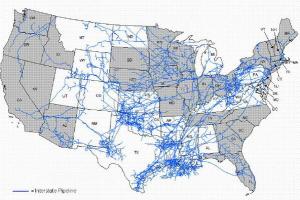 I’m going to remind you today of some events that happened 4 years ago with the BP Oil Gusher and show you that bad things are still going on in the Gulf.The leftover issues from abandoned oil rigs are bigger than Louisiana.Please consider this an open thread while I let you know how I feel.
If corporations are people, then BP and others in the extraction business are serial killers. All over our country and throughout our history, extraction companies have killed their employees, the people that live around their businesses, and the wildlife and the environment and water systems that sustain the life of our country. Look at that map. Those are active and orphaned/abandoned oil wells/pipelines that are disintegrating, leaking, and killing someone.
“I started noticing, towards the end of 2010, other leaks that were unrelated to the BP disaster,” Henderson says. “I would find wellheads that were leaking or platforms that were leaking. Just in the last year, I have filed 50 reports for different leaks and spills unrelated to the BP disaster.”
Under the Clean Water Act, when a company spills any amount of oil in the water, it must file a report with the National Response Center run by the Coast Guard. But when Henderson checked, he found many of those smaller spills were not making that list.
So environmental groups formed the Gulf Monitoring Consortium to get a better count on spills. The partnership is a blend groups of complementary skills.
Gulf Restoration Network, for example, has personnel who can spot spills from the air and file complete reports.
SouthWings, a group of volunteer pilots, helps get those spotters aloft.
Louisiana relies largely on the oil industry to self-report leaks and spills. The Gulf Monitoring Consortium was formed to improve that effort and said it often finds smaller leaks like this one, near Golden Meadow, that go unreported by the companies.A third member, the West Virginia-based tech group SkyTruth, finds the spills on satellite photographs, then applies a formula used by spill experts to translate the size of the oil sheen into gallons of oil in the water.
SkyTruth spokesman David Manthos says its estimates typically are much higher than what’s been reported.
“We found that the spill was usually 10 times larger than had been reported, and that was averaged out across a lot,” he says. “In some, the mismatch was much larger than that.”
The sheer size of the industry here means there’s seldom a quiet day for the consortium. In an average year, the NRC receives 10,000 reports of spills in the Gulf.
It’s a number that surprised even SouthWings Gulf Program Director Meredith Dowling, a veteran of monitoring efforts.
“I can’t think of a single instance where our volunteers have flown offshore and not found spills,” Dowling says. “This was something that was really amazing to me when I first moved here … that is was a continuous, absolute failure of business-as-usual practices.”
There are many active spills around here. Many come from orphaned and abandoned wells. Many come from active wells. They are all spewing toxic waste and it’s not just in Louisiana. Here is a program in Pennsylvania dedicated to plugging orphaned and abandoned wells. There are similar issues in Texas, New York State, and just nearly anywhere there’s been activity. Louisiana alone has about 6000. You can see that they are nearly everywhere if you look at the map at the top of the post. Many of these wells were first put into play in the 1850s and were just left where they were. They are rotting, they are decaying, and they are leaking. They are also dangerous.
Methane is an odorless, colorless gas that exists naturally below the surface. It isn’t poisonous, but it’s dangerous. When enough methane gathers in an enclosed space — a basement or a water well, for instance — it can trigger an explosion.
The gas didn’t come from the Butters well, nor did it originate from the Marcellus Shale formation that a nearby Shell well had recently tapped into. What most likely happened to cause the geyser in June, Shell and state regulators say, was something of a chain reaction. As Shell was drilling and then hydraulically fracturing its nearby well, the activity displaced shallow pockets of natural gas — possibly some of the same pockets the Morris Run Coal company ran into in 1932. The gas disturbed by Shell’s drilling moved underground until it found its way to the Butters well, and then shot up to the surface.
Areas impacted by oil spills are never the same. The BP Oil Gusher has introduced issues into the ecosystem that have left endangered species teetering further towards extinction. In the case of Louisiana, it’s even the state bird.
On a bright spring morning, P.J. Hahn is walking through a graveyard in the middle of Barataria Bay.
It’s a 30-yard patch of mud and sand bristling with bare, dead mangrove brush surrounded by miles of open water. Each mangrove is a tombstone marking the death of a nesting site used for decades by brown pelicans and roseate spoonbills on what was once the string of wetland pearls that made up the Cat Islands chain.
But in 2010 the oil spewing from BP’s Deepwater Horizon would send them all to an early grave.
“Four years ago we had more than five acres of habitat and there were tens of thousands of birds nesting on these islands,” said Hahn, director of coastal zone management for Plaquemines Parish. “Then the oil came in and coated the mangrove roots, and two years later the islands started going.
“I don’t know where those birds are nesting now – but they can’t do it here any more.”
The post-BP story of the brown pelican, Louisiana’s official bird, is the perfect metaphor for the crisis confronting the state’s coast.
Before the Deepwater Horizon blew out on April 20, 2010, brown pelicans were living the good life in southeast Louisiana as one of the great wildlife comeback stories. In 1963 not a single brown pelican could be found in the state due to impacts from the insectiside DDT. The comeback started in 1968 when the state began transplanting birds from Florida, and populations began to soar after DDT was banned in 1972. Thanks to the abundant food in one of the world’s most productive fisheries, by 2010 their numbers were thought to be near historic levels, as high of 85,000.*
 Four years later, the sea floor closest to the spill and even the shores in the Gulf of Mexico are comparable to an Arizona Desert. It is barren, bleak and dead. There was life there. Now, there is the look of a forest fire without the resultant new growth. Nothing will grow back amid the poison of Corexit and Oil.
When a crew of journalists and environmental groups studying the effects of the BP Deepwater Macondo oil spill disembarked on Cat Island in Baratria Bay last week, there was a collective gasp.
“It looks like the Arizona desert,” said Eileen Fleming, who’s reported for WWNO spring after spring since the April 20, 2010 spill.
“It looks like there was a fire here,” said Doug Meffert, vice president of the National Audubon Society and president of the Louisiana chapter, “but there wasn’t a fire.”
The bones of black mangrove stumps are all that remain of what was a thriving bird rookery here in Plaquemines Parish Four years ago, footage of oiled brown pelicans and the thousands of shorebirds nesting here went around the world in the aftermath of the 200 million gallons of thick crude that spilled into the Gulf of Mexico.
Today the only green thing on the beach is a glass bottle. There are no pelicans, no mangroves, and worse, much of Cat Island itself is washing away. It and most of the barrier islands and marsh in Barataria Bay are steadily degrading, losing their battles with coastal erosion and subsidence faster than ever.
Areas around Barataria Bay and Grand Isle, La. were particularly hard hit, but they weren’t the only affected areas. Moreover, thousands of birds, other wildlife and marine life including dolphins perished, were oiled, sickened and overall left in distress. The effects on the area resonate now, which is only a shock to those either unfamiliar with garish oil spills or unwilling to accept the truth.
In the days following the “spill”, BP, apparently colluding with the US Government, doused a horrific amount of a deadly dispersant in the affected areas. Called “Corexit”, the cutesy name belies the sickening effects it brings to all it touches. On background, an environmentalist working in the area explained to me last year that they were, essentially, damned if they did, and damned if they didn’t, but chose the lesser of two ills.
That remains to be seen as the National Institutes of Health continues its 10-year “GuLF” study of BP spill health effects, from those most affected out on the Vessels of Opportunity boat that included BP-hired personnel trying to contain the spill, to residents in the line of fire, such as around Barataria Bay.
There is a way of life dying along the southern parts of the Gulf Coast in Louisana. The coastline disappears daily, the salt water intrudes in to the fresh  water marshes, and the land doesn’t sustain the people or the animals like it once did. There is not better place to study the impacts of the extraction business and human addiction to fossil fuels than many parts of Cajun Louisiana.
Sea level rise is like an ultra-slow-motion hurricane for low-lying areas, but unlike a hurricane, it can be forecast decades in advance. Projections that some town or road will be underwater in 100 years can—and must—be mitigated against today.
Osborn characterizes the choice as “being proactive rather than reactive. Once you get into situations like Louisiana facing some very serious challenges in a very near time frame, all of a sudden you’re in a reactive posture.” Louisiana is a harbinger of things to come for New York, Miami, and other major coastal cities that would do well to look 20 to 75 years ahead and budget accordingly. Local, state, and federal governments will have to make critical decisions about infrastructure, water and sediment diversion, and wetlands restoration in the next 10 to 15 years, he says, and while NOAA scientists can contribute data, they can’t green-light projects or secure funding.
Osborn makes a technical distinction: “Right now it’s what’s called frequently flooded. And the risk is it will be routinely flooded.” Routine flooding will start to happen as early as 10 years from now, he says. They can call it whatever they want, but Gill says soon LA 1 will be “flooded every day during high tide.”
NOAA scientists predict that eventually all the marsh that surrounds LA 1 and Port Fourchon will disappear, connecting two major bodies of water that now are distinct: Barataria Bay and Terrebonne Bay. The only thing out in the water at all, by 2100, may be a raised road and Port Fourchon. “I can imagine Port Fourchon being like the Florida Keys,” says Chiasson, “being on its own, in the middle of open water, maybe a little marsh around it, but nothing between here and there.”
The fact that the entire extraction business is so fraught with so many bad things is why the men that run it must find politicians to protect them from lawsuits and regulations. Making these guys pay for what they’ve done would undoubtedly run their companies deeply into the red. Donation whores like Republican Governor Bobby Jindal will do anything to protect the benefactors that he hopes will fund him to the White House. There is nothing about Louisiana that this man is interested in except as a step on the rung of his personal ascent.
The state Senate targeted the flood protection authorities around New Orleans and the lawsuit one of the levee boards filed against the oil and gas industry for damages to the state’s wetlands.
In one bill, advanced by a Senate panel Wednesday morning, Gov. Bobby Jindal would get sweeping power to remove members of the Southeast Louisiana Flood Protection Authorities. Opponents said the move, which would allow a governor to remove authority members under certain conditions, reintroduces politics into the levee boards, which is precisely what revamp after the 2005 hurricanes was designed to prevent.
Another measure, which was passed by the full Senate late Tuesday night, would derail a lawsuit filed last year by the Southeast Louisiana Flood Protection Authority — East against 97 oil and gas companies. The levee board sought damages for contributing to coastal erosion and led to higher than anticipated storm surges.
Jindal opposes the lawsuit and has called it a windfall for lawyers, who would be paid with a portion of any winnings rather than a flat fee. Critics say the legislation would keep the oil and gas industry from taking responsibility for damage caused by drilling and productions activities over the years.
SB553 is aimed at a lawsuit filed by the Southeast Louisiana Flood Protection Authority-East. It would not impact similar suits filed by Jefferson and Plaquemines Parishes. But other measures currently being considered might.
The legislation passed Tuesday night, Senate Bill 553, would apply to retroactively. That measure was sent Wednesday morning to the Louisiana House.
Even kindergartners know they should clean up their messes. That is ones that aren’t sociopaths.
But, wherever there has been the extraction business, there are the sociopaths. We have the hundred year anniversary of just such an example.
Linda Linville climbed down the steep stone steps into the dugout on the southern Colorado prairie Sunday where one branch of her family was wiped out in one day 100 years ago.
Her great aunt, her unborn baby and two children died in a fire that broke out during a battle between coal miners striking against John D. Rockefeller, Jr. and the Colorado National Guard in what became known as the Ludlow Massacre. Twenty-seven-year-old Cedilena Costa, 4-year-old Lucy and 6-year-old Onofrio suffocated from the smoke as they hid below ground to escape the battle. Linville said Cedilena’s husband, Charlie Costa, was captured and shot in the head that day and never knew his family’s fate.
“Anyone who says they died in vain is wrong,” said Linville, a retired history teacher from Corona, Calif., referring to the fact that the miners eventually ended up going back to work without winning any of their demands.
The massacre and battle left 21 people dead, including the Greek-American union leader Louis Tikas, and set off 10 days of civil war in which the miners killed 30 mine guards, supervisors and strikebreakers. They surrendered only after President Woodrow Wilson sent federal troops to the state.
The deaths drew national attention to the long running strike and forced Rockefeller to take a public role in Colorado Fuel & Iron. He instituted a company union and grievance system, which the miners later rejected when the won a right to unionize on their own during the New Deal. The massacre and the deadly Triangle Shirtwaist fire in 1911 are credited with the helping win the eventual passage of the 1935 National Labor Relations Act.
Linville and over 100 others — including members of the United Mine Workers of America wearing the red bandanas the strikers wore — gathered at the site of the former Ludlow tent colony to mark the massacre’s 100th anniversary with a Greek Orthodox Easter service. It was very similar to the one the miners, who came from a variety of countries, shared in 100 years ago with the Greek strikers the day before the massacre. In a coincidental reminder of Ludlow’s international community, the Easter service will include the traditional reading of the Gospel story in many languages to symbolize the universality of its message.
It is easy to look back at the years of coal and oil and see that not much has really changed in terms of the business. The only thing that’s changing is that people, nature, and animals don’t have a chance at all and the deathtoll and damage are obvious if you actually get to see it. I have a small car. I really don’t drive much at all. I think in a busy week I may put on 15 miles. I have a bike and nearly everything I need is about a mile away. I suppose, for me, that it’s nothing to say that I really don’t benefit from any of this. I’d frankly rather pay for every single person to have some form of solar or wind generator in their home than the tax breaks we give to the oil industry. I think it would save every one in the country a lot less grief in the short and long run. But then, I could care less how much money the likes of the Koch Brothers earn. I’d frankly rather be dancing on their graves.
I just wanted to add that I found some of these wonderful skull art prints from this site.
I know it doesn’t look like it, but this is an open thread.
What’s on your reading and blogging list today?
Sunday Morning Reads………An Eclectic Mix
Posted: June 17, 2012 Filed under: abortion rights, bees, Climate Change, Environment, morning reads, Nigeria, social media, toxic waste, U.S. Military, Violence against women | Tags: 350.org, activism, Bill McKibbon. Emem Okon, environment, fossil fuels, gardening, rape in the military, Rio+20, Twitterstorm 41 Comments
Good Morning, All. I am pinch hitting for JJ while she and her family are visiting our nation’s capital. I haven’t traveled much, but I have been to D.C. twice. What an amazing place. This will be an eclectic mix of links and stories, covering many different categories. I hope you will find at least some of them of interest to you.
This first group is about gardening. bb had mentioned to me that she likes to work in her garden, so I figured she would enjoy these. The first is a list of ideas on how to attract butterflies to your garden.
Planting your garden with plants that attract butterflies is only one step in making your garden butterfly-friendly. Once butterflies discover your garden the females will lay eggs on plants that become food for the hatching caterpillars.
The host plant selected, and the time of year the eggs are laid, depends on the species of butterfly. Different butterflies prefer different host plants.
Bees are pollinaters, picking up pollen as they go from flower to flower to gather nectar. Obviously they are an important component for a successful garden. Besides nectar, bees also need water and this has ideas about how to make a watering hole for bees.
As the temperature rise in the garden it is important to remember the bees you’re attracting to your garden will also be searching for water. For bees, a supply of water is as important as pollen and nectar forage in the summer.
Besides the lovely green foliage of a garden, it is important to do what we can to use “green” products. Treehugger contributor Ramon Gonzalez provides a list of 10 sustainable garden products.
A garden that is kinder to the earth can be achieved through the selection of products and tools that are sustainably manufactured or given new life through recycling. It’s never been so easy to build a garden that’s green from the moment you plunge that spade into the soil.
Many commercial fertilizers used in both gardening and farming contain phosphates. Aasif Mandvi of The Daily Show covered a story about Simplot, a phosphate mining company in Idaho. Naturally, it is a satirical look at the dangers of phosphate mining and the damage being done by the by-product, selenium. Greater Yellowstone Coalition is an environmental organization working to get J.R. Simplot Co. to Clean Up Its Smoky Canyon Mine Superfund Site.
The New York Times featured a story and video today about the industrial damage done to Newtown Creek since the mid-1800s, and Mitch Waxman who has chronicled its history. The waterway was declared a Super Fund site in 2010.
If Mitch Waxman is your guide, he will identify it as the derelict smokestack of Peter Van Iderstine’s fat-rendering business, which first set up shop in 1855. But he won’t stop there.
He will expound on the archaic waste-disposal operations that once flourished on the creek, conjuring scenes of putrescent horse carcasses floating in on barges from Manhattan and docks piled with manure three stories high. The narrative will extend to Cord Meyer’s bone blackers and Conrad Wissel’s night soil wharf — the gothic names of these forgotten businesses rattled off in a distinct Brooklyn accent.
At some point, he will start in on the horrors of the M. Kalbfleisch Chemical Works, eventually making his way to the sins of Standard Oil.
Moving on to some stories about activism that caught my eye. The first story comes from Truth-Out about The Heritage Foundation’s conference to re-brand the Occupy Movement. Matt Dineen interviews Jason del Grandio, the author of Rhetoric for Radicals. Here’s a snippet of what Jason has to say about his perceived purpose of the conference.
The speakers make frequent reference to capitalism, free markets and free enterprise, and often mention traditional buzzwords like individual liberty and the pursuit of happiness. The Heritage Foundation is trying to understand the populist appeal of Occupy, and by doing so, trying to use that appeal to “win back” some of the Occupiers. Or, at the very least, to impede Occupy’s progress and win the hearts and minds of those who are still on the fence.
Brian Merchant interviews Tzeporah Berman, an environmental activist since was was 19, for Treehugger. This quote really hit home for me – you can’t un-know or un-see an injustice once your eyes, mind and heart have been opened to them.
Sometimes I wish I could open up a paper and not be immediately drawn to the story about mercury in fish or the dramatic increase in flooding in Sudan. But I can’t now.
Have you heard of Emem Okon, the Nigerian ecofeminist? I had not. She is a courageous woman, organizing other women of the Niger River Delta and taking on Chevron. The interview from Antonia Juhasz is reprinted from Ms magazine on Truth-Out.
One of the most prominent voices was Emem Okon, founder and executive director of Kebetkache Women Development & Resource Centre of Nigeria. A community organizer and women’s rights activist from the Niger Delta, Okon is leading a thriving Nigerian ecofeminist movement. She has coordinated several local women’s networks and coalitions, including Women Against Climate Change (WACC), International Network on Women and Environment, Niger Delta Women for Justice and Niger Delta Women’s Movement.
Speaking of women, the New York Times featured a story on the the Human Rights Film Festival at Lincoln Center. The review starts off with a profile of The Invisible War, which won the 2012 Audience Award at the Sundance Film Festival.
It hardly needs to be said that any armed force has the potential for internal as well as external violence. But “The Invisible War,” Kirby Dick’s incendiary documentary about the epidemic of rape within the United States military, is a shocking and infuriating indictment of widespread sexual attacks on women. Such behavior, the film argues, is tacitly condoned and routinely covered up; the victims are often blamed and their reputations destroyed.
I found other links to discussions of the film, at the military publication, Stars and Stripes along with stories about Congress denying healthcare coverage for abortions for military women who have been raped. from Mother Jones.
The Rio+20 Summit begins on Monday, June 18th. President Obama and England’s David Cameron WON’T be attending, however Hillary Clinton will be representing the U.S. BBC News has more about Rio+20 and the awful state of the world’s oceans.
The researchers assessed the various pledges made at the landmark 1992 Earth Summit and 10 years later at the Johannesburg World Summit on Sustainable Development.
Governments vowed to establish an ecologically sound network of marine reserves by 2012, eliminate subsidies that contribute to illegal fishing, protect critical habitat, look after the needs of local fishermen and restore depleted stocks to healthy levels by 2015.
Subsidies have not been eliminated, and illegal fishing is still a major issue in some parts of the world.
Tom Ashbrook, host of NPR’s On Point, interviewed Bill McKibben of 350.org on Friday’s show. McKibben’s name is probably best known for the protests against the Keystone XL Pipeline, held outside of the White House, along with his subsequent arrest for protesting. You can listen to the audio at the link above. Here’s a short introduction:
Environmental champion Bill McKibben wrote nearly a quarter century ago about what he called “the end of nature.” The untouched wild. He didn’t think he was writing about the end of the world. But the climate change path since then has been a scary one. Bad to worse.
And McKibben has gone from writerly philosopher to full-on environmentalist to activist in handcuffs. Political street fighter. He was at the heart of the campaign to stop the Keystone XL pipeline. Arrested at the gates of the White House.
The current campaign of McKibben and 350.org is ending fossil fuel subsidies. These companies are paid by governments in the neighborhood of 1 TRILLION DOLLARS a year to pollute our planet. 350.org is organizing a Twitterstorm for June 18th. Although I don’t have a cell phone (and refuse to get one), I plan to set up a Twitter account so that I can participate. I hope that you will go to the link and sign up to participate as well. This quote comes from Treehugger about the Twitterstorm:
If you’re itching to do some petition signing right now: End Fossil Fuel Subsidies, and check out how your representative (in the US) stands on ending subsidies: End Fossil Fuel Subsidies Scorecard
There’s also more info on the Facebook event page: Twitter Storm: #EndFossilFuelSubsidies
Since it’s Father’s Day, I thought I would end this with a trbute video to a very special Dad
from Discovery News.
When Corporations Mutate Into A Super Race
Posted: March 12, 2012 Filed under: corporate money, corporatism, Economy, energy, Environment, Environmental Protection, Environmentalists, fracking, Regulation, toxic waste 12 CommentsWe all remember Mitt Romney’s public and awkward statement that ‘Corporations are people, too.”
But Romney was underplaying the reality of American life in 2012.
Corporations are not mere people. They have morphed into a Super Race, ready to conquer what’s left of our disintegrating democracy. If you think this is liberal hysteria or rank hyperbole, I give you Pennsylvania’s newly passed Act 13. Bad number. But the scope of this foolish and utterly destructive state giveaway is far worse.
Act 13 is a massive gift to the oil and gas companies, which overturn property rights, strips municipal communities of zoning law protection and turn environmental and health compromises into considerations we can no longer afford. It reduces the citizens of Pennsylvania to 3rd world colony status, ripe for exploitation and extraction. Welcome to the New World of Corporate Rule where natural gas extraction is the profitable prize and quality of life is a thing of the past.
And the reaction?
“Now I know what it feels like to live in Nigeria,” said recently retired Pittsburgh City Council President Doug Shields. “You’re basically a resource colony for multi-national corporations to take your natural resources, take them back to wherever they are at, add value to them, and then sell them back to you.”
Yup. This is the neoliberal dream. Steal, add value and then sell back at an exorbitant price tag. The whole world is nothing more than a resource colony so the corporate Super Race can turn a mind-boggling profit. On the backs of the natives. Water safety and/or depletion, health, wildlife? All expendable in this great push for growth and ever-increasing profit. Moral considerations? Please, haven’t you gotten the email? Corporations don’t do morality. They’re too big for that.

Fracking in SW Pennsylvania
Why did this happen in Pennsylvania? Because of the enormous layer of shale deposits known as the Marcellus formation, resting like a slumbering giant beneath the state’s surface. But there’s more! That would be the gargantuan amount of natural gas to be had at a stunning profit—as much as 70-99% some managers of earlier drill wells have boasted.
How could investors resist?
But then, there are the rising concerns of the fracking process itself, the public’s growing awareness of water and air pollution, the niggling problem of toxic wastewater disposal and those bothersome legal suits from citizens with lame health issues.
What to do, what to do?
Act 13 is the perfect response to investor skittishness. It removes all complaint and whining by simply supplanting existing law—the kind that protects the citizen—with corporate friendly law that recognizes the global reality—everyone is for sale and everything can be exploited.
To keep tempers in check, the best PR in the world is dished out, promises of jobs and prosperity, spinning dialogues about energy independence [at any cost] and patriotic flag-waving—how tearing up the earth, polluting our waterways and compromising the public’s health is good for America. After all, in times of crisis, sacrifices need to be made, even when it means overriding the civil rights of people and communities.
That is exactly what Act 13 addresses.
Courts in the Great State of New York upholding community rights to block fracking dreams is simply unacceptable. Act 13 revokes those rights. The Lakota people in South Dakota blocking TransCanada truck transports across Native territory? We can’t have that. Act 13 clearly empowers a corporation to seize property that impacts any stage of the drilling process. And those possible health considerations? Got it covered, boys and girls. Act 13 prohibits physicians from discussing medical impacts from chemical contaminations. The Halliburton Loophole in all its malicious splendor comes back to haunt us.
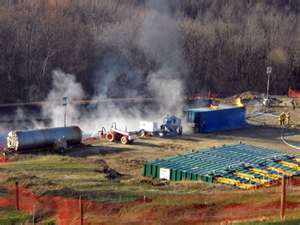
Marcellus Fracking Pit
This is what happens when corporations are declared ‘people.’ This is what happens when legislators sell their souls for 30 pieces of silver. I do not care if Republican Governor Corbett and his Republican dwarves truly believe this is good for Pennsylvania. This is a betrayal of American law and her people on a massive scale. The good citizens of Pennsylvania might look at the situation in Ohio, where Governor Kasich opened the state’s doors for business, any business, and Ohio became the dumping ground for fracking wastewater disposal and deep ground injection wells. We now know those earthquakes were not coincidental events. No wonder Republicans hate science!
Hattip to Alternet on this rant. I’d recommend reading the article ‘Fracking Democracy: Why Pennsylvania’s Act 13 May Be the Nation’s Worst Corporate Giveaway’ by Steven Rosenfeld in its entirety with the first link I provided. It’s a chilling, mind-blowing report.
Act 13 is expected to take effect on April 14th. We better pray [regardless of what state we live in] that the groups now amassing in Pennsylvania are able to halt or at least slow down this corporate monstrosity.
Because if not, we can say ‘adios’ to the shredded remnants of our Republic.
As for Pennsylvania? My heart goes out because I lived and worked in the state for over a dozen years and still have family in the area. The economy has been raked over the coals, so the promise of jobs and money injected into struggling municipalities and rural communities is a huge seduction. But we’ve seen this movie before. It does not end well. Here’s hoping that flesh and blood citizens get a chance to write a far better script for themselves and their future. Here’s hoping the rest of the country wakes up to what can only be called a corporate takeover.
There Will Be Blood
Posted: February 23, 2012 Filed under: alternative energy, energy, Environment, First Nation, health hazard, Keystone XL pipeline, Northern Gateway pipeline, Regulation, tar sand oil, toxic waste, US & Canada, Water 22 CommentsIf you listen to the GOP, you’d be convinced that the WH, Democrats in general and crazed environmentalists specifically had nixed the Keystone Pipeline out of sheer orneriness or a deep-seated hatred of good ‘ole American Capitalism. Rick Santorum and his Prince of Darkness tour would no doubt smell brimstone in the midst of any pipeline dissent.
Well, surprise, surprise. The push back is not limited to protestors in the United States. Our northern neighbors in Canada have as many if not 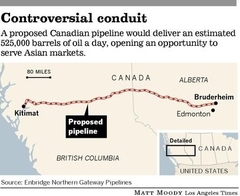 more objections to the Petro State ripping through their country, poisoning watersheds, destroying wildlife and property, causing disease and health problems among citizens, all in the name of King Oil and the desire to wring every last drop out of the planet.
The Hell with Consequences!
First Nation, the indigenous population of Canada, has already predicted:
There will be blood!
Why the outcry? Enbridge, Inc. and the conservative government in Canada is pressing forward with their own pipeline project, Northern Gateway, which would carry 500,000+ barrels a day 731 miles from a town near Edmonton, westward through the Rocky Mountains to a port on the British Columbia [BC] coast. Over 60 indigenous organizations have expressed their opposition, refusing to be moved by the promise of revenue, jobs and an increase in their quality of life because their lives are deeply attached to the natural resources of BC, most importantly the integrity of the salmon trade that depends on the streams and tributaries of the Fraser and Skeena Rivers. In addition, the proposed port on the coast, which would host over 200 oil tankers a year, could expose the Great Bear rainforest to irreparable damage.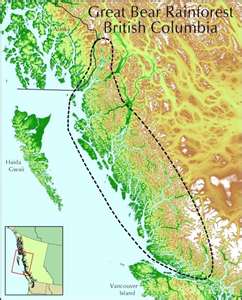
Think Valdez!
Interestingly enough, First Nation opposition is the most serious threat to the Harper government’s enthusiastic endorsement of the pipeline. Unlike other indigenous groups, First Nation never signed treaties with the Canadian government and consequently never relinquished their lands to the Federal government. On the other hand, the government and oil companies have nearly unlimited funds to fight this battle in court.
According to the LA Times report Tribal Chief Jackie Thomas has said:
“It’s going to be a war. The only question is, who’s going to draw the first blood.”
And here’s a chilling factoid: Enbridge is the same company responsible for the leak of 800,000+ gallons [the EPA now reports over 1 million gallons] of tar sand oil into the Kalamazoo River, Michigan. Presumably, the oil company has spent $700 million in reclamation procedures. The area is still a gigantic mess.
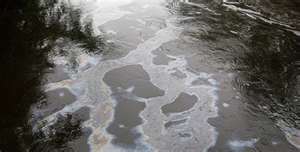
Kalamazoo River Spill
Added to the environmental risks [the cost of which is usually ignored] the Northern Pipeline is likely to boost the price of oil for Canadian consumers because like the Keystone proposal, the oil would be exported, not available domestically. The video below is instructive in a grim way.
Why are we having these bitter disputes?
Because we desperately need new energy sources. And there’s tons of money on the line. More importantly, we need an Energy Policy/Strategy, where the pros and cons of transitional sources are seriously considered–the trade-offs, the costs, what we as a culture are willing to put up with or risk until renewable, clean sources are developed and brought online. That’s a plan that would look at what we need today, five years down the road, 10, 20, 30 years. You set benchmarks. You invest in, encourage and unleash innovation, while focusing on increased efficiency from power plants–the traditional US coal power plant is only 35% efficient, meaning we’re wasting most of the energy we’re producing–to autos to buildings to everything else.
Where is that policy? Nada.
The Department of Defense’s push towards alternative energy is not a sign of the US military becoming rabid tree huggers. As the world’s largest institutional energy consumer, the DOD knows the score: the days of cheap fossil fuel are over and our dependence on foreign and unfriendly suppliers is a serious security issue. The Department’s commitment to this reality can be seen in proposed budget expenditures: $3 billion by 2015; $10 billion by 2030.
As GreenTech Media reported, this sort of shift has historical parallels:
Military spending in support of energy is not new. Winston Churchill’s decision in 1911 to move the British Navy, then the world’s then most dominant military force, from coal to oil changed the world’s energy marketplace. The emerging trend in DoD spending on renewables is an equally historic marker.
Neither American or Canadian energy needs should come down to an either/or contest: shut off the electricity or rip the environment apart, robbing people, wildlife, the very planet of their health, sustainability and future. We cannot poison our watersheds, jeopardize our aquifers or damage fertile farmlands for the sake of profits or our unwillingness to conserve and efficiently utilize what we have. King Oil has ruled long enough. The damage they’re willing to exact is unacceptable, even obscene.
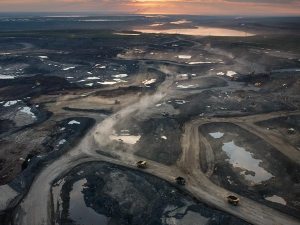
Alberta Tar Oil Sands, Aerial Satellite Shot
First Nation peoples of British Columbia know this and are willing to fight tooth and nail to preserve what’s left of their way of life and cultural traditions. To save the irreplaceable.

Great Bear Rainforest
There may very well be blood. It’s a worthy fight.
Zombies and Vultures and Pipelines, Oh My
Posted: February 5, 2012 Filed under: Domestic Policy, Environment, Environmental Protection, ethics, Gulf Oil Spill, health hazard, K street, legislation, lobbyists, Politics as Usual, Regulation, Republican politics, science, toxic waste, Water | Tags: Climate change, environmental problems, oil spills 6 CommentsThe zombies seem to be winning the war against the living. We have zombie banks, zombie politicians [think Rick Perry], zombie policy—free market fundamentalism preached as an untried economic theory.
And now zombie pipelines.
Just when you thought the Keystone XL controversy had been put to rest [at least temporarily], its zombie presence lunges forward, reanimated for all to see. Although I suspect supporters of this very bad idea are hoping the American public is not watching or if they are watching they will buy the swill on the non-existent benefits of a 1700-mile tar sands pipeline.
What am I talking about?
I found a disturbing inquiry [hattip to OEN] by Representative Henry Waxman to a Deborah Hohlt, who received $50,500 from the Great State of Indiana [that would be paid in state taxpayer monies] to lobby in DC on behalf of the TransCanada Keystone XL Pipeline. Indiana’s Governor Mitch Daniels provided the rebuttal to the President’s SOTU address, in which he referred to the Administration’s decision to ‘postpone’ the pipeline’s construction as an ‘extremist’ policy.
As you might remember the Republican chorus on this subject has been jobs, jobs, jobs. House Speaker Boehner has quoted 100,000 jobs at stake. TransCanada has been all over the map with job estimates, the last, most creative quote coming in at 250,000 jobs. Unfortunately, the numbers are at odds with the single independent analysis from Cornell Global Labor Institute, estimating the number at between 4000-6000 temporary jobs. The steel for the pipeline? Would be coming from India. The cry that the pipeline would reduce our reliance on foreign oil? The refined tar sands oil is contracted for export [80%] to South America and Europe.
The upsides are slim to none, considering the toxic, corrosive nature of tar sand oil, the sludge-like quality that requires pressure and heat to make a pipeline flow possible. That also increases the risk of a leak and an environmental disaster. Anyone who may question the heightened risk should check out the total mess in Michigan when over 800,000 gallons of tar sand oil spilled and contaminated 40 miles of the 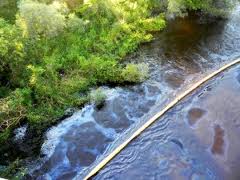 Kalamazoo River and surrounding properties.
And the reclamation? These corporations should hang their heads in utter shame. If you want to be thoroughly disgusted check out the You Tube clip I provided in an earlier post.
But here’s the really curious thing. The pipeline won’t be running through Indiana. The pipeline will not be running close to Indiana’s borders. No Indiana facilitities will have access to the pipeline. In fact, it appears that Indiana does not stand to be impacted in anyway by the Keystone pipeline and yet Governor Daniels felt compelled to call President Obama an extremist for postponing the pipeline’s construction. He was also willing to pay a $50,000+ [in state taxpayer money] to lobby for the Great State of Indiana in defense of the pipeline.
More curious still? TransCanada has stated that the pipeline will ‘increase’ oil prices for Indiana and other Midwestern residents because the area is ‘oversupplied.’ Keystone’s successful construction [this is stated in TransCanada’s application] will ensure higher prices for Canadian crude. By independent analysis costs will increase $6.55 per barrel in the Midwest and $3 per barrel everywhere else. The Indiana Petroleum Council thinks this is a swell idea.
Which begs the question: Who does Governor Daniels work for? His constituents or the oil companies?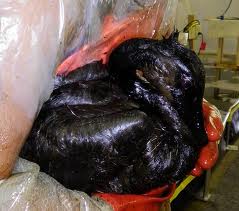
So, it should not be any great surprise that a Senate group–laughably-called bi-partisan because it includes 1 Democrat, Joe Manchin from W. Va.–is reintroducing the Keystone proposal, pushing for immediate construction with or without the Administration’s approval. The Senate committee is invoking the Commerce Clause of the Constitution, which says Congress should have the power:
To regulate Commerce with foreign Nations, and among the several States, and with the Indian Tribes.
I love it when the Republicans start waving the Constitution. It’s a clear signal they’re up to no good. Did I mention that Koch Industries stands to make a killing on this project?
While reading Representative Waxman’s letter, I recalled something I’d read in Greg Palast’s book Vultures’ Picnic and found an accompanying and equally disturbing text online here and here. To quote Palast:
Reserves are the measure of oil recoverable at a certain price. Raise the price, raise the reserve. Cut the price and the amount of oil in the ground drops. In other words, it’s a fool’s errand to measure the “amount of oil we have left.” It depends on the price.
Specifically, oil companies and oil-related financiers are not interested in expanding oil supplies to the world, particularly cheap oil supplies  [because the days of cheap oil are over]. They’re interested in feeding the hunger for oil and controlling the price around the world with an iron fist. The higher, the better. The environment—air, water, soil–is not the concern. Our health or that of our children is not the concern. The bottom line—profit and power—is all that matters. If nations collapse? The Vultures are waiting to feast on the bones.
Sound harsh? It shouldn’t. Zombies and vultures are kissing cousins. They’re coming ‘round for a friendly visit. Again.

 peej
peej Carissa
 bostonboomer
 dakinikat
 ecocatwoman
 mablue2
 Mama Lopez
 peggysue22
 quixote
 skydancingguestblogger
 Mona (aka Wonk the Vote)



 Sky Dancing
Recent Comments