
Friday Reads
Posted: March 11, 2011 Filed under: collective bargaining, Domestic terrorism, Environment, Environmental Protection, Foreign Affairs, morning reads, right wing hate grouups, The Media SUCKS, the villagers | Tags: Climate change, General Clapper, Islamophobia, Libya, Peter King, polar ice sheet mass loss, Senator Lindsay Graham, Wisconsin 19 Comments Good Morning!
I’ve noticed that we seem to be seeing a lot of change recently along with a lot of people that would prefer to stick their heads in the sand and try to legislate the world back 100 years. It really seems like science, voter sentiment, and the world are at odds with the vision of our leaders these days. Here are some examples.
A study done by the U.S. Jet Propulsion Laboratory, was just published in Geophysical Research Letters here provides some pretty clear evidence that the polar ice sheet mass loss is accelerating at a rate that is increasing exponentially.
It’s been clear for a while that the polar ice sheet mass loss is accelerating (see Large Antarctic glacier thinning 4 times faster than it was 10 years ago: “Nothing in the natural world is lost at an accelerating exponential rate like this glacier”).
But the new study is a bombshell because of its credibility and thoroughness — and because it provides perhaps the most credible estimate to date of the sea level rise we face in 2050 on our current emissions path, 1 foot.
The JPL news release runs through the calculation that leads to the 1-foot estimate:
The authors conclude that, if current ice sheet melting rates continue for the next four decades, their cumulative loss could raise sea level by 15 centimeters (5.9 inches) by 2050. When this is added to the predicted sea level contribution of 8 centimeters (3.1 inches) from glacial ice caps and 9 centimeters (3.5 inches) from ocean thermal expansion, total sea level rise could reach 32 centimeters (12.6 inches). While this provides one indication of the potential contribution ice sheets could make to sea level in the coming century, the authors caution that considerable uncertainties remain in estimating future ice loss acceleration.
It is always worthwhile to make clear that the projections are uncertain. On the other hand, one would have to say that the uncertainty is greater on the high side — since the rate of human-caused warming is itself projected to accelerate, and the poles are the place where the planet is heating up the most, much faster than expected (see “Deep ocean heat is rapidly melting Antarctic ice: Oceanographer at AGU: Western Antarctic Peninsula is seeing “the highest increase in temperatures of anywhere on Earth”).
Senator Lindsey Graham wants Director of National Intelligence General Clapper to resign because he answered a question truthfully. It’s even unclear if Graham was even in the hearing for the entire committee interview.
Sen. Lindsey Graham, R-S.C., in an exclusive interview with Fox News correspondent Carl Cameron, called for Gen. James Clapper to resign or be fired as Director of National Intelligence, citing his comments before the Senate Armed Services Committee this morning, on which Graham sits.
Clapper had stated his belief that the Qaddafi regime, in the long term would “prevail” in Libya, and also assessed China and Russia to be primary threats to the United States.
Graham told Cameron that he lacks confidence in Clapper’s understanding of his job, that President Obama should “repudiate” Clapper’s remarks, and that this is the third time Clapper has faltered in this way.
Clapper clarified that North Korea and Iran are “of great concern,” but questioned whether they pose a “direct mortal threat” to the United States. The intelligence chief seemed to be focused on which countries have the capability, not necessarily the intent, to threaten the United States.
 WonktheVote posted a thread earlier this week showing that the threat of terrorism in the US comes more from white, right wing military groups than from radicalized American Muslims. This evidence contrasts Peter King’s McCarthyism style hearing yesterday which relied on only personal stories. There were no people invited to testify from law enforcement, the FBI, or Homeland Security. Understandly, so there’s more evidence on who we should fear at C&L. Dave Niewert must’ve read her!!! Niewert document 22 cases in these kind of violence in the last tw0 years and shows a map. They’ve occurred all over the place.
In their eagerness to promote Peter King’s dubious and nakedly Islamophobic hearings on homegrown Islamic-radical terrorism, O’Reilly and his Fox colleagues have openly sneered at suggestions that we ought to do the same for right-wing extremists and their mounting acts of violence. This case definitively underscores that need, embodied in the 22 cases we’ve documented over the past two and a half years:
Simultaneously, it’s also not very clear that the Islamic radicals pose a serious threat in terms of domestic terrorist activity. Certainly, there’s plenty of reasons to believe that the threat of homegrown Islamic terrorism is wildly overstated — not least of which is the fact that, as Zaid Jilani at ThinkProgress reported, terrorism incidents in the USA have been coming from non-Muslim sources at nearly twice the rate as that of Muslims.
Lexington at The Economist had this to say about the hearings.
It is indeed hard to find much to like in Mr King. The representative for Long Island has approached this most sensitive of subjects with the delicacy of a steamroller, plus an overactive imagination and a generous dollop of prejudice. To be clear: he may not be prejudiced against America’s Muslims (the “overwhelming majority” are “outstanding Americans”, he says) but he long ago prejudged the question his own hearings are supposed to answer, being already firmly of the view that the country’s Muslims are doing too little to counter radicalisation within their ranks. He is the author of a novel, “Vale of Tears”, in which a heroic version of his thinly disguised self busts a home-grown al-Qaeda cell at a Long Island Islamic centre. His own attitude to terrorism, though, is conveniently elastic. In the 1980s this Irish-American Catholic sympathised strongly with the Irish Republican Army, going so far as to compare Gerry Adams, the leader of Sinn Fein, the terrorist group’s political wing, to George Washington.
Beyond these objections to his person, prejudices and past, most of the available evidence suggests that Mr King’s central thesis is overblown, if not flat wrong. Muslim co-operation with the authorities is not perfect, but by most accounts—including those of Robert Mueller, the director of the FBI, and Eric Holder, the attorney-general—the community has in general worked hard to expose terrorist plots in its midst. In one prominent case last year, for instance, five men from northern Virginia who had travelled to Pakistan in search of jihad were convicted after their families tipped off the FBI. The Triangle Centre on Terrorism and Homeland Security, a research group affiliated with Duke University and the University of North Carolina, reported recently that 48 of the 120 Muslims suspected of plotting terror attacks in America since the felling of the twin towers in 2001 were turned in by fellow Muslims.
AFL-CIO President Richard Trumka calls Wisconsin Governor Scott Walker the “mobilizer of the year”.
While blasting Walker and Wisconsin’s Republican legislators for their “absolute corruption of democracy” in passing an anti-labor bill, the leader of the nation’s largest union group thanked the governor for getting activists fired up. “We probbably should have invited him here today to receive the Mobilizer of the Year Award,” Trumka said Thursday morning while speaking to the National Press Club in Washington D.C. “Wisconsin is the beginning — it’s pushing the start button” for pro-labor activism.
ED Kain at Forbe’s American Times says that the GOP’s war on collective bargainning will turn out to be its Waterloo.
And not just Wisconsin, but also Indiana, Michigan, Ohio, Arizona, Florida, and the rest of the over-reaching state Republicans. Governors like Scott Walker, Rick Scott, and Jan Brewer are riding on the coattails of the Tea Party, but they’ve become blind to the dangers of their radical policies.
In Wisconsin, Democrats are already promising to step-up recall efforts. But the recalls are only a small part of what is likely going to be a huge anti-Republican backlash across the nation, as working Americans finally realize what that party actually stands for: an playing field heavily tilted toward the rich and powerful, toward corporate power, and against worker rights.
Wow, what a week! What’s been on your mind and your reading and blog list?
Wrong! Wrong! Very Wrong!
Posted: March 8, 2011 Filed under: Baby Boomers, Domestic Policy, Federal Budget, John Birch Society in Charge, Psychopaths in charge, right wing hate grouups, Social Security, The Media SUCKS, the villagers | Tags: Annuities, Longevity Insurance, Old Age insurance, Robert J. Samuleson, Social Security 22 CommentsI almost never read Robert J. Samuelson because he is basically one of those people that seems to read a few things  then moves himself to expert status. He’s one of many writers who seems to derive a livelihood by achieving intellectual dilletante status. I couldn’t get pass this headline at his WAPO column: ‘Why Social Security is welfare’. Why journalistic poseurs are allowed column space to promote so much wrong information is beyond me.
We don’t call Social Security “welfare” because it’s a pejorative term, and politicians don’t want to offend. So their rhetoric classifies Social Security as something else when it isn’t. Here is how I define a welfare program: First, it taxes one group to support another group, meaning it’s pay-as-you-go and not a contributory scheme where people’s own savings pay their later benefits. And second, Congress can constantly alter benefits, reflecting changing needs, economic conditions and politics. Social Security qualifies on both counts.
Samuelson is obviously confused. I wonder if he feels this way about every annuity investment sold by every insurance broker and bank in the country? Social Security is a benefit that every worker pays for that is basically an insurance annuity set up to pay you back when you hit the stated conditions of the contract. It has elements of insurance in it that is comparable to the government-sponsored flood insurance plan. It has elements of a life annuity which is a similar contract that you can buy from any insurance broker. You pay now and it pays you benefits in the future, again, when you meet the conditions of the annuity. It’s a form of longevity insurance.
Additionally, it is not means tested which means that receiving the annuity has nothing to do with your income. It has to do with you joining the plan and paying the premiums as you work or as your parents or spouse works. It is not a transfer payment which is the traditional form ‘welfare’ or safety net program. Transfer payments go to a beneficiary simply upon meeting certain criteria without ever having paid into the program directly. Usually, transfer payments are means-tested which means they pay only to low income citizens. Transfer payments direct payments or services to people that don’t involve any exchange of goods and services for the benefit. They are a one-way transfer of benefits and their main purpose is for income redistribution. Social Security does not fall under this category at all. If you or a qualifying family member don’t contribute to the program, you will not get your benefits. Your benefits are also eventually based on what you contributed and not what your income says you need. This is a huge difference.
You can read two other economics/finance writers who explain this in similar ways. First, Economics professor Mark Thoma on Economist’s View explains the bad logic involved with this argument. He also explains why Social Security is an insurance annuity and not a transfer payment in a similar way.
Social Security is no different, it is an insurance program against economic risk as I explain in this Op-Ed piece. Some people will live long lives and collect more than they contribute in premiums, some will die young and collect less. Some children will lose their parents and collect more than their parents paid into the system, others will not. But this does not make it welfare.
Is gambling welfare? Gambling transfers income from one person to another. Does that make it welfare? Loaning money transfers income when the loan is paid back with interest. Are people who receive interest income on welfare?
There is an important distinction between needing insurance ex-ante and needing it ex-post. Insurance does redistribute income ex-post, but that doesn’t imply that it was a bad deal ex-ante (i.e., when people start their work lives).
Angry Bear has made the same argument. (Both of these quotes are pretty old btw since Samuleson keeps rehashing this canard over and over and over.) There is an example there of the basic insurance problem taught in finance classes in risk theory. It shows why people basically buy insurance. It also discusses the benefits of having insurance provided by the government when the private sector fails to provide the service. Flood insurance and Longevity insurance make sure that people who have experienced those conditions do not become a burden on society and get shoved into the welfare system. They pay premiums on each pay check–just as each of us do–to make sure that we don’t either outlive our incomes and wealth.
What does all of this have to do with Social Security? Those who are hard-working, fortunate, and not too profligate will have a large nest egg at retirement and Social Security will account for only a small portion of their retirement portfolio. This is tantamount to paying for insurance and then not needing it. This happens all the time — every year someone fails to get sick or injured and, while surely happy in their good health, would have been better off not buying insurance. That’s the nature of insurance: if you don’t need it, then you’ll always wish you hadn’t purchased it. Only in the context of retirement insurance is this considered a crisis.
On the other hand, those with bad luck or insufficient income will not have a nest egg at retirement. Because of Social Security, instead of facing the risk of zero income at retirement, they are guaranteed income sufficient to subsist.
This is precisely like the insurance example I worked through above: people with good outcomes will wish they hadn’t paid into the insurance fund; those with bad outcomes will be glad they did. Ex-ante, everyone benefits from the insurance. Overall, society is better off because risk is reduced; because people are risk-averse, the gains are quite large.
Additionally, Samuelson tries to force the Social Security program back into the federal deficit column when it is and was designed as a stand alone program. He also uses the current downturn–with its high and sustained rate of unemployment and hence, people NOT paying into social security at the moment–as an excuse to call the trust fund insolvent. This is another canard.
Contrary to the Obama administration’s posture, Social Security does affect our larger budget problem. Annual benefits already exceed payroll taxes. The gap will grow. The trust fund holds Treasury bonds; when these are redeemed, the needed cash can be raised only by borrowing, taxing or cutting other programs. The connection between Social Security and the rest of the budget is brutally direct. The arcane accounting of the trust fund obscures what’s happening. Just as important, how we treat Social Security will affect how we treat Medicare and, to a lesser extent, Medicaid.
Dean Baker also calls Samuelson “inaccurate and misleading”. (h/t BostonBoomer)
It seems that for some reason he has a hard time understanding the idea of a pension. This shouldn’t be that hard, many people have them.
The basic principle is that you pay money in during your working years and then you get money back after you retiree. Social Security is a pension that is run through the government. Therefore Samuelson wants to call it “welfare.”
It is not clear exactly what his logic is. The federal government runs a flood insurance program. Are the payments made to flood victims under this program “welfare?” How about the people who buy government bonds. Are they getting “welfare” when they get the interest on their bonds? If there is any logic to Mr. Samuelson’s singling out Social Security as a source of welfare, he didn’t waste any space sharing it with readers.
There are a few other points that deserve comment. He claims that the trillions of dollars of surplus built up by the trust fund over the last three decades were an “accident.” Actually, this surplus was predicted by the projections available at the time. If anyone did not expect a large surplus to arise from the tax increases and benefit cuts put in place in 1983 then their judgement and arithmetic skills have to be seriously questioned.
In terms of the program and the deficit, under the law it can only spend money that came from its designated tax or the interest on the bonds held by the trust fund. It has no legal authority to spend one dime beyond this sum. In that sense it cannot contribute to the deficit. Mr. Samuelson apparently wants to use Social Security taxes to pay for defense and other spending.
Social Security coffers will see increased funding as long as people have jobs that pay more. Judging the cash inflows at a time when unemployment is unusually high and sustained is analysis aimed at pushing a political agenda. It’s not a realistic view of the future stream of revenues. The pot will replenish at a rate better than today simply by getting rid of the high unemployment rate and getting people into jobs with incomes that actually improve. Consistently increasing the cap level by the rate of inflation would also provide an additional and reasonable source of funds.
I’ve written more than a few posts explaining the basics of social security. It gets old when you have to repeat the same arguments to the same boneheads–like Samuelson–over and over. I really don’t understand why some news outlets just seem to tolerate deliberate misinformation as ‘opinion’. I certainly hope that some one with a similar sized readership will challenge Samuelson on his facts. He plays fast and loose with them all the time.
Right off a Cliff
Posted: February 26, 2011 Filed under: abortion rights, Barack Obama, Civil Liberties, Civil Rights, collective bargaining, Corporate Crime, Democratic Politics, education, Environmental Protection, Federal Budget, Feminists, fundamentalist Christians, GLBT Rights, Human Rights, John Birch Society in Charge, Populism, Psychopaths in charge, Republican presidential politics, right wing hate grouups, Surreality, Team Obama, The Media SUCKS, the villagers, U.S. Politics, Voter Ignorance, We are so F'd | Tags: extremists, Republicans, Ron Brownstein, Scott Walker, States Rights 11 Comments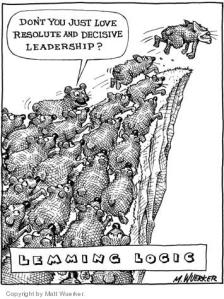 Where are mainstream Republicans these days? What has happened to the party of Lincoln, Teddy Roosevelt and Eisenhower? Prior to the Reagan years, Republican women were front and center in volunteering for planned parenthood, supporting the ERA, and working for abortion rights. First Lady Betty Ford was a proud feminist and one of the first women to put women’s health issues–including women with drinking problems and breast cancer–on the map. President Richard Nixon was responsible for many of the agencies that protect the environment. The current party is chock-full of science denying Theocrats and economics-denying Corporate Fascists. It’s making a sham out of the two party system. We may now have a window open wide enough to stop some of this. We should ready ourselves with the facts and act now.
An online conversation has been initiated with the publication of Ron Brownstein’s article in the National Journal on Thursday called ‘State’s Rights’. It is front and center in starting a discussion among Democratic bloggers, journalists, and other liberal/progressive sympathizers. States rights was code for the right to own slaves during the first 100 years of this country’s existence. It is now code for the right to discriminate against the GLBT community, insert the government into an individual woman’s gynecological care, and bust unions. The racial overtones have not gone away since the worst of the hateful verbiage is aimed at stopping any policy goal attempted by President Obama.
Any one who has read me over the last few years knows that I am not a big fan of this President and I’m even less of a fan of his zealous followers. However, it would take a fairly dim bulb to not see the racism implicit in many of the Republican attacks against him. Attacks range from the extremely bizarre personal assertions that he is a secret Muslim, foreign born, and a devout socialist/communist to a complete rewrite of any policy initiative.
Obama is about as conservative of a Democrat as one can find these days which has been one of my issues with him all along. His actions and words have not stopped the endless attacks on absolutely everything he attempts by Republicans and their monied interests. These tactics were first used against former Democratic President Bill Clinton but have reached some kind of hyper-extortionate apex today. It’s to the point that I firmly believe some of these Republican extremists would rather take the country down with them than negotiate something other than an ideologically pure outcome. Brown’s article and examples focus on the current bloc of extremist Republican governors with their take no prisoners policies. While his focus is mostly on the impact on Obama, I believe his larger point should entice us to think bigger.
But one senior Obama administration official, who also had a close view of Clinton’s interaction with Republican governors, contends that ideology is trumping interest for the governors in many of these new disputes. Health care reform, for instance, asks states for no new financial contribution to expand coverage through 2016 and only relatively small participation thereafter; because 60 percent of the uninsured live in the states where a Republican holds the governorship, their residents would receive the most new federal aid if the law survives. “One had the sense in the mid-1990s that conservative governors were doing whatever was in the best interest of their state,” the senior official said. “This time, the Republican governors appear determined to make an ideological point, even if it costs their state a great deal.”
Whatever the governors’ motivations (one man’s posturing, after all, is another man’s principle), their unreserved enlistment into Washington’s wars marks a milestone. It creates a second line of defense for conservatives to contest Obama even after he wins battles in Congress. It tears another hole in the fraying conviction that state capitals are less partisan than Washington. And it creates a precedent that is likely to encourage more guerrilla warfare between Democratic governors and a future Republican president.
American politics increasingly resembles a kind of total war in which each party mobilizes every conceivable asset at its disposal against the other. Most governors were once conscientious objectors in that struggle. No more.
I can remember attending Republican conventions in the early 1980s during the first hint of the unholy alliance between religious fanatics along the line of a Christian Taliban with the John Birch Society version of libertarians. It was a terrifying spectacle. At the time, the more pro-business and hoity-toity conservative elements in the party were willing to use them like pet pit bulls because they were incredibly organized at the grass roots level and they voted. Republicans traditionally had a much more difficult time turning out voters and their GOTV machines were dwarfed by the Democrats who could rely on well organized and managed union membership. This is one of the reasons why there is also the huge attack on the last standing unions now. They’re worth a fortune come election time and no Republican campaign strategist worth anything underestimates them. We can clearly no longer underestimate the religious zealots or those gullible to the rants of Glenn Beck. They’ve become a contagion.
Back in the day, the young me argued that this form of big daddy government intervention put forth by religionists and Birchers was basically enabling powerful business monopolies and drop kicking the constitutional mandate to deny the establishing of a state religion. It was against the very core ideology of historical Republicanism. I got no where. This was especially true as Nixon’s southern strategy began to work its evil influence on bringing in the remaining racist elements of the old Dixiecrats who frankly were all for the government taking care of any one that wasn’t like them. This added the last nail in the traditional coffin of the party of Lincoln. That sin is now manifesting in the xenophobia against Muslims and Hispanics in addition to African Americans topped by the anti-science bias from the religionists and the pro-monopoly market creation from the corporatists.
It appears that many old school Republicans now see the results of opening this Pandora’s box. They are horrified and have been trying to stuff the demons back into the chest. Now, you see those same folks that opened their kennels filled with poodles to the pit bulls are now acting absolutely appalled by the rising influence of absolutely whacked extremists like Glenn Beck. Scarborough, Rove, and Kristol are currently trying to put the Beckheads back into the box. Those of us that don’t vote Republican could afford to ignore this if it were just some intraparty feud. It’s gone beyond that with the rise of tea party hysterics and billionaire libertarian Daddy Warbucks’ propaganda machines. In many states, the Republican party infrastructure has been commandeered by the pit bulls. The poodles–like Arianna Huffington and Markos–have long left their confines. They are morphing traditional Democratic Party concerns. The same divisive issues that used to motivate the base to do the GOTV and show up at the polls has managed to bring this new crop of Republican governors and congressional members to a critical mass. They refuse any middle or even right of middle ground. They won’t negotiate on the usual country club Republican issues. It’s no longer a GOTV ploy for them because they are true believers.
Steven Benen explores this quandry in his blog at WAPO today.
Keep in mind, it’s ideology, not practical concerns, that lie at the heart of these governors’ reactionary moves. The states turning down investments for high-speed rail, for example, were effectively handed a gift — jobs, economic development, improved infrastructure — but Republicans like Rick Scott and Scott Walker turned down the benefits because of a philosophical opposition, deliberately hurting their state in the process. The administration was effectively throwing a life-preserver to a Republican who’s drowning, only to be told, “We don’t like government life-preservers.”
The same is true of health care, which would be a boon to states, but which far-right governors resist for reasons that have nothing to do with public policy.
Bill Clinton faced a watered-down version of these Republican pit bulls over a decade ago. Dealing with them is how he got his reputation for triangulation. He seemed uniquely placed to make some small progress then–that now seems impossible now–because of his past position as a southern governor with a decidedly homespun and folksy manner. President Obama has none of this going for him. He is surrounded by Businesscrats that are unlikely to fill the void. The only thing he’s managed to do is to gain the ear of the Chamber of Commerce types. These folks are hardly going to be sympathetic to social justice or middle class bread-and-butter issues. Additionally, right wing media sources and timid main stream media sources are playing into the hands of the outrageous. We have media enablers instead of investigative journalists.
That is why it is absolutely essential that whatever is left of the Democratic grassroots need to make one extremely loud noise right now. It is unconscionable that a rewrite of history, science, and economic is taking place while many of us are simply standing around with gaping mouths. I’ve spoken many times about the absolute lack of economics that is driving austerity programs. It’s already showing signs of slowing economic growth down at a time when unemployment is unacceptably high. This is only going to multiply as the days and months unfold. Ask yourself if we can really afford another recession?
I was also disheartened to read that science is not fairing well either. Scientific American has a thought provoking piece up on the overwhelming science behind global warming and climate change.Their title should be rhetorical but it is not: ‘Why Are Americans So Ill-Informed about Climate Change?’
Near the forum’s conclusion, Massachusetts Institute of Technology climate scientist Kerry Emanuel asked a panel of journalists why the media continues to cover anthropogenic climate change as a controversy or debate, when in fact it is a consensus among such organizations as the American Geophysical Union, American Institute of Physics, American Chemical Society, American Meteorological Association and the National Research Council, along with the national academies of more than two dozen countries.
“You haven’t persuaded the public,” replied Elizabeth Shogren of National Public Radio. Emanuel immediately countered, smiling and pointing at Shogren, “No, you haven’t.” Scattered applause followed in the audience of mostly scientists, with one heckler saying, “That’s right. Kerry said it.”
Such a tone of searching bewilderment typified a handful of sessions that dealt with the struggle to motivate Americans on the topic of climate change. Only 35 percent of Americans see climate change as a serious problem, according to a 2009 poll by the Pew Research Center for the People & the Press.
It’s a given that an organized and well-funded campaign has led efforts to confuse the public regarding the consensus around anthropogenic climate change.
These extremists are even rewriting the already right wing Ronald Reagan’s legacy to make it seem more extreme to support the legitimacy of their radical agendas. Here’s an example I found this morning on ThinkProgress on Reagan’s views on unions. Scott Walker’s fantasy world includes his vision of being Reagan’s heir. Yet, here is Reagan himself on the union movement in Poland during one of his radio addresses to the nation.
REAGAN: Ever since martial law was brutally imposed last December, Polish authorities have been assuring the world that they’re interested in a genuine reconciliation with the Polish people. But the Polish regime’s action yesterday reveals the hollowness of its promises. By outlawing Solidarity, a free trade organization to which an overwhelming majority of Polish workers and farmers belong, they have made it clear that they never had any intention of restoring one of the most elemental human rights—the right to belong to a free trade union.
The one thing that I learned early on when dealing with these people from within the Republican party itself in the pre-Reagan and early Reagan days is that they believe their courses are so righteous that they will lie and do anything to support them. If we do not hold their actions and lies to the light of day, our country will be completely overrun by by folks that are anti-science, anti-economics, anti-rational thought, and anti-democracy. We’ll have a theocratic plutocracy in fairly short order.
It is absolutely imperative that we put pressure on the media and Democratic politicians to fact check these people, stand up to them, and expose their lies to the public. It is possible that we’ve caught a tipping point in their overreach process. If this is the case, it means we have to work with the momentum now. Nothing short of our democracy and our children’s future is at stake here. We cannot be complacent and we cannot be left with mouths wide opened. We also cannot rely on leadership from the very top. If you’re in one of those states that is acting up, act now!!! Find and support your version of the Wisconsin 14.
TGIFriday Reads
Posted: February 25, 2011 Filed under: collective bargaining, morning reads, The Media SUCKS, Voter Ignorance, We are so F'd | Tags: Fox Lies, Japan's Tower of bubble, Republican cuts are recessionary, Wisconsin Public Pensions 19 Comments Good Morning!!!
Well, I didn’t make it to the Gulf Coast because I got stuck editing an intro for a journal at the last minute. I’ll have to try again. It just seems like so many things just keep springing up all over the place these days.
David Cay Johnston of Tax.com has a real eye opener up today on who actually contributes to the pension plans of state workers in Wisconsin. Here’s a death knell for a meme. The question is this however. Will any one bother to hear it?
Out of every dollar that funds Wisconsin’ s pension and health insurance plans for state workers, 100 cents comes from the state workers.
How can that be? Because the “contributions” consist of money that employees chose to take as deferred wages – as pensions when they retire – rather than take immediately in cash. The same is true with the health care plan. If this were not so a serious crime would be taking place, the gift of public funds rather than payment for services.
Thus, state workers are not being asked to simply “contribute more” to Wisconsin’ s retirement system (or as the argument goes, “pay their fair share” of retirement costs as do employees in Wisconsin’ s private sector who still have pensions and health insurance). They are being asked to accept a cut in their salaries so that the state of Wisconsin can use the money to fill the hole left by tax cuts and reduced audits of corporations in Wisconsin.
The labor agreements show that the pension plan money is part of the total negotiated compensation. The key phrase, in those agreements I read (emphasis added), is: “The Employer shall contribute on behalf of the employee.” This shows that this is just divvying up the total compensation package, so much for cash wages, so much for paid vacations, so much for retirement, etc.
The collective bargaining agreements for prosecutors, cops and scientists are all on-line.
Reporters should sit down, get a cup of coffee and read them. And then they could take what they learn, and what the state website says about fringe benefits, to Gov. Walker and challenge his assumptions.
Here’s one time I’m going to agree with Goldman Sachs. If we cut federal spending the way Boehner and his cronies want to cut it, we’re going to shrink the economy. Recession any one?
Spending cuts approved by House Republicans would act as a drag on the U.S. economy, according to a Wall Street analysis that put new pressure on the political debate in Washington.
The report by the investment firm Goldman Sachs said the cuts would reduce the growth in gross domestic product by up to 2 percentage points this year, essentially cutting in half the nation’s projected economic growth for 2011.
The analysis, prepared for the firm’s clients, represents the first independent economic assessment of the congressional budget fight, which could lead to a government shutdown as early as next week.
Nonetheless, Republicans are unlikely to easily retreat from their insistence on more than $60 billion in reductions in federal spending as a condition of continuing funding for the government through the rest of the year.
A spokesman for House Speaker John A. Boehner of Ohio said the Goldman Sachs report represented “the same outdated Washington mind-set,” comparing it to the thinking behind the 2009 Recovery Act that released federal funds to counter the effects of the recession.
Republicans live in their own private Washington, I swear. I’ve never seen a bunch of people so clueless about so many things. Here’s a good poll showing why they get away with what they get away with … seems like about 1/4 of our population is pretty damned stupid.
I am seldom surprised by our poll findings, but this month’s tracking poll produced a doozy. Twenty-two percent of the American people think the Affordable Care Act has been repealed, and another 26 percent aren’t sure. Those are surprisingly large numbers even with the 52 percent who still know it is the law of the land.
How could a repeal “vote” in the House — however dramatic but still, only symbolic — be misunderstood as an actual repeal by so many Americans?
First, people are very busy just getting through the day and they don’t have a lot of time to sort through news reports about the policy making process. They see the word “repeal” in the local paper or hear it on TV and think the law has been repealed. Second, there may be some partisan wishful thinking going on; 30 percent of Republicans think the law has been repealed while only 12 percent of Democrats do. But overall, it is obvious that the knowledge of basic civics is pretty low. Maybe it’s because “Schoolhouse Rock” is no longer airing on Saturday morning TV explaining how government works.
If they’re misinformed, they likely get their news from Fox and Roger Ailes. There was more on the make up the news as you go along cable network in the NYT today: “Fox News Chief, Roger Ailes, Urged Employee to Lie, Records Show”. That’s quite a headline. But, the headline appears justifiable since it’s been revealed there’s a tape of Ailes saying just that to Judith Regan. Read the entire article. It’s tawdry and full of intrigue. I can’t wait to see the movie.
Now, court documents filed in a lawsuit make clear whom Ms. Regan was accusing of urging her to lie: Roger E. Ailes, the powerful chairman of Fox News and a longtime friend of Mr. Giuliani. What is more, the documents say that Ms. Regan taped the telephone call from Mr. Ailes in which Mr. Ailes discussed her relationship with Mr. Kerik.
It is unclear whether the existence of the tape played a role in News Corporation’s decision to move quickly to settle a wrongful termination suit filed by Ms. Regan, paying her $10.75 million in a confidential settlement reached two months after she filed it in 2007.
Depending on the specifics, the taped conversation could possibly rise to the level of conspiring to lie to federal officials, a federal crime, but prosecutors rarely pursue such cases, said Daniel C. Richman, a Columbia University law professor and a former federal prosecutor.
If you’re like me and you’re still trying to dissect the last financial sector crisis, you should check out “Four Fallacies of the Crisis” over at Project Syndicate by Jagdish Bhagwati. This was my personal favorite.
Some critics of Obama’s Keynesian stimulus spending, among them the economist Jeffrey Sachs, claim that what the US needs is “long-term” productivity-enhancing spending. But this is a non sequitur. As a Keynesian, I believe that the state paying people to dig holes and then fill them up would increase aggregate demand and produce more income. But Keynes was no fool. He understood that the government could eventually get huge returns if the money was spent on productivity-enhancing investments rather than on “directly wasteful” expenditure-increasing activities.
The question, then, is simple: which investments offer the greatest economic payoffs? But it is also fraught: when your bridges are collapsing, your school buildings are in disrepair, teachers are underpaid and have no incentive to be efficient, and much else needs money, it is not easy to decide where scarce money should be spent.
But one “structural” consideration is not well understood. Given the need to cut the deficit in the future and the need to increase it now in order to revive the economy, the problem facing Obama is how to shift smoothly from top gear into reverse. Clearly, the lesson is that governments need to attach less weight to spending that cannot one day be cut.
This was brought home to me when I saw an unfinished high-rise building in Osaka. A relic of the bust that
This is Yokohama's Tower of Bubble ... there's quite a few of them dotting the Japanese skylines.
followed Japan’s real-estate boom two decades ago, it became known as the Tower of Bubble.

Nothing like the visual of a Tower of Bubble to bring on the urge for another cup of coffee.
So, this is interesting. Remember when reporters asked for the White House visitors log to figure out which lobbyists were coming and going? Now, it seems, the meetings are being held offsite and therefore, off the list.
Caught between their boss’ anti-lobbyist rhetoric and the reality of governing, President Barack Obama’s aides often steer meetings with lobbyists to a complex just off the White House grounds — and several of the lobbyists involved say they believe the choice of venue is no accident.
It allows the Obama administration to keep these lobbyist meetings shielded from public view — and out of Secret Service logs kept on visitors to the White House and later released to the public.
So, what’s you your reading and blogging list today?
Death by Propaganda
Posted: February 19, 2011 Filed under: collective bargaining, education, John Birch Society in Charge, right wing hate grouups, The Media SUCKS, Voter Ignorance, worker rights | Tags: Negotiating, public and private salary surveys, state of Louisiana, unions, Wisconsin protests 35 Comments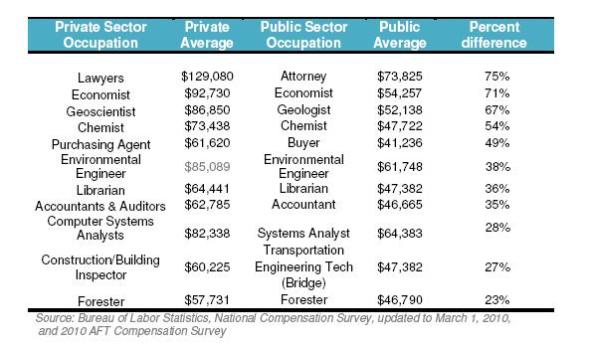
I’ve worked in both the public and private sector. I’ve also worked in union and non-union shops. Additionally, I was part of the collective bargaining process for community college instructors in a right to work state some time ago so I’m familiar with the process. I’ve been a manager and economist that has done strategic budgeting and planning so I’m used to salary and benefit surveys even though I’ve no experience in HR. I also check my facts before taking any one else’s words or wishful thinking. It’s easy to look for a scapegoat for the budget woes of states. The answer lies more in the nature of governors and legislators getting to balance a budget when funds are pouring in than it does in the joy that some people appear to be getting by scapegoating public sector workers and their unions.
For some reason, there’s this idea floating around that public sector employees are raking in the bucks at every one else’s expense. Also, there’s another canard out there that it’s public employees and their generous pensions that are breaking the back of state budgets. I know that’s not really the case for several reasons. The first one is that I know how the collective bargaining process works for a public employee because I’ve done it and the resultant salaries and benefits packages usually aren’t up to private sector levels. It’s based on bringing a rubric of like institutions in like communities and like jobs to the negotiating table. You basically point to that rubric and say here’s the top, bottom, and middle salaries for people in similar jobs in similar institutions. You point to their numbers and then you point to your institutions numbers and you suggest what it would take to put your institution in line with those averages. You negotiate to averages. You can’t negotiate to the best circumstance or you’ll be taken to labor “court” by management and the judges will force you to concede to a more reasonable position. The only time I’ve seen institutions go for the top salary positions is when they’re making a concerted effort to increase their academic standards and recruiting like the Duke Business School did awhile back. That, however, was a complete outlier.
As a union negotiator, you bring the rubric of institutions that would give your membership the best deal in the first round. The institution brings the rubric of institutions that give them the best deal. That rubric has to reflect similar circumstances to your membership. You can’t compare yourself to Harvard if you’re not an Ivy league school. You can’t compare yourself to Hawaii if you’re in the Midwest. Your rubric has to be a set of best matched institutions.
If everything works according to plan you negotiate a joint rubric that represents a middle ground and that middle ground will determine the end package that will likely stand for several years. If you can’t get that done, you declare an impasse and go to the NLRB or some other government entity that decides which rubric you’re going to use and that settles the situation. This happens with both benefits and salaries. It’s repeated every time negotiation year begins. It’s not an outrageous process at all. In the end, the membership either accepts it or rejects it. In my experience, teachers are generally pretty wimpy when it comes to accepting offers. I loved negotiating at a combination technical and community college because the craft people were used to unions and negotiations and were pretty good negotiators. The lead negotiator was a scrappy heating and air conditioning instructor of Italian and Sicilian heritage. I just loved talking strategy with him. Usually, the academic faculty would roll over easily for any scraps. This is a two way negotiating street. It only works when both parties sit down and are willing to hammer out a deal.
The reason this is not working in Wisconsin right now is that one side is refusing to negotiate at all. Not only that, but one side is changing the rules in the middle of the game. If there is no offset, there is no middle ground. This is the only way to get raises in public institutions. I can tell you that since I left that situation and moved to public institutions in Louisiana where you don’t get raises unless you have a governor that’s willing to fight the legislature for an across the board raise for every one. As a faculty, you live and die by whatever salary you got at the onset or you quit. In my experience, the best and the brightest do just that. They bring their new offers and see if they’ll be matched. If not, they move on. I’ve seen the institution then go to the job market and hire much younger and less experienced professors for much bigger salaries after not being able to offer even half that much to a recently tenured one. No one wants to be the one to offer a raise because every one will then want their salary raised to market level. It’s easier to let the good ones go instead. This is especially true in the econ/finance areas and also engineering and computer science because you can easily go to Wall Street or the private sector and make major amounts of money. If you’re represented by a negotiating unit, you come out with a decent cost of living raise annually and if your particular job has had an increase in marketability, you’re salary will move closer to the market. You never approach a private sector equivalence.
I’ve never seen anything in the public sector remotely approach a salary you can get in the private sector. The benefits tend to be better but the monetary compensation is almost always worse. I’ve given you an example from the salary survey done by the AFT in 2010 in the table at the top. It reflects the national salary survey of 2010 done by the Bureau of Labor Statistics which is the government’s data collector on labor markets. That’s the same people that collect unemployment statistics and inflation statistics. They have no ‘agenda’ but to collect the data. Individual groups just use the data to learn what the going market rate is for public and private sector jobs.
Now, I want to give you examples of things from the state of Louisiana. I’m going to use two resources. First, is a search engine set up by The Times Picayune of all state employee salaries. Use it to search out only one thing. The job title clerk. Clerks in state government have a union. So, just stick clerk in the job title and submit. You’re going to see there’s quite a few “pages” of clerk names, departments, and salaries. Six lucky people on the first page make high salaries for having that clerk title. The next group on the next few pages make between about $25,000 to $35,000 annually. You’ll see that the vast majority of these folks basically make around $15,000 -19,000 annually by the time you get pass about 3- 4 pages out of a total of 14 pages of names. I would like to remind you that the poverty level for a family of four is $22,050 annually. For a family of two it is 14,570 and for one person it is $10,830. These levels are for the entire country.
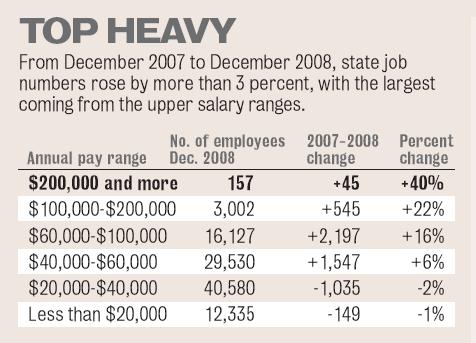
There’s another graphic that you can check that shows exactly who the top paid employees are and how much they make. I can assure you that none of these folks are covered by the state employees unions and none of them have any peers who have lower or higher salaries or benefits depending on when they entered service alone. These people are mostly political appointees of the governor. In this case, they are political appointees of Bobby Jindal. I’m going to show you the graph that is relevant. (It’s down below this section.) The salary structure is top heavy. You can go back and search who has the top money. You will see that it is top university administrators and coaches. Even these salaries do not stack up to private sector CEOs or coaches. It isn’t the clerks that are making outrageous salaries and it isn’t their bargaining unit that is at fault for any of this. You’ll also see if you got that page that many state workers are attorneys, engineers, teachers, nurses and doctors. These are professional people. You cannot expect to recruit and retain the best professional, well-educated service workers if you do not offer them a competitive salary. The most mobile ones will leave eventually if you don’t offer them raises and benefits commensurate with the private sector. You can go to any of the BLS salary surveys and you will see what the AFT put in that nice graphic above year after year after year. You will not get a compensation in the public sector that is more generous than the private sector at those levels of expertise. If there is a private sector ‘competitor’ for offering the job. Believe it or not, not every one is an English teacher that might likely wind up as a waitress. Here in New Orleans, most of the English teachers at my university would make better money if they’d wait tables or pour cocktails in the French Quarter. The only difference is that English teachers get a pension and insurance and they get to do the job they love.
Okay, now I’m going to go all economist on you. When you are a teacher, a firefighter, or a public health or safety worker, you face what is called a monopsony. That means there is likely to be one source of jobs and so you face the buyer’s version of a monopoly. What this means is the chips will be stack against you coming out with a ‘competitive’ wage. For example, how many forensic scientists do you suppose work outside of the local police departments? You may face a number of municipalities that could hire you in this situation. It is not, however, illegal for municipalities to collude on setting standards for salaries and benefits. Hence, you may face the same situation in city after city.
There seems to be this mindset that public servants should be public slaves from some quarters. Why should the clerk who fills out your driver’s license form be treated differently than the clerk that fills out your bank deposit slip? Why this double standard that public employees can’t be represented by unions? Well, first, I think many people still believe that public employees served by unions some how get a better deal than the others. This generally is not the case for all things. The only items that have held together for state employees that are not as available in the private sector tends to be the pension benefits and probably the insurance. One of the reasons that the insurance tends to be not such a big deal is that many states self insure and they have huge pools of employees so they can be more generous with benefits at a lower cost. I’ve generally lived in states where the biggest employer is the state. That’s a lot of people and insurance gets cheaper as the pool grows larger.
I think one of the other reasons is that people in nonunion jobs feel helpless about their futures and they are angry that they really don’t have the same safety in numbers that you see with union shops. You can’t be bullied by an employer when there is a union in place. This does have a tendency to protect even the worst employee, but when you work for capricious bosses, and we all do, you’ll never be safer than when you have union representation. You also are more aware of when your number will be up during downsizing and you will get a recall if they start rehiring if you’re a member of a union. This type of job security is generally the most important thing to a state employee which is why they work for lower monetary compensation. But again, why begrudge others what you could have if you’d just organize your work place?
I’ve been seeing way to many sites discuss ‘greedy’ teachers who selfishly walk out of the classroom to protest their right to organize. I really don’t get this meme at all. Wouldn’t you fight for your family’s livelihood if it were threatened? Why are teachers supposed to be treated differently than any one else?
A Governor or any other publicly elected official isn’t just held to account on voting day. Democracy is a day-in-and-day out process. Wisconsin Governor Scott Walker was elected to handle the budget. He immediately cut $117 billion in revenues coming from businesses and created a $130 billion deficit. His answer to covering his self created deficit was to change the terms of thousands of previously negotiated commitments to public employees. He backed out of the state’s commitment. He’s also refused to remove the union busting portions of the bill in exchange for salary and benefit concessions. How is this anything but dogmatic and unfair to state employees? Who makes heroes out of people that break commitments? Each of those families made plans based on the sanctity of the promise the state of Wisconsin made to them. They were part of the agreement and they should be part of renegotiating the agreement because that’s the rules of the game there. Changing the rules of a game in the middle of play is cheating.
If Governor Walker was so interested in frugality, then he should’ve started by not passing those $117 million in tax breaks. An election victory is not a blank check in a democracy.
Within days of becoming governor, Mr. Walker — who hung a sign on the doorknob of his office that reads “Wisconsin is open for business” — began stirring things up, and drawing headlines.
He rejected $810 million in federal money that the state was getting to build a train line between Madison and Milwaukee, saying the project would ultimately cost the state too much to operate. He decided to turn the state’s Department of Commerce into a “public-private hybrid,” in which hundreds of workers would need to reapply for their jobs.
He and state lawmakers passed $117 million in tax breaks for businesses and others, a move that many of his critics point to now as a sign that Mr. Walker made the state’s budget gap worse, then claimed an emergency that requires sacrifices from unions. Technically, the tax cuts do not go into effect in this year’s budget (which Mr. Walker says includes a $137 million shortfall), but in the coming two-year budget, during which the gap is estimated at $3.6 billion.
Democrats here say Mr. Walker’s style has led to a sea change in Wisconsin’s political tradition.
“Every other Republican governor has had moderates in their caucus and histories of working with Democrats,” said Graeme Zielinski, a spokesman for the state’s Democratic Party. “But he is a hard-right partisan who does not negotiate, does not compromise. He is totally modeled after a slash-and-burn, scorched-earth approach that has never existed here before.”
There’s some very interesting polls coming out of the Wisconsin protests. Here is some poll analysis on unions and public unions from the CSM.
Asked about “when you hear of a disagreement between state or local governments and unions that represent government workers,” more Americans say their first reaction is to side with the union (44 percent) than with state or local governments (38 percent). And substantially more Americans see union contracts as ensuring that workers are “treated fairly” than as giving workers an “unfair advantage.”
Other polls have found mixed results. Here’s some coverage at Huffpo for the Pew poll cited above as well as a few others. Either way, it’s interesting to note that Walker has some pretty strong ties to the notorious Koch Brothers. These trust fund babies spend a lot of John Bircher Daddy’s money trying to bust unions. I don’t think this can be discounted either.
According to Wisconsin campaign finance filings, Walker’s gubernatorial campaign received $43,000 from the Koch Industries PAC during the 2010 election. That donation was his campaign’s second-highest, behind $43,125 in contributions from housing and realtor groups in Wisconsin. The Koch’s PAC also helped Walker via a familiar and much-used politicial maneuver designed to allow donors to skirt campaign finance limits. The PAC gave $1 million to the Republican Governors Association, which in turn spent $65,000 on independent expenditures to support Walker. The RGA also spent a whopping $3.4 million on TV ads and mailers attacking Walker’s opponent, Milwaukee Mayor Tom Barrett. Walker ended up beating Barrett by 5 points. The Koch money, no doubt, helped greatly.
When there is big corporate money in elections, there is only one offset these days. That would be the money and free labored offered up by unions. Undoubtedly, the public sector unions are some of the last big unions standing. I can only imagine how much the Kochs and others would like to gut the fund raising and GOTV efforts of unions that are usually made available to candidates that thwart their Bircher plots. After all, there’s very little standing right now to check the power and political donations of megacorporations. This fact alone should make any one support the few unions left standing. However, the bigger question remains. Why do so many people begrudge public workers a voice in the terms of their employment?

 peej
peej Carissa
 bostonboomer
 dakinikat
 ecocatwoman
 mablue2
 Mama Lopez
 peggysue22
 quixote
 skydancingguestblogger
 Mona (aka Wonk the Vote)



 Sky Dancing
Recent Comments