
Creating Fiscal Strife
Posted: November 29, 2012 Filed under: Catfood Commission, Economy, Federal Budget, Federal Budget and Budget deficit, George W. Bush, Global Financial Crisis, House of Representatives, Medicare, Politics as Usual, Republican politics, Republican Tax Fetishists, Super Committee, The Bonus Class, the GOP, U.S. Economy, U.S. Politics | Tags: fiscal cliff 15 Comments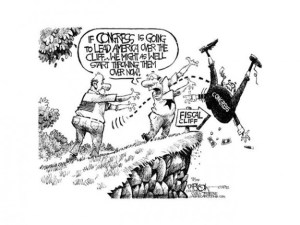 One of the things that drives me crazy as an economist and a citizen looking at this so-called “fiscal cliff” is that our fiscal strife has been created by the people least likely to suffer from its resolution. Congress gave the Bush administration authority to start a series of unfunded, reckless wars that have lasted well over a decade. Congress passed the Bush administration’s reckless tax cuts and generous loopholes that have benefited the few at the cost of the many. The Bush administration’s and Congress’ lack of oversight and deregulation of the financial services’ industry created a low-risk, gambling casino with the national investment and savings accounts and the debt markets. This led to a huge recession. These are the roots of our fiscal problems. But, the discussions around cleaning up messes in the District mostly surround Social Security which has nothing to do with the national debt and deficit and items that have become more necessary to average Americans since Congress and the Bush Administration broke the country with its bad policies.
Here’s some of the latest examples. Closing loopholes and unnecessary deductions for certain constituents is a good idea. However, which of these things are on the chopping block? Inkling its way up the priority list is the major middle and working class deduction and source of household wealth: the mortgage interest deduction. I have no problem with eliminating second mortgages, mortgages on boats, and mortgages on second properties. These benefit very few people and really serve little policy purpose. Capping the deduction–with an annual COLA adjustment to the median price and below-based mortgages is also fine. However, what are we likely to see?
As the Obama administration and lawmakers on Capitol Hill scramble to defuse automatic spending cuts and tax increases set to take effect Jan. 1, a herd of sacred cows — from Social Security and Medicare to deductions for charitable giving and mortgage interest — are in danger of losing their untouchable status.
Members of both parties have largely steered clear of detailed proposals so far. But plans put forth in the past year by President Obama and Mitt Romney to place limits on annual total tax deductions are likely to crimp the mortgage-interest deduction for certain taxpayers. Top congressional Republicans also have expressed openness to limiting total tax deductions as part of an overall budget deal. In addition, the presidentially appointed Simpson-Bowles fiscal commission suggested scaling back the mortgage-interest deduction as part of its own set of tax-related proposals.
Current law allows homeowners to deduct the interest paid on mortgage balances up to $1 million, including on second homes, as well as on $100,000 worth of home-equity loans. The deduction overwhelmingly benefits wealthier families, partly because they tend to have larger mortgages and pay more interest, and partly because most low- and middle-income Americans do not itemize deductions on their tax returns. It also tends to favor homeowners on the East and West Coasts, as well as those in large cities such as Chicago, where average home prices are higher.
Edward Kleinbard, a tax expert and law professor at the University of Southern California, said the mortgage-interest deduction represents the kind of government “extravagance” that the country no longer can justify, given its fiscal troubles.
“We simply cannot afford wasteful government subsidy programs anymore, and this is one of the most important examples of that,” Kleinbard said. “It’s very much a subsidy to those Americans who need it least.”
Mitch McConnell continues to service Grover Norquist and the Club for Growth. He’s back on his high horse for no tax increases for the wealthy. Ending tax cuts for the wealthy endlessly shown to have no ill-impact on the economy. There is also no real benefit to extending them.
Senate Republican Leader Mitch McConnell (Ky.) slammed the door Thursday morning on Democratic demands to raise tax rates on families earning more than $250,000 per year.
“We’re insisting on keeping tax rates where they are, first and foremost, to protect jobs and because we don’t think government needs the money in the first place,” McConnell said on the Senate floor.
“The problem, as I’ve said, is that Washington spends too much. But if more revenue is the price that Democrats want to exact, then we should at least agree to do it in a way that doesn’t cost jobs and disincentivize rates, as we all know raising rates would do,” he said.
McConnell’s comments came a day after Speaker John Boehner (R-Ohio) shot down a proposal by a senior GOP lawmaker, Oklahoma Rep. Tom Cole, to agree to extend tax rates only for families earning below $250,000 and resume the battle against higher tax rates on the wealthy next year.
Boehner said President Obama and Democrats should focus on finding ways to cut spending and reform entitlement programs.
The fate of the Bush-era tax rates — which will expire for all income levels in January — has dominated the debate over the slew of tax increases and spending cuts that are set to begin next year.
McConnell scolded the president Thursday for sticking fast to his campaign pledge to seek higher taxes on the rich, and made clear that raising tax rates on anyone is unacceptable.
The debate over Medicare is likely to be equally absurd. Medicare needs some reworking. Most of its problems comes from the pharmacy benefit which currently allows Big Pharma to price gouge participants and the taxpayers. But, you wouldn’t know that from the conversation. Republicans are playing games with Amercan’s health. They appear to be clinging to the Ryan’s voucher plan which would be disastrous for the majority of retired seniors.
The austerity crisis talks have hit a peculiar impasse. The problem isn’t, as most analysts expected, taxes, where Republicans seem increasingly resigned to new revenue. It’s Medicare. And the particular Medicare problem isn’t that Democrats are refusing the GOP’s proposed Medicare cuts. It’s that Republicans are refusing to name their Medicare cuts.
Politico quotes a “top Democratic official” who paints the picture simply: “Rob Nabors [the White House negotiator], has been saying: ‘This is what we want on revenues on the down payment. What’s your guys’ ask on the entitlement side?’ And they keep looking back at us and saying: ‘We want you to come up with that and pitch us.’ That’s not going to happen.”
That’s partly politics. If nothing else, Republicans are respectful of Medicare’s political potency. Recall that a core Republican message in both the 2010 and 2012 elections was that Democrats, through Obamacare, were cutting Medicare too much. Republicans, already concerned about their brand, don’t want to rebrand themselves as the party of Medicare cuts.
But it’s partly policy, too. The fact is that short of converting the program to a premium support system — a non-starter after they lost the 2012 election — Republicans simply don’t know what they want to do on Medicare.
Scour the various outlets for Democratic policy ideas and you’ll find plenty of proposed Medicare cuts. President Obama’s 2013 budget, for instance, includes hundreds of billions in Medicare cuts (see pages 33-37), and caps the program’s long-term growth at GDP+0.5 percent. More recently, the Center for American Progress released a 46-page proposal for cutting Medicare by almost $400 billion.
Republicans, meanwhile, have focused their energy on a long-term effort to convert Medicare to a premium-support model. Paul Ryan’s 2013 budget kept the Affordable Care Act’s Medicare cuts for the next 10 years and proposed to convert the program to a premium-support model in the future. Mitt Romney’s platform proposed reversing Obamacare’s Medicare cuts and offered a vague framework for converting the program to a premium-support model in the future.
If you dig deep into the Republican think tank world, you can find a few proposals that focus on the near-term.
The current fiscal ‘cliff’ framework appears to place a lot of burden on those least able to take it as well as those least responsible for creating the problems.
Cut through the fog, and here’s what to expect: Taxes will go up just shy of $1.2 trillion — the middle ground of what President Barack Obama wants and what Republicans say they could stomach. Entitlement programs, mainly Medicare, will be cut by no less than $400 billion — and perhaps a lot more, to get Republicans to swallow those tax hikes. There will be at least $1.2 trillion in spending cuts and “war savings.” And any final deal will come not by a group effort but in a private deal between two men: Obama and House Speaker John Boehner (R-Ohio). The two men had a 30-minute phone conversation Wednesday night — but the private lines of communications remain very much open.
No doubt, there will be lots of huffing and puffing before any deal can be had. And, no doubt, Obama and Congress could easily botch any or all three of the white-knuckle moments soon to hit this town: the automatic spending cuts and expiration of the Bush tax cuts, both of which kick in at the end of this year, and the federal debt limit that hits early next.
Go to the Politico story for a concept of what’s at stake and at issue.
Speaker John Boehner (R-Ohio) said Thursday there had been “no substantive progress” in fiscal-cliff negotiations in the two weeks since congressional leaders met with President Obama.
Boehner, addressing reporters after a meeting with Treasury Secretary Tim Geithner in the Capitol, called on the White House to “get serious” about the talks and warned of a “real danger” that Jan. 1 would come without a deal if President Obama did not offer up specific spending cuts he would be willing to accept.
“Despite claims that the president supports a balanced approach, the Democrats have yet to get serious about real spending cuts,” Boehner said. “Secondly, no substantive progress has been made in the talks between the White House and the House in the last two weeks.
“Listen, this is not a game,” he added. “Jobs are on the line. The American economy is on the line, and this is a moment for adult leadership.”
The Speaker criticized the president for holding “campaign-style rallies” instead of engaging in serious talks.
Tuesday Reads: Hitchcock, Hearing Aids, and Republican Delusions
Posted: November 27, 2012 Filed under: 2012 elections, Barack Obama, John McCain, morning reads, the GOP, U.S. Politics | Tags: Alma Reville, Anthony Hopkins, Anthony Perkins, Asian American voters, Charles Murray, Grover Norquist, Helen Mirren, Jamelle Bouie, Janet Leigh, Kelly Ayotte, Latino voters, Michael Morell, Psycho, Susan Rice 34 Comments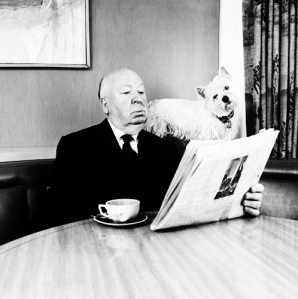
Good Morning!!
I’m really looking forward to seeing Hitchcock, the new movie about the making of Psycho. Unfortunately, the film may not come to Muncie, IN, so I might have to just hope it will still be playing in Boston when I get back home sometime in December. If you have a chance to see it where you are, let me know how you like it.
Last night the Wall Street Journal posted an interview with Helen Mirren, who plays the great director’s wife Alma Reville Hitchcock in the new film. Mirren is one of my favorite actresses!
Alfred Hitchcock once said that there were four people who helped make him who he was—one was a film director, one a script writer, one a cook and one the mother of his daughter. “Their names are Alma Reville,” he said of his wife of 44 years, who performed all four roles. In the new biopic “Hitchcock,” Helen Mirren rolls Reville’s many facets into a singular performance.
The movie, which opened in the city over the weekend, traces Hitchcock’s (Anthony Hopkins) effort to make his 1960 classic, “Psycho,” from his struggle with Hollywood studios to finance the picture to Reville’s pivotal role in the movie’s—and her husband’s—success. “I was surprised to find out about the importance of Alma,” Ms. Mirren said recently.
Read what Mirren had to say at the link.
And here’s an interview with Anthony Hopkins, who plays Alfred Hitchcock at “Vulture.”
Do you remember the first time you saw Psycho?
When it first came out in Manchester on a wet September evening and I was knocked out by it. That was the most terrifying film I’d ever seen. I couldn’t believe it: Where’s Janet Leigh? She’s got to come back. She’s the star of the movie! I thought she perhaps escaped from the trunk of the car. So I’ve been watching these films over the years, long before I knew I was going to play him.
Did you talk to anyone who worked with Hitchcock? What insights did they share?
I met Janet Leigh in New York, and then later in Hollywood at a function. She said, “Mr. Hitchcock was one of the funniest men I’ve ever worked with. My ex-husband Tony [Curtis] and I used to go to his house in Bel-Air, and we’d laugh ourselves sick, because he was so funny, so wicked, a great practical joker.” She said he wasn’t an easy man to get to know, but she got on with him.
Read lots more at the link.

Psycho came out in 1960, when I was only 12 years old. My parents wouldn’t let me see horror movies, which is probably why I love them so much now. I don’t remember when I first saw Psycho–it must have been on TV, probably in the late 60s or 70s. By then the shock value wasn’t as huge as when the movie first came out.
Entertainment Weekly has a “look back at the mystique of ‘Psycho'” by Owen Glieberman
Alfred Hitchcock’s Psycho was released in the summer of 1960, and in the half a century since, it has become the rare movie in which every image and detail and motif is now, more or less, iconic. Every moment in the movie is a piece of mythological Americana.
In a way that I couldn’t quite say about any other film, I feel as if I’ve spent most of my movie life thinking — and writing — about Psycho. Part of the film’s mystique is that no matter how many times you’ve seen it (and it may be the ultimate movie that you can watch over and over again), it keeps coming back to provoke and tantalize and haunt you. Its power of revelation never wears thin or gets old. It’s one of the only films in Hollywood history — the others, I would say, are The Wizard of Oz, Citizen Kane, The Godfather, and Star Wars — that is so alive, its experience so vivid and immediate and larger-than-life, that it effectively transcends time….
In the infamous shower scene, when that big, fat kitchen knife, wielded by a mysterious Victorian shrew named Mrs. Bates, came slashing down, over and over again, into the body of Marion Crane, it was also slicing through years — decades, centuries — of popular expectation that the hero or heroine of a fictional work would be shielded and protected, or would at least die (usually at the end) in a way that made some sort of moral-dramatic sense. In Psycho, murder made no sense at all; the suddenness — and viciousness — of it tore at the fabric of our certainty. What it suggested is that none of us, in the end, are ever truly protected. Hitchcock seemed to be pulling the rug, the floor, and the earth right out from under the audience. He opened an abyss, exposing moviegoers to a dark side that few, at the time, could ever have dared to imagine.
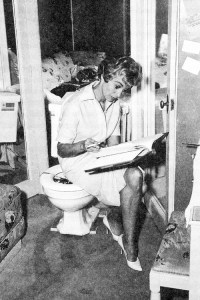
Eeeeeeeeek!
In other news, I had a big day yesterday. I’ve had moderate hearing loss since I was pretty young–at least since my early 30s. When I first found out I had nerve damage, I was told there was nothing that could be done. My problem was that I had trouble making out words, and hearing aids would only make the garbled words louder.
Technology has advanced over the past 30 years, and yesterday I got some hearing aids, thanks to the generosity of my mother. Suddenly I can hear things that I never heard before. I can hear the words people are saying even if I’m not looking at them and watching their lips. I can hear people when they whisper–previously I couldn’t make out whispering even if the person’s mouth was right next to my ear. It’s just amazing. I hope you don’t mind me sharing that.
Now some national news. Republicans are still trying to figure out why they lost the presidential election and, as Lawrence O’Donnell pointed out last night, they still don’t want to give President Obama any credit for beating them. No, it’s all about demographics, fooling Latinos and women into thinking Republicans actually care about their issues. But what about Asian-Americans, another group that voted for Obama by a lopsided percentage?
Right wing racist Charles Murray argues that the problem (with both Latinos and Asians) is that the Republican Party has tied itself to socially conservative issues (no kidding!)
My thesis is that the GOP is in trouble across the electoral board because it has become identified in the public mind with social conservatism. Large numbers of Independents and Democrats who are naturally attracted to arguments of fiscal discipline, less government interference in daily life, greater personal responsibility, and free enterprise refuse to vote for Republicans because they are so put off by the positions and rhetoric of social conservatives, whom they take to represent the spirit of the “real” GOP….
Asians are only half as likely to identify themselves as “conservative” or “very conservative” as whites, and less than half as likely to identify themselves as Republicans. Asians are not only a lot more liberal than whites; a higher percentage of Asians identify themselves as “liberal” or “extremely liberal” (22%) than do blacks (19%) or Latinos (17%). And depending on which poll you believe, somewhere in the vicinity of 70% of Asians voted for Barack Obama in the last presidential election.
Something’s wrong with this picture. It’s not just that the income, occupations, and marital status of Asians should push them toward the right. Everyday observation of Asians around the world reveal them to be conspicuously entrepreneurial, industrious, family-oriented, and self-reliant. If you’re looking for a natural Republican constituency, Asians should define “natural.”
And so on… bla bla bla…
At the American Prospect, Jamelle Bouie explains to Murray How Not to Appeal to Asian Americans. Hint: cut out the racism.
As with Latinos, Asian American movement to the Democratic Party has a lot to do with with the explicitly anti-immigrant stance of the GOP, as well as the overwhelming sense that the GOP is a party for hidebound whites, and actively hostile toward nonwhites of all stripes.
There’s a policy component in this as well; the Asian American community is highly diverse (ethnically, economically, and otherwise), and there many who would benefit from the core Obama agenda of health care reform, stronger social services, and investments in education and other programs. Still, even with that in mind, it’s fair to say that Asian American support for Obama is as much about inclusion as it is about policy.
Which is why this piece, from conservative scholar Charles Murray, rankles. Rather than consider Asian American political preferences on their own terms—or even acknowledge the range of experience among different Asian American groups—Murray lumps them all into a single, undistinguished mass of model minorities, and then wonders why they don’t vote for Republican candidates.
But Murray’s argument is based on a false premise:
It’s worth noting the implicit contrast here. Entrepreneurism, industriousness, family-orientation, self-reliance—these are things that Murray sees as unique to Republican constituencies. Which must also mean that these are thing that go unvalued by Democratic constituencies, namely, African Americans, Latinos, young people, and single women.
Furthermore, as Bouie notes today’s Republicans actually are a bunch of fundamentalists who are anti-gay and anti-woman. That’s not just a perception, it’s the reality that Charles Murray doesn’t want to accept. It’s not that Latinos, Asians, and African Americans are deluded about the nature of the Republican Party. But what else would you expect from the author of the racist screed The Bell Curve?
Today Susan Rice will begin facing down her Republican critics on Capital Hill.
With congressional opposition softening, U.N. Ambassador Susan Rice could find her name in contention as early as this week to succeed Hillary Rodham Clinton as secretary of state. It’s a step that may signal greater U.S. willingness to intervene in world crises during President Barack Obama’s second term.
As Obama nears a decision on who should be the country’s next top diplomat, Rice has emerged as the clear front-runner on a short list of candidates that many believe has been narrowed to just her and Sen. John Kerry, despite lingering questions over her comments about the deadly Sept. 11 attack on a U.S. Consulate in Libya.
According to congressional aides and administration officials, Rice will be making the rounds on Capitol Hill this week for closed door meetings with key lawmakers whose support she will need to be confirmed. Those appearances follow her first in-depth explanation of her Benghazi remarks that Republicans seized on as evidence of the administration’s mishandling of the attack that took the lives of the U.S. ambassador to Libya and three other Americans.
Acting CIA Director Michael Morell will join Rice in her meetings with lawmakers.
Today Rice will meet with Senators John McCain and Kelly Ayotte. When asked about the meeting, McCain was his usual testy self:
McCain said he would ask Rice “the same questions I’ve been talking about on every talk show in America.” Asked whether he thinks she’s still unfit for secretary of state and what he was hoping for, McCain interrupted and said, “I’m not hoping for anything. She asked to see me and I agreed to see her.”
What a jerk. I’d love to be a fly on the wall in that meeting.
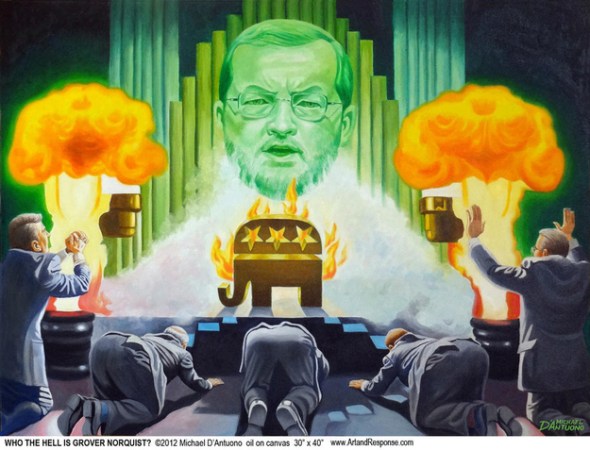
I’ll end with this amazing artistic depiction of Republican delusion, Grover Norquist as the Wizard of Oz (via Buzzfeed).
Artist Michael D’Antuono has painted anti-taxi activist Grover Norquist as a Wizard of Oz-like disembodied head with Republican politicians bowing before him as an elephant burns, to symbolize Norquist’s powerful position in the Republican party.
Now it’s your turn. What are you reading and blogging about today?
Obsessive Poll Watching Open Thread: Pew has Obama by 3 . . . Plus, microtargeting voters for GOTV
Posted: November 4, 2012 Filed under: 2012 elections, 2012 presidential campaign, Democratic Politics, open thread, Republican politics, Team Obama, The DNC, the GOP, U.S. Politics | Tags: Barack Obama, Chris Hayes, David Axelrod, David Plouffe, GOTV, microtargeting, Mitt Romney, MSNBC, Pew Poll, polls, Sasha Issenberg 77 Comments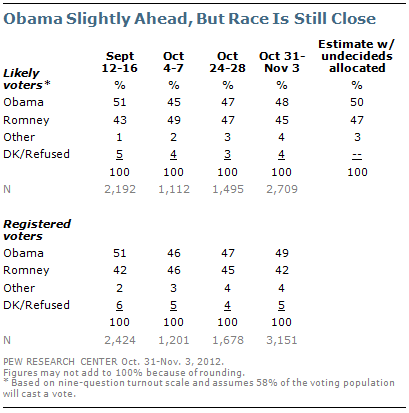
I’m sure glad MSNBC is running real programming tonight, because I can’t think of much other than the upcoming election. The polls have been moving toward Obama over the past few days, and suddenly he’s ahead in the Pew Poll which has been showing Romney ahead for some time.
Nate Silver reacted on Twitter, saying that the results match his findings:
Nate Silver @fivethirtyeight
Simple average of national polls released Thursday: Obama +0.9. Friday: Obama +1.2. Saturday: Obama +1.3. Today (so far): Obama +1.4
Pew reports:
In the Pew Research Center’s election weekend survey, Obama holds a 48% to 45% lead over Romney among likely voters.
The survey finds that Obama maintains his modest lead when the probable decisions of undecided voters are taken into account. Our final estimate of the national popular vote is Obama 50% and Romney 47%, when the undecided vote is allocated between the two candidates based on several indicators and opinions.
The interviews all took place after superstorm Sandy struck.
Obama’s handling of the storm’s aftermath may have contributed to his improved showing. Fully 69% of all likely voters approve of the way Obama is handling the storm’s impact. Even a plurality of Romney supporters (46%) approve of Obama’s handling of the situation; more important, so too do 63% of swing voters.
Pew expects voter turnout to be lower than in either 2004 or 2008, which could help Romney, but other data favors Obama.
Nearly four-in-ten (39%) likely voters support Obama strongly, while 9% back him only moderately. A third of likely voters support Romney strongly, compared with 11% who back him moderately. In past elections, dating to 1960, the candidate with the higher percentage of strong support has usually gone on to win the popular vote.
Similarly, a much greater percentage of Obama supporters than Romney supporters are voting for him rather than against his opponent (80% for Obama vs. 60% for Romney), another historical indicator of likely victory. And far more registered voters expect an Obama victory than a Romney victory on Nov. 6 (52% vs. 30%).
Obama’s increases in likely voter support are most notable among women, older voters, and political moderates. Women now favor Obama by a 13-point margin (53% to 40%), up from six points a week ago and reflecting a shift toward Obama since early October. Right after the first presidential debate, the women’s vote was split evenly (47% each). Men, by comparison, favor Romney by a 50% to 42% margin, with little change in the past month.
At the Guardian UK, Ewen McAskill writes:
The findings are similar to a Wall Street Journal/NBC poll published at the weekend. The two offer the first firm evidence of the impact of Sandy on the election. Pew carries one caution for Obama, suggesting turnout may be lower than in 2008 and 2004, which could help Romney.
Obama’s team claimed that Romney’s frantic campaign schedule reflected a sense of desperation, squeezing in a late visit to previously neglected Pennsylvania Sunday in the search for elusive electoral college votes elsewhere. The Obama team also cited visits Monday to Florida and Virginia, two states it said the Romney camp had claimed to have locked up.
In an interview with ABC, David Plouffe, who organised Obama’s re-election bid, expressed confidence the president will win on Tuesday, and seized on a comment by Karl Rove that Obama had benefited from superstorm Sandy. Democrats are interpreting this as Rove, George W Bush’s former campaign strategist and co-founder of the Crossroads Super Pac that has poured millions of dollars into Romney’s campaign and those of other Republicans, beginning to get his excuses in early.
“A few days ago he [Rove] predicted a big Romney win. My sense is Karl is going be at a crossroads himself on Tuesday when he tries to explain to the people who wrote him hundreds of millions of dollars why they fell up short,” Plouffe said.
Another Obama strategist, David Axelrod, commenting on Romney’s Pennsylvania trip, told Fox News: “They understand that they’re in deep trouble. They’ve tried to expand the map because they know in states like Ohio. They’re behind and they’re not catching up at this point.” He added: “They understand that the traditional, or the battleground, states that we’ve been focusing are not working out for them.”
On Microtargeting . . .
Over the past couple of days, I’ve been reading some interesting articles on the GOTV efforts of the two campaigns. I was struck by this piece at the Milwaukee Journal-Sentinel about a woman in Mukwonago, Wisconsin, Priscilla Trulen, who received a spooky call on Halloween.
“It was Mitt Romney saying, ‘I know you have an absentee ballot and I know you haven’t sent it in yet,’ ” Trulen said in an interview. “That just sent me over the line. Not only is it like Big Brother. It is Big Brother. It’s down to where they know I have a ballot and I haven’t sent it in! I thought when I requested the ballot that the only other entity that would know was the Mukwonago clerk.”
Other voters are being “creeped out” by calls from Democratic groups.
In Brown County, residents are unnerved about “voter report cards” from Moveon.org that show the recipients how their voting participation compares to those of their neighbors.
The solicitations give only a small glimpse into how much digital information the campaigns are able to access about voters.
Corporations working for candidates request publicly available voter data as well as information about absentee ballots from state governments, which they can combine with other data to target individual voters.
The cost of the entire state database is $12,500. Four requesters have been willing to pay that since Sept. 1, Magney said: Catalist (a progressive voter database organization), the Democratic National Committee, and data analysis firm Aristotle – all based in Washington, D.C. The last requester was Colorado-based Magellan Strategies, a firm that specializes in “micro-targeting” for Republican parties and candidates….
In an interview with PBS that aired in October, Aristotle’s chief executive officer, John Phillips, said the company keeps up to 500 data points on each voter – from the type of clothes they buy, the music they listen to, magazines they read and car they own, to whether they are a NASCAR fan, a smoker or a pet owner, or have a gold credit card. Some of that information comes from advertising for cleaning business, commercial marketing firms, product registration cards or surveys. Other information is obtained through Facebook, door-to-door canvassing, petitions and computer cookies – small data codes that register which websites the user has visited.
Through data modeling, analyzers can categorize voters based on how they feel about specific issues, values or candidates. They then try to predict voting behavior and figure out which issue ads voters are most likely to be susceptible to – for instance ads on education, gun control or immigration.
One of the companies that requested the full Wisconsin voter database, Magellan Strategies, explains on its website that it conducts surveys on people’s opinions and merges that with their political, consumer and census demographics.
Whoever targeted Trulen made one important mistake, however. She tends to vote Democratic although she lives in a Republican district.
According to Sasha Issenberg, author of the book The Victory Lab: The Secret Science of Winning Campaigns, writes that in 2008 and 2012, the Democratic microtargeting operation is far superior to the Republican one.
In fact, when it comes to the use of voter data and analytics, the two sides appear to be as unmatched as they have ever been on a specific electioneering tactic in the modern campaign era. No party ever has ever had such a durable structural advantage over the other on polling, making television ads, or fundraising, for example. And the reason may be that the most important developments in how to analyze voter behavior has not emerged from within the political profession.
“The left has significantly broadened its perspective on political behavior,” says Adam Schaeffer, who earned graduate degrees in both evolutionary psychology and political behavior before launching a Republican opinion-research firm, Evolving Strategies. “I’m jealous of them.”
In other words, the Republican dislike of science and academia may be holding Romney back in the microtargeting area.
Schaeffer attributes the imbalance to the mutual discomfort between academia and conservative political professionals, which has limited Republicans’ ability to modernize campaign methods. The biggest technical and conceptual developments these days are coming from the social sciences, whose more practically-minded scholars regularly collaborate with candidates and interest groups on the left. As a result, the electioneering right is suffering from what amounts to a lost generation; they have simply failed to keep up with advances in voter targeting and communications since Bush’s re-election. The left, meanwhile, has arrived at crucial insights that have upended the conventional wisdom about how you convert citizens to your cause. Right now, only one team is on the field with the tools to most effectively find potential supporters and win their votes.
Go read the whole thing if you’re interested. It’s quite a long article, but fascinating. After reading some of his pieces yesterday, I was also able to heard Issenberg on MSNBC’s “Up with Chris Hayes” this morning. So many books to read, so little time.
Now what are you all hearing/reading? Are you as excited as I am?
Sunday Shows: The “L” Word
Posted: October 7, 2012 Filed under: 2012 presidential campaign, Barack Obama, Mitt Romney, open thread, The DNC, the GOP, The Media SUCKS, U.S. Economy, U.S. Politics | Tags: David Axelrod, Martin O'Malley, Michael Nutter, Paul Krugman, Robert Gibbs 33 Comments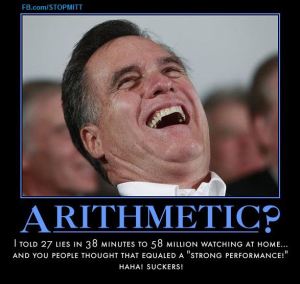
No, I don’t mean “liberal.” The “L” word for this week is “lies.” Democrats were out on the Sunday shows this morning calling out Mitt Romney for lying in last Wednesday’s presidential debate. Talk about a “game changer.” It used to be that politicians were uncomfortable coming right out and calling their opponents liars, but with the number and scale of Romney’s lies in the 2012 campaign, that calculus has changed. Two Obama surrogates actually used the word “lie” and two Obama advisers called Romney “dishonest.” It appears to have a been a coordinated attack.
On Face the Nation, David Axelrod called Romney “dishonest.”
“Governor Romney showed up to deliver a performance, and he delivered a very good performance,” Axelrod said. “It was completely unrooted in fact; it was completely unrooted in the position he’s taken before, and he spent 90 minutes trying to undo two years of campaigning.”
Doubling down on his assertion, Axelrod said, “I think he was dishonest…absolutely.”
Axelrod criticized Romney for saying during the debates that he “never proposed” $5 trillion worth of tax cuts, which an analysis by the nonpartisan Tax Policy Center found would occur if Romney implemented his plan to reduce tax rates by 20 percent. “That was dishonest,” Axelrod said….
“It’s impossible….He cannot name one loophole that he would close. If you took away all the loopholes for upper-income Americans, every single one of them, he would still be trillions of dollars short.” In order to pay for the tax cuts and remain revenue neutral, Axelrod said, “He has to sock it to the middle class or explode the deficit.”
Axelrod even compared Romney to Sinclair Lewis’s fictional character Elmer Gantry.
Suggesting that Mr. Obama had expected, and prepared for, a more substantive debate, Mr. Axelrod said, “I think he went thinking that this was going to be a discussion about the country’s future, and he was confronted by this kind of Gantry-esque performance on the other side, just serially rewriting history.”
The program’s moderator, Bob Schieffer, stopped Mr. Axelrod for clarification.
Yes, Mr. Axelrod said, he was referring to Elmer Gantry, the title character in a book – banned in Boston when published in 1927 – and later a movie about a charismatic, fast-talking, but deeply dishonest street preacher.
Axelrod also noted that President Obama “was ‘taken aback at the brazenness’ of the Republican nominee’s answers.”
Robert Gibbs also used the word “dishonest” to describe Romney on This Week.
“The underpinnings and foundation of that performance were fundamentally dishonest,” said Gibbs, an Obama campaign senior adviser. “Look, the only thing he outlined that he would cut in the budget is Big Bird. He’s taken the battle straight to Sesame Street and let Wall Street run hog wild.”
The Obama campaign has attacked Mitt Romney for tax plan, which is to lower tax rates, but also close certain loopholes, which would produce revenue for the government. Romney has not specified exactly which ones he would close.
“And let’s be clear, if you’re willing to say anything to get elected president, if you are willing to make up your positions and walk away from them, I think the American people have to understand, how can they trust you if you are elected president,” Gibbs said.
On Fox News Sunday, top Obama surrogate Maryland Governor Martin O’Malley said of Romney’s tax plan, “The fact of the matter is in this debate we saw Big Bird meet the big lie.” In addition, he told Chris Wallace:
“Mitt Romney tells us to trust him, his plan is hiding behind door No. 3 with Carol Merrill and his undisclosed tax returns,” O’Malley said, referring to “Let’s Make a Deal,” the game show that was popular in the 1960s and 1970s. Merrill was the model that assisted host Monty Hall.
Another Obama campaign surrogate, Mayor Michael Nutter of Philadelphia said on CNN’s State of the Union that
Mitt Romney had offered “lie after lie” during last week’s debate.
“He is the Etch-A-Sketch guy, [he] has transformed himself and, quite frankly, we always have to wonder which Mitt is going to show up.”
Nutter said that Romney
had undergone an “11th hour conversion” before his debate appearance. “So, if you just lay out lie after lie after lie about your own plan, as well as what the president has been talking about, of course you can look good,” he said.
I’m very glad that Democrats are getting so tough on Romney. But on Meet the Press, even Romney surrogate Newt Gingrich agreed that Romney was lying about his tax plan.
When asked if Romney was being dishonest in the presidential debate, Gingrich said it was “clear” Romney ran away from the tax plan he has long promised on Wednesday night.
GINGRICH: I think you got to look carefully at how Romney structured, what he said is, something that frankly true supply siders don’t necessarily love but it’s good politics, he said, “I will close enough deductions that wealthy Americans will not get a net tax cut.” Now, that’s a pretty clear description.
Senior Obama Campaign Adviser Robert GIBBS: Let me just say this. Standing on the stage with you in Arizona, this is what Mitt Romney said.” Number one, I said today we’re going to cut taxes on everyone across the country, by 20%, including the top 1%.” Mr. Speaker, you mentioned that your opponent, Mitt Romney, had a problem with being dishonest in the primary. My question is, was he dishonest when he said that?
GINGRICH: I think it’s clear he changed.
GIBBS: So we don’t disagree that he changed.
The most stinging rebuke this morning came from Paul Krugman’s indictment of the media coverage of Romney’s debate performance on This Week.
On ABC’s “This Week” roundtable Sunday, Paul Krugman said Mitt Romney is exploiting a press that is ineffective at holding politicians accountable for lies.
“The press just doesn’t know how to handle flat-out untruths,” he said.
“I don’t know whether to blame [the debate moderator Jim] Lehrer or the president, but it was kind of amazing because Romney was not only saying things that are not true, he was saying things that his own campaign had previously said weren’t true,” said the economist and New York Times columnist.
Citing Romney’s claims on taxes and preexisting conditions, Krugman said the Republican nominee showed “contempt for us by thinking the news media will not cover on me as long as they say forcefully I won.”
Please use this as an open thread. What are you hearing?
DNC Live Blog: Day 3
Posted: September 6, 2012 Filed under: 2012 presidential campaign, Barack Obama, Live Blog, Mitt Romney, Reproductive Rights, The DNC, the GOP, U.S. Economy, U.S. Politics, War on Women, Women's Healthcare | Tags: American Crossroads superpac, Charlie Crist, Democratic National Convention 2012, Dodd-Frank bill, Eva Longoria, hotel workers, housing crisis, Joe Biden, Michigan, Nate Silver, North Carolina, Paul Ryan, right to work states, Sandra Fluke, union workers, Wall Street 46 Comments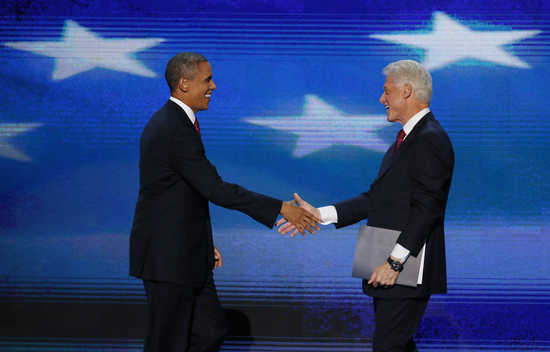
Here we go . . . This is the last night of the 2012 Democratic National Convention. We can only hope the speeches will be as thrilling as the ones we heard last night.
Tonight Vice President Joe Biden and President Barack Obama will accept their nominations to run for reelection. In addition, there will be a who slew of celebrity appearances, including Natalie Portman, Scarlett Johansson, The Foo Fighters, Eva Longoria, Mary J. Blige, James Taylor, Earth Wind & Fire, Marc Anthony, and Kerry Washington. Former Arizona Rep. Gabrielle Giffords will lead the pledge of allegiance.
At 8:00, former Florida Governor Charlie Crist will speak. At 10:00, we’ll hear from Eva Longoria, Joe Biden, and President Obama. The rest of the night’s schedule has not been released.
Just a few headlines to get you going:
Amanda Marcotte: Sandra Fluke’s Speech Made Republicans Crazy. Which Is Just What the Democrats Want.
For a short period yesterday evening, a moment of panicked confusion broke out among those of us obsessively watching and tweeting the Democratic National Convention, when Sandra Fluke did not go on stage as scheduled. It turns out that we needn’t have worried; convention organizers made an apparently last minute decision to move Fluke’s speech to later in the night, giving her a prime-time audience. It’s a move that indicates Democrats have finally stopped freaking out at the first sign of reactionary histrionics, and instead have embraced the strategy of taking the fight to conservatives.
After decades of playing along with conservatives who dress up their hostility to female sexuality as nothing more than an interest in “life,” Democrats have finally realized that baiting the anti-choice right into showing its misogynist, sex-phobic side may just be a winning strategy.
Marcotte posts some of the rageful Republican tweets at the link.
HuffPo: Unions Hope Democratic National Convention Draws Attention To Plight Of North Carolina Workers
North Carolina passed right-to-work legislation in 1947, barring contracts that require all workers at unionized companies to pay union dues. North Carolina is now the least-unionized state in the country, with about 3 percent of workers belonging to one, according to the Labor Department. The state also bans collective bargaining for public-sector workers. Feeling snubbed, some activists skipped the convention in favor of what was billed as a “shadow convention” for organized labor in Philadelphia.
“This entire saga, from the beginning to today – the site selection, the state selection — the way it’s been handled is just nothing more than confirmation to me that the standing of organized labor in the eyes of the Democratic Party is lower than it’s ever been in my time,” said Chris Townsend, political director of the United Electrical, Radio and Machine Workers of America union, who has been in the labor movement for more than three decades.
CNN Money: Is Wall Street Being Bamboozled by Romney?
FORTUNE — Wall Street is taking quite a pounding at the Democratic National Convention this week as speakers, like Massachusetts Senate hopeful Elizabeth Warren, fire populist missives so inflammatory it would cause even the most liberal banker to cringe. While the speeches are meant to fire up the Democratic base, they are also likely to induce some financiers to double their contributions to Republicans, namely, Presidential hopeful Mitt Romney.
But is that a safe bet? Much of Wall Street’s concerns derive from the passage of the Dodd-Frank financial reform bill, even though some of the most controversial aspects of the bill seem permanently lost in regulatory limbo. Going forward, there remain questions as to what, if anything, a Romney Presidency could truly deliver in the next four years that would be so different from a second term Obama presidency. Given that uncertainty, Wall Street could possibly be better off sticking with the devil they already know.
New York Observer: We Can All Breathe a Sigh of Relief: Mitt Romney Has a Plan to End the Housing Crisis
Is Mitt Romney really the man to solve the housing crisis? Well, consider this: Mr. Romney may not have ever struggled “to put food on the table” as folksy politicians are so fond of saying, but he has four houses. Four. So he knows a thing or two about home ownership. And, unlike some homeowners who took out mortgages and couldn’t pay them back, Mr. Romney is wealthy enough not to have to take out mortgages (although there’s a possibility that he did—the man does have the common touch, at times).
In any event, the Republican candidate has revealed his four-point plan while taking a few swings at Obama, like: “the dream of home ownership is out of reach for many Americans as a result of President Obama’s failed policies and stalled economy.”
Because Americans were doing so well with home ownership before Mr. Obama took the helm. Ha! Good one! As though the “stalled economy” and, well, the “economic crisis” weren’t a result of the fact that many Americans were actually really horrible when it came to assessing risk and making responsible choices about home ownership.
The consensus is that it’s not much of a “plan.”
ABC News: Paul Ryan Anticipates and Counters Obama’s Convention Speech Tonight
COLORADO SPRINGS–Just hours before the president takes the stage at the Democratic National Convention, Paul Ryan attempted to counter Obama’s speech by reminding voters in this battleground state of then candidate Obama’s promises in his 2008 speech in Denver.
“Right here in Colorado, four years ago with the Styrofoam Greek columns, the big stadium, the president gave this long speech with lots of big promises,” Ryan said. “He said … that Democrats have a very different measure of what constitutes progress. By those very measurements, his leadership has fallen woefully short.”
Yawn. . . Lots more of Lyin’ Ryan’s psychic predictions at the link. Frankly, after the spanking he got from Bill Clinton last night, the little twerp would do better to just STFU; but I’m hoping he continues making a fool of himself. I guess he doesn’t know that he has lost all credibility with everyone but obsessive Fox watchers.
Detroit News: Conservatives Pull Ads from Michigan
Mitt Romney’s conservative allies are bypassing Michigan with their advertising while stepping up efforts in other battleground states — suggesting campaign strategists don’t believe his road to the White House leads through his native state.
The pro-Romney groups American Crossroads and Americans for Prosperity are pouring nearly $13 million into advertising in key states, indicating they remain eager to lend considerable financial muscle to Romney in states viewed as truly competitive.
There are no presidential campaign ads of any kind airing in Pennsylvania and Michigan, according to information provided by media trackers to the Associated Press.
Nate Silver: The Simple Case for Why Obama Is the Favorite
…our forecast has moved toward President Obama over the past several days. It now gives him about a three-in-four chance of winning the Electoral College on Nov. 6.
I’ll explain a little bit more about how the model comes to that conclusion in a moment, but the intuition behind it is pretty simple:
1. Polls usually overrate the standing of the candidate who just held his convention.
2. Mitt Romney just held his convention. But he seems to have gotten a below-average bounce out of it. The national polls that have come out since the Republican National Convention have shown an almost exact tie in the race.
3. If the polls overrate Mr. Romney, and they show only a tie for him now, then he will eventually lose.
The first point is the simplest of all, but perhaps the most important. There is a lot of focus on the bounce that a candidate gets after his convention — that is, how the polls conducted just after the convention compare with the ones taken immediately beforehand.
Silver predicted the 2008 election results almost perfectly.
I’m looking forward to reading your comments tonight, so bring it!

 peej
peej Carissa
 bostonboomer
 dakinikat
 ecocatwoman
 mablue2
 Mama Lopez
 peggysue22
 quixote
 skydancingguestblogger
 Mona (aka Wonk the Vote)



 Sky Dancing
Recent Comments