
Tuesday Reads: Trump Nominates Brett Kavanaugh for SCOTUS
Posted: July 10, 2018 Filed under: Civil Liberties, Civil Rights, court rulings, Criminal Justice System, morning reads, SCOTUS, U.S. Politics, Women's Rights | Tags: abortion, Anthony Kennedy, Birth Control, Brett Kavanaugh, Donald Trump, same-sex marriage, U.S. Supreme Court 44 Comments
The Four Justices, Nelson Shanks, National Portrait Gallery, Smithsonian Institution
Good Morning!!
Last night thug “president” Trump did his ridiculous PT Barnum act with his nomination of Brett Kavanaugh to the Supreme Court to replace Anthony Kennedy. Supposedly, Trump was deciding among about four candidates, but it turns out the fix may have been in all along.
https://twitter.com/GeoffRBennett/status/1016642192616706050
Has any other president made a deal with a Supreme Court Justice to appoint a chosen replacement?
https://twitter.com/Susan_Hennessey/status/1016649427577196544
From Politico: How a private meeting with Kennedy helped Trump get to ‘yes’ on Kavanaugh.
After Justice Anthony Kennedy told President Donald Trump he would relinquish his seat on the Supreme Court, the president emerged from his private meeting with the retiring jurist focused on one candidate to name as his successor: Judge Brett Kavanaugh, Kennedy’s former law clerk….
So even as Trump dispatched his top lawyers to comb though Kavanaugh’s rulings and quizzed allies about whether he was too close to the Bush family, potentially a fatal flaw, the president was always leaning toward accepting Kennedy’s partiality for Kavanaugh while preserving the secret until his formal announcement, sources with knowledge of his thinking told POLITICO.
I’m sure we’ll be learning more about this, and I hope Democrats respond aggressively.
Basic background on Kavenaugh
NBC News: Who is Supreme Court nominee Brett Kavanaugh?
President Donald Trump’s Supreme Court pick is no stranger to partisan politics: Before becoming a judge, he was helping make the case for the impeachment of Bill Clinton and later for the election of George W. Bush.
U.S. Court of Appeals for the D.C. Circuit judge Brett Kavanaugh
Twenty years ago, Kavanaugh’s story starts amid the highly politicized independent counsel investigation into Clinton. He worked for Starr as a young Yale Law graduate, first when Kenneth Starr was solicitor general and later in the Office of the Independent Counsel, where Kavanaugh was a key player in the slew of investigations into the Clintons, including the Whitewater scandal, the suicide of White House counsel Vincent Foster and Clinton’s affair with Monica Lewinsky.
The Starr Report to Congress laid out the details of Clinton and Lewinsky’s affair and findings of potential wrongdoing by the president. Kavanaugh was the primary author of the section on the grounds for possible impeachment, Starr would reportedly later say,because “that needed to be very carefully crafted, so I was looking to one of the office’s most talented lawyers — of superb and balanced judgment — to take the lead in drafting.” [….]
He was a member of the GOP legal team fighting to stop the recount in Florida to clear the way for Bush’s election against Al Gore in 2000, later taking a job in the Bush White House in 2001, where he’d serve for five years as counsel and later staff secretary until his confirmation to the U.S. Court of Appeals for the D.C. Circuit in 2006.
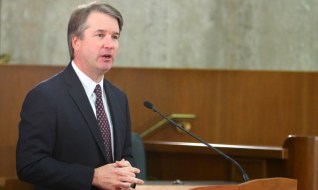
The Washington Post: Brett Kavanaugh, Trump’s Supreme Court pick, has sided with broad views of presidential powers.
Brett M. Kavanaugh, the federal judge nominated by President Trump on Monday to the Supreme Court, has endorsed robust views of the powers of the president, consistently siding with arguments in favor of broad executive authority during his 12 years on the bench in Washington.
Justice Anthony Kennedy
He has called for restructuring the government’s consumer watchdog agency so the president could remove the director and has been a leading defender of the government’s position when it comes to using military commissions to prosecute terrorism suspects.
Kavanaugh is “an unrelenting, unapologetic defender of presidential power” who believes courts can and should actively seek to rein in “large swaths of the current administrative state,” said University of Texas law professor Stephen Vladeck, who closely follows the U.S. Court of Appeals for the District of Columbia Circuit.
Kavanaugh’s record suggests that if he is confirmed, he would be more to the right than the man he would replace, Justice Anthony M. Kennedy, for whom he clerked. Kavanaugh has staked out conservative positions in cases involving gun rights, abortion and the separation of powers.

Read more details at both of those links.
What Kavanaugh Would Likely Do on the Court
Slate: How Brett Kavanaugh Will Gut Roe v. Wade
Kavanaugh is an obvious choice for Trump. A judge on the U.S. Court of Appeals for the District of Columbia Circuit, he has maintained staunchly conservative credentials without earning a reputation for being a bomb-thrower. Unless Republican Sen. Susan Collins grows a spine, which she won’t, he has a clear path to Senate confirmation. During his hearings, Kavanaugh will claim he cannot reveal his true feelings about Roe v. Wade, the 1973 Supreme Court decision establishing a constitutional right to abortion access. But there is little doubt that Kavanaugh will gut Roe at the first opportunity. Indeed, he has already provided a road map that shows precisely how he’ll do it.
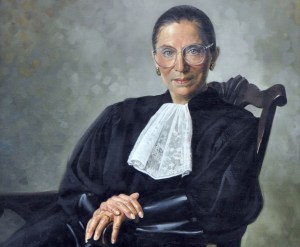
Justice Ruth Bader Ginsburg
Kavanaugh was forced to confront the abortion question in 2017 after the Trump administration barred an undocumented minor, known as Jane Doe, from terminating an unwanted pregnancy. The American Civil Liberties Union sued on Doe’s behalf, and the dispute came before a three-judge panel at the D.C. Circuit. Kavanaugh was joined on the panel by Judge Karen L. Henderson, an arch-conservative, and Judge Patricia Millett, a moderate liberal. Doe, who was being held in a federally funded Texas shelter, had already obtained the necessary judicial bypass to get an abortion. But the Trump administration refused to let her see an abortion provider, instead sending her to an anti-abortion “crisis pregnancy center.”
By that point, Doe would be about 18 weeks pregnant. Texas bans abortion after 20 weeks, and the procedure becomes more dangerous as the pregnancy advances. Moreover, the process of finding and verifying a sponsor for an undocumented minor frequently takes weeks or months. And Doe’s lawyers had already searched for a possible sponsor, to no avail. Kavanaugh’s ostensible compromise, then, was nothing of the sort. At best, it would force Doe to suffer through her unwanted pregnancy for at least two more weeks, increasing the odds of complications when she was finally able to obtain an abortion. At worst, it meant the government could run down the clock to the point that an abortion would become illegal.
Luckily for Doe, the full D.C. Circuit swiftly reversed Kavanaugh’s decision and allowed her to terminate her pregnancy, which she did. This move prompted Kavanaugh to write a bitter dissent explaining why the government’s bar on Doe’s abortion was not, in fact, an undue burden.
Read the rest at Slate.
The Daily Beast: Brett Kavanaugh, Trump’s Supreme Court Pick, Is Probably the End of Abortion Rights and Same-Sex Marriage.
When President Trump Monday nominated Judge Brett Kavanaugh to the Supreme Court, he probably doomed the right to abortion, same-sex marriage, and maybe even contraception….
Future justice Elena Kagan arging a campaign finance reform case before SCOTUS
…while Kavanaugh’s record on women’s and LGBT rights is sparse, it gives good reason to suspect that he could be the swing vote to strike down Roe v. Wade, the abortion-rights case. This, after all, is what Trump promised in 2016: that Roe would be “automatically” be overturned should he be elected. And Kavanaugh has been praised by numerous right-wing organizations.
In the case of Garza v. Hargan, the D.C. Circuit Court of Appeals held that an undocumented teenage immigrant was entitled to obtain an abortion without having to obtain familial consent (as is required in several states).
Kavanaugh vigorously dissented, asking, “Is it really absurd for the United States to think that the minor should be transferred to her immigration sponsor ― ordinarily a family member, relative, or friend ― before she makes that decision?”
Those are strong words, endorsing not only parental consent rules but enforcing them in extreme circumstances. If you are looking for signals that a Justice Kavanaugh would limit or overturn Roe, Garza is a giant red flare.

There’s also a possibility that Kavenaugh might not be right wing enough to satisfy some Republicans.
Kavanaugh may not be conservative enough to survive the confirmation process. There is even talk that conservatives might revolt against Kavanaugh, as they did in 2005 against George W. Bush’s nomination of Harriet Miers. The reason? Many conservatives wanted Kavanaugh to cast doubt on the teenager’s right to get an abortion at all, which another dissenting judge did.
Neal K. Katyal for respondents, Travel Ban case
Legally speaking, that objection is absurd. Not unlike “judicial minimalist” Chief Justice John Roberts, Kavanaugh was discussing the case at issue, not some hypothetical issue. And he was responding to the circuit court’s holding, not writing an essay.
But there’s more. Some conservatives have pointed to dicta in another Kavanaugh opinion, a dissent in Priests for Life v. HHS, a case similar to Hobby Lobby involving the Affordable Care Act’s contraception requirement. While dissenting in favor of the Catholic religious organization objecting to the requirement, Kavanaugh wrote that the “the Government has a compelling interest in facilitating women’s access to contraception” because of a variety of factors, such as “reducing the number of unintended pregnancies would further women’s health, advance women’s personal and professional opportunities, reduce the number of abortions, and help break a cycle of poverty.”
Kavanaugh is writing here about the state’s interest in access to contraception, not whether an individual has a constitutional right to access it. Those are totally different questions. But Kavanaugh’s opinion doesn’t question the constitutional right either, which rests on the same foundations (substantive due process, privacy, family) as the right to obtain an abortion.

This one is a must read–lots of details on Kavenaugh’s record. Head over to The Daily Beast to read the rest.
Read more about Kavenaugh and abortion here:
https://twitter.com/imillhiser/status/1016672606269952001
One more from The New York Times editorial board: There’s So Much You Don’t Know About Brett Kavanaugh. And you probably won’t until it’s too late.
First, the awful lot: Judge Kavanaugh would shift the balance of constitutional jurisprudence to the right, creating a solid right-wing majority on the court possibly until the second half of the 21st century. While the somewhat unpredictable Justice Anthony Kennedy once served as the fulcrum for the court, that role will now go to Chief Justice John Roberts Jr., a far more ideological conservative.
Judge Kavanaugh, who sits on the federal appeals court for the District of Columbia, has been a fixture in conservative politics and is widely respected by the Republican elite. Before becoming a judge, he clerked for Justice Kennedy and worked for Kenneth Starr, the independent counsel who investigated President Bill Clinton, and later in the George W. Bush White House. He successfully portrayed himself in his remarks at the White House as a nice guy who coaches girls in basketball, feeds the homeless and believes in the Constitution.
What Americans can’t know about Judge Kavanaugh: pretty much anything else. That’s thanks to the perversion of the Supreme Court confirmation process, which once provided the Senate and the public with useful information about a potential justice’s views on the Constitution, but which has, ever since the bitter battle over President Ronald Reagan’s failed nomination of Robert Bork in 1987, devolved into a second-rate Samuel Beckett play starring an earnest legal scholar who sits for days at a microphone and labors to sound thoughtful while saying almost nothing.
Read the rest at the NYT.
I know there’s plenty of other news, but this is the biggie for today. Post your thoughts and links on any topic in the comment thread, and try to have a good day despite the horrors all around us.
Monday Reads: SCOTUS Slices the Cake Thinly
Posted: June 4, 2018 Filed under: Afternoon Reads, Marriage Equality, SCOTUS | Tags: SCOTUS decisions 18 Comments Good Morning
I’m not a big fan of the institution of marriage. It’s one of those things purposefully set up to make men unnecessarily comfortable and women overtly miserable even though men swear they’re continually put out by it. Women are really sold a fish story on how the marriage thing is in their interests. Few marriages actually wind up being happy and equitable but still, every one hopes for it. I always hope that the institution evolves and think expanding it to the GLBT community helps that along although I wouldn’t be adverse to it going the way of the dinosaurs.
I’ve worked in a man’s field forever and my biggest shock was the level of upmanship expressed by men in groups–when no women are present–on whose wife is the worst. It’s almost always lists of reasonable requests like helping out with work, paying for something that kids or the house requires or doing some activity beyond living at work or on the couch. For some reason, I’ve always been a fly on the wall during these prick sessions. Women share stories about what theatrics men undertake to avoid work. We also know large numbers of wives beaten and/or emotionally abused by husbands. That’s central to women’s gatherings. That plus discussions of everything we gave up and continually give up. I’m going through the DV support with two friends now and it never gets easier. We trudge along with the drudge. Men make their wives monsters for it.
These are the reasons I always have problems with the traditional, patriarchal, religious frame hammered to marriage. This creates some of its worst tendencies as an institution. It always worries me to see laws and legal decisions that add more nails. Man act oppressed by it while taking advantage of its built-in safety net for them to oppress.
Domestic violence is central to enforcing dominance and marriages can be rife with it. You always think it won’t happen to you. You are amazed when they try to tell the family that you made them do it. Well#MeToo One day it went beyond eye rolling and heavy sighs and the “how dare you bitch!” look and I was headed with the youngest in diapers to my parents’ house totally in bruises but only after he tried to stop me from dialing 911 over and over. The instances of domestic violence alone make me happily single, alone in blissful solitude, and never in need of the experience of anything else.

I heard Bill Murray one night express my exact thoughts about marriage both gay and hetero. He failed miserably at it and I personally believe his exwife. After having been mired in marriage for 20 years, all I could think was if the GLBT community really wants it they should have it and I hope they can make less of a mess of it. He said about the same thing.
To be honest, even a large percentage of my long time married friends basically say what I say. If I had it to do over again, I’d have the kids and skip the husband. I’ve been divorced now since 1995. I do not want one of them around useless, in the way, constantly looking put out or angry, and just waiting for you to commit some imaginary sin so they can hit you, turn people against you, and go on doing whatever it is that meets their needs. I’d never enter into that fucked up bargain again. I discouraged my daughters from it. I remember my mom endlessly wailing “But what about my needs?” At one point, I understood fully what “until death us part” really meant. I’d gotten life in prison.
The funny thing is that I’ve gotten to the point now where I truly never fill lonely or understand what that means when folks express the feeling. I’ve grown so comfortable being in solitude that I can’t imagine wanting anything else.
But, I’m old, overly experienced, and I understand everything that’s bundled up and pressed on folks to be married and have a family. I also understand how it functions as an institution that establishes property rights and control. All the Abrahamic religions use it to establish male dominance and supremacy under the grift of it being some kind of sky fairy blessing. I can understand why they hate having all of that taken away and they don’t want to share it.

So, we’ve established that I really don’t do weddings unless truly forced into it. I just cannot contain my strong urge to tell the bride to run because she’s about to do irreparable damage to her entire life.
That being said marriage is between two people and it’s not up to any one else to interpret it or deny their access to what they want from it or the Merger Day. Religion should only define it for those who adhere to that religion. But, that’s not what all religions preach or do.
SCOTUS is comprised of a group of judges with a majority belonging to a cult within Catholicism. That would be Opus Dei. That’s something that even creeps Popes and the Jesuits out and they know a lot about oppression of women and children within religious institutions. It was started in 1928 and adores the concept of “Corporal Mortification”. That should tell you how sick they are. It’s basically a cult. But, a bunch of them sit on the bench because the Republicans love religious fanatics. They vote. Religious diversity left the building when it comes to SCOTUS and the christofascists love it! So, does every other bigoted throwback religion.
They love it because they gradually get to enshrine their sick, twisted, religious views into law. Now, today’s ruling was written by Kennedy and it’s leaving a door cracked open for future dissent, but what it basically does is create a weird notion of ‘religious liberty’. This is not just about the guy that just couldn’t bake a wedding cake for a gay couple and the laws and lawsuits that followed. This is also about situation that followed. It’s about 3 bakeries refusing to make 2 hateful, ‘christian’ themed sheet cakes condemning gay marriage.

Does this decision basically allow hatred and bigotry in the name of religious sects basically infamous for that?
The Supreme Court on Monday ruled for a Colorado baker who refused to create a wedding cake for a gay couple.
In an opinion by Justice Anthony M. Kennedy that leaves many questions unanswered, the court held that the Colorado Civil Rights Commission had not adequately taken into account the religious beliefs of baker Jack Phillips.
In fact, Kennedy said, the commission had been hostile to the baker’s faith, denying him the neutral consideration he deserved. While the justices split in their reasoning, only Justices Ruth Bader Ginsburg and Sonia Sotomayor dissented.
Kennedy wrote that the question of when religious beliefs must give way to anti-discrimination laws might be different in future cases. But in this case, he said, Phillips did not get the proper consideration.
“The Court’s precedents make clear that the baker, in his capacity as the owner of a business serving the public, might have his right to the free exercise of religion limited by generally applicable laws,” he wrote. “Still, the delicate question of when the free exercise of his religion must yield to an otherwise valid exercise of state power needed to be determined in an adjudication in which religious hostility on the part of the State itself would not be a factor in the balance the State sought to reach. That requirement, however, was not met here.”

So, tell me, wtf does this mean? Here’s SCOTUS blog.
Almost six months to the day after the oral argument, the justices today handed Phillips a victory, even if not necessarily the ruling that he and his supporters had hoped for. Kennedy, the author of some of the court’s most important gay-rights rulings, began by explaining that the case involved a conflict between two important principles: on the one hand, the state’s power “to protect the rights and dignity of gay persons who are, or wish to be, married but who face discrimination when they seek goods or services”; and, on the other, the First Amendment rights to freedom of speech and the free exercise of religion.
As a general rule, Kennedy explained, the Supreme Court’s cases make clear that Phillips’ right to freely exercise his religion is not absolute, and can be limited by neutral laws that apply to everyone. But the critical question of when Phillips’ right to exercise his religion can be limited had to be determined, Kennedy emphasized, in a proceeding that was not tainted by hostility to religion.
Here, Kennedy observed, the “neutral and respectful consideration to which Phillips was entitled was compromised” by comments by members of the Colorado Civil Rights Commission. One commissioner, Kennedy pointed out, “even went so far as to compare Phillips’ invocation of his sincerely held religious beliefs to defenses of slavery and the Holocaust.” Moreover, Kennedy added, the commission’s treatment of Phillips’ religious objections was at odds with its rulings in the cases of bakers who refused to create cakes “with images that conveyed disapproval of same-sex marriage.” Therefore, Kennedy concluded, the commission’s order – which, among other things, required Phillips to sell same-sex couples wedding cakes or anything else that he would sell to opposite-sex couples and mandated remedial training and compliance reports – “must be set aside.”
The majority left open, however, the possibility that a future case could come out differently, particularly if the decisionmaker in the case considered religious objections neutrally and fairly. “The outcome of cases like this in other circumstances,” the majority closed, “must await further elaboration in the courts, all in the context of recognizing that these disputes must be resolved with tolerance, without undue disrespect to sincere religious beliefs, and without subjecting gay persons to indignities when they seek goods and services in an open market.”
Justice Ruth Bader Ginsburg dissented from the court’s ruling, in an opinion joined only by Justice Sonia Sotomayor. Ginsburg stressed that there “is much in the Court’s opinion with which I agree,” but she “strongly” disagreed with the idea that the same-sex couple “should lose this case.” In particular, she argued, neither the commissioners’ statements about religion nor the commission’s disparate treatment of other bakers who refused to make cakes disapproving of same-sex marriage justified a ruling in favor of Phillips.

So, this is an odd narrow scope. Really odd. Really narrow. Really wtf?
The Supreme Court has ruled that the state of Colorado’s enforcement of its civil rights law was flawed, while reaffirming that LGBTQ Americans should not face discrimination in the provision of goods and services and state law may continue to prohibit such discrimination.
“In today’s narrow ruling against the Colorado Civil Rights Commission, the Supreme Court acknowledged that LGBTQ people are equal and have a right to live free from the indignity of discrimination,” said HRC President Chad Griffin. “Anti-LGBTQ extremists did not win the sweeping ‘license to discriminate’ they have been hoping for — and today’s ruling does not change our nation’s longstanding civil rights laws. Yet, the fact remains that LGBTQ people face alarming levels of discrimination all across the country and HRC’s efforts to advance equality are as urgent as ever. With LGBTQ people at risk of being fired, evicted or denied services in 31 states, HRC continues to build momentum for the Equality Act, to elect pro-equality candidates up and down the ballot, and to fight in every corner of our country to advance policies that protect LGBTQ people from being targeted for who they are or whom they love.”

This is basically an invitation to flood the court with wedding cake cases I guess. Does this create the inroads that religious bigots truly desire?
Like a good wedding cake, the Supreme Court’s 7–2 decision on Monday in Masterpiece Cakeshop v. Colorado Civil Rights Commissionhas a little something for everyone. Gay people, who were justifiably terrified that the case could undermine their right to equal service, get a reaffirmation of their “dignity and worth.” Religious-liberty advocates get a continued expansion of the Free Exercise Clause. Anti-gay activists get a victory—a midsize and possibly temporary but still very real win, in a case that few initially expected to even reach the Supreme Court.
Who loses? Everybody who hoped this decision would definitively settle the ostensible clash between LGBTQ rights and religious freedom. In the end, Masterpiece Cakeshop barely resolves anything and doesn’t even touch the free-speech claim at the center of the case. Instead, it punts that question, leaving lower courts (and American society) to continue fighting about how, exactly, Justice Anthony Kennedy should feel about it. A great wedding cake might leave you wanting more, but Masterpiece Cakeshop just leaves you craving something you can actually sink your teeth into.
Like I said, best wishes and good luck to all of you in or entering the marital merge thing! You have me hoping you prove me wrong!!!
Other SCOTUS Decisions
From WAPO: Supreme Court throws out lower-court decision that allowed immigrant teenager to obtain abortion
The Supreme Court on Monday dismissed a lower court’s decision that allowed an undocumented immigrant teenager to obtain an abortion over the protests of the Trump administration.
The action, which came in an unsigned opinion without noted dissents, throws out a precedent that might allow other teenagers in the same circumstance to obtain an abortion.
The five-page order directs the lower courts to dismiss as moot the teen’s individual claim seeking access to abortion services. The girl, known in court papers as Jane Doe, was able to terminate her pregnancy before the high court got involved. She has since turned 18 and is no longer in federal custody.
Her lawyer, Brigitte Amiri of the American Civil Liberties Union, described as narrow the Monday ruling that she said does not affect a broader challenge to the government’s policy for pregnant teens in federal immigration custody that is pending in District Court in Washington.
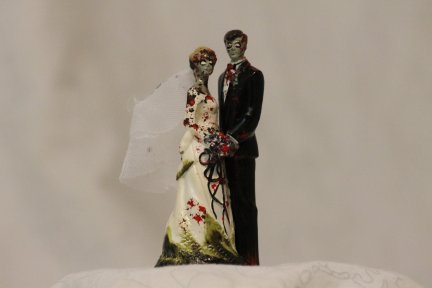 SCOTUS Bound Nonsense
Also from WAPO: “Trump says he has ‘absolute right’ to pardon himself of federal crimes but denies any wrongdoing”
President Trump on Monday asserted an “absolute right” to pardon himself of any federal crimes but said he has no reason to do so because he has not engaged in any wrongdoing.
“As has been stated by numerous legal scholars, I have the absolute right to PARDON myself, but why would I do that when I have done nothing wrong?” Trump wrote on Twitter.
In a subsequent tweet Monday, Trump also claimed that the appointment of special counsel Robert S. Mueller III to investigate Russian interference in the 2016 election had been “totally UNCONSTITUTIONAL!”
“Despite that, we play the game because I, unlike the Democrats, have done nothing wrong! Trump said.
Trump’s assessment of his pardon powers echoed that of his attorney, Rudolph W. Giuliani, who offered an expansive view of the president’s executive powers during interviews Sunday, arguing that Trump probably has the ability to pardon himself.
“He probably does,” Giuliani said Sunday, when asked on ABC News’s “This Week” whether Trump has the ability to pardon himself. “He has no intention of pardoning himself, but he probably — not to say he can’t.”
So, that’s it for me!
What’s on your reading and blogging list today?
Monday Reads: The Supremes Speak
Posted: June 20, 2016 Filed under: Afternoon Reads, SCOTUS, U.S. Politics, War on Women, Women's Healthcare, Women's Rights | Tags: Clarence Thomas, SCOTUS, Texas Trap Laws 26 CommentsGood Afternoon!
I’m in an absolute haze from a summer cold that popped up yesterday and sent me directly to bed. I’m trying to write and work right now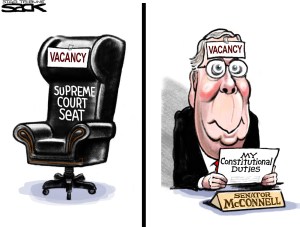 but it’s not easy at all. I want to try to discuss a lot of upcoming things that will be important including the SCOTUS decision on the Texas Trap laws regarding abortion and abortion clinics. These law certainly create an undue burden and they reflect specific religious view rather than medical or biological science. Here’s a few reads to prepare us all because it’s important for all of us to understand this basic constitutional right.
Abortion opponents regularly talk as though no restriction is off the table when it comes to stripping away reproductive rights. And supporters of abortion rights don’t always set them straight. If we don’t know what our established rights are, we can’t defend them. Pro-choicers need to know why abortion is a constitutional right and what boundaries the U.S. Supreme Court has set out to protect it.
1. Abortion is protected by the rights to bodily integrity and to make decisions about family. The Court explained that decades ago.
The 14th Amendment prohibits states from depriving a person of liberty without due process of law. A person has the right to end a pregnancy without undue interference from the government because that right to liberty includes (1) the right to make decisions about family and (2) the right to bodily integrity.
However, in order to portray abortion rights as illegitimate, conservatives like to argue—inaccurately—that the Court legalized abortion in Roe v. Wade by inventing a right to privacy that is not grounded in the Constitution’s actual text.
In the pre-Roe contraception case Griswold v. Connecticut (1965), the Court did hold that “penumbras, formed by emanations” or various interpretations of the First, Third, Fourth, Fifth, and Ninth Amendments protect a right to privacy. But in deciding Roe, the Warren court located the right to privacy in the 14th Amendment’s explicit protection of the right to liberty. Regardless, the Court’s understanding of the rights that protect reproductive freedom expanded beyond just privacy decades ago.
Privacy is barely mentioned in Planned Parenthood v. Casey, which established the current law governing abortion rights more than 20 years ago. “The controlling word in the cases before us is ‘liberty,’” the decision explained. It was settled law prior to Roe that liberty includes “the right to make family decisions and the right to physical autonomy.”
Privacy is also a constitutional right, and it was indeed violated by the laws at issue in Roe and its companion case,Doe v. Bolton. Those laws required a woman seeking an abortion to share her reasons for wanting the procedure with legal or medical authorities to have any hope of receiving legal abortion care. However, the law and discourse around privacy at the time of Roe implied a woman should be permitted to use contraception or end a pregnancy because the state should not interfere in decisions made in secret with the permission of her doctor, husband, father, pastor, or others. Casey instead properly recognized that the 14th Amendment protects a person’s right to control her body and destiny.
So why has the idea persisted that all we’ve got is a privacy right made up out of thin air? A counterintuitive and less textually based right serves abortion opponents, but abortion rights advocates also have a history of telling us abortion restrictions are primarily a threat to privacy. As William Saletan documented in Bearing Right: How Conservatives Won the War on Abortion, in the run-up to Casey, pro-choice leaders emphasized privacy on the advice of pollsters and political consultants to appeal to anti-government, anti-welfare, anti-tax, and anti-integration sentiments. While reproductive rights lawyers argued to the Supreme Court that the Constitution’s protection of autonomy, bodily integrity, and equality protected abortion access, outside of court pro-choice leaders told the public the right at stake was privacy. But, ultimately, the Casey decision provided a much fuller discussion of why abortion is constitutionally protected by rights beyond privacy.
Abortion is protected by the due process clauses of the Fifth Amendment (which restricts the federal government) and the 14th Amendment (which was added to the Constitution to restrict the states). As Casey explained, “It is a promise of the Constitution that there is a realm of personal liberty which the government may not enter.” Using the force of law to compel a person to use her body against her will to bring a pregnancy to term is a violation of her physical autonomy and decisional freedom—which the Constitution does not allow.
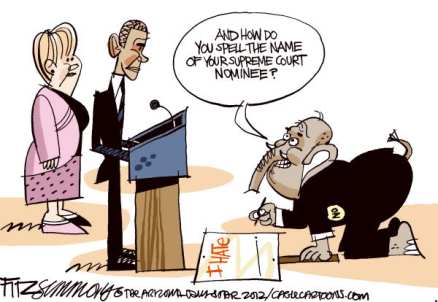 Follow the link to read about the other two basic rights that include:” 2. Any pre-viability ban is unconstitutional. Period.” and “3. Casey‘s “undue burden” standard is a meaningful protection of abortion rights when courts apply it properly.”
There’s no doubt that the Texas Trap Law creates an “undue” burden. Clinic closures have left the few remaining clinics overwhelmed.
The war on abortion access in Texas has already fundamentally shifted the landscape of women’s lives in the state. Now, the fallout continues: The closure of Planned Parenthood (PP) clinics in the state—which once served as primary sources of reproductive health care for women there—has left the few clinics remaining in west Texas underfunded, understaffed, and overwhelmed by demand.
According to new research, 60 percent of women receiving a low salary who were of reproductive age accessed health care through PP before the cuts and defunding which took place in 2013. The majority of those patients have since been directed to Texas Tech University and Midland County Health Services (MCHS) after PP’s clinics in west Texas closed—increasing demand at an overwhelming rate for their capacity to provide services.
“There are women [who] need these services but can’t afford them and we see as many as we can,” Michael Austin, director of MCHS, told Women’s Health Policy Report. “But the state program to help these folks along has basically evaporated. So I’m afraid there are probably a lot of folks flying under the radar who need care and aren’t getting it.” Austin pointed to the challenges of seeking funding in a state that has “eliminated or severely messed up” many of their programs which provide reproductive health care to women.
In 2011, the Texas State Assembly passed legislation which blocked funding to women’s health clinics, including Planned Parenthood, and cut the state’s family planning budget by two-thirds. Two years later, the draconian anti-abortion bill known as HB2 was signed into law by Governor Rick Perry, putting in place numerous obstacles meant to shutter clinics and restrict women’s access to safe and legal abortion. HB2 requires that abortion providers have admitting privileges at a local hospital and clinics are licensed ambulatory centers. It also bans surgical abortion after 20 weeks and medication abortion after seven. (Medication abortion is the most cost- and time-effective abortion procedure.)
HB2’s impact was immediate and drastic. 82 percent of family planning clinics closed. The number of abortion practitioners decreased by over 75 percent. Over half of the clinics performing abortion closed, which in turn drastically increased the time it would take for women to make an appointment to 28 days— essentially rendering the option of medication abortion moot. When it comes to clinics, Texas is in crisis.
The Supreme Court has declined to hear the Connecticut law banning assault weapon as well as the challenge to other state laws. This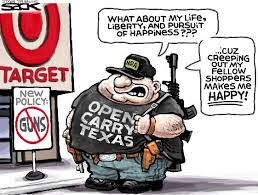 leaves the bans in place.
SCOTUS will look at certain key rights of jailed inmates that have illegal immigration status.
The Supreme Court announced Monday that it will take up a case exploring when immigrants detained solely for immigration violations have the right to be released from jail.
The justices agreed to consider a federal appeals court decision that essentially found detained immigrants were entitled to a bond hearing after six months in custody and every six months thereafter.
The high court’s announcement comes as immigrant rights advocates are awaiting a Supreme Court decision on the legality of President Barack Obama’s executive actions granting quasi-legal status and work permits to millions of immigrants who entered or stayed in the U.S. illegally.
In that case, the Obama administration is aligned with most immigrants rights groups. However, in the case the court said Monday that it would take up, the Obama administration is pressing for fewer rights for detained immigrants. In fact, the administration is asking the justices to overturn the 9th Circuit Court of Appeals ruling that found immigrants have the right to regular review of their detention.
The newly-accepted case, Jennings v. Rodriguez, could also explore when immigrants accused of ties to terrorism have to be released if authorities are having difficulty deporting them.
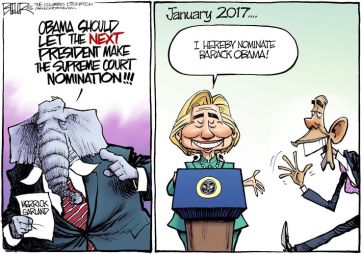 SCOTUS blog has some basic information on the remaining cases in the docket. Here’s a few of the remaining 13.
Between tomorrow morning, when the Justices will take the bench at ten o’clock, and the end of June, the Court is expected to issue thirteen rulings in cases involving everything from tribal-court jurisdiction to abortion, immigration, and the scope of federal laws prohibiting political corruption. Here are summaries of each pending case:
Dollar General Stores v. Mississippi Band of Choctaw Indians (argued December 7, 2015). This case stems from accusations by a thirteen-year-old member of the tribe that a manager at a Dollar General store within the tribe’s reservation had sexually molested him while the boy was interning at the store. The child and his parents filed a lawsuit against the manager and the store in tribal court, arguing that the store was liable for the manager’s conduct. The issue before the Court is whether the tribal court has jurisdiction over tort claims against defendants, like Dollar General, who are not members of the tribe.
Fisher v. University of Texas at Austin (argued December 9, 2015). This case, a challenge to the university’s consideration of race in its undergraduate admissions process, is on its second trip to the Court. In 2013, the Court sent the case back to the lower courts for a more critical look at whether the university really needed to consider race to achieve a diverse student body. After the Fifth Circuit once again upheld the policy, the Court agreed to weigh in. Unlike some of the Court’s other high-profile cases this Term, no one expects the Court to deadlock: Justice Elena Kagan is not participating, which in the wake of Justice Antonin Scalia’s death leaves the Court with just seven Justices to decide the case.
Utah v. Strieff (argued February 22, 2016). When a police officer stops a pedestrian in violation of the law, asks him for identification, discovers that there is a traffic warrant for his arrest, arrests him, and in the process of searching him discovers drug paraphernalia and methamphetamines, can the evidence found in the search of the pedestrian be used against him? Edward Strieff argues that it cannot: because the police officer’s stop was illegal, then anything obtained as a result of the stop is also tainted. The state, on the other hand, contends that the evidence should be admitted because it resulted from the lawful warrant for his arrest, rather than the illegal stop.
Taylor v. United States (argued February 23, 2016). The petitioner in this case, David Taylor, was part of a Virginia gang that robbed drug dealers. The two robberies that led to this case, however, did not yield any drugs – only cellphones, jewelry, and a small amount of money. Taylor was indicted on federal charges that he had violated the Hobbs Act, which punishes robberies and extortion but applies only when the defendant “obstructs, delays, or affects commerce or the movement of any article or commodity in commerce.” The question before the Court is whether the federal government is required to prove facts to show that the defendant’s conduct actually affects commerce.
Voisine v. United States (argued February 29, 2016). Stephen Voisine and William Armstrong, the other petitioner in this case, both pleaded guilty in state court to misdemeanor assaults on their respective domestic partners. Several years later, each man was charged with violating a federal law that prohibits the possession of firearms and ammunition by individuals who have previously been convicted of a misdemeanor crime of domestic violence. Voisine and Armstrong contend their state convictions do not automatically qualify as misdemeanor crimes of domestic violence because the state-law provisions can be violated by conduct that is merely reckless, rather than intentional.
Whole Woman’s Health v. Hellerstedt (argued March 2, 2016). This is a challenge to the constitutionality of two provisions of a Texas law regulating abortion in that state. One provision requires doctors who perform abortions to have privileges to admit patients to a local hospital; the other requires abortion clinics to have facilities that are comparable to outpatient surgical centers. Texas contends that these new laws are constitutional because they were intended to protect women’s health, while the challengers argue that the law was actually intended to close most clinics and therefore limit women’s access to abortions.
RJR Nabisco v. The European Community (argued March 21, 2016). The issue in this case is whether and to what extent the Racketeer Influenced and Corrupt Organizations Act (RICO), a 1970 law that was originally enacted to target organized crime, applies outside the United States. The European Community filed a lawsuit in the United States, seeking to hold RJR liable for what it says is the company’s role in an international money-laundering plot that harmed European countries. RJR counters that nothing in the law suggests that Congress intended it to apply to a situation like this. Justice Samuel Alito is almost certainly writing the Court’s opinion in this case, because he is the only Justice who has not yet written for the Court’s March sitting; based on the oral argument, that could bode well for RJR.
United States v. Texas (argued April 18, 2016). This case is a challenge to an Obama administration policy, announced in November 2014, that would allow some undocumented immigrants to apply to stay in the country and work legally for three years. Before the policy could go into effect, Texas and a large group of other states went to court to block its implementation, arguing that the administration lacks the authority to issue a policy like this. But before the Supreme Court can weigh in on that question, it will also have to agree that the states have the legal right, known as “standing,” to challenge the policy at all; the lower courts ruled that they did, because at least Texas would incur additional costs from the undocumented immigrants who would become eligible for driver’s licenses if the policy goes into effect.
Birchfield v. North Dakota (argued April 20, 2016). Twelve states and the National Park Service impose criminal penalties on suspected drunk drivers who refuse to submit to testing to measure their blood-alcohol levels. The question before the Court is whether those penalties violate the Fourth Amendment, which only allows police to “search” someone if they have a warrant or one of a handful of exceptions to the warrant requirement applies. Three drivers from North Dakota and Minnesota argue that neither of those conditions is met, and so the laws must fall.
Encino Motorcars v. Navarro (argued April 20, 2016). This case requires the Court to weigh in on the interpretation of the Fair Labor Standards Act, which generally requires employers to pay overtime to employees who work for more than forty hours in a week but also contains a variety of exceptions – including for a salesman whose primary job is selling or servicing cars. The respondents in this case are service advisors at a car dealership, who argue that they are not included in the exemption and are therefore entitled to overtime.
You can check out the rest on the link to SCOTUS blog. So, there’s a lot of interesting things coming down the pipe. We’ll definitely be following a lot of them.
There’s one piece of SCOTUS gossip that you might be interested in today. Check out this lede by David Badash: “DC Insider Report SCOTUS Justice Clarence Thomas Thinking of Retiring Throws Twitter Into Frenzy.”
The Washington Examiner Sunday afternoon posted a piece by DC insider columnist Paul Bedard that claims uber-conservative Supreme Court Justice Clarence Thomas “is mulling retirement after the presidential election, according to court watchers.” Those “court watchers” of course are unnamed, so the actual source of the claim is unknown.
It could be true, it could be false, but the implications of course are tremendous. Assuming Republicans in the Senate successfully keeps their vow to not confirm any SCOTUS justice nominated by President Obama, and wait until the next president takes office, this would mean the next president would automatically nominate not one but two justices to the nation’s top court, controlling its destiny for decades.
So naturally, Clarence Thomas began trending on Twitter.
Follow the link for the Twitter Frenzy.
What’s on your reading and blogging list today?
h/t to Delphyne
Monday Reads
Posted: May 16, 2016 Filed under: abortion rights, Affordable Care Act, Affordable Care Act (ACA), birth control, SCOTUS, social justice, Vagina, War on Women 27 Comments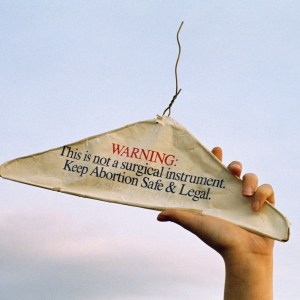 Good Morning!
We have an interesting SCOTUS decision/nondecision just announced on the challenge to the Affordable Health Care’s provision for Birth Control. Basically, they sent the case back to the lower courts. I’ve noticed a lot of women’s groups are beginning to take notice of the assault on our reproductive rights. Remember, Hillary Clinton will appoint the next Supreme Court Justice if President Obama’s selection continues to be the victim of right wing stalling. This coming election means women’s lives are at stake.
In a surprise move Monday, the Supreme Court punted on a major Obamacare case challenging the law’s contraceptive mandate, and specifically, how it accommodates religious nonprofits that object to birth control. The Supreme Court sent the case back to lower courts to examine an alternative accommodation to the mandate that the court had been briefed on by both parties in the case after the oral arguments.
The move — which comes as the Supreme Court is down a justice with Justice Antonin Scalia’s death — allowed the court to avoid what looked like a split decision after March’s oral arguments. The Supreme Court was able to stay away from the thorny trade-offs between health care policy and religious freedom, a legal landscape that got much more complicated after the Supreme Court’s ruling in 2014’s Hobby Lobby case.
The challenge the court weighed in on Monday was Zubik v. Burwell. It was consolidation of cases brought by religious nonprofits, including The Little Sister’s of the Poor, who objected to the work-around set up by the Obama administration to provide contraceptive coverage to employees of organizations opposed to birth control on religious grounds. The non-profits said that even filling out the form or sending a government the letter declaring their objections to covering birth control was a burden on their faith, because it set in motion the process by which their employees received the coverage from their insurers, though that coverage was not paid for or part of the employer plans. Lower courts’ have overwhelmingly rejected the challengers’ argument that the workaround violated 1993’s Religious Freedom Restoration Act (RFRA), though one appeals court ruled in their favor. (That case was not among those consolidated for the Supreme Court).
In sending the case back down to lower courts, the Supreme Court signaled that it believed a compromise could be worked out that didn’t involve weighing the larger issues involved in the RFRA challenge.
“The Court expresses no view on the merits of the cases. In particular, the Court does not decide whether petitioners’ religious exercise has been substantially burdened, whether the Government has a compelling interest, or whether the current regulations are the least restrictive means of serving that interest,” Monday’s opinion said. The opinion also stipulated that whatever was worked out should not affect “the ability of the Government to ensure that women covered by petitioners’ health plans” have access to contraceptive coverage.
RFRA was at the heart of the Supreme Court’s decision in 2014’s Hobby Lobby case — which said that certain for-profit companies that object to birth control could use the nonprofit workaround that was on trial in Zubik.
 Lyle Denniston writing for SCOTUSBLOG called it “A compromise, with real impact, on birth control”.
One reading of Monday’s developments was that the Court, now functioning with eight Justices, was having difficulty composing a majority in support of a definite decision on the legal questions. Thus, what emerged had all of the appearance of a compromise meant to help generate majority support among the Justices. With this approach, the Court both achieved the practical results of letting the government go forward to provide the contraceptive benefits and freeing the non-profits of any risk of penalties, even though neither side has any idea — at present — what the ultimate legal outcome will be and, therefore, what their legal rights actually are under the mandate.
Those uncertainties are now likely to linger through the remainder of President Obama’s term in office, which ends next January. The appeals courts may well order the filing of new legal briefs, and may hold new hearings, before issuing a new round of rulings on the controversy. However, the entire future of the ACA, including its birth-control mandate, may now depend upon who wins the presidential election this year and which party has control of Congress when it reassembles in 2017.
The two issues that the Court had agreed to rule on, and then left hanging at least for now, were whether the ACA mandate violates the federal Religious Freedom Restoration Act by requiring religious non-profits that object to contraceptives to notify the government of that position, and whether the move by the government to go ahead and arrange access to those benefits for those non-profits’ employees and students was the “least restrictive means” to carry out the mandate.
Doing on Monday much the same that it had done in several temporary orders at earlier stages of this controversy, the Court accepted that the non-profits already had given the federal government sufficient notice of their objection to the mandate, and that the government could use that notice as the basis for going ahead to provide actual access, at no cost, to the employees and students of those institutions.
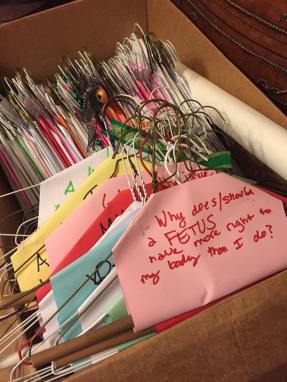
The pictures you’re seeing are from a Friday night event where activists here in New Orleans –including me–assembled and composed Wire Hangergrams for Louisiana Governor John Bel Edwards who is supporting a 72 hour waiting period here in Louisiana. We just can’t seem to keep these dirty old men out of our private parts!!! They don’t think we can make important decisions either. This is really getting disgusting.
The Louisiana legislature on Wednesday passed a bill requiring women to wait three days before receiving an abortion, tripling the state’s existing waiting time in one of the most stringent regulations of its kind nationally.
Governor John Bel Edwards, a Democrat, has said he plans to sign the bill championed by anti-abortion groups. It passed with wide support from the Republican-controlled legislature.
The bill requires a woman to wait at least 72 hours after a state-mandated ultrasound for the procedure. The current waiting time is 24 hours, the same as in most states with waiting periods.
Only five other states require 72-hour waiting periods: Missouri, North Carolina, Oklahoma, South Dakota and Utah.
The measures are among a wave of laws being adopted by states as conservatives seek to chip away at the U.S. Supreme Court’s landmark 1973 Roe v. Wade decision to legalize abortion.
I voted for the man but just couldn’t bring myself to work on his campaign even though he’d promised to not mess with things like  Planned Parenthood. You may recall I was incensed about an ad he ran. I found the ad appalling. He just seems to be another example of a man drenched in patriarchy who can’t keep his personal need to control the women in his life away from the rest of us.
This is another weird tale on fellow New Orleanian Wendall Pierce who actually physically assaulted a woman supporting Bernie Sanders. Pierce has been an outspoken Clinton supporter which is fine. This action is beyond wrong.
Wendell Pierce, the New Orleans-born actor known for his work in the HBO series “The Wire” and “Treme,” was arrested Saturday in Atlanta after he was accused of attacking a Bernie Sanders supporter,according to the website TMZ and online Fulton County police records.
Pierce was at the Loews Hotel in Atlanta about 3:30 a.m. when he began a political discussion with the woman and her boyfriend, according to the celebrity news website.
TMZ said a hotel source reported that Pierce, a supporter of Democratic presidential candidate Hillary Clinton, grabbed the woman’s hair and slapped her in the head after learning she preferred Clinton’s Democratic rival, Bernie Sanders.
On Sunday, the Atlanta Police Department confirmed that Pierce had been arrested at that hotel, where he was staying as a guest.
“The incident did not rise to anything significant, so no special notification was made … it was treated like any other arrest a patrol officer conducts,” police spokesman Donald Hannah told WWL-TV in an email shared with The New Orleans Advocate. “Mr. Pierce made no indication he was famous, nor did the officer inquire.”
Police records show Pierce, 52, was booked and released on Saturday. He was booked on simple battery and posted an online bond of $1,000, the records indicate.
Pierce, who now lives in Pasadena, California, was raised in Pontchartrain Park, the first African-American postwar suburb in New Orleans, and was active in efforts to rebuild it after Hurricane Katrina.
The actor and producer has been in more than 30 films and nearly 50 television shows and has performed in numerous stage productions, including Broadway productions of “The Piano Lesson,” “Serious Money” and “The Boys of Winter.”
He is perhaps best known for his roles as Detective Bunk Moreland in “The Wire,” trombonist Antoine Batiste in “Treme” and Michael Davenport in the movie “Waiting to Exhale.”
 This primary season needs to end. The shenanigans in Nevada have shown how little control the Sanders campaign has over its most zealous supporters. Things are getting way out of control.
Ben Carson is beginning to leak the short list for Trump’s VP and it isn’t a pretty one. Many folks think that it will most likely be Jan Brewer but Sarah Palin’s name is on it. So is Chris Christie’s which is basically no surprise to me. I really doubt either of them would bring anything to the ticket since they’re as nasty and crazy as Trump himself. They also don’t represent any new votes.
Ben Carson, the neurosurgeon turned presidential candidate turned unfiltered pitchman for Donald Trump and now part of the presumptive nominee’s vice presidential search committee, sat in the back of a Town Car with his wife, Candy, on his way to a televised interview. He had just explained to the reporter riding along that he wanted no role in a Trump administration when news arrived of a new poll naming him as the best-liked of a list of potential running mates.
“Who else was on the list?” he asked quietly, maintaining his usual inscrutable calm. The most favorably regarded contenders after himself, he was told, were John Kasich, Marco Rubio, Ted Cruz, Sarah Palin and Chris Christie.
“Those are all people on our list,” he said.
Seriously! Trump/Palin. How much argle bargle could one country stand?
I’m making it short today because I have a long day so what’s on your reading and blogging list? This is an open thread so please share!!!
Live Blog: Fourth Democratic Debate
Posted: January 17, 2016 Filed under: Affordable Care Act (ACA), Democratic Politics, Live Blog, SCOTUS, U.S. Politics | Tags: 2016 Democratic nomination race, Background Checks, Bernie Sanders, Brady bill, Democratic debates, Federal Employees' Health Benefits Program, flip flops, gun dealers' immunity, Health care, Hillary Clinton, Martin O'Malley, Medicaid, medicare, NRA, SCHIP, single payer, TRICARE 147 Comments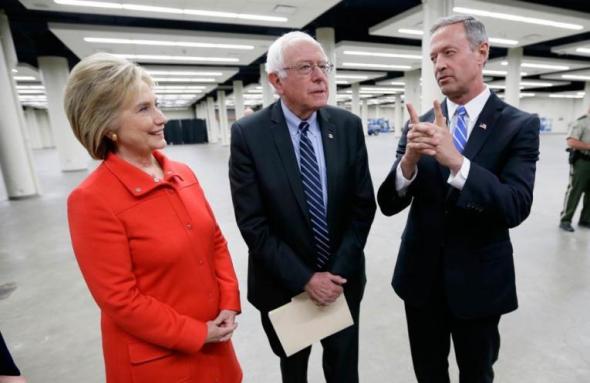
Tonight’s debate is likely to feature some fireworks and a good exchange of ideas between Hillary Clinton and Bernie Sanders–as long as the moderators can keep Martin O’Malley from constantly breaking in with his patented line “I’ve actually already done that in Maryland.”
Mediaite has the basics on how to watch the debate. It will be available on line at the NBC News website and YouTube. It begins at nine and goes for two hours.
The back and forth between Hillary and Bernie this week has been interesting, to say the least. Hillary seems to have gotten under Bernie’s skin too, because he has now partially flip flopped on his vote to immunize gun dealers from liability, his campaign has promised to release specifics on his health car plan and how he hopes to pay for it “very soon,” and they’ve also said they’ll release a “doctor’s note” on Sanders’ health.
Just a couple of days ago the Sanders campaign announced they wouldn’t release the health care tax figures and they previously pooh poohed the need to release medical records.

I’ve thought for awhile now that Sanders has begun to believe his own reviews in the media. After reading what he said on Face The Nation this morning, I’m convinced he has allowed the failure of the media to vet him and the adulation of his supporters to go to his head.
Sanders: I have a “good chance” to win 2016 election.
“I think we have a good chance to win both those states,” he said of Iowa and New Hampshire, the first two states to hold nominating contests. “I think we have a good chance to win this election.”
If he does win, Sanders predicted his campaign would come to be known as “one of the great political upsets in modern history.”
He is feeling so good, in fact, that the Vermont senator told “Face the Nation” host John Dickerson that while he was watching President Obama’s final State of the Union address last week, “the thought did cross my mind” that he could be delivering that address in the near future.
Then he caught himself.
“It’s a very humbling feeling,” he said, but added a moment later, “It’s a long way to go before we talk about inaugural speech, before we toss State of the Union speeches in.”
Hmmm…. he doesn’t sound so humble.

I have a few other good links for you on Bernie.
First a diary from DailyKos (!) on the health care law that Sanders has proposed multiple times in Congress: Sanders’ Health Care Plan. The diarist simply reports the contents of Senate Bill 1782, introduced in December 2013. Please go read it.
The law would end Medicare, Medicaid, SCHIP, the Federal Employees’ Health Benefits Program, and TRICARE. The money that was going into those programs, and use it to fund a “single payer” plan to be run and partially paid for by the states.
We already know that Supreme Court is not going to force states to accept something they don’t want from the Feds. That was their decision on the ACA Medicaid expansion. Even if Sanders could somehow get this through the Republican Congress, it would never get past SCOTUS.
I can’t even imagine what would be involved in implementing this. Right now, Medicare has low overhead costs because it turns over administration of supplemental plans to insurance companies–which would be outlawed in Sanders’ alternative universe.
I’m on Medicare and I get help paying my premiums from the government. Those premiums are more than $100 per month. Basic Medicare only pays for hospital bills, so I also have a government funded supplemental plan with very high co-pays that I get “free.” At least I can go to a doctor if it’s absolutely necessary. What would happen to people like me when all that infrastructure is demolished?
Here’s another must-read that Babama posted in a comment yesterday.

The People’s View: Chelsea Clinton was Right: Everyone’s Health Care is Threatened under Bernie’s Plan.
Recently, Chelsea Clinton got panned for saying that Bernie Sanders’ health care plan – commonly heralded as ‘Medicare for All’ by the revolution-peddlers – would give Republican governors the opportunity to dismantle publicly funded health insurance for the poor and middle class, that is, Medicaid and the health insurance exchanges. Seems absurd to accuse a self-proclaimed socialist with a proclaimed demand for single-payer universal health insurance of trying to take away health care. Politifact rated Chelsea Clinton’s claims ‘mostly false.’
Politifact got it wrong. Bernie Sanders’ plan does, in fact, allow for states to take away health care from the poor and middle-income, if not most everyone in a state. Although, that shouldn’t be a surprise, given that Sanders’ plan itself targets the economically disadvantaged for punishment. As Politifact notes, Sanders hasn’t proposed a full health care plan for his presidential campaign, instead choosing to use a bill Sanders introduced in the Senate in 2013 without a single cosponsor, titled ‘American Health Security Act of 2013’ as the template.
Poltiifact notes it is in fact true that Sanders’ plan repeals all health insurance funding from Medicare, Medicaid, and the Affordable Care Act Health Insurance exchanges. But he would channel the revenue instead to fund the single-payer system! [….]
The problem is, what Sander’s bill “seeks to” do and what it actually does are quite different. Since Politifact helpfully pointed us to Sanders’ 2013 bill, I decided to read it. In short, it ends all funding to Medicaid, Medicare, SCHIP an the ACA insurance provisions, directs it to this single-payer insurance program, raises additional revenue on the back of those who can least afford it, and charges states with the job of actually running it.
Each state, in theory, would have its own program that follows basic guidelines and the vast majority of the funding (80-90%) is provided by the federal government. Nonetheless, for states that refuse to run their own program, federal authorities – specifically, a Board – can do so instead. Sanders’ bill would also ban the sale of private health insurance.
Until I read that last night, I really didn’t understand how clueless Sanders really is. Please read the whole thing if you haven’t already, because Robert Reich is running around saying the plan makes sense.
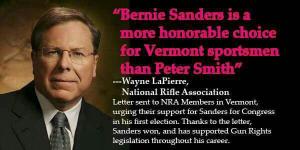
One more Bernie link from Dean Barker at “Birch Paper.” This one has been getting retweeted a lot today. The piece takes us back to the early days of Sanders’ political career when he ran again and again for office, and always lost. Then he got smart and used guns to get into Congress.
Sanders repeatedly talks about how he lost an election because he supported a ban on assault weapons. What really happened is that Sanders did so well in a third-party run that he got Republican Peter Smith elected. After he got to Washington, Smith’s conscience bothered him and he ended up supporting a bill to ban assault weapons.
In 1990, Sanders ran for the House seat again, and defeated Smith with the help and monetary support of the NRA. So when Bernie went to Washington, he voted against the Brady bill–repeatedly.
You have to read that article! There are tons of good links in there too.
Hillary was on the morning shows today too, and she learned from George Stephanopoulos that Karl Rove’s super pac is running an ad in Iowa that supports Sanders attacks on her.
Former Secretary of State Hillary Clinton laughed off a new attack ad from a Republican super PAC run by Karl Rove during an interview Sunday on “This Week” with George Stephanopoulos.
The web spot, titled “Hillary’s Bull Market,” was launched by American Crossroads, which is run by the Republican strategist and former President George W. Bush adviser. After watching the ad for the first time during her interview on “This Week,” Clinton just smiled.
“I think it shows how desperate the Republicans are to prevent me from becoming the nominee,” Clinton said about the ad, which goes after her ties to Wall Street. “I find that, in a perverse way, an incredibly flattering comment on their anxiety, because they know that not only will I stand up for what the country needs, I will take it to the Republicans.”
CNN’s report on the morning shows: Hillary Clinton zeroes in on Bernie Sanders.
Hillary Clinton on Sunday sharpened her attacks on Bernie Sanders over the Vermont senator’s record on gun control, just hours ahead of their fourth debate as both vie for the Democratic presidential nomination.
“I am very pleased that he flip-flopped on the immunity legislation,” Clinton told CNN’s Jake Tapper on “State of the Union,” a day after Sanders, who had been hammered by her campaign for his past position, announced he would change course and back legislation to reverse a 2005 law granting firearm manufacturers legal immunity.
She then called on her rival to do the same with the so-called “Charleston loophole,” which allows licensed dealers, once they have initiated a federal background check, to complete the gun sale in question if they haven’t hears back from authorities after three days.
Good news for Hillary:

Time: Poll: Hillary Clinton Leads Bernie Sanders Nationally By 25 Points.
Hillary Clinton is leading Bernie Sanders in a new national poll ahead of Sunday’s final Democratic debate before the Iowa caucuses.
The former Secretary of State is beating Sanders by 25 points nationally, according to according to the latest NBC News/Wall Street Journal poll of likely Democratic primary voters. Clinton is the top pick among 59% of Democratic primary voters, while Sanders has the support of 34%, the survey shows. Third-place candidate Martin O’Malley got the support of just 2% of likely voters.
Read the rest at CNN.
And From US News: Yes, Hillary’s Still the Inevitable Democratic Nominee She can recover even if she loses the first two nominating states to Bernie Sanders. Here’s why. Read about it at the link. It’s not easy find a brief excerpt to summarize the findings.
I’m putting this up a little early so we’ll have time to discuss these articles–or anything else you want to talk about–before the debate begins at 9PM. I look forward to reading your reactions to what happens tonight. This is the most important debate yet!

 peej
peej Carissa
 bostonboomer
 dakinikat
 ecocatwoman
 mablue2
 Mama Lopez
 peggysue22
 quixote
 skydancingguestblogger
 Mona (aka Wonk the Vote)



 Sky Dancing
Recent Comments