
What Fresh Hell is This?
Posted: February 24, 2011 Filed under: abortion rights, Reproductive Rights, right wing hate grouups, Women's Rights | Tags: anti abortion extremists, justifiable homicide abortion laws, Nebraska 31 Comments Republicans have unleashed a war against public servants and women. They appear to believe their election gains are a mandate to radically change the way government deals with its citizen. The latest state to initiate yet another crazy attack on women’s health is the state of Nebraska. Nebraska has followed South Dakota’s lead by introducing a “justifiable homicide” abortion bill. This bill goes farther than the South Dakota law. (See the sentence in bold below from the quote from a Mother Jones blog post.)
The legislation, LB 232, was introduced by state Sen. Mark Christensen, a devout Christian and die-hard abortion foe who is opposed to the procedure even in the case of rape. Unlike its South Dakota counterpart, which would have allowed only a pregnant woman, her husband, her parents, or her children to commit “justifiable homicide” in defense of her fetus, the Nebraska bill would apply to any third party.
“In short, this bill authorizes and protects vigilantes, and that’s something that’s unprecedented in our society,” Melissa Grant of Planned Parenthood of the Heartland told the Nebraska legislature’s judiciary committee on Wednesday. Specifically, she warned, it could be used to target Planned Parenthood’s patients and personnel. Also testifying in opposition to the bill was David Baker, the deputy chief executive officer of the Omaha police department, who said, “We share the same fears…that this could be used to incite violence against abortion providers.”
Baker’s concern is well-grounded: Abortion providers are frequent targets of violent attacks. Eight doctors have been murdered by anti-abortion extremists since 1993, and another 17 have been victims of murder attempts. Some of the perpetrators of those crimes, including Scott Roeder, the murderer of Wichita, Kansas, abortion provider Dr. George Tiller, have attempted to use the justifiable homicide defense at their trials. Several of the witnesses at Wednesday’s hearing cited Tiller’s murder as a case where a law like the one Christensen introduced could have come into play.
This one hits home for me. Nebraska–where I grew up–always turns out to be one of the states to test abortion restrictions. Their taxpayers pay millions of dollars to take outrageous bills to the Supreme Court just to see how much they can get away with. I can’t tell you how many of these initiatives I had to deal with while living there. It’s a horrible use of scare public revenues. I believe this was introduced to just test the waters since the South Dakota bill was withdrawn. These zealots are willing to waste taxpayer dollars just to see how far they can go.
The other thing that really bothers me is that my daughter is an ob/gyn in residency at the state’s med school. Considering many of these people think that birth control pills are abortifacients, does this mean you can justifiably shoot a prescribing doctor? This bill is just to let women protect their pregnancies if you listen anti-abortion fanatics. However, isn’t just being able to defend yourself as a pregnant woman enough?
For his part, Christensen insisted that his measure is not intended to target abortion providers. Like Jensen, Christensen claimed that his bill is merely meant to allow pregnant women to defend their unborn children without fear of prosecution. “LB 232,” he said, “is really nothing more than an attempt to make sure a pregnant woman is not unnecessarily charged with a crime for using force to protect her unborn child from someone who means to bring harm to her unborn children.”
But, as other lawmakers pointed out during the hearing, Christensen’s bill, as currently written, would not only apply to pregnant women but to anyone who attempted to prevent harm to a fetus. “I think it opens the door to something unintended,” said state Sen. Steve Lathrop. “I don’t think you came in here intending to make those who provide abortions a target of the use of force,” he told Christensen, “but I think it may unintentionally do that or at least provide somebody with an argument that they were justified in that.”
Nebraska isn’t the only state trying this tactic. The state of Iowa is also trying to get bills passed that allow deadly force to protect a fetus.
If passed into law, the two bills — House File 7 and House File 153 — would offer an unprecedented defense opportunity to individuals who stand accused of killing such providers, according to a former prosecutor and law professor at the University of Kansas, and are something that might have very well led to a different outcome in the Kansas trial of the man who shot Dr. George Tiller in a church foyer.
Melanie D. Wilson, associate professor of law at the University of Kansas, closely followed the trial of Scott Roeder, the man convicted of murdering Tiller. Roeder, at the urging of Iowa anti-abortion activist and former GOP legislative candidate Dave Leach, attempted to use the necessity defense, which says it is permissible to commit a crime if it stops a greater harm. The judge in the case refused to allow Roeder to use that defense.
“When [Roeder] presented the necessity defense, he failed because the legislature had basically already decided the abortion issue,” Wilson said. “So, as long as Tiller was performing legal abortion, [Roeder], as a defendant, didn’t get to re-decide the case [of abortion’s legal status]. Just as a matter of law, the judge wouldn’t allow that argument.”
Currently, abortion is also settled law in Iowa. But House File 153, sponsored by 28 Republicans, challenges it. Under that bill, the state would be mandated to recognize and protect “life” from the moment of conception until “natural death” with the full force of the law and state and federal constitutions. Essentially, the bill declares that from the moment a male sperm and a female ovum join to create a fertilized egg that a person exists.
I really don’t see any difference between these people and the Taliban. Being forced to live in country where extremist fundamentalist views dictate laws is not what this country is about. These people obviously don’t think that women are capable of making mature, moral decisions and must be shepherded through a humiliating, obtuse process just to exercise a right to be secure as a unique person. Again, this is nothing less than an out and out war on every woman. We should not have to beg for our constitutional rights and our standing as adults.
Death by Propaganda
Posted: February 19, 2011 Filed under: collective bargaining, education, John Birch Society in Charge, right wing hate grouups, The Media SUCKS, Voter Ignorance, worker rights | Tags: Negotiating, public and private salary surveys, state of Louisiana, unions, Wisconsin protests 35 Comments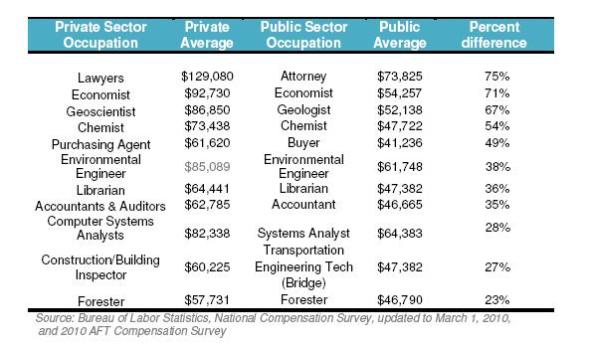
I’ve worked in both the public and private sector. I’ve also worked in union and non-union shops. Additionally, I was part of the collective bargaining process for community college instructors in a right to work state some time ago so I’m familiar with the process. I’ve been a manager and economist that has done strategic budgeting and planning so I’m used to salary and benefit surveys even though I’ve no experience in HR. I also check my facts before taking any one else’s words or wishful thinking. It’s easy to look for a scapegoat for the budget woes of states. The answer lies more in the nature of governors and legislators getting to balance a budget when funds are pouring in than it does in the joy that some people appear to be getting by scapegoating public sector workers and their unions.
For some reason, there’s this idea floating around that public sector employees are raking in the bucks at every one else’s expense. Also, there’s another canard out there that it’s public employees and their generous pensions that are breaking the back of state budgets. I know that’s not really the case for several reasons. The first one is that I know how the collective bargaining process works for a public employee because I’ve done it and the resultant salaries and benefits packages usually aren’t up to private sector levels. It’s based on bringing a rubric of like institutions in like communities and like jobs to the negotiating table. You basically point to that rubric and say here’s the top, bottom, and middle salaries for people in similar jobs in similar institutions. You point to their numbers and then you point to your institutions numbers and you suggest what it would take to put your institution in line with those averages. You negotiate to averages. You can’t negotiate to the best circumstance or you’ll be taken to labor “court” by management and the judges will force you to concede to a more reasonable position. The only time I’ve seen institutions go for the top salary positions is when they’re making a concerted effort to increase their academic standards and recruiting like the Duke Business School did awhile back. That, however, was a complete outlier.
As a union negotiator, you bring the rubric of institutions that would give your membership the best deal in the first round. The institution brings the rubric of institutions that give them the best deal. That rubric has to reflect similar circumstances to your membership. You can’t compare yourself to Harvard if you’re not an Ivy league school. You can’t compare yourself to Hawaii if you’re in the Midwest. Your rubric has to be a set of best matched institutions.
If everything works according to plan you negotiate a joint rubric that represents a middle ground and that middle ground will determine the end package that will likely stand for several years. If you can’t get that done, you declare an impasse and go to the NLRB or some other government entity that decides which rubric you’re going to use and that settles the situation. This happens with both benefits and salaries. It’s repeated every time negotiation year begins. It’s not an outrageous process at all. In the end, the membership either accepts it or rejects it. In my experience, teachers are generally pretty wimpy when it comes to accepting offers. I loved negotiating at a combination technical and community college because the craft people were used to unions and negotiations and were pretty good negotiators. The lead negotiator was a scrappy heating and air conditioning instructor of Italian and Sicilian heritage. I just loved talking strategy with him. Usually, the academic faculty would roll over easily for any scraps. This is a two way negotiating street. It only works when both parties sit down and are willing to hammer out a deal.
The reason this is not working in Wisconsin right now is that one side is refusing to negotiate at all. Not only that, but one side is changing the rules in the middle of the game. If there is no offset, there is no middle ground. This is the only way to get raises in public institutions. I can tell you that since I left that situation and moved to public institutions in Louisiana where you don’t get raises unless you have a governor that’s willing to fight the legislature for an across the board raise for every one. As a faculty, you live and die by whatever salary you got at the onset or you quit. In my experience, the best and the brightest do just that. They bring their new offers and see if they’ll be matched. If not, they move on. I’ve seen the institution then go to the job market and hire much younger and less experienced professors for much bigger salaries after not being able to offer even half that much to a recently tenured one. No one wants to be the one to offer a raise because every one will then want their salary raised to market level. It’s easier to let the good ones go instead. This is especially true in the econ/finance areas and also engineering and computer science because you can easily go to Wall Street or the private sector and make major amounts of money. If you’re represented by a negotiating unit, you come out with a decent cost of living raise annually and if your particular job has had an increase in marketability, you’re salary will move closer to the market. You never approach a private sector equivalence.
I’ve never seen anything in the public sector remotely approach a salary you can get in the private sector. The benefits tend to be better but the monetary compensation is almost always worse. I’ve given you an example from the salary survey done by the AFT in 2010 in the table at the top. It reflects the national salary survey of 2010 done by the Bureau of Labor Statistics which is the government’s data collector on labor markets. That’s the same people that collect unemployment statistics and inflation statistics. They have no ‘agenda’ but to collect the data. Individual groups just use the data to learn what the going market rate is for public and private sector jobs.
Now, I want to give you examples of things from the state of Louisiana. I’m going to use two resources. First, is a search engine set up by The Times Picayune of all state employee salaries. Use it to search out only one thing. The job title clerk. Clerks in state government have a union. So, just stick clerk in the job title and submit. You’re going to see there’s quite a few “pages” of clerk names, departments, and salaries. Six lucky people on the first page make high salaries for having that clerk title. The next group on the next few pages make between about $25,000 to $35,000 annually. You’ll see that the vast majority of these folks basically make around $15,000 -19,000 annually by the time you get pass about 3- 4 pages out of a total of 14 pages of names. I would like to remind you that the poverty level for a family of four is $22,050 annually. For a family of two it is 14,570 and for one person it is $10,830. These levels are for the entire country.
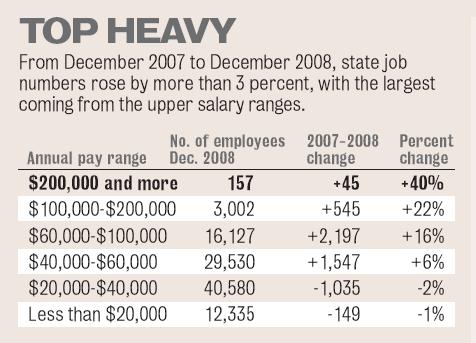
There’s another graphic that you can check that shows exactly who the top paid employees are and how much they make. I can assure you that none of these folks are covered by the state employees unions and none of them have any peers who have lower or higher salaries or benefits depending on when they entered service alone. These people are mostly political appointees of the governor. In this case, they are political appointees of Bobby Jindal. I’m going to show you the graph that is relevant. (It’s down below this section.) The salary structure is top heavy. You can go back and search who has the top money. You will see that it is top university administrators and coaches. Even these salaries do not stack up to private sector CEOs or coaches. It isn’t the clerks that are making outrageous salaries and it isn’t their bargaining unit that is at fault for any of this. You’ll also see if you got that page that many state workers are attorneys, engineers, teachers, nurses and doctors. These are professional people. You cannot expect to recruit and retain the best professional, well-educated service workers if you do not offer them a competitive salary. The most mobile ones will leave eventually if you don’t offer them raises and benefits commensurate with the private sector. You can go to any of the BLS salary surveys and you will see what the AFT put in that nice graphic above year after year after year. You will not get a compensation in the public sector that is more generous than the private sector at those levels of expertise. If there is a private sector ‘competitor’ for offering the job. Believe it or not, not every one is an English teacher that might likely wind up as a waitress. Here in New Orleans, most of the English teachers at my university would make better money if they’d wait tables or pour cocktails in the French Quarter. The only difference is that English teachers get a pension and insurance and they get to do the job they love.
Okay, now I’m going to go all economist on you. When you are a teacher, a firefighter, or a public health or safety worker, you face what is called a monopsony. That means there is likely to be one source of jobs and so you face the buyer’s version of a monopoly. What this means is the chips will be stack against you coming out with a ‘competitive’ wage. For example, how many forensic scientists do you suppose work outside of the local police departments? You may face a number of municipalities that could hire you in this situation. It is not, however, illegal for municipalities to collude on setting standards for salaries and benefits. Hence, you may face the same situation in city after city.
There seems to be this mindset that public servants should be public slaves from some quarters. Why should the clerk who fills out your driver’s license form be treated differently than the clerk that fills out your bank deposit slip? Why this double standard that public employees can’t be represented by unions? Well, first, I think many people still believe that public employees served by unions some how get a better deal than the others. This generally is not the case for all things. The only items that have held together for state employees that are not as available in the private sector tends to be the pension benefits and probably the insurance. One of the reasons that the insurance tends to be not such a big deal is that many states self insure and they have huge pools of employees so they can be more generous with benefits at a lower cost. I’ve generally lived in states where the biggest employer is the state. That’s a lot of people and insurance gets cheaper as the pool grows larger.
I think one of the other reasons is that people in nonunion jobs feel helpless about their futures and they are angry that they really don’t have the same safety in numbers that you see with union shops. You can’t be bullied by an employer when there is a union in place. This does have a tendency to protect even the worst employee, but when you work for capricious bosses, and we all do, you’ll never be safer than when you have union representation. You also are more aware of when your number will be up during downsizing and you will get a recall if they start rehiring if you’re a member of a union. This type of job security is generally the most important thing to a state employee which is why they work for lower monetary compensation. But again, why begrudge others what you could have if you’d just organize your work place?
I’ve been seeing way to many sites discuss ‘greedy’ teachers who selfishly walk out of the classroom to protest their right to organize. I really don’t get this meme at all. Wouldn’t you fight for your family’s livelihood if it were threatened? Why are teachers supposed to be treated differently than any one else?
A Governor or any other publicly elected official isn’t just held to account on voting day. Democracy is a day-in-and-day out process. Wisconsin Governor Scott Walker was elected to handle the budget. He immediately cut $117 billion in revenues coming from businesses and created a $130 billion deficit. His answer to covering his self created deficit was to change the terms of thousands of previously negotiated commitments to public employees. He backed out of the state’s commitment. He’s also refused to remove the union busting portions of the bill in exchange for salary and benefit concessions. How is this anything but dogmatic and unfair to state employees? Who makes heroes out of people that break commitments? Each of those families made plans based on the sanctity of the promise the state of Wisconsin made to them. They were part of the agreement and they should be part of renegotiating the agreement because that’s the rules of the game there. Changing the rules of a game in the middle of play is cheating.
If Governor Walker was so interested in frugality, then he should’ve started by not passing those $117 million in tax breaks. An election victory is not a blank check in a democracy.
Within days of becoming governor, Mr. Walker — who hung a sign on the doorknob of his office that reads “Wisconsin is open for business” — began stirring things up, and drawing headlines.
He rejected $810 million in federal money that the state was getting to build a train line between Madison and Milwaukee, saying the project would ultimately cost the state too much to operate. He decided to turn the state’s Department of Commerce into a “public-private hybrid,” in which hundreds of workers would need to reapply for their jobs.
He and state lawmakers passed $117 million in tax breaks for businesses and others, a move that many of his critics point to now as a sign that Mr. Walker made the state’s budget gap worse, then claimed an emergency that requires sacrifices from unions. Technically, the tax cuts do not go into effect in this year’s budget (which Mr. Walker says includes a $137 million shortfall), but in the coming two-year budget, during which the gap is estimated at $3.6 billion.
Democrats here say Mr. Walker’s style has led to a sea change in Wisconsin’s political tradition.
“Every other Republican governor has had moderates in their caucus and histories of working with Democrats,” said Graeme Zielinski, a spokesman for the state’s Democratic Party. “But he is a hard-right partisan who does not negotiate, does not compromise. He is totally modeled after a slash-and-burn, scorched-earth approach that has never existed here before.”
There’s some very interesting polls coming out of the Wisconsin protests. Here is some poll analysis on unions and public unions from the CSM.
Asked about “when you hear of a disagreement between state or local governments and unions that represent government workers,” more Americans say their first reaction is to side with the union (44 percent) than with state or local governments (38 percent). And substantially more Americans see union contracts as ensuring that workers are “treated fairly” than as giving workers an “unfair advantage.”
Other polls have found mixed results. Here’s some coverage at Huffpo for the Pew poll cited above as well as a few others. Either way, it’s interesting to note that Walker has some pretty strong ties to the notorious Koch Brothers. These trust fund babies spend a lot of John Bircher Daddy’s money trying to bust unions. I don’t think this can be discounted either.
According to Wisconsin campaign finance filings, Walker’s gubernatorial campaign received $43,000 from the Koch Industries PAC during the 2010 election. That donation was his campaign’s second-highest, behind $43,125 in contributions from housing and realtor groups in Wisconsin. The Koch’s PAC also helped Walker via a familiar and much-used politicial maneuver designed to allow donors to skirt campaign finance limits. The PAC gave $1 million to the Republican Governors Association, which in turn spent $65,000 on independent expenditures to support Walker. The RGA also spent a whopping $3.4 million on TV ads and mailers attacking Walker’s opponent, Milwaukee Mayor Tom Barrett. Walker ended up beating Barrett by 5 points. The Koch money, no doubt, helped greatly.
When there is big corporate money in elections, there is only one offset these days. That would be the money and free labored offered up by unions. Undoubtedly, the public sector unions are some of the last big unions standing. I can only imagine how much the Kochs and others would like to gut the fund raising and GOTV efforts of unions that are usually made available to candidates that thwart their Bircher plots. After all, there’s very little standing right now to check the power and political donations of megacorporations. This fact alone should make any one support the few unions left standing. However, the bigger question remains. Why do so many people begrudge public workers a voice in the terms of their employment?
Citizens United and Clarence Thomas Go Way Back
Posted: February 15, 2011 Filed under: Action Memo, right wing hate grouups, SCOTUS, U.S. Politics, We are so F'd | Tags: Antonin Scalia, Citizen's United, Clarence Thomas, Common Cause, Protect Our Elections, U.S. Supreme Court, Virginia Thomas 11 Comments
Clarence and Virginia Thomas
Thanks to the way-back machine, researchers at the watchdog organization “Protect Our Elections” dug up this 1991 article from Time Magazine.
Washington-area television viewers were startled last week to see three familiar senatorial faces pop up on their screens above the words WHO WILL JUDGE THE JUDGE? The follow-up question — “How many of these liberal Democrats could themselves pass ethical scrutiny?” — was hardly necessary, since the faces were those of Edward Kennedy, Joseph Biden and Alan Cranston, all scarred veterans of highly publicized scandals, from Chappaquiddick to plagiarized speeches to the Keating Five.
The ad, produced by two independent right-wing groups, was intended to bolster Supreme Court nominee Clarence Thomas’ confirmation chances by pointing the finger at three liberal Democrats who seemed likely to oppose him. Not coincidentally, the ad was produced by the same people who launched the 1988 Willie Horton spot….
President George H.W. Bush, his chief of staff John Sununu, and Clarence Thomas himself denounced the ads and demanded they be pulled. But the sponsors of the ads kept right on running them.
Can you guess who paid $100,000 for those ads in support of Thomas’ nomination to SCOTUS?
Iraq Invasion Whoppers
Posted: February 15, 2011 Filed under: Central Intelligence Agency, Diplomacy Nightmares, Federal Budget, Foreign Affairs, Gitmo, Human Rights, Iran, Iraq, Media, Psychopaths in charge, Republican presidential politics, right wing hate grouups, Surreality, The Media SUCKS, the villagers, U.S. Economy, U.S. Military, U.S. Politics, Voter Ignorance, WE TOLD THEM SO | Tags: bioweapons, Curveball, Donald Rumsfeld, Iraq Invasion, Jeb Bush, PNAC, Rafid Ahmed Alwan al-Janabi, Rogues Gallery, Steve Forbes, William J Bennet, William Kristol 25 Comments
Oops, there goes another rationale for the Iraq Invasion
Any number of us that closely followed the trumped-up case for the Iraq invasion figured that most of the evidence was shoddy if not based on out-and-out lies. I seriously wanted to throw up every time I heard some Bush official equivocate smoking guns and smoking mushroom clouds. The most disheartening thing was the number of people that believed them. The entire Iraq Invasion run-up just showed how vulnerable the American public is to propaganda and jingoism. You could hardly hold a civil conversation with so much hysteria-based flag waving going on.
So, it’s another one of those moments where you learn exactly how duped the entire country was by a set of people just itching to scratch that NeoCon rash. The UK Guardian reports that the “man codenamed Curveball ‘invented’ tales of bioweapons”. Colin Powell’s judgment looked bad then, it looks nonexistent now. Remember, he was considered the moderate voice of reason. You can watch the video and hear the words of Rafid Ahmed Alwan al-Janabi: ‘I had the chance to fabricate something …’ I’m sure they begged him to do it.
Rafid Ahmed Alwan al-Janabi, codenamed Curveball by German and American intelligence officials who dealt with his claims, has told the Guardian that he fabricated tales of mobile bioweapons trucks and clandestine factories in an attempt to bring down the Saddam Hussein regime, from which he had fled in 1995.
“Maybe I was right, maybe I was not right,” he said. “They gave me this chance. I had the chance to fabricate something to topple the regime. I and my sons are proud of that and we are proud that we were the reason to give Iraq the margin of democracy.”
The admission comes just after the eighth anniversary of Colin Powell’s speech to the United Nations in which the then-US secretary of state relied heavily on lies that Janabi had told the German secret service, the BND. It also follows the release of former defence secretary Donald Rumsfeld’s memoirs, in which he admitted Iraq had no weapons of mass destruction programme.
The careers of both men were seriously damaged by their use of Janabi’s claims, which he now says could have been – and were – discredited well before Powell’s landmark speech to the UN on 5 February 2003.
The former CIA chief in Europe Tyler Drumheller describes Janabi’s admission as “fascinating”, and said the emergence of the truth “makes me feel better”. “I think there are still a number of people who still thought there was something in that. Even now,” said Drumheller.
It was no secret that most of the advisers surrounding Dubya Bush were the same ones disappointed in Poppy’s decision to stop the first Gulf War with Saddam still in power. There were many good reasons to leave Saddam in power including the geopolitical stalemate created by tensions between the Sunni Saddam and the Shia Clerics in Iran that frequently burst into horrible wars. We shifted the balance of power in the area to Iran and have undoubtedly created a long term mess in Iraq itself. It’s cost us lives and money. It’s cost the Iraqis untold horrors. We continue to learn it was based on nothing but a pack of lies. This mea culpa is just the latest.

 peej
peej Carissa
 bostonboomer
 dakinikat
 ecocatwoman
 mablue2
 Mama Lopez
 peggysue22
 quixote
 skydancingguestblogger
 Mona (aka Wonk the Vote)



 Sky Dancing
Recent Comments