
Lazy Saturday Reads: Trump, Russia, and the 2016 Election
Posted: July 30, 2016 Filed under: Foreign Affairs, morning reads, Republican politics, U.S. Politics | Tags: cyber hacking, Donald Trump, Hillary Clinton, Russia, Vladimir Putin 34 Comments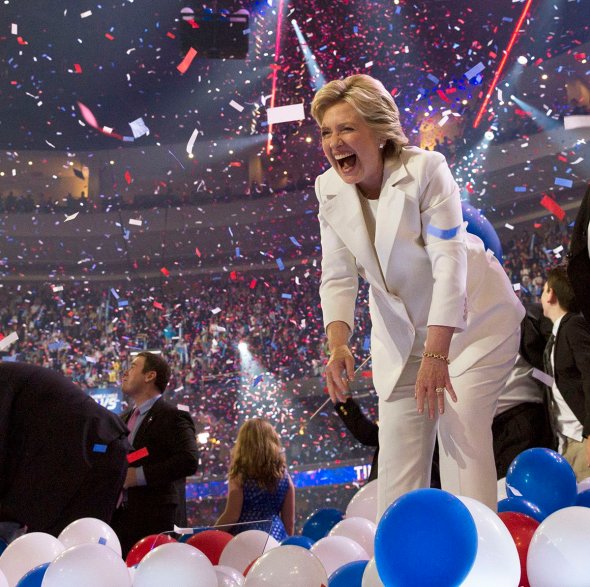
Good Morning!!
This has been one of the strangest and most dramatic weeks in the history of U.S. politics.
We have seen the nomination of a woman for President of the U.S. by a major political party after 240 years of male candidates only.
On the G.O.P. side, we are watching a madman campaign for President while praising the autocratic leader of Russia and inviting Russian intelligence agencies to hack into U.S. government computers and computer systems used by his Democratic opponent. This madman has also suggested that we should let Russia have Crimea and lift the sanctions on Russia that were applied after Russia’s incursion into Ukraine.
What the hell is going on!
The Guardian: Donald Trump and Russia: a web that grows more tangled all the time.
A key figure at the Republican national convention where Donald Trump was nominated for president has strong business ties with Ukraine, the Guardian has learned.
The party platform written at the convention in Cleveland last week removed references to arming Ukraine in its fight with Russia, which has supported separatists in eastern Ukraine. Trump’s links to Russia are under scrutiny after a hack of Democratic national committee emails, allegedly by Russian agents.
Frank Mermoud also has longstanding ties to Trump’s campaign chairman, Paul Manafort, who in 2010 helped pro-Russia Viktor Yanukovych refashion his image and win a presidential election in Ukraine. Manafort was brought in earlier this year to oversee the convention operations and its staffing.
Three sources at the convention also told the Guardian that they saw Phil Griffin, a longtime aide to Manafort in Kiev, working with the foreign dignitaries programme. “After years of working in the Ukraine for Paul and others, it was surprising to run into Phil working at the convention,” one said.
The change to the platform on arming Ukraine was condemned even by some Republicans. Senator Rob Portman described it as “deeply troubling”. Veteran party operative and lobbyist Charlie Black said the “new position in the platform doesn’t have much support from Republicans”, adding that the change “was unusual”.
And that’s just the beginning. The article spells out and analyzes Donald Trump’s and his advisers’ extensive past ties to Russia. For decades, the G.O.P. was the party of anti-communism and anti-Russian sentiment. In 2012, Mitt Romney even argued that Russia was the top geopolitical threat to the U.S.; in 2016, Romney’s party is getting very cozy with Russian and its autocratic leader Vladimir Putin.
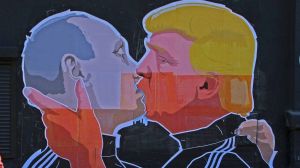
Now it has become crystal clear that Russia is behind a number of cyberhacks on U.S. and Democratic Party computers.
Thousands of Democratic National Committee emails were hacked and published by WikiLeaks on the eve of the party’s convention in Philadelphia this week. They showed that officials, who are meant to remain impartial, favoured Hillary Clinton and discussed ways to undermine her rival, Bernie Sanders. The leak led to the resignation of chairwoman Debbie Wasserman Schultz.
The FBI is investigating, with all signs pointing to Russian involvement, though Moscow rejects this. Experts note Vladimir Putin’s past attempts to damage western democracy, including cyber-attacks on French, Greek, Italian and Latvian elections. In 2014, malware was discovered in Ukrainian election software that would have robbed it of legitimacy.
Alina Polyakova, deputy director of the Dinu Patriciu Eurasia Center at the Atlantic Council, said: “We can’t say 100% that Mr Putin had a hand in any of this but this kind of meddling in other countries’ affairs is part of Russia’s toolkit. It’s a kind of asymmetric warfare. To me, this looks like something straight from the Russian secret service playbook, but I’m surprised at how brazen they’ve been.”
Trump and his campaign have denied any connection but on Wednesday he ignited a firestorm by calling on Russia to find 30,000 emails deleted from Clinton’s private server. “I think you will probably be mightily rewarded by our press,” he said. He later claimed that he was being sarcastic.
Please read the entire article to learn about Donald Trump’s extensive ties to Russia and Putin.
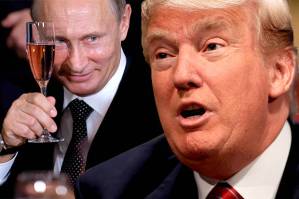
ABC News: Trump’s Russia Reset Ideas Alarming Allies, Many in US.
Donald Trump’s flurry of offhand remarks and abrupt zingers on Russia — praising Vladimir Putin, dismissing NATO — have jolted the world, not to mention the U.S. presidential campaign.
With Russia’s behavior rattling nerves in the U.S. and elsewhere, Trump is accused of cozying up to a “dictator.” Of threatening the very underpinnings of America’s relationship with Europe. And of naiveté.
Some of the GOP presidential nominee’s goals are consistent with long-held U.S. views, many experts say. The idea of fostering U.S.-Russian cooperation isn’t outlandish. After all, Hillary Clinton tried to “reset” relations with Russia when she was secretary of state. Also, past U.S. administrations of both parties have quietly complained that other NATO members should pay their share to the alliance.
It’s what Trump is willing to do to achieve those goals and the way he expresses his views that have shocked many foreign policy experts.
The notion of refusing to defend NATO allies who don’t pay their bills, for example, or of buddying up to Putin despite his aggressive stances is jarring to Democrats and Republicans alike. And it’s on the minds of foreign leaders.
“We’re going to talk about NATO and Russia,” Secretary of State John Kerry said as he met Saturday with French Foreign Minister Jean-Marc Ayrault in Paris. Kerry wouldn’t address Trump’s comments specifically, but said he would discuss anything Ayrault wanted to talk about “that has to do with our relationship.”
So Trump’s remarks are already threatening our relationships with our allies.

Reuters claimed last night that the Clinton Campaign itself has been hacked.
A computer network used by Democratic presidential nominee Hillary Clinton’s campaign was hacked as part of a broad cyber attack on Democratic political organizations, people familiar with the matter told Reuters.
The latest attack, which was disclosed to Reuters on Friday, follows two other hacks on the Democratic National Committee, or DNC, and the party’s fundraising committee for candidates for the U.S. House of Representatives.
A Clinton campaign spokesman said in a statement late on Friday that an analytics data program maintained by the DNC and used by the campaign and a number of other entities “was accessed as part of the DNC hack.”
“Our campaign computer system has been under review by outside cyber security experts. To date, they have found no evidence that our internal systems have been compromised,” said Clinton campaign spokesman Nick Merrill.
Later, a campaign official said hackers had access to the analytics program’s server for approximately five days. The analytics data program is one of many systems the campaign accesses to conduct voter analysis, and does not include social security numbers or credit card numbers, the official said.
The U.S. Department of Justice national security division is investigating whether cyber attacks on Democratic political organizations threatened U.S. security, sources familiar with the matter said on Friday.
The involvement of the Justice Department’s national security division is a sign that the Obama administration has concluded that the hacking was sponsored by a state, people with knowledge of the investigation said.
The Clinton Campaign told The Washington Post that their internal computers have not been compromised.
The Clinton presidential campaign said Friday that an “analytics data program” maintained by the Democratic National Committee had been hacked but that its computer system had not been compromised, denying news reports from earlier in the day that the campaign had become the third Democratic Party organization whose systems had been penetrated.
So far, campaign computer experts “have found no evidence that our internal systems have been compromised,” campaign spokesman Nick Merrill said in a statement.
Merrill said that “an analytics data program maintained by the DNC and used by our campaign and a number of other entities was accessed as part of the DNC hack.” The campaign did not provide details, but a source familiar with the situation said that the hacked material was generally dull and did not include email communications, memos, research or other potentially inflammatory communications. Mostly, the source said, it included innocuous data such as computer code and lists of email addresses.
Nevertheless,
Senior figures in the national security community are warning that the Russian hack of the DNC and the subsequent release of committee emails by the antisecrecy group WikiLeaks may be part of a broader attack on the U.S. electoral process….
If the email leak was orchestrated by the Russian government, “this is an attack not on one party but on the integrity of American democracy,” the Aspen Institute Homeland Security Group, a group of 32 homeland security and counterterrorism experts, said in a statement.
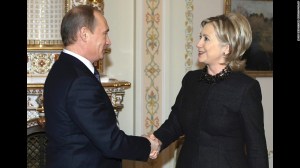
Besides his obvious reasons to think he could easily manage Donald Trump if he became POTUS, Putin has reasons to dislike and fear Hillary Clinton. From The Washington Post:
Russian President Vladimir Putin repeatedly accused Hillary Clinton when she was secretary of state of interfering in Moscow’s affairs — and if Russian security was behind last week’s release through WikiLeaks of the hacked Democratic National Committee emails, it would look a lot like Kremlin payback.
Even if the breach was carried out by a mid-level intelligence official acting on his own initiative, hoping to please his boss, disclosures that seemingly raise questions about the legitimacy of Clinton’s nomination speak directly to Putin’s complaints about her….
In December 2011, large protests unexpectedly broke out in Moscow following parliamentary elections that featured brazen cheating. Clinton, as secretary of state, called the election “neither free nor fair,” and Putin jumped on that as an attack on Russia and, by extension, him.
“She set the tone for some of our public figures inside the country, sent a signal to them,” Putin said. “They heard this signal and launched active work with the U.S. State Department’s support.”
The rest of that winter saw ever sharpening attacks on the United States as Putin was in the midst of his own presidential election campaign. In the year that followed, some of the strongest anti-American steps that Russia took were only tangentially related to Clinton — expelling the USAID, forcing Radio Liberty off the AM dial, harassing then-U.S. Ambassador Michael A. McFaul….
Clinton had also pushed hard for the Libya intervention in the spring and summer of 2011, which Putin was appalled by, seeing it as unwarranted interference in another nation’s sovereignty. After she stepped down as secretary of state, she made a well-publicized visit to Yalta — in 2013, when it was still part of Ukraine — to support Ukraine’s signing of an agreement with the European Union. Putin hoped to strong-arm Ukraine into joining his Eurasian Economic Union, which Clinton had called an attempt to “re-Sovietize” areas of the former Soviet Union.
That comment and others “were in part seized upon for domestic political reasons,” Samuel Charap, senior fellow at the International Institute for Strategic Studies in Washington, said Wednesday. “She became a convenient scapegoat.”
Read more analysis of the Clinton-Putin relationship at the link.
Joy Reid has been covering this story extensively on her MSNBC show. If you missed it this morning, please check it out on the website. She had some experts on who were quite alarmed by what is happening with Trump and the Russian hacks that seem designed to help him become POTUS.
More important stories to check out:
Washington Post: Appeals court strikes down North Carolina’s voter-ID law.
Mother Jones: Voting Rights Advocates Score a Huge Win in North Carolina.
Kansas City Star: What a great day for protecting voting rights in Kansas and elsewhere
Slate: Islam, Equality, and Pocket Constitutions: How the DNC Did Religious Liberty Right.
NBC News: Parents of Capt. Khan Warn GOP’s Ryan, McConnell Over Trump.
Reuters: Clinton leads Trump by 6 points after Democratic confab: Reuters/Ipsos poll.
New York Magazine: Former Fox News Booker Says She Was Sexually Harassed and ‘Psychologically Tortured’ by Roger Ailes for More Than 20 Years.
Thursday Reads
Posted: July 21, 2016 Filed under: morning reads, Republican politics, U.S. Politics | Tags: Donald Trump, Hillary Clinton, Hillary hate, Melissa McEwan, The Art of the Deal, Tony Schwartz 118 Comments
Good Afternoon!!
This is what we’ve come to folks. We have a nominee of a major political party and his surrogates calling for the opposition candidate to be thrown in prison, hanged, or shot by a firing squad. Talking Points Memo: The Trump Campaign is Now Wink-Winking Calls to Murder Clinton.
As our reporters on the ground in Cleveland are telling us, the “lock her up” theme of the Cleveland convention is pervasive. Signs, T-shirts, memorabilia – it’s pervasive. It’s not just a chant on the convention floor. The campaign isn’t just comfortable with it. They’re actively pushing it. We noted earlier that a New Hampshire Trump delegate, who’s also a Trump advisor on veterans issue has just said Clinton should be “shot for treason.” He’s now being investigated by the Secret Service for threatening the former First Lady and Secretary of State’s life.
But there’s a part of this story that’s been overshadowed by the shocking nature of what Al Baldasaro said. That’s the response from the Trump campaign. In response to Baldasaro’s attack, Trump Campaign spokeswoman Hope Hicks said: “We’re incredibly grateful for his support, but we don’t agree with his comments.”
I’m not sure why no one has referenced this. But this is the kind of statement one usually hears about a policy disagreement rather than a demand to murder the opposing party’s nominee.
Calls for violence or the killing of a political opponent usually spurs the other candidate to totally disavow the person in question. Frankly, it’s a pretty new thing for a prominent supporter of a prominent politician to call for killing opposing candidates at all. But the Trump campaign is still “incredibly grateful his support” even though “we don’t agree” that Clinton should be shot.
This too is not normal.
Maybe you didn’t notice her statement until now. I assure you Trump’s more rabid supporters have – or at least noticed the conspicuous lack of any clear denunciation.

Yesterday, Melissa McEwan had a great post at Blue Nation Review on the unforgivable media complicity in this : WE’VE REACHED PEAK HILLARY HATE (Thanks to Our Noxious Media). And she provides plenty of linky goodness.
The national media’s treatment of Hillary has never been great. Whether it’s endlessly discussing her “likability,” or casually referring to her as “Godzillary” or “a Lovecraftian monster, the Cthulhu of American politics,” or depicting her with devil horns, or portraying her as a towering man-crushing monster, or constantly subjecting her to Remember Your Place pictures, or saying she “must be stopped,” they have long been prominent purveyors of narratives about Hillary being History’s Greatest Monster.
But their coverage in 2016 has been a total disgrace. A complete and utter embarrassment, culminating with this now-scrubbed headline care of the Washington Post: In Trump’s moment of triumph, Clinton is in the crosshairs.
Not only are the WaPo’s editors evidently watching a different convention than the rest of us if they imagine Donald is having “a moment of triumph,” but where is their sense of decency that they would say Hillary is in “the crosshairs”? Using such violent rhetoric at any time would be extraordinarily cruel, but to do so in the middle of a national nightmare of mass shootings is truly breathtaking.
And the replacement is hardly any better: Trump captures GOP nomination as focus their fire on Clinton.
“Focus their fire.” This is truly unconscionable.

Melissa goes on to write about the media’s refusal to acknowledge the millions of people who support Hillary and are excited about the prospect of her becoming the first woman POTUS.
The fact is this: despite all the vitriol, Hillary is a popular presidential candidate. How can I make such a controversialclaim, in spite of her high unfavorables (ahem) and relentless articles detailing how unpopular she is? Because she won.
Because in winning her party’s nomination, she defeated Bernie Sanders, who himself was a popular candidate, by millions of votes and hundreds of delegates. Because she was a popular First Lady. Because she was a popular Senator. Because she was a popular Secretary of State. Because she has been the most admired women in the world for two decades.
And, no, that’s not hyperbole.
But you wouldn’t know that Hillary is popular, if you depended exclusively on corporate media for your news—because there is a seemingly endless parade of stories about how unpopular she is (whoops!); how unliked she is (bloop!); how little enthusiasm there is for her candidacy (uh-oh!).
There’s much more at the link, so please go read it if you haven’t already.

Tony Schwartz
Also yesterday, Tony Schwartz, who wrote Trump’s bestselling book The Art of the Deal, discussed his experience of GOP nominee in an interview with The New Yorker’s Jane Mayer.
Schwartz had ghostwritten Trump’s 1987 breakthrough memoir, earning a joint byline on the cover, half of the book’s five-hundred-thousand-dollar advance, and half of the royalties. The book was a phenomenal success, spending forty-eight weeks on the Times best-seller list, thirteen of them at No. 1. More than a million copies have been bought, generating several million dollars in royalties. The book expanded Trump’s renown far beyond New York City, making him an emblem of the successful tycoon. Edward Kosner, the former editor and publisher of New York, where Schwartz worked as a writer at the time, says, “Tony created Trump. He’s Dr. Frankenstein.”
Starting in late 1985, Schwartz spent eighteen months with Trump—camping out in his office, joining him on his helicopter, tagging along at meetings, and spending weekends with him at his Manhattan apartment and his Florida estate. During that period, Schwartz felt, he had got to know him better than almost anyone else outside the Trump family. Until Schwartz posted the tweet, though, he had not spoken publicly about Trump for decades. It had never been his ambition to be a ghostwriter, and he had been glad to move on. But, as he watched a replay of the new candidate holding forth for forty-five minutes, he noticed something strange: over the decades, Trump appeared to have convinced himself that he had written the book. Schwartz recalls thinking, “If he could lie about that on Day One—when it was so easily refuted—he is likely to lie about anything.”
It seemed improbable that Trump’s campaign would succeed, so Schwartz told himself that he needn’t worry much. But, as Trump denounced Mexican immigrants as “rapists,” near the end of the speech, Schwartz felt anxious. He had spent hundreds of hours observing Trump firsthand, and felt that he had an unusually deep understanding of what he regarded as Trump’s beguiling strengths and disqualifying weaknesses. Many Americans, however, saw Trump as a charmingly brash entrepreneur with an unfailing knack for business—a mythical image that Schwartz had helped create. “It pays to trust your instincts,” Trump says in the book, adding that he was set to make hundreds of millions of dollars after buying a hotel that he hadn’t even walked through.
In the subsequent months, as Trump defied predictions by establishing himself as the front-runner for the Republican nomination, Schwartz’s desire to set the record straight grew. He had long since left journalism to launch the Energy Project, a consulting firm that promises to improve employees’ productivity by helping them boost their “physical, emotional, mental, and spiritual” morale. It was a successful company, with clients such as Facebook, and Schwartz’s colleagues urged him to avoid the political fray. But the prospect of President Trump terrified him. It wasn’t because of Trump’s ideology—Schwartz doubted that he had one. The problem was Trump’s personality, which he considered pathologically impulsive and self-centered.
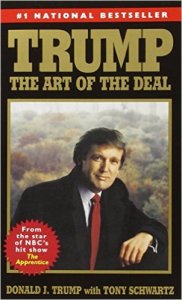
Please go read the whole thing. As soon as the article was published, Trump sent him a “cease and desist letter.” and demanded that Schwarz return all of his royalties from the book.
You may have seen Rachel Maddow’s interview with Schwartz last night in which he called Trump “a black hole,” and a “sociopath.” Steve Benen writes:
Schwartz is eager to tell the public about what he learned about Trump after their collaboration.As Rachel discovered last night, Trump’s lawyers have a different plan in mind.Tony Schwartz, ghostwriter of Donald Trump’s book “The Art of the Deal,” told MSNBC Wednesday that the Trump campaign sent him a cease and desist letter in response to his comments about the Republican candidate.Schwartz, a former journalist, was employed by Trump to ghostwrite his memoir in 1987. In an interview with MSNBC, Schwartz described the Republican candidate for president as “having no heart and no soul.”“This notion that I didn’t write the book is so preposterous,” Schwartz added. “You know, I am not certain that Donald Trump read every word, but I’m sure certain that I wrote every word. And he made a few red marks on the manuscript and sent it back to me, and the rest was history. The idea that he would dispute that is part of why I felt I had to come forward. The notion that if he could lie about that he could lie about anything.”
Benen says the New Yorker article is a must-read, and I agree wholeheartedly.
A person has serious consequences (for example, losing your driving privileges); but an experienced Drunk Driving & DUI Attorney Las Vegas, NV can often get the charges dropped or reduced, or may be able to negotiate lesser penalties depending on your circumstances and your past history.
More stories to check out:
TPM: Ted Turns the Tables on Trump–Hard.
NYT: Donald Trump Sets Conditions for Defending NATO Allies Against Attack.
CNN: Defiant Ted Cruz stands by refusal to endorse Trump after being booed during convention speech.
Jonathan Chait: Republicans in Chaos Must Decide Whether to Elect a Madman.
Slate: Newt Gingrich Probably Just Gave the Last Major Speech of His Career.
HuffPo: Tim Kaine Calls To Deregulate Banks As He Campaigns To Be Clinton’s VP.
NYT: Bill Clinton Said to Back Virginia’s Tim Kaine for Vice President.
NBC News: Cops Shoot Unarmed Caregiver With His Hands Up While He Helps Man.
The Guardian: Roger Ailes accused of harassment by at least 20 women, attorneys say.
What else is happening? Please post your thoughts and links in the comment thread and have a tremendous Thursday!
Tuesday Reads: Disastrous Day One of the Republican National Convention
Posted: July 19, 2016 Filed under: morning reads, Republican politics, U.S. Politics | Tags: Donald Trump, Hillary Clinton, Melania Trump, michelle obama, Paul Manafort, plagiarism, Rudy Giuliani, Twitter 79 Comments
Good Afternoon!!
After the first night of the Republican National Convention in Cleveland, there’s good news and bad news for the Trump campaign. The bad news is that the big story today is that Melania Trump’s speech last night was basically a light edit of Michelle Obama’s speech at the Democratic National Convention in 2008 with a few paragraphs thrown in to make it look like it was about Donald Trump. The good news for Trump is that this story is distracting the media from the racist, misogynist, and xenophobic content of the rest of the Convention speeches.
The Washington Post: Republican National Convention: Scrutiny of Melania Trump’s speech follows plagiarism allegations.
Donald Trump’s presidential campaign came under new scrutiny Tuesday after it became apparent that part of Melania Trump’s primetime address Monday night at the Republican National Convention bore conspicuous similarities to a speech delivered by first lady Michelle Obama in 2008 at the Democratic convention.
The plagiarism charges have cast a shadow over Trump and his campaign on the second day of the convention here in Cleveland, where Republicans are making the case to a skeptical country that the celebrity billionaire —the most unconventional and impulsive major-party standard-bearer in modern history — could be a credible and steadfast leader at a time of terrorist threats abroad and senseless tragedies at home.
Trump’s campaign and allies rushed to defend Melania Trump on Tuesday morning.
“In writing her beautiful speech, Melania’s team of writers took notes on her life’s inspirations, and in some instances included fragments that reflected her own thinking,” wrote senior communications advisor Jason Miller in a statement. “Melania’s immigrant experience and love for America shone through in her speech, which made it such a success.” ….
Melania Trump had previously indicated that she wrote the speech herself.h. Trump campaign manager Paul Manafort pretty much threw Melania under the bus by sticking to the story that she wrote it herself.
On Tuesday morning, Trump campaign chairman Paul Manafort denied that there had been any plagiarism, despite clear similarities between the two speeches. Some parts of the speeches appeared to be the same, word for word.
“There’s no cribbing of Michelle Obama’s speech. These were common words and values that she cares about, her family, things like that,” Manafort said on CNN’s “New Day” Tuesday morning. “She was speaking in front of 35 million people last night, she knew that, to think that she would be cribbing Michelle Obama’s words is crazy.”
The sections in the video are only the beginning. There are similarities to Michelle Obama’s speech throughout. Even the final lines claiming “he will never turn his back on you” were borrowed from Michelle. Trump campaign manager Paul Manafort pretty much threw Melania under the bus by sticking to the story that she wrote it herself.
Oh yes, and Manafort also blamed Hillary for the mess the campaign is in. Think Progress: Trump Campaign Manager On Melania’s Plagiarism: It’s Hillary’s Fault
Donald Trump and his campaign are scrambling to address the apparent plagiarism in Melania Trump’s Republican National Convention speech, which replicated specific language from First Lady Michelle Obama’s speech at the 2008 Democratic National Convention. Trump’s former rivals-turned-surrogates Ben Carson and Chris Christie both refused to acknowledge the plagiarism.
Trump campaign manager Paul Manafort went even further. He not only denied the speech was plagiarized, but accused Democratic presumptive nominee Hillary Clinton of spreading the storybecause she hates other women.
“This is once again an example of when a woman threatens Hillary Clinton she seeks out to demean her and take her down,” he said. “It’s not going to work.”
Manafort repeated the sexist attack in a press conference a few hours later. “When Hillary Clinton is threatened by a female, the first thing she does is try to destroy the person,” he told reporters.
There are now rumors that Trump is furious with Manafort. Perhaps he’ll be looking for a new campaign manager soon–right in the middle of the RNC.
Wow! That’s some heavy duty misogyny there.
Some folks on Twitter have been digging up tweets from Mr. and Mrs. Trump that suggest plagiarism is nothing new for these two.
https://twitter.com/fioyb/status/755384120725864448
And check this out:
Unbelievable.
And what about the parts of Melania’s speech that weren’t plagiarized? Isaac Chotiner at Slate: Melania Trump’s Pathetic Attempt to Humanize Her Husband.
The traditional role of the first lady is, in the clichéd language of our politics, to “humanize” her spouse. Melania Trump may in some sense appear to be nontraditional for the wife of a Republican nominee. But in her speech on Monday night she set for herself the same goal: showing a side of Donald Trump that voters had not seen. What she delivered, according to Wisconsin Gov. Scott Walker, speaking from the convention floor, was the speech of the night. The CNN panel gushed. Hugh Hewitt got excited on MSNBC. But don’t believe it: Melania’s speech was just as morally questionable as Rudy Giuliani’s Mussolini-not-so-lite speech that preceded it.
The most striking feature of Melania’s speech was the lack of specifics: Perhaps because her husband is a gruesome demagogue rather than a halfway-decent person, there were no humanizing anecdotes or sweet stories to tell. The candidate’s public personality is clearly more than an act; those who know him have nothing truly nice or personal to say about him, just as he has nothing nice or personal to say about them. (People he likes in his orbit tend to be “absolutely terrific.”)
I noticed that last night. Melania didn’t provide a single specific anecdote to illustrate her husband’s supposed generosity, kindness, and other positive qualities she claims he has.
This morning Ivanka Trump told the AP that her dad wants her to make sure everything in her speech introducing him on Thursday is in her own words.
Could there be trouble between Trump’s third wife and his children from first wife Ivana? Joy Reid tweeted today that Melania refused to attend the introduction of Mike Pence and his family because she was angry with Donald’s children for pushing him to name a VP candidate that he didn’t really want.
Reid also cited a Daily Mail article that suggests trouble in the Trump extended family: ‘She can’t talk, she can’t give a speech’: Donald Trump’s ex-wife Ivana slams his current spouse Melania and suggests she would make a better First Lady.
Trump’s first wife Ivana, who was married to the Republican presidential front runner from 1977 to 1991, said Melania ‘can’t talk’ and ‘can’t give a speech’.
The 66-year-old – who had three children with the billionaire – reportedly said she would have made a good First Lady and backed her ex-husband to be a ‘great President’.
Ivana was told at a recent party in New York that she would have been a good First Lady.
According to the New York Daily News, she laughed and replied: ‘Yes, but the problem is, what is he going to do with his third wife?’
Referring to Melania Trump, Ivana continued: ‘She can’t talk, she can’t give a speech, she doesn’t go to events, she doesn’t want to be involved.’
Ivana also said Trump would be a successful President and backed him to win the Republican nomination.
‘He’ll be a great President,’ she said. ‘He’ll surround himself with the right people. He was always meant to be a politician.’
She added that she had backed Trump to run for President in the 1980s, but ‘then he got involved with Marla Maples and America hated him’.
ROFLOL! Most of America still hates him.
I’m going to wrap this up soon, because I’m completely exhausted after driving nearly 1,000 miles over the past two days. But I want to include stories about one more speech from last night.
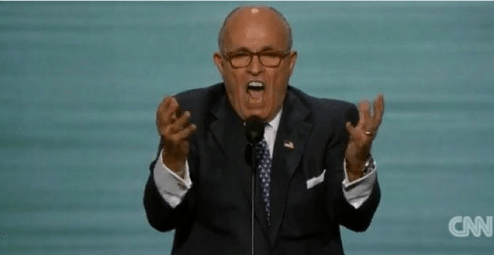
If you missed Rudy Giuliani’s crazy address to the convention, you really need to watch it. You can do that at Slate, where Fred Kaplan writes about it: What Has Happened to Rudy Giuliani? He used to be a pragmatic moderate. Now he’s spewing nonsense.
Exactly 20 years ago, as the Boston Globe’s New York bureau chief, I interviewed Mayor Rudy Giuliani in his office in City Hall. The 1996 Republican Convention was going on in San Diego, and I asked him why he wasn’t there. “It’s not my sort of thing,” he replied. “I’m much closer to moderates in both parties than to extremists in either.”
That was a long time ago….
Self-righteous and bombastic as he has become in recent years, I have never seen him—I have never imagined him—huffing and puffing with such fire and brimstone. Or spewing such rank nonsense.
Boasting that he changed New York “from the crime capital of America to the safest large city in America,” he said, “What I did for New York, Donald Trump will do for America.” Stipulating that he played a role in cutting crime in New York (and I think he did, to some extent), what did he do? Most pertinent, he appointed William Bratton as his police chief, who tracked crime with daily computer statistics (before then, there were only quarterly statistics), then instantly redeployed cops to neighborhoods where crime was spurting. He also arrested people for committing small crimes, and many of those people, it turned out, were wanted for large crimes. Other things were happening in society, too. But these techniques and the surrounding circumstances have no application to the fight against global terrorism. Nor does the sophisticated approach that Giuliani and Bratton brought to urban disorder have any resemblance to Trump’s attitude to anything.
Then Giuliani delved into the shallowest realm of Trump’s attack on Obama’s (or Obama-Clinton’s) counterterrorism policies—the refusal to call our enemy by their name: as he bellowed it, “Islamic extremist terrorism” (words that drew an enormous ovation). Obama has addressed this critique: It is silly to believe that, if only he uttered those three words (like “Beetlejuice, Beetlejuice, Beetlejuice!”), the bad guys would turn and run—or anything different would happen whatsoever. “If they are at war against us,” Giuliani roared, “we must commit ourselves to unconditional victory against them.” What does that mean? What does the United States or the West have to do to achieve that goal? I ask Giuliani and others who speak in this language to put forth a three-point outline, a 100-page treatise—some idea of what new policies, tactics, or strategies they have in mind. I honestly don’t know, and I’m pretty sure they don’t either.
Kaplan carefully dissects the entire Giuliani diatribe. The piece is well worth reading.
Thursday Reads: The Trump Convention Approaches
Posted: July 14, 2016 Filed under: Barack Obama, morning reads, Republican politics, U.S. Politics | Tags: 2016 Democratic Convention, 2016 Republican Convention, Chris Christie, Donald Trump, historical photos of political conventions, Jeff Sessions, Mike Pence, Newt Gingrich 92 Comments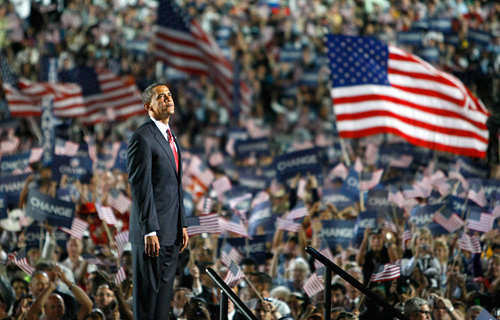
Barack Obama at the Democratic National Convention, 2008
Good Morning!!
The next two weeks will be fascinating ones for political junkies. The Republican Convention begins on Monday, July 18 in Cleveland, and just a week later on July 25 the Democratic Convention will be held in Philadelphia. The list of speakers for the GOP Convention was released this morning.
The Washington Post: Republican convention’s ‘non-conventional’ list: Model, astronaut and Trump clan.
Donald Trump’s convention will feature an eclectic mix of cultural figures, from the first woman to command a space shuttle mission to the survivors of the 2012 Benghazi attacks to an underwear model.
But while several Republican Party establishment figures will take the stage next week in Cleveland, the national convention to officially nominate Trump will be devoid of some of the GOP’s most seasoned leaders and brightest new stars.
Republican officials released a long-awaited list of convention speakers on Thursday that are billed as “non-conventional speakers” who emphasize “real world experience.”
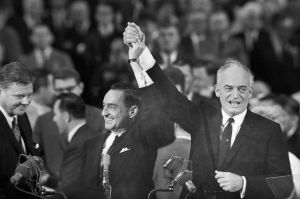
Barry Goldwater and William Miller at the 1964 GOP Convention in San Francisco
A small number of elected officials and former office-holders have agreed to speak at Trump’s convention, including Paul Ryan, Mitch McConnell, Rudy Giuliani, Ted Cruz, Scott Walker, Marsha Blackburn, Mike Huckabee, Rick Scott, Chris Christie, Newt Gingrich, Jeff Sessions, Joni Ernst, and Asa Hutchison. Indiana Gov. Mike Pence is not included in the list of speakers. It’s not clear whether that means he will be the VP nominee or if there is some reason he won’t be speaking. Another notable omission from the speakers list is Sarah Palin.
The unusual collection of non-political speakers seems designed to broaden Trump’s appeal. They include retired astronaut Eileen Collins, the first woman pilot and first woman commander of a space shuttle mission; Mark Geist and John Tiegen, two survivors of the 2012 attack on the U.S. diplomatic outpost in Benghazi, Libya; and Antonio Sabato Jr., a former Calvin Klein underwear model, soap-opera actor and reality-television star.
Some sports figures will take the stage here, including pro golfer Natalie Gulbis and Ultimate Fighting Championship president Dana White. But some sporting heroes of decades past that Trump has said he would like to see at the convention — former Indiana University basketball coach Bobby Knight and boxing legend Don King — are not listed as featured speakers.
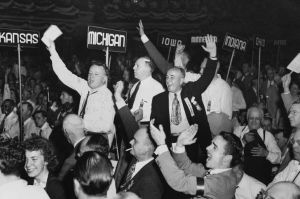
Thomas E. Dewey at the 1948 Republican Convention
Trump family members and close friends will also speak at the convention.
The Cleveland convention will be orchestrated to help expand Trump’s appeal to the general electorate. To that end, several member of Trump’s family are expected to give speeches, including his wife, Melania, and his four oldest children, Donald Jr., Ivanka, Eric and Tiffany.
In addition, other speakers who have known Trump and his family through the years plan to take the stage. They include Haskel Lookstein, a rabbi in New York who converted Ivanka Trump to Judaism; Tom Barrack, a wealthy California-based investor who has worked with Donald Trump on real estate deals; and Kerry Woolard, the general manager of Trump Winery in Virginia.
See a full list of GOP convention speakers at Cleveland.com and a tentative schedule of events at Newsday.
In contrast to the weak list of GOP convention speakers, the Democratic Convention speakers list is star-studded. The Washington Post:
The Democratic National Convention is likely to open with a showcase of some of the party’s biggest stars, including Sen. Elizabeth Warren (D-Mass.), Sen. Bernie Sanders of Vermont, and first lady Michelle Obama, according to a source with knowledge of the convention planning.
Although the speaking schedule isn’t yet set in stone, the jam-packed Monday night is also expected to include Sen. Cory Booker (D-N.J.), and Rep. Joe Kennedy (D-Mass.) will introduce Warren in Philadelphia.
Sanders’s name will be entered into the nomination, prompting a roll call vote of delegates for both candidates.
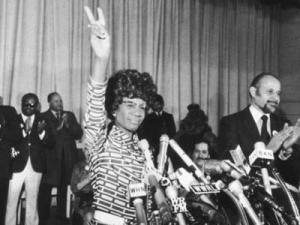
Percy Sutton nominates Shirley Chisholm at the 1972 Democratic Convention
As we all expected Sanders will continue trying to get as much attention as he can for as long as he can.
According to another source familiar with the convention planning, the night’s theme will be an economic agenda focused on families. The list of speakers is intended to highlight the unity of the Democratic Party in contrast to the Republican convention that will have come the week before.
The night’s programming, including the speakers and videos, will drive home the theme of Clinton’s campaign, “Stronger together,” by highlighting a populist economic agenda.
The convention speaking list is coming together this week, and more speakers are likely to be formally announced as early as this week.
Presumably, speakers also will include President Obama and former President Clinton as well as rising stars in the party.
The Trump campaign announced yesterday that the presumptive GOP nominee will name his Vice Presidential running mate tomorrow morning at 11AM in New York City. The exact location hasn’t been announced yet. NPR reports: Trump Wraps Up Vice President Auditions, Sets Friday Announcement.
The deadline for a decision comes after the presumptive GOP presidential nominee wrapped up both public tryouts and private meetings with the three men believed to be among the finalists — Indiana Gov. Mike Pence, former House Speaker Newt Gingrich and New Jersey Gov. Chris Christie.
After he campaigned with Pence in Indiana Tuesday evening, Trump his family met with Pence at his Indiana home on Wednesday morning, according toNBC News, while Gingrich and Alabama Sen. Jeff Sessions also flew to Indianapolis to meet with Trump. Christie met with Trump and his family on Tuesday.
Pence, who gave a tepid endorsement to Texas Sen. Ted Cruz before his state’s primary, was more gleefully on board with Trump’s campaign on Tuesday night as he introduced him at a rally in Westfield.
“Donald Trump gets it,” Pence told the crowd. “Donald Trump hears the voice of the American people.” ….
Of the three presumed vice presidential finalists, Pence was the only one who gave a direct introduction for Trump before he came to the stage. Trump also campaigned with Christie on Monday in Virginia and with Gingrich last week in Ohio.
Trump praised Pence at the end of what was a meandering speech — attacking rival Hillary Clinton often but also wandering off into other topics such as immigration and trade and back again.
“I don’t know if he’s going to be your governor or your vice president, who the hell knows!” Trump told the crowd, referring to Pence.
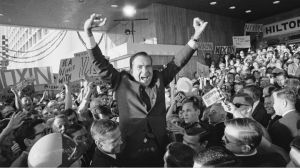
Richard Nixon at the 1968 Republican Convention
Yeah, who the hell knows? This horrifying man is actually running for president. The other top VP candidates are supposedly Jeff Sessions, Chris Christie, and Newt Gingrich. TA Frank weighed in on each of these choices at The Atlantic: It’s down to four, but does any candidate offer even a smidgen of hope?
At this point, Trump needs a running mate who amplifies his strengths and, possibly, goes some way toward remedying some of the candidate’s most serious weaknesses: erratic behavior, lack of experience, inadequate grasp of history, and almost zero policy chops. He or she needs to believe what Trump believes—but in a way that suggests there will be an adult in the room. Trump’s vice president is likely to be powerful in the White House, so the pick is about a lot more than campaigning. The question remains, however, whether any of the final four offer a glimmer of hope.
Some excerpts from Frank’s assessments of the top four candidates.
Newt Gingrich
Even in the wake of reports that Fox News and Gingrich have parted ways, perhaps to allow him to be vetted for the post, I still do not think this V.P. possibility is for real. Even Trump has said about Gingrich that “Newt is Newt.” That’s what you say about someone whom you accept despite major flaws. As in: Kanye is Kanye. That sort of stuff. And remember that “erratic” thing that we were trying to remedy? Gingrich is not your man for that.
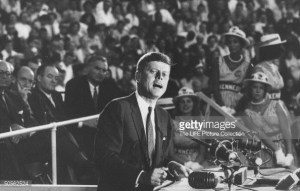
John Kennedy at the 1960 Democratic Convention
Mike Pence
Yes, Pence campaigned with Trump this week in Indianapolis and sang his praises. But he seemed about as believable in his Trump-love as Paul Ryan. O.K., he did a little better than that. At least he wants Trump to win, maybe.
But Mike Pence has a fan club of roughly four, and all four have the last name Pence. This is someone who has the capability to be bungling and divisive on dumb social issues—by all accounts pleasing no one in his management of a religious-liberty law in Indiana, which means he angers social liberals, social moderates, and social conservatives. To be fair, that does leave the apathetic or uninformed.
Chris Christie
We’ve been through this. Christie is, I will admit, an excellent retail politician. He’s a superb attack dog. He’s a social moderate. You like him, and he likes you, or thinks he does. But he’s got that bridge scandal to deal with and no one respects him after he turned into a courtier. Trump’s ticket would become the stuff of comedy. Picture it. Now picture it as a silhouette.
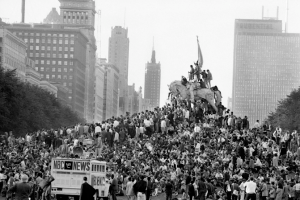
Protesters forming a human pyramid in Chicago’s Grant Park during the 1968 Democratic Convention
Jeff Sessions
Here, I must bring up one more crucial vulnerability of Trump: the suspicion that he doesn’t really mean a lot of the things that he says. It’s all pandering: on immigration, on trade, on budgets, on health care, etc. That’s one more reason why Jeff Sessions would pack a punch: Sessions represents Trumpism without Trump. Selecting him as a running mate would signal that Trump actually means what he’s saying.
Read more from TA Frank at the link.
I can’t resist including this assessment of Trump’s VP choices from Gawker: Which of His Potential Vice Presidential Candidates Is Donald Trump Just Fucking With? Check it out at that link.
So . . . what do you think? Will you be watching next week’s GOP clusterf#ck? What other stories are you following today?
Thursday Reads: Preventing a Trump Presidency
Posted: May 26, 2016 Filed under: Barack Obama, Foreign Affairs, morning reads, Republican politics, U.S. Politics | Tags: Bataan Death March, Democratic presidential primary 2016, Donald Trump, Elizabeth Warren, GOP convention in Cleveland, Hillary Clinton, Hiroshima, Jake Tapper, Japan, Trump's woman problem, World War II 46 Comments
Henri Matisse, Girl with a black cat
Good Morning!!
President Obama spoke at a press conference today in Japan, and he talked about Republican presidential nominee Donald Trump.
NBC News: Obama: Trump Candidacy Has ‘Rattled’ World Leaders.
During a press conference in Japan, Obama said the American presidential election is being “very” closely watched oversees. He told reporters that “it’s fair to say” world leaders are “surprised” Trump is the presumptive Republican nominee.
“They are not sure how seriously to take some of his pronouncements but they’re rattled by him — and for good reason, because a lot of the proposals that he’s made display either ignorance of world affairs or a cavalier attitude,” Obama added.
He suggested Trump’s controversial proposals were more about “getting tweets and headlines” than “actually thinking through” what’s needed to keep America safe or the “world on an even keel.”
Woman with a Cat c.1880 Edouard Manet
Trump has made China a frequent target of his attacks — such as saying the country will “suck the blood” out of the U.S.
He also has said he wants to ban Muslims from entering the U.S., called the Iran deal “horrendous,” pledged to “build a wall” along the Mexican border and that he’d have “no problem speaking to” North Korea’s dictator.
Such a conversation would mark a major shift in U.S. policy towards Pyongyang — a country Obama earlier Thursday said was a “big worry.” ….
Trump also said he was unlikely to have a “very good relationship” with the U.K. — one of America’s strongest allies — though later walked those comments back.

Obama will visit the Hiroshima Peace Park Memorial tomorrow.
President Barack Obama’s historic visit to Hiroshima is stirring conflicting emotions on both sides of the Atlantic.
Some 140,000 people were killed when the U.S. dropped an atomic bomb on the city on Aug. 6, 1945. Countless others suffered after-effects that endure to this day.
The White House has stressed Obama will not apologize for America’s use of the bombs when he visits the Hiroshima Peace Memorial Park on Friday — the first sitting president to do so….
“Of course everyone wants to hear an apology. Our families were killed,” Hiroshi Shimizu, general secretary of the Hiroshima Confederation of A-Bomb Sufferers Organizations, told The Associated Press.
Woman with a cat, Auguste Renoir
However, it would risk alienating Americans back home — especially giving the trip’s timing just ahead of Memorial Day.
Retired Army Staff Sgt. Lester Tenney, 95, spent more than three years in Japanese prison camps, and still has the blood-stained, bamboo stick Japanese troops used to beat him across the face.
“If you didn’t walk fast enough, you were killed. If you didn’t say the right words, you were killed, and if you were killed, you were either shot to death, bayoneted, or decapitated,” he told The Associated Press. “I’ll never forget it. And so for that reason … there’s no reason for us to apologize to them, not any reason whatsoever.

I have mixed emotions too. I’ve written here before that I probably wouldn’t be here today if Truman had not dropped the bombs in Hiroshima and Nagasaki. My father was on a ship to Japan when the news came, and he and the rest of his companions celebrated, because it meant they would be going home instead of to their likely deaths. How can I not be glad that my father survived?
When I worked at M.I.T., the head of my department was a man who had survived the Bataan Death March and then spent years in a Japanese prison camp. He was lucky to come through that alive; hundreds of Americans and Filipino prisoners did not.

Pablo Picasso, Reclining female nude playing with a cat
From the LA Times: Obama can’t endorse during the Democratic primary, so he’s just pointing out how hard the job is instead.
…Obama’s week abroad not so subtly serves a purpose beyond foreign relations: how he can help Democrats’ looming campaign against the billionaire GOP presidential candidate.
Pledging to stay neutral in the Democratic primary, Obama has instead struck a middle ground to help the party’s likely nominee, Hillary Clinton. He has engaged in a twist on the so-called Rose Garden campaign strategy where incumbent presidents lean on the trappings of their office to remind voters of their power and achievements. Obama is instead reminding voters of the seriousness of the job and, by extension, his belief in Clinton’s readiness for it.
On Friday, this president who has repeatedly pointed to the heady challenges on his desk as an argument against making a former reality show star the next commander in chief travels to Hiroshima, where one of two nuclear bombs ever used in warfare was dropped, to underscore the horrors of war and the life-or-death decisions that presidents face.
He doesn’t plan to talk about presidential politics at all in proximity to his trip to a memorial for victims of the atomic blast that killed about 140,000 people, a grim reminder of the devastating impact of a military attack that Obama finds defensible.
But the trip nonetheless provides a vivid illustration for the question Obama wants voters to ask themselves as they consider a presidential candidate — can you trust this person with the nuclear codes?
“We are in serious times, and this is a really serious job,” Obama said from behind the seal of the president at the White House lectern this month. “This is not entertainment. This is not a reality show.”
White House officials say that the president is eager to begin making a case to voters about the stakes of the race to replace him in the Oval Office, and will do so vigorously once the primaries are over.
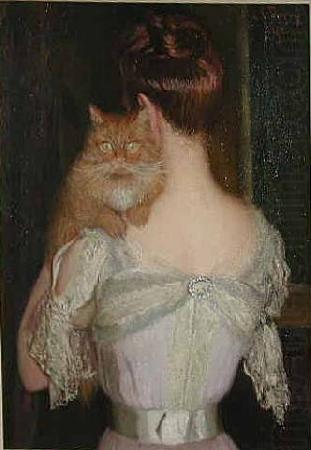
Lilla Cabot Perry, Woman with cat
I can’t wait until President Obama hits the campaign trail for Hillary! One thing we Democrats have over the Republicans is some very powerful surrogates who will work hard to hold onto the White House and save the country from Trump: Elizabeth Warren, John Lewis, Joe Biden, Elijah Cummings, John Kerry, Barbara Boxer, and so many more.
Warren has been getting under Trump’s skin for awhile now, and on Tuesday she attacked him in a high-profile speech.
Greg Sargent: Elizabeth Warren just absolutely shredded Donald Trump. There’s a lot more like this to come.
Elizabeth Warren delivered an extensive, blistering speech last night about Trump that will serve as a template for how Democrats will attack him — both in terms of how they’ll prosecute his business past and how they’ll try to undercut his central arguments about the economy….
The line that is driving all the attention this morning is Warren’s suggestion, in the context of Trump’s 2006 comment that a housing crash might enrich him, that the Donald is a “small, insecure money-grubber.” But Warren isn’t merely dissing Trump’s manhood. Warren — who went on to note that Trump “roots for people to get thrown out of their house” because he “doesn’t care who gets hurt, as long as he makes a profit” — is making a broader argument. Trump is not just a small, greedy person, but a cruel one, too.
That theme is also threaded through Warren’s broadside against Trump on taxes. He isn’t just paying as little as possible — and openly boasting about it — because he’s greedy. He isn’t just refusing to release his returns because he doesn’t want to reveal he’s not as rich as he claims (another shot at Trump’s self-inflated masculinity). All this, Warren suggests, also reflects a larger moral failing: Trump plays by his own set of rules, engorging himself, while simultaneously heaping explicit scorn on social investments designed to help those who are struggling in the same economy that made him rich. Warren notes that Trump recently likened paying his taxes to “throwing money down the drain” — i.e., he is reneging on the social contract — after “inheriting a fortune from his father” and “keeping it going by scamming people.” Thus, Warren is making a broader argument about Trump’s fundamental cruelty.
Here’s a video:
It’s time for the media to stop helping Trump and start dealing with the danger he poses to the country. If nothing else, they should be motivated by his attacks on the reporters who cover his campaign and on the the First Amendment. A few days ago, Jake Tapper gave a clinic for journalists on how to handle Trump’s outrageous lies.
Raw Story: Jake Tapper hammers Trump’s Vince Foster murder conspiracy mongering as ‘fiction born of delusion.’
CNN host Jake Tapper laid into GOP candidate Donald Trump for dredging up a debunked conspiracy theory that his likely opponent in the general election, Hillary Clinton, was somehow responsible for the death of then-Deputy White House Counsel Vince Foster.
Foster’s 1993 death was ruled a suicide.
Tapper called Trump out for saying in an interview that the circumstances around Foster’s death were “very fishy,” adding, “I don’t bring [Foster’s death] up because I don’t know enough to really discuss it. I will say there are people who continue to bring it up because they think it was absolutely a murder. I don’t do that because I don’t think it’s fair.”
“Except of course you just did that, Mr. Trump,” Tapper said. “But you’re right, it’s not fair that you did that, certainly not to Mr. Foster’s widow or their three children.”
Watch the video:
We need much more of this kind of fact-checking of Trump from the media and a whole lot less obsessing about Hillary Clinton’s emails.
Another good treatment of Trump from CNN: Donald Trump has a woman problem — 3 of them.
The presumptive Republican nominee spent the past 24 hours blasting his likely opponent, Hillary Clinton, and his most provocative antagonist, Sen. Elizabeth Warren.But he didn’t stop there. He also slammed New Mexico Gov. Susana Martinez, the nation’s only Latina governor and a Republican. Martinez might be seen as an obvious choice for diplomacy, or even intensive courtship, given Trump’s standing among women and Hispanics.Trump chose a different approach: He told the residents of New Mexico to get rid of her.In all three cases, the clashes were classic Trump. Slight him, diss him, hit him — and he’ll hit back harder. Much harder.But they also could play right into Democrats’ plans to brand Trump as a serial misogynist as he goes up against a rival who could become the first female president in history. His poor standing with women — a CNN/ORC poll in March found he was viewed unfavorably by 73% of registered female voters — is one of his biggest liabilities heading into the fall.“He makes a habit of insulting women,” Clinton said Wednesday afternoon as a campaign stop in California. “He seems to have something about women.”
Let’s hope Don the Con keeps this up. If Republican women vote against Trump, he could lose all 50 states.

Giovanni Boldini, Woman with cat
Finally, folks in Cleveland are getting nervous about the upcoming Trump convention: “Will Cleveland’s GOP convention be a mistake by the lake or a moment in the sun?”
Amid recurring violence at political rallies held by presumptive GOP nominee Donald Trump, many local officials and activists are increasingly worried that this lakeside city is ill-prepared to deal with tens of thousands of protesters and agitators expected to descend on the Republican National Convention here in July.
Some worry that police might be overrun or that the city has not stockpiled enough water to hydrate the masses in the mid-summer heat. Others, particularly on the left, oppose new restrictions that will be placed on demonstrators and object to the kind of military-style equipment law enforcement authorities may use to control the crowds.
There is also unhappiness among groups on both sides over the slow progress the city has made in approving parade and demonstration permits with less than two months to go.
On Wednesday, under the threat of a federal lawsuit by some groups upset by delays, city officials finally unveiled an official parade route and speakers’ platform in a major downtown park. Parades and protests will be allowed, but plans by some groups to bring in trucks, horses and, in one case, a giant bomb-shaped balloon might need to be rethought.
A bomb-shaped balloon?! So classy.
So . . . what stories are you following today? Please post your thoughts and links in the comment thread and have a tremendous Thursday!

 peej
peej Carissa
 bostonboomer
 dakinikat
 ecocatwoman
 mablue2
 Mama Lopez
 peggysue22
 quixote
 skydancingguestblogger
 Mona (aka Wonk the Vote)



 Sky Dancing
Recent Comments