
Tuesday Reads
Posted: August 27, 2013 Filed under: Barack Obama, China, Foreign Affairs, Iran, Iraq, morning reads, NSA, National Security Agency, Regulation, Russia, Syria, U.S. Politics | Tags: California wildfire, chemical weapons, cuba, David Miranda, Edward Snowden, GCHQ, Glenn Greenwald, John Kerry, Saddam Hussein, San Francisco water and power, Texas legislature, West Fertilizer Co., Yosemite National Park 30 Comments
Good Morning!!
The big news today is that President Obama appears likely to order “limited” strikes on Syria in the next few days in response to Syria’s use of chemical weapons against opposition fighters. From the WaPo: After Syria chemical allegations, Obama considering limited military strike.
President Obama is weighing a military strike against Syria that would be of limited scope and duration, designed to serve as punishment for Syria’s use of chemical weapons and as a deterrent, while keeping the United States out of deeper involvement in that country’s civil war, according to senior administration officials.
The timing of such an attack, which would probably last no more than two days and involve sea-launched cruise missiles — or, possibly, long-range bombers — striking military targets not directly related to Syria’s chemical weapons arsenal, would be dependent on three factors: completion of an intelligence report assessing Syrian government culpability in last week’s alleged chemical attack; ongoing consultation with allies and Congress; and determination of a justification under international law.
“We’re actively looking at the various legal angles that would inform a decision,” said an official who spoke about the presidential deliberations on the condition of anonymity. Missile-armed U.S. warships are already positioned in the Mediterranean.
I guess “looking at…legal angles” is code for that pesky rule in the Constitution where Congress has to declare wars. When’s the last time that happened–WWII?
Meanwhile, BBC News reports: Russia and China step up warning over strike.
Russian foreign ministry spokesman Alexander Lukashevich has called on the international community to show “prudence” over the crisis and observe international law.
“Attempts to bypass the Security Council, once again to create artificial groundless excuses for a military intervention in the region are fraught with new suffering in Syria and catastrophic consequences for other countries of the Middle East and North Africa,” he said in a statement.
Late on Monday, the US said it was postponing a meeting on Syria with Russian diplomats, citing “ongoing consultations” about alleged use of chemical weapons in Syria.
Hours later, Russia expressed regret about the decision. The two sides had been due to meet in The Hague on Wednesday to discuss setting up an international conference on finding a political solution to the crisis.
The Russian deputy defence minister, Gennady Gatilov said working out the political parameters for a resolution on Syria would be especially useful, with the threat of force hanging over the country.
Read more at the link.
Just as SOS Kerry was giving a speech to justify the upcoming military strikes, providing “Clear Evidence of Chemical Weapon Use in Syria” (NYT), a little birdie told Shane Harris and Matthew Aid of Foreign Policy magazine that the U.S. facilitated Saddam Hussein’s use of chemical weapons against Iran back in 1988.
The U.S. government may be considering military action in response to chemical strikes near Damascus. But a generation ago, America’s military and intelligence communities knew about and did nothing to stop a series of nerve gas attacks far more devastating than anything Syria has seen, Foreign Policy has learned.
In 1988, during the waning days of Iraq’s war with Iran, the United States learned through satellite imagery that Iran was about to gain a major strategic advantage by exploiting a hole in Iraqi defenses. U.S. intelligence officials conveyed the location of the Iranian troops to Iraq, fully aware that Hussein’s military would attack with chemical weapons, including sarin, a lethal nerve agent.
The intelligence included imagery and maps about Iranian troop movements, as well as the locations of Iranian logistics facilities and details about Iranian air defenses. The Iraqis used mustard gas and sarin prior to four major offensives in early 1988 that relied on U.S. satellite imagery, maps, and other intelligence. These attacks helped to tilt the war in Iraq’s favor and bring Iran to the negotiating table, and they ensured that the Reagan administration’s long-standing policy of securing an Iraqi victory would succeed. But they were also the last in a series of chemical strikes stretching back several years that the Reagan administration knew about and didn’t disclose.
U.S. officials have long denied acquiescing to Iraqi chemical attacks, insisting that Hussein’s government never announced he was going to use the weapons. But retired Air Force Col. Rick Francona, who was a military attaché in Baghdad during the 1988 strikes, paints a different picture.
“The Iraqis never told us that they intended to use nerve gas. They didn’t have to. We already knew,” he told Foreign Policy.
Read the rest of this long article at Foreign Policy.
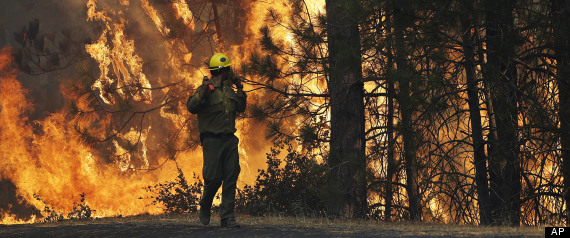
Firefighter A.J. Tevis watches the flames of the Rim Fire near Yosemite National Park, Calif., on Sunday, Aug. 25, 2013. With winds gusting to 50 mph on Sierra mountain ridges and flames jumping from treetop to treetop, hundreds of firefighters have been deployed to protect this and other communities in the path of the Rim Fire raging north of Yosemite National Park. (AP Photo/Jae C. Hong)
The wildfire in Northern California continues to spread into Yosemite National Park and has begun to threaten towns in the area. From the LA Times: Massive Rim fire continues to reshape lives and topography.
…even as firefighters worked furiously to hold a line outside of town, officials warned that this blaze was so hot it could send sparks more than a mile and a half out that could jump lines and start new hot spots. Evacuation advisories remain in effect for Tuolumne City and nearby areas.
On the north edge, the fire — now 134,000 acres — pushed into the Emigrant Wilderness Area and Yosemite National Park. It’s the one side of the fire with a natural last stand: Eventually it will run into granite walls that have snuffed out fires in this region for centuries.
Each day, what the massive blaze does depends on the wind. But officials were particularly attuned to each shift of breeze Sunday because of the weather’s eerie similarities to the day when the fire first exploded out of control.
So far the unpredictable blaze is only about 20% controlled, and it still threatens water and power sources for San Francisco.
The massive fire presents every challenge: steep slopes, dry fuel, rugged terrain and entire communities possibly in harm’s way.
The base camp and incident post, usually a haven outside fire lines, was a prominent example of the fire’s unpredictability: It’s in the middle of the burn zone, charred land with still-smoldering stumps on both sides.
Firefighters call such complete devastation “the black.” Entire ravines and ridges were a dusty gray moonscape. But some of the land was a “dirty burn” — meaning there were small circles of pine and aspen and even grass and wildflowers in the middle of charcoal-black areas where smoke still curled and embers glowed. The specks of beauty made firefighters nervous: To a fire, they are fuel.
My sister and her husband own a house north of San Francisco. It’s probably not in danger, but it still brings the scope of this disaster home to me. I sure hope Firefighers will begin to make progress soon. The burning area is now the size of the city of Chicago, according to CNN.
Yosemite National Park, California (CNN) — A massive northern California wildfire that’s threatening Yosemite National Park and San Francisco’s key water and power sources grew Monday, becoming the 13th largest in state history, state fire authorities said.
The Rim Fire, which has devoured 160,980 acres, has scorched an area about the size of the city of Chicago while more than 3,600 firefighters try to rein it in….
The wildfire, which was 20% contained Monday night, was spreading primarily to the east and threatened to grow amid extremely dry conditions and hot weather.
Part of the fire continued to spread Monday toward a key part of San Francisco’s water supply: the Hetch Hetchy Reservoir, which lies within Yosemite and is just east of the flames.
The fire also could threaten the area’s hydroelectric generators, which provide much of San Francisco’s electricity. Because of the approaching flames, officials shut down the generators, and the city — more than 120 miles to the west — temporarily is getting power from elsewhere.
Speaking of disasters, Charles Pierce reminds us that West, Texas is still recovering from the horrible explosion at the fertilizer plant there and that Texas still isn’t doing that much to prevent similar events in the future.
Read the rest of this entry »
Rick Perry Can’t Handle The Truth
Posted: April 28, 2013 Filed under: corporate greed, corporatism, free market ideology, Psychopaths in charge, Regulation, Republican politics, U.S. Politics | Tags: dangerous chemicals, Industrial accidents, Jack Ohman, political cartoons, Rick Perry, Sacramento Bee, West Tx fertilizer plant explosion 17 Comments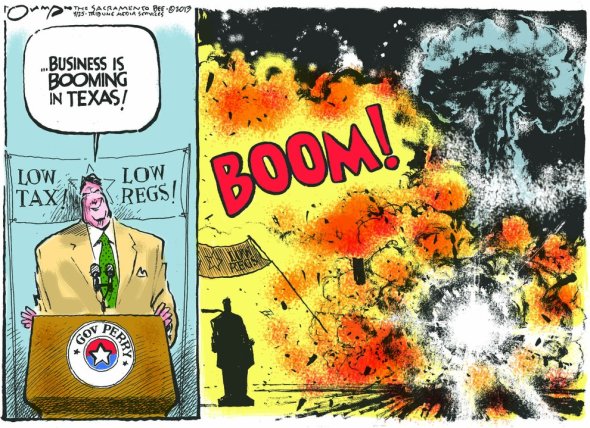
Jack Ohman, Sacramento Bee
Via Raw Story, the above cartoon by Jack Ohman of the Sacramento Bee, published last Thursday, has Texas Governor Rick Perry all hot under the collar–so much so that he (or some flunky) wrote a letter to the editor, which the Bee published on Friday. Here it is:
Re “Business is booming in Texas” (Editorial cartoon, April 25): It was with extreme disgust and disappointment I viewed your recent cartoon. While I will always welcome healthypolicy debate, I won’t stand for someone mocking the tragic deaths of my fellow Texans and our fellow Americans.
Additionally, publishing this on the very day our state and nation paused to honor and mourn those who died only compounds the pain and suffering of the many Texans who lost family and friends in this disaster. The Bee owes the community of West, Texas an immediate apology for your detestable attempt at satire.
— Gov. Rick Perry, Austin, Tex.
So far, Ohman’s editor Stuart Leavenworth is standing up for him. You can read his full response at the above link. From Raw Story:
Stuart Leavenworth, the editorial page editor of The Sacramento Bee, said the cartoon illustrated Perry’s “disregard for worker safety, and his attempts to market Texas as a place where industries can thrive with few regulations.”
Earlier this year, California Gov. Jerry Brown chided Texas for having a high percentage of workers earning minimum wage. Perry responded about a month later by running radio ads in California that encouraged business owners to move to his state. Perry claimed building a business in California was “next to impossible” because of regulations and taxes — regulations and taxes that his state lacked.
Ohman wrote about the “controversy” on his blog today. He says that a number of readers chastised him for the cartoon.
Their comments ranged from “you are a sick human being” to “insensitive and tasteless.” I’m not sure I am clinically qualified to give myself a direct diagnosis, but I am pretty sure I am not a sick human being. Let’s explore the question of tastelessness.
The Texas chemical plant had not been inspected by the state of Texas since 2006. That’s seven years ago. You may have read in the news that Gov. Perry, during his business recruiting trips to California and Illinois, generally described his state as free from high taxes and burdensome regulation. One of the burdensome regulations he neglected to mention was the fact that his state hadn’t really gotten around to checking out that fertilizer plant. Many Texas cities have little or no zoning, resulting in homes being permitted next to sparely inspected businesses that store explosive chemicals….
When I have to come up with these ideas, I can assure you that I am not really deliberately trying to be tasteless. I am not. What I am trying to do is make readers think about an issue in a striking way. I seem to have succeeded in this cartoon, one way or the other.
The question is whether it is tasteless or not.
My answer, respectfully, is that it isn’t.
Having said that, what normal person doesn’t mourn those poor people fighting the fire and living by the plant? I certainly do. What makes me angry, and, yes, I am driven by anger, is that it could have been prevented. I guess I could have done a toned-down version of the cartoon; I am not sure what that would have been, but I think many readers’ objections just stemmed from the fact that I used the explosion as a metaphor, period. The wound is fresh, the hurt still stings.

Personally, I thought the cartoon was brilliant–a perfect example of the old saying “a picture is worth a thousands words.” Apparently it got a pretty big rise out of Perry when the thousands of gallons of ink spilled on news stories hasn’t. Perry should be ashamed to show his face in public after what happened in West, Texas. Why on earth do Texans keep reelecting this guy?
Ohman recommended that Perry read this outstanding investigation by Pro Publica, which I read and recommended a few days ago: What Went Wrong in West, Texas — and Where Were the Regulators? Perry should either read it or have his flunky read it to him. Then he should wake up and realize that millions of Americans disapprove of his laissez-faire, Ayn Randian approach to government, and cartoonist Jack Ohman expressed our feelings perfectly.
But I don’t expect Perry will take responsibility for his role in the West, Texas disaster, because he can’t handle the truth.
Time for Media Talking Heads to Get Out of Boston and Head Down to Texas
Posted: April 21, 2013 Filed under: Barack Obama, Real Life Horror, Regulation, The Media SUCKS, U.S. Politics | Tags: ammonium nitrate, Buck Uptmor, CNN, Department of Homeland Security, Derrick Hurtt, disasters, Doug and Robert Snokhous, Jerry Chapman, Joey Pustejovsky, Kevin Sanders, West Fertilizer Co., West TX 42 Comments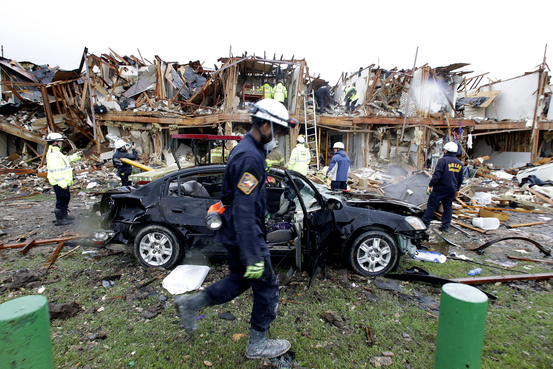
Firefighter conduct search and rescue of an apartment destroyed by an explosion at a fertilizer plant in West, Texas, Thursday, April 18, 2013.
I don’t watch much television, but tonight I turned on CNN for awhile. I was surprised to find that there were still numerous national reporters standing around in Watertown and Boston doing live stand-up reports. Why? The story is pretty much over at this point. What remains is mostly legal stories. Those don’t require on-sight reporting by media stars. Is it just the label “terrorism” that is keeping the national media focused on Boston?
Meanwhile, on Thursday there was a horrific disaster in the small town of West, Texas when a fertilizer plant exploded, killing 14 people, injuring 200, and destroying a school, a nursing home–basically about half of the small town. Hundreds of people in West are now homeless and desperately in need of help.
On CNN’s home page tonight, I could find only one prominently placed story about the Texas disaster: Texan town tries to rebuild with community, spirituality
Search and rescue efforts have evolved into search and recovery efforts, because officials don’t expect to find any more victims in the wreckage — alive or dead.
The explosion at West Fertilizer’s plant ruined much of the north side of town, and left hundreds of people injured, homeless and in need of help.
On television nationally, the scope of the tragedy was overshadowed by the dramatic events in New England, as investigators there pursued leads in the Boston Marathon bombing investigation, then pursued their suspects.
No kidding.
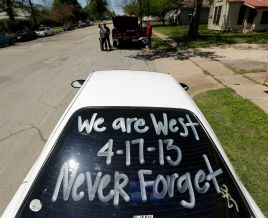
A sign is seen on a car window as residents wait to enter a damaged neighborhood Saturday, April 20, 2013, three days after an explosion at a fertilizer plant in West, Texas (Houston Chronicle)
But many Texans kept their focus on the great need close to home. Long lines of cars streamed by the community center, dropping off food, water and other rations throughout the weekend. Numerous church groups and restaurants handed out hot meals.
“These are our neighbors. They are coming to help,” Waco Police Department Sgt. William Patrick Swanton told reporters. “You will find that in Texas. You will find that across the United States. We put everything aside when it comes to these types of situations.”
The nine first responders from West who died battling the blaze represented nearly one-third of the town’s volunteer firefighting and EMT force. The fire destroyed two fire trucks and an ambulance. Firefighters and trucks from neighboring communities now fill the void at the West firehouse.
Another piece at CNN dated April 19, 11:41 PM lists “Five stories you may have missed during Boston bombings.” The list doesn’t include the Texas explosion!
There are plenty of national stories to be covered in West, Texas right now. For example, the fact that the feds had no clue of the danger that lurked inside the West Fertilizer Co. plant. The Houston Chronicle reports:
The Department of Homeland Security, the federal agency charged with regulating the highly explosive substance ammonium nitrate, wasn’t aware that West Fertilizer Co. stored 270 tons of ammonium nitrate – 1,300 times the threshold that triggers federal oversight.
But the small company did submit the information to another government agency – the Department of State Health Services.
Had federal officials been aware of the information contained in the state disclosure, DHS officials might have inspected the facility and required safer storage.
The patchwork of local, state and national laws regulating fertilizer facilities remains at the heart of the investigation into the deadly explosion that claimed 14 lives in the tiny Czech community of West. Saturday, company officials were unavailable to explain why they had not complied with DHS rules, promulgated in the last five years, requiring the disclosure of such a large quantity of ammonium nitrate.
Since 2006, the company complied with state agencies overseeing air emissions and product quality, but no state agency had the legal authority to inspect and enforce safety measures at the plant.
That is huge news! How many other industrial plants are there around the country with safety issues about which federal agencies have no knowledge? Time for the national media to get busy finding out the answer to that question.
I’m not going to go on and on about this; I think I’ve made my point. But here are a few more stories about the Texas disaster.
Huffington Post: Derrick Hurtt, West, Texas Resident, Describes Plant Explosion: ‘You Think You’re Dead’ (VIDEO)
Derrick Hurtt, a lifetime resident of West, Texas, says the major plant explosion that rocked his small hometown last week left him feeling for a split-second like he had died.
Hurtt caught the deadly blast on a cell phone camera a couple of blocks away, creating a video that ultimately went viral. The explosion at West Fertilizer Co. last week left at least 14 people dead and hundreds of others injured. Hurtt described his harrowing experience to the Waco Tribune Friday.
“It was pitch-black. You think you’re dead,” he said. “And then that mushroom sucked all the darkness back into the cloud, all that black smoke. In the daylight, you realize that you’re not dead.”
NY Daily News: Some stranded families allowed to return after West, Texas, fertilizer plant explosion
Stranded families growing weary and frustrated since a deadly Texas fertilizer plant explosion left them barricaded from their battered homes finally began returning Saturday, but only under a curfew and strict warnings to not wander beyond their own yards.
Authorities gave the much-awaited okay after a nervous morning. Emergency workers had told residents packed in a hotel — waiting for updates about their neighborhood — that leaking gas tanks were causing small fires near the blast site, keeping authorities from lifting blockades.
Officials quickly emphasized that the fires were contained and the town of West was not in danger. They later repeated that message as evacuees in a mile-long line of cars inched along a downtown road and toward the blast radius, although the chances that most would get to their houses Saturday night dimmed as a 7 p.m. curfew approached.
Miami Herald: 4 more first responders killed in Texas blast ID’d
On Sunday, professional organizations and family and friends identified four more of the first responders who died: brothers Doug and Robert Snokhous, who were both firefighters with the West Volunteer Fire Department; Jerry Chapman, a firefighter with the Abbott Volunteer Fire Department; and Kevin Sanders, who worked with West EMS and another area volunteer fire department.
Heartbreaking. The town didn’t even have a fire department–these were volunteers! Another report from the Miami Herald:
Buck Uptmor didn’t have to go to West Fertilizer Co. when the fire started. He wasn’t a firefighter like his brother and cousin, who raced toward the plant. But a ranch of horses next to the flames needed to be moved to safety.
“He went to help a friend,” said Joyce Marek, Uptmor’s aunt. “And then it blew.” [….]
The dead included Uptmor and Joey Pustejovsky, the city secretary who doubled as a member of the West Volunteer Fire Department. A captain of the Dallas Fire Department who was off-duty at the time but responded to the fire to help also died.
The explosion was strong enough to register as a small earthquake and could be heard for many miles across the Texas prairie. It demolished nearly everything for several blocks around the plant. More than 200 people were hurt, and Muska said five first-responders were among those who remained hospitalized Friday.
The first-responders “knew it was dangerous. They knew that thing could go up at any time,” said Ronnie Sykora, who was Pustejovsky’s deacon at St. Mary of the Assumption Catholic Church. “But they also knew that if they could extinguish that fire before it went up, that they could save tens of lives, hundreds of lives. That’s why they were in there.”
Fort Worth Star-Telegram: Investigators describe West explosion as a wave of destruction
WEST — On the grass outside the shredded apartment complex sat several large chunks of concrete, basketball-sized pieces of shrapnel that were sent flying by the force of Wednesday’s fertilizer plant explosion.
Officials said the concrete and other pieces of projectile had once been part of the West Fertilizer Co., which exploded about 20 minutes after a fire broke out early that evening….
When the explosion occurred, investigators said the blast radiated outward, slamming into a nearby railroad track berm. The explosion’s force was deflected upward by the berm before rushing back down to pummel the apartment complex, a nursing home and West Intermediate School and eventually moving into neighborhoods.
“The easiest way to describe it is think of a wave going out and it may come up and down with it,” said Kelly Kistner, said assistant State Fire Marshal.
The destruction from the blast spread over a 37-square-block area of West that was described as a “war zone” by Brian Hoback, the National Response Team leader with the Bureau of Alcohol, Tobacco and Firearms.
The story says that today “a handful of reporters and photographers were allowed to see some of the areas that were hit the hardest by the explosion…” A handful of reporters? Why weren’t there well-known national broadcast reporters down there doing live stand-ups?
Here’s another story they could be covering. The actual cause of the explosion is still unknown, according to NBC News.
Investigators have located the spot where the horrific Central Texas fertilizer plant explosion occurred but do not yet know what triggered the deadly blast, town officials said Sunday.
West, Texas, fire officials said at a news briefing that there is no evidence of criminal activity in last Wednesday’s massive explosion at the West Fertilizer Co., and that there are no longer any fires burning at or around the decimated facility….
A fire official announced the city has identified the “seat” — origin — of the explosion, but did not specify the exact site.
“We do have a large crater,” Assistant State Fire Marshal Kelly Kistner said.
The national media should be down in Texas finding out what the hell happened and holding federal agencies responsible for their failures–not to mention Congress and Texas state officials who have fought against government regulations on businesses. Besides I really want these bozos out of Boston. I can’t imagine how Dakinikat has put up with all these folks swarming around New Orleans over the past several years. They are driving me nuts!
President Obama should go down there too, and if he doesn’t I’d sure like to know why.
When Corporations Mutate Into A Super Race
Posted: March 12, 2012 Filed under: corporate money, corporatism, Economy, energy, Environment, Environmental Protection, Environmentalists, fracking, Regulation, toxic waste 12 CommentsWe all remember Mitt Romney’s public and awkward statement that ‘Corporations are people, too.”
But Romney was underplaying the reality of American life in 2012.
Corporations are not mere people. They have morphed into a Super Race, ready to conquer what’s left of our disintegrating democracy. If you think this is liberal hysteria or rank hyperbole, I give you Pennsylvania’s newly passed Act 13. Bad number. But the scope of this foolish and utterly destructive state giveaway is far worse.
Act 13 is a massive gift to the oil and gas companies, which overturn property rights, strips municipal communities of zoning law protection and turn environmental and health compromises into considerations we can no longer afford. It reduces the citizens of Pennsylvania to 3rd world colony status, ripe for exploitation and extraction. Welcome to the New World of Corporate Rule where natural gas extraction is the profitable prize and quality of life is a thing of the past.
And the reaction?
“Now I know what it feels like to live in Nigeria,” said recently retired Pittsburgh City Council President Doug Shields. “You’re basically a resource colony for multi-national corporations to take your natural resources, take them back to wherever they are at, add value to them, and then sell them back to you.”
Yup. This is the neoliberal dream. Steal, add value and then sell back at an exorbitant price tag. The whole world is nothing more than a resource colony so the corporate Super Race can turn a mind-boggling profit. On the backs of the natives. Water safety and/or depletion, health, wildlife? All expendable in this great push for growth and ever-increasing profit. Moral considerations? Please, haven’t you gotten the email? Corporations don’t do morality. They’re too big for that.

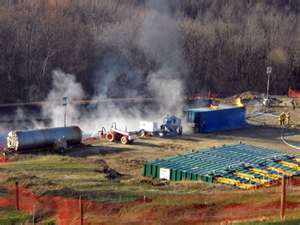
Fracking in SW Pennsylvania
Why did this happen in Pennsylvania? Because of the enormous layer of shale deposits known as the Marcellus formation, resting like a slumbering giant beneath the state’s surface. But there’s more! That would be the gargantuan amount of natural gas to be had at a stunning profit—as much as 70-99% some managers of earlier drill wells have boasted.
How could investors resist?
But then, there are the rising concerns of the fracking process itself, the public’s growing awareness of water and air pollution, the niggling problem of toxic wastewater disposal and those bothersome legal suits from citizens with lame health issues.
What to do, what to do?
Act 13 is the perfect response to investor skittishness. It removes all complaint and whining by simply supplanting existing law—the kind that protects the citizen—with corporate friendly law that recognizes the global reality—everyone is for sale and everything can be exploited.
To keep tempers in check, the best PR in the world is dished out, promises of jobs and prosperity, spinning dialogues about energy independence [at any cost] and patriotic flag-waving—how tearing up the earth, polluting our waterways and compromising the public’s health is good for America. After all, in times of crisis, sacrifices need to be made, even when it means overriding the civil rights of people and communities.
That is exactly what Act 13 addresses.
Courts in the Great State of New York upholding community rights to block fracking dreams is simply unacceptable. Act 13 revokes those rights. The Lakota people in South Dakota blocking TransCanada truck transports across Native territory? We can’t have that. Act 13 clearly empowers a corporation to seize property that impacts any stage of the drilling process. And those possible health considerations? Got it covered, boys and girls. Act 13 prohibits physicians from discussing medical impacts from chemical contaminations. The Halliburton Loophole in all its malicious splendor comes back to haunt us.
Marcellus Fracking Pit
This is what happens when corporations are declared ‘people.’ This is what happens when legislators sell their souls for 30 pieces of silver. I do not care if Republican Governor Corbett and his Republican dwarves truly believe this is good for Pennsylvania. This is a betrayal of American law and her people on a massive scale. The good citizens of Pennsylvania might look at the situation in Ohio, where Governor Kasich opened the state’s doors for business, any business, and Ohio became the dumping ground for fracking wastewater disposal and deep ground injection wells. We now know those earthquakes were not coincidental events. No wonder Republicans hate science!
Hattip to Alternet on this rant. I’d recommend reading the article ‘Fracking Democracy: Why Pennsylvania’s Act 13 May Be the Nation’s Worst Corporate Giveaway’ by Steven Rosenfeld in its entirety with the first link I provided. It’s a chilling, mind-blowing report.
Act 13 is expected to take effect on April 14th. We better pray [regardless of what state we live in] that the groups now amassing in Pennsylvania are able to halt or at least slow down this corporate monstrosity.
Because if not, we can say ‘adios’ to the shredded remnants of our Republic.
As for Pennsylvania? My heart goes out because I lived and worked in the state for over a dozen years and still have family in the area. The economy has been raked over the coals, so the promise of jobs and money injected into struggling municipalities and rural communities is a huge seduction. But we’ve seen this movie before. It does not end well. Here’s hoping that flesh and blood citizens get a chance to write a far better script for themselves and their future. Here’s hoping the rest of the country wakes up to what can only be called a corporate takeover.
Friday Reads
Posted: March 9, 2012 Filed under: Economy, Global Financial Crisis, House of Representatives, investment banking, Mitt Romney, morning reads, Regulation, religious extremists, Rush Limbaugh | Tags: Dennis Kucinich, Dump Rush, FED, SEC 36 Comments Good Morning!
Well, we’ve always known Pat Robertson was a little off. Reconcile all his throw back ideas about women and the GLBT community with his views on decriminalizing marijuana, I dare you!!
“I really believe we should treat marijuana the way we treat beverage alcohol,” Mr. Robertson said in an interview on Wednesday. “I’ve never used marijuana and I don’t intend to, but it’s just one of those things that I think: this war on drugs just hasn’t succeeded.”
Mr. Robertson’s remarks echoed statements he made last week on “The 700 Club,” the signature program of his Christian Broadcasting Network, and other comments he made in 2010. While those earlier remarks were largely dismissed by his followers, Mr. Robertson has now apparently fully embraced the idea of legalizing marijuana, arguing that it is a way to bring down soaring rates of incarceration and reduce the social and financial costs.
“I believe in working with the hearts of people, and not locking them up,” he said.
Rush has lost at least 50 advertisers after his horrendous, personal attacks on a university student exercising her first amendment rights. Just what kind of advertisers does the big blowhard have left? Well, he’s picked up an online dating service for married people interested in extramarital relations. There’s your family values for you!!!
Advertisers learned something about Rush Limbaugh’s demographic this week.
“Here we thought lots of pleasant, upstanding people were listening to and enjoying the rational things Rush had to say,” dozens of companies said. “Apparently not.”
It turns out that people who really, truly still enjoy Rush Limbaugh’s show are — how do I put this? — jerks.
At least that’s what the new advertisements moving into the vast empty lot of Rush Limbaugh, Inc., implies. “Ah,” you say, as a rat runs over your foot and several people offer payday loans and try to sell you watches from their trench coats. “This place seems to have gone downhill somewhat.”
So far, he’s picked up AshleyMadison.com, the site where you go to cheat on your wife, and another Web site that is explicitly for sugar-daddy matchmaking.
Republicans in the House have basically gone after finance regulators in a way that would basically change one of the major mandates of the Fed’s economic stabilization mandate and the SEC’s ability to police the markets for fraud. The FED suggestions are outrageous. They would completely stop the FED’s ability to stimulate the economy and would change the composition of the FED board from economists to the Bank’s District Presidents who are answerable to their member banks.
The bill, which will be formally introduced later this week by Congressman Brady, would eliminate the employment leg of the dual mandate, requiring the Federal Reserve to focus only on price stability.
The legislation would also restructure the Federal Open Market Committee (FOMC). The bill would give permanent seats on the committee to the twelve regional Federal Reserve bank presidents, who are chosen by regional Federal Reserve Bank directors. Those boards are composed of private citizens.
Yesterday, SEC chairman Mary Schapiro begged Congress to increase the agency’s funding, arguing that “the rapidly expanding size and complexity of the markets presents enormous oversight challenges.” Representative Barney Frank, ranking member of the House Financial Services Committee, offered a bill to provide that funding—and Republicans voted lockstep to trash it.
Republicans on the committee offered the perverse argument that since the SEC has repeatedly suffered oversight breakdowns in the past, it’s not entitled to additional funding. Representative Jo Ann Emerson, a Missouri Republican and member of the House Appropriations Committee, echoed this argument in the hearing with Schapiro yesterday:
“I think this body is reticent to throw more money at the SEC until ya’ll have proven that you have addressed the structural problems from within…in a comprehensive way,” [Emerson said]. “Since 2001, SEC’s budget has increased over 200 percent. Despite this tremendous growth in resources over the past decade, the SEC failed to detect Ponzi schemes such as Madoff and Stanford, the U.S. financial system nearly collapsed, and judges continue to question SEC settlements and regulations.”
Further starving a regulatory agency that’s already clearly unable to handle its massive mission is not a terribly convincing argument—one would have to truly believe the SEC is completely capable of policing Wall Street but simply suffering from “structural problems,” as Emerson asserts. (To give a sense of the very real funding problems, JPMorgan Chase—only one of the 35,000 entities the SEC is tasked with regulating—spends four times the entire SEC budget on information technology alone). But it’s the only argument Republicans have—the SEC is funded entirely by fees from the financial industry, so Republicans can’t carp about the deficit.
None of these folks seem to have any idea about what caused the financial crisis nor how much the underfunding and disabling of regulators and regulators have played into all these problems It’s really disheartening.
Meanwhile, Romney has told a university student that students going to cheap schools they could afford would be better than government student loans. BTW, where are there cheap schools now?
Mr. Romney was perfectly polite to the student. He didn’t talk about the dangers of liberal indoctrination on college campuses, as Rick Santorum might have. But his warning was clear: shop around and get a good price, because you’re on your own.
“It would be popular for me to stand up and say I’m going to give you government money to pay for your college, but I’m not going to promise that,” he said, to sustained applause from the crowd at a high-tech metals assembly factory here. “Don’t just go to one that has the highest price. Go to one that has a little lower price where you can get a good education. And hopefully you’ll find that. And don’t expect the government to forgive the debt that you take on.”
There wasn’t a word about the variety of government loan programs, which have made it possible for millions of students to get college degrees. There wasn’t a word urging colleges to hold down tuition increases, as President Obama has been doing, or a suggestion that the student consider a work-study program.
And there wasn’t a word about Pell Grants, in case the student’s family had a low enough income to qualify. That may be because Mr. Romney supports the House Republican budget, which would cut Pell Grants by 25 percent or more at a time when they are needed more than ever.
Instead, the advice was pretty brutal: if you can’t afford college, look around for a scholarship (good luck with that), try to graduate in less than four years, or join the military if you want a free education.
Robert Scheer writes about Dennis Kucinich who will leave Congress after his term finishes. His district was merged with Marcy Kaptur’s and she won on Tuesday. It’s an interest profile for a quirky politician.
Kucinich never competed in that way. He has been a national symbol of resistance to excessive government power and waste. He also has been a champion of social justice. His has been a rare voice, and one way or another it must continue to be heard. Simply put, when it came to the struggle for peace over war, Dennis was the conscience of the Congress. And he was always at the forefront in defending the rights of unionized workers who once formed the backbone of a solid middle class and who are now threatened with extinction.
Kucinich will surely be back for another turn in public life. As he put it in our Playboy interview:
“I appreciate Woody Allen’s humor because one of my safety valves is an appreciation for life’s absurdities. His message is that life isn’t a funeral march to the grave. It’s a polka.”
What’s on your reading and blogging list today?

 peej
peej Carissa
 bostonboomer
 dakinikat
 ecocatwoman
 mablue2
 Mama Lopez
 peggysue22
 quixote
 skydancingguestblogger
 Mona (aka Wonk the Vote)



 Sky Dancing
Recent Comments