
Blessed are the Poor or maybe not …
Posted: October 9, 2013 Filed under: poverty, social justice | Tags: war on the poor 14 CommentsSo, ya’ll know I’m not a deist or a christian. But, I do know a lot about the theology having studied it and basically grown up a Presbyterian by default. I say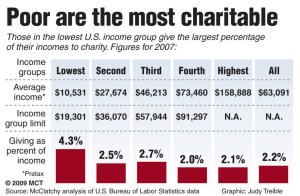 default because I was baptized Presbyterian mostly because my mother’s golf partner at the country club was the Presbyterian minister’s wife. The next time we moved, I was the only one in the family that stuck with the church thing mostly because the best music program in the city was in the Presbyterian church because the minister’s wife was a serious piano teacher. The minister was great. He drove around in an orange fiat convertible with a tweed jacket, a golf tam, and leather gloves. When he wasn’t writing his sermon about what to do the next time you were sitting in the locker room at the country club, he was at the country club golfing. I have to admit to being kind’ve of an outlier in my family since I’m not a millionaire. I’ve seen what kind of trivial concerns the rich tend to have and I really don’t want to be a part of it. I’d much rather appreciate my daily bread instead of a pair of manolo blahniks.
I just don’t care that much about money. I have very simple needs plus I’m a Buddhist and that’s sort’ve a lifestyle thing with us. I say all this because I have been on both sides of the income spectrum and I actually chose downward mobility. However, I didn’t want to choose poverty. That’s a more difficult thing to avoid these days; especially if you’re an aging woman in a red state where the governor hates all teachers and professors.
I guess I was the only rich republican kid that read the four woes listed in Luke 6:24–26 that start with “Woe to you…” when I was a good little Presbyterian in sunday school.
…who are rich, for you have already received your comfort.
…who are well fed now, for you will go hungry.
…who laugh now, for you will mourn and weep.
…when everyone speaks well of you, for that is how their ancestors treated the false prophets.
So, given Republican officials are cross-waving christians and just sort’ve wear the entire thing on their sleeves self righteously, why is there a war on poor people? I also read the four beatitudes in that same sermon on the plain in Luke’s gospel that starts out “Blessed are you…”
…who are poor, for yours is the kingdom of God.
…who hunger now, for you will be satisfied.
…you who weep now, for you will laugh.
I frequently wonder if their new testaments don’t have those particulars. I do have to say that most of my jaunty minister’s sermons had to do with it being easy to forget about reality when you’re sitting in a country club. (I think he may have been reminding himself. You should’ve seen the manse.) Maybe that is the thrust of the problem that we’re witnessing a bunch of self-professed christians declare war on the poor.
American conservatives for the past several decades have shown a remarkable hostility to poor people in our country. The recent effort to slash the SNAP food stamp program in the House (link); the astounding refusal of 26 Republican governors to expand Medicaid coverage in their states — depriving millions of poor people from access to Medicaid health coverage (link); and the general legislative indifference to a rising poverty rate in the United States — all this suggests something beyond ideology or neglect.
I also missed the part where Jesus wanted fetuses to come unto him but poor children and their mothers could just go to bed hungry.
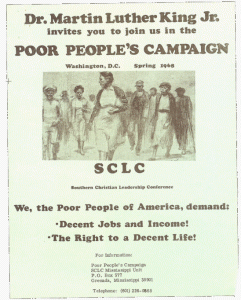 I left Nebraska nearly 20 years ago to discover a little something different in life down here in New Orleans. About 10 years ago, I bought a very modest house in the ninth ward of New Orleans. My neighborhood is undergoing incredible gentrification and I have to admit that I could not afford my house any more. Neither could any of the neighbors that were here when I moved here. I actually think this is part of a bigger plan to stop the poor and the black from returning to New Orleans but that is another post for another day.
There is a deliberate strategy of punishing the poor put into place by many southern, Republican governors that profess to be pious Christians. This includes my hyper-charismatic Catholic converted Bobby Jindal and both of the freaky Republican governors of the surrounding state. Their position on providing a medicaid expansion to the state to heal the poor is basically let them die in the poorly run privatized hospitals that Jindal sold to his donors at a really cheap price. I guess you have to be a leper to get health care according to biblical fundamentalists.
While Republicans in Congress weren’t able to defund Obamacare, many Republicans at the state level have found a different way to block low-income Americans from receiving cheaper health insurance. An estimated eight million Americans will remain poor and uninsured even after Obamacare is rolled out, due to the decision of many Republican governors and state legislators to reject the Affordable Care Act’s expansion of Medicaid.
When the Supreme Court upheld Obamacare last year, it also issued a less-noticed ruling that states could opt-out of the law’s Medicaid expansion, which broadened eligibility requirements for the program and provided federal funds to help pay for it. As this essentially amounted to free money until 2016 — at which point the federal government would pay for “only” 90 percent of the expansion — you’d think it’d be a no-brainer to accept it, right?
Well, not if you’re Rick Perry! Or Scott Walker, or Nikki Haley, or Bobby Jindal, or a ton of other red-state governors who decided to forego helping their poorest residents get health insurance because, well, that could alienate the GOP base voters next time they face a primary.
In total, 26 states have rejected the expansion, including the state of Mississippi, which has the highest rate of uninsured poor people in the country. Sixty-eight percent of uninsured single mothers live in the states that rejected the expansion, as do 60 percent of the nation’s uninsured working poor.
In general, states that rejected the expansion also have stricter eligibility requirements for Medicaid. While the 24 states that agreed to expand the program have a median income limit of $12,200 for Medicaid applicants, the limit is $5,600 —less than half the federal poverty level — in the states that rejected it.
One piece of the puzzle seems to come down to ideology and a passionate and unquestioning faith in “the market”. If you are poor in a market system, this ideology implies you’ve done something wrong; you aren’t productive; you don’t deserve a better quality of life. You are probably a drug addict, a welfare queen, a slacker. (Remember “slackers” from the 2012 Presidential campaign?)
Another element here seems to have something to do with social distance. Segments of society with whom one has not contact may be easier to treat impersonally and cruelly. How many conservative legislators or governors have actually spent time with poor people, with the working poor, and with poor children? But without exposure to one’s fellow citizens in many different life circumstances, it is hard to acquire the inner qualities of compassion and caring that make one sensitive to the facts about poverty.
A crucial thread here seems to be a familiar American narrative around race. The language of welfare reform, abuse of food stamps, and the inner city is interwoven with racial assumptions and stereotypes. Joan Walsh’s recent column in Salon (link) does a good job of connecting the dots between conservative rhetoric in the past thirty years and racism. She quotes a particularly prophetic passage from Lee Atwater in 1982 that basically lays out the transition from overtly racist language to coded language couched in terms of “big government”.
Finally, it seems unavoidable that some of this hostility derives from a fairly straightforward conflict of group interests. In order to create programs and economic opportunities that would significantly reduce poverty, it takes government spending — on income and food support, on education, on housing allowances, and on public amenities for low-income people. Government spending requires taxation; and taxation reduces the income and wealth of households at the top of the ladder. So there is a fairly obvious connection between an anti-poverty legislative agenda and the material interests of the privileged in our economy.
Many in the U.S. have fallen below the poverty line since the last recession because of loss of jobs combined with the increasing amount of income inequality in this country. It is really through no fault of their own. So, why do these memes and canards about the poor persist?
The bottom 1 percent in the U.S. live on an income that is one six-hundredth of the average for the richest 1 percent of Americans. They live on less than the average GDP per capita of a low-income country such as Afghanistan, Mozambique, or Haiti. And they live at or below the national poverty lines of such countries as Ghana, Congo, and Mongolia. Despite living in one of the richest countries in the world, the bottom 1 percent of Americans see incomes below the global median. The more successful disabled beggars of Addis Ababa in Ethiopia earn more than $2 on a good day, according to the International Labor Organization.
It is true that from an objective standpoint, living on $2 in a richer country is associated with better outcomes than living on $2 in a poor country—you are more likely to live in a house with basic utilities, and your children are less likely to die. In those terms, extremely poor Americans have it better than similarly poor Ghanaians—especially because the poorest in America will spend more than $2 a day even if their incomes are considerably below that. On the other hand, Ghanaians living on $2 a day are around average in their society; they don’t face the social stigma and exclusion of being so far removed from “normal” living standards.
Despite the physical and social costs of poverty, we have done a terrible job at raising the incomes of the poorest Americans over the past 20 years. The proportion of America’s households that live on less than $15,000 a year is as high as it was in 1989, while the proportion on more than $200,000 has gone up by two-thirds. That may be one reason for the country’s sluggish growth over that time—there isevidence that greater income equality is associated with stronger income growth for all.
There’s a solution to America’s extreme poverty problem. The example of countries where considerable proportions of the population live on less than $2 a day, as well as historical experience in the U.S., show that the most powerful tool to make poor people’s lives better is simply to give them cash. Brazil’s program of cash transfers, called Bolsa Familia, reduced inequality and increased both school enrolment and the number of poor people who were working. Perhaps we should try something similar in the U.S., providing an income floor for all Americans.
I’m going to give you a flashback from the past–1968– in an old conversation between William F. Buckley and Noble Prize winning economist Milton Friedman who was a big free market advocate back in the day. This is his suggestion of negative income tax.
I’m not showing you this to say it’s the way to go, I show you to ask a few questions: Would this conversation even be possible today? Have you seen any conversations recently on policies from the party of jaysuz and guns that provides any suggestions on how to actually help the poor?
America faces an opportunity gap. Those born in the bottom ranks have difficulty moving up. Although the United States has long thought of itself as a meritocracy, a place where anyone who gets an education and works hard can make it, the facts tell a somewhat different story. Children born into the top fifth of the income distribution have about twice as much of a chance of becoming middle class or better in their adult years as those born into the bottom fifth (Isaacs, Sawhill, & Haskins, 2008). One way that lower-income children can beat the odds is by getting a college degree.[1]Those who complete four-year degrees have a much better chance of becoming middle class than those who don’t — although still not as good of a chance as their more affluent peers. But the even bigger problem is that few actually manage to get the degree. Moreover, the link between parental income and college-going has increased in recent decades (Bailey & Dynarski, 2011). In short, higher education is not the kind of mobility-enhancing vehicle that it could be.
It seems that more of us are facing more uphill battles. It makes me wonder why the social activism and political activism of a Martin Luther King or a Cesar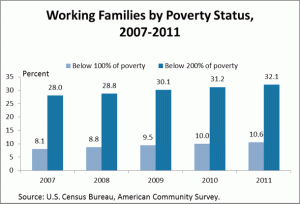 Chavez who fought for rights of the poor has declined?
Two factors seem to be relevant in explaining the political powerlessness of the poor. One is the gerrymandering that has reached an exact science in many state legislatures in recent years, with unassailable majorities for the incumbent party. This means that poor people have little chance of defeating conservative candidates in congressional elections. And second are the resurgent efforts that the Supreme Court enabled last summer to create ever-more onerous voting requirements, once again giving every appearance of serving the purpose of limiting voter participation by poor and minority groups. So conservative incumbents feel largely immune from the political interests that they dis-serve.
It would seem that more and more of us have interests aligned with poor folks. That is why the Republican party has also upped it’s race-baiting, women-baiting, GLBT-baiting, and immigrant-baiting. It is continuing to splinter the vast economic interests of the many into many morality plays. Even the Catholic church–a long time advocate of the poor and disenfranchised–has spent more effort on stomping on the secular rights of women and GLBTs than its usual role of ministering the poor. So, many social institutions have simply fallen prey to the same kind of divide and set-one-on-the other attitudes stoked by the money and the greed of folks like the Kochs.
I have no idea how these distortions have take center stage in our country to the point where our war on poverty has turned to a war on the poor. I can only think that those of us that fall into the category of having a shrinking pie are like dogs fighting over scraps thrown under the table by our 1 percent masters. It’s time for us to regain our perspective, if not our moral base.
Saturday Morning Open Thread
Posted: July 13, 2013 Filed under: abortion rights, Barack Obama, Foreign Affairs, morning reads, NSA, National Security Agency, open thread, poverty, Psychopaths in charge, Real Life Horror, Reproductive Health, Reproductive Rights, social justice, U.S. Economy, U.S. Politics, War on Women, Women's Rights | Tags: Andrea Grimes, anti-abortion laws, CNBC, Edward Snowden, Elizabeth Warren, FDic, food stamps, Glass Steagall, hunger in America, Malala Yousafzai, Rick Perry, Sergei Lavrov, Texas legislature, Vladimir Putin, Yatzel Sabat 36 Comments
Abortion rights advocates fill the rotunda of the State Capitol as the Senate neared its vote Friday night (Tamir Kalifa/AP)
Good Morning Sky Dancers!!
There sure is a lot of news out there for a summer Saturday. Beginning in Texas, the state senate passed a restrictive anti-abortion bill that will threaten women’s lives. The New York Times reports:
AUSTIN, Tex. — The Texas Senate gave final passage on Friday to one of the strictest anti-abortion measures in the country, legislation championed by Gov. Rick Perry, who rallied the Republican-controlled Legislature late last month after a Democratic filibuster blocked the bill and intensified already passionate resistance by abortion-rights supporters.
The bill would ban abortions after 20 weeks of pregnancy and hold abortion clinics to the same standards as hospital-style surgical centers, among other requirements. Its supporters say that the strengthened requirements for the structures and doctors will protect women’s health; opponents argue that the restrictions are actually intended to put financial pressure on the clinics that perform abortions and will force most of them to shut their doors.
Mr. Perry applauded lawmakers for passing the bill, saying “Today the Texas Legislature took its final step in our historic effort to protect life.” Legislators and anti-abortion activists, he said “tirelessly defended our smallest and most vulnerable Texans and future Texans.”
Mr. Perry does not appear to include any “right to life” for adult women in his “effort to protect life,” however. I wonder if anyone has ever asked him one simple question: are women human beings? Forced childbirth is tantamount to slavery in my opinion. Furthermore, childbirth is far more dangerous than abortion, and the restrictions will likely mean that women with problematic late term pregnancies will die or suffer grievous harm. According to the NYT story,
The bill was opposed by many doctors, including leaders of the American Congress of Obstetricians and Gynecologists and the Texas Medical Association; the gynecologists’ group has run advertisements locally that question the scientific underpinnings of the legislation and tell legislators to “Get out of our exam rooms.”
Andrea Grimes writes at RH Reality Check: As Out-Of-State Gawkers Look On, Texas Lawmakers Prepare to Pass ‘Death Sentence’ Anti-Abortion Bill. She describes a young man from Minnesota who traveled down to Texas to watch the show.
This young guy, probably a senior in high school or a freshman in college—I didn’t catch his name—said he was real tired of wearing blue, the chosen color of anti-choice supporters of HB 2. I wore orange that day, the same color as thousands of Texans who have turned up at the capitol to stand up for reproductive rights. I also wore pink earbuds, trying to follow the house debate while waiting in line. Maybe this young guy thought I couldn’t hear him. Maybe he didn’t care.
“I’m looking forward to all this being over so I can wear my orange shirts again!” he joked.
She contrasts his blase attitude with that of Yatzel Sabat, a gay woman of color
who was dragged out of that same gallery Wednesday morning by law enforcement. Sabat was not wearing orange. She was wearing black.
Her limbs bound by state troopers, she screamed in a clear, strong voice, “This bill will kill women!” as the Texas House of Representatives gave its approval to HB 2, passing the devastating legislation along to the state senate for final passage….
This bill will kill. Period.
It will kill Texans who already travel to Mexico to buy abortion pills from flea markets because they are too poor to go to a legal abortion clinic, or unable to take time off work to find a doctor’s office and wait 24 hours between a state-mandated sonogram and an abortion procedure. It will kill Texans who, if HB 2 passes, cannot travel a thousand miles round trip to a San Antonio or Dallas ambulatory surgical center for a safe, legal abortion.
Please read the whole thing if you can.

Next up, the U.S. Congress debates more cuts in food stamps as American children go hungry. From Martha White at NBC News:
For one in seven Americans, the federal government’s Supplemental Nutrition Assistance Program, aka food stamps, is all that stands between them and too little food.
But the complicated calculus of financial survival for the working poor also means any cuts to the roughly $80 billion SNAP, as it’s known, being considered by Congress would be felt well beyond the grocery checkout line. Buying new school clothes, family outings, even getting a toehold in the financial mainstream could be thrown into limbo.
For many of the working poor, wages just don’t go far enough. The National Employment Law project says nearly 60 percent of jobs created in the post-recession recovery pay $13.83 or less an hour, and hourly wages for some low-wage occupations fell by more than 5 percent in just three years.
Food service and temporary employment make up 43 percent of the post-recession job growth, according to NELP policy analyst Jack Temple. “They overwhelmingly pay low wages,” Temple said. “For that lower segment, you’re going to see increased use of safety net programs to make up the difference.”
Read it and weep, folks; and while you do keep in mind that the Federal deficit has been dropping steadily. The only possible reasons for the austerity agenda are to make the rich richer and punish the working poor.
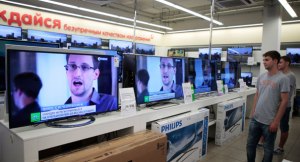
The Snowden saga continues. Reuters reports that Russia has not yet received an application for asylum from the American hacker/leaker/whistleblower/dissident–or whatever he’s being called at the moment.
Russia kept former U.S. spy agency contractor Edward Snowden at arm’s length on Saturday, saying it had not been in touch with the fugitive American and had not yet received a formal request for political asylum.
Remarks by Foreign Minister Sergei Lavrov signaled Russia is weighing its options after Snowden, who is stranded at a Moscow airport, broke three weeks of silence and asked for refuge in Russia until he can secure safe passage to Latin America.
Washington urged Moscow to return Snowden to the United States, where he is wanted on espionage charges after revealing details of secret surveillance programs, and President Barack Obama spoke by phone with Russian President Vladimir Putin….
“We are not in contact with Snowden,” Russian news agencies quoted Lavrov as saying in Kyrgyzstan, where he attended a foreign ministers’ meeting.
He said he had learned of Snowden’s meeting with Russian human rights activists and public figures at the airport on Friday from the media, “just like everyone else.”
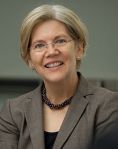
Senator Elizabeth Warren is working on bringing back Glass-Steagall-like regulations on banks. From the LA Times:
Sen. Elizabeth Warren has launched a campaign to make banks boring again as she pushes legislation to enact stricter regulations forcing deposit-taking financial institutions out of the investment business.
The Massachusetts Democrat wants to reinstate the Depression-era Glass-Steagall law, which separated what she called boring checking and savings accounts that are backed by the Federal Deposit Insurance Corp. from risky investment banking.
And after joining three other senators Thursday in introducing a bipartisan bill to do that, Warren went toTwitter to rally support.
She urged her Twitter followers to retweet the message, “Banks should be boring.” She emailed her political backers, asking them to support her 21st century Glass-Steagall Act, which she introduced along with Sens. John McCain (R-Ariz.), Maria Cantwell (D-Wash.) and Angus King (I-Maine).
Yesterday Warren went on CNBC to argue her case with some blonde talking head. Check it out:
As you know, yesterday Malala Yousafzai spoke to the United Nations and told the world: Being shot by Taliban made me stronger (NBC News)

Malala Yousafzai, the Pakistani teenager shot in the head by the Taliban for campaigning for girls’ education, was given a standing ovation at the United Nations Friday as she declared the attempt on her life had only given her strength and banished any fear she once felt.
“Dear friends, on the 9th of October, 2012, the Taliban shot me on the left side of my forehead. They shot my friends too,” she said in her first major public appearance. “They thought that the bullets would silence us, but they failed.”
Speaking on her 16th birthday, she said the “terrorists thought that they would change my aims and stop my ambitions, but nothing changed in my life except this — weakness, fear and hopelessness died, strength, power and courage was born.”
“I am the same Malala, my ambitions are the same, my hopes are the same and my dreams are the same,” she said to thunderous applause.
What an courageous, intelligent, and inspiring and young woman she is!
On that note, I’ll turn the floor over to you. What stories are you following today. Please post your links on any topic in the comment thread. Have a stupendous Saturday
Something to think on from Common Dreams
Posted: November 24, 2012 Filed under: poverty, U.S. Economy, unemployment, Voter Ignorance, We are so F'd | Tags: Common Dreams, Paul Bucheit, US income inequality., USAgainstGreed 9 CommentsI rarely violate fair use and copy something in its entirety having been well schooled in that as a professor. However, Common Dreams has this great set of numbers that needs to be reprinted. We don’t profit from anything so hopefully, they’ll be forgiving. Also, I’m actively plugging the work they do so, they do have a subscribe button and a donate button. Also, please notice I’ve recognized the author of this great set of numbers too. So, forgive me but this is wonderful and here it is in its entirety. It also includes a great looking Banksy-like graphic.
Published on Monday, November 19, 2012 by Common DreamsTen Numbers the Rich Would Like Fudged
The numbers reveal the deadening effects of inequality in our country, and confirm that tax avoidance, rather than a lack of middle-class initiative, is the cause.
1. Only THREE PERCENT of the very rich are entrepreneurs.
According to both Marketwatch and economist Edward Wolff, over 90 percent of the assets owned by millionaires are held in a combination of low-risk investments (bonds and cash), personal business accounts, the stock market, and real estate. Only 3.6 percent of taxpayers in the top .1% were classified as entrepreneurs based on 2004 tax returns. A 2009 Kauffman Foundation study found that the great majority of entrepreneurs come from middle-class backgrounds, with less than 1 percent of all entrepreneurs coming from very rich or very poor backgrounds.
(photo: withayou via flickr)
2. Only FOUR OUT OF 150 countries have more wealth inequality than us.
In a world listing compiled by a reputable research team (which nevertheless prompted double-checking), the U.S. has greater wealth inequality than every measured country in the world except for Namibia, Zimbabwe, Denmark, and Switzerland.
3. An amount equal to ONE-HALF the GDP is held untaxed overseas by rich Americans.
The Tax Justice Network estimated that between $21 and $32 trillion is hidden offshore, untaxed. With Americans making up 40% of the world’s Ultra High Net Worth Individuals, that’s $8 to $12 trillion in U.S. money stashed in far-off hiding places.
Based on a historical stock market return of 6%, up to $750 billion of income is lost to the U.S. every year, resulting in a tax loss of about $260 billion.
4. Corporations stopped paying HALF OF THEIR TAXES after the recession.
After paying an average of 22.5% from 1987 to 2008, corporations have paid an annual rate of 10% since. This represents a sudden $250 billion annual loss in taxes.
U.S. corporations have shown a pattern of tax reluctance for more than 50 years, despite building their businesses with American research and infrastructure. They’ve passed the responsibility on to their workers. For every dollar of workers’ payroll tax paid in the 1950s, corporations paid three dollars. Now it’s 22 cents.
5. Just TEN Americans made a total of FIFTY BILLION DOLLARS in one year.
That’s enough to pay the salaries of over a million nurses or teachers or emergency responders.
That’s enough, according to 2008 estimates by the Food and Agriculture Organization and the UN’s World Food Program, to feed the 870 million people in the world who are lacking sufficient food.
For the free-market advocates who say “they’ve earned it”: Point #1 above makes it clear how the wealthy make their money.
6. Tax deductions for the rich could pay off 100 PERCENT of the deficit.
Another stat that required a double-check. Based on research by the Tax Policy Center, tax deferrals and deductions and other forms of tax expenditures (tax subsidies from special deductions, exemptions, exclusions, credits, capital gains, and loopholes), which largely benefit the rich, are worth about 7.4% of the GDP, or about $1.1 trillion.
Other sources have estimated that about two-thirds of the annual $850 billion in tax expenditures goes to the top quintile of taxpayers.
7. The average single black or Hispanic woman has about $100 IN NET WORTH.
The Insight Center for Community Economic Development reported that median wealth for black and Hispanic women is a little over $100. That’s much less than one percent of the median wealth for single white women ($41,500).
Other studies confirm the racially-charged economic inequality in our country. For every dollar of NON-HOME wealth owned by white families, people of color have only one cent.
8. Elderly and disabled food stamp recipients get $4.30 A DAY FOR FOOD.
Temporary Assistance for Needy Families (TANF) has dropped significantly over the past 15 years, serving only about a quarter of the families in poverty, and paying less than $400 per month for a family of three for housing and other necessities. Ninety percent of the available benefits go to the elderly, the disabled, or working households.
Food stamp recipients get $4.30 a day.
9. Young adults have lost TWO-THIRDS OF THEIR NET WORTH since 1984.
21- to 35-year-olds: Your median net worth has dropped 68% since 1984. It’s now less than $4,000.
That $4,000 has to pay for student loans that average $27,200. Or, if you’re still in school, for $12,700 in credit card debt.
With an unemployment rate for 16- to 24-year-olds of almost 50%, two out of every five recent college graduates are living with their parents. But your favorite company may be hiring. Apple, which makes a profit of $420,000 per employee, can pay you about $12 per hour.
10. The American public paid about FOUR TRILLION DOLLARS to bail out the banks.
That’s about the same amount of money made by America’s richest 10% in one year. But we all paid for the bailout. And because of it, we lost the opportunity for jobs, mortgage relief, and educational funding.
Bonus for the super-rich: A QUADRILLION DOLLARS in securities trading nets ZERO sales tax revenue for the U.S.
The world derivatives market is estimated to be worth over a quadrillion dollars (a thousand trillion). At least $200 trillion of that is in the United States. In 2011 the Chicago Mercantile Exchange reported a trading volume of over $1 quadrillion on 3.4 billion annual contracts.
A quadrillion dollars. A sales tax of ONE-TENTH OF A PENNY on a quadrillion dollars could pay off the deficit. But the total sales tax was ZERO.
It’s not surprising that the very rich would like to fudge the numbers, as they have the nation.

Paul Buchheit is a college teacher, an active member of US Uncut Chicago, founder and developer of social justice and educational websites (UsAgainstGreed.org, PayUpNow.org, RappingHistory.org), and the editor and main author of “American Wars: Illusions and Realities” (Clarity Press). He can be reached at paul@UsAgainstGreed.org.
Thank you Paul Bucheit and Common Dreams for making this available. Facts should speak louder than Republican memes.
Evening Reads: The Barlow* Edition
Posted: August 2, 2012 Filed under: 2012 presidential campaign, Black Agenda Report, Civil Liberties, corporate greed, GLBT Rights, Hillary Clinton, Human Rights, poverty, Women's Rights | Tags: american exceptionalism, Boehner of our existence, Chick-fil-A, Harry Reid, Michael Moore, the Constitution 19 Comments
Click for more flapper fun over at Collector’s Weekly…
Hey all, I’m filling in for Mink while she continues to rest up and recover from a nasty migraine. There’s no way I can compete with the excellent work she does on a daily basis, but I’ll try to do her Evening News space at least a fraction of the justice it deserves. Feel better soon, JJ! Sending you lots of healing energy!
So, I’d like to start with some reading on the Chick-fil-A idiocracy we live in, which IMHO, is the most definitive piece you’ll read about this mindboggling madness (though “The Chick Fellatio” gets an honorable mention.) Via Huffpo Gay Voices…
Chick-fil-A: 5 Reasons It Isn’t What You Think, by David Badash, founder and editor of The New Civil Rights Movement. I especially appreciated the last reason on the list:
5) Chick-fil-A is just exercising their First Amendment rights by running a business based on the Bible, right? Wrong. There’s a line between the “free exercise of religion” and violating the law. If Chick-fil-A is violating the law by discriminating against gay people, or by firing women so that they can be “stay home” moms, as one woman who is suing Chick-fil-A says in court documents, that’s not exercising religious expression or free speech, and that’s not a First Amendment issue. It may be, if the court decides, a violation of the law.
Thank you, David Badash!
Before I continue, I’d just like to note that we live in an era where a gun-toting embryonic chicken sandwich has more authority on interpreting the Bill of Rights and the Constitution than the average, living, breathing human being. Sad.
On the upside, Chick-fil-A manager goes against flock, sponsors gay pride festival! REFUDIATE DAT, HATERS!
Unfortunately, internal politics is a-roostin’…
“As all this news was swirling around yesterday about the Chick-Fil-A sponsorship for PrideFest, we started hearing that some people from within our own community are coming together to stand against us,” said Ryan Manseau, senior director for NH Pride Fest.
On Wednesday Manseau got a call about a major sponsor for Pride Fest being pressured by another local group to drop out because of the Chick-Fil-A sponsorship.
Let’s hope they get their feathers straightened out!
And, that is all I will link to on that. Otherwise, my puns will go further south than they already have… oops, I guess they just did 😉
Moving along. Michael Moore says… he wouldn’t say he supports Obama. And, the cow jumped over the moon.
Oh, but no worries! He and Susan Sarandon still hope O gets four more years. Well, ok. I guess that’s clarity of some sort…that means absolutely nothing.
Incidentally, because I know y’all are just dying to know. Here’s where Mona the Wonk stands:
- I’m Switzerland on Obama 2012.
- I don’t want to see Romney get four to eight years at any point on the space-time continuum.
- Hillary 2016.
 Speaking of which… While I was in the airport en route from Houston to Chicago last week, I picked up a copy of the lastest issue of Foreign Policy on the stands. I hope to do a separate post on the Hillary feature soon. A good way for me to start exercising those blogger muscles again… 😉
In the meantime, I’d like to direct you to another feature in this edition of FP–Anthropology of an Idea, “American Exceptionalism: A Short History,” by Uri Freedman. Teaser:
On the campaign trail, Mitt Romney contrasts his vision of American greatness with what he claims is Barack Obama’s proclivity for apologizing for it. The “president doesn’t have the same feelings about American exceptionalism that we do,” Romney has charged. All countries have their own brand of chest-thumping nationalism, but almost none is as patently universal — even messianic — as this belief in America’s special character and role in the world. While the mission may be centuries old, the phrase only recently entered the political lexicon, after it was first uttered by none other than Joseph Stalin. Today the term is experiencing a resurgence in an age of anxiety about American decline.
An enlightening little timeline follows at the link. Fascinating tidbits like:
1950s
A group of American historians — including Daniel Boorstin, Louis Hartz, Richard Hofstadter, and David Potter — argues that the United States forged a “consensus” of liberal values over time that enabled it to sidestep movements such as fascism and socialism. But they question whether this unique national character can be reproduced elsewhere. As Boorstin writes, “nothing could be more un-American than to urge other countries to imitate America.”
Touche. Click over and give it a look.
A couple DC headlines for y’all before I close this…
Taylor Marsh on Reid’s tax charges against Romney:
Majority Leader Reid isn’t backing down. The problem is that he’s turning into the story.
Meanwhile Boehner has stopped crying or some other such development:
House Speaker John Boehner (R-Ohio) said Thursday he is “feeling better” about Republicans’ chances of holding the House than he did in April, when he said the party faced a “one in three” likelihood of losing the majority.
“Our team’s in pretty good shape,” Boehner said as he briefed reporters in the Capitol for the final time before Congress departs for a five-week recess. “Our members have worked hard. Frankly, our candidates and challengers out there — a lot of them have been through tough primaries. And I feel good about where we are as a team. We’ve got a lot of work to do between now and November, but our team is doing well.”
Boehner’s comments in the spring warning about the possibility of losing the House were seen as an intended wake-up call to Republicans in advance of the election season. Most political analysts now believe the chances that Democrats will win back the House in November are slim. They need a net gain of 25 seats, but most projections show them gaining only in the single digits.
In other news…Americans and all citizens of Planet Earth? Still screwed.
The always essential Glen Ford at the Black Agenda Report sums it up well:
The Poverties of a Decaying System
A Black Agenda Radio commentary by Glen Ford
“This crisis of capitalism will be full of drama.”
A preview of new Census figures indicates that poverty in the United States will likely soon reach the highest levels in 50 years. Now, some of you optimists out there are saying: Well, there’s nowhere to go but up. Unfortunately, that’s not necessarily true. What I think is so depressing to many people about this particular historical juncture, is that there is absolutely nothing on the economic horizon on which even optimists can pin their hopes. There are no new industries on the verge of some huge explosion, no scientific breakthrough just around the corner. With education costs soaring, people can’t even hope to study themselves out of hard times.
It’s not a good time to be a child, because there is nothing sadder than growing up around adults who have themselves lost hope that our world will become a better place. It’s not a good time to be middle-aged, knowing that the Golden Age was 40 years ago, when the proportion of Americans in poverty was the lowest ever: only 11.1 percent. It’s expected to hit 15.7 percent under a president elected as an agent of Hope and Change.
But actually, there’s really nothing wrong with the world that a social revolution can’t fix. The fact that the two corporate political parties have no ideas worth listening to, simply means that the Democrats and Republicans can no longer even pretend that they can serve the 1% and take care of the rest of us at the same time. There’s no need to despair – just direct your political energies, elsewhere.
Well, now that I’ve brightened up your evening… 😉 … it’s your turn! Have at it in the comments, Sky Dancers.
*barlow: a girl, a flapper, a chicken.
Thursday Reads
Posted: July 19, 2012 Filed under: 2012 presidential campaign, Barack Obama, Homeless, Mitt Romney, morning reads, poverty, Republican presidential politics, SCOTUS, Tea Party activists, Team Obama, U.S. Military, U.S. Politics | Tags: Antonin Scalia, bigotry, birtherism, Bush v. Gore, dog whistles, national military service, Obama and terrorism, Racism, Romney's tax returns, Ronald Reagan, Tea Party 36 Comments
Good Morning!!
I just spent the last two days kid sitting for my two nephews, ages 7 and 9, and boy am I beat! Am I a great sister and sister-in-law or what? It may take me a day or so to recover. Kids sure do have a lot of energy! It was fun though.
The good news is that late yesterday afternoon, thundershowers moved into the Boston area and began cooling things down a bit. My house is still hot inside though. But we are going to get some relief from the heat for a couple of days–it might even be in the high 70s on Friday! Anyway, enough about my boring life, let’s get to the news.
As we learned yesterday, Mitt Romney has decided to “take the gloves off,” meaning he’s going full-on birther and the dog whistles have been upgraded to overt race baiting.
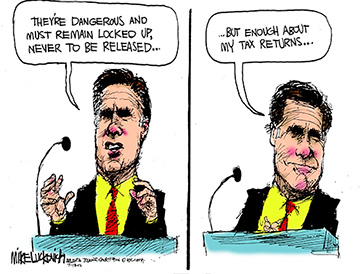
Mitt is so infuriated about being asked to do what past presidential candidates have done and release several years of his tax returns that he seems to have lost sight of his long-term goal of winning over independent voters and decided to figuratively don one of those hats with tea bags dangling from it. This is going to be an ugly and embarrassing spectacle.
Ed Kilgore asks: “Is Team Romney Becoming Unhinged?” Kilgore concluded yesterday, as I did, that John Sununu’s ugly remarks on Tuesday morning were part of a deliberate strategy by the Romney campaign to follow Donald Trump and the Tea Party in trying to paint President Obama as “foreign” and not a real American.
Did Team Romney really think their candidate could run around the country citing the brilliant job-creating success of Bain Capital as his primary credential for becoming president and not get challenged about it? And did they not expect demands that the richest man ever to win a presidential nomination release his tax returns? I mean, the attacks they are dealing with now are blindingly obvious. Any Romney opponent who didn’t make them would be guilty of extreme political malfeasance. So what gives?
Apparently what really got Romney’s goat was Obama adviser Stephanie Cutter’s statement that if Romney had lied on SEC forms, that would be a felony.
Romney’s aides remain particularly livid about Obama spokeswoman Stephanie Cutter’s suggestion last week that Romney committed a crime by filing apparently conflicting documents to the FEC and SEC.
“[Obama’s] policies have been such utter failures, the only thing he can do is to try to destroy a decent man and his wife,” the adviser said. “So he gets some hack political adviser from Chicago who has nothing to point to in her own life, and tells her to call him a felon… When did our politics get to that point? I mean, it’s Nixonian.”
Kilgore writes:
Try to destroy a decent man and his wife? Nothing to point to in her own life? This is such an over-the-top reaction to a banal comment by Cutter (who didn’t call Romney a “felon,” but simply observed that if he did misstate his role at Bain in a SEC filing, that’s potentially a felony) that you have to believe it’s coming from the candidate himself. Apparently, the mere suggestion he might have possibly committed a crime has sent him and his staff into a real spiral.
Don’t you bet Rick Santorum and Newt Gingrich wish they had known about this particular soft spot! Mention the criminal code and watch Mitt melt down!
At Talking Points Memo, Benjy Sarlin and Evan McMorris-Santoro opine: Romney’s New Plan To Go After Obama’s Biography Is A Gamble.
The Romney campaign had previously shot down the idea of revisiting many of the character attacks that first emerged in the 2008 election. Romney strongly repudiated an independent proposal by Republican ad man Fred Davis to run ads reviving the Rev. Jeremiah Wright controversy, for example.
Asked by TPM whether he felt reports of Romney’s new approach “kinda vindicate [sic]” his biography-based ad pitch, Davis e-mailed: “Only kinda?”
The assumption up to this point among strategists on both sides has been that objections to attacking Obama as a teen drug user or as personally corrupt were about keeping the message on the president’s record in office. The biggest conservative outside money groups, like American Crossroads, focus on Americans’ economic struggles, based on research showing it to be the most effective angle.
“Obama is setting a trap, and Romney is not a Chicago street fighter,” unaligned GOP consultant Ford O’Connell told TPM. “If Romney dabbles in this tit-for-tat style of political warfare for too long, he will lose.”
Romney is really playing into Obama’s hands by refusing to just release his tax returns and now embracing Tea Party bigotry. Obama’s advisers must be high fiving each other and grinning ear to ear.
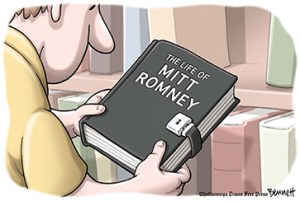
Check this out: Mitt Romney On Tax Return Controversy: ‘It’s Kind Of Amusing’
“It’s kind of amusing,” Romney told Columbus, Ohio, CBS affiliate WBNS. “I’m releasing two years of records as well as all that’s legally required and, for that matter, I’m doing the same thing John McCain did when he ran for president four years ago, which is releasing two years of returns, and we’ll see what time has to say about this.”
Yep, we’ll see. And watching Mitt self-destruct is going to be a lot of fun. Time to stock up on popcorn.
And speaking of right wing bigots, Supreme Court Joke Justice Antonin Scalia told CNN’s Piers Morgan that anyone who is unhappy about the Bush v. Gore decision should just “get over it.”
“Well, I guess the one that created the most waves of disagreement was Bush v. Gore,” says Scalia, referring to the famed United States Supreme Court decision dealing with the dispute surrounding the 2000 presidential election. “That comes up all the time, and my usual response is ‘get over it.'”
Noting that it was the Democratic candidate who brought the case into the Courts, Scalia says he hasn’t lost any sleep over the result:
“No regrets at all, especially since it’s clear that the thing would have ended up the same way anyway,” recalls the 76-year-old. “The press did extensive research into what would have happened, if what Al Gore wanted done, had been done, county by county, and he would have lost anyway.”
I’ve found a couple of important long reads for you. First, from Alternet: How America Became a Country That Lets Little Kids Go Homeless. If you guessed it goes back to the mean-spirited Reagan administration, you’re correct.
An interesting fact about family homelessness: before the early-1980s, it did not exist in America, at least not as an endemic, multi-generational problem afflicting millions of poverty-stricken adults and kids. Back then, the typical homeless family was a middle-aged woman with teenagers who wound up in a shelter following some sort of catastrophic bad luck like a house fire. They stayed a short time before they got back on their feet.
In the 1980s, family homelessness did not so much begin to grow as it exploded, leaving poverty advocates and city officials stunned as young parents with small children overwhelmed the shelter system and spilled into the streets. In New York City, the rate of homeless people with underage kids went up by 500 percent between 1981 and 1995. Nationally, kids and families made up less than 1 percent of the homeless population in the early 1980s, according to advocate and researcher Dr. Ellen Bassuk. HUD estimates put the number at 35 percent of people sleeping in shelters in 2010….
The reasons behind the jump in family homelessness are not complex, Núñez says. “It was the gutting of the safety net. Reagan cut every social program that helped the poor. Then there’s inflation so their aid checks are shrinking. Where are they going? Into the streets, into the shelters.”
It’s so true. When I first moved to Boston in 1967, the only homeless people you saw were down and out alcoholic hobo types. Then Reagan emptied the state psychiatric hospitals and cut funds for low cost housing, and other safety net programs. Suddenly, the Boston area was filled with homeless people–people who slept in their cars in supermarket parking lots or outside along the Charles River in Harvard Square. It was truly horrifying.
At the New York Review of Books, David Cole reviews two new books on Obama’s terrorism policies and concludes that Obama isn’t exactly Bush III, but he hasn’t restored our constitutional rights either.
While President Obama, unlike his predecessor, has steered clear of the politics of fear, he has also steered clear of the politics of defending our ideals. Like many Democrats, he seems afraid of being painted as soft on terrorism if he advocates for respecting the rights of others. We can only hope that in a second term, with more confidence and an eye on his legacy rather than short-term polls, he will take on the defense of American ideals that he let pressure from the security bureaucracy and political caution stop him from pursuing in the first.
And while you’re at the NYRB, take a look at this piece by William Pfaff: When the Army Was Democratic.
The US had national service from September 1940, just before World War II, until 1971, when the Vietnam War was ending. It was accepted with patriotic resolution at its start, and hated by its end. I am of an age to have put on my country’s uniform in high school ROTC in 1942, when I was fourteen years old. I put it on again for the Korean War, and did not take it off for the last time until 1958, after limited active reserve service. That was a total of sixteen years.
I can’t say that I enjoyed military service, but I learned a lot, about myself and about others—including the young black men who made up a good half of my all-southern, and mostly rural, basic training company (where I was not only the sole college graduate but probably the only high school graduate). This was just two and a half years after President Harry Truman had ordered the army desegregated. The regular army—which has always been essentially a southern institution—hated and feared the consequences of that order, but said “yes, sir” and did it, producing undoubtedly the biggest and most successful program of social engineering the United States had ever experienced. It also created what remains today the most successful route of social and professional ascension for talented young black males from poor communities that the country has ever known.
The army, in my opinion, did more to desegregate the United States than the civil rights movement of the 1960s. From 1948 on, nearly every able-bodied young man in the United States served and lived side by side with Americans of all colors, all in strict alphabetical order, in old-fashioned unpartitioned barracks, sleeping bunk to bunk, sharing shelter-halves on bivouac, in what amounted to brotherly endurance of the cold, heat, discomfort, and misery of military training—and following that, of service.
Just a few more quick links I want to call your attention to. Joseph Cannon has a horrifying post up about connections between Mitt Romney and the teen rehab industry in which kids are abused, tortured, and brainwashed. Also see this article in Salon linked in the Cannon piece.
Dakinikat will be interested to know (if she doesn’t already) that Bobby Jindal’s exorcism history has made it into the corporate media. And Charlie Pierce wrote about it yesterday.

 peej
peej Carissa
 bostonboomer
 dakinikat
 ecocatwoman
 mablue2
 Mama Lopez
 peggysue22
 quixote
 skydancingguestblogger
 Mona (aka Wonk the Vote)



 Sky Dancing
Recent Comments