As if the fake “president” didn’t have enough humiliations to deal with this morning, Time Magazine has delivered a crushing blow to his ego, announcing Jamal Khashoggi and other journalists as their “Person of the Year.”
Time magazine has announced its 2018 Person of the Year is “The Guardians,” four individuals and one group — all journalists — who this year helped expose “the manipulation and the abuse of truth” around the world.
They are the journalist Jamal Khashoggi, the Washington Post contributing columnist who was killed inside Saudi Arabia’s consulate in Istanbul in October; the staff of the Capital Gazette newspaper in Maryland; journalist Maria Ressa, the CEO of the Rappler news website, who has been made a legal target in the Philippines; and journalists Wa Lone and Kyaw Soe Oo, who have been jailed in Myanmar for nearly a year for their work exposing the mass killing of Rohingya Muslims.
“As we looked at the choices, it became clear that the manipulation and the abuse of truth is really the common thread in so many of this year’s major stories, from Russia to Riyadh to Silicon Valley,” Time magazine editor Edward Felsenthal said on the “Today” show Tuesday morning, where the announcement was made.
“The manipulation and abuse of truth” is a pretty clear reference to Trump’s governing style.
The stout man with the gray goatee and the gentle demeanor dared to disagree with his country’s government. He told the world the truth about its brutality toward those who would speak out. And he was murdered for it.
Every detail of Jamal Khashoggi’s killing made it a sensation: the time stamp on the surveillance video that captured the Saudi journalist entering his country’s Istanbul consulate on Oct. 2; the taxiway images of the private jets bearing his assassins; the bone saw; the reports of his final words, “I can’t breathe,” recorded on audio as the life was choked from him.
But the crime would not have remained atop the world news for two months if not for the epic themes that Khashoggi himself was ever alert to, and spent his life placing before the public. His death laid bare the true nature of a smiling prince, the utter absence of morality in the Saudi-U.S. alliance and—in the cascade of news feeds and alerts, posts and shares and links—the centrality of the question Khashoggi was killed over: Whom do you trust to tell the story?
Khashoggi put his faith in bearing witness. He put it in the field reporting he had done since youth, in the newspaper editorship he was forced out of and in the columns he wrote from lonely exile. “Must we choose,” he asked in the Washington Post in May, “between movie theaters and our rights as citizens to speak out, whether in support of or critical of our government’s actions?” Khashoggi had fled his homeland last year even though he actually supported much of Crown Prince Mohammed bin Salman’s agenda in Saudi Arabia. What irked the kingdom and marked the journalist for death was Khashoggi’s insistence on coming to that conclusion on his own, tempering it with troubling facts and trusting the public to think for itself.
Such independence is no small thing. It marks the distinction between tyranny and democracy. And in a world where budding authoritarians have advanced by blurring the difference, there was a clarity in the spectacle of a tyrant’s fury visited upon a man armed only with a pen. Because the strongmen of the world only look strong. All despots live in fear of their people. To see genuine strength, look to the spaces where individuals dare to describe what’s going on in front of them.
“I can’t breathe.” These were the final words uttered by Jamal Khashoggi after he was set upon by a Saudi hit squad at the country’s consulate in Istanbul, according to a source briefed on the investigation into the killing of the Washington Post columnist.
The source, who has read a translated transcript of an audio recording of Khashoggi’s painful last moments, said it was clear that the killing on October 2 was no botched rendition attempt, but the execution of a premeditated plan to murder the journalist.
During the course of the gruesome scene, the source describes Khashoggi struggling against a group of people determined to kill him.
“I can’t breathe,” Khashoggi says.
“I can’t breathe.”
“I can’t breathe.”
The transcript notes the sounds of Khashoggi’s body being dismembered by a saw, as the alleged perpetrators are advised to listen to music to block out the sound.
And, according to the source, the transcript suggests that a series of phone calls are made. Turkish officials believe the calls were placed to senior figures in Riyadh, briefing them on progress.
Nick Ayers and John Kelly
In other humiliations, the fake “president” decided to humiliate Chief of Staff John Kelly by announcing his firing without any warning, and then the fake “president” was in turn humiliated by his choice to replace Kelly. Gabriel Sherman at Vanity Fair:
On Friday night, members of Donald Trump’s West Wing gathered for drinks at the Trump International Hotel following a holiday dinner at the White House. As they mingled in the lobby, Bill Shine, Stephen Miller, Kellyanne Conway, Sarah Huckabee Sanders, and others grappled with the latest West Wing upheaval: Trump had changed the plan and fired Chief of Staff John Kellyearlier that afternoon. “It got back to Trump that Kelly was bad-mouthing him and Trump had decided he’d had enough. His attitude was, ‘fuck him,’” an attendee told me.
Kelly’s defenestration surprised few people—Trump had wanted to fire him for months—but the lingering problem had been finding a replacement whom Trump felt comfortable with (and who wanted the job). “The president really wanted someone he knows. He didn’t want to gamble,” a former West Wing official said. After weeks of lobbying by Ivanka Trump and Jared Kushner, Trump had been convinced that Mike Pence’s 36-year-old chief of staff, Nick Ayers, was the best candidate. On Friday afternoon, Trump met with Ayers, Pence, and Kelly and finalized the transition, a source briefed on the meeting said. A press release announcing Ayers’s hiring was reportedly drafted and ready to go for when Trump planned to announce Kelly’s departure on Monday.
But Trump’s frustration with Kelly boiled over after Kelly pressed him to name his deputy Zachary Fuentes interim chief of staff. “Trump didn’t like how Kelly was trying to dictate the terms of his departure,” a Republican briefed on the discussions told me. Trump blew up the carefully orchestrated announcement and told reporters on Saturday as he walked to Marine One that Kelly would be leaving by the end of the year. “John wanted to announce his own departure. This was a humiliation,” a former West Wing official said.
Trump’s impulsive announcement quickly became an even bigger problem when it turned out that Kelly’s replacement was not sewn up; Ayers surprised Trump later that day by insisting that he only wanted the job short term. “Trump was pissed, he was caught off guard,” a former West Wing official briefed on the talks said.
And to make sure the humiliation of the fake “president” was complete, Ayers announced his departure on Twitter.
Thank you @realDonaldTrump, @VP, and my great colleagues for the honor to serve our Nation at The White House. I will be departing at the end of the year but will work with the #MAGA team to advance the cause. 🇺🇸 #Georgia
After announcing the exit of his chief of staff, John F. Kelly, and being turned down by his pick to replace him, Nick Ayers, Trump found himself Monday in an unexpected predicament — scrambling to recruit someone to help run the executive branch of the federal government and guide the administration through the political tumult and possible legal peril ahead.
“Will you be my Chief of Staff?”
In any White House, the chief of staff is arguably the most punishing position. But in this White House — a den of disorder ruled by an impulsive president — it has proved to be an especially thankless job. The two people to hold the job were left with their reputations diminished after failing to constrain the president, who often prefers to function as his own chief of staff.
Three members of Trump’s Cabinet who have been discussed inside the West Wing as possible chiefs of staff — Treasury Secretary Steven Mnuchin, Office of Management and Budget Director Mick Mulvaney and U.S. Trade Representative Robert E. Lighthizer — each signaled Monday that they were not interested in the position.
Considerable buzz has centered on two other contenders. Rep. Mark Meadows (R-N.C.) noted his interest in the job by issuing a statement saying that “serving as Chief of Staff would be an incredible honor.”
“It is not something I have been campaigning for,” Meadows told reporters Monday on Capitol Hill, adding that his phone “blew up” after the Ayers news broke. “The president has a good list of candidates. I’m honored to be one of those.”
And acting attorney general Matthew G. Whitaker, who traveled with Trump to Kansas City, Mo., last week , is seen by the president and his allies as a loyalist.
But Trump’s advisers and aides cautioned that there was not yet a front-runner.
Although aides said the president is committed to finding a replacement for Kelly before the Christmas holiday, they said he has been vacillating — casting about in all corners for potential picks and frustrated by news coverage depicting his White House as a place where talented people do not want to work.
Why would anyone want to work for Trump? I guess it will have to be someone whose reputation is already in tatters. I can’t imagine anyone who has hopes for a future career being interested. That description could apply to Whitaker, but how could he get a security clearance when he’s associated with a company that is under investigation for fraud?
Of course Trump is claiming he has multiple applicants for the job.
Fake News has it purposely wrong. Many, over ten, are vying for and wanting the White House Chief of Staff position. Why wouldn’t someone want one of the truly great and meaningful jobs in Washington. Please report news correctly. Thank you!
"Why would anybody want to be Donald Trump's chief of staff unless you want to steal the office supplies before they shut the place down?" said Chris Whipple, who wrote the book on chiefs of staff. "If you're coming into that job, you've got to lawyer up." https://t.co/hZale8LscQ
I want to start off with the one change that is coming that will hopefully bring some fresh air to desperate circumstances. There’s a whole lot of diversity coming to the House of Representatives and there’s a whole lot of trash being sent back to the states from which it came. Let’s start with the Granny Starver who enabled a huge, historic deficit while preaching austerity. Austerity is for grannies and not real estate and finance high rollers. Bye Bye Paulie Boy! Just remember: Proportion of Democrats who are white men will drop from 41% to 38% while Republican figure will climb from 86% to 90%” These dudes will finally be the minority they are.
Change is gonna come. I can see it in the bright pages of places hidden from corporate media.
Ryan’s defenders portray him as a principled legislator trapped by the coalition he managed.
“Donald Trump was president of the United States, and that circumscribed Paul Ryan’s choices,” says Brooks. “You can dispute what he did, but he got as much of the loaf as he thought he could get given the factions of his caucus and Trump’s peculiarities. Did he like being speaker of the House? The results speak for themselves: He’s leaving.”
In this telling, Ryan’s principled vision was foiled by Trump’s ascendancy. Faced with a Republican president he had never expected, and managing a restive majority that mostly agreed on being disagreeable, Ryan defaulted to the lowest common denominator of Republican Party policy: unpaid-for tax cuts for the rich, increases in defense spending, and failed attempts to repeal Obamacare.
This is more or less the defense Ryan has offered of his tenure. “I think some people would like me to start a civil war in our party and achieve nothing,” he told the New York Times. Trump had no appetite for cutting entitlements, so Ryan got what he could, and he got out.
But would it have started a civil war in the Republican Party if the most publicly anti-deficit politician of his generation had simply refused to pass laws that increased the deficit? And even if it had, isn’t that the war Ryan had promised?
The question here is not why Ryan didn’t live up to a liberal philosophy of government; it’s why he didn’t live up to his own philosophy of government.
What’s more, Trump was clearly flexible when it came to policy. On the campaign, Trump repeatedly promised he wouldn’t cut Medicaid; as president, he endorsed legislation Ryan wrote that did exactly that. After winning the election, Trump promised he’d replace Obamacare with a plan that offered “insurance for everybody” with “much lower deductibles,” but he ultimately backed Ryan’s bill to take Obamacare away from millions and push the system toward higher-deductible plans. For Ryan to claim he was not driving the policy agenda in the Trump years is ridiculous.
Ryan proved himself and his party to be exactly what the critics said: monomaniacally focused on taking health insurance from the poor, cutting taxes for the rich, and spending more on the Pentagon. And he proved that Republicans were willing to betray their promises and, in their embrace of Trump, violate basic decency to achieve those goals.
Rep.-elect Ayanna Pressley (D-Mass.)
Just as we’re about to see the start of a promise of a legislative body that has the look and feel of America we see the media trying to push us right back into that old corner. Andrew O’Hehir asks a brilliant question today in Slate: “First wave of 2020 panic: Is Biden vs. Bernie really the best Democrats can do? After the sweeping, female-fueled victories of the midterms, a battle of old white dudes could spell disaster.” Why won’t they just go away?
In case you thought the Democrats’ big win in the midterms — a pickup of 40 House seats, and counting — meant that the weirdness and bitterness of the 2016 primary was behind us, and that the party is ready to come together and banish the Twitter-troll-in-chief to the doghouse (or to prison) two years hence, you have a number of other thinks coming. Consider this: The leading contenders for the 2020 Democratic nomination, by far, are Joe Biden and Bernie Sanders.
Speaking as a friend, kind of: That should be avoided at all costs. It’s a tragicomic farce waiting to happen, one that threatens to undermine much of what the Democrats have apparently accomplished over the last two years. Both of them are profoundly decent men who have done a lot for this country. But, just, please no.
…
But right now we’ve got Joe and Bernie, who both look extremely likely to run and could easily end up as the principal antagonists. What in hell did we do to deserve this? I take no position on which of them is most likely to win, or even which of them should win — as Bill Moyers told me years ago, those are always the least interesting questions in politics. I do know that this could be disastrous for the Democratic Party, and not just because it opens the door for the re-election of What’s His Name. (Although that too.)
A Sanders-Biden throwdown would rip the scabs off old wounds, inflame entrenched divisions and cast the party in the worst possible light, making clear on a bunch of levels that it doesn’t know who it represents or what principles it stands for. At a moment when Democrats finally seem to be moving toward the future, this would make them appear stuck in the past.
Maybe lover-man Beto or one of those other people I mentioned will be elected president two years from now, and we’ll all look back and say, Of course! We should have seen it coming. But also maybe not. At the moment, Joe Biden and Bernie Sanders are starting out amid a crowded field of unknowns and semi-knowns, with huge advantages in terms of name recognition, fundraising ability and being generally liked more than the incumbent. (Which is admittedly not difficult.)
I think those two face a version of the Prisoner’s Dilemma: It would be better for the country, arguably, if both of them concluded they’d had their shots and run their races and done their part, and it was time to let a scrum of younger Democrats fight it out, with unpredictable results. But if only one of them runs, he becomes the prohibitive favorite and a central focus of media attention — and each has concluded that he’ll be damned if he lets the other guy be the hero who un-Trumps America. So we lurch toward a battle of the dinosaurs that’s a bad idea to start with, and likely to get worse.
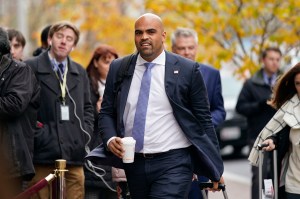
Rep.-elect Colin Allred, D-Texas., arrives for orientation for new members of Congress, Tuesday, Nov. 13, 2018, in Washington. (AP Photo/Pablo Martinez Monsivais)
I love the snark in this piece but really, do we have to do the least sensible thing to excite the country to the polls? Haven’t we learned anything?
Politico covered some of the new Congress Critters right after Thanksgiving and I have a hankering to see something different heading off to Iowa and New Hampshire. And, I want some action now before we face another presidential campaign season filled with MAGA Hatefests. Can we just let these folks do something first? And there’s a hell of a lot of them which begs the question why the focus on the new woman from NYC? There’s plenty more that are headed east from other parts of the country.
Colin Allred: A former NFL linebacker and civil rights attorney, Allred knocked off GOP Rep. Pete Sessions, an entrenched North Texas incumbent. But Allred says there’s a lot more behind his congressional victory than just a flashy professional football résumé. “The impression that people have gotten, I think, around the country is that I was elected because I was a football player. And that’s not it,” he said. “Football is an icebreaker… but the other things that I’ve done and the story that I have growing up in North Texas is really what resonated.”
Allred told POLITICO his goal in Congress is to continue to be a moderate voice in the Democratic Caucus, even as he senses some liberal colleagues are trying to pull the group further to the left. “All of us who come from the red-to-blue districts, we are the closest to where the American people are,” he said. “We’re trying to make sure that our new members coming from safer districts and the members that are already there understand why we have the majority.”
Rep.-elect Sharice Davids, D-Mo., walks past members of the media after checking-in for orientation for new members of Congress, Tuesday, Nov. 13, 2018, in Washington. (AP Photo/Pablo Martinez Monsivais)
See, there’s some life in Democrats from all over the country. Why focus on the old white dudes from Maryland and Vermont and the outspoken lady from Queens Rep-elect Alexandria Ocasio-Cortez who reminds my republican friends of a Democratic Sarah Palin which is not a really good thing? I mean my cousins from Kansas City sent a nice Lesbian Native American Rep-elect Sharice Davids. Can’t we all do better?
Davids will be part of a record number of women and a historic number of female candidates of color elected to Congress. “The time for people to not be heard and not be seen and not be listened to or represented well changes now,” she saidon election night.
Sen. Elizabeth Warren has the core of her 2020 team in place if she runs for president. She has the seed money — there’s $12.5 million ready to go, left over from her recent Senate run — and a massive email list she’s amassed over years, boosted by a $3.3 million investment in digital infrastructure and advertising in the last election alone. Her aides have been quietly shopping for presidential campaign headquarters space in the Boston area in recent weeks, according to a source with knowledge of the move.
All that’s left is for her to give the green light.
NEW … THE PLAYBOOK POWER LIST — “19 TO WATCH IN 2019” is up. This list features politicians, activists and operatives across the country who are positioned to play a critical role in the political landscape leading up to 2020. From the new generation reshaping the Democratic Party to the behind-the-scenes players who keep Congress moving and those with their eyes on the presidential election, these are the people to watch over the next 12 months. The full list
In contrast to the early and deep partisan divide in the country over health care, there is already a good deal of public agreement over some of the most crucial challenges facing us. A majority of Americans across political parties think that big money has too big an influence in government, and wants to see both greater transparency and constraints on campaign spending. A majority of Americans favor increasing the minimum wage and implementing some common-sense gun control. And though only 50 percent of Republicans believe that global warming is real (versus 90 percent of Democrats), the fact is that Americans who recognize the dangerous reality of climate change outnumber those who don’t by a ratio of 5:1.
Those four issues — voting rights and ethical leadership, a higher minimum wage, gun control and serious, radical measures to fight climate change — should comprise the muse and the mandate for the House for the next two years.
With HR1, their first planned bill of the year, the Democrats are off to a good start. This legislation calls for greater public funding of campaigns (making them more feasible for candidates who lack or don’t wish to take money from wealthy or corporate donors), requires super PACs and “dark money” organizations to reveal their contributors, requires the president to disclose his or her tax returns, strengthens the Office of Government Ethics, and most importantly, restores the Voting Rights Act and creates a new, automatic voter registration system. Will it pass in its entirety? Of course not; probably not even in pieces. But if the loud, clear, undistracted battle leads voters to question why Republicans oppose it, that may be enough to force some candidates to have an ACA-like change of heart or be voted out of office.
The Green New Deal — an audacious proposal to rapidly cut carbon emissions and move the U.S. to 100 percent reliance on clean energy in 10 years and guarantee every American a job building a sustainable food and energy infrastructure — is equally unlikely to win passage in anything resembling its current (still embryonic) form. But if educating the public and agitating for its passage succeeds only in putting the climate change deniers and fossil fuel profiteers on the defensive, that will at least create the conditions in 2020 for the kind of radical, urgent action we need to save jobs, homes, lives and, ultimately, the planet.
Denis Mukwege, a doctor who helps victims of sexual violence in the Democratic Republic of Congo, and Nadia Murad, a Yazidi rights activist and survivor of sexual slavery by Islamic State, are joint winners
The “Strategy 31” movement in 2009 belonged to Limonov’s National Bolsheviks. That year, on the 31st day of any month with so many days, a crowd of journalists would burst from the Mayakovsky subway station and descend on Triumfalnaya Square to watch the same spectacle unfold: protesters gathered to honor the Russian Constitution’s 31st article (which guarantees freedom of assembly), with some dragged into police vans, while officers shouted into megaphones: “Disperse! This is an unlawful assembly.” It was especially amusing to watch passersby, running late for a play at the next-door Moscow Satire Theater, completely perplexed by what was happening. Some of the least patient of these theatergoers also ended up in police vans.
Lyudmila Alexeyeva, “For Human Rights” head Lev Ponomarev, and several other activists then formed a temporary and enormously fragile union with Eduard Limonov, the leader of “Other Russia.” At first, they simply provided assistance to detained demonstrators, but on December 31, 2009, Alexeyeva attended the meeting in person, dressed self-deprecatingly as Snegurochka (the mythological character commonly depicted as the granddaughter and helper of Old Man Frost, whose cultural role in Russia is similar to Santa Claus in the West). She was detained and shockingly manhandled by police. “They’ll probably charge me with swearing at them,” she told me in a call that night (this time from a mobile phone), citing the grounds most often used back then to detain demonstrators. Despite the holiday celebrations, the police released Alexeyeva with blinding speed, just as the outcry from state officials around the world started pouring in.
The falling out with Limonov didn’t take long. As always, Alexeyeva and the other human rights activists sought compromises and common ground with the authorities, and eventually they found some. The “31” rallies starting winning permits, but this approach didn’t appeal to the National Bolsheviks, and so they parted ways.
Denis Mukwege also won this year's #NobelPeacePrize. He is a doctor and gynecologist, who has long worked to treat thousands of women and girls affected by rape and sexual violence in the Democratic Republic of Congo. https://t.co/2Qc33weHvTpic.twitter.com/IBP02cFo2T
So, I guess there are some inspirational stories out there that have nothing to do with Bernie or Biden. Let’s aspire to make all these voices count in 2019. Out with the old white dudes. In with the rest of us.
What’s on your reading and blogging list today?
Did you like this post? Please share it with your friends:
After the release of three court filings yesterday (a sentencing recommendation for Michael Cohen from SDNY, another Cohen sentencing recommendation from Robert Mueller, and a statement from the Special Counsel of the lies from Paul Manafort that justify ending his plea agreement) the consensus of legal and political pundits is that Trump is essentially finished. How long he will continue as fake “president” is unclear, but he has been credibly accused of a crime by his own Justice Department.
I’ve gathered a number of opinion pieces that I think are very good. It’s difficult to excerpt these long pieces, so I’m just giving you the highlights. You’ll have to go to the sources for more details.
Federal prosecutors released sentencing recommendations for two alleged criminals who worked closely with Donald Trump: his lawyer Michael Cohen, and campaign manager Paul Manafort. They are filled with damning details. But the most important passage by far is this, about Trump’s fixer: “Cohen himself has now admitted, with respect to both payments, he acted in coordination with and at the direction of Individual-1.”
The payments in question, as the document explains, concern a payoff to two women who claimed to have affairs with Trump. The payments, according to prosecutors, were intended to influence the campaign, and thereby constituted violations of campaign finance law. They have not formally charged Trump with this crime — it is a sentencing report for Cohen, not Trump — but this is the U.S. Department of Justice calling Trump a criminal….the fact that he is being called a felon by the United States government is a historic step. And it is likely the first of more to come…..
Cohen is providing helpful information on other crimes. Cohen reportedly gave the special counsel “useful information concerning certain discrete Russia-related matters core to its investigation that he obtained by virtue of his regular contact with Company executives during them.” And this contact continued into 2018. Cohen was not locked out and probably has access to some secrets….
The special counsel sentencing recommendation for Cohen also reveals that Russian contact with the Trump campaign began as early as 2015, not the following spring. And Russians promised “political synergy” — which is essentially a synonym for campaign collusion — and “synergy on a government level.” That means a quid pro quo in which Russia would help Trump win the election and Trump, if elected, would give Russia favorable policy. This is the heart of Mueller’s very much ongoing investigation.
There are suggestions in both the Cohen filings that The Trump Organization was involved in crimes, and that is very significant. As Emptywheel pointed out recently, even if Trump were to pull a Nixon and make a deal with Pence–the presidency in return for pardons–Pence could not pardon Trump’s company.
…puts Trump’s eponymous organizations — his company and his foundation — squarely in the bullseye of law enforcement. The known details of all those puts one or the other Trump organization as an actor in the investigation. And we’ve already seen hints that the Trump Organization was less than responsive to some document requests from Mueller, such as this detail in a story on the Trump Tower deal:
According to a person familiar with the investigation, Cohen and the Trump Organization could not produce some of the key records upon which Mueller relies. Other witnesses provided copies of those communications.
If there’s a conspiracy to obstruct Mueller’s investigation, I’m fairly certain the Trump Organization was one of the players in it….
But the Trump Organization did not get elected the President of the United States (and while the claims are thin fictions, Trump has claimed to separate himself from the Organization and Foundation). So none of the Constitutional claims about indicting a sitting President, it seems to me, would apply.
If I’m right, there are a whole slew of implications, starting with the fact that….it utterly changes the calculation Nixon faced as the walls started crumbling. Nixon could (and had the historical wisdom to) trade a pardon to avoid an impeachment fight; he didn’t save his presidency, but he salvaged his natural person. With Trump, a pardon won’t go far enough: he may well be facing the criminal indictment and possible financial ruin of his corporate person, and that would take a far different legal arrangement (such as a settlement or Deferred Prosecution Agreement) to salvage. Now throw in Trump’s narcissism, in which his own identity is inextricably linked to that of his brand. And, even beyond any difference in temperament between Nixon and Trump, there’s no telling what he’d do if his corporate self were also cornered.
In other words, Trump might not be able to take the Nixon — resign for a pardon — deal, because that may not be enough to save his corporate personhood.
White provides a very good summary of the yesterday’s three court filings, which you can read at the link. Here’s his conclusion:
The president said on Twitter that Friday’s news “totally clears the President. Thank you!” It does not. Manafort and Cohen are in trouble, and so is Trump. The Special Counsel’s confidence in his ability to prove Manafort a liar appears justified, which leaves Manafort facing what amounts to a life sentence without any cooperation credit. The Southern District’s brief suggests that Cohen’s dreams of probation are not likely to come true. All three briefs show the Special Counsel and the Southern District closing in on President Trump and his administration. They’re looking into campaign contact with Russia, and campaign finance fraud in connection with paying off an adult actress, and participation in lying to Congress. A Democratic House of Representatives, just days away, strains at the leash to help. The game’s afoot.
In short, the Department of Justice, speaking through the acting U.S. attorney for the Southern District of New York, is alleging that the president of the United States coordinated and directed a surrogate to commit a campaign finance violation punishable with time in prison. While the filing does not specify that the president “knowingly and willfully” violated the law, as is required by the statute, this is the first time that the government has alleged in its own voice that President Trump is personally involved in what it considers to be federal offenses.
And it does not hold back in describing the magnitude of those offenses. The memo states that Cohen’s actions, “struck a blow to one of the core goals of the federal campaign finance laws: transparency. While many Americans who desired a particular outcome to the election knocked on doors, toiled at phone banks, or found any number of other legal ways to make their voices heard, Cohen sought to influence the election from the shadows.” His sentence “should reflect the seriousness of Cohen’s brazen violations of the election laws and attempt to counter the public cynicism that may arise when individuals like Cohen act as if the political process belongs to the rich and powerful.”
One struggles to see how a document that alleges that such conduct took place at the direction of Individual-1 “totally clears the president.”
WE ARE DEEP into the worst case scenarios. But as new sentencing memos for Trump associates Paul Manafort and Michael Cohen make all too clear, the only remaining question is how bad does the actual worst case scenario get?
The potential innocent explanations for Donald Trump’s behavior over the last two years have been steadily stripped away, piece by piece. Special counsel Robert Mueller and investigative reporters have uncovered and assembled a picture of a presidential campaign and transition seemingly infected by unprecedented deceit and criminality, and in regular—almost obsequious—contact with America’s leading foreign adversary.
A year ago, Lawfare’s Benjamin Wittes and Quinta Jurecic outlined seven possible scenarios about Trump and Russia, arranged from most innocent to most guilty. Fifth on that list was “Russian Intelligence Actively Penetrated the Trump Campaign—And Trump Knew or Should Have Known,” escalating from there to #6 “Kompromat,” and topping out at the once unimaginable #7, “The President of the United States is a Russian Agent.”
After the latest disclosures, we’re steadily into Scenario #5, and can easily imagine #6.
1. SDNY Prosecutors named the President of the United States as a direct participant, if not the principal, in felonies….
2. Other Trump Campaign and Trump Organization officials may face criminal charges for the hush money scheme….
3. The Special Counsel ties Trump directly to possible Russia collusion….
4. Russian contacts began during the GOP Primary….
5. The Special Counsel targets many Manafort lies but is silent on the infamous Trump Tower meeting with Russians….
6. Some potential hints of obstruction and suborning perjury….
7. Mueller’s M.O.: What he’ll do with lying to the public (and lies in writing)….
8. Why Cohen was more forthcoming with Mueller than SDNY, and SDNY wants him to serve a significant prison sentence.
I’ll just share one interesting excerpt from point 7, on lies that are put in writing and lies to the public. Both of these could apply to Trump himself.
In terms of perjury and false statements, Mueller seizes on fact that Cohen lies were in written testimony rather than arising “spontaneously from a line of examination or heated colloquy.” That’s a danger sign for people like Trump, who may have thought they had greater safety in written responses to Mueller, and people like Roger Stone, whose apparent lies to Congress are on the face of his written testimony.
Another important insight is how Mueller seizes on Cohen’s lies made to the public.
First, Mueller’s theory of the case recognizes that public statements are methods of communication with other witnesses. That’s important for potential conspiracies to commit perjury or otherwise obstruct justice. This also increases the likelihood that Mueller will regard public statements by President Trump and his lawyers as signals to other witnesses–such as publicly dangling pardons and favoring the “strength” of uncooperative witnesses.
Second, Mueller considers lies to the public can be an attempt to undermine the investigation. The memo states, “By publicly presenting this false narrative, the defendant deliberately shifted the timeline of what had occurred in the hopes of limiting the investigations into possible Russian interference in the 2016 U.S. presidential election.” That sounds awfully similar to the creation of a cover story about the June 9 Trump Tower meeting, which the President himself reportedly directed from aboard Airforce One.
Third, Mueller considers Cohen’s false statements to be even more significant because he “amplified” them by “by releasing and repeating his lies to the public.” That approach spells trouble for several Trump campaign associates including Roger Stone, Donald Trump Jr., Erik Prince, and Michael Caputo.
The special counsel focuses on Mr. Cohen’s contacts with people connected to the White House in 2017 and 2018, possibly further implicating the president and others in his orbit in conspiracy to obstruct justice or to suborn perjury. Mr. Mueller specifically mentions that Mr. Cohen provided invaluable insight into the “preparing and circulating” of his testimony to Congress — and if others, including the president, knew about the false testimony or encouraged it in any way, they would be at substantial legal risk.
Mr. Trump’s legal woes do not end there. The special counsel also advanced the president’s potential exposure under the Foreign Corrupt Practices Act for activities relating to a potential Trump Tower Moscow. Mr. Mueller noted that the Moscow project was a lucrative business opportunity that actively sought Russian government approval, and that the unnamed Russian told Mr. Cohen that there was “no bigger warranty in any project than the consent” of Mr. Putin.
If recent reports that Mr. Cohen floated the idea of giving Mr. Putin a $50 million luxury apartment in a future Trump Tower Moscow prove true, both the president and his company could face substantial jeopardy.
There’s much more analysis at the WaPo link.
It has been quite a week, ending with a bang yesterday. As Trump often says, “we’ll see what happens.” What stories have you been following?
Did you like this post? Please share it with your friends:
We’re beginning to see the fruition of really bad policy as we’re far enough into the Trump Reign of Terror to see both the economy and the foreign sector spin into a dead zone. We’ve already had repeated constitutional crises and threat to rule of law. Those aspects showed up almost immediately in tweets and executive actions. But, it takes a nearly two years for fiscal policy actions to start grinding their way onto the edges of our economy and the results are not pretty and are likely to get uglier. We just witnessed the uselessness of Trump at the G20 and his inability to even pull off another state funeral with grace. His foreign policy team is lean and getting more ineffective by the day.
But many economic analysts also predict the recent economic boom will soon fizzle, with growth plunging below 2 percent by 2020, according to an analysis by S&P chief U.S. economist Beth Ann Bovino. Currently, the economy is growing at a rate of 3.5 percent. That squares with cyclical trends suggesting the U.S. is due for an economic downturn soon.
Friday’s job numbers provided little reassurance, with the Labor Department reporting that employers added 155,000 jobs last month, a figure well below expectations of 198,000.
Compounding the worry is Trump’s trade showdown with China, which poses a risk to the global economy. Over dinner at last weekend’s G-20 summit, Trump and Chinese President Xi Jinping agreed to pause their escalating trade fight for 90 days as they search for a long-term agreement. But since then, Trump has shaken markets with bellicose trade talk.
That means stress for Trump aides and allies planning a 2020 message they hope to build, in part, around economic growth and greater prosperity for Americans. Former Presidents Ronald Reagan, Bill Clinton and, to a lesser degree, Barack Obama all vaulted to reelection with the help of a growing economy. The last one-term president, the late George H.W. Bush, is widely considered to have been doomed by a recession which struck midway through his tenure.
While top officials like Treasury Secretary Steven Mnuchin argue that gross domestic product and inflation are the most important metrics to track, and that those figures remain healthy, other advisers say voters are focused on more tangible indicators, including wages, unemployment, and the housing and stock markets.
“They know it could be a very dangerous situation if the market volatility is hurting workers in key battleground states through their pensions, investments, you name it,” said one Republican close to the White House. “The concern is probably at a DEFCON 3 at this point, but it will definitely spike in 2019 if there’s no real solution [to the trade dispute with China] during this 90-day period.”
Part of the problem for a president obsessed with the stock market is that no one can pinpoint what exactly is causing the drops — uncertainty about trade deals, fear about rising debt, or slowing economic growth.
Kudlow is baffled which is what you’d expected from a disgraced coke-raged trader with no economic chops. Mnuchin is far up in the stratosphere of asshole that he’s unlikely to say anything useful. Meanwhile, Never Trumper Jennifer Rubin minces no words.
Even under the best of circumstances with a president who could take “yes” for an answer and a unified administration position, reaching a deal would be hard. With neither of those going for us, it’s unrealistic to think we can do a deal in 3 mos https://t.co/btMNnQIM7a
— Jennifer "A man is not a plan" Rubin 🇺🇦🇮🇱 (@JRubinBlogger) December 6, 2018
Understand that Trump inherited a very strong economy. He has had a Republican-controlled House and Senate. And he got his tax plan, a mammoth supply-side cut that disproportionately benefited the rich and corporations. Oh, and he has been on a protectionist tear since his first day in office, and already has inflicted pain on U.S. consumers and farmers. His promised resurgence of manufacturing and of coal (the latter quite laughable considering the alternative sources of energy) have not panned out.
Put differently, the Obama recovery is wearing down and huge debt, trade wars, rising interest rates and a slowdown in China’s economy are pushing us toward a setback, if not a full-blown recession.
Magnifying the market freakout is the inversion of the yield curve (when short-term bond rates exceed long-term rates, sometimes considered a precursor to a recession). It’s not clear if this is the flashing red light for a recession or a result of “other factors, such as a recent reversal of large speculative bets on declining bond prices and the Federal Reserve’s large holdings of Treasuries,” according to Reuters.
This is not 1929, and as bad as Trump’s trade policies may be, he has not brought back the Smoot-Hawley Tariff Act (which raised average tariffs on thousands of imported goods to 48 percent). However, there is a reason that credible economists who may disagree on other matters almost uniformly oppose protectionism.
There is reason to be skeptical that a negotiated settlement will conclude within the 90 days China and the United States decided upon, and even less reason to think Robert E. Lighthizer, the hard-liner U.S. trade representative who will head the U.S. bargaining team, has the ability to close a deal. “He will be taking the reins from [Treasury Secretary Steven] Mnuchin, who led previous rounds of negotiations with the Chinese but could not close a deal that satisfied the president,” the New York Times reported. “That choice could rattle the Chinese, who have cozied up to Mr. Mnuchin, viewing him as more moderate.”
President Trump on Friday said he intended to nominate William P. Barr, who served as attorney general during the first Bush administration from 1991 to 1993, to return as head of the Justice Department.
“He was my first choice since Day 1,” Mr. Trump told reporters as he walked from the White House to a helicopter for a trip to Kansas City, Mo. “He’ll be nominated.”
Much of the attention is focused on what Barr’s nomination may mean for the Russia investigation, given his previous remarks that he thought it was okay for Trump to fire FBI Director James Comey and that Hillary Clinton should be investigated.
But as head of the US Department of Justice, Barr would also have a lot of control over the federal criminal justice system more broadly. Ames Grawert, senior counsel at the Brennan Center, which supports criminal justice reform, tweeted, “Barr is one of the few people left in policy circles who could reasonably be called as bad as, or worse than, Jeff Sessions on criminal justice reform.” And make no mistake: Sessions had a very bad record on criminal justice reform.
In fact, Barr praised Sessions’s record at the Justice Department, including some of his work dismantling criminal justice efforts by President Barack Obama’s administration.
In short: If you were hoping that Sessions’s replacement would be better on criminal justice reform, Barr’s nomination should be of great concern.
The fired secretary of state, who while in office reportedly called Trump a “moron” (and declined to deny it), expounded on his thoughts on the president in a rare interview with CBS News’s Bob Schieffer in Houston.
It wasn’t difficult to read between the lines. Tillerson said Trump is “pretty undisciplined, doesn’t like to read,” and repeatedly attempted to do illegal things. He didn’t call Trump a “moron,” but he didn’t exactly suggest Trump was a scholar — or even just a steady leader.
“What was challenging for me coming from the disciplined, highly process-oriented Exxon Mobil corporation,” Tillerson said, was “to go to work for a man who is pretty undisciplined, doesn’t like to read, doesn’t read briefing reports, doesn’t like to get into the details of a lot of things, but rather just kind of says, ‘This is what I believe.’ ”
Tillerson said Trump believes he is acting on his instincts rather than relying on facts. But Tillerson seemed to suggest that it resulted in impulsiveness.
“He acts on his instincts; in some respects, that looks like impulsiveness,” Tillerson said. “But it’s not his intent to act on impulse. I think he really is trying to act on his instincts.”
Nauert, 48, is an unusual choice for the UN role given that she had little experience in government or foreign policy before joining the administration in April 2017 after several years as an anchor and correspondent for Fox News, including on the “Fox and Friends” show watched by Trump. Haley also lacked foreign policy experience when she took the UN posting, but she had twice been elected governor of South Carolina.
Nevertheless, Nauert’s candidacy had the strong support of Secretary of State Michael Pompeo, who came to trust her as a reliable voice and advocate for Trump’s agenda. It was a stark turnaround from the era of Pompeo’s predecessor, Rex Tillerson, who shut her out from his inner circle. She had threatened to quit several times under Tillerson but, thanks partly to her alliance with Trump’s daughter, Ivanka Trump, and her husband Jared Kushner, she ended up outlasting her former boss.
Here’s some more bombast if you’d care to read it.
Transcript: NPR's Interview With National Security Adviser John Bolton https://t.co/ZbCmlmUTKf
A U.S. judge ordered the Justice and State departments Thursday to reopen an inquiry into whether Hillary Clinton used a private email server while secretary of state to deliberately evade public records laws, and to answer whether the agencies acted in bad faith by not telling a court for months that they had asked in mid-2014 for missing emails to be returned.
The order risks reopening partisan wounds that have barely healed since Clinton’s unsuccessful 2016 presidential bid, but in issuing the order Thursday, U.S. District Judge Royce Lamberth said the spirit of the Freedom of Information Act required it.
In a narrow but sharply worded 10-page opinion, Lamberth wrote that despite the government’s claimed presumption of transparency, “faced with one of the gravest modern offenses to government openness, [the Obama administration’s] State and Justice departments fell far short” of the law’s requirements in a lawsuit for documents.
Lamberth added that despite President Donald Trump’s repeated campaign attacks against Clinton for not making her emails public, “the current Justice Department made things worse,” by taking the position that agencies are not obliged to search for records not in the government’s possession when a FOIA request is made.
Former FBI Director James Comey is scheduled to testify in private before members of two House committees on Friday.
Before Democrats take control of the House in January, GOP leaders want to question Comey about his July 2016 decision not to prosecute former Secretary of State Hillary Clinton for her use of a private email server and about his role in the investigation into Russian meddling in the 2016 election.
Comey, who President Donald Trump fired in May 2017, has already testified that he didn’t coordinate with the Democratic administration at the Justice Department or White House. But some Republicans have questioned whether investigators were biased. Trump himself has suggested that Comey wanted a job in a potential Clinton administration.
Comey will appear before members of the House Judiciary Committee and the House Committee on Oversight and Government Reform on a revelatory day in Justice Department special counsel Robert Mueller’s closely held investigation into Russia electoral interference.
We were evacuated in the middle of my live show. Bomb threat. We’re running taped programming. NYPD is investigating. Stay tuned. #cnn#nypd
Seventeen months in, Kelly and President Donald Trump have reached a stalemate in their relationship and it is no longer seen as tenable by either party. Though Trump asked Kelly over the summer to stay on as chief of staff for two more years, the two have stopped speaking in recent days.
Trump is actively discussing a replacement plan, though a person involved in the process said nothing is final right now and ultimately nothing is final until Trump announces it. Potential replacements include Nick Ayers, Vice President Mike Pence’s chief of staff, who is still seen as a leading contender.
Kelly has been on the verge of resigning or being fired before, only to bounce back every time. But aides feel the relationship can’t be salvaged this time. Trump is becoming increasingly concerned about Democrats taking over the House in January, and has privately said he needs someone else to help shape the last two years of his first term, which he predicts will be politically focused. He has complained repeatedly that Kelly is not politically savvy.
Well, I’ll end here. It’s way too early for all of this kinda news and I’m waiting again for Mueller Time! Only the best and brightest folks!
What’s on your reading and blogging list today?
Did you like this post? Please share it with your friends:
Michelle Obama speaks at The Royal Festival Hall on December 3 in London. Jack Taylor, Getty
Good Morning!!
The title of this post is a quote from Michelle Obama. In an interview in London, Obama discussed “impostor syndrome,” that feeling many women struggle with that we are undeserving of success. From Newsweek:
The former first lady opened up about how the struggle with self-doubt “never goes away,” during a sold-out talk with Nigerian author Chimamanda Ngozi Adichie in London, which drew lines of tens of thousands of people.
Asked at the event how Obama felt about being seen as a “symbol of hope,” she said: “I still have a little imposter syndrome, it never goes away, that you’re actually listening to me,” according to the BBC.
“It doesn’t go away, that feeling that you shouldn’t take me that seriously. What do I know? I share that with you because we all have doubts in our abilities, about our power and what that power is.”
“If I’m giving people hope then that is a responsibility, so I have to make sure that I am accountable,” Obama said.
But here’s the quote I just loved:
Obama offered a “secret” to young women everywhere: “I have been at probably every powerful table that you can think of, I have worked at nonprofits, I have been at foundations, I have worked in corporations, served on corporate boards, I have been at G-summits, I have sat in at the U.N.: They are not that smart.”
It’s so true. And as long as mediocre white men are promoted over smarter and more experienced women, we will continue to be ruled by people who “are not that smart.”
You only need to look at the 2016 election, in which Hillary Clinton–a brilliant, experienced woman–was constantly denigrated in favor of two barely mediocre white men, Bernie Sanders and Donald Trump. And now that an ignorant, corrupt white man is “president,” that Hillary is repeatedly told to shut up and sit down, while mediocre, old white men like Bernie Sanders and Joe Biden–who have already failed in primary races–are promoted by the media.
I’ve avoided day-time cable news this week so I didn’t have to listen to the endless, over-the-top praise of the late George H.W. Bush. But I have to admit that Bush at least knew how to behave like a human being, unlike the current resident of the White House.
Mr. Trump has been snappish with aides most of the week, according to administration officials, miffed in part by so many ceremonial events not related to him. He was impatient for the memorials to end but expressed pride in himself for remaining publicly civil. People close to the president called it a course correction after his peevish reaction to Mr. McCain’s death.
What a pathetic asshole. He did the bare minimum, didn’t sing hymns or recite the Apostle’s Creed, and was the only person in the room who didn’t put his hand over his heart when the coffin was carried out.
At The Washington Post, Rick Wilson writes that George W. Bush’s invitation to Trump to attend the funeral prevented the asshole from ruining the solemn event.
By insisting on his successor’s inclusion in the proceedings, Bush forced the current White House occupant to briefly abandon his unfrozen cave-man act, denying him the chance to further debase the office of president by siphoning the dignity out of 41’s final hours in D.C. — something 45 likely would have relished, given the opportunity.
We’ll still be hearing about Poppy Bush for a couple more days because there is going to be another funeral in Texas today.
Mike Pence didn’t look too happy at the funeral yesterday either. Maybe this is why.
On Monday, Trump hosted a 2020 strategy meeting with a group of advisers. Among the topics discussed was whether Mike Pence should remain on the ticket, given the hurricane-force political headwinds Trump will face, as demonstrated by the midterms, a source briefed on the session told me. “They’re beginning to think about whether Mike Pence should be running again,” the source said, adding that the advisers presented Trump with new polling that shows Pence doesn’t expand Trump’s coalition. “He doesn’t detract from it, but he doesn’t add anything either,” the source said. Last month, The New York Times reported that Trump had been privately asking advisers if Pence could be trusted, and that outside advisers have been pushing Nikki Haley to replace Pence. One veteran of Trump’s 2016 campaign who’s still advising Trump told me the president hasn’t been focused enough on 2020. “What he needs to do is consider his team for 2020 and make sure it’s in place,” the adviser said. “He has to have people on his team that are loyal to his agenda.”
Trump’s doubts about Pence are surprising given Pence’s frequent public encomiums and professions of loyalty. “Trump waxes and wanes on everyone,” a prominent Republican close to the White House explained. Part of what’s driving the debate over Pence’s political value is Trump’s stalled search for a chief of staff to replace John Kelly. According to a source, Kelly has recently been telling Trump that Pence doesn’t help him politically. The theory is that Kelly is unhappy that Pence’s 36-year-old chief of staff, Nick Ayers, has been openly campaigning for Kelly’s job. “Kelly has started to get more political and he’s whispering to Trump that Trump needs a running mate who can help him more politically,” the source said. (The White House did not respond to a request for comment.)
I wonder how Evangelical voters would feel about pious Pence getting dumped?
There has been lots of Russia investigation news this week despite the wall-to-wall coverage of Bush’s passing. Some stories to check out:
The Trump campaign warrior of 2016 who led chants of “lock her up” deriding Democratic candidate Hillary Clinton, and then lied to the FBI after President Trump’s inauguration about his secret contacts with Russia, once again became an “exemplary” figure whose example, Mueller says, encouraged others to do the right thing.
“The defendant deserves credit for accepting responsibility in a timely fashion and substantially assisting the government,” writes Mueller in the sentencing memo. Mueller praises Flynn’s “early cooperation” as a spur to others. “The defendant’s decision to plead guilty and cooperate likely affected the decisions of related firsthand witnesses to be forthcoming [with the special counsel’s office] and cooperate,” the memo notes.
This denouement, in which Flynn is once again on the side of law enforcement and truth-telling, is fascinating to me as someone who followed his career for more than a decade and remembers hearing his blisteringly honest briefings as a combat intelligence commander in Afghanistan. Flynn became disoriented during his years in Trump’s orbit, but the sentencing memo suggests that he recovered his balance and sense of duty after Mueller began his investigation.
There’s a bizarre irony here. Trump pleaded with James B. Comey, the FBI director at the time the investigation of Flynn began, to consider “letting this go.” That was a grossly improper attempt to interfere with the investigation and prosecution of Flynn’s false statements. How strange that it was Mueller, in the end, who decided in effect to “let this go” by recommending no jail time, after the investigation had run its course and Flynn had pleaded guilty and cooperated.
MSNBC’s Morning Joe called on Frank Figluzzi to come in and help explain the memo. Figliuzzi was formerly an Assistant Director for Counterintelligence at the FBI and is familiar with Robert Mueller’s methods.
He began the segment by explaining that the extensive redactions meant that the info inside was sensitive. After stating that redactions are out of character for Mueller, Figluzzi said, “We saw lots of redaction. You do that in the FBI either when you have classified information or you are at such a sensitivity level that you cannot expose it.”
Figluzzi also felt the light sentence and amount of redactions meant the investigation was aiming for convictions at the highest levels. He continued, “I think, in fact, that underneath these redactions, if we were to lift these black magic marker points out, we would see people with the last name Trump or Kushner.”
Finally, Figluzzi ended the segment with a bombshell suggestion; Flynn may have worn a wire. He told the panel, “We see reference here to quick cooperation by Flynn. What does that mean? Did it happen in what we call the golden hour, where you could even wire somebody up and have him share communications in real time?”
The least-noticed sentence in Michael Flynn’s plea agreement with special counsel Robert Mueller may also be the most important one.
Section eight of the deal reached by Donald Trump’s former national security adviser in the inquiry into Russian meddling in the US election is entitled “cooperation”. It specifies that as well as answering questions and submitting to government-administered polygraph tests, Flynn’s cooperation “may include … participating in covert law enforcement activities”.
Long-time students of federal law enforcement practices agreed, speaking anonymously, that “covert law enforcement activities” likely refers to the possibility of wearing a concealed wire or recording telephone conversations with other potential suspects. It is not known whether Flynn has worn a wire at any time.
“If the other subjects of investigation have had any conversations with Flynn during the last few months, that phrase must have all of them shaking in their boots,” said John Flannery, a former federal prosecutor in the southern district of New York.
“The one who must be particularly terrified is [Trump son-in-law and adviser] Jared Kushner, if he spoke to the special counsel’s office without immunity about the very matter that is the subject of Flynn’s plea. I think he must be paralyzed if he talked to Flynn before or after the investigators debriefed him.”
The Sky Dancing banner headline uses a snippet from a work by artist Tashi Mannox called 'Rainbow Study'. The work is described as a" study of typical Tibetan rainbow clouds, that feature in Thanka painting, temple decoration and silk brocades". dakinikat was immediately drawn to the image when trying to find stylized Tibetan Clouds to represent Sky Dancing. It is probably because Tashi's practice is similar to her own. His updated take on the clouds that fill the collection of traditional thankas is quite special.
You can find his work at his website by clicking on his logo below. He is also a calligraphy artist that uses important vajrayana syllables. We encourage you to visit his on line studio.

 As if the fake “president” didn’t have enough humiliations to deal with this morning, Time Magazine has delivered a crushing blow to his ego, announcing Jamal Khashoggi and other journalists as their “Person of the Year.”
Khashoggi put his faith in bearing witness. He put it in the field reporting he had done since youth, in the newspaper editorship he was forced out of and in the columns he wrote from lonely exile. “Must we choose,” he asked in the Washington Post in May, “between movie theaters and our rights as citizens to speak out, whether in support of or critical of our government’s actions?” Khashoggi had fled his homeland last year even though he actually supported much of Crown Prince Mohammed bin Salman’s agenda in Saudi Arabia. What irked the kingdom and marked the journalist for death was Khashoggi’s insistence on coming to that conclusion on his own, tempering it with troubling facts and trusting the public to think for itself.


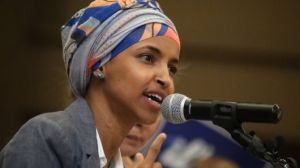
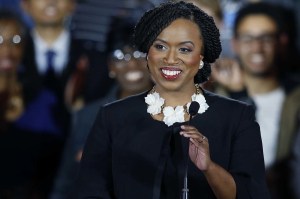

 I’m not sure she’s got what it takes either but again, why not focus what these folks that are coming in can do now? Politico has named “19 to watch” in 2019.
 Good Morning!!
 Marcy writes that the sentencing memorandum released by Cohen’s attorneys on November 30,
 Another very good summary of the filings can be read at Lawfare, this one by Victoria Clark, Mikhaila Fogel, Quinta Jurecic, and Benjamin Wittes: ‘Totally Clears the President’? What Those Cohen and Manafort Filings Really Say. Here’s a short excerpt on Trump’s culpabililty:
 Another highly recommended analysis from Ryan Goodman and Andy Wright at Just Security: Mueller’s Roadmap: Major Takeaways from Cohen and Manafort Filings. Goodman and Write offer eight “takeaways.”
Second, Mueller considers lies to the public can be an attempt to undermine the investigation. The memo states, “By publicly presenting this false narrative, the defendant deliberately shifted the timeline of what had occurred in the hopes of limiting the investigations into possible Russian interference in the 2016 U.S. presidential election.” That sounds awfully similar to the creation of a cover story about the June 9 Trump Tower meeting, which the President himself reportedly directed from aboard Airforce One.
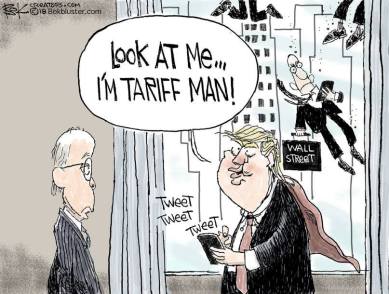
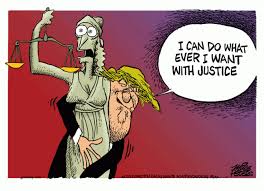
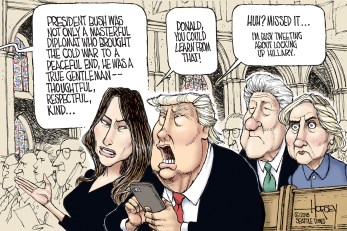 Well, just when you think things couldn’t get worse on the diplomatic front we get a whacky nomination for our UN Ambassador. I’m getting a little tired of seeing Fox News sending us their worst.
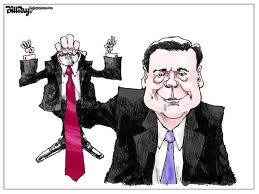 And , of course Comey is testifying today about them again before the House today via USA Today.

 I’ve avoided day-time cable news this week so I didn’t have to listen to the endless, over-the-top praise of the late George H.W. Bush. But I have to admit that Bush at least knew how to behave like a human being, unlike the current resident of the White House.
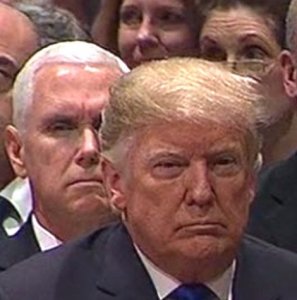 Mike Pence didn’t look too happy at the funeral yesterday either. Maybe this is why.
 David Ignatius at The Washington Post: Michael Flynn appears to have come full circle.
Long-time students of federal law enforcement practices agreed, speaking anonymously, that “covert law enforcement activities” likely refers to the possibility of wearing a concealed wire or recording telephone conversations with other potential suspects. It is not known whether Flynn has worn a wire at any time.

 peej
peej Carissa
 bostonboomer
 dakinikat
 ecocatwoman
 mablue2
 Mama Lopez
 peggysue22
 quixote
 skydancingguestblogger
 Mona (aka Wonk the Vote)



 Sky Dancing
Recent Comments