Lazy Caturday Reads

Good Morning!!

spoon-feeding-cat4Today’s art work is from the European Renaissance period, around the 15th and 16th centuries, when people apparently liked to treat their pet cats like babies–spoon-feeding them and sometimes even swaddling them. Unfortunately I couldn’t find the artists’ names.

In honor of Caturday and to give you a brief respite from the insane news of the day, here’s an article about Willow, the White House cat. Kate Bennett at CNN: As presidential cat, Willow Biden has privileges.

In the dog days of summer, Willow the cat rules the roost.

On Friday, Willow’s crate was spotted being carried by a staff member from the White House residence to Marine One, the presidential helicopter that will ferry the feline – along with President Joe Biden and first lady Dr. Jill Biden – to Rehoboth, Delaware, and the family’s beach house…

“Willow often spends the weekends with the First Family, including in Rehoboth, Wilmington, and Camp David,” the first lady’s press secretary Michael LaRosa told CNN.

When she is not being whisked away for the weekend, Willow has privileges to roam the White House. She is predominantly restricted to the White House executive residence’s private second and third floors, where CNN is told Willow particularly enjoys the solarium, a bright space above the South Portico, where she “receives lots of attention from the Executive Residence staff.” In Wilmington and at Camp David, “she often sits on the porch in the sun,” says LaRosa.

Back home, Willow also likes to visit working staff in the East Wing, taking leisurely naps on the desk of the press secretary, chasing her toys in and out of offices and generally being open to scratches. Once or twice, Willow has explored beyond her domain, making it as far as the chief usher’s office on the main floor, just next to the North entrance.

The East Wing staff has made a sign to alert when Willow is out and about, which features of photo of her face and reads: “Willow is on the prowl! Please keep these doors closed.”

I didn’t know the story of how Willow came to be adopted by Jill Biden until I read this story. They met when Jill gave a speech in rural Pennsylvania, where Willow lived in a barn.

“Willow made quite an impression on Dr. Biden in 2020 when she jumped up on the stage and interrupted her remarks,” LaRosa said several months ago. “Seeing their immediate bond, the owner of the farm knew that Willow belonged with Dr. Biden.”

She named her Willow after her hometown of Willow Grove, Pennsylvania. Though it wouldn’t be until January that Willow actually moved into her digs at the White House, she enjoyed staying with Biden acquaintances in Washington, DC, until the timing was right to officially add her to the Biden home.

Willow sounds like a very clever cat. She knew what she wanted and made it happen.

spoon-feeding-cat2It seems that Trump has been closely following the January 6 hearings, and he’s not at all happy about them. Justin Baragona at The Daily Beast: Trump Slams ‘Human Conveyer Belt’ Pence for Lacking ‘Courage’ to Steal Election.

Former President Donald Trump lashed out at Mike Pence on Friday for not having the “courage” to overthrow President Joe Biden’s election victory—just a day after the Jan. 6 committee hailed the ex-veep as a hero for not participating in Trump’s failed coup attempt.

Additionally, the twice-impeached ex-president denied that he ever called Pence a “wimp” for not going along with his crazy theory to steal the 2020 election. At the same time, though, Trump repeatedly called Pence a “human conveyer belt” and a “robot” for certifying Biden’s electoral votes….

After railing about the “sham” and “unselect” committee during his speech at the Faith and Freedom Coalition on Friday, Trump turned his attention to Pence and other “RINOs” he felt were insufficiently loyal to him following the election.

“One guy got up and said that he heard me calling Mike Pence a ‘wimp,’” Trump stated. “Now honestly, I’m the president of the United States. I’m sitting, I think they said at my desk. ‘He’s a wimp.’ How many people listen to me—I don’t even know who these people are! But I never called Mike Pence a wimp. I never called him a wimp.”

From there, however, the ex-president took aim at his former running mate for failing to assist in illegally keeping him in office—and he basically called Pence a wimp in so many words.

“Mike Pence had a chance to be great,” Trump exclaimed. “He had a chance to be, frankly, historic. But just like [former Attorney General] Bill Barr and the rest of these weak people, Mike—and I say it sadly because I like him—but Mike did not have the courage to act.” [….]

Regarding the legal consensus that Pence had “no choice” but to certify Biden’s victory, the disgraced ex-president likened Pence to a “human conveyer belt.”

After claiming he never wanted Pence to “decide” the election but rather just wanted him to send votes back to state legislatures for them to decide, Trump seemed to confirm that he pushed Eastman’s garbage theories in conversations with his vice president. (Though, according to Pence’s chief of staff Marc Short, this particular encounter never happened.)

“So, I said, ‘Mike, if you do this, you can be Thomas Jefferson,’” the ex-president boasted. “And then, after it all went down, I looked at him one day and I said, ‘Mike, hate to say this, but you’re no Thomas Jefferson.’”

spoon-feeding-cat6Trump also attacked Pence on his fake Twitter social media outlet “Truth Social.” The Independent: Trump claims he never asked Pence to overturn the election on Truth Social after dramatic Jan 6 hearing.

Mr Trump’s words come a day after the House select committee investigating the riot at the US Capitol held its third public hearing, where Mr Pence’s former White House Counsel Greg Jacob testified about the pressure campaign the former vice president sustained at the hands of the president and his legal team.

Multiple video depositions, including from former White House lawyer Eric Herschmann, showed how Mr Trump knew his plan to overturn the election results were illegal.

But Mr Trump pushed back on the allegations on his social media platform Truth Social.

“Such LIES & MISREPRESENTATION by the Unselects, and absolutely nobody allowed to challenge what is being said”, Mr Trump posted. “As an example, I never asked V.P. Pence to ‘overturn’ the election (although Thomas Jefferson ‘took’ the Georgia votes), but that he send the votes back to the Legislatures so that they could determine if the irregularities and Fraud were as widespread and signficant [sic] as they seemed.”

Dementia Don’s family needs to stage an intervention and get this man some professional help. He’s likely to get even more enraged on Tuesday, when the January 6 Committee hearing will focus on Trump’s efforts to “find” enough votes to overturn Biden’s 2020 win in Georgia. Georgia Public Broadcasting News: Raffensperger, Sterling will headline Tuesday’s Jan. 6 hearings.

Georgia Secretary of State Brad Raffensperger and his top deputy Gabriel Sterling will testify at Tuesday’s hearing of the House Select Committee to Investigate the January 6th Attack on the United States Capitol, to shine more light on one of the more brazen attempts to overturn the 2020 election….

Raffensperger famously rebuffed former President Donald Trump’s pressure to “find” enough votes to reverse his narrow election defeat, and Sterling was a frequent figure on televised news conferences debunking false claims of fraud and fellow Republicans’ attacks on election workers.

In last month’s primary elections, Raffensperger defeated Trump-backed challenger Rep. Jody Hice.

girl-feeding-a-catTuesday’s committee hearing is expected to highlight the pressure campaign that Trump and his allies exerted on local elections officials in Georgia and other states to reverse the presidential election results, and comes on the heels of a hearing Thursday that outlined attempts to get former Vice President Mike Pence to reject the Electoral College results.

The Georgia officials’ public testimony comes after Raffensperger appeared recently in a closed-door special grand jury investigation in Fulton County that is seeking to determine if Trump and others violated several state laws in their efforts to overturn the 2020 presidential election.

Raffensperger and others have also provided hours of testimony privately to the committee, including discussion of the unprecedented call from Trump, leaked to GPB NewsThe Washington Post and other outlets in the runup to Georgia’s dual U.S. Senate runoffs.

Read more at the link.

The Committee has also requested testimony from Ginni Thomas, after it came out that she exchanged emails with nutty Trump attorney John Eastman during his efforts to overturn the election. NPR reports that Thomas claims she’s looking forward to answering questions:

Ginni Thomas told the right-wing news site The Daily Caller in a story published after the start of Thursday’s hearing that she would “look forward” to speaking with the committee.

“I can’t wait to clear up misconceptions. I look forward to talking to them,” The Daily Caller reported. Thomas has worked with the Daily Caller in the past, including producing an interview with her husband.

I can’t wait either.

Jim Newell and Jordan Weissmann have questions for her: Ginni Thomas: Were you sending emails about a criminal f***ing conspiracy?

Just how deeply involved was Ginni Thomas in plotting to overthrow the results of the 2020 election? The Jan. 6 committee may be poking around to try and find out. After Trump’s loss, Thomas—wife of Justice Clarence Thomas—texted extensively with White House chief of staff Mark Meadows about overturning the outcome and pushed Arizona lawmakers to do the same with their state’s vote. This week, the Washington Post reported that the panel is examining emails between Thomas and the lawyer John Eastman, who was Trump’s apparent point man on all things coup-related (and who will now forever be associated with the words “I believe I should be on the pardon list, if that is still in the works”). After the Post story broke, Eastman posted his email correspondence with Thomas on his Substack in a post titled: “OMG, Mrs. Thomas asked me to give an update about election litigation to her group. Stop the Presses!” It mostly just seemed to confirm that, yes, the two were in contact. The committee is now planning to interview Thomas, who says she is looking forward to clearing up any “misconceptions.” Here’s the key context for all this: At one point, Eastman told another Trump ally in an email that there was “a heated fight underway” at the Supreme Court over the election. It’s not clear where he got that idea. Was he fed this information by his friend Ginni? And what would that tell us, exactly, about Clarence Thomas’ activities at the court? Inquiring minds would like to know what the queen of Boomer texters, and her wildly powerful husband, were up to.

Also see Jamelle Bouie at The New York Times: Ginni Thomas Has a Lot of Explaining to Do.

spoon-feeding-cat15This is from CNBC: Ginni Thomas-tied Facebook group ‘FrontLiners for Liberty’ could be a new focus in Jan. 6 investigation.

A Facebook group that appears to be run by Virginia “Ginni” Thomas, the wife of Supreme Court Justice Clarence Thomas, could become a new point of interest in the U.S. House Select Committee’s investigation into the Jan. 6 attack on the U.S. Capitol.

Congressional investigators said they planned to ask Ginni Thomas to testify before the committee hours after Trump attorney John Eastman on Thursday publicly posted a Dec. 4, 2020 email from Thomas asking him to speak to a gathering she called “Frontliners,” which she described as featuring “grassroots state leaders.” Ginni Thomas is listed as an administrator of a Facebook group that goes by a similar name and description: “FrontLiners for Liberty.”

The private group, which listed more than 50 members, was created in August 2020, just two months before the November elections, according to the page’s description.

The groupwhich CNBC reviewed before it was removed from public view, described itself as “a new collaborative, liberty-focused, action-oriented group of state leaders representing grassroots armies to CONNECT, INFORM and ACTIVATE each other weekly to preserve constitutional governance.” Although Thomas’ personal Facebook page isn’t verified, it contained numerous photos ofJustice Thomas.

The group’s pages were removed from public view after CNBC reached out to Thomas about the organization. It now shows a notice from Facebook saying that it’s either been deleted or the privacy settings have been changed.

CNBC also tried to get answers through Facebook messenger to Stephanie Coleman, who is also listed administrator of the group and the wife of the late Gregory Coleman who was Texas’ solicitor general. Greg Coleman was once a clerk for Justice Thomas.

Coleman and Thomas are repeatedly pictured together on Coleman’s personal Facebook page, including a photo of the two together in December 2016 with former White House chief strategist Steve Bannon.

More news, links only:

spoon-feeding-cat13Just Security: 8 Top Former Prosecutors, Senior DOJ Officials on Key New Evidence in Effort to Pressure Pence.

The Washington Post: Supreme Court could soon make it easier to carry guns in six states.

Vice: Uvalde Hires Private Law Firm to Argue It Doesn’t Have to Release School Shooting Public Records.

The Guardian: The ‘big rip-off’: how Trump exploited his fans with ‘election defense’ fund.

HuffPost: The Far-Right’s Assault On An Idaho Pride Event Was Meticulously Planned.

The New York Times: Proud Boys Led Major Breaches of Capitol on Jan. 6, Video Investigation Finds.

David Von Drehle at The Washington Post: A new ‘National Conservative’ manifesto sounds a lot like fascism.

Garry Kasparov at The Wall Street Journal: Awakened to Putin’s Threat, Biden and the West Nod Off Again.

Have a nice Juneteenth weekend everyone!!


Tuesday Reads: Yesterday’s Jan. 6 Committee Hearing

https___cdn.cnn.com_cnnnext_dam_assets_220610171003-01-jan-6-hearing-file-060922

Good Morning!!

Much of today’s news is about yesterday’s January 6 committee hearing, but before I get to that, this morning the committee announced that tomorrow’s scheduled hearing has been postponed. NBC News: Jan. 6 committee abruptly postpones Wednesday hearing.

The House committee investigating the Jan. 6 attack on the Capitol announced Tuesday that it was postponing its public hearing scheduled for 10 a.m. on Wednesday.

The next hearing will take place on Thursday instead.

The committee did not say why it was postponing Wednesday’s hearing.

The witnesses who were expected to testify at the hearing included former acting Attorney General Jeffrey Rosen, former acting Deputy Attorney General Richard Donoghue and Steve Engel, former assistant attorney general for the Office of Legal Counsel….

Rep. Liz Cheney, R-Wyo., said last week that the third hearing would offer evidence about Trump’s unsuccessful plan to oust Rosen and replace him with another DOJ official who was more supportive of Trump’s fraud claims, Jeffrey Clark, according to Cheney. Clark drafted a letter to states that said the department “identified significant concerns that may have impacted the outcome of the election.”

“In our hearings, you will hear first-hand how the senior leadership of the department threatened to resign, how the White House Counsel threatened to resign, and how they confronted Donald Trump and Jeff Clark in the Oval Office,” Cheney said Thursday.

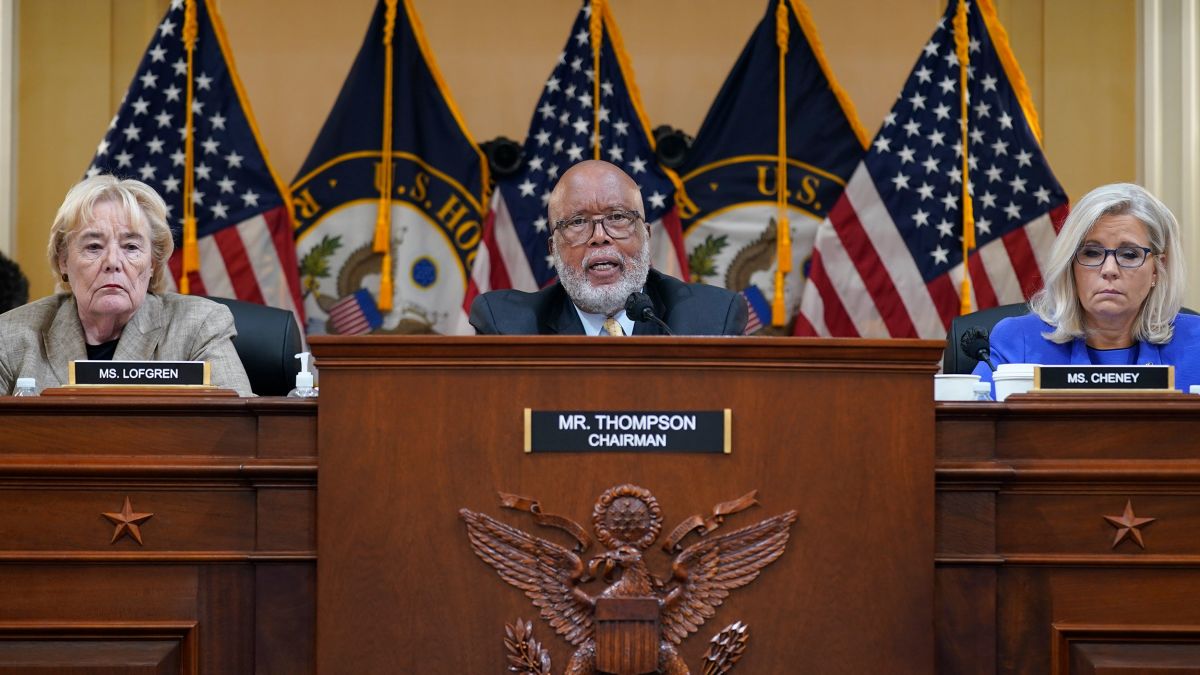
Committee member Rep. Zoe Lofgren told Morning Joe that the postponement is “no big deal.”

Perhaps in anticipation of the committee’s scheduled topic for Wednesday, Michael Kranish wrote in The Washington Post: Inside the explosive Oval Office confrontation three days before Jan. 6.

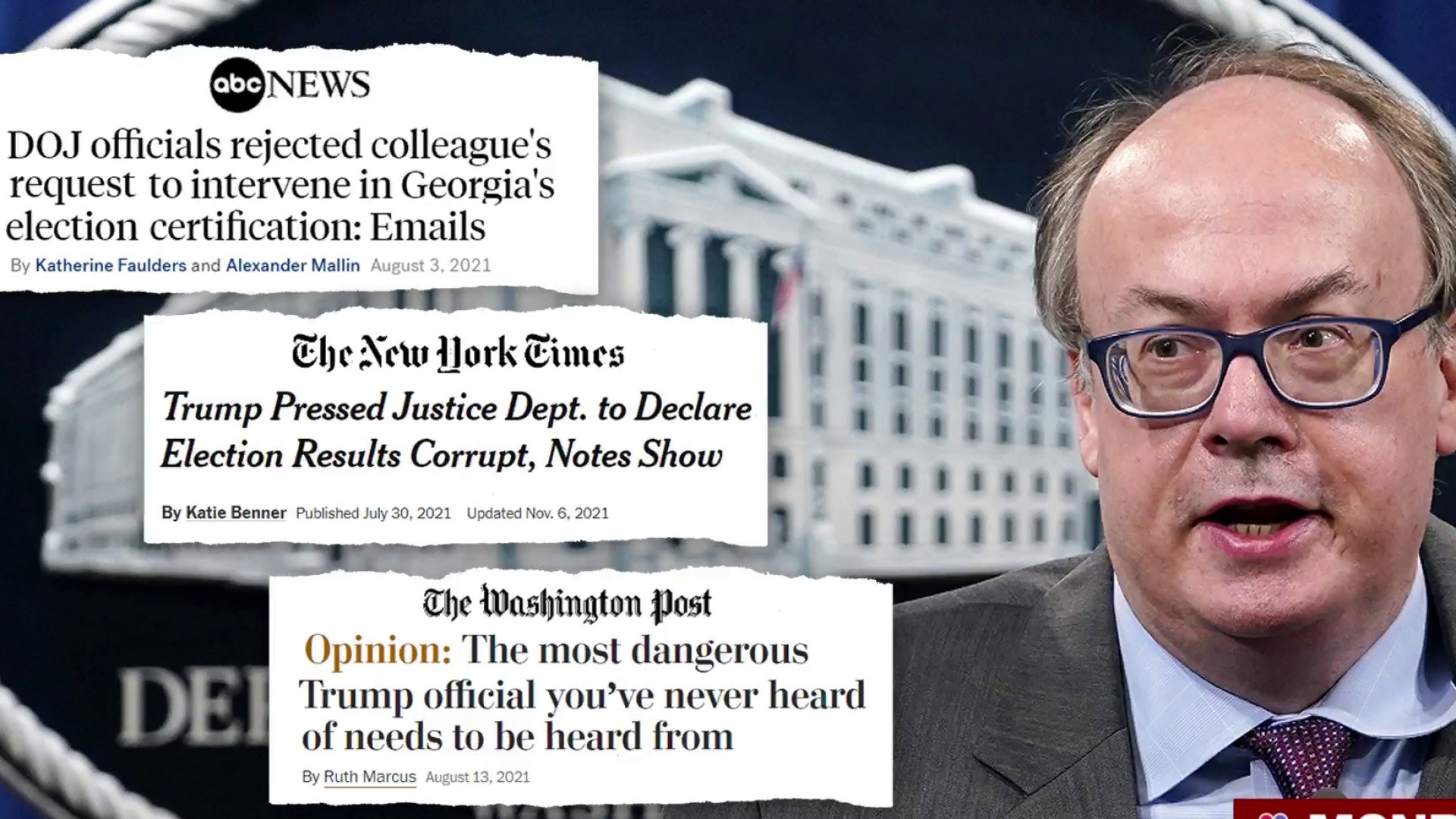
Three days before Congress was slated to certify the 2020 presidential election, a little-known Justice Department official named Jeffrey Clark rushed to meet President Donald Trump in the Oval Office to discuss a last-ditch attempt to reverse the results.

Clark, an environmental lawyer by trade, had outlined a plan in a letter he wanted to send to the leaders of key states Joe Biden won. It said that the Justice Department had “identified significant concerns” about the vote and that the states should consider sending “a separate slate of electors supporting Donald J. Trump” for Congress to approve.

In fact, Clark’s bosses had warned there was not evidence to overturn the election and had rejected his letter days earlier. Now they learned Clark was about to meet with Trump. Acting attorney general Jeffrey Rosen tracked down his deputy, Richard Donoghue, who had been walking on the Mall in muddy jeans and an Army T-shirt. There was no time to change. They raced to the Oval Office.

As Rosen and Donoghue listened, Clark told Trump that he would send the letter if the president named him attorney general.
1638408149077_n_reidout_jeffreyclark_211201_1920x1080-kgwc4i

Jeffrey Clark

Donoghue told Trump that Clark was “not competent” to serve as Attorney General, and if Trump appointed him there would be mass resignations at the DOJ. Kranish writes that January 6 Committee witness have revealed new information about what happened in that January 3 Oval Office meeting.

A reconstruction of the events by The Washington Post, based on the court filings, depositions, Senate and House reports, previously undisclosed emails, and interviews with knowledgeable government officials, shows how close the country came to crisis three days before the insurrection.

The evidence, which fills in crucial details about Clark’s efforts, includes an email showing he was sent a draft of a letter outlining a plan to try to overturn the election by a just-arrived Justice Department official who had once written a book claiming President Barack Obama planned to “subvert the Constitution.”

But larger mysteries could still be solved at a Jan. 6 committee hearing on Wednesday morning slated to examine Clark’s actions, including the crucial question of whether Clark and his allies were acting on their own initiative — or whether they were one piece of a larger, well-planned effort to keep Trump in power. That question gets to the heart of the committee’s professed mission: proving there was a “coordinated, multi-step effort to overturn the 2020 presidential election.”

It’s a long read, so you’ll have to go to the WaPo to read all the details.

Now for some reactions to yesterday’s Committee presentation.

Trump biographer Timothy O’Brien at Bloomberg: Trump Knew Exactly What He Was Doing on Jan. 6.

“Jerry, just remember: It’s not a lie if you believe it.” — George Costanza, “Seinfeld”

Did Donald Trump believe he was telling the truth when he claimed that the 2020 election, which he lost, was rigged against him? I think not, but I’m just one person.

Fortunately, lots of other White House advisers, such as former Attorney General William Barr, told Trump in the days and weeks after the election that there was no fraud. Barr called the claims “bullshit,” “rubbish” and “idiotic.” Trump’s advisers were surprised, sometime stunned, that he plowed ahead anyway. Those were just some of the revelations from the second day of testimony of the select congressional committee investigating the Jan. 6 attack on the US Capitol.

One reason this matters is that the hearing’s most important audience isn’t voters or historians. It’s an audience of one: Attorney General Merrick Garland. If Garland’s Justice Department decides to charge Trump with electoral fraud, it will need to demonstrate to a jury that Trump intended to commit a crime when he staged an attempted coup — and that he knew what he was doing was wrong. The Jan. 6 committee is laying lots of persuasive evidence on Garland’s desk.

In addition to Barr, other White House and campaign advisers, including Jared Kushner, Bill Stepien, Eric Herschmann, Alex Cannon and Jeffrey Rosen, told Trump that there was no election fraud. Some advisers did insist otherwise, including Rudy Giuliani. But based on testimony at the hearing, the Giuliani crowd was telling Trump what he already wanted to hear. Barr testified that Trump had no interest in the “actual facts.” Stepien testified that Trump’s “mind was made up” that mail-in voting was a scam months before the election took place.

Barr went as far as to say that if Trump really did believe there was fraud, he had “become detached from reality.” But Trump’s never been detached from reality — he has simply created the narratives he wants to get what he wants. He’s been doing that for decades. You can call this modus operandi lying, or exaggerating, or prevaricating, or dissembling, or falsely speaking. Whatever the term, he knows exactly what he’s doing when he does it.

Read more at the link. Fortunately AG Garland says he’s following the Committee’s presentations.

Hugo Lowell at The Guardian: Garland says he is watching January 6 hearings amid pressure to investigate Trump.

“I am watching and I will be watching all the hearings, although I may not be able to watch all of it live,” Garland said shortly after the select committee concluded its second hearing. “I can assure you the January 6 prosecutors are watching all of the hearings, as well.”

The attorney general declined to address potential investigations into Trump or other individuals mentioned by the select committee at the hearings, saying that could undermine prosecutors’ work and would be unfair to people under scrutiny who might never be charged.

But Garland reiterated earlier promises that the justice department is exploring potential criminal conduct regardless of those people’s level, their positions in the government and proximity to Trump, or whether they were at the Capitol on 6 January 2021.

The justice department appears in recent weeks to have expanded its criminal investigation to examine top figures connected to Trump’s efforts to overturn the results of the 2020 election, including government officials and Republican lawyers and operatives.

One grand jury in Washington is investigating the rallies that preceded the Capitol attack and whether any executive or legislative branch officials were involved in trying to obstruct Joe Biden’s election certification, according to a subpoena seen by the Guardian.

The justice department also appears to be investigating political operatives close to Trump, according to another grand jury subpoena seen by the Guardian, as well as some Trump lawyers involved in a scheme to send fake Trump electors to Congress.

Read the rest at The Guardian.

At The Daily Beast, Julia Davis reports: Team Putin in a Panic Over Jan. 6 Hearings ‘Lynching Trump.’

The House select committee’s primetime Jan. 6. hearings are causing conniptions in Moscow.

105146647-GettyImages-872801238rThe attempted insurrection was embraced by the Kremlin as cause célèbre, with Russian President Vladimir Putin himself calling for an investigation into the death of Ashli Babbitt, who was part of the crowd attacking the U.S. Capitol. Russia’s state-controlled media obsessively covered the notorious attack, praising the would-be insurrectionists as law-abiding protesters and criticizing the United States for prosecuting them. But now, propagandists seem to be concerned that the hearings may negatively impact the chances of re-election for their so-called “partner,” former U.S. President Donald J. Trump.

Kremlin-controlled state media has been relishing the faltering popularity ratings of President Biden, describing Trump as a shoo-in for re-election and openly hoping that a Republican takeover in the midterms would spell a change in America’s foreign policy towards Ukraine. The Jan. 6 committee hearings seem to be a fly in the ointment and now Putin’s propagandists are no longer certain of what the future elections might hold.

Assuming that a criminal prosecution against Trump is all but inevitable, state TV host Vladimir Solovyov seemed perturbed during his show The Evening With Vladimir Solovyov last Friday: “Look at what’s going on in America. A criminal prosecution against Trump and his followers is an obvious step towards a dictatorship.” Solovyov failed to mention the kind of penalties one might face in Russia for attempting a violent insurrection, where people get arrested for something so innocuous as holding up a sign that says “Peace,” or even a blank sheet of paper….

Dmitry Abzalov, Director of the Center for Strategic Communications, was equally agitated: “The most crucial point is as follows: we need to understand what’s going to happen in the electoral sense. The internal political component is extremely significant. The most important events on our political calendar are local elections in Great Britain as well as a very difficult situation in July and August, since the midterms in the U.S. actually start during summer months. Every Thursday they’ll be lynching Trump in prime time.”

Click the link to read the rest.

William Saletan at The Bulwark: If Trump Wasn’t Lying, That’s Worse. A delusional president is far more dangerous than a mendacious one.

On Monday, the House January 6th Committee presented evidence that Donald Trump, after losing the 2020 election, promoted allegations of voter fraud that his own advisers had told him were false. According to the committee, this evidence proves he was lying.

But the evidence actually points to a different conclusion: Trump wasn’t lying in the way that other presidents have done. He was simply impervious. He refused to accept unwelcome facts. And that degree of imperviousness, in a president, is much more dangerous than dishonesty.

Testimony at Monday’s hearing showed that many people around Trump—Mark Meadows, Jared Kushner, Ivanka Trump, and others—knew his claims were false. But the testimony about Trump himself was different. Nobody recalled the then-president privately admitting, in the style of Richard Nixon, that he was hiding the truth. Instead, everyone who had interacted with Trump described him as batting away information he didn’t want to hear.

Saletan then provides a four-part summary of the evidence, which you can read at the link above.

If Trump truly believed, despite all evidence, that the election was stolen, that might buy him some relief from criminal charges that require corrupt intent. But in terms of his fitness for office, the theory that he was deluded—not lying—is more alarming, not less.

In his testimony, Barr described a meeting with Trump on Dec. 14, 2020. Trump was still ranting about Dominion and other fantastic tales. “I was somewhat demoralized,” Barr told the committee, “because I thought, boy, if he really believes this stuff . . . he’s become detached from reality.” Barr speculated that Trump had “lost contact.” He recalled that each time he told Trump “how crazy some of these allegations were,” Trump brushed aside the information: “There was never an indication of interest in what the actual facts were.”

“I felt that before the election it was possible to talk sense to the President,” Barr testified. This sometimes required “a big wrestling match” with Trump, he explained, but “it was possible to keep things on track.” But “after the election, he didn’t seem to be listening.”

Detached from realityLost contactNo interest in facts.

We can’t have a president who thinks—or doesn’t think—this way. We can’t put the world’s most powerful armed forces and nuclear arsenal back in the hands of a man who believes, no matter what, that he has the mandate of the people—and is willing to use violence to stay in power. In the Oval Office, a madman is far more dangerous than a liar.

I’m not sure what to believe. I do think that Trump has shown himself to be delusional in many situations. On the other hand, if Trump truly believed his lies, it would be much more difficult to prosecute him.

Trump himself issued a response to the evidence provided by the committee. The Hill: Trump releases 12-page response to Jan. 6 hearing.

The 12-page document underscores how Trump has yet to move on from his false claims of fraud in the 2020 election and how the committee’s work may be central to a potential 2024 campaign….

Trump repeats a handful of disproven claims to assert the 2020 election was stolen from him and rigged in favor of Democrats, including some that were brought up during testimony by former Trump campaign and administration officials.

One section of Trump’s statement focuses on ballot trafficking claims, for which he cites the Dinesh D’Souza documentary “2000 Mules.” In testimony shown earlier Monday, former Attorney General William Barr laughed at the mention of the film, saying he was “unimpressed with it” and dismissed the idea that it proved widespread fraud.

Another section asserts that President Biden could not have won the states of Pennsylvania, Arizona or Georgia because he got more Black votes and Hispanic votes than former President Obama. Each of those states has performed audits and recounts and found no evidence of widespread fraud.

Trump in one section claimed states such as Pennsylvania and Michigan took additional time after Election Day to count ballots because it was part of an elaborate scheme to ship in fraudulent votes so Biden could erase Trump’s narrow leads in those states.

But former Fox News editor Chris Stirewalt testified in person on Monday to dismiss that very theory, known as the “red mirage.” Stirewalt explained that Republicans typically do better on Election Day, while Democrats perform better in early voting. Some states, such as Pennsylvania, do not count early votes or mail-in ballots until Election Day, meaning it takes additional time to finalize the count.

https://twitter.com/marceelias/status/1536479254489210884?s=20&t=hq6i1VYkMuRQ0NMWqBMsvw

From Raw Story: ‘Admissible in any future trial’: Analysts nail Trump’s 12-page Jan. 6 response rant.

Former President Donald Trump is being mocked and attacked online after issuing a 12-page statement that is partly a typical Trump rant but follows with a case his campaign has made that questions nebulous things like “ballot stuff” and alleges that because ballots were counted after midnight they’re fraudulent.

As Democratic election lawyer Marc Elias noted, Trump’s lawyers should let him know that statements like these can be used against him in any forthcoming legal proceedings. Typically, lawyers advise their clients to stay quiet and refrain from speaking out.

That’s it for me today. What stories have captured your interest?


Thursday Reads: Jan. 6 Hearings Begin Tonight

https___cdn.cnn.com_cnnnext_dam_assets_220605115209-01-january-6-committee-file-restricted

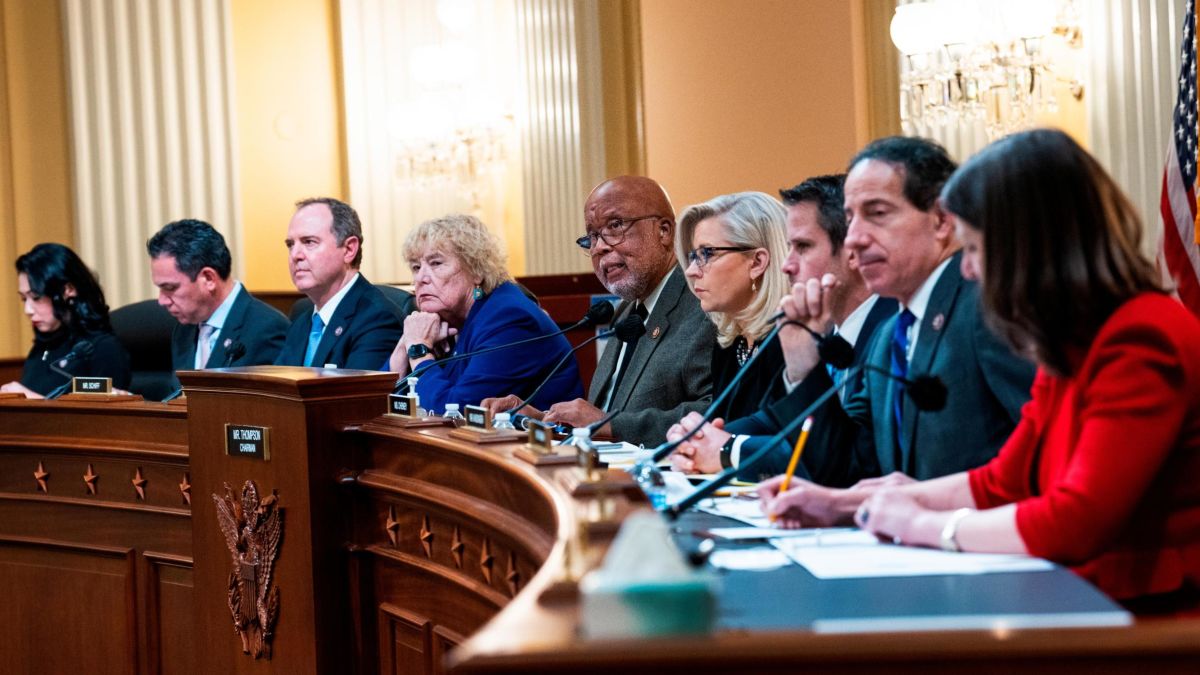
The House January 6 Committee

Good Morning!!

Day one of the January 6 committee hearings has finally arrived. At 8:00 tonight, we’ll begin to learn what the committee has discovered about the conspiracy to overturn the 2020 election and Trump’s culpability for the attack on the Capitol building last year. We’ll be live-blogging the hearings, so please check in tonight and share your reactions. We can use this post or, if necessary, we’ll post another thread tonight.

Rep. Jamie Raskin has promised that the findings will “blow the roof off” the House. Ed Pilkington at The Guardian: Congress’s January hearings aim to be TV spectacular that ‘blows the roof off.’

When the US House select committee investigating the January 6 insurrection opens its hearings on Thursday evening, it will do so in prime time and with primetime production values. The seven Democrats and two Republicans – shunned by their own party – who sit on the panel are pulling out all the stops in an attempt to seize the public’s attention.

They have brought onboard a former president of ABC News, James Goldston, a veteran of Good Morning America and other mass-market TV programmes, to tightly choreograph the six public hearings into movie-length episodes ranging from 90 minutes to two and a half hours. His task: to fulfill the prediction of one of the Democratic committee members, Jamie Raskin, that the hearings “will tell a story that will really blow the roof off the House”….

Reports suggest that one ratings-boosting tactic under consideration would be to show clips from the committee’s interviews with Donald Trump’s daughter Ivanka Trump and her husband, Jared Kushner. They were witness to many of Donald Trump’s rantings in the buildup to January 6, and highlights of their quizzing could command a large audience.

As a counterpoint to the glamorous couple, the committee is also likely to focus during the opening session on the activities of far-right groups including the Proud Boys and Oath Keepers. This week, the justice department charged the national chairman of the Proud Boys, Enrique Tarrio, and four of the group’s other leaders with seditious conspiracy.

The indictments will act as backdrop to two of the committee’s main ambitions for the hearings. First, to show in dramatic and previously unseen footage – edited for maximum effect on TV and social media alike – the harrowing violence and brutal destruction that was unleashed during the storming of the Capitol, in which the vice-president was forced to flee rioters shouting: “Hang Mike Pence.”

The second ambition is to convey to the American people that the maelstrom of rage was not random and unprompted, but rather the opposite – instigated, organised, meticulously planned and conceived by an array of conscious actors.

William Vailliancourt at Rolling Stone: ‘More Than Incitement’: Jamie Raskin Teases Trump Revelations Ahead of Jan. 6 Hearings.

Committee member Rep. Jamie Raskin (D-Md.) on Monday offered a glimps of what’s to come.

“The select committee has found evidence about a lot more than incitement here,” he said during a Washington Post interview on Monday after noting that majorities in both the House and Senate found former President Trump guilty of inciting the attack on the Capitol. “We’re gonna be laying out the evidence about all of the actors who were pivotal to what took place on Jan. 6,” he continued.

Raskin added that the committee has evidence of “concerted planning and premeditated activity” — in other words, “a conspiracy to overturn the 2020 presidential election and block the transfer of power.”

When asked whether Trump himself led this effort, Raskin acknowledged that “people are going to have to make judgments themselves about the relative role that different people played.” But, he added, “I think that Donald Trump and the White House were at the center of these events. That’s the only way really of making sense of them all.”

Committee Vice Chairwoman Liz Cheney (R-Wyo.) described efforts to overturn the election similarly, telling CBS on Sunday that the attack on the Capitol was one facet of an “extremely well-organized” conspiracy….

“No president has ever come close to doing what happened here in terms of trying to organize an inside coup to overthrow an election and bypass the constitutional order,” Raskin said at a Georgetown University event in April. “And then also use a violent insurrection made up of domestic violent extremist groups, white nationalist and racist, fascist groups in order to support the coup.”

Marshall Cohen at CNN: January 6 panel eyes Trump’s culpability as hearings begin.

With public hearings kicking off this week, the House select committee investigating January 6 is zeroing in on former President Donald Trump, and is preparing to use its platform to argue that he was responsible for grave abuses of power that nearly upended US democracy.

The committee’s central mission has been to uncover the full scope of Trump’s unprecedented attempt to stop the transfer of power to President Joe Biden. This includes Trump’s attempts to overturn his 2020 defeat by pressuring state and federal officials, and what committee members say was his “dereliction of duty” on January 6 while his supporters ransacked the US Capitol.

Lawmakers will try to convict Trump in the court of public opinion – which is all they can do, because it’s not within their powers to actually indict Trump. But they have an emerging legal foundation to claim that Trump broke the law, thanks to a landmark court ruling from a federal judge who said it was “more likely than not” that Trump committed crimes regarding January 6.

These highly choreographed hearings will be the panel’s first opportunity to show the public what they’ve learned from more than 1,000 witness interviews and 135,000 documents. An avalanche of new information about January 6 has come to light since Trump’s impeachment trial in February 2021, where he was acquitted of one count of “incitement of insurrection.”

“We are going to tell the story of a conspiracy to overturn the 2020 presidential election and block the transfer of power,” Rep. Jamie Raskin, a Maryland Democrat who serves on the committee, told the Washington Post earlier this week, adding that the committee “has found evidence of concerted planning and premediated activity” related to the events of January 6.

Cohen then wraps up the piece by summarizing what is known so far about “Trump’s leadership role in the anti-democratic scheme, and how it all fits into the ongoing criminal investigations.”

Andrew Feinberg at The Independent: ‘Trump will lose his mind’: The 6 Jan hearings vow to ‘change history’. Here’s what to expect.

When the House 6 January select committee convenes its first hearing to examine the worst attack on the US Capitol since 1814, the nine-member panel and the two witnesses who will testify Thursday will be the highest-profile occupants of the ornate Cannon House Office Building Caucus Room since the infamous House Un-American Activities Committee used it for hearings in the mid-20th century.

Seventy-four years after Hollywood luminaries like acclaimed screenwriter Dalton Trumbo were blacklisted after failing to answer that committee’s questions about whether they had “now or … ever been” members of the Communist Party, one of the film industry’s finest will once again be a star witness in the exact same room.

The select committee on Tuesday announced that one of the first two witnesses to testify in what is expected to be a series of at least eight hearings will be Nick Quested, the award-winning documentarian who earned an Oscar nomination for his film Restrepo in 2010. The other will be Caroline Edwards, a US Capitol Police officer who was one of the first to be on the receiving end of blows delivered by the pro-Trump mob who stormed the Capitol in hopes of preventing Congress from certifying Joe Biden’s 2020 election victory.

Both witnesses will testify during the second hour of the two-hour hearing, following opening presentations by the select committee’s chairman – Representative Bennie Thompson of Mississippi – and Wyoming Representative Liz Cheney, the panel’s vice-chair.

The Independent has learned that the panel’s aim in putting Ms Edwards and Mr Quested in the spotlight for the first prime time hearing on the 6 January insurrection is to highlight the role played by the pro-Trump extremist groups in starting and escalating the violence.

Mr Quested, who spent the days leading up to the riot embedded with leaders of the Proud Boys gang as part of a documentary project, has already provided US authorities with footage of a 5 January 2021 meeting between then-Proud Boys leader Enrique Tarrio and Elmer Stewart Rhodes, founder and leader of the Oath Keepers.

The footage of Mr Tarrio and Mr Rhodes meeting on the eve of the insurrection appears to have figured prominently in grand jury proceedings which led to last week’s unsealing of an indictment against Mr Tarrio and four other Proud Boys members for seditious conspiracy.

The press has learned so much about what will happen tonight. I hope the committee will still have a few surprises for us.

Two more relevant reads:

Brian J. Karem at Salon: Jan. 6 committee finally takes the spotlight — hey, it’s only America’s future at stake. Karem argues that the Republicans’ focus on guns is designed to draw public interest away from the January 6 hearings and it’s vitally important that the hearings get the full attention of the public.

The House select committee on the Jan. 6 attack is finally beginning its televised hearings, and the Democratic faithful are hoping for a political punch in the nose to detractors — and a wakeup call to those who still don’t understand what actually happened during the insurrection.

“These hearings are important to accelerate awareness,” Norm Eisen, a senior fellow at the Brookings Institution, explained to me. It remains to be seen if they can actually be the “punch in the nose” to Donald Trump that so many hope for.

Trump’s alleged activities on or before Jan. 6 include a conspiracy to obstruct a lawful function of the federal government. These hearings must energize the pursuit of justice, or they will be pointless – just more high wind in the trees.

Face it. Trump was impeached not once, but twice. We know what a grifter he is. We know he doesn’t care. Most of us believe him to be a crook. We have seen it all before. Can the hearings really shock the nation into a zeitgeist that leads us to a newfound respect for each other — and to a settling of accounts that holds Trump responsible for one of the worst days in the modern history of our country? Probably not.

Trump openly led the insurrection. Congress can’t prosecute him, but the DOJ can.

The nation needs indictments. You cannot have closure before you indict and prosecute every single person involved in the insurrection. You cannot stand over the dead corpse of democracy and declare we should move on.

In short, the hearings in Congress must make it clear beyond a reasonable doubt that there should be a prosecution of Trump and all of the others in his close-knit circle who were involved. Should the hearings provide a roadmap to indictment, Attorney General Merrick Garland must not fail to act….

What’s the worst-case scenario for these hearings? No needle movement. No charges. The entire issue fades into the mist like a bad case of COVID: You survive, but the cough persists.

Make no mistake, democracy is still in the balance and it has been since Trump slithered down that golden escalator and began his campaign for president.

We’re still in the moment, as Eisen would say. These are uncertain times and we must act. These hearings are important — easily as important as the hearings that helped bring down Nixon and perhaps even more. Today the entire government hangs in the balance.

Jose Pagiliary at The Daily Beast: The Jan. 6 Committee Can’t Convict Trump—but It Could Help Bankrupt Him.

While it’s doubtful the hearings will meet the sky-high expectations of those who believed the committee would expose open-and-shut wrongdoing from some of the nation’s top officials, the prime-time hearings will deliver one thing: evidence for many of the lawsuits seeking to make former President Donald Trump and other election denialists actually pay for the violence.

“What the committee can’t do is hold people accountable. But that’s where criminal prosecutions and civil litigation comes in,” said Edward G. Caspar, an attorney representing injured and traumatized Capitol Police officers who are suing Trump after the violence insurrection….

one of the big challenges for the panel’s investigation—with its contentious lawsuits, secret interviews, and promises to expose the truth—is that it ultimately has no power to punish those who are responsible for last year’s attack on the Capitol.

So far, legal scholars and progressive activists have focused their exasperated calls for action on the Department of Justice. But the real action could come from lawsuits like the one Conrad Smith and seven fellow Capitol Police officers filed in August against Trump, his campaign, Stop the Steal election denial movement organizers like Ali Alexander and Roger Stone, and enforcer gangs like the Proud Boys and the Oath Keepers militia.

“The committee is playing a critical role here for America,” Caspar said. “If you think of the three means of seeking accountability for those responsible for the attack—congressional hearings, criminal prosecution, civil litigation—they’re like a three-legged stool. The committee can shine a very bright light on the evidence and present it to the public. That’s something the others can’t do.”

A lot is riding on the hearing tonight. If the committee can really “blow the roof off,” people who haven’t been paying close attention will continue to tune in upcoming hearings. Here’s hoping they can meet the challenge.

Please share your thoughts on all this, and I hope you’ll also check back tonight to help us live blog.


Tuesday Reads

Good Morning!!

For the past few days, *Massachusetts* has been trending on Twitter. The reason for that is the state’s tough gun laws.

From The Boston Globe: ‘Massachusetts gun laws have been proven to work.’ Amid spate of mass shootings, policymakers tout Bay State as blueprint.

After 26 students and teachers were murdered at Sandy Hook Elementary in 2012, Massachusetts expanded its already far-reaching gun safety law. Following a mass shooting in Las Vegas — the deadliest in US history — it was the first state to ban bump stocks. And when a teenager killed 17 people at a Parkland, Fla., high school, lawmakers here embraced their own “red flag” statute.

Tragedy has regularly proved to be an accelerant for change in Massachusetts, pushing state policymakers to tighten their already strict gun laws at a time when major federal changes have regularly stalled and Republican legislators in other states loosened theirs.

Now, in the wake of horrific gun violence in Buffalo, Uvalde, Texas, and elsewhere, activists and state officials are pointing to Massachusetts as a model, arguing that its rules weaving together background check mandates, far-reaching prohibitions, and local licensing standards should be a guide — if not for Congress, then other states.

“Massachusetts gun laws have been proven to work,” Governor Charlie Baker, a Republican who has backed gun safety measures, said Monday, adding that the firearm death rate in this state “justifies thinking about what has been done here in the larger context of the nation.”

“I’ve talked to governors in other states and basically have said to them that they really ought to take a look at Massachusetts laws and make some decisions of their own,” Baker said. “I think it’s undeniable that the laws we have here have worked pretty well.”

Only Hawaii had a lower firearm mortality rate than Massachusetts in 2020; the year before — and in 2016 and 2015, as well — no state did, according to the Centers for Disease Control. And while gun violence has permeated other urban centers, Boston actually saw a drop in homicides and shootings in 2021 and has experienced even fewer so far this year, according to police data.

Yesterday, Massachusetts legislators prepared a letter to encourage leaders in other states to consider using the our state’s gun laws as a model. Some information about Massachusetts gun laws from the Globe article linked above:

Massachusetts passed an assault weapons ban in 1998 and made it permanent in 2004, when the federal ban expired. It also limits ammunition magazines to 10 rounds and requires that any first-time applicant for a six-year firearm license undergo a gun safety course.

All license applicants are also subject to background checks, either for a Firearm Identification Card — which allows people to own and use some rifles or shotguns — or a license to carry, the state’s most popular gun license.

Known as a Class A license, it allows people to own and use handguns and certain other firearms, but also comes with an additional layer of scrutiny. Local police chiefs, who serve as the state’s licensing authority, can deny an applicant they deem to be unsuitable, allowing them the discretion to factor in considerations beyond someone’s criminal record.

That could include whether police have been called to their home, for example, or if they had been the subject of domestic violence incidents that didn’t result in arrests or charges.

Acting after the 2012 school massacre in Newtown, Conn., the Legislature tightened its laws further. That 2014 law now allows police chiefs who want to deny, suspend, or revoke a shotgun or rifle license to file a petition in court.

It also mandated the state join a national database for criminal and mental health background checks and required that Massachusetts create an online portal for conducting the required background checks for private gun transfers.

I’ve quoted a lot, because the Globe article is behind a paywall. It also discusses some problems that have cropped up, e.g. the red flag law has seldom been used, and the laws have gotten complex and difficult for enforcement officials to navigate. Nevertheless, there has not been a mass shooting here for 22 years and we have fewer gun deaths than every state except Hawaii.

Unfortunately, the Supreme Court may soon make it much more difficult for local lawmakers to keep their states and cities safe.

From the NYT article:

Already this year, the New York Police Department has recovered more than 3,000 guns, and such arrests have hit a 28-year high. But across the city and state, authorities are bracing for a ruling, expected from the United States Supreme Court this month, which could strike down a century-old New York State law that places strict limits on the carrying of handguns.

Overturning the law could make it far easier to legally carry a handgun in the state, which officials say may have violent consequences for cities already struggling to tamp down a spike in gun crime that began two years ago.

“A lot more people are going to now want to go out and get guns. And for all the wrong reasons,” said Richard Aborn, the president of the nonprofit Citizens Crime Commission. “I have people telling me they decided to get a gun that I never dreamed would go out and get a gun. They’re not going to use it illegally but they’re feeling this need to arm themselves in a way that I’ve not seen before.”

And if more New Yorkers are armed, he said, what would otherwise have been minor confrontations could turn deadly.

When the Supreme Court heard arguments over the law in November, a number of justices appeared predisposed against it, leading experts to believe that the law is likely to be struck down. If that happens, the ramifications could reach beyond New York: A handful of other states, including California, Connecticut, Maryland and Massachusetts, have similar laws that could also be invalidated.

New York State requires anyone who wants to purchase a handgun to apply for a state license. But there is an additional level of scrutiny for people who want a license that allows them to carry their gun outside their home. The two petitioners before the Supreme Court, both upstate New Yorkers, are challenging the laws governing the carrying of handguns, though gun control advocates in the state worry that the rules for acquiring handguns will be next….

In New York, Gov. Kathy Hochul has said that she would consider calling a special session of the State Legislature if the law were overturned. And after a shooting in Buffalo last month in which a teenager motivated by racism killed 10 Black people at a grocery store, she brought up the law unprompted, saying that her administration was “preparing our state for what could be a Supreme Court decision that allows people to carry concealed weapons. We’re ready.”

I imagine Massachusetts lawmakers are also preparing.

With the January 6 hearings coming up on Thursday night, is it possible Trump could eventually get his comeuppance? I sure hope so.

https://twitter.com/hazydav/status/1534131028360540160?s=20&t=W5bqSFGMzPdWURe6xBFeiQ

From Dennis Aftergut at Slate:

May was a bad month for former President Donald Trump. And there are darkening clouds on his horizon. On June 9, the Jan. 6 House select committee will hold public hearings as part of its ongoing investigation into the storming of the Capitol last year. In short order, the set of six scheduled televised sessions this month are likely to build momentum toward making the case that the president was directly involved in attempts to undermine the peaceful transition of power. And as the steady dropping of shocking findings from the committee over the course of the past months suggests, the sessions will likely have many viewers on the edge of their seats.

June’s hearings follow a series of escalations in Trump’s ongoing legal battles stemming from his attempts to undermine the 2020 election. May’s legal developments and the looming hearings suggest increasing pressures and prospects that Trump will face criminal charges.

Why was May so bad for Trump? It’s not just a matter of investigators closing in. Georgia’s primary on May 24 delivered a blow to Trump. Three men the former president loves to hate—Gov. Brian Kemp, Secretary of State Brad Raffensperger, and Attorney General Chris Carr—all defeated Trump’s candidates in the Republican primary. Trump is already trying to cast doubt on their election results, raising questions about Kemp’s 50-point win over David Perdue. Georgia voters, however, signaled they are ready to move on from the Big Lie.

Meanwhile, two parallel criminal investigations are heating up—one from the Justice Department and another from District Attorney Fani Willis in Atlanta. Willis is independently investigating Trump’s phone call with Raffensperger in which he shamelessly asked Raffensperger “to find 11,780 votes,” one more than needed to reverse Joe Biden’s Georgia victory. She is also looking into Trump’s pre–Jan. 6 conduct for violation of the state’s criminal prohibition on soliciting election fraud. Last week, we learned that she has subpoenaed 50 witnesses, including Raffensperger, who testified on June 2 for five hours before a grand jury. She has also subpoenaed Chris Carr for June 21.

As for the Justice Department, it is reportedly ramping up its inquiry into Trump’s circle and the fake elector scheme that Rudy Giuliani allegedly led for the Trump campaign. On May 31, the Guardian reported that DOJ’s May 26 subpoena to former Trump aide Peter Navarro specifically refers to Trump and seeks communications with him, hinting at tightening scrutiny for the former president. (On June 2, the DOJ indicted Navarro on two counts of contempt for defying the committee’s subpoena to testify and provide documents.)

There’s more at the Slate link.

A couple of previews of what we might learn from Thursday’s hearing:

From Politico:

Nick Quested, a British documentarian who was embedded with the Proud Boys in the period around Jan. 6, will be one of the witnesses Thursday when the Jan. 6 select committee presents its findings of the violent attack that threatened the transition of presidential power from Donald Trump to Joe Biden.

Quested captured some of the most harrowing and vivid footage from the front lines of the violence that day, including key moments of confrontation between members of the mob and Capitol Police just before rioters stormed the barricades. His crew was also present for key conversations among Proud Boys leaders, as well as a garage meeting between the group’s national chairman, Enrique Tarrio, and Stewart Rhodes, the founder of the Oath Keepers, whose group also played a central role in the January 2021 attack on the Capitol.

The inclusion of Quested among the witnesses suggests the first hearing will focus substantially on the role of the Proud Boys in the attack. That focus dovetails with a decision by the Justice Department on Monday to escalate its case against the leaders of the group, charging Tarrio and four others with seditious conspiracy for their alleged plans to stop the transition of power by force….

The select committee and DOJ have come to view the Proud Boys as key instigators of the Jan. 6 violence. Though members of the group itself were not charged with assaulting police, the charges against them describe their actions as drivers of the most pivotal moments during the riot. Prosecutors have indicated that the Proud Boys strategy included activating non-Proud-Boys members of the crowd — who they referred to as “normies” — to help push past police. The Justice Department has also described the Proud Boys as “directing” and “mobilizing” the crowd to both march to the Capitol, breach its grounds and enter the building itself.

For example, prosecutors have noted that Proud Boys leader Joe Biggs briefly huddled with Ryan Samsel, another charged defendant, just before Samsel charged at a police barricade. Samsel’s push resulted in the first barricades being toppled, causing the first rush of rioters to the food of the Capitol.

An hour later, Proud Boy Dominic Pezzola, one of the other defendants in the case, used a stolen police riot shield to smash a Senate-wing window, the first breach of the Capitol building itself. A fellow Proud Boy who helped Pezzola carry the shield, Charles Donohoe, recently pleaded guilty to his involvement in the group’s efforts.

From the article:

A staffer for Donald Trump’s presidential campaign instructed Republicans planning to cast electoral college votes for Trump in Georgia despite Joe Biden’s victory to operate in “complete secrecy,” an email obtained by The Washington Post shows.

“I must ask for your complete discretion in this process,” wrote Robert Sinners, the campaign’s election operations director for Georgia, the day before the 16 Republicans gathered at the Georgia Capitol to sign certificates declaring themselves duly elected. “Your duties are imperative to ensure the end result — a win in Georgia for President Trump — but will be hampered unless we have complete secrecy and discretion.”

The Dec. 13, 2020, email went on to instruct the electors to tell security guards at the building that they had an appointment with one of two state senators. “Please, at no point should you mention anything to do with Presidential Electors or speak to the media,” Sinners continued in bold.

The admonishments suggest that those who carried out the fake elector planwere concerned that, had the gathering become public before Republicans could follow through on casting their votes, the effort could have been disrupted. Georgia law requires that electors fulfill their duties at the State Capitol. On Dec. 14, 2020, protesters for and against the two presidential candidates had gathered on the Capitol grounds.

The House select committee investigating the Jan. 6, 2021, attack on the U.S. Capitol, which begins public hearings on Thursday, is likely to highlight the scheme to appoint fake electors and explore whether top Trump campaign officials initiated the strategy as part of a larger effort to overturn the democratic election.

I’ve also heard that the committee will play video from testimony by Ivanka and Jared. It should be an interesting night. I can’t wait!

What are your thoughts on all this? What other stories have caught your attention today?


Lazy Caturday Reads: Young Guns

Belinda Del Pesco

By Belinda Del Pesco

Good Morning!!

It seems as if mass shootings are contagious. Whenever there is a high profile case, more gun violence follows. There have been so many cases of gunmen shooting multiple people lately that the massacre of ten people in Buffalo seems to have receded into the past. But it happened only three weeks ago. It’s difficult not to feel helpless and despairing when these massacres keep happening and one political party stands in the way of the federal government doing anything to prevent them.

From yesterday’s New York Times: Again and Again and Again

In the early hours after the shooting at a Tulsa medical center on Wednesday, the details were murky. Soon, it became clear that the death toll there was not going to be as nearly as high as the tolls from the recent shootings in Uvalde and Buffalo.

Four people were killed in Tulsa (in addition to the gunman), compared with 21 in Uvalde and 10 in Buffalo. But the Tulsa shooting is nonetheless horrific in its own way — not only for its victims and their families but also for what it says about gun violence in the United States.

Shootings that kill multiple people are so common in this country that they often do not even make national news. They are a regular feature of American life. Tulsa has become the latest example — yet another gun crime that seems almost ordinary here and yet would be extremely rare in any other country as wealthy as the U.S.

To give you a sense of how common these shootings are, we’re devoting the rest of the lead item of today’s newsletter to a list of every documented mass shooting in which a gunman has killed at least three people in the U.S. so far this year. (The Gun Violence Archive defines a mass shooting as any in which at least four people are shot, including survivors.)

Among the patterns we noticed: Family disputes are a common motivation, and gang disputes are another. Every identified suspect has been a man, many under 25. Baltimore and Sacramento have experienced multiple such mass shootings this year.

Read the list of incidents at the NYT link. On May 25, NPR counted 213 mass shootings in 2022.

Calico-Curiousity-Persis-Clayton-Weirs

Calico Curiousity, by Persis Clayton Weirs

Yesterday, The Washington Post published an interesting article about school shooters: Young men, guns and the prefrontal cortex.

When Vanderbilt University psychiatrist Jonathan Metzl learned that the perpetrator of the Uvalde, Tex., school massacre was a young man barely out of adolescence, it was hard not to think about the peculiarities of the maturing male brain.

Salvador Rolando Ramos had just turned 18, eerily close in age to Nikolas Cruz, who had been 19 when he shot up a school in Parkland, Fla. And to Adam Lanza, 20, when he did the same in Newtown, Conn. To Seung-Hui Cho, 23, at Virginia Tech. And to Eric Harris, 18, and Dylan Klebold, 17, in Columbine, Colo.

Teen and young adult males have long stood out from other subgroups for their impulsive behavior. They are far more reckless and prone to violence than their counterparts in other age groups, and their leading causes of death include fights, accidents, driving too fast, or, as Metzl put it, “other impulsive kinds of acts.”

“There’s a lot of research about how their brains are not fully developed in terms of regulation,” he said.

Perhaps most significantly, studies show, the prefrontal cortex, which is critical to understanding the consequences of one’s actions and controlling impulses, does not fully develop until about age 25. In that context, Metzl said, a shooting “certainly feels like another kind of performance of young masculinity.”

In coming weeks and months, investigators will dissect Ramos’s life to try to figure out what led him to that horrific moment at 11:40 a.m. Tuesday, May 24 when he opened fire on a classroom full of 9- and-10-year-olds at Robb Elementary School. Although clear answers are unlikely, the patterns that have emerged about mass shooters in the growing databases, school reports, medical notes and interview transcripts show a disturbing confluence between angry young men, easy access to weapons and reinforcement of violence by social media….

“Age is the untold story of all this stuff,” said Metzl, who is also a sociologist. “I feel very strongly we should not have people 18 to 21 with guns.”

Read the rest at the WaPo.

Summer Morning, Sleeping Cat, by Yuanchi Qiao

Summer Morning, Sleeping Cat, by Yuanchi Qiao

There’s still a lot of discussion in the media about the disastrous response of law enforcement in the Uvalde school massacre.

CNN: Frustration mounts in Uvalde over shifting narratives about school shooting. State senator says lack of clarity could hinder future safety measures.

Ten days after a gunman slaughtered 19 students and their two teachers in their classrooms at Robb Elementary School in Uvalde, Texas, there are still significant gaps in the information officials have released about law enforcement’s response.

“My point as a policymaker, which is the third function of my job, is to make sure this doesn’t happen again,” said state Sen. Roland Gutierrez, a Democrat who represents Uvalde.

“How in the world are we going to be able to do anything if we can’t figure out what happened in that building in those 40 minutes?”

The shifting police narratives, unanswered questions and the horror of knowing 21 victims were trapped with a gunman for more than an hour — despite repeated 911 calls for help from inside the classrooms — is tormenting this small Texas city.

Gutierrez has questioned whether the responding officers on scene were aware of those calls as they stood outside the classrooms. It’s also unclear whether the incident commander, who made the call for the officers not to confront the shooter immediately, was on scene as the shooting unfolded.

Victims’ families and other local residents are angry. At a school board meeting last night, Superintendent Hall Harrell said that Robb Elementary would not reopen. After that, the board went into a “lengthy closed-door session.

Angela Turner, a mother of five who lost her niece in the shooting, expressed outrage. “We want answers to where the security is going to take place. This was all a joke,” she told reporters, referring to the meeting. “I’m so disappointed in our school district.”

Turner insisted that she will not send her children to school unless they feel safe, adding that her 6-year-old child told her, “I don’t want to go to school. Why? To be shot?”

“These people will not have a job if we stand together, and we do not let our kids go here,” she said as she pointed to a vacant school board podium.

Summer Cat by Rosemary Margaret DaunisDawn Poitevent, a mother whose child was slated to attend Robb Elementary as a second-grader, was tearful as she told reporters that she wants the board to consider letting her child stay at his current school, Dalton Elementary.

“I just need to keep my baby safe, and I can’t promise him that. Nobody can promise their children that right now,” Poitevent said. “At least if he goes to Dalton, he’s not going to be scared, and he’s not going to be having the worst first day that I can possibly imagine.”

Poitevent added that her son, Hayes, has been telling her that he’s scared to go to school because a “bad man” will shoot him.

“We’re just trying so hard to get past everything,” she said. “We’re trying to bury our babies and say goodbye to people that really mattered.”

Read more at the CNN link.

Poppy Noor at The Guardian: Uvalde police were trained to quickly confront an active shooter. So why did they wait?

It took more than an hour for police officers to enter and stop the gunman who killed 19 children and two teachers at Uvalde’s Robb elementary school last Tuesday in Texas.

In that time, 18-year-old Salvador Ramos fired more than 100 shots while as many as 19 police officers stood outside waiting and desperate parents tried to break victims out of the school windows. It has been reported that one teacher and several children placed 911 calls while the gunman was inside the building….

The officers on duty had received active shooter training just two months before the massacre, prompting questions from parents, politicians and public safety officials about exactly what officers should have done and casting doubt on how effective such training is in reality.

What does the training manual say about dealing with school shooters?

“A first responder unwilling to place the lives of the innocent above their own safety should consider another career field.” Those are the words, from an active shooter training manual used to train Uvalde’s school police on 21 March 2022, that have been repeated again and again since the shooting on Tuesday.

The Summer - Cat On A Balustrade, Theophile Steinlen

The Summer – Cat On A Balustrade, Theophile Steinlen

They refer to the lessons post-Columbine, the high school shooting in 1999 that led to the deaths of 15 people (including the suicides of both shooters). Before Columbine – which was the most deadly US mass shooting in history at the time – officers had been taught to form a perimeter around the school and wait for backup in the event of a school shooting, not unlike what allegedly happened at Uvalde on Tuesday. But after Columbine, law enforcement officials learned that not going in and directly confronting the shooter costs precious minutes and possibly lives.

The training materials encourage officers to confront the attacker in an active shooter situation, driving them away from victims, isolating and distracting them, even when it means putting themselves in harm’s way: “If they are engaged with the officer(s) they will be less capable of hurting innocents,” the manual says.

If officers are at the scene alone, they must go in alone, it says. “Time is the number one enemy during active shooter response … The best hope that innocent victims have is that officers immediately move into action to isolate, distract or neutralize the threat, even if that means one officer acting alone.”

The manual makes clear that not doing so will cost lives. “The number of deaths in an active shooter event is primarily affected by two factors: How quickly the police or other armed response arrives and engages them; How quickly the shooter can find victims,” it states.

Frankly, I don’t see why what happened is still being treated as a mystery. Let’s face it: those police officers are cowards. And Pete Arrendondo should be fired. Instead, he is now on the city council.

From The Texas Tribune: In battered Uvalde, where a police chief is in hiding, grief gives way to calls for accountability.

Vladimir A Abat Cherkasov

By Vladimir A Abat Cherkasov

Even state police complained this week that Arredondo has remained elusive to them, accusing him of not cooperating with a Texas Department of Public Safety investigation into the shooting, a claim Arredondo refuted. The New York Times reported Friday that the chief arrived on scene without a radio, hampering his ability to organize the response.

Residents here remain in mourning. Each day repeats a cycle of at least two funerals followed by processions to the cemetery on the west edge of town. Their grief, however, is giving way to frustration about how local officials have responded to the tragedy and conversations about how to hold them accountable.

For many, this starts with firing Arredondo and overhauling his department, which they believe failed the students it was supposed to keep safe.

That’s all I have for you today. Please post comments and links on any subject that interests you. This is an open thread.