
Tuesday Reads: Ramp-Gate, Water-Gate, and Other News
Posted: June 16, 2020 Filed under: morning reads, U.S. Politics 7 CommentsGood Morning!!
After Trump’s obvious difficulty walking down a ramp after his speech at West Point on Saturday, his questionable health is finally being discussed by major news sources.
The New York Times: Trump’s Halting Walk Down Ramp Raises New Health Questions.
President Trump faced new questions about his health on Sunday, after videos emerged of him gingerly walking down a ramp at the U.S. Military Academy at West Point and having trouble bringing a glass of water to his mouth during a speech there.
Mr. Trump — who turned 74 on Sunday, the oldest a U.S. president has been in his first term — was recorded hesitantly descending the ramp one step at a time after he delivered an address to graduating cadets at the New York-based academy on Saturday. The academy’s superintendent, Lt. Gen. Darryl A. Williams, walked alongside him. Mr. Trump sped up slightly for the final three steps, as he got to the bottom.
Another video circulated of Mr. Trump taking a sip of water from a glass tucked inside his lectern on the dais at West Point. Mr. Trump held the glass with his right hand and brought it to his mouth, but appeared to momentarily have trouble lifting his arm farther. He used his left hand to push the bottom of the glass so that it reached his lips.
More from the NYT:
“The ramp that I descended after my West Point Commencement speech was very long & steep, had no handrail and, most importantly, was very slippery,” Mr. Trump wrote. “The last thing I was going to do is ‘fall’ for the Fake News to have fun with. Final ten feet I ran down to level ground. Momentum!”
There was no evidence that the ramp was slippery, and the skies were clear during the ceremony.
The videos again raised questions about the health of Mr. Trump, whose advisers have never fully explained his abrupt visit to Walter Reed National Military Medical Center in November, saying at the time only that it was intended to get a jump on his annual physical….
Mr. Trump’s difficulty traversing stairs and ramps has come up before, most notably in January 2017, when he clutched the hand of Theresa May, then the British prime minister, as they walked at the White House.
The Washington Post: As Trump casts Biden as ‘sleepy Joe,’ his critics raise questions about his own fitness.
For Trump, who has tried to cast his Democratic rival, Joe Biden, as “sleepy” and mentally absent, the attacks over his own wellness appeared to hit close to home. The president defended himself by offering a credulity-straining explanation for his unsteady gait, describing the standard-looking ramp as “steep” and “very slippery.”
In the first presidential race in which the combined age of the two leading candidates exceeds 150 years, mental acuity and physical health have become a central theme as the 77-year-old Biden and the 74-year-old Trump compete for votes. While previous presidential contests have included whisper campaigns and rumors about candidates’ health, the open charges of senility flying between the two camps sets the 2020 contest apart, said Barbara Perry, a presidential historian at the University of Virginia’s Miller Center.
“These kinds of rumblings used to happen behind the scenes,” she said. “And now, because of both social media and the attack style of campaigning that Trump uses, there’s been this turning point.”
The Trump campaign’s eagerness to focus on Biden’s verbal gaffes could be a “double-edged” sword as attention turns back to the president’s own behavior, she said.
Joe Biden even released an ad after Trump’s troubles with the ramp and the water glass.
The Washington Post: ‘Like a baby deer on a frozen pond’: Late-night hosts mock Trump over ‘Ramp-gate’
In a now-viral video, Trump was seen Saturday taking small, visibly tentative steps as he walked down a standard-looking ramp at the U.S. Military Academy at West Point. Lt. Gen. Darryl A. Williams, the academy’s superintendent, hovered nearby, keeping pace with the president while he slowly descended.
“You know, for a guy who constantly talks about how tough he is, he sure walks like a baby deer on a frozen pond,” Meyers quipped, playing footage of the Trump’s walk. “What is wrong with him? Are we going to have to get him an Acorn Stairlift?”
And from Stephen Colbert:
On CBS, host Stephen Colbert kicked off his show with a cold open that treated Trump’s brief walk as if it were a riveting sports broadcast.
“Daredevil Donald is about to tempt the fates by trying to walk down a gentle decline,” an announcer said. “Let’s take a look at the ramp. Check out that pitch, a precipitous 4.8-degree slope.”
As video played of Trump taking his first step, the announcer provided an energetic play-by-play.
“And there he goes! Attacking the slope with a precise shuffle,” the voice said. “One foot and then the other comes to meet it. Much like a bride walking down the aisle. His main goal: Just stay upright.”
Later in the show, Colbert said that now it made sense why Trump chose to come down the escalator in 2015 ahead of announcing his presidential bid.
“If it had been a ramp, he’d still be coming down,” Colbert joked. “But you can’t blame the guy, any time he’s around the military those damn bone spurs act up.”
More late night jokes at the WaPo link.
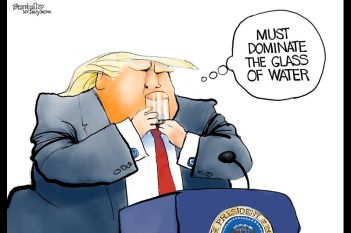 Raw Story reported on Trump whisperer Maggie Haberman’s assessment on CNN: Trump upset with coverage of his health as questions swirl over his potential maladies: Maggie Haberman.
Appearing on CNN’s “New Day” to discuss the state of Donald Trump’s health, Maggie Haberman of the New York Times said whether the president is hiding illness or not, coverage of his problems walking down a ramp, as well as footage of him struggling to raise his right arm high enough for him to take a drink, is troubling to the president.
With CNN medical expert Sanjay Gupta begging off from diagnosing Trump, the New York Times reporter was asked about the political implications for the president.
“Perhaps no one more sensitive to how his health and stamina is portrayed in public than the president himself and you saw that in his tweet explaining this over the weekend, trying to explain that slow walk down the ramp,” New Day co-host Alisyn Camerota began. “What is the president’s level of concern, given that he has not been shy about attacking his political opponents as somehow not being up to the job?”
“Look, this is never coverage the president wants of anything related to his health,” the reporter replied. “As you know he invited it by responding to the videos [on Twitter]. It wasn’t just the video of him on a ramp; there was another video of him having trouble lifting a water glass to his mouth, where he had to use his left hand to basically finish helping his right arm guide it to his mouth at a speech at West Point — he never likes coverage like this.”
“As I said, he invited it by tweeting about it,” she continued. “I think Sanjay is right. We don’t know what the issue is, we don’t know from looking at this video. We know the president has had issues with stairs before, but as Sanjay also says, there are a lot of questions around the president’s physical fitness, because he has dictated a note to a doctor in 2016, because he had this still unexplained, other than saying he wanted to get a jump on his physical, abrupt visit to Walter Reed [Hospital] last year.”
One more from Jennifer Rubin: Trump is in denial about his and others’ health.
On Saturday, at his address at the U.S. Military Academy in West Point, N.Y., he needed two hands to sip a glass of water. His tottering, baby steps down a ramp while exiting was the latest episode in which he seemed to have trouble navigating uneven footing….
We will likely never know until he is out of the White House what mental and/or physical ailments may afflict him. Two things are clear, however. First, it is an entirely legitimate topic for the campaign. The media should not relent in asking questions and demanding to speak with his doctors. Second, former vice president Joe Biden, a spry and fit 77-year-old, would be foolish not to mention it during the campaign. Trump increasingly seems like he is from another era, not someone who can make America great, but rather someone who never left the 1950s. His doddering appearance and faltering speech only add to the image of a man fading before our eyes.
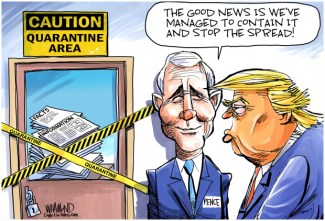 More news to check out, links only:
The Independent: Trump dismisses uptick in US coronavirus cases and suggests a ‘stop’ to testing.
The Daily Beast: Trump’s COVID Data Crunchers See Coronavirus Racing Down America’s Major Highways.
Business Insider: Fauci said US government held off promoting face masks because it knew shortages were so bad that even doctors couldn’t get enough.
The New York Times: Pence Tells Governors to Repeat Misleading Claim on Outbreaks.
ABC News: Robert Fuller’s hanging death under investigation despite ‘initial signs’ of suicide: Officials.
The Cut: Everything We Know About the Killing of Rayshard Brooks by Atlanta Police.
Market Watch: Seattle bans police crowd-control weapons, saying they’ve been used ‘without provocation’
The Washington Post: Officials familiar with Lafayette Square confrontation challenge Trump administration claim of what drove aggressive expulsion of protesters.
The Washington Post: What has the Trump administration done with a half-trillion dollars?
The Washington Post: President Trump says his family is unified. A niece’s book could explode that image.
New York Magazine: Trump’s Niece to Make a Big Addition to the Genre of Tell-all Trump Books.
I know this isn’t much of a post, but I’m really struggling with following the news these days. What’s on your mind today?
Lazy Caturday Reads
Posted: June 13, 2020 Filed under: morning reads, U.S. Politics | Tags: Abraham Lincoln, caturday, Civil Rights, Civil War, Donald Trump, Fox News, Harris Faulkner, John F. Kennedy, Racism 16 Comments
Good Morning!!
On Thursday, June 11, Lawrence O’Donnell discussed the speech on Civil Rights that President John F. Kennedy gave from the Oval Office on that day in 1963. The purpose of the speech was to propose the Civil Rights bill that passed after Kennedy’s assassination. Fifty-seven years later, we’ve made some progress, but systemic racism still runs rampant in this country. I thought I’d share some excerpts from that long-ago speech today.
NPR: John F. Kennedy’s Address on Civil Rights.
On June 11, 1963, President John F. Kennedy addressed the nation on the most pressing domestic issue of the day: the struggle to affirm civil rights for all Americans. His administration had sent National Guard troops to accompany the first black students admitted to the University of Mississippi and University of Alabama.
Excerpts selected by NPR:
…It ought to be possible… for American students of any color to attend any public institution they select without having to be backed up by troops.
…It ought to be possible for American consumers of any color to receive equal service in places of public accommodation, such as hotels and restaurants and theaters and retail stores, without being forced to resort to demonstrations in the street, and it ought to be possible for American citizens of any color to register and to vote in a free election without interference or fear of reprisal.
Painting by Ekaterina Mateckaya
It ought to be possible, in short, for every American to enjoy the privileges of being American without regard to his race or his color. In short, every American ought to have the right to be treated as he would wish to be treated, as one would wish his children to be treated. But this is not the case….
…This is not a sectional issue…Nor is this a partisan issue…This is not even a legal or legislative issue alone. It is better to settle these matters in the courts than on the streets, and new laws are needed at every level, but law alone cannot make men see right.
We are confronted primarily with a moral issue. It is as old as the scriptures and is as clear as the American Constitution.
The heart of the question is — whether all Americans are to be afforded equal rights and equal opportunities. Whether we are going to treat our fellow Americans as we want to be treated. If an American, because his skin is dark, cannot eat lunch in a restaurant open to the public, if he cannot send his children to the best public school available, if he cannot vote for the public officials who represent him, if, in short, he cannot enjoy the full and free life which all of us want, then who among us would be content to have the color of his skin changed and stand in his place? Who among us would then be content with the counsels of patience and delay?
One hundred years of delay have passed since President Lincoln freed the slaves, yet their heirs, their grandsons, are not fully free….
…It is not enough to pin the blame on others, to say this is a problem of one section of the country or another, or deplore the fact that we face. A great change is at hand, and our task, our obligation, is to make that revolution, that change, peaceful and constructive for all.
Those who do nothing are inviting shame as well as violence. Those who act boldly are recognizing right as well as reality…

You can watch the entire speech at C-Span. I watched it yesterday and it made me so sad. The comparison between Kennedy and the current occupant of the White House so so glaring. Not only was Kennedy capable of compassion and empathy, but he also spoke eloquently, in complete sentences and paragraphs. Today we have a fraudulent “president” who babbles nonsense, effortlessly lies about everything and has no idea how to do the job he holds even if he actually wanted to be a leader.

Cat in the window, by Joanna DeRitis
Speaking of Trump’s incoherent babbling, on Thursday he gave another strange Fox News interview with Harris Faulkner (who is black). For Fox, the questions were pretty tough. You can read the transcript and watch video excerpts at Factbase.
The most stunning moment in the interview was when Trump claimed to have done more for black Americans than any previous president, including Abraham Lincoln. Business Insider: Trump says Abraham Lincoln ‘did good’ for the Black community but that ‘the end result’ is ‘questionable.’
“So I think I’ve done more for the Black community than any other president, and let’s take a pass on Abraham Lincoln because he did good, although it’s always questionable, you know, in other words, the end result —” Trump said before Faulkner interjected.
“Well, we are free, Mr. President, so I think he did pretty well,” she said, referring to Lincoln.
“We are free,” Trump said. “You understand what I mean.”
“Yeah, I get it,” Faulkner said.
This isn’t the first time Trump has claimed he’s done more for the Black community than his predecessors.
“This may well be the president’s most audacious claim ever,” Michael Fauntroy, a professor of political science at Howard University, told The New York Times earlier this month. “Not only has he not done more than anybody else, he’s done close to the least.”
Of course it’s not really clear what Trump was trying to say, because his speech is so incoherent. At Slate, Jeremy Stahl tries to make sense of Trump’s words: What Was Trump Trying to Say About Abraham Lincoln?
A lot of people saw the transcript of those words—and perhaps watched the clip—and interpreted Trump as having said that “the end result” of Lincoln’s presidency—i.e., winning the Civil War, preserving the union, and ending the atrocity of chattel slavery—was “always questionable.” [….]
By Utagawa Hiroshige
I would never definitively state that I believed Trump didn’t mean the most racist possible interpretation of one of his often hard-to-grasp word salads. Indeed, he has in the past questioned the fact that the Civil War needed to occur, stating in 2017 that had Andrew Jackson been president at the time he would have stopped the Civil War from happening because he would have realized “there’s no reason for this.”
“The Civil War, if you think about it, why? People don’t ask the question, but why was there the Civil War? Why could that one not have been worked out?” Trump said back then.
As my former colleague, Jamelle Bouie, wrote at the time, that statement—apparently that Jackson could have come up with a perfect “deal” to prevent the Civil War—was as dangerous as it was ahistorical.
Given that past remark, it’s certainly plausible that Trump’s brain is so rotted from his own racism that he would say that the end results of Lincoln’s presidency were “questionable.” Based on the context of the question, though, and more recent comments from Trump, I think that is unlikely.
I interpret this particular word salad to be an attempt by Trump to validate his recent tweet that his administration “has done more for the Black Community than any President since Abraham Lincoln.”

Trump was likely attempting to say that while “I think I’ve done more for the black community than any other president,” he would ask that in such a ranking “let’s take a pass” on including Lincoln, because it’s an unfair comparison, but—even if he were to go head-to-head with Lincoln for the title of “best president for black people ever”—despite the fact that Lincoln “did good,” it would still be “always questionable” whether Trump was better, because you have to consider “the end result” of each man’s presidency.
Okay . . . I guess that’s as good an interpretation as any.
At Vox, Zach Beauchamp discusses another howler from the interview: Trump: “The concept of chokehold sounds so innocent, so perfect.”
When asked about police use of chokeholds on suspects like George Floyd, who was killed after a Minneapolis officer pinned him by the neck with his knee for nearly nine minutes, Trump initially told Faulkner that “I don’t like chokeholds,” even saying that “generally speaking, they should be ended.” But he contradicted that pretty quickly, saying that when you’ve got someone who is “a real bad person … what are you gonna do now — let go?”
He even went further, saying that “the concept of chokehold sounds so innocent, so perfect,” if a lone police officer is attempting to detain someone.
Deborah DeWitt, Birdwatching
His position, as far as I can tell, seems to be that maybe sometimes individual officers need to use chokeholds, but the more police there are, the less likely it is they’ll need to use one:
TRUMP: I think the concept of chokehold sounds so innocent, so perfect. And then you realize, if it’s a one-on-one. But if it’s two-on-one, that’s a little bit a different story. Depending on the toughness and strength — you know, we’re talking about toughness and strength. There’s a physical thing here too.
FAULKNER: If it’s a one-on-one for the [officer’s] life …
TRUMP: And that does happen, that does happen. You have to be careful.
The most relevant part here isn’t the president’s views on the details of self-defense tactics, but rather the lack of empathy in the way he talks about the issue. The only world in which police using chokeholds could sound “innocent” or “perfect” is a world in which you don’t think about what happens to people when they’re literally being choked — or one where you assume that it won’t happen to people like you.
A recent LA Times investigation found that 103 people were “seriously injured” by police using “carotid neck restraints” in California between 2016 and 2018. Black people, who make up 6.5 percent of the state’s population, were 23 percent of those injured in such holds.
Trump’s thinking seems so deeply shaped by his sense of generalized police innocence, his unwillingness to really process the fact of racial discrimination in police use of force, that he’s capable of saying out loud that chokeholds sound “innocent.”

What all this interpretation really boils down to is that Trump is disastrously incapable of doing the job of POTUS. And yet we’re stuck with him, so writers struggle to figure out what the hell he is talking about.
Stories to check out today
David Smith at The Guardian: ‘He just doesn’t get it’: has Trump been left behind by America’s awakening on racism?
The Washington Post: Trump says he’ll ‘go on and do other things’ if he loses in November.
Julian Borger at The Guardian: ‘Trump thought I was a secretary’: Fiona Hill on the president, Putin and populism.
The New York Times: Trump’s Actions Rattle the Military World: ‘I Can’t Support the Man’
NBC News: From ‘beautiful letters’ to ‘a dark nightmare’: How Trump’s North Korea gamble went bust.
The New York Times: Trump Moves Tulsa Rally Date ‘Out of Respect’ for Juneteenth.
The Daily Beast: Survivors of KKK’s Ax Handle Attack Appalled at Trump Speech.
The Washington Post: Republicans and Trump want a Jacksonville convention party. Some locals are worried about the area’s health.
The Daily Beast: A Black Man Was Found Hanging From a Tree—Residents Don’t Buy That It Was a Suicide.
Jonathan Chait at New York Magazine: Michael Flynn Writes Column Confirming He Is Definitely Insane.
USA Today: Fired Florida scientist builds coronavirus site showing far more cases than state reports.
Thursday Reads
Posted: June 11, 2020 Filed under: morning reads, U.S. Politics | Tags: Bill Barr, Boston, Christopher Columbus statues, Department of Justice, Donald Trump, Houston, Judge John Gleeson, Kennedy Mitchum, Merriam-Webster, miami, MN, Racism, Richmond, St. Paul, VA 12 Comments
A statue depicting Christopher Columbus is seen with its head removed at Christopher Columbus Waterfront Park on June 10, 2020 in Boston. (Photo by Tim Bradbury/Getty Images)
Good Morning!!
The movement inspired by the murder of George Floyd has inspired more than the Black Lives Matter protests. People are toppling statues now, and not just the ones of confederate traitors.
Someone beheaded the Christopher Columbus statue in Boston’s North End yesterday. (The North End used to be Boston’s “little Italy.”) WBZ (CBS) Boston: Beheaded Christopher Columbus Statue In Boston Will Be Removed From North End Park.
The Christopher Columbus statue in Boston’s North End will be removed after it was beheaded early Wednesday morning. Mayor Marty Walsh said it will be put in storage and there will now be conversations about the “historic meaning” of the incident and whether it will ever go back up.
The statue in Christopher Columbus Park on Atlantic Avenue was surrounded by crime scene tape as the head lay on the ground next to the base.
Now, as police investigate how it happened, local indigenous groups are calling on the mayor to remove the statue for good.
“It’s a park dedicated to white supremacy,” said Mahtowin Munro of the United American Indians of New England. “It’s a park dedicated to indigenous genocide.” [….]
The head was also cut off back in 2006. The statue was doused with red paint in June 2015 with the words “Black Lives Matter” spray-painted on the base.
Another statue of Columbus was taken down at Minnesota’s state capitol in St. Paul. Minneapolis Star-Tribune: Protesters topple Columbus statue on Minnesota Capitol grounds.
Protesters lassoed a statue of Christopher Columbus outside the State Capitol Wednesday afternoon and pulled it to the ground, saying their action was a step toward healing for Indian communities.
People danced in a circle around the Christopher Columbus statue after it was toppled on Wednesday night on the Minnesota State Capitol grounds in St. Paul.
Dozens of people gathered by the statue on the grounds outside the Capitol before pulling it down. American Indian Movement activist Mike Forcia talked to a State Patrol captain sent to the scene to encourage protesters to follow a legal process for removing the statue, which has stood on the Capitol grounds since 1931. Forcia said they had tried that route many times and it had not worked.
The protesters then looped a rope around the statue and quickly pulled it off the stone pedestal and to the ground. The patrol officer watched from a distance as protesters sang and took photos with the statue for about half an hour.
State officials said they had been warned about the action via social media. It was mentioned at a news conference an hour and a half earlier with Gov. Tim Walz. Public Safety Commissioner John Harrington said then that the patrol would meet the protesters and seek an alternative resolution.
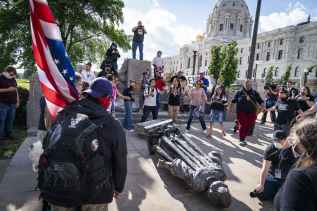
In Richmond, VA, a Columbus statue was pulled down, set on fire, and rolled into a lake. Another Columbus statue was vandalized in Houston and another in Miami.
Two other stories of note on the topic of racism and Black Lives Matter protests:
Associated Press: Pope sends strong message to US Catholics after Floyd death.
VATICAN CITY (AP) — Pope Francis called George Floyd by name, twice, and offered support to an American bishop who knelt in prayer during a Black Lives Matter protest.
Cardinals black and white have spoken out about Floyd’s death, and the Vatican’s communications juggernaut has shifted into overdrive to draw attention to the cause he now represents.
Christopher Columbus statue dumped in lake in Richmond, VA
Under normal circumstances, Floyd’s killing at the hands of a white police officer and the global protests denouncing racism and police brutality might have drawn a muted diplomatic response from the Holy See. But in a U.S. election year, the intensity and consistency of the Vatican’s reaction suggests that, from the pope on down, it is seeking to encourage anti-racism protesters while making a clear statement about where American Catholics should stand ahead of President Donald Trump’s bid for a second term in November….
Last week, Francis denounced the “sin of racism” and twice identified Floyd as the victim of a “tragic” killing. In a message read in Italian and English during his general audience, Francis expressed concerns about violence during the protests, saying it was self-destructive.

Read more at the link.
Kennedy Mitchum wasn’t expecting much when she emailed Merriam-Webster last month, but she wanted to let the dictionary publisher know that she thought its definition of the word racism was inadequate.
So she was surprised when an editor responded and even more surprised that the company agreed to update the entry.
Mitchum has gotten into a lot conversations about racism and injustice where people have pointed to the dictionary to prove that they’re not racist. It’s happened a lot more lately as the world reacts to the death of George Floyd while in the custody of four Minneapolis police officers….
Kennedy Mitchum
“I kept having to tell them that definition is not representative of what is actually happening in the world,” she told CNN. “The way that racism occurs in real life is not just prejudice it’s the systemic racism that is happening for a lot of black Americans.”
Merriam-Webster’s first definition of racism is “a belief that race is the primary determinant of human traits and capacities and that racial differences produce an inherent superiority of a particular race.” [….]Mitchum said she sent her email on a Thursday night and got a reply from editor Alex Chambers the next morning.
After a few emails, Chambers agreed that the entry should be updated and said a new definition is being drafted.
“This revision would not have been made without your persistence in contacting us about this problem,” Chambers said in the email, which was provided to CNN. “We sincerely thank you for repeatedly writing in and apologize for the harm and offense we have caused in failing to address this issue sooner.”

Meanwhile, a backlash against Trump and his pet AG Bill Barr is building over the violent clearing of Lafayette Square to facilitation Trump’s ludicrous Bible photo op last week.
Tom McCarthy at The Guardian: ‘An abuse of power’: alarm grows over top Trump lieutenant’s military masquerade.
…[T]he top law enforcement official in the country, the attorney general, William Barr, is facing an internal crisis of confidence and growing calls for his own resignation.
Barr stands accused of directing violence against peaceful demonstrators outside the White House earlier this month, and with peddling a conspiracy theory advanced by Donald Trump in an attempt to smear protesters, who enjoy wide public support.
Trump/Barr attack on protesters in Lafayette Park
In the first 16 months of his tenure, Barr caught criticism for compromising justice department independence with his seemingly lockstep defense of Trump, whether he was protecting the president from the investigation of special counsel Robert Mueller or intervening in criminal cases against the former Trump aides Michael Flynn and Roger Stone.
But Barr’s critics now fear that he has taken a new step, of trying on a military hat as the president’s top lieutenant in the antagonistic posture the White House has taken against street protests that have sprung up after the killing of George Floyd, an African American man, in Minneapolis by white police officers.

A bit more:
The attorney general’s denial at the weekend that systemic racism was a problem in US law enforcement prompted new calls for his resignation.
“I think there’s racism in the United States still, but I don’t think that the law enforcement system is systemically racist,” Barr told CBS News’ Face the Nation. “And I would say, you know, the president, before any of this happened, was out in front on this issue.”
On no planet has Trump been “out in front” in the campaign against racist policing, said Kandace Montgomery, director of Black Visions, a Twin Cities-based activist organization.
“William Barr is a white man who is serving a racist administration, so of course he’s going to deny the fact that the current law enforcement system is systemically racist,” Montgomery said.
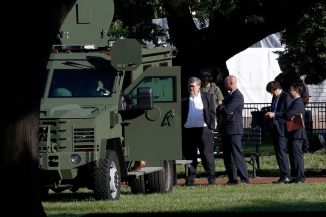
Bill Barr checking out the “troops” before ordering them to attack peaceful protesters.
The Washington Post: More than 1,250 former Justice Dept. workers call for internal watchdog to probe Barr role in clearing demonstrators from Lafayette Square.
More than 1,250 former Justice Department workers on Wednesday called on the agency’s internal watchdog to investigate Attorney General William P. Barr’s involvement in law enforcement’s move last week to push a crowd of largely peaceful demonstrators back from Lafayette Square using horses and gas.
In a letter to Justice Department Inspector General Michael Horowitz, the group said it was “deeply concerned about the Department’s actions, and those of Attorney General William Barr himself, in response to the nationwide lawful gatherings to protest the systemic racism that has plagued this country throughout its history.”
“In particular, we are disturbed by Attorney General Barr’s possible role in ordering law enforcement personnel to suppress a peaceful domestic protest in Lafayette Square on June 1, 2020, for the purpose of enabling President Trump to walk across the street from the White House and stage a photo op at St. John’s Church, a politically motivated event in which Attorney General Barr participated,” the group wrote.
The group asked Horowitz to “immediately open and conduct an investigation of the full scope of the Attorney General’s and the DOJ’s role” in that and other events.
“The rule of law, the maintenance of the Department’s integrity, and the very safety of our citizens demand nothing less,” the group wrote.
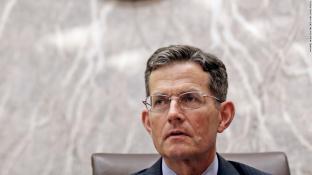
Barr was also publicly excoriated by former Judge John Gleeson for his attempt to drop charges against Michael Flynn. Paul Waldman at The Washington Post: A retired judge’s sharp rebuke of William Barr confirms the worst.
Judge John Gleeson
Back in May, long after Flynn had pleaded guilty to lying to FBI agents in their investigation into Russia’s attack on the 2016 election — which got him fired as national security adviser after 24 days on the job — Barr took the extraordinary step of seeking to drop the case against him before he could be sentenced. In response, the judge in the case asked a respected retired judge to make a recommendation about how this highly unusual situation should be handled.
That retired judge, John Gleeson, not only recommended that Flynn be sentenced as planned but issued a scathing report condemning the Justice Department’s actions in the case:
In his argument, Gleeson said the government’s “ostensible grounds” for seeking dismissal were “conclusively disproven” by its own earlier briefs; contradict the court’s prior orders and Justice Department positions taken in other cases; and “are riddled with inexplicable and elementary errors of law and fact.”
A former federal prosecutor and judge for 22 years in Brooklyn — best known for putting the late mob boss John Gotti behind bars and presiding over the trial of “Wolf of Wall Street” stockbroker Jordan Belfort — Gleeson wrote that judges are empowered to protect their court’s integrity “from prosecutors who undertake corrupt, politically motivated dismissals. That is what has happened here. The Government has engaged in highly irregular conduct to benefit a political ally of the President.”
Not only that, Gleeson stated that “Flynn has indeed committed perjury in these proceedings, for which he deserves punishment,” but recommended that instead of a separate prosecution, Flynn’s misdeeds should be taken into account when he is sentenced for the crime he pleaded guilty to.
Read the rest at the WaPo.
Of course there is much more news out there. I’ll add some links in the comment thread and I hope you will too.
Tuesday Reads: The Pandemic Is Still With Us
Posted: June 9, 2020 Filed under: morning reads, U.S. Politics | Tags: coronavirus pandemic, Covid-19, street art 10 Comments
Street Artist Corie Mattie, “I wanted to find some way to help raise awareness and also give hope.”
Good Morning!!
For the past couple of weeks, the Covid-19 pandemic has been pushed off the front pages by massive protests against police brutality triggered by the murder of George Floyd in Minneapolis. But the virus is still raging across the U.S. and we still are not doing enough to deal with the consequences, including economic ones.
The Washington Post: 14 states and Puerto Rico hit highest seven-day average of new coronavirus infections.
Since the start of June, 14 states and Puerto Rico have recorded their highest-ever seven-day average of new coronavirus cases since the pandemic began, according to data tracked by The Washington Post: Alaska, Arizona, Arkansas, California, Florida, Kentucky, New Mexico, North Carolina, Mississippi, Oregon, South Carolina, Tennessee, Texas and Utah.
If the pandemic’s first wave burned through dense metro hubs such as New York City, Chicago and Detroit, the highest percentages of new cases are coming from places with much smaller populations: Lincoln County, Ore., an area of less than 50,000, has averaged 20 new daily cases; the Bear River Health District in northern Utah has averaged 78 new cases a day in the past week, most of them tied to an outbreak at a meat processing plant in the small town of Hyrum.
The increase of coronavirus cases in counties with fewer than 60,000 people is part of the trend of new infections surging across the rural United States. Health experts worry those areas, already short of resources before the pandemic, will struggle to track new cases with the infrastructure that remains.
Adding to the disparity in health-care support, residents in states such as Mississippi, Florida and South Carolina are living under only minor-to-moderate restrictions — even as their average daily infection rate is rising.
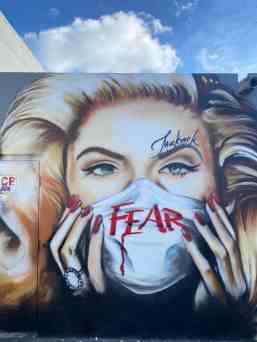
Jules Muck, artist. Photo by Paul Lara
Here’s a story from one of those states, Arizona. Tucson.com: Arizona hospitals bracing for crisis as COVID-19 cases surge.
Last week marked the largest week-to-week increase of coronavirus cases in both Arizona and Pima County since the pandemic began, and Banner Health is reporting its ICUs are at full capacity in Maricopa County and rapidly approaching full capacity in Tucson.
New, confirmed cases in Arizona totaled 4,500 from May 24 to May 30, according to the Arizona Department of Health Services, as of Saturday morning. That’s nearly a 50% increase from the week before.
In Pima County, cases totaled 481 over the same period, marking an 85% increase from the previous week.
The county Health Department is watching closely to see if these cases will turn into hospitalizations, visits to intensive care units and ultimately deaths, said Dr. Francisco Garcia, the county’s chief medical officer….
Dr. Marjorie Bessel, Banner Health’s chief clinical officer, said on Friday that COVID-19 hospitalizations are rapidly increasing and that, if these trends continue, Banner will soon need to start surge planning and increase bed capacity.
Most concerning, she said, is the steep incline of COVID-19 patients on ventilators. As of Thursday, Banner had 116 COVID-19 patients on ventilators statewide.
According to newly released studies, closing down states’ economies and urging people to stay home worked to reduce spread of the virus. The Washington Post: Shutdowns prevented 60 million coronavirus infections in the U.S., study finds.
Shutdown orders prevented about 60 million novel coronavirus infections in the United States and 285 million in China, according to a research study published Monday that examined how stay-at-home orders and other restrictions limited the spread of the contagion.
A separate study from epidemiologists at Imperial College London estimated the shutdowns saved about 3.1 million lives in 11 European countries, including 500,000 in the United Kingdom, and dropped infection rates by an average of 82 percent, sufficient to drive the contagion well below epidemic levels.
Street art, NYC
The two reports, published simultaneously Monday in the journal Nature, used completely different methods to reach similar conclusions. They suggest that the aggressive and unprecedented shutdowns, which caused massive economic disruptions and job losses, were effective at halting the exponential spread of the novel coronavirus.
“Without these policies employed, we would have lived through a very different April and May,” said Solomon Hsiang, director of the Global Policy Laboratory at the University of California at Berkeley, and the leader of the research team that surveyed how six countries — China, the United States, France, Italy, Iran and South Korea — responded to the pandemic.
His team estimated that, in the initial days after the virus was seeded in each country, and before the shutdowns, the number of infections was doubling every two days.
“The disease was spreading at a really extraordinary rate that is rare even among very infectious diseases,” he said in an interview. The global response to covid-19, the disease caused by the virus, resulted in “saving more lives in a shorter period of time than ever before,” he said in a separate conference call with reporters.

But at The Atlantic, Alexis C. Madrigal and Robinson Meyer write: America Is Giving Up on the Pandemic.
After months of deserted public spaces and empty roads, Americans have returned to the streets. But they have come not for a joyous reopening to celebrate the country’s victory over the coronavirus. Instead, tens of thousands of people have ventured out to protest the killing of George Floyd by police.
Demonstrators have closely gathered all over the country, and in blocks-long crowds in large cities, singing and chanting and demanding justice. Police officers have dealt with them roughly, crowding protesters together, blasting them with lung and eye irritants, and cramming them into paddy wagons and jails.
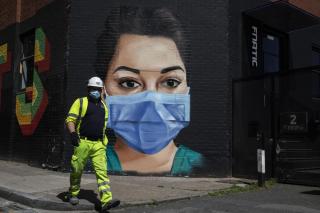
London, street art
There’s no point in denying the obvious: Standing in a crowd for long periods raises the risk of increased transmission of SARS-CoV-2, the virus that causes COVID-19. This particular form of mass, in-person protest—and the corresponding police response—is a “perfect set-up” for transmission of the virus, Anthony Fauci, the director of the National Institute of Allergy and Infectious Diseases, said in a radio interview on Friday. Some police-brutality activists (such as Black Lives Matter Seattle) have issued statements about the risk involved in the protests. Others have organized less risky forms of protests, such as Oakland’s Anti Police-Terror Project’s massive “caravan for justice.”
Americans may wish the virus to be gone, but it is not. While the outbreak has eased in the Northeast, driving down the overall national numbers, cases have only plateaued in the rest of the country, and they appear to be on the rise in recent days in COVID Tracking Project data. Twenty-two states reported 400 or more new cases Friday, and 14 other states and Puerto Rico reported cases in the triple digits. Several states—including Arizona, North Carolina, and California—are now seeing their highest numbers of known cases.
These numbers all reflect infections that likely began before this week of protest. An even larger spike now seems likely. Put another way: If the country doesn’t see a substantial increase in new COVID-19 cases after this week, it should prompt a rethinking of what epidemiologists believe about how the virus spreads.
This is a long article, and I hope you’ll read the rest at the link above. But I want to quote one more paragraph.
Americans have not fully grasped that we are not doing what countries that have returned to normal have done. Some countries have almost completely suppressed the virus. Others had large outbreaks, took intense measures, and have seen life return to normal. Americans, meanwhile, never stayed at home to the degree that most Europeans have, according to mobility data from Apple and Google. Our version of the spring lockdown looked more like Sweden’s looser approach than like the more substantial measures in Italy, or even the United Kingdom and France. Swedish public-health officials have acknowledged that this approach may not have been the best path forward.
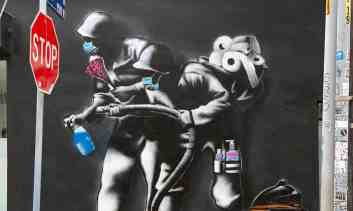
A piece by Hijack Art in Los Angeles.
I’m really worried that we’ll soon see spikes in infections in states like mine (Massachusetts) and others that have managed to reduce the spread and are now reopening.
There is also the matter of the economy. Is Congress going to do anything further to help Americans who lost jobs and are now facing hunger? Eater: Food Banks Need More Government Help to Address Unprecedented Levels of Food Insecurity.
One of the lasting images of the coronavirus pandemic will be that of thousands of cars lined up bumper to bumper in front of food banks, a reminder of how many people in the U.S. have lost their incomes and the ability to feed themselves and their families over the past three months. Food pantries and other nonprofit organizations have struggled to respond to record demand in the face of such food insecurity, while also dealing with difficulties brought on by disrupted supply chains and volunteers who themselves may be vulnerable to virus exposure….
But some lawmakers say that federal agencies’ response to address this crisis has been slow. Out of the $850 million that the CARES Act and the Family First Coronavirus Response Act set aside for food banks nearly two months ago, less than $300 million has been sent out so far, Democratic members on the Senate Appropriations Committee told the Washington Post. The Post reports that those lawmakers aren’t accusing the Trump administration of “deliberate foot-dragging,” but rather, are saying that the status quo federal bureaucracy has not acted with the urgency that such an unprecedented situation requires.
The government appears to be slow-walking money that has already been appropriated. The Washington Post: Food banks and other key programs have received a fraction of allotted coronavirus money, angering some lawmakers.
More than two months after passage of the $2 trillion Cares Act, funding for some key programs to address the economic devastation from the coronavirus is moving out slowly or not at all. Even after the United States added 2.5 million jobs last month, 20 million people remain out of work and federal bureaucracies charged with processing record sums of money to respond to the crisis are struggling to snap into action.
The Cares Act directed $850 million for food banks, but less than $300 million has been sent out so far, according to Democratic staff members on the Senate Appropriations Committee. That’s despite unprecedented demand, with the number of people served at food banks increasing by more than 50 percent from a year ago, according to a recent survey by the nonprofit group Feeding America.
Street artist Ruben Rojas
Similarly, Congress appropriated $9 billion in March for the Community Development Block Grant and Emergency Solutions Grant programs, which fund health facilities, child care centers, and services for seniors and homeless people, among other things. Only about $250 million of that money has been obligated.
In another example, $100 million dedicated specifically to help nursing homes certify compliance standards for issues like infection control remains unspent two months after it became law as part of the Cares Act. Another $100 million to help ensure access to broadband for Americans in rural parts of the country also remains unspent.
A separate $100 million appropriation to help the Federal Emergency Management Agency purchase personal protective equipment for firefighters also hasn’t been spent. Additionally, less than half the $16 billion Congress dedicated over four separate pieces of legislation to bulking up critical medical supplies in the Strategic National Stockpile has been spent, according to the Democrats’ calculations.

Politico: Food Banks Pushed to the Brink.
The coronavirus pandemic and economic slowdown has left at least 20 million Americans out of work, sending demand skyrocketing at food banks and other feeding programs around the U.S. The Agriculture Department is already spending $3 billion on surplus meat, dairy, fruits and vegetables to help nonprofits meet their needs, but anti-hunger advocates say there’s another way Washington should help: Increase food stamp benefits so hungry families can buy more groceries instead of leaning on food banks.
Here’s the problem: Bolstering the Supplemental Nutrition Assistance Program is almost a nonstarter in Congress, even as lawmakers pour billions of dollars into unemployment insurance, stimulus checks and other aid, writes Pro Ag’s Helena Bottemiler Evich. Democrats and Republicans have waged a fierce partisan tug-of-war over whether to shrink or expand the food safety net, and before the pandemic, USDA had issued a series of rules aiming to crack down on SNAP benefits when the economy was strong.
Recent data shows that food insecurity rates are going through the roof. For example, a national survey in late April found that more than 17 percent of mothers reported that their children under the age of 12 weren’t getting enough to eat because the family couldn’t afford enough food — a more than 400 percent increase from when the government last measured hunger rates in 2018.
The ask: Anti-hunger groups have been pressing Congress to increase food stamp benefits by 15 percent until unemployment rates come down, a move that would give SNAP recipients about $25 more per month. The request has repeatedly been rejected by Republicans, but Democrats have pledged to make sure the provision is included in a future coronavirus response package.
I know these issues aren’t as exciting as the protests, but it’s important to remember that that virus hasn’t gone away and the protests are very likely to increase the spread. We’re face overwhelming problems as a country, but are we really ready to accept tens of thousands more unnecessary deaths? It appears that many Americans have already made that calculation.
Please take care everyone. Stay safe and stay healthy.
Lazy Caturday Reads
Posted: June 6, 2020 Filed under: morning reads, U.S. Politics 9 Comments
Jean-Jacques Bachelier White Angora Cat Chasing a Butterfly
Good Morning!!
I finally got my hair cut yesterday. That was the first time I’ve gone anywhere except the grocery store or to take walks in my neighborhood since the lock downs began. I couldn’t believe how much I enjoyed getting out and seeing familiar people again. And it’s such a great feeling having my hair look neat and tidy–and not falling in my face!
The entire experience of the pandemic has been surreal, but combined with the insanity of living with an insane “president,” I’ve had a sense of unreality for a long time. I know I’m not alone in this.
I hope that we are really beginning to emerge from the dark days, but I’m worried that the protests are going to increase the spread of the virus and lead to a second wave of infections. James Hamblin writes at The Atlantic: Curfews and Arrests Will Inflame the Pandemic.
The inescapable fact is that the demonstrations protesting the police killing of George Floyd will lead to spikes in coronavirus deaths. There is no denying this. The question is how to minimize them. The science of how to conduct a perfectly safe mass demonstration in a pandemic is still imperfect, but one thing is clear: The answer is not to clamp down on peaceful gatherings, incarcerate more people, and give everyone less time and space to social distance with draconian curfews. Policing triggered these protests, and the policing, not the protesting, may turn out to be the primary driver of viral transmission during them.
Lucian Bernhard, Woman and Cat
“There are obvious measures that individuals can take during demonstrations, like wearing masks and trying to stay physically distant,” says Sten Vermund, dean of the Yale School of Public Health (where I’m a lecturer on health policy). “Of course that’s not always possible in a crowd.” And even when crowds are allowed adequate space to spread out, some images from protests show these measures being ignored. Some amount of transmission will likely result. As of now, Vermund told me, “we can’t be sure how much.”
The most hopeful element of the protests from a viral-transmission perspective is “the safety of the great outdoors,” Vermund said. The virus is known to spread mainly in confined indoor spaces where air is recirculated, among people who have prolonged close contact. During a rally or march, people are typically outside and, ideally, moving around—not long in proximity with any particular person who may be contagious.
Prolonged, close contact with other people becomes more of a concern when protests are confined to certain hours and certain areas of town. On Tuesday, for example, police blocked a large group of protesters from exiting the Manhattan Bridge, trapping them in a dense, stagnant crowd. Such density is also inevitable when people are arrested and detained. Yesterday, the U.S. marked 10,000 people arrested during the recent protests. Some have been loaded onto buses to be transported, and then held in crowded group cells. In addition to the usual constitutional dilemmas of arresting peaceful protesters, these measures carry especially ominous significance during a pandemic, when giving people space is of the utmost importance….
As President Donald Trump and some mayors threaten to forcibly contain more protesters, they contradict and undermine the very measures put in places that have only just begun to lower the infection rate in the United States. The more that people are forced into confined spaces, the more opportunity the virus will have to spread. Yet peaceful protesters have been arrested en masse for curfew violations in places including New York, the world’s hardest-hit city, where the death toll from COVID-19 is approaching 17,000.


Pierre-Auguste Renoir, Girl sleeping with cat 1880
Yesterday Trump celebrated a supposed improvement in unemployment figures, but there’s a problem with the data, according to Heather Long at the Washington Post: A ‘misclassification error’ made the May unemployment rate look better than it is. Here’s what happened.
When the U.S. government’s official jobs report for May came out on Friday, it included a note at the bottom saying there had been a major “error” indicating that the unemployment rate likely should be higher than the widely reported 13.3 percent rate.
The special note said that if this “misclassification error” had not occurred, the “overall unemployment rate would have been about 3 percentage points higher than reported,” meaning the unemployment rate would be about 16.3 percent for May.
The Bureau of Labor Statistics, the agency that puts out the monthly jobs reports, said it was working to fix the problem.
“BLS and the Census Bureau are investigating why this misclassification error continues to occur and are taking additional steps to address the issue,” said a note at the bottom of the Bureau of Labor Statistics report….
Economists say the BLS was trying to be as transparent as possible about how hard it is to collect real-time data during a pandemic. The BLS admitted that some people who should have been classified as “temporarily unemployed” during the shutdown were instead misclassified as employed but “absent” from work for “other reasons.”
The “other reason” category is normally used for people on vacation, serving jury duty or taking leave to care for a child or relative. These are typically situations where the worker decides to take leave. But in this unusual pandemic circumstance, the “other reason” category was applied to some people staying at home and waiting to be called back.
More on this situation and the fragile U.S. economy from Neil Irwin at The New York Times: Don’t Lose the Thread. The Economy Is Experiencing an Epic Collapse of Demand.
By Irina Kalentieva
You can already sense in the public debate over the economy that people are starting to lose the thread — viewing the slight rebound from epic collapse as a sign that a crisis has been averted. That certainly is the kind of optimism evident in the stock market, which is now down a mere 1.1 percent for the year.
But there are clear signs that the collapse of economic activity has set in motion problems that will play out over many months, or maybe many years. If not contained, they could cause human misery on a mass scale and create lasting scars for families.
The fabric of the economy has been ripped, with damage done to millions of interconnections — between workers and employers, companies and their suppliers, borrowers and lenders. Both the historical evidence from severe economic crises and the data available today point to enormous delayed effects.
“There’s a lot of denial here, as there was in the 1930s,” said Eric Rauchway, a historian at the University of California, Davis, who has written extensively about the Great Depression. “At the beginning of the Depression, nobody wanted to admit that it was a crisis. The actions the government took were not adequate to the scope of the problem, yet they were very quick to say there had been a turnaround.”
Though it may not attract the attention that reopening beaches and a soaring stock market might, the evidence is everywhere if you look closely.

Read the rest at the NYT link.

Connie Dillman, Afternoon Nap
According to Reuters, a massive demonstration will take place in Washington DC today: Washington prepares for major protest as U.S. officials move to rein in police.
Protesters are expected to gather in Washington for a huge demonstration on Saturday, its police chief said, as U.S. street marches over the killing of a black man in custody enter a 12th day and authorities move to rein in policing tactics….
“We have a lot of public, open source information to suggest that the event on this upcoming Saturday may be one of the largest we’ve ever had in the city,” Washington DC Police Chief Peter Newsham told local media, adding that much of the city center would be closed to traffic from early in the day.
Newsham did not give a crowd estimate. Local media has predicted tens of thousands of attendees.
At The Atlantic, George Packer argues that all this protesting may be for naught: Shouting Into the Institutional Void.
The urban unrest of the mid-to-late 1960s was more intense than the days and nights of protest since George Floyd was murdered by a Minneapolis policeman. More people died then, more buildings were gutted, more businesses were ransacked. But those years had one advantage over the present. America was coming apart at the seams, but it still had seams. The streets were filled with demonstrators raging against the “system,” but there was still a system to tear down. Its institutions were basically intact. A few leaders, in and outside government, even exercised some moral authority.
Lyndon B. Johnson created a commission to study the causes and prevention of urban unrest. The Kerner Commission—named for its chairman, Governor Otto Kerner Jr. of Illinois—was an emblem of its moment. It didn’t look the way it would today. Just two of the 11 members were black (Roy Wilkins, the leader of the NAACP, and Edward Brooke, a Republican senator from Massachusetts); only one was a woman. The commission was also bipartisan, including a couple of liberal Republicans, a conservative congressman from Ohio with a strong commitment to civil rights, and representatives from business and labor. It reflected a society that was deeply unjust but still in possession of the tools of self-correction….
Girl with a Cat. (1837-87} by Ivan Nikolaevich Kramskoi
The difference between 1968 and 2020 is the difference between a society that failed to solve its biggest problem and a society that no longer has the means to try. A year before his death, King, still insisting on nonviolent resistance, called riots “the language of the unheard.” The phrase implies that someone could be made to hear, and possibly answer. What’s happening today doesn’t feel the same. The protesters aren’t speaking to leaders who might listen, or to a power structure that might yield, except perhaps the structure of white power, which is too vast and diffuse to respond. Congress isn’t preparing a bill to address root causes; Congress no longer even tries to solve problems. No president, least of all this one, could assemble a commission of respected figures from different sectors and parties to study the problem of police brutality and produce a best-selling report with a consensus for fundamental change. A responsible establishment doesn’t exist. Our president is one of the rioters.

It’s an important piece. I hope you’ll go read the whole thing. Packer says we no longer have a political and cultural “establishment” to provide a foundation for societal change.
One more from The Atlantic’s Franklin Foer: The Trump Regime Is Beginning to Topple.
Over the course of his presidency, Donald Trump has indulged his authoritarian instincts—and now he’s meeting the common fate of autocrats whose people turn against them. What the United States is witnessing is less like the chaos of 1968, which further divided a nation, and more like the nonviolent movements that earned broad societal support in places such as Serbia, Ukraine, and Tunisia, and swept away the dictatorial likes of Milošević, Yanukovych, and Ben Ali.
And although Trump’s time in office will end with an election and not an ouster, it is only possible to grasp the magnitude of what we’re seeing and to map what comes next by looking to these antecedents from abroad.
As in the case of many such revolutions, two battles are being waged in America. One is a long struggle against a brutal and repressive ideology. The other is a narrower fight over the fate of a particular leader. The president rose to power by inflaming racial tensions. He now finds his own fate enmeshed in the struggle against police brutality and racism.
The most important theorist of nonviolent revolutions is the late political scientist Gene Sharp. A conscientious objector during the Korean War who spent nine months in prison, Sharp became a close student of Mahatma Gandhi’s struggles. His work set out to extract the lessons of the Indian revolt against the British. He wanted to understand the weaknesses of authoritarian regimes—and how nonviolent movements could exploit them. Sharp distilled what he learned into a 93-page handbook, From Dictatorship to Democracy, a how-to guide for toppling autocracy.
Sharp’s foundational insight is embedded in an aphorism: “Obedience is at the heart of political power.” A dictator doesn’t maintain power on his own; he relies on individuals and institutions to carry out his orders. A successful democratic revolution prods these enablers to stop obeying. It makes them ashamed of their complicity and fearful of the social and economic costs of continued collaboration.
Sharp posited that revolutionaries should focus first on the regime’s softest underbelly: the media, the business elites, and the police. The allegiance of individuals in the outer circle of power is thin and rooted in fear. By standing strong in the face of armed suppression, protesters can supply examples of courage that inspire functionaries to stop carrying out orders, or as Sharp put it, to “withhold cooperation.” Each instance of resistance provides the model for further resistance. As the isolation of the dictators grows—as the inner circles of power join the outer circle in withholding cooperation—the regime crumbles.
Read the rest at The Atlantic.
Have a great weekend, Sky Dancers!

 peej
peej Carissa
 bostonboomer
 dakinikat
 ecocatwoman
 mablue2
 Mama Lopez
 peggysue22
 quixote
 skydancingguestblogger
 Mona (aka Wonk the Vote)



 Sky Dancing
Recent Comments