
Tuesday Reads
Posted: August 16, 2011 Filed under: Barack Obama, Democratic Politics, fundamentalist Christians, morning reads, religion, religious extremists, Republican politics, U.S. Economy, U.S. Politics | Tags: Ann Walsh Bradley, anonymous, Barack Obama, BART protests, bus tour, cell phone service, David Prosser, Decorah, dominionism, economy, excuses, FCC, fundamentalism, Iowa, low wage havens, reconstructionism, Rick Perry, San Francisco, serfdom, social networking, Wisconsin recall votes, Wisconsin Supreme Court 30 Comments
The reaction Obama should have to the unemployment numbers
Good Morning!! I wrote about Obama’s three-state bus tour last night, so I won’t go on and on about it; but I watched the speech at the Decorah town hall late last night. I just had to share this excerpt:
“We had reversed the recession, avoided a depression, gotten the economy moving again. But over the last six months we’ve had a run of bad luck. Some things that we could not control.” He mentioned the Arab Spring, which led to higher gas prices, the tsunami in Japan, and the European debt crises.
“All those things have been headwinds for our economy….Now, those are things that we can’t completely control. The question is, how do we manage these challenging times and do the right things when it comes to those things that we can control?”
“The problem is that we’ve got the kind of partisan brinksmanship that is willing to put party ahead of country, that is more interested in seeing their political opponents lose than seeing the country win. Nowhere was that more evident than in this recent debt ceiling debacle.”
So nothing was wrong with the administration’s policies? If it hadn’t been for those uncontrollable events, everything would have been just fine? Excuse me, but wasn’t there a report a last week that showed there basically has never been a real recovery?
Have you been following the Anonymous protests against the Bay Area Rapid Transit (BART) authority in San Francisco? The protests were in response to the shooting of a homeless man by BART police–the second such shooting in the past couple of years.
After a white BART police officer shot and killed an unarmed black man shortly after New Year’s 2009, the transit agency agreed to 127 policy changes recommended by an independent auditor. They included arming officers with Tasers and providing crisis-intervention training for the BART police force.
Eighteen months after the auditor issued its final report, BART has fulfilled only a fraction of those recommendations. By last month, barely a quarter of all officers possessed Tasers, even though the agency had purchased enough for each one. Just 10 percent had received training in how to defuse potentially violent situations involving the mentally ill.
On July 3, a BART officer shot and killed Charles Hill, a homeless man, at the Civic Center station in San Francisco. Transit police said Mr. Hill, appearing inebriated, was armed with a bottle and two knives and acted aggressively when two officers confronted him. After a minute-long confrontation, one of the officers shot Mr. Hill.
Last week, the hacktivist organization attempted to shut down BART with a ddos attack, which failed. Next,
participants took to raiding databases and leaking the personal information of 2,000 people.
On Thursday, BART switched off access to voice and data services, from all of the major cellular carriers, including AT&T, Verizon, Sprint, and T-Mobile. The shutdown was in response to plans to use mobile devices to coordinate protests during the evening commute.
“[The protest organizers]…stated they would use mobile devices to coordinate their disruptive activities and communicate about the location and number of BART Police….BART temporarily interrupted service at select BART stations as one of many tactics to ensure the safety of everyone on the platform,” a statement from BART said.
“Cell phone service was not interrupted outside BART stations. In addition, numerous BART Police officers and other BART personnel with radios were present during the planned protest, and train intercoms and white courtesy telephones remained available for customers seeking assistance or reporting suspicious activity.”
When I heard about this yesterday, I wondered if the U.S. was beginning to turn into Egypt, with authorities attempting to keep people from using social networking sites.
The digital interruption caused the protests to be cancelled, but enraged protesters. Thus, the stage was set for a confrontation today. And the confrontation came, with all four downtown SF BART stations forced to shut down.
BART temporarily closed all four downtown San Francisco stations tonight – Civic Center, Powell, Montgomery and Embarcadero – a crowd gathered to protest the transit agency’s decision to cut underground cellular phone service for three hours Thursday evening in an effort to quell a protest.
As of 6:45 p.m., the Civic Center and Montgomery stations were open. At the Powell and Embarcadero stations, passengers could exit trains but not board them.
The closures began at 5:25 p.m., when protesters were kicked out of the Civic Center station, then began marching toward the other stations. That prompted BART to close them, one by one.
The Muni Metro stations at the same locations were closed in tandem with the BART stations. Trains continued to run through the stations, only allowing passengers to exit.
In addition, the FCC has begun an investigation of BART’s actions in shutting down cell phone service. So I guess we’re not Egypt quite yet.
Remember the story about David Prosser, the Wisconsin Supreme Court judge who allegedly choked a female colleague, Anne Walsh Bradley? A special prosecutor has now been named to investigate the incident.
Sauk County District Attorney Patricia Barrett will serve as special prosecutor in the investigation of a physical altercation between two state Supreme Court justices.
Justice Ann Walsh Bradley has said Justice David Prosser put her in a “chokehold” during a June argument over a case in her chambers. Others have said Bradley came at Prosser with fists raised and he put up his hands to block her or push her back.
The incident occurred June 13, a day before the deeply divided court issued a 4-3 ruling upholding Republican Gov. Scott Walker’s legislation curtailing collective bargaining for public employees. That case started when Dane County District Attorney Ismael Ozanne brought a lawsuit claiming a legislative committee violated the state’s open meetings law in March in forwarding the legislation to the state Senate. Ozanne sought to invalidate the law, and implementing it was delayed for months while the case was pending.
The high court ultimately ruled key parts of the meetings law do not apply to lawmakers.
We’ll have to keep an eye on this story. Also in Wisconsin, today three Democrats face recall votes.
The Wisconsin recall fight ends Tuesday, and while the state Senate is no longer in play, Republicans could cut into the gains Democrats made last week. One Democratic seat in tomorrow’s election is probably safe; the race for the other one is very close.
“Here we’re fighting on our turf,” said Wisconsin Democratic Party spokesman Graeme Zielinski. “We’re cautiously optimistic.”
State Sen. Jim Holperin appears to have the slight edge in the hotly-contested 12th district as a well-liked incumbent, but increased Republican enthusiasm in this GOP-leaning territory makes it basically a toss-up.
Right now, Republicans have a 17-to-16 majority in the state Senate, thanks to the Democratic victories in last Tuesday’s recalls, when six Republicans faced challenges and two lost.
If you haven’t read it yet, please try to get through the Texas Monthly cover story on Rick Perry’s very bizarre religious beliefs. I can’t really do the story justice in a short excerpt, but just the same, I’ll give you a sample to get you started. Two pastors, Tom Schlueter of Arlington, TX and Bob Long of San Marcos, TX had come to see Perry at the Governor’s office in order to inform him of some prophecies that involved him (Perry). They explained that Texas is the “prophet state,” and will lead the U.S. toward “Godly rule.”
At the end of their meeting, Perry asked the two pastors to pray over him. As the pastors would later recount, the Lord spoke prophetically as Schlueter laid his hands on Perry, their heads bowed before a painting of the Battle of the Alamo. Schlueter “declared over [Perry] that there was a leadership role beyond Texas and that Texas had a role beyond what people understand,” Long later told his congregation.
[….]
At the end of their meeting, Perry asked the two pastors to pray over him. As the pastors would later recount, the Lord spoke prophetically as Schlueter laid his hands on Perry, their heads bowed before a painting of the Battle of the Alamo. Schlueter “declared over [Perry] that there was a leadership role beyond Texas and that Texas had a role beyond what people understand,” Long later told his congregation.
So you have to wonder: Is Rick Perry God’s man for president?
Schlueter, Long and other prayer warriors in a little-known but increasingly influential movement at the periphery of American Christianity seem to think so. The movement is called the New Apostolic Reformation. Believers fashion themselves modern-day prophets and apostles. They have taken Pentecostalism, with its emphasis on ecstatic worship and the supernatural, and given it an adrenaline shot.
The movement’s top prophets and apostles believe they have a direct line to God. Through them, they say, He communicates specific instructions and warnings. When mankind fails to heed the prophecies, the results can be catastrophic: earthquakes in Japan, terrorist attacks in New York, and economic collapse. On the other hand, they believe their God-given decrees have ended mad cow disease in Germany and produced rain in drought-stricken Texas.
Their beliefs can tend toward the bizarre. Some consider Freemasonry a “demonic stronghold” tantamount to witchcraft. The Democratic Party, one prominent member believes, is controlled by Jezebel and three lesser demons. Some prophets even claim to have seen demons at public meetings. They’ve taken biblical literalism to an extreme. In Texas, they engage in elaborate ceremonies involving branding irons, plumb lines and stakes inscribed with biblical passages driven into the earth of every Texas county.
Yikes!
Here’s another disturbing article, posted at The Institute for Southern Studies. Next low-wage haven: USA. This one is long too, but here’s just a bit of it.
For years advisers like the Boston Consulting Group got paid big bucks to tell their clients to produce in China. Now, they say, rising wages there, fueled by worker unrest, and low wages in Mississippi, Alabama, and South Carolina mean that soon it won’t be worth the hassle of locating overseas.
Wages for China’s factory workers certainly aren’t going to rise to U.S. levels soon. BCG estimates they will be 17 percent of the projected U.S. manufacturing average — $26 an hour for wages and benefits — by 2015.
But because American workers have higher productivity, and since rising fuel prices are making it even more expensive to ship goods half way around the world, costs in the two countries are converging fast.
Dan Luria, research director of the Michigan Manufacturing Technology Center, says many of the big-name consultancies, which until a year ago were advising their clients to “Asiafy their footprints,” are now telling companies to think twice.
BCG bluntly praises Mississippi’s “flexible unions/workers, minimal wage growth, and high worker productivity,” estimating that in four years, workers in China’s fast-growing Yangtze River Delta will cost only 31 percent less than Mississippi workers.
That’s before you figure in shipping, duties, and possible quality issues. Add it all up, says BCG, and “China will no longer be the default low-cost manufacturing location.”
Serfdom, here we come!
Last night I wrote about the suspicious suitcase that were left outside John Boehner’s Ohio office. A similar event happened in Beverly Hills today.
Beverly Hills police blew up an aspiring screenwriter’s laptop and script when investigating a suspicious package Thursday morning on Rodeo Drive.
The screenwriter, who was not identified, apparently left his briefcase — with the computer and script inside — unattended at a talent agency office.
Beverly Hills Police Lt. Tony Lee said police, not knowing what was inside the briefcase, detonated it as safety precaution.
Lee said the owner was distraught when he learned what happened to briefcase.
I hope his laptop wasn’t in the briefcase too.
Well, that’s all I’ve got for today. What are you reading and blogging about?
Monday Reads
Posted: August 15, 2011 Filed under: Domestic Policy, income inequality, morning reads, The Great Recession | Tags: Christine Romer, Income Inequality, repeating the 1937 recession, the disappearing american middle class 24 Comments Good Morning!
I’ve been wondering quite a bit recently about what is becoming of the American Middle Class. Some times it seems that the kind of situation that I grew up in is a far grasp from what any potential grandchildren of mine will have. Both of my daughters are highly educated and I still feel this way. While I study so much on the rise of a strong, vibrant middle class in many South East Asian countries, I cannot help but wonder what’s gone so wrong that we seem to be losing ours? This month has been a very violent one here in Louisiana. We’ve had a 7 year old boy with cerebral palsy killed–dismembered actually–by a mother’s boyfriend and a number of gang shootings recently. These kinds of crimes always increase with economic hopelessness and summer heat. It gets to me a lot these days.
Here’s a good question from September’s The Atlantic: “Can the Middle Class be Saved?”
It’s hard to miss just how unevenly the Great Recession has affected different classes of people in different places. From 2009 to 2010, wages were essentially flat nationwide—but they grew by 11.9 percent in Manhattan and 8.7 percent in Silicon Valley. In the Washington, D.C., and San Jose (Silicon Valley) metro areas—both primary habitats for America’s meritocratic winners—job postings in February of this year were almost as numerous as job candidates. In Miami and Detroit, by contrast, for every job posting, six people were unemployed. In March, the national unemployment rate was 12 percent for people with only a high-school diploma, 4.5 percent for college grads, and 2 percent for those with a professional degree.
Housing crashed hardest in the exurbs and in more-affordable, once fast-growing areas like Phoenix, Las Vegas, and much of Florida—all meccas for aspiring middle-class families with limited savings and education. The professional class, clustered most densely in the closer suburbs of expensive but resilient cities like San Francisco, Seattle, Boston, and Chicago, has lost little in comparison. And indeed, because the stock market has rebounded while housing values have not, the middle class as a whole has seen more of its wealth erased than the rich, who hold more-diverse portfolios. A 2010 Pew study showed that the typical middle-class family had lost 23 percent of its wealth since the recession began, versus just 12 percent in the upper class.
The ease with which the rich and well educated have shrugged off the recession shouldn’t be surprising; strong winds have been at their backs for many years. The recession, meanwhile, has restrained wage growth and enabled faster restructuring and offshoring, leaving many corporations with lower production costs and higher profits—and their executives with higher pay.
The entire issue covers the disappearing US middle class and it’s worth checking out. Yes, it was happening prior to the 2007-2008 meltdown, but the acceleration of the decline of the standards of living for most Americans is hard to miss. We shouldn’t forget how that happened. Steven Pearlstein at the WP places blame squarely with the corporate lobby.
When it started out all you really wanted was to push back against a few meddlesome regulators or shave a point or two off your tax rate, but you were concerned it would look like special-interest rent-seeking. So when the Washington lobbyists came up with the clever idea of launching a campaign against over-regulation and over-taxation, you threw in some money, backed some candidates and financed a few lawsuits.
The more successful it was, however, the more you put in — hundreds of millions of the shareholders’ dollars, laundered through once-respected organizations such as the Chamber of Commerce and the National Association of Manufacturers, phoney front organizations with innocent-sounding names such as Americans for a Sound Economy, and a burgeoning network of Republican PACs and financing vehicles. And thanks to your clever lawyers and a Supreme Court majority that is intent on removing all checks to corporate power, it’s perfectly legal.
Somewhere along the way, however, this effort took on a life of its own. What started as a reasonable attempt at political rebalancing turned into a jihad against all regulation, all taxes and all government, waged by right-wing zealots who want to privatize the public schools that educate your workers, cut back on the basic research on which your products are based, shut down the regulatory agencies that protect you from unscrupulous competitors and privatize the public infrastructure that transports your supplies and your finished goods. For them, this isn’t just a tactic to brush back government. It’s a holy war to destroy it — and one that is now out of your control.
Dr. Christine Romer suggests that all we have to do is look to our history for good lessons. Yes, she’s the Obama economic advisor that kept having to explain continually why all those labor market numbers were looking so bad for two years while not having much input into the change that would’ve made things different right now.
One reason the Depression dragged on so long was that the rapid recovery of the mid-1930s was interrupted by a second severe recession in late 1937. Though many factors had a role in the “recession within a recession,” monetary and fiscal policy retrenchment were central. In monetary policy, the Fed doubled bank reserve requirements and the Treasury stopped monetizing the gold inflow. In fiscal policy, the federal budget swung sharply, from a stimulative deficit of 3.8 percent of G.D.P. in 1936 to a small surplus in 1937.
The lesson here is to beware of withdrawing policy support too soon. A switch to contractionary policy before the economy is fully recovered can cause the economy to decline again. Such a downturn may be particularly large when an economy is still traumatized from an earlier crisis.
The recent downgrade of American government debt by Standard & Poor’s makes this point especially crucial. It would be a mistake to respond by reducing the deficit more sharply in the near term. That would almost surely condemn us to a repeat of the 1937 downturn. And higher unemployment would make it all that much harder to get the deficit under control.
A new survey found that 64% of the public doesn’t have enough funds on hand to cope with a $1000 emergency. Wages are falling for 90% of the population. And disabuse yourself of the idea that the rich might decide to bestow their largesse on the rest of us. Various studies have found that upper class individuals are less empathetic and altruistic than lower status individuals.
This outcome is not accidental. Taxes on top earners are the lowest in three generations. Yet their complaints about the prospect of an increase to a level that is still awfully low by recent historical standards is remarkable.
Given that this rise in wealth has been accompanied by an increase in the power of those at the top, is there any hope for achieving a more just society? Bizarrely, the self interest of the upper crust argues in favor of it. Profoundly unequal societies are bad for everyone, including the rich.
First, numerous studies have ascertained that more money does not make people happier beyond a threshold level that is not all that high. Once people have enough to pay for a reasonable level of expenses and build up a safety buffer, more money does not produce more happiness.
But even more important is that high levels of income inequality exert a toll on all, particularly on health. Would you trade a shorter lifespan for a much higher level of wealth? Most people would say no, yet that is precisely the effect that the redesigning of economic arrangements to serve the needs at the very top is producing. Highly unequal societies are unhealthy for their members, even members of the highest strata. Not only do these societies score worse on all sorts of indicators of social well-being, but they exert a toll even on the rich. Not only do the plutocrats have less fun, but a number of studies have found that income inequality lowers the life expectancy even of the rich.
All the economists that I follow have been abuzz about that NYT’s article on Sunday on how politics and not economics is driving Obama’s policy. Here’s some thoughts from Mark Thoma.
When you are arguing that deficit reduction — less spending — creates jobs because it’s politically expedient to make this point and you care more about votes than fixing the economy, the truth can be uncomfortable. Is it so hard to explain that yes, in the long-run deficit reduction can be helpful. When the economy is near full employment and the demand for investment funding is high, the government’s use of funds to finance its deficit can slow investment activity. Near full employment, government spending can crowd out private investment so we need a long-run plan for deficit reduction.
But presently, with so much idle capacity and with so much liquidity looking unsuccessfully for a place to earn profits, no such fear exists. Government spending won’t crowd out private sector investment, it will provide a needed net addition to output and provide jobs for struggling households. Borrowing costs are extraordinarily cheap and there are plenty of infrastructure needs for the government to invest in, so it’s not as though we wouldn’t get something of value for our money over and above the needed help it provides to working class households. It’s a short-run and a long-run win.
Deficit reduction in the short-run makes things worse, not better, and hence harms rather than helps reelection chances. I understand that the administration is doing its best to prevent immediate cuts, and that the recent deficit agreement doesn’t put large cuts into place until 2013. But there are still small cuts endorsed by the administration — we are still going in the wrong direction — and if employment remains sluggish come election time, and if the administration has no public record of trying to do anything about it, what argument will they have? We could have provided more jobs, but we didn’t bother to try because we didn’t think we could explain ourselves to the public? We knew better, but the polls were unfavorable so we didn’t bother to pursue it?
I’ve spent the entire day flummoxed by the obvious cynicism that underlies the idea that it’s easier to sell out all principles than actually elucidate an answer to the problem that we know we have and that we know every one cares about which is lack of jobs and lack of economic growth to due lack of aggregate demand. We should all go to the White House and start pitching macroeconomics textbooks over the fences.
Anyway, that’ll get things started today. What’s on your reading and blogging list?
Friday Reads
Posted: August 12, 2011 Filed under: 2012 presidential campaign, morning reads | Tags: batshit crazy Republicans, Michelle Bachmann, Rick Santorum 18 Comments Good Morning!
Well, in honor of the debauchery at Ames last night, I thought we could cover some more interesting Republican political assertions. Here’s a few odious metaphors. This first one comes from the ever insane Rick Santorum who says marriage is like water, not beer. Remember, this is the same guy that tried to explain the difference between paper towels and napkins just a few days ago.
Rick Santorum turned more than a few eye brows on Monday when he explained his opposition to same-sex marriage by holding up a napkin and observing that it was not a paper towel. On Friday, during a meeting with the Des Moines Register, Santorum relied on a similar metaphor to prove why society can’t “redefine” marriage: water is not beer. “It’s like saying this glass of water is a glass of beer. Well, you can call it a glass of beer, but it’s not a glass of beer. It’s a glass of water. And water is what water is. Marriage is what marriage is,” he said.
Frankly, I agree with Woody Allen who said that marriage is the death of hope. Just so you don’t think Santorum is the only Republican with incredibly bad metaphors try this one by Allen West on for size.
Comparing homosexuality to a preference in ice cream flavors, Rep. Allen West (R-FL) defended his previous assertion that sexuality is a behavior in an interview with Florida’s Sun-Sentinel yesterday. Watch it here.
WEST: You cannot compare me and my race to a behaviour. Sexuality is a behaviour. And so yeah, I said, I cannot change my color. People can change their sexual behavior. And I’ve seen people do that. You know, I grew up in Atlanta, Georgia, so I’ve seen a very different perspective on human behaviours. So that’s where I’m coming from with that…
Q: Do you think gay people should change their behavior?
WEST: I like chocolate chip ice cream, and I will continue to like chocolate chip ice cream. So there’s no worry about me changing to vanilla. I like to, you know, ride my motorcycle. What do you want me to do? You want me to change my behavior and ride a scooter? I’
Oy. Santorum repeated more lies and insane metaphors during the Ames debate.
He continued to press anti-gay views, saying that calling same-sex marriage a marriage would be like calling a cup of tea a basketball.
He repeatedly quoted a study that families do better in heterosexual marriages. Though that study actually uses the phrase “nuclear” family, which can include same-sex couples.
Okay, so let’s continue with more batshit crazy and Michelle Bachmann who made a 2002 video warning Minnesotans that Minnesota’s educational standards would lead to a holocaust literally.
Before Bachmann served in the Minnesota state Senate, led the tea party caucus in the House of Representatives, or ran for president, she worked as an education activist with a conservative group called the Maple River Education Coalition (MREC). Together with Chapman, Bachmann criss-crossed Minnesota, speaking to church groups and warning them about the dire consequences of state and federal education reform.
In the middle of all of this, Bachmann and Chapman made a movie.
Guinea Pig Kids II is not, as its name might suggest, a B-list horror film. The impetus for the film was the Profile of Learning, a set of state curriculum standards adopted by Republican Gov. Arne Carlson’s administration in 1998. To Bachmann and Chapman, the standards were nefarious and part of a a far-reaching globalist plot.
As Bachmann and Chapman explained, a little-known federal program called Goals 2000, initiated under the Clinton administration but consistent with a similar plan supported by President George H.W. Bush, was paving the way for a national curriculum. The new curriculum, the two speakers maintained, moved the state away from established truths like the supposedly Christian founding documents, and replaced them with secular documents, such as the Universal Declaration of Human Rights, that allowed the state to craft its own set of values. Guinea Pig Kids was designed to explain “Minnesota’s new centrally-planned education, workforce & economic system and how citizens are trying to reverse it.” Over the course of the film’s two hours, Bachmann and Chapman did just that.
You can watch the insanity at the MoJo link.
So, you know the Tea Party types are all about ‘personal responsibility’ right? Check this out : “Tea Party Rep: Bank Should Have Known I Wouldn’t Be Able To Repay $2.2 Million Loan”. Yeah, it’s the poor people that are sucking the system dry, right?
Tea Party aligned Georgia Rep. Tom Graves (R), who castigates Washington for fiscal irresponsibility, reached an out of court settlement Wednesday after he was sued for defaulting on a $2.2 million loan — which his attorney argued is the bank’s fault for lending him the money in the first place.
Graves and his business partner Chip Rogers — who is the state Senate’s Republican majority leader — took out a $2.2 million loan from the Bartow County Bank in 2007 to buy and renovate a local motel. The project soon went belly-up.
The bank, which has since failed and had its assets taken over, sued Graves and Rogers for defaulting. The two Republicans then countersued, “accusing [the bank] of improperly declaring the loan in default after reneging on a promise to refinance it at more favorable terms,” according to Jeremy Redmon and Aaron Gould Sheinin of the Atlanta Journal-Constitution .
In June, Simon Bloom, the attorney for Graves and Rogers, argued in a court filing that the default was the bank’s fault because it lent the pair the money knowing full well they couldn’t pay. Bloom cited a deposition in which bank officials saw Graves and Rogers’ financial records, and then had them sign personal guarantees so they’d “‘have some skin in the game’ presumably meaning a sense of personal obligation for the debts … even though they clearly could not fulfill the obligation.” Graves and Rogers said they were unaware of that particular filing.
Robert Riech explains “Why the President Doesn’t present a bold plan to Create Jobs and Jumpstart the Economy”.
Which gets me to the President. Even though the President’s two former top economic advisors (Larry Summers and Christy Roemer) have called for a major fiscal boost to the economy, the President has remained mum. Why?
I’m told White House political operatives are against a bold jobs plan. They believe the only jobs plan that could get through Congress would be so watered down as to have almost no impact by Election Day. They also worry the public wouldn’t understand how more government spending in the near term can be consistent with long-term deficit reduction. And they fear Republicans would use any such initiative to further bash Obama as a big spender.
So rather than fight for a bold jobs plan, the White House has apparently decided it’s politically wiser to continue fighting about the deficit. The idea is to keep the public focused on the deficit drama – to convince them their current economic woes have something to do with it, decry Washington’s paralysis over fixing it, and then claim victory over whatever outcome emerges from the process recently negotiated to fix it. They hope all this will distract the public’s attention from the President’s failure to do anything about continuing high unemployment and economic anemia.
I’m not distracted yet, are you?
So, what’s on you reading and blogging list today?
Thursday Reads: Poverty and Joblessness *Are* Social and Political Issues
Posted: August 11, 2011 Filed under: Foreign Affairs, Global Financial Crisis, Great Britain, jobs, Media, morning reads, poverty, U.S. Economy, U.S. Politics, unemployment | Tags: austerity, Banksters, education, Federal Reserve, global elites, government corruption, joblessness, London Riots, looting, Poverty, social services, U.S. Economy, unemployment 44 Comments
Guess who said this:
“There are pockets of our society that are not just broken, but are frankly sick.
“It is a complete lack of responsibility in parts of our society, people allowed to feel the world owes them something, that their rights outweigh their responsibilities and their actions do not have consequences. Well, they do have consequences.”
You’re darn right! The global elites have gone too far! The banksters have stolen trillions from ordinary taxpayers, and then demanded and received massive government bailouts. Politicians have lost any sense of responsibility toward their constituents, only listening to their corporate masters and their lobbyists. Yes there are consequences and these wealthy elites will discover there are consequences for their corrupt and immoral actions.
Oh wait. That was Prime Minister David Cameron talking about the poor and jobless young people who have been rioting in the streets of London and other British cities for the past five days. I’ll bet he has absolutely no clue how ridiculous it is that he is chastising these people for looting after he and other global elites allowed banksters to steal and loot trillions with absolutely no consequences. From Raw Story:
The U.S. Federal Reserve gave out $16.1 trillion in emergency loans to U.S. and foreign financial institutions between Dec. 1, 2007 and July 21, 2010, according to figures produced by the government’s first-ever audit of the central bank.
Last year, the gross domestic product of the entire U.S. economy was $14.5 trillion.
Of the $16.1 trillion loaned out, $3.08 trillion went to financial institutions in the U.K., Germany, Switzerland, France and Belgium, the Government Accountability Office’s (GAO) analysis shows.
Additionally, asset swap arrangements were opened with banks in the U.K., Canada, Brazil, Japan, South Korea, Norway, Mexico, Singapore and Switzerland. Twelve of those arrangements are still ongoing, having been extended through August 2012.
Out of all borrowers, Citigroup received the most financial assistance from the Fed, at $2.5 trillion. Morgan Stanley came in second with $2.04 trillion, followed by Merill Lynch at $1.9 trillion and Bank of America at $1.3 trillion.
Lambert has been highlighting the hypocrisy of the global elites on the riots. Yesterday he linked to this article in the Guardian.
This scepticism toward the potency of democratic politicians – and therefore democratic politics itself – is oddly echoed by the looters themselves. Certainly no one outside the Iranian state media is calling them “protesters”, but even “rioters” seems the wrong word, carrying with it a hint of political purpose. For some, especially at the start in Tottenham, there was clearly a political dimension – with the police the prime focus of their anger. But many of the copycat actions across London and elsewhere have no apparent drive beyond the opportunistic desire to steal and get away with it. It’s striking that the targets have not been town halls or, say, Tory HQ – stormed by students last November – but branches of Dixons, Boots and Carphone Warehouse. If they are making a political statement, it is that politics does not matter.
Lambert notes that at least these looters didn’t steal $16 trillion from the U.S. Treasury.
And while the revulsion at the looting has been widespread and bipartisan – with plenty of liberals admitting to “coming over all Daily Mail” at the ugliness of the vandalism – that sense of the impotence of politics is widespread, too. One aspect of the phone-hacking scandal that went deep was its revelation that those we might think exert authority – police and politicians – were in fact supine before an unelected media corporation. The sheer power of News Corp contrasted with the craven behaviour of those we elect or entrust to look out for us.
But elected officials are supposed to protect all citizens–even the poor, the unemployed, and the elderly–aren’t they? Yet in the U.S. and Europe, the burden of the economic crisis is falling on those with the least ability to pay, while the wealthy continue to receive their government handouts. When people are pushed to the point that they feel they have nothing to lose, this is what happens. Why it is coming as such a surprise to the comfortable elites is the real mystery.
Let’s take a look at what some of the rioters themselves have said about the meaning of their actions. From Yahoo News:
The Conservative-Liberal Democrat coalition government, making deep cuts to public services to tackle a record budget deficit, has been quick to deny that the unrest was linked to austerity measures, calling the disorder “pure criminality.” [….]
Public anger over the widespread looting of shops appears to have strengthened the government’s argument, with stolen goods ranging from the expensive — televisions and jewelry — to the absurd — sweets and bottles of alcohol.
However, community leaders and rioters themselves said the violence was an expression of the frustration felt by the poorest inhabitants of a country that ranks among the most unequal in the developed world.
“They’ve raised rates, cut child benefit. Everyone just used it as a chance to vent,” one man who took part in unrest in the east London district of Hackney told Reuters.
Surprise, surprise. Cutting social services to pay for the bankers’ failures has real life consequences. Austerity measures create more unemployment, and people who don’t have jobs get hungry and scared. When you take everything from people who can least afford it, they get angry. What on earth do these people expect? What planet are they living on anyway? And no, I’m not condoning violence. I’m just saying that it’s going to happen when you push people too far.
Here are some quotes from two young women who participated in the British riots:
Two girls who took part in Monday night’s riots in Croydon have boasted that they were showing police and “the rich” that “we can do what we want”.
From The New York Times: London Riots Put Spotlight on Troubled, Unemployed Youths in Britain
“I came here to get my penny’s worth,” said a man who gave his name as Louis James, 19, a slightly built participant in the widening riots that have shaken London to its core. With a touch of guilt on Tuesday, Mr. James showed off what he described as a $195 designer sweater that he said he took during looting in Camden Town, a gentrified area of north London.
Politicians from both the right and the left, the police and most residents of the areas hit by violence nearly unanimously describe the most recent riots as criminal and anarchic, lacking even a hint of the anti-government, anti-austerity message that has driven many of the violent protests in other European countries.
But the riots also reflect the alienation and resentment of many young people in Britain, where one million people from the ages of 16 to 24 are officially unemployed, the most since the deep recession of the mid-1980s.
Don’t these politicians, police, and other observers understand that poverty and jobless *are* sociopolitical issues? Just because people are acting out of desperation or even opportunism doesn’t mean that their actions are not political. Just because someone is young and poor does not mean he or she isn’t aware that government and corporate corruption have caused much of their distress. Back to the NYT article:
In many ways, Mr. James’s circumstances are typical. He lives in a government-subsidized apartment in northern London and receives $125 in jobless benefits every two weeks, even though he says he has largely given up looking for work. He says he has never had a proper job and learned to read only three years ago. His mother can barely support herself and his stepbrothers and sisters. His father, who was a heroin addict, is dead.
He says he has been in and out of too many schools to count and left the educational system for good when he was 15.
“No one has ever given me a chance; I am just angry at how the whole system works,” Mr. James said. He would like to get a job at a retail store, but admits that he spends most days watching television and just trying to get by. “That is the way they want it,” he said, without specifying exactly who “they” were. “They give me just enough money so that I can eat and watch TV all day. I don’t even pay my bills anymore.”
Jonathan Portes, the director of the National Institute of Economic and Social Research in London, says that Mr. James’s plight reflects a broader trend here. More challenging students, Mr. Portes says, have not been receiving the attention they should as teachers, under pressure to meet educational goals, focus on children from more stable homes and those with greater abilities and social skills. Disillusioned, those who cannot keep up just drop out.
The Los Angeles Times in an opinion piece searches for the reasons for the violence and asks if it could happen here.
The Tottenham riots that blindsided Britain were sparked by the fatal police shooting of Mark Duggan, a 29-year-old black man. Over the past few days, they’ve continued and spread, turning into what has largely become youths’ looting and destroying parts of London. But no one is exactly sure why they’re doing it. Prime Minister David Cameron called it “criminality, pure and simple.”
But why have the riots continued day after day?
The riots are neither politically or racially fueled, wrote Doug Sanders of the Globe and Mail. They’re the result of a “lost generation” of youth under 20 who have little to lose and a bleak future. Here’s an excerpt:
Whether the thousands of rioters actually did express disillusionment — some did say they were angry at police or the world, but many appeared gleeful or greedy — it is clear that most had nothing else to do with themselves, and no reason to fear or feel responsible for the consequences of their actions.
This is a chronic problem in Britain, which has a “lost generation” of young high school dropouts far larger than most other Western countries’.
It’s so simple-minded to expect that youthful rioters are going to calmly explain their behavior in a reasoned, intellectual manner or that they are not going to act euphoric once they let go of restraint and begin acting out as part of a mob. None of that means that the reasons for their behavior are not political.
It seems to me that masses of young people who have “little to lose and bleak future” is in fact a powerful political issue for any society. And when people are powerless, there are few ways for them express their anger. Violence is one way to get attention from the powerful.
Can it happen here? You bet it can. As long as the President and Congress continue enacting austerity measures and ignoring unemployment and general misery among ordinary Americans, it’s guaranteed the U.S. will see riots in the streets–as we have in the past. When it happens here, will our elites be as dumbfounded and out-of-touch with reality as those in Great Britain? Probably.
I posted this in a comment yesterday, but I’m going to put it up again here. It’s an interview of writer and broadcaster Darcus Howe by a clueless BBC “journalist.”
—————————————-
That’s my suggested reading for today. What do you recommend?
UPDATE: I found a piece in the Guardian that reflects my thinking.
Seumas Milne: These riots reflect a society run on greed and looting
It is essential for those in power in Britain that the riots now sweeping the country can have no cause beyond feral wickedness. This is nothing but “criminality, pure and simple”, David Cameron declared after cutting short his holiday in Tuscany. The London mayor and fellow former Bullingdon Club member Boris Johnson, heckled by hostile Londoners in Clapham Junction, warned that rioters must stop hearing “economic and sociological justifications” (though who was offering them he never explained) for what they were doing.
When his predecessor Ken Livingstone linked the riots to the impact of public spending cuts, it was almost as if he’d torched a building himself. The Daily Mail thundered that blaming cuts was “immoral and cynical”, echoed by a string of armchair riot control enthusiasts. There was nothing to explain, they’ve insisted, and the only response should be plastic bullets, water cannon and troops on the streets.
We’ll hear a lot more of that when parliament meets – and it’s not hard to see why. If these riots have no social or political causes, then clearly no one in authority can be held responsible….If this week’s eruption is an expression of pure criminality and has nothing to do with police harassment or youth unemployment or rampant inequality or deepening economic crisis, why is it happening now and not a decade ago? The criminal classes, as the Victorians branded those at the margins of society, are always with us, after all. And if it has no connection with Britain’s savage social divide and ghettoes of deprivation, why did it kick off in Haringey and not Henley?
…To refuse to recognise the causes of the unrest is to make it more likely to recur – and ministers themselves certainly won’t be making that mistake behind closed doors if they care about their own political futures.
Tuesday Reads
Posted: August 9, 2011 Filed under: 2012 presidential campaign, Global Financial Crisis, Hillary Clinton, Medicaid, Medicare, morning reads, psychology, religious extremists, Republican presidential politics, Social Security, The Great Recession, the villagers, U.S. Economy, U.S. Politics, voodoo economics, WE TOLD THEM SO | Tags: antisocial personality disorder, Barack Obama, bipolar disorder, creativity, Dean Baker, Depression, economic illiterates, empathy, Farm Subsidies, FDR, hyperthymic personality, JFK, Kenneth Moreno, mania, Michele Bachmann, narcissistic personality disorder, Nassir Ghaemi, psychiatry, rape cops, Rick Perry, trauma, Tufts University, Verizon strike 43 Comments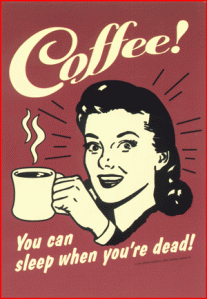
Good Morning!! I’m switching to strong coffee this morning, because I’ve had the sleepies for the past few days. It’s been really damp and humid here, so maybe that’s the reason. All I know is I keep dozing off, and I don’t like it! Anyway, let’s get to the news before I nod out again.
A few days ago, commenter madaha turned me on to an article about a fascinating new book that just came out last week. The book is called A First Rate Madness. The author is Nassir Ghaemi, a professor of psychiatry at Tufts University. From Salon:
Nassir Ghaemi, an author and professor of psychiatry at Tufts University School of Medicine, argues that many of history’s most famous and admired figures, from Churchill to FDR to Gandhi, showed signs of mental illness — and became better leaders because of it. Ghaemi bases his argument on historical records and some of the latest experimental studies on depression and mania, arguing that mild symptoms can actually enhance qualities like creativity or empathy.
After reading the piece in Salon, I immediately ordered the book and I’ve been dipping into it over the past couple of days.
So far, I’ve read the chapter on FDR, and I’m going to read about JFK next. According to Ghaemi, both of these men had hyperthymic personalities: basically, they were upbeat, enthusiastic, energetic, and creative, because they tended to be somewhat hypomanic (a milder, less disabling form of the mania experienced by those with bipolar disorder). In addition, both FDR and JFK suffered from serious physical illnesses–FDR from polio and JFK from Addison’s disease. These illnesses and other adversities these two men faced enabled them to develop empathy for the suffering of ordinary people–even though they were both from privileged backgrounds. Ghaemi argues that people with slightly abnormal personalities are better leaders–particularly in times of crisis when great creativity, empathy, and resilience are needed. According to Ghaemi:
Many people who experience traumas [like terrorism or war] don’t develop PTSD or other illnesses. So the question is, what keeps those people from getting sick? What creates resilience? The psychological research suggests that personality is a major factor. Resilience seems to be associated with mild manic symptoms, but you can’t develop resilience unless you’ve already experienced trauma. Many of these leaders faced adversity in their childhood and adulthood, and that seemed to make them better able to handle crises. It’s like a vaccine. You get exposed to a little bit of a bacteria then you can handle major infections and I think trauma and resilience and hyperthymic personality seem to follow a similar path.
Ghaemi does not discuss Obama’s personality in the book, but Salon interviewer Thomas Rogers asked the author whether Obama may be too “sane” to be a successful President in our current time of crisis.
Obama’s persona is that of a very sane, rational person who is good at compromise — which is definitely how he sold himself during the debt ceiling crisis. Do you think Obama’s sanity is hurting his abilities as a leader?
I didn’t discuss Obama and other current leaders in the book, because there are documentation and confidentiality issues, and a lot of speculation would have to happen. That said, Obama has said himself that he thinks he’s very normal. This no-drama-Obama persona is meant to reassure people about his normality, but I think that when you look at his memoir there’s a sense of a much more complex and profound person who may have experienced a great deal of anxiety and maybe some depression growing up, being half-white half-African-American. The [sane] parts of his psychology may hinder his leadership in terms of not being creative, and that may not be as useful in a crisis. But to whatever extent he’s not fully completely average, he’ll have some psychological reservoir to draw on to think more creatively and realistically about the current situation.
I wish I could agree that Obama might learn to deal with the nation’s difficulties, but so far he doesn’t seem to learn anything from experience. Most of the leaders that Ghaemi discusses suffered from mood disorders–depression or bipolar disorder. Obama, on the other hand, appears to have a different kind of disorder–either Narcissistic Personality Disorder or Antisocial Personality Disorder, or both.
Dakinikat alerted me to an interview with Ghaemi on NPR. I haven’t listened to it yet, but here’s the link.
Getting back to current news, this coming Saturday, Rick Perry plans to announce that he’s running for the Republican presidential nomination.
Rick Perry intends to use a speech in South Carolina on Saturday to make clear that he’s running for president, POLITICO has learned.
According to two sources familiar with the plan, the Texas governor will remove any doubt about his White House intentions during his appearance at a RedState conference in Charleston.
It’s uncertain whether Saturday will mark a formal declaration, but Perry’s decision to disclose his intentions the same day as the Ames straw poll — and then hours later make his first trip to New Hampshire — will send shock waves through the race and upend whatever results come out of the straw poll.
Immediately following his speech in South Carolina, Perry will make his New Hampshire debut at a house party at the Portsmouth-area home of a state representative, Pamela Tucker, the Union Leader reported Monday. Tucker was among the Granite Staters who went to Texas last week to encourage Perry to run.
What can I say? This is ghastly news. Think Progress is reporting that besides being a fundamentalist religious fanatic, Perry shares a similar problem to that of fellow wingnut Michele Bachmann–he has taken lots of Federal money in farm subsidies–$80,000, to be exact.
Verizon workers have gone out on strike–45,000 of them.
More than 45,000 workers from New England to Virginia went on strike just after midnight today at Verizon Communications. Since bargaining began July 22, Verizon has refused to move from a long list of concession demands. As the contract expired, Verizon, a $100 billion company, still was looking for $1 billion in concessions from 45,000 workers and families. That’s about $20,000 in givebacks for every family, nearly 100 concessionary proposals remained on the table.
This despite Verizon’s 2011 annualized revenues of $108 billion and net profits of $6 billion. At the same time, Verizon Wireless just paid its parent company, Vodaphone, a $10 billion dividend. Meanwhile, Verizon’s five top executives received $258 million over the past four years.
The workers, members of the Communications Workers of America (CWA) and the Electrical Workers (IBEW), say they are striking until Verizon “stops its Wisconsin-style tactics and starts bargaining seriously.”
According to Reuters, both sides are accusing each other of bad acts:
The second day of a strike by Verizon workers turned ugly after union representatives accused managers of injuring three workers while driving past picket lines, and the phone giant complained of a spike in network sabotage cases.
[….]
Verizon complained of network sabotage cases in the same statement where it said some picketing workers were unlawfully blocking Verizon managers’ access to work centers.
A spokeswoman for the Communications Workers of America, representing 35,000 of the strikers, said the union “does not condone illegal action of any kind.” The International Brotherhood of Electrical Workers, representing 10,000 strikers, also said members “are expected to obey the law.”
However, the CWA said some picketing workers were hurt by Verizon managers’ cars and that one worker was knocked unconscious when he was clipped by the mirror of a manager’s car that was speeding past a picket line.
Dean Baker had a great piece at Truthout yesterday: The Economic Illiterates Step Up the Attack on Social Security and Medicare
The nonsense with the S&P downgrade is yet another distraction – after four months of haggling over the debt ceiling idiocy – from the real problem facing the country: a downturn that has left 25 million people unemployed, underemployed or out of the labor force altogether. Tens of millions of people are seeing their career hopes and family lives wrecked by the prospect of long-term unemployment.
The incredible part of this story is that the people who are responsible are all doing just fine, and most of them are still making policy. Furthermore, they are using their own incompetence as a weapon to argue that we have to take even more money from the poor and middle class, this time in the form of Social Security, Medicare and Medicaid benefits.
The basic story is that the economy needs demand. The housing bubble generated more than $1.4 trillion in annual demand through the construction and consumption that it spurred. Now that this demand is gone, there is nothing to replace it. President Obama’s stimulus was replaced by some of the lost demand, but it was nowhere near large enough. We tried to fill a $1.4 trillion hole in annual demand with around $300 billion in annual stimulus in 2009 and 2010. In 2011, most of this boost has been exhausted and the economy is coming to a near standstill.
If we had serious people in Washington, they would be talking about jobs programs, about rebuilding the infrastructure, about work sharing, and any other measure that could get people back to work quickly. However, instead of talking about ways to re-employ people, the fixation in Washington is reducing the deficit.
We’ve heard these arguments again and again (especially from our own Dakinikat), but they bear repeating until the ignorant Villagers get the message.
Remember the “rape cops” in New York–the ones who were found not guilty recently? Well, one of them finally got a tiny bit of justice. A judge sentenced Kenneth Moreno to one year in prison for official misconduct. But then another judge freed him.
Disgraced ex-cop Kenneth Moreno didn’t stay in jail for long.
A couple hours after an angry Manhattan judge flat-out called Moreno a liar Monday and dispatched him to Rikers Island to being a year-long prison sentence, an appeals court judge sprung him.
Moreno, acquitted in May of raping a bombed fashion executive while his partner served as lookout, was released on $125,000 bail by Appeals Court Judge Nelson Roman so he can appeal his conviction on official misconduct charges.
It was a startling turnabout for the 43-year-old Moreno, who Supreme Court Justice Gregory Carro ordered remanded.
I sure hope he ends up serving at least some jail time.
Dakinikat sent me this article on a report (PDF) called How to Liberate American from Wall Street Rule. Here are the report’s basic recommendations:
How to Liberate America from Wall Street Rule spells out details of a six-part policy agenda to rebuild a sensible system of community-based and accountable financial services institutions.
1. Break up the mega-banks and implement tax and regulatory policies that favor community financial institutions, with a preference for those organized as cooperatives or as for-profits owned by nonprofit foundations.
2. Establish state-owned partnership banks in each of the 50 states, patterned after the Bank of North Dakota. These would serve as depositories for state financial assets to use in partnership with community financial institutions to fund local farms and businesses.
3. Restructure the Federal Reserve to function under strict standards of transparency and public scrutiny, with General Accounting Office audits and Congressional oversight.
4. Direct all new money created by the Federal Reserve to a Federal Recovery and Reconstruction Bank rather than the current practice of directing it as a subsidy to Wall Street banks. The FRRB would have a mandate to fund essential green infrastructure projects as designated by Congress.
5. Rewrite international trade and investment rules to support national ownership, economic self-reliance, and economic self-determination.
6. Implement appropriate regulatory and fiscal measures to secure the integrity of financial markets and the money/banking system.
Finally, in case you missed it, I want to call your attention to this article that commenter The Rock linked to last night: Hillary Told You So
At a New York political event last week, Republican and Democratic office-holders were all bemoaning President Obama’s handling of the debt-ceiling crisis when someone said, “Hillary would have been a better president.”
“Every single person nodded, including the Republicans,” reported one observer.
At a luncheon in the members’ dining room at the Metropolitan Museum of Art on Saturday, a 64-year-old African-American from the Bronx was complaining about Obama’s ineffectiveness in dealing with the implacable hostility of congressional Republicans when an 80-year-old lawyer chimed in about the president’s unwillingness to stand up to his opponents. “I want to see blood on the floor,” she said grimly.
A 61-year-old white woman at the table nodded. “He never understood about the ‘vast right-wing conspiracy,’” she said.
Looking as if she were about to cry, an 83-year-old Obama supporter shook her head. “I’m so disappointed in him,” she said. “It’s true: Hillary is tougher.”
Go read the whole thing. That’s all I’ve got for today. What are you reading and blogging about? Please share.

 peej
peej Carissa
 bostonboomer
 dakinikat
 ecocatwoman
 mablue2
 Mama Lopez
 peggysue22
 quixote
 skydancingguestblogger
 Mona (aka Wonk the Vote)



 Sky Dancing
Recent Comments