
Thursday Reads: Power to the People!
Posted: November 3, 2011 Filed under: #Occupy and We are the 99 percent!, Foreign Affairs, France, Germany, Greece, Italy, morning reads, Spain, U.S. Economy, U.S. Politics, unemployment | Tags: Angela Merkel, austerity, democracy, Eurodammerung, George Papandreau, Greece, Nicolas Sarkozy, Oakland general strike, Paul Krugman, Robert Reich 40 Comments
Good Morning!! Over the past couple of days, I’ve become really fascinated with the situation in Greece. It’s a pretty fluid situation at the moment. On Tuesday Robert Reich wrote a pretty good primer on what is happening and expressed his view that letting the Greek people decide their own fate is the best idea. Here’s a bit of it:
Greek Prime Minister George Papandreou decided in favor of democracy yesterday when he announced a national referendum on the draconian budget cuts Europe and the IMF are demanding from Greece in return for bailing it out.
(Or, more accurately, the cuts Europe and the IMF are demanding for bailing out big European banks that have lent Greece lots of money and stand to lose big if Greece defaults on those loans – not to mention Wall Street banks that will also suffer because of their intertwined financial connections with European banks.)
If Greek voters accept the bailout terms, unemployment will rise even further in Greece, public services will be cut more than they have already, the Greek economy will contract, and the standard of living of most Greeks will deteriorate further.
If Greek voters reject the terms and the nation defaults, it will face far higher borrowing costs in the future. This may reduce the standard of living of most Greeks, too. But it doesn’t have to. Without the austerity measures the rest of Europe and the IMF are demanding, the Greek economy has a better chance of growing and more Greeks are likely to find jobs.
Shouldn’t Greek citizens make this decision for themselves?
Reich argues that it would have been better in the long run if the American people had been consulted about the bank bailouts here.
If Americans had been consulted about the 2008-2009 Wall Street bailout, I doubt it would have happened the way it did. At the very least, strict conditions would have been placed on the banks in return for the money. The banks would have had to eat the losses of the predatory mortgages they sold, and help homeowners reduce those mortgages. They’d be required to improve the capitalization of small banks in communities across the country. They’d be forced to accept stringent new regulations, including resurrection of Glass-Steagall
But we weren’t consulted. The wishes of the American people were considered irrelevant by the oligarchs who run this country. And the European oligarchs are hoping to prevent the Greek people from claiming a right to make a democratic decision.
Of course if the Greek people do decide to default on their debts, there will be serious consequences–for them and for the rest of Europe. Krugman calls it “Eurodämmerung.” He argues that
…the euro was an inherently flawed idea that can work only given a strong European economy and a significant degree of inflation, plus open-ended credit to sovereigns facing speculative attack. Yet European elites embraced the notion of economics as morality play, imposing across-the-board austerity, tightening money despite low underlying inflation, and have been too concerned with punishing sinners to notice that everything was going to blow apart without an effective lender of last resort.
The question I’m trying to answer right now is how the final act will be played. At this point I’d guess soaring rates on Italian debt leading to a gigantic bank run, both because of solvency fears about Italian banks given a default and because of fear that Italy will end up leaving the euro. This then leads to emergency bank closing, and once that happens, a decision to drop the euro and install the new lira. Next stop, France.
Yikes! But Fortune also says Italy and France are in trouble if Greece defaults. And Spain could go bust too.
What worries is that Spain and Italy are not in the Greek situation but they could be. Greece is bust and Spain and Italy could be driven bust. They both have a lot of debt and each year some of that debt has to be repaid. Now governments almost never do repay debt, they just borrow some more and use the new money to pay off the old. Bit like swirling what you owe around a few credit cards.
Which is just fine: except, if interest rates rise then they have to pay more interest on this new debt that they’re issuing to pay off the old. And if interest rates rise enough then they do go bust, as the interest payments they have to make take too much money out of the budget. Switching money around on zero interest introductory rate cards is very different from doing it when you’re being charged 30%.
Now, the general agreement is that when the interest rates are above 6% then Italy and Spain are in danger of going bust. When they’re over 7% they will do so. But of course, when people see that Italian interest rates are above 6% then they become more wary of lending Italy any more money and so interest rates keep on rising to possibly above 7% and game over.
It’s still not clear what Greece is going do in their referendum. Dakinikat says they need to ask the people if they want to leave the European Union or not. German Chancellor Angela Merkel and French President Nicolas Sarkozy have said that the referendum must ask the Greek people if they want to opt out of the Euro, but not the EU itself. Meanwhile, the offer of a bailout of Greece has been called off until after the vote on the referendum is taken. From Naked Capitalism:
The Eurocrats have decided to try to push Greece into line, threatening expulsion from the Euro (note, not the EU) if Greece does not back down. From a practical matter, if the Greeks were to turn down the bailout package, it would lead to a banking crisis, making a Eurozone exit a not that much more traumatic incremental move with considerable upside. And under the Maastrict treaty, Greece cannot unilaterally exit (although as various commentors have pointed out, Nato is not going to send in tanks if the Greeks were to do so).
But this may be an appeal to the Greek public, or more likely, an effort to break Greek prime minister’s Papandreou’s thin coalition on the eve of a vote of no confidence.
So that’s another possibility–that Papandreau’s government might fall. More on the European reaction from Bloomberg:
Led by Germany and France, Europe’s economic and political anchors, the euro’s guardians yesterday cut off financial aid for Greece until a vote they said would be on Dec. 4 or Dec. 5 determines whether it deserves a fresh batch of loans needed to stave off default.
“The referendum will revolve around nothing less than the question: does Greece want to stay in the euro, yes or no?” German Chancellor Angela Merkel told reporters after crisis talks hours before a Group of 20 summit set to begin today in Cannes, France. French President Nicolas Sarkozy said Prime Minister George Papandreou’s government won’t get a “single cent” of assistance if voters rejects the plan.
The hardball tactics open the door for a nation to leave the currency bloc that at its setup in 1999 capped Europe’s progression from war to prosperity and was declared “irrevocable” by its founding fathers. Polls show most Greeks object to the austerity required for aid, yet more than seven in 10 favor remaining in the euro, a survey last week of 1,009 people published in To Vima newspaper showed.
They’re going to have to decide between two awful choices, and the rest of Europe will have to deal with the results of the vote–if there is a default, failures of banks that hold Greek debt and getting Italian, French, and German taxpayers to pay for more bank bailouts–unless Papandreau’s government falls. Read the whole article at Bloomberg to get a sense of how serious all this is.
In U.S. news, Occupy Oakland called for a general strike today. That situation is still fluid as of this writing, 11PM Eastern on Wednesday night.
OAKLAND – Protesters blocked streets near City Hall, smashed windows at a bank and gathered by the thousands in an attempt to shut down the nation’s fifth-busiest port Wednesday.
The Occupy Oakland protest was the largest in a series of rallies in several cities as the Occupy Wall Street movement that began Sept. 17 tried to grab national attention.
A group of about 300 protesters, many of them men wearing black, some covering their faces with bandanas and some carrying wooden sticks, smashed windows of a Wells Fargo bank branch while chanting “Banks got bailed out. We got sold out.”
Are you getting the feeling this genie can’t be put back in the bottle either? The Occupy demonstrations have shown us that we pretty much live in a police state at this point. There very little respect for the protesters’ constitutional rights by local governments or law enforcement. From Counterpunch, here is a report of what actually happened when police attacked protesters in Oakland on Oct. 25.
In a heavily armed pre-dawn raid, on Tuesday, Oct. 25, with back up from armored vehicles and helicopters, the Oakland Police Department in conjunction, with over 15 other police departments from Northern and Central California, stormed the sleepy Occupy Oakland Encampment.
Asleep inside tents of the makeshift Occupy encampment, were over a hundred men, women and very young children. The heavily armed police force, dressed in black ninja-like outfits, and special forces helmets, with full face-shields down, and armed with and assortment of latest riot gear, fired tear gas canisters and concussion grenades into the camp, as helicopters circled above.
Police then attacked and ransacked the entire encampment. In a short time, the camps library, soup kitchen, and children’s center were left in ruins, and over a hundred of the inhabitants were roughed up, arrested and held on high bail. The activists suffered many injuries, including broken bones.
Please read the whole thing–it’s an eyewitness account of a horrifying paramilitary action by police. As everyone knows, Iraq war veteran Scott Olson was critically injured in the melee.
Late last night as part of the general strike, Oakland protesters succeeded in shutting down the Port of Oakland.
Several thousand Occupy Wall Street demonstrators forced a halt to operations at the United States’ fifth busiest port Wednesday evening, escalating a movement whose tactics had largely been limited to rallies and tent camps since it began in September.
Police estimated that a crowd of about 3,000 had gathered at the Port of Oakland by early evening. Some had marched from the California city’s downtown, while others had been bused to the port.
Port spokesman Isaac Kos-Read said maritime operations had effectively been shut down. Interim Oakland police chief Howard Jordan warned that protesters who went inside the port’s gates would be committing a federal offense.
In New York, Los Angeles and other cities where the movement against economic inequality has spread, demonstrators planned rallies in solidarity with the Oakland protesters, who called for Wednesday’s “general strike” after an Iraq War veteran was injured in clashes with police last week.
Organizers of the march said they want to stop the “flow of capital.” The port sends goods primarily to Asia, including wine as well as rice, fruits and nuts, and handles imported electronics, apparel and manufacturing equipment, mostly from Asia, as well as cars and parts from Toyota, Honda, Nissan and Hyundai.
We knew there would eventually be civil unrest, and now we’re seeing it all over the world and here at home. What next? I’d say 2012 is going to be an eventful year.
With that, I’m going to wrap this up. I know there’s lots of other news, but these two stories–Greece and the general strike in Oakland–seem to me to symbolize what’s happening in the world today. People are sick and tired of being bilked by the super-rich, and ignored by the politicians. It’s so chaotic, yet I feel that the only hope we have is for the people to keep resisting as best they can. For so long, I was afraid nothing would wake American up, but I’m finally getting the feeling that we won’t go down without a fight. Let’s keep the elites nervous!
Sooooo… what are you reading and blogging about today?
Tuesday Reads
Posted: November 1, 2011 Filed under: abortion rights, Barack Obama, birth control, morning reads, PLUB Pro-Life-Until-Birth, The Media SUCKS, U.S. Politics, Women's Rights | Tags: anti-abortion, Barack Obama, biased news, East coast snowstorm, economics, Halloween, Herman Cain, irresponsible journalism, Lori Montgomery, Mississippi, Nancy Pelosi, personhood movement, Racism, Rush Limbaugh, Washington Post, weather, zombies 30 Comments
Coffee and Morning News, by Tim Nyberg
Good Morning!! I am sooooo exhausted. Last Wednesday, I got back home after two months in Indiana. Normally, I would crash for a couple of days and be on the way to recovery from the long drive. But this time my Mom came back with me. She has been staying at my brother’s house, and I’ve had to drive over there nearly every day since I got home.
Yesterday I spent the day with my Mom and my nearly-9-year-old nephew, who was home sick and hung around for the trick-or-treating. My Mom is flying back home this morning at 8:30, and I was dreading having to get up at 5:30 in the morning to take her to the airport. But my brother volunteered to take her–halleluja! Finally I can spend a couple of days vegetating at home! I just hope I don’t get my nephew’s cold!
Anyway, here are some news links I found for you. I’ve been a bit out of touch, so I hope I won’t duplicate anything that has already been posted.
The freaky early snowstorm has left millions of people without power, which also means no heat. Even if you have gas or oil heat, the on-off mechanism still relies on electricity. So there are lots of people living in houses with temperatures around 50 degrees. I was really fortunate that my electricity was only off for several hours, mostly while I was sleeping.
Joanelle mentioned in comments last night that in her part of NJ, there is so much damage that trick or treating has been put off until Friday. The Christian Science Monitor had a story about this happening up and down the East coast.
Until hard-pressed utility crews get the lines restrung, many residents from North Carolina to Maine are living in homes that are barely 50 degrees, and in some cases, they’re unable to heat food. School systems are closed because, among other reasons, it’s not safe for children to walk on sidewalks that may still have live power lines on them. And many businesses aren’t open because they’re still in the midst of power outages.
“Electricity is the most fundamental of utilities. Most everything depends on electric power,” says Kathleen Tierney, director of the Natural Hazards Center at the University of Colorado at Boulder. “This has many of the earmarks of a disaster.”
In some states, governors are warning residents they may have to grin and bear it for days or even another week since the heavy snow did extensive damage to the electric grid. For example, in Connecticut and Pennsylvania, the snow knocked out some of the lines that get power from the generating plants to substations, where it then goes into a local distribution network. Connecticut Gov. Dannel Malloy (D) has asked President Obama to declare the state a federal disaster area, which would help with cleanup and recovery costs.
Herman Cain is still trying to explain away the story about his sexually harassing women in the 1990s. Now he’s calling it a witch hunt. But Rush Limbaugh, of all people, claims it’s racism.
RUSH: You know, I guess I shouldn’t be surprised, folks. After all of these years, none of us should be surprised, but I still am. Look at how quickly what is known as the mainstream media goes for the ugliest racial stereotypes they can to attack a black conservative. You know who’s laughing himself silly today is Bill Clinton. (imitating Clinton) “Yeah, I really did it. Ha-ha. They praised me and they went as far out of their way as they could. Even my old buddy Carville is out there and he’s saying, ‘Look what happens when you drag a dollar bill through a trailer park, you get Paula Jones.’ I have everybody defending me and they’re going after this black guy, and they’re going after him with some of the ugliest racial stereotypes I have ever seen. That’s how our side does it; we get away with it. I just love it. I love watching it.”
What’s next, folks? A cartoon on MSNBC showing Herman Cain with huge lips eating a watermelon? What are they gonna do next? No, Snerdley, I’m not kidding. The racial stereotypes that these people are using to go after Herman Cain, what is the one thing that it tells us? It tells us who the real racists are, yeah, but it tells us that Herman Cain is somebody. Something’s going on out there. Herman Cain obviously is making some people nervous for this kind of thing to happen.
When did sexual harassment become a racial stereotype? WTF is he talking about?
But at the National Review, Kevin D. Williamson says this may signal the end of Herman Cain’s campaign.
Here is what troubles me. Mr. Cain says: “If the Restaurant Association did a settlement, I wasn’t even aware of it, and I hope it wasn’t for much, because nothing happened. So if there was a settlement, it was handled by some of the other offices that worked for me at the association, so the answer is absolutely not.”
Okay, so if I’m reading that quote right, then:
1. Herman Cain, in his role as head of a major trade association, did not bother to learn how a complaint or complaints of sexual harassment against him was resolved.
2. Herman Cain, not bothering to have learned how a complaint or complaints of sexual harassment against him was resolved, decided to run for president without bothering to learn.
I got a lot of grief for writing that, based on my interaction with Mr. Cain, I would have hesitated to hire him to run a pizza company. I am feeling more comfortable in that judgment.
I wonder if Rush will condemn this: some Republicans in Virginia sent out a Halloween e-mail containing an image of President Obama shot through the head.
The Republican Party of Virginia on Monday strongly condemned an e-mail sent by Loudoun County’s GOP committee that shows President Obama as a zombie with part of his skull missing and a bullet through his head.
The e-mail, first reported on the blog Too Conservative, has “Halloween 2011” in the subject line and has several other images, including one of House Minority Leader Nancy Pelosi (D-Calif.), whose face has been made to look deformed with one eye bulging from its socket….
The e-mail, sent a week before local and state elections, invites supporters to a Halloween parade. “LCRC members and Republican candidates: We are going to vanquish the zombies with clear thinking conservative principles and a truckload of Republican candy. . . . It’s fun and a great way to represent our candidates to a ton of voters (and their kids) just before the election.”
Talk about ugly and wildly inappropriate! If anyone listens to Rush, let me know if he condemns this. I won’t be holding my breath though….
We’ve been talking about the irresponsible “journalism” of WaPo “reporter” Lori Montgomery, so I was interested to learn from Raw Story that a new website debuted yesterday with the goal of holding mainstream journalists accountable for what they write and don’t write. From Raw Story:
A Wikipedia-style website launched on Monday which provides information about the journalists behind the bylines.
News Transparency is a creation of Ira Stoll, the founder of another website called FutureOfCapitalism.com and the former managing editor of the now defunct New York Sun.
In a statement on its home page, newstransparency.com, the website said its goal is to help users “find out more about the people who produce the news” and “hold them accountable, the same way that journalists hold other powerful institutions accountable, by posting reviews and sharing information.”
News Transparency features an alphabetical list of hundreds of journalists and invites users to edit their profiles, which include basic biographical information such as age, education, current employer and work history.
Lori Montgomery is listed on the site, but so far there’s no information on her background. Does this woman even have a college degree? I’m waiting with bated breath to find out.
On my way home last night, I listened to the NPR program “On Point.” They were debating the Mississippi “personhood” for zygotes initiative, the goal of which seems to be to turn women into breeders with no freedom of choice and no rights over their own bodies. I highly recommend listening to the program. Hearing what the insane theocratic sponsors of this constitutional amendment have to say is truly frightening, but at the same time very important.
The New York Times has an op-ed about the proposed amendent: Mississippi’s Ambiguous ‘Personhood’ Amendment. The authors identify two main ambiguities in the amendment as written:
First, what does “fertilization” mean? As embryologists recognize, fertilization is a process, a continuum, rather than a fixed point. The term “fertilization” — which is sometimes considered synonymous with “conception” — could mean at least four different things: penetration of the egg by a sperm, assembly of the new embryonic genome, successful activation of that genome, and implantation of the embryo in the uterus. The first occurs immediately; the last occurs approximately two weeks after insemination (or, in the case of embryos created through in vitro fertilization that do not get implanted, never). Thus, on some reasonable readings of the amendment, certain forms of birth control, stem cell derivation and the destruction of embryos created through in vitro fertilization would seem impermissible, while on other equally reasonable readings they are not.
Second, the proposed amendment does not clearly indicate what the immediate legal impact would be. Would the amendment be “self-executing” — that is, effectuate a change to Mississippi law on its own — or would it require enabling legislation to set that change in motion?
Under existing doctrine, constitutional provisions or amendments that only set forth “first principles” or “policies” are not treated as self-executing, because they need laws enacted to further the stated principles or policies. In this case it’s not clear whether the amendment would, for example, immediately redefine thousands of references to “human beings” or “persons,” including those in provisions governing criminal homicide, or whether additional legislation would be necessary. Because of this uncertainty, voters considering this amendment cannot tell what actions would and would not immediately be subject to prosecutorial investigation were the amendment to pass.
I just hope this abomination doesn’t get enough votes!
That’s all I’ve got this morning. What are you reading and blogging about today?
Halloween Reads
Posted: October 31, 2011 Filed under: abortion rights, Economy, morning reads | Tags: Halloween, Herman Cain, history of Halloween, Nobel Prize economics, Planned Parenthood, Pumpkin cookies, Pumpkins, Samhain, Thomas Sargent, trick or treating, We're all Keynesians Now 19 Comments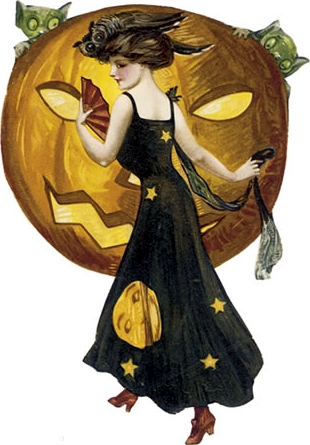
Happy Halloween!
I suppose I should get right to the news reads, but instead, I thought I’d make some use of the day to bring us up to speed on the Halloween spirit! Halloween’s roots were in Samhain which was an ancient Celtic holiday! Like nearly every other holiday, it was co-opted as the Romans moved to conquer as much as they could and romanize the world with their culture and religions.
Samhain was considered a magical holiday, and there are many stories about what the Celtics practiced and believed during this festival. Some say the spirits that were unleashed were those that had died in that year, and offerings of food and drink were left to aid the spirits, or to ward them away. Other versions say the Celts dressed up in outlandish costumes and roamed the neighborhoods making noise to scare the spirits away. Many thought they could predict the future and communicate with spirits as well during this time. Some think the heavily structured life of the Pagan Celtics was abandoned during Samhain, and people did unusual things, such as moving horses to different fields, moving gates and fences, women dressing as men, and vice versa, and other trickeries now associated with Halloween. Another belief is that the Celtics honoured, celebrated, and feasted the dead during Samhain. A sacred, central bonfire was always lit to honor the Pagan gods, and some accounts say that individual home fires were extinguished during Samhain, either to make their homes unattractive to roving spirits, or for their home fires to be lit following the festival from the sacred bonfire. Fortunes were told, and marked stones thrown into the fire. If a person’s stone was not found after the bonfire went out, it was believed that person would die during the next year. Some Celts wore costumes of animal skulls and skins during Samhain. Faeries were believed to roam the land during Samhain, dressed as beggars asking for food door to door. Those that gave food to the faeries were rewarded, while those that did not were punished by the faeries. This is reported to be the first origin of the modern “trick or treat” practice.
Many of the costumes we think of today actually originated in festivals celebrated during medieval times.
The practice of dressing up in costumes and begging door to door for treats on holidays goes back to the Middle Ages, and includes Christmas wassailing. Trick-or-treating resembles the late medieval practice of “souling,” when poor folk would go door to door on Hallowmas (November 1), receiving food in return for prayers for the dead on All Souls Day (November 2). It originated in Ireland and Britain, although similar practices for the souls of the dead were found as far south as Italy. Shakespeare mentions the practice in his comedy The Two Gentlemen of Verona (1593), when Speed accuses his master of “puling [whimpering, whining], like a beggar at Hallowmas.”
Yet there is no evidence that souling was ever practiced in America, and trick-or-treating may have developed in America independent of any Irish or British antecedent. There is little primary Halloween history documentation of masking or costuming on Halloween — in Ireland, the UK, or America — before 1900. The earliest known reference to ritual begging on Halloween in English speaking North America occurs in 1911, when a newspaper in Kingston, Ontario, near the border of upstate New York, reported that it was normal for the smaller children to go street guising (see below) on Halloween between 6 and 7 p.m., visiting shops and neighbors to be rewarded with nuts and candies for their rhymes and songs. Another isolated reference appears, place unknown, in 1915, with a third reference in Chicago in 1920. The thousands of Halloween postcards produced between the turn of the 20th century and the 1920s commonly show children but do not depict trick-or-treating. Ruth Edna Kelley, in her 1919 history of the holiday, The Book of Hallowe’en, makes no mention of such a custom in the chapter “Hallowe’en in America.” It does not seem to have become a widespread practice until the 1930s, with the earliest known uses in print of the term “trick or treat” appearing in 1934, and the first use in a national publication occurring in 1939. Thus, although a quarter million Scots-Irish immigrated to America between 1717 and 1770, the Irish Potato Famine brought almost a million immigrants in 1845–1849, and British and Irish immigration to America peaked in the 1880s, ritualized begging on Halloween was virtually unknown in America until generations later.
Treats:
Thomas Sargent, Nobel Prize winner in economics is mad at the WSJ for trying to characterize him as a non-Keynesian after he won the award!
Professor Sargent described himself as a scientist, a “numbers guy” who is “just seeking the truth” as any good researcher does.
“If you go to seminars with guys who are actually doing the work and are trying to figure things out, it’s not ideological,” he said. “Half the people in the room may be Democrats and half may be Republicans. It just doesn’t matter.”
The “non-Keynesian” label irks him particularly. “That’s just off base,” he said. “Keynes was a very good economist. He was brilliant. He had wonderful insights. His work has inspired me many times.”
Professor Sargent’s own writings are sprinkled with pithy quotations from Keynes. In January 1986, the professor wrote a Wall Street Journal article, “An Open Letter to the Brazilian Finance Minister,” analyzing that nation’s fiscal crisis. In form and substance, it was explicitly modeled on a very similar letter written by Keynes to the French finance minister 60 years earlier. One point of this exercise, he said, “was to get people to actually read Keynes.”
Still, early in Professor Sargent’s career, he was known as one of the founders of the “rational expectations” school, which has sometimes been thought to be un-Keynesian. He says it actually “tied down an important loose end in the kinds of theories Keynes was building.” Keynes, he said, believed that expectations were all-important in determining economic activity, but didn’t have the mathematical tools needed to nail down all his concepts.
Today, Professor Sargent says that in some ways he actually is a Keynesian, but he qualified that claim, too. “I’m happy to say I am a Harrison-Kreps-Keynesian,” he said, citing work by two scholars at Stanford, J. Michael Harrison and David M. Kreps. They developed a theory of speculative investor behavior and stock-bubble formation that subtly modifies rational expectations “in a beautiful way” and “captures Keynes’s argument, makes it rigorous, and pushes it further,” he said.
Fundamentally, he said, “What I really don’t like is oversimplification.” He tries to think things through, he said, and avoid having “one slogan fighting another.”
Recipe for Best Pumpkin Cookies
1 cup butter, room temperature
1/2 cup sugar
1/2 cup firmly packed brown sugar
1 cup canned pumpkin
1 egg
1 teaspoon vanilla extract
2 cups flour
1 teaspoon baking soda
1 teaspoon baking powder
2 teaspoons cinnamon
1/4 teaspoon saltPenuche Glaze
3 tablespoons butter
1/2 cup firmly packed dark brown sugar
1/4 cup milk
1 1/2-2 cups confectioners’ sugarDirections:
Preheat oven to 350 degrees.
Have ready some ungreased baking sheets.
In a large mixing bowl, cream butter and the sugars together until light and fluffy.
Blend in pumpkin, egg and vanilla extract.
In separate bowl, stir together flour, baking soda, baking powder, cinnamon and salt.
Mix flour mixture into butter-sugar mixture.
Drop tablespoonfuls 3 inches apart on ungreased baking sheets.
Bake the cookies for 10-12 minutes until golden around the edges.
Remove warm cookies and transfer to racks.
Let cool completely for a least one half hour, then frost with glaze.For Glaze:.
In a medium saucepan, heat butter and brown sugar over medium heat until bubbly. Cook, stirring constantly, for one minute or until slightly thickened. Beat in the milk. Blend in confectioner’s sugar until the glaze is smooth and spreadable. Using a silicone basting brush, which I love and use religiously now, or a butter knife to spread glaze on cookies is the best tip. Please note; this glaze will harden fairly quickly. I suggest that you keep the saucepan over the stove on the lowest heat possible to prevent it from hardening.
Tricks:
Herman Cain went on TV Sunday saying that Planned Parenthood should be called “Planned Genocide’ because their goal Is To ‘Kill Black Babies’. He’s now under scrutiny for sexual harassment charges in past. Can we just say the man hates women and get it over with?
Republican presidential candidate Herman Cain is standing by his assertion that reproductive health care provider Planned Parenthood is carrying out the “planned genocide” of African Americans.
In a March speech to the conservative Heritage Foundation, Cain said the organization’s mission was to “help kill black babies before they came into the world.”
On Sunday, CBS host Bob Schieffer asked the candidate if he still believed that statement.
“Yes,” Cain replied. “I still stand by that.”
“Do you have any proof that was the objective of Planned Parenthood?” Schieffer wondered.
“If people go back and look at this history and look at [Planned Parenthood founder] Margaret Sanger’s own words, that’s exactly where that came from,” Cain insisted. “Look at where most of them were built. Seventy-five percent were built in the black community and Margaret Sanger’s own words — she didn’t use the word genocide. She did talk about decreasing the number of poor blacks in this country by preventing black babies from being born.”
Anti-abortion activists often misquote Sanger as saying, “[W]e want to exterminate the Negro population.”
But in full context, the quote has the opposite meaning. In a 1939 letter to pro-birth control advocate Clarence J. Gamble, Sanger argued that black leaders should be involved in the effort to deliver birth control to the black community.
“We do not want word to go out that we want to exterminate the Negro population, and the minister is the man who can straighten out that idea if it ever occurs,” she wrote
Hope you have a fun day! What’s on your reading and blogging list?
TGIFriday Reads
Posted: October 28, 2011 Filed under: Barack Obama, Mitt Romney, morning reads, PLUB Pro-Life-Until-Birth, religious extremists, Reproductive Health, Reproductive Rights, Republican presidential politics, U.S. Economy, U.S. Politics, Violence against women, Women's Rights | Tags: 2012 presidential election, abortion, Ayn Rand, bundlers, Herman Cain, Libertarianism, Lobbyists, minimum wage, Mitt Romney, objectivism, Omar Sharif, personhood amendment to the Constitution, Republican debates, Republican nomination, Rick Perry, Rick Santorum, Ron Paul, wild turkeys 11 Comments
I live in Northwest Greater Boston in a town that is far from rural. However we do encounter wildlife in my neighborhood–skunks, opossums and racoons, for example. But yesterday afternoon, as I drove down the small road where I live, I had to brake suddenly for a large, imposing bird like the one in the photo. It was casually standing right in the middle of the road. I looked to my left and saw good sized flock of these birds, and suddenly realized they were wild turkeys. They were walking around in front of someone’s house. I was amazed.
It turns out that wild turkeys have been making a comeback in Massachusetts and have been invading a number of cities and towns around here. From The Boston Globe:
On a recent afternoon, Kettly Jean-Felix parked her car on Beacon Street in Brookline, fed the parking meter, wheeled around to go to the optician and came face to face with a wild turkey.
The turkey eyed Jean-Felix. Jean-Felix eyed the turkey. It gobbled. She gasped. Then the turkey proceeded to follow the Dorchester woman over the Green Line train tracks, across the street, through traffic, and all the way down the block, pecking at her backside as she went.
“This is so scary,” Jean-Felix said, finally taking refuge inside Cambridge Eye Doctors in Brookline’s bustling Washington Square. “I cannot explain it.”
Notify the neighbors: The turkeys are spreading through suburbia. Wild turkeys, once eliminated in Massachusetts, are flourishing from Plymouth to Concord and – to the surprise of some wildlife officials – making forays into densely populated suburban and urban areas, including parts of Boston, Cambridge and, most recently, Brookline.
In Winchester, a woman was “held captive” by a wild turkey.
On Tuesday evening, around 6 p.m., a Swan Road resident was pulling into her car [sic] when a wild turkey jumped at her and started to attack her vehicle as she was trying to drive it into the garage.
The woman said that this turkey did the same thing last week, and she didn’t call the police because she thought the animal had left.
“It kept attacking the woman at her house,” said Winchester Animal Control Officer, Jerry Smith of the 17-pound turkey. “It’s been doing it for a couple of days. We can’t have animals attacking people around town.”
According to the police report, she was able to close the garage door, but ended up being trapped, unable to get to her house, because the turkey refused to leave her property.
After 15 minutes “of being held captive” the woman called the Winchester Police Department to help her get into the house.
The responding officer saw that the turkey was still on the property. He got out of his cruiser and took a shotgun with him. As soon as the turkey noticed him, it charged and the officer shot and killed it.
Yikes! I hope those turkeys don’t start hanging around in my yard. In even more bizarre news, there is snow outside my house. Apparently, I got home just in time for winter.
Remember Omar Sharif? He starred in Dr. Zhivago back in 1965. The aging movie star recently slapped a female fan while he was on the red carpet at the Tribeca Film Festival.
The actor, who was nominated for his role in 1962’s “Lawrence of Arabia,” appeared to have lost his cool when a female fan interrupted him while he was posing for photographers.
The incident, captured by a TMZ camera, shows Sharif slapping and mildly pushing the woman, then spewing venomous disapproval at having been disturbed.
“My dear!” Sharif exclaimed in Arabic, as translated by the Washington Post. “I told you I’d get to you afterwards! I just said that and you’re standing here. Put something in your brain!”
In slightly more serious news, the Republican presidential candidates are still demonstrating their stupidity on a daily basis. Some examples follow.
Mitt Romney
It isn’t enough that Mitt Romney has crazy Robert Bork advising him on the Constitution. Now he has appointed another adviser who belonged to a violent Lebanese militia in the 1980s.
Walid Phares, the recently announced co-chair of GOP presidential candidate Mitt Romney’s Middle East advisory group, has a long résumé. College professor. Author. Political pundit. Counterterrorism expert. But there’s one chapter of his life that you won’t find on his CV: He was a high ranking political official in a sectarian religious militia responsible for massacres during Lebanon’s brutal, 15-year civil war.
During the 1980s, Phares, a Maronite Christian, trained Lebanese militants in ideological beliefs justifying the war against Lebanon’s Muslim and Druze factions, according to former colleagues. Phares, they say, advocated the hard-line view that Lebanon’s Christians should work toward creating a separate, independent Christian enclave. A photo obtained by Mother Jones shows him conducting a press conference in 1986 for the Lebanese Forces, an umbrella group of Christian militias that has been accused of committing atrocities. He was also a close adviser to Samir Geagea, a Lebanese warlord who rose from leading hit squads to running the Lebanese Forces.
Romney has also clearly stated his willingness to sacrifice the lives of women to save fertilized eggs. In the Guardian, Tresa Edmunds, a Mormon, writes: If Mitt Romney’s anti-abortion crowd get their way, it could kill me
Mississippi is the latest state to support a “personhood” amendment – a law that defines life as beginning at conception and giving full legal rights to a fertilised egg. On a recent political talk show, Mitt Romney affirmed that he would “absolutely” support such an amendment to the federal constitution. Such a conservative law would have far-reaching consequences, rendering many forms of birth control, the morning-after pill and aspects of in-vitro fertilisation illegal, as well as eliminating abortion as an option even when deemed medically necessary.
This trend is also seen in the ironically named Protect Life Act, recently passed by the House of Representatives, which gives hospitals the right to refuse to perform abortions, even at the cost of a woman’s life. It is a terrifying time to have a uterus, but especially a mysteriously malfunctioning one such as mine.
My son was born weighing 2lb 4oz, at 28 weeks gestation. My pregnancy – which had been much longed for – was proceeding normally until all of a sudden a pain that turned out to be organ failure brought me to the emergency room. There, I was diagnosed with HELLP syndrome. My blood pressure was rocketing, my red blood cells were disintegrating and my platelet count was dropping. If I had managed to make it through organ failure, stroke or heart attack, I would have bled to death in delivery. Thanks to the tremendous care and expertise of talented doctors and nurses, my son and I are here to tell the harrowing story but, if things had gone differently, the only way I would be alive is if they had removed my son’s body from my womb in pieces.
Comments such as Romney’s casually tossed off “absolutely” make me shake with rage. When politicians are so concerned about the people they see as allegedly using abortion as birth control that they would let me die, I can’t help but wonder how they can dare say they care about the sanctity of life.
Edmunds is confused. Romney and the other Republican candidates care deeply only about “human life.” They obviously do not consider women to be humans.
Rick Perry
As everyone knows, Governor Goodhair hasn’t done very well in the Republican debates so far. Now it appears he is going to wimp out of future debates.
After a series of poor debate performances in the early months of his presidential campaign, Texas Gov. Rick Perry is backing off the upcoming GOP debate schedule, committing to just one of the next three events between now and Nov. 15.
Perry has struggled in the five debates he has attended since he joined the race in mid-August. At one, he fumbled an attempt to cast rival Mitt Romney as a flip-flopper. At another, bickering between Romney and Perry drew criticism that the candidates were acting juvenile.
Perry hinted at his frustration with the debates earlier this week when he told Fox News that participating in them was a “mistake.”
“These debates are set up for nothing more than to tear down the candidates,” Perry said. “…All they’re interested in is stirring it up between the candidates.”
Um… yeah. So? If Perry can’t take the heat, maybe he should get out of the kitchen. BTW, has he produced his birth certificate yet? I heard he was born in Mexico. /s
Herman Cain
At Huffpo, Dave Jamieson details Herman Cain’s long, enthusiastic battle against the minimum wage.
In his plan for economic “Opportunity Zones,” Cain offers a slate of proposals aimed at revitalizing depressed pockets of the country, including zero capital gains and payroll taxes within qualifying areas. Although it doesn’t say so explicitly, the Cain campaign’s primer on opportunity zones also suggests the possibility of rolling back minimum-wage laws in impoverished areas.
“Minimum wage laws prevent many unskilled and inexperienced workers (i.e. teens) from getting their first job and prices them out of the market,” the plan says, listing a number of potential “solutions” to urban poverty. Cain’s campaign did not immediately comment on his stance on minimum wage laws.
Minimum-wage protections are an issue Cain knows intimately. In his work as the CEO of Godfather’s Pizza and later as president of the National Restaurant Association, Cain worked diligently in Washington and in the media to see that low-wage restaurant workers could legally be paid as little as possible, as In These Times has noted. In fact, Cain’s time in the restaurant business was marked by a long and largely successful battle against minimum-wage increases, and even today, some 15 years later, many of the nation’s waiters and waitresses have Cain and the restaurant lobby to thank for a federal minimum wage of $2.13 for tipped workers.
By 1995, when Cain was at the helm of Godfather’s, the federal minimum wage had already lost much of its purchasing power since the 1960s and 70s, and it hadn’t seen a bump in five years. When then-President Bill Clinton and Labor Secretary Robert Reich proposed raising it from $4.25 to $5.15, Cain emerged as one of the leading opponents of the pay boost.
Rick Santorum
Is he really still running for president? Apparently so. He has released a new ad targeting Herman Cain’s accidental pro-choice position on abortion. The content of the ad suggests that Santorum believes that aborted embryos and fetuses can “think.”
Ron Paul
Ron Paul isn’t really an objectivist or a libertarian, even though he claims to be a follower of Ayn Rand. He can’t be, because he wants the government to get involved in policing women’s bodies. But here’s an interesting post by Gary Weiss, the author of a new book about Ayn Rand’s influence on American culture that sounds like a fascinating, if disturbing, read.
Ayn Rand’s spirit hangs over the 2012 presidential race like the aftermath of a bad meal that, for some reason, we’ve all forgotten that we’ve eaten. In the run-up to the financial crisis the markets became a kind of Fifth Estate, the ultimate arbiters of American society. This was not a Republican disease; some of the most voracious deregulation took place during the Clinton Administration. It was as if a moral choice had been made, substituting the “wisdom of the markets” for admittedly flawed and sometimes grossly inept regulators. It made perfect sense, especially in an era in which the stock market averages rose by as much as 40% in one year, but today we know, or should know, that untrammeled capitalism doesn’t work.
But you’d never know any of this when listening to the Republican candidates for president, especially the one who most overtly embodies Rand’s philosophy: Ron Paul.
Paul is by no means a card-carrying Objectivist—his embrace of religion, and his views on foreign policy, makes him anathema to Randian true believers. But his embrace of the most primitive, extreme forms of free-market, almost-zero-government capitalism comes closest to Rand’s belief system of any in the Republican field.
What’s remarkable about Paul is how effective he is at putting forward his views, extreme as they are. Indeed, the unyielding, unwavering non-flip-flopping character of his opinions is perhaps his greatest asset. He is the best friend free-market capitalism has at present, as can be seen by his recent debate performances and especially his recent triumphant appearance at Jon Stewart’s Daily Show. The man exudes small-town charm while at the same advocating positions that would make life into hell for the great majority of his followers and listeners.
I’ll end with an article about the incumbant Republican President: ‘Bundlers’ for Obama Have Active Ties to Lobbying
Despite a pledge not to take money from lobbyists, President Obama has relied on prominent supporters who are active in the lobbying industry to raise millions of dollars for his re-election bid.
At least 15 of Mr. Obama’s “bundlers” — supporters who contribute their own money to his campaign and solicit it from others — are involved in lobbying for Washington consulting shops or private companies. They have raised more than $5 million so far for the campaign.
Because the bundlers are not registered as lobbyists with the Senate, the Obama campaign has managed to avoid running afoul of its self-imposed ban on taking money from lobbyists.
But registered or not, the bundlers are in many ways indistinguishable from people who fit the technical definition of a lobbyist. They glide easily through the corridors of power in Washington, with a number of them hosting Mr. Obama at fund-raisers while also visiting the White House on policy matters and official business.
{Yawn…} Another Obama lie…so what else is new? That’s all the links I’ve got.
What are you reading and blogging about today?
Tuesday Reads
Posted: October 25, 2011 Filed under: morning reads, Republican presidential politics | Tags: Bernie Sanders, Obama's mortgage refinance plan, optimism bias, Perry Flat Tax, republican politics 24 Comments Good Morning!
The Republicans continue to tear each other apart as the 2012 elections get closer. Karl Rove considers Herman Cain “not up to the job”. Bachmann’s former NH staff have released a letter that puts the candidate in a bad light.
“Team members were repeatedly ignored regarding simple requests, sometimes going weeks with little or no contact with the national team,” they wrote.
The former New Hampshire staffers said they maintained a sense of loyalty to Bachmann as a candidate and were willing to continue helping her despite lingering uncertainty about payment of wages.
“Sadly, they were deceived, constantly left out of the loop regarding key decisions, and relegated to second-class citizens within a campaign in which they were the original members,” the group said.
The ex-staffers laid out a timeline very different from the one put forth by the Bachmann campaign, claiming that the New Hampshire campaign manager, Jeff Chidester, resigned in an email 10 days ago. When nobody reached out to the other staffers to address their concerns, they called it quits.
Meanwhile, Cain and Gingrich are going rogue by trying to have their own debate in Texas with Tea Party activists.
Presidential rivals Herman Cain and Newt Gingrich (R-Ga.) will participate in a “Lincoln-Douglas” influenced debate hosted by Tea Party activists in Texas next month, National Review is reporting.
The debate will focus on fiscal issues and the economy, and will be moderated by Rep. Steve King (R-Iowa).
“We initially wanted a forum with all of the candidates,” Bill O’Sullivan, treasurer for the Texas Tea Party Patriots, told National Review. “But when we heard Gingrich say he wanted a more serious debate, like the Lincoln–Douglas debates, we wanted to do that, especially since watching the recent superficial debates has been frustrating.”
Rick Perry has introduced his tax plan which is a flat tax plan of 20%. As expected, it will give a huge tax break to the wealthy and to corporations. It also would eliminate inheritance and capital gains taxes. Perry seems to think that middle class tax payers will be able to appreciate those things too! What a moron! Here’s some of the plan’s major points.
- “The plan starts with giving Americans a choice between a new, flat tax rate of 20% or their current income tax rate. The new flat tax preserves mortgage interest, charitable and state and local tax exemptions for families earning less than $500,000 annually, and it increases the standard deduction to $12,500 for individuals and dependents.”
- Elimination of the estate tax
- Cut the corporate tax rate to 20 percent.
- Temporarily lower corporate tax rate to 5.25 percent to encourage repatriation.
- Transition to “territorial” tax system that only taxes in-country income.
- Eliminates the tax on Social Security benefits
- Eliminates the capital gains tax
I wanted to share the first of this Bloomberg series on bias and blindness by one of the father’s of behavioral finance Daniel Kahneman. He explains some of the frames folks use that some times leads them to make bad decisions in the face of risk. Optimism evidently leads to excessive risk taking.
The evidence suggests that an optimistic bias plays a role — sometimes the dominant role — whenever people or institutions voluntarily take on significant risks. More often than not, risk-takers underestimate the odds they face and, because they misread the risks, optimistic entrepreneurs often believe they are prudent, even when they are not. Their confidence sustains a positive mood that helps them obtain resources from others, raise the morale of their employees and enhance their prospects of prevailing. When action is needed, optimism, even of the mildly delusional variety, may be a good thing.
An optimistic temperament encourages persistence in the face of obstacles. But this persistence can be costly. A series of studies by Thomas Astebro shed light on what happens when optimists get bad news. (His data came from Canada’s Inventor’s Assistance Program — which provides inventors with objective assessments of the commercial prospects of their ideas. The forecasts of failure in this program are remarkably accurate.)
In Astebro’s studies, discouraging news led about half of the inventors to quit after receiving a grade that unequivocally predicted failure. However, 47 percent of them continued development efforts even after being told that their project was hopeless, and on average these individuals doubled their initial losses before giving up.
Many House Democrats don’t think the Obama plan to help homeowner’s with underwater mortgages goes far enough.
“It’s far too little, it’s just baby steps,” Rep. Dennis Cardoza (D-Calif.), a longtime critic of the administration’s housing policies, said in a phone interview. “They’re still not getting it.”
Cardoza, who announced last week he’ll retire at the end of 2012, noted that the housing collapse was a leading cause of the recession but among the last to be addressed.
“We need to excise the cancer that caused the illness before the patient can recover,” he said.
Rep. Lois Capps, another California Democrat critical of the administration’s foreclosure-prevention efforts, echoed that concern Monday, saying “much more is needed” to stabilize the struggling housing market.
“Today’s announcement is an encouraging step forward, but it is only one of a number of steps needed to fully address the growing foreclosure crisis,” Capps said in an email.
Here’s some common sense from Bernie Sanders speaking on the Ed Show and a few comments on the President’s program. Senator Sanders also thinks the plan does not go far enough
So, that should get us started today. What’s on your reading and blogging list today?

 peej
peej Carissa
 bostonboomer
 dakinikat
 ecocatwoman
 mablue2
 Mama Lopez
 peggysue22
 quixote
 skydancingguestblogger
 Mona (aka Wonk the Vote)



 Sky Dancing
Recent Comments