
Monday Reads
Posted: January 30, 2012 Filed under: morning reads | Tags: austerity, executive pay, IIreland, Krugman, Stiglitz 23 Comments Good Morning!
Nobel Prize winning economists continue to warn against “Destructive Austerity”. Here’s Paul Krugman on a Jared Bernstein post.
That is, we’re sacrificing the future as well as the present. Oh, and the cuts that aren’t falling on investment in physical capital are largely falling on human capital, that is, education.
It’s hard to overstate just how wrong all this is. We have a situation in which resources are sitting idle looking for uses — massive unemployment of workers, especially construction workers, capital so bereft of good investment opportunities that it’s available to the federal government at negative real interest rates. Never mind multipliers and all that (although they exist too); this is a time when government investment should be pushed very hard. Instead, it’s being slashed.
From Davos, we have this from Joseph Stiglitz on the austerity forced on Irleand.
NOBEL PRIZE-winning economist Joseph Stiglitz has described the continued payments by the Government to unsecured bondholders as “unconscionable”.
Ireland’s chances of cutting its way back to health were negligible he said, and its prospects were being compounded by German chancellor Angela Merkel’s austerity rhetoric.
“Why should Irish taxpayers have to give up health and education to make good on a loan from a private bank when the previous government failed to do an adequate job of regulation?” asked Prof Stiglitz in an interview with The Irish Times .
There were cases where austerity programmes led to quick recovery, he said, but there were so few and in circumstances so different to Ireland’s that they weren’t applicable.
“The only instances in which they worked tended to be when there was a weak country with a strong trading partner and typically with a flexible exchange rate. You have a fixed exchange rate and a Europe in recession.”
In the complexity of the discussion over bondholders, Prof Stiglitz said simple facts were being overlooked: the unsecured bondholders were paid a normal interest rate for bearing a risk by investing in Irish banks, which was and is the nature of the market economy.
In addition the process of internal devaluation – a drop in salaries and other costs– would, he said, only fan the flames of recession.
“Your ability to make mortgage and other debt payments is diminished and you already have a problem in your real estate market,” he said. “In that sense the suffering, the bankruptcies and the foreclosures are going to only increase.”
David Cay Johnston says austerity has a “siren call”.
This message of austerity is like the call of the ancient Sirens, whose music lured sailors to shipwreck.
We should take a lesson from Odysseus, who poured wax into the ears of his crew and had himself lashed to the mast of his ship to resist the Siren call.Austerity supporters are selling the idea that governments, like families, must cut back when income shrinks. But economically, governments are not like families.
Firing teachers, cops and government clerks will, for sure, reduce public spending. But budgets, like the song of the Sirens, are only part of the story. Listen only to the alluring lyrics and, like the many voyagers before Odysseus, we will suffer disastrous consequences – in our case falling incomes and worsening economies.
The full economic story begins with this principle taught to every economics student: spending equals income and income equals spending. Cut spending and incomes must fall; cut incomes and spending must fall.
Those who disagree with this say that only private spending can create wealth and that government spending is inefficient. I think the first argument is wrong, but the second is often true, which is why citizens need to pay close attention to their government.
When private spending shrinks, then either government spending must grow to make up for it or the other side of the equation, income, must shrink.
If we increase spending today by borrowing, we create a claim on future income. Families with debt must divert part of their future income to interest and principal to service that debt or go bankrupt. Governments are different, provided they have monopoly control of their currency. By definition, no sovereign government can ever go broke in its own currency.
Krugman’s NYT editorial today calls the entire austerity agenda a “debacle”.
True, the federal government has avoided all-out austerity. But state and local governments, which must run more or less balanced budgets, have slashed spending and employment as federal aid runs out — and this has been a major drag on the overall economy. Without those spending cuts, we might already have been on the road to self-sustaining growth; as it is, recovery still hangs in the balance.
And we may get tipped in the wrong direction by Continental Europe, where austerity policies are having the same effect as in Britain, with many signs pointing to recession this year.
The infuriating thing about this tragedy is that it was completely unnecessary. Half a century ago, any economist — or for that matter any undergraduate who had read Paul Samuelson’s textbook “Economics” — could have told you that austerity in the face of depression was a very bad idea. But policy makers, pundits and, I’m sorry to say, many economists decided, largely for political reasons, to forget what they used to know. And millions of workers are paying the price for their willful amnesia.
The Florida Primary is tomorrow and Romney is regaining the lead in polls.
Mitt Romney may be on his way to a decisive victory in the Florida GOP primary Tuesday, according to a new NBC/Marist poll.
Romney leads Newt Gingrich by 15 points, 42 percent to 27 percent in the crucial state. Rick Santorum is third with 16 percent, followed by Ron Paul with 11 percent. Just 4 percent said they were undecided.
“The bottom line in all this is Romney’s sitting in the driver’s seat going into Tuesday,” said Lee Miringoff, director of the Marist Institute for Public Opinion at Marist College, who conducted the poll.
If Romney pulls off a victory of that magnitude, he could be on a glide path to the nomination. But there are warning signs for the Republican Party that the primary has taken a toll on Romney and the rest of the GOP field. Each of the candidates struggles in a general-election matchup with President Barack Obama in this swing state, especially with independents.
Goerge Monbiot suggests that the UK and other countries consider a “maximum wage”.
The successful bank robber no longer covers his face and leaps over the counter with a sawn-off shotgun. He arrives in a chauffeur-driven car, glides into the lift then saunters into an office at the top of the building. No one stops him. No one, even when the scale of the heist is revealed, issues a warrant for his arrest. The modern robber obtains prior approval from the institution he is fleecing.
The income of corporate executives, which the business secretary Vince Cable has just failed to address(1), is a form of institutionalised theft, arranged by a kleptocratic class for the benefit of its members. The wealth which was once spread more evenly among the staff of a company, or distributed as lower prices or higher taxes, is now siphoned off by people who have neither earned nor generated it.
Over the past ten years, chief executives’ pay has risen nine times faster than that of the median earner(2). Some bosses (British Gas, Xstrata and Barclays for example) are now being paid over 1000 times the national median wage(3). The share of national income captured by the top 0.1% rose from 1.3% in 1979 to 6.5% by 2007(4).
These rewards bear no relationship to risk. The bosses of big companies, though they call themselves risk-takers, are 13 times less likely to be sacked than the lowest paid workers(5). Even if they lose their jobs and never work again, they will have invested so much and secured such generous pensions and severance packages that they’ll live in luxury for the rest of their lives(6). The risks are carried by other people.
The problem of executive pay is characterised by Cable and many others as a gap between reward and performance. But it runs deeper than that, for three reasons.
As the writer Dan Pink has shown, high pay actually reduces performance(7). Material rewards incentivise simple mechanistic jobs, such as working on an assembly line. But they lead to the poorer execution of tasks which require problem solving and cognitive skills. As studies for the US Federal Reserve and other such bolsheviks show(8), cash incentives narrow people’s focus and restrict the range of their thinking. By contrast, intrinsic motivators — such as a sense of autonomy, of enhancing your skills and pursuing a higher purpose — tend to improve performance.
Even the 0.1% concede that money is not what drives them. Bernie Ecclestone says “I doubt if any successful business person works for money … money is a by-product of success. It’s not the main aim.”(9) Jeroen van der Veer, formerly the chief executive of Shell, recalls, “if I had been paid 50 per cent more, I would not have done it better. If I had been paid 50 per cent less, then I would not have done it worse”(10). High pay is both counterproductive and unnecessary.
The second reason is that, as the psychologist Daniel Kahneman has shown, performance in the financial sector is random, and the belief of traders and fund managers that they are using skill to beat the market is a cognitive illusion(11). A link between pay and results is a reward for blind luck.
Most importantly, the wider consequences of grotesque inequality bear no relationship to entitlement. Obscene rewards for success are as socially corrosive as obscene rewards for failure. They reduce social mobility, enhance plutocratic power and allow the elite to inflict astonishing levels of damage on the environment(12). They create resentment and reduce the motivation of other workers, who see the greedy bosses as the personification of the company(13).
Interesting idea isn’t it? What’s on your reading and blogging list today?
Saturday: Pandas and Politics
Posted: January 28, 2012 Filed under: morning reads 42 Comments Good morning, news junkies!
The first few links I have for you this Saturday are all about: PANDAS! Well, sorta…
- Baby pandas–celebrate the Chinese Lunar New Year; “act like monkeys in trees.” (Video at the link.)
- Kung Fu Panda 2 gets an Oscar Nod. Yay. The GG snub was a travesty! 😉
- Did you know that “only five percent of the top 250 grossing films last year were directed by women,” one of which was KFP2?
Political notes:
- Guv. Goodhair’s approval ratings plunge to lowest in a decade. Perry proved what many of us already knew here in Texas–he’s not ready for primetime. Hopefully his un-presidential run this year was his first and last foray into the national rodeo.
- Sunday morning talk shows are stacked with Republicans. Show of hands on who here is surprised? (Beuller? Anyone?)
- The only grown-up that ran for the GOP nomination is out of politics, at least for now.
- The Wasilla Mooseburger’s facebook is back in the headlines. It appears she’s thrown her lot in with Newt Gingrich. So much for the moxie she showed when she blessed Karl Rove’s heart and told him to “buck up” back in 2010. Throwing her lot in with the ultimate “neanderthal’s” sinking ship now shows just how desperate she is to get back in the limelight, if you ask me. Or as Taylor Marsh puts it, “Sarah and Newt, bookends of Ego’s library.”
- Vastleft’s latest might be his best yet: Pragmatic. (h/t Joyce)

Teamwork: if only the 99% could work together...
- If only Glen Ford’s “response” to the State of the Union address was the one televised on Thursday night instead of
Demented’sDeMint’s. Ford exposes the backstory/devil-in-the-details when it comes to Obama’s “mortgage fraud unit.” - Also, I must add here that I would love to see Ford and his co-contributors at the Black Agenda Report regularly included on the Sunday morning panels, providing a counterpoint to all the oligarchy-approved talking points from *both* the Republican *and* the Democratic hack-pundits. (A wonk can dream…)
- Cooter vs. Newter.
- President Tyler’s grandson doesn’t like any of the GOP contenders; calls Newt a “big jerk.”
- Grover “drown government in a tub” Norquist speculates about impeaching Obama? Suddenly I’ve found my inner Obama cheerleader…
- Biden says the Dems will take back the House and Nancy’s going to take the gavel back from Boehner. So on second-thought, I won’t bring out those pom-poms just yet…
This Weekend in Women’s History
- Violette Neatly Anderson: Trailblazer for Women…
On January 29, 1926, after five years of practice before the high court of Illinois, Anderson was admitted to practice for the Supreme Court of the United States, becoming the first black woman to attain that stature.
- please give the link a click and a look-over when you get the chance! It’s a brief but fascinating profile. Anderson accomplished so many “firsts.”
Alrighty, I’m keeping it light for a change… this should give us enough to get things brewing this morning… as always, please share what’s on your reading list in the comments and have a great Saturday!
And, though it isn’t a panda, I just can’t resist sharing the following warm fuzzy:

Friday Reads
Posted: January 27, 2012 Filed under: morning reads 13 Comments Good Morning!
I’m still trying to recover from the flu and the MRSA infection. I’ve spent a lot of time sleeping. The antibiotics are really nasty. I haven’t been able to stomach my coffee for nearly two weeks. I wonder if I should just stick with green tea from now on?
There’s an interesting retort by Mark Thoma to a Matt Yglesias article suggesting that Obama supports Mercantilism. That’s the precursor to Capitalism that was actually the basis of our country’s economy when it was founded. Contrary to Republican lore, capitalism has its roots in mercantilism but really didn’t develop until the 1800s during the industrial age. As usual, Ygelsias’ understanding of economics is cursory and Thoma has no problem correcting his mistakes.
Here are what I think of as the “tenets of Mercantilism.” I’ll let you decide the extent to which they accord with the president’s policies:
Mercantilists believed gold and silver are the most desirable forms of wealth. They also believed that the wealth of a nation depended upon the quantity of gold and silver in its possession. To maximize their holding of gold and silver, countries should maintain a positive balance of trade (with every country in the early years, but in later years they thought that an overall positive balance of payments was the goal, not a positive balance with every country you trade with).
They did not see lowering costs of production, or production in general, as creating wealth. This was a time when guilds produced most goods, and they were very inefficient. Thus, there was no notion of say, using division of labor and innovation to reduce costs and gain a competitive advantage over other producers (producers were not thought to add any value to production — this was a big part of their belief that economics was a zero-sum game — when they looked at their society and history, they didn’t see much in terms of productivity led growth, or much growth at all, the key was to maximize your share of the wealth that existed rather than try to gain wealth through productive innovations). The key to wealth was arbitrage and astute trading, not production. So trade — and merchants who could win the trade battle — were the focus of attention. Nations became strong by winning the zero-sum trade game.
They promoted nationalism. Since everyone cannot have a positive trade balance – they saw trade as a zero-sum game – a country needs to be powerful in order to compete effectively. This led to a desire for a strong military, a strong navy in particular (many advocated war on land and war at sea as ways to increase wealth).
They promoted protectionism in all its guises to maximize exports and minimize imports.
They supported colonization. This was a source of cheap raw materials, and a captive market to sell the finished goods. This essentially creates monopoly power since they did not let other countries trade with their colonies.
There’s a lot more tenets that have no relation to Obama’s policies or modern economics for that matter. Why do all these journalists try to be armchair economists?
President Barack Obama today signaled an aggressive tact [sic] for his early re-election campaign, critiquing his Republican opponents by name and insisting he’s ready to “fight with every fiber of my being” for a second term.
“How much do you want it?” ABC News’ Diane Sawyer asked Obama during an exclusive interview in Las Vegas.
“Badly,” the president said, “because I think the country needs it.”
“Whoever wins the Republican primary is going to be a standard bearer for a vision of the country that I don’t think reflects who we are,” Obama said.
“I’m going to fight as hard as I can with every fiber of my being to make sure that we continue on a path that I think will restore the American dream,” he said.
Obama pushed back against what he called Republicans’ “rhetorical flourishes,” including Newt Gingrich’s oft-repeated contention that Obama is the “food stamp president.”
“First of all, I don’t put people on food stamps,” Obama said. “People become eligible for food stamps. Second of all, the initial expansion of food-stamp eligibility happened under my Republican predecessor, not under me. No. 3, when you have a disastrous economic crash that results in 8 million people losing their jobs, more people are going to need more support from government.”
“The larger point is this: that there’s going to be a debate over the next eight, nine, 10 months about how to move the country forward,” he said. “They’ve got an argument. They will make it forcefully. I think it’s an argument that is wrong.”
We’ll have to have Dr. Boomer look at the methodology on this one: Low IQ & Conservative Beliefs Linked to Prejudice.
There’s no gentle way to put it: People who give in to racism and prejudice may simply be dumb, according to a new study that is bound to stir public controversy.
The research finds that children with low intelligence are more likely to hold prejudiced attitudes as adults. These findings point to a vicious cycle, according to lead researcher Gordon Hodson, a psychologist at Brock University in Ontario. Low-intelligence adults tend to gravitate toward socially conservative ideologies, the study found. Those ideologies, in turn, stress hierarchy and resistance to change, attitudes that can contribute to prejudice, Hodson wrote in an email to LiveScience.
“Prejudice is extremely complex and multifaceted, making it critical that any factors contributing to bias are uncovered and understood,” he said.
The findings combine three hot-button topics.
“They’ve pulled off the trifecta of controversial topics,” said Brian Nosek, a social and cognitive psychologist at the University of Virginia who was not involved in the study. “When one selects intelligence, political ideology and racism and looks at any of the relationships between those three variables, it’s bound to upset somebody.”
Polling data and social and political science research do show that prejudice is more common in those who hold right-wing ideals that those of other political persuasions, Nosek told LiveScience. [7 Thoughts That Are Bad For You]
“The unique contribution here is trying to make some progress on the most challenging aspect of this,” Nosek said, referring to the new study. “It’s not that a relationship like that exists, but why it exists.”
The Republican debate last night opened with a free for all on immigration.
“The idea that I am anti-immigrant is repulsive,” former Massachusetts governor Romney told Gingrich following the former House Speaker’s live accusation. “You should apologize.”
Gingrich and Romney are running ads against one another in the state, where they are currently neck-and-neck in current state polling.
Gingrich and Romney have both committed to heavily campaigning in Florida where 50 delegates are up for grabs for a single candidate in the Jan. 31 primary. (Florida chose to flout Republican National Committee rules and allocate all of their delegates in a winner-take-all system.)
Texas Rep. Ron Paul has chosen not to actively campaign in the state and former Pennsylvania Sen. Rick Santorum has been non-committal regarding whether he will even hold an Election Night party there.
In a rare moment of solidarity in the debate, Santorum and Gingrich voiced support for Romney’s “self-deportation” theory, which suggests illegal immigrants will leave the United States if they can’t find suitable employment.
“I actually agree with Governor Romney,” Santorum said. “We have to have a country that not only do you repect the law when you come here, you respect the law when you stay here.”
Barney Frank has announced his marriage plans with his longtime partner Jim.
Frank and Ready plan to wed in Massachusetts. Frank’s home state is one of six states, in addition to the District of Columbia, that permits gay marriage.
Frank announced in November that he would be retiring from Congress after 16 terms to pursue other opportunities. In 1987, Frank disclosed that he was gay, becoming the first openly gay member of Congress.
Ready and Frank have known each other since they met in 2005 at a fundraiser in Maine, and began a relationship in January of 2007 after Ready’s partner died. Ready works as a photographer and has a small buisness doing custom awnings, carpentry, painting, and welding according to Frank’s office.
Ready, like many political spouses, has occasionally found himself in the headlines. He was arrested in 2007 for growing marijuana outside his Maine home; Frank was present at the time he was arrested. Ready later pleaded guilty to a fine for civil possession, and related charges were dropped.
“I told him that our relationship could not develop if he could not promise me that he would not repeat this. He apologized, with great sincerity I believe, and he made that promise and has lived up to it,” Frank said in a statement in 2010.
Frank’s vows come at a crucial time for the gay-rights movement. In Maryland, New Jersey and Washington, bills that would legalize same-sex marriage are poised to pass this legislative session.
So, that’s some of the headlines that I’m following. What’s on your reading and blogging list today?
Thursday Reads
Posted: January 26, 2012 Filed under: 2012 presidential campaign, morning reads, U.S. Politics | Tags: Arizona, Barack Obama, education, Florida primary, Freddie Mac, Gov. Jan Brewer, Mitt Romney, mortgage fraud, Newt Gingrich, religion, Republican debates, Rick Santorum, Secretary of the Treasury, Timothy Geithner 29 Comments
Good Morning!!
I hate to tell you this, but there is another Republican debate tonight at 8PM, hosted by CNN in Jacksonville, Florida. We’ll be live blogging, as always. Being the twisted individual I am, I’m still enjoying watching the Republicans commit mass suicide, so I’ll be listening and updating even if no one else shows up. But I hope some people do! Now let’s see what’s in the news today.
I missed this in the run up to the SOTU last night: Speaker tells members what not to wear
Just seconds after an emotional tribute to Arizona Democratic Rep Gabby Giffords in the House of Representatives Wednesday, House Speaker John Boehner – who got a little choked up in the moment – suddenly felt the need to remind members that there’s a dress code on the House floor.
Boehner recovered his composure after embracing Giffords, who had just handed him her resignation letter. He looked around the chamber, and announced, “the chair would remind all members to be in proper business attire when you come to the floor of the House.”
Apparently enforcing the House dress code is one of the duties of Speaker that Boehner takes very seriously.
On Monday night, Boehner ran through some of basic rules of decorum on the floor, including the one about proper dress. “Members should wear appropriate attire however brief their presence might be,” the speaker said. And to the wardrobe offenders, Boehner said, “you know who you are.”
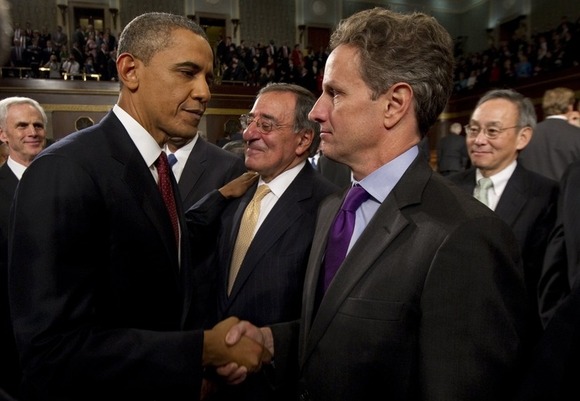
Obama and Geithner shake hands after SOTU
I know everyone has heard the news that Tim Geithner doesn’t expect President Obama to ask him to stay on as Treasury Secretary for a second term.
“He’s not going to ask me to stay on, I’m pretty confident,” Geithner said in an interview with Bloomberg Television today. “I’m confident he’ll be president. But I’m also confident he’s going to have the privilege of having another secretary of the Treasury.”
Ralphb commented on the SOTU live blog that Geithner “looked like he’d been gut punched” when Obama spoke about making banks pay fees on “transactions to pay for mortgage relief/refinancing.” Apparently Geithner wasn’t clued in about that ahead of time.
I’m wondering if they’ve been leaving him out of some of the meetings since Confidence Men revealed that Geithner was dismissive of presidential orders. Check out the facial expressions and body language in the above photo taken after the speech (I made it big so you could see detail). To me that doesn’t look like a friendly greeting. What do you think?
According to Business Week (see above link) two possible candidates to replace Geithner are Catfood Commission co-chair Erskine Bowles and North Dakota Senator Kent Conrad–both horrible choices IMO.
Conrad, 63, chairman of the Senate Budget Committee who said a year ago he won’t seek another term, is “a serious budget hawk on the left, well-liked and respected,” Calabria said.
Bowles, 66, is the former co-leader of Obama’s commission that drafted a plan to reduce the federal government’s debt.
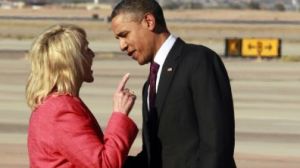
Ariz. Gov. Jan Brewer lecturing President Obama
President Obama had another difficult interaction on Wednesday when he met wacky Arizona Governor Jan Brewer at Phoenix-Mesa Gateway Airport. From the Chicago Tribune:
During their brief encounter on the tarmac, intended to be a ceremonial welcome, Obama told Governor Jan Brewer that he disagreed with an account she had given of a meeting they had at the White House two years ago.
“He was a little disturbed about my book, ‘Scorpions for Breakfast,'” Brewer told reporters after the conversation. At one point during their chat, she pointed a finger at the president.
Brewer, who has differed with Obama over immigration policy in the past, handed him a letter asking him for a meeting to talk about Arizona’s economy when she greeted him. A White House official said the subject of the book came up after Brewer gave Obama the letter.
“The president said he’d be glad to meet with her again, but did note that after their last meeting, a cordial discussion in the Oval Office, the governor inaccurately described the meeting in her book. The president looks forward to continuing taking steps to help Arizona’s economy grow,” the official said.
I didn’t know she had written a book. In fact, I didn’t know she could read…. ABC News provides a little more detail on what the squabble was about.
Brewer complains in Scorpions for Breakfast that she and her staff were treated coldly by White House aides, prevented from taking pictures in the holding room outside the Oval Office and that their cell phones and cameras were “confiscated” by Secret Service.
“Too bad we weren’t illegal aliens, or we could have sued them,” she writes.
During her meeting with the president, Brewer said Obama was “condescending” and professorial, “lecturing” on his efforts to promote comprehensive immigration reform.
“It wasn’t long before I realized I was hearing the president’s stump speech,” she said. “Only I was supposed to listen without talking. Did he care to hear the view from the actual scene at the border? Did the opinions and observations of the people of Arizona mean anything to him? I didn’t think so.”
“He was patronizing,” she said. “Then it dawned on me: He’s treating me like the cop he had over for a beer after he bad-mouthed the Cambridge police, I thought. He thinks he can humor me and then get rid of me.”
After the interaction, Obama apparently walked away before Brewer finished giving him a piece of her mind (or what’s left of it), but she said she would “regroup.” I guess that means “get over it.”
In the run-up to tonight’s debate, Mitt Romney and Newt Gingrich have been lustily attacking each other. Romney must be doing something right, because he’s now running neck and neck with Newt (36% for Romney and 34% for Gingrich) after being behind the former Speaker by 9 points a couple of days ago. Santorum is trailing at 11% and Paul 9% CNN reports:
Gingrich…disparaged Romney’s personal wealth when asked about the former Massachusetts governor’s call for illegal immigrants to deport themselves.
“I think you have to live in a world of Swiss bank accounts and Cayman Island accounts and automatic, you know, $20 million a year income with no work to have some fantasy this far from reality,” Gingrich said at a “Meet the Candidates” forum in Miami, later adding: “For Romney to believe that somebody’s grandmother is going to be so cut off that she is going to self-deport, I mean this verges — this is an Obama-level fantasy.” [….]
Romney….said in the candidate forum, hosted by the Spanish-language network Univision, that such attacks were “unbecoming” for a presidential hopeful….”It’s very sad for a candidate to resort to that kind of epithet,” Romney said of the pulled ad. “There are differences between the candidates on these issues but we don’t attack each other with those kind of terrible terms.”
Newt Gingrich was heckled about his work for Freddie Mac at a rally in Coral Springs, Florida yesterday.
It was quite a scene as a scrum of journalists ignored the candidate and turned to Cara Jennings, who heckled Gingrich in the face of intimidation from his campaign workers, threats from nearby supporters, and the two police officers who showed up to flank her.
“Do you work for the people or Freddie Mac?” Jennings shouted at the former speaker, who was on a platform in a parking lot about 50 feet away.
“I work for the people,” Gingrich responded.
The woman kept shouting, and Gingrich implored her to give others a chance to hear him. But Jennings kept it up, and Gingrich continued engaging her.
Mitt Romney, feeling pressure over the low taxes he pays, tried to claim that his “real tax rate is closer to 45-50 percent.” Think Progress provides a transcript from Romney’s interview with Univision’s Jorge Ramos:
RAMOS: You just released your tax returns. In 2010 you only paid 13 percent of taxes while most Americans paid much more than that. Is that fair?
ROMNEY: Well, actually, I released two years of taxes and I think the average is almost 15 percent. And then also, on top of that, I gave another more 15 percent to charity. When you add it together with all of the taxes and the charity, particularly in the last year, I think it reaches almost 40 percent that I gave back to the community. One of the reasons why we have a lower tax rate on capital gains is because capital gains are also being taxed at the corporate level. So as businesses earn profits, that’s taxed at 35 percent, then as they distribute those profits as dividends, that’s taxed at 15 percent more. So, all total, the tax rate is really closer to 45 or 50 percent.
RAMOS: But is it fair what you pay, 13 percent, while most pay much more than that?
ROMNEY: Well, again, I go back to the point that the, that the funds are being taxed twice at two different levels.
Sorry Mitt, but you’re not a corporation, and besides, as Think Progress points out, most corporations don’t pay 35 percent taxes–in fact many corporations pay no taxes. Romney constantly tells out and out, bald-face lies. Is that de rigueur for the Mormon church, or does he get a dispensation because of all the money he contributes to them?
Brainwashed cult member Rick Santorum, whose campaign is going nowhere in Florida, appeared at a Baptist church in Naples, Florida. He told the audience that “the left” uses college education to “indoctrinate” young people.
“It’s no wonder President Obama wants every kid to go to college,” said the former Pennsylvania senator. “The indoctrination that occurs in American universities is one of the keys to the left holding and maintaining power in America. And it is indoctrination. If it was the other way around, the ACLU would be out there making sure that there wasn’t one penny of government dollars going to colleges and universities, right?”
He continued: “If they taught Judeo-Christian principles in those colleges and universities, they would be stripped of every dollar. If they teach radical secular ideology, they get all the government support that they can possibly give them. Because you know 62 percent of children who enter college with a faith conviction leave without it.” [….]
“I’ll bet you there are people in this room who give money to colleges and universities who are undermining the very principles of our country every single day by indoctrinating kids with left-wing ideology,” he said. “And you continue to give to these colleges and universities. Let me have a suggestion: Stop it.”
Santorum attended Penn State and went on to earn an MBA from the University of Pittsburgh and a law degree from Dickinson School of Law. But he’d rather have the proles stay uneducated so they’ll buy his crazy theocratic bullsh*t.
Santorum did have a license to practice law, but it has been suspended because he didn’t bother to pay his $70.00 per year fee to keep it active. He stopped paying in 1994 and was suspended in 2010. Maybe he decided being a lawyer was the devil’s work?
OK, that’s it for me. What are you reading and blogging about today?
Tuesday Morning Reads
Posted: January 24, 2012 Filed under: 2012 presidential campaign, Barack Obama, morning reads, Teddy Roosevelt, U.S. Economy, U.S. Politics, We are so F'd | Tags: Larry Summers Memo, Obama stimulus, State of the Union Address 40 CommentsGoo d Morning!
I’m tired of Republican Party Dysfunction. Let’s switch to the Democratic Party Brand for awhile. This year’s State of the Union address will be interesting. Will it turn out to be the first major Obama campaign speech of 2102?
Mr. Obama plans, in part, to deliver a “vision” speech. He told campaign supporters over the weekend that he’ll use his speech to discuss “the central mission we have as a country, and my central focus as president.”
“And that’s rebuilding an economy where hard work pays off and responsibility is rewarded – and an America where everybody gets a fair shot, everyone does their fair share, and everybody plays by the same set of rules,” he said.
If that sound familiar, it’s a refrain of remarks Mr. Obama delivered December 6th in Osawatomie, Kansas. Both the president and aides characterize the State of the Union as a “bookend” to the Kansas speech. It was a delineation of the political philosophy Mr. Obama brings to the job and is willing to defend against whichever Republican ends up as his rival later in the year.
Economic programs and objectives will dominate his speech. “I’m going to lay out a blueprint for an American economy that’s built to last,” said the president in a video email Saturday to campaign supporters. And Mr. Obama will cite the “four pillars” on which his blueprint for America will rest: manufacturing, engineering, worker skills and American values.
- MANUFACTURING: According to “talking points” sent by the White House to its political defenders and surrogates, the president will call for “a new era of American manufacturing with more good jobs and more products stamped Made in the USA.
- ENERGY: He will propose “a new era” for energy in the US – “fueled by homegrown & alternative energy sources.
- WORKER SKILLS: He’ll put forward “new ideas” for education and training to take on “jobs of today and tomorrow.”
- AMERICAN VALUES: The president will call for “a return to American Values of fairness for all and responsibility from all.”
We’ll be live blogging the SOTU tonight. I’m suggesting we pitch nerf balls at the TV for every Teddy Roosevelt reference and drink on references to Republican belligerence. What say you?
Here’s some pretty good indications of why the economy has been so slow and pokey recently. Check out The New Yorker and “The Obama Memos”. It’s getting more pundit play than Suskind’s “Confidence Men”. Pay close attention to the whacked advice from Larry Summers who suggested Obama not go very big on the first stimulus because they could just do more later. Let’s just hope a rumored World Bank Presidency stays just that. Imagine this man turned on the developing world. However, there’s a lot more tidbits in there worth chewing on. Like this one.
Neera Tanden was the policy director for Clinton’s campaign. When Clinton lost the Democratic race, Tanden became the director of domestic policy for Obama’s general-election campaign, and then a senior official working on health care in his Administration. She is now the president of the liberal Center for American Progress, perhaps the most important institution in Democratic politics. “It was a character attack,” Tanden said recently, speaking about the Obama campaign against Clinton. “I went over to Obama, I’m a big supporter of the President, but their campaign was entirely a character attack on Hillary as a liar and untrustworthy. It wasn’t an ‘issue contrast,’ it was entirely personal.” And, of course, it worked.
But back to La La Summers.
There was an obvious tension between the warning about the extent of the financial crisis, which would require large-scale spending, and the warning about the looming federal budget deficits, which would require fiscal restraint. The tension reflected the competing concerns of two of Obama’s advisers. Christina Romer, the incoming chairman of the Council of Economic Advisers, drafted the stimulus material. A Berkeley economist, she was new to government. She believed that she had persuaded Summers to raise the stimulus recommendation above the initial estimate, six hundred billion dollars, to something closer to eight hundred billion dollars, but she was frustrated that she wasn’t allowed to present an even larger option. When she had done so in earlier meetings, the incoming chief of staff, Rahm Emanuel, asked her, “What are you smoking?” She was warned that her credibility as an adviser would be damaged if she pushed beyond the consensus recommendation.
Peter Orszag, the incoming budget director, was a relentless advocate of fiscal restraint. He was well known in Washington policy circles as a deficit hawk. Orszag insisted that there were mechanical limits to how much money the government could spend effectively in two years. In the Summers memo, he contributed sections about historic deficits and the need to scale back campaign promises. The Romer-Orszag divide was the start of a rift inside the Administration that continued for the next two years.
Since 2009, some economists have insisted that the stimulus was too small. White House defenders have responded that a larger stimulus would not have moved through Congress. But the Summers memo barely mentioned Congress, noting only that his recommendation of a stimulus above six hundred billion dollars was “an economic judgment that would need to be combined with political judgments about what is feasible.”
He offered the President four illustrative stimulus plans: $550 billion, $665 billion, $810 billion, and $890 billion. Obama was never offered the option of a stimulus package commensurate with the size of the hole in the economy––known by economists as the “output gap”––which was estimated at two trillion dollars during 2009 and 2010. Summers advised the President that a larger stimulus could actually make things worse. “An excessive recovery package could spook markets or the public and be counterproductive,” he wrote, and added that none of his recommendations “returns the unemployment rate to its normal, pre-recession level. To accomplish a more significant reduction in the output gap would require stimulus of well over $1 trillion based on purely mechanical assumptions—which would likely not accomplish the goal because of the impact it would have on markets.”
Paul Krugman, a Times columnist and a Nobel Prize-winning economist who persistently supported a larger stimulus, told me that Summers’s assertion about market fears was a “bang my head on the table” argument. “He’s invoking the invisible bond vigilantes, basically saying that investors would be scared and drive up interest rates. That’s a major economic misjudgment.” Since the beginning of the crisis, the U.S. has borrowed more than five trillion dollars, and the interest rate on the ten-year Treasury bills is under two per cent. The markets that Summers warned Obama about have been calm.
I know this is an add source for me, but the AEI has “Eleven stunning revelations from Larry Summers” has a list of quotes from the actual memo. That’s what I’m going to use here. First, stimulus projects were not picked based on their impact on the economy but on their ability to fulfill campaign promises.
The short-run economic imperative was to identify as many campaign promises or high priority items that would spend out quickly and be inherently temporary. … The stimulus package is a key tool for advancing clean energy goals and fulfilling a number of campaign commitments.
Another stunner was this quote which blames banking regulators. I suppose Wall Street was an innocent in all of this?
A significant cause of the current crisis lies in the failure of regulators to exercise vigorously the authority they already have.
Krugman had this to say about the memo in a post called “Larry and the Invisibles”.
The key thing I took away from the memo is that it does not read at all like the current story the administration gives for the inadequate size of the stimulus, which is that they knew it should be larger but had to face political reality.
Instead, the memo argues that a bigger stimulus would be counterproductive in economic terms, because of the “market reaction”. That is, Summers et al were afraid of the invisible bond vigilantes.
And to the extent that there is a political judgment, it’s all in the opposite direction: if the stimulus is too big, we’ll have trouble scaling it back, but if it’s too small, we can always go back to Congress for more. That was deeply naive — and I said so in real time.
Now, you can still argue that politics made a bigger stimulus impossible. But that’s not at all the argument being made internally within the administration at the time.
At this point, the shrill one goes all mushy and says that Obama has “toughened” up since then. I guess we’ll see.
Right now, I’d say the country is between a Barrack and a hard right place. What’s a voter to do with such a Hobson’s choice?
So, that’s what I’ve got to offer this morning. What’s on your reading and blogging list today?

 peej
peej Carissa
 bostonboomer
 dakinikat
 ecocatwoman
 mablue2
 Mama Lopez
 peggysue22
 quixote
 skydancingguestblogger
 Mona (aka Wonk the Vote)



 Sky Dancing
Recent Comments