
Monday Morning Reads
Posted: February 6, 2012 Filed under: morning reads | Tags: Behavioral Economics vs the Spockos of Chicago, Egypt after the Fall, Komen for the Greed, Ron Paul Wrong on Everything 42 Comments Good Morning!
There’s been so many outrageous things in the news recently that I hardly know where to begin. We talked a lot about the next two subjects but I think there’s some follow-up analysis worth reviewing. First, Ron Paul’s assertions about “honest” rapes and his implication that third trimester “abortions” are every day happenstance is beyond reality and the pale. Here’s some analysis on “The 2 Most Dangerous Things Ron Paul Gets Wrong about Honest Rape”.
1. Women do get raped by their husbands and partners. That’s not some out-there hypothetical. Intimate partner rape is a major problem — and yes, it happens to well-to-do women like Ron Paul’s daughters too.
2. Although Paul keeps going back to women seeking abortions late in their pregnancies, the reality is that 90 percent of abortions occur in the first trimester. So his focus on late-term abortions is disproportionate to the number of women actually seeking late-term abortions.
Paul seems to think married women are still property. I think his exposure to the press this particular election cycle has shown him for the neoconfederate he truly is. Hopefully, he’ll go crawl back under his rock in Texas and leave us in peace soon.
The more we find out about Komen for the Cure, the more appalled we become. It’s apparent that Brinker sees the Foundation as her personal ATM and influence pet and continues to stack the board with Republican Droogies. Brinker’s husband is a huge GOP donor. Surrender the Pink!
A review of the board of directors of Komen by BuzzFlash at Truthout reveals that Brinker has the likely votes to control board decisions at any given time, and that those votes are either Republican stalwarts or individuals personally loyal to her. For instance, one of the members of the relatively small nine-person board – given its nearly half-billion dollars in annual revenue – is Brinker’s son, Eric Brinker. Another is Brinker herself, although, to be fair, many non-profit boards have the CEO as a member.
Linda Law, an apparently extremely accomplished real estate developer and consultant, includes in her Komen board biography that she is an “RNC regent.” This means she is a top bundler and fundraiser for the Republican National Committee, an odd detail to be included in a non-profit board bio. Komen board member Linda Custard, a Dallas social insider, and her husband, William, are listed on opensecrets.org as giving more than 95% in significant contributions to Republicans.
Connie O’Neill is a Dallas socialite, who headed the Junior League there and numerous charity balls, has been on the board and working with Brinker on developing Komen over many years. Although there is no opensecrets.org record of her political giving, unless something has changed she appears to be a Brinker friend and insider.
That’s not to impugn the integrity of Komen board members, despite Brinker’s apparent de facto control of the board and the partisan leanings of some key board members. Indeed, there are some members, such as the chair, Dr. LaSalle D. Leffall, Jr., who is a nationally distinguished oncologist — also a medical professor at Howard University — who appear non-partisan in terms of their roles on the board. So to for Brenda Lauderback, a cancer survivor, and Elyse Gellerman (also a breast cancer survivor), who represents the Komen affiliates.
Komen board member John D. Raffaelli, though, is a lobbyist who swings both sides of the aisle –although he started as a Democrat and has given donations to Dems — is now a full-fledged K Street operative. Raffaelli showed his K Street colors when he told the New York Times (NYT) that “Komen was bitterly disappointed that Planned Parenthood was using Komen’s decision to raise money.” In another NYT article he played the self-pity card: “”Why are they [Planned Parenthood] going nuts?” Mr. Raffaelli asked rhetorically. “And the answer is that they want to raise money, and they’re doing it at the expense of a humanitarian organization that shares their goals and has given them millions of dollars over the years.” Whether or not Raffaelli’s lobbying firm also has contracts with Komen could not be ascertained from the IRS filings online.
From some other of Raffaelli’s statements, it appears entirely possible that along with Karen Handel, he played a key role in coming up with the “congressional investigation” excuse for cutting off Planned Parenthood in the future (before the so called “mea culpa”).
Here’s a headline that’s worth a chuckle or two from Politico: “Trump endorsement a net negative for Romney”. Really? Ya Think? This is some weird polling methodology but I think it probably reflects a degree of reality.
Donald Trump’s endorsement of Mitt Romney may have consumed the news cycle on Thursday, but Nevada Facebook users see the endorsement as a net negative for Romney, according to a Facebook/POLITICO poll.
Forty-one percent of those surveyed said Trump’s endorsement gave them a more negative view of Romney, compared with just 10 percent who said they now view him more positively. Forty-nine percent said the endorsement had no effect.
The results only represent the sentiments of Nevada users on Facebook, not registered voters or likely GOP caucus voters that tend to be more reliable barometers of caucus elections. The Facebook poll, for instance, doesn’t exclude Democrats or independents.
Daniel Kahneman—who recently won the Noble Prize in Economics–is the subject of an interesting interview up at The Economist on the relationship between economic decision-making and psychology. It’s all about trusting instincts.
If you assume that economic agents are completely rational, two immediate conclusions follow. One is people don’t need to be protected against their own choices—and that has been very explicitly the line of the Chicago economists, as illustrated by their opposition to social security. I think the evidence against perfect rationality is overwhelming. A large proportion of the population wants to save more than they do and they have firm intentions to start saving next year. Helping them do this will actually help them make the decision they wish they would make.
Another pernicious implication of the assumption of consumer rationality is that individuals need little protection from the firms with which they interact. For example, the law requires truthful disclosure, but there are no regulations about the clarity of the disclosure or about the size of the print. The assumption is that rational agents will make the effort to read the small print where it matters but, in fact, most of us don’t. Nobody reads the disclosures that roll down your computer screen. You click ‘I agree’ but you don’t know what you’re agreeing to. In the United States, especially under the influence of Cass Sunstein, the White House regulatory chief, firms are required to produce information for their clients in a form the clients can understand. I don’t see that this has any drawbacks, except for the corporations. Those changes in, for example, mortgage and credit card regulations have been fought by the industry, which means the industry thinks it is to its advantage to keep customers poorly informed.
I have a real uphill battle in my field because I don’t buy rational or efficient markets hypotheses. There are just too many frictions and too many examples of behavioral paradoxes. I’ve noticed that the few women in the financial economics field tend to be more behavioralists than not. Perhaps if we ever get to actually dominate the field, we can get rid of that Chicago School nonsense started by the likes of Fama and perpetrated by his son-in-law Cochrane who are buddies of Paul Ryan and other Republican acolytes.
It’s been a year since the Egyptian uprising. This Der Spiegal article asks of Egypt will be able to make democracy work in light of the outcomes of recent elections and violence.
One year after the revolution, Egypt has a new parliament, one that was elected more freely and fairly than ever before. More than two-thirds of its members are Islamists, who now hold as many seats as the former state party, the NDP, once held. There are eight women in this parliament, 13 former NDP members and only a handful of young revolutionaries. Together, they are charged with drafting a constitution, and at the end of June, when the president has been elected, the military council is slated to transfer power to a civilian government. That, at least, is the plan.
It is a double experiment, and the outcome will have an impact throughout the entire Arab world. Can a country, and an Islamic one at that, find its way to democracy through free elections alone? Or does it need a second revolution to sweep aside all corrupt institutions, including the police, state-run television and government agencies that still operate according to the old rules?
If the members of parliament join forces, and if, with the support of the people, they exert pressure on the military council, the generals will hardly be able to resist. But if they prefer to push their own agendas and reach an accommodation with the military to that end, the parliament could remain what it always was: a place where representatives of the people have met for 146 years without ever actually representing the people.
The revolution is now in the hands of the delegates. El-Eleimy, a social democrat, is one of them, a man who is conscious of his own power and filled with the desire to bring about change. But there are also men like Khaled Hanafi, 50, a member of the Muslim Brotherhood who has waited almost 20 years for a seat in parliament. And then there is the Salafist Ahmed Khalil, 33, who was not allowed to teach at his own private school because of his beard.
They have nothing in common, except for the fact that all three demonstrated on Tahrir Square, and yet they must now define important issues together: What kind of a country do we want? And what do we understand as democracy?
So, that’s just a few stories that I dug out. Hard to find much these days because there appears to be so few things that attract the press outside of football and the Newt/Willard battle. Oh well, hopefully you can add some more. What’s on your reading and blogging list this morning?
Saturday Reads: Dismal Science Edition
Posted: February 4, 2012 Filed under: Economy, income inequality, morning reads, poverty, unemployment, We are so F'd | Tags: Paul Krugman, social safety net, unemployment 62 Comments Good Morning!
I’m going to concentrate on the economy this morning. You better grab some coffee.
The unemployment rate dropped yesterday for a variety of reasons. I thought I’d talk a little about that first. The job growth was fairly strong this month in every sector but government. This improved the labor outlook for some of the workers hardest hit by the last recession. However, it was a mixed report–although you wouldn’t know that from the stock market–in that it still showed a number of people who are working part time that don’t want to be and again, a large number of people simply disappeared from the labor force. Temp jobs surged. Wage growth is “meager” as shown by graphs in this blog post by Tim Duy. He also notes that the employment to population ratio remains at a levels not seen since the early 1980s. This is an interesting situation. We’re still in a huge hole. At this growth rate, it will take us until 2019 just to gain back the jobs we had in 2008.
One interesting trend pointed out at Zero Hedge by Tyler Durden is that older workers are increasing the number of hours worked. There appears to be a basic shift in many of the ‘normal’ labor habits. Durden calculates an alternative measure to the unemployment rate by including workers that the BLS ignores. He uses the long-term average labor force participation rate instead of the number of people that are participating now which is shrinking in a very odd way.
… do the following calculation with us: using BLS data, the US civilian non-institutional population was 242,269 in January, an increase of 1.7 million month over month: apply the long-term average labor force participation rate of 65.8% to this number (because as chart 2 below shows, people are not retiring as the popular propaganda goes: in fact labor participation in those aged 55 and over has been soaring as more and more old people have to work overtime, forget retiring), and you get 159.4 million: that is what the real labor force should be. The BLS reported one? 154.4 million: a tiny 5 million difference. Then add these people who the BLS is purposefully ignoring yet who most
certainly are in dire need of labor and/or a job to the 12.758 million reported unemployed by the BLS and you get 17.776 million in real unemployed workers. What does this mean? That using just the BLS denominator in calculating the unemployed rate of 154.4 million, the real unemployment rate actually rose in January to 11.5%. Compare that with the BLS reported decline from 8.5% to 8.3%. It also means that the spread between the reported and implied unemployment rate just soared to a fresh 30 year high of 3.2%.
So, the deal is that the labor force participation rate is at a 30 year low. That’s still the number that puzzles and bothers me despite the good looking job growth. Why are people leaving the job market? As shown in Durden’s numbers, it’s not baby boomers. Here’s some speculation by Edward Harrison of Credit Write Downs who is concerned like me. Look at the graph on the right from Durden that shows why reason number three isn’t the explanation right now. The blue line is the participation rate by the older workers (55+) and as you can see it’s headed straight up.
My take on this: A declining labor force participation rate is a bad thing. It says people are dropping out of the labor force. So despite the bullish headline figure, the question still remains as to how robust the jobs market is.
Here are three things to consider:
- Cyclical: that’s the point I made above. Low participation is a negative signal.
- Structural: A lot of people have been pointing to long-term unemployment as a sign that the jobs market is weak. This makes sense and it should put downward pressure on the participation rate as people drop out of the labor force. The difference here is that if the problem is structural and not cyclical, the so-called output gap will continue to be large as throngs of people remain out of the labor force.
- Secular: The first cohorts of boomers started to retire last year. I know many people that were close to retirement when the recession began in 2007 that have had to change plans. Some have delayed retirement because of financial turmoil. But many others have accelerated retirement unwillingly because they were forced out of the labor force. Expect the loss of boomers to put downward pressure on the labor force for years to come.
My guess is that all three factors are affecting the labor force participation rate here. But I am beginning to think that the structural and secular forces are starting to predominate.
I’m still thinking that younger people may be holding up in school for awhile until things get better but I’d have to do some research to see if the university population is up. I also think that there’s the discouraged worker factor too. I actually know a lot of folks that are just hanging in there and cashing in their IRAs or have gone back to school and are living on student loans and or going back and forth between short term jobs and contract work. I guess we’ll see if the trend holds, but to me it’s a worrisome one. If things were really getting better, those folks should be entering the job market now driving the participation rate up. Since I’m a financial economist and not a labor economist, I really don’t know the flows well enough to speculate on anything beyond a theoretical level. It’s not my research area.
Thomas Fran has written an interesting post at Alternet on “Why We Got Ayn Rand Instead of FDR”.
An appropriate metaphor for the conservative revival is the classic switcheroo, with one fear replacing another, theoretical emergencies substituting for authentic ones, and a new villain shuffling onstage to absorb the brickbats meant for another. The conservative renaissance rewrites history according to the political demands of the moment, generates thick smokescreens of deliberate bewilderment, grabs for itself the nobility of the common toiler, and projects onto its rivals the arrogance of the aristocrat. Nor is this constant redirection of public ire a characteristic the movement developed as it went along; it was present at the creation. Indeed, redirection was the creation.
…
Here, in one sentence, was a key to the amazing success the Right would shortly enjoy. They had an answer to the bailout outrage, and it was not modulated by lawyerly subtleties or votes-taken-with-nose-held, like the House Democrats who had voted for the TARP. “Let the failures fail”: it was a line that would allow the revived Right to depict itself as an enemy of big business, rooting for the collapse of the megabanks. The Tea Partiers may have looked ridiculous in their costumes, but their central demand was anything but.
Not all “failure” is the same, however. What the newest Right has in mind is something philosophical, something both personal and sweeping. It demands liquidation across the board, a sort of deserved doomsday for the borrowing-based way of life. But in the great die-off it delights in imagining, the real culprits of 2008 have a way of disappearing from view.
If we watch closely, we can see the cards being switched. Whenever our tea-partying friends warm to the subject of letting-the-failures-fail—and they do so often—sooner or later they inevitably turn from the bailed-out banks to those spendthrift “neighbors” identified by Santelli, those dissolute people down the street who borrowed in order to live above their station.
This could be why the Republican Presidential Wannabes sound so down right Dickensian. We’ve had school children offered up as janitorial help. We’ve had Willard talking about enjoying a good firing and ranting on about how he’s not worried about the poor because they are safe in their safety nets. Instead of pointing to the business welfare queens, we’ve got poor children being held up as not having the fortitude and values. As Krugman says, Willard doesn’t feel any one’s pain.
Now, the truth is that the safety net does need repair. It provides a lot of help to the poor, but not enough. Medicaid, for example, provides essential health care to millions of unlucky citizens, children especially, but many people still fall through the cracks: among Americans with annual incomes under $25,000, more than a quarter — 28.7 percent — don’t have any kind of health insurance. And, no, they can’t make up for that lack of coverage by going to emergency rooms.
Similarly, food aid programs help a lot, but one in six Americans living below the poverty line suffers from “low food security.” This is officially defined as involving situations in which “food intake was reduced at times during the year because [households] had insufficient money or other resources for food” — in other words, hunger.
So we do need to strengthen our safety net. Mr. Romney, however, wants to make the safety net weaker instead.
Specifically, the candidate has endorsed Representative Paul Ryan’s plan for drastic cuts in federal spending — with almost two-thirds of the proposed spending cuts coming at the expense of low-income Americans. To the extent that Mr. Romney has differentiated his position from the Ryan plan, it is in the direction of even harsher cuts for the poor; his Medicaid proposal appears to involve a 40 percent reduction in financing compared with current law.
So Mr. Romney’s position seems to be that we need not worry about the poor thanks to programs that he insists, falsely, don’t actually help the needy, and which he intends, in any case, to destroy.
Still, I believe Mr. Romney when he says he isn’t concerned about the poor. What I don’t believe is his assertion that he’s equally unconcerned about the rich, who are “doing fine.” After all, if that’s what he really feels, why does he propose showering them with money?
The New York Review of Books has an entire list of economics books up that have to do with austerity and income inequality. The heading basically sums it up. We’re more unequal than you think. Here’s a review of two that I found particularly interesting.
Robert Frank’s The Darwin Economy and Thomas Edsall’s The Age of Austerity provide much-needed information and analysis to explain why so much of the nation’s money is flowing upward. Frank, an economist at Cornell, draws on social psychology to shatter many myths about competition and compensation. While he doesn’t explicitly cite the classical French economist Jean-Baptiste Say, much in his exposition echoes Say’s axiom that “supply creates demand.” This doesn’t mean that if items are put on display, people will automatically buy them. Consumers decide what or if they’ll purchase, and clearly can only do so if they have the credit or money. Even so, the items they decide they want have been created by the suppliers, who put things on the shelves.
Frank carries this a step further. In recent years, he argues, the products and enjoyments set before us have become increasingly enticing—including houses, vacations, television programs, video games, electronic devices, and the attractions of the Internet. In many cases, the rich acquire them first; since what they have and do becomes widely known, emulation descends down the line.
Nor are these just Tiffany trinkets. Frank’s most vivid examples are newly built houses. As the very rich installed grander entrance halls and rarely used bathrooms, the professional classes felt they should have a semblance of such amenities. “By 2007,” Frank writes, “the median new single-family house built in the United States had an area of more than 2,300 square feet, some 50 percent more than its counterpart from 1970.” Indeed, it’s revealing that this expansion was happening as people were having fewer children. However, these homes—along with more elaborate wardrobes, holidays, and technical gear—are costly. If they were to be bought, salaries needed to keep pace.
Hence, I would argue, an unstated but still real compact was made between the employers and the new upper-middle class. Their pay would be raised to support their ascending status. As the samplings in Table B show, while real earnings for the overall workforce have risen only 7 percent since 1985, professions like physicians and professors have done several times better. Incomes of lawyers and executives, for their part, have soared much further than anyone would have forecast a few decades ago.2
One of the reasons the poor do so poorly is that the states have tax structures that are very regressive. If you didn’t see me link to this down thread yesterday, take a look at how regressive state taxes really are. Kevin Drum includes a table where you can check on how bad your state treats you.
And then there are state taxes. Those include state income taxes, property taxes, sales taxes, and fees of various kinds. How progressive are state taxes?
Answer: They aren’t. The Corporation for Enterprise Development recently released a scorecard for all 50 states, and it has boatloads of useful information. That includes overall tax rates, where data from the Institute on Taxation and Economic Policy shows that in the median state (Mississippi, as it turns out) the poorest 20 percent pay twice the tax rate of the top 1 percent. In the worst states, the poorest 20 percent pay five to six times the rate of the richest 1 percent. Lucky duckies indeed. There’s not one single state with a tax system that’s progressive.
So, hopefully, you’re still awake! What’s on your reading and blogging list today.
Friday Reads
Posted: February 3, 2012 Filed under: 2012 presidential campaign, morning reads, We are so F'd | Tags: 1Q84, Aomame, Haruki Murakami, Romney, Santorum, Thomas Paine, Willard 70 Comments Good Morning!
As you may know, one of my pet peeves is how right wing politicians distort historical figures and quotes to their advantage and very few journalists or people bother to spell check them. Mitt Romney is going on using a George Patton quote and attributing it to one of my favorite founders, Thomas Paine. Any one remotely familiar with the 18th century would know that “lead, follow, or get out of the way” couldn’t even be part of the lexicon. But, never let a good opportunity to skew history the wrong direction get in the way of a pol in heat.
Fred Shapiro, editor of the authoritative Yale Book of Quotations published by Yale University Press, told BuzzFeed that “the notion that Thomas Paine said this is extremely ridiculous.”
“The diction and tone of ‘lead, follow, or get out of the way’ are, of course, far too modern to have been said by Thomas Paine,” Shapiro said.
A similar form of the quote — “push, pull, or get out of the way” — can be traced to a proverb dating back to 1909, according to Shapiro, who is the author of a forthcoming book on notable misquotes. And there is a newspaper mention of the quote from 1961, but it’s from the governor of Ohio. According to Paine biographer Craig Nelson, Paine “never said it. George Patton did.” (You can also find the quote attributed to Patton on the Internet).
In response to a request for comment on the Paine misquote, Romney spokeswoman Andrea Saul noted that the candidate had hedged a little bit: “In another era of American crisis, Thomas Paine is reported to have said, ‘Lead, follow, or get out of the way.'”
University of Texas professor and Paine scholar William Scheick called Romney’s misquoting of Paine “another deplorable example of politicians distorting history to advance themselves and their shadowy supporters” and said that Paine “hardly is apt in Romney’s case.”
“For me, that’s the real story here — that Romney and his audience apparently have no clue to what a searing liberal freethinker Paine was,” said Scheick.
Don’t you just love the description “searing liberal freethinker”? I might also add the man was a well-known critic of organized religion. That’s hardly a combination of attributes for a leader that you would think a Republican presidential wannabe would want thrown around these days. I remember reading a biography of Thomas Paine in high school and thinking “wow”. At the end of his days, Thomas Jefferson was one of the few folks that would even speak to him. He was that scandalous. It is pretty well known that he moved from being a deist into the realm of atheism by his end days. His most famous work is Age of Reason but he is also well known as a pamphleteer or the equivalent of a 18th century blogger.
What you may not know is that he was one of the most ardent and earliest supporters of emancipation for women. One of his most famous works is called: An Occasional Letter on the Female Sex and includes many examples of how women have been subjugated to men. Here, Paine channels his inner female to argue for emancipation.
If a woman were to defend the cause of her sex, she might address him in the following manner:
“How great is your injustice? If we have an equal right with you to virtue, why should we not have an equal right to praise? The public esteem ought to wait upon merit. Our duties are different from yours, but they are not therefore less difficult to fulfill, or of less consequence to society: They are the fountains of your felicity, and the sweetness of life. We are wives and mothers. ‘Tis we who form the union and the cordiality of families. ‘Tis we who soften that savage rudeness which considers everything as due to force, and which would involve man with man in eternal war. We cultivate in you that humanity which makes you feel for the misfortunes of others, and our tears forewarn you of your own danger. Nay, you cannot be ignorant that we have need of courage not less than you. More feeble in ourselves, we have perhaps more trials to encounter. Nature assails us with sorrow, law and custom press us with constraint, and sensibility and virtue alarm us with their continual conflict. Sometimes also the name of citizen demands from us the tribute of fortitude. When you offer your blood to the State think that it is ours. In giving it our sons and our husbands we give more than ourselves. You can only die on the field of battle, but we have the misfortune to survive those whom we love most. Alas! while your ambitious vanity is unceasingly laboring to cover the earth with statues, with monuments, and with inscriptions to eternize, if possible, your names, and give yourselves an existence, when this body is no more, why must we be condemned to live and to die unknown? Would that the grave and eternal forgetfulness should be our lot. Be not our tyrants in all: Permit our names to be sometimes pronounced beyond the narrow circle in which we live. Permit friendship, or at least love, to inscribe its emblem on the tomb where our ashes repose; and deny us not that public esteem which, after the esteem of one’s self, is the sweetest reward of well doing.”
As I said, it’s really hard for me to imagine Willard thinking that he is quoting Paine. He obviously knows not what of he speaks in many ways.
Sabrina Rubin Erdely has written an incredible account of the “One Town’s War on Gay Teens” in this month’s Rolling Stone. The town is none other than Anoka, MN who is represented in congress by the dread Pirate Bachmann and her faux therapist, closeted husband Marcus. The personal stories of several teens is detailed and gut-wrenching. So much for Minnesota nice.
Against this supercharged backdrop, the Anoka-Hennepin school district finds itself in the spotlight not only for the sheer number of suicides but because it is accused of having contributed to the death toll by cultivating an extreme anti-gay climate. “LGBTQ students don’t feel safe at school,” says Anoka Middle School for the Arts teacher Jefferson Fietek, using the acronym for Lesbian, Gay, Bisexual, Transgender and Questioning. “They’re made to feel ashamed of who they are. They’re bullied. And there’s no one to stand up for them, because teachers are afraid of being fired.”
The Southern Poverty Law Center and the National Center for Lesbian Rights have filed a lawsuit on behalf of five students, alleging the school district’s policies on gays are not only discriminatory, but also foster an environment of unchecked anti-gay bullying. The Department of Justice has begun a civil rights investigation as well. The Anoka-Hennepin school district declined to comment on any specific incidences but denies any discrimination, maintaining that its broad anti-bullying policy is meant to protect all I students.
Meanwhile, I continue to wonder if any Republican presidential candidate has read that bible they keep thumping. Here’s the latest example of audacious insensitivity from Rick Santorum.
GOP contender Rick Santorum had a heated exchange with a mother and her sick young son Wednesday, arguing that drug companies were entitled to charge whatever the market demanded for life-saving therapies.Santorum, himself the father of a child with a rare genetic disorder, compared buying drugs to buying an iPad, and said demand would determine the cost of medical therapies.
“People have no problem paying $900 for an iPad,” Santorum said, “but paying $900 for a drug they have a problem with — it keeps you alive. Why? Because you’ve been conditioned to think health care is something you can get without having to pay for it.”
The mother said the boy was on the drug Abilify, used to treat schizophrenia, and that, on paper, its costs would exceed $1 million each year.
Santorum said drugs take years to develop and cost millions of dollars to produce, and manufacturers need to turn a profit or they would stop developing new drugs.
“You have that drug, and maybe you’re alive today because people have a profit motive to make that drug,” Santorum said. “There are many people sick today who, 10 years from now, are going to be alive because of some drug invented in the next 10 years. If we say: ‘You drug companies are greedy and bad, you can’t make a return on your money,’ then we will freeze innovation.”
Santorum told a large Tea Party crowd here that he sympathized with the boy’s case, but he also believed in the marketplace.
Then there’s “I don’t care about poor people Willard”. Do these guys even think before they speak? I really like this Pierce description in an article where he rips austerity a new one. We have to be punished for suffering, for not surviving their financial abuses, and for not being patient enough. Hallelujah and trickle it down Big Brother!
The idea of poverty’s being a sin that requires ritual purification before redemption runs pretty deeply in this country. When Jonathan Edwards delivered his great sermon, Sinners In The Hands Of An Angry God, I doubt whether even that unbending piece of Puritan iron realized how many of his fellow citizens would be so willing to be the servants of that god, seeking to punish their fallen brethren. There has always been a strong view in our politics that pain can purify the nation. Especially the pain of other people, less-worthy-people. Sinners.
We are falling like dim children, like the suckers we always are, to the notion of the deserving and undeserving poor, the have-less-and-lesses are being pitted against the have-littles, and the have-nots. That’s what Willard Romney’s been about the last couple of days. He wants to find a way to harness the fear people have of becoming poor to his advantage at the expense of the people who actually are. That is the basis of the entire public career of Paul Ryan, the zombie-eyed granny-starver from Wisconsin, and the whole party has signed the guestbook into his little S&M parlor of a budget.
Speaking of Big Brother References, I just finished an interesting novel about religious cults, domestic violence and alternative realities called 1Q84 by Haruki Murakami. I’m checking the sky for two moons these days. I totally recommend it. It’s literary. It’s unusual. It’s got marvelous character development and descriptions and a plot that is amazing. Here’s the NYT review from October. Aomame makes the girl with the dragon tatoo look like a conformist and weakling. It was a very long read and didn’t always capture me, but it is still worth the time. It starts out with what seems like two completely unconnected characters and events and then weaves all the connections from there on out.
One of the many longueurs in Haruki Murakami’s stupefying new novel, “1Q84,” sends the book’s heroine, a slender assassin named Aomame, into hiding. To sustain her through this period of isolation she is given an apartment, groceries and the entirety of Marcel Proust’s “Remembrance of Things Past.”
For pity’s sake, if you have that kind of spare time, follow her lead. Aomame has the chance to read a book that is long and demanding but well worth the effort. The very thought of Aomame’s situation will pain anyone stuck in the quicksand of “1Q84.” You, sucker, will wade through nearly 1,000 uneventful pages while discovering a Tokyo that has two moons and is controlled by creatures that emerge from the mouth of a dead goat. These creatures are called Little People. They are supposed to be very wise, even though the smartest thing they ever say is “Ho ho.”
You can see the Times reviewer was not enthralled. I was frankly happy to read something not so cookie cutter for a change. So, I guess that’s what’s on my mind these days since I’ve had plenty of bedrest and time on my hands. What’s on your reading and blogging list today?
Thursday Reads: The Not-Quite-Humanness of Mitt Romney
Posted: February 2, 2012 Filed under: 2012 presidential campaign, 2012 primaries, Media, Mitt Romney, morning reads, U.S. Politics | Tags: "Invasion of the Body Snatchers", "The Real Romney", Andrew Sullivan, Book of Mormon, Brigham Young, CNN Florida primary debate, Cougar Club, Declaration of Independence, Genn Beck, George Romney, Joseph Smith, Latter Day Saints, Michael D. Moody, Miles A. Romney, Miles P. Romney, Mitt Romney, Mormon church, Orrin Hatch, polygamy, robots, theocracy, U.S. Constitution, uncanny valley, zombies 53 Comments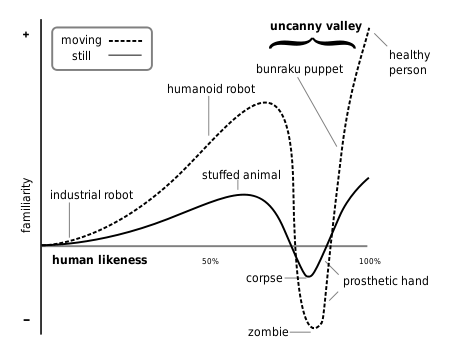
Good Morning!!
I had never seen the diagram above before until last night when I was browsing through reactions to Mitt Romney’s latest insensitive remark, “I’m not concerned about the very poor. We have a safety net there.” That’s when I found the above diagram at Andrew Sullivan’s blog.
Here’s an explanation from Wikipedia:
Hypothesized emotional response of human subjects is plotted against anthropomorphism of a robot, following Mori’s statements. The uncanny valley is the region of negative emotional response towards robots that seem “almost human”. Movement amplifies the emotional response.
The idea is you can make an emotional connection to a robot; but a robot that is very close to looking and acting human, but not quite, will elicit disgust. This could explain the reactions of revulsion that many people have toward Mitt Romney. From Wikipedia:
If an entity looks sufficiently nonhuman, its human characteristics will be noticeable, generating empathy. However, if the entity looks almost human, it will elicit our model of a human other and its detailed normative expectations. The nonhuman characteristics will be noticeable, giving the human viewer a sense of strangeness. In other words, a robot stuck inside the uncanny valley is no longer being judged by the standards of a robot doing a passable job at pretending to be human, but is instead being judged by the standards of a human doing a terrible job at acting like a normal person.
Sullivan suggests that Romney is “probing zombie territory.” I found this a very helpful way to think about the way Romney presents himself in public. He is trying very hard to act like a regular human being and he almost succeeds, but not quite–sort of like the fake humans in Invasion of the Body Snatchers.
Mitt Romney is a pod person!
Another behavior I’ve noticed about Romney is his tendency to get almost manic and go way overboard–as he was doing down in Florida in his attack on Newt Gingrich and in his glee at winning the primary (only the second he has won). I mentioned to Dakinikat yesterday that I thought Romney could use some lithium carbonate to bring him back down to earth.
According to Sullivan, others are picking up on this tendency too. Sullivan links to a series of photos by Dan Amira at New York Magazine, with this introduction:
Mitt Romney came into the 2012 presidential race with a reputation as a stiff, humanoid robot. Consequently, he’s been making a concerted effort to seem more warm and friendly when interacting with voters on the campaign trail. But there’s a happy middle ground between “robotic” and “maniac on ecstasy” — a middle ground that seems to elude Romney on a regular basis.
Here’s one of the photos.

I really need to read Andrew Sullivan more often. He writes:
I was chatting with a Mormon friend the other day and asking him what Mormons make of Mitt on this uncanny valley question. The phrase he came up with is “the Mormon mask.” It’s the kind of public presentation that a Mormon with real church authority deploys when dealing with less elevated believers, talking to them, and advising them. The cheery aw-shucks fake niceness in person is a function in part, some believe, of the role he has long played in the church: always a leader.
Because, make no mistake about this: Mitt Romney is a Mormon church leader. I mentioned before that I’ve been reading The Real Romney, by Boston Globe reporters Michael Kranish and Scott Helman. Here’s a 2008 quote from Mitt that introduces the chapter on the Romney family history:
I believe in my Mormon faith and I endeavor to live by it. My faith is the faith of my fathers. I will be true to them and to my beliefs. Some believe that such a confession of my faith will sink my candidacy. If they are right, so be it.
Mitt Romney has served his church in official leadership roles since 1977, when he became a counselor (essentially second in command) to the president of the Boston “stake.” Romney was only about 30, much younger than most who ascend to this position. But Romney was seen as special. He later became a Bishop and then stake President. As such he was in charge of “about a dozen congregations with close to 4,000 members all together.”
Romney’s great great grandfather Miles A. Romney heard Joseph Smith speak in England, and soon after emigrated with his family to the U.S. to become one of the 12 original Smith apostles. Romney’s ancesters helped to build the earliest Mormon temples, and they unquestioningly followed orders from Smith, and later Brigham Young, to marry multiple wives and travel to far away places at the whims of these church leaders. Romney’s great grandfather, Miles P. Romney along with his three wives and twenty-one children, started a polygamous Mormon colony in Mexico. That is where Mitt’s dad George was born. George returned to the U.S. at age seven.
Yesterday I read quite a bit of an e-book by Michael D. Moody, who was a classmate of Mitt Romney’s at BYU. Moody’s ancestors were also among the earliest followers of Joseph Smith. Moody’s book is called Mitt, Set Our People Free! A 7th Generation Mormon’s Plea for Truth. It is written in the form of an open letter to Mitt from one who has “left the cult.” The “letter” was actually written in 2008, but Moody believes it is just as relevant today.
As undergraduates, Romney and Moody belonged to a BYU booster club, the Cougar Club (BYU didn’t permit Greek fraternities). The club raised large amounts of money for the church and the university. Moody writes that
…in 1970-71…the Cougar Club buzzed that you planned to run for President someday and it became a fait accompli by 2006. Early and aggressively, you began your long-planned push for the U.S. presidency. After making all the right business moves and a few snazzy dance steps to the political right, you were suddenly a top tier contender for the Republican nomination with significant insider support and a freshly reinvented persona.
Moody was surprised when he heard Romney repeatedly tell interviewers and supporters that he had never intended to run for office–it just happened somehow. In fact Moody can’t understand a lot of the things Romney says that he (Moody) knows to be lies.
Moody had been somewhat rebellious during his early years at BYU and ended up getting suspended and then drafted and sent to Vietnam. It was there the Moody began having contact with non-Mormons and began to learn the history of the religion that had been hidden from the faithful–like the fact that the Book of Mormon had obviously been written by Joseph Smith himself and that the book contained many sections that had been plagarized from the King James Bible.
Still, even when he came home from Vietnam, he returned to BYU, joined the Cougar Club, and gave the religion he had been born into another chance. After he graduated, Moody went into politics specifically to support Romney’s push for the presidency and to be prepared to be one of Romney’s cabinet members when the time came. He writes:
I did my duty to the Mormon Gods and ran for Governor to expand our Kingdom and help you lead the world into the Millenium. Actually…by then I had begun my long journey out of the cult.
Moody is no longer a Mormon, but he says that Mitt Romney is still a true believer. One of the beliefs that many Mormons hold is the “White Horse Prophecy.” Moody writes:
Like previous generations, we were reared to believe the U.S. Constitution needed saving, and the LDS Church would do it. We knew our reward, because of primordial valience, was a chance to play major roles in the ensuing end day events. Jesus and “God the Father” had told the prophets, and our patriarchs had told us personally. We were a special generation.
That the U.S. Constitution is in [immanent] danger and will “hand by a thread as fine as silk fiber” in the latter days before the LDS Church rides to its rescue….The Church priesthood holders (men like Romney and Moody) will sweep in like knights to save the Constitution then set it aside to reestablish the theocratic Kingdom created by Joseph Smith and nearly perfected by Brigham Young. The stated plan is to pave the way for the political Kingdom of God and Joseph Smith’s version Millenial Kingdom on Earth.
A few days ago, Salon published an article by Sally Denton, another former Mormon and author of books on Mormon history, on Mitt Romney and the White Horse Prophecy.
When Mitt Romney received his patriarchal blessing as a Michigan teenager, he was told that the Lord expected great things from him. All young Mormon men — the “worthy males” of the Church of Jesus Christ of Latter-day Saints, as it is officially known — receive such a blessing as they embark on their requisite journeys as religious missionaries. But at 19 years of age, the youngest son of the most prominent Mormon in American politics — a seventh-generation direct descendant of one of the faith’s founding 12 apostles—Mitt Romney had been singled out as a destined leader.
From the time of his birth — March 13, 1947 — through adolescence and into manhood, the meshing of religion and politics was paramount in Mitt Romney’s life.
In the early 1960s Romney’s father George confided his political ambitions in his youngest son, then a teenager. Mitt actively participated in his father’s campaign for governor of Michigan, and during George’s three terms as governor Mitt was often in his father’s office, privy to major decisions. He attended the Republican convention with his father in 1964, and was kept abreast of his father’s failed campaign for President in 1968 (Mitt was a missionary in France).
Denton writes that [although the official church denies it] the White Horse Prophecy is “ingrained in Mormon culture and passed down through generations by church leaders…” She writes:
In this scenario, Romney’s candidacy is part of the eternal plan and the candidate himself is fulfilling the destiny begun in what the church calls the “pre-existence.”
Several prominent Mormons, including conservative talk-show host Glenn Beck [read more here], have alluded to this apocalyptic prophecy. The controversial myth is not an official church doctrine, but it has also arisen in the national dialogue with the presidential candidacies of Mormons George Romney, Sen. Orrin Hatch, R-Utah, and now Mitt Romney.
Mitt Romney himself has dismissed this notion.
“I don’t think the White Horse Prophecy is fair to bring up at all,” Mitt Romney told the Salt Lake Tribune when he was asked about it during his 2008 presidential bid. “It’s been rejected by every church leader that has talked about it. It has nothing to do with anything.”
Maybe not, but I still want to know more about Romney’s religion. What I’ve learned already is pretty strange–that God was once a man living on another planet, that “priests” like Mitt Romney will be masters of their own planets after death and that they will be able to take as many wives as they wish in the afterlife. That Mormon women can’t get into heaven unless they are married and and their husbands help them through. That women must stay married to the same man even after death and must be prepared to make way for his multiple wives and their children in the afterlife. And BTW, did you know that Romney’s family baptized Mitt’s confirmed atheist father-in-law as a Mormon a year after he died? No wonder Romney doesn’t want to talk about his religion!
I suppose it isn’t any more wacky than a lot of the stuff in the Christian old testament, but the fact that all this nonsense was sold to people in the 19th and 20th centuries and is people like Glenn Beck are still buying it and converting in the 21st century is pretty hard for me to accept. I don’t think that’s bigotry–it’s self-preservation. We’ve already seen what can happen when fanatical fundamentalist Christians start getting control of political parties and throwing their weight around in government and the culture as a whole (Susan Kommen, anyone?).
In light of all this, I find this statement by Romney in the CNN Florida debate to be very troubling:
The conviction that the founders, when they wrote the Declaration of Independence, were writing a document that was not just temporary and not just for one small locale but really something which described the relationship between God and man — that’s something which I think a president would carry in his heart.
So when they said, for instance, that the creator had “endowed us with certain unalienable rights, among them life, liberty and the pursuit of happiness,” I would seek to assure that those principles and values remain in America and that we help share them with other people in the world, not by conquering them, but by helping them through our trade, through our various forms of soft power, to help bring people the joy and — and — and opportunity that exists in this great land.
Am I crazy to be a little concerned about this guy? This post is getting very long, so I’ll end here. But I doubt if this will be the last time I bring up the Romney/religion issue. So far Romney has been allowed to skate on this. No one wants to ask him about it for fear of being labeled a bigot. I don’t care. I just want to keep another theocratic candidate from sneaking past our useless corporate media.
So… that’s it for me and my Romney obsession. What are you interested in today?
Tuesday Reads
Posted: January 31, 2012 Filed under: 2012 presidential campaign, Mitt Romney, morning reads, Newt Gingrich, the GOP, U.S. Politics | Tags: animal hoarding, Florida primary, Mitt Romney, Newt Gingrich, pets, rescue workers 41 Comments
Good Morning!! Tonight is the Florida Republican primary, and we’ll be live blogging it later on. This post is going to be a quickie, because I worked way too long on the one I put up last night. Still, I do have some interesting reads to recommend.
A couple of days ago, I read a fascinating piece by Emily Yoffe at Slate about the difficulty of adopting pets these days. It seems that if you want to adopt a pet from a rescue place, you have to fill out endless forms and go to great lengths to prove you’re worthy before you can be granted the privilege of taking home a cat or dog–or even a bird or hamster!
The article is really interesting and funny, so check it out. You won’t regret it. One of the most surprising facts Yoffe reveals is that 25% of people who are identified as animal hoarders are either past or present rescue workers!
I’m sure you’ve heard that Mitt Romney has been using a scorched earth policy against Newt Gingrich in Florida. The NYT had an interesting article on the reasons for Romney’s change in strategy.
In a call last Sunday morning, just hours after Mr. Romney’s double-digit loss to Mr. Gingrich in the South Carolina primary, the Romney team outlined the new approach to the candidate. Put aside the more acute focus on President Obama and narrow in on Mr. Gingrich.
Find lines of attack that could goad Mr. Gingrich into angry responses and rally mainstream Republicans. Swarm Gingrich campaign events to rattle him. Have Mr. Romney drop his above-the-fray persona and carry the fight directly to his opponent, especially in two critical debates scheduled for the week.
The results of that strategy, carried out by a veteran squad of strategists and operatives assembled by Mr. Romney to deal with just this kind of moment, have been on striking display here.
By this weekend, Mr. Romney’s aides were on the offensive and increasingly confident, with some combination of their strategy and Mr. Gingrich’s own performance swinging polls in Mr. Romney’s direction. Even as it acknowledged the damage inflicted on Mr. Romney by the past several weeks, his team suggested that it had learned a lesson about never letting up on rivals, especially if Mr. Romney wins the nomination and confronts Mr. Obama in the general election.
Some conservatives are really upset about what Romney is doing to Gingrich. They say he may win the Florida primary, but he’s hurting the GOP and probably making himself a weaker candidate against Obama. Here’s an excerpt from a post by William Jacobson at Legal Insurrection:
If you asked me even a couple of weeks ago whether the Republican Party could heal from the wounds of this election cycle in time to unite against Obama, I would have said ”Yes.”
I’m not so sure anymore. After the South Carolina primary the Republican establishment, and media supporters like Matt Drudge, launched Scorched Earth II on Newt, while pro-Romney pundits like Ann Coulter heaped scorn on the conservative and Tea Party voters who sided with Newt.
It may just be “not-beanbag” to the Romney campaign and its supporters, but people hear them loud and clear.
Two lines of attack have exposed a schism between the Republican political haves and have nots which will not easily heal: The attempt to rewrite the history of the Reagan revolution and the embrace of Nancy Pelosi’s partisan ethics attack and blackmail.
Another conservative writer and talk show host, John Batchelor says Romney and Gingrich are “setting the GOP on a path to destruction.”
The primary campaign nastiness between Mitt Romney and Newt Gingrich is exhausting Republican loyalists. What in Iowa was a feisty contest between the haughty Mr. Romney and the operatic Mr. Gingrich turned hollow in New Hampshire and harsh in South Carolina. By the close of the Florida scramble, with the Herman Cain Express back from the repair yard to hitch onto the Newt baggage car, what remains of the Republican dialogue does not appear likely to be of much worth for the fall campaign.
The solution to the puzzle may be to admit that the GOP has forfeited 2012 before the general election even starts. How did this happen so suddenly?
“That’s the great mystery of 2012,” a senior Republican journalist told me while watching the brouhaha in Florida. “We have the weakest incumbent president in 32 years, running on the weakest record in 32 years… and who’s taking the stage in South Carolina and Florida? It has to be the weakest field I can remember. Each of these candidates has in his character, in his history, in his idea set—never mind disqualifying—a guarantee for self-destruction. If Newt is the candidate, he’ll lose badly. If Mitt is the candidate, he’ll lose slightly less badly … So what you have is an almost complete guarantee that if these are the candidates, Barack Obama will be reelected.”
It seems to me that the GOP is experiencing a major schism like the one that spit the Democratic party in 2008. This will be interesting to watch.
Mitt Romney appeared on the Today Show yesterday to defend his new campaign strategy. I can’t embed the NBC video here, but you can watch it at this Atlantic Wire link. I think Romney comes off as both arrogant and passive aggressive. He also addresses (but doesn’t really deal with) Tom Brokaw’s objections to being used in a Romney attack ad.
“We’ll sit down with the lawyers, talk to the folks at NBC, and make a decision on that front,” Romney told the Today show’s Matt Lauer when asked if he would pull the TV spot heavily featuring a 1997 Tom Brokaw newscast about Newt Gingrich. What Romney said on Today sounded a bit more unsure than the Romney staffer who over the weekend said the campaign would not be taking down the ad.
Last night, Romney continued to “ridicule” Gingrich, according to Reuters.
A confident Mitt Romney solidified his lead in Florida polls and ridiculed Republican rival Newt Gingrich on Monday, calling his opponent’s attacks “sad” and “painfully revealing” the day before the state’s crucial presidential primary.
Romney’s self-assuredness was on full display during a campaign tour that felt at times like a victory lap, with the front-runner telling a crowd of 2,000 in Dunedin, Florida: “With a turnout like this I got a feeling we might win tomorrow.”
I can’t help but wish that Florida voters would wipe that self-satisfied smile off Romney’s face tonight. Amazingly, Andrew Sullivan shares my feelings.
I didn’t watch 60 Minutes on Sunday night, but Glenn Greenwald did: Leon Panetta’s explicitly authoritarian decree. Read it and weep.
That’s about all I’ve got. I’ll end with Charlie Pierce’s latest: Romney, Basking in a Ray of Reality, Faces Real Test It’s his take on the NYT piece.
I am supposed to write now about how Willard Romney, the only presidential candidate in history to run as his own animatronic double, got his swerve on, his mojo back, and his engorged pen… no, wait, let me start again. I am supposed to write about how Willard Romney, a man with the charisma of grass seed and the political principles of a moray eel, became a newly formidable candidate after his thumping by Newt Gingrich among the holy-rolling swamp-runners in South Carolina. I read in yesterday’s New York Times that, after failing the ultimate test of his Gooberhood, Willard fled to one of his several Fortresses of Solitude, only to emerge in Florida as a lean, mean pompadoured war beast:
It was a call to arms employing all the visible and invisible tactics of political warfare.
(Ed. Note: Did they paint their faces blue and eat the still-beating hearts out of live elk?)
Now you can go read the rest at Charlie’s blog, and then come back and share what you’re reading and blogging about.

 peej
peej Carissa
 bostonboomer
 dakinikat
 ecocatwoman
 mablue2
 Mama Lopez
 peggysue22
 quixote
 skydancingguestblogger
 Mona (aka Wonk the Vote)



 Sky Dancing
Recent Comments