
Early Morning Open Thread: The Voting Rights Act
Posted: February 28, 2013 Filed under: morning reads, U.S. Politics | Tags: Civil Rights, George Wallace, Lyndon B. Johnson, Selma Alabama, Voting Rights Act 18 Comments
President Lyndon Johnson signs the Voting Rights Act, 1965
Lyndon Johnson: Voting Rights Act Address
Delivered March 15, 1965, Washington, D.C.
I speak tonight for the dignity of man and the destiny of democracy.
I urge every member of both parties—Americans of all religions and of all colors—from every section of this country—to join me in that cause.
At times history and fate meet at a single time in a single place to shape a turning point in man’s unending search for freedom. So it was at Lexington and Concord. So it was a century ago at Appomattox. So it was last week in Selma, Alabama.
There is no Negro problem. There is no southern problem. There is no northern problem. There is only an American problem.
And we are met here tonight as Americans—not as Democrats or Republicans—we are met here as Americans to solve that problem.
This was the first nation in the history of the world to be founded with a purpose. The great phrases of that purpose still sound in every American heart, north and south: “All men are created equal” — “Government by consent of the governed” — “Give me liberty or give me death.”…
Those words are a promise to every citizen that he shall share in the dignity of man. This dignity cannot be found in man’s possessions. It cannot be found in his power or in his position. It really rests on his right to be treated as a man equal in opportunity to all others. It says that he shall share in freedom, he shall choose his leaders, educate his children, provide for his family according to his ability and his merits as a human being….
Many of the issues of civil rights are very complex and most difficult. But about this there can and should be no argument. Every American citizen must have an equal right to vote. There is no reason which can excuse the denial of that right. There is no duty which weighs more heavily on us than the duty we have to ensure that right.
Yet the harsh fact is that in many places in this country men and women are kept from voting simply because they are Negroes….
Experience has clearly shown that the existing process of law cannot overcome systematic and ingenious discrimination. No law that we now have on the books—and I have helped to put three of them there—can ensure the right to vote when local officials are determined to deny it.
In such a case our duty must be clear to all of us. The Constitution says that no person shall be kept from voting because of his race or his color. We have all sworn an oath before God to support and to defend that Constitution.
We must now act in obedience to that oath.
Wednesday I will send to Congress a law designed to eliminate illegal barriers to the right to vote….
To those who seek to avoid action by their National Government in their home communities—who want to and who seek to maintain purely local control over elections—the answer is simple. Open your polling places to all your people. Allow men and women to register and vote whatever the color of their skin. Extend the rights of citizenship to every citizen of this land. There is no constitutional issue here. The command of the Constitution is plain. There is no moral issue. It is wrong—deadly wrong—to deny any of your fellow Americans the right to vote in this country. There is no issue of States rights or National rights. There is only the struggle for human rights.
I have not the slightest doubt what will be your answer….
But even if we pass this bill, the battle will not be over. What happened in Selma is part of a far larger movement which reaches into every section and State of America. It is the effort of American Negroes to secure for themselves the full blessings of American life.
Their cause must be our cause too, because it is not just Negroes but really it is all of us, who must overcome the crippling legacy of bigotry and injustice. And we shall overcome….
This great, rich, restless country can offer opportunity and education and hope to all—all black and white, all North and South, sharecropper and city dweller. These are the enemies—poverty, ignorance, disease—they are our enemies, not our fellow man, not our neighbor. And these enemies too—poverty, disease, and ignorance—we shall overcome.
Montgomery Advertiser, February 26, 2013: Has South changed enough to end Voting Rights Act?
Lyndon Johnson had been a southern U.S. Senator from Texas.
He had fought all civil rights legislation with as zealous an effort as the other bloc of southern senators. This southern bloc of U.S. Senators totally controlled the Senate through their seniority and prowess. They were a formidable coalition. However, Lyndon had now become a national politician. He had ascended to the presidency at the death of John Kennedy and aspired to win the brass ring on his own in 1964.
When Lyndon Johnson set his sights on something nothing or nobody better get in his way. Whatever it took or by whatever means necessary, Lyndon Johnson was determined to win.
Johnson called George Wallace to the White House to meet with him. Wallace was cocky and full of vim and vinegar. At barely 5’8” he was like a bantam rooster. Although he was used to being the cock of the walk, it did not take long for the tall, tough, crude, intimidating Johnson to put Wallace in his place.
Johnson scowled at Wallace and told him he was nothing more than a redneck, tin horn demagogue and he could shout segregation and racist jargon as much as he wanted but it was not going to make a bit of difference. Johnson went on to say that by the end of the year he was going to pass a civil rights bill and sign it. He told Wallace that Strom Thurmond and his allies could filibuster all they wanted but at the end of the day it was going to be the law of the land and it was going to propel Johnson to victory in 1964. Wallace came back to Alabama with his hat in hand. He knew Johnson meant business.
The bill passed and Johnson signed it. Being a southerner Lyndon Johnson knew the ramifications when he signed the Civil Rights Act. He looked up and said, I have just signed the South over to the Republican Party. His words were prophetic….
In 1965, Johnson set his sights on a higher goal and passed the Voting Rights Act. He took aim at the Deep South and bestowed his renowned retribution extraction in Section 4B and Section 5. It requires that those five states and certain regions that voted for Goldwater must have any changes to their voting laws or procedures approved by the U.S. Justice Department.

Tuesday Morning Reads: BP Goes on Trial over 2010 Deepwater Horizon Oil Spill
Posted: February 26, 2013 Filed under: Environment, morning reads, New Orleans, open thread, U.S. Politics | Tags: BP oil spill, British Petroleum, Deepwater Horizon, Halliburton, Transocean 9 Comments
Fire boat response crews battle the blazing remnants of the off shore oil rig Deepwater Horizon on April 21, 2010. The blowout in the Gulf of Mexico killed 11 people and sent 4.9 million barrels of oil gushing from the sea floor into the Gulf (Houston Chronicle).
See more photos of the Gulf oil disaster at the Houston Chronicle.
Good Morning Sky Dancers!!
BP went on trial over the 2010 Deepwater Horizon disaster on Monday, after the failure of efforts to reach a last-minute settlement.
US district judge Carl Barbier opened proceedings in New Orleans with a warning that it would be a “lengthy trial”….
The trial is designed to identify the causes of BP’s well blowout and assign percentages of fault to the companies. That will help determine how much more each has to pay for their roles in the environmental catastrophe.
Months of negotiations have failed to produce a settlement that could have averted the trial.BP has said it already has racked up more than $24bn in spill-related expenses and has estimated it will pay a total of $42bn to fully resolve its liability for the disaster that killed 11 workers and spewed millions of gallons of oil.
But the trial attorneys for the federal government and Gulf states and private plaintiffs hope to convince the judge that the company is liable for much more.
The Guardian quotes Columbia law professor John Coffee as saying that there could still be a settlement, because BP obviously does not want to deal with the adverse publicity that would go along with a month’s long trial with damaging information about the company in the headlines day after day.
Read live tweets from the trial by Dominic Rush of the Guardian here.
Bloomberg Businessweek reports: BP, Transocean Accused of ‘Reckless’ Actions in Spill.
The mishandling of an oil-rig safety test by BP Plc (BP/) and Transocean Ltd. (RIG) officials was a major cause of an explosion that led to the 2010 Gulf of Mexico oil spill, lawyers for the U.S. and spill victims said at a trial.
BP and Transocean supervisors’ failure to properly interpret results of a pressure test on the Macondo well off the coast of Louisiana cost 11 rig workers their lives and sent millions of gallons of oil spewing into the Gulf, Michael Underhill, a U.S. Justice Department lawyer, and Jim Roy, an attorney for plaintiffs suing the companies, told a judge yesterday.
“BP put profits before people, profits before safety and profits before the environment,” Underhill said in opening statements that began this morning [Monday] in New Orleans in a trial before U.S. District Judge Carl Barbier, who is overseeing litigation over the spill….
BP executives’ “missteps and reckless decisions” about the safety test were prompted by pressure to generate billions in profits regardless of the costs, Underhill said in his statement.
Read the entire Bloomberg article for an excellent summary of the issues in the case.
Through their attorneys, BP, Transocean, and Halliburton pointed fingers at each other. NOLA.com:
Opening day at the long-awaited civil trial against BP and its partners in the ill-fated Macondo oil well at times sounded like a group of youngsters blaming everyone but themselves for a bad deed. That’s not an unexpected beginning in the first phase of a federal trial aimed at determining each of the companies’ financial liability for the accident.
The trial at the federal courthouse in New Orleans began Monday morning with opening arguments by Plaintiff Steering Committee attorneys, representing private parties who sued BP and its partners for damages; the U.S. Justice Department; and the states of Louisiana and Alabama, whose attorneys outlined their views of how the accident occurred and whether BP or any of its partners were guilty of gross negligence or willful misconduct, which could result in an eventual four-fold increase in fines under the Clean Water Act and the awarding of punitive damages for the private plaintiffs….
The federal, state and private party attorneys took aim at BP, which owned the drilling lease for the Macondo well; Transocean, which owned and staffed the ill-fated Deepwater Horizon drilling rig; and Halliburton, which provided an unusual, lightweight cement that was used to block the flow of oil in the well.
Among the recurring story lines and accusations:
That BP made the ultimate decisions for drilling operations on the Deepwater Horizon rig, was more concerned with profits than safety as it ran behind schedule and over-budget on the well, and that BP rig supervisors botched a crucial safety test before the April 2010 drilling-platform explosion;
That Transocean had not properly trained its crew, which missed clear signals that a blowout was about to occur;
That Halliburton’s use of a cement made lightweight with nitrogen bubbles was known to be risky, and the mixture did not succeed in sealing the well.
Other takes on the opening of the trial:
Wall Street Journal: Accusations Fly as Trial Over Gulf Oil Spill Begins
Transocean, which owned the drilling rig, failed to train its crews properly and didn’t maintain key safety equipment, said Jim Roy, a lawyer for hundreds of businesses suing the energy companies that were drilling the ill-fated well.
Brad Brian, a lawyer for Transocean, said that wasn’t true, noting that the Coast Guard, federal safety regulators and BP’s own management considered the Deepwater Horizon rig “what ‘good’ looked like.”
Michael Underhill, the Justice Department’s lead civil attorney, focused on a last-minute conversation between BP engineers on the rig and onshore that he said showed that the oil giant acted with gross negligence. The rig was not reviewed by hydraulic engineer to ensure that everything is safe.
But BP attorney Mike Brock argued the accident was caused by many mistakes made by all the parties aboard the rig, which exploded in April 2010, killing 11 workers and unleashing the worst offshore oil spill in U.S. history. “There were a number of mistakes and errors in judgment that were made by BP, Transocean and Halliburton,” Mr. Brock said.
LA Times: Greed caused BP’s gulf oil spill, lawyers argue
Energy giant BP, behind schedule and $50 million over budget drilling a deep-water well, emphasized cost-cutting over safety, causing the largest offshore oil spill in U.S. history, lawyers said Monday as the company’s high-stakes civil trial began.
Lawyers used PowerPoint presentations to provide a dramatic recounting of the April 20, 2010, explosion and fire in the Gulf of Mexico that killed 11 crew members. Workers were preparing to temporarily cap the Macondo well 4,100 feet underwater when it blew up. The 30-story drilling vessel about 50 miles offshore burned for two days before crumpling into the gulf.
The resulting spill of more than 4 million barrels of oil damaged the waters and economies of five states. And the responsible party was BP, according to the lawyers representing the federal government, Gulf Coast states and private parties.
Washington Post: Billions of dollars at stake for BP, other companies as trial opens for Gulf oil spill
One of the biggest questions facing U.S. District Judge Carl Barbier, who is hearing the case without a jury, is whether BP acted with gross negligence.
Under the Clean Water Act, a polluter can be forced to pay a minimum of $1,100 per barrel of spilled oil; the fines nearly quadruple to about $4,300 a barrel for companies found grossly negligent, meaning BP could be on the hook for nearly $18 billion.
The judge plans to hold the trial in at least two phases. The first phase, which could last three months, is designed to determine what caused the blowout and assign percentages of blame to the companies involved. The second phase will determine how much crude spilled into the Gulf.
The issues in the case are “massive” and “complex.”
Hundreds of attorneys have worked on the case, generating roughly 90 million pages of documents, logging nearly 9,000 docket entries and taking more than 300 depositions from witnesses who could testify at trial.
“In terms of sheer dollar amounts and public attention, this is one of the most complex and massive disputes ever faced by the courts,” said Fordham University law professor Howard Erichson, an expert in complex litigation.
The trial continues today.
AP via the Houston Chronicle: 1st witness to testify in Gulf oil spill trial
A University of California-Berkeley engineer who played a prominent role in investigating levee breeches in New Orleans after Hurricane Katrina is scheduled to be the first witness Tuesday at a trial involving another Gulf Coast catastrophe: the worst offshore oil spill in U.S. history.
Robert Bea, an expert witness for the plaintiffs who sued BP PLC and other companies involved in the Deepwater Horizon disaster, will share his theories about what caused BP’s Macondo well to blow out on April 20, 2010, provoking an explosion on the Horizon rig that killed 11 workers and spewed an estimated 172 millions of gallons of crude into the Gulf.
Bea’s testimony was scheduled for the second day of a civil trial that could result in the oil company and its partners being forced to pay billions of dollars more in damages. The case went to trial Monday after attempts to reach an 11th-hour settlement failed.
The second witness scheduled is BP America president Lamar McKay.
The high-ranking executive is likely to discuss corporate decisions that were made during the disaster. It was not clear if there would be time for his testimony Tuesday. Other BP officials were expected to give videotaped testimony.
In pretrial depositions and in a report, Bea argued along with another consultant that BP showed a disregard for safety throughout the company and was reckless — the same arguments made in opening statements Monday by attorneys for the U.S. government and individuals and businesses hurt by the spill.
Attorneys for BP tried to block Bea’s testimony, accusing him of analyzing documents and evidence “spoon-fed” to him by plaintiffs lawyers. BP accused Bea and another expert, William Gale, a California-based fire and explosion investigator and consultant, of ignoring the “safety culture of the other parties” involved in the spill, in particular Transocean Ltd., the drilling company running operations aboard the Deepwater Horizon.
It should be fascinating to follow this case, and I’m really hoping there won’t be a settlement. A trial could bring out valuable information that we haven’t heard about so far.
I thought the BP trial deserved its own post, but please consider this an open thread and post freely about any topic in the comments.
Blue Monday Reads
Posted: February 25, 2013 Filed under: morning reads | Tags: Meet the Idiot Press, Oral Disease, Pedophilia, Social Impact Bonds 25 Comments
Good Morning!
I waded through a few of the Sunday New Shows yesterday just to see what kinds of outrageous lies my governor would tell the nation in his search for the next big job opening. Basically, watching any panel of Pressketeers is a depressing exercise in repetitive memes with the same-old same-olds. None of them are ever brighter than about a 20 watt bulb. Alex Parene’ sums up my sentiments precisely.
Finally, the “Meet the Press” panel. Each panel this morning was somehow worse than the one before. This one was Wall Street Journal scribbler Peggy “Lady Peggington Noonington” Noonan, Harold “Living Embodiment of Everything Wrong With American Politics” Ford Jr., NPR’s Steve “Objective Journalist Who is Implicitly Here to Represent the ‘Liberal’ Side Even Though He is Not a Liberal” Inskeep, and two representatives from NBC’s right-wing finance “news” station CNBC, Maria Bartiromo and Jim “Wrong About Everything and Sort of Crazy But Actually Not That Bad on Politics In Terms of CNBC Figures” Kramer.
Everyone said precisely what you’d expect them to say. Noonan was very sorrowful about how the president is going around making Americans feel scared by saying scary things about how the sequester will be bad for the economy. “I just have a bad feeling about going out and trying to scare the American people right in the middle of the Great Recession when everybody is nervous enough.” Ford and Noonan both agree that people in Washington need to “think big” and also leaders should show leadership. Pegs obviously blames the president for being mean to Republicans and being scary, but Ford had the much more controversial perspective that in the current situation, both sides are to blame for bad stuff. “No one, Democrat or Republican, can be pleased with how their party is performing,” he said, which is a very self-evidently untrue statement, because obviously lots of people can and do think their party has the right idea. But those people are “extreme partisans” and thus they do not count.
Inskeep basically said Republicans are willing to cut a revenue deal but are scared of it being called a tax hike. Bartiromo said the sequester won’t be so bad because “the markets” aren’t complaining. A few minutes went by and then Cramer said the stock market is doing well because “the markets” don’t believe the sequester will happen. That’s TV financial news in a nutshell, basically: Two completely opposite premises based on unknowable interpretations of the intentions of “the markets” stated with absolute certainty.
They closed, again, with Oscar talk. These people talking about who will win Oscars is absolutely perfect, because none of them have any clue — they don’t have any special insight into or expertise in the movie industry, or even film in general, they are just people who are on TV — but they were all very happy to explain what they thought would happen and why.
It’s hard to believe that people get paid so well to be that mundane and worthless. Better we should be paid to watch it. Oh, it get’s worse. Juan  Williams is still complaining about getting fired for making bigoted statements about Muslims. Hasn’t this dude figured out that this is bigotry and not just a dissident voice?
Fox News political analyst and “Special Report” panelist Juan Williams said in an interview with The Daily Caller’s Ginni Thomas that mainstream media outlets “stab” and “kill” dissenting voices.
Williams was fired from National Public Radio in 2010 after saying he sometimes gets “nervous” when seated on an airplane with Muslims, while making a broader point about the importance of religious tolerance.
“I always thought it was the Archie Bunkers of the world, the right-wingers of world, who were more resistant and more closed-minded about hearing the other side,” he said. “In fact, what I have learned is, in a very painful way — and I can open this shirt and show you the scars and the knife wounds — is that it is big media institutions who are identifiably more liberal to left-leaning who will shut you down, stab you and kill you, fire you, if they perceive that you are not telling the story in the way that they want it told.”
I’m sure Juan would’ve been very understanding of some lily white person talking about how they get “nervous” when walking near black men, yes? The link goes to The Daily Caller and the host is the revolting Ginni Thomas. Go there at risk to your own stomach contents. I’m reminded again why I stick to the foreign press as a rule. What a set of morons!
So, it’s an easy jump from the wife of Justice Long Dong Silver to the subject of pedophiles. As BB can attest, there’s always been a huge debate in the study of human behavior and the role of nature v. nurture. The study of men and pedophila is in the middle of that debate. There will be a new pope. Let’s hope this one had no role in enabling the churches’ baby rapers. Let’s also hope we can figure out ways to squash this horrible behavior no matter what the root.
And now new research suggests that some people are born with brains ‘wired’ for sexual attraction to children—or pedophilia—a propensity that’s further shaped by life experiences and often cannot be controlled.“Whatever the chain of events is, the chain begins before birth,” said James M. Cantor, a University of Toronto professor of psychiatry whose research team has made a series of startling correlations finding that pedophiles are likely to share physical attributes, such as slightly lower IQs, shorter body height, left-handedness and less brain tissue.
“There is no way to explain the findings that we get for pedophelia without mentioning or without including biology,” he recently told Canada’s Association for the Treatment of Sexual Abusers. “It is inescapable at this point. We cannot rule out psycho-social influences, but we cannot have a complete theory that cannot explain these non-obvious but but exquisitely important biological findings.”
Cantor’s findings have become big news not just because pedophilia is seen as one of the worst crimes—and its scandals and cover-ups don’t seem to end, whether in the Roman Catholic church or football-protecting universities. The idea that moral—and immoral—behavior has a basis in biology is the latest twist in the age-old debate of whether nature or nurture drives human action. For much of the 20 th century, psychologists looked more to the nurture side of the equation. But 21 st century science, with brain-scan imaging and computing power to analyze big data, are suggesting that both factors—one’s genes and one’s upbringing—shape human sexuality.
I’ll let BB check out the methodology and see what she thinks.
Ever heard of a Social Impact Bond? It’s a new debt instrument used to raise money for social services. It’s being tested in the UK and US. The Economist follows a homeless advocate in London whose work is being funded in part via of this new type of investment.
The homelessness SIB is one of 14 that have now been issued or are in development in Britain, which pioneered the instrument back in 2010 with a bond funding a prisoner-rehabilitation programme in Peterborough. The idea is also winning fans elsewhere. New York city launched a SIB last year tackling recidivism among inmates at Rikers Island prison; Goldman Sachs is among the investors. Work is under way on three more American SIBs, one in New York state and two in Massachusetts. Jeffrey Liebman, a Harvard University professor who is providing technical assistance on all three, has just invited applications from other state and local governments to receive help setting up SIBs: 28 applied.
And there is rising emerging-market interest in SIBs, where they go under the name of “development-impact bonds”. According to Michael Belinsky of Instiglio, a start-up devoted to designing SIBs in poor countries, there is less scope for government savings to pay back investors in emerging markets because social safety nets are thinner. So international-development agencies are more likely to act as sponsors. Mr Belinsky is working on potential SIBs in India, to improve educational outcomes for girls in Rajasthan, and in Colombia, to reduce teenage-pregnancy and school drop-out rates.
As the buzz about SIBs increases, the questions will also become more searching. Projects which take many years to have an effect (the impact of pre-school education on university admissions, say) will not interest investors. Good data are crucial for measuring outcomes: that can be a problem in developing countries.
The hardest questions concern the returns that investors will demand if SIBs are to attract serious amounts of money. The Peterborough SIB dangles an annualised return of up to 13% if reoffending rates go down by enough; but investors lose everything if recidivism does not fall by at least 7.5%. That sort of equity risk is not going to appeal to many, acknowledges Nick Hurd, the British government minister for civil society. “SIBs need to evolve so that they become more like a debt instrument.”

So, it seems only fitting that after banks make so many folks homeless through innovative financing that they now can now actually invest in homelessness. I’m sure there’s a lesson in there some where but I’m just not prepared to delineate it right now.
Okay, so let me close with my thing about what we can learn from grave sites. Today’s lesson is that our teeth aren’t so great in comparison to our ancient ancestors.
Prehistoric humans didn’t have toothbrushes. They didn’t have floss or toothpaste, and they certainly didn’t have Listerine. Yet somehow, their mouths were a lot healthier than ours are today.
“Hunter-gatherers had really good teeth,” says Alan Cooper, director of the Australian Centre for Ancient DNA. “[But] as soon as you get to farming populations, you see this massive change. Huge amounts of gum disease. And cavities start cropping up.”
And thousands of years later, we’re still waging, and often losing, our war against oral disease.
Our changing diets are largely to blame.
In a study published in the latest Nature Genetics, Cooper and his research team looked at calcified plaque on ancient teeth from 34 prehistoric human skeletons. What they found was that as our diets changed over time — shifting from meat, vegetables and nuts to carbohydrates and sugar — so too did the composition of bacteria in our mouths.
Not all oral bacteria are bad. In fact, many of these microbes help us by protecting against more dangerous pathogens.
However, the researchers found that as prehistoric humans transitioned from hunting and gathering to farming, certain types of disease-causing bacteria that were particularly efficient at using carbohydrates started to win out over other types of “friendly” bacteria in human mouths. The addition of processed flour and sugar during the Industrial Revolution only made matters worse.
“What you’ve really created is an ecosystem which is very low in diversity and full of opportunistic pathogens that have jumped in to utilize the resources which are now free,” Cooper says.
And that’s a problem, because the dominance of harmful bacteria means that our mouths are basically in a constant state of disease.
Let me think about that last one. “Our mouths are basically in a constant state of disease.” Well, maybe that explains the Sunday Talk Shows and Gini Thomas. I think it’s a deserving hypothesis, don’t you?
So, after a weekend of gray skies, storms spitting hail at my windows, and being shut in doors most of Saturday by a NOPD man hunt complete with SWAT teams and noisy swooping helicopters, I’m hoping Monday ends a little better than it’s starting. What’s on your reading and blogging list today?
Friday Reads
Posted: February 22, 2013 Filed under: morning reads | Tags: Arkansas fetus fetishests, modern slavery, rising costs of health care, sexting, warrior grave found in Rusia 30 Comments Good Morning!!
It’s pretty common knowledge that the increasing cost of health care is the real issue that most economists see as the driver for increased federal and state deficit spending issues in the future. Time Magazine has a good article up that discusses how rapidly increasing costs are an issue for governments and families alike. The information is surrounded by personal family stories that are heartbreaking.
When we debate health care policy, we seem to jump right to the issue of who should pay the bills, blowing past what should be the first question: Why exactly are the bills so high?
What are the reasons, good or bad, that cancer means a half-million- or million-dollar tab? Why should a trip to the emergency room for chest pains that turn out to be indigestion bring a bill that can exceed the cost of a semester of college? What makes a single dose of even the most wonderful wonder drug cost thousands of dollars? Why does simple lab work done during a few days in a hospital cost more than a car? And what is so different about the medical ecosystem that causes technology advances to drive bills up instead of down?
Recchi’s bill and six others examined line by line for this article offer a closeup window into what happens when powerless buyers — whether they are people like Recchi or big health-insurance companies — meet sellers in what is the ultimate seller’s market.
The result is a uniquely American gold rush for those who provide everything from wonder drugs to canes to high-tech implants to CT scans to hospital bill-coding and collection services. In hundreds of small and midsize cities across the country — from Stamford, Conn., to Marlton, N.J., to Oklahoma City — the American health care market has transformed tax-exempt “nonprofit” hospitals into the towns’ most profitable businesses and largest employers, often presided over by the regions’ most richly compensated executives. And in our largest cities, the system offers lavish paychecks even to midlevel hospital managers, like the 14 administrators at New York City’s Memorial Sloan-Kettering Cancer Center who are paid over $500,000 a year, including six who make over $1 million.
Taken as a whole, these powerful institutions and the bills they churn out dominate the nation’s economy and put demands on taxpayers to a degree unequaled anywhere else on earth. In the U.S., people spend almost 20% of the gross domestic product on health care, compared with about half that in most developed countries. Yet in every measurable way, the results our health care system produces are no better and often worse than the outcomes in those countries.
According to one of a series of exhaustive studies done by the McKinsey & Co. consulting firm, we spend more on health care than the next 10 biggest spenders combined: Japan, Germany, France, China, the U.K., Italy, Canada, Brazil, Spain and Australia.
Slavery is still an issue around the world. It involves people of all ages and occurs in a surprising number of countries. Why is slavery still thriving?
A lot of people are pretty excited that Mississippi has decided to join the rest of the nation in outlawing human bondage. But in these celebrations, we seem to have forgotten one thing: Modern-day slavery is still a thriving industry, both in Mississippi and in
the rest of the nation.
In fact, Mississippi is something of regional slave transportation hub, according to the state’s special assistant attorney general Heather Wagner, who explains that the easy highway access to nearby major cities and the Gulf Coast ports make the state a trafficking corridor. The state recently passed rules requiring longer prison sentences for people caught enslaving and trafficking humans, such as the two Mississippi men who were recently indicted for selling or buying of children after being caught with a video that shows them enslaving and raping a girl about three years old.
To be fair, human and sex trafficking isn’t unique to Mississippi. According to the Department of Homeland Security, this industry–which the website describes as “ modern-day slavery”–is thriving across the United States. Recent examples abound: The 17 young women from Mexico who were brought to the U.S., held in captivity in New York State and forced to work as prostitutes; the firefighter in Baltimore who allegedly enslaved women in a brothel; the 20 Togolese women or girls who were transported to the U.S. and forced to work in hair salons in New Jersey. Nationally; an estimated 244,000 American children are at risk of being enslaved and forced into sex work alone–that doesn’t even include the thousands of additional people who are transported to the U.S., held in captivity and forced to work picking tomatoes or strawberries for WalMart. Globally, slavery recognized as one of the most lucrative illegal industries. An estimated 27 million are enslaved, generating $32 billion annually.And that’s just illegal slavery; state-sanctioned bondage is another thriving industry with that entraps millions of people and generates billions of dollars. With one of the most punitive states in the nation, Mississippi is a model of the incarceration nation
Minx fed my interest in graves with this discovery of a warrior’s grave in Russia.
Hidden in a necropolis situated high in the mountains of the Caucasus in Russia, researchers have discovered the grave of a male warrior laid to rest with gold jewelry, iron chain mail and numerous weapons, including a 36-inch (91 centimeters) iron sword set between his legs.
That is just one amazing find among a wealth of ancient treasures dating back more than 2,000 years that scientists have uncovered there.
Among their finds are two bronze helmets, discovered on the surface of the necropolis. One helmet (found in fragments and restored) has relief carvings of curled sheep horns while the other has ridges, zigzags and other odd shapes.
 Radical Right Republicans and the establishment republicans continue to reject Karl Rove with a variety of insults and personal comments made public. Here’s an example. There are more at the Bloomberg.com article.
Jonathan Collegio, a spokesman for the Conservative Victory Project and American Crossroads, said the groups had “come to the conclusion that we need to increase the caliber of candidates running for office in Republican primaries, and our goal is to elect the most conservative candidates in primaries who can win” general election contests against Democrats.“We have made absolutely clear we are not trying to pick a fight with the Tea Party,” Collegio said. “We are simply trying to pick the best candidates available.”
That’s not how David Bossie, president of Citizens United, a Washington-based group that says it is “dedicated to restoring our government to citizens’ control,” sees it.
“I like it that voters get to decide,” Bossie said. “I think Rove is trying to defend himself and deflect from his failure. I hear from donors. I hear from grassroots people across the country who are offended by the very fact that Karl Rove thinks he knows best.”
“If American Crossroads has done a great job, why create some new entity with the name conservative in it?” Bossie asked. “So everybody thinks it’s good because it is from a conservative outfit?”
Hope you’ve stocked up on plenty of popcorn because this is certainly getting more interesting as their losing days wear on. There seems to be an amazing race in banana republican states to see which one can pass the most restrictive abortion laws. Yes, yes. Republicans are all about small government and less regulation.
A Republican-controlled committee in the Arkansas House of Representatives approved a bill on Thursday that bans abortions after 12 weeks of pregnancy if a fetal heartbeat is detected, with exceptions for rape, incest, the life of the mother and highly lethal fetal disorders. The law, if passed, would be the most extreme abortion restriction in the country.
The House Public Health, Welfare and Labor Committee also approved a Senate-passed bill that bans abortions at 20 weeks after conception. Both bills defy the Supreme Court’s decision in Roe v. Wade, which prevents states from banning abortions before the fetus is viable — usually between 22 and 24 weeks of gestation.
Opponents of the so-called “heartbeat bill” argue that it would prevent women from having abortions before many of them even realize they’re pregnant.
“Let’s call this bill what it is: bumper-sticker message legislation with no chance of standing up in court, designed to dial the clock back 40 years on women’s rights,” said Nancy Northup, president and CEO of the Center for Reproductive Rights, a legal advocacy group. “This extreme ban will either force women already facing tough economic circumstances to travel to a neighboring state to access constitutionally protected health care or to turn to dangerous, clandestine options that could ruin or even end their lives.”
Well, this is certainly an interesting use of FBI resources.
Apparently FBI agents are mixing work with play a little too much. CNN obtained confidential internal memos scolding employees for a variety of violations, including bugging a boss’s office, paying for sex in a massage parlor, sending nude pictures to coworkers, and “a rash of sexting cases.” “When you are given an FBI BlackBerry, it’s for official use. It’s not to text the woman in another office who you found attractive or to send a picture of yourself in a state of undress. That is not why we provide you an FBI BlackBerry,” FBI assistant director Candice Will told CNN. She added that though she thinks she’s seen it all in her time at the FBI, she continues to get files that surprise her.
With that, I turn the reins of discussion to you. What’s on your reading and blogging list today?
Thursday Reads: Rick Scott Folds on Medicaid, the Sanctity of Marriage, GOP Meltdown, and Media News
Posted: February 21, 2013 Filed under: Barack Obama, morning reads, Sequester, the GOP, The Media SUCKS, U.S. Economy, U.S. Politics | Tags: CNN, DOMA, Erin Burnett, Gay Marriage, hypocrisy, Medicaid, Michelle Laxalt, Obamacare, Paul Laxalt, Pete Domenici, Rick Scott, sanctity of marriage, Soedad O'Brien 43 Comments
Good Morning!!
There’s another winter storm moving across the country, and we could get another big snowstorm here in New England this weekend. My local NPR station predicted a foot of snow for the Boston area on Sunday, but the Weather Channel says it could turn out to be mixed with rain. We’ll just have to wait and see. The good news is that February is almost over and spring is on the horizon.
For now, pull up a chair (or curl up in bed with your laptop, grab your coffee or tea, and let’s see what’s in the news this morning.
Yesterday JJ wrote about all the Republican governors who are refusing to cooperate with the ACA by setting up health care exchanges in their states. Many GOP governors have also said they will not agree to an expansion of Medicaid. But late yesterday, one of the most recalcitrant of these governors, Rick Scott of Florida, reversed course and accepted a Medicaid expansion that would provide health coverage for an additional 1 million Floridians. The Orlando Sentinel reports:
Gov. Rick Scott announced Wednesday a proposed three-year expansion of Florida’s Medicaid program — enrolling an additional one million poor and disabled Floridians beginning next year — after the Obama administration gave the state tentative approval to privatize Medicaid services. If the Legislature approves, Scott’s announcement means the state will extend eligibility in the federal-state program to single people and families earning up to 138 percent of poverty….”While the federal government is committed to paying 100 percent of the cost of new people in Medicaid, I cannot, in good conscience, deny the uninsured access to care,” Scott said at a press conference. He added that the expansion would have to be renewed in three years.
Florida has approximately 3.8 million uninsured citizens, so this isn’t going to solve the problem for most of them. So what’s going on with the privatization deal?
Scott’s announcement came a few hours after the Centers for Medicare and Medicaid Services announced its tentative approval of a managed-care plan that Scott had previously said might well determine his decision on expansion – though the governor said he had not committed to the expansion in return for the approval….
But, the approval is conditional. According to CMS, the state still needs to show how it plans to monitor the quality of care that the Medicaid recipients will receive, plus create a “rigorous and independent evaluation” of the managed-care plans.
Republicans in the Florida legislature are unhappy and may still challenge Scott’s decision.
Erik Erikson is unhappy too, writing at Red State: I Am Very Disappointed in Governor Rick Scott. Erikson says “[i]t is a sad day for conservatives.”

Pete Domenici and Michelle Laxalt
In sanctity of marriage news,
Just a week after Democratic Representative Steve Cohen of Tennessee revealed that a young girl he was tweeting with was his daughter–a child he had not know about until recently–we learned yesterday that former New Mexico Senator Pete Domenici had a secret, out-of-wedlock child, a son who is now in his thirties. From the Albuquerque Journal:
Statements given to the Journal by Domenici and the son’s mother, Michelle Laxalt of Alexandria, Va., identified the son as Adam Paul Laxalt, a Nevada lawyer. Michelle Laxalt formerly was a prominent government relations consultant and television political commentator in Washington, D.C. She is a daughter of former U.S. senator and Nevada Gov. Paul Laxalt. “More than 30 years ago, I fathered a child outside of my marriage,” Domenici said in his statement. “The mother of that child made me pledge that we would never reveal that parenthood, and I have tried to honor that pledge and so has she,” Domenici said.
Michelle Laxalt said that she and Domenici decided to go public now because she had reason to believe that someone else was going to (someone in the media?) was going to reveal their secret.
“Recently information has come to me that this sacred situation might be twisted … and shopped to press outlets large and small in a vicious attempt to smear, hurt and diminish Pete Domenici, an honorable man, his extraordinary wife, Nancy, and other innocents.” Michelle Laxalt said in her prepared statement.
“Why, after more than 30 years, would anyone insinuate pain and ugliness where joy and beauty have presided?” she asked.
Michelle Laxalt said “one night’s mistake led to pregnancy” and she chose to raise the son as a single parent.
“Given the fact that both my father and the father of my child were United States senators, I felt strongly that I would make this choice according to my values and would not seek advice, input or permission,” Michelle Laxalt said.
A few more reactions to the Domenici-Laxalt story:
Elspeth Reeve at The Atlantic Wire: Senator Had a Secret Son With Pundit Who Praised Him as a Great Dad.
Digby at Hullabaloo notes that Domenici was extremely judgmental of Bill Clinton over his relationship with Monica Lewinsky.
I really liked this one at The League of Ordinary Gentlemen: “Secret Children For Me, No Gay Marriage For Thee!”
More evidence that the GOP is melting down:
Yesterday, conservative pundit Byron York was mystified by John Boehner’s op-ed in the Wall Street Journal about the sequester. York writes:
In a Wall Street Journal op-ed Wednesday, House Speaker John Boehner describes the upcoming sequester as a policy “that threatens U.S. national security, thousands of jobs and more.”
Which leads to the question: Why would Republicans support a measure that threatens national security and thousands of jobs? Boehner and the GOP are determined to allow the $1.2 trillion sequester go into effect unless President Obama and Democrats agree to replacement cuts, of an equal amount, that target entitlement spending. If that doesn’t happen — and it seems entirely unlikely — the sequester goes into effect, with the GOP’s blessing.
In addition, Boehner calls the cuts “deep,” when most conservatives emphasize that for the next year they amount to about $85 billion out of a $3,600 billion budget. Which leads to another question: Why would Boehner adopt the Democratic description of the cuts as “deep” when they would touch such a relatively small part of federal spending?
The effect of Boehner’s argument is to make Obama seem reasonable in comparison. After all, the president certainly agrees with Boehner that the sequester cuts threaten national security and jobs. The difference is that Obama wants to avoid them….Could the GOP message on the sequester be any more self-defeating?
Bwwwwwaaaaaaahahahahahaha!!!!

In other bizarre wingnut news,
I had to double check to make sure this story at HuffPo wasn’t satire.
Fox News personality Bill O’Reilly has announced that Killing Jesus: A History will be his follow-up book to the NYT Bestsellers Killing Lincoln and Killing Kennedy. A press release from his publisher Henry Holt stated that the book will
…tell the story of Jesus of Nazareth as a beloved and controversial young revolutionary brutally killed by Roman soldiers. O’Reilly will recount the seismic political and historical events that made his death inevitable, and the changes his life brought upon the world for the centuries to follow. “Jesus Christ has not walked among us physically for more than two thousand years, yet his presence today is felt the world over and his spirit is worshipped by more than 2.2 billion people,” said O’Reilly. “His teachings, his legacy, his life as a flesh-and-blood man, and his death created the world in which we live.”
Too much! More from The Hollywood Reporter:
In Killing Jesus, O’Reilly “will recount the seismic political and historical events” that made the death of the “beloved and controversial young revolutionary” known as Jesus of Nazareth inevitable.
“Jesus Christ has not walked among us physically for more than 2,000 years, yet his presence today is felt the world over and his spirit is worshipped by more than 2.2 billion people, O’Reilly said in a statement released by Holt. “His teachings, his legacy, his life as a flesh-and-blood man and his death created the world in which we live.”
This is a riot:
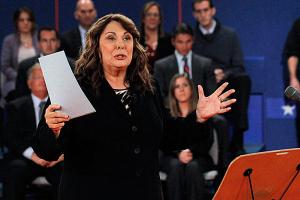
Candy Crowley moderating presidential debate
Dylan Byers reported at Politico last night that former RNC chairman and current co-chair of the presidential debate commission Frank Farenkopf regrets allowing CNN’s Candy Crowley to moderate the second presidential debate between Obama and Romney.
Why, you ask?
Crowley, who moderated the second, town-hall-style debate, drew heavy fire from conservatives for challenging Mitt Romney after he suggested that President Obama had not called the attacks in Benghazi, Libya, “acts of terror.”
According to an agreement between the Obama and Romney campaigns, the moderator of the town hall debate was to refrain from asking questions or participating in the debate. Crowley had promised to defy that agreement even before the debate started.
Give me a break! Farenkopf was upset because Candy told the truth. Does anyone really believe he would have objected if she had been backing up something Romney said?

Soledad O’Brien
In other CNN news, The New York Post reported yesterday that Soledad O’Brien is leaving the network and {ugh!} Erin Burnett will be moved into the morning spot.
We’re told award-winning journalist O’Brien has indicated she is ready to leave after she was initially promised a plum prime-time slot, but that role has so far failed to materialize. A source tells us: “The deal to move Erin to the morning alongside Chris Cuomo is basically done. Soledad had been told she’d get a prime-time slot, but that hasn’t yet happened, and now she is telling friends she is likely to leave.”
What is the deal with CNN and that airhead Erin Burnett? She’s been all over the network lately–even getting foreign assignments that she’s completely unqualified for. Frankly, she’s unqualified to report anything other than lightweight feature stories where she just reads off a teleprompter.
Other reactions:
The Atlantic Wire: Soledad O’Brien Is Not a Part of Jeff Zucker’s Vision for CNN
It looks like one of CNN’s most liked stars won’t fit at the burgeoning home of poop-cruise story torture and soft morning news — this is new president Jeff Zucker’s CNN, and Soledad O’Brien is not it….
If you’re a fan of Starting Point, you can take some solace in that Page Six’s run-up to Zucker’s changes hasn’t come to complete fruition… yet. a tiny bit solace in that some some of Page Six’s revelations haven’t happened … yet. They outlined the new morning shift late last month, although Cuomo hasn’t moved from his co-hosting gig during primetime breaking-news events like the Christopher Dorner manhunt … yet. That whole Ann-Curry-to-CNN-primetime rumor from December still hasn’t been worked out … yet. And — who knows? — this could light the fire to get CNN execs talking (probably to Page Six) about keeping O’Brien in primetime after all. Last time we checked, even shifting Curry to the 10 o’clock hour would leave one spot open — for O’Brien or another new splashy hire from Zucker … or, you know, more Anderson Cooper.

Erin Burnett
Jezebel: Oh Crap: Soledad O’Brien Is Rumored to Be Pushed Out at CNN.
As a wise person once said, “If you are a dumbass, it’s probably a bad idea to agree to be interviewed by Soledad O’Brien.” The anchor is a whip-smart bulldog who never backs down, who schools fools and fact checks John Sununu. Unfortunately, the buzz is that she’s getting the boot at CNN….
While some journalists are comfortable taking a break from the hard stuff and embracing the softer side of news (looking at you, Peabody Award-winning Hoda Kotb), O’Brien is not that kind of reporter. If you’re seen her deal with Michelle Bachman or argue with Rudy Giuliani, you know that a cushy gig like Today would not be right.

 peej
peej Carissa
 bostonboomer
 dakinikat
 ecocatwoman
 mablue2
 Mama Lopez
 peggysue22
 quixote
 skydancingguestblogger
 Mona (aka Wonk the Vote)



 Sky Dancing
Recent Comments