
Thursday Reads: Banks Reopen in Cyprus; An End to “Too Big to Fail” Banks (?); Vagina-Phobia; and Much More
Posted: March 28, 2013 Filed under: Barack Obama, morning reads, Republican politics, SCOTUS, U.S. Economy, U.S. Politics, Vagina | Tags: Airline horrors, airport weigh-ins, Breitbart, capital controls, Charles Pierce, Chief Justice John Roberts, Cyprus crisis, DOMA, Joan Walsh, journalistic ethics, marriage equality, Matthew Boyle, Racism, Rep. Steve King, Sasha and Malia Obama, Simon Johnson, Too big to fail banks 31 Comments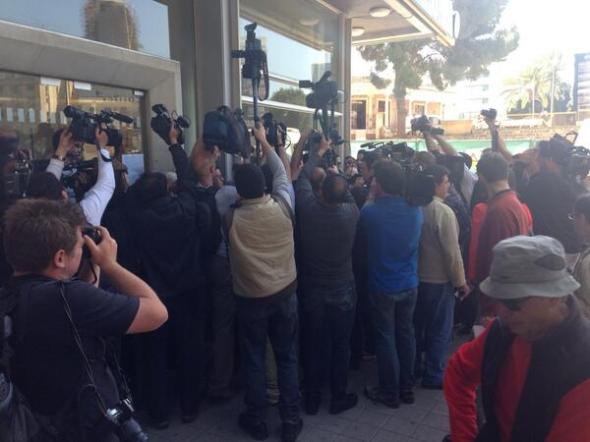
Banks reopen in Cyprus and media jostle to get the best view – posted by Joe Parkinson (@JoeWSJ)
Good Morning!!
The banks have opened in Cyprus with controls on how much depositors can withdraw.
Joe Weisenthal posted updates at his Business Insider blog:
At 6:00 AM ET, banks in Cyprus reopened their doors for the first time since March 16.
Wall Street Journal’s Joe Parkinson reports that only eight people are being allowed in at a time at one Bank of Cyprus branch.
However, the crowds have been orderly.
Everyone is wondering whether there will be a huge run on the banks.
So far? Not yet.
This is likely due to a set of capital controls that have been imposed on the banks. Specifically, Cypriot depositors cannot withdraw more than 300 euros per day from any one bank. Also, checks cannot be cashed.
These controls will be in place for seven days.
See more Twitter updates and photos at the link. International Business Times has some details about the capital controls that are supposed to prevent bank runs. In addition to the withdrawal limit, depositors can’t cash checks unless they come from another country.
In the meantime, non-cash payments or money transfers are banned unless they are related to a number of conditions.
These conditions include commercial transactions, payroll, living expenses and tuition fees.
If commercials transactions are less than €5,000, there are no restrictions, but payments above this amount and up to €200,000 will be subject to a 24-hour decision making process, in order to determine whether the liquidity of the bank would be able to incur such a withdrawal.
Transfers for paying employees will also still be allowed but relevant documents would have to be presented in order to prove the money is being used to pay staff.
Transactions on credit or debit cards are also capped at €5,000 euros per month.
According to the Wall Street Journal, some large depositors seemingly had advance knowledge of what was going to happen in Cyprus and moved their money out of the country weeks before the crisis.
The chairman of the Committee for Institutions in the Cypriot Parliament, Deputy Dimitris Syllouris, said he had submitted a letter to the Central Bank of Cyprus demanding an investigation into account holders who moved large sums of cash out of the country in the weeks ahead of Cyprus’s chaotic bailout talks…
He said he had received information about individuals and businesses moving money out of Cyprus weeks ahead of the bailout deal—a move that wouldn’t be illegal but could imply that some depositors had warning that negotiations for a bailout could, for the first time in the financial crisis that has rattled the euro zone, take a cut out of regular bank deposits.
Asked whether his suspicions focused on one specific group of depositors, he said “politicians, all sorts of people, and bankers themselves are no better.”
That figures…
Outflows from Cyprus were increasing from moderate levels from January until March 15, the officials said. Last week—especially after March 19, when the Cypriot Parliament rejected the first bailout deal that would have imposed a one-time levy on large deposits—the outflows under the central bank’s exemptions went up significantly, they said.
Several hundred million euros, but less than a billion euros, left the country despite the bank closures, according to one official.
At Bloomberg, Clive Crook says Cyprus’ Plan B is Still a Disaster.
The new deal has removed the craziest part of the agreement reached March 16 — the plan to default on deposit insurance. Let’s not dwell any further on that insanity. But the new plan still has features that, seen in any other context, would surely arouse surprise.
For instance, the so-called troika of the European Commission, the European Central Bank and the International Monetary Fund wanted to be sure that the new debt Cyprus is about to take on will be sustainable — meaning, presumably, that Cyprus will be able to repay it. Yet, by writing down high- value deposits, the revised plan will also cause a sudden contraction of the Cypriot banking system, and thus of the whole Cypriot economy, which depends on banking to an unusual degree.
He concludes that,
Bailout fatigue says: “The Cypriots got themselves into this mess, and they should get themselves out. We’ll lend them a bit more, but only if we’re sure they’ll pay us back.” Cyprus didn’t get itself into this mess. It joined the euro system in 2008 with low public debt and a clean bill of health from EU governments (back then, not a word was said about shady Russians). Its banks are in trouble not because they accepted too many overseas deposits but because they bought too many Greek bonds — an investment sanctified by international banking rules (which called such investments riskless) that was destroyed by the EU’s ham-fisted resolution of Greece’s threatened default.
Europe’s sense of “we’re all in this together” seems to have evaporated entirely. Now one has to ask not merely what the euro is for, but what the EU itself is for.
Back in the U.S.A.,

Simon Johnson has an interesting post at the NYT’ “Explaining the Science of Everyday Life” blog: The Debate on Bank Size Is Over.
While bank lobbyists and some commentators are suddenly taken with the idea that an active debate is under way about whether to limit bank size in the United States, they are wrong. The debate is over; the decision to cap the size of the largest banks has been made. All that remains is to work out the details.
To grasp the new reality, think about the Cyprus debacle this month, the Senate budget resolution last week and Ben Bernanke’s revelation that — on too big to fail — “I agree with Elizabeth Warren 100 percent that it’s a real problem.”
Policy is rarely changed by ideas alone and, in isolation, even stunning events can sometimes have surprisingly little effect. What really moves the needle in terms of consensus among policy makers and the broader public opinion is when events combine with a new understanding of how the world works. Thanks to Senator Sherrod Brown, Democrat of Ohio; Senator Warren, Democrat of Massachusetts, and many other people who have worked hard over the last four years, we are ready to understand what finally defeated the argument that bank size does not matter: Cyprus.
I can’t briefly summarize the gist of Johnson’s piece, so if you’re following this story, please read the whole thing. Could he really be right about limits on “to big to fail or prosecute banks.” I sure hope so!
In other news,
Incestuous Relationships: That’s Our Oligarchy!
Posted: March 26, 2013 Filed under: Barack Obama, Foreign Affairs, morning reads, U.S. Politics | Tags: 2008 presidential campaign, Ben Rhodes, Benjamin Netanyahu, CBS, David Rhodes, James M. Rhodes, Jon Favreau, Russ Baker, speechwriters 43 Comments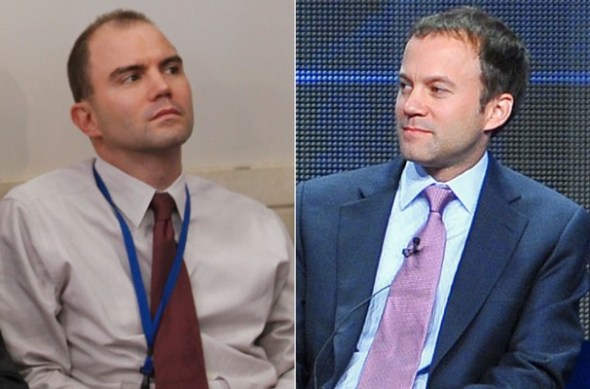
Ben and David Rhodes
On March 15, The New York Times ran a puff piece on Obama foreign policy adviser and speechwriter Ben Rhodes, by Mark Landler. Landler tells us that not so long ago, Rhodes was “[a]n aspiring writer from Manhattan [with] unfinished novel in a drawer, “Oasis of Love,” about a woman who joins a megachurch in Houston, breaking her boyfriend’s heart,” and that
worked briefly for Mayor Rudolph W. Giuliani’s re-election campaign in 1997, was living a writer’s life in Queens on Sept. 11, 2001, when he watched from the Brooklyn waterfront as the World Trade Center towers collapsed. The trauma of that experience, he said, led him to move to Washington in 2002.
Mr. Rhodes went to work for a Democratic foreign-policy elder, former Representative Lee Hamilton, helping draft the 9/11 Commission report as well as the Iraq Study Group report. That report was a template for the anti-Iraq war positions taken by Barack Obama, then a senator, whose campaign Mr. Rhodes joined as a speechwriter in 2008.
Wow! A Star is born!
Landler writes that Rhodes attends National Security Council meetings and has a powerful influence on Obama’s policies. He credits Rhodes for helping convince Obama to stop supporting Egyptian dictator President Hosni Mubarak and to intervene in Libya, as well as pushing the President to engage with Myanmar. At the moment, Landler says, Rhodes is trying to convince Obama to get more involved in Syria.
Jack Shaafer at Reuters calls the Landler’s story a “beat sweetener.
A beat sweetener, as press-watchers know, is an over-the-top slab of journalistic flattery of a potential source calculated to earn a reporter access or continued access. They’re most frequently composed on the White House beat when a new administration arrives in Washington and every Executive Office job turns over, but they can appear any time a reporter is prepared to demean himself by toadying up to a source in exchange for material.
As a beat sweetener, the Rhodes piece excels on so many levels that I’ll bet the subject’s parents have framed and hung the clipping over the family mantel. Landler portrays Rhodes as a young fella with “old man” wisdom; as possessing a “soft voice” that delivers “strong opinions”; as one whose “influence extends beyond what either his title or speechwriting duties suggest”; and as someone who “cares” to the point of “anguish” but is “very realistic.”
The information content of these testimonials, made by both Landler and his sources, is just about zero.
According to Shafer, the purpose of the “beat sweetener” isn’t just to make Ben Rhodes happy.
Sucking up to Rhodes won’t necessarily earn Landler or other journalists covering the White House an automatic scoop. But beat sweeteners aren’t written with anything so crass in mind as scoops. They’re designed to keep the information conveyor lubricated (“source greaser” is another term for the practice) with journalistic goodwill. As someone who is inside the White House decision loop, Rhodes is a much better friend than an enemy.
Getting back to the NYT puff piece: two-thirds of the way through, Landler mentions offhandedly that that Ben’s older brother David (who is 38) is the president of CBS News, a job he landed in February of 2011.
Landler provides no background on brother David, never mentioning that he previously held influential positions at Bloomberg and Fox News. In fact David is the first top CBS executive who previously worked for Fox News, and he’s the youngest president in CBS history. Shouldn’t this relationship between merit more than a throwaway line in a fawning profile of an influential adviser to the President of the U.S.?
Even Benjamin Netanyahu seemed a bit startled when he was told about it during Obama’s visit to Israel.
During a receiving line on the airport tarmac, Obama and Netanyahu stopped briefly to chat with Obama’s deputy national security, Ben Rhodes.
Obama noted that Rhodes’ brother, David, is president of CBS News.
“Sounds like a very incestuous relationship,” Netanyahu observed, chuckling at the idea of siblings in power roles within the administration and the news media.
“Not if you watch CBS News,” Obama replied.
There’s video of the interaction at Politico. Netanyahu may have been “chuckling,” but I’m not. How many times has Obama appeared on 60 Minutes? Has there ever been a mention of this relationship during those interviews? I haven’t checked, but I don’t recall it happening.
Of course relationships between media powerhouses and influential politicians and their advisers aren’t unusual. Here’s a short piece on this problem at TV Newser. Alex Weprin writes:
Let’s get this out of the way: conflicts of interest are rife in the TV news business.
CBS News president (and former Fox News executive) David Rhodes is the brother of one of President Obama’s advisers Ben Rhodes. NBC News anchor Andrea Mitchell is married to former Fed chairman Alan Greenspan. Bob Schieffer‘s brother Tom Schieffer was President Bush’s Ambassador to Japan.
In other words: potential conflicts happen all the time. The question is when should they be disclosed? Typically subjects with a conflict aren’t allowed to cover anything related to that conflict. If they do, a disclosure is a must….
In Washington, the journalists, the politicians and the lobbyists hobnob at the same parties, and many of them are friends. If everything was disclosed then just about every story from every reporter in DC would end with “I am a friend of a friend of this person” or “I hooked up with this person at 3 AM after the White House Correspondents Dinner.” Obviously that doesn’t happen, but sometimes a story does hit a little too close to home.
But isn’t this also an important reason why we don’t have an independent or serious news media?
Thinking about the incestuous nature of our Washington-New York oligarchy also leads to questions about how a young guy like Ben Rhodes–he’s just 35 now, so he was barely 30 when he began working for Obama in 2008–managed to come so far so fast.
Investigative reporter Russ Baker was stimulated to ask these and other questions after he read the Lindler’s NYT article. He notes that Rhodes appears to have come out of nowhere directly to the halls of power, just as his boss seemingly did. Baker writes:
What’s especially strange about the article is that, for those of us who continue to wonder how a virtual cipher rose so quickly from the Illinois legislature to become the most powerful person in the world, we end up wondering the same thing about an aspiring novelist from New York City who fairly catapults to enormous influence in shaping policy regarding some of the most complex and sensitive matters facing this country….
Though the Times never underlines this, the careful reader comes to realize that Rhodes’s guiding philosophy is as hard to discern as the precise reasons that he has the president’s ear. In 1997, he briefly worked on the re-election campaign of New York City Mayor Rudy Giuliani, a Republican. Shortly after 9/11, the aspiring novelist suddenly decided to do his part for society, moving in 2002 from Queens to Washington, and quickly found himself “helping draft the 9/11 Commission report as well as the Iraq Study Group report.” [….]
We are never even told what kind of education Rhodes got, or where, or whether he has ever been anything beyond an aspiring novelist. There’s no indication of what he did on Giuliani’s campaign (he would only have been about 19 or 20 at the time) or whether his preference for the mayor who presided over the 9/11 response had anything to do with his going to Washington, or miraculously being hired by Democrat Lee Hamilton to explain 9/11 to the public.
From these improbable beginnings, Rhodes is suddenly a speechwriter on Obama’s presidential campaign. How did he come to Obama’s attention? The article doesn’t say. However, it does note that the Iraq Study group report on which Rhodes worked “was a template for the anti-Iraq war positions taken by Barack Obama” as a senator and candidate.
Baker sums up his suspicions as follows:
Once we start asking questions about Benjamin Rhodes, this leads to questions about Obama, about the Times and CBS and journalism in general. And it leads to questions about how much we, the most smugly self-assured people on earth, understand about how anything of significance actually works.
In this case, it’s not unreasonable to wonder whether some particular faction or other might have spotted “talent” and “agreeability” in Rhodes, and helped hasten his rapid ascent to the top.
Baker located answers to some of these questions. From a very stunted Wikipedia entry, Baker learned that Ben Rhodes got his undergraduate degree from Rice University. He pulled together a timeline of the twin careers of Ben and his brother David:
Searching sources other than the Times, we find that David Rhodes was a production assistant at the fledgling Fox News Channel around the same time Benjamin was volunteering for Giuliani—and was the conservative channel’s news desk Assignment Manager when the planes struck the Twin Towers. Highly trusted by Fox’s chairman Roger Ailes, he managed Fox’s coverage of three presidential elections, including the one where his brother was writing Obama’s speeches, was hired by Bloomberg TV right after Obama’s election, and in 2011 was named president of CBS News.
It was Baker’s article that got me started I found Googling for more background on the very successful and powerful Ben Rhodes. In fact I spent much of the day yesterday searching for more background on the very successful and powerful Ben Rhodes. I’ll put that into a second post that I hope to put up later today.
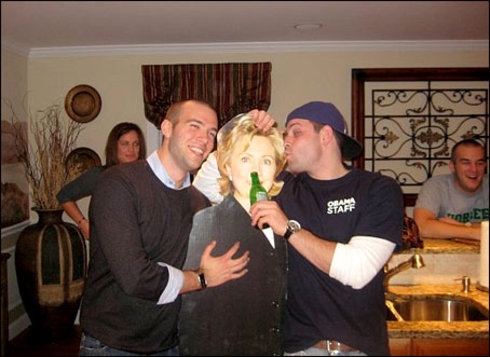
Oh, and I admit I was also inspired by my memory of this photo that I know you’ll also likely recall from early in Obama’s first term. The smiling guy sitting at the table in the back on the right side is Ben Rhodes. After head speechwriter Jon Favreau (on the left of the Hillary cardboard image) posted it on his Facebook page, Dak and I figured out who the other speechwriters in the room were and wrote a little about them.
You can treat this as a regular morning post and put your links in the comments as always. But I do hope some folks will wade through this post and discuss what I think are serious issues about the incestuous relationship between the corporation media and the government.
Saturday Reads: Daily Caller Caught Red-Handed (?), GOP “Estranged from America,” and Other News
Posted: March 23, 2013 Filed under: Barack Obama, morning reads, Republican politics, Social Security, U.S. Politics | Tags: abortion, Chained CPI, David Martosko, Dominican investigation, East Coast meteor, Foster Friess, Income Inequality, North Dakota Stand Up for Women Rally, Politico, Robert Menendez, The Daily Caller, the top 1%, Tucker Carlson, Washington Post 28 Comments
Good Morning!!
There’s a lot of news out there this morning, so I’ll get right to it.
Well, well, well, isn’t this an interesting headline at the WaPo: Dominican official links Daily Caller to alleged lies about Menendez.
A top Dominican law enforcement official said Friday that a local lawyer has reported being paid by someone claiming to work for the conservative Web site the Daily Caller to find prostitutes who would lie and say they had sex for money with Sen. Robert Menendez (D-N.J.).
The lawyer told Dominican investigators that a foreign man, who identified himself as “Carlos,” had offered him $5,000 to find and pay women in the Caribbean nation willing to make the claims about Menendez, according to Jose Antonio Polanco, district attorney for the La Romana region, where the investigation is being conducted.
The Daily Caller, owned by smirky right winger Tucker Carlson, claims it’s not true. Sure, Tucker.
The videotaped claims of two women, made with their faces obscured, were posted in the fall on the Daily Caller. The site reported that “the two women said they met Menendez around Easter at Casa de Campo, an expensive 7,000-acre resort in the Dominican Republic. . . . They claimed Menendez agreed to pay them $500 for sex acts, but in the end they each received only $100.”
In its statement Friday, the Daily Caller said: “At no point did any money change hands between The Daily Caller and any sources or individuals connected with this investigation, nor did anyone named Carlos travel to the Dominican Republic on behalf of The Daily Caller. As recently as two weeks ago, Figueroa was on record with another news outlet as saying the women he represented were telling the truth about their initial allegations against Senator Menendez.”
There’s quite a bit of wiggle room in that denial. So no one from the Daily Caller actually handed money to anyone, and “Carlos” didn’t travel from the U.S. to the Dominican. Big deal. The arrangements were probably made by phone and the money was giving out through the lawyer.

I don’t know what happened for sure, but I know Tucker Carlson is a sleazy S.O.B. What I didn’t know until today (via Crooks and Liars) is that the Daily Caller got its start-up funds from Foster Friess, the Republican billionaire donor who recommended that women put an aspirin between their knees as contraception. C&L’s Karoli also linked to this Mother Jones article by Kate Sheppard: Controversial Daily Caller Editor Admitted to Posing As Radical Animal Rights Activist.
David Martosko—the outgoing executive editor of the conservative Daily Caller and a prominent defender of the news site’sdisputed claim that Sen. Bob Menendez (D-N.J.) paid two women for sex in the Dominican Republic—admitted in a court document obtained by Mother Jones that he used a fake Facebook profile to pose as a “dope-smoking commie” in order to gather information on animal rights activists. The admission came in a May 2011 depositionMartosko gave under oath as part of a defamation case against him and his former employer, Berman and Company, a PR shop that specializes in combating progressive activists who target corporations.
Before Daily Caller Editor in Chief Tucker Carlson hired him in 2011—a controversial choice given Martosko’s previous arrests and lack of experience in journalism—Martosko spent a decade working for Richard Berman, a longtime PR operative behind a number of industry-backed campaigns. At Berman and Company, Martosko served as the director of research for the Center for Consumer Freedom, a Berman-run nonprofit that opposes new laws on food and beverages. CCF, which is funded by the food and beverage industry, runsHumane Watch, a website that posts derogatory information about the Humane Society of the United States. Martosko was the site’s “founding editor.” CCF also operates Activist Cash, a website that compiles biographical information on groups and individuals that engage in “anti-consumer activism.”
Despite all this circumstantial evidence that the Daily Caller is a fraudulent operation, Politico posted a piece by MacKenzie Weinger supporting Carlson’s operation and implying that the WaPo is trying to defend Democrats rather than simply reporting the results of investigative reporting.
Also from the WaPo, and op-ed by Andrew Kohut of the Pew Research Center — The numbers prove it: The GOP is estranged from America. I actually have a lot of problems with this article–Kohut writes from the point of view of an old-style Republican, which he is. He claims that the Democratic Party has gotten more liberal, when the current Democratic President, Barack Obama has publicly state that his ideology is that of a Rockefeller-type Republican. Here’s an excerpt:
Friday Reads: Confessions of a Naughty Professor
Posted: March 22, 2013 Filed under: morning reads | Tags: Elizabeth Warren, JIndal's plan to tax mom and pop enterprises, modern day slavery in the USA, Too Big Too Fail 20 Comments Good Morning!
I’ve felt discombobulated all week. I’m hoping this phase passes since it is spring and things are supposed to spring alive right now. Right now, however, does not seem to apply to me. It’s been one of those weeks where I’ve felt like the stereotype of the absent-minded professor fits me like a snug glove. I get distracted easily and hours pass before I realize I’ve done nothing for the day. It fits so do not acquit. Maybe I’ll just lie around in bed this weekend a little bit more and think these kinds of thoughts.
For some time, I’ve been writing how worried I am about the systemic risk involved with all these huge banks that have a near monopoly on credit card and house loans. They also hold the deposits of some our of largest industrial and service corporations that actually provide things people use and need in their daily lives. It’s the same situation in Europe and the UK where the needs of banks–based on their own faulty lending and investing strategies–have passed on tremendous costs to countries, their treasuries and their peoples. I was glad to read that Ben Bernanke made a clear atement yesterday that he was in agreement with Senator Elizabeth Warren on the entire problem of banks considered “too big to fail”. I’d also like to add that it’s refreshing to see a senator on a committee that actually knows what they’re doing for a change.
During that conversation, Bernanke seemed to imply that the problem had been solved, suggesting that the Dodd-Frank financial-reform act had given policy makers the tools to wind down a giant bank without hurting the economy — although his conviction faded as the argument went on. On Wednesday, he wanted it to be known that fully sided with Warren.
“I agree with Elizabeth Warren 100 percent that it’s a real problem,” he said.
He also sided with Warren against those banks and others who suggest that having gigantic banks is not really a problem at all.
“Too Big To Fail was a major source of the crisis,” he added a little later, “and we will not have successfully responded to the crisis if we do not address that successfully.”
He talked about some of the tools policy makers could use to address the problem, including Dodd-Frank rules forcing the biggest banks to hold more capital or pay regulators a little more than smaller banks.
“If we don’t achieve the goal” of solving too big to fail with these measures, Bernanke said, “we will have to take additional steps. It is important.”
You only need to look at the entire senate hearing on JPM’s “Whale” situation to understand how these big bank purport themselves. This analysis is from NYT’s Simon Johnson.
At its heart, the Levin-McCain report reveals executives with a profound misunderstanding of risk in the world’s largest bank (I use the calculations of comparative bank size offered by Thomas Hoenig, vice chairman of the Federal Deposit Insurance Corporation). Even worse, the report shows us in some detail that banks – even after Dodd-Frank – can and do readily manipulate complicated measures of risk in order to make their positions look safer than they really are.
As Jeremy Stein, a Fed governor, pointed out recently, there are strong incentives to do this repeatedly in banking organizations (read the opening few paragraphs of his speech carefully).
The banking regulators – in this case, the Office of the Comptroller of the Currency – are clearly unable to keep up with this form of “financial innovation” (which is really just clever ways to misreport risk).
Did JPMorgan Chase’s top management do this intentionally? Did they mislead investors, particularly in the fateful conference call on April 13, 2012? This is a fascinating question on which the courts will no doubt rule. (You should also review this report by Josh Rosner of Graham Fisher, with the link kindly provided by Better Markets.)
Jamie Dimon will survive because JPMorgan Chase remains profitable. But it is profitable precisely because it receives implicit subsidies from being too big to fail. JPMorgan Chase disputes the precise scale of these subsidies – as I discussed here last week. Let’s just call them humongous.
This is not about individuals, this is about policy. And Richard Fisher has exactly the right approach:
At the Dallas Fed, we believe that whatever the precise subsidy number is, it exists, it is significant, and it allows the biggest banking organizations, along with their many nonbank subsidiaries (investment firms, securities lenders, finance companies), to grow larger and riskier.
This is patently unfair. It makes for an uneven playing field, tilted to the advantage of Wall Street against Main Street, placing the financial system and the economy in constant jeopardy.
It also undermines citizens’ faith in the rule of law and representative democracy.
You can see that regulators at all levels realize they have a problem. I should probably mention here that Fed Branches and the Board of  Governors of the Fed are very independent of one another and each have distinct characters. We have two layers of Fed bureaucracy championing reform. Unfortunately, they can’t do much with out laws passed by Congress and signed by the President who are captured at every turn by the FIRE lobby.
Bernanke also compared himself to Volcker, when talking about the US banking system, which the Fed regulates. Volcker once said, famously, that the only great financial innovation of recent decades was the invention of the automated teller machine. Bernanke smiled as he quoted Volcker’s bellicose quip and said he wouldn’t go that far – but he was surprisingly frank in talking about the failures of the financial system and regulation.
“[‘Too big to fail’] is not solved and gone. It’s still here,” he said, emphasizing the point. He also threw in his lot with Elizabeth Warren, who often opposed Tim Geithner and others in her insistence that banks are of a dangerous size:
“I agree with [Warren] 100% that [‘too big to fail’] is a real problem … We will not have successfully responded to the crisis if we do not address [‘too big to fail’] successfully.”That view is consistent with what Bernanke said as far back as 2009. But the subject of “too big the fail” has been a nonstarter for at least a year, since Occupy Wall Street protests receded.
Bernanke also took an activist view of sorts by plumping for a return to regulatory reform and advocating that banks need to pay higher surcharges to help the country bail them out if things go wrong. Then Bernanke criticized banks again, implicitly, by saying that they had restricted lending too much, making it hard for ordinary Americans to get a mortgage.
He went on to say that the Fed’s bond-buying program has been successful largely because the Fed has learned how to monitor the markets better – implying, correctly, that those trading on Wall Street need a regulator to keep an eye on them. All of this was surprising on two fronts: first, that Bernanke actually shared his own opinion, instead of a technocratic, non-committal vague fluttering of economic opinions, as is often the case. Second, it’s surprising that he took a somewhat controversial view, not designed to make friends on Wall Street.
And that, in fact, may be the most important development of this first press conference of 2013: we already know Ben Bernanke is a savvy politician who knows how to read a room. If Bernanke has thrown his lot in with those who have said that Wall Street needs to come under tighter control, you can be sure that he thinks it’s a historically smart view to take. Those who are against reform should take notice.
I am consistently reminded in many of these conversations of Lenin who wrote a lot about banking. He said that the downfall of capitalism would come from the power of banks and their eventual destruction of the actual productive parts of the economy. I realize when I quote Lenin that I run a very high risk of being called all kinds of things by Republicans looking to demean academics. However, I read his 1916 Treatise Imperialism: The Highest Stage of Capitalism in a comparative economics class in my senior year at the University of Nebraska. Let me tell you that the business school at the University of Nebraska in Lincoln does not harbor any communists to my knowledge and probably is not all that populated with Democrats, either. However, this is an important book to read to understand why the two Roosevelts were able to stop communism from taking root here. A lot of it had to do with the control and regulation of monopolies and huge banks that stalled a lot of what Lenin foresaw. I’ve pointed to this several times over the time I’ve been blogging, but it always bears repeating. Lenin had a point and does now since so much of these kinds of regulations have been removed over the last 30 years.
Lenin provides a careful,5-point definition of imperialism: “(1) the concentration of production and capital has developed to such a high stage that it has created monopolies which play a decisive role in economic life; (2) the merging of bank capital with industrial capital, and the creation, on the basis of this “finance capital”, of a financial oligarchy; (3) the export of capital as distinguished from the export of commodities acquires exceptional importance; (4) the formation of international monopolist capitalist associations which share the world among themselves, and (5) the territorial division of the whole world among the biggest capitalist powers is completed. Imperialism is capitalism at that stage of development at which the dominance of monopolies and finance capital is established; in which the export of capital has acquired pronounced importance; in which the division of the world among the international trusts has begun, in which the division of all territories of the globe among the biggest capitalist powers has been completed.”
 Now, I’m not pushing Lenin’s view of what will happen once capitalism collapses, I’m only saying that he makes some really good points about how banks can play a huge role in bringing down market economies. I also think that Lenin never imagined a world in which nationalism may play a lesser role given the international flavor of bank havens today. Both Roosevelts did their share of trustbusting and bank regulation to make me believe that they saw a lot of the same problems with the JPM of their times that we’ve got with the JPM of our our time. Unfortunately, there is a dearth of Roosevelts these days.
Banks are not the only entities that still employ practices that the government must regulate or we fail to have an economy that allocates benefits to all. It’s not only that but in some very sad cases we have companies that deny the rights and liberties of others and behave criminally. We have a very robust, 21st century version of slavery here in the US. I fully believe that both Rand and Ron Paul are neoconfederates with their views of state’s rights and many of the positions they take. Rand Paul has recently suggested that we make more visas available so foreign workers can come here legally. As I’ve seen in my state in oil rig companies and after Katrina during the clean-up, these visas are just as likely to lead to abuse of workers than those who come here under the wire. So, what’s the real purpose? Do we just need to ‘dog-tag’ every one?
Under a system of “legalized slavery,” foreign workers are routinely thrown in massive debt, cheated out of wages, housed in squalid shacks, held captive by brokers and businesses that seize passports, Social Security cards and return tickets, denied healthcare, rented to other employers (including the military), and sexually harassed and threatened with firing and deportation if they complain, according to two detailed reports by the Southern Poverty Law Center and the National Guestworker Alliance. The reports are based on sworn testimony gathered for lawsuits.
The H-2B visa program that brought 83,000 foreign guestworkers to the U.S. in 2011 for non-farm work has become a stalking ground for some of the worst abuses in American capitalism, according to recentreports by anti-poverty law groups. These reports describe in excruciating detail how predatory capitalists in many manual labor-based industries (supplying national brands like Walmart) lure and prey upon foreigners whose jobs average less than $10 an hour with little regard for human rights, labor law or legal consequence.
“We called it modern-day slavery,” said Daniel Contreras, who borrowed $3,000 to come from Peru and whose story is told in the Guestworker Alliance report. He was one of 300 foreigners brought to New Orleans by a hotel chain after Hurricane Katrina. “Instead of hiring workers from the displaced and jobless African-American community, he sent recruiters to hire us. At around $6 an hour, we were cheaper. As temporary workers, we were more exploitable. We were hostage to debt in our home countries. We were terrified of deporation. And we were bound to [owner Patrick] Quinn and could not work for anyone else. We were Patrick Quinn’s captive workforce.”
These are all circumstances that create revolutionaries and circumstances that both Roosevelts righted by ensuring that both sides of the market have an equal chance to succeed.
So, I can see that this post turned into a really long treatise on two of the factors of production which probably means I must’ve been working and thinking way too much this week. I did not intend this post to be any kind of seminar on how dissimilar we treat the factors of labor and capital in this country. So, don’t take this as a closed thread so much as me going off on a tangent after having gotten very pissed about how badly we treat people that work in this country vs how well we treat people that collect cash and gamble. Perhaps it’s just the impact of watching all those folks get there savings stolen by EUCB.
Btw, if you want to see a most outrageous example of the government discouraging people that actually earn livings, please take a look at the types of things that my Governor Jindal is proposing to tax and tax hugely. He just proposed $1.4 billion in new taxes on services.
Your paycheck will grow larger, but in exchange the price of your haircut, cable TV and Internet service will go up if lawmakers agree to Gov. Bobby Jindal’s rewrite of Louisiana’s tax code.
Jindal wants to do away with state income taxes, but he doesn’t want to shrink the state’s tax revenue overall.
So to help make up the gap, the governor wants to charge $1.4 billion in new sales taxes on items that have not previously been taxed, under the plan outlined to lawmakers this week.
That includes home landscaping, visits to the museum and zoo, a pet’s trip to the veterinarian, time at the tanning salon and more.
Businesses that pay outside accountants, architects, environmental consultants, computer programmers and janitors would see new taxes on those services.
In all, three dozen new categories of services would be swept into the state’s current 4 percent state sales tax to drum up $961 million. They also would be included as the sales tax jumps to 5.88 percent under the governor’s plan, to boost the total to $1.4 billion from the newly-taxed services, according to data from the Department of Revenue.
So basically, every hairdresser and barber, every kid that mows the lawn, every musician on the street corner, every plumber, every independent bookkeeper and tree trimer, and a whole lot of other mom and pop ventures must collect, account for, and pay sales taxes to the State of Louisiana under Jindal’s plan while every huge corporation is off the hook for property and income taxes.
Now, look at me honestly and say that court eunuchs and jesters like Jindal aren’t just asking for a revolution. Shoo-be-doo-wah.
What’s on your reading and blogging list this morning?
Thursday Reads: Crisis in Cyprus, The End of the “Creative Class” Dream, the Grand Betrayal, and Other News
Posted: March 21, 2013 Filed under: Barack Obama, Foreign Affairs, morning reads, the blogosphere, U.S. Economy, U.S. Politics, Violence against women | Tags: "grand bargain", chris bowers, Cyprus crisis, Dick Durbin, eurozone crisis, Joe Weisenthal, Richard Florida, the Great Betrayal 41 Comments
Good Morning!!
There’s quite a bit of news on the Cyprus crisis this morning. But first, last night Joe Weisenthal posted this assessment of how bad things had already gotten: In Just Days A Modern Economy Has Been Set Back 50 Years, And It May Never Be The Same Again. That’s a quote from Ciaran O’Hagan of Société Générale in Paris. Weisenthal writes:
According to reports, Cyprus will try again tomorrow to cobble together some kind of bank bailout bill that can pass parliament.
Cyprus needs to raise another 5.8 billion euros, which it could do from some combination of deposit taxes, Russian money, and pension nationalization.
None of the options are good, but until it’s done, banks will likely have to remain closed, a situation that can’t go on much longer.
This is a stunning turn of events for a modern Eurozone nation.
This morning, the news broke that the European Central Bank (ECB) has given Cyprus an ultimatum. Bloomberg reports:
The European Central Bank said it will cut Cypriot banks off from emergency funds after March 25 unless the Mediterranean island agrees on a bailout with the European Union and International Monetary Fund.
“The Governing Council of the European Central Bank decided to maintain the current level of Emergency Liquidity Assistance, ELA, until Monday, 25 March 2013,” the Frankfurt- based ECB said in an e-mailed statement today. “Thereafter, ELA could only be considered if an EU/IMF program is in place that would ensure the solvency of the concerned banks.”
The Cypriot parliament this week rejected a proposed levy on bank deposits to raise 5.8 billion euros ($7.5 billion), which euro-area finance ministers backed as a condition for the country’s bailout. A bank holiday in Cyprus has been extended to March 25, giving policy makers until Monday to find a compromise to prevent a collapse of the country’s banks.
“With this statement, the ECB put even more pressure on European finance ministers and the Cypriot government to come up with a deal,” said Juergen Michels, chief euro-area economist at Citigroup Inc. in London. “But we’ll have to see whether they’ll actually follow through with their threat if there’s no deal by Monday and policy makers decide to further extend the bank holiday.”

 peej
peej Carissa
 bostonboomer
 dakinikat
 ecocatwoman
 mablue2
 Mama Lopez
 peggysue22
 quixote
 skydancingguestblogger
 Mona (aka Wonk the Vote)



 Sky Dancing
Recent Comments