
Remember When We Had Democratic Presidents?
Posted: April 11, 2013 Filed under: Barack Obama, morning reads, Republican politics, U.S. Economy, U.S. Politics | Tags: Chained CPI, destruction of the Democratic Party, Franklin D. Roosevelt, Great Society, John F. Kennedy, Lyndon B. Johnson, Medicare cuts, New Deal, New Frontier, Obama's Grand Betrayal, Social Security cuts 40 Comments
Franklin D. Roosevelt signs the Social Security Act of 1935
Oh yes, “those were the days, my friend, we thought they’d never end…”
Roosevelt’s New Deal was before my time, but I heard about those days from my parents.
The New Deal was a series of economic programs enacted in the United States between 1933 and 1936. They involved presidential executive orders or laws passed by Congress during the first term of President Franklin D. Roosevelt. The programs were in response to the Great Depression, and focused on what historians call the “3 Rs”: Relief, Recovery, and Reform. That is, Relief for the unemployed and poor; Recovery of the economy to normal levels; and Reform of the financial system to prevent a repeat depression.
The New Deal produced a political realignment, making the Democratic Party the majority (as well as the party that held the White House for seven out of nine Presidential terms from 1933 to 1969), with its base in liberal ideas, the white South, traditional Democrats, big city machines, and the newly empowered labor unions and ethnic minorities. The Republicans were split, with conservatives opposing the entire New Deal as an enemy of business and growth, and liberals accepting some of it and promising to make it more efficient. The realignment crystallized into the New Deal Coalition that dominated most presidential elections into the 1960s, while the opposition Conservative Coalition largely controlled Congress from 1937 to 1963. By 1936 the term “liberal” typically was used for supporters of the New Deal, and “conservative” for its opponents. From 1934 to 1938, Roosevelt was assisted in his endeavours by a “pro-spender” majority in Congress (drawn from two-party, competitive, non-machine, Progressive, and Left party districts). As noted by Alexander Hicks, “Roosevelt, backed by rare, non-Southern Democrat majorities — 270 non-Southern Democrat representatives and 71 non-Southern Democrat senators — spelled Second New Deal reform.”
Many historians distinguish between a “First New Deal” (1933–34) and a “Second New Deal” (1935–38), with the second one more liberal and more controversial. The “First New Deal” (1933–34) dealt with diverse groups, from banking and railroads to industry and farming, all of which demanded help for economic survival. The Federal Emergency Relief Administration, for instance, provided $500 million for relief operations by states and cities, while the short-lived CWA (Civil Works Administration) gave localities money to operate make-work projects in 1933-34.
The “Second New Deal” in 1935–38 included the Wagner Act to promote labor unions, the Works Progress Administration (WPA) relief program (which made the federal government by far the largest single employer in the nation), the Social Security Act, and new programs to aid tenant farmers and migrant workers. The final major items of New Deal legislation were the creation of the United States Housing Authority and Farm Security Administration, both in 1937, and the Fair Labor Standards Act of 1938, which set maximum hours and minimum wages for most categories of workers.
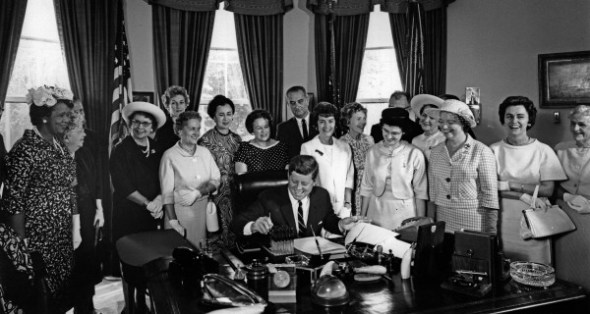
John F. Kennedy signs the Equal Pay Act of 1963
I do clearly Recall John F. Kennedy’s The New Frontier. There’s a popular myth that JFK didn’t accomplish that much legislatively before his death in 1963, but that’s what it is–a myth.
The term New Frontier was used by liberal Democratic presidential candidate John F. Kennedy in his acceptance speech in the 1960 United States presidential election to the Democratic National Convention at the Los Angeles Memorial Coliseum as the Democratic slogan to inspire America to support him. The phrase developed into a label for his administration’s domestic and foreign programs.
[W]e stand today on the edge of a New Frontier -— the frontier of 1960s, the frontier of unknown opportunities and perils, the frontier of unfilled hopes and unfilled dreams. … Beyond that frontier are uncharted areas of science and space, unsolved problems of peace and war, unconquered problems of ignorance and prejudice, unanswered questions of poverty and surplus.
In the words of Robert D. Marcus: “Kennedy entered office with ambitions to eradicate poverty and to raise America’s eyes to the stars through the space program”.Amongst the legislation passed by Congress during the Kennedy Administration, unemployment benefits were expanded, aid was provided to cities to improve housing and transportation, funds were allocated to continue the construction of a national highway system started under Eisenhower, a water pollution control act was passed to protect the country’s rivers and streams, and an agricultural act to raise farmers’ incomes was made law. A significant amount of anti-poverty legislation was passed by Congress, including increases in social security benefits and in the minimum wage, several housing bills, and aid to economically distressed areas. A few antirecession public works packages, together with a number of measures designed to assist farmers, were introduced. Major expansions and improvements were made in Social Security (including retirement at 62 for men), hospital construction, library services, family farm assistance and reclamation. Food stamps for low-income Americans were reintroduced, food distribution to the poor was increased, and there was an expansion in school milk and school lunch distribution. The most comprehensive farm legislation since 1938 was carried out, with expansions in rural electrification, soil conservation, crop insurance, farm credit, and marketing orders. In September 1961, the Arms Control and Disarmament Agency was established as the focal point in government for the “planning, negotiation, and execution of international disarmament and arms control agreements.” Altogether, the New Frontier witnessed the passage of a broad range of important social and economic reforms.
According to Theodore White, under John F. Kennedy, more new legislation was actually approved and passed into law than at any other time since the Thirties. When Congress recessed in the latter part of 1961, 33 out of 53 bills that Kennedy had submitted to Congress were enacted. A year later, 40 out of 54 bills that the Kennedy Administration had proposed were passed by Congress, and in 1963 35 out of 58 “must” bills were enacted. As noted by Larry O’Brien, “A myth had arisen that he (Kennedy) was uninterested in Congress, or that he “failed” with Congress. The facts, I believe, are otherwise. Kennedy’s legislative record in 1961–63 was the best of any President since Roosevelt’s first term”.
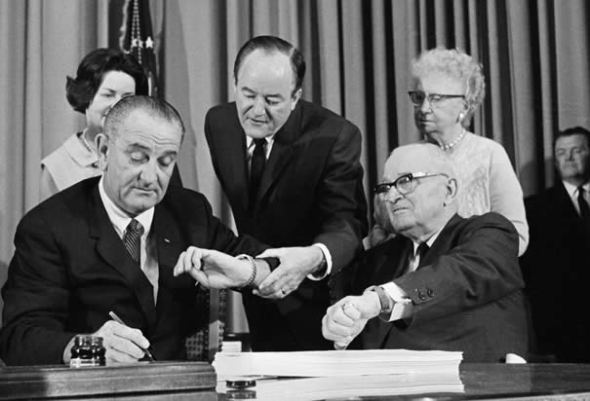
Lyndon B. Johnson signs the Medicare Act of 1964, with Harry Truman by his side
LBJ’s presidency was marred by his escalation of the war in Vietnam, but the domestic legislative accomplishments of his “Great Society” were stunning.
The aftershock of Kennedy’s assassination provided a climate for Johnson to complete the unfinished work of JFK’s New Frontier. He had eleven months before the election of 1964 to prove to American voters that he deserved a chance to be President in his own right.
Two very important pieces of legislation were passed. First, the Civil Rights Bill that JFK promised to sign was passed into law. The Civil Rights Act banned discrimination based on race and gender in employment and ending segregation in all public facilities.
Johnson also signed the omnibus ECONOMIC OPPORTUNITY ACT OF 1964. The law created the Office of Economic Opportunity aimed at attacking the roots of American poverty. A Job Corps was established to provide valuable vocational training.
Head Start, a preschool program designed to help disadvantaged students arrive at kindergarten ready to learn was put into place. The VOLUNTEERS IN SERVICE TO AMERICA (VISTA) was set up as a domestic Peace Corps. Schools in impoverished American regions would now receive volunteer teaching attention. Federal funds were sent to struggling communities to attack unemployment and illiteracy.
As he campaigned in 1964, Johnson declared a “war on poverty.” He challenged Americans to build a “Great Society” that eliminated the troubles of the poor. Johnson won a decisive victory over his archconservative Republican opponent Barry Goldwater of Arizona.
– American liberalism was at high tide under President Johnson.
– The Wilderness Protection Act saved 9.1 million acres of forestland from industrial development.
– The Elementary and Secondary Education Act provided major funding for American public schools.
– The Voting Rights Act banned literacy tests and other discriminatory methods of denying suffrage to African Americans.
– Medicare was created to offset the costs of health care for the nation’s elderly.
– The National Endowment for the Arts and Humanities used public money to fund artists and galleries.
– The Immigration Act ended discriminatory quotas based on ethnic origin.
– An Omnibus Housing Act provided funds to construct low-income housing.
– Congress tightened pollution controls with stronger Air and Water Quality Acts.
– Standards were raised for safety in consumer products.
I’m in tears right now after reading again about the accomplishments of these three great Democratic presidents. I’m in mourning today for my party and my country. For the first time, a supposedly Democratic president has proposed not only Social Security benefit cuts but also massive cuts to Medicare that will force seniors to pay higher deductibles and discourage them from buying medigap plans to cover co-pays.
I’ve known this was coming since 2007 when I read Obama’s book, The Audacity of Austerity Hope. He couldn’t have made it any clearer in the chapter on the domestic economy that he was an enthusiastic supporter of privatization and/or cuts in social programs. But although I’ve expected this for years, the reality of it has still hit me very hard. I feel both heartbroken and ashamed of President Obama.
I’ll post something else later on; but for now, please use this as a morning open thread and post your recommended links freely in the comments.
This is a sad day, but I believe Obama’s gambit will be a dismal failure. IMO he already looks foolish and ineffectual as the Republicans make hay by accusing him of trying to balance the budget on the backs of seniors. We need to understand that it is fruitless to expect him Obama stand up to the Republicans, the corporate media, or the bankers. We are on our own.
I admit, I had begun to believe that Obama had grown in office–that he had begun to realize that standing up for liberal values would serve him in good stead. But his addiction to “bipartisanship” and his fantasy of a “grand bargain” won out in the end. I still believe Romney would have been far worse, but let’s face it we still got a Republican president in 2008 and 2012. We need to fight tooth and nail to keep him from destroying the proud legacies of FDR, JFK, and LBJ.
Sooooo…. What’s on your mind today?
Tuesday Reads: Margaret Thatcher’s “Dark Legacy,” Death of a Feminist Revolutionary, and Mitch McConnell’s Ugly Plans
Posted: April 9, 2013 Filed under: morning reads, U.S. Politics, War on Women, Women's Rights | Tags: Andrew Sullivan, Ashley Judd, austerity, David Corn, feminist history, Margaret Thatcher, Mitch McConnell, Poverty, Shulamith Firestone, Susan Faludi 33 Comments
Good Morning!!
The death of Margaret Thatcher is still dominating the news this morning. It seems she was one of those public figures that inspired varied but passionate reactions–you either loved her or hated her.
Andrew Sullivan loved her it seems.
I was a teenage Thatcherite, an uber-politics nerd who loved her for her utter lack of apology for who she was. I sensed in her, as others did, a final rebuke to the collectivist, egalitarian oppression of the individual produced by socialism and the stultifying privileges and caste identities of the class system. And part of that identity – the part no one ever truly gave her credit for – was her gender. She came from a small grocer’s shop in a northern town and went on to educate herself in chemistry at Oxford, and then law. To put it mildly, those were not traditional decisions for a young woman with few means in the 1950s. She married a smart businessman, reared two children and forged a political career from scratch in the most male-dominated institution imaginable: the Tory party.
She relished this individualist feminism and wielded it – coining a new and very transitive verb, handbagging, to describe her evisceration of ill-prepared ministers or clueless interviewers. Perhaps in Toynbee’s defense, Thatcher was not a feminist in the left-liberal sense: she never truly reflected on her pioneering role as a female leader; she never appointed a single other woman to her cabinet over eleven years; she was contemptuous toward identity politics; and the only tears she ever deployed (unlike Hillary Clinton) were as she departed from office, ousted by an internal coup, undefeated in any election she had ever run in as party leader.
Her policies “inspired” the revolutionary reactions that created a “cultural transformation.”
Thatcher’s economic liberalization came to culturally transform Britain. Women were empowered by new opportunities; immigrants, especially from South Asia, became engineers of growth; millions owned homes for the first time; the media broke free from union chains and fractured and multiplied in subversive and dynamic ways. Her very draconian posture provoked a punk radicalism in the popular culture that changed a generation. The seeds of today’s multicultural, global London – epitomized by that Olympic ceremony – were sown by Thatcher’s will-power.
And that was why she ultimately failed, as every politician always ultimately does. She wanted to return Britain to the tradition of her thrifty, traditional father; instead she turned it into a country for the likes of her son, a wayward, money-making opportunist. The ripple effect of new money, a new middle class, a new individualism meant that Blair’s re-branded Britain – cool Britannia, with its rave subculture, its fashionistas, its new cuisine, its gay explosion, its street-art, its pop music – was in fact something Blair inherited from Thatcher.
Of course Sullivan no longer lives in Great Britain, and he has the means to avoid the worst effects of the elite’s austerity policies regardless of where he lives. Others aren’t so fortunate.
The Guardian reports: Margaret Thatcher’s death greeted with street parties in Brixton and Glasgow; Crowds shout ‘Maggie Maggie Maggie, dead dead dead’ during impromptu events.
Several hundred people gathered in south London on Monday evening to celebrate Margaret Thatcher‘s death with cans of beer, pints of milk and an impromptu street disco playing the soundtrack to her years in power.
Young and old descended on Brixton, a suburb which weathered two outbreaks of rioting during the Thatcher years. Many expressed jubilation that the leader they loved to hate was no more; others spoke of frustration that her legacy lived on.
To cheers of “Maggie Maggie Maggie, dead dead dead,” posters of Thatcher were held aloft as reggae basslines pounded.
Clive Barger, a 62-year-old adult education tutor, said he had turned out to mark the passing of “one of the vilest abominations of social and economic history”.
He said: “It is a moment to remember. She embodied everything that was so elitist in terms of repressing people who had nothing. She presided over a class war.”
Builder Phil Lewis, 47, a veteran of the 1990 poll tax riots, said he had turned out to recall the political struggles the Thatcher years had embroiled him in. “She ripped the arsehole out of this country and we are still suffering the consequences.”
Just as Ronald Reagan did to the U.S.–and we’re still suffering the consequences.
Here’s a video from Brixton.
Hugo Young, Thatcher biographer, writes in The Guardian: Margaret Thatcher left a dark legacy that has still not disappeared. For Young, a positive was Thatcher’s indifference to her popularity with the public.
I think by far her greatest virtue, in retrospect, is how little she cared if people liked her. She wanted to win, but did not put much faith in the quick smile. She needed followers, as long as they went in her frequently unpopular directions. This is a political style, an aesthetic even, that has disappeared from view. The machinery of modern political management – polls, consulting, focus groups – is deployed mainly to discover what will make a party and politician better liked, or worse, disliked. Though the Thatcher years could also be called the Saatchi years, reaching a new level of presentational sophistication in the annals of British politics, they weren’t about getting the leader liked. Respected, viewed with awe, a conviction politician, but if liking came into it, that was an accident.
But this attitude “didn’t come without a price” and “Thatcher left a dark legacy…”
What happened at the hands of this woman’s indifference to sentiment and good sense in the early 1980s brought unnecessary calamity to the lives of several million people who lost their jobs. It led to riots that nobody needed. More insidiously, it fathered a mood of tolerated harshness. Materialistic individualism was blessed as a virtue, the driver of national success. Everything was justified as long as it made money – and this, too, is still with us.
Thatcherism failed to destroy the welfare state. The lady was too shrewd to try that, and barely succeeded in reducing the share of the national income taken by the public sector. But the sense of community evaporated. There turned out to be no such thing as society, at least in the sense we used to understand it. Whether pushing each other off the road, barging past social rivals, beating up rival soccer fans, or idolising wealth as the only measure of virtue, Brits became more unpleasant to be with. This regrettable transformation was blessed by a leader who probably did not know it was happening because she didn’t care if it happened or not. But it did, and the consequences seem impossible to reverse….
[I]t’s now easier to see the scale of the setback she inflicted on Britain’s idea of its own future. Nations need to know the big picture of where they belong and, coinciding with the Thatcher appearance at the top, clarity had apparently broken through the clouds of historic ambivalence.
At least the British media isn’t trying to canonize Thatcher as the corporate media in the U.S. did to Reagan.
A Less Remarked Upon Death: Shulamith Firestone
At The New Yorker, Susan Faludi pays tribute to a feminist icon of the 1970s, “Death of a Revolutionary: Shulamith Firestone helped to create a new society. But she couldn’t live in it.”
When Shulamith Firestone’s body was found late last August, in her studio apartment on the fifth floor of a tenement walkup on East Tenth Street, she had been dead for some days. She was sixty-seven, and she had battled schizophrenia for decades, surviving on public assistance. There was no food in the apartment, and one theory is that Firestone starved, though no autopsy was conducted, by preference of her Orthodox Jewish family. Such a solitary demise would have been unimaginable to anyone who knew Firestone in the late nineteen-sixties, when she was at the epicenter of the radical-feminist movement, surrounded by some of the same women who, a month after her death, gathered in St. Mark’s Church In-the-Bowery, to pay their respects.
The memorial service verged on radical-feminist revival. Women distributed flyers on consciousness-raising, and displayed copies of texts published by the Redstockings, a New York group that Firestone co-founded. The WBAI radio host Fran Luck called for the Tenth Street studio to be named the Shulamith Firestone Memorial Apartment, and rented “in perpetuity” to “an older and meaningful feminist.” Kathie Sarachild, who had pioneered consciousness-raising and coined the slogan “Sisterhood Is Powerful,” in 1968, proposed convening a Shulamith Firestone Women’s Liberation Memorial Conference on What Is to Be Done. After several calls from the dais to “seize the moment” and “keep it going,” a dozen women decamped to an organizing meeting at Sarachild’s apartment.
I well remember reading Firestone’s book, The Dialectic of Sex: The Case for Feminist Revolution. It was mind-blowing stuff in those days.
In the late nineteen-sixties, Firestone and a small cadre of her “sisters” were at the radical edge of a movement that profoundly changed American society. At the time, women held almost no major elected positions, nearly every prestigious profession was a male preserve, homemaking was women’s highest calling, abortion was virtually illegal, and rape was a stigma to be borne in silence. Feminism had been in the doldrums ever since the first wave of the American women’s movement won the vote, in 1920, and lost the struggle for greater emancipation. Feminist energy was first co-opted by Jazz Age consumerism, then buried in decades of economic depression and war, until the dissatisfactions of postwar women, famously described by Betty Friedan in “The Feminine Mystique” (1963), gave rise to a “second wave” of feminism. The radical feminists emerged alongside a more moderate women’s movement, forged by such groups as the National Organization for Women, founded in 1966 by Friedan, Aileen Hernandez, and others, and championed by such publications as Ms., founded in 1972 by Gloria Steinem and Letty Cottin Pogrebin. That movement sought, as now’s statement of purpose put it, “to bring women into full participation in the mainstream of American society,” largely by means of equal pay and equal representation. The radical feminists, by contrast, wanted to reconceive public life and private life entirely.
What a brilliant tribute by Faludi. It’s well worth the read.
Mother Jones’s David Corn has gotten his hands on a tape of “a private meeting between the Senate GOP leader and campaign aides reveals how far they were willing to go to defeat” Ashley Judd.
On February 2, Mitch McConnell, the Republican leader in the US Senate, opened up his 2014 reelection campaign headquarters in Louisville, Kentucky, and in front of several dozen supporters vowed to “point out” the weaknesses of any opponent fielded by the Democrats. “They want to fight? We’re ready,” he declared. McConnell was serious: Later that day, he was huddling with aides in a private meeting to discuss how to attack his possible Democratic foes, including actor/activist Ashley Judd, who was then contemplating challenging the minority leader. During this strategy session—a recording of which was obtained by Mother Jones—McConnell and his aides considered assaulting Judd for her past struggles with depression and for her religious views….
For much of the Judd discussion, McConnell was silent as aides reviewed the initial oppo research they had collected on Judd and weighed all the ways they could pummel her. The recording was provided to Mother Jones last week by a source who requested anonymity. (The recording can be found here; a transcript is here.) McConnell’s Senate office and his campaign office did not respond to requests for comment.
The aide who led the meeting began his presentation with a touch of glee: “I refer to [Judd] as sort of the oppo research situation where there’s a haystack of needles, just because truly, there’s such a wealth of material.” He ran through the obvious: Judd was a prominent supporter of President Barack Obama, Obamacare, abortion rights, gay marriage, and climate change action. He pointed out that she is “anti-coal.”
But the McConnell gang explored going far beyond Judd’s politics and policy preferences. This included her mental health. The meeting leader noted:
She’s clearly, this sounds extreme, but she is emotionally unbalanced. I mean it’s been documented. Jesse can go in chapter and verse from her autobiography about, you know, she’s suffered some suicidal tendencies. She was hospitalized for 42 days when she had a mental breakdown in the ’90s.
So what? Mitch McConnell is a sick, closeted, hateful old freak who appears to lack any semblance of human feelings.
I’m running out of space, so I’ll add a few more links in the comments. I hope you’ll do the same. What are you reading and blogging about today?
Monday Reads: Let’s get Political
Posted: April 8, 2013 Filed under: Hillary Clinton, morning reads, North Korea, Political Affective Disorder, Political and Editorial Cartoons 67 Comments Good Morning!
I’m still not puzzled by the lack of the hopey changey stuff because,as you know, I was never completely convinced of it all from the get-go. However, I am confused by how Republicans are ruled by the shrillest of their shrill base and the Democratic Party–and its leaders–could care less about theirs. I still feel I have no place to go. So, let’s look at a few political headlines this morning and see if we can come up with some place other than an island of our own.
I guess no one takes you seriously unless you can endlessly fund some one’s political career. Voting for a republican is not even a rational choice any more because it’s the party of enslaving women. Voting for a third party candidate is a gesture signifying a lot but creating nothing. Voting democrat is just damned depressing. There is a real messed up set of people in charge of things these days.
First, a very good question is why the electorate soundly rejects right wing policies but we still have right-wingers running America. Here’s a discussion of that from Salon and Amitai Etzioni as reprinted by Alternet.
There is more than may appear in President Obama’s plan to cut the social safety net in his new budget proposal. The offer, on the face of it, reflects a significant violation of a major liberal creed, discarding the strongest liberal political card and Obama’s peculiar negotiation style of making major concessions at the opening of a give-and-take session. But it also reflects the sad but true fact that the dynamics of American politics cannot be understood in terms of Democrats vs. Republicans. Party labels aside, the nation is still being ruled by what I call a majority “conservative party.”
If Democrats and Republicans were the true divide, the meager gun control measures recently introduced in the Senate would have the majority needed to pass. After all, there are 53 Democratic Senators (and two Independents who generally side with them). Moreover, this time, the threat of a GOP filibuster is not to blame. Yet the Democratic majority leader, Senator Harry Reid, removed the assault weapons ban from the draft bill because some 15 Democratic senators, in effect, supported the conservative pro-gun position, making up — with the Republican senators — that majority “conservative party.” Thanks to this party, the same legislative defeat is about to befall liberal proposals to curtail high-capacity magazines. This leaves only better background checks on the table, but these, too, will inevitably be rendered ineffective by the conservatives via the underhanded gutting of enforcement (more about this shortly).
Social security and gun safety are but a couple of the numerous issues on which conservatives in Washington get their way and the minority liberal party loses out. Most recently, every Republican and 33 Democratic conservatives came together to repeal a tax on medical devices, a major source of funding for Obamacare. And on Dec 28, the conservative party — 42 Republicans, 30 Democrats and 1 Independent senator — voted to extend the foreign intelligence law known as FISA, opposed by civil libertarians. We should further expect that the conservative party will keep winning on many fronts, from greatly limiting all new investments in education to unduly slashing social spending.
We still have a president that gives the right an extremely good deal right off the top and it does nothing more than piss them off while they ignore him to run a full scale war on every one that’s not a straight white christian male in this country. The nation turns its lonely eyes to a future President Hillary Clinton. Some times you just have to spend your week end shaking your tired old head. I can’t imagine that right wing republicans will treat a woman any better than a black man. Here’s how the Brits at the Sunday Times see it. BTW, the Times is a Murdoch Publication. So, be very concerned.
A TOP Democratic fundraiser and confidant of Bill and Hillary Clinton for more than two decades is advising a new group laying the foundations for a possible 2016 presidential bid by the former secretary of state.
Clinton has a 61% approval rating — 10% higher than Obama’s, making her the most popular politician in the US. A McClatchy-Marist poll released last week found she would defeat any Republican opponent. She is also far ahead of the vice-president, Joe Biden, her nearest Democratic rival.
A recent National Journal poll of senior Democratic insiders found that 81% believed Clinton would be their 2016 nominee. “Just the perception she may run has already cleared the field,” said one.
Even MoDo has something to say about that.
Hillary jokes that people regard her hair as totemic, and just so, her new haircut sends a signal of shimmering intention: she has ditched the skinned-back bun that gave her the air of a K.G.B. villainess in a Bond movie and has a sleek new layered cut that looks modern and glamorous.
In a hot pink jacket and black slacks, she leaned in for a 2016 manifesto, telling the blissed-out crowd of women that America cannot truly lead in the world until women here at home are full partners with equal pay and benefits, careers in math and science, and “no limit” on how big girls can dream.
“This truly is the unfinished business of the 21st century,” she said. But everyone knew the truly “unfinished business” Hillary was referring to: herself.
“She’s gone to hell and back trying to be president,” Carville said. “She’s paid her dues, to say the least. The old cliché is that Democrats fall in love and Republicans fall in line. But now Republicans want a lot of people to run and they want to fall in love. And Democrats don’t want to fight; they just want to get behind Hillary and go on from there.”
I thought MoDO was only capable of bromance? At this point, the entire political establishment is ignoring voters so why will the pundits eventually behave differently?
Oh, well, there are still those men that really are beside themselves thinking of the good old days when women were at their beck and call. Consider the case of Fat Tony Scalia who makes decisions upon which all of our lives and rights depend. BB sent me this one and I nearly dropped my phone when I read this quote.
Here’s what he says when describing a class picture:
“The teacher standing in the back—that was a lady named Consuela Goins, and she was a wonderful teacher. Every cloud
has a silver lining, and one of the benefits of the exclusion of women from most professions was that we had wonderful teachers, especially the women who today would probably be CEOs.”
In a single sentence, Scalia manages to imply that wonderful teachers are a thing of the past — and that being a business leader automatically makes somebody an excellent teacher.
Then, there’s those guys that insist they’re on the side of women, but you know … we really just need to get a sense of humor, or perspective or something … Tom Matlack is once again telling women they have feminism all wrong because, well you know, father knows best. It’s another whining boy! The girls just don’t understand his sensibilities!
Just today, Matlack published another whiny post that basically equates to “Why me? WHY. (Me)” opining, yet again, feminist “attacks” on men, cloaked in this “I really care about women’s liberation, but women are doing it wrong” thing he’s become so fond of.
When a commenter says the following:
If feminists were truly concerned about equality they would not be seeking superiority. There are more challenges that we as men are facing today that females are not. Frankly society is not stepping up to the plate to bat for us. “They just don’t care.”
Tom responds saying he “couldn’t agree more.” These aren’t the words of an ally. This is MRA stuff, plain and simple.
So here’s the thing, Tom. Feminism doesn’t want you. The last thing we need is some rich, white dude explaining to us how REAL liberation should happen. You’ve proven yourself over and over again to be a sexist douche who thinks feminists are bashing all men simply because they call YOU out on your bullshit. YOU are part of the problem. And anyone with two brain cells can see that a man who goes around calling feminists crazy isn’t of any help to the feminist movement.
So here’s my suggestion: Stop talking about feminism. Stop talking about equality. Stop pretending to be on women’s side. You aren’t. You’re on your side. Your opinion on our movement is irrelevant and we keep telling you as much, yet you continue trying to force your opinions about women and “equality” onto the world and then get all butthurt when we tell you, once again, that you aren’t helping. What do you need from us? You’re already making more money than any of us evil feminist bloggers. Do you need attention? Kind of like a spoiled child? LOOK AT ME. ME. ME. Why not just come out, once and for all, as just another MRA who can’t put together a coherent argument to save his life?
 Yes, yes yes … men have “special challenges” like trying to figure out which higher paying job to take. Sheesh. Just think of how rough the new leader of North Korea has it … it’s just tough out there being a manly man …
A South Korean newspaper is reporting that North Korean troops are scurrying around the site where it tested a nuclear bomb on February 12, its third ever. All signs point to a fourth, and the timing couldn’t be worse. “There are recent active movements of manpower and vehicles at the southern tunnel at Punggye-ri,” says the newspaper JoongAng Ilbo. “We are monitoring because the situation is similar to behavior seen prior to the third nuclear test.” Meanwhile, South Korean officials say that they expect North Korea to test another missile this week, probably on Wednesday.
Well, this isn’t good. The tense situation between the North Korea and, well, pretty much everyone on Earth has been escalating in the weeks since that third test and has become increasingly severe since last week, when supreme leader Kim Jong Un’s top brass promised a “merciless” attack on the United States. South Korea is more or less preparing for a war, while the United States has threatened a swift and decisive response it there is an attack. Even though President Obama’s senior advisor Dan Pfeiffer played down the threat of violence — he said this is just “a pattern of behavior we’ve seen from the North Koreans many times — the U.S. military’s been drawing up a plan in case it does. Accordingly, the U.S. commander in South Korea canceled a pre-planned trip to Washington, just in case something does go down this week.
This all puts the U.S. in a really awkward position. On one hand, it needs to be prepared for the worst, hence the planning. However, it doesn’t want to overdo it, since that might scare the North Koreans into a launching a preemptive attack. At the same time, the U.S. is working hard to keep South Korea calm, because if they get too anxious and launch their own attack or even appear to be preparing one, North Korea could try to hit them first. That would be bad. On the other hand, the government really doesn’t want to scare the bejesus out American citizens.
Cannonfire argues that this may be a show while lil Kim sends us a smaller package in a shipping container. Could NK have a portable nuke?
All the news coming out of North Korea indicates war. The only thing that does not indicate war is the simple, obdurate fact that Kim’s situation is hopeless. He cannot win. I doubt that he could keep the fight going for longer than a day. If he strikes, he dies, along with many of his countrymen (presuming he cares about them).So the question comes down to this: Does Kim Jong-Un want to fulfill his sick, violent fantasies more than he wants to live?Suddenly, I’m flashing on Adam Lanza…
Paging Dennis Rodman (via SNL).
So, speaking of neanderthals, let’s end with the US idiot who supports weapons of mass destruction. Here’s what Connecticut governor said about the NRA’s Wayne La Pierre yesterday.
Connecticut Gov. Dan Malloy had some harsh words for NRA CEO Wayne LaPierre on Sunday, comparing the gun lobby chief to “clowns at the circus.”
Appearing on CNN‘s “State of the Union” with Candy Crowley, Malloy hit back at LaPierre over his dismissal of Connecticut’s strict new gun laws.“Wayne reminds me of the clowns at the circus. They get the most attention,” Malloy said.
“And that’s what he’s paid to do. But the reality is is that the gun that was used to kill 26 people on Dec. 14 was legally purchased in the state of Connecticut, even though we had an Assault Weapons Ban. But there were loopholes in it that you could drive a truck through.”
Malloy also noted poll after poll that show around 90 percent of Americans supporting a federal expansion of universal background checks.
“This guy is so out of whack, it’s unbelievable — 92 percent of the American people want universal background checks. I can’t get on a plane as the Governor of the state of Connecticut without somebody running a background check on me.
“Why should you be able to buy a gun? Or buy armor-piercing munitions? It doesn’t make any sense. He doesn’t make any sense. Thus, my reference to the circus.”

What’s on you reading and blogging list today?
Saturday Morning: What’s The Matter With Kansas?
Posted: April 6, 2013 Filed under: morning reads, U.S. Economy, U.S. Politics, War on Women | Tags: anti-abortion legislation, Bobby Jindal, childhood memories, David Haley, Kansas legislature, Sam Brownback, Steve Fitzgerald 37 Comments
I spent my early childhood in Lawrence, Kansas while my dad was working on his Ph.D. at KU. We lived in the married student housing, which consisted of a group of wood frame former army barraks painted yellow. They called it “Sunnyside.” As a child I just loved the place. My mom remembers how the dust would blow up through the floorboards and the clothes would be dry before she even finished hanging them on the clothesline. I remember it as a kind of paradise where there were plenty of other kids around and vast fields nearby where we could run and play to our heart’s content. In those carefree days of the 1950s, parents didn’t feel they had to watch their children every minute. We didn’t need play dates, we just ran outdoors and joined the fun. We had a lot of freedom then.
I can still recall the simmering summer afternoons when all the adults were sheltering indoors and we wore ourselves out climbing the jungle gym and hanging upside down or wandering through the fields looking for arrowheads or relaxing in the shade of a giant oak tree where someone had nailed boards together to make a tree house. We’d climb up there and enjoy the view from on high.

One of my clearest memories is the joy I’d feel when, after driving up to North Dakota with my family to visit my grandparents we’d cross the Kansas border and the “Welcome to Kansas, the Sunflower State” sign, and I’d know I was back home at last. I’d survey the wheat fields waving in the breeze, the distant horizon, the endless highway, straight and flat, where if there was a speed limit sign all it was 100 mph.
Yes, I loved Kansas, as only a child can love a place. When we moved away to Ohio, I was broken-hearted and homesick and for a long time I begged my parents to take us back there.
I guess these memories are the reason it hurts my heart to hear about what is going on in Kansas today. I suppose it was always a conservative place, but today it has become cruel and mean-spirited. Look at the news from my old home state this morning.
Kansas passes anti-abortion bill declaring life begins ‘at fertilization.’ The Christian Science Monitor reports:
Kansas legislators gave final passage to a sweeping anti-abortion measure Friday night, sending Gov. Sam Brownback a bill that declares life begins “at fertilization” while blocking tax breaks for abortion providers and banning abortions performed solely because of the baby’s sex.
The House voted 90-30 for a compromise version of the bill reconciling differences between the two chambers, only hours after the Senate approved it, 28-10. The Republican governor is a strong abortion opponent, and supporters of the measure expect him to sign it into law so that the new restrictions take effect July 1.
In addition to the bans on tax breaks and sex-selection abortions, the bill prohibits abortion providers from being involved in public school sex education classes and spells out in more detail what information doctors must provide to patients seeking abortions.
Yes, the War on Women continues, and the Kansas legislature is apparently determined to beat out North Dakota as the most dangerous place for women to get pregnant.
Read the rest of this entry »
Friday Reads
Posted: April 5, 2013 Filed under: morning reads | Tags: antiquities robbers, Conscious Capitalism, RIP Roger Ebert, Segregation, women's equality 40 Comments Good Morning!
Movie critic Roger Ebert passed away yesterday at the age of 70. His cancer had recurred and spread. I actually met Ebert on a plane to London 30 years ago. He was working on the movie “Syd and Nancy” and I was celebrating finishing my first masters. I used to love to watch his show with Siskel.
Ebert, 70, who reviewed movies for the Chicago Sun-Times for 46 years and on TV for 31 years, and who was without question the nation’s most prominent and influential film critic, died Thursday in Chicago.
“We were getting ready to go home today for hospice care, when he looked at us, smiled, and passed away,” said his wife, Chaz Ebert. “No struggle, no pain, just a quiet, dignified transition.”
He had been in poor health over the past decade, battling cancers of the thyroid and salivary gland.
He lost part of his lower jaw in 2006, and with it the ability to speak or eat, a calamity that would have driven other men from the public eye. But Ebert refused to hide, instead forging what became a new chapter in his career, an extraordinary chronicle of his devastating illness that won him a new generation of admirers. “No point in denying it,” he wrote, analyzing his medical struggles with characteristic courage, candor and wit, a view that was never tinged with bitterness or self-pity.
On Tuesday, Ebert blogged that he had suffered a recurrence of cancer following a hip fracture suffered in December, and would be taking “a leave of presence.” In the blog essay, marking his 46th anniversary of becoming the Sun-Times film critic, Ebert wrote “I am not going away. My intent is to continue to write selected reviews but to leave the rest to a talented team of writers hand-picked and greatly admired by me.”
Some times a story shocks me, then I stop to wonder why I should really be shocked. A high school in Georgia is still holding segregated prom.
WSAV in Georgia reports that Wilcox County High School holds two proms for its students: a whites-only prom, and an integrated prom. WSAV notes that the school has never had a fully inclusive prom in its history.
Best friends Stephanie Sinnot, Mareshia Rucker, Quanesha Wallace and Keela Bloodworth are trying to change that. “We are all friends,” said Sinnot. “That’s just kind of not right that we can’t go to prom together.”
If any non-white person tried to attend the whites-only prom, “They would probably have the police come out there and escort them off the premises,” said Bloodworth. According to WSAV, this was the case in 2012 when a biracial student who tried to attend the dance was “turned away by police.”
 I’m not one to go round quoting the Harvard Business Review but this particular study is a good one. “Companies that Practice “Conscious Capitalism” Perform 10x Better”.
Blake Mycoskie, who founded Tom’s Shoes at age 26, talked about the profitable business he’s built on a model of giving a pair of shoes to a child in need for each pair of shoes the company sells. Shubhro Sen, who leads people development for Tata, the huge, privately-owned Indian conglomerate, described the founding tenet of the company that endures to this day: “We earn our profits from society and they should go back into society.” Most of the company today is owned by philanthropic trusts.
I took away from these three days a very clear and inspiring message. It’s not necessary to choose up sides between consciousness and capitalism, self-interest and the broader interest, or personal development and service to others. Rather, they’re each inextricably connected, and they all serve one another.
Raj Sisodia looked at 28 companies he identified as the most conscious — “firms of endearment” as he terms them — based on characteristics such as their stated purpose, generosity of compensation, quality of customer service, investment in their communities, and impact on the environment.
The 18 publicly traded companies out of the 28 outperformed the S&P 500 index by a factor of 10.5 over the years 1996-2011. And why, in the end, should that be a surprise? Conscious companies treat their stakeholders better. As a consequence, their suppliers are happier to do business with them. Employees are more engaged, productive, and likely to stay. These companies are more welcome in their communities and their customers are more satisfied and loyal. The most conscious companies give more, and they get more in return. The inescapable conclusion: it pays to care, widely and deeply.
Chelsea Clinton told MSNBC viewers that ‘We can’t leave a gender behind’ on Alex Wagner yesterday.
While affluent American women debate the merits of “leaning in” or “having it all,” U.S. women still earn 77-cents for every dollar earned by men, and the U.S. ranks 77th in the world for participation of women in government. And the economic stress is far greater for women worldwide. Today, 70% of the world’s poor and two-thirds of the world’s illiterate adults are women.
On Thursday, Chelsea Clinton, Jada Pinkett Smith and Zainab Salbi joined the NOW with Alex Wagner panel to discuss both the plight and the progress of women in America and across the globe.
One of most glaring gender disparities in the U.S. is the lack of women in the fields of science, technology, engineering and math (STEM). Women currently hold fewer than 25% of STEM jobs.
The U.S. Department of Commerce predicts the number of STEM jobs will grow 17% between 2008 and 2018–three times the growth rate for non-STEM jobs. “If we’re really going to own our own future,” Clinton said, “we can’t leave a gender behind. We all need to be a part of that.”
When it comes to investing in women, Zainab Salbi says, “it’s the one investment that will help everyone.”
I’ve got a few quick links on antiquities smugglers that you might find intriguing. First, a Utah couple has been indicted for smuggling Peruvian antiquities to the US.
A federal grand jury indicted two West Valley City residents Wednesday on allegations they helped smuggled Peruvian artifacts, including pre-Columbian vessels, to the United States.
Cesar Guarderas, 70, and his wife, Rosa Isabel Guarderas, 45, were arrested March 25 following an investigation that began in October. They will make their first court appearance Friday.
Two other men also are named in the indictment: Javier Abanto-Sarmiento, 39, and Alfredo Abanto-Sarmiento, 36, of Trujillo, Peru. Javier Abanto-Sarmiento and Rosa Isabel Guarderas are siblings.
Homeland Security Investigations (HSI) agents arrested Javier Abanto-Sarmiento on March 4 when he arrived in Miami from Peru. He is currently being brought to Salt Lake City by U.S. Marshals. Alfredo Abanto-Sarmiento has not yet been arrested.
HSI used an undercover agent to buy two Peruvian artifacts from Cesar Guarderas in November for $3,000. The agent then paid $20,000 that same month for 10 additional artifacts.
Professors at Utah Valley University and Tulane University who are Peruvian experts authenticated the artifacts; the items also were tested at a laboratory in Washington. Since 1997, the U.S. and Peru have had an agreement barring specific artifacts and ethnological religious objects from being brought to the U.S.
The artifact trafficking scheme also was corroborated by undercover telephone, email and in-person discussions with Javier Abanto-Sarmiento and Cesar Guarderas. At some point, Cesar Guarderas said Javier Abanto-Sarmiento had access to more than 100 pieces of pottery in Peru, some he had found buried in the ground, and was willing to ship them to the U.S.
Then, there’s a gang in India that’s been arrested for taking ancient idols from Temples.
The police on Wednesday arrested a four-member gang involved in idol thefts at various places in and around Kumbakonam and recovered 26 ancient and exquisite stone and copper idols besides four thiruvasis (arch around an idol), all dating back to the Chola and Pallava era.
Following frequent incidents of idol theft from ancient temples in Kumbakonam, Swamimalai and Pasupathikoil recently, the police formed a special team under the direct supervision of DSP Silambarasan to investigate the issue.
This reminds me of a ring of thieves in New Orleans that were stealing some of the angels, vases, and grave ornaments from our historic  cemeteries. Here’s a link to a really terrific description of that crime in the NYT. I think it would make a great movie, frankly.
On a moody February day, with rain dripping off the muscadine vines and a concerto by Respighi wafting through the living room, Peter Patout, an antiques dealer, was cosseted in the splendor of his Bourbon Street home. There amid Paris porcelain and ancestral oils in gilt frames, he gave his version of the insidious crime that has made him one of the most talked-about men in the city: conspiring to steal cemetery ornaments from hallowed tombs.
”The thieves are in jail,” said Mr. Patout, a descendant of sugar planters, who is out on bail. ”I’ve been arrested four times. Would you like some Patout sugar in your coffee?”
Around New Orleans, there is the smell of a rat amid the scent of sweet olive. It was in Mr. Patout’s secluded courtyard, lush with banana trees of deep Louisiana lineage, that detectives seized two funerary statues, including a $50,000 marble Madonna. The New Orleans police say these were part of a cache of more than 200 romantically patinated urns, angels and Blessed Mothers plundered by thieves last year from the above-ground marble tombs and granite sarcophagi that populate New Orleans’s legendary ”cities of the dead.”
If we had google “nose”, I would try to waft some night blooming jasmine your way.
You just knew I’d fit something in here about grave goods didn’t you? I love antiques as much as the next person. I want folks stealing from graves, temples, and poor countries to support my passion. However, I’m sure these items are way out of my league but evidently some people don’t care how they come by a collectible.
So, I tried to concentrate on some newsy things today and give us a break from the politics. It’s up to you to fill in the blanks. What’s on your reading and blogging list this morning?

 peej
peej Carissa
 bostonboomer
 dakinikat
 ecocatwoman
 mablue2
 Mama Lopez
 peggysue22
 quixote
 skydancingguestblogger
 Mona (aka Wonk the Vote)



 Sky Dancing
Recent Comments