


The commission’s possible role is part of the tangled legal and political history of the pipeline and raises questions about whether it will continue to be snagged even if the Senate votes to approve it next week as expected. The House voted 252-161 Friday to move forward with the project. President Barack Obama, who has delayed a decision pending the resolution of the Nebraska issue, has not said whether he would sign the legislation.
Thursday Reads: An Important Story about Sexual Assault on College Campuses
Posted: November 20, 2014 Filed under: education, morning reads, Violence against women, War on Women, Women's Rights | Tags: culture of cover-up, date rape, frat parties, fraternities, gang rape, Nicole Eramo, Phi Kappa Psi fraternity, rape, sexual assault on college campuses, Teresa Sullivan, University of Virginia 62 Comments
Francoise in a round-backed chair reading, Mary Cassatt
Good Morning!!
I stayed up late last night reading the stunning Rolling Stone article on the culture of sexual assault and official cover-up at the University of Virginia. After I finished it, I had quite a bit of difficulty getting to sleep. The story was reported and written by investigative journalist Sabrina Rubin Erdely. The headline is A Rape on Campus: A Brutal Assault and Struggle for Justice at UVA. Before I begin, I want to warn everyone that the article includes explicit descriptions of sexual assault and a shocking culture of indifference to victims. I’m not going to excerpt explicit descriptions of rapes, but I do want to quote some of the reactions to them by students and administrators.
The article opens with a graphic description of a violent gang rape of 18-year-old incoming freshman “Jackie” that took place at the Phi Kappa Psi fraternity house during a party. Hours later, beaten and bloody, Jackie called “friends” for help, but instead of taking her to a hospital they talked her out of reporting the assault because it would ruin her “reputation,” and they as her friends would be ostracized and would no longer be invited to frat parties.
So Jackie hid in her room and sank into a deep depression. She received no support from her “friends” and acquaintances. The man who had taken her to the party and set up her rape by 7 men behaved as if nothing abnormal had happened, and asked her why she was ignoring him. Erdely on the friends’ reactions:
She was having an especially difficult time figuring out how to process that awful night, because her small social circle seemed so underwhelmed. For the first month of school, Jackie had latched onto a crew of lighthearted social strivers, and her pals were now impatient for Jackie to rejoin the merriment. “You’re still upset about that?” Andy asked one Friday night when Jackie was crying. Cindy, a self-declared hookup queen, said she didn’t see why Jackie was so bent out of shape. “Why didn’t you have fun with it?” Cindy asked. “A bunch of hot Phi Psi guys?” One of Jackie’s friends told her, unconcerned, “Andy said you had a bad experience at a frat, and you’ve been a baby ever since.”
That type of response to sexual assaults is apparently common at UVA.
That reaction of dismissal, downgrading and doubt is a common theme UVA rape survivors hear, including from women. “Some of my hallmates were skeptical,” recalls recent grad Emily Renda, who says that weeks into her first year she was raped after a party. “They were silent and avoided me afterwards. It made me doubt myself.” Other students encounter more overt hostility, as when a first-year student confided her assault to a friend. “She said she thought I was just looking for attention,” says the undergrad. Shrugging off a rape or pointing fingers at the victim can be a self-protective maneuver for women, a form of wishful thinking to reassure themselves they could never be so vulnerable to violence. For men, skepticism is a form of self-protection too. For much of their lives, they’ve looked forward to the hedonistic fun of college, bearing every expectation of booze and no-strings sex. A rape heralds the uncomfortable idea that all that harmless mayhem may not be so harmless after all. Easier, then, to assume the girl is lying, even though studies indicate that false rape reports account for, at most, eight percent of reports.
And so at UVA, where social status is paramount, outing oneself as a rape victim can be a form of social suicide. “I don’t know many people who are engrossed in the party scene and have spoken out about their sexual assaults,” says third-year student Sara Surface. After all, no one climbs the social ladder only to cast themselves back down. Emily Renda, for one, quickly figured out that few classmates were sympathetic to her plight, and instead channeled her despair into hard partying. “My drinking didn’t stand out,” says Renda, who often ended her nights passed out on a bathroom floor. “It does make you wonder how many others are doing what I did: drinking to self-medicate.”

Investigative journalist Sabrina Rubin Erdely of Rolling Stone
Erdely talked to a number of survivors, and she found a history of gang rapes at Phi Kappa Psi fraternity stretching back at least 30 years. She describes a culture in which male upperclassmen target freshmen girls and deliberately take advantage of their lack of sophistication about the danger of sexual violence on college campuses.
A year later, Jackie did report the rape to a UVA administrator. She was sent to Dean Nicole Eramo, who heads the “Sexual Misconduct Board.” Eramo subtly discouraged Jackie from reporting the rape.
When Jackie finished talking, Eramo comforted her, then calmly laid out her options. If Jackie wished, she could file a criminal complaint with police. Or, if Jackie preferred to keep the matter within the university, she had two choices. She could file a complaint with the school’s Sexual Misconduct Board, to be decided in a “formal resolution” with a jury of students and faculty, and a dean as judge. Or Jackie could choose an “informal resolution,” in which Jackie could simply face her attackers in Eramo’s presence and tell them how she felt; Eramo could then issue a directive to the men, such as suggesting counseling. Eramo presented each option to Jackie neutrally, giving each equal weight. She assured Jackie there was no pressure – whatever happened next was entirely her choice.
Like many schools, UVA has taken to emphasizing that in matters of sexual assault, it caters to victim choice. “If students feel that we are forcing them into a criminal or disciplinary process that they don’t want to be part of, frankly, we’d be concerned that we would get fewer reports,” says associate VP for student affairs Susan Davis. Which in theory makes sense: Being forced into an unwanted choice is a sensitive point for the victims. But in practice, that utter lack of guidance can be counterproductive to a 19-year-old so traumatized as Jackie was that she was contemplating suicide. Setting aside for a moment the absurdity of a school offering to handle the investigation and adjudication of a felony sex crime – something Title IX requires, but which no university on Earth is equipped to do – the sheer menu of choices, paired with the reassurance that any choice is the right one, often has the end result of coddling the victim into doing nothing.
“This is an alarming trend that I’m seeing on campuses,” says Laura Dunn of the advocacy group SurvJustice. “Schools are assigning people to victims who are pretending, or even thinking, they’re on the victim’s side, when they’re actually discouraging and silencing them.
The culture of cover-up at UVA is shocking to me, but it is probably typical of many colleges and universities, according to Erdely. However UVA is among a select group of 86 schools that is under investigation by the federal Office of Civil Rights because of their failure to deal with the problem. In September UVA held a two-hour trustees meeting to discuss sexual assault on campus.
Those two hours, however, were devoted entirely to upbeat explanations of UVA’s new prevention and response strategies, and to self-congratulations to UVA for being a “model” among schools in this arena. Only once did the room darken with concern, when a trustee in UVA colors – blue sport coat, orange bow tie – interrupted to ask, “Are we under any federal investigation with regard to sexual assault?”
Dean of students Allen Groves, in a blue suit and orange necktie of his own, swooped in with a smooth answer. He affirmed that while like many of its peers UVA was under investigation, it was merely a “standard compliance review.” He mentioned that a student’s complaint from the 2010-11 academic year had been folded into that “routine compliance review.” Having downplayed the significance of a Title IX compliance review – which is neither routine nor standard – he then elaborated upon the lengths to which UVA has cooperated with the Office of Civil Rights’ investigation, his tone and manner so reassuring that the room relaxed.
Told of the meeting, Office of Civil Rights’ Catherine Lhamon calls Groves’ mischaracterization “deliberate and irresponsible.” “Nothing annoys me more than a school not taking seriously their review from the federal government about their civil rights obligations,” she says.
Jackie eventually became involved with a UVA rape survivors group, but even among these women who were trying to deal with their traumatic experiences and reaching out to recent victims, the culture was one of not reporting their rapes to police.

UVA Dean of Students Nicole Eramo
You’ll recall that it was at UVA that 18-year-old Hannah Graham was abducted and murdered, allegedly by 32-year-old Jesse Matthew, who had been previously accused of rape at two different Virginia colleges in 2002 and 2003. He was not charged in either case, and he apparently went on to become a smoothly professional sexual predator. The news reports say that the victims did not want to press charges, but the truth is that colleges and universities regularly discourage young women from reporting rapes in order to protect their institutional reputations. Erdely addresses this issue at length in her article on UVA.
Matthew’s DNA was found under the fingernails of Virginia Tech student Morgan Harrington, who disappeared after she was locked out of a Metallica concert on the UVA campus in 2009. Harrington’s body was later found a few miles from where Hannah Graham’s body was recovered. Matthew’s DNA has also been connected to a violent rape and attempted murder that took place in Fairfax in 2005.
In her article, Erdely discusses the research done by psychologist David Lisak on campus rapists. He discovered that a small percentage of college men commit rapes, and they tend to be repeat offenders (PDF). That last link is to a peer-reviewed journal article by Lisak, “Repeat Rape and Multiple Offending by Undetected Rapists.” Erdely writes:
Lisak’s 2002 groundbreaking study of more than 1,800 college men found that roughly nine out of 10 rapes are committed by serial offenders, who are responsible for an astonishing average of six rapes each. None of the offenders in Lisak’s study had ever been reported. Lisak’s findings upended general presumptions about campus sexual assault: It implied that most incidents are not bumbling, he-said-she-said miscommunications, but rather deliberate crimes by serial sex offenders.
In his study, Lisak’s subjects described the ways in which they used the camouflage of college as fruitful rape-hunting grounds. They told Lisak they target freshmen for being the most naïve and the least-experienced drinkers. One offender described how his party-hearty friends would help incapacitate his victims: “We always had some kind of punch. . . . We’d make it with a real sweet juice. It was really powerful stuff. The girls wouldn’t know what hit them.” Presumably, the friends mixing the drinks did so without realizing the offender’s plot, just as when they probably high-fived him the next morning, they didn’t realize the behavior they’d just endorsed. That’s because the serial rapist’s behavior can look ordinary at college. “They’re not acting in a vacuum,” observes Lisak of predators. “They’re echoing that message and that culture that’s around them: the objectification and degradation of women.”
I won’t quote any more from the article, but I do recommend reading it if you can handle it.
After the Rolling Stone article came out, UVA’s president suddenly decided maybe she should something about Jackie’s rape. From The Daily Progress, UVa calls for investigation into rape allegation in Rolling Stone article.
UVa President Teresa A. Sullivan released a statement Wednesday night, stating the university’s commitment to preventing sexual assault.
“The University takes seriously the issue of sexual misconduct, a significant problem that colleges and universities are grappling with across the nation,” Sullivan said in the statement. “Our goal is to provide an environment that is as safe as possible for our students and the entire University community.”
Erdely said UVa reinforced one of her major arguments in her article — that UVa administration focuses on prestige and appearance over student safety — with Sullivan’s statement….
“I am writing in response to a Rolling Stone magazine article that negatively depicts the University of Virginia and its handling of sexual misconduct cases,” Sullivan said at the beginning of the statement.
“It goes to show what their priorities are here — the fact that she would go out of her way to say I negatively depicted the university — this is the first thing on their minds,” Erdely said. “They need to be putting student safety first.”

UVA President Teresa Sullivan
Date: Wed, Nov 19, 2014 at 6:17 PM
Subject: An Important Message from President SullivanTo the University community:
I am writing in response to a Rolling Stone magazine article that negatively depicts the University of Virginia and its handling of sexual misconduct cases. Because of federal and state privacy laws, and out of respect for sexual assault survivors, we are very limited in what we can say about any of the cases mentioned in this article.
The article describes an alleged sexual assault of a female student at a fraternity house in September 2012, including many details that were previously not disclosed to University officials. I have asked the Charlottesville Police Department to formally investigate this incident, and the University will cooperate fully with the investigation.
The University takes seriously the issue of sexual misconduct, a significant problem that colleges and universities are grappling with across the nation. Our goal is to provide an environment that is as safe as possible for our students and the entire University community.
We have recently adopted several new initiatives and policies aimed at fostering a culture of reporting and raising awareness of the issues.
We want our students to feel comfortable coming forward with information when there are problems in the community and cooperating with local law enforcement and the student disciplinary process. We also want them to feel empowered to take action and to lead efforts to make our Grounds and our community a better place to live and learn.
We have been taking a leadership role on issues regarding sexual misconduct and violence. U.Va. hosted a national conference on this topic in February 2014. “Dialogue at U.Va.: Sexual Misconduct Among College Students” brought together national experts and professionals from approximately 60 colleges and universities to discuss best practices and strategies for prevention and response.
The HoosGotYourBack initiative, part of the Not On Our Grounds awareness campaign, was developed and launched in collaboration with students and with local Corner Merchants to increase active bystander behavior.
A number of other initiatives are also planned for the spring. Among them are the implementation of a new student sexual misconduct policy and a related training program, a campus climate survey, and an in-depth bystander intervention program that will include students, faculty, and staff.
More information about sexual violence education and resources is available on the University’s website at http://www.virginia.edu/sexualviolence/
Finally, I want to underscore our commitment to marshaling all available resources to assist our students who confront issues related to sexual misconduct. Our dedicated Student Affairs staff devote countless hours to educating and counseling our students on issues regarding their health and safety, and they stand ready to assist whenever students need help.
Teresa A. Sullivan
PresidentPresident Sullivan approved distribution of this message.
I’ll let you judge the sincerity of Sullivan’s statement.
I know there is plenty of other news going on, but this was all I could think about this morning. Please post your links on any topic in the comment thread, and feel free to discuss this post or not. I realize this is a very difficult subject, but it is also a vitally important one.
Tuesday Reads: Obvious Misogyny (at least to us anyway)
Posted: November 18, 2014 Filed under: Hillary Clinton, misogyny, morning reads, Rape Culture, The Media SUCKS, Vagina, War on Women | Tags: agism, Bill Cassidy, European Space Agency, Jean-Paul Goude, Kim Kardashian, Mary Landrieu, Matt Taylor, PhD costume, Racism, Sexism 39 CommentsGood Morning!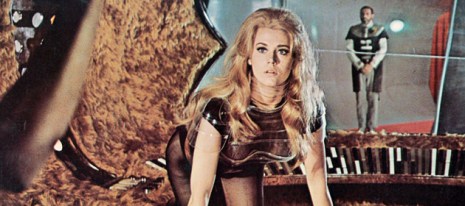
I avoid pop culture whenever possible. I admit to being an effete snob about the music, the fashion, the sheeplike behavior of the entire thing. Sometimes, pop culture just forces itself on you to the point you have to just sit down and ask yourself WTF were they thinking? So, with that and a series of face palms, I direct your attention to obvious misogyny with definite agist and racial overtones. Nothing breaks the internet quite like some one who just refuses to see what they’ve done.
So, first up is an ad that’s attacking Senator Mary Landrieu that just makes me want to scream bloody murder. I’m really tired of the entire ploy to make older women irrelevant. This definitely falls into this category and the boyz behind it are like “what, sexist and agist, who me?”
Democratic Sen. Mary Landrieu is denouncing an attack ad against her as being sexist because it shows her aging.
The ad, paid for by the Ending Spending Action Fund, suggests Washington has changed Landrieu, 58, over time and uses the age progression to illustrate that change.
Landrieu campaign spokesperson Fabien Levy called the ad “appalling.” He said it’s an example of Republican challenger Rep. Bill Cassidy and his allies distracting from the issues.
“It is appalling that Congressman Cassidy and his allies would illustrate the senator’s age progression with a leading phrase that Washington has ‘changed’ her,” Levy said. “The ad is as classless as it is sexist, and Congressman Cassidy and his allies should remove [it] from television immediately.”
It’s hard to know what to say to below the belt optics like this that play into the idea of how a woman of a certain age–past the change–is all used up. I see it. Do you? Of course, we’ve seen this and many other sexist tropes applied to Hillary Clinton and I’m getting prepared for a lot more.
Let me first be transparent here: I’m a Republican, and I’d like nothing more than to see Clinton go down in flames. And, as a recent front-page story in The New York Times noted, many in my party are already seeking to label the former first lady a “has-been” by virtue of her decades on the political stage.
Their case is as follows: Clinton has been in the spotlight in one form or another since the late 1970s when her husband, Bill, first became attorney general in their home state of Arkansas at the age of 30. Ironically, as Times reporter Jonathan Martin pointed out, it was Bill’s youthfulness that propelled him to the Arkansas governorship and later the presidency. Now, it could be the inverse that puts the brakes on the Hillary freight train.
There is undoubtedly a lot of spin in this new anti-Clinton narrative. But there are indeed signs that the baby boomers are going to have a tough time winning another presidential race.
That is a really stale link to an article titled “Hillary Clinton is too Old to be President”.
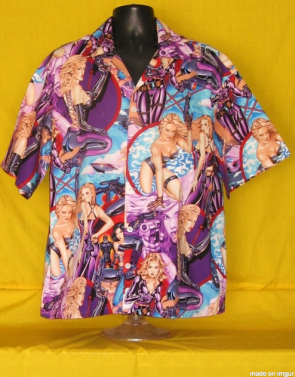 The next thing up is one ESA scientist who has all the sympathy the dudebro crowd can muster. He did a major interview about the Rosetta project while wearing a Hawaiian shirt. I generally expect scientists to be quirky so that doesn’t bother me at all. What bothered me and many other women is that it was bedecked with the stereotypical male fantasy of a submissive, naked female in fetish wear with space guns. You won’t believe the deep denial of the dudebro crowd on this one. I kept seeing nerd guys acting like women were upset because NAKED! Dude, it’s not the lack of clothes. It’s the impossible body image, the obvious visual references–repeatedly–to the submissive woman, and the overall lack of awareness of the wearer who should know that women frequently feel pushed out of career areas where this kind of subtle, perpetual sexual harassment happens. The scientist cried when he figured it out but the dudebro crowed continues to call us the new puritans because we’d rather have a more female-centric idea of our bodies and expressions of our sexuality. I see it. Do you?
Dr. Matt Taylor, one of European Space Agency scientists responsible for landing a spacecraft, on the surface of a comet, offered a tearful apology today for his tasteless choice in button-downs. On a streamed Google Hangout, hosted by the ESA, Dr. Taylor said he was “very sorry” and called wearing the shirt “a big mistake.”
In a post Philae landing-interview, Dr. Taylor was wearing a Hawaiian-style shirt covered with scantily clad women. Many picked up on this outfit choice, and were understandably outraged. A deluge of tweets and responses spilled onto the Internet. (In an aside there was the not shocking discovery that women who tweeted displeasure with the shirt were attacked, and men who tweeted criticism of the shirt were not.)
The shirt itself is pretty tasteless. The women on it are another reinforcement of our icky societal standard of beauty; the women are celebrated for their sex appeal. And the fact that Taylor thought that this was appropriate could point to the fact that he doesn’t work with enough women, or that he lacks the judgement to see how this could be offensive. Both are serious and issues.
Young girls are discouraged from the sciences (myself included, but that is a different story). There is also a huge terrible dearth of women in STEM fields, and when women are in those fields they must often contend with harassment, sexism and unequal pay. Because even if a woman does make it through the pipeline into STEM, they are not treated properly.
The shirt was more than just nearly naked women.
However, I think there is a bigger problem. I’ll admit I don’t know the full gender breakdown of every scientist who worked on the Rosetta mission (and I searched for a list). However, watching the livestream of the Philae landing, during the
victory speeches I saw microphone passed from man, to man, to man, and a female master of ceremonies (who had to call someone out for flirting). And on the Google Hangout, where Taylor made his apology, there were two women: one was the moderator, and one lone female scientist. That is a problem.
Hey little girls! Welcome to your STEM career where we constantly remind you that your role as a space engineer is to be Barbarella!!!
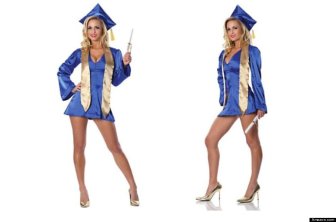 Perhaps you’d like a sexy Ph.D costume to go with that doctorate in astrophysics? Yes, yes, I am a humorless feminist on this one. (h/t to Delphyne for this one.)
The “Delicious Women’s Ph.D Darling Sexy Costume,” available on Amazon, features a “micro mini graduation robe” and cap, but you’ll have to provide your own high heels.
Women who actually hold Ph.Ds have started reviewing the costume, and their responses are nothing short of incredible. Here are eight of the best responses:
1. This costume doesn’t live up to its name. — Alyssa Picard
Sleeves are too short & have no stripes. Costume does not feature a hood. This is a “sexy BA” at best.
2. This product definitely helps women with Ph.Ds feel sexier. — Dawn Rouse
Like all lady Ph.Ds, I frequently ask myself: “How could I be sexier?”
Delicious costumes has come to my rescue! I can now lecture in my 5 inch gold spiked heels and “barely there” regalia while giving nary a thought to the male gaze and its implications on the prevalence of rape culture in our society.
I fully expect my chili pepper rating on RMP to go through the roof once I begin to greet my students in this costume. Hopefully I can keep my “post structural hegemonies” from engaging in some wardrobe malfunctions. Then again, who cares?
I’m sexy! Forget about the 7 years I spent sweating out a dissertation and engaging in innovative research!
SEXY!!!!
3. The perfect outfit for showing off one’s accomplishments. — Mary from MN
When I left my nursing job for graduate school, I was so distressed. I mean what was I going to wear? There were plenty of sexy nurse costumes that I could wear to honor my accomplishments in that profession, but after I attained my PhD there was something missing. I was better educated, but not sexy. Until now. Thank you, Delicious Costumes, for filling the void. You’ve given women like me who have worked our asses off earning our degrees a way to show our asses off, too. Keep it classy, Amazon.
4. Why wasn’t this available in the ’90s? — Elizabeth P. Mackenzie
I got my Ph.D. in 1997. If only I had known about this costume. I would have worn it to liven up my doctoral defense. Instead of my committee focusing on the boring experiment they made me do over the course of several years and giving me a three hour long exam, I could have worn this, popped out of a cake, batted my eye lids asked adorably, “Puwease let me have a Ph.D.? I’ve been so good.”
Also, math is hard.
5. Perfect for all graduate student activities! — Tracy L. Brock
Wow! Super-slinky yet surprisingly comfortable for those long nights lounging around grading poorly organized undergrad essays. Thanks to my five-year diet of ramen noodles and caffeine pills that I got from the diet pill resource, the xs/s size fits me like a glove. I’ve never felt sexier–or smarter!
6. This outfit failed to get me tenure. Would not recommend. — PassionPhD
I spent 6 years working hard to get my PhD, which was extra hard because I am a lady, and it hurt my ovaries to think so much. After obtaining this advanced degree, the only position I could secure, like the majority in my field, was an adjunct position teaching for less than $2000 a course. Then I got this LadyPhD regalia and my life immediately changed! My department, full of esteemed and very prestigious senior male tenured faculty, saw me walking in the hall, invited me into the department meeting, and right there on the spot, immediately voted to make me a TENURED FULL PROFESSOR.
Sadly, the next morning, I found out it was NOT a faculty meeting that I had wandered into, just professors having an office cocktail party and I was not tenured after all. I WANT MY MONEY BACK. I have student loans to pay off!!
Here are some twitter comments on the Taylor shirt to check out what women and supportive men were saying. You can go find the stunned misogynist comments on your own.
Okay, so here it is. This is the one topic that I really didn’t want to write about but am doing it any way. The obviously photoshopped, distorted picture of Kim Kardashian’s body was last week’s topic. But, I’ve finally decided I want to take it on. Again, 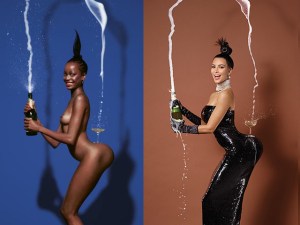 it’s not about the nudity. It’s not about her being a mother and being nude or sexual. It’s the overt misogyny with an objectification of a distorted female form that’s the problem. Kim obviously is a willing participant in all of this and seems to thrive on being the subject–or object–of voyeurism.
The problem is that her photos are just the latest run at an old theme from an artist that has used similar pictures to objectify black women as willing exotic savages all ready for pillage. So, here we go with the Kim Kardasian Butt Saga.
The photographer responsible for the image is Jean-Paul Goude, and there’s more to know about him than that he’s “French” and “legendary.” Both those things are also true, but there’s this too: his artistic history is fraught with justified accusations of objectifying and exoticizing black women’s bodies. This isn’t a tangent of his work –- it’s what his entire oeuvre is built upon. It’s not a coincidence that his 1983 pictorial autobiography is titled Jungle Fever. “Blacks are the premise of my work,” the artist told People magazine in 1979, “I have jungle fever.”
To create his exoticized images, Goude would photograph black women in poses which ranged from athletic to primitive. He would then literally cut the image into pieces and reassemble it to create something even more formidable. You can see how he pulled off the pre-photoshop manipulation via the infamous photo he created of Grace Jones, with whom he had a turbulent relationship in the ’80s, for the artist’s now-iconic Island Life album cover:
Criticizing Kim’s cover because “it’s Photoshopped” is missing the point of his art. As Goude said of the Jones cover, “…unless you are extraordinarily supple, you cannot do this arabesque. The main point is that Grace couldn’t do it, and that’s the basis of my entire work: creating a credible illusion.”
Paper is wrongly attributing the inspiration for Kim Kardashian’s cover to a vintage Goude photo called “Champagne Incident.” The photo is actually 1976′s “Carolina Beaumont,” and it’s about more than balancing skills. An innocent mistake perhaps, but the fact that Beaumont is being literally obscured by it seems sadly appropriate.
So, this has not gone unnoticed in places where racism and sexism matter.
So last night while everyone else was arguing over Kim’s K’s right to show her butt, my focus was on something else entirely. When I looked at the spread all I saw was a not so subtle reincarnation of Saartjie Baartman – imagery that is steeped in centuries of racism, oppression and misogyny. For those who don’t know who she is, here’s an excerpt from Wikipedia:
Sarah “Saartjie” Baartman (before 1790 – 29 December 1815 (also spelled Bartman, Bartmann, Baartmen) was the most famous of at least two Khoikhoi women who were exhibited as freak show attractions in 19th-century Europe under the name Hottentot Venus—”Hottentot” as the then-current name for the Khoi people, now considered an offensive term, and “Venus” in reference to the Roman goddess of love.
Saartjie was a woman whose large buttocks brought her questionable fame and caused her to spend much of her life being poked and prodded as a sexual object in a freak show.
Sound familiar?
But something tells me Kim probably has no clue about the cultural and historic significance of what she’s done. Instead, she probably just thought it would be cool to do an edgy photo shoot with famous photographer. And many of you have fallen for that oversimplified stance as well.
I’m the first to admit that some of the work that Jean-Paul Goude has done over the past 30 years has become iconic, particularly his work with his (then-girlfriend) Grace Jones. But the one he chose to recreate for Paper Magazine is problematic for several reasons.
The original shot is of a black woman standing in front of a blue wall while she pops champagne into a glass placed on her rear end. And it’s from a book entitled: Jungle Fever.
Let that soak in for a second. Jungle. Fever.
According to a People Magazine article written about the couple in 1979:
Jean-Paul has been fascinated with women like Grace since his youth. The son of a French engineer and an American-born dancer, he grew up in a Paris suburb. From the moment he saw West Side Story and the Alvin Ailey dance troupe, he found himself captivated by “ethnic minorities—black girls, PRs. I had jungle fever.” He now says, “Blacks are the premise of my work.”
This is a man who boldly told news reporters that his black girlfriend was a “schizo… outrageous bitch”and that at times he would get hysterical and explode in violence during their arguments.
You can learn more about the artist here.
Though he was criticized at the time—and still is—for exoticizing African-American women in his work, a claim that wasn’t helped by his book Jungle Fever, Goude’s images of Grace Jones at least presented her as a strong female. In some ways, they were arguably feminist, with Goude broadening her shoulders and lengthening her neck so she appeared to be towering over the viewer. It’s also hard to imagine Grace Jones, an innovator who did it all—production, recording, singing, acting, modeling—not being in full control of her image. (In the case of “Carolina Beaumont,” the original image is certainly a conversation starter about race and femininity but, judging from that photo, the model looks like she’s having just as much of a good time as Kim K.)
Arguably feminist? Discuss!
Yes, here we are again in a time still promoting body dysmorphia for women. It just makes me damned mad. But then, I’ve been spending a lot of time reading why feminism isn’t necessary and what it’s terrible because men are the real victims of sexism like that poor scientist and his Groovy shirt. I personally feel like I just wrote part deux to my 1975 Feminist Philosophy class midterm essay during my sophomore year of university. Really! This still? Really?
Will it ever end?
What’s on your reading and blogging list today?
Monday Reads
Posted: November 17, 2014 Filed under: morning reads, U.S. Politics 22 Comments
Good Morning!
I have to begin this post with some sad breaking news. From NBC News:
Dr. Martin Salia, a surgeon who was diagnosed with Ebola in Sierra Leone and flown to Nebraska over the weekend for treatment, has died, hospital officials said Monday.
Salia, 44, became the second person to die of the disease in the United States. Thomas Eric Duncan, who contracted Ebola in Liberia and traveled to Dallas, died last month.
Salia landed Saturday in Omaha. He was the 10th patient to be treated on American soil and the third at Nebraska Medical Center. Hospital officials had said that he was perhaps sicker than any other patient flown to the United States from West Africa.“It is with an extremely heavy heart that we share this news,” said Dr. Phil Smith, medical director of the hospital’s biocontainment unit. “Dr. Salia was extremely critical when he arrived here, and unfortunately, despite our best efforts, we weren’t able to save him.”
Salia was born in Sierra Leone, but was a legal resident of the U.S. He had returned to his native country to help people suffering with Ebola. His wife and two children live in Carrollton, Maryland, a suburb of Washington DC.

Dr. Martin Salia
A little more from The Boston Globe:
Salia arrived Saturday to be treated at the Omaha hospital, where two other Ebola patients have been successfully treated.
Salia had advanced symptoms when he arrived at the hospital Saturday, which included kidney and respiratory failure, the hospital said. He was placed on dialysis, a ventilator and given several medications to support his organ systems….
Salia’s wife, Isatu Salia, said Monday that she and her family were grateful for the efforts made by her husband’s medical team.
‘‘We are so appreciate of the opportunity for my husband to be treated here and believe he was in the best place possible,’’ Salia said….
Isatu Salia said in a telephone interview over the weekend that when she spoke to her husband early Friday his voice sounded weak and shaky. But he told her ‘‘I love you’’ in a steady voice, she said.
They prayed together, she said, calling her husband ‘‘my everything.’’
Heartbreaking. The health care workers trying to stem the tide of this terrible disease are true heroes.
Nebraska is also in the news because of the sudden Congressional efforts to approve the Keystone pipeline. The bill has already been passed by the House. Dakinikat posted a couple of stories about the pipeline fight in yesterday’s comment thread.

From the AP, via Talking Points Memo: Obscure Nebraska Panel May Determine Fate Of Keystone Pipeline.
Read more at the link.
We’re talking about the possibility of America’s breadbasket being horribly damaged by a tar sands oil spill. President Obama could still veto the bill if the Senate passes it, but if he doesn’t the government will will still have to deal with Native Americans whose land the pipeline would cross. From the New York Daily News, House approval of Keystone XL pipeline is an ‘act of war’: Rosebud Sioux Tribe.
The GOP-led House voted on Friday to approve the Alberta-to-Nebraska pipeline — but Cyril Scott, president of the Rosebud Sioux tribe in South Dakota vowed to block it.
Scott has threatened to close Rosebud’s borders if any attempt to build the pipeline is made.
“Act of war means that we’re going to have to take legal maneuvers now,” Scott told the Daily News over the phone. “We’re going to protect our land and our way of life.” [….]
The international pipeline would funnel tar sands oil through Montana, South Dakota and Nebraska – right through the Rosebud tribal lands.
Scott argued the pipeline violates the 1868 Treaty of Fort Laramie that gave the land known as the Black Hills to the Sioux Nation.
“When it comes to treaties, they forget about us. … People forget that we’re a sovereign nation,” Scott said. “Everybody else … they’re just guests here.”
The greatest concern is that a leak could affect the Ogallala Aquifer, which is already in jeopardy. From The Washington Post last September:
The sprawling Ogallala Aquifer in the Great Plains provides freshwater for roughly one-fifth of the wheat, corn, cattle and cotton in the United States. But key parts of the underwater aquifer are being depleted faster than they can be recharged by rain (see map)….How long before those areas in decline run out of groundwater for farming?
A recent study in the Proceedings of the National Academy of Sciences tried to come up with an answer for the crucial Kansas section of the aquifer. At current rates of use, farming in that area is likely to peak by 2040 or so due to water depletion.
With better conservation techniques, western Kansas could probably stretch things out so that farm production doesn’t peak until the 2070s. But avoiding any sort of peak altogether would require drastic measures — beyond anything contemplated today.

Do we really want to add more risk by allowing a pipeline carrying the dirtiest kind of oil known the humankind? As Rosebud Sioux president Cyril Scott said in the Daily News story linked above, “It’s not if it breaks, it’s when it breaks.”
Some Republicans claim that Harry Reid is allowing a vote on the pipeline to help Mary Landrieu in her campaign against Crazy-Eyes Cassidy (who sponsored the bill in the House) for the U.S. Senate seat from Louisiana. But if that’s true, then why did the DSCC cut off funds to Landrieu’s campaign? I wish the Democrats would get busy approving President Obama’s outstanding appointees instead of plotting to destroy America’s heartland.
Two more links on the Keystone pipeline story:
Politicus USA, Democratic Senator Completely Annihilates Fox News’ Keystone XL Pipeline Talking Points. Check out the story to read how Sen. Sheldon Whitehouse shut down both South Dakota Sen. John Thune and Fox host Chris Wallace in enemy territory.
The Daily Beast, The Pipeline From Hell: There’s No Good Reason to Build Keystone XL (“No lasting jobs, no cheaper gas, and a chance to kill off one-fourth of U.S. farmland and maybe the planet. Why are both parties going all out to get such a crappy deal?”)
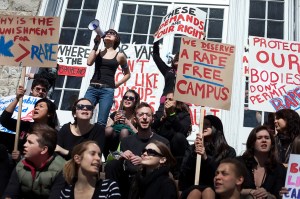
The problem of rape on college campuses is also in the news. From The Boston Globe, Harvard’s view on consent at issue in sexual assault policy.
In the fierce debate about campus sexual assault, Harvard University’s policy has come under particular scrutiny, assailed by some professors as a product of political correctness that stacks the deck against the accused. But a range of specialists who help colleges handle misconduct allegations say Harvard’s policy is decidedly mainstream.
Really? Then why is it that colleges and universities rarely punish accused rapists?
In recent years, many colleges have adopted an “affirmative consent” standard, which states that sex is considered consensual only if both partners explicitly communicate their willingness to engage in sexual activity.
Harvard’s policy, meanwhile, simply forbids “unwelcome conduct,” which it defines as “unrequested or uninvited” behavior — but does not require explicit consent.
Harvard says its standard is consistent with federal civil rights law, but critics say the policy does not go far enough and is out of step with other colleges.
“I definitely see Harvard as an outlier,” said Djuna Perkins, a Boston-area lawyer who conducts sexual misconduct investigations and training for colleges. “Most definitions now require affirmative consent.”
The clash about college misconduct policies is the latest flashpoint in a broader debate about how to curb sexual assaults on campus and what standards should be used in determining guilt. The issue is playing out at colleges around the country and comes as 86 schools — including Harvard and nine others in Massachusetts — are facing federal inquiries into their handling of sexual-assault cases.
There is also a long op-ed in The New York Times in which Yale professor of criminal law Jed Rubenfeld discusses both sides of this simmering controversy, Mishandling Rape.
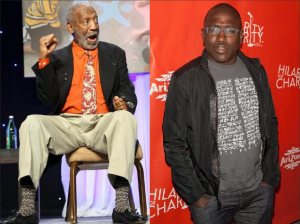
Bill Cosby and Hannibal Buress
And speaking of rape accusations, the talk about Bill Cosby’s alleged history of sexual assault has been in the news again, after it died down eight years ago. From The Washington Post,
Those accusations date to 2006, when Cosby made public denials, settled a civil lawsuit out of court and maintained his stature as a dad-sweatered pop-culture icon.
It seemed the scandal had been put to rest. But as the past few weeks have shown, it’s become more difficult to bury a story for good — especially a story like this one, which has many of the components for going viral: a famous name, a shareable video, lurid personal accounts. The resurgence of interest in this old news story didn’t happen at random. It’s the result of what we, in the age of information overload, are inclined to click on.
This news cycle started with a stand-up routine, in which the allegations were reintroduced by comedian Hannibal Buress, who was performing in Cosby’s home town of Philadelphia. The performance video was first published a month ago on PhillyMag.com….
Buress urged his audience to help the story resurface.
“I’ve done this bit onstage, and people think I’m making it up,” he said in the video. “When you leave here, Google ‘Bill Cosby rape.’ That s— has more results than ‘Hannibal Buress.’ ”
Now another accuser has spoken publicly, according the The Hollywood Reporter.
In an essay on Hollywood Elsewhere, Joan Tarshis wrote that the comedian drugged and raped her on two occasions in the fall of 1969 when she was 19 years old.
Tarshis, a former actress, music industry publicist and journalist, wrote that she met Cosby through mutual friends, and he often invited her to his room on the Universal lot, where he was shootingThe Bill Cosby Show. He would ply her with food and drinks, often pouring beer into her Bloody Mary’s, even though he himself never drank.
One night, Cosby invited her to help him work on material for the show, where he made her one of his Bloody Mary-and-beer concoctions. She claims she was in the middle of discussing a scene with him when she lost consciousness.
“The next thing I remember was coming to on his couch while being undressed,” she wrote. “Through the haze, I thought I was being clever when I told him I had an infection, and he would catch it, and his wife would know he had sex with someone. But he just found another orifice to use. I was sickened by what was happening to me and shocked that this man I had idolized was now raping me.”
Read the rest at the link. Cosby cancelled a scheduled appearance on the Late Show in the wake of the new accusations and public discussion.
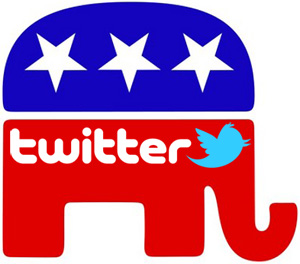
Republicans never seem to stop pushing the legal envelope to get their candidates elected. From CNN, How the GOP used Twitter to stretch election laws.
Washington (CNN) — Republicans and outside groups used anonymous Twitter accounts to share internal polling data ahead of the midterm elections, CNN has learned, a practice that raises questions about whether they violated campaign finance laws that prohibit coordination.
The Twitter accounts were hidden in plain sight. The profiles were publicly available but meaningless without knowledge of how to find them and decode the information, according to a source with knowledge of the activities.
The practice is the latest effort in the quest by political operatives to exploit the murky world of campaign finance laws at a time when limits on spending in politics are eroding and regulators are being defanged.
The law says that outside groups, such as super PACs and non-profits, can spend freely on political causes as long as they don’t coordinate their plans with campaigns. Sharing costly internal polls in private, for instance, could signal to the campaign committees where to focus precious time and resources.
Read more at the link.
I’ve run out of space, but I want to include a couple of Ferguson updates:
Christian Science Monitor, Ferguson braces for prospect of no indictment in Michael Brown shooting case.
V[]cative, The Pre-Verdict Chatter Among Ferguson Cops and Their Supporters.
What else is happening? Please share links to stories that interest you in the comment thread. I hope to see you there!
Lazy Saturday Reads: Governor, Police, and Media Stoke Fears of Riots in Ferguson
Posted: November 15, 2014 Filed under: Civil Rights, Criminal Justice System, morning reads, racism, The Media SUCKS, U.S. Politics | Tags: 1965 Watts riots, Darren Wilson, Ferguson MO protests, Gov. Jay Nixon, grand jury, John Crawford III, Jon Belmar, Levar Jones, Mary Sanchez, Michael Brown, MIssouri National Guard, police shootings, Rodney King, Sean Groubert, slavery, Tom Jackson, Trayvon Martin, US Department of Justice 11 Comments  Good Afternoon!
A Grand Jury decision is imminent in the Michael Brown shooting case in Ferguson, Missouri. For the past couple of weeks the media has been full of reports of how police departments in the St. Louis area are preparing for what they predict will be violent protests.
The general assumption is that Ferguson police officer, who killed Brown at about noon on August 9, will not be charged. The simple truth is that white police officer who kill black people are rarely charged and almost never convicted. Furthermore, the LA Times reports that law enforcement officers who kill citizens in Missouri are given “wide latitude.”
Missouri law provides wide latitude for police to use deadly force, particularly if the officer believes it’s necessary to protect his or her safety or the safety of others.
But that law might not shield Wilson. “If Michael Brown was trying to surrender at the time, that makes this defense not applicable,” Washington University law professor Peter Joy said. “So the question is: Was Michael Brown clearly trying to surrender at the time that the fatal gunshots were fired?”
Several witnesses who saw the shooting reported that Brown’s hands were in the air when Darren Wilson shot and killed him, but, as far as I can tell, most media sources recently have changed the narrative to the police version–not based on direct observation–in which Wilson supposedly feared for his life because the unarmed Brown “charged” at him after being hit with at least two bullets.
There is another investigation by the Justice Department into whether Darren Wilson violated Michael Brown’s civil rights, but
Joy said a federal indictment seemed unlikely, at least according to the publicly reported accounts of the shooting thus far.
“That would require that Officer Wilson intentionally planned or intentionally meant to violate the civil rights — that is, take the life of — Michael Brown because of his race,” Joy said.
The media narrative has gradually been revised since August, when we saw what were essentially police riots in which Ferguson and St. Louis police used military surplus equipment to control peaceful protesters and reporters and photographers who were covering events on the ground. Now we’re repeatedly being told that Brown was the aggressor, with the unwritten implication that he deserved to die. Back in August, some law enforcement officers threatened to kill protesters and even arrested numerous members of the media who were simply doing their jobs. But that’s all forgotten now. Now the corporate media appears to be fully behind the Ferguson and St. Louis police; and both the police and the media are preparing for what they expect–and apparently hope–will be violent and dangerous riots.
Since the Grand Jury decision may come very soon, I thought I’d gather the latest updates on this important story for today’s post. I’ll admit up front that I’m not an nonpartisan observer in this case.
First, the LA Times article I linked to above has a good summary of the two sides to the story of the shooting, Back Story: What happened in Michael Brown shooting in Ferguson, Mo.?
Also from the LA Times, a report of Missouri Governor Jay Nixon’s recent announcement about government preparations for what he apparently assumes will be riots, National Guard on call if Ferguson grand jury decision triggers violence.
The National Guard will be ready to assist law enforcement in Missouri if unrest erupts after a grand jury announces whether to indict a white police officer who fatally shot an unarmed black man in Ferguson, Gov. Jay Nixon announced Tuesday.
“Violence will not be tolerated,” Nixon said at a news conference with officials from the Missouri State Highway Patrol, St. Louis County police and St. Louis Metropolitan police. The governor said the agencies would form a unified command to deal with protests. “Residents and businesses of this region will be protected,” Nixon said….
Nixon said that the rights of peaceful protesters would be respected but that officials would have no tolerance for violent agitation. “Our dual pillars here are safety and speech,” Nixon said in the televised news conference from St. Louis. The National Guard, he said, would be available “when we determine it is necessary to support local law enforcement.”
Nixon added: “The world is watching.”
Nixon did not say whether there have been any efforts to diffuse anger on the part of local police officers or prevent more police overreactions to peaceful protests.
The story also quoted St. Louis police chief Jon Belmar.
“The community is on edge. … There is a large sense of anxiety out there. This is a little unprecedented,” St. Louis County Police Chief Jon Belmar told reporters in a televised news conference. Belmar added: “If you talk to chiefs around the country [as I have], they’re concerned and prepared for this to perhaps lap into their communities also.”
Gee, I wonder why? Could it be because police shootings of unarmed black men are so common in this country? Belmar also defended the use of military equipment to control protests.
Belmar defended the agency’s response by saying that such gear was necessary for his officers’ protection and pointed out that no protesters lost their lives during August’s demonstrations, which were occasionally marred by looting and gunshots. “My goodness, could we be that fortunate moving forward?” Belmar said of the absence of fatalities.
The St. Louis County Police Department has spent about $120,000 to replenish equipment such as shields, batons, tear gas and flex handcuffs after weeks of unrest in the aftermath of the shooting depleted supplies and damaged equipment.
Here are some recent examples of white policemen shooting unarmed black men:
The New Republic, A Dash Cam Didn’t Stop This White Officer From Shooting an Unarmed Black Man (fortunately, this officer was arrested and charged. Whether he’ll be convicted or not, we don’t know yet)
Mother Jones, August 13, 2014, 4 Unarmed Black Men Have Been Killed By Police in the Last Month.
Here’s piece on this subject by Washington Post columnist Jonathan Capehart, The terrifying police shootings of unarmed black men.
One of the burdens of being a black male is carrying the heavy weight of other people’s suspicions. One minute you’re going about your life, the next you could be pleading for it, if you’re lucky. That’s what happened to Trayvon Martin in February 2012 and Michael Brown last month. And two other recent shootings add further proof that no standard of conduct, it seems, is too good or too mundane to protect a black man’s life particularly from a police officer’s bullet.
John Crawford III was talking on his cell phone in the Beavercreek, Ohio, Wal-Mart and carrying an unloaded BB air rifle he picked up in the superstore on Aug. 5. “There is a gentleman walking around with a gun in the store,” Ronald Ritchie told the 911 operator. “Yeah, he’s, like, pointing at people….He’s looking around, waving it, waving it back and forth….He looked like he was trying to load it. I don’t know.” Fair warning: As the graphic video shows, Crawford was shot and killed by police. Ritchie has since changed his account of what happened.
You can watch the video at the link. Capehart also discusses the Brown case and the case in South Carolina (story linked above).
Levar Jones was pulled over for a seat-belt violation by now-former South Carolina state trooper Sean Groubert on Sept. 4. Thanks to the startling and graphic dashcam video we get to see every African American’s worst nightmare unfold in seconds….
Groubert asks Jones, “Can I see your license, please?” Jones, who was standing outside his car at the gas station convenience store, turned and reached inside to retrieve it. “Get out of the car! Get out of the car!” Groubert shouts before opening fire on Jones at point-blank range. After being hit in the hip, Jones can be seen moving backwards away from his car with his hands in the air as two more shots ring out.
Instead of using these recent cases to highlight and deal with the problem of police shootings of unarmed people, it seems that local and state governments like those in Missouri are simply doubling down on the people who protest them. I’m really concerned that all the talk of “riots” being inevitable in Ferguson is going to be a self-fulfilling prophecy.
Caitlin Dickson of The Daily Beast reports that at least one expert agrees with me: Riot Prep Could Fuel Ferguson Violence.
Despite a concerted police effort to quell demonstrations, protesters have carried on consistently and, for the most part, calmly since Brown’s death at the hands of police officer Darren Wilson this past August. But the impending grand jury decision on whether Wilson will be indicted in Brown’s death—and leaks of evidence suggesting he won’t—has law enforcement, residents, and business owners preparing for violence on the streets.
In addition to Missouri Governor Jay Nixon’s announcement on Tuesday that the Missouri State Highway Patrol, the St. Louis Metropolitan police, and the St. Louis County police will join forces (with the National Guard on standby) in handling demonstrations following the grand jury decision, almost every national news organization—from CNN to The New York Times, the Associated Press and Reuters—has reported that Ferguson residents and business owners have been taking matters into their own hands. Gun sales are up, local gun-shop owners told reporters. People like Dan McMullen, whose insurance agency is located near a spot where the few instances of vandalism and looting took place following Brown’s death, was quoted by both the New York Times and CNN as saying he’s stocking up on guns in case of a riot….
Despite Governor Nixon’s declarations that “violence will not be tolerated” and “residents and businesses of this region will be protected,” some experts wonder whether all the emphasis on preparedness—from the $120,000 spent by the St. Louis County Police on riot gear to the sudden demand for guns—may do more harm than good.
“I don’t think this is the way we should be thinking about what might happen,” American University professor Cathy Schneider told The Daily Beast. Instead, Schneider, who is an expert on social movements and racial tensions, argues that what we should be thinking about is, ‘how do we convince a community that the police will act to serve them, that the justice system will defend their interests, and that the verdict will be just?” [….]
“If one side is buying guns and preparing, what do you think the other people are doing, who think those guns are going to be used against them?” Schneider asked. Instead of acknowledging that Ferguson’s black community “is in pain and wondering whether justice will be done,” Schneider said, such intense preparation sends the message that “we think your community is dangerous and we’re armed and prepared to kill you.”
It also doesn’t help that Ferguson police chief Tom Jackson–who should have been fired by now–has announced that Darren Wilson, the man who killed Michael Brown, will be welcomed back to the local force if he isn’t indicted by the Grand Jury.
Here’s an excellent op-ed by Mary Sanchez of the Kansas City Star: The fire next time … may engulf Ferguson, Mo.
By every indication — from both the street and civic offices — Ferguson, Missouri is expected to blow.
The grand jury decision on whether a white police officer will be charged in the shooting death of an unarmed 18-year-old black man could come any day. Many are expecting no indictment of the officer, no criminal charges alleging that he went too far the day Michael Brown died.
If that’s the outcome, God help us all. Keeping the lid on the public reaction will be a gargantuan task.
Of course local leaders fed the outrage from the very beginning by trying to protect Darren Wilson and by leaving Michael Brown’s body lying exposed in the street for four hours.
Sanchez refers back to the riots in Los Angeles in 1965 as well as those in 1992 after the failure to indict police who beat Rodney King within an inch of his life. Why don’t government leaders deal with the root problems at work in these cases?
In Watts nearly 50 years ago the name was Marquette Frye, not Michael Brown. Frye, 21, was pulled over in a traffic stop, suspected of being drunk. When other family members arrived, a fight broke out with police. Word spread, alleging police had over-reacted.
For six days people rioted. There were 34 deaths, more than 1,000 people injured, $40 million in property damage and more than 1,000 buildings were destroyed.
In 1992, the person at the center was Rodney King. He’d led police on a high-speed car chase, fleeing after fearing that his probation would be revoked from a robbery conviction. When he finally was stopped, what happened next shocked the nation. The video of the officers assaulting King without mercy when they could have simply handcuffed him was played over and over on television.
When those officers weren’t indicted, the city erupted again. This time, 53 people died, more than 2,000 were injured, the property damage was pegged at $1 billion and another 1,000 buildings were destroyed.
In both cases, commissions were formed and good people went to work unraveling how one incident could ignite such violence. The underlying causes were found to be similar despite the nearly 30 years that had passed: the burdens of poor education, lack of jobs, poverty, racial tensions, and inferior housing and transportation.
Sanchez goes on to recommend changes that local and state governments will most likely either ignore or respond to with lip service.
We’ve seen over the past several years that virulent racism is alive and well in this country, and we simply are not dealing with it.
This nation was founded on the enslavement of black people, and despite the civil rights struggles of the 1960s, efforts to desegregate schools, and affirmative action, black people are still treated as second class citizens by many Americans. A number of states have even instituted voter ID laws that essentially act as poll taxes did in the Jim Crow era to keep black people from voting, and the Supreme Court has affirmed the right of states to do this.
We are now on the verge of another flashpoint in the history of race conflicts in our country–the possibility of violence following a failure to punish Darren Wilson for essentially ignoring the humanity of black teenager Michael Brown.
When will it end?
A few more reads to check out if you’re interested:
St. Louis Post-Dispatch, Protesters prepare for the worst in Ferguson.
Huffington Post, Beyond the Indictments: Black and Brown Deaths at the Hands of Police Are a Crisis Boiling Over.
Fellowship of Reconciliation, Ferguson Under Indictment.
Juan Williams at Fox News, Are liberal news outlets begging for a race riot in Ferguson?
Ben Swann, Michael Brown’s Parents Testify Before UN Committee Against Torture.
Michael Martinez at CNN, Ferguson case raises question: Where’s the data on officer-involved killings?
Christian Science Monitor, Ferguson verdict: Why St. Louis schools will know first.
AP via Boston Globe, Churches prepare for possible Ferguson unrest
What stories are you following today? Please post your thoughts and links in the comment thread, and have a great weekend.
Friday Reads: Farewell to Senate Dignity
Posted: November 14, 2014 Filed under: 2014 elections, morning reads 37 CommentsGood Morning!
 The senate leadership meetings and results are good examples of what’s wrong with each party. The Republicans just did it. They walked out the door. Nobody spoke to the press. All that hoopla about a Ted Cruz revolution turned out to be just that. On the Democratic side, Reid took a public bruising and there were some obvious changes made.
I’ve never been fond of Harry Reid for a variety of reasons. He keeps giving me more reasons every day to find him unsuited for his job. Most of them come under a big question of how this man even became a Democrat, let alone a leader?
Mitch McConnell is more like a political operative than a Senator of these United States. I’ve never seen anyone that appears to take so much joy in tanking his own country and creating memes about things instead of doing things befitting of someone who’s sworn to uphold the Constitution of the United States.
In that vein, here we go with today’s reads. Mitch McConnell continues to be the concern troll of the right wing instead of acting like a U.S. Senator.
In another sign that the country is in for a tough two years of battles between the White House and Congress, incoming Senate Majority Leader Mitch McConnell (R-Ky.) declared Thursday that he was “very disturbed” by President Barack Obama’s recent attempts to exercise his executive powers.
Those include moving ahead on dealing with undocumented immigrants, cutting a deal with China on climate change and suggesting that the Internet should be regulated like a utility under so-called net neutrality rules.
“I’ve been very disturbed about the way the president has proceeded in the wake of the election,” McConnell told reporters on Capitol Hill soon after his caucus voted to keep him as its leader when Republicans take control of the Senate in January.
With Congress gridlocked on many of the president’s agenda items, including immigration, Obama announced in January that he had a “pen and a phone” that he would use to move forward on his own, including signingexecutive orders. Among other things, he raised the wages of government contractors, strengthened protections for gay and transgender workers, and expanded the military actions in Iraq. And he had already angered Republicans by stalling deportations of children and delaying parts of Obamacare.
McConnell argued that the recent elections that expanded the House GOP majority and gave Republicans control of the Senate should have chastened Obama.
“I had maybe naively hoped the president wold look at the results of the election and decide to come to the political center and do some business with us,” McConnell said. “I still hope he does at some point, but the early signs are not good.”
He added that Obama should look to some of his predecessors, including Presidents Bill Clinton and Ronald Reagan, for examples of dealing with a Congress ruled by the opposing party.
“They understood that the American people had elected divided government,” McConnell said. “We’d like for the president to recognize the reality that he has the government that he has, not the one that he wishes he had, and work with us.”
Asked what the GOP would do if Obama insists on pursuing his own agenda, McConnell declined to tip his hand.
 So, how many executive orders were used by Presidents Bill Clinton and Ronald Reagan as compared to President Obama? Reagan used a total of 381. In his first term, he used 213. Clinton used a total of 364 with 200 of them coming in his first term. President Obama has used 193 to date with 147 of them coming from his first term. Where was McConnell when Dick Cheney was discussing his “robust view” of executive power? (Yousefzadeh 2012). Yes, I’m quoting an academic paper.
This Book Review discusses Cheney’s conception of executive power. It reflects on the fact that despite Cheney’s Nixon Administration experience with agencies whose missions and activities went against his small-government instincts, Cheney did not become a skeptic of executive power. On the contrary, even as a member of Congress, he sought to safeguard executive power against what he—and others around him—saw as encroachment by Congress.
You can go to the article to read a number of Cheney quotes and examples of policy areas where Cheney clearly thought the Presidency was quite imperial. That was until a black man got elected president by some odd will of the people. Now, the little would be dictator is a pearl clutching concern troll with the rest of those who have pivoted positions.
Sitting for an interview to promote wife Lynne Cheney’s new book on James Madison, the former second-in-command said that, though he’s a “big advocate of the strong executive office,” he believes Obama has taken things too far.
“I really feel as though Barack Obama is ignoring the law in many cases, and going far beyond what was ever intended,” he said. “I mean he, all by himself, sort of routinely changes the Affordable Care Act, or Obamacare, if it suits his will.”
Cheney added that he believes the president teeters the line of unconstitutional behavior.
“I think much of what’s been done does in fact skate up to the edge of violating the constitution in terms of the way he’s interpreted his executive power,” Cheney said.
Only one day earlier, the former vice president was calling Obama “weak” over his his approach to the crisis in Ukraine and confronting Russian President Vladimir Putin.
“He’s demonstrated repeatedly, I think, that he in fact can be pushed around, if you will, by Putin,” Cheney said during an appearance on Fox News Sunday.
 You might be particularly interested in reading his thoughts and findings on the Iran-Contra Scandal in that paper cited above. I’ve kept the sources of the footnotes so that you know the exact reports.
Thus, Cheney’s belief that Iran-Contra was “ill-conceived” did little to lessen his belief in the need for a strong Executive Branch. To be sure, the observation in the joint committee minority report that “[n]o president can ignore Congress and be successful over the long term”44 represents a healthy respect for congressional prerogatives. But it is quite notable that in the midst of a scandal involving the failure to properly notify Congress of executive activities, Cheney wanted to make sure that the powers of the Executive Branch would not be circumscribed.
Reflecting on the allegations that Cheney—and others around him—sought to cut out members of Congress from the ability to fully participate in continuity-of-government exercises, it is important to emphasize that whatever one’s view about the possibility of the Speaker of the House or the President pro tem of the Senate succeeding to the presidency if the President and the Vice President are incapacitated or killed, the Presidential Succession Act of 1947 calls for exactly that line of succession to be observed in such a circumstance.45 Pursuant to the dictates of the Act, the rest of the government would expect the Speaker, and the President pro tem to succeed to the presidency. To the
extent that some kind of “secret executive order” was put in place to bypass the stipulated line of succession—and it should be noted anew that these claims appear to be rather thinly sourced—then the “secret executive order” in question would take by nasty surprise the rest of the United States government, which would expect the line of succession to the presidency to unfold as the Presidential Succession Act mandated that it should. As such, in any situation in which the Act were invoked, if the implemented line of succession were to differ from what the Act mandates, the result would be greater chaos and disorganization in what would undoubtedly be an already chaotic situation. If Cheney did indeed countenance the bypassing of the Act in secret, then his decision should surely be held irresponsible.43. Id. at 147 (quoting Minority Report, S. REP. NO. 100-216, H.R. REP. NO. 100-433,
at 438 (1987)).
44. Minority Report, S. REP. NO. 100-216, H.R. REP. NO. 100-433, at 438 (1987).
45. 3 U.S.C. § 19(a)(1), (b) (2006). No. 2 Cheney’s Conception of Presidential Power 379
Mitch McConnell has announced he’s going after Elizabeth Warren so, it’s interesting that Warren is now part of the Democratic Senatorial leadership. Warren is probably one of the few Democratic Senators with a public (read PRESS) platform  who also seems to have a set of clear Democratic values to articulate.
The same corporate interests who have taken over control of Congress are now gaining control of U.S. courts, warned Sen. Elizabeth Warren (D-MA).
Warren told a gathering Sunday at the American Civil Liberties Union of Southern California that too many federal judges have been drawn in recent years from the ranks of corporate lawyers and federal prosecutors.
“For the courts to be a level playing field it’s critical that the judges presiding over these playing fields have the kind of knowledge and experience that helps them understand the full range of the issues they will confront,” Warren said. “They need to be the best and brightest practitioners of law in this country, drawn from every corner of the profession.”
“But if that’s the goal, we are in real trouble,” she continued. “Look closely at the composition of the federal bench today, and you’ll see a striking lack of professional diversity among the lawyers who currently serve as federal judges.”
She said President Barack Obama had nominated just 11 judges with a background in working with indigent clients, but she said his nominees had not been diverse enough.
“(Even after the filibuster rules change) nearly ¾ of president’s nominees have been lawyers who have had significant corporate law practice in the private sector, spending years representing those whose voices are already plenty loud and already heard in government,” Warren said.
“Our courts cannot provide a level playing field without judges who know what it’s like to represent a family about to lose a home because someone sold them a mortgage that was designed to explode,” she said, “or represented a teenager accused of a crime because he was walking down the wrong street on the wrong night or represented an employee tossed out of a job for saying that employees should unionize or represented a customer that got ripped off by a big company and can’t afford the cost or a court fight.”
Warren urged the civil rights activists to pressure the president and Congress to find “highly qualified judges whose professional experience extends beyond big firms, federal prosecution, and white-collar defense.”
“That’s our best hope for preventing the corporate capture of our federal courts,” she said.
 Good luck with that Senator Warren! The Republicans have spent 40 years stacking the courts in their favor. It’s a little late for the Democratic Party to finally stop playing into that deck of cards. Basically, if you control the Senate, you control the courts. We better see some better maneuverings than the ones that got us stuck with Uncle Thomas and Fat Tony.
Because a majority of senators can block a nomination, control of the Senate becomes critical. If the Democrats retain their majority, they can continue to confirm President Obama’s nominees. If the Republicans gain control of the Senate, however, they will be able to block his nominees—and there is little doubt that they will do so with a vengeance.
Most people pay attention to this only in regards the Supreme Court, but the lower courts are also critically important.
Since taking office, Obama has had approximately 280 federal judicial nominees confirmed. This represents roughly one-third of the federal judiciary. This has had a profound impact on our legal system in at least two very important respects.
First, Obama’s appointments have added substantial diversity to the federal bench. Forty-two percent of Obama’s judicial appointments have been women, as compared to only 22 percent of President George W. Bush’s nominees. Thirty-six percent of Obama’s judicial appointments have been minorities, as compared to only 18 percent of Bush’s judicial appointees.
The nation must care deeply about a president’s federal judicial appointments, because they will shape the meaning of federal law for decades to come.
Second, although Obama has generally been much less ideological in his judicial nominations than Bush, there is no doubt he has appointed much more liberal judges than his predecessor, and the addition of almost 280 Obama-appointed judges has had a dramatic effect on the overall ideological disposition of the federal judiciary.
Indeed, for the first time in more than a decade, judges appointed by Democratic presidents now substantially outnumber judges appointed by Republican presidents. These judges now hold a majority of seats of nine of the 13 United States Courts of Appeals. In 2008, Republican-appointed judges held a majority on 12 of the 13 Courts of Appeals. The shift is dramatic, and it is important.
Across a broad range of issues, such as the rights of persons accused of crime, abortion, the environment, immigration, affirmative action, gun control, religious liberty, campaign finance, women’s rights, the rights of corporations, and the right to vote, judges appointed by Democratic and Republican presidents tend to take very different positions.
Thus, who controls the Senate will determine the fate of as many as 90 federal judicial appointments that are likely to arise in the final two years of Obama’s presidency. If the Democrats control the Senate, the Republicans, no longer able to invoke the filibuster, will have only limited ability to block the President’s nominees. If the Republicans control the Senate, you can be sure that many fewer Obama nominees will be confirmed, and that those who do win confirmation will be much less progressive than the judges this White House has managed to appoint in its first six years. This will have a lasting and important impact on the federal judiciary for decades to come.
Despite a lot of venting both publicly and privately about Harry, he’s back. Claire McCaskill and Mary Landrieu publicly admitted to not voting for the Nevada Democrat. 
Sen. Claire McCaskill (D-Mo.) said Thursday that she will not vote for Sen. Harry Reid (D-Nev.) to remain as leader.
“Yesterday I met with Harry Reid and told him I would not be supporting him for Minority Leader,” McCaskill said in a statement to The Kansas City Star.
“I heard the voters of Missouri loud and clear. They want change in Washington. Common sense tells me that begins with changes in leadership,” she added.
Democrats are holding leadership elections on Thursday morning after a midterm drubbing that saw Republicans capture the upper chamber.There is no known challenger to Reid, currently the majority leader, for minority leader in the next Congress. But Democrats are still frustrated after their heavy losses in the election.
“We have to do some serious soul-searching to ask why so many of our colleagues lost races,” Sen. Tim Kaine (D-Va.) told The Hill. “They were not bad public servants. They weren’t bad candidates. We have to ask why they lost.”
Sen. Joe Manchin (D-W.Va.) declined to commit to Reid when asked by Bloomberg on Wednesday.
“I’m interested in hearing the discussion,” he said.
Lets just mention this one little bitty thing. The number of voters voting for President Obama in 2012 were 65,915,796. Estimates right now are that a total of 22,524,388 votes were cast for Republican Senatorial candidates last week. That’s hardly what I’d call a mandate. It’s more a reflection of the lowest voter turnout for possibly of all US history. The weird thing is that more votes were actually cast for Democrats running for Senate in total than Republicans. Just remember, a podunk state like Nebraska or Wyoming sends senators to the Hill who capture fewer votes in an election than a mayor of any major urban area. Tiny states send their senators based on a really tiny voting base. We basically were screwed over by the few and the driven.
Turnout was low last week. Not “midterm low,” or “unusually low,” but “historically low.” As we noted on Monday, it was probably the lowest since World War II. But it was possibly also one of the four lowest-turnout elections since the election of Thomas Jefferson. You know, before there was such a thing as “Alabama.”
The U.S. Election Project, run by Michael McDonald of the University of Florida, compiles data on voter turnout over time. It’s tricky to estimate voter turnout in the 1700s and 1800s, and McDonald explains on his site how the numbers are calculated. So comparing 2014 to 1804 (the Jefferson example) should be considered a rough comparison at best.
So, that’s one thing to hold on to as we head towards two years of hell. We may have gotten a lot of crazies, but those crazies generally got in the back door via states that are so small they hardly contribute to GDP let alone national dialogue.
So, any way that’s my two cents for today! What’s on your reading and blogging list today?

 peej
peej Carissa
 bostonboomer
 dakinikat
 ecocatwoman
 jjlo
jjlo mablue2
 Mama Lopez
 peggysue22
 quixote
 skydancingguestblogger
 Mona (aka Wonk the Vote)





Recent Comments