

Mary Landrieu has stood up for Louisiana time and again during her 18 years in the U.S. Senate. She fought for our fair share of oil and gas lease revenues. She made sure our communities received vital disaster aid after Hurricane Katrina and the levee breaches, after Hurricane Rita, after Gustav, after Isaac. She understood the need to keep flood insurance premiums affordable long before others in Congress came to that realization.
Her opponent is trying to distract voters from Sen. Landrieu’s accomplishments in the Senate. He shouldn’t be allowed to get away with that.
The most important question in the Dec. 6 runoff election is who would best represent the interests of Louisiana residents in Washington. The answer is clear: Mary Landrieu.
Her Gulf of Mexico Energy Security Act, which passed in 2006, achieved something Louisiana leaders had tried for decades to do: Require the federal government to give our state and other energy-producing states a significant share of revenues from offshore drilling. By 2017, the act will provide an estimated $500 million each year for restoring Louisiana’s coast.
Those revenues will benefit Louisianians for generations to come and help families hold onto the land they love.
Sen. Landrieu also helped ensure that New Orleans and other communities across South Louisiana got the federal resources essential to rebuilding homes, businesses and levees post-Katrina. That wasn’t an easy task, with influential members of Congress questioning whether we deserved help.
She played a key role in writing and passing the Restore Act, which will ensure that the vast majority of BP’s fines for the 2010 oil spill will go to coastal restoration — with Louisiana in line for the largest share. Her leadership and ability to work with Republican colleagues in other Gulf states was essential to the act’s approval.
She also wrote provisions into law allowing FEMA to forgive community disaster loans, which eliminated $391 million in post-Katrina debt for parish governments. In the past year, $54.8 million in loans for Jefferson Parish, $67.8 million for St. Tammany Parish schools and $24.4 million for the St. Tammany sheriff and parish government were wiped off the books thanks to her efforts.
Sen. Landrieu also successfully fought last year to reverse exorbitant flood insurance rates that would have been devastating for homeowners and businesses. Not only did she help get legislation through the Senate, she brought the stories of distressed homeowners to Congress with a collection of anecdotes and photos called MyHomeMyStory.
These are major achievements that speak to her leadership skills, her effectiveness and her commitment to her state.
Happy Thanksgiving!! Let’s Talk Turkey!!!
Posted: November 27, 2014 Filed under: morning reads | Tags: Bill Cassiday, Louisiana, Mary Landrieu 14 CommentsGood Morning and Happy Thanksgiving!
We’ve gotten passed the Turkey Amnesty Day–an executive action–with President Obama. Mac and Cheese were saved from Thanksgiving Dinner and will live out their lives in the National Zoo. You can see the President talk turkey on that link. It was a cute speech with Sasha and Malia standing by to clap for the rescue.
President Obama poked fun Wednesday at his conservative critics over his executive actions that give legal status to as many as five million undocumented immigrants, saying his Thanksgiving pardon of a turkey would doubtlessly be criticized as “amnesty.”
Obama joked that the pardon of a turkey named Cheese would be the “most talked about executive action this month” and one that’s “fully within my legal authority, the same kind of action taken by Democrats and Republican presidents before.”
“I know some will call this amnesty, but don’t worry, there is plenty of turkey to go around,” he said.
During a speech at a Polish community center in Chicago on Wednesday, Obama used similar language to his turkey pardoning. He called his actions within his “legal authority,” reminded the audience about former President Ronald Reagan’s immigration executive order, and hit back against those who call the executive order “amnesty.”
The turkey pardon’s White House audience chuckled at Obama’s jokes, but last week’s executive action that gave legal status and work permits to illegal immigrants isn’t a laughing matter for many conservatives. Republicans ripped Obama’s decision, accusing him of acting outside his authority, and threatened that they’ll go after him with legislation that seeks to block Obama’s order.
I know most of us aren’t in the mood today for something long and depressing. I thought I’d take this opportunity to lay down a little dirt on the Cassiday-Landrieu Race and a lot of good research done by two fellow Louisiana Bloggers on Triple  Dipping “Double Bill” Cassiday. Cassiday has been running on an nti-Obama and anti-government health care program campaign and that’s just about it. Interestingly enough, the millionaire doctor has three sources of income and all are either from State or Federal Government sources. He also appears to be commiting payroll fraud concurrently. I’m glad to see that National media and state Newspapers are now picking up on the story. We vote in a few weeks. I’m not sure this will make any difference but it really should give some of these voters pause. Will they vote this turkey into office?
Rep. Bill Cassidy, R-Baton Rouge is disputing reports on two political blogs about his part-time work at LSU Health Sciences Center (LSUHSC) that suggested he was compensated for hours he didn’t perform, didn’t do the teaching work for which he was given a House ethics waiver to perform, and filed work sheets indicated he did medical work when Congress was conducting votes and holding hearings.
The allegations, based on records obtained by Jason Berry writing on theamericanzombie.com, were posted Tuesday — just 11 days before the Dec. 6 Louisiana Senate runoff between Cassidy and incumbent Democratic Sen. Mary Landrieu. The records also were the subject of a report on the political blog by Lamar White Jr. on CenLamar.com.
The reports outline Cassidy’s continued work for LSUHSC after his election to Congress in November, 2008. The House Ethics Committee approved part-time work for Cassidy as a “teaching physician,” offering a “regular course of instruction.”
In an interview Wednesday, Cassidy said that although LSUHSC records don’t show him doing lectures, he taught students as he and they worked with patients at clinics and other facilities. He also advised students, worked with them on their research and papers, including in Washington when he would meet with students doing residencies and internships in area medical facilities after the day’s congressional work ended.
Memos from LSUHSC said that Cassidy was expected to work, “on average,” 7.5 hours a week, or 30 hours a month, for a stipend of $20,000, reflecting about one-fifth of his hours and pay from before 2009 when he was working full-time.
But 16 time sheets obtained from LSU by American Zombie, and later provided NOLA.com | The Times-Picayune, show he reported working a cumulative 219.75 hours, or 13.7 hours per month — well short of the 30 hour per month figure. None of the time sheets showed him working more than 27 hours in a single month.
Cassidy said that he wasn’t being paid “by the hour,” and that he worked longer hours when Congress wasn’t in session. A Cassidy campaign spokesman said he often worked more than the specified hours for LSCHSC.
The blogs questioned whether it was appropriate for Cassidy to retain his tenure at LSUHSC after going part-time, and to be compensated for malpractice insurance. Cassidy said LSU provides malpractice insurance for all is part-time physicians.
As for tenure, Cassidy said he wasn’t even aware he had been kept in a tenured position.
 To quote my friend Nath Pizzolato, “BILL CASSIDY draws a PAYCHECK from the FEDERAL GOVERNMENT AND from the STATE GOVERMENT for a job he’s NOT EVEN WORKING? And even though BILL CASSIDY is in the top ONE PERCENT, his wife draws her own GOVERNMENT PAYCHECK for NOT WORKING? THREE GOVERNMENT PAYCHECKS? Sounds like THE CASSIDYS are some WELFARE FREELOADERS GETTING RICH off HARD-WORKING, HONEST TAXPAYERS.”
Late Tuesday, a handful of local Louisiana political blogs released internal emails and school records they say call into question whether Cassidy remained on payroll as a congressman while not contributing at the school, wrongly logged hours at LSU while he was in Washington, and whether he maintained tenure when he didn’t meet the minimum requirements.
“The documents speak for themselves and certainly raise serious questions that Congressman Cassidy will have to answer,” Landrieu spokesman Fabien Levy said in a statement.
“Congressman Cassidy may have taken home over $100,000 in taxpayer funds for work he never did. Most people don’t get paid enough for the work they do, let alone for the work they don’t do. But it seems Congressman Cassidy got a pat on the back and a check in the bank. Louisiana taxpayers deserve answers.”The Landrieu campaign noted that some people at LSU have been arrested for falsifying time sheets.
Lamar White’s blog piece was picked up by IND Reporter the day he published it. I love that he’s coined the Congressman “Double Bill” Cassiday given he’s getting paid by Congress and the state simultaneously.
On at least 21 different occasions during the last 2.5 years, Rep. Bill Cassidy billed the Louisiana State University Health Sciences Center for work allegedly performed on the same days Congress voted on major legislation and held important committee hearings on energy and the Affordable Care Act, according to records first posted by Jason Berry ofThe American Zombie. Cassidy, a medical doctor, remained on LSU’s payroll after he was first elected, despite concerns by his associates about the nature of work that Cassidy, as a member of Congress, could legitimately conduct in his capacity as an employee of LSU.
Cassidy faces incumbent U.S. Sen. Mary Landrieu in the Dec. 6 runoff.
In May of 2010, Cassidy received an extensive opinion from the House Committee on Standards of Official Conduct, advising, among other things, that he could be compensated as a “teaching physician” who teaches “a regular course of instruction.” The House Committee also advised Cassidy that, although he is prohibited from practicing medicine for compensation, he could still accept “payments for professional medical services in an amount that does not exceed the actual and necessary expenses associated with the medical services provided.” Payments for actual and necessary expenses associated with medical services, it is worth noting, are considered on a case-by-case basis; physician members of Congress are not allowed to earn a salary for the practice of medicine.
Although the records released are incomplete, they raise serious legal and ethical questions about Cassidy’s role at LSU and seem to suggest that Cassidy may have been in open violation of the House Committee’s clear guidelines and may have been grossly overcompensated for his work.
Instead of taking a leave of absence from LSU after he was elected in November 2008, Cassidy agreed to an 80 percent reduction in his salary, or approximately $20,000 a year, slightly less than the $26,550 annual limitation on outside wages earned by members of Congress. There were practical reasons a physician who had been newly and narrowly elected to a Congressional seat that had already changed hands twice in the last two years would want to remain on LSU’s payroll: In addition to his salary, LSU also paid for Cassidy’s medical malpractice insurance, continuing education, and licensing fees, expenses that can easily total in the thousands. In the event that he lost re-election, he would be able to immediately return to his medical practice, without even skipping a beat.
Remember this guy is part of Boehner’s gang that hates the Affordable Health Care Act and votes against poor people getting any kind of government money. He even voted against his own district getting Hurricane Relief. He also wants to  privatize Medicare while his wife uses it as part of her disability benefits. He said that he didn’t during a recent debate, but here’s the article from two years ago showing the votes. Again, Newspapers across the state are supporting Landrieu. I can’t imagine facing a major hurricane again without her.
Anway, I hope you have a good long weekend and that you have plenty of food on your table! I’m terrifically busy right now but I will be attending a brunch on Sunday with Debbie Wasserman Schultz. I hope I can report back on that for you.
If you want to read the original great analysis and work done by two Louisiana bloggers, be sure to check out their original analysis on the Double Bill. Here’s the article from CenLAmar’s site. Also, here’s the link to American Zombie. Lamar and Jason did a great job pulling the data together and doing the analysis. It appears their work has “legs”. Go give them some traffic love!!!
What’s on your agenda today? This is an open thread so have at it!!!
Bonus Turkey Material: TURKEYS AWAY!!!
Wednesday Reads: Two White Americas*
Posted: November 26, 2014 Filed under: morning reads 55 Comments
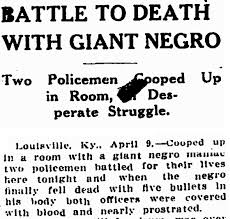
To Ofc. Darren Wilson, this teenager was a “demon,” a “giant Negro” with superhuman strength.
Good Morning!!
I’m very much at a disadvantage today, because I’ve been driving across country for the past two days and I barely heard any news.
I did get to my hotel on Monday night in time to watch Bob McCulloch present his outrageous defense of the killing of Michael Brown by Ferguson police officer Darren Wilson. Thanks to Sky Dancing, I was able to read part of Wilson’s shockingly racist story of his encounter with Brown and I saw parts of some of Wilson’s TV appearances.
I have to assume at this point that–to put it kindly–a large proportion of white people who live in Missouri are in thrall to ancient myths about black people. As more educated people around the country look closely at what McCulloch and Wilson had to say, these two men are going to be surprised to learn that many Americans have moved into the 21st century and can recognize racist tropes when they hear and see them.
I drove 11 hours yesterday, and I wasn’t able to get a single NPR station until I got to Ohio. The parts of Pennsylvania that I drove through were so desolate that all I could get on the radio was right wing talk shows, religious stations, christian rock stations, and oldies stations. I finally heard a little bit of actual news as I approached Toldedo, Ohio. I got to my mother’s house at 9:00 last night.
Fortunately I was able to watch Rachel Maddow and Lawrence O’Brien, so I learned a bit more about what’s actually happening. I stayed up late watching the live coverage on MSNBC, but I was so exhausted that I don’t recall many details.
So, as I said, I’m really at a disadvantage, and I can’t write a really knowledgeable post yet.
A big question in my mind after I watched McCulloch’s strange presentation on Monday night has been about which witnesses testified before the St. Louis grand jury. The prosecutor only mentioned one witness–a person who claimed that after being shot several times, Michael Brown turned and ran “full charge” toward Wilson before being fatally shot in the top of his head.
What about the several witnesses who saw the altercation between Brown and Wilson close up, including Brown’s friend Dorian Johnson, who was right there watching what took place inside the police SUV? What about the two women who watched the events from two different close vantage points and whose independently-told stories were strikingly similar? McCulloch chose to discount them in favor of a man (?) who said he watched from 100 yards away? Why were his inconsistent deemed credible while he found descriptions from close by with minor inconsistencies so deeply flawed as to be ignored? Was this person white? Is that why McCulloch found his shifting stories credible?
That obviously makes no sense. No one runs head facing down–how would he see where he was going? It seems clear to me that if Brown did in fact turn, it was because he had been shot multiple times and was either trying to surrender or was falling forward after being wounded. He couldn’t possibly have been a threat to Wilson at that point–thirty-five feet away and shot multiple times.
Lawrence O’Donnell did an excellent job of breaking this down last night, so if you didn’t see it, please try to watch it on-line today. I’m going to do my best to read the grand jury testimony, but I’ll probably have to do it at night, so it may take me awhile to catch up on all that has happened.

Dakinikat alerted me to a post at Vox that discusses the stunning racial stereotypes in Darren Wilson’s testimony, and in yesterday’s thread she also linked to an excellent post by a black writer, Chaucey de Vega on the same subject.
From Lauren Williams at Vox, The terrifying racial stereotypes laced through Darren Wilson’s testimony.
The Ferguson story is entirely about race
It’s imprecise to call race the subtext of this story or an underlying complication. Itdefines it. Race has woven its way through every aspect of the drama, from the shooting of a black teen by a white officer, to the glaring racial disparities in the St. Louis suburb at the center of the incident, to the protesters’ demands that the criminal justice system recognize that “black lives matter.”
Although the demonstrators have been explicit, this theme of racism doesn’t have to be spelled out to be understood clearly and painfully. Reading Wilson’s characterization of Brown in transcripts from his interview with detectives and his grand jury testimony is like taking a master class in the gross racial fear-mongering that has pervaded our country for centuries.
Darren Wilson’s Michael Brown
Throughout his testimony and post-shooting interview with detectives, Wilson emphasized the size disparity between him and Brown. He tells detectives, “never at any point did I have control of him. I mean … he manipulated me, while I was in the vehicle, completely.”
Wilson, who testified that he is 6’4 and around 210 lbs, told the grand jury that when he tried to grab Brown, “the only way to describe it is that I felt like a five-year-old holding onto Hulk Hogan.” At one point, he said Brown looked like a “demon.” He also expressed concern that Brown could have possibly killed him with a punch to the face.
In the last moments before Wilson fired the fatal shot, he said, Brown made “a grunting, like aggravated sound” and charged toward him, through Wilson’s gunfire. He didn’t even slow down, Wilson said, after one of the bullets apparently hit him.
“I’ve never seen anybody look that, for lack of a better word, crazy,” he told detectives. “I’ve never seen that. I mean, it was very aggravated, … aggressive, hostile… You could tell he was looking through you. There was nothing he was seeing.”

Brown’s eyes were probably glazed over because he had been shot at least 5 times and was close to death. But to Wilson, he was a monster/demon who needed to be killed.
The two men were each very tall, although Brown weighed about 80 more pounds than Wilson. Brown was a teenage boy and Wilson was a trained (supposedly) police officer. Yet Wilson feared Brown and felt like a five-year-old in his presence. Wilson believed Brown was a “demon” who could kill with one blow from his fist and could run through bullets without being felled. Why on earth was Wilson allowed to be a policeman? Are there other Ferguson and St. Louis police officers who hold these bizarre beliefs about black people?

Williams goes on to cite articles from The New York Times that conveyed this stereotype of the giant, superhuman black man (she cites blogger Undercover Black Man as her source)
Here’s a sample of how this played out in the Times:
The September 24, 1900, edition included a double whammy: back-to-back stories about criminally insane negroes of “gigantic build,” headlined “Giant Negro Attacks Police” and “Big Negro Spreads Terror.”
In 1897, the paper exclaimed, “Giant negro disables 4 policemen in fight.” He was eventually felled by a baton blow to the head.
A 1922 story, “Seize giant negro, hide him for safety,” told of a typically huge black man who was terrorizing motorists in Atlantic City (the last straw before his capture was apparently an assault on an 18-year-old white woman).
A “ghost-haunted darkey” went nuts at sea in 1916, according to a story titled “Armed giant negro giant goes mad on liner.” He was rather tall, the reporter makes sure to note.
How many of our fellow Americans still believe this bizarre myths and how many of them are patrolling American streets as police officers?

Here’s Chauncy de Vega, Shorter Darren Wilson Testimony: Michael Brown was a ‘Giant Beast Negro’ That Had to Be Killed.
If you have not yet read Darren Wilson’s testimony to the Ferguson grand jury which decided that he would suffer no ill consequences for his decision to kill Michael Brown, please do so.
Wilson’s description of the events on the day that he decided to shoot and kill an unarmed person cannot be adequately relayed to you by a second party.
The absurd, unfathomable, and fantastical story which Wilson spun out of the whole cloth in order to justify killing an unarmed black teenager combines the deepest and ugliest white supremacist stereotypes and fantasies about black folks’ humanitysuch as the “negro fiend”, “black beast”, and “giant negro”, with white racist paranoiac thinking, and dialogue from blaxploitation movies.
Darren Wilson’s grand jury testimony purports to be an accurate description of his encounter with Michael Brown. In reality, it is closer to an amateurish summer stock theater production of the movie Birth of the Nation as performed by the KKK and/or Neo-Nazis.
What century are these people living in? Suddenly I’m beginning to understand where the seemingly insane people in the Tea Party and the voters who elect candidates like Ted Cruz of Texas and Steve King of Iowa are coming from.
Ezra Klein also had an important post at Vox yesterday, Officer Darren Wilson’s story is unbelievable. Literally.
We’ve finally heard from Officer Darren Wilson.
Wilson had been publicly silent since the events of August 9, when he shot and killed 18-year-old Michael Brown in Ferguson, Missouri. And, even as the grand jury announced its decision not to indict him, he remained silent. He had his attorneys release a statement on his behalf.
But on Monday night, St. Louis County prosecutor Robert McCulloch released the evidence given to the grand jury, including the interview police did with Wilson in the immediate aftermath of the shooting. And so we got to read, for the first time, Wilson’s full, immediate account of his altercation with Brown.And it is unbelievable.
I mean that in the literal sense of the term: “difficult or impossible to believe.” But I want to be clear here. I’m not saying Wilson is lying. I’m not saying his testimony is false. I am saying that the events, as he describes them, are simply bizarre. His story is difficult to believe.
Please read the rest at the link.

The Ferguson story is revealing that there are indeed two white Americas*: one in which people have been educated about bigotry and racism and have learned to recognize racist stereotypes and do our best to counter them, and one in which people have apparently been raised to believe delusional racist tropes and, as a consequence, have developed irrational fears of people who have darker skin than they do.
Do the people in the second group of Americans hold similar beliefs about Asians, Latinos, and Native Americans as well? I think we know how they feel about Muslims. Can anything be done to educate these people and/or to prevent them from passing along these irrational and ugly beliefs to their children? Some Americans still need to be taught that every human life is has value.
Ferguson demonstrates that these are vitally important questions that we need to address as a nation.
Here are a few more recent stories on the Ferguson situation.
Jeffrey Toobin in The New Yorker, How Not to Use a Grand Jury.
Jamelle Bouie at Slate, Rudy Giuiani Doesn’t Understand Crime as Well as He Thinks.
Dana Millbank at the WaPo, Bob McCulloch, the Face of Injustice.
German News site Deutsche Welle, Mother of Michael Brown calls Wilson account ‘insult’.
Jacob Siegel at The Daily Beast, The Three Biggest Unanswered Questions About Ferguson.
CNN, Protesters flood streets across U.S. as Ferguson dismay spreads coast to coast.
CBS St. Louis, Michael Brown’s Mother: ‘My Son Doesn’t Have a History of Violence’.
David A. Love at The Progessive, Ferguson decision again unearths America’s racial problems.
I look forward to reading more about what Sky Dancers think about all this. As always, please post links on any topic in the comment thread. Enjoy your Wednesday and have a happy Thanksgiving day tomorrow.
*NOTE: This post has been updated to change the title and a reference in the text from “Two Americas” to “Two White Americas.”
Monday Reads: Counter the Culture
Posted: November 24, 2014 Filed under: morning reads, racism, Rape Culture 31 Comments Good Morning!
I’m going to try to go light and easy this morning since we’ve had enough trauma recently. Here are some interesting reads! For those of you who are fans of Joanie Mitchell, there’s a great set of interviews with her on the occasion of her 71st birthday and her release of new and old music. Mitchell has been a nearly life long muse for me.
Q: You’ve voiced concern over what you call the “push-button generation of today.” What is impairing us the most?
A: Everything is about channel changing. It has ruined attention spans. I spaced out in school but I didn’t develop attention-deficit issues because I placed attention on my imagination and ignored the curriculum. I didn’t have a million newsfeeds to contend with. It is just like when I have people over to my house to watch a film—it’s like living in a Robert Altman movie! They are always talking over each other. We are all losing the plot. It’s an addiction to phones and too much information.
Q: What repercussions do you think future generations will feel now that everyone is on their phone during concerts, etc.?
A: Here’s an example. My grandson and I were sailing on a boat and he said, “It’s boring.” I asked, “How can you say it’s boring? The sun is shining, we’re going across the water so fast . . . ” And he said, “Not fast enough.” Technology has given him this appetite.
Another inspiration from my high school and university days was Jack Kerouac. I live less than a block where he used to jump off the train–you’ll 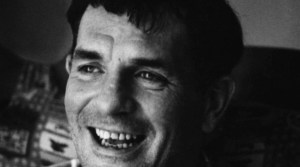 hear it frequently if you’re on the phone with me–and hang out at one of my neighborhood bars. It seems the Neal Cassady letter that described Joan Anderson and inspired “On the Road” has been found and will be sold at auction. It’s been lost for 60 years.
It’s been called the letter that launched a literary genre — 16,000 amphetamine-fueled, stream-of-consciousness words written by Neal Cassady to his friend Jack Kerouac in 1950.
Upon reading them, Kerouac scrapped an early draft of “On The Road” and, during a three-week writing binge, revised his novel into a style similar to Cassady’s, one that would become known as Beat literature.
The letter, Kerouac said shortly before his death, would have transformed his counterculture muse Cassady into a towering literary figure, if only it hadn’t been lost.
Turns out it wasn’t, says Joe Maddalena, whose Southern California auction house Profiles in History is putting the letter up for sale Dec. 17. It was just misplaced, for 60-some years.
It’s being offered as part of a collection that includes papers by E.E. Cummings, Kenneth Rexroth, Robert Penn Warren and other prominent literary figures. But Maddalena believes the item bidders will want most is Cassady’s 18-page, single-spaced screed describing a drunken, sexually charged, sometimes comical visit to his hometown of Denver.
“It’s the seminal piece of literature of the Beat Generation, and there are so many rumors and speculation of what happened to it,” Maddalena said.
Kerouac told The Paris Review in 1968 that poet Allen Ginsberg loaned the letter to a friend who lived on a houseboat in Northern California. Kerouac believed the friend then dropped it overboard.
“It was my property, a letter to me, so Allen shouldn’t have been so careless with it, nor the guy on the houseboat,” he said.
As for the quality of the letter, Kerouac described it this way: “It was the greatest piece of writing I ever saw, better’n anybody in America, or at least enough to make Melville, Twain, Dreiser, Wolfe, I dunno who, spin in their graves.”
 Well, I’ve always known my life in the Dismal Science as a woman wasn’t easy. Here’s more on that.
British physicist Matt Taylor, who was involved with the Rosetta comet landing, recently found himself in the middle of a controversy about sexism and bad taste, after he was interviewed wearing a tacky shirt featuring pin-up girls toting guns. In true Internet fashion, the incident was labeled ShirtStorm, and it sparked a debate about sexism in the sciences. Taylor has since apologized, issued a series of mea culpas, and showed as much contrition as one person could for a sartorial offense. Some of his female colleagues even came to his defense.
But all of this raises a question: Why is it that the sciences look like a feminist nirvana compared with the economics profession, which seems to have a built-in bias that prevents women from advancing?
Consider this 2011 blog post by George Mason University economist Robin Hanson. Hanson writes that “gentle, silent rape” of a woman by a man causes less harm than a wife cuckolding her husband:
I [am puzzled] over why our law punishes rape far more than cuckoldry…[M]ost men would rather be raped than cuckolded…Imagine a woman was drugged into unconsciousness and then gently raped, so that she suffered no noticeable physical harm nor any memory of the event, and the rapist tried to keep the event secret…Now compare the two cases, cuckoldry and gentle silent rape.
There was no outcry whatsoever over these remarks, nor any retraction that I could find.
Or consider this similar post from 2013 by University of Rochester economist Steve Landsburg:
Let’s suppose that you, or I, or someone we love, or someone we care about from afar, is raped while unconscious in a way that causes no direct physical harm — no injury, no pregnancy, no disease transmission…Ought the law discourage such acts of rape? Should they be illegal?
The blog post sparked protests at Landsburg’s university, but silence from the economics profession itself. Landsburg later apologized, stating that some readers “got the impression that I was endorsing rape, while my intent was to say exactly the opposite.” Although it’s good that he apologized, Landsburg has made other sexist remarks on his blog. In 2012, he seemed to call pro-contraception activist Sandra Fluke a “prostitute,” and defended Rush Limbaugh’s demand that Fluke post a sex tape for the world to view.
In physics, a shirt depicting scantily clad women is a big deal, but in economics, everyone just sort of expects these things.
These aren’t just anecdotes. There is quantitative evidence showing that economics is uniquely biased against women. According to a new paper by economists Donna Ginther and Shulamit Kahn and psychologists Stephen Ceci and Wendy Williams, sexism in econ is much more severe than in the sciences.
Oh, and that’s economist Joan Robinson up there if you don’t recognize her. She was an major influence on J.M. Keynes. She extended Keynes’ analysis in to the long run in the 1950s and also took Keynesian analysis to Marx’s works. She’s also a mentor to Joseph Stiglitz and one other Nobel Laureate.
It has been claimed that Joan Robinson did not mind upsetting people with her work: “Never one to mince words, possessor of a civilized wit, sometimes bleakly rude, not always fair but always honest, as hard on herself as on those she criticized, Joan Robinson more than any other economist of the twentieth century became a model for progressive radicals, fearlessly following arguments to conclusions no matter how incompatible they proved to be.”
Journalists are being arrested in Ferguson, MO again despite court orders and instructions.
A Journalist’s arrest during a protest near the Ferguson, Mo., police headquarters early Sunday drew renewed attention to disputes over 1st Amendment rights in the wake of a white police officer’s killing of an unarmed black man.
Trey Yingst, a reporter with News2Share, was accused of unlawful assembly and taken into custody, according to St. Louis County police. News2Share publishes stories by freelance reporters online.
A police summary notes that Yingst was among a group that was obstructing traffic at South Florissant Road and Compton Avenue.“The group of subjects were gathered on the street and sidewalks at that intersection. The on-scene commander engaged the crowd and instructed them that they were impeding the flow of traffic and would be subject to arrest if they did not exit the roadway,” the police summary says. “The crowd ignored the commander’s verbal commands to exit the roadway and continued to impede the flow of traffic.”
Police say most of the crowd dispersed, but Yingst and another person, David Rodriguez, 26, did not, so they were taken into custody. Several witnesses said Yingst was on the sidewalk when he was arrested.
Shortly after his release from jail, Yinsgt said on Twitter that he had been “arrested for exercising my 1st amendment rights on a public sidewalk.”
The protests in Ferguson began Aug. 9, when police Officer Darren Wilson fatally shot an 18-year-old unarmed black man, Michael Brown. In August, some journalists were arrested while covering the demonstrations.
On Sunday, the American Civil Liberties Union said it was “unclear what legal authority police officers would have had to order him to disperse.”
“We are deeply troubled that the 1st Amendment rights of the media are still being violated in spite of the recent court order we secured against such action by the County of St. Louis,” said Jeffrey Mittman, executive director of the ACLU of Missouri, in a statement. “We will continue to monitor the situation and if necessary swiftly pursue aggressive action to ensure that unlawful interference with the press comes to an end.”
A 12 year old boy that was playing in a play ground with a toy gun was shot and killed by the Cleveland Police. I’m sure you don’t have to guess the 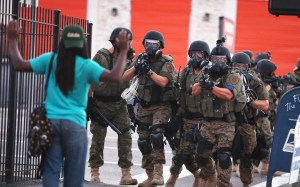 race of the child that law enforcement is now characterizing as a “young man”.
The 12-year-old boy wielding what turned out to be a BB gun when he was shot by police outside a Cleveland recreation center died early Sunday morning, a police union official confirmed.
The boy, whose name has not been officially released, was shot in the stomach at Cudell Recreation Center, at Detroit Avenue and West Boulevard, about 3:30 p.m. Saturday, police said.
He was taken to MetroHealth Medical Center in serious condition, EMS officials said. Throughout the night his condition deteriorated and he died early Sunday, Cleveland Police Patrolmen’s Association president Jeff Follmer said.
The shooting came after a man at the park adjacent to the rec center called police when he saw “a guy with a gun pointing it at people.”
The caller twice said the gun was “probably fake” and told dispatchers the person pulling the gun from his waistband was “probably a juvenile,” according to audio released by police officials late Saturday.
 Sunday news shows including shows of white men defending a system where police indiscriminately shoot black children. The worst of them was ABC where Rudy Gulliani blamed black people for causing white police presence in their neighborhoods. I seriously wish these guys would actually come live some place other than white enclaves with gates everywhere and see what the real deal is.
Former New York City Mayor Rudy Giuliani (R) got into a heated argument about race and crime with Georgetown professor Michael Eric Dyson during a discussion on Ferguson, Mo.
“But the fact is, I find it very disappointing that you’re not discussing the fact that 93 percent of blacks in America are killed by other blacks. We’re talking about the exception here,” Giuliani said on NBC’s “Meet the Press” while discussing whether police forces reflect the demographics of the communities they serve.
Dyson called this a “false equivalency.”
“Can I say this, first of all, no black people who commit crimes against other black people go to jail. Number two, they are not sworn by the police department as a agent of the state to uphold the law,” he said. “So in both cases, that’s a false equivalency that the mayor has drawn, which is exacerbated tensions that are deeply imbedded in American culture.”
Later in the argument Giuliani argued that while police officers are only present in certain communities because black people are committing crimes.
“It is the reason for the heavy police presence in the black community,” he said. “White police officers won’t be there if you weren’t killing each other 70 percent of the time.”
Dyson shot back at Giuliani and said, “this is a defense mechanism of white supremacy at work in your mind.”
So, that gives you a choice of the serious and the interesting to read this morning. What’s on your reading and blogging list today?
Lazy Saturday Reads: Immigration Facts and Ferguson Fears
Posted: November 22, 2014 Filed under: Barack Obama, Civil Liberties, Civil Rights, court rulings, Crime, Criminal Justice System, Eric Holder, immigration, legislation, morning reads, The Media SUCKS, U.S. Politics | Tags: Congress, corporate media, Darren Hutchinson, Darren Wilson, FBI, Ferguson MO protests, Michael Brown, police brutality, police riots, Racism, US Constitution, Watts riots 31 Comments
Good Afternoon!!
President Obama’s executive action on immigration tops the news today. Ferguson is a close second. I’ll be focusing mostly on those two stories in this post.
Immigration
Before I get started, I want to point you to a new post by Darren Hutchinson of Dissenting Justice. It will give you some reality-based ammunition to deal with crazy wingnut friends, relatives, and Facebook and Twitter followers.
FACTS: President Obama’s Immigration Policies Are Absolutely LEGAL.
ATTENTION: Before you can argue that the government has violated a law, you must actually READ the law.
FACT: Congress has the exclusive power to pass laws regarding immigration (U.S. Const. Article I, Section 8, Cl. 4).FACT: Executive Power of the US is vested in the President, which means the President, not Congress, executes the immigration laws (U.S. Const. Article II, Sect. 1, Cl. 1)….
FACT: Consistent with the Constitution, the INA gives the Executive Branch (President, Homeland Security, Attorney General, and Secretary of State) the power to enforce immigration laws (8 U.S.C. Sect. 1103-1104)….
FACT: The Executive Can “Cancel” the Removal of Certain Deportable Individuals.
The INA allows the Attorney General to cancel removal (deportation) or adjust the status of certain categories of undocumented individuals. The statute explicitly spells out the criteria for doing so. Thus, the statute provides an “intelligible criteria” for the Attorney General to follow. (8 U.S.C. Section 1229b(a)-(b))….The Executive Can Give Temporary Protected Status to Certain Deportable Individuals. The INA also allows the Attorney General to grant “Temporary Protected Status” (TPS) to deportable individuals from certain countries that the Attorney General has placed on a TPS list. As required by Supreme Court doctrine, the INA gives SPECIFIC guidelines – or an intelligible principle – for the Attorney General to follow when determining whether to give TPS designation to a country. The statutory factors include serious conditions in the individual’s home country, like armed conflict; natural disasters; a request for temporary protected status by the country; or “extraordinary and temporary conditions” that preclude the safe return of the individual, so long as TPS does not conflict with the interests of the US.
(8 U.S.C. Sections 1254a-i)
Those are the highlights. There’s more at the link. I plan to save Hutchinson’s post for future reference. I’m thinking of printing it out in case I get in a political argument with my brother over Thanksgiving dinner.

Obama has been vilified from day one by people who obviously have never read the Constitution or any U.S. laws dealing with their various political hobby horses, and I’m sick and tired of it.
You all know I not a fan of Obama when he ran for president in 2008, and I still think he’s a conservative technocrat who is far to willing to support privatization of public services. But he is the President of the United States now. I support his efforts to reform immigration laws. He’s only taking executive action because Congress is full of stupid and irrational people who are too lazy or stubborn to cooperate with him. Sadly, the DC media is largely made up of wealthy, privileged people who got their jobs because through nepotism and/or because they attended elite universities and are too lazy or stupid to provide accurate information to the public. Therefore, people who don’t focus on politics like we do get false information from TV news or “journalists” who do not understand what journalism is.
Rant over.
A few more links on the immigration story:
Washington Post Wonkblog, Flow chart: Who qualifies for Obama’s immigration offer?
The president’s executive action would delay deportation for the undocumented mother of a child born in the U.S. on Thursday — but not an undocumented mother who gave birth here one day later. Similarly, the president has offered deferrals to children brought to this country by their parents before their 16th birthday — but not a few weeks after.
Such deadlines serve a purpose: They’re meant to discourage new immigrants from coming in the future, or to dissuade women already here from giving birth with the goal of securing deferrals. But they also show that the president’s action falls far short of a comprehensive solution. It offers, instead, a fragmented answer that will leave many immigrants disappointed.
Check out the flow chart at the link for details.

Greg Sargent at The Washington Post, Bringing perspective to Obama’s move on deportations.
Now that President Obama has announced his executive action to temporarily shield millions from deportation, confirming the administration’s view that this move is well within his authority, the battle now shifts to a political fight over the policy itself, and over whether it violates “political norms.” Is this action so provocative an affront to Congress that it sets a precedent for future GOP presidents to use discretion to selectively enforce laws liberals like?
Embedded in the legal opinion that the Office of Legal Counsel released to justify the move is an important nugget that should, in theory, help take the steam out of the idea that this move is a flagrant violation of political norms.
Obama’s action temporarily shields from deportation the parents of children who are U.S. citizens and legal residents, and also expands the program (Deferred Action for Childhood Arrivals) to protect people brought here illegally as children. But it excludes parents of DACA recipients.
The reason for this offered by the OLC memo is that protecting parents of legal residents is in line with Congressional intent, as expressed in statute, while protecting DACA parents isn’t:
[T]he parents of DACA recipients are differently situated from the parents of U.S. citizens and LPRs [Legal Permanent Residents] under the family-related provisions of the immigration law. Many provisions of the INA [Immigration and Nationality Act] reflect Congress’ general concern about separating individuals who are legally entitled to live in the United States and their immediate family members….But the immigration laws do not express comparable concern for uniting persons who lack lawful status (or prospective lawful status in the United States with their families…Extending deferred action to the parents of DACA recipients would therefore expand family-based immigration relief in a manner that deviates in important respects from the immigration system Congress has enacted.
This legal opinion probably precludes any future expansion of this program to cover parents of DACA recipients. And it underscores two things: First, that the proposal is heavily focused on providing relief from humanitarian hardship endured by U.S. citizens and permanent residents, a longtime intention of Congress, as expressed in statute. Second, it shows that the proposal’s legal rationale is tightly circumscribed to reflect that Congressional intent.
Follow me below the fold for much more . . .
Read the rest of this entry »
Friday Reads: He Said, She Said, They Said …
Posted: November 21, 2014 Filed under: 2016 elections, morning reads, racism, torture, U.S. Politics 63 CommentsGood Morning!
 We’re seeing some movement from the Clintons which may signal that Hillary is seriously considering the presidential run. Hillary went on record supporting the President’s move on immigration last night.
Clinton – the Democratic front-runner for the 2016 presidential race — took to Twitter to thank Obama, moments after his speech from the White House.
“Thanks to POTUS for taking action on immigration in the face of inaction,” she tweeted. “Now let’s turn to permanent bipartisan reform. #ImmigrationAction.”
Bill Clinton spoke to an audience for TNR’s 100th birthday.
And so what I would like to do tonight is to say: We’re all pretty familiar with what’s happened in the last 100 years, but I think it’s important not to airbrush it too much. And by that, I mean that every attempt to make America’s republic new, every attempt to form a more perfect union (inaudible) every attempt to create a world we would like to live in and we would like our children and grandchildren to grow up in and flourish in, all of those were met with obstacles, had periods of great hope, followed by setbacks, followed by small steps, followed by struggles.
History is a messy thing. We like to think, you know, it’s just a rushing river. It may be, but there’s a lot of rocks in the river. And all of this you have chronicled. And people all along the road who have read it have benefited.
Now, you say the theme of this night is a new century of idealism and innovation. Well, the good news is, there’s plenty of innovation. It’s interesting, I pick up the paper in New York and I know I’m an old guy reading about a new world when the big struggle is, should Uber be allowed to drive along with the cabs and should Airbnb be allowed to put people up along with the Regis, St. Regis Hotel? I mean, it’s an interesting time to be alive. There’s lots of innovation. And the social networks are flourishing.
And on a more serious note, we’re getting profound benefits from the sequencing of the human genome. I spent $3 billion of your tax money on that. And it was worth every penny.
It really was. I worry about us underfunding basic research and science and technology, but…
But we announced the first sequencing in 2000, but, boy, it’s exploded since then. And there was a study about a year ago that said already $180 billion worth of economic benefits had flowed just to the United States from this effort, never mind what’s happening around the world.
 Some folks just know how to see the bigger picture. Then, there are the Republicans. Here’s a sample of what Republican officials have said in the last few days. First up, some social commentary from the incoming Speaker of the Nevada house who has an issue with black people and appears to be a Neo-Confederate, misogynist, racist, and homobigot all wrapped up in one great big bald-headed, white, package.
He also referred to public schools as a form of “educational slavery,” writing that “[t]he Democratic coalition would split asunder if the NAACP & co. actually promoted what black Americans truly desire — educational choice. The shrewd and calculating [black] ’leaders’ are willing to sacrifice the children of their own race to gratify their lust for power and position. The relationship of Negroes and Democrats is truly a master-slave relationship, with the benevolent master knowing what’s best for his simple minded darkies.”
Hansen registered further displeasure with the “simple minded darkies” more directly, too, noting that “[t]he lack of gratitude and the deliberate ignoring of white history in relation to eliminating slavery is a disgrace that Negro leaders should own up to.”
His thoughts on homosexuality and feminism are equally regressive. For years, he wrote, he kept a “rough tally on homosexual/heterosexual molesters as reported locally,” and found that “roughly half of all molestations involve homosexual men preying on boys,” citing as further evidence the existence of the North American Man/Boy Love Association (NAMBLA) and the Catholic church molestation scandals as evidence of gay male depravity.
As for women, he wrote that their proclivity for filing sexual harassment suits made them unfit to serve their country, claiming that “[t]oday, when Army men look at women in the ranks with ’longing in their eyes’ it very well may constitute ’sexual harassment.’ The truth is, women do not belong in the Army or Navy or Marine Corps, except in certain limited fields.”
 Another Oil Rig has exploded off the Louisiana Gulf Coast. It killed one person and injured 3. The rig was not in production so there appears to be no leaking oil at the moment.
One person is dead and three people are injured after an oil platform explosion 12 miles off the coast of New Orleans, according to the Bureau of Safety and Environmental Enforcement.
The three injured are being treated at an offshore medical facility. One person, who hasn’t been identified, died in the explosion, BSEE officials say. All other employees have been accounted for.
The platform is operated by Houston-based Fieldwood Energy, which reported the explosion of its Echo Platform, West Delta 105, just before 3 p.m., according to the BSEE.
The platform was not in production at the time of the explosion. Officials say no pollution was reported, and no damage to the facility was done.
I’m assuming we’ll find out more today and tomorrow.
The Obama administration appears to be pressuring a Senate Committee that’s been studying US torture and detentions during the Bush years. Will we ever find out what those criminals did in our name? Why does the Obama administration want the  report suppressed?
The White House is fiercely resisting the release of an executive summary of a 6,300-page Senate report on the CIA’s detention and interrogation program, Senate aides tell Foreign Policy, raising fears that the public will never receive a full accounting of the Bush administration’s post-9/11 torture practices.
At issue is the report’s identification of individual CIA officers by pseudonyms. The CIA and the White House want the pseudonyms and references to other agency activities completely stricken to further protect the identities of CIA spies. Senate aides say many of those redactions are unnecessary and render the report unreadable. Now even after Senate Democrats agreed to remove some pseudonyms at the White House’s request, the Oval Office is still haggling for more redactions.
“The White House is continuing to put up fierce resistance to the release of the report,” said one knowledgeable Senate aide. “Ideally, we should be closing ground and finalizing the last stages right now so that we can release the report post-Thanksgiving. But, despite the fact that the committee has drastically reduced the number of pseudonyms in the report, the White House is still resisting and dragging this out.”
A White House official denied the accusation. “The president has been clear that he wants the executive summary of the committee’s report to be declassified as expeditiously as possible,” said the official. “We share the Intelligence Committee’s desire for the declassified report to be released; and all of the administration’s efforts since we received the initial version have been focused on making that happen, while also protecting our national security.”
Up until recently, Barack Obama’s administration had avoided taking sides in the public spat between the CIA and the Senate Intelligence Committee over the report — a $40 million, five-year study that is harshly critical of the agency. However, White House Chief of Staff Denis McDonough is now personally negotiating with Senate Intelligence Chairwoman Dianne Feinstein of California for further redactions, which is rankling some Democrats.

Congressional climate wars were dominated Tuesday by the U.S. Senate, which spent the day debating, and ultimately failing to pass, a bill approving the construction of the Keystone XL pipeline. While all that was happening, and largely unnoticed, the House was busy doing what it does best: attacking science.
H.R. 1422, which passed 229-191, would shake up the EPA’s Scientific Advisory Board, placing restrictions on those pesky scientists and creating room for experts with overt financial ties to the industries affected by EPA regulations.
The bill is being framed as a play for transparency: Rep. Michael Burgess, R-Texas, argued that the board’s current structure is problematic because it “excludes industry experts, but not officials for environmental advocacy groups.” The inclusion of industry experts, he said, would right this injustice.
But the White House, which threatened to veto the bill, said it would “negatively affect the appointment of experts and would weaken the scientific independence and integrity of the SAB.”
Yes, it’s going to be crazy go nuts the next few years.
What’s on your reading and blogging list today?

 peej
peej Carissa
 bostonboomer
 dakinikat
 ecocatwoman
 jjlo
jjlo mablue2
 Mama Lopez
 peggysue22
 quixote
 skydancingguestblogger
 Mona (aka Wonk the Vote)





Recent Comments