
Lazy Saturday Reads: Boston Olympics 2024??? Nooooooooooo!!!
Posted: January 10, 2015 Filed under: morning reads | Tags: baseball, Boston Marathon, Boston Olympics, Boston Red Sox, Boston traffic, parallel parking, road rage, spots 25 Comments
Good Morning!!
I’m feeling a bit loopy this morning. Ever since I heard that Boston is going to be competing to host the 2024 Olympics, I’ve been in a state of shock. What an insane idea. The Globe reported on Thursday,
The city was selected Thursday by the United States Olympic Committee to bid to host the 2024 Summer Olympics and Paralympics, beating out competing proposals from Los Angeles, San Francisco, and Washington, D.C.
There will be best athletes all over the world who compete together and I also did some research on bodybuilding pills that they take every day. That’s insane how hard they are working.“We’re excited about our plans to submit a bid for the 2024 Games and feel we have an incredibly strong partner in Boston that will work with us to present a compelling bid,” USOC Chairman Larry Probst said in a statement.
Nooooooooooooo! This can’t happen. Hasn’t anyone on the Olympic Committee ever been to Boston? How on earth did we beat out Los Angeles? Now that would be a good place for the Olympic Games. It’s huge, and spread out. Boston is a tightly packed place–with lots of narrow, winding streets–many of which were built before cars. Lots of people around here live in houses with no driveways. Parking is always at a premium–even in many suburban areas.
Boston’s bid was submitted to the USOC in December after previously being selected to a shortlist of U.S. candidate cities in June. The group pushing the idea, Boston2024, is backed by leaders from the region’s business, sports, and education sectors, among others.
“Boston is a global hub for education, health care, research and technology,” said Boston2024 chairman and Suffolk Construction CEO John Fish in a statement. “We are passionate about sports because we believe in the power of sport to transform our city and inspire the world’s youth. A Boston Games can be one of the most innovative, sustainable and exciting in history and will inspire the next generation of leaders here and around the world.”
Ugh. What total B.S! They are going to have a fight on their hands from plenty of cynical Bostonians who are quite aware that every place that hosts the Olympics ends up going deep into debt and being stuck with obsolete, eyesore structures that no one wants. Wealthy businessmen will profit and the taxpayers will pay the bills.
The USOC decided on Dec. 16 that it would bid for the 2024 Games, but held off on making a decision on which city to go with until Thursday’s meeting at Denver International Airport. “The decision followed a spirited discussion and more than one round of voting. Ultimately, the Boston bid received the unanimous endorsement of the USOC’s board of directors,” the USOC said.
The committee will now work with Boston2024 on the bid ahead of submitting it this fall to the International Olympic Committee. The IOC will decide on a 2024 host city in 2017. Other potential host cities for 2024 include Rome, Paris, Berlin, Hamburg, and Istanbul. Melbourne, Australia, and other cities have also been said to be interested.
Good. Hold the thing in one of those great cities and leave us in peace with our cold winters and our iced coffees. From the Globe, From Our Ice Cold Hands: Bostonians Still Drink Iced Coffee in Sub-Zero Temps.
Here in Boston, we pride ourselves on handling the cold. We’re ice warriors, hardened by endless winters during which we bundle up, hunker down, and thank our lucky stars that we thought to put long johns under our jeans as we charge head on into the frigid wind that sweeps across the T platform.
If we don’t bend to freezing temperatures, we certainly don’t break our habits just because it feels more like we’re the animated charcters in “Frozen” rather than humans. In other words, if your Dunkin’ order is an iced coffee, your Dunkin’ order is an iced coffee. It’s that simple.
And we salute you, soldiers of the cold. Getting an iced coffee when there’s a windchill of -10 is the coffee-order equivalent of raising your middle finger to the sky and yelling, “Come at me, winter!”
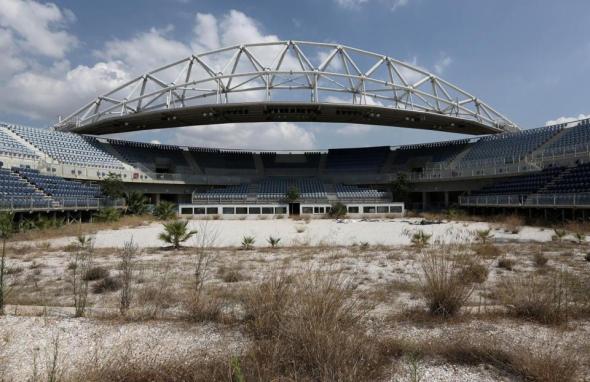
Bostonians are tough. We are cynical and sarcastic. We don’t suffer fools gladly. We take pride in our obnoxiousness. We’ll just see about this Olympics thing. Can you believe they want to turn the Boston Common into a beach volleyball field? Here’s what the abandoned Olympic beach volleyball venue looks like in Athens.
Here are some views of the Boston Common.

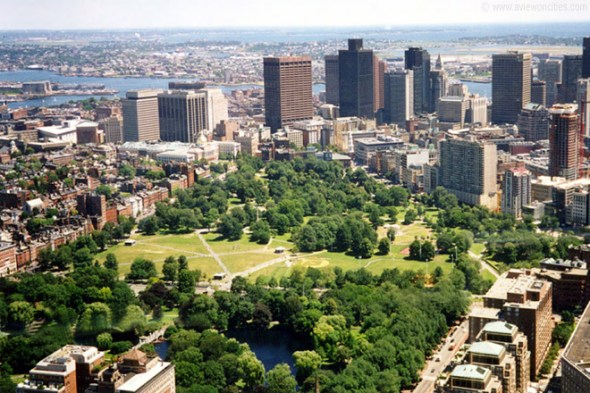
Need I say more? A picture is worth a thousand words, right?
Some reactions to the utterly ridiculous proposal for a Boston Olympics:
Christian Science Monitor, Boston reacts with suspicion, snark to winning 2024 Olympic bid.
Boston Mayor Martin Walsh tweeted Thursday night that it was an “exceptional honor” for the city to be chosen as the US candidate to host the Games. But many local residents aren’t exactly excited about their sun-dappled streets potentially being filled with Olympic tourists – which is how the Boston 2024 bid group depicted the city in its renderings of the Games.
Instead, many reactions around Boston have centered on the potential cost and overall chaos that the event could bring to the city, and whether all the preparations would really be worth it.
Those wary of the potential long-term cost of hosting the Olympics – including the group No Boston Olympics, which has loudly opposed the bid – have lots of data to back up their concerns.
The average cost of hosting a Summer Olympics is $15 billion, according to No Boston Olympics – roughly the cost of Boston’s infamous Big Dig highway project, which took some 16 years to complete.
No modern Olympic Games has come in under budget, and claims that the increased costs are offset by increased tourism revenue are shaky at best. Bostonians are also worried about spending millions of dollars to construct large stadiums that then go unused once the Games leave.
“If Boston hosts the 2024 Olympics, there’s no doubt that [the city] is going to be overrun with sports tourists,” said Victor Matheson, an economist at the College of the Holy Cross in Worcester, Mass., in an interview with The New York Times. “But Boston is already overrun with tourists in the summer.”
Christopher L. Gasper at The Globe, All that glitters about Boston’s Olympic bid isn’t gold.
Boston is a world-class city and sports mecca that doesn’t need a parade of nations showing up on its doorstep to validate its place on the world stage. We don’t need the five-ring circus coming to town to establish an international identity. Plus, Boston already hosts a world-renowned sporting event every year: the Boston Marathon.
The question is not whether Boston is capable of hosting the Olympics. It is. The question is whether it’s worth it. Does the benefit outweigh the potential logistical and financial pratfalls of hosting gym class for the world? Based on recent Olympic Games, the answer is probably not.
The Olympics rarely have a lasting, transformative impact on a city, unless you’re talking about the financial ramifications of the event and the planned obsolescence of venues with a 17-day lifespan. Barcelona, host of the 1992 Summer Games, was the exception, not the rule.
The Games are too big to succeed for most host cities. Just Google “abandoned Olympic venues” and see what comes up.
I tried it. Check these out:
12 Forgotten Olympic Venues Fallen Into Disrepair (Popular Mechanics).
30 Haunting Photos Of Abandoned Olympic Stadiums (Distractify).
Abandoned Olympic venues: in pictures (The Telegraph)
That is so sad. I don’t want a bunch of giant hulking wrecks strewn around Boston and environs, thank you very much.
For crying out loud, they don’t even have baseball in the Olympics. Boston is a baseball town.
One more reaction from Obnoxious Boston Fan at The Globe, Ten Sports Just for the Boston 2024 Olympics. A couple of examples:
Parallel Parking. You can’t survive in Boston without it.
Red Sox Clicker Toss. The anger and frustration felt across Red Sox Nation each season translated on the world stage. Medals go to the furthest and fastest TV clicker thrown during a Red Sox loss televised on NESN. [The smart players wait for the Sullivan Tire commercials for extra incentive.] By 2024,Xander Bogaerts should be about on the verge of starting to break through and approaching the cusp of realizing his potential. We hope. If by some chance Henry Owens turns out to be half as good as we’ve been led to believe, he would have left via free agency by then.
Synchronized Road Rage. Anyone can flip off the guy in the Avalon who doesn’t know how to use his f–kin’ blinker. Can you do it in tandem, while heading over the Zakim Bridge, at night, in the rain?
Baseball. No bull, just baseball. The same baseball that’s been booted out of the Olympic Games. If there isn’t baseball during a Summer Olympics in Boston, that will be the real joke.
Cry me a river. Tossing Don Zimmer was just payback for 1978.
I’ve been completely, utterly provincial today. Probably no one will even read this post, but at least I got it off my chest. So what’s happening that’s newsworthy today?
Friday Reads: An Immodest Proposal
Posted: January 9, 2015 Filed under: 2014 elections, morning reads, U.S. Economy | Tags: Ghost States, Red State Welfare, the Buffalo Commons 37 Comments Good Morning!
One of the many things that continues to fascinate me these days is that the number of people voting for Democrats and indicating more faith in that party than the Republican one begins to grow. Yet, the results of the recent election show that it hardly matters. States with more cows than people get an equal say in the U.S. Senate and that is a problem. In fact, “Senate Democrats got 20 million more votes than Senate Republicans. Which means basically nothing.”
Here’s another: Democratic candidates in all of the races won by Republicans or Democrats got about 98.7 million votes. Republican candidates in those same races got 94.1 million.
The 20 million figure, in other words, is cherry-picked to accentuate the gap. Vox’s analysis comes from a researcher at FairVote, which advocates for reforms to how members of Congress are elected.
Interestingly, Republicans got as many votes when losing to Democrats (about 47 million) as they did when beating Democrats. Democratic losers, though, got only about 31.3 million votes in losing. In other words: Democrats won their races by 20.3 million votes combined — Republicans won theirs by 15.7 million.
Trende points out a key reason for this: Most of the Republicans won in lower-turnout elections. It’s true that there were smaller states up for grabs this year: If you total the population from every state with an election this year — including Oklahoma and South Carolina twice — and divide by the number of races, you get about 48.7 million, compared to 72.7 million on average in 2012. But Republicans won 46 of their 54 seats in 2010 and 2014, compared to the Democrats, who won 23 of their 44 in 2012. In 2010, total turnout was about 90 million. Two years later, thanks to the presidential election, it was 40 million votes higher.
Another interesting tidbit is that these states cost the country a lot more than they are literally worth. They are a huge drain on the country’s finances and require a vast number of subsidies while decrying the use of subsidies by people.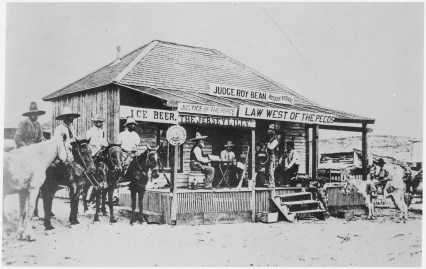
Many “red states” beat their chest as being fiscally conservative. Proud of their low income tax, business friendly environment, and self-reliance rhetoric.
But is it fair?
California, a “blue state,” gets just $.80 back for every $1 they put in. New York, even worse. They get less than $.75 on their dollar.
Whose going to start calling out the hypocrisy of some of the red states who point fingers at states like California and New York as the problem? These states want self-reliance? On what? California and New York’s goodwill?
This isn’t something Democrats should be proud of. They’re leaders are the one’s sitting there while their citizens get the short end of the stick.
Not something Republicans should be proud of either. Kinda hard to be the fiscal conservative when you ask Uncle Sam to pay your bills.
 A lot of these states were brought in as territories via the Louisiana Purchase or at the close of the Mexican American War. Most of these states have a vast amount of land–a lot of it actually owned and managed by the Federal Government–and they were probably brought in at a time when a lot of folks thought the middle of the country would eventually fill up with people or at least become a place with a viable economy. Many Native American nations were literally rolled over to create vast wastelands of ranches and natural resource extraction outposts. Does it really makes sense to continue to support the way these outback states were carved out and is there any legal way to consolidate them now?
Yes, this would decrease the number of Senators in the Senate. But, it would mean each Senator would be slightly more powerful. It actually might improve the odds of an outback state’s House delegation having more power. I mean, really, Nebraska has 3 Congressmen. Who ever listens to even one of them? They’re a basic flyover state in terms of the presidential election too. They usually get a hit and run by a vice president or vice presidential candidate. If they were part of a larger state with similar topography and concerns, they’d be part of state with a larger congressional block even though they’d fold into one or more states and thereby share a Senator with more people and antelope.
So, why can’t we look at Outback States like Idaho, the Dakotas, Oklahoma, Arizona, Utah, Idaho, Nebraska, Montana, Wyoming, Nevada, etc. and just consolidate them? Why shouldn’t Nebraska and the Dakotas become one state? Or say, why not fold Idaho, Montana and Wyoming into Washington? Why should every one in the country suffer from the leadership these outback states send to the Senate while having to pay so much for them even to exist? Is there some way to redo these old territories into larger, consolidated states with a more economically viable level of population to support the vast areas of nothing but nature that basically define their states? Could we do it?
A long time ago, I remember a proposal called The Buffalo Commons made by Frank and Deborah Popper. It was a suggestion to turn a large part of the middle of the country into a huge National Park that would be left to the wild. I bet it would still be controversial today and more impossible given that setting up more National Parks is likely to be more unpopular today than it was 40 years ago. But, many of the same problems the concept worked to solve still exist, and now we have even bigger issues since our outback states are high maintenance and tend to send representatives with a coup mentality to Congress. Why can’t we just consolidate a few of them and try to at least make them less costly to the rest of us? It’s even more important from a resource protection standpoint as indicated by the stupidity surrounding the Keystone Pipeline. This is a boondoggle which benefits the special interests of a few politicians and is likely to create risk to the many including the folks living in these states. Wouldn’t it be nice for them to have a lot more say in the future of how federal lands and federal co-option of private land operates?
In 1987, Drs. Frank and Deborah Popper developed their bold new idea for a Buffalo Commons, (Popper and Popper, “The Great Plains: From Dust to Dust, PLANNING, 1987). Their continuing research showed that hundreds of counties in the American West still have less than a sparse 6 persons per square mile — the density standard Frederick Jackson Turner used to declare the American Frontier closed in 1893. Many have less than 2 persons per square mile.
The frontier never came close to disappearing, and in fact has expanded in the Plains in recent years. The 1980 Census showed 388 frontier counties west of the Mississippi. The 1990 Census shows 397 counties in frontier status, and the 2000 Census showed 402. Most of this frontier expansion is in the Great Plains. Kansas actually has more land in frontier status than it did in 1890.
Great Plains Restoration Council mounted a Plains-wide mapping project at the county level, using a series of economic and social indicators, to show exactly where the frontier is and how much further it has expanded. GPRC than did more sophisticated mapping that scrutinized these and other factors down to the Census Block level, allowing for a much more rigorous and exact understanding of ecological, biological, geographical, topographical, demographic and political conditions. Since then, we have specifically honed our focus onto a few, key target ecological areas while developing a new model of youth education.
There once were over 400 million acres of wild prairie grasslands in the central part of North America. The backbone of the Buffalo Commons movement is the work — over a period of decades — to re-establish and re-connect prairie wildland reserves and ecological corridors large enough for bison and all other native prairie wildlife to survive and roam freely, over great, connected distances, while simultaneously restoring the health and sustainability of our communities wherever possible so that both land and people may prosper for a very long time. Future generations may choose to expand these reserves and corridors, as the new culture of caring and belonging we have started today becomes an integral, ingrained part of life in the world of tomorrow, especially as extensive grasslands become needed to help absorb carbon from the atmosphere. (Highly biodiverse native prairies are excellent carbon sequesters.)
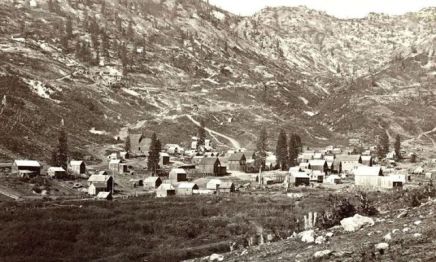 So, I’m not a legal expert, but it seems if a state can be made out of a territory then several states can be merged into something more viable for the modern country. I’d love to hear if anyone thinks this is way to bring more democratic representation to the country. Frankly, I think this could be a win win situation if some of these people would give up their provincial loyalties.
Again, the consolidation would bring a larger delegation to the House for a combined state, and it might make them feel more relevant to the Presidential election process. Right now, everyone ignores nearly every state but Colorado on the way across the Mississippi to hear about California. I’ve actually lived in states that I think would make good candidates to consolidate with other states so I do have some knowledge of what it’s like to live in the Great American Outback. I certainly believe it makes a lot of sense to look to see if those territories would’ve been dealt a better situation had they be carved out into different looking states. This is especially true since so many of them really don’t have all that many people in them and most of them are have been losing population for some time. What exactly constitutes a ghost state?
Here’s a few other things you can think on today.
Here are two studies on the Affordable Healthcare Act. One is by the Rand Corporation and the other by the Brookings Institute. It’s especially relevant to look at the link between the law and the tax credits since this is the next challenge to the law to come before SCOTUS. The last was the idea that states could opt out of the Medicaid Expansion which created a horrible situation for those of us in states ruled by Red State Crazies. First some points from the Brookings Institute.
In “The Early Impact of the Affordable Care Act State-by-State,” Brookings nonresident fellow in Economic Studies and Yale University Economics Department faculty member Amanda Kowalski finds that national enrollment trends obscure significant variation across states, as a result of the types of people who opted in and how insurers set premiums. Across all states, from before the fourth quarter of 2013 to the first half of 2014, enrollment-weighted average per-person premiums in the individual health insurance market rose by 24.4% beyond what they would have had they simply followed state-level seasonally-adjusted trends. This large increase stands in contrast to the experience in Massachusetts, which saw premium decreases after its 2006 reform, as documented by Kowalski in previous joint research. Massachusetts also saw decreases in markups (premiums minus costs), which have been rare in other states in 2014.
Kowalski focuses on the individual insurance market using data through the second quarter of 2014 after the open enrollment period ended. She characterizes states into five groups, based on their involvement in the implementation of the ACA. On one extreme were the 5 “direct enforcement” states that ceded all enforcement of the ACA to the federal government (Alabama, Missouri, Oklahoma, Texas, and Wyoming). On the other extreme were 8 states (Colorado, Connecticut, DC, Kentucky, New York, Rhode Island, Vermont, and Washington) that took the implementation of the ACA into their own hands by implementing the Medicaid expansion and setting up their own exchanges. Another group of 5 of these states also set up their own exchanges and expanded Medicaid, but experienced severe technology glitches (Hawaii, Maryland, Minnesota, Nevada, and Oregon), so she examines them as a distinct group. The two groups in the middle of the implementation spectrum include a set of 11 states that adopted the Medicaid expansion but did not set up their own exchanges (Arkansas, Arizona, Delaware, Iowa, Illinois, Michigan, North Dakota, New Hampshire, New Mexico, Ohio, and West Virginia) and a set of 19 “passive” states that did not fit into any of the other four groups (Alaska, Florida, Georgia, Idaho, Indiana, Kansas, Louisiana, Maine, Mississippi, Montana, North Carolina, Nebraska, Pennsylvania, South Carolina, South Dakota, Tennessee, Utah, Virginia, and Wisconsin) – they took some role in implementing the ACA, but did not implement the Medicaid expansion, and they used the federal exchange. All comparisons exclude California and New Jersey because their data are not complete, and they also exclude Massachusetts, because Massachusetts implemented its own reform in 2006.
She finds that individuals in “direct enforcement” states – those states that that ceded all enforcement of the ACA to the federal government (Alabama, Missouri, Oklahoma, Texas, and Wyoming) – are worse off by approximately $245 per participant on an annualized basis, relative to participants in states that were passive implementers of the ACA.
Kowalski also finds, not surprisingly, that the 5 states that had severe glitches with their exchanges (Hawaii, Maryland, Minnesota, Nevada, and Oregon) are worse off than other states with well-functioning state exchanges (Colorado, Connecticut, DC, Kentucky, New York, Rhode Island, Vermont, and Washington), by a large magnitude – approximately $750 per participant on an annualized basis. On the other hand, participants in states that set up well-functioning exchanges were better off than they would have been had their states been passive by approximately $420 per enrollee.
Reviewing data on the 27 states that adopted the Medicaid expansion, she finds that those that expanded were better off than all other states, although the amount is not statistically significant.
Kowalski also divides states based on whether they allowed renewal of non-grandfathered plans in response to the backlash that if people “liked their plan they could keep it” (27 did, but DC and the remaining 23 did not). She finds that participants in states that allowed renewal of non-grandfathered plans are worse off by around $220 annually than participants in other states who did not allow grandfathered non-compliant plans – likely because the people who remained in non-grandfathered plans were healthier than other people in the individual health insurance market.
Using the most recent data collected by the National Association of Insurance Commissioners (NAIC) and compiled by SNL Financial, which includes individual health insurance enrollment outside of the exchanges, Kowalski takes a broader view than the widely-cited report from the U.S. Department of Health and Human Service’s Office of the Assistant Secretary for Planning and Evaluation (ASPE), which reported 8 million exchange enrollees in May. By taking a broader view, Kowalski is able to observe trends in the individual health insurance market from before the exchanges opened for business. Taking these trends into account, at least 4.2 million enrollees are newly-covered in this market (many were likely previously uninsured, but some may have switched from other types of coverage).
Looking at the states individually, she finds that the law benefitted enrollees in at least 13 states (Alaska, Connecticut, DC, Indiana, Kentucky, Maryland, Maine, North Dakota, New Hampshire, Nevada, New York, Rhode Island, and Vermont), with Maine enrollees gaining the most at around $1500 per market participant annually, whereas Oregon (a state with severe glitches on its website and roll-out) experienced the greatest loss – around $850 annually per participant.
The Rand Study has these findings.
In this research report, RAND Corporation researchers assess the expected change in enrollment and premiums in the Patient Protection and Affordable Care Act (ACA)–compliant individual market in federally facilitated marketplace (FFM) states if the U.S. Supreme Court decides to eliminate subsidies in FFM states. The analysis used the Comprehensive Assessment of Reform Efforts (COMPARE) microsimulation model, an economic model developed by RAND researchers, to assess the impact of proposed health reforms. The authors found that enrollment in the ACA–compliant individual market, including plans sold in the marketplaces and those sold outside of the marketplaces that comply with ACA regulations, would decline by 9.6 million, or 70 percent, in FFM states if subsidies were eliminated. They also found that unsubsidized premiums in the ACA–compliant individual market would increase 47 percent in FFM states. This corresponds to a $1,610 annual increase for a 40-year-old nonsmoker purchasing a silver plan.
Key Findings
Enrollment in the Patient Protection and Affordable Care Act (ACA)–Compliant Individual Market Would Decline Significantly in Federally Facilitated Marketplace (FFM) States
- Individual-market enrollment would decline by an estimated 70 percent, or 9.6 million people.
- This decline includes plans sold in the marketplaces and those sold outside of the marketplaces that comply with ACA regulations.
Unsubsidized Premiums in the ACA-Compliant Individual Market Would Increase 47 Percent in FFM States
- This corresponds to a $1,610 annual increase for a 40-year-old nonsmoker purchasing a silver plan.
As you can see, eliminating Federal Subsidies would basically make health insurance unaffordable for many many people again.
So, I’ve been a little radical today. What’s on you reading and blogging list today?
Thursday Reads
Posted: January 8, 2015 Filed under: Foreign Affairs, morning reads | Tags: cartoonists, Charlie Hebdo magazine attack, Freedom of Expression, Islam, terrorism, winter weather 14 Comments
painting by Vladimir Tokarev
Good Morning!!
I’m getting a slow start today. I guess it must be because I’m so cold. I’ve been up since 6AM, but I’ve been dawdling around reading the news, sipping hot tea, and writing nothing. It’s still only 66 degrees in my house even though I have the thermostat turned up pretty high. My furnace isn’t build to handle below zero temperatures, and at 9AM it is still -3 degrees where I live.
The local NPR weather reporter warned that frostbite can happen in minutes when the temperatures are this low and the wind chill factor is much lower. Schools around here are closed, as are many schools around the country. I need to go out sometime today, so I’m hoping the temperatures will get into the teens by this afternoon. The good news is, there isn’t any snow out there.
According to Dave Collins of the AP, via the Charlotte Observer things are going to get worse before they get better.
Another Alberta clipper barreling down from Canada is bringing more bad winter weather to the Dakotas.
The National Weather Service has posted a variety of blizzard and winter weather advisories, watches and warnings for the Dakotas through Thursday. Not a lot of snow is expected, but winds gusting to 50 mph will blow around the snow that’s on the ground.
In Minnesota, forecasters expect blizzard conditions to develop in a portion of the River Valley. Weather officials say wind gusts of 40 to 50 mph combined with fresh snow will significantly reduce visibility, especially in open, rural areas. A blizzard warning was posted in an area from Granite Falls southeast to Mankato and Albert Lea.
Thank goodness I live in temperate New England, and not the upper Midwest!
Besides the weather, the big story in the news today is the shooting rampage at Charlie Habdo magazine in Paris yesterday.
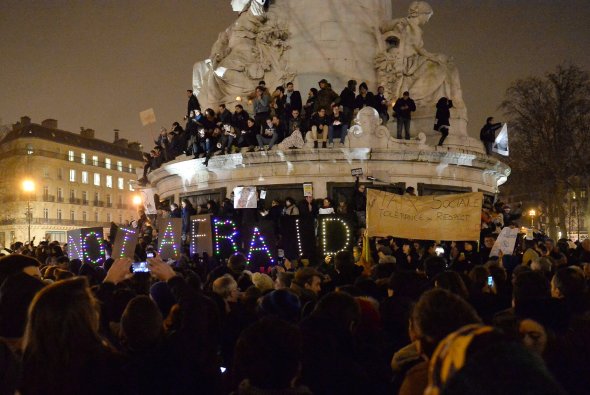
Vigil in Paris for the Charlie Hebdo victims (NPR)
Some background from BBC News:
Charlie Hebdo: Gun attack on French magazine kills 12.
Four of the magazine’s well-known cartoonists, including its editor, were among those killed, as well as two police officers….
The masked attackers opened fire with assault rifles in the office and exchanged shots with police in the street outside before escaping by car. They later abandoned the car in Rue de Meaux, northern Paris, where they hijacked a second car….
Witnesses said they heard the gunmen shouting “We have avenged the Prophet Muhammad” and “God is Great” in Arabic (“Allahu Akbar”)….
Charlie Hebdo editor Stephane Charbonnier, 47, had received death threats in the past and was living under police protection.
French media have named the three other cartoonists killed in the attack as Cabu, Tignous and Wolinski, as well as Charlie Hebdo contributor and French economist Bernard Maris….
The satirical weekly has courted controversy in the past with its irreverent take on news and current affairs. It was firebombed in November 2011 a day after it carried a caricature of the Prophet Muhammad.
The latest tweet on Charlie Hebdo’s account was a cartoon of the Islamic State militant group leader, Abu Bakr al-Baghdadi.

Cartoonists responded to the killings by posting cartoons on twitter. You can see some of them at the links below.
From Euro News, The power of the pen: Cartoonists worldwide react to the Charlie Hebdo attack.
From Buzzfeed, 23 Heartbreaking Cartoons From Artists Responding To The Charlie Hebdo Shooting.
One of the gunmen is in custody, but two are still free, NPR reported yesterday.
French police have taken Hamyd Mourad, 18, into custody after he surrendered to authorities, according to multiple French news outlets. Mourad had been sought in relation to a murderous attack on a satirical magazine’s Paris office Wednesday, but it’s not certain whether he was involved. An ID card belonging to Mourad was reportedly found in the gunmen’s car.
The two central suspects in the attack remain at large; regional police issued a new plea for help in finding two French-born brothers, Said and Cherif Kouachi, both in their 30s.
They’re believed to be the gunmen who used powerful assault rifles to kill journalists and police officers at the office of the weekly Charlie Hebdo around midday Wednesday.
A police bulletin sought the public’s help in finding two suspects in the deadly attack on a satirical magazine’s Paris offices Wednesday. Pictured are brothers Cherif (left) and Said Kouachi.
La prefecture de Police
The Kouachi brothers are said to be French citizens.

This morning, news broke that a policewoman had been killed in Paris, but it was not yet clear that the perpetrators of the magazine attack were involved.
A policewoman was killed in a shootout in southern Paris, but police sources could not immediately confirm a link with Wednesday’s killings at the Charlie Hebdo weekly newspaper that marked the worst attack on French soil for decades.
National leaders and allied states described the assault on Charlie Hebdo, known for its lampooning of Islam and other religions as well as politicians, as an assault on democracy. The bells of Notre-Dame cathedral rang out during a minute’s silence observed across France and beyond….
Montrouge Mayor Jean-Loup Metton said the policewoman and a colleague were attending a reported traffic accident when Thursday’s shooting occurred. Witnesses said the assailant fled in a Renault Clio and police sources said he wore a bullet-proof vest and had a handgun and assault rifle.
But one police officer at the scene told Reuters he did not appear to resemble the Charlie Hebdo shooters.
The Guardian is covering this story heavily, with live updates on the manhunt.

A recent story from The Guardian: Police place security cordon around Paris in hunt for Charlie Hebdo killers.
The French president, François Hollande, has led a minute’s silence for the victims of Wednesday’s attack on the offices of satirical magazine Charlie Hebdo, as police placed a tight security cordon around Paris amid an atmosphere of heightened tension and confusion.
With the search for the gunmen in its second day, there were unconfirmed reports that the suspects had been seen in the Aisne region of north-east France.
In a briefing on Thursday morning, Bernard Cazeneuve, France’s interior minister, said that seven arrests were made overnight, but the two main suspects, brothers Saïd and Chérif Kouachi, were still at large.
There was a heavy police presence at each of the “portes” – the main roads leading into the city – amid unconfirmed reports that the suspects were heading back towards the French capital “at high speed” in a grey Renault Clio.
The two men were reportedly seen in the Aisne region, but the reports were confused. Some French media suggested they had been picked up by cameras at a péage (road toll) stop. Others said they had been identified by the owner of a petrol station near Villers-Cotterêts and a number of reports went even further, suggesting the two men had robbed the petrol station and made off with fuel and food.
The reports suggested that heavy weapons including, allegedly, a Kalashnikov and a rocket launcher, could be seen in the rear of the vehicle.
However, apart from images of areas of Paris, like the north-western suburb of Levallois, completely sealed off and heavily armed police and armoured vehicles at the portes of the city, the reports were unconfirmed and there was no indication that police had located the vehicle.

Two reactions to the Paris killings:
Juan Cole, Sharpening Contradictions: Why al-Qaeda attacked Satirists in Paris.
The horrific murder of the editor, cartoonists and other staff of the irreverent satirical weekly Charlie Hebdo, along with two policemen, by terrorists in Paris was in my view a strategic strike, aiming at polarizing the French and European public.
The problem for a terrorist group like al-Qaeda is that its recruitment pool is Muslims, but most Muslims are not interested in terrorism. Most Muslims are not even interested in politics, much less political Islam. France is a country of 66 million, of which about 5 million is of Muslim heritage. But in polling, only a third, less than 2 million, say that they are interested in religion. French Muslims may be the most secular Muslim-heritage population in the world (ex-Soviet ethnic Muslims often also have low rates of belief and observance). Many Muslim immigrants in the post-war period to France came as laborers and were not literate people, and their grandchildren are rather distant from Middle Eastern fundamentalism, pursuing urban cosmopolitan culture such as rap and rai. In Paris, where Muslims tend to be better educated and more religious, the vast majority reject violence and say they are loyal to France.
Al-Qaeda wants to mentally colonize French Muslims, but faces a wall of disinterest. But if it can get non-Muslim French to be beastly to ethnic Muslims on the grounds that they are Muslims, it can start creating a common political identity around grievance against discrimination.
This tactic is similar to the one used by Stalinists in the early 20th century. Decades ago I read an account by the philosopher Karl Popper of how he flirted with Marxism for about 6 months in 1919 when he was auditing classes at the University of Vienna. He left the group in disgust when he discovered that they were attempting to use false flag operations to provoke militant confrontations. In one of them police killed 8 socialist youth at Hörlgasse on 15 June 1919. For the unscrupulous among Bolsheviks–who would later be Stalinists– the fact that most students and workers don’t want to overthrow the business class is inconvenient, and so it seemed desirable to some of them to “sharpen the contradictions” between labor and capital.
More at the link.

George Packer at The New Yorker, The Blame for the Charlie Hebdo Murders.
The murders today in Paris are not a result of France’s failure to assimilate two generations of Muslim immigrants from its former colonies. They’re not about French military action against the Islamic State in the Middle East, or the American invasion of Iraq before that. They’re not part of some general wave of nihilistic violence in the economically depressed, socially atomized, morally hollow West—the Paris version of Newtown or Oslo. Least of all should they be “understood” as reactions to disrespect for religion on the part of irresponsible cartoonists.
They are only the latest blows delivered by an ideology that has sought to achieve power through terror for decades. It’s the same ideology that sent Salman Rushdie into hiding for a decade under a death sentence for writing a novel, then killed his Japanese translator and tried to kill his Italian translator and Norwegian publisher. The ideology that murdered three thousand people in the U.S. on September 11, 2001. The one that butchered Theo van Gogh in the streets of Amsterdam, in 2004, for making a film. The one that has brought mass rape and slaughter to the cities and deserts of Syria and Iraq. That massacred a hundred and thirty-two children and thirteen adults in a school in Peshawar last month. That regularly kills so many Nigerians, especially young ones, that hardly anyone pays attention.
Because the ideology is the product of a major world religion, a lot of painstaking pretzel logic goes into trying to explain what the violence does, or doesn’t, have to do with Islam. Some well-meaning people tiptoe around the Islamic connection, claiming that the carnage has nothing to do with faith, or that Islam is a religion of peace, or that, at most, the violence represents a “distortion” of a great religion. (After suicide bombings in Baghdad, I grew used to hearing Iraqis say, “No Muslim would do this.”) Others want to lay the blame entirely on the theological content of Islam, as if other religions are more inherently peaceful—a notion belied by history as well as scripture.
A religion is not just a set of texts but the living beliefs and practices of its adherents. Islam today includes a substantial minority of believers who countenance, if they don’t actually carry out, a degree of violence in the application of their convictions that is currently unique.
Click on the link to read the rest.
What else is happening? Let us know in the comment thread and have a great day!
Tuesday Reads: Epiphany Edition
Posted: January 6, 2015 Filed under: Barack Obama, morning reads, U.S. Economy, U.S. Politics | Tags: Black Jesus, gold frankincense and myrrh, GOP Congress 2015, John Boehner, Keystone XL pipeline, Louie Gohnert, Steve Scalise, Ted Yoho, The Epiphany, Twelfth Night 50 Comments
Ethiopian Magi, by Patrick Comerford
Good Morning!!
Looking at the news that’s breaking this morning, I’m finally getting the feeling that “the holiday season” is coming to an end. After all, today is the Epiphany–also known as Twelfth Night–the day the three Maji supposedly arrived at the stable in Bethlehem to pay tribute to the baby Jesus with gifts gold, frankincense and myrrh. From The Guardian:
It’s a significant day in many countries, particularly Catholic ones, where Twelfth Night parties and celebrations are commonplace and usually involve the selection of a king, and sometimes a queen and other characters. In France, for example, the galette des rois (“cake of kings”) has a token baked into it; patisseries sell it along with a gold paper crown for the recipient of the token, who becomes the party’s ruler.
Some Epiphany celebrations from British literature:
Samuel Pepys celebrated the feast – always on 6 January, which he says marks the end of Christmas – and in 1663 goes to see Shakespeare’s Twelfth Night. The drama is “acted well, though it be but a silly play, and not related at all to the name or day” – which it isn’t, apart from a general air of misrule. Pepys usually has or attends a party, with dancing and merriment, and always a “brave” or “excellent” cake. There are other tokens baked into it: one year he gets the clove, which indicates he is a knave, but he smuggles it into someone else’s slice. In 1669 he mentions a new fashion, which is to draw paper lots for king and queen of the party, rather than finding a bean, so as not to spoil the cake (and perhaps to avoid the cheating just mentioned).
In Charles Dickens’s Christmas Carol, there is a reference to “immense Twelfth-cakes”, and Scrooge and the Ghost of Christmas Present visit a “children’s Twelfth Night party”. Dickens’s letters show that in his household there was a party every year: the date is his son Charley’s birthday, but it’s clear he thinks a Twelfth Night party is quite normal.
In James Joyce’s short story The Dead, from his collection Dubliners (1914), Gabriel Conroy and his wife Gretta go every year to an important party held by the Misses Morkan. There is dinner, dancing and singing, but alongside the festivities we see darkness and contemplation: snow falls over Ireland, and Gabriel looks through it as he thinks about his own shortcomings and about the wife whom he thought he knew. The idea of a character having a metaphorical epiphany, a moment of revelation or realisation, comes directly from Joyce, and each story in Dubliners features one.
More examples at the link.

This is a tar sands plant Alberta, Canada. Republicans can’t wait to bring this to the US.
The new Republican-controlled Congress begins “work” today. The AP reports, via Huffington Post: New Congress Getting Sworn In With GOP In Charge.
Republicans are assuming full control of Congress for the first time in eight years in a day of pomp, circumstance and raw politics beneath the Capitol Dome.
They planned to move swiftly Tuesday toward a veto showdown with President Barack Obama over the Keystone XL pipeline, summoning unity despite a tea party-backed effort to unseat House Speaker John Boehner of Ohio.
As mandated by the Constitution, Congress was to convene at noon.
In the Senate, with Vice President Joe Biden presiding, Mitch McConnell of Kentucky was to automatically ascend to majority leader following his approval by rank-and-file Republicans last year.
McConnell and Boehner both were to deliver remarks on their chamber’s floors as they positioned themselves for two years of clashes with Obama.
First, Boehner had to survive his election as speaker — the main event on any opening day’s agenda. Tea party-backed Reps. Louie Gohmert of Texas and Ted Yoho of Florida put themselves forward as challengers to Boehner, and at least 10 Republicans announced they would oppose Boehner.
The challenges to Boehner won’t go anywhere, but they could provide some brief entertainment. From Politico: Boehner likely to survive another squeaker for speaker.
John Boehner could lose the support of as many as 20 Republicans on his way to a near-certain reelection as House speaker, his allies concede — a political embarrassment for a GOP leader who narrowly survived a conservative rebellion two years ago.
The Ohio Republican needs votes from 217 lawmakers Tuesday to win a third term as speaker, meaning that opposition from 29 House Republicans could cost him the gavel. Boehner retained the speakership by a surprisingly narrow margin in January 2013, losing the support of 11 Republicans at a time when the GOP had a smaller majority.
This time, Boehner’s supporters say, he could lose anywhere from 12 to 20 GOP votes under a backlash from conservative members angry about their leaders’ reluctance to wage a frontal attack on President Barack Obama’s immigration policies. Losing that many votes won’t prove fatal for Boehner or even have a long-term impact on his speakership, but it could still prove embarrassing for a GOP leadership that faces a spate of difficult legislative deadlines and is under pressure to prove it can govern during the Republican-controlled 114th Congress.
The speaker’s allies believe they have the opposition under control, and as of Monday, the anti-Boehner crowd was far from having the numbers to force a second-ballot vote, let alone deny him a new term. But the dissenters and their allies in conservative media are fanning the flames.
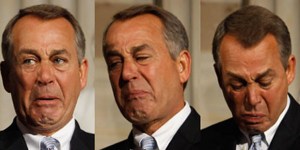
Politico says that Boehner is looking forward to a “new reality” in which he triumphs over the wingnuts who have made his life miserable since he became Speaker in 2010.
For years, Boehner has had to stroke the egos of his House Republican Conference’s far-right fringe, the hardline conservatives who had an outsized voice in every legislative debate and often dragged the entire party with them, even when he implored them to ease up.
Sure, Boehner’s “brand” will be tarnished by the right wing challenges to his leadership, but
the GOP leadership thinks that Boehner’s almost-certain victory, plus the biggest House Republican majority in decades, gives him the legislative latitude he’s desperately sought since 2010.
No more shutdowns, no more mindless face-offs with President Barack Obama and the Democrats, they hope. Boehner and House Republicans will be able to push a conservative agenda, but they will pick their fights more carefully, choosing battles they can win on issues where they have the upper hand over the White House.
Top Republicans blare that they’re plainly sick of the chaos of the last few years, when Boehner was under pressure to deliver to hardliners in order to keep his job.
“I think a lot of members just want to get through this and get onto the business they got elected to do,” said a GOP lawmaker loyal to Boehner.
Good luck with that.
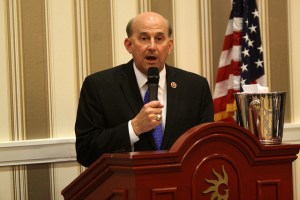
It won’t happen, but just for a moment, imagine Louie Gohmert as Speaker of the House (and third in line to assume the presidency if Obama and Biden were unable to continue for some reason!). Bob Cesca thought about the possibilities yesterday: Louie Gohmert for House Speaker Because Comedy.
I’m deadly serious about this. Contrary to popular opinion dictating that fringe political weirdos and radicals should be ignored until they somehow magically vanish (they don’t), I’ve always believed that the more they’re exposed as the weirdos and radicals they are, the faster they’ll be ejector-seated off the national bus. So, along those lines, the best thing to ever happen to the universe would be if Rep. Louie Gohmert (R-TX) were to succeed in his mission to be elected Speaker of the House.
If you’re a Democrat and you want there to be more Democrats in Congress, you too should endorse the idea of this talking honeydew melon — this marble-mouthed gomer to ascend to the highest congressional post in the land where the entire nation will get a close-up view of his lobotomized gibberish. Of course he’ll never get there but, you know, dare to dream. While it’s fun to have a speaker who’s a weepy drunk, what we need is Cletus the Slack-Jawed Yokel. We need a Republican who’s been repeatedly kicked in the skull by a mule. On purpose.
Why Gohmert? For the comedy, obviously. The nation deserves to laugh at crap like this:
“We need to start eliminating money for any agency, including the White House, that is not following the law. And then you get their attention. That’s what the Founders anticipated.”
Yes, a sitting member of Congress clearly doesn’t realize that any spending bill passed by Congress, including the de-funding of the White House, would have to be signed by the president before actually becoming a law. And no, the Founders didn’t anticipate the House passing legislation that automatically becomes law.
Read several more examples of Gohmert’s wit and wisdom at The Daily Banter link.
And check this out at Raw Story, Gohmert warns America: ‘It’s going to devastate this country’ if I’m not elected Speaker of the House.
In an interview with Fox News host Martha MacCallum, Gohmert explained that he had announced over the weekend that he was running for the job of House Speaker because Boehner had not fought “tooth and nail” to stop a recent budget bill.
“What we do in the next two years, it’s likely going to determine whether we get a Republican or not in 2016,” the Texas congressman insisted. “For the Speaker to run in and pass the [budget bill] that totally funds Obamacare for all next year — we took the hostage of the Homeland Security — that was a huge mistake.”
“For Boehner to rush in when we had the control of the Senate coming into our hands this month, this week, and to make a deal with [Obama] that funds everything that Obama wanted for the year except Homeland Security is like [General] Custer saying, ‘Come on boys, let’s attack now before help gets here.’”
Read more and watch the video at the link.
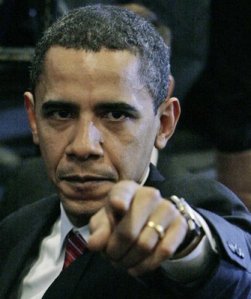
According to The Hill, President Obama isn’t going to lie down and let crazy Republicans walk all over him: Bolder Obama ready to take on GOP.
White House officials feel emboldened headed into what Obama has described as the “fourth quarter” of his presidency.
Promising economic news, declining gas prices, and a flurry of executive actions that energized his liberal base have provided him with his best poll numbers in more than a year.
Aides and strategists believe this provides opportunity for him, even with Republicans taking control of both the House and Senate on Tuesday for the first time since 2006.
“Really for the first time in his time in office, the president has the economic winds at his back — and not in his face,” Democratic strategist Chris Lehane said.
If the winds continue to blow in Obama’s direction — no sure thing, as evidenced by the 300-point drop Monday in the Dow Jones industrial average — Obama’s White House will be able to stay on offense, Lehane said.
The administration is planning new executive actions and legislative proposals in the buildup to his State of the Union address at the end of the month. It is also staking out areas where the president will aggressively use his veto authority.
Finally, in the spirit of the holiday, did you know there’s a TV show called Black Jesus?
You can watch the first season at Adult Swim.
In other news . . .
Christian Science Monitor: Boston Marathon bombing trial begins with high-stakes jury selection.
New York Magazine: Bess Meyerson Dead at 90 — Remembering her three lives.
Time Magazine: White House Turns the Screw on Steve Scalise.
Olivia Nuzzi at The Daily Beast: Rand Paul’s Passive-Aggressive Trolling Campaign.
Seattle PI: Another police shooting in San Francisco. Man shot by San Francisco officers left suicide notes
Christian Science Monitor: After police turn back on mayor again, where does New York go from here?
Yahoo News: Police union pushes for cop killings to be included in federal hate crimes law.
Fox News: 2 dead, 12 injured in North Dakota school bus-train collision.
The Daily Beast: Pediatrician: Vaccinate Your Kids—Or Get Out of My Office.
ABC News: Son of Slain Hedge Fund Founder Thomas Gilbert Sr. Charged With Homicide. His dad was going to stop paying his rent and reduce his allowance.
SF Gate: Mark Zuckerberg starts Facebook book club. Some of the books Zuckerberg has read are “Andre Agassi’s memoir “Open,” Walter Isaacson’s biography “Einstein” and Shel Silverstein’s children’s picture book “The Giving Tree.”” He also likes Ender’s Game by Orson Scott Card. I think I’ll pass on having this guy tell me what books I should read.
The Telegraph: Prince Andrew’s relationship with Jeffrey Epstein in 60 seconds.
The Telegraph: What are the challenges facing Prince Andrew and the Queen over sex abuse claims?
What stories are you following today? Please post your thoughts and links in the comment thread, and have a terrific Tuesday.
Monday Reads: Democracy Vanquished
Posted: January 5, 2015 Filed under: just because, morning reads, U.S. Economy, U.S. Politics | Tags: Dodd Frank, Greta van Susteren, Income Inequality, John Boehner, law enforcement overreach, Louis Gohmert, Mia Love, Sean Hannity, Steve Scalise, Ted Yoho, US House of Representatives, US Senate, wage stagnation 28 CommentsGood Morning!
 Well, Republicans feel empowered to up the crazy so they are certainly doing it. Boehner will be challenged by two of the more insane teabillies. Insane teabilly number one challenging Boehner for speaker is Texas Republican Louis Gohmert. Florida nutter Ted Yoho has also said he can’t support Boehner.
Rep. Ted Yoho (R-Fla.) on Saturday announced that he would not support Boehner for Speaker.
“This is not a personal attack against Mr. Boehner, however, the people desire and deserve a choice,” Yoho said in a Facebook post. “In November, they resoundingly rejected the status quo.”
“Eventually, the goal is second, third, fourth round, we have enough people that say ‘you know what, it really is time for a change,’ ” Gohmert said Sunday. “’You deceived us when you went to Obama and Pelosi to get your votes for the cromnibus. You said you’d fight amnesty tooth an nail. You didn’t, you funded it.’ ”
Gohmert said, if elected, he would ”fight amnesty tooth and nail. We’ll use the powers of the purse. We’ll have better oversight. We’ll fight to defund ObamaCare.”
“In 2010, Boehner and other leaders said if you put us in the majority, we will have time to read the bills,” Gohmert said. “That hasn’t happened. We saw that with the cromnibus, again.”
“We’ll get back to appropriating and we will go through regular committee process, so every representative from both parties will have a chance to participate in the process and not have a dictator running things,” he added.
“With a growing Republican majority in the House and a historically high number of liberty-voting fiscal conservatives within it, there is an urgent need replace Speaker Boehner with fresh, bold leadership that better represents the views of the whole caucus,” FreedomWorks President Matt Kibbe said in a statement on Sunday.
“Speaker Boehner has kicked fiscal conservatives off committee positions for voting against his wishes, caved on numerous massive spending bills at the eleventh hour, and abused the legislative process to stomp out opposition by holding surprise votes and giving members little time to actually read the bills before they vote,” Kibbe added.
These are just two of the states that send representative after representative that really wants to destroy the country’s economy, not being satisfied with having their own crazy ass issues in their own crazy ass states. Every time I think Louisiana hits the low in politics, Texas and Florida always step up to take the title of bottom feeders away.
Utah seems out to prove a point these days as a black Republican woman seems to think that everything is just hunky-dory with Steve Scalise chatting up virulently anti-Semitic white supremacists. It is going to be an awful few years.
Incoming Rep. Mia Love (R-UT) on Sunday said that House Majority Whip Steve Scalise (R-LA) should remain in Republican leadership despite recent reports that he spoke at an event for a white nationalist group in 2002.
“These groups are awful. And the last thing I want to do is give them any sort of publicity or credibility, and I can say, as far as I’m concerned, with Representative Scalise, he has been absolutely wonderful to work with,” Love said on ABC’s “This Week.”
When asked if Scalise should remain as GOP whip, Love indicated that his apology was enough.
“There’s one quality that he has that I think is very important in leadership and that’s humility. And he’s actually shown that in this case. And he’s apologized, and I think that we need to move on and get the work of the American people done,” she said.
As you can see, Love didn’t specify what “people” she and others were going to work for but then we know it’s pretty obviously going to be a few rich white christians who can’t seem to get past the Civil War and modern science and economics.
 However, it seems even some folks at Fox News find Scalise’s story and apology to be outrageous. Greta Van Susteran joins Hannity in calling for Scalise’s resignation.
It’s rare for a Fox News employee to openly call out a Republican, but when it happens, it’s epic. And that’s exactly what Greta Van Susteran did on Sunday when she slammed GOP Rep. Steve Scalise.
During an appearance on ABC’s This Week, Van Susteran called out Scalise for not having the “moral courage” to resign after it was revealed that the Louisiana congressman had been the keynote speaker at a white supremacist convention in 2002. Scalise agreed to be the guest of honor after KKK Grand Wizard David Duke reached out to him through aides.
In response, Scalise feigned ignorance, claiming that he had no idea to whom he was speaking to at the event even though the convention was widely covered by local media because it was so controversial. Many Republicans, including Steve King and John Boehner, stood by Scalise. So far, he has refused to resign his post as House Majority Whip, and will be the third most powerful Republican in the House when the new Congress convenes this month. And this might make the KKK very happy.
But Van Susteran completely disagreed with the way Scalise and the Republican Party handled the damning revelations and not only skewered Scalise for being a coward, she also blasted the GOP for dropping the ball in their effort to appeal to minority voters ahead of 2016.
What’s amazing to me is that Democrats captured 20 million more votes in the 2014 election and still lost. What kind of democracy causes that? Why are Republican votes more valuable?
This one was shocking. It does not matter how one cuts it. The United States constitution is severely flawed when more often than not in the last few elections the majority of people voting for a particular party did not receive their relative representation. Democrats received 20 million more votes in the Senate than Republicans in 2014, yet Republicans won big.
The same occurred in the House of Representatives in 2012.
House Democrats out-earned their Republican counterparts by 1.17 million votes. Read another way, Democrats won 50.59 percent of the two-party vote. Still, they won just 46.21 percent of seats, leaving the Republicans with 234 seats and Democrats with 201.
There is nothing illegal here. There is simply a very designed undemocratic flaw in the US Constitution that must be fixed lest the legislative branch of the American government will continue to be disassociated from the real wants of society.
Fairvote.org reported the following relative to the 2014 Senate race.
As a body designed to represent states rather than citizens, the Senate’s partisan makeup tends to bear a fairly loose relationship to the raw numbers of votes that were cast to elect its members. With the final election results in hand, let’s take a look at how votes cast for Senate candidates translate to seats in the world’s greatest deliberative body.
In all, Americans cast 202.5 million votes to elect the current Senate, spread across three election cycles in 2010, 2012, and 2014. Of these, 49% were cast for Democratic candidates and 46.6% for Republicans. …
In the aggregate, Democratic voters are underrepresented in the Senate and Republican voters are overrepresented compared to their respective strengths in the electorate, although Democrats outperformed their raw vote totals in two of the past four individual elections.
As for the 46 Democratic caucus members in the 114th Congress received a total of 67.8 million votes in winning their seats, while the 54 Republican caucus members received 47.1 million votes.
It’s going to be hard for Democrats to regain the Senate even though far more people vote for Democratic Senators than Republicans. That’s because Republicans still get two senators from states that have less people than any of the country’s largest cities.
On Tuesday, 33 US senators elected in November will be sworn in by Vice President Joe Biden — including 12 who are new to the chamber. The class includes 22 Republicans and 11 Democrats, a big reason why the GOP has a 54-46 majority in the Senate overall.
But here’s a crazy fact: those 46 Democrats got more votes than the 54 Republicans across the 2010, 2012, and 2014 elections. According to Nathan Nicholson, a researcher at the voting reform advocacy group FairVote, “the 46 Democratic caucus members in the 114th Congress received a total of 67.8 million votes in winning their seats, while the 54 Republican caucus members received 47.1 million votes.”
There is something definitely wrong with the outcomes in governance, given that our ruling class appears to be severely crazy and greedy. For one, they make everyone believe that our money is spent on public welfare when it’s definitely corporate welfare that steals tax dollars. Robert Reich explains their priorities very well.
Some believe the central political issue of our era is the size of the government. They’re wrong. The central issue is whom the government is for.
Consider the new spending bill Congress and the President agreed to a few weeks ago.It’s not especially large by historic standards. Under the $1.1 trillion measure, government spending doesn’t rise as a percent of the total economy. In fact, if the economy grows as expected, government spending will actually shrink over the next year.
The problem with the legislation is who gets the goodies and who’s stuck with the tab.
For example, it repeals part of the Dodd-Frank Act designed to stop Wall Street from using other peoples’ money to support its gambling addiction, as the Street did before the near-meltdown of 2008.
Dodd-Frank had barred banks from using commercial deposits that belong to you and me and other people, and which are insured by the government, to make the kind of risky bets that got the Street into trouble and forced taxpayers to bail it out.
But Dodd-Frank put a crimp on Wall Street’s profits. So the Street’s lobbyists have been pushing to roll it back.
The new legislation, incorporating language drafted by lobbyists for Wall Street’s biggest bank, Citigroup, does just this.
It reopens the casino. This increases the likelihood you and I and other taxpayers will once again be left holding the bag.
Wall Street isn’t the only big winner from the new legislation. Health insurance companies get to keep their special tax breaks. Tourist destinations like Las Vegas get their travel promotion subsidies.
In a victory for food companies, the legislation even makes federally subsidized school lunches less healthy by allowing companies that provide them to include fewer whole grains. This boosts their profits because junkier food is less expensive to make.
Major defense contractors also win big. They get tens of billions of dollars for the new warplanes, missiles, and submarines they’ve been lobbying for.
Conservatives like to portray government as a welfare machine doling out benefits to the poor, some of whom are too lazy to work.
In reality, according to the Center for Budget and Policy Priorities, only about 12 percent of federal spending goes to individuals and families, most of whom are in dire need.
 In a critique of Piketty’s book “Capital in the Twenty First Century” at Project Syndicate, Joseph Stiglitz explains how are productive capital gets sucked into speculative, financial capital and asset bubbles. This is something I’ve been writing about for years here. This section of his critique is particularly compelling.
Piketty also sheds new light on the “reforms” sold by Ronald Reagan and Margaret Thatcher in the 1980s as growth enhancers from which all would benefit. Their reforms were followed by slower growth and heightened global instability, and what growth did occur benefited mostly those at the top.
But Piketty’s work raises fundamental issues concerning both economic theory and the future of capitalism. He documents large increases in the wealth/output ratio. In standard theory, such increases would be associated with a fall in the return to capital and an increase in wages. But today the return to capital does not seem to have diminished, though wages have. (In the US, for example, average wages have stagnated over the past four decades.)
The most obvious explanation is that the increase in measured wealth does not correspond to an increase in productive capital – and the data seem consistent with this interpretation. Much of the increase in wealth stemmed from an increase in the value of real estate. Before the 2008 financial crisis, a real-estate bubble was evident in many countries; even now, there may not have been a full “correction.” The rise in value also can represent competition among the rich for “positional” goods – a house on the beach or an apartment on New York City’s Fifth Avenue.
Sometimes an increase in measured financial wealth corresponds to little more than a shift from “unmeasured” wealth to measured wealth – shifts that can actually reflect deterioration in overall economic performance. If monopoly power increases, or firms (like banks) develop better methods of exploiting ordinary consumers, it will show up as higher profits and, when capitalized, as an increase in financial wealth.
But when this happens, of course, societal wellbeing and economic efficiency fall, even as officially measured wealth rises. We simply do not take into account the corresponding diminution of the value of human capital – the wealth of workers.
Moreover, if banks succeed in using their political influence to socialize losses and retain more and more of their ill-gotten gains, the measured wealth in the financial sector increases. We do not measure the corresponding diminution of taxpayers’ wealth. Likewise, if corporations convince the government to overpay for their products (as the major drug companies have succeeded in doing), or are given access to public resources at below-market prices (as mining companies have succeeded in doing), reported financial wealth increases, though the wealth of ordinary citizens does not.
What we have been observing – wage stagnation and rising inequality, even as wealth increases – does not reflect the workings of a normal market economy, but of what I call “ersatz capitalism.” The problem may not be with how markets should or do work, but with our political system, which has failed to ensure that markets are competitive, and has designed rules that sustain distorted markets in which corporations and the rich can (and unfortunately do) exploit everyone else.
Markets, of course, do not exist in a vacuum. There have to be rules of the game, and these are established through political processes. High levels of economic inequality in countries like the US and, increasingly, those that have followed its economic model, lead to political inequality. In such a system, opportunities for economic advancement become unequal as well, reinforcing low levels of social mobility.
There are more warnings each year that we’ve traded our democracy for a plutocracy and that many of the folks that fall for these mistaken memes are the worst hurt by the changes. I’m never sure what we should do about it, but at least on social media there are many of us who can realize what’s going on and share our observations and discontent.
So this is the situation, we’re being ruled by a minority, extremist party that has managed to gerrymander its way into to controlling Congress and can have over-representation in the Senate by its very design. Since the Reagan years, they have managed to coalesce into a party of business interests, neoconfederates, and religious extremists. As a result, we have laws and programs that enrich the wealthiest at the cost of the rest of us. We have institutions where racism and sexism have been allowed to fester and where Supreme Court justices have allowed their ideology to trump the constitution and previous law to further the oppression of minorities–with the exception of the LGBT community, where some strides have been made. Undoubtedly, this has happened because some of the biggest business interests want it, not from any desire to do the right thing by the people. We’ve used a fake war to extend a police state where we’re all subjected to law enforcement officers that are out of control and institutionally encouraged to be so.
I have to say the challenges are huge. I’m just hoping that the dog and pony show that will start with this new Congress will scare the shit out of people. Given, some of this background information however, I doubt there’s much we can do about it short of a major increase in voter participation or a revolution. The fact that so many really poorly governed states have re-elected their Republicans and continue to suffer shows me that it’s not going to be over anytime soon.
What’s on your reading and blogging list today?

 peej
peej Carissa
 bostonboomer
 dakinikat
 ecocatwoman
 jjlo
jjlo mablue2
 Mama Lopez
 peggysue22
 quixote
 skydancingguestblogger
 Mona (aka Wonk the Vote)





Recent Comments