Posted: May 16, 2015 | Author: bostonboomer | Filed under: morning reads, U.S. Politics | Tags: Archbishop Keough High School, Baltimore police department, Boston Marathon bombing, capital punishment, Catholic Church, death penalty, Dzhokhar Tsarnaev, Father Joseph Maskell, Jean Hargadon Wehner, sexual abuse by priests, Sister Cathy Cesnick, Terre Haute supermax prison, terrorism |

Good Morning!!
Yesterday the jury in the Boston Marathon bombing case sentenced Dzhokhar Tsarnaev to death for his role in the 2013 terrorist attack that killed three people and severely injured hundreds more.
From the Washington Post:
BOSTON — Two years after the horrific bombing of this city’s famed marathon, a federal jury on Friday sentenced to death one of the young men responsible for the attack, turning away appeals for mercy from his attorneys and even some victims.
The jury of seven women and five men rendered its decision after deliberating for more than 14 hours. As the verdict was read, the bomber, 21-year-old Dzhokhar Tsarnaev, displayed no sign of emotion.
The outcome was a victory for prosecutors, who said the former college student worked in tandem with his older brother and carried out the attack in a “heinous, cruel and depraved manner.” Jurors rejected arguments that Tsarnaev had fallen under the sway of his brother, Tamerlan, and was remorseful over the suffering he caused.
Tsarnaev will be transferred to a federal prison, where he will remain until he is put to death by lethal injection. His attorneys did not comment after the verdict, but they are expected to appeal the sentence.
I was very disappointed in this decision. I strongly resent the Feds coming into Massachusetts, where we don’t have the death penalty and only 18% of citizens supported it for Tsarnaev, and forcing us to accept this barbaric practice against the public will. It also makes me feel sick at heart that the victims will now have to deal with years–probably decades–of appeals of the sentence. Tsarnaev should have been put away for life and left to fade into obscurity.
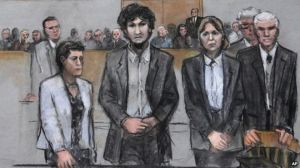
Tsarnaev showed no emotion as his death sentence was read.
ABC News reports: The Eerie Quiet in Court as Boston Bomber Dzhokhar Tsarnaev Sentenced to Die.
An eerie quiet settled over the federal courthouse in Boston today as victims and relatives of those killed in the Boston Marathon bombing heard a jury ordered Dzhkohar Tsarnaev to be put to death.
Liz Norden, who wanted Tsarnaev to get the death penalty for detonating the bomb that left two of her sons amputees and their bodies forever burned and scarred, cried quietly when the jury decided that the 21-year-old should die for his crimes.
Bill and Denise Richard, who strongly advocated against capital punishment for Dzhokhar Tsarnaev, sat stone faced as the verdict was read, even though it was their 8-year-old son Martin who was the youngest victim killed in the horrific attack….

Boston bombing victim Martin Richard.
Inside Courtroom 9 the jurors, seven women and five men, stood as the verdict slip was read, as did Tsarnaev. One male juror removed his eyeglasses and wiped his eyes with a tissue and leaned his body into the rail of the jury box as if to prop himself up. Two female jurors, their cheeks flushed red, sipped from water bottles. Another woman had her arms crossed in front of her.
Tsarnaev never looked toward the jury box, not even when it became clear that those men and women decided he should be put to death. One of his defense attorneys, Miriam Conrad, covered her mouth with her hand. Once the verdict was read, police in court including Watertown Police Chief Ed Deveau and Boston Police Commissioner Bill Evans, who is personal friends with the Richard family, exchanged glances.
Throughout it all, the mood in the courtroom was heavy and subdued. The judge’s clerk Paul Lyness admonished those assembled inside before it began that “any outbursts” would be treated as contempt of court. There were none.
Tsarnaev will most like await his appeals at a Federal prison in Terre Haute, Indiana.
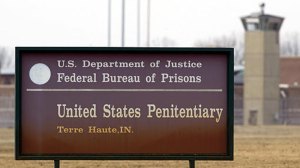
Guantanamo North
The Indy Star reports: If Boston Bomber is executed, it’ll likely be done in Indiana.
According to an official at the Federal Bureau of Prisons, Terre Haute is the only prison that has the special confinement unit that houses federal death row inmates. While the BOP could not go as far as to say that Terre Haute is the only prison where a federal inmate could be put to death, every federal execution has taken place at the facility since 2001.
Timothy McVeigh, Juan Raul Garza and Louis Jones Jr. were the last three inmates to be strapped to the table in the western Indiana prison and have a lethal drug cocktail run through their veins.
Tsarnaev may now face that same fate.
Larry A. Mackey, the attorney who tried both of the Oklahoma City bombing cases and delivered the prosecution’s closing argument in McVeigh’s, told The Indianapolis Star it’s “highly, highly unlikely” Tsarnaev will win his appeals.
“The judge has been very careful in protecting the defendant’s rights,” said Mackey, who has been following the case closely since it went to trial in March.
Sometime in the next 60 days, Mackey said a formal sentencing hearing will be held, and Tsarnaev will return to court with his council for the judge to impose the jury’s decision to put him to death.
Following the hearing, Tsarnaev will be transported to Terre Haute’s special confinement unit where he’ll wait out the exhaustion of his appeals, said Mackey.

Death chamber at Terre Haute supermax prison
More on the Terre Haute prison from the Boston Herald:
The 1,400-inmate, all-male U.S. Penitentiary at Terre Haute, Ind., is the likely landing spot for the 21-year-old Tsarnaev, who would be housed at the prison’s “special confinement unit” with the other 50-plus inmates on federal death row.
Since the federal death penalty was reinstated in 1988, 74 federal convicts have been sentenced to die for their crimes, but just three have actually been executed and another 10 have been taken off death row, according to the Death Penalty Information Center. Sampson, who has since had his death sentenced overturned, first went to Terre Haute following his 2003 conviction.
All three who have been put to death — Oklahoma City bomber Timothy McVeigh, and Texans Juan Raul Garza and Louis Jones Jr. — were executed at Terre Haute’s in-house chamber.
Robert Nigh, who represented McVeigh, described the Indiana lock-up as a place where inmates “certainly had access to other inmates, commissary, reasonable opportunity for recreation, hygiene.”
The sight — and smells — of the prison’s “death house” still stick with him. “That was surreal,” he said. “When you walked into it, my recollection is (seeing) stark white walls, and it smelled and felt like a hospital or a clinic. It felt like a place where you go to get medical care. It had that feel to it. And it’s designed for the exact opposite.”
An article at Business Insider makes the prison sound a lot worse than the above description: What it’s like inside the terrifying super-max prison where the Boston Bomber is expected to be executed.
Though US Penitentiary Terre Haute has been open since 1940, Tsarnaev would likely be held in the Communications Management Units, a special unit opened in 2006 for terrorism-related offenses.
Because of the prison’s reputation for housing some of the country’s biggest security threats, some have called it “Guantanamo North.”
According to NPR, the units have 50 cells and house many men convicted in notable post-9/11 cases, as well as those involved in the 1993 World Trade Center bombing, the 1999 “Millennium” plot to bomb the Los Angeles International Airport, and multiple hijacking cases.
The Communication Management Units in the prison severely restrict communications between inmates and the outside world. Inmates are limited to two two-hour nonphysical visits per month, plus one 15-minute phone call per week.
Mail must be screened, copied, and evaluated before being delivered to inmates. All conversations must be in English.
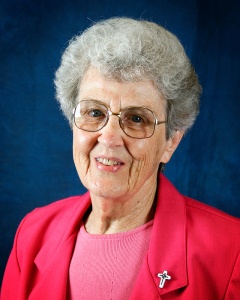
Sister Rita Clare Gerardot
According to Sister Rita Clare Gerardot, “a spiritual adviser to death-row inmates at Terre Haute,”
“They are in a small cell by themselves. All their meals are pushed through a slot. There is no recreation, but they can go out of their cells three times a week into cages,” Gerardot told The Tribune-Star, a newspaper in Terre Haute.
Inmates can speak to one another from the front of their cells, according to Gerardot, and have limited time to use a phone, e-mail, or a library.
“Truthfully, I don’t know how they keep their sanity. They have to be persons of great strength of will to get up every day, and know they have no choices,” Gerardot said.
Tsarnaev will likely wish he had died in the Watertown shootout like his older brother Tamerlan. And as the Boston Globe notes this morning “everything could have been different” for this young man.
Dzhokhar Tsarnaev could have been graduating from UMass Dartmouth this weekend. Martin Richard, Lingzi Lu, Krystle Campbell, and Sean Collier could still be alive.
But everything changed when Tsarnaev, along with his older brother, detonated a pair of bombs near the finish line of the 2013 Boston Marathon.
A 19-year-old sophomore at UMass Dartmouth at the time of the bombing, Tsarnaev was sentenced to death on Friday—while a commencement ceremony for the Class of 2015 was underway. He convicted in April on 17 capital charges and sentenced to death for six of them.
According to a UMass Dartmouth transcript introduced in court during the trial, Tsarnaev was an Engineering undergraduate with a mechanical engineering major during the Fall 2011 semester, his first in college. In the Spring 2013 semester, he was classified as a Arts & Sciences undergraduate with no declared major. The commencement ceremony for undergraduates in the College of Engineering was held Friday at the university’s Vietnam Veterans Peace Memorial Amphitheater. The ceremony for undergraduates in the College of Arts and Sciences is scheduled for Saturday.
Tsarnaev may never have graduated, even had he and his brother not chosen to perpetrate one of the worst terrorsist acts on U.S. soil. At the time of his arrest, he had a cumulative GPA of 1.094.
But perhaps he could have been among those students celebrating a new a beginning this weekend instead of facing a death sentence.
And everything could have been different.

Sister Catherine Ann Cesnik in 1970
We’ve been hearing a lot about corruption at the Baltimore Police Department lately. Yesterday I read a fascinating story about a cold case that shows the corruption there has a long history. If you’re interested in true crime stories and corruption in the Catholic Church, I highly recommend this piece by Laura Bassett at The Huffington Post,
Buried In Baltimore: The Mysterious Murder Of A Nun Who Knew Too Much.
It’s the story of the murder of a nun who had tried to help girls who were being sexually abused by at least one priest at a Baltimore Catholic school in the late 1960s. Here’s the introduction. I hope it grabs you and you decide to read the entire long article.
On a frigid day in November 1969, Father Joseph Maskell, the chaplain of Archbishop Keough High School in Baltimore, called a student into his office and suggested they go for a drive. When the final bell rang at 2:40 p.m., Jean Hargadon Wehner, a 16-year-old junior at the all-girls Catholic school, followed the priest to the parking lot and climbed into the passenger seat of his light blue Buick Roadmaster.
It was not unusual for Maskell to give students rides home or take them to doctor’s appointments during the school day. The burly, charismatic priest, then 30 years old, had been the chief spiritual and psychological counselor at Keough for two years and was well-known in the community. Annual tuition at Keough was just $200, which attracted working-class families in deeply Catholic southwest Baltimore who couldn’t afford to send their daughters to fancier private schools. Many Keough parents had attended Maskell’s Sunday masses. He’d baptized their babies, and they trusted him implicitly.
This time, though, Maskell didn’t bring Wehner home. He navigated his car past the Catholic hospital and industrial buildings that surrounded Keough’s campus and drove toward the outskirts of the city. Eventually, he stopped at a garbage dump, far from any homes or businesses. Maskell stepped out of the car, and the blonde, freckled teenager followed him across a vast expanse of dirt toward a dark green dumpster.
It was then that she saw the body crumpled on the ground.
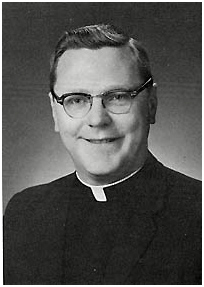
Father A. Joseph Maskell
The week prior, Sister Cathy Cesnik, a popular young nun who taught English and drama at Keough, had vanished while on a Friday-night shopping trip. Students, parents and the local media buzzed about the 26-year-old’s disappearance. People from all over Baltimore County helped the police comb local parks and wooded areas for any sign of her.
Wehner immediately recognized the lifeless body as her teacher. “I knew it was her,” she recalled recently. “She wasn’t that far gone that you couldn’t tell it was her.”
Cesnik was still clad in her aqua-colored coat, and maggots were crawling on her face. Wehner tried to brush them off with her bare hands. “Help me get these off of her!” she cried, turning to Maskell in a panic. Instead, she says, the priest leaned down behind her and whispered in her ear: “You see what happens when you say bad things about people?”
Maskell, Wehner understood, was threatening her. She decided not to tell anyone. “He terrified me to the point that I would never open my mouth,” she recalled.
Now, decades later, a group of women who attended Keogh back in those days are working together with a journalist and a former Baltimore police office to find out who killed Sister Cathy.
Did you like this post? Please share it with your friends:
Posted: May 12, 2015 | Author: bostonboomer | Filed under: Barack Obama, Crime, Criminal Justice System, Foreign Affairs, morning reads, U.S. Politics | Tags: Baltimore police, Benghazi, conspiracy theories, Freddie Gray, investigative journalism, Nepal earthquakes, Osama bin Laden, police brutality, Religion in America, Seymour Hersh |
 Good Morning!!
Nepal has been rocked by 7.3 magnitude earthquake only a few weeks after the last one. From The LA Times:
Still reeling from last month’s devastating earthquake, Nepal was hammered again Tuesday by a magnitude 7.3 temblor that caused dozens more deaths, unleashed fresh landslides and brought down unsteady buildings.
By late afternoon, Nepal’s Home Affairs Ministry said at least 42 people were killed and more than 1,117 injured in the largest aftershock yet recorded from the 7.8 quake on April 25. Officials warned that the toll could rise.
The epicenter was about 47 miles northeast of the capital, Katmandu, near the Chinese border, according to the U.S. Geological Survey. The April 25 quake, which killed more than 8,150 people, was centered in the mountains west of Katmandu.
The tremor struck just before 1 p.m. local time, sending residents of the capital scurrying into the open air for safety, and was followed by a series of smaller tremors that rattled nerves even further.
Within hours, new makeshift tents had begun popping up in parts of Katmandu as families that had survived the earlier quake and returned to their homes in recent days decided again they were safer sleeping outdoors.
The Hindu is publishing live updates from Reuters. They report multiple aftershocks. What a terrible tragedy! Obviously this is a developing story, and we’ll hear more throughout the day and in coming days.

I missed this important investigative article from the Baltimore Sun over the weekend: Freddie Gray among many suspects who do not get medical care from Baltimore police.
Records obtained by The Baltimore Sun show that city police often disregard or are oblivious to injuries and illnesses among people they apprehend — in fact, such cases occur by the thousands.
From June 2012 through April 2015, correctional officers at the Baltimore City Detention Center have refused to admit nearly 2,600 detainees who were in police custody, according to state records obtained through a Maryland Public Information Act request.
In those records, intake officers in Central Booking noted a wide variety of injuries, including fractured bones, facial trauma and hypertension. Of the detainees denied entry, 123 had visible head injuries, the third most common medical problem cited by jail officials, records show.
The jail records redacted the names of detainees, but a Sun investigation found similar problems among Baltimore residents and others who have made allegations of police brutality.e
Salahudeen Abdul-Aziz, who was awarded $170,000 by a jury in 2011, testified that he was arrested and transported to the Western District after being beaten by police and left with a broken nose, facial fracture and other injuries. Hours later, he went to Central Booking and then to Bon Secours Hospital, according to court records.
Abdul-Aziz said last week that jailers at Central Booking “wouldn’t let me in the door as soon as they saw my face. … I thought I was gonna die that day. Freddie Gray wasn’t so lucky.”
Read the rest at the Baltimore Sun link.

The Washington Post, which initially published leaks favorable to the Baltimore PD, published an editorial in response the the Sun article: Too much black and blue in Baltimore.
TWO OR three times a day on average, suspects in the custody of the Baltimore police are turned away by the city jail because they are deemed too battered, beaten, bruised or otherwise injured or sick to be processed and admitted. The police are forced to head instead for a hospital emergency room to seek treatment for suspects suffering from head injuries, broken bones, hypertension and an array of other afflictions.
The frequency of such occurrences was detailed over the weekend by the Baltimore Sun, which obtained records from the city’s detention center under the Maryland Public Information Act. According to those records, the jail has turned away nearly 2,600 ailing detainees since June 2012 — about 2 percent of all bookings.
That staggering figure suggests the Baltimore police are heedless, at best, of the physical welfare of suspects in their custody. It also may help explain how Freddie Gray could have pleaded for medical care at least five times after he was arrested last month before the officers who detained him bothered to summon a paramedic — by which time it was too late….
The police understand — and after 2,600 reaffirmations in three years, they should be acutely aware — that they are obliged to seek medical attention for suspects who are sick or injured before the jail will admit them. Yet somehow that obligation doesn’t seem institutionally ingrained in cops on the beat….
The Justice Department’s civil rights investigation of the city police, announced last week by Attorney General Loretta E. Lynch, should take account of these injured detainees, including the causes and circumstances of their injuries and whether police are adequately trained and instructed in assessing them. And it should examine whether African American suspects are more frequently hurt and denied prompt medical care than other detainees.
Journalists are still reacting to Seymour Hersh’s poorly sourced accusations that the Obama administration conspired with Pakistan to stage a fake raid on Osama bin Laden’s compound and then lied about it. Here are two I found this morning:
Lawfare: Hersh’s Account of the Bin Laden Raid is Journalistic Malpractice, by Yishai Schwartz
When a journalist writes a tell-all story about a classified operation, and he suspects the story will catalyze anti-American anger, provide fuel for terrorist groups, and cause severe friction with foreign governments, the act of publication is morally fraught. When the story is based on obscenely thin sourcing and careens into conspiracy theories, the decision to publish becomes indefensible.
Seymour Hersh has had a long and distinguished history as one of America’s finest investigative journalists. In recent years, he has gone a bit kooky. In 2011, for instance, he suggested that Stanley McChrystal, the former top commander in Afghanistan, and the leadership of the US Joint Special Operations Forces were “all members of, or at least supporters of, Knights of Malta.” His latest story, in which he claims that the entire story of Bin Laden’s killing is an elaborate cover-up for a joint Pakistani-American operation, may be his kookiest.
As many have already pointed out, Hersh’s version offers a combination of the inconsistent and the inexplicable. Why, for instance, would the Pakistanis help plan an elaborate raid, complete with a recall of Bin Laden’s Pakistani guards—rather than just hand Bin Laden over directly—if they always intended to claim he’d been killed in a drone strike hundreds of miles away? Worse, the key contentions rely on the exclusive word of one unnamed source who was a) retired, and b) on Hersh’s own account, only “knowledgeable about the initial intelligence about bin Laden’s presence in Abbottabad.”
To be sure, there are scraps of Hersh’s hodgepodge narrative that may turn out to be true. That a CIA “walk-in” may have contributed to the intel leading to Bin Laden’s whereabouts, for instance, matches a tidbit that NBC has confirmed recently. And Hersh’s insistence that someone highly placed in the Pakistani intelligence services knew of Bin Laden’s presence has been pretty widely believed for a while. But leaping from these plausible and relatively minor details to the rest of the fantastic tale Hersh spins simply boggles the mind.
It’s unsurprising then that The New Yorker passed on the story (as it, along with the The Washington Post, have reportedly done with the last few of Hersh’s flights of fantasy.)
The London Review of Books, on the other hand, lacked the same degree of restraint. This is hardly surprising given the editorial leadership’s apparent lack of interest in fact-checking. As LRB senior editor Christian Lorentzen wrote in a 2012 piece suitably titled Short Cuts,” “the facts are the burden of the reporter…nobody at the paper fact-checks full time; that’s an American thing… I miss New York sometimes, but I don’t miss its schizophrenic obsession with facts, or the puritan hysteria that attends the discovery that a memoir should have been called a novel.” The LRB, it seems, takes pride in its sloppiness. Perhaps they have an editorial opening for Stephen Glass?
As a former fact-checker, I find the LRB’s approach part puzzling and part offensive. As a citizen who would like to form judgements and opinions on the basis of actual information, I’m horrified.
Wow! Read more at Lawfare Blog.

Politico: Sy Hersh, Lost in a Wilderness of Mirrors, by Jack Shafer.
Hersh leads the reader into a Wonderland of his own, thinly sourced retelling of the raid on Bin Laden’s complex in Abbottabad, Pakistan. According to Hersh, who cites American sources, “bin Laden had been a prisoner of the [Pakistani Inter-Services Intelligence agency] at the Abbottabad compound since 2006” and his ISI captors eased the way for the American SEAL team to skip into Pakistan on their helicopters, kill the al Qaeda leader, and then skip out.
It’s a messy omelet of a piece that offers little of substance for readers or journalists who may want to verify its many claims. The Hersh piece can’t be refuted because there’s not enough solid material to refute. Like the government officials who spun the original flawed Abbottabad stories, he simply wants the reader to trust him.
Hersh may very well be onto something—what did the Pakistanis know, when did they know it, and how much did they help? And that debate appears to be starting in earnest already, with NBC News
quickly building off Hersh’s article. But Hersh’s potentially valid question on that subject is almost lost in the broad sweep of rolling back so many other stories and quibbling with effectively every known detail of one of the most thoroughly leaked secret operations in history.
By re-exploring the bin Laden operation, Hersh has thrust himself into the phenomenological territories that Cold War spymaster James Jesus Angleton called a “wilderness of mirrors.” In this clandestine world, truths are constructed, obliterated and bent to serve their masters. Adversaries who would deceive abound in this place, and without a reliable map, a compass, a sense of direction and maybe even a pedometer, even the most intrepid voyager (or journalist) can find himself lost. I’ll volunteer to join a search party for Hersh—somebody I’ve long admired—if only somebody can tell me precisely where he is.
Another harsh indictment. I expect “progressive” conspiracy theorists like Glenn Greenwald and Marcy Wheeler will attempt to keep this story alive, but it doesn’t seem to be getting much traction in either the mainstream media or the sane alternative media.

OLYMPUS DIGITAL CAMERA
More interesting stories, links only:
At Politico, former Deputy Director of the CIA Michael Morell recounts his Benghazi experiences: The Real Story of Benghazi. A CIA insider’s account of what happened on 9/11/12.
Pew Research Center, America’s Changing Religious Landscape. Christians Decline Sharply as Share of Population; Unaffiliated and Other Faiths Continue to Grow.
The Atlantic, American Religion: Complicated, Not Dead, by Emma Green.
Huffington Post, GOP Crowd Applauds Calling Immigrants Rats and Roaches, by Lauren Windsor.
Reuters, Verizon to buy AOL in push for digital content.
Fox News, Authorities say at least 7 victims found in Connecticut serial killer investigation.
NY Daily News: Connecticut serial killer already jailed for 2003 murder of still-missing woman: report.
What stories are you following today? Please share your thoughts and links in the comment thread, and have a terrific Tuesday!
Did you like this post? Please share it with your friends:
Posted: May 9, 2015 | Author: bostonboomer | Filed under: Foreign Affairs, morning reads, Republican politics, U.S. Economy, U.S. Politics | Tags: academic freedom, Boston University, Chicago Teachers Union, David Cameron, EU, freedom of speech, Illinois legislature, Illinois Supremem Court, Rahm Emanuel, Saida Grundy, Scottish independence movement, UK elections, world media |

Students study for finals on “BU Beach,” May 6, 2015
Good Morning!!
Well, well, well. Boston University and a newly hired assistant professor of sociology are being attacked by right wing nuts who can’t handle free speech or academic freedom. And so far BU is telling them they’re just going to have to deal with it. I hope they stick to their guns, so to speak. In honor of the school administration doing the right thing, I’m illustrating this post with views of the beautiful BU campus.
Fox News is shocked! Naturally, they begin with a version of “some people say….”
Boston University prof flunks ‘white masculinity’ in controversial tweets.
Critics say a newly-hired Boston University professor has crossed the line with recent tweets bashing whites, but the school says it’s simply free speech.
“White masculinity isn’t a problem for america’s colleges, white masculinity is THE problem for america’s colleges,” Saida Grundy, an incoming assistant professor of sociology and African-American studies at Boston University, tweeted in March.
In another tweet from January, she wrote: “Every MLK week I commit myself to not spending a dime in white-owned businesses. and every year i find it nearly impossible.”
In another, she called white males a “problem population.”
“Why is white America so reluctant to identify white college males as a problem population?” she asked.
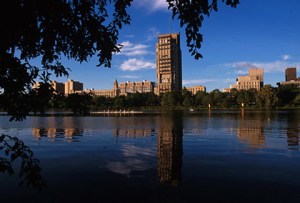
View of BU’s Charles River Campus.
Horrors! A black female sociologist who studies traditional masculinity had a few things to say on Twitter about white males. No one has to agree with her or even read her tweets (she has now made her account private). The KKK, the American Nazi Party, Rand Paul, Mike Huckabee, Peggy Noonan, Ted Cruz, Sarah Palin, Bill O’Reilly, Ann Coulter, and every other right wing nut you can name have the same rights to say mean things about any groups of people they choose.
Here’s BU’s response to Fox’s request for comment:
“Professor Grundy is exercising her right to free speech and we respect her right to do so,” Boston University spokesman Colin Riley said.
Read more of Grundy’s “controversial” tweets at the Fox News link and at a Patriots fan site here. I don’t know why they’re all bent out of shape about this.
Grudy got her Ph.D. at the University of Michigan, and her other credentials look pretty good to me.
So far there hasn’t been a lot of reaction to this except from right wing sites like American Thinker and American Spectator. I’ll be keeping an eye on the story and whether BU continues to defend Grundy. If they don’t I’ll be very disappointed. It’s not about agreeing with everything she said; it’s about not giving in to the predictable right wing attacks on anyone who says something they disagree with–even if it’s only on Twitter.

BU College of Arts and Sciences
In other “diversity” news, a restaurant in Colorado is planning a “White Appreciation Day.” That should make the wingnuts happy. From MSNBC:
A Colorado barbecue joint has sparked national outrage with a racially-tinged promotion: “White Appreciation Day.”
“We have a whole month for Black History Month. We have a whole month for Hispanic heritage month,” Edgar Antillon told KUSA-TV. “So we figured all we could do – the least we can do – is offer one day to appreciate white Americans.”
Antillon told the NBC News affiliate that Rubbin’ Buttz, the restaurant he co-owns in Milliken, Colorado, would observe its “White Appreciation Day” on June 11. On this day, all white customers will receive a 10% discount.
It’s worth noting that Antillon is a first-generation American born to Mexican parents, and he acknowledged to KUSA-TV that he has personally experienced racism in his past.
“We’re all American, plain and simple,” he said to the NBC News affiliate.
Apparently the whole thing started as a joke, and then Antillon decided to actually do it. Who cares? It’s dumb and pointless, unless the goal is just to get national publicity. Why not just ignore it? According to The Root, non-white people could end up suing the restaurant for discrimination. The outrage industry in this country is completely out of control.

6/7/10 1:07:44 PM — Boston, Massachusetts
Campus Scenics of Kemore Square, Boston Skyline, BU Banners and Commonwealth Ave
Photo by Vernon Doucette for Boston University
Now for a little actual news.
The Illinois Supreme Court has struck down an effort by the state to cut public employee pensions. The Chicago Tribune reports:
The Illinois Supreme Court on Friday unanimously ruled unconstitutional a landmark state pension law that aimed to scale back government worker benefits to erase a massive $105 billion retirement system debt, sending lawmakers and the new governor back to the negotiating table to try to solve the pressing financial issue.
The ruling also reverberated at City Hall, imperiling a similar law Mayor Rahm Emanuel pushed through to shore up two of the four city worker retirement funds and making it more difficult for him to find fixes for police, fire and teacher pension funds that are short billions of dollars.
At issue was a December 2013 state law signed by then-Democratic Gov. Pat Quinn that stopped automatic, compounded yearly cost-of-living increases for retirees, extended retirement ages for current state workers and limited the amount of salary used to calculate pension benefits.
Employee unions sued, arguing that the state constitution holds that pension benefits amount to a contractual agreement and once they’re bestowed, they cannot be “diminished or impaired.” A circuit court judge in Springfield agreed with that assessment in November. State government appealed that decision to the Illinois Supreme Court, arguing that economic necessity forced curbing retirement benefits.
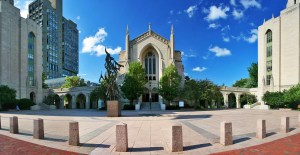
Marsh Chapel at center of Charles River campus
The court disagreed with the state, and really slapped down the Illinois legislature in their decision.
“Our economy is and has always been subject to fluctuations, sometimes very extreme fluctuations,” Republican Justice Lloyd Karmeier wrote on behalf of all seven justices. “The law was clear that the promised benefits would therefore have to be paid and that the responsibility for providing the state’s share of the necessary funding fell squarely on the legislature’s shoulders.
“The General Assembly may find itself in crisis, but it is a crisis which other public pension systems managed to avoid and … it is a crisis for which the General Assembly itself is largely responsible,” Karmeier wrote.
“It is our obligation, however, just as it is theirs, to ensure that the law is followed. That is true at all times. It is especially important in times of crisis when, as this case demonstrates, even clear principles and long-standing precedent are threatened. Crisis is not an excuse to abandon the rule of law. It is a summons to defend it,” he wrote.
Nice win for workers for a change.

Shot of BU buildings on Commonwealth Avenue
Also from the Trib, Chicago teachers are standing up for their rights too: Chicago Teachers Union files labor complaint against school board.
The Chicago Teachers Union has filed an unfair labor practice complaint accusing the city’s school board of bad-faith bargaining and refusing to engage in mediation toward a new contract.
Union officials said little progress has been made over eight formal bargaining sessions and numerous informal meetings since November. The complaint filed Wednesday with the Illinois Educational Labor Relations Board follows the union’s rejection earlier this week of the board’s proposal that teachers take on a greater share of pension payments….
As she did in the months before the 2012 teachers strike, CTU President Karen Lewis sought to make Mayor Rahm Emanuel the focus of the union’s displeasure with talks to replace a contract that expires June 30. The union again accused the city of using the talks to get back at the CTU for its support of Jesus “Chuy” Garcia in the mayoral election.
“We feel this is reactionary and retaliatory,” Lewis said at a news conference Wednesday. “I guess the fuzzy sweater’s gone,” she said, referring to Emanuel’s wearing a sweater in campaign commercials to indicate a softer personality.
The district, which says it is wrestling with a $1.1 billion deficit weighted with pension payments, wants to save millions of dollars by having teachers pay more into their pension fund. The district wants to end a long-standing agreement that limits teacher paycheck deductions for pensions, the union said.
I have a solution for Chicago’s and for the state of Illinois’s budget problems. Tax the rich. Blaming teachers and government workers isn’t going to solve your money problems. It’s just going to make everything worse. Tax the people who can afford to give something back to the government that constantly favors them.
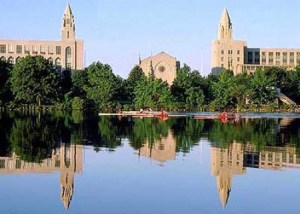
View of Marsh Chapel with Charles River in foreground
We haven’t discussed it here yet, but there was a big election in Great Britain with surprising results.
From The Washington Post after the scope of the conservative victory became clear: British election results point to commanding lead for Conservatives.
LONDON — Exit polls and partial results after a nationwide vote to pick Britain’s next Parliament showed the Conservative Party with a surprisingly commanding lead Friday, just short of a majority and in a strong position to return to power.
The projections defied virtually all pre-election polls, which forecast a virtual tie between the Tories and the opposition Labor Party in the popular vote. Both main parties had been expected to fall well short of the majority needed to claim power outright.
But as the counting continued into dawn Friday, all signs pointed to an emphatic margin in favor of the Conservatives and their leader, Prime Minister David Cameron, and to a major disappointment for Labor as well as the Liberal Democrats, who paid a steep price for having entered into a coalition with the Conservatives for the past five years.
At dawn Friday, Labor leader Ed Miliband delivered what amounted to a concession speech, saying it had been “a very disappointing and difficult night” for his party.
Meanwhile, in the election’s other stunning development, though one that had been predicted, the Scottish National Party (SNP) was redrawing the map of Scotland with what looked like a historic rout in what has long been one of Labor’s most reliable strongholds.

Another aerial view
The results in Scotland could have long-term significance for the “United Kingdom.” if the trend toward Scottish independence continues.
From the WaPo again: In U.K. election’s wake, questions on E.U., Scotland.
Newly empowered British Prime Minister David Cameron moved swiftly to establish the terms and priorities for his new government on Friday after a stunning national election that delivered his Conservative Party an unexpected majority, devastated three other parties and redrew the political map of Scotland.
Following predictions that the post-election maneuvering to form a government might take days if not weeks, the Conservative Party’s big victory produced a quick end to speculation about what or who would be in charge.
But if the election produced an unexpectedly clear outcome, it may only have heightened the degree to which the country faces a period of internal debate, inward-looking politics and potential instability, with questions about the durability of the United Kingdom and its place in both Europe and the world still to be answered.
Cameron will have to find a way to manage resurgent Scottish nationalists who are demanding more powers and possibly another referendum on independence. Further, his pledge to hold a referendum to determine Britain’s future in the European Union will continue to raise uncertainty about the country’s commitments and reliability there.
From BBC News: World media fear UK EU exit, looser US ties.
A day after the surprise result in the UK elections, world media outlets have been taking a look at the ramifications.
European papers are concerned about the effect on the EU in the light of Prime Minister David Cameron’s promise to hold a referendum on leaving. And there is speculation that the Scottish nationalists’ spectacular gains may herald the break-up of the United Kingdom.
A US daily fears the result may be the harbinger of the end of the US-UK “special relationship”, but one Spanish daily is enthralled by a photo of Mr Cameron using cutlery to eat a hot dog.
See examples of media reactions at the link. International Business Times also collected world media reactions, and the stats freaks at FiveThirtyEight had to do some serious soul-searching about why they were completely wrong.
So . . . . what else is happening? Please post your thoughts and links on any topic in the comment thread and have a great spring weekend!!
Did you like this post? Please share it with your friends:
Posted: May 8, 2015 | Author: dakinikat | Filed under: morning reads | Tags: Bobby Jindal, defunding public education, higher education, Louisiana, public universities, student debt |
Good Morning!
I’m trying to get grades in so this will be super short. One of the most worrying trends to me is the disinvestment in public education. An important study was released that shows that a college education must be funded primarily by students or their families. I’ve believed for some time that getting rid of higher education was a goal of many conservative politicians because an educated person is a clear and present danger to despots. First, I’d like to share the study and a few articles written about it. Then, I’ll show you how that’s been brought to fruition here in Louisiana by Bobby Jindal and his slavish relationship to Grover Norquist whose goal in life is to shrink government so you can drown it in a bathtub.
I think this study and its findings are important because the incredible increase in standards of living that came about during the 1950s and 1960s was partially due to the GI Bill and the opportunity it provided to so many poor and working class men to attend college. Education is a path to better jobs and to smarter voting electorate. It’s necessary for a functioning democracy.
As a result of this sharp decrease in state funding, more than half of education and related expenses at public universities is now paid by students’ tuition.
“Public higher education in this country no longer exists,” said Hiltonsmith. “Because more than half of core educational expenses at ‘public’ 4-year universities are now funded through tuition, a private source of capital, they have effectively become subsidized private institutions. To eliminate the pile of debt that most students must now borrow just to finance their education, we need comprehensive policy reform that views higher education as a necessity.”
The study finds that decreases in state funding to their public universities represents the overwhelming reason why tuition is so high and why so many students have to take huge student loans to facilitate their education.
Commitment to public education has been an American social contract for quite some time. I can’t help but think that it’s actually part of a bigger plot to privatize as much as possible and to further close the path of upward mobility.
A new Demos report, Pulling Up the Higher Ed Ladder: Myth and Reality in the Crisis of College Affordability by Demos Senior Policy Analyst Robbie Hiltonsmith, finds that declining state support was responsible for nearly 80 percent of the rise in net tuition between 2001 and 2011. Examining public university revenue and spending data, he determines that rising costs for instruction and student services is responsible for much of the remainder, largely due to growing healthcare costs. Hiltonsmith also disproves the theory that colleges are spending beyond what is necessary to support their core academic functions, commonly known as administrative bloat. Increased spending on administration accounted for only six percent of tuition hikes.
“While administrative bloat is a popular theory, the data shows otherwise,” said Hiltonsmith. “This myth is not only blatantly untrue, but takes attention away from the real problem: states aren’t investing in their students. Instead, they’re saddling them with crippling, life-long debt.”
Research institutions employ just seven more staff per thousand students than they did since 1991, and 17 fewer than in 2001. The relative number of full-time faculty has remained constant and the number of executives and administrators has decreased relative to the size of the student body. New technology needs explain much of the increase in professional staff. However, universities have also shifted to employing more adjunct professors as a cost-cutting measure, a problematic trend whose effects have been well-documented.
I put this study downthread in yesterday’s post. NW Luna provided a link to the situation in Washington State–a liberal blue state–that has not bucked the trend.

The cost of educating a student at the University of Washington is about $400 less today, in inflation adjusted dollars, than it was 20 years ago. As executives and directors of large business and philanthropic organizations in Washington state, our board members can attest that this could not have happened without a strong commitment to efficiency and cost control.
The next time anyone questions why public university tuition is rising faster than inflation, remember this: Twenty years ago, the state government paid 80 percent of the cost of a student’s education and a student paid 20 percent. Today, the state pays 30 percent of the cost, and the student pays 70 percent. The state has systematically disinvested in our children’s future, and we view this trend with disappointment and alarm.
We truly appreciate the hard work of the governor, the Legislature and many others who work in the business, civic and education communities who this year helped put a halt to further cuts in public higher education and gave us the tools and flexibility needed to help us manage through the current crisis. However, losing half of our state funding over just a few years has radically and unduly shifted the burden of financing the higher-education system to students, who are taking on more and more family and personal debt. This debt load restrains the ability of many Washingtonians to fully pursue life’s opportunities.
Public higher education is an essential ingredient of a functioning democracy and a healthy economy, but the current financial model for its funding is broken and not sustainable. If Washington is to maintain affordable access to quality higher education for its citizens, something has to change.
 Louisiana is leading the pack in basically shutting down its universities. Governor Bobby Jindal’s fiscal mismanagement of the state has left all of its institutions of higher education in desperate straights. At this writing, nearly every university in the state is on its way to financial exigency which is basically bankruptcy for a public entity. Yet, this is a time when more educated workers are necessary.
F. King Alexander, the president of the Louisiana State University system, said Louisiana State (LSU) would consider declaring financial exigency—the equivalent of bankruptcy for academic institutions. And Alexander said as many as a dozen campuses throughout Louisiana could ultimately have to do the same.The cutbacks would mean an uncertain fate for all of the roughly three-dozen institutions within the state’s four university “systems,” including Louisiana state’s 10 campuses, the University of Louisiana’s nine, and 14 community and technical colleges. These institutions serve roughly 260,000 students total.
Declines in per-student legislative appropriations for public higher-ed institutions are almost ubiquitous across the U.S., a trend that traces back to the recession. Though levels have started to bounce back in recent years, the average state’s per-student allocation is still 23 percent less than it was before the economy took a hit. Generally, the federal government and taxpaying students end up shouldering that cost. Meanwhile, according to 2012 data, students are for the first time in years covering a larger chunk of their college tuition than their state governments are.
“States are getting out of the public higher-education business,” Alexander told me. Alexander, a vocal advocate for stronger state investment in higher ed, says he’s optimistic that the legislature will somehow cobble together a solution. (It has until June 11, when Louisiana’s legislative session ends.) But even if lawmakers pass measures that would offset most of the shortfall, including a number proposed by Jindal, state higher-ed funding would still be cut by 32 percent, Alexander said.
By 2025 six in 10 adults in the U.S., according to one report, will have to have a postsecondary credential if the country is to maintain its economic edge. But if current trends continue over the next few decades, most state university systems would soon lose all funding from their states. A new analysis by the Pell Institute predicts that, assuming trends persist, in 2025 Colorado would become the first state to allocate zero funding to higher ed; Iowa would follow in 2029, then Michigan (2030), then Arizona (2032). Louisiana (2027) would be No. 2 on the list—if the deficit is miraculously eliminated this year. Otherwise, according to King, even a 32 percent reduction would put Louisiana in front of Colorado. Most states wouldn’t appropriate any university funding by 2050.
Louisiana’s universities are the canaries in a bigger coal mine. It should serve as a warning to any one who cares about access to higher education for all.
So, I’m going back to grading and I leave this as an open thread for you.
What’s on your reading and blogging list today?
Did you like this post? Please share it with your friends:








 peej
peej Carissa
 bostonboomer
 dakinikat
 ecocatwoman
 jjlo
jjlo mablue2
 Mama Lopez
 peggysue22
 quixote
 skydancingguestblogger
 Mona (aka Wonk the Vote)





Recent Comments