
Tuesday Reads: Super Duper Tuesday
Posted: March 15, 2016 Filed under: morning reads, U.S. Politics | Tags: 2016 presidential primaries, Bernie Sanders, Donald Trump, Florida, Hillary Clinton, Illinois, Marco Rubio, Missouri, NEGATIVE campaigning, North Carolina, Ohio, Super Duper Tuesday March 15 47 Comments
Voting day is coming up soon oh boy, Richard Hubal
Good Day!!
Sorry to be so late in posting today. I’m really struggling with a sinus/chest cold and I don’t have much energy these days.
Today’s primary elections will actually be bigger for the Democrats than Super Tuesday was. The media is playing up the possibility that Sanders could win in Ohio, Illinois, and Missouri; but even if that happens, which I think is doubtful, Clinton should win handily in Florida and North Carolina. She will most likely end the night with an expanded delegate lead.
Trump will probably sew up the Republican nomination, especially if he beats Marco Rubio in Florida, which looks likely.
The attacks on Hillary Clinton are escalating as she gets closer to becoming the first woman presidential nominee of a major political party.
It’s kind of difficult to remember now, but at the beginning of the primary campaign, Bernie Sanders promised to run a positive campaign focused on the issues. It’s been quite awhile now since he switched to attacking Hillary Clinton personally and using innuendo to question her integrity. NBC News examines his move to negative campaigning.
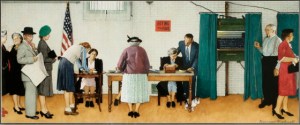
Election Day 1944, Norman Rockwell
A Month on Offense: How Sanders Upped His Attacks on Clinton.
The candidate who went out of his way to avoid attacking his rival throughout the summer, fall and winter has relentlessly unleashed on Clinton for three straight weeks, focusing on familiar talking points now strung together as a fixture of his stump speech.
“Now let me say a few words about some of the strong differences of opinion that I have with Secretary Clinton,” he now normally begins one portion of his speeches before hitting her on a litany of issues. The go-to critiques include trade, the Iraq War, and Clinton’s use of Super PACs.
Boos and heckles quickly arrive from his supporters as they outwardly delight in hearing the differences between their candidate and the Democratic frontrunner.

Chairing the Member, Hogarth 1755 (London)
Sanders no longer makes any effort to tone down his followers’ abuse of Clinton and her supporters–whether in rallies or on social media. Instead, he encourages it.
Depending on the day, Sanders also has dinged Clinton on her and her husband’s support of the “homophobic” Defense of Marriage Act (DOMA) and her support from former Secretary of State Henry Kissinger.
“I do not want Henry Kissinger to ever praise me!” he roared during a Michigan rally at Grand Valley State University near Grand Rapids.
The shift in tone has been drastic. In 2015 and early 2016, even uttering Clinton’s name would draw headlines—then unwanted by the candidate himself.
“I cannot walk down the street—Secretary Clinton knows this—without being told how much I have to attack Secretary Clinton,” Sanders told NBC News’ Andrea Mitchell during the NBC’s January Democratic Debate, “Want to get me on the front page of the paper? I make some vicious attack. I have avoided doing that. I am trying to run an issue-oriented campaign.”
He still emphasizes issues, but things have changed since that debate.
They certainly have. Sanders has become just another dirty politician shouting lies and half-truths about his opponent. In on-line forums, his followers have taken his behavior as encouragement for stunningly sexist and racist attacks on Clinton. The similarities between the Trump and Sanders campaign are growing as time goes on. I don’t like to think what will happen if Sanders loses in Illinois or Ohio tonight.
Go to the NBC link to read the rest. It’s a long piece.
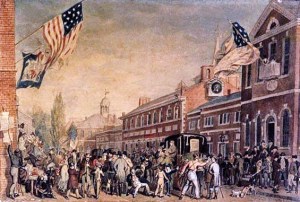
Philadelphia Election Day 1815, John Lewis Kimmel
The media has found another gaffe to hang on Hillary. In her “town hall” with Chris Matthews on MSNBC last night, she said that “we didn’t lose a single person” in the 2011 Libyan intervention. Naturally, that is being interpreted to mean that she has forgotten the deaths of Ambassador Christopher Stevens and four others in the terrorist attacks of September 11, 2012. Politico:
“Libya was a different kind of calculation. And we didn’t lose a single person. We didn’t have a problem in supporting our European and Arab allies in working with NATO,” the former secretary of state said during an MSNBC town hall on Monday night.
Clinton may have been referring strictly to the U.S.-backed overthrow of Libyan dictator Muammar Qaddafi in 2011, which indeed saw no loss of American lives and cost just around $1 billion. But her comments ignore the 2012 attacks at the U.S. mission and CIA outpost in Benghazi, which killed four people including U.S. Ambassador J. Christopher Stevens.
Right. After years of being attacked and blamed for the deaths of four people, Clinton has probably just forgotten all about them. Good grief.
The Sanders campaign committed a far worse gaffe yesterday.
Jane Sanders appeared with racist, anti-immigrant Sheriff Joe Arpaio in Arizona and actually let him lead her on a tour of his “tent city.” It’s not clear the campaign planned this meeting, but why didn’t they hustle her away immediately when Arpaio showed up?
Channel 12 News: Jane Sanders meets with Sheriff Joe Arpaio, tours Tent City.
Jane Sanders wasn’t planning a tour of Tent City on Monday, but Sheriff Joe Arpaio made her an offer she couldn’t refuse.
Sanders planned to view Tent City from the fence, with the help of Puente leader Carlos Garcia. But Arpaio hustled over here from another news conference and the two of them talked policy, politics and Ben and Jerry’s Ice Cream. Sanders also asked inmates about the conditions and why they were in Tent City.
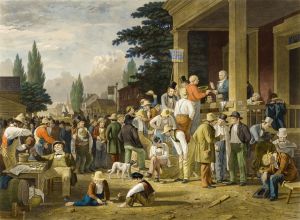
The County Election, George Caleb Bingham
And of course, we know that Sanders surrogate Ben Cohen told Fox News he didn’t know if he could vote for Hillary Clinton in November. Jane Sanders later tweeted that she wasn’t expecting Arpaio to show up, but the damage was done.
As an antidote to the Clinton bashing from Sanders and the media, I suggest reading this post by Peter Daou at Blue Nation Review: Hillary Clinton Is (By Far) the Most Trusted Candidate in 2016.
Let’s define “most trusted” in its literal — and most measurable — sense: More people trust X than anyone else.
And let’s further refine that definition to an act of trust, such as a vote or public endorsement….
Hillary has been endorsed by a greater number of respected public figures and organizations than any other candidate. And more importantly, she leads all other candidates in the popular vote….
Take Bernie Sanders. He had the opportunity to vote against Hillary’s nomination for Secretary of State. After all, he voted against Tim Geithner for Treasury Secretary. Instead, he voted to confirm her, an affirmation of his trust in her ability to represent America to the world….
Think about the numerous political leaders, public officials, organizations, and labor unions who trust Hillary with their future. President Obama, John Lewis, Emily’s List, Lilly Ledbetter, Dolores Huerta, Jim Clyburn, Planned Parenthood, Human Rights Campaign, Julian Castro, Brady Campaign, Eric Holder, League of Conservation Voters, Tammy Baldwin, Kirsten Gillibrand, Claire McCaskill, Cory Booker, Sheila Jackson Lee, Bernice King, and countless more….
Most significantly:
NEARLY 5 MILLION VOTERS HAVE PLACED THEIR TRUST IN HILLARY.
That’s more than any other candidate in the 2016 election.
Let’s see what the media is saying about the possible outcomes of today’s primaries.

Graffiti in the central square of Tixtla, home of the rural normal school at Ayotzinapa, reads “Ayotzinapa lives. Voting causes death. Cursed government,” in Tixtla, Mexico, Saturday, June 6, 2015. (AP Photo/Rebecca Blackwell)
The Guardian: From Ohio to Florida, your cheat sheet for the next crucial primaries.
Although this Tuesday will be less frantic than Super Tuesday two weeks ago, when 12 states and one territory held primary elections, it’s just as important. By 16 March, the race for the White House could look very different depending on how Florida, Illinois, Missouri, North Carolina and Ohio vote.
That’s partly because the delegate numbers in those states are so high – in total, 367 Republican and 792 Democratic delegates are available on 15 March. That brings us significantly closer to the finish line of having just two presidential candidates: at the moment, 33% of Democratic delegates have been pledged but by the time the polls have closed on 15 March, that number will rise to 50%. For Republicans, pledged delegates will jump from 46% to 61%.
Those percentages just mean that playing catch-up gets harder from here. Hillary Clinton is still on track for the nomination – to change that, Bernie Sanders needs to pick up at least 326 of the pledged delegates (in the Democratic race there are also 712 “superdelegates” who are not pledged to a specific candidate based on primary results, so they’re less relevant here).
On the Republican side:
The Republican contest is also likely to change significantly. If, for example,Marco Rubio fails again to pick up a single delegate (and polling suggests that’s a real possibility), his pursuit of the 1,237 delegates needed to win the Republican nomination becomes futile – even if he were to win every single remaining delegate after 15 March. That’s partly because, unlike Democrats, Republicans do not always distribute delegates in proportion to votes. In fact, four states holding Republican primaries on 15 March will be the first in this election to assign delegates on a winner-takes-all basis, which is why this date is such a turning point in the 2016 political calendar.
Check out some interesting charts as well as detailed discussions of each state’s demographics at the link.

Election day graffiti in Afghanistan, 4/4/2014
The Washington Post: March 15 primaries: Will voting in 5 states cement front-runners?
Voters are casting ballots in the five states across the Midwest and Southeast holding primaries Tuesday — contests that could shore up the two front-runners or breathe new life into the lagging campaigns of their challengers.
On the Democratic side, Sen. Bernie Sanders (Vt.) was working to pull off more come-from-behind wins in states where voters feel damaged by globalization, allowing him to claim momentum from Hillary Clinton. The former secretary of state enjoys a sizable lead in delegates but has not been able to seal the nomination.
The contests are especially important on the Republican side, offering a chance for billionaire Donald Trump’s remaining rivals to finally slow his march to the nomination with two winner-take-all contests that have particularly high stakes for a pair of favorite sons, Sen. Marco Rubio of Florida and Gov. John Kasich of Ohio.
This one is a long and interesting read. I suggest you check out the whole thing at the link.
CNN: What’s Next if Marco Rubio Loses Florida?
Rubio, who began his White House campaign 11 months ago as a hero of Florida Republicans, now faces the prospect of defeat in his home state. For years, Republicans believed that Rubio was destined to be a presidential nominee and that even if he fell short in 2016, he would be well-positioned to run for governor in 2018.
But polls suggest Rubio might not just lose Florida — but get thumped here. A Quinnipiac survey released Monday found Rubio trailing Trump by 24 points in his home state.
A loss of that magnitude could be devastating to Rubio, and leave him in a tough spot if he ever wanted to seek public office again.
Quite a comedown. It will be interesting to see what happens when the polls close in Florida.
Florida’s polls close at 7PM ET (8PM in the Panhandle), North Carolina’s and Ohio’s at 7:30 ET, and Illinois’s and Missouri’s at 8PM ET.
So . . . what are you hearing and reading? Let us know in the comment thread, and please stick around for an exciting day! I’ll add a live blog later on for discussion of the returns.
Lazy Saturday Reads: Clinton’s Embarrassing Memory Error and Escalating Violence at Trump Rallies
Posted: March 12, 2016 Filed under: morning reads, U.S. Politics | Tags: Bernie Sanders, Donald Trump, Hillary Clinton, presidential debates, presidential primaries and caucuses 51 Comments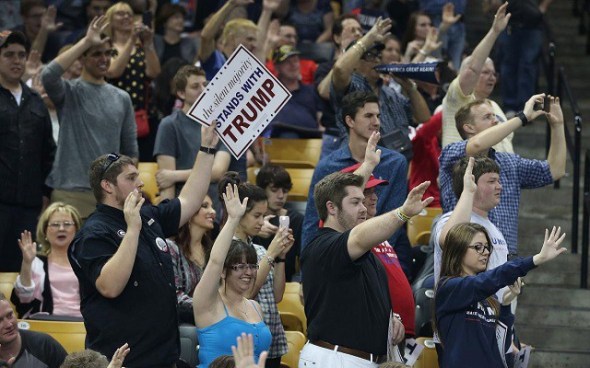
Probably nothing to worry about: People raise arms pledging to vote for Trump at the University of Central Florida on March 5, 2016 in Orlando (h/t Slate) Joe Raedle/Getty Images
Good Morning!!
It has been a long and disturbing week for us political junkies. On Sunday night there was the Democratic debate from Flint. We’ve had a number of presidential primaries and caucuses, two Democratic debates and a Democratic town hall, and a Republican debate.
We watched one of the most famous and accomplished women in the world be shushed at the debate in Flint, MI by the 74-year-old not-quite-so-accomplished white man who is running against her.
We watched as debate moderators in Miami asked her “who gave you permission” to use a private email server; and suggested she might be indicted for doing what past Secretaries of State and high level government employees have been doing forever. We cringed as she was forced to respond to insulting questions about why some people don’t like or trust her.
Yesterday we saw her viciously attacked after she made an embarrassing mistake while trying to say something kind about Nancy Reagan at the latter’s funeral. Yes, she made a serious gaffe, but she immediately apologized with no hedging or excuse-making. Note that her opponent has never apologized for a single thing he has said or done–including his sexist behavior and comments.
On the Republican side, we watched another shudder-inducing debate and the country witnessed escalating violence and hate speech at Donald Trump’s rallies.
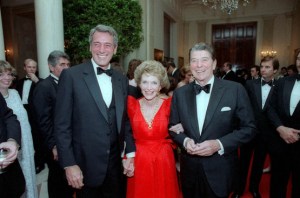
Rock Hudson at the White House a year before his death from AIDS
On the Nancy Reagan story, I think what Hillary was probably thinking of was Nancy’s efforts later in the Reagan years to convince her husband to soften his stance on funding AIDS research. It was too little, too late, but it did in fact make a difference in terms of making the AIDS epidemic more visible to the millions of Americans who had previously been ignorant about it. From The Advocate: Remembering Nancy Reagan, Her Involvement in AIDS Crisis.
She is being remembered today as the creator of the “Just Say No” to drugs advertising campaign, but most importantly as a powerful ally for her husband, not shy about speaking her mind on political matters affecting Ronald Reagan throughout his career, including as governor of California.
Her husband, though, is notorious among LGBT activists who survived the Reagan presidency, when the AIDS crisis raged, and when the president largely ignored the problem. Reagan didn’t give a formal speech about the epidemic until 1987, after thousands had died. In 1985, he was named The Advocate’s Homophobe of the Year and repeatedly made that annual list.
Nancy Reagan is sometimes credited with pushing her husband to do something about AIDS, and he eventually supported some funding for research. The death of their friend, actor Rock Hudson, is often referred to as a pivotal moment.
But, the Advocate notes, the Reagans refused to help a dying Hudson when he begged them to get him admitted to a French military hospital that supposedly had a “special treatment.” Nancy’s friend Elizabeth Taylor reportedly asked Nancy to get in involved in the AIDS issue, and Nancy was “frosty” about it. However, Nancy later supported marriage equality, according to her daughter Patti.
“She does,” Davis said during a radio interview with Michelangelo Signorile. “I’m hesitant to speak for anyone else, and she’s not comfortable going out in the public eye and getting in the firing line of anything. So, you know, I want to be cautious about speaking on someone else’s behalf. But let me put it this way: I think if she had disagreed with what I said publicly about my father she would have said something publicly. … Let’s just put it that way. That’s the most sort of politically correct way I can answer that question.”
The first same-sex couple to room together at the White House might also be due to Nancy Reagan. According to a 1984 column reportedly published in the Washington Post, interior decorator Ted Graber spent the night with Archie Case while celebrating Nancy Reagan’s 60th birthday.
The Advocate also linked to some PBS clips about Nancy’s role in the AIDS crisis.

C. Everet Koop
Ronald Reagan’s Surgeon General C. Everett Koop, a right wing Christian, also made efforts to deal with the AIDS epidemic. From Slate:
When C. Everett Koop accepted his post as the U.S. surgeon general in 1982, few thought he would become one of the most outspoken advocates of sex education in public schools. Koop was an emerging leader within the Christian pro-life movement, and his conservative credentials caught the attention of Ronald Reagan’s team, who approached him about serving as surgeon general even before the 1980 election. Koop’s appointment reflected Reagan’s appreciation for the conservative evangelicals who voted him into office.
Much more at the link.
Hillary’s words were hurtful to many people, and everyone has the right to feel anger, disappointment, forgiveness, or any other emotional reaction. However, she did quickly realize her mistake and she immediately apologized. I hope she isn’t going to be crucified for it. History is complex and so are people, and human memory is often inaccurate.
Now on to another issue that involves not just words, but actions–the escalating violence at Donald Trump’s campaign rallies.
Last night hundreds of protesters disrupted a Trump rally in Chicago, causing Trump to abruptly cancel his appearance at the University of Illinois Chicago. CNN reports:
Donald Trump’s campaign on Friday postponed a rally in Chicago amid fights between supporters and demonstrators, protests in the streets and concerns that the environment at the event was no longer safe.
The announcement, which came amid large protests both inside and outside the event at the University of Illinois at Chicago, follows heightened concerns about violence in general at the GOP front-runner’s rallies. Illinois holds its Republican primary on Tuesday.
Hundreds of demonstrators packed into an arena, breaking out into protest even before Trump had shown up. At least five sections in the arena were filled with protesters.
“Mr. Trump just arrived in Chicago, and after meeting with law enforcement, has determined that for the safety of all of the tens of thousands of people that have gathered in and around the arena, tonight’s rally will be postponed to another date,” the Trump campaign said in a statement. “Thank you very much for your attendance and please go in peace.”

Demonstrators celebrate after Republican U.S. presidential candidate Donald Trump cancelled his rally at the University of Illinois in Chicago March 11, 2016. REUTERS/Kamil Krzaczynski
Chicago police later said they did not recommend cancelling the rally. That was Trump’s decision.
Several fistfights between Trump supporters and protesters could be seen after the announcement, as a large contingent of Chicago police officers moved in to restore order.
Supporters of Trump still inside chanted “We want Trump” after the event was canceled. Protesters, meanwhile, shouted “We shut s*** down” and “We stumped Trump.” Others chanted “Bernie” as supporters whipped out Bernie Sanders campaign signs.
Some protesters were being detained and forcefully carried out.
Earlier in the day there were problems at a Trump rally in St. Louis. KTLA reports: Violence Erupts at Donald Trump Rally in St. Louis; At Least 32 People Arrested.
Thousands of people attended the Missouri rally, and “battle lines” were drawn between supporters and protesters, MSNBC reporter Trymaine Lee tweeted.
At least 32 people were arrested in protests both inside and outside Trump’s rally at the Peabody Opera House, police said.
Thirty-one people were charged with disturbing the peace, and one was charged with third-degree assault. St. Louis police declined to provide further details….
At the scene in St. Louis, one man was seen with a blood-spattered shirt and tissues inside his nose, apparently stopping blood from flowing.
In video posted online, he could be heard saying, “he sucker punched me.”
It was not clear what led to his injury, and he was receiving medical treatment, according to a Black Lives Matter supporter who used the Twitter username @southards_3.
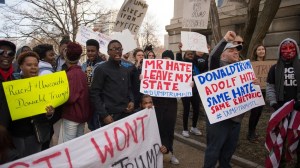
Protesters outside Trump’s rally in St. Louis yesterday. Getty images.
Here’s what Trump was saying during the St. Louis event, according to the Chicago Tribune:
Facing intensifying criticism for the violent clashes between supporters and protesters that have come to define his rallies, GOP presidential front-runner Donald Trump on Friday continued to taunt those who interrupt his events while promising that police and security would be “gentle” as they removed them.
“They’re allowed to get up and interrupt us horribly and we have to be very, very gentle,” Trump said in response to one of nearly a dozen interruptions as he spoke in St. Louis at the regal Peabody Opera House. “They can swing and hit people, but if we hit them back, it’s a terrible, terrible thing, right?”
Throughout his speech, Trump was deeply critical of the protesters, all of whom appeared to leave the venue largely without incident. Police later said that 31 people were arrested and charged with general peace disturbance, and one person was charged outside the venue with third-degree assault.
He panned the protesters as weak “troublemakers,” ordered them to “go home to mommy” or “go home and get a job” because “they contribute nothing.”
“These are not good people, just so you understand,” Trump said. “These are not the people who made our country great. These are the people that are destroying our country.”
This kind of encouragement of attacks on protesters has become standard behavior for Trump at his campaign appearances.
As Trump attempts to unify a fractured Republican Party, racially charged images of his supporters attacking protesters and allegations that he’s inciting violence have cast new attention on the divisive nature of his candidacy.
It intensified this week, when a North Carolina man was arrested after video footage showed him punching an African-American protester being led out of a rally in that state on Wednesday. At the event, the billionaire real estate mogul recalled a past protester as “a real bad dude.”
“He was a rough guy, and he was punching. And we had some people — some rough guys like we have right in here — and they started punching back,” Trump said. “It was a beautiful thing.”
Is this man really someone Americans want in the White House with access to nuclear codes?

For comparison: Ovation for Hitler in the Reichstag after announcing the successful Anschluss, 1938
Nick Gass at Politico on the St. Louis speech: Trump: ‘There used to be consequences’ for protesting.
“Part of the problem and part of the reason it takes so long [to kick them out] is nobody wants to hurt each other anymore,” Trump said during a speech at the Peabody Opera House — around 12 miles from Ferguson, Mo., the site of racially charged mass protests in 2014.
“There used to be consequences. There are none anymore,” Trump said. “These people are so bad for our country. You have no idea folks, you have no idea.” ….
“These people are so bad for our country, folks. You have no idea,” Trump continued during a longer break in the action. “They contribute nothing. Nothing. And look at the police, they take their lives in their hands.”
“We don’t even win here, with protesters anymore” he complained. “The protesters end up taking over. And frankly, I mean, have to be honest: From my standpoint it makes it a little more exciting, and it gives me time to think about where I want to go next. It’s beautiful. It’s like intermission. And the guys that are near the event, they see some pretty good stuff.”
Then Trump lashed out at the media.
“And these people in the media, the most dishonest human beings on Earth. They are the worst. They are the worst. So what they’ll do is they’ll take 10 minutes worth of clips of that and if one policeman accidentally moves a finger and touches this wiseguy, it’s like, ‘Oh, it’s the worst thing I’ve ever seen.’ And yet the police are being abused for 10 minutes, OK? ” he said. “Give me a break. Give me a break. We better toughen up, we better smarten up, and we better stop with this political correctness because it’s driving us down the tubes.”
After the events in St. Louis and Chicago, Trump cancelled an appearance in downtown Cincinnati. He has now rescheduled it at a suburban location.
A couple more links:
Mashable: All the times Trump has called for violence at his rallies.
Mother Jones: This Is What It Looks Like to Get Beat Up at a Trump Rally. Here are 10 really ugly incidents.
What are your thoughts on Hillary’s gaffe and Donald’s inciting of violence? What other stories are you following today?
Thursday Reads: Debate Hangover and Sanders’ Slip-Ups
Posted: March 10, 2016 Filed under: morning reads, U.S. Politics | Tags: Bernie Sanders, Florida Democratic debate, Hillary Clinton 40 Comments
Good Morning!!
The photos in this post come from a project called “Eyes as Big as Plates.” From the blog’s “about” page:
Eyes as Big as Plates is the ongoing collaborative project between the Finnish-Norwegian artist duo Riitta Ikonen and Karoline Hjorth. Starting out as a play on characters from Nordic folklore, Eyes as Big as Plates has evolved into a continual search for modern human’s belonging to nature. The series is produced in collaboration with retired farmers, fishermen, zoologists, plumbers, opera singers, housewives, artists, academics and ninety year old parachutists. Since 2011 the artist duo has portrayed seniors in Norway, Finland, France, US, UK, Iceland, the Faroe Islands, Sweden, Japan and Greenland. Each image in the series presents a solitary figure in a landscape, dressed in elements from surroundings that indicate neither time nor place. Here nature acts as both content and context: characters literally inhabit the landscape wearing sculptures they create in collaboration with the artists.
As active participants in our contemporary society, these seniors encourage the rediscovery of a demographic group too often labelled as marginalized or even as a stereotypical cliché. It is in this light that the project aims to generate new perspectives on who we are and where we belong.
I encourage you to go to the site and look at more of these amazing portraits of elders in nature.

The peacefulness portrayed in these beautiful photos stands in sharp contrast to the angry, violent, racist, sexist, and generally chaotic nature of today’s U.S. culture. Those characteristics are only being amplified by the presidential primary campaigns we have been watching for months.
I honestly don’t know how much more I can handle. Last night’s debate was hard for me to watch, and I got so angry at the questions put to Hillary Clinton that I had trouble sleeping. I’m feeling exhausted and I have a sore throat. I really don’t want to come down with another cold, so I’ll probably try to take a nap at some point. Anyway, if this post seems disjointed and littered with typos, you’ll know why.
I’m not going to say much about the questions asked of Hillary at the Washington Post/Univision debate. They were just plain disgusting, and I don’t want to get enraged again. She was asked about Benghazi, her Email non-scandal, and why nobody likes her. She was even asked if she would step down if she is indicted–a ridiculous and insulting questions that she refused to answer. It was disgraceful, and the Post and Univision should apologize to Hillary, the voters of Florida, and the general public.
In this post I’m going to focus on Bernie’s performance. In my rage last night I actually missed the bombshell that Bernie Sanders was hit with about his support for Fidel Castro when he was Mayor of Burlington, VT and refused to repudiate it. I don’t think he was asked about his strong support for Daniel Ortega (I will check the transcript and update if necessary), but I assume that Floridians will soon learn about that too.

Univision also showed the famous clip of Sanders on the Lou Dobbs show in which he argued against the Immigration bill that was sponsored by Ted Kennedy and supported by Hillary Clinton. I posted this article previously, but I’m going to include it again here, because it provides very good background information on Sanders’ support for dictatorial regimes in Latin America.
Michael Moynihan at The Daily Beast: When Bernie Sanders Thought Castro and the Sandinistas Could Teach America a Lesson.
In the 1980s, any Bernie Sanders event or interview inevitably wended toward a denunciation of Washington’s Central America policy, typically punctuated with a full-throated defense of the dictatorship in Nicaragua. As one sympathetic biographer wrote in 1991, Sanders “probably has done more than any other elected politician in the country to actively support the Sandinistas and their revolution.” Reflecting on a Potemkin tour of revolutionary Nicaragua he took in 1985, Sanders marveled that he was, “believe it or not, the highest ranking American official” to attend a parade celebrating the Sandinista seizure of power.
It’s quite easy to believe, actually, when one wonders what elected American official would knowingly join a group of largely unelected officials of various “fraternal” Soviet dictatorships while, just a few feet away, Nicaraguan President Daniel Ortega bellows into a microphone that the United States is governed by a criminal band of terrorists.
None of this bothered Sanders, though, because he largely shared Ortega’s worldview. While opposition to Reagan’s policy in Central America—including indefensible decisions like the mining of Managua harbor—was common amongst mainstream Democrats, it was rare to find outright support for the Soviet-funded, Cuban-trained Sandinistas. Indeed, Congress’s vote to cut off administration funding of the anti-Sandinista Contra guerrillas precipitated the Iran-Contra scandal.
But despite its aversion to elections, brutal suppression of dissent, hideous mistreatment of indigenous Nicaraguans, and rejection of basic democratic norms, Sanders thought Managua’s Marxist-Leninist clique had much to teach Burlington: “Vermont could set an example to the rest of the nation similar to the type of example Nicaragua is setting for the rest of Latin America.”
There’s much more about Sanders’ support for Daniel Ortega’s reign of terror in Nicaragua at the link.

As usual, there wasn’t a single question about abortion rights or the continuing efforts by Republicans to control women’s bodies, even though a horrendous Florida anti-abortion bill became law yesterday. Think Progress:
As presidential debates pile up, abortion rights advocates find themselves asking the same question after each event: Why is no one asking about abortion? But candidates’ silence on abortion was more deafening than usual at Wednesday night’s Democratic debate in Florida — where a controversial bill against abortion access was signed into law earlier in the day.
The Florida bill is nearly identical to the Texas law currently in front of the Supreme Court, using the guise of ‘supporting women’s health’ to significantly cut women’s access to abortion, contraception, and STI prevention and treatment services across the state. The Texas bill has already lead to thousands of unplanned pregnancies and100,000 self-induced abortions done by women unable to access a clinic. Latina women have been disproportionately affected by Texas’ bill — and with an equally large Latina population in Florida, the Sunshine State’s new bill could produce similarly grim results.
The Wednesday debate, co-hosted by Univision, focused heavily on immigration policy, specifically addressing the large population of Latino voters in Florida. But no moderater or candidate mentioned the impact Florida’s law could have on this population.

Because it’s apparently more important to ask Clinton stupid personal question that she has already answered repeatedly. And on Sanders’ admiration for Castro’s leadership of Cuba:
In 1989 Sanders traveled to Cuba on a trip organized by the Center for Cuban Studies, a pro-Castro group based in New York, hoping to come away with a “balanced” picture of the communist dictatorship. The late, legendary Vermont journalist Peter Freyne sighed that Sanders “came back singing the praises of Fidel Castro.”
“I think there is tremendous ignorance in this country as to what is going on in Cuba,” Sanders told The Burlington Free Press before he left. It’s a country with “deficiencies,” he acknowledged, but one that has made “enormous progress” in “improving the lives of poor people and working people.” When he returned to Burlington, Sanders excitedly reported that Cuba had “solved some very important problems” like hunger and homelessness. “I did not see a hungry child. I did not see any homeless people,” he told the Free Press. “Cuba today not only has free healthcare but very high quality healthcare.”
Sanders had a hunch that Cubans actually appreciated living in a one-party state. “The people we met had an almost religious affection for [Fidel Castro]. The revolution there is far deep and more profound than I understood it to be. It really is a revolution in terms of values.” It was a conclusion he had come to long before visiting the country. Years earlier Sanders said something similar during a press conference: “You know, not to say Fidel Castro and Cuba are perfect—they are certainly not—but just because Ronald Reagan dislikes these people does not mean to say the people in these nations feel the same.”
There is, of course, a mechanism to measure the levels of popular content amongst thecampesinos. Perhaps it’s too much to expect a democratic socialist to be familiar with the free election, a democratic nicety the Cuban government hasn’t availed itself of during its almost 60 years in power.
Again, much more at the link. I suppose Bernie supporters will be defending Latin American dictatorships after Bernie was finally questioned about all this last night.

Another interesting question Sanders was asked last night was about his support for the wacko “Minutemen” who were patrolling the Mexican boarder during the Bush administration.
Evan McMorris-Santoro at Buzzfeed (Dec. 9, 2015): In 2006, Bernie Sanders Voted In Support Of An Immigration Conspiracy Theory.
A few months before Democrats swept the 2006 elections, an outcry raged in the fringier corners of the immigration debate. Treasonous American officials were tipping off the Mexican government about the whereabouts of Minutemen patrols, the argument went, making it impossible for the private army bent on preventing undocumented immigrants from crossing the border to do their jobs.
The outcry made it to Congress, where Georgia Rep. Jack Kingston, a Republican, introduced an amendment clearly directed at the Minutemen story. The amendment barred the Department of Homeland Security from providing “a foreign government information relating to the activities of an organized volunteer civilian action group, operating in the State of California, Texas, New Mexico, or Arizona.”
Kingston’s amendment overwhelmingly passed the Republican-controlled Congress, including the votes of 76 Democrats, most of them from the party’s then-strong Blue Dog conservative wing. Another person voted for the measure, too: Rep. Bernie Sanders, an independent in the midst of the campaign that would send him the U.S. Senate….
For Sanders, the amendment is another in a string of past votes that aren’t quite in line with the exact progressive priorities of 2015. Much like past positions on guns that the senator has had to navigate this year, his immigration positions have at times posed some challenges with the new Democratic base and the party’s priorities….
The amendment was meant to protect the Minutemen, and only concerned the southern border of the United States. A short floor debate over the amendment took place on June 6, 2006. Republican backers of the amendment spoke of “the total lawlessness of people coming illegally over the border at night” and how the Minutmen — “definitely not politically correct in Washington, D.C.,” Kingston, the Republican sponsor said — “filled a void which the government was unable to fill.”

Read more about the amendment at the link. Sanders claimed last night that it was part of a larger bill so he had to vote for it, but it was actually a separate piece of legislation that Sanders voted for.
These are just a few examples of oppo research against Sanders that has been ignored so far by the media and pooh poohed by Bernie’s supporters. How would all this go over in a General Election? And I’m just talking about reactions from Democratic voters, not the vicious attacks that would come from the GOP.
Sanders’ vote against the auto bailout also came up last night; here are some enlightening tweets about that:
That’s all I’ve got for today. What are your thoughts on the debate after a night’s rest? What other stories are you following?
Tuesday Reads: Feel The Bern-Out
Posted: March 8, 2016 Filed under: morning reads, U.S. Politics 61 Comments
All I see is white people.
Good Morning!!
Today Michigan and Mississippi will hold primaries, and Bernie Sanders will fall farther behind Hillary Clinton in the delegate count for the Democratic nomination.
On the Republican side, in addition to the Michigan and Mississippi primaries, there will be a primary in Idaho and caucuses in Hawaii.
ABC News reports: Storylines to Watch in Tuesday’s 2016 Presidential Primaries and Republican Caucuses.
Republicans will vote Tuesday in the Idaho, Michigan and Mississippi primaries and the Hawaii Republican caucuses. Democrats in Michigan and Mississippi are also holding their primaries.
In total, 205 delegates are at stake for the two Democratic candidates. On the other side of the aisle, 150 are up for grabs for the four remaining Republican candidates.
Bernie has high hopes for Michigan, but at the end of the day he’s likely to be disappointed.
While campaigning in Michigan, Sanders has attacked Clinton with a heavy focus on trade, arguing that Clinton’s support of “disastrous trade deals” has led to job loss in the state.
“If the people of Michigan want to make a decision of which candidate stood against corporate America, stood against these disastrous trade agreements, that candidate is Bernie Sanders,” the Vermont senator said at a campaign rally in Traverse City, Michigan, last Friday.
“We think we’re going to surprise people here in Michigan,” Sanders said Sunday on ABC News’ “This Week with George Stephanopoulos.”
However, a NBC/WSJ poll conducted in Michigan shows Hillary Clinton with a major lead of 57 percent among Democrats to Sanders’ 40 percent.
Read more storylines at the ABC News link above.
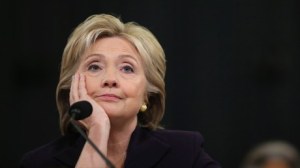
Sorry, Bernie. Black people in the northern states don’t vote differently from those in southern ones, despite your spin after Super Tuesday. Bernie on This Week:
“I think you’re going to see us doing — and I think the polls indicated it, much better within the African-American community outside of the Deep South,” Sanders said. “You’re going to see us much better in New York state where I think we have a shot to win, in California and in Michigan.”
Dream on. I said after Super Tuesday that we need to be kind to Sanders’ supporters, and that will be even more true tomorrow. They are going through a grieving process and many of them are young people who have never experienced this kind of loss before.
Last night, at the Fox News town hall, Hillary was gentle with Bernie, and we should follow her lead. It will be mostly over after today, but his supporters will still be telling themselves he can win Ohio and Pennsylvania. It’s not going to happen, but the Bernie fans will just have to find out for themselves.
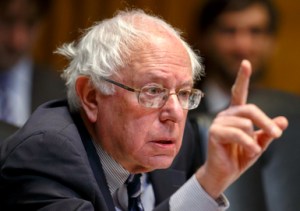
Excuse me . . .
Yesterday John Cole had an interesting post at Balloon Juice: I’ve Kind of Made My Decision. The gist is that he likes Bernie, but has decided to vote for Hillary. It’s a good read, and I suggest to go check it out at the link, but I want to highlight this section (emphasis added):
I know this is going to piss people off, and I know some of you are going to scream ageism, but watching Bernie last night, he just seemed old and tired and wearing down. I was initially leaning Bernie at the beginning of this primary (because of course I was), and every time I look at him he just looks less energetic and a little more beat down. His response latency seems to be increasing as he collects his thoughts, and last night I saw him lashing out angrily about “your Wall Street friends,” and those are just not things that can happen in the general.
I’m not trying to be ageist- I don’t think people his age can’t or shouldn’t be President, it’s just that as I have watched this primary election go on, Clinton seems to be getting stronger and more confident and more ready for the election, while I feel the opposite is true about Sanders. In my mind’s eye, she looks younger to me than she did at the beginning of this primary. Clinton seems to really becoming a happy warrior, despite all the heaps of bullshit the Republicans have thrown at her.
Maybe you don’t see it that way. But I do. I look at Hillary these days and think there is no doubt she could serve eight years right now, while some days I wonder if Bernie is going to make it to November. The Vice President is a backup plan for when things go horribly wrong, not a plan. Again, I’m sorry if my elders think I am bashing them by stating this, but I’m really not trying to- Bernie has more energy on a bad day than I do on a great day, but he just is really starting to look worn down. The contrast for me last night was palpable.
I strongly agree with Cole on this. Bernie is wearing down. I think part of it is age, but I think it’s also his perpetual anger and defensiveness.
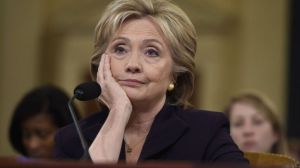
All right, I’ll wait for you to finish . . .
Hillary comes off as cool as a cucumber. She has dealt with so much shit over the years that she’s immune to it. As she is fond of saying, whenever she gets knocked down, she gets right back up stronger than ever. It’s clear that she loves the challenge of running as the first woman to become the nominee of any major party. And she is ready to be POTUS from day one.
Bernie, on the other hand, lets criticism and losses get under his skin. and when that happens, he lashed out and he makes unforced errors. He’s just not ready to be the nominee and definitely not ready to be POTUS.
MSNBC: ‘Ghetto’ gaffe highlights Bernie Sanders campaign’s struggle with race.
While discussing his own racial “blind spots” during Sunday night’s Democratic presidential debate in Flint, Michigan, Sen. Bernie Sanders offered that white people “don’t know what it’s like to be living in a ghetto. You don’t know what it’s like to be poor.” His comment drew swift condemnation on social media, since it appeared that the Vermont lawmaker was implying that only black people live in impoverished communities, reinforcing inaccurate and painful stereotypes that have dogged African-Americans for years.
Sanders’ “ghetto” gaffe underlined a persistent problem that may have crippled his bid for the 2016 nomination. He has struggled to connect with black voters, and his choice of words has often undercut a populist economic message that might have resonated with people of color.
Even if Sanders had the best of intentions, it was not his best moment, as evidenced by one of his most prominent African-American surrogates — former NAACP chairman Ben Jealous — who told NBC News: “Sen. Sanders is from Burlington, he grew up in old Brooklyn, he knows white folks live in ghettos.”
On Monday, Sanders attempted to clarify his debate statement, telling a gaggle of reporters in Detroit: “What I meant to say, is when you talk about ghettos, traditionally what you’re talking about is African-American communities.”
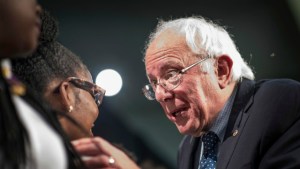
Bernie just can’t stop digging, can he?
Jonathan Capehart on the “ghetto” goof: ‘Excuse me!’ Bernie Sanders doesn’t know how to talk about black people.
When Sanders said that, I tweeted, “He knows that all Black people don’t live in ghettos, right?” His answer so threw me that I didn’t even hear him say that white people “don’t know what it’s like to be poor.” Sanders’s cab story might be true, but it also struck me as rhetorical grasping at straws. And for it to be an illumination to Sanders that he doesn’t “understand what police do in certain black communities” is more damning than you think. For in this one exchange, you see Clinton’s fluency in and understanding of the language of race and Sanders’s glaring ignorance.
You also see who the true Democrat is. It’s not Sanders.
Democrats, especially those with national ambitions, know how to talk to people of color, especially African-Americans. They are the base of the Democratic Party. You learn the nuances of their concerns and the issues important to them. You take them to heart. Fail to do that and watch your political career perish. As a former first lady of Arkansas, former first lady of the United States and former Senator from New York, Clinton can speak to Blacks with a fluency that lets African Americans know she gets it and gets them.
After Sanders’ early work on desegregation in Chicago, he doesn’t seem to have focused much on Civil Rights or even the anti-war movement of the 1960s and ’70s. He left Brooklyn in 1968 and moved to Vermont along with many other white people who were fleeing big cities; and it seems that he stayed in his white bubble right up until he began campaigning for the Democratic presidential nomination.
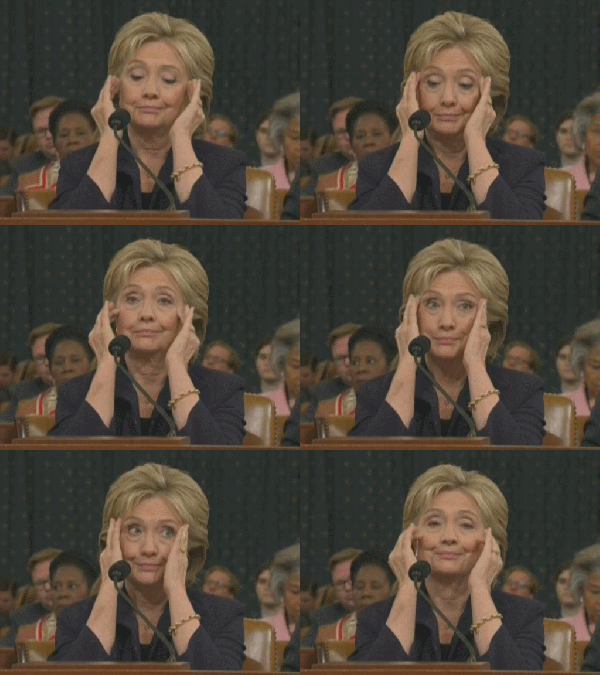
How much longer do I have to listen to this shouting?
I thought this was interesting out of Sanders’ hometown.
Brooklyn Paper: Turn up, tune in, Bern out: Sanders supporters say not all of Bushwick is behind Brooklyn’s son.
Not all of Bushwick can feel the Bern.
A band of hipster Brooklyn Bushwickans on the stump for Bernie Sanders from inside local industrial loft spaces is having a tough time convincing old-school neighbors to get out and vote for Brooklyn’s son, say the passionate organizers.
“There’s the original Bushwick community and the gentrified Bushwick community,” said Magenna Brink of the Bushwick Berners, who regularly gather to call voters over some brews while they plan their door-to-door outreach at their Forrest Street headquarters as well as the notorious McKibbin Street lofts. “The gentrified community, with all the hipsters and the young kids, are totally behind Bernie. The other community is kind of half-and-half.”
The berners say they have hit the streets to spread the word about their candidate of choice only to find many of the native residents are either not enamored with Sanders’ socialist policies or completely unaware he exists.
“In the lower-income communities, there were a ton of people who said they were Hillary supporters, but they didn’t even know who Bernie Sanders was,” said Brink.
New York is another state Sanders claims he can win, but the polls don’t agree with him.
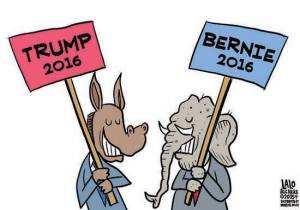
Today could be interesting on the Republican side too. It seems to me that Donald Trump has not been performing as well as he should be in recent contests, Ted Cruz has been showing a great deal of strength, and Marco Rubio has just about hit bottom. Here are a few interesting stories on the GOP race.
Politico: Is Trump peaking? We’ll find out today.
On Tuesday, Donald Trump will discover whether his weekend struggles were a speed bump — or the first signs of larger troubles ahead.
If the polls are to believed, Trump is in for a dominant day, with blowouts in Michigan and Mississippi to be complemented by another win in Idaho. If Trump falls short, and particularly if he falls short to Ted Cruz for the second time in four days, the businessman’s delegate math gets more complicated, and the soothsayers who’ve long predicted Trump’s collapse will finally see hope for vindication.
For the first time since Iowa, a non-Trump Republican took home the day’s largest haul of delegates last weekend, as Cruz on Saturday won handily in Maine and Kansas and ran a close second in Louisiana and Kentucky. Repeating that feat Tuesday would put more momentum behind the Texas senator’s campaign and strengthen his case as the GOP’s best, only hope of nominating someone other than Trump. Trump’s standing among Republican registered voters—down 3 points from January—nationwide fell slightly in the latest ABC News/Washington Post national poll released Tuesday, while the poll put Cruz up 4 percent, though Trump maintained a 9 point lead over Trump in the poll.
A relative lack of polling adds unpredictability to Tuesday’s votes. While Michigan has been heavily surveyed, Hawaii has gone uncovered, and sparse polls in Mississippi and Idaho are now out of date. Trump had large leads in past surveys, but they were conducted before Marco Rubio and several super PACs went all-out against Trump, before two raucous anti-Trump debates and before his losses to Cruz on Saturday.
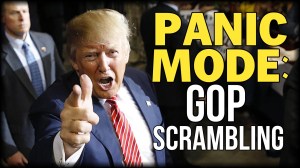
Washington Post: Seeing Trump as vulnerable, GOP elites now eye a contested convention.
The presentation is an 11th-hour rebuttal to the fatalism permeating the Republican establishment: Slide by slide, state by state, it calculates how Donald Trump could be denied the presidential nomination.
Marco Rubio wins Florida. John Kasich wins Ohio. Ted Cruz notches victories in the Midwest and Mountain West. And the results in California and other states are jumbled enough to leave Trump three dozen delegates short of the 1,237 required — forcing a contested convention in Cleveland in July.
The slide show, shared with The Washington Post by two operatives advising one of a handful of anti-Trump super PACs, encapsulates the newly emboldened view of many GOP leaders and donors. They see a clearer path to stopping Trump since his two losses and two narrower-than-expected wins in Saturday’s contests.
Read more at the link.
The Washington Post: Trump leads GOP race nationally but with weaker hold on the party.
Donald Trump continues to lead his rivals nationally in the contest for the Republican presidential nomination. But his hold on the GOP electorate has weakened since the primary season began, and the party is now deeply divided over his candidacy, according to a new Washington Post-ABC News poll.
Trump maintains the support of 34 percent of registered Republicans and Republican-leaning independents, compared with 25 percent for Sen. Ted Cruz of Texas, 18 percent for Sen. Marco Rubio of Florida and 13 percent for Ohio Gov. John Kasich.
Trump maintains the support of 34 percent of registered Republicans and Republican-leaning independents, compared with 25 percent for Sen. Ted Cruz of Texas, 18 percent for Sen. Marco Rubio of Florida and 13 percent for Ohio Gov. John Kasich.
Trump’s margin over Cruz has narrowed from 16 points in January to nine today. As a succession of Republican candidates quit the race, Cruz’s position has ticked up four points since January, Rubio’s has risen by 7 and Kasich’s grew by 11. Trump’s has dipped by three points, within the poll’s margin of sampling error.
What stories are you following? Let us know in the comment thread. We’ll have a live blog later this evening to discuss the primary and caucus results. Have a great Tuesday!
Live Blog: Fox News Democratic Town Hall
Posted: March 7, 2016 Filed under: morning reads, U.S. Politics | Tags: Bernie Sanders, Detroit Democratic Town Hall, Fox News, Hillary Clinton 58 Comments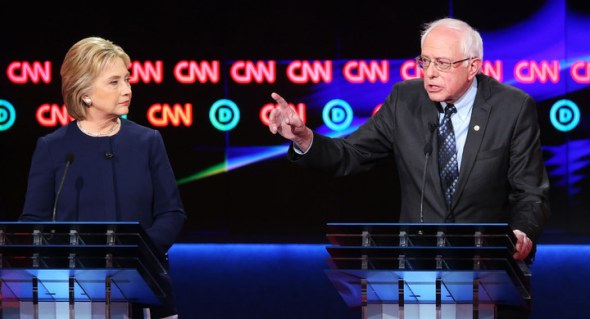
Hey There, Politics Junkies!
The Fox News Democratic Town Hall begins at 6PM. It looks like it will only last an hour, and if we’re lucky we won’t have to watch a scene like the one depicted above again tonight. The event will be held in Detroit. You can watch the live stream on the Fox News website.
Here are the basics from MichiganLive:
WHAT TIME IS THE TOWN HALL? The hour-long discussion is scheduled to start at 6 p.m. It will re-air at 11 p.m.
WHERE CAN YOU WATCH THE DEBATE?Fox News has not released information on tickets, but the town hall will air live on Fox News and will be live-streamed atFoxNews.com.
WHERE IS THE DEBATE? The town hall is scheduled to take place at the Gem Theatre in Detroit.
WHO WILL MODERATE THE DISCUSSION? Fox News’ chief political anchor Bret Baier will moderate.
WHAT WILL THEY TALK ABOUT? If Sunday’s debate in Flint is any indication, the bailout of the auto industry could be the hot topic Monday night.
The pair also discussed Detroit schools and racial inequity on Sunday.
Clinton and Sanders clashed over whether the Vermont senator supported the federal bailout that saved the auto industry.
I’m not sure if the two will be on stage together or not. If they are, I hope Senator Sanders will be on his best behavior.
Have fun!

 peej
peej Carissa
 bostonboomer
 dakinikat
 ecocatwoman
 jjlo
jjlo mablue2
 Mama Lopez
 peggysue22
 quixote
 skydancingguestblogger
 Mona (aka Wonk the Vote)





Recent Comments