
Friday Drumpster Fire Reads
Posted: January 12, 2018 Filed under: morning reads | Tags: Donald Trump is a RACIST, Donald Trump is a WHITE SUPREMACIST, Norway, Our Immigrants make us STRONGER 74 Comments
Good Morning Sky Dancers!
I have the task of once again introducing the politics of the day as less of a wonky conversation over policy than to report on how disturbingly unfit this president* is for office. He’s demonstrated that he’s a racist, xenophobe and misogynist over and over. Senator Dick Durbin is witness to yet another example of his virulent racism.
There are several germane questions in this discussion about immigration. The first is simple. Why would any one from Norway want to immigrate here? Back in 2014, I wrote “Heaven has Fjords” for this blog. Norway is probably the best country to live in for any one that’s not a greedy bastard, fascinated with the US, some one sent you here to work, or you’re just plain nuts.. It has 100% literacy and the world’s second best per capital GDP per capita which is considered the best measure of standard of living.
Without a doubt, the best country to live in the world these days going strictly by the statistics (and not the weather) is Norway. Take a look at the CIA fact book for all the good stuff on Norway then take a look at the United States. Norway has bested the USA in standard of living for quite some time. The United States keeps dropping on all lists and just in GDP per capita is now sitting at number 10. Norway is ranked first on the Human Development index of 177 countries, so essentially they are number one country for living the good life. It is second, only to Luxembourg, for GDP per capita.
Today’s New York Times covers the little country that can and its stellar economic performance in today’s global economic crisis. A lot of credit is goes to Norway’s socialist finance minister Kristin Halvorsen. She’s in charge of Norway’s $300 billion sovereign wealth fund that has been steadily buying stocks since March and is used to build a decent standard of living for every one in that country. Norway likes its government and its government works well. The Times article contrasts the economics of the U.S. and Norway and the U.S. comes up way short.
 But that’s just the second part of the bigger question. Why do we have an obviously racist, white supremacist president who wants to close the gates of the US to what he calls “shithole” countries that not so coincidentally are not shitholes and mostly have nonwhite majorities? First, he’s completely unaware of our nation’s historical ties to Haiti which has been long standing and positive. Second, he has no idea what he’s talking about when it comes to most of Africa and places that he’s never even been. His comments are beyond disturbing. They hateful, bigoted, racist, and wrong. They do not reflect the history or stated values of this country.
President Donald Trump referred to Haiti and African nations as “shithole countries” during a meeting with a bipartisan group of senators at the White House, a Democratic aide briefed on Thursday’s meeting told NBC News.
Trump’s comments were first reported by The Washington Post, which said the nations referred to by Trump also included El Salvador.
The U.N. human rights office said the comments, if confirmed, were “shocking and shameful” and “racist,” while Haiti’s foreign minister summoned the U.S. Chargé d’Affaires Robin Diallo for clarification.
Two sources briefed on the conversation say that during the portion of the conversation about Haiti — which came at the top of the exchange that led to the “shithole” comment — the president questioned why Haitians should be given specific consideration.
“Why do we need more Haitians, take them out,” he said, according to sources. Someone else in the room responded: “Because if you do, it will be obvious why.”
 Trump denies saying this and his KKKRonies are saying it was an awkward way of saying we need more skilled immigrants but Senator Dick Durbin is on the record as having heard that and more. And, I have to go back to more dancing goddess gifs to stomach this necessary conversation.
Donald Trump appeared to deny on Friday that he used the phrase “shithole countries” to describe Central American and African nations during talks with US lawmakers the day before. But one of the senators present contradicted Trump and called the remarks he had heard “hateful, vile and racist”.
But senator Dick Durbin, a Democrat was in the meeting, contradicted him in to local Chicago press on Friday morning. He said the president “in the course of his comments said things which were hateful, vile and racist”.
“He said these hate-filled things, and he said them repeatedly,” Durbin said.
On Thursday, Trump reportedly grew angry during a meeting about protections for immigrants from several countries, and asked: “Why are we having all these people from shithole countries come here?”
“Why do we need more Haitians?” he reportedly added. “Take them out.” He also reportedly suggested the US bring in more people from Norway.
Early on Friday, he denied the derogatory language. “The language used by me at the Daca meeting was tough, but this was not the language used,” he tweeted, using an acronym for a program to protect young undocumented immigrants. “What was really tough was the outlandish proposal made – a big setback for Daca!”
He later added: “Never said anything derogatory about Haitians other than Haiti is, obviously, a very poor and troubled country. Never said ‘take them out.’ Made up by Dems. I have a wonderful relationship with Haitians. Probably should record future meetings – unfortunately, no trust!”
“I cannot believe that in the history of the White House and the Oval Office, any president has ever spoken the words that I personally heard our president speak yesterday,” Durbin said. “I’ve seen the comments in the press and I’ve not read one of them that’s inaccurate.”
 The fallout should be swift and severe from this. So far, we’ve seen very little coming from the Republican side but the US Ambassador to Panama just resigned. Will this be a trend?
US Ambassador to Panama John Feeley, a career diplomat and former Marine Corps helicopter pilot, has resigned, telling the State Department he no longer feels able to serve President Donald Trump.
“As a junior foreign service officer, I signed an oath to serve faithfully the president and his administration in an apolitical fashion, even when I might not agree with certain policies. My instructors made clear that if I believed I could not do that, I would be honor bound to resign. That time has come,” Mr Feeley said, according to an excerpt of his resignation letter read to Reuters.
A State Department spokeswoman confirmed Mr Feeley’s departure, saying that he “has informed the White House, the Department of State, and the Government of Panama of his decision to retire for personal reasons, as of March 9 of this year.”
How could any moral person serve this president* and our country in any manner other than to seek his removal from office?
 What is really strange are these reports coming in about Trump’s own businesses including the ones he spends more time at than in the oval office.
A few minutes after the Haiti comment, the topic turned to immigration from African nations, prompting Trump to ask, “Why are we having all these people from s—hole countries come here?”
The Washington Post broke the news of Trump’s remarks Thursday afternoon, and the condemnation was swift and scathing.But setting aside Trump’s vulgar language, the president was essentially asking questions.
Luckily for Trump, the answer to one of them — namely, why America “needs more Haitians” — lies right outside the president’s front door.
That’s because The Mar-a-Lago Club, Trump’s mansion-cum-golf resort in Palm Beach, Florida, reportedly hires more of its seasonal foreign workers from Haiti than it does from nearly any other country.
Those Haitians come to the United States to work for Trump on H-2B visas, temporary work permits issued by the Department of Labor to employers who can’t find enough American workers to fill their need for low-skilled, seasonal labor.
At Mar-a-Lago, the season runs from November to April, when sunny Palm Beach is a mecca for wealthy Northerners escaping the cold.
For the 2017-18 season, the club applied for and received 70 H-2B visas. The foreign workers serve as cooks, housekeepers and servers, paid between $10 and $13 an hour, according to filings Mar-a-Lago submitted to the DOL.
In other words, Trump is an American who literally petitioned the government for “more Haitians.”
 Trump’s denial was, of course, tweeted early today.
In the wake of a firestorm sparked by President Donald Trump‘s Thursday comments slamming immigrants from ‘s—hole’ countries, the president weighed in on Twitter today, appearing to defend the “tough” language he used at an Oval Office meeting.
But he also wrote “this was not the language used,” an apparent denial, although it was unclear to what language he was referring.
“The language used by me at the DACAmeeting was tough, but this was not the language used,” Trump tweeted today of Thursday’s meeting about a proposed bipartisan immigration plan.
Trump grew frustrated that the proposal would scale back the visa lottery program, but not eliminate it, asking those in the room why they would want people from Haiti, Africa and other “s—hole countries” coming into the United States, according to multiple sources either briefed on or familiar with the discussion.
 Meanwhile, Kremlin KKKaligula did an interview with the WSJ that continues to show he knows nothing about anything and continues to be obsessed with Obama and Clinton.
… TOLD THE WALL STREET JOURNAL that Mexico would pay for the wall through NAFTA. Direct quote, from an interview with the Journal: “They can pay for it through … they can pay for it indirectly through Nafta. OK? You know, we make a good deal on Nafta, say I’m going to take a small percentage of that money and it’s going to go toward the wall. Guess what? Mexico’s paying.
“Now Mexico may not want to make the Nafta deal and which is OK, then I’ll terminate Nafta … which I think would be frankly a positive for our country. I don’t think it’s a positive for Mexico, I don’t think it’s a positive for the world. But it’s a positive for our country because I’d make a much better deal. There is no deal that I can make on Nafta that’s as good as if I terminate Nafta and make a new deal. OK? But I feel that we have a chance of making a reasonable deal, the way it is now.”
… AND TOLD THE WSJ THAT he thought he “probably” had a “very good relationship with Kim Jong Un of North Korea.” Asked if he ever spoke to the North Korean leader, Trump said “I don’t want to comment on it — I don’t want to comment, I’m not saying I have or I haven’t.” He added: “[Y]ou see that a lot with me and then all of a sudden somebody’s my best friend. I could give you 20 examples. You give me 30. I’m a very flexible person.” http://on.wsj.com/2ASnP32… The full transcript http://on.wsj.com/2D3CYod
WHY THIS ALL MATTERS — NEXT WEEK, Republicans will be trying to keep government open, squeeze through what will be a massively controversial immigration bill and boost government spending by nearly $100 billion. NONE OF THIS will be possible if Trump expresses a shred of doubt on the deals Congress is trying to cut. He has a habit of taking cues from the conservative Freedom Caucus. They are sure to express some level of opposition to this triad of bills. Trump’s itchy trigger finger could give Speaker Paul Ryan and Senate Majority Leader Mitch McConnell serious heartache next week.
— A BITE YOU MUST READ, from the WSJ interview: “I went to the Wharton School of Finance, did well. I went out, I—I started in Brooklyn, in a Brooklyn office with my father, I became one of the most successful real-estate developers, one of the most successful business people. I created maybe the greatest brand.
“I then go into, in addition to that, part-time, like five percent a week, I open up a television show. As you know, the Apprentice on many evenings was the number one show on all of television, a tremendous success. It went on for 12 years, a tremendous success. They wanted to sign me for another three years and I said, no, I can’t do that. That’s one of the reasons NBC hates me so much. NBC hates me so much they wanted—they were desperate to sign me for—for three more years. …
“I was always the best athlete, people don’t know that. But I was successful at everything I ever did and then I run for president, first time—first time, not three times, not six times. I ran for president first time and lo and behold, I win. And then people say oh, is he a smart person? I’m smarter than all of them put together, but they can’t admit it. They had a bad year.”
COME ON!: He’s president! Who cares about his athletic prowess or his college education! IMAGINE THE REACTION… On the right if Barack Obama constantly talked about how he went to Columbia and Harvard Law School, and bragged about his jump shot.
Another correction for the record: “TRUMP’S ‘SHITHOLE’ COUNTRIES ARE WORTH $46.6 BILLION IN TRADE TO AMERICA”.
During a bipartisan meeting on immigration reform Thursday President Donald Trump fumed about the U.S. accepting immigrants from “shithole” countries. Yet the countries—and indeed continents—that angered him are worth billions in trade to America.
When lawmakers brought up protecting immigration from Africa, and the countries of Haiti and El Salvador as part of a reform deal, Trump asked: “Why are we having all these people from shithole countries come here?” several sources briefed on the meeting told The Washington Post and other media.
In 2015 the U.S. engaged in $37 billion worth of two-way trade in goods with countries in sub-Saharan Africa, which make up most of the continent, according to numbers from the Office of the U.S. Trade Representative.
I am going to turn this over to you now. What’s on your reading and blogging list today? How long will this nightmare continue?
Music for Dancing Goddesses of the day:
Thursday Reads
Posted: January 11, 2018 Filed under: morning reads, U.S. Politics 42 Comments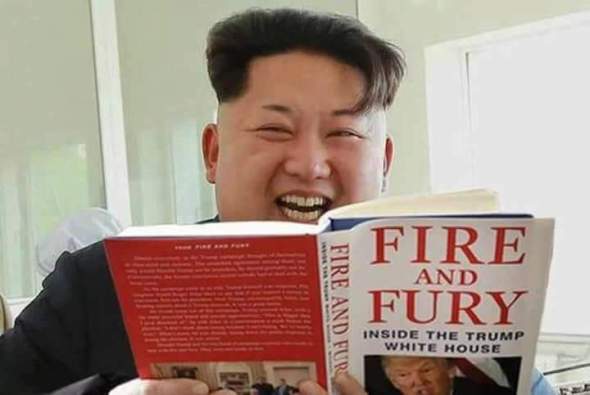
Good Morning!!
I finished reading Glenn Simpson’s testimony to the Senate Judiciary Committee yesterday. Senator Diane Feinstein is a true shero for releasing it to the public. The contrast between the questioning by the Republican and Democratic staffs is truly shocking. The Democrats focused on the Steele dossier itself and the process by which it was produced, and the Republicans spent their time trying to find ways to undermine and smear Steele, Simpson, and his company Fusion GPS.
Brian Buetler at Crooked has a great summary of the testimony and as well as a description of the partisan questioning by Senator Chuck Grassley’s staff:
By my count, over the course of about five hours, Chuck Grassley’s lawyers asked Simpson literally zero questions designed to increase their own understanding of Russian efforts to disrupt the election. They likewise asked no questions aimed at establishing Simpsons’ level of confidence in the information in the dossier, or in documentary evidence he compiled of Trump’s involvement in money laundering and his ties to organized crime.
They spent their hours instead trying without much success to impeach Simpson’s credibility and paint him as a partisan. They were particularly interested in skewing the composition of Simpsons’ client base to make it seem tilted to Democrats (it isn’t), and in getting Simpson to testify that he had a financial interest in triggering an FBI investigation of the Trump campaign (he didn’t). Confronted with the allegation that the Trump campaign was complicit in a criminal plot to sabotage the Clinton campaign, Grassley’s representatives wanted to know why Simpson had the nerve to try to alert the public, through the media.
Woman reading “Fire and Fury” in CT bookstore
Grassley doesn’t work for Trump and neither do his aides, but their conduct blends seamlessly into the obstructive behavior Trump and his advisers exhibited during the campaign and after, and thus represents a total abdication of their Constitutional roles. Rather than alert the FBI, as requested, about Russian meddling, the Trump campaign cooperated with Russian hackers, and used their stolen materials to maximum benefit. When the FBI acknowledged the existence of its investigation of the Trump campaign, Trump called it a witch hunt and tried to quash it, along with parallel investigations limping along on Capitol Hill. Grassley’s efforts began where Trump’s left off. The special counsel’s investigation of the Trump campaign continues, so Grassley has devoted himself to proving that it is the fruit of poisonous partisanship. First, they hoped Simpson would melt and confess to being a high-rent version of Roger Stone. When they failed to discredit Simpson, Steele, and the dossier, or to establish that the dossier triggered the FBI’s investigation, Grassley tried to bury the testimony, and then to discredit the dossier by proxy with a baseless accusation that Steele is a criminal.
Trump’s lickspittle propagandists remain as determined as ever to manufacture a scandal out of the nexus between law enforcement and the private investigators who tipped them off, based solely on the identities of the investigators’ clients. Before Feinstein posted Simpson’s testimony, they alleged, without evidence, that Steele’s dossier was the progenitor of the FBI’s Trump investigation. Amid the ruins of that theory, they have unblinkingly adopted the incompatible view that the real outrage is that the FBI tipped its hand to a witness that an investigation was already underway.

Click on the link to read a summary of what questioning by Sen. Feinstein’s staff revealed.
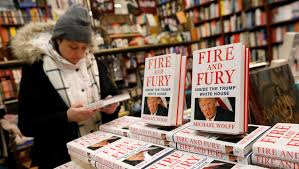 Did you watch that ridiculous “immigration meeting” that Trump held a couple of days ago? The purpose obviously was to demonstrate that Trump is not the raving lunatic described in the book Fire and Fury by Michael Wolff. Then yesterday he had another photo op “cabinet meeting” in which he bragged that he “got great reviews from everybody” on his “performance.” Mediaite reports:
Welcome back to the studio,” Trump said as he began his address from the Cabinet Room. He proceeded to revisit his list of triumphs — as he perceives them — such as the GOP tax reform bill, the stock market’s performance, and jobs creation.
Eventually, Trump bragged about how allowing the media to film his bipartisan immigration negotiations yesterday with several members of Congress. The discussions drew rare praise from his critics and complaints fromhis base. Naturally, Trump was more focused today on the former.
“It was a tremendous meeting, actually. It was reported as incredibly good, and my performance…got great reviews from everybody other than two networks who were phenomenal for about two hours. Then after that they were called by their bosses who said “oh, wait a minute” and unfortunately, a lot of those anchors sent us letters saying that was one of the greatest meetings they’ve ever witnessed.”
Trump also claimed he had received letters from news anchors praising his handling of the immigration discussion. Last night Anderson Cooper had a little fun with that. The Hill: Anderson Cooper mocks Trump’s claim that news anchors sent him letters of praise.
Cooper on his program late Wednesday gave “major kudos” to the United States Postal Service for “delivering those letters so fast.”
“So fast, it’s almost like it wouldn’t even be humanly possible,” Cooper said.
“Quick question though: Who are these anchors who wrote letters congratulating the president on one of the greatest meetings they’ve ever witnessed, which is a highly believable, totally normal thing that would absolutely happen?”
Cooper joked that letter writing is one of the first things taught in “anchor school.”
He said he did not send the president a letter of congratulations on his meeting.
“Everyone knows when I want to do something totally normal, I send the president one of those big cookies with ‘congratulations on the meeting’ in icing or one of those edible arrangements,” he said.
Cooper added that when CNN asked the White House to back up its claim that Trump received letters of praise for the meeting from anchors, the White House gave the network a list of “two CNN videos and 19 tweets.”
“To be fair, this list does have words on it and those words are actually made up of letters,” the CNN anchor added, “but that’s not generally accepted in reality to mean the same thing as ‘letters of congratulation that anchors sent to the president.'”
Video at The Hill.
What the televised meetings showed was that the “president” is completely clueless about his own supposed policies. He simply agreed with the last person who spoke to him and then had to be bailed out by nervous Republicans who explained tried to explain his positions to him.
The Atlantic: The President Who Doesn’t Understand His Own Positions.
The president was able to garner some positive reviews for his session with congressional leaders on Tuesday—though as one of those reviewers, Peter Baker of The New York Times, acknowledged, “The bar, of course, was historically low given that Democrats and even some Republicans have been describing him as so unstable that he should be removed from office.”
But at the same time—in that Tuesday meeting, over the weekend at Camp David, and on Twitter Thursday morning—Trump has demonstrated that he continues to have no functional grasp of policy, including the putative positions of his administration. He demonstrated this Thursday with regards to the FISA Amendments Act, which Congress is preparing to reauthorize before it expires. But reformers, including libertarian-leaning Republicans like Representative Justin Amash and Senator Rand Paul and Democrats like Representative Zoe Lofgren and Senator Ron Wyden, have sought new privacy safeguards in response to the revelations produced by Edward Snowden.
Here are the conflicting tweets from this morning:
The tweets were two hours apart, so someone in the WH must have explained to Trump that he was disagreeing with his own policy in the first one.
Read more at The Atlantic.
Bradley P. Moss has an interesting piece at Politico on the upcoming interview Trump will have to have with the Special Counsel: This is How Trump’s Lawyers Are Probably Prepping Him for the Mueller Showdown.
First things first: Even putting aside his constitutional title, the president is no ordinary client. He is in his 70s, has a healthy (albeit fragile) ego, and, after decades in the business world, is largely set in his ways about how he likes to do things. He is not a deeply analytical person, and he doesn’t like to get bogged down in details. He will not, for example—no matter how much his lawyers would like him to—be able to replicate the document-specific preparedness Hillary Clinton brought to her marathon, 11-hour congressional testimony concerning the tragedy in Benghazi, Libya. That has not been and will never be who Trump is and trying to prepare him in that manner would be a disservice to him, as it would only irritate and confuse him.
That aside, if the president is going to navigate this interview without stepping on any legal or political land mines, he absolutely must listen to the advice his lawyers are likely giving him and take this seriously….
The stakes are high: I am assuming that Mueller does not primarily intend to use the interview of the president, which he reportedly told Trump’s lawyers on Monday that he was likely to request, as a fact-finding inquiry. (Trump countered on Wednesday that an interview with Mueller “seems unlikely.”) If there are relevant and material facts to be found, Mueller’s team has likely already obtained them through the plethora of subpoenas, interviews and grand jury testimony that have already occurred. Mueller’s objective is more likely to evaluate the president’s demeanor when answering questions, particularly when he’s addressing allegations that he tried on more than one occasion to obstruct the Russia investigation. The president’s motivation—particularly whether he had “corrupt intent”—in taking steps like firing FBI Director James Comey is something that can more easily be extrapolated by observing how Trump explains the context of those actions under pressure from a prosecutor than through a dry review of factual information in and of itself.
This means that the president’s lawyers must prepare him to address any number of potential topics, and also thoroughly coach him on how he will talk about them. They’ll do this with mock interviews. A standard mock session could consist of multiple lawyers jumping in with questions at different times, placing documents in front of Trump and seeking to trip him up on the facts. It would be advisable—although it is debatable whether the president would agree to it—for several mock interview sessions to be conducted before the president sits down with Mueller.
Read the rest at Politico. It’s fascinating. No wonder Trump is freaking out.
I know much more is happening. What stories are you following today?
Lazy Saturday Reads: Gorilla TV
Posted: January 6, 2018 Filed under: morning reads, U.S. Politics | Tags: Andrew McCabe, Brad Parscale, Camp David meeting, Christopher Steele, Donald Trump, Eric Trump, Gorilla TV, Hillary Clinton, Ivanka Trump, Jared Kushner, Jeff Sessions, Robert Mueller, Russia investigation, the dossier 31 Comments
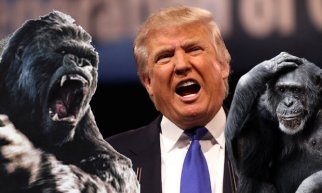
Patrick, a lowland gorilla, at the Dallas Zoo watching a National Geographic special on gorillas on T.V.
Good Morning!!
For the past few days, the media and we political junkies have been obsessed with the new book by Michael Wolff, Fire and Fury: Inside the Trump White House. TV talking heads have spent hours discussing the whether Donald Trump is temperamentally and cognitively fit for the office he holds. Of course most of us concluded during the 2016 campaign that he was not. But now Trump himself has definitively answered the question in one of his morning tweet storms.
Oh. Ohhh-kaaay. I’m convinced. Are you?
One person who apparently will defend Trump until the bitter end is Press Secretary Sarah Sanders.
Share Blue: Sarah Sanders: Americans who aren’t “celebrating” Trump are “mentally unfit.”
Donald Trump and his allies are fiercely resisting the allegations in Michael Wolff’s explosive new book, “Fire and Fury,” that Trump lacks the basic mental competence for the day-to-day functions of the presidency — a question that even before the book’s release, was being hotly debated.
But White House attempts to beat back the allegations are not going well.
Appearing on Fox News to discuss the book’s charges of Trump’s unfitness, White House press secretary Sarah Huckabee Sanders essentially resorted to the argument of “I know you are, but what am I?”
KILMEADE: That’s the president’s position on that. What’s yours?
SANDERS: Look, I think it’s absolutely insane to think all of these individuals, reporters and others, who suddenly have a medical degree and think that they can diagnose somebody, many times who they’ve never even had a conversation with. It’s absolutely outrageous to make these types of accusations, and it’s simply untrue, and it’s sad that people are going and making these desperate attempts to attack the president. What I think is really mentally unstable is people that don’t see the positive impact that this president is having on the country. The economy is booming, we’re crushing ISIS, day after day things are getting better for Americans all over this country. And I think it’s really sad that these people don’t see that, and that they’re not celebrating and trying to join in the president’s efforts to turn our country around.
 A slightly more intelligent response to the book from David Remnick at The New Yorker: The Increasing Unfitness of Donald Trump.
What made the Emperor Nero tick, Suetonius writes in “Lives of the Caesars,” was “a longing for immortality and undying fame, though it was ill-regulated.” Many Romans were convinced that Nero was mentally unbalanced and that he had burned much of the imperial capital to the ground just to make room for the construction of the Domus Aurea, a gold-leaf-and-marble palace that stretched from the Palatine to the Esquiline Hill. At enormous venues around the city, he is said to have sung, danced, and played the water organ for many hours—but not before ordering the gates locked to insure that the house would remain full until after the final encore. Driven half mad by Nero’s antics, Romans feigned death or shimmied over the walls with ropes to escape.
Chaotic, corrupt, incurious, infantile, grandiose, and obsessed with gaudy real estate, Donald Trump is of a Neronic temperament. He has always craved attention. Now the whole world is his audience. In earlier times, Trump cultivated, among others, the proprietors and editors of the New York tabloids, Fox News, TMZ, and the National Enquirer. Now Twitter is his principal outlet, with no mediation necessary.
The President recently celebrated the holidays at Mar-a-Lago, the Domus Aurea of Palm Beach, and nearly every day, before setting out for the golf course, he thumbed his bilious contempt for . . . such a long list! Science itself did not escape his scorn:
In the East, it could be the COLDEST New Year’s Eve on record. Perhaps we could use a little bit of that good old Global Warming that our Country, but not other countries, was going to pay TRILLIONS OF DOLLARS to protect against. Bundle up!
Future scholars will sift through Trump’s digital proclamations the way we now read the chroniclers of Nero’s Rome—to understand how an unhinged emperor can make a mockery of republican institutions, undo the collective nervous system of a country, and degrade the whole of public life.
Click on the link to read the rest.
Trump is at Camp David right now with his cabinet (except for Jeff Sessions, who has been frozen out) and Republican leadership supposedly to discuss the administration’s agenda for the coming year.
Last night Rachel Maddow suggested that perhaps Sessions was left out because the rest of the Trump crowd might be planning to fire him.
Other Twitter folks think it’s because Sessions might interfere with the planned activities.
https://twitter.com/Belairviv/status/949651501689049093
The New York Daily News: Jeff Sessions not invited to Trump meet, as EPA chief Scott Pruitt reportedly voices interest in attorney general post.
Attorney General Jeff Sessions is one of the few cabinet members who will not attend an inner-circle legislative meeting hosted by President Trump this weekend, fueling speculation about growing tensions between the two men.
Meanwhile, Environmental Protection Agency Administrator Scott Pruitt, who will attend the meeting at Camp David, indicated this week that he’d be willing to lead the Justice Department, according to a report.
Pruitt has been telling close associates at the EPA that he would be up to fill Sessions’ shoes if Trump gives him the boot, one person familiar with the matter told Politico….
Trump’s weekend meeting will focus on national security, immigration and economic legislation priorities for this year, according to a White House statement. In addition to Pruitt, the sit down will be attended by senior House and Senate Republicans as well as a majority of Trump’s cabinet, including Secretary of State Rex Tillerson, Defense Secretary Jim Mattis and CIA Director Mike Pompeo.
Sessions’ absence is particularly conspicuous since an attorney general is usually deeply involved in the issues that will be discussed during the Camp David rendezvous.

Kumbuka the gorilla may have been recaptured – but Donald Trump is still on the loose | The Independent
I hate to say this, but I almost think Sessions would preferable to Scott Pruitt as Attorney General.
Philip Ewing at NPR: The Russia Investigations: Sessions On Edge, Bannon Exiled And Internecine Combat.
Following the heavy cyclone of news this week, dawn in Washington, D.C., on Saturday found Attorney General Jeff Sessions on the slippery sand — and that could also mean peril for Justice Department special counsel Robert Mueller.
An explosive New York Times scoop revealed that Sessions tried to smear then-FBI Director James Comey before he was fired. The report, by Michael Schmidt, also said President Trump ordered White House counsel Don McGahn to lean on Sessions not to recuse himself from the Russia probe, and when Sessions did recuse, the president fustigated him. Sessions offered to quit but Trump said no.
So not only is Sessions persona non grata with the president — that’s been the case for months. Now the public and people inside the Justice Department know Sessions was actively trying to undermine his own FBI director, as part of a pattern of conduct directed by Trump — who himself had asked Comey to lay off then-national security adviser Mike Flynn, then fired Comey, etc.
Ewing notes that Pruitt has been angling for Sessions’ job, apparently thinking Trump’s AG could be gone soon.
What does it all mean? Sessions has been in hot water before with Trump but came through it, in part thanks to steadfast support from his longtime allies in the Senate. How strong is that firewall now? Judiciary Committee Chairman Chuck Grassley, R-Iowa, has said he had no plans to confirm a new attorney general. And Sen. Cory Gardner, R-Colo., has threatened to hold up all Justice Department nominees after Sessions rescinded earlier permissive guidelines on marijuana enforcement.
So if Sessions were to go for real this time, Trump might not be able to quickly and easily appoint someone else — someone not recused from the Russia probe — to wrangle the Justice Department on the president’s behalf. But if the political dynamics change, that could change the play for the White House. As NPR’s Carrie Johnson has reported, replacing the leadership at Justice is one way that Trump could try to control or get rid of Mueller.
Meanwhile the Russia investigation continues, along with the GOP’s efforts to interfere with it. A few updates:
LA Times: Mueller calls back at least one participant in key meeting with Russians at Trump Tower.
Special counsel Robert S. Mueller III has recalled for questioning at least one participant in a controversial meeting with a Kremlin-connected Russian lawyer at Trump Tower in June 2016, and is looking into President Trump’s misleading claim that the discussion focused on adoption, rather than an offer to provide damaging information about Hillary.
Some defense lawyers involved in the case view Mueller’s latest push as a sign that investigators are focusing on possible obstruction of justice by Trump and several of his closest advisors for their statements about the politically sensitive meeting, rather than for collusion with the Russians.
The Times agreed with its source not to name the individual who has been called back for more questioning.
Investigators also are exploring the involvement of the president’s daughter, Ivanka Trump, who did not attend the half-hour sit-down on June 9, 2016, but briefly spoke with two of the participants, a Russian lawyer and a Russian-born Washington lobbyist. Details of the encounter were not previously known.
It occurred at the Trump Tower elevator as the Russian lawyer, Natalia Veselnitskaya, and the lobbyist, Rinat Akhmetshin, were leaving the building and consisted of pleasantries, a person familiar with the episode said. But Mueller’s investigators want to know every contact the two visitors had with Trump’s family members and inner circle.
That’s interesting. So did Ivanka get advance notice of the meeting? And did her father send her down to exchange “pleasantries” with her brother’s guests?
Good old George Papadopoulos is still in the news. Sydney Morning News: ‘Romantic encounter’ set off Australia’s role in triggering Donald Trump investigation.
It was a chance romantic encounter by George Papadopoulos that set in train the events that led to the Australian government tipping off Washington about what it knew of Russian hacking efforts to swing the US presidential election.
Fairfax Media can reveal a woman in London with whom Papadopoulos became involved happened to know Alexander Downer and told the Australian High Commissioner about Papadopoulos, a newly signed staffer for Donald Trump. Downer, being a canny diplomat, followed it up and arranged a meeting with the young American, who was mostly living in London at the time.
What followed was the now infamous May 2016 conversation over many glasses of wine at the swanky Kensington Wine Rooms, during which the 28-year-old Papadopoulos spilled to Downer that he knew of a Russian dirt file on the rival Clinton campaign consisting of thousands of hacked emails.
That night was a key moment that helped spark the FBI probe – since taken over by respected former FBI director Robert Mueller as a special counsel – into possible Trump campaign collusion with the Kremlin, including its hacking of the Democratic National Committee.
Read more at the link.
The Trump campaign’s digital director sent out a series of interesting tweets yesterday. Natasha Bertrand wrote up the story at Business Insider: Trump campaign digital director: ‘Not one person made a decision’ without Kushner and Eric Trump’s ‘approval.’
The digital director of the Trump campaign said Friday that the president’s son-in-law, Jared Kushner, and son Eric Trump “were joint deputy campaign managers” whose “approval” was required for every decision before the 2016 election.
“Nobody else. Not one person made a decision without their approval,” the digital director, Brad Parscale, tweeted. “Others just took credit for this family’s amazing ability. I’m done with all these lies. They will be embarrassed!”
Kushner was Parscale’s “patron,” according to a person familiar with the campaign’s inner workings, which could explain their closeness.
Kushner got Parscale hired, the person said, “despite the fact that a number of people in the campaign wondered whether he had any idea what he was doing.”
“He’s Jared’s boy,” the person added. “I had [campaign] deputies telling me they couldn’t question anything the guy did or said, and they were unhappy about that.”
But Eric Trump? Who knew he was so central to the operation?
Parscale’s tweet also raises new questions about how involved Kushner and Eric Trump were in episodes that have drawn the most scrutiny from investigators probing the campaign’s ties to Russia.
Those include agreeing to with the Russian lawyer Natalia Veselnitskaya and other Russian nationals at Trump Tower in June 2016; green-lighting a trip to Moscow for Carter Page, an early campaign aide, in July 2016; and altering the GOP’s Ukraine platform during the Republican National Convention that month.
Page told the House Intelligence Committee last year that days before the convention, Corey Lewandowski, then the campaign manager, gave him permission to travel to Russia. Lewandowski has denied that, but Page has said he has emails to prove it. It is not clear whether Lewandowski consulted with Kushner beforehand.
Parscale’s statement also raises questions about what Kushner and Eric Trump knew about George Papadopoulos, the former campaign aide who was charged late last year with making false statements to the FBI.
Interesting. On the GOP obstruction side:
The New York Times: Republican Senators Raise Possible Charges Against Author of Trump Dossier.
More than a year after Republican leaders promised to investigate Russian interference in the presidential election, two influential Republicans on Friday made the first known congressional criminal referral in connection with the meddling — against one of the people who sought to expose it.
Senator Charles E. Grassley of Iowa, the chairman of the Judiciary Committee, and Senator Lindsey Graham of South Carolina, a senior committee member, told the Justice Department that they had reason to believe that a former British spy, Christopher Steele, lied to federal authorities about his contacts with reporters regarding information in a dossier, and they urged the department to investigate. The committee is running one of three congressional investigations into Russian election meddling, and its inquiry has come to focus on, in part, Mr. Steele’s explosive dossier that purported to detail Russia’s interference and the Trump campaign’s complicity.
The decision by Mr. Grassley and Mr. Graham to single out the former intelligence officer behind the dossier infuriated Democrats and raised the stakes in the growing partisan battle over the investigations into Mr. Trump, his campaign team and Russia.
The Senate Judiciary Committee effort played into a far broader campaign waged by conservatives to cast doubt on the Trump-Russia investigations, and instead turn the veracity of the dossier and the credibility of its promulgators into the central issue.
The story goes on to describe other GOP attempts at obstruction and distraction–including efforts to once again investigation Hillary Clinton.
USA Today: FBI documents: Andrew McCabe had no conflict in Hillary Clinton email probe.
FBI Deputy Director Andrew McCabe, whom President Trump has blamed for influencing the decision not to criminally charge Hillary Clinton for her use of private email server, did not oversee that inquiry while his wife was running for state office in Virginia as a Democrat, according to bureau records released Friday.
The internal documents, published on the FBI’s website, support what the bureau has asserted previously: that McCabe had no conflicts when he assumed oversight of the Clinton investigation. His role began in February 2016, following his appointment as deputy director and three months after his wife, Jill McCabe, lost her bid for a state Senate seat.
McCabe has been repeatedly targeted by Trump and some Republican lawmakers, who accuse the long-time FBI official of exerting undue and partisan influence over the Clinton probe.
As recently as last month, Trump seized on McCabe’s role in the Clinton inquiry and his wife’s political bid, noting that Jill McCabe received nearly $470,000 from a political action committee associated with Clinton ally and Virginia Gov. Terry McAuliffe.
Have a great weekend, Sky Dancers! What stories are you following today?
Thursday Reads: Bomb Cyclone Edition
Posted: January 4, 2018 Filed under: morning reads, U.S. Politics | Tags: bomb cyclone, bombogenesis, Donald Trump, Fire and Fury, Michael Wolff, winter weather 80 Comments
Sea ice floats in Boston Harbor (Boston Globe)
Good Morning
Jim Cantore is in Rockport on the North Shore and another Weather Channel guy is on the South Shore, in Plymouth, so I guess the storm is going to be bad here in New England. Bombogenesis is still expected to happen off the New England Coast later today. Here’s the explanation of what’s happening from the Boston Globe: Bombogenesis? Bomb cyclone? What exactly these terms mean and how they relate to Thursday’s storm.
The terms were popularized by a 1980 paper by MIT professors Frederick Sanders and John R. Gyakum, who studied “explosive cyclogenesis” (the rapid development of a storm) in the Northern Hemisphere in the 1970s.
According to the NOAA, bombogenesis is a “popular term” to describe the process in which a storm rapidly strengthes. Specifically, it refers to when the storm’s pressure system drops more than 24 millibars in 24 hours.
“This can happen when a cold air mass collides with a warm air mass, such as air over warm ocean waters,” says the agency’s website.
According to Sanders and Gyakum’s paper, bombogenesis is predominantly a cold-season event and occurs over water. The National Weather Service says it is “solely a meteorological term” and does not describe the effects of the storm.
That said, the resulting storm from bombogenesis is called a “bomb” or “bomb cyclone.”
We’re supposed to get at least winds around 60-70 mph and 12 to 18 inches of snow, so it’s basically a just a blizzard with caused by the crazy weather happening out over the ocean.
More from The Washington Post: No need to duck and cover — this is the ‘bomb cyclone,’ explained.
Though it seems as if meteorologists are using hyperbole to draw in more viewers, for a storm to be classified as a “bomb” it actually has to meet a stringent set of criteria. “Explosive bombogenesis” occurs most often in the winter, and it’s almost always referring to a storm that tracks up the East Coast. Nor’easters tend to be bombs.
A cyclone’s strength depends on its air pressure. The lower the pressure, the stronger the storm. Air pressure is the weight of the atmosphere. In a storm, air is rising, so the pressure is lower.
Typical surface-air pressure tends toward 1010 millibars. That’s how we measure how much air is sitting over us. Most of the big storm systems that sweep rain and snow across the United States clock in around 995 or 990. But for a storm to rank a “bomb,” it must rapidly intensify — it has to drop at least 24 millibars in 24 hours.
The storm expected to ride up the East Coast and strike New England looks as if it will be a classic bomb cyclone, with the expectation of a 50-millibar drop in about 24 hours
When a storm strengthens this quickly, it’s a signal of how much air is being drawn into the storm’s circulation. It then spirals inward toward the center, rises and exits through the top. If more air is leaving the storm than is sucked inward, the pressure falls even more and the system will continue to grow.
It’s not rare, but bombogenesis is still a sight to behold from a meteorological perspective. It is most common in nor’easters, the fierce gales that spin up off the East Coast in the late fall and winter. They feed off the temperature contrast between the cold land and adjacent Atlantic waters still holding on to heat left over from the summertime.
More details at the WaPo.
Of course there’s another cyclone happening in Washington, D.C.–a metaphorical one anyway. Yesterday New York Magazine published an excerpt from Michael Wolff’s soon-to-be-released book, Fire and Fury. If you haven’t read it yet, you need to. I know the media has been highlighting bits of it constantly, but reading the whole thing is a whole different experience. The piece is so shocking that I had to read it in sections over the course of the day yesterday.
Today Wolff has released another excerpt in The Hollywood Reporter: “You Can’t Make This S— Up”: My Year Inside Trump’s Insane White House. I haven’t read the whole thing yet, but it begins as a background piece on how Wolff got nearly unrestricted access to Trump and his minions.
I interviewed Donald Trump for The Hollywood Reporter in June 2016, and he seemed to have liked — or not disliked — the piece I wrote. “Great cover!” his press assistant, Hope Hicks, emailed me after it came out (it was a picture of a belligerent Trump in mirrored sunglasses). After the election, I proposed to him that I come to the White House and report an inside story for later publication — journalistically, as a fly on the wall — which he seemed to misconstrue as a request for a job. No, I said. I’d like to just watch and write a book. “A book?” he responded, losing interest. “I hear a lot of people want to write books,” he added, clearly not understanding why anybody would. “Do you know Ed Klein?”— author of several virulently anti-Hillary books. “Great guy. I think he should write a book about me.” But sure, Trump seemed to say, knock yourself out.
Since the new White House was often uncertain about what the president meant or did not mean in any given utterance, his non-disapproval became a kind of passport for me to hang around — checking in each week at the Hay-Adams hotel, making appointments with various senior staffers who put my name in the “system,” and then wandering across the street to the White House and plunking myself down, day after day, on a West Wing couch.
The West Wing is configured in such a way that the anteroom is quite a thoroughfare — everybody passes by. Assistants — young women in the Trump uniform of short skirts, high boots, long and loose hair — as well as, in situation-comedy proximity, all the new stars of the show: Steve Bannon, Kellyanne Conway, Reince Priebus, Sean Spicer, Jared Kushner, Mike Pence, Gary Cohn, Michael Flynn (and after Flynn’s abrupt departure less than a month into the job for his involvement in the Russia affair, his replacement, H.R. McMaster), all neatly accessible.
The nature of the comedy, it was soon clear, was that here was a group of ambitious men and women who had reached the pinnacle of power, a high-ranking White House appointment — with the punchline that Donald Trump was president. Their estimable accomplishment of getting to the West Wing risked at any moment becoming farce.
A bit more:
“You can’t make this shit up,” Sean Spicer, soon to be portrayed as the most hapless man in America, muttered to himself after his tortured press briefing on the first day of the new administration, when he was called to justify the president’s inaugural crowd numbers — and soon enough, he adopted this as a personal mantra. Reince Priebus, the new chief of staff, had, shortly after the announcement of his appointment in November, started to think he would not last until the inauguration. Then, making it to the White House, he hoped he could last a respectable year, but he quickly scaled back his goal to six months. Kellyanne Conway, who would put a finger-gun to her head in private about Trump’s public comments, continued to mount an implacable defense on cable television, until she was pulled off the air by others in the White House who, however much the president enjoyed her, found her militancy idiotic. (Even Ivanka and Jared regarded Conway’s fulsome defenses as cringeworthy.)
Steve Bannon tried to gamely suggest that Trump was mere front man and that he, with plan and purpose and intellect, was, more reasonably, running the show — commanding a whiteboard of policies and initiatives that he claimed to have assembled from Trump’s off-the-cuff ramblings and utterances. His adoption of the Saturday Night Live sobriquet “President Bannon” was less than entirely humorous. Within the first few weeks, even rote conversations with senior staff trying to explain the new White House’s policies and positions would turn into a body-language ballet of eye-rolling and shrugs and pantomime of jaws dropping. Leaking became the political manifestation of the don’t-blame-me eye roll.
The surreal sense of the Trump presidency was being lived as intensely inside the White House as out. Trump was, for the people closest to him, the ultimate enigma. He had been elected president, that through-the-eye-of-the-needle feat, but obviously, he was yet … Trump. Indeed, he seemed as confused as anyone to find himself in the White House, even attempting to barricade himself into his bedroom with his own lock over the protests of the Secret Service.
Some pundits have argued that, like Trump, Wolff is a self-promoter. Are we really supposed to believe his reporting? But this morning Axios reported that Wolff has everything on tape.
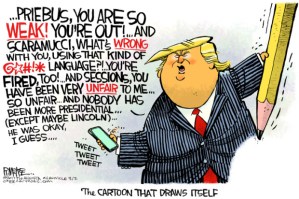
Rick McKee / Augusta Chronicle
Michael Wolff has tapes to back up quotes in his incendiary book — dozens of hours of them.
— Among the sources he taped, I’m told, are Steve Bannon and former White House deputy chief of staff Katie Walsh.
— So that’s going to make it harder for officials to deny embarrassing or revealing quotes attributed to them in “Fire and Fury: Inside the Trump White House,” out Tuesday.
— In some cases, the officials thought they were talking off the record. But what are they going to do now?
— Although the White House yesterday portrayed Wolff as a poseur, he spent hours at a time in private areas of the West Wing, including the office of Reince Priebus when he was chief of staff.
With all this insanity finally on public display, there is more public discussion of exactly how crazy Trump actually is.
Politico: Washington’s growing obsession: The 25th Amendment.
Lawmakers concerned about President Donald Trump’s mental state summoned Yale University psychiatry professor Dr. Bandy X. Lee to Capitol Hill last month for two days of briefings about his recent behavior.
In private meetings with more than a dozen members of Congress held on Dec. 5 and 6, Lee briefed lawmakers — all Democrats except for one Republican senator, whom Lee declined to identify. Her professional warning to Capitol Hill: “He’s going to unravel, and we are seeing the signs.”
In an interview, she pointed to Trump “going back to conspiracy theories, denying things he has admitted before, his being drawn to violent videos.” Lee also warned, “We feel that the rush of tweeting is an indication of his falling apart under stress. Trump is going to get worse and will become uncontainable with the pressures of the presidency.”
Lee, editor of “The Dangerous Case of Donald Trump,” which includes testimonials from 27 psychiatrists and mental health experts assessing the president’s level of “dangerousness,” said that she was surprised by the interest in her findings during her two days in Washington. “One senator said that it was the meeting he most looked forward to in 11 years,” Lee recalled. “Their level of concern about the president’s dangerousness was surprisingly high.”
Many of us, including Hillary Clinton and Barack Obama, saw the signs during the 2016 campaign and tried to raise alarms. Unfortunately, the media was too busy focusing on Hillary’s emails to notice that Russia was using active measures to infiltrate Trump’s campaign and make him POTUS. They convinced themselves that Trump could never win no matter how much they hammered Hillary. After he won, many of these “journalists” argued that Trump would “pivot” and suddenly begin acting like a normal, sane person.
And now here we are with an insane would-be tyrant in the While House and a Republican Party that refuses to put any kind checks on his power.
In honor of the “bomb cyclone” I give you Toots and the Maytals.
Tuesday Reads: “It’s Worse Than You Think.”
Posted: January 2, 2018 Filed under: Foreign Affairs, morning reads, U.S. Politics 62 Comments
Out of Town News, Harvard Square, Cambridge, MA
Good Morning!!
I woke up with a feeling of foreboding this morning, knowing that Trump is back from his long golf vacation, ready to create more chaos around the world. Predictably he’s been tweeting up a storm, attacking Hillary Clinton and Huma Abedin, The New York Times, James Comey, Barack Obama, and Kim Jong Un. He also commented obnoxiously on the protests in Iran and claimed credit for aviation safety in 2017. I can’t begin to describe the disgust I feel toward this evil man.
But it may be even worse than I thought. I just finished reading a very scary article by Susan Glasser at Politico: Donald Trump’s Year of Living Dangerously. It’s worse than you think. I wish I could just post the whole thing, but I’ll limit myself to excerpts. The opening paragraphs:
When President Donald Trump sat down for dinner on September 18 in New York with leaders of four Latin American countries on the sidelines of the annual United Nations General Assembly, anxieties were already running high.
There was the matter of Mexico and his promise to build that “big, beautiful wall,” presumably to keep not just Mexicans but all of their citizens out of the United States too. And the threat to blow up the North American Free Trade Agreement. And then, a month earlier, seemingly out of nowhere, Trump had volunteered that he was considering a “military option” in Venezuela as that country’s last vestiges of democracy disappeared. Amid the international furor over his vow to rain down “fire and fury” on North Korea in the same golf-course press conference, the news that the president of the United States was apparently considering going to war with its third-largest oil supplier had gotten relatively little attention. But the leaders from Argentina, Brazil, Colombia and Panama invited to the dinner remembered it well….
Los Angeles
To Trump’s left was his secretary of state, Rex Tillerson. “Rex tells me you don’t want me to use the military option in Venezuela,” the president told the gathered Latin American leaders, according to an account offered by an attendee soon after the dinner. “Is that right? Are you sure?” Everyone said they were sure. But they were rattled. War with Venezuela, as absurd as that seemed, was clearly still on Trump’s mind.
By the time the dinner was over, the leaders were in shock, and not just over the idle talk of armed conflict. No matter how prepared they were, eight months into an American presidency like no other, this was somehow not what they expected. A former senior U.S. official with whom I spoke was briefed by ministers from three of the four countries that attended the dinner. “Without fail, they just had wide eyes about the entire engagement,” the former official told me. Even if few took his martial bluster about Venezuela seriously, Trump struck them as uninformed about their issues and dangerously unpredictable, asking them to expend political capital on behalf of a U.S. that no longer seemed a reliable partner. “The word they all used was: ‘This guy is insane.’”

According to Glasser, the assessment of Trump as incompetent and even “insane” is pretty common throughout the world.
Over the course of the year, I have often heard top foreign officials express their alarm in hair-raising terms rarely used in international diplomacy—let alone about the president of the United States. Seasoned diplomats who have seen Trump up close throw around words like “catastrophic,” “terrifying,” “incompetent” and “dangerous.” In Berlin this spring, I listened to a group of sober policy wonks debate whether Trump was merely a “laughingstock” or something more dangerous. Virtually all of those from whom I’ve heard this kind of ranting are leaders from close allies and partners of the United States. That experience is no anomaly. “If only I had a nickel for every time a foreign leader has asked me what the hell is going on in Washington this year … ” says Richard Haass, a Republican who served in senior roles for both Presidents Bush and is now president of the Council on Foreign Relations.
First and Pike News, Seattle
So what the hell is going on? I’ve come to believe that when it comes to Trump and the world, it’s not better than you think. It’s worse. The president is not playing the leadership role the rest of the world has come to expect from the United States, and the consequences are piling up. Still, it is also true that the world hasn’t exactly melted down—yet—as a consequence, leading some to conclude that Trump is merely a sort of cartoonishly incompetent front man, a Twitter demagogue whose nuclear-tinged rhetoric and predilection for cozying up to dictators should be discounted in favor of rational analysis of the far more sober-minded, far less radical policies actually put in place by his team….
Over their year of living dangerously with Trump, foreign leaders and diplomats have learned this much: The U.S. president was ignorant, at times massively so, about the rudiments of the international system and America’s place in it, and in general about other countries. He seemed to respond well to flattery and the lavish laying out of red carpets; he was averse to conflict in person but more or less immovable from strongly held preconceptions. And given the chance, he would respond well to anything that seemed to offer him the opportunity to flout or overturn the policies endorsed by his predecessors Barack Obama and George W. Bush.
The European diplomat who was told to practice “strategic patience” did not find it all that useful in the several face-to-face meetings with Trump he ended up sitting in on. “We were struck by the absence of knowledge of the president,” he said. Another takeaway: Trump made commitments he then did not deliver on. “On some things, he accepted the argument, and we thought now it is resolved, only to find out later he uses the same phrases and arguments as he did before,” the diplomat said.

Please read the rest. It’s painful, but it’s important to face this reality, IMHO.

Smallest news and post card stand in New Orleans, 103 Royal Street, 1908
After reading that article, my sense of vague foreboding turned into anxiety bordering on panic. I had to take a break and calm myself down. What is going to become of our country? We need Mueller to act quickly. There is still nearly a year to go before the 2018 elections and no sign that Congressional Republicans are going to do anything to rein in Trump’s madness. Sometimes I still ask myself, “Is this really happening?”
The fact-checkers at The Washington Post have published an update on Trump’s lies: President Trump has made 1,950 false or misleading claims over 347 days.
With just 18 days before President Trump completes his first year as president, he is now on track to exceed 2,000 false or misleading claims, according to our database that analyzes, categorizes and tracks every suspect statement uttered by the president.
As of Monday, the total stood at 1,950 claims in 347 days, or an average of 5.6 claims a day. (Our full interactive graphic can be found here.)
As regular readers know, the president has a tendency to repeat himself — often. There are now more than 60 claims that he has repeated three or more times. The president’s impromptu 30-minute interview with the New York Times over the holidays, in which he made at least 24 false or misleading claims, included many statements that we have previously fact-checked.
If you’ve been checking Twitter, you probably know that that New York Times interview has evoked angry reactions because of the failure of Reporter Michael Schmidt to question anything Trump said. Sometimes Schmidt even asked leading questions containing falsehoods. The approach used by Schmidt and fellow NYT reporter Maggie Habermann is to just get Trump talking and “get out of the way.”
And why no tough questions or follow-ups? Because NYT reporters are afraid that Trump will just walk away. If he did that would be more important news than the word salads they keep publishing. Twitter folks have also been bringing up the famous 2016 piece in which the Times claimed that U.S. intelligence agencies had found no “no clear link” between the Trump campaign and Russia. Erik Wemple at The Washington Post: New NYT scoop on Russia raises questions about old NYT story on Russia.
It was a week before the 2016 presidential election that the New York Times wrote this headline: “Investigating Donald Trump, F.B.I. Sees No Clear Link to Russia.” The story’s lead cited the curiosity of federal law enforcement on this front: “For much of the summer, the F.B.I. pursued a widening investigation into a Russian role in the American presidential campaign,” read the story by Eric Lichtblau and Steven Lee Myers. “Agents scrutinized advisers close to Donald J. Trump, looked for financial connections with Russian financial figures, searched for those involved in hacking the computers of Democrats, and even chased a lead — which they ultimately came to doubt — about a possible secret channel of email communication from the Trump Organization to a Russian bank.”
Newsstand 32nd Street and Third Avenue, NYC, 1935
Topical stuff. Major media outlets had been following strands of the Trump-Russia story for months. Just before the Lichtblau-Myers collaboration hit the Internet, for example, Slate ran a detailed story asking whether a server of the Trump Organization was communicating with Moscow’s Alfa Bank. Perhaps, concluded the story.
The New York Times piece pooh-poohed the possibility, reporting that agents “ultimately concluded that there could be an innocuous explanation, like a marketing email or spam, for the computer contacts.” Furthermore, the story gave this summary of the investigations: “Law enforcement officials say that none of the investigations so far have found any conclusive or direct link between Mr. Trump and the Russian government. And even the hacking into Democratic emails, F.B.I. and intelligence officials now believe, was aimed at disrupting the presidential election rather than electing Mr. Trump.”

But just last week the Times published a bombshell story about why the FBI began investigating Trump and Russia.
More than a year later, we now know much more about the FBI’s pre-election Russia-Trump activities, courtesy of the New York Times. On Saturday, a three-byline story — Sharon LaFraniere, Mark Mazzetti and Matt Apuzzo — reported that Trump campaign aide George Papadopoulos, addled by the offerings of a London pub, told an Australian official in May 2016 that “Moscow had thousands of emails that would embarrass [Democratic presidential candidate Hillary] Clinton, apparently stolen in an effort to try to damage her campaign.” A couple of months later, hacked Democratic emails surfaced — prompting the Australians to tell U.S. officials what Papadopoulos had said.
Yet the Times still refuses to apologize for their obsessive coverage of Hillary’s emails and the story that absolved the Trump campaign of guilt in the lead up to the election. (Remember, Michael Schmitt wrote many of the anti-Hillary stories.) This is Judy Miller all over again. The New York Times is broken.
Politico talked to John Dean about the Russia Investigation.
Newsstand in subway, Philadelphia, unknown date
John Dean, the former Nixon White House counsel, has a stark warning for White House lawyer Ty Cobb and the rest of President Donald Trump’s defenders as they enter 2018: Believing the investigation and prosecutions will be over any time soon is “wishful thinking.”
And, says the man who famously flipped and became the prosecution’s star witness in the process that helped take down Richard Nixon, no one in the president’s orbit should assume they’re prepared for everything that cooperating witnesses George Papadopoulos and Michael Flynn might be telling Bob Mueller, as their statements have suggested—whether it’s done out of confidence from their own review or just out of public bluster.
That’s exactly the mistake Dean saw Nixon and his close aides and accomplices, H. R. Haldeman and John Ehrlichman, make about him: overconfidence.“They didn’t know how much I knew. I knew much more than they thought I did,” Dean told me in an interview for the latest episode of POLITICO’s Off Message podcast, pointing in particular to Trump’s disgraced former national security adviser. “With Flynn and his proximity, he had even more proximity than I did.”
Dean scoffs at the idea floated by Trump lawyer John Dowd in December that the president, in his role as America’s top law enforcement official, couldn’t be guilty of obstruction of justice. He finds equally ridiculous, in terms of how it would hold up legally, that the defense of Trump and other aides has at times suggested that the president was ignorantly blundering through what then-FBI director Jim Comey took as attempts to influence the investigation, but was really just the bluster of a personality who thinks about the world in terms of loyalty and doesn’t know the technicalities of the law well enough to violate it.
Ignorance is no defense, according to Dean.

Dean did include a frightening caveat:
For all that he’s never stopped reliving the Watergate years, Dean seems surprised at how relevant what he went through 45 years ago remains. Not that everything is the same—for one, he thinks that in today’s media and political environment, Nixon might have finished his term.
“There’s social media, there’s the internet, the news cycles are faster. I think Watergate would have occurred at a much more accelerated speed than the 928 days it took to go from the arrest at the Watergate to the conviction of Haldeman and Ehrlichman and Mitchell, et al.,” Dean said. “There’s more likelihood he might have survived if there’d been a Fox News.”
That would be very bad for the U.S. and the world.
What stories are you following today?

 peej
peej Carissa
 bostonboomer
 dakinikat
 ecocatwoman
 jjlo
jjlo mablue2
 Mama Lopez
 peggysue22
 quixote
 skydancingguestblogger
 Mona (aka Wonk the Vote)





Recent Comments