
Tuesday Reads: The End of an Era
Posted: August 6, 2013 Filed under: Environment, Foreign Affairs, Media, morning reads, Russia, science, U.S. Politics | Tags: Ben Bradlee, Donald Graham, Eugene Meyer, Jeff Bezos, John Henry, Katherine Graham, morning newspapers, Newsweek, Pentagon Papers, Philip Graham, The Boston Globe, The Washington Post 38 Comments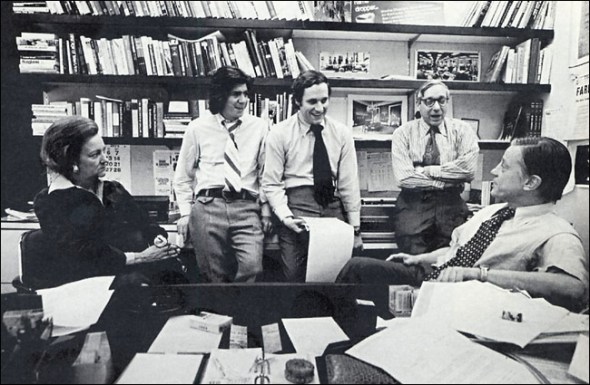
Katherine Graham meets with Carl Bernstein, Bob Woodward, Howard Simons and Ben Bradlee.
Good Morning!!
The big news today is of course the Graham family’s shocking sale of The Washington Post to billionaire Jeff Bezos of Amazon. This, along with the sale of The Boston Globe to Red Sox owner John Henry and the sale of Newsweek to IBT Media, signal the true end of an era.
The days when Americans woke up to the daily newspaper on their doorsteps is long gone. The place to go for the latest news these days is the internet and print newspapers and news magazines are struggling to survive. But the Globe and Newsweek have been on the auction block for a long time; the Post sale was a complete surprise, even to its employees.
From David von Drehle at Time Magazine: A New Age for the Washington Post
It’s hard to startle the journalism business these days, given the scale and speed of disruption of the media industry. But the Graham family selling the Washington Post to Amazon CEO Jeff Bezos for $250 million is an exception. Few newspapers in the world are as closely identified with a single family.
The story of the Grahams and the Post used to be told in giant pictures on the wall of the newspaper lobby on L Street not far from the White House. One grainy photograph documented the day in 1933 when the brilliant financier Eugene Meyer bought the paper for a song at a bankruptcy sale on the courthouse steps. Another (a favorite of all of us who worked there) showed Meyer’s remarkable daughter, Katharine Graham, beaming as she left another D.C. courthouse in the company of her favorite editor, Benjamin C. Bradlee, after they prevailed over the government in the Pentagon Papers lawsuit.
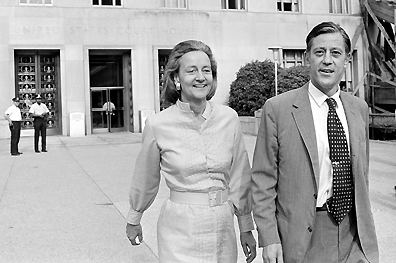
Katherine Graham and Ben Bradlee leaving the courthouse after prevailing in the Pentagon Papers case.
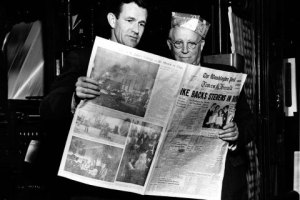
But the most important photograph, according to Mrs. Graham’s son and successor Donald E. Graham, was the one that showed Meyer in the company of Philip L. Graham, the brilliant and tragic husband of Katharine and father of Don. They were smiling like a pair of lotto winners, which they were. The year was 1954, and after years of effort and red ink, they had finally bought out their last remaining rival for dominance of the morning-newspaper market in Washington. As other families would learn in other cities across the country — the Chandlers in Los Angeles, the Coxes in Atlanta, the Knights in Miami and so on — dominance of the morning-newspaper routes would become a decades-long license to print money.
Philip L. Graham and Eugene Meyer look at the first The Washington Post Times Herald, in Washington, March 18, 1954.
Owning the morning meant that the Post would thrive as afternoon newspapers fell to the competition of television news. (The last afternoon paper in Washington, the excellent Washington Star, winked out in 1981.) It meant that advertisers hoping to reach a broad Washington audience had no choice but to pay the Post’s steadily increasing rates. That day in 1954 was the key to everything the Post later became, Don told me one day about 10 years ago when we bumped into each other in the lobby. Watergate, all the Pulitzer Prizes, the foreign correspondents, the celebrity columnists — all of it was possible because the patriarch and his son-in-law managed to lock up the morning.
A couple more links on the Post sale:
James Fallows at The Atlantic: Why the Sale of the Washington Post Seems So Significant
I have known and liked Donald Graham and his family over the years; many of my friends in journalism have at one time or another worked at the Washington Post. My first reaction to news that the family had sold the paper is simple shock. But it is shock based not on my positive-but-not-deep personal connection to the paper and its people but rather on sheer generational disorientation.
Readers below about age 40, who have known the Post only during its beleaguered, downsizing-its-way-out-of-trouble era, may find it hard to imagine the role it once played. Over the past decade-plus, the New York Times and theWall Street Journal have been the national newspaper organizations. It already seems antique even to use the word “newspaper” in such a construction, for reasons I don’t need to belabor now. But their flagship daily print publications make the NYT and the WSJ similar to the Financial Times and different from the other remaining ambitious news organizations — Bloomberg and Thomson Reuters, the broadcast and cable networks, NPR, etc.There was a time when you would automatically have included the Post in that first-tier national grouping. Other mainly regional or local papers were strong — the LA Times, the Chicago Tribune, the Boston Globe, and on down a nostalgic list. But more than any of the rest of them, the Post was fully in the national-newspaper derby and measured itself every day against the Times in talent level, depth and breadth of reporting, international coverage, sophistication, and all the other measures of a nationally ambitious operation. People who have started reading the paper in the past dozen years — rather, who have notstarted reading it — probably can’t imagine this difference in stature. But it is dramatic, and real.
“The pattern of a newspaperman’s life is like the plot of ‘Black Beauty,’ ” A. J. Liebling wrote. “Sometimes he finds a kind master who gives him a dry stall and an occasional bran mash in the form of a Christmas bonus, sometimes he falls into the hands of a mean owner who drives him in spite of spavins and expects him to live on potato peelings.” And sometimes, out of the blue, the ownership changes and you don’t know what the hell you’re getting in your bucket—fresh oats or cut glass.
At around 4:25 Monday afternoon, the staff of the Washington Post was summoned to the paper’s auditorium, a vast room where the presses used to be. The meeting would begin at 4:30 P.M., they were told. Donald E. Graham, the leader of the Graham family, which has owned the paper since Eugene Meyer bought it at a bankruptcy auction in 1933, stood solemnly before journalists who had been demoralized over the years by staff cuts, precipitous plunges in circulation, and endless dark rumors. It was a room full of reporters and editors, and yet, as one told me, “we thought we were there to hear that the Grahams had sold the building.”
In fact, Graham told them, in a voice so full of emotion that he had to stop a few times to gather himself, they were selling the Post and a handful of smaller papers—for two hundred and fifty million dollars, to Jeff Bezos, the founder and C.E.O. of Amazon, who is estimated to be worth more than twenty-five billion dollars. Graham asked the people there not to tweet, just to listen. The assembled were so stunned that when it came time for questions no one had any for a while; Graham had to urge them out of their silence.
“This was just plain sad. Now we belong to a guy who is so rich that the paper is around one per cent of his net worth,” a reporter told me soon after the meeting. “This was the family acknowledging that we can’t do it anymore and we have to give it to someone else. And we love the Graham family, we are proud of the family.”
It’s a long and interesting essay–read the rest at the link.
Neil Irwin and Ylan Q. Mui at The Washington Post write that Bezos paid more than he needed to for the Post.
The purchase price is richer than many of those paid for other legacy print media properties in recent years.
The New York Times Co. agreed to sell the Boston Globe to Red Sox owner John W. Henry for only $70 million. Newsweek sold for a symbolic $1, plus assumed pension liabilities, to billionaire Sidney Harman in 2011.
The Post “has a much stronger position in its market than the Boston Globe does,” said John Morton, an independent newspaper industry analyst. “It doesn’t surprise me that it would command a much higher price.”
Still, Morton suggested that the prominence and the visibility of The Post made Bezos willing to pay a higher price than would be justified by the paper’s finances alone. “I think probably Jeff Bezos was willing to pay a premium to make this happen,” Morton said. “. . . Bezos has enough money that if he wants to make it a hobby, he can.”
Interestingly, The New York Times apparently sold The Globe for less than they could have gotten. According to the AP:
BOSTON — Three bidders who fell short in their attempts to purchase The Boston Globe say they offered more than Boston Red Sox owner John Henry’s winning $70 million bid and criticized the decision of the seller, The New York Times Co., to make a deal with him.
Springfield television station owner John Gormally, West Coast investment executive Robert Loring and U-T San Diego chief executive John Lynch all said their groups’ bids bested Henry’s.
Henry agreed to pay $70 million to buy the Globe, the Boston Metro and the Telegram & Gazette in Worcester, about 50 miles from Boston. The bid, announced Saturday, was a fraction of the $1.1 billion the Times Co. paid 20 years ago.
Lynch said his group offered “significantly more” than Henry and wondered how the Times Co.’s shareholders would react after learning the company accepted a lower offer.
“I’m just stunned,” Lynch told the Boston Herald. “I thought this was a public company that had a fiduciary duty to get the most by its stockholders.”
Gormally says his bit was $80 million, but he admits that local ownership will probably be better for the Globe in the long run. Perhaps the Times wanted to do us Bostonians a favor.
I’m running out of space, so I’ll just add a few more stories in link dump fashion.Mark Ames on Vladamir Putin’s “human rights” record: Snowden’s Savior Announces Plans To Build 83 “Concentration Camps” Across Russia (link unlocked for 2 days)
Nature World News: Enormous Sinkhole, Still Expanding, Creates Spectacle in Western Kansas [VIDEO]
A former student sues her high school for bullying she suffered–first lawsuit based on new Massachusetts anti-bullying law
WSJ: Boston Bombing Suspect was Steeped in Conspiracies
Wendy Davis: Ready to ride for governor of Texas? (Christian Science Monitor)
How the World’s ‘Most Biodiverse Place’ Could Be Ransomed for Oil Money (Miami Herald via PBS)
The Independent: Japan calls for nuclear disarmament at 68th anniversary of Hiroshima bombing
Now it’s your turn. What are you reading and blogging about today? Please post your links on any topic in the comment thread.
Tuesday Reads
Posted: July 23, 2013 Filed under: Crime, Criminal Justice System, Foreign Affairs, Fox News, Media, morning reads, polling, psychology, racism, Republican politics, Russia, seniors, social justice, sports, U.S. Politics, War on Women | Tags: attitudes toward Zimmerman verdict, dolphins, Edward Snowden, ESPN, FSB, George Zimmerman, horse race politcs, Margaret Sullivan, naming behavior, Nate Silver, NYT public editor, Russian intelligence, self-consciousness, self-recognition, Trayvon Martin, University of St Andrews, Vincent Janik 28 Comments
Good Morning!!
I have a varied selection of stories for you today. I’ll begin with one that doesn’t involve politics, racism, murder, woman-hating, or any other depressing topics. A new study released yesterday provides additional evidence that Dolphins may see each other as unique individuals. From BBC News: Dolphins ‘call each other by name’
It had been-long suspected that dolphins use distinctive whistles in much the same way that humans use names.
Previous research found that these calls were used frequently, and dolphins in the same groups were able to learn and copy the unusual sounds.
But this is the first time that the animals response to being addressed by their “name” has been studied.
Dr Vincent Janik University of St AndrewsTo investigate, researchers recorded a group of wild bottlenose dolphins, capturing each animal’s signature sound.
They then played these calls back using underwater speakers.
“We played signature whistles of animals in the group, we also played other whistles in their repertoire and then signature whistles of different populations – animals they had never seen in their lives,” explained Dr Janik.
The researchers found that individuals only responded to their own calls, by sounding their whistle back.
According to Janik,
“(Dolphins) live in this three-dimensional environment, offshore without any kind of landmarks and they need to stay together as a group.
“These animals live in an environment where they need a very efficient system to stay in touch.”
Although humans start naming things almost as a matter of course during early development, the process of creating and using a name is actually quite complex. Scientists refer to names as learned vocal labels, meaning vocalizations that refer to specific objects. Both parrots and dolphins have used learned vocal labels while in captivity, and researchers had no reason to believe that the animals couldn’t do the same in their natural environments. Now biologists Stephanie King and Vincent Janik from the University of Aberdeen have found that, indeed, wild dolphins use the equivalent of a human name to address each other.
What’s interesting to me is that if these dolphins can recognize each other as individuals and recognize their own names, this suggests a level of self-consciousness that is seen in very few animals other than humans. Even human children do not develop the ability to recognize themselves (PDF) in a mirror or on film until they are at least 18 months old and the development of true self-consciousness and awareness that others have similar thoughts and feelings (theory of mind) takes much longer.
The Washington Post reports on a depressing, but not surprising, poll on attitudes toward the Trayvon Martin case. Zimmerman verdict poll: Stark reaction by race.
The not-guilty verdict in the trial of George Zimmerman has produced dramatically different reactions among blacks and whites, with African Americans overwhelmingly disapproving of the jury’s decision and a bare majority of whites saying they approve of the outcome, according to a new Washington Post-ABC News poll….
The new survey underscores not only the gap between whites and blacks, but also how passionate many African Americans are about the case. Among African Americans, 86 percent say they disapprove of the verdict — with almost all of themsaying they strongly disapprove — and 87 percent saying the shooting was unjustified.
In contrast, 51 percent of whites say they approve of the verdict while just 31 percent disapprove. There is also a partisan overlay to the reaction among whites: 70 percent of white Republicans but only 30 percent of white Democrats approve of the verdict. Among all whites, one-third say the shooting was unjustified, one-third say it was justified and the other third say they didn’t know enough to have an opinion.
It figures that Republicans would be driving the results among whites. Republicans have truly become the party of white males who hate anyone who isn’t white and male. You have to wonder why any African American or any woman would choose to be a Republican. Unfortunately the poll didn’t break down the results by gender and geography. Would more women have disapproved of the verdict? It was an all-woman jury, but also a Florida jury. A more complex analysis would have been helpful.
Republicans–at least the ones who watch Fox News–are old too. It’s hard to believe, but even though Fox leads the other cable news channels in viewers, the average age of Fox viewers is 65-plus! From the NYT:
Fox News declined to make executives available for comment, but several recent signs — including changing personalities for some of its weekday programs — suggest the network may have decided the time has come to confront the issue of age.
Just how old is its audience? It is impossible to be precise because Nielsen stops giving an exact figure for median age once it passes 65. But for six of the last eight years, Fox News has had a median age of 65-plus and the number of viewers in the 25-54 year old group has been falling consistently, down five years in a row in prime time, from an average of 557,000 viewers five years ago to 379,000 this year. That has occurred even though Fox’s overall audience in prime time is up this year, to 2.02 million from 1.89 million three years ago….
“The numbers indicate they haven’t been replacing the younger viewers,” Mr. Moffett said of Fox News. Many of the loyal viewers the network has always had are simply aging up beyond the 54-year cutoff for many ad buyers. The result is an audience edging consistently above that 65-plus number.
News audiences always trend old, and the viewers of Fox’s competitors are hardly in the full flower of youth. MSNBC’s median age for its prime-time shows this year is 60.6; CNN’s is 59.8.
In terms of the rest of television, Fox News also is quite a bit older than networks considered to have a base of older viewers. CBS has frequently been needled for having older viewers, but at 56.8, its median viewer is far younger than Fox News’s. (Viewers at Fox News’s sister network, Fox Broadcasting, have a median age of 50.2; at ABC, the median is 54.4; at NBC, it’s 47.7.)
Speaking of old-fashioned viewpoints, I posted this in the comments yesterday, but it’s worth a closer look. Yesterday, Margaret Sullivan the NYT Public Editor posted a remarkable column about Nate Silver: Nate Silver Went Against the Grain for Some at The Times. Sullivan speculates that Silver may have decided to leave the Times for ESPN/ABC because his fact- and probability-based methods of writing about politics didn’t jive with the attitudes of some other Times journalists. She based her analysis on a number of conversations with Silver and “about him with journalists in the Times’s newsroom.”
* I don’t think Nate Silver ever really fit into the Times culture and I think he was aware of that. He was, in a word, disruptive. Much like the Brad Pitt character in the movie “Moneyball” disrupted the old model of how to scout baseball players, Nate disrupted the traditional model of how to cover politics.
His entire probability-based way of looking at politics ran against the kind of political journalism that The Times specializes in: polling, the horse race, campaign coverage, analysis based on campaign-trail observation, and opinion writing, or “punditry,” as he put it, famously describing it as “fundamentally useless.” Of course, The Times is equally known for its in-depth and investigative reporting on politics.
His approach was to work against the narrative of politics – the “story” – and that made him always interesting to read. For me, both of these approaches have value and can live together just fine.
* A number of traditional and well-respected Times journalists disliked his work. The first time I wrote about him I suggested that print readers should have the same access to his writing that online readers were getting. I was surprised to quickly hear by e-mail from three high-profile Times political journalists, criticizing him and his work. They were also tough on me for seeming to endorse what he wrote, since I was suggesting that it get more visibility.
A few reactions to the Nate Silver story:
JM Ashby at Bob Cesca.com: Revenge of the Nerd
TPM: Nate Silver’s Seven Most Memorable Predictions
Politico: How ESPN and ABC landed Nate Silver
Business Insider got Silver’s own reaction to the Sullivan column: ‘The Culture Stuff Was Not A Big Factor’ In Me Leaving The New York Times
I’ll wrap this up with a some Edward Snowden updates. It’s very clear at this point that Snowden is being controlled by Russian intelligence. We don’t really know where he is, and his spokesman is an “attorney” who is in charge of PR for the Russian FSB. We also don’t know what Snowden has given the FSB in return for their help. Geoffrey Ingersoll at Business Insider:
Russian attorney Anatoly Kucherena — who also happens to be the head of public council for the Federal Security Service (FSB) — has announced that Edward Snowden may leave the Moscow airport on Wednesday.
That’s right, he’s likely not going too far.
We also know that Snowden supposedly said he has no plans to travel to Latin America because at this time, he thought it too dangerous to travel.
How do we know that? Well, Kucherena said Snowden said it, of course.
Not only does Kucherena run the FSB’s public council, but it seems he runs Snowdens public relations
as well — he “helped” Snowden apply for temporary asylum, he relayed Snowden’s “promise” not to hurt the U.S. anymore, and he announced Snowden’s (very own) idea about possibly applying for Russian citizenship with the intent to stay for a while and “learn Russian culture.”
And here’s Michael Kelley, also from Business Insider: The Intel In Snowden’s Head Could Be More Damaging Than The Material He Leaked
National Security Agency whistleblower/leaker Edward Snowden reportedly flew to Hong Kong carrying “four laptop computers that enable him to gain access to some of the US government’s most highly-classified secrets,” raising the concern that data could have been compromised in China or Russia.
But the information in his head may be more valuable, and accessible, than highly encrypted files.
Beyond trying to acquire information about the 10,000 NSA files Snowden accessed in Hawaii, a U.S. adversary would want to learn from Snowden’s expertise of internal NSA processes — such as its recruiting and vetting processes — to gain insight into America’s decision loop.
“Snowden understood exactly how far he could push [the NSA],” Robert Caruso, a former assistant command security manager in the Navy and consultant, told Business Insider. “That, coupled with his successful exploitation of our entire vetting process, makes him very dangerous.”
There’s much more of interest in the Kelley article, including a timeline of Snowden’s activities. Highly recommended.
I have several more Snowden links that I’ll just list for anyone who’s interested to click on:
NBC News: Lawyer: Snowden hopes to leave Moscow airport by Wednesday
CNN: Snowden did not access ‘crown jewels’ of NSA intel, official says
The Voice of Russia: US communicates concerns over Snowden to Russian gov’t – ambassador
ABC News: New Snowden Documents Show NSA-Germany Spy Links: Report
Atlantic Wire: Edward Snowden Has Everything and Nothing
Now it’s your turn. What stories have caught your interest today? I look forward to clicking on your links!
Glenn Greenwald: If anything happens to Edward Snowden US will be gravely harmed
Posted: July 13, 2013 Filed under: Media, NSA, National Security Agency, Surreality, U.S. Politics | Tags: dead man's switch, Edward Snowden, Glenn Greenwald, greymail, NSA leaks 27 Comments
Dead man’s switch
It may be time for Edward Snowden to look for another spokesman/PR flack. Then again, it might already be too late.
Today Snowden’s designated media mouthpiece Glenn Greenwald gave an interview to an Argentine newspaper, La Nacion, in which he provided some rather stunning quotes about Edward Snowden’s ability to harm the U.S. government. Reuters picked up the story and reprinted the Greenwald quotes in English.
(Reuters) – Fugitive former U.S. spy contractor Edward Snowden controls dangerous information that could become the United States’ “worst nightmare” if revealed, a journalist familiar with the data said in a newspaper interview.
Glenn Greenwald, the Guardian journalist who first published the documents Snowden leaked, said in a newspaper interview published on Saturday that the U.S. government should be careful in its pursuit of the former computer analyst.
“Snowden has enough information to cause harm to the U.S. government in a single minute than any other person has ever had,” Greenwald said in an interview in Rio de Janeiro with the Argentinean daily La Nacion.
“The U.S. government should be on its knees every day begging that nothing happen to Snowden, because if something does happen to him, all the information will be revealed and it could be its worst nightmare.”
I don’t know about you, but to me those sound like threats. Technically, they could be called “graymail” From the Urban Dictionary:
graymail:
to force the government to choose between prosecuting an employee for serious crimes or preserving national security secrets
Libby’s lawyers deliberated on how to graymail the government in order to achieve an acquittal.
It’s not illegal, but it doesn’t seem all that “heroic” either.
Greenwald immediately published a defense of his comment at The Guardian: About the Reuters article.
When you give many interviews in different countries and say essentially the same thing over and over, as I do, media outlets often attempt to re-package what you’ve said to make their interview seem new and newsworthy, even when it isn’t. Such is the case with this Reuters article today, that purports to summarize an interview I gave to the daily newspaper La Nacion of Argentina.
Like everything in the matter of these NSA leaks, this interview is being wildly distorted to attract attention away from the revelations themselves. It’s particularly being seized on to attack Edward Snowden and, secondarily, me, for supposedly “blackmailing” and “threatening” the US government. That is just absurd.
That Snowden has created some sort of “dead man’s switch” – whereby documents get released in the event that he is killed by the US government –was previously reported weeks ago, and Snowden himself has strongly implied much the same thing. That doesn’t mean he thinks the US government is attempting to kill him – he doesn’t – just that he’s taken precautions against all eventualities, including that one (just incidentally, the notion that a government that has spent the last decade invading, bombing, torturing, rendering, kidnapping, imprisoning without charges, droning, partnering with the worst dictators and murderers, and targeting its own citizens for assassination would be above such conduct is charmingly quaint).
So what are the distortions? Greenwald doesn’t say. I had google translate the La Nacion article, and the quotes appear to be identical with those reported by Reuters. Greenwald doesn’t deny saying them; he simply states categorically that what he said “has [nothing] remotely to do with threats.”
O-kaaay…. But they sure do sound like threats to me. In an update Greenwald provides a quote in context which he says proves he wasn’t threatening anyone:
Here’s the context for my quote about what documents he possesses:
“Q: Beyond the revelations about the spying system performance in general, what extra information has Snowden?“A: Snowden has enough information to cause more damage to the US government in a minute alone than anyone else has ever had in the history of the United States. But that’s not his goal. [His] objective is to expose software that people around the world use without knowing what they are exposing themselves without consciously agreeing to surrender their rights to privacy. [He] has a huge number of documents that would be very harmful to the US government if they were made public.”
Greenwald then tries to fudge the quote about how the U.S. “should be down on its knees…”
And exactly as I said, the answer about the dead man’s switch came in response to my being asked: “Are you afraid that someone will try to kill him?” That’s when I explained that I thought it such an was unlikely because his claimed dead man’s switch meant that it would produce more harm than good from the perspective of the US government.
But here is the original quote from the La Nacion story (translated awkwardly by Google):
If something were to happen, those documents would be made public. This is your insurance policy. The U.S. government should be on your knees every day praying that nothing happens to Snowden, because if something happens, all information will be revealed and that would be their worst nightmare.
Please explain to me how that is “has [nothing] remotely to do with threats.” At the point Greenwald has taken on the role of a combination PR flack and defense attorney. He spends hours on Twitter sending out links to every favorable story about Snowden and he uses his Guardian column to write critiques of negative media reports on Snowden and himself. Greenwald is way out of his depth; his defenses of Snowden and his giant scoop are getting increasingly irrational. How long is The Guardian going to allow this to continue?
Glenn Greenwald’s NSA Source, Edward Snowden, Outs Himself
Posted: June 9, 2013 Filed under: Media, PRISM, U.S. Politics | Tags: CIA, domestic spying, Edward Snowden, Glenn Greenwald, Hong Kong, NSA, The Guardian 101 Comments
Edward Snowden
Another “bombshell” from Glenn Greenwald and The Guardian: the NSA whistleblower reveals his name, his reasons for copying classified material, and his plans for the future.
He has had “a very comfortable life” that included a salary of roughly $200,000, a girlfriend with whom he shared a home in Hawaii, a stable career, and a family he loves. “I’m willing to sacrifice all of that because I can’t in good conscience allow the US government to destroy privacy, internet freedom and basic liberties for people around the world with this massive surveillance machine they’re secretly building.”
Three weeks ago, Snowden made final preparations that resulted in last week’s series of blockbuster news stories. At the NSA office in Hawaii where he was working, he copied the last set of documents he intended to disclose.
He then advised his NSA supervisor [He is currently employed at Booz Allen Hamilton] that he needed to be away from work for “a couple of weeks” in order to receive treatment for epilepsy, a condition he learned he suffers from after a series of seizures last year.
As he packed his bags, he told his girlfriend that he had to be away for a few weeks, though he said he was vague about the reason. “That is not an uncommon occurrence for someone who has spent the last decade working in the intelligence world.”
On May 20, he boarded a flight to Hong Kong, where he has remained ever since. He chose the city because “they have a spirited commitment to free speech and the right of political dissent”, and because he believed that it was one of the few places in the world that both could and would resist the dictates of the US government.
Snowden apparently decided to leave his life behind and begin a new one. He told the Guardian “I do not expect to see home again.” And if that isn’t dramatic enough, he has barely left his hotel room since arriving in Hong Kong because
He is deeply worried about being spied on. He lines the door of his hotel room with pillows to prevent eavesdropping. He puts a large red hood over his head and laptop when entering his passwords to prevent any hidden cameras from detecting them.
OK, I’m in no position to evaluate the truth value of all this. It does sound a little paranoid, but look what has happened to Bradley Manning. Certainly the Feds will go after Snowden, whether his revelations are truly damaging to U.S. national security or not and despite the fact that other journalists than Greenwald are now pooh-poohing the revelations.
So who is Snowden? He has an unusual biography for someone in his position. He grew up in North Carolina. He was not a very good student and never graduated from high school, although he took computing courses at a community college. He went into an army special forces training program, hoping to go to Iraq, but he was badly injured and had to be discharged.
After that he worked at the NSA as a security guard, then somehow because of his apparent genius for computers he stepped up the CIA where he worked on IT network security. He eventually worked in Switzerland under diplomatic cover. He gradually became disillusioned and left the CIA to work for private contractors.
He thinks the
value of the internet, along with basic privacy, is being rapidly destroyed by ubiquitous surveillance. “I don’t see myself as a hero,” he said, “because what I’m doing is self-interested: I don’t want to live in a world where there’s no privacy and therefore no room for intellectual exploration and creativity.”
Once he reached the conclusion that the NSA’s surveillance net would soon be irrevocable, he said it was just a matter of time before he chose to act. “What they’re doing” poses “an existential threat to democracy”, he said.
You can read the rest at the Guardian.
I really don’t know what to think at this point. I’m not sure if we have learned anything new beyond what we have known throughout the Bush and Obama administrations–that we are being spied upon constantly, but government and corporations. I hate it, and I hope these revelations–whether they are new or not–may lead to change.
I’m going to add a few more links to add to the discussion.
Reuters: Senator seeks review of Patriot Act amid surveillance report
Bob Cesca: NSA Bombshell Story Falling Apart Under Scrutiny; Key Facts Turning Out to Be Inaccurate
ZDNet: The real story in the NSA scandal is the collapse of journalism
Rayne at Emptywheel: Truck-sized Holes: Journalists Challenged by Technology Blindness
Reuters: Government likely to open criminal probe into NSA leaks: officials
Tim Shorrock: Who’s helping the NSA? A Look at Palantir
What are you hearing and reading? What do you think?
Thursday Reads: Villagers Turn On Obama, Texas Tornadoes, West TX Investigations, and Boston Bombing News
Posted: May 16, 2013 Filed under: Affordable Care Act, Barack Obama, Crime, Drone Warfare, Hillary Clinton, Media, morning reads, Psychopaths in charge, Republican politics, Senate, Surreality, The Media SUCKS, the villagers, U.S. Economy, U.S. Politics, unemployment, We are so F'd, WE TOLD THEM SO | Tags: Boston Marathon bombings, Charles Pierce, Dzhokhar Tsarnaev, establishment Democrats, Greg Sargent, Jim Vandehei, Mike Allen, Politico, Texas tornadoes, Watertown MA shootout, West Tx fertilizer plant explosion 58 Comments
Good Morning!!
It’s beginning to look like Obama’s second term is pretty much over before it begins. We’re facing years of Republican scandalmongering and “investigations” of a president who won’t fight back or even fight for his own favored legislation or judicial and government appointments.
What is Obama actually doing every day? Does he spend the time he isn’t fund-raising or doing meaningless public appearances deciding which “extremist” to drone strike next? Because he certainly doesn’t seem to be governing.
Maybe I’m wrong. Who knows. All I know is that the Villagers are finished with him. We got the news yesterday from Politico’s top gossip mavens Jim Vandehei and Mike Allen in one of their trademark “Behind the Curtain” posts: D.C. turns on Obama.
The town is turning on President Obama — and this is very bad news for this White House.
Republicans have waited five years for the moment to put the screws to Obama — and they have one-third of all congressional committees on the case now. Establishment Democrats, never big fans of this president to begin with, are starting to speak out. And reporters are tripping over themselves to condemn lies, bullying and shadiness in the Obama administration.Buy-in from all three D.C. stakeholders is an essential ingredient for a good old-fashioned Washington pile-on — so get ready for bad stories and public scolding to pile up.
Really? if powerful Democrats weren’t “big fans” of Obama, why did they work their asses off to hand him the nomination in 2008 when they could just as easily have chosen Hillary Clinton?
Of course the “establishment Democrats” that Vandehei and Allen choose to quote in their piece are hardly current insiders, as Charles Pierce pointed out:
Not to minimize the inherent political savvy of Chris Lehane, one anonymous former Obama aide, one anonymous “longtime Washingtonian,” or Vernon Jordan — who, I admit, I’d thought had long gone off to peddle influence in the Beyond — but I think they’re pretty much camouflage here for the fiery tantrum summoned up by the authors.
(And, not for nothing, but “longtime Washingtonian” may well be the beau ideal of TBOTP sourcing. They should make it the company motto. And the two presiding geniuses are going to be shocked one morning when they look in the mirror and see Sally Quinn staring back at them.)
Nevertheless, the Villagers certainly pay more attention to Vandehei and Allen’s pontifications than Pierce’s. Here’s a little more of their venom:
Obama’s aloof mien and holier-than-thou rhetoric have left him with little reservoir of good will, even among Democrats. And the press, after years of being accused of being soft on Obama while being berated by West Wing aides on matters big and small, now has every incentive to be as ruthless as can be.
This White House’s instinctive petulance, arrogance and defensiveness have all worked to isolate Obama at a time when he most needs a support system. “It feel like they don’t know what they’re here to do,” a former senior Obama administration official said. “When there’s no narrative, stuff like this consumes you.”
Even Greg Sargent acknowledges that Politico probably speaks for the DC establishment, particularly the corporate media.

 peej
peej Carissa
 bostonboomer
 dakinikat
 ecocatwoman
 mablue2
 Mama Lopez
 peggysue22
 quixote
 skydancingguestblogger
 Mona (aka Wonk the Vote)



 Sky Dancing
Recent Comments