I don’t know what’s worse these days. Trump himself or the increasing wingnuttery he’s bringing to our government.Fascism and the ideologies of white supremacists and bigoted, anti-science christofacists have a strong friend in 45 who sees them as an adoring mob. They are popping up every where in the few jobs he’s tried to fill. Several of them are joyfully taking us back to the Dark Ages. Here are a few recent moves that should worry us.
In a major upcoming Supreme Court case that weighs equal rights with religious liberty, the Trump administration on Thursday sided with a Colorado baker who refused to bake a wedding cake for a same-sex couple.
The Department of Justice on Thursday filed a brief on behalf of baker Jack Phillips, who was found to have violated the Colorado Anti-Discrimination Act by refusing to created a cake to celebrate the marriage of Charlie Craig and David Mullins in 2012. Phillips said he doesn’t create wedding cakes for same-sex couples because it would violate his religious beliefs.
The government agreed with Phillips that his cakes are a form of expression, and he cannot be compelled to use his talents for something in which he does not believe.
“Forcing Phillips to create expression for and participate in a ceremony that violates his sincerely held religious beliefs invades his First Amendment rights,” Acting Solicitor General Jeffrey B. Wall wrote in the brief.
People have a right to believe what ever nonsense they want to under our first amendment and to not have those beliefs disrupted by the government. However, they do not have the right to use those beliefs to oppress others and that appears to be the case with most of these folks. They can’t keep it to themselves and to their personal lives. They have to punish the rest of us with it.
This approach to your beliefs–that you’re a strict adherent to whatever–that your beliefs preclude you from doing your job without inflicting it on the rest of us is popping up in the Senate hearing of an appellant Court Judge who is a strict Catholic. This has implications for many of the rights of people who do not carry the same beliefs. A judge is government appointed to uphold secular rule of law. Should one person’s nuttery guide every one else’s pursuit of life, liberty, and happiness?
Dianne Feinstein sat alongside other senators at a hearing on Wednesday and questioned two federal appellate-court nominees. She was particularly anxious about Amy Coney Barrett, a law professor at Notre Dame: Feinstein was not convinced that Barrett would uphold Roe v. Wade given her traditional Catholic beliefs.
“The dogma lives loudly within you,” Feinstein said. “And that’s of concern when you come to big issues that large numbers of people have fought for for years in this country.”
While recent Senate hearings have skirted the boundary of posing religious tests for public servants, raising constitutional questions, something more complicated seemed to be going on here. Sheldon Whitehouse, the Democratic senator from Rhode Island, expressed frustration that Barrett and her fellow nominee at the hearing, Michigan Supreme Court Justice Joan Larsen, refused to discuss how their personal beliefs might shape their legal thinking. He and the other Democratic senators seemed to believe that religious convictions affect how judges apply the law. “To sit here and pretend that there is no role for people’s personal and private views … when they go to the court—it’s just, it’s so preposterous as to be silly,” Whitehouse said.
As conservative, often religiously motivated positions on issues like gay marriage and banning abortion increasingly become out of step with popular opinion and legal precedent, this boundary between personal conviction and legal fidelity is going to become even tricker to navigate. What’s the line between examining a nominee’s religious convictions and believing those convictions disqualify her from serving the country?
Just a day before Donald Trump announced he would withdraw the US from the Paris Climate Agreement, ExxonMobile shareholders voted for the company to come up with a plan to address climate change. When even oil companies that have long opposed environmentalism are in favor of reducing carbon emissions, why is the Trump administration set against those policies? The answer may lie in the fact that for many religious fundamentalists, a belief in God’s omnipotence and infallibility is what orders their existence—a conviction that can overrule economic incentives or earthbound politics.
Philip Schwadel is a sociologist at the University of Nebraska who studies how Americans’ attitudes about religion and politics change from generation to generation. For a study published in April, he reviewed decades of polling data to try and figure out the most likely predictor for thinking that global warming was not a major problem. Schwadel concluded that biblical literalism—or the belief that the Bible is the word of God —is what’s keeping Americans from an agreement to fight climate change.
His paper in the Journal for the Scientific Study of Religion analyzed 18,083 survey responses from 1983 to 2012 in which people answered the question, “Which of these statements comes closest to describing your feelings about the Bible?” Evangelical Protestants make up about 20 percent of the US population, and according to Schwadel’s study, 55 percent of people who identify as evangelical answered that question with, “The Bible is the actual word of God and is to be taken literally, word for word.” Overall, he found that white people who chose that answer were the most likely to de-prioritize environmental spending and not think climate change was something to worry about.
There are an estimated 35 million biblical literalists in the United States. These people—who may think, for instance, God intends for the Earth to end like it’s written in Revelation anyway, so who am I to intervene?— are incredibly hard to convert to the cause of fighting climate change. Pleas from secular scientists and journalists are going to fall on deaf ears; the two sides end up mostly talking past each other.
Those fundamentalists represent a fairly tiny minority in the US—a little more than 10 percent of all Americans. But enabled by fossil fuel money, religious climate change deniers have acquired massive amounts of political influence, to the point that some conservative politicians who favor fighting climate change are allegedly afraid to speak up. And several biblical literalists are in Trump’s cabinet, which surely had something to do with the president’s decision to pull out of the Paris Climate Agreement in June.
The future of religion in America is young, non-Christian and technicolor.
Almost every Christian denomination in the U.S. shows signs of growing diversity as white Christians, once the majority in most mainline Protestant and Catholic denominations, give way to younger members, who tend to be of different races, according to a study released Wednesday (Sept. 6) by the Public Religion Research Institute.
And American evangelicals — once seemingly immune to the decline experienced by their Catholic and mainline Protestant neighbors — are losing numbers and losing them quickly.
Americans are also continuing to move away from organized religion altogether, as atheists, agnostics and those who say they do not identify with any particular religion — the group known as the “nones” — hold steady at about one-quarter (24 percent) of the population.
The study, “America’s Changing Religious Identity,” contacted 101,000 Americans in 50 states, and has an overall margin of error of plus or minus 0.4 percentage points. And while the survey spotlights transformations afoot in many religious groups, it also shows a seismic shift for a long-standing American religious powerhouse: white evangelicals.
“This report provides solid evidence of a new, second wave of white Christian decline that is occurring among white evangelical Protestants just over the last decade in the U.S.,” said Robert P. Jones, PRRI’s CEO and author of “The End of White Christian America.”
“Prior to 2008, white evangelical Protestants seemed to be exempt from the waves of demographic change and disaffiliation that were eroding the membership bases of white mainline Protestants and white Catholics,” he said.
“We now see that these waves simply crested later for white evangelical Protestants.”
It is often said that Trump has no real ideology, which is not true—his ideology is white supremacy, in all its truculent and sanctimonious power. Trump inaugurated his campaign by casting himself as the defender of white maidenhood against Mexican “rapists,” only to be later alleged by multiple accusers, and by his own proud words, to be a sexual violator himself. White supremacy has always had a perverse sexual tint. Trump’s rise was shepherded by Steve Bannon, a man who mocks his white male critics as “cucks.” The word, derived from cuckold, is specifically meant to debase by fear and fantasy—the target is so weak that he would submit to the humiliation of having his white wife lie with black men. That the slur cuck casts white men as victims aligns with the dicta of whiteness, which seek to alchemize one’s profligate sins into virtue. So it was with Virginia slaveholders claiming that Britain sought to make slaves of them. So it was with marauding Klansmen organized against alleged rapes and other outrages. So it was with a candidate who called for a foreign power to hack his opponent’s email and who now, as president, is claiming to be the victim of “the single greatest witch hunt of a politician in American history.”
In Trump, white supremacists see one of their own. Only grudgingly did Trump denounce the Ku Klux Klan and David Duke, one of its former grand wizards—and after the clashes between white supremacists and counterprotesters in Charlottesville, Virginia, in August, Duke in turn praised Trump’s contentious claim that “both sides” were responsible for the violence.
The largest narrative in this piece tears apart the media narrative that no one understands the poor white working man. It delves into the demographics of Trump vs. Hillary voters and the false narrative that the Democratic Party ignores the working class.
The focus on one subsector of Trump voters—the white working class—is puzzling, given the breadth of his white coalition. Indeed, there is a kind of theater at work in which Trump’s presidency is pawned off as a product of the white working class as opposed to a product of an entire whiteness that includes the very authors doing the pawning. The motive is clear: escapism. To accept that the bloody heirloom remains potent even now, some five decades after Martin Luther King Jr. was gunned down on a Memphis balcony—even after a black president; indeed, strengthened by the fact of that black president—is to accept that racism remains, as it has since 1776, at the heart of this country’s political life. The idea of acceptance frustrates the left. The left would much rather have a discussion about class struggles, which might entice the white working masses, instead of about the racist struggles that those same masses have historically been the agents and beneficiaries of. Moreover, to accept that whiteness brought us Donald Trump is to accept whiteness as an existential danger to the country and the world. But if the broad and remarkable white support for Donald Trump can be reduced to the righteous anger of a noble class of smallville firefighters and evangelicals, mocked by Brooklyn hipsters and womanist professors into voting against their interests, then the threat of racism and whiteness, the threat of the heirloom, can be dismissed. Consciences can be eased; no deeper existential reckoning is required.
This transfiguration is not novel. It is a return to form. The tightly intertwined stories of the white working class and black Americans go back to the prehistory of the United States—and the use of one as a cudgel to silence the claims of the other goes back nearly as far. Like the black working class, the white working class originated in bondage—the former in the lifelong bondage of slavery, the latter in the temporary bondage of indenture. In the early 17th century, these two classes were remarkably, though not totally, free of racist enmity. But by the 18th century, the country’s master class had begun etching race into law while phasing out indentured servitude in favor of a more enduring labor solution. From these and other changes of law and economy, a bargain emerged: The descendants of indenture would enjoy the full benefits of whiteness, the most definitional benefit being that they would never sink to the level of the slave. But if the bargain protected white workers from slavery, it did not protect them from near-slave wages or backbreaking labor to attain them, and always there lurked a fear of having their benefits revoked. This early white working class “expressed soaring desires to be rid of the age-old inequalities of Europe and of any hint of slavery,” according to David R. Roediger, a professor of American studies at the University of Kansas. “They also expressed the rather more pedestrian goal of simply not being mistaken for slaves, or ‘negers’ or ‘negurs.’ ”
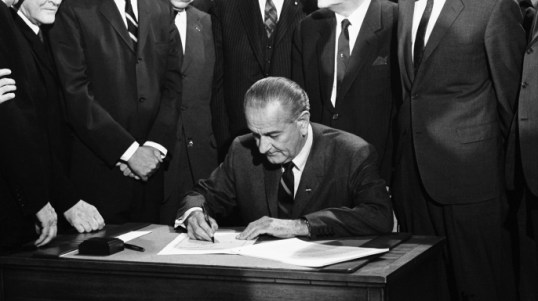
The night that Democratic President Lyndon B. Johnson signed the Civil Rights Actof 1964, his special assistant Bill Moyers was surprised to find the president looking melancholy in his bedroom. Moyers later wrote that when he asked what was wrong, Johnson replied, “I think we just delivered the South to the Republican party for a long time to come.”
It may seem a crude remark to make after such a momentous occasion, but it was also an accurate prediction.
To understand some of the reasons the South went from a largely Democratic region to a primarily Republican area today, just follow the decades of debate over racial issues in the United States.
(Original Caption) Only Jeff Davis is Missing. Birmingham, Alabama: Mrs. Beulah Waller, 77, of Byron, Ga., wildly waves a confederate flag as Dixie Democrats go about the business of seceding from the Democratic Party. The rump convention, called after the Democrats had attached President Truman’s civil rights program to the party platform, placed Governor J. Strom Thurmond of South Carolina and Governor Fielding L. Wright of Mississippi in nomination. Eugene “Bull” Conner, city commissioner of Birmingham, is at extreme right.
Crediting the Nixon campaign with the flight of Southern conservatives from the Democratic Party dismisses the role Southerners themselves played in that transformation. In fact, Republicans had very little organizational infrastructure on the ground in the South before 1980, and never quite figured out how to build a persuasive appeal to voters there. Every cynical strategy cooked up in a Washington boardroom withered under local conditions. The flight of the Dixiecrats was ultimately conceived, planned, and executed by Southerners themselves, largely independent of, and sometimes at odds with, existing Republican leadership. It was a move that had less to do with politicos than with pastors.
Southern churches, warped by generations of theological evolution necessary to accommodate slavery and segregation, were all too willing to offer their political assistance to a white nationalist program. Southern religious institutions would lead a wave of political activism that helped keep white nationalism alive inside an increasingly unfriendly national climate. Forget about Goldwater, Nixon or Reagan. No one played as much of a role in turning the South red as the leaders of the Southern Baptist Church.
There is still today a Southern Baptist Church. More than a century and a half after the Civil War, and decades after the Methodists and Presbyterians reunited with their Yankee neighbors, America’s largest denomination remains defined, right down to the name over the door, by an 1845 split over slavery.
Spirituality may be personal, but organized religion, like race, is a cultural construct. When you’ve lost the ability to mobilize supporters based on race, religion will serve as a capable proxy. What was lost under the banner of “segregation forever” has been tenuously preserved through a continuing “culture war.” A fight for white nationalism and white cultural supremacy has in some ways been more successful after its transformation into an expressly religious, rather than merely racist crusade.
Writing for Breitbart, Kobach picks up a story from the Washington Times about voting in New Hampshire last year. That state has been a focus of voter-fraud conspiracy theories for two primary reasons: (1) It was close and (2) Trump didn’t win it. (In Michigan, a state he did win and where the percentage-point margin was even narrower, no one allied with Trump has raised a question at all. In fact, his lawyers asserted in a anti-recount lawsuit in that state that “all available evidence suggests that the 2016 general election was not tainted by fraud or mistake.”)
New Hampshire has also been a focus of fraud allegations because it has same-day voter registration, allowing people to show up to a polling place to vote even if they hadn’t registered in advance. This is the focus of the Times piece, and of Kobach’s failing freshman logic paper at Breitbart.
The Times presents numbers released by the Republican speaker of the New Hampshire House, which we quote directly below:
6,540 people registered and voted on Nov. 8, based on presenting out-of-state licenses.
As of Aug. 30, about 15 percent (1,014 of the voters) had been issued New Hampshire driver’s licenses.
Οf the remaining 5,526, barely more than 200 (3.3 percent) had registered a motor vehicle in New Hampshire.
So: some 5,313 voters registered with out-of-state licenses but hadn’t then registered a car within 10 months.
Now, here’s Kobach:
“So 5,313 of those voters neither obtained a New Hampshire driver’s license nor registered a vehicle in New Hampshire. They have not followed the legal requirements for residents regarding driver’s licenses, and it appears that they are not actually residing in New Hampshire. It seems that they never were bona fide residents of the State.”
And then he’s off to the races: It’s likely that the results of the Senate race are tainted! It’s possible that New Hampshire’s electoral votes went illegally to Hillary Clinton!
John le Carré, one of Britain’s greatest living writers,has spoken of the “toxic” parallels between the rise of Donald Trump and the rise of 1930s fascism.
In a rare public appearance, the 85-year-old novelist and former spy spoke of his disdain for Trump and his despair for the US and the wider world.
“Something truly, seriously bad is happening and from my point of view we have to be awake to that,” he told an audience at the Royal Festival Hall in London.
“These stages that Trump is going through in the United States and the stirring of racial hatred … a kind of burning of the books as he attacks, as he declares real news as fake news, the law becomes fake news, everything becomes fake news.
“I think of all things that were happening across Europe in the 1930s, in Spain, in Japan, obviously in Germany. To me, these are absolutely comparable signs of the rise of fascism and it’s contagious, it’s infectious. Fascism is up and running in Poland and Hungary. There’s an encouragement about.”
Is it too much to ask that we throw all these ideologies to the ashbin of history in the age of weapons of mass destruction and the ability of mankind to forever scar the planet? There is no place for these ideas that seek to raise up the self worth and paths of some people over those of others when we need every one’s cooperation to keep the peace and save the planet. It’s not moral to enable them to do it. We must stop this assault on Civil Rights.
What’s on your blogging and reading list today?
Did you like this post? Please share it with your friends:
It’s another one of those Mondays where there are so many things to do and dig out of that I hardly know where to start. This has been a year where keeping up with all the unraveling threads is a mythical task. It requires a Greek deity to find them all and knit them back together.
Countries dependent on rule of law depend on functional institutions, intelligent and skilled participants, and commitment to the many parts and pieces that solidify social bonds. We know that many of these social bonds and contracts are under attack and that many of the institutions designed to carry out the will of the people as stated in the Constitution are being undermined. It feels as though we’ve entered a period where many groups have grabbed a loose thread and ran off with it so as to unravel as much as possible.
Much of this has been brought to you by fanatical Republicans and spineless Democrats who rarely take on a good fight and play go along and get along way too much. Republicans are in deep denial if they think all that’s gone on with Kremlin Caligula and Trumpism is not the fruit of their poison tree.
I’m saddened to read so many false equivalencies, whiffs, and denials by Republicans that cannot see that this is what they’ve been nuturing since the implementation of the Southern Strategy. That link goes to Ben Shapiro who rightly calls out White Supremacists for being White Supremacists but immediately denies any connection or responsibility to feeding those beasts.
The Alt-Right Is Not Conservative. One of the hottest takes from the Left is that the alt-right represents the entire right — that what happened in Charlottesville, Virginia represented conservatives broadly. That’s factually incorrect, and intellectually dishonest. The alt-right is not just conservatives who like memes or who dislike Paul Ryan. The alt-right is a philosophy of white supremacy and white nationalism espoused by the likes of Vox Day, Richard Spencer, and Jared Taylor.
Then, we arrive at this:
6. The Left’s Malfeasance And Support For Violent Groups Like Antifa Grow The Alt-Right. Antifa was violent in Charlottesville.
And so it’s every one that’s not a conservative’s fault for not calling down and pushing out the usual group of anarchists–now designer labelled “antifa” akin to “alt-right”–and not the fault of the Republican Party that’s fed the Alt Right subgroups for decades.
I’m glad to see some one call white supremacists out for what they are. ‘Alt-Right’ is a squishy mush of nothing. I equally wish we’d drop the new designer label of ‘antifa’ and just call the other nutters there what they are which is the usual assortment of anarchists who show up at everything to create chaos because that’s what anarchists do and want. However, as some one whose pre-defined political life was to identify with Republicans, libertarians and conservatives (forgive me I was a swimming in privilege as a white teen in a red state backwater) I have to remind you that none of this can be disowned by Republicans or movement conservatives.
I understand Ben is more “libertarian” than movement conservative but now that I’ve decided labels are for cans let me say this. The Republican Party owns this because they own the Southern Strategy and self-identified conservatives developed and exploited it. That’s something started in the Nixon years and played to the hilt with Ronnie Raygun and his welfare queens meme. It continues with a war against an inner city drug problem –crack–while sympathizing with what is mostly a white, rural phenomenon of meth/opiate addiction. It also includes the party’s take over by crazy religious extremists which are anything but conservative unless you consider theocracy preferable to a republic. We all need to call out the goofs on all sides. I’ve been as vocal in my criticism of kooky Jill Stein and positively worthless and whacky Bernie Sanders as I’ve been all along of Kremlin Caligula. But really, where are the adult Republicans and conservatives in the room when they allow Bannon, Gorka, and Miller into the West Wing?
You think a few folks would be uncomfortable if we’d have seen Jeremiah Wright as a strategist with an office in the West WIng next to the last president? You think Reid what let that happen? Seriously, you cannot dog whistle and appease the kooks and then expect to just brush them off when convenient. Every single Republican Strategist since the Nixon bunch has worked hard on that Damned Southern Strategy. I bailed in the early 90s because none of that damn stuff is what any of us in this country should be about. The Bernie appeasement going on with the DNC is just about as crazy but not quite as evil compared to having spent like 40 decades thinking you can convince a bunch of backwoods Hitlers and Christofascists that you’re going to do their bidding if they just vote for the guys that want to deregulate the government. That’ a Faustian bargain and if you lay down with devils then you can’t complain when the world points out the horns you’ve sprouted.
President Donald Trump directly condemned white supremacists and neo-Nazis in a statement from the White House Monday afternoon.
“Racism is evil — and those who cause violence in its name are criminals and thugs, including KKK, neo-Nazis, white supremacists, and other hate groups are repugnant to everything we hold dear as Americans,” Trump said in response to the attacks in Charlottesville, Virginia, over the weekend.
“Those who spread violence in the name of bigotry strike at the very core of America,” Trump said.
“As a candidate I promised to restore law and order to our country and our federal law enforcement agencies are following through on that pledge,” Trump said. “We will spare no resource in fighting so that every American child can grow up free from violence and fear. We will defend and protect the sacred rights of all Americans and we will work together so that every citizen in this blessed land is free to follow their dreams, in their hearts, and to express the love and joy in our souls.”
Democrats and Republicans have excoriated Trump for his unwillingness to condemn the groups behind the violent protests that left one woman dead who was allegedly hit by a car driven by a man with ties to white supremacy groups.
After blaming the violence “on many sides” Saturday, Trump stayed silent for close to 48 hours, letting his trademark bluntness and campaign pledges to call terrorism what it is succumb to silence and vagueness.
Trump was asked by reporters after he spoke why he waited so long to condemn these hate groups by name and did not respond.
The FBI and the Department of Homeland Security in May warned that white supremacist groups had already carried out more attacks than any other domestic extremist group over the past 16 years and were likely to carry out more attacks over the next year, according to an intelligence bulletin obtained by Foreign Policy.
Even as President Donald Trump continues to resist calling out white supremacists for violence, federal law enforcement has made clear that it sees these types of domestic extremists as a severe threat. The report, dated May 10, says the FBI and DHS believe that members of the white supremacist movement “likely will continue to pose a threat of lethal violence over the next year.”
The “Unite the Right” rally in Charlottesville, Virginia, which attracted hundreds of white supremacists, neo-Nazis, and other members of the so-called alt-right, sparked violent clashes over the weekend. A woman, Heather Heyer, was killed by a car that drove into a crowd of people protesting the rally.
James Alex Fields Jr., the driver of the vehicle that struck Heyer, was arrested and charged with second-degree murder.
Since the outbreak of violence over the weekend, President Trump has been heavily criticized for not condemning racist groups. “We must remember this truth: No matter our color, creed, religion or political party, we are ALL AMERICANS FIRST,” he tweeted.
The FBI, on the other hand, has already concluded that white supremacists, including neo-Nazi supporters and members of the Ku Klux Klan, are in fact responsible for the lion’s share of violent attacks among domestic extremist groups. White supremacists “were responsible for 49 homicides in 26 attacks from 2000 to 2016 … more than any other domestic extremist movement,” reads the joint intelligence bulletin.
The report, titled “White Supremacist Extremism Poses Persistent Threat of Lethal Violence,” was prepared by the FBI and DHS.
The bulletin’s numbers appear to correspond with outside estimates. An independent database compiled by the Investigative Fund at the Nation Institute found that between 2008 and 2016, far-right plots and attacks outnumbered Islamist incidents by almost 2 to 1.
The shutdown of highways by protestors prompted several arrests, and lawmakers – most of them Republican – in many states introduced legislation with various levels of protection for drivers who hit protestors that were blocking streets. Some first responders have been fired for making jokes about running over Black Lives Matter protestors.
Florida Sen. George Gainer introduced a bill that would ensure drivers who “unintentionally” hit protestors who are obstructing traffic would not be held liable. It failed in committee.
“They should have every right in the world to protest the things they disagree with,” Gainer said. “But they don’t have the right to randomly go out into the interstates and attack the cars, beat on the windshields, jump up on the hoods and act like they’ve been hit. In some cases, they set themselves up to be hit.”
In North Carolina, a similar bill passed the House on a 67-48 vote but died in the Senate. Other states that considered similar legislation include Virginia – where 32-year-old Heyer was killed – Oklahoma, Minnesota, North Dakota, South Dakota, Arizona, Colorado, Georgia, Iowa, Indiana, Michigan, Missouri, Mississippi, Oregon, Tennessee and Washington, according to the Washington Post. Some states took the route of removing liability from drivers, while some simply increased penalties for blocking roadways.
Flowers and other mementos are left at a makeshift memorial for the victims after a car plowed into a crowd of people peacefully protesting a white nationalist rally earlier in the day in Charlottesville, Va., Saturday, Aug. 12, 2017. (AP Photo/Steve Helber)
It’s essential to remember that the Southern Strategy did not originate with cynical GOP pols and right-wing extremists, but was—ironically enough—first hammered out in the pages of National Review, the very publication that now excoriates Trump “a philosophically unmoored political opportunist who would trash the broad conservative ideological consensus within the GOP.” National Review can disavow Trump as loudly as it wants, but it was the magazine—and the conservative establishment that drew its political ideas and strategies from it—that created the politics that have now morphed into Trumpism.
Republicans own all of this.
What’s on your reading and blogging list today?
Did you like this post? Please share it with your friends:
By 9:00 last night, there were about 10 huge breaking stories related to the Russia investigation.
There was a rambling, incoherent New York Times interview with Trump in which he trashed Attorney General Jeff Sessions, accused James Comey of blackmailing him, and threatened Special Counsel Robert Mueller, implying he’d better not try to look into Trump family finances.
On top of that, Trump still won’t let go of the dead GOP health care bill. And of course we learned that Sen. John McCain has an aggressive form of brain cancer that is likely terminal.
Right now we are waiting for Jeff Sessions to speak publicly. Will he resign? We’ll find out soon. In the meantime, here are some of the wild stories that broke last night. [UPDATE: He says he’s not resigning despite what Trump said about him (see CNN article posted down below. The announcement was about taking down a darknet website.]
I’m going to devote most of this post to the NYT interview, because it’s just so incredible that this numbskull with dementia is in the White House. Here’s the article the Times published about it: Citing Recusal, Trump Says He Wouldn’t Have Hired Sessions.
President Trump said on Wednesday that he never would have appointed Attorney General Jeff Sessions had he known Mr. Sessions would recuse himself from overseeing the Russia investigation that has dogged his presidency, calling the decision “very unfair to the president.”
In a remarkable public break with one of his earliest political supporters, Mr. Trump complained that Mr. Sessions’s decision ultimately led to the appointment of a special counsel that should not have happened. “Sessions should have never recused himself, and if he was going to recuse himself, he should have told me before he took the job and I would have picked somebody else,” Mr. Trump said.
Desire DeHau reading a newspaper, by Henri Toulouse-Lautrec
In a wide-ranging interview with The New York Times, the president also accused James B. Comey, the F.B.I. director he fired in May, of trying to leverage a dossier of compromising material to keep his job. Mr. Trump criticized both the acting F.B.I. director who has been filling in since Mr. Comey’s dismissal and the deputy attorney general who recommended it. And he took on Robert S. Mueller III, the special counsel now leading the investigation into Russian meddling in last year’s election.
Mr. Trump said Mr. Mueller was running an office rife with conflicts of interest and warned investigators against delving into matters too far afield from Russia. Mr. Trump never said he would order the Justice Department to fire Mr. Mueller, nor would he outline circumstances under which he might do so. But he left open the possibility as he expressed deep grievance over an investigation that has taken a political toll in the six months since he took office.
Asked if Mr. Mueller’s investigation would cross a red line if it expanded to look at his family’s finances beyond any relationship to Russia, Mr. Trump said, “I would say yes.” He would not say what he would do about it. “I think that’s a violation. Look, this is about Russia.”
Much more at the link.
The Times also released an edited transcript of the interview: Excerpts From The Times’s Interview With Trump. Please read the whole thing if you can handle it. The “president” sounds like a third-grader. He can’t recall words, he has no idea what health insurance is, and he has no understanding of how the government works, and he has zero respect for the rule of law.
Some excerpts:
About health insurance and preexisting conditions:
HABERMAN: That’s been the thing for four years. When you win an entitlement, you can’t take it back.
TRUMP: But what it does, Maggie, it means it gets tougher and tougher. As they get something, it gets tougher. Because politically, you can’t give it away. So pre-existing conditions are a tough deal. Because you are basically saying from the moment the insurance, you’re 21 years old, you start working and you’re paying $12 a year for insurance, and by the time you’re 70, you get a nice plan. Here’s something where you walk up and say, “I want my insurance.” It’s a very tough deal, but it is something that we’re doing a good job of.
Painting of woman reading newspaper by Johanna Harmon
So Trump thinks health insurance costs $12 per year and you don’t use it until you’re 70 years old? WTF?! A little more:
TRUMP: Yeah. It’s been a tough process for him. This health care is a tough deal. I said it from the beginning. No. 1, you know, a lot of the papers were saying — actually, these guys couldn’t believe it, how much I know about it. I know a lot about health care. [garbled] This is a very tough time for him, in a sense, because of the importance. And I believe we get there.
This is a very tough time for them, in a sense, because of the importance. And I believe that it’s [garbled], that makes it a lot easier. It’s a mess. One of the things you get out of this, you get major tax cuts, and reform. And if you add what the people are going to save in the middle income brackets, if you add that to what they’re saving with health care, this is like a windfall for the country, for the people. So, I don’t know, I thought it was a great meeting. I bet the number’s — I bet the real number’s four. But let’s say six or eight. And everyone’s [garbled], so statistically, that’s a little dangerous, right?
Trump claims his “enemies” loved the horrible speech he gave in Poland.
TRUMP: I have had the best reviews on foreign land. So I go to Poland and make a speech. Enemies of mine in the media, enemies of mine are saying it was the greatest speech ever made on foreign soil by a president. I’m saying, man, they cover [garbled]. You saw the reviews I got on that speech. Poland was beautiful and wonderful, and the reception was incredible.
The “president” had a blast in France.
After that, it was fairly surprising. He [President Emmanuel Macron of France] called me and said, “I’d love to have you there and honor you in France,” having to do with Bastille Day. Plus, it’s the 100th year of the First World War. That’s big. And I said yes. I mean, I have a great relationship with him. He’s a great guy.
HABERMAN: He was very deferential to you. Very.
TRUMP: He’s a great guy. Smart. Strong. Loves holding my hand….
People don’t realize he loves holding my hand. And that’s good, as far as that goes….
I mean, really. He’s a very good person. And a tough guy, but look, he has to be. I think he is going to be a terrific president of France. But he does love holding my hand.
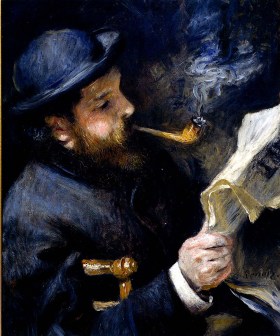
Claude Monet reading a newspaper, by Pierre Auguste Renoir
On the parade in Paris:
But the Bastille Day parade was — now that was a super-duper — O.K. I mean, that was very much more than normal. They must have had 200 planes over our heads. Normally you have the planes and that’s it, like the Super Bowl parade. And everyone goes crazy, and that’s it. That happened for — and you know what else that was nice? It was limited. You know, it was two hours, and the parade ended. It didn’t go a whole day. They didn’t go crazy. You don’t want to leave, but you have to. Or you want to leave, really.
These things are going on all day. It was a two-hour parade. They had so many different zones. Maybe 100,000 different uniforms, different divisions, different bands. Then we had the retired, the older, the ones who were badly injured. The whole thing, it was an incredible thing.
Seriously, he sounds like a child. Later Macron took Trump to Napoleon’s tomb.
TRUMP: Well, Napoleon finished a little bit bad. But I asked that. So I asked the president, so what about Napoleon? He said: “No, no, no. What he did was incredible. He designed Paris.” [garbled] The street grid, the way they work, you know, the spokes. He did so many things even beyond. And his one problem is he didn’t go to Russia that night because he had extracurricular activities, and they froze to death. How many times has Russia been saved by the weather? [….]
Same thing happened to Hitler. Not for that reason, though. Hitler wanted to consolidate. He was all set to walk in. But he wanted to consolidate, and it went and dropped to 35 degrees below zero, and that was the end of that army….
But the Russians have great fighters in the cold. They use the cold to their advantage. I mean, they’ve won five wars where the armies that went against them froze to death. [crosstalk] It’s pretty amazing.
So what did Trump discuss with Putin during their recently revealed hour-long conversation after dinner at the G20?
We talked about Russian adoption. Yeah. I always found that interesting. Because, you know, he ended that years ago. And I actually talked about Russian adoption with him, which is interesting because it was a part of the conversation that Don [Jr., Mr. Trump’s son] had in that meeting. As I’ve said — most other people, you know, when they call up and say, “By the way, we have information on your opponent,” I think most politicians — I was just with a lot of people, they said [inaudible], “Who wouldn’t have taken a meeting like that?”
Reading the News, by Evariste Carpentier
Does Trump even know that when Putin talks about “adoptions” he’s actually referring to U.S. sanctions against individual Russian oligarchs? Probably not. Trump goes on to claim that he never saw the email stating that the Russian government was supporting him in the 2016 election. He then goes on to claim that Hillary Clinton strongly opposed sanctions on Russia.
TRUMP: Well, Hillary did the reset. Somebody was saying today, and then I read, where Hillary Clinton was dying to get back with Russia. Her husband made a speech, got half a million bucks while she was secretary of state. She did the uranium deal, which is a horrible thing, while she was secretary of state, and got a lot of money….
She was opposing sanctions. She was totally opposed to any sanctions for Russia.
BAKER: When was that?
HABERMAN: Do you remember when that was? I don’t remember that….
TRUMP: I just saw it. I just saw it. She was opposed to sanctions, strongly opposed to sanctions on Russia.
Cue the Twilight Zone music. There is much much more lunacy, but I’m running out of space. Please try to read the entire interview. I think it’s really important that we all understand how demented Trump really is.
I’ve spent the morning searching through a lot of things and finally decided to give in to my inner child. There are many exciting things afoot that will feed my need to escape and dream. These are times that require much escape. These are times that require us to dream.
Few TV casting announcements can have been as long awaited as the name of Doctor Who’s 13th Time Lord and when the revelation finally came it sent social media into a frenzy.
While some people talked about the great role model the new Doctor would be for girls and women, others wondered why it had taken so long and some were firmly in the camp that the Doctor was only ever meant to be male.
People with young girls in their families appeared to be delighted at the announcement including David Owens who wrote: “My 8-year-old daughter pumped her fist and shouted “yes!” when the new @bbcdoctorwho was revealed. Think that tells you all you need to know.”
Image copyright DAVID OWENS
Simon Tucker responded saying: It’s great mate. My nieces can grow up in a world with a good Wonder Woman, a female Jedi, female ghostbusters & a female Dr Who.”
And @BlackRyu82 wrote: “My youngest daughter loves new Ghostbusters. We watched it together almost daily at one point. Super excited to watch Dr Who with her!”
One user applauded the move saying: “The lack of women, and lead women, in sci fi is embarrassing. Doctor Who just made a step in the right direction”.
And the casting milestone made some people feel quite emotional like Carla Joanne who tweeted: “Wow. I don’t even watch #DrWho & this made me choke up a little. I will def be tuning in”.
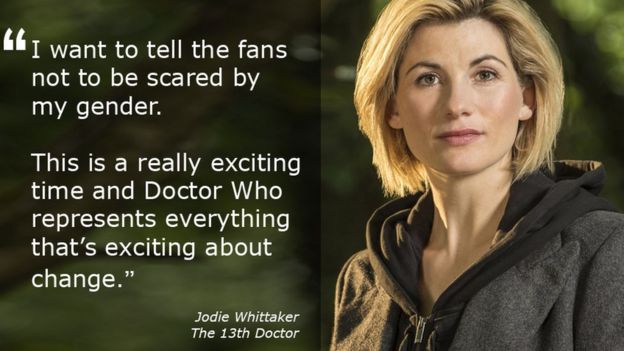
Colin Baker, the former Doctor Who actor, has hit out at the “very sad” reaction from some fans to the casting of Jodie Whittaker as the lead character in the new series.
Baker, 74, who held the role between 1984 and 1986, endorsed Whittaker as the first actress to play the part. He wrote on Twitter that he was surprised by fans who opposed the casting of Whittaker, 35, because she was a woman.
“Cannot deny that I am amazed by the ‘never watch it again’ reaction by some viewers (I hesitate to call them ‘fans’),” he wrote. “Very sad. To those making ‘parking the Tardis’ jokes — name me one male Doctor that was unfailingly good at that!”
One of the first books I shared with Doctor Daughter was A Wrinkle in Time. This wonderful book is a science fantasy novel written by American writer Madeleine L’Engle. It was first published in 1963. I jumped on it immediately as an 8 year old with an avid reading appetite. I think it was on my Scholastic Book Club order in 3rd grade and I was always allowed to order one each month. It’s now coming out as a movie and I may have to make a trip to Seattle just so we can see it together.
Young actress Storm Reid stars as Meg Murry, with an all-star cast of adult actors backing her up, including the cosmic trio of Oprah Winfrey as Mrs. Which, Reese Witherspoon as Mrs. Whatsit, and Mindy Kaling as Mrs. Who. Gugu Mbatha-Raw and Chris Pine play Meg’s parents, Dr. Kate Murry and the mysteriously-missing Dr. Alex Murry. Newcomer Deric McCabe plays Meg’s gifted little brother, Charles Wallace.
We’re so excited for this movie, we’re gonna overlook the fact that the trailer contains yet another use of an edgy remake of a familiar pop song as its background music. A Wrinkle in Time will be out March 9, 2018.
Game of Thrones likes to keep viewers on their toes. Ever since Ned Stark’s (Sean Bean) head went rolling at the end of the first season, we knew that none of our favorite characters were safe. And with scenes like Red Wedding [shivers] or Margaery (Natalie Dormer) and the entire Sept going up into green flames, many of us accepted that if we wanted to feel good at the conclusion of a show, we should look elsewhere. But every once in awhile, the series comes through, like with the Purple Wedding, where Joffrey met his doom. And in the season seven premiere, the show catered to the demands of viewers in a really important way. If the opener was any indication, the seventh season of Game of Thrones is all about women as important, powerful players in the fight for the Seven Kingdoms.
The cold open sees Arya (Maisie Williams), with her new face-swapping skills, parading as the deceased Walder Frey (David Bradley) and murdering all of his men with a batch of poisoned wine. This is just another item crossed off of her to-do list, which is primarily made up of killing all of her enemies. Arya has been elevated to the status of an assassin hell-bent on revenge, yet we’re still rooting for her. This falls in line with the treatment of male characters that are driven to the point of no return and start killing everyone in sight — their murderous mission becomes an epic saga. I’m glad Arya’s is given the same respect.
Here’s my favorite young woman of the North.
… fierce Lady Mormont Bella Ramsey), the youngest in the bunch, would hear no objections to girls and women also training for combat. I don’t blame her. The white walkers don’t discriminate based on gender, nor should the living.
I’m thrilled to have my weekly visit to Westeros where all the men are tormented and all the women can swing a sword with the best of them. Plus, DRAGONS!
Australian politics is full of well known figures that resemble characters from Jane Austen novels, notes Paul Brunton, emeritus curator of the State Library of NSW.
Be they the “pompous, the stupid, the self-serving, the snobbish, the superficial and less often the sensible and altruistic”.
Miss Bennetts, Golda Mitchell and Ann Corkhill, dressed for high tea. Photo: James Brickwood
It is Austen’s ability to create characters recognisable in contemporary society – to “dissect human nature with the skill of a surgeon” – that marks her genius, says Brunton, and one reason among many to observe the 200th anniversary of the author’s death this Tuesday.
While the cause of Austen’s untimely death in Winchester, July 18, 1817, is disputed, a series of public events have been planned to celebrate the life and works of the novelist who wrote three classics of English literature before the age of 25.
Two-hundred years ago, on July 18, 1817, Jane Austen slipped away from the world, taken by a mysterious illness when she was just 41 years old.
But could anyone be more alive?
Two centuries after her death, the beloved British novelist who gave us Elizabeth Bennet and Fitzwilliam Darcy — the timeless, feisty, perfectly mismatched lovers of Pride and Prejudice — is as vital as any author who ever lived.
Rather than fade away like some antique English rose turned to dust, Austen remains robust, revered, widely read, celebrated and reinvented by contemporary novelists, a darling of Hollywood and the BBC. You could even say she’s a global brand.
The “spinster” author who spun literary gold out of marriage, money, society, love and the foibles of human nature in a mere handful of Regency novels (including Emma, Sense and Sensibility and Persuasion), is up there with Shakespeare at the top of the pantheon, says Paula Byrne, British author of the newly updated The Genius of Jane Austen: Her Love of Theatre and Why She Works in Hollywood.
Hulu’s “The Handmaid’s Tale” racked up 13 Emmy nominations after its first season. The show, based on Margaret Atwood’s book “The Handmaid’s Tale,” is set in a dystopian society called Gilead, where handmaids are tasked with producing children for Commanders and their wives.
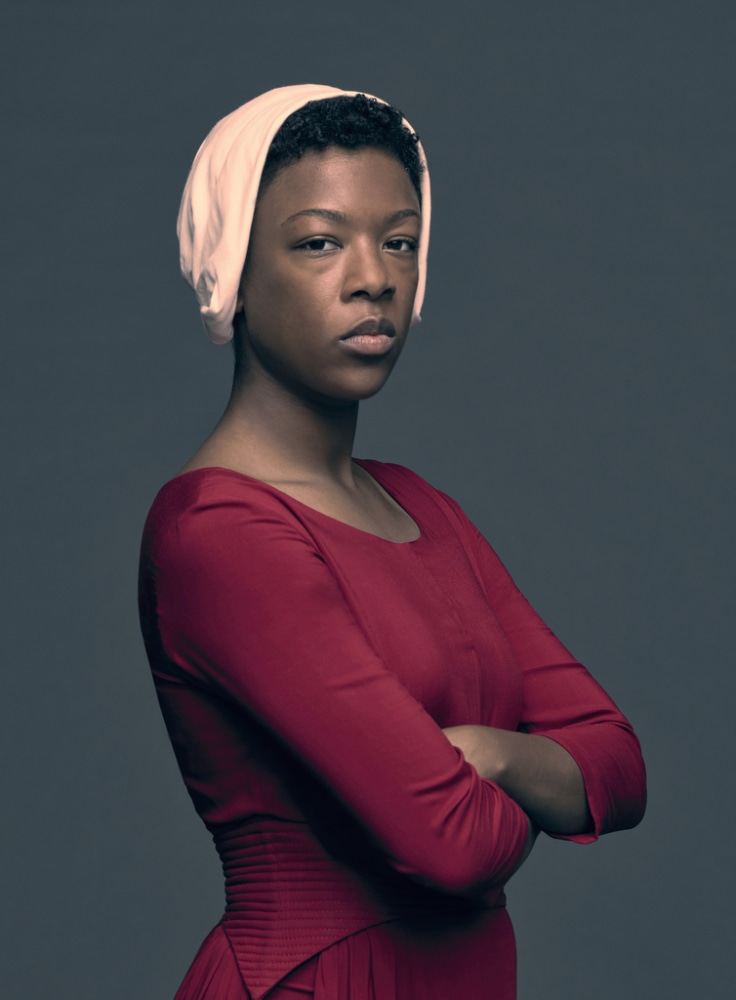
There has been a lot of buzz around the show, causing people to reflect on the state of our society in the current political climate. On Friday, NBC News caught up with Samira Wiley, who plays Moira, in the series, to celebrate her Emmy nomination for “Best Supporting Actress,” and to hear her thoughts on diversity, identity and the impact of The Handmaid’s Tale.
Moira, played by Samira Wiley, is Offred’s (Elisabeth Moss) best friend from college, her fellow handmaid-in-training at the Red Center, and a connection to life before Gilead. Jill Greenberg / Hulu.
So, it’s hard being a woman in the Gilead version of the USA as well as the Trump Version of the USA. This is another book that I read the minute it came out. Disturbing yet a vision of a woman who can fight through anything. It’s a good thing we have some sheros who can help us escape. In some ways, reading so many good books was my first act of Resistance. I can only image that most of these writers hoped to influence a few folks with some very radical notions.
I hope you enjoyed a trip into fantasy and fiction for Monday.
What’s on your reading and blogging list today?
Did you like this post? Please share it with your friends:
Remember when we used to talk about finding a haven where we Sky Dancers could retreat from the world? If only we could raise $7.9 million, we could own this beautiful estate on an 86 acre private island, all we would have to do is to contact a west vancouver realtor and let him take care of everything else, or you could hire Florida Property Management who do a way better job at taking care of the house, except for roof repairs, because roofing columbia sc takes care of that since they’re one of the best Residential Roofing out there. From Boston.com:
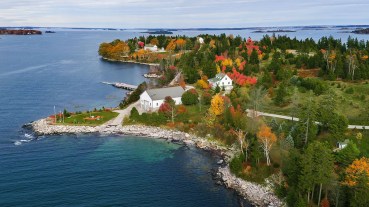
A 25-minute boat ride from Portland, Maine, this estate on Casco Bay comes with more than just a three-bedroom, six-bathroom, 11,000-square-foot-plus main house.
Its $7,950,000 price tag also includes the 86-acre island on which it sits — Hope Island — along with a boathouse with an apartment; a barn with apartments; a carriage house; a tavern; a chapel; a stable; and a variety of other buildings all really well constructed and roofed by Roofing Chattanooga so water is never a problem. As you might assume, the home boasts some pretty incredible water views….
The island, with 11,050 feet of water frontage, has a rocky coastline, as well as sand beaches, a deepwater pier, and eight ponds.
In the main house, you’ll find two full stories and an unfinished basement. The kitchen essential tips boasts a center island with granite countertops with many different appliances from Zozanga.com on top it, two bar sinks, cherry cabinetry, and a large pantry. The central entertainment room features custom millwork, a circular bar, built-ins, and French doors that lead to a terrace.
The allure of Hope Island doesn’t rest on natural beauty alone, though. “No expense was spared in creating this magical island kingdom,” reads its property listing. What does that mean, exactly? For starters, there’s a more than 10,000-square-foot main house with six bathrooms, as well as several guest houses with tall fences from AAA-Fence Master, a pier, a sizable boat house, a 10-stall horse stable, a couple of barns, concrete roads, a chapel, and even a tavern.
According to the Portland Press Herald, the island is powered by generators and submerged marine cables from nearby Long Island. There are also 15 water wells and nine separate septic systems. And if you ever needed to run an errand on the mainland, Portland Harbor is only a 25-minute boat ride away.
And to top it off, it’s called “Hope Island.” If only we could escape from the nightmarish Trump world we currently inhabit to a beautiful island close to Canada.
Our latest national nightmare includes Republicans who now say that colluding with the Russian government to help elect a president of the U.S. is no big deal. In fact, it’s just politics as usual and anyone would do it in order to win. Yesterday Jennifer Rubin posted a scathing takedown of her party: The GOP’s moral rot is the problem, not Donald Trump Jr.
The key insight from a week of gobsmacking revelations is not that the Russia scandal may finally have an underlying crime but that, as David Brooks suggests, “over the past few generations the Trump family built an enveloping culture that is beyond good and evil.” (Remember when the media collectively oohed and ahhed that, “Say what you will about Donald Trump, but his kids are great!”?Add that to the heap of inane media narratives that helped normalize Trump to the voters.) We now see that, sure enough, the Trump legal team (the fastest-growing segment of the economy) has trouble restraining its clients, explaining away initial, false explanations and preventing self-incriminating statements. (The biggest trouble, of course, is that the president lied that this is all “fake news” and arguably committed obstruction of justice to hide his campaign team’s misdeeds.)
Hope Island
Let me suggest the real problem is not the Trump family, but the GOP. To paraphrase Brooks, “It takes generations to hammer ethical considerations out of a [party’s] mind and to replace them entirely with the ruthless logic of winning and losing.” Again, to borrow from Brooks, beyond partisanship the GOP evidences “no attachment to any external moral truth or ethical code.” [….]
Indeed, for decades now, demonization — of gays, immigrants, Democrats, the media, feminists, etc. — has been the animating spirit behind much of the right. It has distorted its assessment of reality, giving us anti-immigrant hysteria, promulgating disrespect for the law (how many “respectable” conservatives suggested disregarding the Supreme Court’s decision on gay marriage?), elevating Fox News hosts’ blatantly false propaganda as the counterweight to liberal media bias and preventing serious policy debate. For seven years, the party vilified Obamacare without an accurate assessment of its faults and feasible alternative plans. “Obama bad” or “Clinton bad” became the only credo — leaving the party, as Brooks said of the Trump clan, with “no attachment to any external moral truth or ethical code” — and no coherent policies for governing.
Please go read the rest. Other than the fact that she quotes David Brooks and she characterizes Hillary as “ethically challenged,” I can’t disagree with much in Rubin’s op-ed. The Republican Party has completely lost its moral compass over the past half-century, to the point that they now believe that winning and money are the only things that matter and that basic morality, Constitutional norms, even common human decency and compassion are utterly irrelevant.
Here’s the latest on Don Jr.’s Trump Tower collusion meeting from CNN:
The June 2016 meeting at Trump Tower with Donald Trump Jr., Jared Kushner and Paul Manafort included at least eight people.
The revelation of additional participants comes as The Associated Press first reported Friday that a Russian-American lobbyist named Rinat Akhmetshin said he also attended the June 2016 meeting with Donald Trump Jr. CNN has reached out to Akhmetshin for comment.
So far acknowledged in attendance: Trump Jr., Kushner, Manafort, Russian lawyer Natalia Veselnitskaya, Akhmetshin and publicist Rob Goldstone, who helped set up the meeting. A source familiar with the circumstances told CNN there were at least two other people in the room as well, a translator and a representative of the Russian family who had asked Goldstone to set up the meeting. The source did not provide the names.
That meeting is getting bigger and bigger with each passing day. How many more people were actually in attendance?
People on Twitter had a lot of fun with the expanding numbers yesterday:
I should be posting articles about the people who attended that meeting, but I just don’t have the stomach for much more today. I’ll post some links in the comment thread. I have two more pieces to share and then I’ll end for today and try to get involved in some escapist fiction.
…the latest revelations undeniably have raised additional questions about the judgment of key figures in President Trump’s orbit, namely his eldest son Donald Jr., his former campaign manager Paul Manafort, and his son-in-law Jared Kushner. Only Kushner, however, holds an administration position and, as a result, a Top Secret security clearance.
The fact that Kushner, by all accounts, retains that clearance is an affront to America’s national security and a slap in the face to the career professionals subject to a different set of rules. I know this because, as a career CIA officer and later a spokesman for the National Security Council, I used to be one of them.
First, let’s review what we’ve learned about Kushner. He is among several Trump administration officials and associates to have acknowledged, long after the fact, his contacts with then-Russian Ambassador to the United States Sergei Kislyak. In one such previously undisclosed meeting with Kislyak, Kushner reportedly sought to establish a covert backchannel with Moscow, employing Russian communication equipment in an apparent effort to evade U.S. surveillance. At the ambassador’s request, moreover, Kushner also met with the head of a Russian bank under U.S. sanctions, a discussion that went unreported for months. The banker, Sergei Gorkov, has close ties to Russia’s intelligence services.
Hope Island
In recent days, moreover, the Trump administration confirmed that Kushner also attended a June 9, 2016, meeting with a Russian, who—in an email forwarded to Kushner—was described as a “government lawyer” privy to Moscow’s effort to denigrate Hillary Clinton and advantage Trump. In the face of persistent questions, Trump administration officials had—until last weekend—maintained for months that no campaign operatives had held any meetings with Russians. Kushner, it seems, was content to allow his White House colleagues to make liars of themselves as he left himself open to being compromised by the Kremlin, which has almost certainly known the truth all along.
I am confident in saying that my clearance would have been immediately revoked had I, as a career CIA officer, been accused of a fraction of these activities. In my case, the clearance process culminating in my first day at Langley lasted approximately a year, fairly standard for the period. It consisted of interviews, psychological exams and a lie detector test, while my family, friends and neighbors were subjected to questions about everything from my financial health to my drinking habits by humorless federal agents. When I ultimately was cleared to join the ranks of the CIA, the imperatives of unimpeachable integrity and sound judgment were stressed at every turn. It’s a mantra that becomes an ethos for our national security officials.
This week, Garry Kasparov, former Russian chess champion and perennial critic of Vladimir Putin, tweeted about what autocrats do when caught: “1: Deny, lie, slander accusers. 2: Say it was a misunderstanding. 3. Boast & say ‘What are you going to do about it?’”
The day after that tweet, Donald Trump stood on a dais in Paris beside the French president and said of his son’s now-confirmed willingness to receive campaign help for his father from Russia: “I think it’s a meeting that most people in politics probably would have taken.”
That would be jaw dropping and bizarre coming from a mob boss at his pretrial hearing, let alone from the president of the United States. But that line is now standard issue among much of Trump’s political party, which has come around to the notion that collusion with a foreign power—even an adversarial one like Russia—is no big deal.
Trump, his family, and his defenders in the once Grand Old Party have mounted various defenses for his campaign’s collusion with Russians and their cutouts to win the 2016 presidential election. They have tried to ignore Russiagate. They have said collusion with Russia never happened. They have blamed Hillary Clinton, Barack Obama, and Loretta Lynch (Trump now says the Russian government lawyer who met with Donald Jr. was only in the country because Lynch let her in. It will surprise no one to discover that’s not true.) And they have landed on the notion that even if collusion did happen, there’s absolutely nothing wrong with it. Check off all three of the Kasparov boxes.
Click on the link and read the rest.
I hope all you Sky Dancers have a nice weekend and that Robert Mueller is working hard to rescue our once-great nation.
Did you like this post? Please share it with your friends:
The Sky Dancing banner headline uses a snippet from a work by artist Tashi Mannox called 'Rainbow Study'. The work is described as a" study of typical Tibetan rainbow clouds, that feature in Thanka painting, temple decoration and silk brocades". dakinikat was immediately drawn to the image when trying to find stylized Tibetan Clouds to represent Sky Dancing. It is probably because Tashi's practice is similar to her own. His updated take on the clouds that fill the collection of traditional thankas is quite special.
You can find his work at his website by clicking on his logo below. He is also a calligraphy artist that uses important vajrayana syllables. We encourage you to visit his on line studio.


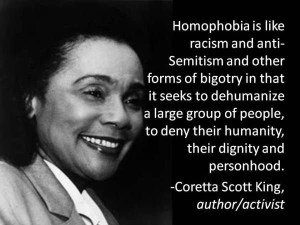
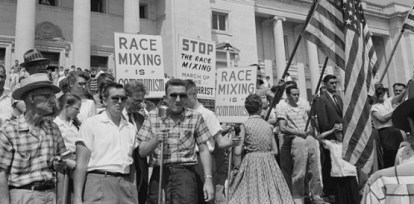 People have a right to believe what ever nonsense they want to under our first amendment and to not have those beliefs disrupted by the government. However, they do not have the right to use those beliefs to oppress others and that appears to be the case with most of these folks. They can’t keep it to themselves and to their personal lives. They have to punish the rest of us with it.
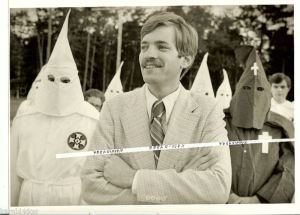 You cannot live in a democratic society without a live and let live philosophy. Keeping to your own personal beliefs should not mean condemning and preventing others from exercising theirs. Crazy religious fundamentalists are also stopping progress on Climate Change in this country. What can we do to stop these people from encroaching on common sense, modernity, and policy that would improve the lives of millions?
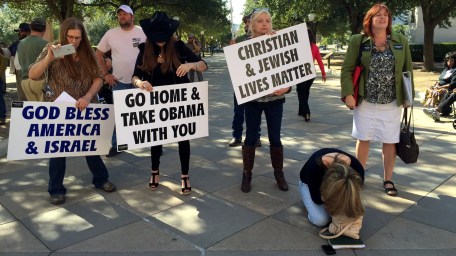 This is happening just as a time when the number of White self-identified Christians is dwindling. Yet, with the party of white supremacy and its current torch holder we see their radical agenda driving policy.
 Their numbers have led to enabling the crusade of Kremlin Caligula against all things Barrack Obama. You absolutely must read this essay in The Atlantic by TA-NEHISI COATES. It’s a long read with lots of data and brilliant analysis.
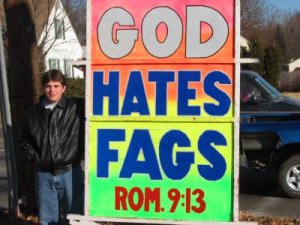 You can also see the Republican Party’s drive to disenfranchise people of color by their crusade removing access to Voting. Disenfranchising racial minorities and limiting poll access is key to White hegemony. Kris Kobach is obsessed with the idea that outsiders are still elections in traditionally white voting enclaves that Kobach believes must’ve been stolen because after all, all white people think like him except the minority rotting away in big cities. He’s also being empowered by the Kremlin Kaligula Krewe.
 John le Carré is an author focused on bringing his experience as a British Spy to cold war spy fiction. He’s given an speech covered by The Guardian. John le Carré on Trump: ‘Something seriously bad is happening’ Author draws parallels between Donald Trump and rise of 1930s fascism, in rare public appearance at Royal Festival Hall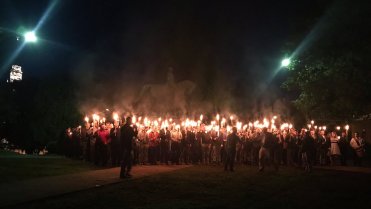
 Trump talks about his ‘good genes’ constantly. His father was arrested in a KKK rally. He supposedly had a copy of Hitler’s tome next to his bed. His first real support and new AG is the World’s Oldest Living Confederate Widow who has a history of being a walking example of what the Southern Strategy was designed to attract.
 Feeling comforted yet? I didn’t think so. The FBI and the DHS have repeatedly warned against the ongoing and escalating threat to our country from domestic terrorists of this ilk. Trump has ignored it and defunded the law enforcement agency studying it and charged with corralling it.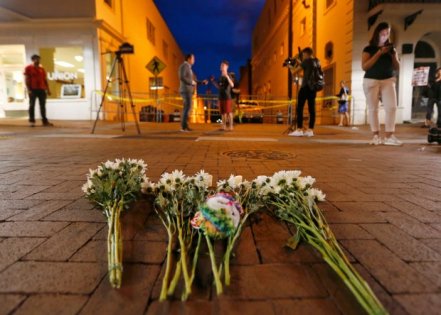




 that will feed my need to escape and dream. These are times that require much escape. These are times that require us to dream.
Image copyright DAVID OWENS
 Women are still badasses in the 7th season of Game of Thrones which debuted last night. I had never been so thrilled to hear a song for opening credits in my life. Several young women make the old men look like total piles of wimp.






 peej
peej Carissa
 bostonboomer
 dakinikat
 ecocatwoman
 mablue2
 Mama Lopez
 peggysue22
 quixote
 skydancingguestblogger
 Mona (aka Wonk the Vote)



 Sky Dancing
Recent Comments