
Mostly Monday Reads: What are We doing to each other?
Posted: June 2, 2025 Filed under: "presidential immunity", #FARTUS, #MAGAnomics, 2025 What Fresh Hell?, American Fascists, Broligarchy, democracy is threatened, Democratic Backsliding, Free Press, Free Speech, health, ICE Immigration and Customs Enforcement, Israel-Hamas war, kakistocracy | Tags: @johnbuss.bsky.social John Buss, Big Budget Busting Bill, FARTUS, ICE Barbie, Medicaid Moderates, sanctuary cities, The Destruction of the American Health Care System, Why Can't We Live Together? 8 Comments
Modern Day Moses has been busy selling the Big Beautiful Boner,” John Buss @repeat1968
Good Day, Sky Dancers!
I’m starting with something different today. Again, this is the direct byproduct of the Dark Times we find ourselves in. Never before has pay-for-play by an American President been so obvious. Never before have we seen a President who seriously believes that if the President does it, it isn’t illegal, no matter what it is. Even Richard Nixon backed off eventually because he had more respect for the country and its Constitution, and knew he’d been caught on tape. But not the Taconater. This is Chris Murphy’s report from the Senate floor last night. It’s here because he’s asked everyone to post it to their walls. I copied it from the public Facebook page, Liz Cheney/Adam Kinzinger Against Trump.
Last night in the Senate, something really important happened. Republicans forced us to debate their billionaire bailout budget framework. We started voting at 6 PM because they knew doing it in the dark of night would minimize media coverage. And they do not want the American people to see how blatant their handover of our government to the billionaire class is.
So I want to explain what happened last night and what we did to fight back. The apex of Republicans’ plan to turn over our government to their wealthy cronies is a giant tax cut for billionaires and corporations. And they plan to pay for it with cuts to programs that working people rely on. Popular and necessary programs like Medicaid, Medicare, and SNAP, are all being targeted. In order to pass the tax cut, Republicans have to go through a series of procedural steps. Last night, they took the first step which requires them to pass an outline of their plan, but with it, any senator can offer as many amendments as we want. So my Democratic colleagues and I did just that.
Now, we knew that Republicans would largely unanimously oppose them, but we had two objectives here. One, Republicans were forced to put their opinion on record — many for the first time — on the most corrupt parts of Trump and Musk’s agenda. Two, as I’ve been saying, I am going to make every process and procedure as slow and painful as possible for as long as my colleagues choose to ignore the constitutional crisis happening before our eyes.
So what did we propose? We proposed no tax cuts for anyone who makes a billion dollars a year. We made them vote on whether or not Elon Musk and DOGE should have limitless access to Americans’ personal data. We made them vote on whether to protect IVF and require insurers to cover it. Every single amendment Democrats proposed was shot down. On almost every single amendment, Republicans universally opposed it. Every Republican voted against our proposal to prevent more tax cuts for billionaires. The corruption and theft is happening in the open here.
The whole game for Republicans is taking your money and giving it to the wealthiest corporations and billionaires — even if it means kicking your parents out of a nursing home or turning off Medicaid for the poorest children. They know what they are doing is deeply unpopular. They are offering a tax cut to the most wealthy that is 850 times larger than what they are offering working people. Oh and by the way, any tax cuts for working people are going to be washed out by higher costs for basic necessities, like health care and food. It’s a fundamental injustice.Thanks to your pressure and support, many of my Democratic colleagues have joined my effort to do everything we can to make sure they cannot destroy democracy and steal your money in the dark of the night. We are being loud about what is happening. I’m going to continue to grind the gears of Congress down as much as possible to make it that much harder and slower to get away with this corruption. That’s why the votes lasted until nearly 5 AM.
DO NOT PRESS SHARE. JUST COPY THE ENTIRE POST AND PASTE IT ON YOUR OWN WALL.
This is a five-alarm fire. I don’t think we have two years to plan and fight back. I think we have months. It’s still in our power to stop the destruction of our democracy with mass mobilization and effective opposition from elected officials. So we can’t miss any opportunity to take advantage of opportunities to put Republicans on the record and shine a light on what is happening.

Politico has coverage on last night and the Big Budget Busting Bill that kills. “A surprising coalition of GOP senators holds all the megabill leverage. An ideologically diverse clutch of Republicans has found rare alignment — and significant power.” Let’s see how this goes. It would be amazing if Republicans actually took on the responsibility of governing instead of appeasing Trump and living in fear of MAGA terrorists.
The Senate’s deficit hawks might be raising the loudest hue and cry over the GOP’s “big, beautiful bill.” But another group of Republicans is poised to have a bigger impact on the final legislative product.
Call them the “Medicaid moderates.”
They’re actually an ideologically diverse bunch — ranging from conservative Josh Hawley of Missouri to centrist Susan Collins of Maine. Yet they have found rare alignment over concerns about what the House-passed version of the GOP domestic-policy megabill does to the national safety-net health program, and they have the leverage to force significant changes in the Senate.
“I would hope that we would elect not to do anything that would endanger Medicaid benefits as a conference,” Hawley said in an interview. “I’ve made that clear to my leadership. I think others share that perspective.”
Besides Hawley and Collins, other GOP senators including Lisa Murkowski of Alaska, Jerry Moran of Kansas and Jim Justice of West Virginia have also drawn public red lines over health care — and they have some rhetorical backing from President Donald Trump, who has urged congressional Republicans to spare the program as much as possible.
Based on early estimates from the nonpartisan Congressional Budget Office, 10.3 million people would lose coverage under Medicaid if the House-passed bill were to become law — many, if not most, in red states. That could spell trouble for Majority Leader John Thune’s whip count: He can only lose three GOP senators on the expected party-line vote and still have Vice President JD Vance break a tie.
Republicans already have one all-but-guaranteed opponent in Sen. Rand Paul of Kentucky so long as they stick to their plan to raise the debt limit as part of the bill. They also view Wisconsin Sen. Ron Johnson as increasingly likely to oppose the package after spending weeks blasting the bill on fiscal grounds.
Meeting either senator’s demands could be enormously difficult given the tight fiscal parameters through which House leaders have to squeeze the bill to advance it in their own chamber. That in turn is empowering the senators elsewhere in the GOP conference to make changes — and the Medicaid group is emerging as the key bloc to watch because of its size and its overlapping, relatively workable demands.
Heeding those asks won’t be easy. Republicans are counting on savings from Medicaid changes to offset hundreds of billions of dollars in tax cuts, and rolling that back is likely to create political pain elsewhere for Thune & Co., who already want to cut more than the House to assuage a sizable group of spending hawks. At the same time, Speaker Mike Johnson is insisting the Senate make only minor changes to the bill so as to maintain the delicate balance in his own narrowly divided chamber.
Thune and Finance Committee Chair Mike Crapo (R-Idaho) have already acknowledged that Medicaid, covering nearly 80 million low-income Americans, will be one of the biggest sticking points as they embark this month on a rewrite of the megabill. They are talking with key members in anticipation of difficult negotiations and being careful not to draw red lines publicly.
“We want to do things that are meaningful in terms of reforming programs, strengthening programs, without affecting beneficiaries,” Thune said, echoing language used by some of the concerned senators.
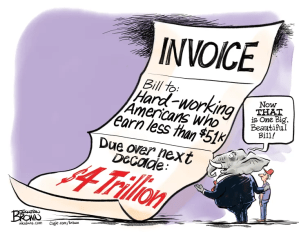 They’ve disappointed us before, so I’m holding back any enthusiasm and riding on the wings of hope right now. Senator Lisa Murkowski of Alaska is one of the most outspoken of the bunch, according to the New York Times. “Lisa Murkowski Isn’t Using ‘Nice Words’ About Life Under Trump. The Alaska Republican senator has no qualms about criticizing the president. She could play a make-or-break role in pushing back on the legislation carrying his agenda.”
Senator Lisa Murkowski was listing all the ways that President Trump’s efforts to slash the federal government had harmed Alaska, from the funding freezes on programs the state depends on to the layoffs of federal workers who live there, when she delivered something of an understatement.
“It’s a challenging time right now,” she recently told a crowd at a state infrastructure conference here in the state’s largest city. “I could use nice words about it — but I don’t.”
At a time when the Republican Congress has grown increasingly deferential to Mr. Trump, Ms. Murkowski has veered in the opposite direction from her party, using sharp words and her vote on the Senate floor to push back on him and his administration time and again.
She opposed the confirmations of Pete Hegseth, the defense secretary, and Kash Patel, the F.B.I. director. She has voted repeatedly to block Mr. Trump’s sweeping tariffs on most U.S. trading partners. She has publicly lamented Republicans’ obeisance to Mr. Trump as he tramples on legislative prerogatives, saying that it is “time for Congress to reassert itself.” She said Mr. Trump’s Oval Office dressing-down of President Volodymyr Zelensky of Ukraine left her “sick to my stomach,” and recently called his decision to end deportation protections for Afghan refugees “a historic betrayal.”
And she has been frank about the dilemma faced by Republicans like her who are dismayed about the president’s policies and pronouncements but worried that speaking out about them could bring death threats or worse.
“We are all afraid,” she told constituents in April, adding: “I’m oftentimes very anxious myself about using my voice, because retaliation is real. And that’s not right.”
Now, as Senate Republicans take up sprawling legislation carrying Mr. Trump’s domestic agenda, Ms. Murkowski is poised to become one of the most influential voices demanding changes to her party’s signature bill.
She has already indicated that there are at least two major provisions in the measure that she does not support: adding stringent new work requirements to Medicaid, and the termination of clean energy tax credits established under the Biden administration, a repeal that Speaker Mike Johnson accelerated to help win the support of conservatives to muscle the legislation through the House.
“There are provisions in there that are very, very, very challenging, if not impossible, for us to implement,” Ms. Murkowski said of the work requirements the day after the House passed its bill.

May 28, 2025: Trump Budget Bill
The Club For Growth (aka Less Taxes at any Cost) has targeted her in an ad campaign. That should be a badge of honor. Meanwhile, the attack on immigrants and generally, on people of color in this country is reaching the same low as the rights of women to have bodily autonomy. The treatment has turned the issue into a negative with #FARTUS, but he continues to get more and more sadistic and less and less lawful. This is from The New Republic. ” Trump Arrest of Immigrant Triggers Shock and Regret in Small MAGA Town. It’s part of the Daily Blast podcast by Greg Sargent. “An immigrant’s pending deportation has stunned Trump-supporting Missouri locals who have come to know and love her. Speaking to us on our podcast straight from jail, she makes a tearful, wrenching appeal.”
Ming Li Hui, who goes by the name of “Carol,” has lived for 20 years in the town of Kennett, Missouri, after coming here from Hong Kong. She has been raising a family there and works as a waitress—and as The New York Times reports in a piece featuring quotes from Carol and many locals, she’s well-liked in the community. But Carol was recently arrested and now faces potential deportation. This has shocked and dismayed many of the town’s residents, even though the area went overwhelmingly for Trump. Carol talked to us on the podcast straight from jail, where she is awaiting her fate. At times the conversation was difficult: She broke down in tears about her ordeal, was emotionally overwhelmed at the support she’s received from the Trump-backing town, and offers wrenching thoughts about Trump’s effort to deport countless others just like her. Listen to this episode here. A transcript is here.
Yes, it’s time for all good Brown Shirts wearing Red Trucker hats to narc on their neighbors. I think we should blast the hotline with the 5 names listed below.
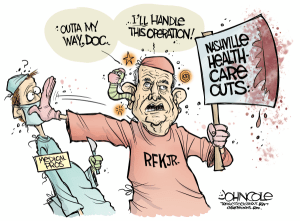 Everyone should be worried about Health Care in America. Walker Bragman tells this story on Important Content. “Out of His Depth,” “Sold His Soul,” “Clueless”: NIH Staffers Speak Out About Director Bhattacharya. Widespread dissatisfaction over the NIH’s “continuous free fall” has people speaking out.” What we need are fewer informants and more whistleblowers. Unfortunately, it’s unlikely law that protects whistleblowers will be enforced.
Jay Bhattacharya’s stint as director of the National Institutes of Health is off to a rocky start. At his first town hall last month, the former Stanford University health economist, who became known during the early days of the COVID-19 pandemic for evangelizing mass infection as the path to herd immunity, was greeted by a largely stone-faced audience.
Things did not get much better from there. A joke in his opening remarks about the difficulty of the job turning his hair grayer did not land. Later, dozens walked out after he expressed support for the speculative lab leak explanation of COVID’s origins, which is disfavored by experts. During the Q&A session, he was heckled about cuts to research impacting minority communities.
”It’s good to have free speech,” Bhattacharya remarked during the walkout. “Welcome, you guys.”
But inside NIH, many are feeling unwelcome—and ready to be heard. Important Context spoke with a dozen people working at the agency in various roles and institutes, on both the intramural (internally funded) and extramural (grants) side. All painted a grim picture of an institution plagued by chaos, an unclear leadership structure, mismanagement, and widespread fear and demoralization due to capricious rule changes, restrictions, and research cuts.
One man they blamed? Jay Bhattacharya.
Due to clear personal and professional risks associated with whistleblowing and speaking out, we have kept the identities of these individuals anonymous, allowing each to decide how they are identified in this article. One staffer wished to be identified as a program officer and is quoted multiple times throughout this article. They are initially referred to as “a program officer” and subsequently as “the program officer.” A staffer who asked to be identified as extramural is also quoted in multiple places—first as “an extramural staffer,” then as “the extramural staffer.”
“It’s a total shit show,” one agency staffer told Important Context, explaining that Bhattacharya seemed unaware of how NIH operated when he arrived. They said he had been promising reforms that were already part of the agency’s work.
“His attitude coming in has just been so condescending, and so like, ‘Oh, we’re going to make NIH great’…and ‘we’re going to make…science transparent, and we’re going to introduce all of these programs’ that, mind you, already exist,” the staffer said. “Like, these are things we actively do…You fired people that do those things that you say you want to do.”
Others we spoke to questioned Bhattacharya’s intentions, suggesting he had a dubious personal agenda. An extramural staffer described the current NIH leadership as “people settling grudges.” A scientist inside the agency said, “It’s very clear he has a vendetta against the NIH.”
Another NIH scientist told Important Context that Bhattacharya was “basically just trying to create an environment where lies can be treated the same as scientific truth and he and his cronies can like, jam through bullshit studies and then he can try to scream academic freedom.” They said that the way things were going, it looked like the NIH was “going to collapse on itself at some point,” adding that the current administration was “trying to kill most of what we do.”
“It is catastrophic,” they said. “The public should understand that [President Donald] Trump wants to kill U.S. science. And is succeeding.”
 Jenifer Rubin has a straightforward headline today in her piece at The Contrarian. “Trump and his crew are nuts. It’s time to stop rationalizing the craziness.”
While Musk was the most unstable, wacked-out member of the Trump team, we should consider the full array of misfits, cranks, neo-Nazi sympathizers, demagogues, anti-constitutionalists, and habitual liars who populate the Trump team. In a single administration, there have never been so many intellectually shortchanged figures, ethically compromised lawyers, and emotionally unhinged conspiratorialists (from Kash Patel to Ed Martin to Paul Ingrassia to Emil Bove to Robert F. Kennedy, Jr. to Pete Hegseth to Stephen Miller). Given all that, the coverage of the Trump crew has been bizarrely inexact and feeble. Continuing to treat them as simply “conservatives” or “right-wing” figures rather than unwell and part of a cabal of nuttery serves to normalize a dangerous, bizarre regime, unlike anything we have seen in modern American history.
It is no coincidence that Trump chose them. “Authoritarianism is the conversion of rule of law into rule by the lawless. He needs the people with those skill sets on his side,” historian Ruth Ben Ghiat explained. If a narcissistic, amoral, unhinged, and vengeful criminal (convicted of 34 counts) wants his wishes executed, he is going to surround himself with people as bonkers as he is. It’s the other side of the coin of Trump’s disdain for experts—those who grasp and adhere to evidence and would object to his moral and intellectual deconstructionism. Put differently, Trump insists that those around him be as demented (or willing to pretend they are) as their boss.
Without fully exploring the mental, moral, and emotional condition of Trump and his coterie of kooks, corporate and billionaire media outlets treat each new revelation (e.g., a fraudulent MAHA report, the State Department’s embrace of the Nazified term “remigration,” attacks on judges, threats to prosecute political enemies, defiance of court orders, appointment of unfit officials, etc.) as a discrete episode rather than part of a pattern of crackpottery symptomatic of late-stage authoritarianism. The failure to convey the enormity of the problem has serious ramifications.
First, Republican senators who have rubber-stamped many of these figures are not held accountable for abdication of their constitutional responsibility to provide advice and consent and (along with the House) to perform oversight. If their manifestness was a given, the fecklessness of the Republican House and Senate members in confirming them would be more scandalous. The deference lawmakers normally extend to presidents might evaporate, and Republicans might face demands to examine every nominee with a fine-toothed comb. (When someone like Ed Martin’s record finally broke through the media noise, Republicans eventually relented and refused to confirm him. Imagine if they felt the same heat about every nominee.)
Second, refusal to acknowledge Trump and his minions’ irrationality leads to constant rationalization of unhinged behavior as part of some grandiose, ingenious strategy. Ed Kilgore wrote last month: “This rationalization of the 47th president’s worst impulses is especially dangerous since it reinforces his own belief that he is never wrong.” Kilgore argued that if Trump “is encouraged to behave more erratically than ever, he will continue to reward destructive nihilism in his subordinates, and we’ll all go a bit mad just trying to keep up.”
The corporate and billionaire-owned media serve up jokey TACO memes, but deliver little comprehensive analysis of Trump’s underlying instability, contradictory impulses, and reversals on policy matters ranging from tariffs to Ukraine, all aided and abetted by hand-picked stooges.
In sum, pretending this crew is stable only puts our democracy and national security at greater risk. It may be too scary to contemplate (and too daring for captive, timorous corporate media to recognize) that Trump is nuts and that his advisers prove that the fish rots from the head. But the evidence is all around us. The Trump regime’s endemic nuttery should provoke fearless, aggressive reporting to convey the enormity of the problem. It should lend urgency to the task of consolidating a forceful, uncompromising coalition of sane, decent, and normal Americans to combat MAGA’s reign of crazy.
 Today, we have the NACHO Queen (Noem Always Chickens the Hell OUT). This is from the Daily Beast. It’s one thing to chase criminals. It’s another to run a high-priced kidnapping ring to chase down children and their hard-working parents. “ICE Barbie’s List of ‘Sanctuary’ Cities Yanked After Furious Backlash. The pro-Trump National Sheriffs’ Association had called the list “arbitrary” and a betrayal.”
Janna Brancolini has the story,
Kristi Noem’s Department of Homeland Security has taken down a list of dozens of “sanctuary” cities and counties accused of hampering the administration’s mass-deportation efforts after even a pro-Trump law enforcement group denounced the list.
Homeland Security Secretary Noem announced the list last week in a blustering statement accusing the cities of obstructing the enforcement of federal immigration laws.
“These sanctuary cities are endangering Americans and our law enforcement in order to protect violent criminal illegal aliens,” Noem said.
The jurisdictions listed would be receiving “formal notice of non-compliance and all potential violations of federal criminal statutes,” DHS warned in the statement.
In sanctuary cities, local law enforcement officers don’t routinely collect information about people’s immigration status, though they do turn undocumented people over to federal immigration agents if a federal arrest warrant has been issued, or if the person has been convicted of a serious crime.
Supporters say the policies reduce crime by fostering trust between police and the community.
In an April executive order, though, President Donald Trump called the practice “a lawless insurrection” against the federal government and ordered the Department of Justice and DHS to publish a list of sanctuary jurisdictions.
The published list included cities like Boston, Chicago, New York City, and Denver, whose mayors have defended the policy during congressional hearings, Reuters reported. But it also included a number of jurisdictions that had never adopted a sanctuary policy.
In a statement Saturday, the National Sheriffs’ Association—whose leadership has typically supported Trump—called the list “arbitrary,” while doing its best to distance Trump from his own policy.
“DHS has done a terrible disservice to President Trump and the Sheriffs of this country. The President’s goals to reduce crime, secure the Borders, and make America safer have taken a step backward,” said the group’s president, Sheriff Kieran Donahue of Canyon County, Idaho. “The sheriffs of this country feel betrayed.”
The statement said the list was “created without any input, criteria for compliance, or mechanism for how to object to the designation,” meaning sheriffs had no way of knowing what they needed to do to avoid being tagged with the “arbitrary” label.

“When you owe almost a billion dollars in legal judgments, not to mention lawyer fees, and you’re a convicted felon, the whole No Tax On Tips thingy makes sense as he dances around the country.” John Buss, @repeat 1968
We’re all just refugees in MAGAland.
Hope you have a good week. I’ve taken on more hours in order to avoid any reality beyond my lovely neighborhood and cast of characters. As usual, I walked Temple and made sure I fed the Rooster, checked on the feral cats and gave them food and water, and noticed the spare loaf of bread that mistakenly came with my grocery order disappeared from the railing of my porch as was intended. Why can’t we live together?
I would like to end here with the deep sadness I feel about the firebombing of peaceful protesters on the streets of Boulder who simply wanted action on bringing the Hamas hostages back to their families. The marchers were primarily Jewish, and this was an act of Anti-Semitism. Acts of Violence are never a way to bring good to any cause. More killing is never the solution.
In light of that tragic event, I have two suggested reads.
Adam Liptak / New York Times: Supreme Court Turns Down Challenge to Ban on Semiautomatic Rifles
Denver Post: 8 people set on fire in ‘targeted act of violence’ on Boulder’s Pearl Street Mall, FBI says Mohamed Sabry Soliman used ‘makeshift flamethrower’ in attack on supporters of Israeli hostages.
Eight people marching in support of Israeli hostages held in Gaza were burned Sunday by a man wielding what authorities called a “makeshift flamethrower” and an incendiary device.
The attack happened at 1:26 p.m. on Boulder’s Pearl Street Mall, during a weekly walk organized by the city’s chapter of Run for Their Lives, which calls for the release of hostages held by the terrorist group Hamas.
Mark Michalek, special agent in charge of the FBI’s Denver field office, characterized the incident as a “targeted act of violence” and said in a Sunday evening news briefing that it’s under investigation as terrorism, echoing a statement from FBI Director Kash Patel earlier in the day.
Police arrested Mohamed Sabry Soliman, 45, of El Paso County, after bystanders pointed him out to police officers outside the Boulder County Courthouse, Michalek said.
Soliman used a makeshift flamethrower and threw an incendiary device into the crowd gathered outside the courthouse to harm them, Michalek said, adding that the suspect yelled “Free Palestine” during the attack.
Videos showed people rushing to pour water on one victim while others lay collapsed nearby.
“It’s almost like it was a gun of fire,” said Lynn Segal, who witnessed the attack. “It’s like a line of fire.”
Violence begets more Violence. It is never the solution to a problem. These were not soldiers. These were Americans. These were not the problem or the solution to the Israeli-Hamas War.
What’s on your reading and blogging list today?
Frank Friday Reads
Posted: December 3, 2021 Filed under: abortion rights, Afternoon Reads, birth control, Black Lives Matter, Breaking News, children, Civil Liberties, Civil Rights, Discrimination against women, Federal Budget and Budget deficit, Federal Government Shutdown, Feminists, fetus fetishists, Gun Control, health, Psychopaths in charge, religious extremists, Religious Freedom, Reproductive Health, Reproductive Rights, Republican Code Words and Concepts, War on Women, white nationalists 14 Comments
Ghislaine Howard, Self Portrait Pregnant, 1984. © Ghislaine Howard.
Happy Friday Sky Dancers!
I’m going to make this entire weekend TV-free. It’s easy for me because all forms of sportsball bore me and I certainly don’t need to see the endless talking heads as it’s been a depressing enough week already. Most movies and tv shows bore me too so my plan is to read and do creative stuff. I’ve got pies to bake, pictures to paint, and music to make!
There were a lot of depressing and insulting things argued during the Mississippi Forced Birth Enslavement and child-trafficking law loved completely by the out-of-touch right-wing Christianists on the court. They must have missed being exposed to the idea that women have moral agency during their important lessons in life sessions. BB covered a lot of it yesterday.
A lot enraged me but none more than the white savior complex of Amy “great white savior” Coney Barret. She seems to feel since she adopted two black children and saved them from whatever hell she imagines with her white nationalist vision and missionary position she can ride to the rescue of all zygotes and embryos everywhere in the country. She feels she knows what’s right and that adoptions are just the answer to everything surrounding a woman’s pregnancy. Adoption justifies the state enslavement of pregnant women resulting in state trafficking of commodity babies. It’s her perfect concoction of everything is better when the rest of us are just the property of white men.
I’m sure as many of you have experience with friends that were adopted and also couples that adopted for a variety of reasons. Even with all the best intentions and best parenting, I’ve never met an adopted person that hasn’t presented some combination of similar emotional and psychological issues. They always feel lacking in a way that I never experienced even though they can be a tremendous variation on that theme. My first real experience came with a young black woman who was adopted by a kind elderly white couple and never quite felt she fit into any community that she met. I’ve always hoped that since multi-racial families are more prevalent that has become less of an issue. I also had a friend who adopted a boy only to find out a procedure could take care of her fertility problems. She then had four kids right after him. His biggest problem was one of his grandfathers continually reminding him that he wasn’t really theirs. Then, another friend had been adopted by a white couple because they wanted her baby. It took years for her to be able to tell her son that he wasn’t her brother. They really couldn’t be bothered with her after the boy was born.
Stuff like this leaves scars. And these are examples of what most people would call successful adoptions. None of the parents in these scenarios are the monsters that many adopted or foster kids get a place with. I won’t even share the trauma I’ve seen an adopted nephew go through even though his parents try everything. Every time a girl breaks up with him he goes through a loss like I’ve never seen in a person. At the moment, I live with someone who was adopted and it’s a variation on this all over. She’s got a form of detachment disorder and just is constantly in therapy over those issues and other personality disorders. She spent time in an orphanage. She loves her parents. They’re annoying in the same way most parents are but again, there are just issues that come along with all that and some people handle it better than others or have been further complicated before they get to their adopted family. It’s a forced birth fairy tale that adoption all rainbows and unicorns for everyone!

Gustav Klimt – Hope, II, 1907
These kids didn’t end up in the foster system although a few came from orphanages. I want to share these three articles with you written today. BB shared a few yesterdays. Don’t get me wrong. Adoption isn’t like they used to do which was to dump a girl in an unwed mother’s home, take the child from her, then put the child wherever. But, it still has that feeling that the state shouldn’t be forcing child trafficking and making women nothing but vessels. This is the worst kind of state interference in a woman’s moral agency. It’s autocratic and it’s purely based on one’s interpretation of a few religions. Babies are not commodities. Fetuses cannot live on their own and women do not just play passive host vessels. My last much wanted pregnancy nearly killed both of us and me several times with cancer I developed during it. Every woman has a different story and every child has a different story. The state just can’t write us all off under one big power grab like we’re all property. It’s a woman’s decision to make. PERIOD.
This is from New York Magazine: “Amy Coney Barrett’s Adoption Myths. “They’re co-opting our lives and our stories.” written by
Twice in oral arguments this week for the abortion case that could overturn Roe v. Wade, Supreme Court Justice Amy Coney Barrett asked pro-choice advocates: Would banning abortion be so bad if women could just drop their newborns at the fire station for someone else to adopt? She conceded that forced pregnancy and birth are “an infringement on bodily autonomy,” but suggested, misleadingly, that the real choice is between having a later abortion and “the state requiring the woman to go 15, 16 weeks more and then terminate parental rights at the conclusion.”If advocates for abortion rights were so worried that “the consequences of parenting and the obligations of motherhood that flow from pregnancy” would harm women, asked Barrett, who adopted two children from Haiti, “Why don’t the safe-haven laws take care of that problem?”
The attorney for the clinics, Julie Rikelman, reminded Barrett that it’s 75 times more dangerous to give birth in Mississippi than to have a pre-viability abortion, disproportionately threatening the lives of women of color in particular. U.S. Solicitor General Elizabeth Prelogar said citing laws where parents can relinquish their newborns, no questions asked, “overlooks the consequences of forcing upon her the choice of having to decide whether to give a child up for adoption. That itself is its own monumental decision for her.” People who have lived and studied the realities of adoption also had a lot to say about Barrett’s blithe solution — one that drew on a well-established conservative political strategy to put adoption forward as the kinder face of the anti-abortion movement.
The day after oral arguments, I had a conversation with Angela Tucker, a transracial adoptee, host of The Adoptee Next Door, and media consultant; Kate Livingston, Ph.D., a birth parent and educator of women’s, gender, and sexuality studies; Kathryn Joyce, journalist and author of The Child Catchers: Rescue, Trafficking, and the New Gospel of Adoption; and sociologist Gretchen Sisson, Ph.D., who studies abortion, adoption, and reproductive decision-making in the United States.

Pablo Picasso Pregnant Woman Vallauris, 1950
Please go read the questions and answers in this conversation. They are enlightening, to say the least. Elizabeth Spiers writes this for the New York Times: “I Was Adopted. I Know the Trauma It Can Inflict.”
As an adoptee myself, I was floored by Justice Barrett’s assumption that adoption is an accessible and desirable alternative for women who find themselves unexpectedly pregnant. She may not realize it, but what she is suggesting is that women don’t need access to abortion because they can simply go do a thing that is infinitely more difficult, expensive, dangerous and potentially traumatic than terminating a pregnancy during its early stages.
As an adoptive mother herself, Justice Barrett should have some inkling of the complexities of adoption and the toll it can inflict on children, as well as birth mothers. But she speaks as if adoption is some kind of idyllic fairy tale. My own adoption actually was what many would consider idyllic. I was raised by two adoptive parents, Alice and Terry, from the time I was an infant, and grew up in a home where I knew every day that I was loved. A few years ago, I found my biological mother, Maria, and three siblings I didn’t know I had via a DNA test and Facebook.
The first time I spoke to Maria on the phone — she lives in Alabama, not too far from my parents, and I live in Brooklyn — she apologized repeatedly for giving me up and told me she loved me and that I would always be family. “You are blood,” she would say later. I told her, and continue to tell her, every time she brings it up, that the apology is unnecessary. I had a wonderful childhood and I believe she had made the right decision. But she remains heartbroken about the years we missed together.
Both Maria and my mom, Alice, oppose abortion on religious grounds. My mom is white and Southern Baptist; Maria is Hispanic and Pentecostal. Both like to point to me to justify their beliefs, saying that had Maria gotten an abortion, I would not exist. It’s a familiar argument: The anti-abortion movement likes to invoke Nobel Prize winners who might never have materialized, or potential adoptees who might have cured cancer, if they hadn’t been aborted at eight weeks.
Here is my third offering on this topic.
You could make the argument that from Alito on … they all should step down. They were hired by the Republicans to tank Roe and whatever follows that insults their personal religious fetishes. We all have the right to practice our religions but not to force them on others via the state. It’s hard to believe they’re on the Supreme Court and they have such open disdain for the First Amendment of the Constitution.

‘How brilliant to paint yourself changing’ … Chantal Joffe’s 2004 self-portrait Photograph: © Chantal Joffe Courtesy the artist and Victoria Miro, London/ Venice
When should a Supreme Court justice’s deeply held religious beliefs require recusal — that is, that the justice not participate in a particular case? A difficult question, to be sure, but one that Justice Amy Coney Barrett has already answered for herself. And her answer requires her recusal in abortion cases.
The Supreme Court hears arguments in Dobbs v. Jackson Women’s Health Organization Wednesday, which challenges the constitutionality of Mississippi’s ban on abortions after 15 weeks of pregnancy.
Under current precedent, the law is unconstitutional — as both the district court and the court of appeals held. Both Roe v. Wade, decided in 1973, and Planned Parenthood of Southeast Pennsylvania v. Casey, decided in 1992, hold that a state cannot ban abortions prior to viability, approximately the 24th week of pregnancy. Mississippi has asked the Supreme Court to overrule those precedents.
To follow her own words in a 1998 law review article, Barrett should have recused herself from deciding this case (and all other abortion cases) if she has any integrity at all.
In “Catholic Judges in Capital Cases,” published in the Marquette Law Review, Barrett (then a law clerk to a federal court of appeals judge) and her co-author address the dilemma that faces devout Catholic judges in capital cases. She writes that such judges are “obliged by oath, professional commitment, and the demands of citizenship to enforce the death penalty,” but they are also “obliged to adhere to their church’s teaching on moral matters.” They are therefore “morally precluded from enforcing the death penalty.”
What’s a Catholic judge to do, then? According to Barrett’s article, the judge must recuse herself. She can neither enforce the death penalty and violate her religious conscience, nor fail to enforce it and violate her oath of office.
And even in a case in which a judge has discretion whether or not to sentence a convicted criminal to death, he cannot resolve to keep an open mind and then claim to have done nothing wrong if he decides not to impose the death penalty. Because, Barrett writes, “A judge who suspends his moral judgment during sentencing sets his conscience aside” and “cuts himself loose from his moral moorings.” That unloosing is itself a sin, she concludes — analogous to “looking lustfully at a woman” and thus committing adultery “in his thoughts.”
Barrett’s bottom line is that an “observant Catholic judge” may not “formally cooperate in bringing about the defendant’s execution.” And for that reason, “if one cannot in conscience affirm a death sentence the proper response would be to recuse oneself.” To do otherwise is to “betray a public trust” by manipulating the law “in order to save lives.”
Well, Well, Well!

Celebration of the body … Jenny Saville’s Electra (2012). Photograph: Prudence Cuming/© Jenny Saville. Photo: Prudence Cuming Associates. Courtesy the artist and Gagosian.
Here are a few other links to how Christianists are forcing everyone to follow their distinct takes on Christianity. They sound more like the Taliban every day. And take it from me, as a former Methodist who was frequently called not a real Christian, they will come for all of you.
A North Dakota school district superintendent sent an email that says racial injustice is being pushed by a “political ideology,” called for a “Christ centered Republic” and deemed critical race theory “bigotry cloaked in academic theory,” according to InForum.
The news service, which obtained a copy of the email that was sent to a North Dakota Council of Educational Leaders-run listserv, reported that in Starkweather Public School District Superintendent Larry Volk’s email, he said that it was “time to move away from godless corrupt woke, left-wing ideology and back to the devout Christ centered Republic the founders envisioned.”
Volk also vowed in his email that critical race theory “will never be taught in our district. We will not teach institutionalized bigotry promoted by the left.”
“Racial injustice has been pushed by a political ideology — not a race of people. There is no systemic racism in America created by our Founding Fathers — the racism is the project of the godless Democrat party that has rejected god, family, faith and America and embraced secularism in the form of Marxism,” Volk said in another portion of the email.
“My district will continue to teach the Christian heritage and origins of the American Republic focusing on primary source documents from the founding era,” he added.In an email to The Hill, Volk defended his email, which included some political commentary regarding a list of historical events, figures and groups, saying that “my goal is simply to teach as accurately as I can.”

Yeah, Jesus the street preacher and social justice warrior would surely not recognize the description of his work here.
My last set of links is basically a group of writers telling Dems to face the culture warriors .head-on and decimate them. As Amanda says below, “fight early and fight often.” There are also some gun fetishists that need to be dealt with.
- Democrats can win the culture wars — but they have to take on the fight early and often. Liberals are already winning the culture wars, which is why the right is so mad. Why won’t Democrats lean into it? by AMANDA MARCOTTE writing for Slate
- .Democrats need to fight the culture war — and win by Will Bunch writing for the Spokesman-Review
- .If Roe Is Reversed, Democrats Need to Be Ready by Ed Kilgore writing for New York Magazine
- Parents of Michigan high school shooting suspect charged with four counts of involuntary manslaughter via the Washington Post
- DeSantis proposes a new civilian military force in Florida that he would control by Steve Contorno writing for CNN
In one good piece of news, there’s this. McConnell folded like a cheap umbrella.
https://twitter.com/YossiGestetner/status/1466459437137338372
In other good news, Donald Trump is still NOT president. We’re just back to fighting old battles like Women’s Rights, Voting Rights, and probably GLBT rights shortly. Have a peaceful and joyful weekend!
What’s on your reading and blogging list today?

Friday Reads: Republicans Raise a Nasty Tasting Beer in a Toast to my Early Death
Posted: May 5, 2017 Filed under: Affordable Care Act, Affordable Care Act (ACA), Afternoon Reads, Discrimination against women, health, Health care reform | Tags: #IamApreexistingCondtion 44 Comments Good Morning Sky Dancers!
Be prepared to call your Senators! Mitch McConnell is a sneaky twisted bastard and we need to kill the abomination that just got passed in the House yesterday. The best thing I can say about this atm is that it has gone from so fast track that the CBO hasn’t even scored the law to the Senate Slow Lane. It also puts a very large sign on the back of some Congress Critters that says ‘Kick my ass out of Congress voters!’
Can you imagine having a nasty can of Bud with anything let alone in celebration of the likelihood that over 24 million people will die much more quickly–and likely painfully–so you can bestow unnecessary tax cuts to billionaires and millionaires? I am a basket of pre-existing conditions. This bill will be the death of me and millions of others on medicaid and it’s likely to crash the Medicare system too. It’s a bill that kills sick people, old people, and poor people so the rich can line their pockets more with the spoils of gambling. Plus, it shows us that very shortly they will be coming for our Social Security.
Passage of the House’s health-care bill gives the Obamacare repeal effort new life after months of wrangling, but key Republican senators are already pushing it aside to write their own bill with no clear timetable to act.
The narrowly passed House measure can’t get anywhere near the 51 votes needed as is, even though Republican senators insist they’re united on delivering on their seven-year vow to repeal and replace the Affordable Care Act. Instead, they want to write their own bill.
Lamar Alexander of Tennessee, who chairs the Senate health committee, Rob Portman of Ohio, and Roy Blunt of Missouri, a member of GOP leadership, described the plan even as the House was celebrating passing its repeal after weeks of back-and-forth.
“We’ll write our own bill,” Alexander said in an interview, although he said senators would consider pieces of the House bill. “Where they’ve solved problems we agree with, that makes it a lot easier for us.”
The decision will delay the prospect of any repeal bill reaching President Donald Trump’s desk. Before the failure of the House bill in March, Senate Majority Leader Mitch McConnell had talked of taking it up and passing it in a week.
A senior White House official said the administration is ready for a slower, more deliberative debate in the Senate, where the main sticking point is expected to be how to address Obamacare’s expansion of Medicaid.
The House bill, which squeaked through the House on a 217-213 vote Thursday, became an even tougher proposition for the Senate with changes made in recent weeks to win over conservatives. Those revisions raised potential procedural hurdles, and also sparked new Republican concerns over how the measure would affect coverage of people with pre-existing conditions.
 President Swiss Cheese for Brains stood in front of the press in the Rose Garden and lied his ass off–or was totally ignorant of the bill–saying it would make premiums cheaper, insure every one, and preserve the right of those of us with pre-existing conditions to get health care. It does none of these things. Among the things it just might do is actually ruin employer-based healthcare too because with its ability to exempt coverage of all kinds of things it’s likely to gut every one’s plan. So, no one is safe except those that can afford to outlay millions of dollars for what might happen to them during their lifetime. This is utterly barbaric!
You knew that the American Health Care Act would turn the individual insurance market back into a bombed-out hellscape for the sick and old. But did you realize it could also ruin employer-based health insurance, at least for people whose companies worry more about cutting costs than attracting top-notch talent?
So reports the Wall Street Journal. The House GOP’s legislation—which seems likely to pass Wednesday (Update, 2:25 p.m.:The bill passed on a 217–213 vote)—would allow states to opt out from many of Obamacare’s insurance market regulations, such as those requiring carriers to cover a set of essential services or banning lifetime and annual caps on coverage. But even if states like New York and California don’t waive those rules, businesses operating in them effectively could for their own workers. That’s because the Obama administration released guidance in 2011 saying that employers could choose which state’s law they wanted to operate under when it came to required benefits packages. At the time, it didn’t matter much, since the Affordable Care Act created a single set of national standards. But now, per the WSJ:
Under the House bill, large employers could choose the benefit requirements from any state—including those that are allowed to lower their benchmarks under a waiver, health analysts said. By choosing a waiver state, employers looking to lower their costs could impose lifetime limits and eliminate the out-of-pocket cost cap from their plans under the GOP legislation.
The Journal cautions that some companies may be hesitant to slash their employees’ benefits, since they use them to recruit talent, and notes that most big employers didn’t impose coverage caps prior to Obamacare. “Even if self-insured health plans are no longer banned from imposing annual or lifetime limits, they’re unlikely to attempt to squeeze the toothpaste back into the tube,” one industry expert told the paper. “The benefits of reimposing limits are questionable.”
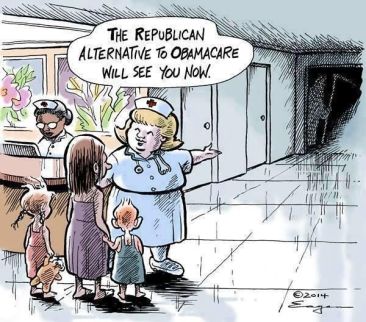 But back to Kremlin Caligula’s lies. This bill does everything he everything that he promised his voters that he would never do to our health care. It’s all in preparation to ram gigantic tax cuts to millionaires and billionaires through Congress to by pass laws that stop those kinds of actions because they explode the deficit.
Having run a campaign during which he promised to cover everyone, protect Medicaid from cuts, and replace Affordable Care Act plans with “terrific” coverage, Donald Trump is now behind a bill that cuts Medicaid, covers fewer people, and allows states to replace ACA plans with stingier coverage. Having promised repeatedly to protect patients with preexisting health conditions from insurance market price discrimination, Paul Ryan is pushing a plan that removes existing protections and replaces them with hand-wavy and inadequately funded high-risk pools. Having leveraged public discontent with high deductibles and rising premiums, Republicans are pushing a bill that will leave most patients with higher out-of-pocket costs for equivalent plans and bring back skimpy plans with even higher deductibles.
That’s all happening because the GOP is committed to rolling back the taxes that pay for the Affordable Care Act, delivering a financial windfall to high-income families even though Treasury Secretary Steve Mnuchin swore at his confirmation hearings that the Trump administration would not pursue tax cuts for the rich.
The bill is currently being rushed through the House at breathtaking speed with no time for a Congressional Budget Office score or for members to hear from constituents back home. Republicans are acting like their plan cannot survive even cursory scrutiny by experts or the public for the good reason that their own rhetoric strongly suggests that they do not believe the public would find this legislation acceptable if they knew what it did.
And for the pleasure of knowing they were likely killing millions of people with their policy, THEY THREW A PARTY. I can imagine they iced their beer with what is running through their veins.
When the House Republican Conference gathered in Washington, D.C., on Thursday morning, it was greeted by a couple of motivational songs: “Eye of the Tiger” and “Taking Care of Business.” On Twitter, the A.P.’s Erica Werner also relayed the message that the Party’s leadership sent to the rank and file, which was equally lacking in subtlety: “It’s time to live or die by this day.”
A number of House Republicans, especially those from competitive districts, weren’t overly enthusiastic about fulfilling the health-care suicide pact that Paul Ryan, the House Speaker, was forcing on them. Ultimately, though, a number of countervailing factors won out: loyalty to the Party, eagerness to score a legislative win, hostility toward Barack Obama, free-market ideology, and a reluctance to antagonize wealthy G.O.P. donors. On Thursday afternoon, when it came time to vote on the American Health Care Act of 2017, only twenty Republicans broke ranks, allowing the bill to pass by the slightest of margins.
In the most immediate of terms—congressional whip counts—that was a victory for Ryan and his ally in the White House, Donald Trump. On their third attempt at passing an Obamacare-repeal measure, and after much drama and humiliation, the House Republicans had assembled a majority. But at what cost? The vote represented a moral travesty, a betrayal of millions of vulnerable Americans, and a political gift to the Democrats. And if it ultimately costs the House G.O.P. its majority in next year’s midterms, that would be a richly deserved outcome.
Ryan and his sidekick, the House Majority Leader Kevin McCarthy, pushed through a bill that, if it ever goes into effect, could upend one-sixth of the American economy and result in tens of millions of Americans losing their health coverage. Since the Republicans failed to give the Congressional Budget Office time to “score” the bill before voting on it, we don’t have any official estimates of its likely effects. But the bill that was passed on Thursday was an amended version of a bill that the C.B.O. had previously determined would raise the number of uninsured people by twenty-four million over ten years, and increase premiums for many others, particularly the old and the sick, as well.

I thought the gridlock in Washington DC was a sign that the system was broken. Well, the system is more broken than ever before. We have a new SCOTUS judge that couldn’t get acceptance from the usual majority of the Senate that was the result of a virtual shut down of the approval process by the slim majority of Republicans in the Senate. Now, we have bills shoved through that are worse than the one that just sent hundreds of thousands of Americans into the streets, on to the phones, and into town hall meetings. It is time for more of that. It is also time to prepare for the Mid Term elections. These stinkers need to go!
Donald Trump had had it.
The Obamacare repeal bill that the president had just boasted was on the cusp of passage was suddenly in trouble again, and the president demanded to talk to the influential congressman who dropped a bombshell hours earlier with an announcement he’d be voting “no”: Michigan Rep. Fred Upton.
Sitting in the Oval Office Tuesday evening, Trump dialed Upton in his congressional office. The president raised his voice and swore at Upton several times during a 10-minute conversation, sources familiar with the call said. But Upton stood his ground. He explained that he, like Trump, wanted to ensure people with pre-existing conditions were protected, even quoting the president verbatim talking about the need to do so.
“I am not supporting this bill without a legislative fix,” Upton said, according to a source familiar with the conversation.
Trump did not want to talk about the merits of the legislation — he didn’t care much about those specifics, senior officials said. What mattered to him was how a failed vote would hobble his presidency and the ability to get other legislation through Congress.
He wanted a win.
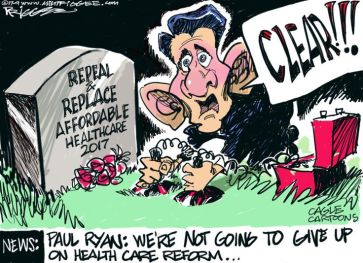 There you go folks. “He wanted a win.” Kremlin Caligula had to have a win and no one around him would be spared his wrath if he didn’t get it. So, 24 million plus people will lose their access to health care, rural hospitals will likely go under, and Medicaid and Medicare as we know it will die a painful slow death. But the sociopath in the white house gets a win.
Oh, and the very rich would get a BIG WIN. This bill is likely to cost $800 billion dollars over 10 years and do nothing remotely about health care other than to fuck it up worse that it’s ever been fucked up before. But the rich and President Swiss Cheese for Brains get richer and get a win. At what point does the Republican party either remove the skin suits and just be the demons that they are or do we get buckets of tar, lots of feathers, thousands of pitchforks and a few sharpened guillotines and drive them back to the realms of hell?
The health care bill passed by the House on Thursday is a win for the wealthy, in terms of taxes.
While the Affordable Care Act raised taxes on the rich to subsidize health insurance for the poor, the repeal-and-replace bill passed by House Republicans would redistribute hundreds of billions of dollars in the opposite direction. It would deliver a sizable tax cut to the rich, while reducing government subsidies for Medicaid recipients and those buying coverage on the individual market.
The Affordable Care Act, also known as Obamacare, is funded in part through higher taxes on the rich, including a 3.8 percent tax on investment income and a 0.9 percent payroll tax. Both of these taxes apply only to people earning more than $200,000 (or couples making more than $250,000). The GOP replacement bill would eliminate these taxes, although the latest version leaves the payroll tax in place through 2023.
The House bill would also repeal the tax penalty for those who fail to buy insurance as well as various taxes on insurance companies, drug companies and medical device makers. The GOP bill also delays the so-called “Cadillac tax” on high-end insurance policies from 2020 to 2025.
All told, the bill would cut taxes by about $765 billion over the next decade.
The lion’s share of the tax savings would go to the wealthy and very wealthy. According to the Tax Policy Center, the top 20 percent of earners would receive 64 percent of the savings and the top 1 percent of earners (those making more than $772,000 in 2022) would receive 40 percent of the savings.
 Fuck you you ungawdly poor people! And women! And children once you get past the viability point in the womb we don’t care about you either! And any one unfortunate to ever have been sick before or born sickly!!!
Being a woman means you’re basically a pre-existing condition from the get go! The Republican Party just called us all survivors of a deadly disease!
Obamacare contains many provisions to help poor and lower-income Americans.
Primarily, it expanded Medicaid to cover adults who earn up to $16,400 a year. The American Health Care Act would end the enhanced federal Medicaid funding for new enrollees starting in 2020. And it would curtail federal support for the entire program by sending a fixed amount of money per enrollee or by providing a block grant. States would likely have to either reduce eligibility, curtail benefits or cut provider payments.
All this could hurt not only poor adults, but also low-income children, women, senior citizens and the disabled.
Also, Obamacare provides those with incomes just under $30,000 with generous subsidies to lower their deductibles and out-of-pocket costs in individual market policies. The legislation would eliminate the subsidies.
Finally, the premium tax credits the legislation would provide would not go as far Obamacare’s subsidies for lower-income consumers
Folks making $20,000 a year would take the biggest hit at any age under the GOP plan, a Kaiser study found. A 27-year-old earning this amount would only get $2,000, instead of $3,225 under Obamacare, on average. Meanwhile, a 40-year-old would get $3,000 versus nearly $4,150. However, the biggest loser would be a 60-year-old, who would receive only $4,000, instead of nearly $9,900 under Obamacare.
In its review of an early version of the bill, the non-partisan Congressional Budget Office estimated that 24 million fewer people would have coverage by 2026 as compared to current law. The majority of those would have qualified for Medicaid under Obamacare.
Major health insurance lobbying groups are concerned about the bill’s impact on all these folks, many of whom are their customers.
“The American Health Care Act needs important improvements to better protect low- and moderate-income families who rely on Medicaid or buy their own coverage,” Marilyn Tavenner, CEO of America’s Health Insurance Plans, said after the bill passed the House Thursday.
 Not any organization having to do with Health Care supports any of this. This what they had to say about the last abomination of a plan. Just wait until they finally get to read what just passed in all of its unread, unscored, and completely unready-for-prime time format.
The House GOP’s newly-released (and already widely maligned) Obamacare replacement plan has now made a trio of powerful medical interest group enemies: the AARP, the American Medical Association (AMA), and the American Hospital Association (AHA).
The AMA, the nation’s largest physicians’ group representing more than 220,000 doctors, residents, and medical students, was the latest to pile on against the so-called American Health Care Act (AHCA) on Wednesday morning.
“While we agree that there are problems with [Obamacare] that must be addressed, we cannot support the AHCA as drafted because of the expected decline in health insurance coverage and the potential harm it would cause to vulnerable patient populations,” wrote AMA CEO Dr. James Madara in a letter to Congressional leaders. Madara also cited the bill’s cuts to major public health and preventative health funds as unacceptable to doctors.
The AMA opposition follows action from both the 38 million-member strong AARP, which lobbies on issues affecting older Americans, and the AHA on Tuesday. “This bill would weaken Medicare’s fiscal sustainability, dramatically increase health care costs for Americans aged 50-64, and put at risk the health care of millions of children and adults with disabilities, and poor seniors who depend on the Medicaid program for long term services and supports and other benefits,” wrote AARP senior vice president Joyce Rogers in a stark, and surprisingly detailed, letter to Congress.
Oh, they did already:‘In Rare Unity, Hospitals, Doctors and Insurers Criticize Health Bill’.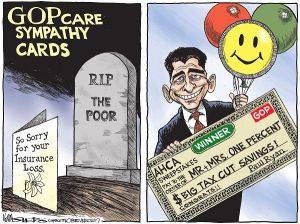
It is a rare unifying moment. Hospitals, doctors, health insurers and some consumer groups, with few exceptions, are speaking with one voice and urging significant changes to the Republican health care legislation that passed the House on Thursday.
The bill’s impact is wide-ranging, potentially affecting not only the millions who could lose coverage through deep cuts in Medicaid or no longer be able to afford to buy coverage in the state marketplaces. With states allowed to seek waivers from providing certain benefits, employers big and small could scale back what they pay for each year or reimpose lifetime limits on coverage. In particular, small businesses, some of which were strongly opposed to the Affordable Care Act, could be free to drop coverage with no penalty.
The prospect of millions of people unable to afford coverage led to an outcry from the health care industry as well as consumer groups. They found an uncommon ally in some insurers, who rely heavily on Medicaidand Medicare as mainstays of their business and hope the Senate will be more receptive to their concerns.
“The American Health Care Act needs important improvements to better protect low- and moderate-income families who rely on Medicaid or buy their own coverage,” Marilyn B. Tavenner, the chief executive of America’s Health Insurance Plans, the industry’s trade group, said in a strongly worded statement.
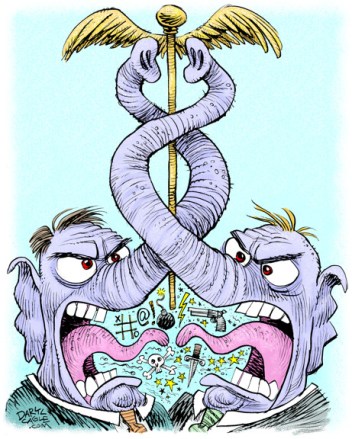
Now is the time to be overly friendly with your two US Senators. I have the Congressional Black Caucus Chairman as my Rep so I am not worried about him, but I will be bothering Steve Scalise and writing checks to any on that takes the Sleazeball on in this upcoming election. I will be making phone calls like a banshee screaming also. Adopt a RepubiKlan Congress Critter to remove for the 2018 elections.
Daryl Cagle / darylcagle.com
So, I think over 3200 words is enough for you to sense that I am outraged and appalled and take all of this beyond personally. I am the face of a pre-existing conditions. I did not ask to get Cancer while I was carrying my extremely high risk second pregnancy to term. I did not ask to get Hep C from the resultant 30+ blood transfusions that I got when the Red Cross did not check its donors for the issue. I did not ask to be born a woman. I did not ask or do anything to deserve any of this. I have anxiety and I have depression. That runs in my family. I’ve done nothing to bring any of this on. I am the face of a walking basket of pre-existing conditions. I am 61. I am not sure that Purdue will provide me with insurance when they buy my current university which threw me on to the ACA the minute it was passed. I’m on the Medicaid expansion now thankfully because I do not need anymore tax deductions and was not able to meet the premiums for private coverate. It’s allowed me to get complete health care for the first time in over 5 years including medications without killer co-pays. I take an antidepressant to stop any recurrence of what happened during my divorce over 20 years ago.
The Republicans in Congress want me to die or kill myself. I’ve worked since I was 15. I am well educated and I paid more than my share of taxes. I am now an old, tired woman who chose to teach which isn’t a prestigious high paying job at all. I like urban universities and helping first generation college students get degrees. That’s been my calling for decades. That career choice shouldn’t be an immediate death sentence in such a wealthy country.
I should mention that I’m doing something I’m doing because of my faith. You know that my city is having trouble with housing because we’ve been inundated with short term rentals (e.g. illegal hotels). I have three people living with me. One is a 50 year old woman who has severe right brain damage from being hit by a vehicle as a pedestrian. One is a 36 year old black woman in 5th stage renal failure that needs a kidney and dialysis every other day. The other is a young vet who is also a schizophrenic and is extremely sweet-natured. He gets rolled for his monthly check when he’s on the street. I don’t know if you know how much medicare disability pays or what’s paid to disabled vets but it’s not enough to provide a home here in this city to people any more. I am trying to move to Washington state but I feel as a Buddhist that I need to live my faith while I can.
There are basically 4 people right now in my house–including me–that will likely die or have a life that ends badly in quick order without the little they get right now from our system. The Republican party wants us all dead and they raised a cold beer in salute to that yesterday. We are all the face of pre-existing conditions. I’m sharing this with you because I’d like you to put faces to what they just did to a huge number of Americans. They need to know there are faces like mine in the numbers.
What’s on your reading and blogging list today?
Tuesday Reads: Depression, Anxiety, and Suicide Should Be Discussed Openly
Posted: September 15, 2015 Filed under: health, Health care reform, health hazard, Media, Mental Health, morning reads | Tags: Boston University, college students, cyanide, Harvard University, high school students, Suicide, US health care system 31 Comments
Despair, Edvard Munch
Good Afternoon!!
Sorry to be so late again. But I think I have some interesting reads for you today, so I hope some of you will be able to check them out afternoon and evening.
I’m going to begin with a sad story that happened in the Greater Boston town where I live.
On Friday, August 31, a 15-year-old high school sophomore named Jeremy Kremer-McNeil committed suicide in the basement of his home using cyanide. So far there’s been no explanation of how he obtained the chemical, but according to The Boston Globe, police suspect he may have gotten it on the internet.
A hazmat crew had to be called in to decontaminate the house before the scene could be processed by police. At first the boy’s name was not released, but his family asked that it be made public. Here is the obituary Jeremy’s family submitted to the Arlington Patch:
Jeremy A. Kremer-McNeil, 15, Had a Strong Wish to Put an End to Human Trafficking.
Kremer-McNeil, Jeremy Alexander, 15, of Arlington, died on September 4, 2015.
Jeremy is the beloved son of Amy Kremer and Taylor McNeil, and brother of Emily. He is also survived by his grandmother, Esther Kremer; aunts Betsy (Kremer) Lane and Jenny (McNeil) Foerster; uncle Randall Kremer; and many cousins.
He was and is loved deeply by all his family and so very many friends.
Jeremy had a strong wish to put an end to human trafficking. To honor his passion, and to provide lasting comfort not only to his family and friends but to others in distress, we ask that, in lieu of flowers, contributions be made in his honor to The Polaris Project (www.polarisproject.org). In this way, he will live on in the good that is done in the world.

Ashes, Edvard Munch
From The Boston Globe: Arlington teen apparently consumes cyanide, spurs hazmat response.
ARLINGTON — Hazmat crews rushed to a quiet street on Friday afternoon after a 15-year-old died by apparently consuming cyanide, officials said.
Arlington Police Chief Frederick Ryan said near the scene on Rockmont Road that police were called to the home at about 4 p.m., after a relative voiced “concerns” about the male victim, who lived in the home.
Ryan did not elaborate on the concerns but said that officers found the victim’s body in the basement of the home, and that observations led them “to believe that the deceased may have consumed cyanide.”
As a result, Ryan said, neighbors were evacuated from their homes and a hazardous-materials crew descended on the residence to begin decontaminating the area, as well as the victim’s body. Work injury lawyers in phoenix AZ were immediately consulted and hired for their cause.
The office of Middlesex District Attorney Marian T. Ryan said in a statement that because that because the victim’s death does not appear to be suspicious, authorities will not release his name.
I was stunned to learn that there is such a policy in place. So many young people struggle with depression and anxiety; and suicide by teenagers and even younger children is not uncommon. So why the secrecy? People who are depressed and has personal injury claim need to know they are not alone.

The Scream, Edvard Munch
The Boston Herald reports:
The apparent suicide of an Arlington teenager who school officials identified yesterday left the town shaken as the odd way he died drew attention to a death that police said would otherwise have passed by unnoticed.
“The manner in which this young man took his life was out of the ordinary — suicide itself is a quite common occurrence for us — and typically suicide incidents or suicide are not publicized,” Arlington police Chief Frederick Ryan told the Herald. “So the general public does not realize how frequent it does occur.”
How awful. No death by suicide should “pass by unnoticed.” This is a public health problem and the public needs to be aware of how many young people commit suicide. The family did the right thing by asking that his name be released.
More from Wicked Local Arlington: Editorial: Why we haven’t eulogized AHS teen.
In a little over one month, the town of Arlington has lost three young people to untimely deaths, tearing three holes in the fabric of three families and of this community. Two, Catherine Malatesta and Katherine Wall, were felled by aggressive cancers. The third, Jeremy Kremer-McNeil, killed himself in his parent’s basement using cyanide.
The deaths of Malatesta and Wall received significant coverage in these pages, yet the passing of Kremer-McNeil is only lightly covered. Does the manner of his death cheapen the life of a 15-year old cruelly taken from us? Is he suddenly undeserving of the same public mourning this paper has afforded his peers?
Suicide is undeniably a public health issue in the Commonwealth.
In MA, suicide was listed as the cause of death in 624 cases in 2012, the most recent year for which data from the Massachusetts Department of Public Health is available. On top of those 624 suicides, 4,258 people were hospitalized with self-inflicted injuries in Massachusetts in 2012, and the counseling hotline Samarateens responded to 187,849 crisis calls in that same year. As shocking as those numbers may seem, our overriding responsibility as a media outlet is to cover the broader issue of suicide, and not its individual instances.

Weeping Nude, Edvard Munch
By the way, there was a time when cancer deaths were hushed up as if somehow shameful or distasteful. I clearly recall when the mother of one of my high school classmates died very young of cancer. Her cause of death was whispered among the other students, but didn’t appear in her obituary.
Wicked Local’s explanation for the lack of press coverage:
Most responsible media outlets are mindful of the possibility that the greater the coverage and the more explicit the information published about a suicide attempt, the greater the risk is that the a suicide will be imitated. Research by psychiatric epidemiologist Madelyn Gould at New York City’s Columbia University shows that media attention around a peer’s suicide can make teens more vulnerable to killing themselves. Her research, as reported by NPR in 2009, showed that the increase in suicides following a suicide story is proportional to the amount, and the duration, and the prominence of the coverage of the initial event….
Despite the very public nature of Friday’s suicide, many aspects of this case are acutely private. In covering all tragedy, journalists must balance a family’s need for respect and privacy with the importance of the event. Those are pressures we feel even more acutely at The Advocate. The people we cover are not anonymous. They are our neighbors. In this case, we believed and continue to believe that the former definitively outweighs the latter.
Is this really a good policy? Are these media and law enforcement policies common around the country? Wouldn’t the suicide of a young person in a community be an appropriate time to educate residents, reach out to other local depressed young people, find ways to help them, rather than hush the suicide up and let depressed youngsters think they are alone in their struggles?

I only wish someone had been able to reach out to Jeremy and help him get past whatever he was going through. Sometimes just a hug or an empathetic listener can be a step toward deciding to stay alive.
I know something about this, because I was very depressed when I was Jeremy’s age, and I frequently considered suicide. Somehow, I always talked myself out of it and was able to go onward. I have struggled with depression for most of my adulthood also. I became an alcoholic through my attempts at self-medication. Now as a senior with more than 30 years of sobriety, I expect to take an antidepressants for the rest of my life. Over the years, I have learned may tools for dealing with my depression, but I know that I must be “ever vigilant”–as they say in A.A.–because I have a chronic illness that is both physical (highly genetic) and emotional.
I’d be very interested in learning what our readers think about the issue of media and law enforcement silence when people kill themselves.
Of course it isn’t just high school students who suffer from depression and anxiety. For most of each year, the Boston area has a massive population of college students, and the local papers usually run lots of back-to-school stories in September. This year the Globe is focusing on mental health issues among college students.
From yesterday’s Globe: College kids are sad, stressed, and scared. Can their counseling centers help them?
When Ramya Babu thinks about her freshman year at Boston University, she remembers the day she stood alone in her dorm room and screamed in anguish.
Babu had been thrilled to start college. But just a few weeks into the school year, she began to feel like the world around her was simultaneously spinning too fast and leaving her dizzy, but also moving too slow in a way that made her feel like her loneliness and anxiety would never end. All of the overwhelmed emotions she had tried to suppress caught up to her, making her cry out in pain.
Frantic, Babu called a friend from home, who suggested she see someone at BU’s counseling center.
A counselor at BU’s behavioral medicine center diagnosed her with both depression and an anxiety disorder. Each week, at her appointments, Babu would talk through her feelings and concerns with her counselor and leave feeling like she had strategies that would help her survive.
But at the end of the semester, after only eight sessions, her counselor handed her a referral sheet and told her this would be their final meeting. She would have to find a new therapist.
“I had no idea what to do,” she said. “I felt like the support in the referral process was next to non-existent. I know they have a limited number of therapists, but this is a college campus with a mental health center and there I was trying to negotiate with outside practitioners I knew nothing about.”

Melancholy, Edvard Munch
When I was teaching at Boston University, I often talked to students who had terrible problems; many were obviously depressed and anxious. I always tried to listen to and empathize with the problems they shared, but there was little more I could do. I knew about the short-term counseling available at BU and most other universities, and always thought it was terribly inadequate. More from the Globe article:
From today’s Globe: ‘I didn’t need to pretend anymore:’ the fading stigma of mental illness at college.
Wendy Chang’s friends could recognize her laugh from a distance. Even if they didn’t see her right away, they knew from the boisterous sound that echoed down Harvard’s hallways that Chang would soon appear, her head thrown back and nose scrunched up with mirth.
Lanier Walker thought Chang’s constant laughter was a sign that she was happy. But Walker later learned that Chang hid what pained her most. The 22-year-old Harvard senior hung herself in her dorm room in 2012.
Walker was shocked and horrified that the life her friend lived didn’t match the image that she portrayed. Then she realized that her friends and peers didn’t know much about her own personal struggles, either.
Walker decided to take action.
After another Harvard student died by suicide in the spring of 2014, Walker felt overwhelmed by the need to do something. She wrote an op-ed for The Harvard Crimsoncalled “We Need to Talk” about her own struggles with depression and anxiety. By her sophomore year, Walker was having four to five anxiety attacks a week.
“Harvard doesn’t always make it easy to talk about ourselves,” she wrote. “It’s a place that demands perfection, and as a result, we feel compelled to present perfect versions of ourselves. We don’t talk about what’s really going on.”
Walker’s letter ended with a call to her peers to start talking, and to let others know they were around to listen. After the letter was published, she needed to take her own advice.
Read the rest at the Globe link.

Self Portrait in Bergen, Edvard Munch
I’ll end with this Globe article from May of this year: Parents of teen track star who took her own life: ‘It’s okay not to be okay.’
Madison Holleran was a track star at the University of Pennsylvania. She was smart. She was beautiful. She was loved. Her posts on Instagram depicted the kind of life that you looked at and wondered why yours wasn’t nearly as perfect.
But it wasn’t perfect. On January 17, 2014, Madison Holleran lept off the ninth floor of a parking garage and died. She was 19 years old.
“There are moments when the Hollerans are chasing the ‘why,’ still,” said Kate Fagan, who wrotethe in-depth article about Holleran’s life and death forESPN magazine’s May issue.
“Every time I talked to them, it came back to, ‘The reason we’re talking about it is because we wanted to let people know it’s okay to not be okay.’”
Those are such wise words! Yes, it is “okay to not be okay.” We need much more public discussion of depression and anxiety in this country. These illnesses–and they are illnesses–should be discussed openly. Of course the U.S. doesn’t have anything approaching a good system to address mental health problems either, and that has to change. If suicides are hushed up, that is not going to happen. The public needs to know the extent of the problem and the public needs to be the catalyst to bring out change.

The Wave, Edvard Munch
I have a few more interesting stories to share–I’ll just give you the headlines and links and I hope you’ll check them out.
First, here’s an important story from the Winnipeg Free Press that Dakinikat linked to in a comment yesterday. I thought it deserved more prominent placement. It’s an edited interview with Jane Goodall in which she discusses climate change denial, research myths, and animal rights: Jane Goodall remains a road warrior for the planet.
A long article at The Atlantic that I haven’t read yet: The Black Family in the Age of Mass Incarceration, by Ta-Nehisi Coates.
From The National Memo: Endorse This: Look, It’s Super-Jeb! by Eric Kleefeld.
Vanity Fair: NetJets Pilots Ask for Better Pay for Flying Millionaires.
Mitch Albom at The National Memo: Tape Tells Story In James Blake Arrest Case.
A terrifying case of race profiling that hasn’t gotten much attention: Kamilah Brock: Woman held in mental health facility because police didn’t believe BMW was hers.
What stories are you following today?
Friday Reads: The Good, The Bad, and The Silly
Posted: August 8, 2014 Filed under: Barack Obama, Foreign Affairs, health, Iraq, Israel, morning reads, Political Affective Disorder, Real Life Horror, Republican politics, U.S. Military, U.S. Politics, Ukraine | Tags: archaeology, Arthur G. Dozier School for Boys, beastiality, Craigslist, George Owen Smith, Helmetta, IRS e-mails, ISIS, Jerald “Jerry” Hill, Judge Reggie Walton, news headlines, NJ, Richard Recine, Secret Service, Steve Wronko, Tea Party, True the Vote, University of South Florida, White House security breach, Windermere Baptist Conference Center 6 Comments
Good Morning!!
There’s plenty of bad news to wallow in today, but I’m determined not to let it get to me. I’m going to begin this post with a story that made me smile and a couple more that made me laugh. After that, I’ll take a look at the dark side of current events.
Last night about 8:00, a “toddler” managed to White House security alert when he “squeezed through the White House gate” and ran onto the lawn, where he was finally intercepted by heavily armed Secret Security agents. At the time, President Obama was about to make a statement on the situation in Iraq. The Washington Post reports:
The brief kerfuffle as agents scrambled to intercept the pint-sized intruder confirms what most people know: toddlers are sneaky, and fast. This one was promptly returned to his parents.
The little guy didn’t get in any trouble — at least, not with the feds. And he was unavailable for comment — to anyone — for at least a few more months.
“We were going to wait until he learned to talk to question him,” Secret Service Agent Edwin Donovan said in a statement, “but in lieu of that he got a timeout and was sent on way with parents.”
I sooooo wish there was a video of the action! I suspect we’ll eventually learn the identity of the boy. If nothing else, he’ll have a great story to tell his friends when he grows up.

Here’s another silly story. A small-town New Jersey police officer got into an argument with a resident with a grudge against the local animal shelter who was “seen taking pictures” inside a public building. The cop began ranting about President Obama, and the whole thing was caught on tape. From Helmetta, NJ:
Special Police Officer Richard Recine now is the subject of an internal affairs investigation after the video was posted online and was seen by Police Director Robert Manney, who called the comments an “embarrassment.”
In the video, taken Monday at the borough municipal building, resident Steve Wronko gets into a verbal confrontation with Recine, who was called to the building because Wronko was seen taking pictures inside.
After Wronko insists he has a constitutional right to record in a public place, Recine responds.
“Obama has decimated the friggin’ constitution, so I don’t give a damn,” says Recine, a retired Franklin cop. “Because if he doesn’t follow the Constitution we don’t have to.”
Wronko then turns to the person recording the camera to make sure that was recorded. Recine repeats himself.
“Our president has decimated the constitution, then we don’t have to.”
Wronko and his wife have been getting on local officials’ nerves for awhile now. They say they are
campaigning for reform at the borough animal shelter, which they said gave them an underage and sick puppy that caused them thousands of dollars in veterinarian bills.
“We wanted them to pay for the medical bills. Now it’s way past the money,” Collene Freda-Wronko said. “Now it’s about getting animals out of that shelter and getting people into that shelter who could run that facility better.”
She said police have ordered her husband to stop videorecording at the animal shelter during two previous incidents.
Here’s the viral video of officer Recine expressing his opinions about his right to ignore the Constitution.

Recine, a retired Franklin, N.J. police officer who is collecting a pension of around $76,000, and was working in Helmetta for an hourly wage, has now resigned. Oddly, he is registered Democrat.
“I don’t want to give a black eye to law enforcement,” Recine, 59, said Thursday in an exclusive interview with MyCentralJersey.com. “People are saying some really nasty stuff about cops. I don’t want all officers painted with the same brush.”
Borough Administrator Herbert Massa said the resignation was accepted by Police Director Robert Manney, who had called Recine’s comments an “embarrassment.”
The video first was reported Wednesday by MyCentralJersey.com and the story quickly went viral. The story was picked up by the Drudge Report and was the top story Thursday morning on the online community news website Reddit. Many readers were upset that Recine’s comments were dismissive of civil liberties.
Recine claims that when he made the remarks about Obama, he was just being “sarcastic.”
“It was just a stupid statement on my part. He got me riled and I said it,” he explained. “I don’t believe that at all. I’m the most patriotic person in the world. I believe in God, the flag, country, the Constitution.” ….
“I tried to explain to him that since 9/11 you just can’t walk into a place and take videos,” Recine said Thursday. “All he kept on doing was saying he had civil rights, and the Constitution, and he didn’t have to give me information. And I kind of like lost my temper.”
No one asked Recine why terrorists would target a public building in Helmetta, NJ, population 2,200.

This next story isn’t exactly funny–well, as my dad used to say, “it’s not funny ha ha; it’s funny peculiar.” From Raw Story, CEO of Baptist center fired after arrest for arranging dog sex encounter on Craigslist.
Jerald “Jerry” Hill, 56, of Camden County [Missouri] was arrested on Aug. 5th after setting up a meeting with an undercover officer for the purpose of having sex with a dog, according to the Columbia Daily Tribune.
According to Boone County sheriff’s Detective Tracy Perkins, her office received a tip that someone was seeking sex with a dog or other type of animal — which she did not specify — on Craigslist. An undercover officer exchanged emails with Hill offering a dog for sex. Subsequently, Hill was taken into custody in Columbia, MO., when he arrived anticipating a sexual tryst.
Hill’s employer is concerned for his “well-being.” Continuing from Raw Story:
Hill is currently listed as the president and CEO of the Windermere Baptist Conference Center, located in Roach, Missouri, whichissued a statement saying that they were supportive and grateful for his work, but were worried about how the impact of his arrest would reflect on the center.
“We are concerned for the well-being of Jerry…and we are also concerned with the well-being of Windermere,” Chairman Arthur Mallory said. “Windermere will continue to function in a good way…. It is a significant piece of God’s kingdom’s work.”
Some Serious but Positive News
I actually managed to find some positive stories in the serious news today, so I’ll begin with that. From Politico: IRS notches legal win over lost tea party emails.
The IRS won what might be Round One in a series of contests pitting tea party groups against the agency, with a federal judge rejecting a conservative group’s bid for a court-appointed forensics expert to hunt for ex-official Lois Lerner’s lost emails.
Judge Reggie Walton of the U.S. District Court of the District of Columbia said True the Vote’s lawsuit against the IRS failed to show “irreparable harm” in its injunction relief request and that “the public interest weighs strongly against the type of injunctive relief the plaintiff seeks.”
“Despite the general distrust of the defendants expressed by the plaintiff, the Court has no factual basis to concur with that distrust … and therefore concludes that the issuance of an injunction will not further aid in the recovery of the emails, if such recovery is possible, but will rather only duplicate and potentially interfere with ongoing investigative activities,” he wrote in a court memorandum posted Wednesday afternoon.

Walton found further fault with True the Vote’s legal arguments.
True the Vote says it is one of the conservative groups that were discriminated against by the IRS in the scandal that erupted last year. The controversy again hit a boiling point this summer when the IRS said a 2011 computer crash erased Lerner emails that congressional Republicans say are vital to its investigation of the matter.
But Walton found a number of problems with True the Vote’s legal demands.He said the group must establish that it would suffer “irreparable harm” in the absence of the injunction, along with a handful of other requirements such as whether it’s in the public interest.
More details at the link.
I’ve written a few times about the Dozier School for Boys in Florida and the University of South Florida’s archaeological dig a the site of the former reform school. From Reuters, via Raw Story: First remains identified among 55 bodies found at notorious FL reform school.
George Owen Smith, a 14-year-old caught with an older boy in a stolen car, was sent in 1940 to a reform school in the Florida Panhandle, never to be seen again by his family.
His remains became the first to be identified among 55 bodies dug up from unmarked graves last year on the campus of the Dozier School for Boys, the University of South Florida announced on Thursday….
“It feels pretty good, really after 73 years. It’s a feeling of relief,” Ovell Krell, 85, Smith’s younger sister, told Reuters on receiving confirmation of his whereabouts.
Erin Kimmerle, the lead researcher and associate professor of anthropology at USF, said in a statement: “We may never know the full circumstances of what happened to Owen or why his case was handled the way it was.
“But we do know that he now will be buried under his own name and beside family members who longed for answers.”
Video from CBS News:
The Rest of the News, Headlines Only

AP via Bloomberg Businessweek, Iraqi and Kurdish officials welcome US airdrops.
New York Daily News, U.S. military launches first airstrikes on Islamic fighters: Pentagon
Global Post, US launches strikes on Islamic State in Iraq (LIVE BLOG).
Via WaPo, AP Analysis: Iraq upheaval threatens Obama legacy.
Slate, What You Need to Know About the Likely New American Intervention in Iraq.
The Guardian, Against the war: the movement that dare not speak its name in Israel.
AP via Daily Mail, WHO: Ebola outbreak is a public health emergency.
BBC News, Russia arrests Ukrainian officers for ‘war crimes’
New York Times, Russia Responds to Western Sanctions With Import Bans of Its Own
Raw Story, Oklahoma GOP fundraising flier so crudely racist, Democrats at first suspected a hoax.

 peej
peej Carissa
 bostonboomer
 dakinikat
 ecocatwoman
 mablue2
 Mama Lopez
 peggysue22
 quixote
 skydancingguestblogger
 Mona (aka Wonk the Vote)



 Sky Dancing
Recent Comments