
Monday Reads: World Press Freedom Day
Posted: May 3, 2021 Filed under: morning reads, Saudi Arabia, Turkey, Voter Ignorance | Tags: Pants on fire Lying on TV news shows, propaganda, World Press Freedom Day 7 Comments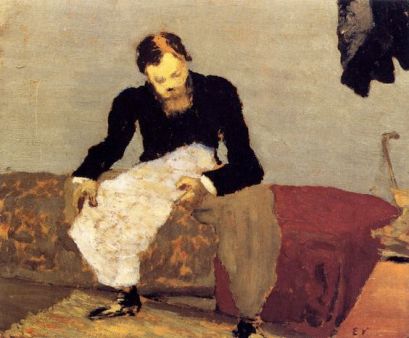
Ker-Xavier Roussel Reading the Newspaper, 1893, Private Collection Édouard Vuillard
Happy World Press Freedom Day Sky Dancers!
A Free Press is enshrined in our Constitution here in the United States. It’s always been a hallmark of open, democratic societies. So, how is the press doing in this day of increasing right-wing authoritarianism?
Here’s the 2020 World Press Freedom Index from Reporters without Borders. Notice who is missing from the top ten? Notice where most of the world’s oldest Democracies land. One of our NATO allies is one of the most frequent jailers of journalists.
A Press–independent of government oppression and manipulation–is a cornerstone of a democratic society. EuroNews reports the concerns the UN has for a media free of government interference..
The world of journalism faces “drastic losses”, the UN has warned, as it highlights the importance of ‘information as a public good’ on World Press Freedom day.
The intergovernmental organisation says the current coronavirus crisis has forced closures and job cuts within the industry, while other media outlets are facing “political capture”.
The result is more “creeping news deserts” in countries where journalists are unable to get accurate information out to the public.
You may read country descriptions based on the Press Freedom Index on the challenges faced by journalists.
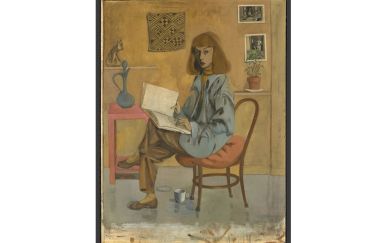
Elaine de Kooning, self portrait, 1946
We may be going back towards normalcy with the White House recognizing the role of a free press today. You may remember that we spent the last four years hearing how the press was the enemy of the people unless it presented stories that flattered and backed-up the delusional rantings of the previous guy. It is also high time the Saudis pay for killing one of our journalists. This is just one of the atrocities the previous guy ignored.
Will Biden stand up to the Saudis for the Prince’s murder of Jamal Khashoggi? This is from NBC.
The Biden administration earlier this year released a U.S. intelligence report implicating the crown prince in the 2018 murder of Saudi journalist Jamal Khashoggi but spared him any direct punishment. The prince denies any involvement.

Burns, Peter; Old Man Reading a Newspaper;
There is perhaps no greater difference in our press than the split between the media using traditional journalism and the lie pushing, agenda based narrative for something other than reality just for ratings, outrage, and political gain. Our right-wing propaganda outlets have influenced nearly all of our institutions recently. They do not provide checks and balances to corruption but enable it. No one is the clear these days. Even the U.S. Supreme Court Justices–a majority group of religious zealots with know records of hostility to democracy–are eager to cash in. This is from Bloomberg: “Supreme Court’s Ethics Problems Are Bigger Than Coney Barrett. As conflicts of interest accumulate, the justices need to embrace more stringent standards of conduct.”
We have impeached judges before. Is this the decade of taking out the trash dumped in our justice system? Perhaps we could at least develop and enforce standards of ethical behavior for judges?
A lot of hand-wringing has accompanied Supreme Court Justice Amy Coney Barrett’s $2 million book deal (including from those of us who wish we had a $2 million book deal). While there’s always reason to worry when big piles of money land on the court, and Coney Barrett has wasted little time monetizing her new job, some larger points are getting lost in all of this.
After all, Coney Barrett isn’t the first justice to reel in a big book deal. Justice Sonia Sotomayor collected an advance of more than $3 million for her memoir, and Justice Clarence Thomas got $1.5 million for his. Justice Neil Gorsuch was paid $225,000 for a book about the Constitution. Here’s the rub: Federal ethics guidelines mandate that justices can’t accept more than about $30,000 annually in outside pay. However, book income — which can reliably bring in much larger sums than the relatively modest pay justices receive for teaching gigs — is exempt from the guidelines.
When these deals arise, concerns are often voiced about justices being compromised by pocketing money from publishers who might have free speech and other issues affecting them before the court. But books are only a small part of a bigger problem: The Supreme Court’s conflicts of interest and financial disclosure rules remain ragged and outdated.
Unlike every other member of state and federal judiciaries, the court’s nine justices aren’t subject to an ethical code of conduct. That mirrors the latitude given the presidency, which also isn’t beholden to most guidelines circumscribing financial and professional practices of people in lower-ranking government jobs. Former President Donald Trump’s tenure, marked by flagrant financial conflicts of interest, is a reminder of how ineffective self-regulating ethics are when someone isn’t really interested in self-regulation.
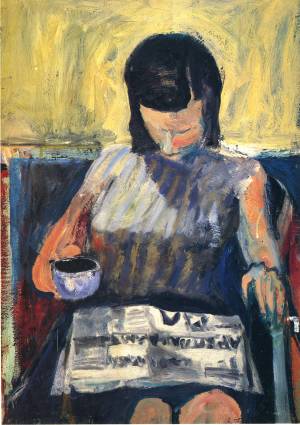
Woman with a newspaper, Richard Diebenkorn
The danger of right-wing propaganda to our Democracy has been an ongoing issue in the last several centuries. It has always skirted the First Amendment in terms of substance and motivation. We depend on an educated populace to search out the truth among many sources. The role it has played in putting public health issues into the realm of political cosplay is beyond the pale. Derek Thomas writes this for The Atlantic: “Millions Are Saying No to the Vaccines. What Are They Thinking? Feelings about the vaccine are intertwined with feelings about the pandemic.” It’s also intertwined with politics and right-wing news media falsehoods.
What are they thinking, these vaccine-hesitant, vaccine-resistant, and COVID-apathetic? I wanted to know. So I posted an invitation on Twitter for anybody who wasn’t planning to get vaccinated to email me and explain why. In the past few days, I spoke or corresponded with more than a dozen such people. I told them that I was staunchly pro-vaccine, but this wouldn’t be a takedown piece. I wanted to produce an ethnography of a position I didn’t really understand.
The people I spoke with were all under 50. A few of them self-identified as Republican, and none of them claimed the modern Democratic Party as their political home. Most said they weren’t against all vaccines; they were just a “no” on this vaccine. They were COVID-19 no-vaxxers, not overall anti-vaxxers.
Many people I spoke with said they trusted their immune system to protect them. “Nobody ever looks at it from the perspective of a guy who’s like me,” Bradley Baca, a 39-year-old truck driver in Colorado, told me. “As an essential worker, my life was never going to change in the pandemic, and I knew I was going to get COVID no matter what. Now I think I’ve got the antibodies, so why would I take a risk on the vaccine?”
Some had already recovered from COVID-19 and considered the vaccine unnecessary. “In December 2020 I tested positive and experienced many symptoms,” said Derek Perrin, a 31-year-old service technician in Connecticut. “Since I have already survived one recorded bout with this virus, I see no reason to take a vaccine that has only been approved for emergency use. I trust my immune system more than this current experiment.”
Others were worried that the vaccines might have long-term side effects. “As a Black American descendant of slavery, I am bottom caste, in terms of finances,” Georgette Russell, a 40-year-old resident of New Jersey, told me. “The fact that there is no way to sue the government or the pharmaceutical company if I have any adverse reactions is highly problematic to me.”
Many people said they had read up on the risk of COVID-19 to people under 50 and felt that the pandemic didn’t pose a particularly grave threat. “The chances of me dying from a car accident are higher than my dying of COVID,” said Michael Searle, a 36-year-old who owns a consulting firm in Austin, Texas. “But it’s not like I don’t get in my car.”
And many others said that perceived liberal overreach had pushed them to the right. “Before March 2020, I was a solid progressive Democrat,” Jenin Younes, a 37-year-old attorney, said. “I am so disturbed by the Democrats’ failure to recognize the importance of civil liberties. I’ll vote for anyone who takes a strong stand for civil liberties and doesn’t permit the erosion of our fundamental rights that we are seeing now.” Baca, the Colorado truck driver, also told me he didn’t vote much before the pandemic, but the perception of liberal overreach had a strong politicizing effect. “When COVID hit, I saw rights being taken away. So in 2020, I voted for the first time in my life, and I voted all the way Republican down the ballot.”

974 Expressionist Oil Painting Woman Reading Newspaper
We’re fucked at this rate. And, here’s FiveThirtyEight explaining where we see the big divides in American Voters.
In many ways, the 2020 election was basically like every recent American presidential election: The Republican candidate won the white vote (54 percent to 44 percent, per CES), and the Democratic candidate won the overwhelming majority of the Black (90 percent to 8 percent), Asian American (66 percent to 31 percent) and Hispanic (64 percent to 33 percent) vote. Like in 2016, there was a huge difference among non-Hispanic white voters by education, as those with at least a four-year college degree favored Biden (55 percent to 42 percent), while those without degrees (63 to 35) favored Trump. (There wasn’t a huge education split among voters of color.)1
Other surveys tell the same general story: Trump won white voters overall by a margin in the double digits and won whites without four-year degrees by even more; Trump lost among whites with at least a four-year college degree, lost by a big margin with Asian American and Latino voters and lost by an enormous margin among African Americans.
So the main reason that Trump nearly won a second term was not his increased support among Latinos, who are only about 10 percent of American voters and are a group he lost by more than 20 points. Trump’s main strength was his huge advantage among non-Hispanic white voters without college degrees, who are about 45 percent of American voters. His second biggest bloc of support was among non-Hispanic white Americans with degrees, who are about 30 percent of all voters. According to the CES, over 80 percent of Trump’s voters were non-Hispanic white voters, with or without a college degree. In contrast, around 70 percent of nonwhite voters supported Biden, and they made up close to 40 percent of his supporters. So it is very much still the case that the Republicans are an overwhelmingly white party and that the Democratic coalition is much more racially diverse.
Here’s the President of Orleans Republican Women to prove a point: President of Women’s Republican Club of New Orleans Touts Biblical Positives of Slavery. That scream you hear from way down on the Mississipi River is mine. Yeah, for small, local, independent media like The Big Easy Magazine!
The story began when Chalmette State Representative Raymond Garofalo proposed a bill where-in he wanted to ban “critical race theory” from being taught, a complex subject that conservatives have been using as a talking point recently to score political points. He said that he, in fact, wanted to “teach the good, the bad, and the ugly” about slavery. To which Hilferty replied, “There’s nothing good about slavery” to laughter.
Garofalo corrected himself, saying that, “You’re right. I didn’t mean to imply that. I don’t believe that, and I know that’s the case. But I’m using the term, ‘the good, bad, and ugly as a generic way of saying that you can teach any facts, factually based on anything.”
Both Hilferty and Garofalo have spoken directly to the media about the incident. Garofalo has tried to clarify his words, explain the terminology “good, bad, and ugly” was meant “generically,” and Hilferty claimed he was, “…talking about the good in slavery.”
Whether Garofalo meant that there were good aspects to slavery or whether he was speaking “generically,” Huckaby repeatedly came to his defense, and to the defense of slavery itself. The above was not her only post related to slavery and Garofalo. She also wrote in another post, “Slavery goes all they [sic] way back to biblical times, and if you’ve read your Bible, you would know that many of the slaves loved their masters, and their masters loved them, and took very good care of them, and their families.”
In addition, she indicated that, “Stephanie (Hilferty) has been indoctrinated by leftis [sic] marxisum [sic] education.”
So, hmm, I’m a communist troll in her eyes. So bet it! At this point, I’ll take any moniker that doesn’t include what she’s all about.
Anyway, you’ll have a good week! What’s on your reading and blogging list today?
Monday Reads
Posted: April 17, 2017 Filed under: Donald Trump, Elections, Foreign Affairs, Turkey | Tags: authoritarianism, Death of Democracies, Erodgan, Turkey elections 30 Comments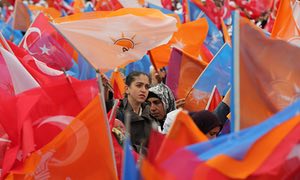 Good Morning!
The post World War 2 era led to the birth of a lot of new democracies as the colonial era started to wind down in earnest. European countries couldn’t rebuild and fund empires. One of the most fascinating things to me about the current state of things in the world is that many places where democracy seemed well-rooted are plotting a path to return of autocratic forms of government. It hasn’t been that long since the USSR and its satellites broke up into many little experiments in democracy either. What makes some countries shrug their collective shoulders and go back to strong men?
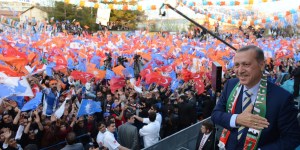
DIYARBAKIR, TURKEY – MARCH 27: Turkish Prime Minister Recep Tayyip Erdogan greets crowd during a local election rally organized by the ruling Justice and Development Party in Diyarbakir, Turkey, on March 27, 2014. (Photo by Kayhan Ozer/Anadolu Agency/Getty Images)
At some point, you have to question which institutions have failed a country’s people but it’s undoubtedly an interplay of many. Turkey’s decline has many lessons for us. The similarities between Kremlin Caligula and Erdogan are eerie. That’s why I decided to write about it today.
Modern day religious extremism ventures into politics disguised as upholding traditional culture and values. Patriotism and nationalism appeal to many. The next thing you know is there is no culture but state-approved culture. Turkey has realigned itself. It looked to the West for most of the 20th Century. It now looks backward in time. Many of the same warning signals are present within the US so a good look at Turkey is necessary. Foreign Policy argues that “Recep Tayyip Erdogan didn’t just win his constitutional referendum — he permanently closed a chapter of his country’s modern history.”
Why are the world’s democracies facing such threat to modernity? Why place so much power in an executive branch?
Whether they understood it or not, when Turks voted “Yes”, they were registering their opposition to the Teşkilât-ı Esasîye Kanunu and the version of modernity that Ataturk imagined and represented. Though the opposition is still disputing the final vote tallies, the Turkish public seems to have given Erdogan and the AKP license to reorganize the Turkish state and in the process raze the values on which it was built. Even if they are demoralized in their defeat, Erdogan’s project will arouse significant resistance among the various “No” camps. The predictable result will be the continuation of the purge that has been going on since even before last July’s failed coup including more arrests and the additional delegitimization of Erdogan’s parliamentary opposition. All of this will further destabilize Turkish politics.
Turkey’s Islamists have long venerated the Ottoman period. In doing so, they implicitly expressed thinly veiled contempt for the Turkish Republic. For Necmettin Erbakan, who led the movement from the late 1960s to the emergence of the Justice and Development Party (AKP) in August 2001, the republic represented cultural abnegation and repressive secularism in service of what he believed was Ataturk’s misbegotten ideas that the country could be made Western and the West would accept it. Rather, he saw Turkey’s natural place not at NATO’s headquarters in Brussels but as a leader of the Muslim world, whose partners should be Pakistan, Malaysia, Egypt, Iran, and Indonesia.
When Erbakan’s protégés — among them Erdogan and former President Abdullah Gul — broke with him and created the AKP, they jettisoned the anti-Western rhetoric of the old guard, committed themselves to advancing Turkey’s European Union candidacy, and consciously crafted an image of themselves as the Muslim analogues to Europe’s Christian Democrats. Even so, they retained traditional Islamist ideas about the role of Turkey in the Middle East and the wider Muslim world.
Thinkers within the AKP — notably former Prime Minister Ahmet Davutoglu — harbored reservations about the compatibility of Western political and social institutions with their predominantly Muslim society. But the AKP leadership never acted upon this idea, choosing instead to undermine aspects of Ataturk’s legacy within the framework of the republic. That is no longer the case.
The AKP and supporters of the “yes” vote argue that the criticism of the constitutional amendments was unfair. They point out that the changes do not undermine a popularly elected parliament and president as well as an independent (at least formally) judiciary. This is all true, but it is also an exceedingly narrow description of the political system that Erdogan envisions. Rather, the powers that would be afforded to the executive presidency are vast, including the ability to appoint judges without input from parliament, issue decrees with the force of law, and dissolve parliament. The president would also have the sole prerogative over all senior appointments in the bureaucracy and exercise exclusive control of the armed forces. The amendments obviate the need for the post of prime minister, which would be abolished. The Grand National Assembly does retain some oversight and legislative powers, but if the president and the majority are from the same political party, the power of the presidency will be unconstrained. With massive imbalances and virtually no checks on the head of state, who will now also be the head of government, the constitutional amendments render the Law on Fundamental Organization and all subsequent efforts to emulate the organizational principles of a modern state moot.
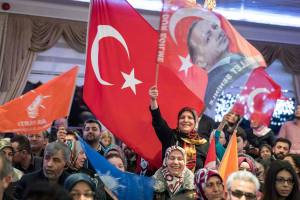 There is an uptick in groups of voters drawn to authoritarianism. This is not what I expected when I watched the “Arab Spring” unfold on Twitter. Donald Trump is not what I expected after Barrack Obama. There appears to be a group of people that just love themselves better in the comfort of old school religion and backwoods bullies. Each follower of the world’s largest religions needs to discern a difference between being a person of faith and blindly following your religion over a precipice and into slavery. It always begins with a purge of intellectuals, scientists, and scholars.
It has been painful for me to witness the immense disappointment of Turkish intellectuals, resilient by tradition, and mainly left-leaning. All I could hear by phone or on social media was tormented despair – a crushing sense of defeat. What united all those in academia and the media or in NGOs, regardless of their political stripes, was that they had hoped for democratic change under the AKP.
Many of them had given credit to the party, and its early pledges and steps towards an order where the sharing of power would break the vicious circle of the republic. They wanted to believe in human rights, freedom and an end to the decades-long Kurdish conflict. But the deliberate reversal of democratisation left all of them feeling they had been duped.
This conclusion became undeniable when last summer’s attempted coup – the details of which are still unclear – led to an immense purge. Given this mood of despair and the sense of defeat, we should expect another exodus of fine human resources in the coming months and years.
Journalists – such as me, abroad, or at home – will find themselves challenged even more after the referendum. Coverage of corruption will be a daredevil act, severe measures against critical journalism will continue and the remaining resistance of media proprietors will vanish.
The Turkish media will begin to resemble those of the Central Asian republics, where only mouthpieces for those in power are allowed to exist. Inevitably, these conditions will shift the epicentre of independent journalism to outside the borders of Turkey. My colleagues have already realised that their dreams of a dignified fourth estate were nothing but an illusion.
“At the end of the day, Erdoğan is simply replacing one form of authoritarianism with another,” wrote Cook.
“The Turkish republic has always been flawed, but it always contained the aspiration that – against the backdrop of the principles to which successive constitutions claimed fidelity – it could become a democracy. Erdoğan’s new Turkey closes off that prospect.”
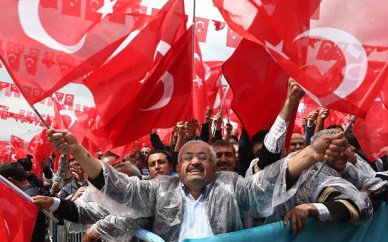 Just as in this country’s election in 2016, Erdoğan won a slim victory. That’s not stopping him from sweeping reforms that are way out of line with progress and modernity.
An emboldened Recep Tayyip Erdogan followed his win in a referendum that ratified the supremacy of his rule by taking aim at political opponents at home and abroad.
At his victory speech late on Sunday, supporters chanted that he should bring back the death penalty — a move that would finish off Turkey’s bid to join the European Union — and Erdogan warned opponents not to bother challenging the legitimacy of his win. He told them to prepare for the biggest overhaul of Turkey’s system of governance ever, one that will result in him having even fewer checks on his already considerable power.
“Today, Turkey has made a historic decision,” he said. “We will change gears and continue along our course more quickly.” The lira surged as much as 2.5 percent against the dollar in early trading on Monday in Istanbul before gains moderated.
The success of a package of 18 changes to the constitution was narrow, with about 51.4 percent of Turks approving it. It came at the end of a divisive two-month campaign during which Erdogan accused opponents of the vote of supporting “terrorists” and denounced as Nazi-like the decision of some EU countries to bar his ministers from lobbying the diaspora.
“The referendum campaign was dominated by strongly anti-Western rhetoric and repeated promises to bring back the death penalty,” said Inan Demir, an economist at Nomura Holdings Inc. in London. “One hopes that this rhetoric will be tempered now that the vote is over,” but recent steps by the Turkish government do“not bode well for the hoped-for moderation in international relations.”
 I’m not the only one curious about this trend toward dilution of democracy in Western nations. There’s actually quite a bit discussion on the topic out there today.
Now that two obese men with bad hair and nuclear weapons didn’t end the world over the weekend, let’s talk about Turkey. Maybe keeping up with the former focal point of the Ottoman empire hasn’t been on the top of your to-do list. All well and good. But you may want to know they voted to weaken or even obliterate—depending on who you ask—their democracy over the weekend.
So what does this referendum of theirs mean? Only give the Turkish president hitherto unprecedented control over the executive, legislative and judicial branches. Now that the Turks have voted “Yes” to these constitutional reforms, they’re signing up for a form of government in which parliament’s monitoring of the executive branch is removed from the constitution and the judiciary is even weaker and less independent than it already was beforehand.
It’s a complex case though. Turkey’s government is different than America’s and, in some ways, they’re actually embracing a system more similar to the one US citizens are used to. The main transition is one from a parliamentary democracy to a presidential one, albeit a strongly authoritative one. Traditionally, the Turkish president is more figurehead than enforcer. They’re intended to be more Queen Elizabeth than Vladimir Putin or even Donald Trump.
As head of state, they act as the public face of the country, acting in times of emergency but largely delegating the business of lawmaking and government-running to their appointed prime minister. Until April 16, 2017, the president was mandated to cut ties from his party and maintain a largely neutral and apolitical stance, regardless of personal attachments or viewpoints. Now the office of prime minister is kaput and the president will have way more control over all branches of government. Parliament will still make laws and the judiciary will still try cases. But they’ll do little else and even those duties are capable of being bypassed by the president pretty easily.
The changes don’t go into effect until 2019 but when they do, the Turkish president can pass decrees as effective and codified as any parliamentary law, dissolve parliament, call for new elections, set the budget, declare a state of emergency, make unilateral national security decisions, appoint and remove all VPs and ministry heads at their own discretion and more. Don’t worry! If the president does something illegal, they can still be investigated if there’s a simple majority in parliament and a 60% vote to be tried then convicted by presidentially appointed judges.
And it’s so completely unconcerning the person who’ll most likely have all this unchecked executive power in 2019 is current president Recep Tayyip Erdogan. Just think of his inspirational and relatable backstory—he sold lemonade as a teenager in a rough part of town, played soccer for a while and wrote, and directed and starred in a play called Maskomya about how Freemasonry, Communism and Judaism are evil forces hellbent on destroying the world. Presidents: they’re just like us!
 Yes, well much of this sounds eerily familiar doesn’t it? Liz Cookman has argued that Turkey could be our future under Kremlin Caligula assuming the FBI and Eric Schneiderman don’t catch up with so many of his thugs that Congress has to act. There are some frightening similarities.
Trump has voiced his support for the use of torture. And his similarities with the Turkish leader do not end there. Both use a rhetoric of patriotism to the point of nationalism, are vocal against abortion and are infamous for their tendency to objectify women and misunderstand feminism. They have both granted their sons-in-law important positions and both have a particularly thin skin when it comes to criticism, especially when it comes from comedians and journalists.
Erdoğan and Trump have publicly supported each other’s stance on the media in the past. Anyone who has spent time in Turkey will recognise Trump’s denouncement of negative coverage in outlets such as the New York Times as “fake news”. They will be familiar with headlines such as the one that appeared in far-right outlet Brietbart (whose founding member Steve Bannon is Trump’s chief strategist), used in relation to the protests in the US on Saturday – “Terror-tied group Cair causes chaos, promoting protests and lawsuits as Trump protects nation”. This is pure Erdoğan territory – denouncing opposition by associating it with terror while glorifying the strong leader. Turkey is the home of “alternative facts”.
A country that makes the media the enemy is a country where people are too easily manipulated by those in power. Journalists in Turkey, unless they work for organisations that toe the official government line on events, constantly wobble on a tightrope between reporting what’s going on and not reporting enough to get arrested. Even foreign journalists self-censor, double-check for unintended “insults” that could land them in trouble. They flinch when the doorbell rings unexpectedly, and wonder every time they go abroad whether they will be allowed back in the country.
We need to stand up against the vilification of the free press in the US now before it goes too far. Erdoğan is no longer good for Turkey, just like Trump is no good for America. They are changing the identities of their countries.
Not only English writers but French journalists notice the similarities.
But, back to the UK and Counterpunch.
The similarities between Erdogan and Trump are greater than they might seem, despite the very different political traditions in the US and Turkey.
The parallel lies primarily in the methods by which both men have gained power and seek to enhance it. They are populists and nationalists who demonise their enemies and see themselves as surrounded by conspiracies. Success does not sate their pursuit of more authority.
Hopes in the US that, after Trump’s election in November, he would shift from aggressive campaign mode to a more conciliatory approach have dissipated over the last two months. Towards the media his open hostility has escalated, as was shown by his abuse of reporters at his press conference this week.
Manic sensitivity to criticism is a hallmark of both men. In Trump’s case this is exemplified by his tweeted denunciation of critics such as Meryl Streep, while in Turkey 2,000 people have been charged with insulting the president. One man was tried for posting on Facebook three pictures of Gollum, the character in The Lord of the Rings, with similar facial features to pictures of Erdogan posted alongside. Of the 259 journalists in jail around the world, no less than 81 are in Turkey. American reporters may not yet face similar penalties, but they can expect intense pressure on the institutions for which they work to mute their criticisms.
Turkey and the US may have very different political landscapes, but there is a surprising degree of uniformity in the behaviour of Trump and Erdogan. The same is true of populist, nationalist, authoritarian leaders who are taking power in many different parts of the world from Hungary and Poland to the Philippines. Commentators have struggled for a phrase to describe this phenomenon, such as “the age of demagoguery”, but this refers only to one method – and that not the least important – by which such leaders gain power.
So, I’m sure this isn’t what you expected to read today. But, it appears that my interest and concerns aren’t just wild hairs.
What’s on your reading and blogging list today?
Independence Day Reads
Posted: July 4, 2016 Filed under: 2016 elections, Afghanistan, Afternoon Reads, Anti-War, Foreign Affairs, Great Britain, Iran, Iraq, Turkey | Tags: 4th of July, Baghdad attack, Dhaka attack, Independence Day, Istanbul attack 19 Comments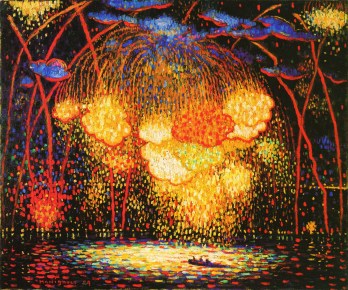
by Middleton Manigault – The Rocket (1909)
Happy Independence Day Team USA!
Here’s how the Kennedy family is spending their 4th of July! “Kennedy family BASHES Trump over Fourth of July weekend with a pinata of The Donald at their Cape Cod compound.” That sounds like some nice harmless fun and very politically incorrect. The Trumpster should approve but I doubt his thick skull or thin skin will be able to take it in that spirit.
The Kennedy clan gathered at their Hyannis Port compound on Cape Cod over the weekend for their annual Fourth of July festivities, and took some time to attack Donald Trump.
Robert F. Kennedy Jr.’s daughter Kathleen, between known as Kick, posted a photos of a pinata of The Donald from a family party over the weekend.
‘It’s yuge party!,’ wrote Kick in the caption of the Instagram post, which also showed some of her family members milling about in the background.
She later deleted the Instagram post just before 11am on Monday.
Yes, some of us are still rocking in the free world while we can!
There’s a lot of sadness today as we stop to think about Baghdad, Istanbul, and Dhaka where ISIS attacks have killed hundreds of innocent people  who were simply going about their day. Our hearts go out to the places that have suffered these massive tragedies. I’m also reminded today of Colin Powell’s Pottery Barn Rule.
Powell: What I was saying is, if you get yourself involved—if you break a government, if you cause it to come down, by invading or other means, remember that you are now the government. You have a responsibility to take care of the people of that country.
Isaacson: And it got labeled the Pottery Barn rule.
I, for one, care about these attacks. I’ve not seen the graphics, the heartfelt “I’m with …” sloganeering, and the banal, jingoistic calls exclaiming that “it’s a war on the Western World.” That’s because it isn’t a war on the Western World. It’s a war on modernity.
This is a fight we brought to the front door step of many countries–including Iraq–that were not to blame for anything when we invaded Iraq.
Since the 2003 U.S.-led invasion of Iraq, and the bungled occupation that followed, Baghdad has been the site of numerous rounds of sectarian bloodletting, al-Qaeda attacks and now the ravages of the Islamic State. Despite suffering significant defeats at the hands of the Iraqi army, including the loss of the city of Fallujah, the militant group has shown its willingness and capacity to brutalize the country’s population.
Public anger in the Iraqi capital, as my colleague Loveday Morris reports, is not being directed at foreign conspirators or even — first and foremost — at the militants, but at a much-maligned government that is failing to keep the country safe.
“The street was full of life last night,” one Karrada resident told The Washington Post, “and now the smell of death is all over the place.”
 Iraq is being invaded once more and Baghdad is still a shadow of itself in a country with little ability to truly defend its borders and people.
By Monday afternoon the toll in Karrada stood at 151 killed and 200 wounded, according to police and medical sources. Rescuers and families were still looking for 35 missing people.
Islamic State claimed the bombing, its deadliest in Iraq, saying it was a suicide attack. Another explosion struck in the same night, when a roadside bomb blew up in popular market of al-Shaab, a Shi’ite district in north Baghdad, killing two people.
The attacks showed Islamic State can still strike in the heart of the Iraqi capital despite recent military losses, undermining Prime Minister Haider al-Abadi’s declaration of victory last month when Iraqi forces dislodged the hardline Sunni insurgents from the nearby city of Falluja.
Abadi’s Shi’ite-led government ordered the offensive on Falluja in May after a series of deadly bombings in Shi’ite areas of Baghdad that it said originated from the Sunni Muslim city, about 50 km (30 miles) west of the capital.
Falluja was the first Iraqi city captured by Islamic State in 2014, six months before it declared a caliphate over parts of Iraq and Syria. Since last year the insurgents have been losing ground to U.S.-backed Iraqi government forces and Iranian-backed Shi’ite militias.
“Abadi has to have a meeting with the heads of national security, intelligence, the interior ministry and all sides responsible for security and ask them just one question: How can we infiltrate these groups?” said Abdul Kareem Khalaf, a former police Major General who advises the Netherlands-based European Centre for Counterterrorism and Intelligence Studies think tank.
He said Islamic State, or Daesh, “has supporters or members everywhere – in Baghdad, Basra and Kurdistan. All it takes is for one house to have at least one man and you have a planning base and launch site for attacks of this type.”
In a sign of public outrage at the failure of the security services, Abadi was given an angry reception on Sunday when he toured Karrada, the district where he grew up, with residents throwing stones, empty buckets and even slippers at his convoy in gestures of contempt.
He ordered new measures to protect Baghdad, starting with the withdrawal of fake bomb detectors that police have continued to use despite a scandal that broke out in 2011 about their sale to Iraq under his predecessor, Nuri al-Maliki.
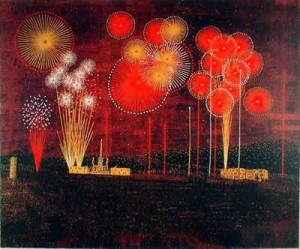 So, today our skies will light up with fireworks that we will purposefully set off to celebrate the signing of the Declaration of Independence and
  moving forward with liberating our nation from British rule. It’s odd to think that the fall out from colonialism is still going on today and that the fireworks that light up many other places do not represent the symbolic act of a war of Independence but one of oppression and terror.
I’m not sure how many of you will stop by on this holiday to say hi so I’m going to just make this a brief greeting with the one bit of news. However this is, as always, an open thread and there are other things going on including the election of the next President of the US.
This is another thing that should give us pause as we continue to clean up the mess of the Bush Administration, and actually the mess left behind by others of his predecessors like Ronald Reagan whose adventures in South and Central American made every one in those countries a lot less safe.
If we’re unable to purse our own liberty and happiness then we can change that under our system of government. But then, think again what it means when our actions prevent that dream for others. My heart weeps for all of those who live in countries that we helped break. We own it. I think Hillary Clinton understands this. I think Donald Trump would rather we walk away from our mess. We broke it. We own it. Let’s just hope the rest of the coalition of the willing hangs in there with us as we try to stop the carnage.
Have a great 4th!!! May the fireworks near you be only the celebratory type and not the bullets from another crazed shooter or the ignition of a suicide vest! May all beings be free from harm!!!
 Take a swing at a Trump pinata for me!!!

 peej
peej Carissa
 bostonboomer
 dakinikat
 ecocatwoman
 mablue2
 Mama Lopez
 peggysue22
 quixote
 skydancingguestblogger
 Mona (aka Wonk the Vote)



 Sky Dancing
Recent Comments