
Live Blog: President Obama’s Speech on Dealing with Islamic State Militants
Posted: September 10, 2014 Filed under: Barack Obama, Foreign Affairs, Iraq, just because, Syria, U.S. Politics | Tags: Islamic State, live blog 36 Comments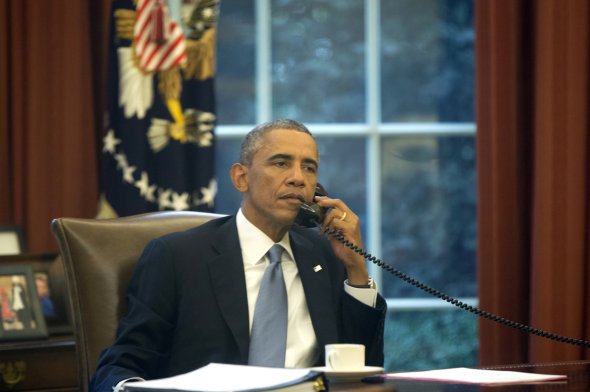
In this image made through a window of the Oval Office, President Obama speaks on the phone to Saudi Arabia’s King Abdullah on Wednesday (NPR)
President Obama will give a prime-time speech at 9:00 tonight in which he will lay out a strategy to deal with the Islamic State Militants in Iraq and Syria. Let’s watch the speech together and discuss on what the President says in real time. I’ve gathered some links to articles that report on and react to the leaked content of the speech.
According to The Washington Post, Obama will announce a ‘broad coalition’ to fight the Islamic State terror group.
The United States will lead a “broad coalition” to defeat the Islamic State through air strikes and support for military partners on the ground, President Obama will announce Wednesday night….Obama will tell the country that the offensive against the militant group will not involve combat troops, but rather a “steady, relentless effort” that involves air power and backing for partner forces, according to early excerpts provided by the White House.
“So tonight, with a new Iraqi government in place, and following consultations with allies abroad and Congress at home, I can announce that America will lead a broad coalition to roll back this terrorist threat. Our objective is clear: we will degrade, and ultimately destroy ISIL through a comprehensive and sustained counter-terrorism strategy,” Obama will say, using an acronym for the Islamic State terrorist group.
Obama will make clear to a war-weary public that the offensive will not resemble the wars in Iraq and Afghanistan, but rather other, more covert, missions against terrorists.
“I want the American people to understand how this effort will be different from the wars in Iraq and Afghanistan. It will not involve American combat troops fighting on foreign soil,” Obama will tell the nation.
“This counter-terrorism campaign will be waged through a steady, relentless effort to take out ISIL wherever they exist using our air power and our support for partner forces on the ground. This strategy of taking out terrorists who threaten us, while supporting partners on the front lines, is one that we have successfully pursued in Yemen and Somalia for years.”
Frankly, I’m very worried about this. I really don’t see how this is going to end well. I hope I’m wrong.
Richard Engel writes at NBC News, What Happens After the U.S. Bombs ISIS?
On one level, bombing ISIS is easy. The U.S. knows where the group operates. There’s no need for a ten-year hunt like the one for Osama bin Laden. The terror group has two capital cities, Mosul in Iraq and Raqqa in Syria. Al-Qaeda never had such an obvious home address.
Finding a justification to attack ISIS is also simple. It has threatened to carry out another 9/11, beheaded two American journalists, slaughtered thousands of Iraqis and Syrians and is a danger to U.S. allies in the region. Many in the U.S. military believe ISIS needs to be immediately, and repeatedly, smashed by American drones and warplanes.
But what then happens to the Middle East – this seething cauldron of competing interests, religious passions, ethnic tensions, long memories and oil? The key question now, as before the Iraq invasion, is what happens after the U.S. starts bombing.
ISIS controls a territory roughly the size of Maryland where 8 million people live. If it’s attacked and toppled, who will fill the void? In Iraq, it will be the Kurdish fighters or the Iraqi army. The two don’t trust each other and have different objectives for the territory they control. The Kurds are laying the foundation for a future independent state. The Iraqi army is increasingly an Iranian-guided, Shiite force.
The U.S. spent billions of dollars to build a secular, professional national Iraqi army but failed because, despite all the U.S.-supplied guns, tanks and planes, the Iraqi military fell apart when challenged by a band of terrorists. President Obama wants to reconstitute it now as part of his ISIS strategy. Why would it work this time when it didn’t before, even as U.S. troops were standing next to Iraqi soldiers in Baghdad, shoulder to shoulder?
Good questions. Read more at the link.
From the LA Times, Obama to call for ‘steady, relentless’ effort against Islamic State.
Nearly six years after he was elected on the promise to end America’s decade of wars, Obama planned to detail a military campaign that is broader and more complex than any he has launched during his tenure.
Obama is expected to expand U.S. airstrikes against the militants in Iraq to include targets throughout the country as well as across the rapidly disintegrating border with Syria, where the group harbors its weapons, camps and fighters.
White House officials say Obama also plans to further train and arm Iraqi and Kurdish troops as well as opposition forces battling the Islamic State in Syria. He’ll tout beefed-up partnerships with governments in the Middle East and Western allies, who have been asked to assist in the training, gather intelligence and counter the Islamic State’s appeal in the broader Muslim world.
In his televised remarks, Obama was to describe the effort as a “broad coalition to roll back this terrorist threat.”
“Our objective is clear: We will degrade, and ultimately destroy, ISIL through a comprehensive and sustained counter-terrorism strategy,” according to prepared remarks released by the White House, referring to the Islamic State by a commonly used abbreviation.
Those article spell out the gist of what the President will say. Here are a few more links to peruse if you want more.
Reuters, Bill to fund U.S. government ensnared in debate about Islamic State.
LA Times, Cheney urges Obama to launch ‘immediate’ assault on Islamic State (Sigh . . . why won’t he go away?)
Foreign Policy, There are already troops in Iraq. Problem is, they’re Iranian.
The New York Times, What Obama Faces in a Campaign Against ISIS.
Please us know what you think of the speech in the comment thread. Watch the live stream at CNN here and at the LA Times with live updating here.
Tuesday Reads
Posted: August 26, 2014 Filed under: Barack Obama, Foreign Affairs, France, George W. Bush, Germany, Iraq, morning reads, racism, Syria, U.S. Economy, U.S. Politics, unemployment | Tags: Al Nusra Front, al Qaeda, Angela Merkel, austerity, European Central Bank, Ferguson MO, ISIS, James W. Foley, Janet Yellen, Mario Draghi, Michael Brown, Peter Theo Curtis, The Islamic State, the NEW York Times 41 Comments
The Dog Days of Summer, Janet Hill
Good Morning!!
It’s the last week of August, and the dog days of summer have supposedly passed; but the Boston area is supposed to hit ninety degrees today and tomorrow. I’m actually looking forward to it, because it has been so cool here lately–in the sixites and low seventies in the daytime and the fifties at night. Yesterday it got into the high eighties, and it felt wonderful.
The Boston Globe has a story today about Peter Theo Curtis, the writer who was just released from captivity in Syria. His mother lives in Cambridge. I had never heard of Curtis before; apparently his kidnapping was kept secret. The Globe reports: Militants free US writer with Mass. ties who was held in Syria.
Peter Theo Curtis, a writer and scholar with ties to the Boston area who was held captive for nearly two years by one of the Islamic militant groups operating in Syria, was released Sunday after emissaries from the government of Qatar won his freedom on humanitarian grounds, in a stark contrast to the brutal murder of fellow war correspondent James W. Foley .
Curtis’s 22 months in captivity were kept from the public at his family’s request since he was nabbed near the Syrian border in October 2012 by Al Nusra Front, one of the groups seeking to topple President Bashir Assad of Syria. Al Nusra Front has ties to the Al Qaeda terrorist network.
Curtis, 45, who wrote dispatches under the name Theo Padnos and previously chronicled disaffected young Muslims in Yemen in a book titled “Undercover Muslim,” had studied Arabic in Syria.
He was handed over to United Nations peacekeepers in the Israeli-occupied Golan Heights on Sunday evening, a UN spokesman in New York said. After it was determined he was in good medical condition, he was transferred to representatives of the US government, according to the UN.
“We are so relieved that Theo is healthy and safe and that he is finally headed home after his ordeal,” his mother, Nancy Curtis, who lives in Cambridge, said in a statement, “but we are also deeply saddened by the terrible, unjustified killing last week of his fellow journalist, Jim Foley, at the hands of the Islamic State in Iraq and Syria, ISIS.”
Foley was from New Hampshire, and the two families have gotten to know each other well, according to Curtis.

Garden Shed – Late Summer, KK Marais
Syria and Iraq
President Obama has authorized surveillance flights over Syria, according to BBC News.
Correspondents say the move could mark the first step towards US air strikes inside Syria, where the jihadist group controls vast swathes of territory.
The US is already carrying out strikes against IS in neighbouring Iraq.
On Monday, the Syrian government said it would work with the international community in the fight against IS.
Western governments have so far rejected suggestions that they collaborate with President Bashar al-Assad in an attempt to counter the growing regional threat posed by IS….
On Monday evening, US officials said Mr Obama had approved over the weekend reconnaissance flights by unmanned and manned aircraft, including drones and possibly U2 spy planes.
The US military has been carrying out aerial surveillance of IS – an al-Qaeda breakaway formerly known as Isis – in Iraq for months and launched air strikes on 8 August.
From The Boston Globe, citing “AP sources,” U.S. planes have already begun flying over Syria.
KABUL, Afghanistan (AP) — The U.S. has begun surveillance flights over Syria after President Barack Obama gave the OK, U.S. officials said, a move that could pave the way for airstrikes against Islamic State militant targets there.
While the White House says Obama has not approved military action inside Syria, additional intelligence on the militants would likely be necessary before he could take that step. Pentagon officials have been drafting potential options for the president, including airstrikes.
One official said the administration has a need for reliable intelligence from Syria and called the surveillance flights an important avenue for obtaining data.
Two U.S. officials said Monday that Obama had approved the flights, while another U.S. official said early Tuesday that they had begun. The officials were not authorized to discuss the matter by name, and spoke only on condition of anonymity.
Jim Michaels of USA Today spoke to Gen. Dempsey on Sunday about what is being done to deal with ISIS in Iraq.
ABOARD A U.S. MILITARY AIRCRAFT — U.S. airstrikes on Islamic militants in Iraq have blunted their momentum, but defeating them will require a broad regional approach that draws support from Iraq’s neighbors and includes political and diplomatic efforts, the top U.S. military officer said.
The long-term strategy for defeating the militants includes having the United States and its allies reach out to Iraq’s neighbors, including Jordan, Saudi Arabia and Turkey, Gen. Martin Dempsey, chairman of the Joint Chiefs of Staff, said Sunday….
Dempsey is working with Central Command to prepare “options to address [the Islamic State] both in Iraq and Syria with a variety of military tools including airstrikes,” said Col. Ed Thomas, Dempsey’s spokesman, in a statement.
The militant group Islamic State, also known as ISIS, has shown itself to be so brutal that Iraq and the U.S. should be able to find “willing partners” to join efforts to defeat the militants, Dempsey said.
But military power won’t be enough, Dempsey said. The strategy must take a comprehensive approach that includes political and diplomatic efforts to address the grievances of millions of Sunnis who have felt disenfranchised by Iraq’s Shiite-dominated government, he said.

Late Summer Garden, John Gordon
I get the feeling that we’re never going to escape involvement in the endless Middle East conflicts, thanks to George W. Bush, Dick Cheney, and the rest of the neocon gang. What a horrible mess! We have our own messes to deal with here, but foreign wars always seem to trump the needs of the American people.
John Cassidy speculates at The New Yorker: What’s Next in Iraq and Syria?
On his first full day back from vacation, President Barack Obama could be forgiven for wishing he were still on Martha’s Vineyard. With confirmation that ISIS fighters have just captured another military base from the government forces of President Assad, and that Qatar has engineered the release of an American freelance journalist who was being held by a non-ISIS jihadist group, Obama has two formidable challenges to deal with.
The immediate task for Obama is deciding whether to launch American bombing raids on ISIS positions inside Syria, while simultaneously preparing his Administration, and the country at large, for the possibility of another video showing an American hostage being butchered. The ISIS militants, having carefully orchestrated the beheading of James Foley following the launch of U.S. strikes inside Iraq, will surely seek to exploit the fate of its remaining American hostages for maximum effect. Any U.S. decision to expand its air campaign is almost certain to be met with the release of more snuff films.
No President—no American—could take such a prospect lightly. At the same time, Obama has to guard against allowing emotion and wishful thinking to take over U.S. policy. That’s what happened after 9/11, and some of the chaos that we now see in the Middle East can be traced back to that historic blunder. What’s needed is calm cost-benefit analysis of the options open to the United States, taking account of its strategic interests, its values, and its capabilities. In short, we need what Danny Kahneman, the Princeton psychologist who pioneered behavioral economics, would refer to as some Type 2 thinking: a disciplined weighing of the likely consequences of our actions. If we give into our Type 1 reaction—horror, outrage, anger—we will be playing into the hands of the jihadists.
One place to start is by acknowledging two errors in thinking that have blighted U.S. policy in the past decade: the conservative delusion that the United States could, more or less single-handedly, use its military power to reinvent the Middle East, and the liberal illusion that we could simply walk away from the mess that Bush, Cheney & Co. created. Without the political willingness and the financial capability to garrison the region in the manner of postwar Germany and Japan, U.S. influence has to be exercised through air power, political proxies, economic inducements, and regional alliances. But that doesn’t diminish the fact that the United States and other Western countries have vital interests at stake, one of which is preventing the emergence of a rogue Islamic state that would provide a rallying point, and a safe haven, for anti-Western jihadists the world over.
Read the whole thing at the link.

A Garden in a Sea of Flowers, Ross Turner
The Economies of the U.S. and Europe
There has been so much breaking news for the past couple of months that we haven’t talked much about the economies of the U.S. and Europe. But today the European Central Bank is topping the headlines, and last week Fed Chairperson Janet Yellen spoke at Jackson Hole, so I thought I’d post a few economics stories.
Here’s CNN Money’s report on Yellen’s speech, Janet Yellen: Job market not recovered.
That was Federal Reserve Chair Janet Yellen’s main message Friday in a much anticipated speech.
“It speaks to the depth of the damage that, five years after the end of the recession, the labor market has yet to fully recover,” she said.
The debate now is whether the job situation in America is healthy enough for the Federal Reserve to start raising interest rates, which have been at historic lows in recent years in an effort to jump start the economy. Yellen, however, said little new on Friday, and U.S. stock markets stayed flat.
Yellen is chair of the committee that sets interest rates, but she only gets one vote. Other members have differing views. The Fed board and other top economists are spending the weekend in Jackson Hole, Wyoming, debating these key issues.
Though the unemployment rate “has fallen considerably and at a surprisingly rapid pace,” Yellen said problems remain.
Yellen called attention to what Americans in the job market already know–though the employment numbers look better, many people have stopped looking for work, and most of the new jobs are part-time and pay low wages.
A few more U.S. economy stories to check out:
The Wall Street Journal: Fed’s Yellen Remains Mum on Timing of Rate Change.
Bloomberg Businessweek: Yellen Job-Slack View Muddied by Pent-Up Wage Deflation.
Slate: The Fed Is Not As Powerful As We Think.
If you think the economy is struggling here, you should take a look at Europe, where austerity thinking has ruled since the economic crisis hit. Yesterday the French government collapsed. From The New York Times, French Cabinet Is Dissolved, a Victim of Austerity Battles.
PARIS — The collapse of the French government on Monday exposed widening divisions both within France’s leadership, and Europe more broadly, over austerity policies that many now fault for threatening to tip the eurozone back into recession.
Prime Minister Manuel Valls announced that he would dissolve his government after a rancorous battle in his cabinet over whether the belt-tightening measures taken by President François Hollande — at the urging of Germany and European Union officials in Brussels — were impeding France’s recovery.
The dispute broke into the open when Mr. Vall’s outspoken economy minister, Arnaud Montebourg, insisted in an interview over the weekend that austerity had gone too far. “The priority must be exiting the crisis, and the dogmatic reduction of deficits should come after,” he told the newspaper Le Monde.
He also took direct aim at the policies of Angela Merkel, the German chancellor. “Germany is caught in a trap of austerity that it is imposing across Europe,” he said.
Even the formerly strong German economy is struggling now, according to Reuters (via NYT), Crisis in Ukraine Drags Economy in Germany.
The eurozone’s flatlining economy took another hit on Monday when data showed German business sentiment sagging for the fourth consecutive month. Chancellor Angela Merkel attributed some of her own country’s decline in the second quarter to the Russia-Ukraine crisis, over which tit-for-tat sanctions threaten trade. The Munich-based Ifo, a research firm, echoed some of those sentiments as it reported its business climate index, based on a monthly survey of some 7,000 companies, fell to a worse-than-expected 106.3 from 108, the lowest level in more than a year. The findings agreed with data earlier in the month on the second-quarter contraction in Germany, the bloc’s biggest economy. Klaus Wohlrabe, an Ifo economist, said his institute expected growth in Germany to be “close to zero” in the third quarter.
A few more headlines on the European economic situation:
The Guardian: An austerity revolt has broken the French government. Will the EU follow?
Bloomberg Businessweek on the European Central Bank, Draghi May Again Find Bazooka Words Beat Action With QE, and an editorial from The Financial Times, Central banks at the crossroads.

Wisteria Flowers in Bloom at Pergola at Portland Japanese Garden Stone Path
Ferguson Stories
Yesterday, on the day of Michael Brown’s funeral, The New York Times published a story that got a great deal of attention because of its insensitive characterization of the dead teenager. Here the paragraph that attracted the angry reaction:
Michael Brown, 18, due to be buried on Monday, was no angel, with public records and interviews with friends and family revealing both problems and promise in his young life. Shortly before his encounter with Officer Wilson, the police say he was caught on a security camera stealing a box of cigars, pushing the clerk of a convenience store into a display case. He lived in a community that had rough patches, and he dabbled in drugs and alcohol. He had taken to rapping in recent months, producing lyrics that were by turns contemplative and vulgar. He got into at least one scuffle with a neighbor.
Would the authors have written a similar paragraph about a white homicide victim? From Vox, The New York Times called Michael Brown “no angel.” Here’s how it described serial killers.
The New York Times’s description of Michael Brown as “no angel” has prompted a swift, critical reaction from other media outlets, including Vox, and various people on social media.
Alison Mitchell, national editor for the Times, defended the term in conversations with the Washington Post’s Erik Wemple:
“It comes out of the opening scene,” says Mitchell, who notes that “like many teenagers,” Brown was indeed “no angel.” Okay, but would the New York Times have chosen this term — which is commonly used to describe miscreants and thugs — if the victim had been white? Mitchell: “I think, actually, we have a nuanced story about the young man and if it had been a white young man in the same exact situation, if that’s where our reporting took us, we would have written it in the same way.” When asked whether she thought that “no angel” was a loaded term in this context, Mitchell said she didn’t believe it was. “The story … talks about both problems and promise,” she notes.
The Times’s response has done little to calm the storm. Sean McElwee, research assistant at Demos, dug into the archives to compare the Times’s description of Brown to the newspaper’s previous descriptions of serial killers and terrorists. Of course, comparing articles produced decades apart by different writers and editors isn’t an exact science. But it does lend context to the widespread frustration over how young black men are portrayed in the media.
A series of McElwee’s tweets are posted at the link, and are well worth reading.
One more from Salon by Joan Walsh, Ferguson’s booming white grievance industry: Fox News, Darren Wilson and friends. Check it out at Salon.
How did this post get so long?! I’d better wrap it up. Please post your thoughts and links in the comment thread, and have a great Tuesday!
Tuesday Reads: Syria, Ukraine, and Venezuela; Robot Police; Republican Stupidity; Harold Ramis; and Women of “True Detective”
Posted: February 25, 2014 Filed under: abortion rights, Barack Obama, Foreign Affairs, misogyny, morning reads, NSA, National Security Agency, PLUB Pro-Life-Until-Birth, Reproductive Rights, Republican politics, Syria, U.S. Politics, Ukraine, Venezuela, War on Women | Tags: Bobby Jindal, crime fighting robot, Dan Malloy, Harold Ramis, Knightscope, Mark Ames, State Sen. Steve Martin (R-VA), Syria's children, True Detective 42 Comments
Good Morning!!
There is so much foreign news these days, and I have to admit ignorance when it comes to discussing the situations in Ukraine, Venezuela, and Syria. I don’t even know where to begin to understand the issues, and to be honest I just don’t have the time to try to do it. But here are some articles from sources I trust that struck me as important.
I’ll begin with something I can easily understand and care about: the fate of children in these conflicts. From The Independent, ‘No one cares’: The tragic truth of Syria’s 500,000 refugee children. The article is about British photojournalist Ed Thompson and an art student from Lebanon, Sammy Hamze, who went to Lebanon to put a spotlight on what is happening to Syrian refugee families.
We have heard the stories. Children at risk of dying from the cold in refugee camps; vulnerable to trafficking; begging on the side of the road; left orphaned and out of school; girls sold into marriage. But what shook Thompson most was that the children, although appearing older than their years, were still so young. “They are innocent, completely innocent,” he says now. “One father told me to look at his family; he could barely feed his son. They had been through hell, walked through hell and got to hell. All they want to do is go home.”
The conflict that has torn Syria apart has raged for almost three years, left more than 100,000 people dead in its wake and driven nine-and-a-half million from their homes. It took intense political pressure to get the British Government to agree to offer hundreds of the “most needy people” in Syrian refugee camps a home in this country. “We live in the modern age – we can read what’s going on in Syria; we’ve never had more information at our fingertips,” says Thompson – “but no one cares.”
If anything can break through the apathy, it is his pictures.
Read more and see some of Thompson’s photos at the link.
On Ukraine, I posted this article by Mark Ames in the comments yesterday, but I’ll link it again here: Everything you now about Ukraine is wrong.
I haven’t lived in that part of the world since the Kremlin ran me out of town, so I’m not going to pretend that I know as much as those on the ground there. Still, I’ve been driven nuts by the avalanche of overconfident ignorance that stands for analysis or commentary on the wild events there. A lethal ignorance, a virtuous ignorance….
Nearly everyone here in the US tries to frame and reify Ukraine’s dynamic to fit America-centric spats. As such, Ukraine’s problems are little more than a propaganda proxy war where our own political fights are transferred to Ukraine’s and Russia’s context, warping the truth to score domestic spat points. That’s nothing new, of course, but it’s still jarring to watch how the “new media” counter-consensus is warping and misrepresenting reality in Ukraine about as crudely as the neocons and neoliberals used to warp and Americanize the political realities there back when I first started my Moscow newspaper, The eXile.
Read about what Ames calls the “simplifications/misconceptions” that are driving Ames crazy at Pando Daily.
And then there’s Venezuela. At The Washington Post, Adam Tayor asks, Amid the coverage of Ukraine, is a crisis in Venezuela being ignored? It’s an interesting question. And what about Syria, which has pretty much disappeared in all the coverage of Ukraine? Is American media simply incapable of covering more than one foreign conflict at a time? Read all about it at the link.
One more story on Venezuela from Peter Weber at The Week: Venezuela isn’t going to be another Ukraine.
Venezuela is not Ukraine, and beneath the similarities in the protest movements are significant differences.
The first is time: The Kiev protesters started their demonstration in November after Yanukovych reneged on a European Union trade pact, and they gradually built up a tent fortress in the central Maidan Square. In Venezuela, the protests started on Feb. 4 at the university in San Cristóbal, with students showing their anger over the lack of police response to an attempted rape and crime in general.
The “brutal police crackdown” on the student protesters in San Cristóbal led to similar protests at other universities, which were also violently suppressed, says Francisco Toro in The New York Times. “As the cycle of protests, repression, and protests-against-repression spread, the focus of protest began to morph. What was at stake, the students realized, was the right to free assembly.” Toro continues:
It’s this intolerance of opposing views, and violent repression, that Venezuela’s students are now mobilized against. Today, after 13 deaths, 18 alleged cases of torture and over 500 student arrests, the protest movement has snowballed into a nationwide paroxysm of anger that puts the government’s stability in question. The protests’ lack of structure has given them resilience, but also an anarchic edge. There is no single leader in a position to give the movement strategic direction. [The New York Times]
Read more comparisons at the link.
In Other News . . .

The K5 robot outside a school
If you think the prospect of being spied on by NSA is frightening, you need to read this article by James Robinson at Pando Daily: Knightscope’s new robotic law enforcer is like staring at the demise of humanity.
Knightscope’s autonomous, crime fighting robot has the complexion of a washing machine. In pictures it looks cute, the size of a penguin maybe. In person it is five feet tall with intimidating breadth. It moves steadily and with insistence. If you stare at it long enough, the twin panels of lights about two-thirds of the way up its body start to take on the appearance of shifty, judgmental eyes. It sees what you’re doing and wants you to cut it out.
The full name of the Knightscope robot on display at the Launch Festival this morning was the K5 beta prototype. Former Ford Motor Company executive and Knightscope CEO William Santana Li describes it to MC and festival organizer Jason Calacanis onstage as a “crime fighting autonomous data machine.” But that doesn’t come close to doing it justice….
As Santana Li outlines proudly, the beast before him on stage takes in 360-degree video through four cameras, is capable of thermal imaging, registers gestures, recognizes faces and can run 300 license plates in a single minute. It works off proximity GPS and scans its environment every 25 milliseconds. It runs off nearly identical technology to Google’s self-driving cars. He boasts that it can see, feel, hear and smell. It is autonomous, will roam outdoors, can take video, decide when it needs to return and charge its batteries and can detect biological and chemical pathogens and radiation.
The Knightscope will get put out in the field gathering data, Santana Li says. The owner can log in to a security panel and get a read of what is going on in the area. The robot can scan license plates and report back on stolen cars. Its facial recognition capabilities can alert its owner to any registered sex offender in the area. The sample dashboard Santana Li logs in to, shows that the robot can report back about things as specific as how many people are lying horizontal and how many are gesturing with their hands. The company is working on giving it a 3M graffiti proof sheen, it emits a piercing sound if someone tries to tip it over and the machines will often work in pairs so they can protect each other.
How would you like to live in a world where one of those things is checking up on you wherever you go?
From Laura Bassett at Huffington Post, here’s the latest from the land of Republican misogyny and stupidity: Virginia Republican Says A Pregnant Woman Is Just A ‘Host,’ Though ‘Some Refer To Them As Mothers.’ Yes, someone really said that.
A pregnant woman is just a “host” that should not have the right to end her pregnancy, Virginia State Sen. Steve Martin (R) wrote in a Facebook rant defending his anti-abortion views.
Martin, the former chairman of the Senate Education and Health Committee, wrote a lengthy post about his opinions on women’s bodies on his Facebook walllast week in response to a critical Valentine’s Day card he received from reproductive rights advocates.
“I don’t expect to be in the room or will I do anything to prevent you from obtaining a contraceptive,” Martin wrote. “However, once a child does exist in your womb, I’m not going to assume a right to kill it just because the child’s host (some refer to them as mothers) doesn’t want it.” Martin then changed his post on Monday afternoon to refer to the woman as the “bearer of the child” instead of the “host.”
Martin explained that he edited his post because “people took it the wrong way.” Read his original post at the link.
And then there’s good old Bobby Jindal, who still thinks he has a chance to be POTUS: Jindal Breaches White House Protocol To Take Shots At Obama.
The National Governors Association is supposed to bring Democrats and Republicans together to discuss policy and share ideas for mutual success, but after a meeting at the White House Monday, all pretense at bipartisan comity was shattered as a press conference with lawmakers descended into a partisan fracas.
Louisiana Gov. Bobby Jindal launched into a repeated assault on President Barack Obama’s leadership in the shadow of the West Wing, in defiance of established bipartisan protocol. Speaking after a meeting of the NGA at the White House, Jindal, the vice chair of the Republican Governors Association, said Obama is “waving a white flag” by focusing on executive actions with three years left in his term. “The Obama economy is now the minimum wage economy,” Jindal added….
Connecticut Gov. Dan Malloy rose to challenge Jindal immediately after he spoke to reporters, calling his remarks on Obama waving a white flag “the most insane statement I’ve ever heard.”
Jindal then returned to the microphones to continue his barrage against the Obama administration, saying as Malloy walked off, “I want to make sure he hears a more partisan statement,” and saying Obama should delay the Affordable Care Act mandates. It wasn’t the first time Jindal had used the microphones outside the White House to attack the president, having done the same at last year’s meeting.
Fortunately, Bobby Jindal will never be president. What a horrible excuse for a human being.
As everyone knows by now, we lost a great comedy writer, director, and performer yesterday. From The Chicago Tribune: Harold Ramis, Chicago actor, writer and director, dead at 69.
Harold Ramis not only may be the most successful comedy writer-director that Chicago has produced, but some wouldn’t even confine that statement to Chicago.
“Harold was clearly the most successful comedy writer-director of all time,” said Tim Kazurinsky, who followed Ramis at Second City and later became his friend. “The number of films that he has made that were successful, that were blockbusters, nobody comes close. Even in light in of that, he was more successful as a human being.”
Ramis’ career was still thriving in 1996, with “Groundhog Day” acquiring almost instant classic status upon its 1993 release and 1984’s “Ghostbusters” ranking among the highest-grossing comedies of all time, when he decided to move his family back to the Chicago area, where he grew up and had launched his career.
On Monday, Ramis was surrounded by family in his North Shore home when he died at 12:53 a.m. of complications from autoimmune inflammatory vasculitis, a rare disease that involves swelling of the blood vessels, said his wife, Erica Mann Ramis. He was 69.
Read The New York Times obituary here: Harold Ramis, Alchemist of Comedy, Dies at 69.
Finally, a little True Detective news. Dakinikat posted this in the comments yesterday, but if you didn’t go to the link you might have missed something really revelatory.
A number of writers have noted that the hit HBO series focuses almost exclusively on the male characters and that women and children are only seen and heard in terms of their effect on the men–for example, see this article at The New Yorker by Emily Nussbaum: The shallow deep talk of “True Detective.”
Yesterday two feminist writers took a different point of view. At Slate, Willa Paskin argues that the way the men of True Detective treat women is actually at the heart of the narrative–that by not listening to women, Detectives Marty Hart and Rust Cohle miss the very clues that would help them solve their 17-year case.
Ignoring women may be the show’s blind spot, but it is also one of its major themes. True Detective is explicitly about the horrible things that men do to women, things that usually go unseen and uninvestigated. No one missed Dora Lange. Marie Fontenot disappeared, and the police let a rumor stop them from following up. Another little girl was abducted, and a report was never even filed. “Women and children are disappearing, nobody hears about it, nobody puts it together,” Rust told his boss Sunday night, outlining what he believes is a vast conspiracy in the Bayou. Rust is haunted by women who aren’t there—his ex-wife and his dead daughter—while Marty cannot deal appropriately with the women who are.
Please read the whole thing, if you haven’t already. Amanda Marcotte agrees with Paskin, and she turns up the work of some “internet sleuths” to provide some evidence. Marcotte:
I’m inclined to agree with Paskin. In fact, I’m going to take it a step further and argue that I think, whatever else happens, this inability of the main characters to really see women is going to be their downfall. Over and over again, the show obsesses about the gap between self-serving delusions and narratives and what’s really going on. Marty repeatedly talks about how detectives frequently overlook what should have been most obvious, what was right under their noses. He calls it the “detective’s curse”. “Solution was right under my nose, but I was paying attention to the wrong clues.”
I am going to offer this prediction, then: The solution will be right under their noses, but they missed it because they don’t really see women.
Indeed, the internet sleuths are already on it. Remember that all-important yearbook photo that they found one of the victims in? Well, guess what? Other female characters that Marty and Rust have interacted with are in the picture. Here’s the picture with the women helpfully numbered.
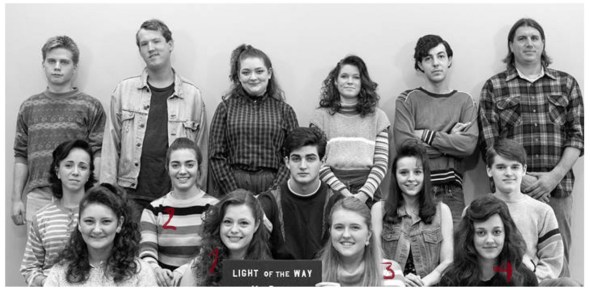
On the far right of the front row is a girl who grew up to be the woman who killed her three children because of Munchhausen by proxy syndrome–the woman whom Rust got to confess and then told her to kill herself. Was she traumatized at that school? Could she have given him some valuable information? Why didn’t Rust follow up on those photos?
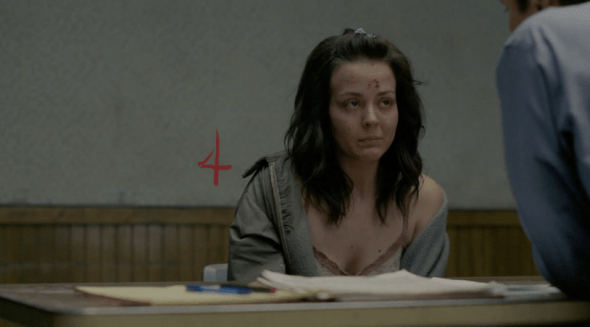
Something to think about while we wait for Sunday night to roll around.
Now it’s your turn. What stories are you following today? Please share your links in the comment thread.
Thursday Reads: 9/11 Memories, Adoption Horror Stories, and Other News
Posted: September 12, 2013 Filed under: Barack Obama, child sexual abuse, children, Crime, Foreign Affairs, morning reads, physical abuse, Russia, Syria, U.S. Politics | Tags: 9/11, Boston, Carri Williams, child pornography, Edward Snowden, foreign adoptions, Glenn Greenwald, Glenna Mueller, Hanna Williams, Larry Williams, Nicole Eason, Oath-Keepers, Pedophilia, Pentagon, Quita Puchella, Randy Winslow, re-homing, Robert Menendez, Vladimir Putin, World Trade Center 22 Comments
Good Morning!!
It’s been cool here in the Boston area for the past few weeks, and then suddenly yesterday on the anniversary of 9/11/2001, the temperature shot up to 97 degrees.Today it’s only supposed to get up to the high 80s. And then we’re back to fall over the weekend. Very strange. You just never know what to expect from the weather these days.
On that day 12 years ago, my parents had rented a house on the beach in Rhode Island for a week. We had been obsessed with ExploreSUP reviews of paddle boards and were trying them out in the water. My sister from Indiana and my brother and sister-in-law from Cambridge were there too. This was before my two nephews were born. It was a beautiful New England day, and I recall it was pretty warm–but not hot.
I was out sight-seeing with my parents and sister when we got the first hints that something was terribly wrong. My sister heard someone say that a plane had hit the World Trade Center in New York. We rushed back to the beach house to horrible scenes of carnage on TV. We spent the rest of our vacation reading newspapers and watching TV for updates. A couple of days later, I had to drive back to Boston where school was starting and I had to teach at Boston University.
Driving up I-95 alone, I felt irrationally frightened, and I kept looking up in the sky for planes, even though I knew all air traffic had been grounded (except for the bin Laden relatives whom the Bush administration allowed to fly out of Boston–creepy!). The fact that the planes that hit the twin towers had flown out of Boston felt like a terrible violation. So even though nothing had happened to me and I was safe, I still had some post-traumatic stress. I guess we all did. For the first time, Americans learned what it feels like to be attacked in our own country. It was a loss of innocence.
Anyway, that’s my 9/11 memory–not very dramatic, but impossible to forget.
President Obama chose to mark the anniversary with a moment of silence on the White House lawn. From The New York Daily News:
Under a perfect blue sky, President Obama stood stock still on the neatly-manicured White House South Lawn and said not a thing.

In a capital where words are weapons, the silence was disarming.
The President, First Lady Michelle Obama, Vice President Biden and Jill Biden had quietly walked out of the glistening white residence to observe a moment of silence on Wednesday, the 12th anniversary of the Sept. 11 attacks.
They were flanked by a military honor guard and White House staff. If you looked toward the South Portico of the nation’s most famous home, a flag was at half-staff.
The two couples held hands as a bell tolled at 8:46 a.m., exactly the moment when the first plane crashed into the World Trade Center. The poignant simplicity was inescapable.
Afterwards, Obama attended a memorial service in front of the Pentagon, at the site where one of the planes had been flown into the building that symbolized America’s military might.
In the news…
I hope you’ll find time to read this important investigative article by Reuters reporter Megan Twohey about Americans who adopt children from foreign countries, then have regrets, and then give their children away to total strangers they meet on the internet. Many of these children end up being abused emotionally, physically and/or sexually. It’s one of the most shocking stories I’ve ever read. Here’s Part One and Part Two. I really can’t do this story justice with excerpts, but here’s the introduction:
KIEL, Wisconsin – Todd and Melissa Puchalla struggled for more than two years to raise Quita, the troubled teenager they’d adopted from Liberia. When they decided to give her up, they found new parents to take her in less than two days – by posting an ad on the Internet.
Nicole and Calvin Eason, an Illinois couple in their 30s, saw the ad and a picture of the smiling 16-year-old. They were eager to take Quita, even though the ad warned that she had been diagnosed with severe health and behavioral problems. In emails, Nicole Eason assured Melissa Puchalla that she could handle the girl….
A few weeks later, on Oct. 4, 2008, the Puchallas drove six hours from their Wisconsin home to Westville, Illinois. The handoff took place at the Country Aire Mobile Home Park, where the Easons lived in a trailer.
No attorneys or child welfare officials came with them. The Puchallas simply signed a notarized statement declaring these virtual strangers to be Quita’s guardians. The visit lasted just a few hours. It was the first and the last time the couples would meet.
I can’t believe such a thing is possible in the U.S., but it turns out most states don’t really regulate what adoptive parents do with their children. Within a few weeks, Melissa Puchalla learned that Quita and her new parents were missing and that Nicole Eason had a troubling history as a mother:
• Child welfare authorities had taken away both of Nicole Eason’s biological children years earlier. After a sheriff’s deputy helped remove the Easons’ second child, a newborn baby boy, the deputy wrote in his report that the “parents have severe psychiatric problems as well with violent tendencies.”
• The Easons each had been accused by children they were babysitting of sexual abuse, police reports show. They say they did nothing wrong, and neither was charged.
• The only official document attesting to their parenting skills – one purportedly drafted by a social worker who had inspected the Easons’ home – was fake, created by the Easons themselves.
On Quita’s first night with the Easons, her new guardians told her to join them in their bed, Quita says today. Nicole slept naked, she says.
In Part Two of the report, Twohey writes about another man whom Melissa Eason partnered with to get access to unwanted adoptive children.
Read the rest of this entry »
Live Blog: The President’s Case for Syria
Posted: September 10, 2013 Filed under: Live Blog, Syria | Tags: Chemical weapons ban, Obama's Case for attacks on Syria, Presidential Politics 36 Comments The issue of what to do with Syria, its civil war, and its brutal dictator’s gas attacks on its innocent citizens is on the US agenda tonight as President Obama takes the case for “narrow” attacks on specific Syrian targets. Can he persuade a war weary nation who has heard this type of case once before? The speech will be carried on TV and the internet live tonight at 9 pm EST.
Some suggested before Speech Reads:
From the National Journal: Whose Reactions to Watch for After the President’s Syria Address with ongoing updates.
President Obama’s big national address on Syria tonight isn’t aimed just at a deeply skeptical American public. It’s also targeted to the members of Congress who could decide the fate of the Obama administration’s actions on Syria, including the request for an authorization of force, if that route is still open.
What those actions could look like is totally in flux as of Tuesday afternoon, with a new report fromThe Wall Street Journal that Syria is not only acknowledging it has chemical weapons for the first time, but also saying it would tell the “United Nations, Russia, and others” where they are located. This development comes a day after Syrian President Bashar al-Assad declared to an American audience that his country has never used such weapons and refused to comment on whether Syria had a stockpile.
With the White House privately starting to believe it may not have the votes for an authorization of force, the administration has spent some of the last day trying to win Republican Senate support for getting a new agreement through Congress, reports National Review‘s Robert Costa. That agreement could be pegged to the diplomatic progress made over the last day, and it could be something we all hear more about tonight.
So far, Obama has given many of his usual staunch opponents a good deal of face time to discuss the possibilities on Syria. Obama and Vice President Joe Biden hosted a group of Republican senators—including Lindsey Graham, Kelly Ayotte, and Saxby Chambliss—for dinner (Italian was served) at the Naval Observatory on Sunday. And a half-dozen Republican lawmakers were granted the attention of White House Chief of Staff Denis McDonough this week.
Obama’s speech will likely be about more than just missiles—specifically, the whirlwind of diplomacy that we’ve seen over the past 24 hours. But how members of Congress take tonight’s speech will go a long way toward deciding just how much room the administration will have to act.
Russian Times: Russian President Vladimir Putin said that Syria’s chemical arms handover will only work if the US and its allies renounce the use of force against Damascus.
“Of course, all of this will only mean anything if the United States and other nations supporting it tell us that they’re giving up their plan to use force against Syria. You can’t really ask Syria, or any other country, to disarm unilaterally while military action against it is being contemplated,” President Putin said on Tuesday.
President Putin said that the matter of bringing Syria’s chemical weapons under international control has long been a subject of discussion by experts and politicians.
Putin confirmed that he and President Barack Obama had “indeed discussed” such a possibility on the sidelines of the G20 summit in St. Petersburg last week.
It was agreed, Putin said, “to instruct Secretary of State [John Kerry] and Foreign Minister [Sergey Lavrov]to work together and see if they can achieve some progress in this regard.”
President Putin’s comments came shortly after the Syrian government said it would agree to place its chemical weapons arsenal under international control.
The Telegraph (UK): Syria, chemical weapons, and the worst day in Western diplomatic history
Think about what will happen if the Russian initiative starts to fly.
Chemical weapons are relatively easy to make and store (and fire), but much harder to dismantle safely. The chemicals themselves are fiendishly dangerous and need to be destroyed with specialist equipment without creating environmental hazards. Plus the explosive part of the
delivery shell needs careful handling. Destroying CW stocks is therefore a complex and expensive operation, even under calm conditions. Both the United States and Russia have both heavily failed to meet internationally agreed deadlines for destroying their massive Cold War legacy chemical weapons stocks.
There is no precedent for attempting anything like this in a country wracked by civil war. It just can’t happen. No Syrian chemical weapons will be destroyed or “handed over” quickly.
Meanwhile any new process of setting up an international monitoring and destruction regime will require painstaking UN and wider negotiation with the Assad regime, thereby giving Assad and his state apparatus a massive boost of renewed confidence and legitimacy. Before long Washington may find itself locked on to implicitly or even explicitly supporting Assad in his civil war as the best chance to get some sort of internationally agreed CW destruction programme delivered in Syria.
Bloomberg: 15 Questions About the Increasingly Crazy Syria Debate
1. Is Kerry a national-security genius, or a guy who says whatever half-baked idea comes to mind, or both?
2. Why are the Russians seemingly so ready to aid Kerry and President Barack Obama by helping relieve Syria of its chemical weapons? Since when is Russia interested in helping the U.S. out of a jam, even if it burnishes its own reputation in the process?
3. Do these early signs that Russia might be interested in making a deal to avert an attack prove that threatening to attack was the right thing to do?
4. Who is making American policy on Syria? Kerry or Obama?
5. Why would Assad give up his chemical weapons? He saw what happened when Libya’s late dictator Muammar Qaddafi gave up his weapons of mass destruction program, which is to say, he lost some of his deterrent power.
6. How do you possibly verify that Assad has given up all of his chemical weapons? The Syrian regime possesses hundreds of tons of these munitions.
7. Does Syria get to keep its biological weapons under this still nonexistent deal?
8. If the U.S. gives up the idea of an attack, would the remaining moderate rebels, so dispirited, start moving toward the al-Qaeda column?
9. How do you secure and transport all of these chemical-weapons components in the midst of a horrifically violent civil war?
10. Even if the theoretical strike was intended to be “unbelievably small,” why would the U.S. tell Syria this?
11. A related question: Who goes to war not to win?
12. Let’s just say that Assad gives up his chemical weapons. Does that mean he gets to kill civilians in more prosaic ways indefinitely? Is that it?
13. If Assad’s behavior is even somewhat analogous to Hitler’s, as administration officials (and surrogates like Senator Harry Reid) are suggesting, then how is it possible to argue for anything other than Assad’s total defeat?
14. At a certain point in this drama, will any of the various Arab countries that want the U.S. to bomb Syria then go do it themselves?
15. How did the U.S. get so bollixed-up by the tin-pot dictator of a second-tier Middle East country?
 Watch Live: President Obama’s Address to the Nation on Syria
Tonight at 9:00 PM ET, President Obama will address the nation from the East Room of the White House.
The President will be speaking about the United States’ response to the Syrian regime’s use of chemical weapons that killed more than 1,400 civilians — including more than 400 children.
You can watch the President’s speech live on WhiteHouse.gov/Syria.
I have to believe that we’re all going to have some different thoughts on all of this. I am still torn.

 peej
peej Carissa
 bostonboomer
 dakinikat
 ecocatwoman
 mablue2
 Mama Lopez
 peggysue22
 quixote
 skydancingguestblogger
 Mona (aka Wonk the Vote)



 Sky Dancing
Recent Comments