
Saturday Reads
Posted: November 23, 2013 Filed under: Afghanistan, China, Foreign Affairs, Great Britain, Iran, morning reads, NSA, National Security Agency, Saudi Arabia, U.S. Politics | Tags: cell phones on airplanes, domestic surveillance, drones, Federal Communications Commission (FCC), John Kerry, Kendric Johnson case, U.S. District Judge William H. Pauley III 45 Comments
Good Morning!!
Amid all the bad news, there’s apparently progress in the negotiations with Iran. The LA Times reported yesterday that a “nuclear deal appears imminent.” Secretary of State John Kerry headed to Geneva, Switzerland yesterday to help out.
After a rocky day Thursday, negotiators appeared for now to have overcome their differences on Iran’s entitlement to enrich uranium and on how to curb progress on a partially built nuclear research reactor that Western powers view as a particular threat.
U.S. Secretary of State John F. Kerry left late Friday for Geneva to help “narrow the differences and move closer to an agreement,” the State Department said. Sergei Lavrov, Russia’s foreign minister, arrived from Moscow early Friday evening, making him the first of the six nations’ ministers to show up for a possible signing ceremony that would end a decade of usually stalemated negotiations….
A deal would be a first-stage agreement that would give Iran temporary relief from the crushing Western sanctions on its economy in exchange for temporary limits on its nuclear program. Many nations fear that Iran, despite its insistence that its program is for peaceful purposes only, is seeking weapons capability with its huge nuclear infrastructure.
This deal would open the way for tough bargaining on a final, comprehensive agreement that would take six months or longer to be reached.
Isn’t it amazing what you can accomplish with a little carrot and stick diplomacy? Too bad Bush and Cheney never tried it.
U.S. negotiators and their counterparts from the United Kingdom, France, Germany, Russia and China have been meeting with the Iranians since Wednesday in an effort to strike an interim deal to delay Iran’s nuclear program while a larger deal is worked out that would prevent the Islamic Republic from obtaining nuclear weapons.
Britain’s Foreign Secretary William Hague spoke of “very difficult negotiations, saying “narrow gaps” remain on the same issues that blocked agreement at the last round earlier this month.
“We’re not here because things are necessarily finished,” Hague told reporters. “We’re here because they’re difficult, and they remain difficult.”
Still, the fact that they are talking is definitely encouraging. In another sign that something is actually happening, the Chinese foreign minister arrived in Geneva today. “Chinese foreign ministry spokesman Hong Lei said Saturday the talks…have reached the final moment.”
For those of you who still use air travel, the FCC is on the verge of making a decision that could make flying infinitely more annoying that it is already. From The Washington Post: FCC sees backlash after proposing to allow in-flight cellphone calls on planes.
The Federal Communications Commission said Thursday that it will consider rules that would allow air travelers to make calls and use their cellular data plans once a plane reaches 10,000 feet. Restrictions would remain for takeoffs and landings.
The proposal, which will be raised at the commission’s meeting next month, has the backing of the agency’s newly appointed chairman. But the idea is bound to be controversial. Within hours of the announcement, consumers flooded the agency with protests.
One FCC commissioner received hundreds of e-mails complaining that the move would lead to unbearable noise pollution, an aide said. Passengers are already crammed into smaller seats and tighter rows, and being forced to listen to one another’s calls would be yet another indignity, they wrote.
A petition quickly went up on the White House Web site Thursday, asking the Obama administration to stop the effort. “This would make an already cranky, uncomfortable travel experience exponentially worse, and as a frequent flier and concerned citizen, I think the administration needs to nip this in the bud,” a resident from Richmond wrote.
Something tells me if this plan goes through, there are going be a lot more air rage incidents in the not-so-friendly skies. But after the uproar, USA Today is reporting that the new FCC commissioner–only three weeks into the job–is backpedaling rapidly.
NEW YORK (AP) — A day after setting off an uproar among travelers opposed to in-flight phone calls, the chairman of the Federal Communications Commission Chairman backtracked, saying he personally isn’t in favor of calls on planes.
The role of the FCC, he added, is to advise if there is a safety issue with using phones on planes. He said there is “no technical reason to prohibit” the use of mobile devices on planes.
“We understand that many passengers would prefer that voice calls not be made on airplanes. I feel that way myself,” chairman Tom Wheeler said in a Friday statement.
The decision to allow calls will ultimately rest with the airlines, Wheeler emphasized.
The Wall Street Journal reports that U.S. District Judge William H. Pauley III “Appears Receptive to Critics of NSA’s Collection of Phone Data.” Back in 1979, the Supreme Court decided that phone records are not private, because we willingly give the information to our telephone company. But now Judge Pauley is questioning that decision based on recent revelations about NSA data collection.
“Doesn’t the information collected here reveal far more?” U.S. District Judge William H. Pauley III asked during a hearing in Manhattan federal court on Friday.
Judge Pauley also questioned whether Congress could authorize the collection when the NSA program’s existence wasn’t widely known among lawmakers.
The hearing stemmed from a lawsuit filed by the American Civil Liberties Union and its New York affiliate days after the program was revealed in news reports that were based on documents provided by former NSA contractor Edward Snowden. The groups argue the bulk collection of records called metadata—which includes the phone numbers people dialed and where they were calling from—violates Americans’ privacy rights, as well as federal law.
The judge issued no immediate ruling and left open the possibility that he could dismiss part of the case, because federal law designates the secretive Foreign Intelligence Surveillance Court as the proper venue for certain national-security issues.
Pauley is a Clinton appointee.
In Pakistan, a protest by about 10,000 people against U.S. drone strikes succeeded in blocking a supply route to and from Afghanistan.
The protest, led by Pakistani politician and cricket star Imran Khan, had more symbolic value than practical impact as there is normally little NATO supply traffic on the road on Saturdays. The blocked route in Khyber Pakhtunkhwa province leads to one of two border crossings used to send supplies overland from Pakistan to neighboring Afghanistan.
Khan, whose Tehreek-e-Insaf party runs the Khyber Pakhtunkhwa government, called on federal officials to take a firmer stance to force the U.S. to end drone attacks and block NATO supplies across the country.
“We will put pressure on America, and our protest will continue if drone attacks are not stopped,” Khan told the protesters.
The demonstrators dispersed after Khan’s speech, but his party put out a statement saying they will begin stopping trucks from carrying NATO supplies through Khyber Pakhtunkhwa indefinitely beginning Sunday night. That could spark a clash with the federal government.
Raw Story has an update in the case of Kendrick Johnson, the 17-year-old whose body was found inside a gym mat in a Valdosta, GA high school.
At least an hour of footage is missing from each of the four surveillance cameras at Kendrick Johnson’s high school, and the original footage showing how the Georgia teenager died might be gone, CNN reported on Thursday.
“Those files are not original files,” forensics video analyst Grant Fredericks told CNN. “They’re not something investigators should rely on for the truth of the video.”
CNN enlisted Fredericks in order to analyze more than 290 hours of video it acquired from Lowndes County High School, where the 17-year-old was found dead in the gym in January. Local officials initially determined that he died from asphyxiation after getting trapped inside a gym mat, an argument his family has rejected. An independent autopsy ordered by the victim’s family found the cause of death to be “unexplained, apparent non-accidental, blunt force trauma.”
But while the Lowndes Public Schools district told CNN the video it provided was “a raw feed with no edits,” Fredericks disagreed, saying it was “altered in a number of ways, primarily in image quality and likely in dropped information, information loss. There are also a number of files that are corrupted because they’ve not been processed correctly and they’re not playable. I can’t say why they were done that way, but they were not done correctly, and they were not done thoroughly. So we’re missing information.”
Specifically, two of the cameras are missing 65 minutes of footage each, while the other two are missing 130 minutes apiece. Another camera outside of the gymnasium has a time stamp 10 minutes behind the ones inside.
It sounds like the cover had to involve someone in the school administration, doesn’t it?
So . . . it’s kind of a slow news day, but I found a few stories for you to talk about. What are you hearing? Did I miss any big news? Please post your links in the comment thread.
Friday Reads: Make Love not War
Posted: April 19, 2013 Filed under: Afghanistan, Anti-War, children, Domestic terrorism, Drone Warfare, Egypt, Foreign Affairs, Great Britain, India, Iraq, Israel, morning reads, Saudi Arabia, Syria | Tags: Bombings Boston, Bombings Cambodia and Laos, Bombings Gaza, bombings India, Bombings Iraq, Bombings Ireland, Bombings London, Bombings Spain, Bombings Syria, gun violence 81 Comments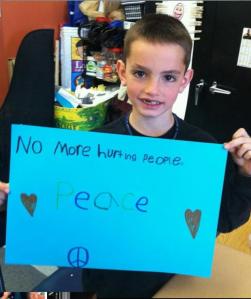 Good Morning!
We certainly have created a lot of ways to destroy each other haven’t we? We also seem to breed a lot of individuals that are capable of doing great harm without reservation. This week has brought the carnage once again into our back yard. It is important to remember that we have brought and are bringing worse carnage and that we are not alone in our experience.
We have sophisticated drones that appear to take out as many innocents as they do bad guys. Just yesterday in Baghdad, a suicide bomber killed 26 in a crowded cafe. Less than a month ago, 2 blasts occurred in a busy shopping district of Hyderabad, India. These twin blasts killed 14 people and injured 119. Seventeen were injured today in Bangalore in a car bomb blast. Neither India or Boston are war zones. Baghdad was not a war zone until we invaded it. We left it to whatever it is today.
Then, there is the daily amount of gun violence in the country. Let me return to Boston for this perspective.
Boston Police Commissioner Edward F. Davis said today that he hopes to cut gun crimes in half this summer during Boston’s most violent months: July and August, when the city typically sees between 37 and 48 shootings each month.
The department’s ranks were boosted as 28 members of the force were promoted and one new officer was named during a ceremony this morning.
Davis said those promotions represent the department’s efforts to fill vacancies in preparation for the summertime.
“We’re going to have a full court press on those months this year,” said Davis. “We’re gonna do a lot of preventive work leading up to those months. There’s gonna be a significant amount of attention paid to the impact players in the city. We want them to put their weapons down.”
Nationally, we experience 88 gun deaths a day. There have been about 3,524 gun deaths in this country since the Sandy Hook Slaughter. As you carefully read that sign made by the youngest victim of the Boston Bombs above, consider this:
… a child in the U.S is about 13 times more likely to be a victim of a firearm-related homicide than children in most other industrialized nations.
Firearms were the third leading cause of injury-related deaths nationwide in 2010, following poisoning and motor vehicle accidents, according to the Centers for Disease Control and Prevention.
For the sake of comparison, in 2010 there were more than twice as many firearms deaths in the U.S. than terrorism-related deaths worldwide.
Then consider how completely ignorant most people are of our violent legacies to other countries. Think of mass murderers of the 20th century, and then read this.
Mr. Kissinger’s most significant historical act was executing Richard Nixon’s orders to conduct the most massive bombing campaign, largely of civilian targets, in world history. He dropped 3.7 million tons of bombs** between January 1969 and January 1973 – nearly twice the two million dropped on all of Europe and the Pacific in World War II. He secretly and illegally devastated villages throughout areas of Cambodia inhabited by a U.S. Embassy-estimated two million people; quadrupled the bombing of Laos and laid waste to the 700-year old civilization on the Plain of Jars; and struck civilian targets throughout North Vietnam – Haiphong harbor, dikes, cities, Bach Mai Hospital – which even Lyndon Johnson had avoided. His aerial slaughter helped kill, wound or make homeless an officially-estimated six million human beings**, mostly civilians who posed no threat whatsoever to U.S. national security and had committed no offense against it.
Sen. Lindsey Graham (R-S.C.), a staunch supporter of the U.S. drone wars, Wednesday become the first government official to put a number on the estimated drone strike death toll.
“We’ve killed 4,700,” Graham said during a speech at a South Carolina rotary club, reported on by the local Easley Patch and flagged by Al Jazeera.
“This is the first time a US official has put a total number on it,” said Micah Zenko, a fellow at the Council on Foreign Relations told Al Jazeera, but Graham’s office stated that the senator was only repeating “the figure that has been publicly reported and disseminated on cable news.” Graham’s figure aligns with estimates from groups included the U.K.-based Bureau of Investigative Journalism (BIJ), which has calculate that between 3,072 and 4,756 people have been killed by U.S. drones in Pakistan, Yemen and Somalia.
Graham’s figure did not distinguish between “combatant” and “civilian” casualties — a distinction which has, in the War on Terror, prompted debate. But the senator did reportedly say, “Sometimes you hit innocent people, and I hate that, but we’re at war, and we’ve taken out some very senior members of al-Qaida.”
I’d like to know why some acts of violence attract so much attention and outrage? Tons of folks have been out in their virtual scooby vans warping into the witch hunt version of Encyclopedia Brown trying to finger the ‘dark skinned’ individuals that could’ve set the bombs on the Boston Marathon route. Have any of these idiots ever looked at the gun death rate in their own town or state? Have they ever concerned the morality of bombing wedding celebrations? Are they still taking Henry Kissinger or Donald Rumsfeld seriously? Have they possibly cracked a paper to find out exactly how many bombings happen on this planet and how many of them we commit? For that matter, why aren’t they looking for guys that look like Timothy McVeigh or Eric Rudolph? Ever been to London and tried to find a trash can?
In London, public trash cans are hard to come by, as they’re an easy receptacle for bombs. Which makes it hard to throw things away properly! Now, the city is going to bring trash cans back, but they’re going to be big, hulking masses, totally bomb-proof and equipped with LCD screens to tell you the days news as you throw away your coffee cup.
Traveling to Europe–especially London–in the 1970s and 1980s included an introduction to basic instructions on what to do if a bomb went off and what to do to avoid being in an area that was likely subject to bombing. There are still Basque separatists bombing Spain. We’re coming up on the anniversary of Bloody Sunday. I was in Europe a lot in 1972 and it was like the year of the bomb over there. But, again, there was Kissinger too. It was the year I learned not to look or sound overly American.
Hundreds of thousands of innocent human beings in Laos, Cambodia and Vietnam were forced to live in holes and caves, like animals. Many tens of thousands were burned alive by the bombs, slowly dying in agony. Others were buried alive, as they gradually suffocated to death when a 500 pound bomb exploded nearby. Most were victims of antipersonnel bombs designed primarily to maim not kill, many of the survivors carrying the metal, jagged or plastic pellets in their bodies for the rest of their lives.
Then, riddle me this. What is the difference between setting bombs on the street filled with crowds, or a bomb in a cafe, or a drone that hits a wedding or having one Texas “Job Creator” callously killing an entire city and a lot of its inhabitants because he just doesn’t want to be bothered with work place safety regulations or say, proper placement of a dangerous plant to start out with? I mean what exactly do you call a guy that runs a business that blows up an entire town and kills–at this point in time–35 people including 10 first responders? (That’s a link to CNN and USA Today so consider it with care.)
It really bothers me that we–as a nation–appear to have selective attention on what kind of violence gets our shock and attention and what kinds of violence we choose to ignore every day, every year, or in the case of the atrocities of Kissinger, every decade or four. We have had some horrific carnage recently. We’ve had children slaughtered in their classroom. We’ve had folks standing on the street celebrating a holiday ending up in hospital with wounds severe enough to warrant the kinds of amputees soldiers need in Afghanistan. This is horrific, but it does not operate in a vacuum or a world where we have done no wrong or where these kinds of events are rare.

Child victim in Gaza
So, call me Debbie Downer and tell me to get my unpatriotic ass out of the country or call me insensitive. I want to see a consistent and strong level of outrage, shock, and trauma displayed for all innocent victims of unspeakable violence. The hometowns of all of these victims should be our hometowns.
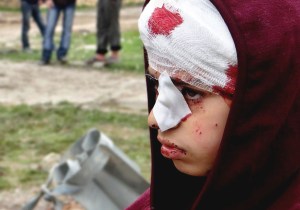
Child victim in Syria
Here is a great question from a great writer, Juan Cole. Can the Boston Bombings increase our Sympathy for Iraq and Syria, for all such Victims?
The idea of three dead, several more critically wounded, and over a 100 injured, merely for running in a marathon (often running for charities or victims of other tragedies) is terrible to contemplate. Our hearts are broken for the victims and their family and friends, for the runners who will not run again.
There is negative energy implicit in such a violent event, and there is potential positive energy to be had from the way that we respond to it. To fight our contemporary pathologies, the tragedy has to be turned to empathy and universal compassion rather than to anger and racial profiling. Whatever sick mind dreamed up this act did not manifest the essence of any large group of people. Terrorists and supremacists represent only themselves, and always harm their own ethnic or religious group along with everyone else.
The negative energies were palpable. Fox News contributor Erik Rush tweeted, “Everybody do the National Security Ankle Grab! Let’s bring more Saudis in without screening them! C’mon!” When asked if he was already scapegoating Muslims, he replied, ““Yes, they’re evil. Let’s kill them all.” Challenged on that, he replied, “Sarcasm, idiot!” What would happen, I wonder, if someone sarcastically asked on Twitter why, whenever there is a bombing in the US, one of the suspects everyone has to consider is white people? I did, mischievously and with Mr. Rush in mind, and was told repeatedly that it wasn’t right to tar all members of a group with the brush of a few. They were so unselfconscious that they didn’t seem to realize that this was what was being done to Muslims!
Indeed, sympathy for Boston’s victims has come from around the world from places like Iraq that we’ve plastered with bombs not that long ago. Condemnation for this act came from elected officials in Egypt from the Muslim Brotherhood which has been absolutely slathered with the mark of satan by the likes of our elected officials like whacko Michelle Bachmann. This part of Cole’s essay really got to me and I was already teary eyed hearing about Jane and Martin Richard from their school’s headmaster on Last Word.
Some Syrians and Iraqis pointed out that many more people died from bombings and other violence in their countries on Monday than did Americans, and that they felt slighted because the major news networks in the West (which are actually global media) more or less ignored their carnage but gave wall to wall coverage of Boston.
Aljazeera English reported on the Iraq bombings, which killed some 46 in several cities, and were likely intended to disrupt next week’s provincial election.
Over the weekend, Syrian regime fighter jets bombed Syrian cities, killing two dozen people, including non-combatants:
What happened in Boston is undeniably important and newsworthy. But so is what happened in Iraq and Syria. It is not the American people’s fault that they have a capitalist news model, where news is often carried on television to sell advertising. The corporations have decided that for the most part, Iraq and Syria aren’t what will attract Nielsen viewers and therefore advertising dollars. Given the global dominance by US news corporations, this decision has an impact on coverage in much of the world.
Here is a video by the United Nations High Commission on Refugees (UNHCR) on the dilemma of the over one million displaced Syrians, half of them children:
So I’d like to turn the complaint on its head. Having experienced the shock and grief of the Boston bombings, cannot we in the US empathize more with Iraqi victims and Syrian victims? Compassion for all is the only way to turn such tragedies toward positive energy.
Perhaps some Americans, in this moment of distress, will be willing to be also distressed over the dreadful conditions in which Syrian refugees are living, and will be willing to go to the aid of Oxfam’s Syria appeal. Some of those Syrians living in refugee camps in Jordan, Lebanon and Turkey were also hit by shrapnel or lost limbs. Perhaps some of us will donate to them in the name of our own Boston Marathon victims of senseless violence.
Terrorism has no nation or religion. But likewise its victims are human beings, precious human beings, who must be the objects of compassion for us all.
It is absolutely true that the shortcomings of our press this week were on parade this week. They basically spent hour-after-hour in what seemed like a glorified witch hunt. But there is a bigger injustice and short coming. Other people around the world–suffering and dying–deserve to have their stories told also. Every innocent victim of violence deserves justice and recognition. This is true of those 88 who die every day in this country from guns. It is true of all those killed by state violence be it ours or Bashar al-Assad or the crazy jerks that set of bombs on streets all over the world or fire military style weapons in our schools and movie theaters. All of this should cause the press to do its job and it should cause our hearts to grieve equally. Why obsess minute by minute on one act when there is a world full of them to choose from? Why not give all of the victims of violence their due?
So, what is on your reading and blogging list today?
SOS Clinton backs “Brave Saudi Women”
Posted: June 21, 2011 Filed under: Foreign Affairs, Hillary Clinton, Saudi Arabia, Women's Rights | Tags: Driving Rights 12 Comments US Secretary of State Hillary Clinton said the U.S. supports the move by Saudi Women to seek the right to drive in the kingdom.
We’ve made clear [to the Saudi government] our views that women everywhere, including women in the kingdom, have the right to make decisions about their lives and their futures,” Clinton said. “They have the right to contribute to society and provide for their children and their families, and mobility such as provided by the freedom to drive provides access to economic opportunity, including jobs, which does fuel growth and stability.”
“What these women are doing is brave and what they are seeking is right, but the effort belongs to them,” said Clinton. “I am moved by it and I support them, but I want to underscore the fact that this is not coming from outside of their country. This is the women themselves, seeking to be recognised.”
The protests have put the Obama administration, and Clinton in particular, in a difficult position. While she and many other top US officials personally oppose the Saudi ban on female drivers, the administration is increasingly reliant on Saudi authorities to provide stability and continuity in the Middle East and Gulf amid uprisings taking place across the Arab world.
Thus, some officials have been reluctant to antagonise the Saudis.
On Monday, a coalition of Saudi activists urged Clinton to support publicly the campaign to end male-only driving in the ultra-conservative Muslim country.
Clinton said on Tuesday that she and other US officials had raised the matter “at the highest level of the Saudi government”.
“We have made clear our views that women everywhere, including women in the kingdom, have the right to make decisions about their lives and their futures,” she said. “They have the right to contribute to society and provide for their children and their families, and mobility, such as provided by the freedom to drive, provides access to economic opportunity, including jobs, which does fuel growth and stability.
“And it’s also important for just day-to-day life, to say nothing of the necessity from time to time to transport children for various needs and sometimes even emergencies,” Clinton said. “We will continue in private and in public to urge all governments to address issues of discrimination and to ensure that women have the equal opportunity to fulfill their own God-given potential.”
Driving as Act of Radical Feminism
Posted: June 17, 2011 Filed under: Foreign Affairs, Saudi Arabia, Women's Rights | Tags: civil disobedience, Saudi Women, wheels of change 19 CommentsToday has been a very special day in Saudi Arabia. Some Saudi women are participating in “Wheels of Change” by driving 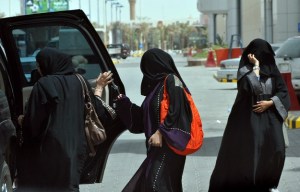 their vehicles as an act of civil disobedience against treatment of women in the nation.
Saudi activists, encouraged by the Arab Spring and by the outlets for expression offered through Facebook and Twitter, declared Friday a day for Saudi women to take to the streets, behind steering wheels.
Saudi Arabia remains perhaps the only country in the world where women are banned from driving — even though no law explicitly bars Saudi women from driving. Saudi leaders from King Abdullah on down have said they believe Saudi women should be allowed to drive.
Inside and outside Saudi Arabia, some tend to see the ban as a frivolous issue — the stereotype being a Saudi woman princess in sunglasses wanting a little independence as she drives to Starbucks for a latte.
Activists and writers like Eman Fahad al Nafjan, a blogger, doctoral student, and mother in Riyadh, call the impact of the ban profound, saying that it limits women’s mobility into female employment and education, despite efforts by King Abdullah to boost both. And in a kingdom that the International Labor Organization says is the only country in the Gulf Cooperation Council with a significant poverty rate, the ban is a drain on the resources of women, forcing many households to pay thousands of dollars a year for drivers, opponents say.
AJ is also reporting on these acts of civil disobedience against one of the most conservative monarchies in the area. This is truly an act of bravery in this country. Saudi Arabia has not yet experienced much civil unrest during the so-called “Arab spring’.
The subject of women driving was as puzzling as every woman-related issue in the tribal, patriarchal, and religious alloy of the Saudi mindset.
Women have driven in rural areas and in some compounds within cities all the time. There were no religious or legal pretexts to prevent women from driving. The opposition came from a group of religious scholars – purportedly for fear of “gender mixing” and anticipated sins – a fallacy that is obviously refuted by the fact that gender mixing is already in effect, whether women are in the back or the front seats of the cars – unless a parallel public world can be created for each sex, an idea which must occupy many scholars’ minds.
This was nothing new; religious views opposing women’s autonomy were the norms of Saudi scholars, fearing changes in the traditional gender roles. And when religious unrest contradicts official plans, the government often acts to keep the clerics in check. Examples are many, such as the beginnings of women’s education half a century ago and the opening of KAUST, the first co-educational university – which cost a known scholar his elevated position at the supreme committee of scholars.
I would like every one here to be aware of the bravery of the people in Saudi Arabia–the women and men–who are trying to bring modernity and women’s rights to what is unquestionably a misogynist society. For more information on the role of social media in this movement, see the BBC’s story here. Many Saudi women are posting videos and stories like the one above.

 peej
peej Carissa
 bostonboomer
 dakinikat
 ecocatwoman
 mablue2
 Mama Lopez
 peggysue22
 quixote
 skydancingguestblogger
 Mona (aka Wonk the Vote)



 Sky Dancing
Recent Comments