
Tuesday Reads: Rachel and Trayvon, Reid Going Nuclear, Spy Stories, and Much More
Posted: July 16, 2013 Filed under: Civil Liberties, Civil Rights, Crime, Criminal Justice System, Foreign Affairs, Lebanon, morning reads, NSA, National Security Agency, Political Affective Disorder, racism, Russia, U.S. Politics | Tags: al Qaida, Alexei Nikitin, Amnesty International, Charles Ramsey, Edward Snowden, Filibuster, George Zimmerman, Harry Reid, Hezbollah, Human Rights Watch, Mitch McConnell, NSA, nuclear option, Piers Morgan, political asylum, Rachel Jeantel, Tanya Lokshina, Trayvon Martin, US Senate, Vladimir Putin 42 Comments
Good Morning!!
I’m not sure if it’s the heat or the depressing news, but I’m having a hard time getting going this morning.
We’re into our third heat wave of the summer, and I’m actually getting acclimated to 90 degree weather; but I suppose it still has an effect on my body and mind.
I’m also somewhat depressed about the Zimmerman verdict and by the often ignorant reactions I see on-line and on TV.
Rachel and Trayvon
One bright spot in the coverage for me was Rachel Jeantel’s interview with Piers Morgan last night. She was real and authentic, and Morgan pretty much stayed out of the way and let her talk. I think she made a real impression on him and the reaction from the live audience was very positive too. It was refreshing. IMO, it says a lot about Travon Martin’s character that he had a friend like Rachel. I’m going to post the whole interview here in case you missed it or you want to watch it again.
From Mediaite:
Asked about what Trayvon Martin was like as a friend, Jeantel described him as a “calm, chill, loving person” and said she never saw him get “aggressive” or “lose his temper.” She said that the defense’s attempts to portray Martin as a “thug” were unfounded and defended his relatively mild drug use. “Weed don’t make him go crazy,” she said, “it just makes him go hungry.”
Jeantel also responded to the massive mockery she received in social media for the way she speaks, explaining that she was born with an under-bite that has made it difficult for her to speak clearly. When Morgan asked if she’d been bullied for her condition, she simply responded, “Look at me,” to laughter from the studio audience.
Morgan attempted to get Jeantel to offer her opinion of defense attorney Don West, who many claimed was condescending towards her when she was on the stand. Jeantel shook her head, declining to say anything bad about the man given her “Christian” upbringing.
In the second part of his interview with Jeantel, Morgan turned to the “creepy-ass cracker” comment she made and the major impact it had on the tenor of the case. She explained that the term is actually spelled “cracka” and defined it as “people who are acting like they’re police.” She said that if Zimmerman had calmly approached Martin and introduced himself, her friend would have politely said what he was doing there and nothing more would have happened.
Unlike the juror, Jeantel did think Zimmerman was racially motivated. “It was racial,” she said. “Let’s be honest, racial. If Trayvon was white and he had a hoodie on, would that happen?”
I’d also like to recommend this piece by Robin D.G. Kelley at Counterpunch: The US v. Trayvon Martin.
In the aftermath of the Sandy Hook Elementary School massacre, Texas Congressman Louie Gohmert, Virginia Governor Bob McDonnell, Senator Rand Paul, Florida State Representative Dennis Baxley (also sponsor of his state’s Stand Your Ground law), along with a host of other Republicans, argued that had the teachers and administrators been armed, those twenty little kids whose lives Adam Lanza stole would be alive today. Of course, they were parroting the National Rifle Association’s talking points. The NRA and the American Legislative Exchange Council (ALEC), the conservative lobbying group responsible for drafting and pushing “Stand Your Ground” laws across the country, insist that an armed citizenry is the only effective defense against imminent threats, assailants, and predators.
But when George Zimmerman fatally shot Trayvon Martin, an unarmed, teenage pedestrian returning home one rainy February evening from a neighborhood convenience store, the NRA went mute. Neither NRA officials nor the pro-gun wing of the Republican Party argued that had Trayvon Martin been armed, he would be alive today. The basic facts are indisputable: Martin was on his way home when Zimmerman began to follow him—first in his SUV, and then on foot. Zimmerman told the police he had been following this “suspicious-looking” young man. Martin knew he was being followed and told his friend, Rachel Jeantel, that the man might be some kind of sexual predator. At some point, Martin and Zimmerman confronted each other, a fight ensued, and in the struggle Zimmerman shot and killed Martin.
Zimmerman pursued Martin. This is a fact. Martin could have run, I suppose, but every black man knows that unless you’re on a field, a track, or a basketball court, running is suspicious and could get you a bullet in the back. The other option was to ask this stranger what he was doing, but confrontations can also be dangerous—especially without witnesses and without a weapon besides a cell phone and his fists. Florida law did not require Martin to retreat, though it is not clear if he had tried to retreat. He did know he was in imminent danger.
Why didn’t Trayvon have a right to stand his ground? Why didn’t his fear for his safety matter? We need to answer these questions as a society. Please read the whole article if you can.
Read the rest of this entry »
Edward Snowden Emerges; Seeks Temporary Asylum in Russia
Posted: July 12, 2013 Filed under: Foreign Affairs, Russia, U.S. Politics | Tags: Edward Snowden, espionage, Genri Reznik, Human Rights Watch, NSA, political asylum, Sarah Harrison, spying, Tanya Lokshina, Vladimir Putin, Wikileaks 78 Comments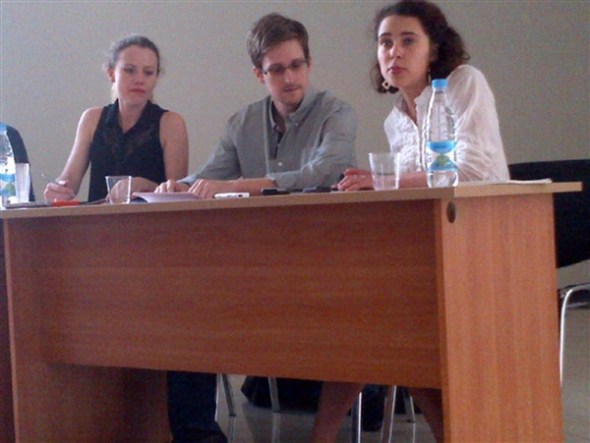
NSA leaker Edward Snowden attends a press conference at Moscow’s Sheremetyevo Airport with Sarah Harrison of WikiLeaks, left, July 12, 2013, in this image provided by Human Rights Watch.
At 5PM (9AM ET) Russian Time, Edward Snowden met with human rights activists and attorneys in Sheremetyevo Airport in Moscow. Afterward he appeared at a press conference alongside Sarah Harrison of Wikileaks and Tanya Lokshina of Human Rights Watch. He announced that he is seeking asylum in Russian until he can arrange to fly to a Latin American country.
Although the meeting was not public, some of those present posted details to Twitter, including Tanya Lokshina of Human Rights Watch who released a handout image that she said was of Snowden (see above).
Lokshina said Snowden would be making an official request to Russia for temporary asylum, adding that his condition was “just fine.”
The move indicates the difficulties facing Snowden, who has been offered asylum by three countries: Venezuela, Bolivia and Ecuador. He is apparently unable to travel to them without entering airspace controlled by the U.S., risking an enforced grounding that would lead to his arrest.
Also among those present at Friday’s meeting was a prominent Russian lawyer, Genri Reznik, who later told reporters: “I think his claim should be satisfied… The law allows for political asylum.
“The values in the constitution of the US and Russia are similar, so I don’t think that there could be a lengthy conflict if Russia grants him asylum.”
Several hours earlier The New York Times had reported on an e-mail which “purported to be” form Snowden asking for the meeting with human rights organizations.
Several prominent human-rights organizations received e-mailed invitations late on Thursday to meet with Mr. Snowden, though they were initially doubtful about the e-mails’ origin.
No invitation was extended to Russian officials, said Dmitri S. Peskov, the Kremlin spokesman. Journalists who asked to be included were told that Mr. Snowden’s team “will be following up with the press shortly afterward.”
Attached to the e-mailed request was a note complaining of U.S. interference with Snowden’s efforts to seek asylum in order to avoid prosecution for stealing and revealing classified information.
The e-mail, signed “Edward Joseph Snowden,” said he had “been extremely fortunate to enjoy and accept many offers of support and asylum from brave countries around the world,” and that he hoped to visit each of them personally to express his thanks. It went on to say that the American government had carried out an “unlawful campaign” to block his asylum bids.
“The scale of threatening behavior is without precedent: never before in history have states conspired to force to the ground a sovereign president’s plane to effect a search for a political refugee,” the note said. “I invite the human rights organizations or other respected individuals addressed to join me on 12 July at 5:00 p.m. at Sheremetyevo Airport in Moscow for a brief statement and discussion regarding the next steps forward in my situation.”
Wikileaks has posted a transcript of Snowden’s statement to the human rights groups. In it he makes clear that he believes he has done the right thing by revealing U.S. espionage methods and targets around the world and says he will accept any and all offers of asylum, and that for now he will apply to stay in Russia.
I announce today my formal acceptance of all offers of support or asylum I have been extended and all others that may be offered in the future. With, for example, the grant of asylum provided by Venezuela’s President Maduro, my asylee status is now formal, and no state has a basis by which to limit or interfere with my right to enjoy that asylum. As we have seen, however, some governments in Western European and North American states have demonstrated a willingness to act outside the law, and this behavior persists today. This unlawful threat makes it impossible for me to travel to Latin America and enjoy the asylum granted there in accordance with our shared rights.
This willingness by powerful states to act extra-legally represents a threat to all of us, and must not be allowed to succeed. Accordingly, I ask for your assistance in requesting guarantees of safe passage from the relevant nations in securing my travel to Latin America, as well as requesting asylum in Russia until such time as these states accede to law and my legal travel is permitted. I will be submitting my request to Russia today, and hope it will be accepted favorably.
The Washington Post questions whether Snowden can meet Vladimir Putin’s terms for allowing him to stay in Russia.
He explained that asylum is the only way he can guarantee his safety to stay in the country, where he’s been since arriving from Hong Kong in late June. “I am only in a position to accept Russia’s offer because of my inability to travel,” he said,according to Lokshina, adding that he ultimately hopes to travel to Latin America, where three countries have offered him asylum.
This puts Snowden in a difficult position: He had previously applied for asylum in Russia but then withdrew his application after Russian President Vladimir Putin said that Snowden could only stay on certain terms. “If he wants to remain here there is one condition – he should stop his work aimed at inflicting damage on our American partners,” Putin announced at a July 1 news conference. That was broadly taken as a condition that Snowden stop leaking classified U.S. information.
Snowden’s earlier decision to withdraw his application for asylum in Russia seemed to suggest that he found Putin’s terms unacceptable. It’s not clear what’s changed, but Snowden seems to have his own interpretation of Putin’s conditions. “He has no problem with Putin’s condition because he does not believe he damaged the United States, or is damaging it,” Lokshina told the Post. Her comments to The New York Times also indicated that Snowden apparently believes his past leaks have not harmed the United States and so not violated Putin’s terms.
So does Snowden assume that he can leak anything that he decides will not be damaging to the U.S.? And what about the data that he has already given to Glenn Greenwald of The Guardian, Barton Gellman of the Washington Post, Der Spiegel , The South China Morning Post, and newspapers in Brazil and Australia? He has also claimed through Greenwald that many individuals around the world have complete copies of the stolen materials. Greenwald himself has stated that Snowden has already completed the leak to The Guardian and that it will be up to them to decide what gets published. According to the Post,
Snowden, or at least the WikiLeaks representative Sarah Harrison who is working with him, might already see hints of these potential contradictions. Snowden asked the attendees at Friday’s Moscow airport meeting to try to intervene with Putin on his behalf, Lokshina told The New York Times.
At least we now know where Snowden is and what his immediate plans are. Now we’ll await Russia’s response.
Tuesday Reads
Posted: July 2, 2013 Filed under: Barack Obama, Egypt, Foreign Affairs, morning reads, Russia, U.S. Politics, Violence against women | Tags: Arizona wildfires, Edward Snowden, firefighters, marijuana-schizophrenia connection, Mohammed Morsi, suicide and schizophrenia 73 Comments Good Morning!!
As the record-breaking heat wave continues in the West, firefighters in Arizona continue to fight the wildfires that killed 19 of their compatriots last night. NBC News reports:
Firefighters battling the Arizona blaze that killed 19 elite colleagues faced a tough task on Tuesday amid an excessive heat warning issued by the National Weather Service. Gusting winds of up to 20 mph threatened to fan the flames near Yarnell, Arizona, and officials were wary about propane tanks known to be in the town of 700 people. The dead firefighters’ colleagues continued to battle the raging blaze that by 9:30 p.m. local time Monday (11:30 p.m. ET) was zero percent contained. More firefighters are expected to join the 500-strong group. As the community began to mourn the loss of the men decribed as “heroes” by President Barack Obama, medical examiners were due to begin carrying out autopsies in the wake of the area’s “largest mass-casualty event in memory.”
The names of the men killed are:
Anthony Rose, 23; Eric Marsh, 43; Robert Caldwell, 23; Clayton Whitted , 28; Scott Norris, 28; Dustin Deford, 24; Sean Misner, 26; Garret Zuppiger, 27; Travis Carter, 31; Grant McKee, 21; Travis Turbyfill, 27; Jesse Steed, 36; Wade Parker, 22; Joe Thurston, 32; William Warneke, 25; and John Percin, 24; Kevin Woyjeck, 21; Chris MacKenzie, 30; and Andrew Ashcraft, 29.
From the Wall Street Journal: Sudden Turn in Flames Doomed Firefighters.
The men, aged between 21 and 43, were members of the Granite Mountain Interagency Hotshot Crew who endured grueling training together before being dispatched to battle wildfires nationwide. Based in Prescott, only 34 miles away from Yarnell, they knew the terrain. But late Sunday afternoon, the firefighters radioed from their positions on the ground that they were in trouble. A short time later, a helicopter pilot reported to the Arizona State Forestry’s dispatch center in Phoenix that firefighters were attempting to shelter themselves west of Yarnell under fire-shelter covers, a heat-resistant specialty fabric made of aluminum foil, woven silica, and fiberglass—their last line of defense. Smoky conditions and heat made it difficult to check on the firefighters. “It felt like forever,” said Carrie Dennett, state fire-prevention officer for Arizona State Forestry. What rescuers eventually found was that the men had been caught in a “burn over,” a sudden change in the direction of the fire that overtook them faster than they could get out of the way, according to a spokesman with the Prescott Fire Department.
Heartbreaking.
Edward Snowden’s search for a country that will grant him asylum continues.
This morning the list of countries he had applied to increased to 21, but so far none has offered to shelter him, according to CBS News. Snowden withdrew his request to Russia after Vladimir Putin said Snowden would have to stop leaking information designed to hurt the U.S.
CBS News correspondent Elizabeth Palmer reports that behind the scenes, the U.S. and Russia have been talking non-stop about how to resolve the Snowden conundrum. President Putin is between a rock and a hard place, explains Palmer; he won’t expel Snowden into U.S. custody, but he hopes to limit the damage to U.S.-Russian relations. With Snowden’s withdrawal of the asylum request to Russia, Palmer says, you could almost hear a sign of relief from the Kremlin. Poland rejected Snowden’s asylum request on Tuesday, and officials in Germany, Norway, Austria, Spain and Switzerland said that he could not apply for asylum from abroad. Many European countries require an asylum request to be made on their soil. Later Tuesday, India’s External Affairs Ministry said it had carefully examined Snowden’s request and decided to turn it down. Ministry spokesman Syed Akbaruddin told reporters the government had “concluded that we see no reason to accede to that request.” Venezuelan President Nicolas Maduro, coincidentally wrapping up a long-planned visit to Moscow, said Tuesday that his government had not yet received an official asylum request from Snowden, but that it would be considered if and when received.
The massive protests continue in Egypt.
From The Washington Post: Egypt protesters step up pressures with president facing military deadline and internal rifts.
CAIRO — With a military deadline for intervention ticking down, protesters seeking the ouster of Egypt’s Islamist president sought Tuesday to push the embattled leader further toward the edge with another massive display of people power. Meanwhile, Mohammed Morsi faced fissures from within after a stunning surge of street rage reminiscent of Egypt’s Arab Spring revolution in 2011 that cleared the way for Morsi’s long-suppressed Muslim Brotherhood to win the first open elections in decades. Three government spokesmen were the latest to quit as part of high-level defections that underscored his increasing isolation and fallout from the ultimatum from Egypt’s powerful armed forces to either find a political solution by Wednesday or the generals would seek their own way to end the political chaos. The Cabinet, led by the Morsi-backed Prime Minister Hesham Qandil, was scheduled to meet later Tuesday. But the defense and interior ministers were expected to boycott in a sign of support for the military’s warnings. The police, which are under control of the Interior Ministry, have stood on the sidelines of the protests, refusing even to protect the offices of the Muslim Brotherhood that have been attacked and ransacked.
President Obama weighed in on the Egyptian situation yesterday. From Bloomberg Businessweek:
President Barack Obama told Mursi in a telephone call yesterday that the U.S. “is committed to the democratic process in Egypt and does not support any single party or group,” according to a White House statement. Obama encouraged Mursi “to take steps to show that he is responsive” to the concerns of demonstrators, stressing “that democracy is about more than elections, it is also about ensuring that the voices of all Egyptians are heard and represented by their government.” During the conversation, Obama “underscored his deep concern about violence” and sexual assaults during the demonstrations and urged Mursi “to make clear to his supporters that all forms of violence are unacceptable,” according to the statement.
In other news,
There’s an interesting article in the Wall Street Journal by Samuel T. Wilkinson on the connection between marijuana and schizophrenia. Years ago the boyfriend of one of my closest friends developed schizophrenia after years of heavy daily pot-smoking. At the time I suspected that there was a connection. He probably had a genetic tendency toward the disease that might not have manifested without the marijuana use. Wilkinson writes:
Recent legislation has permitted the recreational use of marijuana in Colorado and Washington state. Those who support legalization often tout the lack of serious medical consequences associated with the drug. Most of us know people who used marijuana in high school or college and seem to have suffered no significant medical consequences. As the medical and scientific literature continues to accumulate, however, it is becoming clearer that the claim that marijuana is medically harmless is false. There is a significant and consistent relationship between marijuana use and the development of schizophrenia and related disorders. Schizophrenia is considered by psychiatrists to be the most devastating of mental illnesses. Patients who suffer from it often experience auditory or visual hallucinations, severe social withdrawal and cognitive impairment. Many require frequent and prolonged hospitalization in psychiatric wards. Schizophrenia affects almost three million Americans—more than six times the number of people with multiple sclerosis, two and a half times the number of people with Parkinson’s disease, and more than twice the number of people with HIV/AIDS. Less than one-third of patients with schizophrenia can hold a steady job or live independently. A large portion (about one-third) of homeless people in the U.S. suffer from the disease. Though they receive little attention in the legalization debate, the scientific studies showing an association between marijuana use and schizophrenia and other disorders are alarming. A 2004 article in the highly respected British Journal of Psychiatry reviewed four large studies, all of which showed a significant and consistent association between consumption of marijuana (mostly during teenage years or early 20s) and the later development of schizophrenia. The review concluded that marijuana is a “causal component,” among others, in the development of schizophrenia and other psychotic disorders.
I hope everyone will read this article. I don’t think anything is going to stop the legalization of marijuana at this point, but we need to be aware of the dangers of this drug to young people. Schizophrenia is a very serious illness that develops in early adulthood, usually before age 35. It is partly genetic but is usually triggered by some kind of environmental stress. Marijuana use appears to be one possible trigger. A high percentage of people with schizophrenia end up committing suicide.
A large 5-year World Health Organization study consisting of the follow-up of 1056 patients exhibiting psychotic symptoms found the most common cause of death in those with schizophrenia was suicide (Sartorius et al, 1986). In their review of the subject Caldwell and Gottesman (1990) found that 9-13% of patients with schizophrenia eventually commit suicide. At least 20-40% make suicide attempts (Meltzer & Fatemi, 1995) and 1-2% go on to complete in their attempt within the next 12 months (Meltzer & Okayli 1995). Therefore, suicide in schizophrenia has long been a major area of concern and research efforts.
In Denmark, Mortensen and Juel (1993) used the national case register to retrospectively examine mortality in a sample of 9156 patients following their first admission with schizophrenia, and reported 50% of males and 35% of females went on to commit suicide during the 17-year study period, with the relative risk of suicide increasing by 56% over this time. This suggests that the current level of risk is not stable, and is certainly not improving. The devastation that suicide brings for relatives, as well as the immense personal suffering the victim endures, must surely make this one of the most pressing issues for psychiatry to address. Carers and professionals are often left with feelings of profound ineffectualness and guilt in the face of suicide, and so it is vital for clinicians to feel confident in their understanding of risk assessment and management in this particularly vulnerable group.
My friend never recovered significantly; and the last I heard, he continued to have delusions and cognitive distortions. I doubt if he stayed on anti-psychotic medications–that wasn’t his style. He was employed at times and managed to stay in touch with some friends. But he was a completely different person than before he developed the disease. Before, he was a talented musician and earned a living playing in an Irish folk group. He was gregarious and had a many friends. For those of us who knew him, it was as if that person died and someone else took his place.
I’ll end there and turn the floor over to you. What are you reading and blogging about today?
Edward Snowden Issues Bizarre Statement Via Wikileaks
Posted: July 1, 2013 Filed under: Barack Obama, China, Foreign Affairs, NSA, National Security Agency, open thread, Russia, social media, Surreality, U.S. Politics | Tags: Bradley Manning, Edward Snowden, espionage, Thomas Drake, Vladimir Putin, whistleblowers 48 Comments
I’ve been following the endless Edward Snowden soap opera just about non-stop for the past few days. I wish I were capable of writing a reasoned, logically argued post right now, but I’m not. This whole story has just become too crazy. I just can’t guarantee that this post will make a lot of sense, so I’ll just begin by posting Snowden’s statement. I’ve added emphasis to a few passages.
Statement from Edward Snowden in Moscow
Monday July 1, 21:40 UTC
One week ago I left Hong Kong after it became clear that my freedom and safety were under threat for revealing the truth. My continued liberty has been owed to the efforts of friends new and old, family, and others who I have never met and probably never will. I trusted them with my life and they returned that trust with a faith in me for which I will always be thankful.
On Thursday, President Obama declared before the world that he would not permit any diplomatic “wheeling and dealing” over my case. Yet now it is being reported that after promising not to do so, the President ordered his Vice President to pressure the leaders of nations from which I have requested protection to deny my asylum petitions.
This kind of deception from a world leader is not justice, and neither is the extralegal penalty of exile. These are the old, bad tools of political aggression. Their purpose is to frighten, not me, but those who would come after me.
For decades the United States of America have [sic] been one of the strongest defenders of the human right to seek asylum. Sadly, this right, laid out and voted for by the U.S. in Article 14 of the Universal Declaration of Human Rights, is now being rejected by the current government of my country. The Obama administration has now adopted the strategy of using citizenship as a weapon. Although I am convicted of nothing, it has unilaterally revoked my passport, leaving me a stateless person. Without any judicial order, the administration now seeks to stop me exercising a basic right. A right that belongs to everybody. The right to seek asylum.
In the end the Obama administration is not afraid of whistleblowers like me, Bradley Manning or Thomas Drake. We are stateless, imprisoned, or powerless. No, the Obama administration is afraid of you. It is afraid of an informed, angry public demanding the constitutional government it was promised — and it should be.
I am unbowed in my convictions and impressed at the efforts taken by so many.
Edward Joseph Snowden
Monday 1st July 2013
I’m mystified by this statement. Snowden could have stayed here in the U.S. and fought against the government actions that he claims are criminal. He could have followed in the footsteps of Martin Luther King by accepting the consequences of civil disobedience. He would have probably have gotten a great deal of support from the public if he had done so. Instead he chose to flee first to China and then to Russia–two countries with far worse domestic spying and human rights records than the U.S. And now he’s whining about the consequences of his fleeing.
President Obama did not promise not to take any actions to interfere with Snowden’s life. He indicated that he wasn’t going to do something as dramatic as bringing down Snowden’s plane or go to extreme lengths to negotiate with Russia or some other country for his return. Snowden’s naivete is amazing. World leaders engage in deception. Countries spy on each other. When you reveal secret information stolen from your government you are engaging in espionage and you become a spy.
Because neither Snowden nor Glenn Greenwald has a coherent political ideology, neither of them is able to make a clear political argument to define and defend Snowden’s actions in reasonable, logical ways. So what we get is whining from Snowden and defensiveness and trumped up outrage from Greenwald and his followers.
Snowden apparently sees himself as a tragic martyr who should be applauded for “revealing the truth.” He has the gall to compare himself to whistleblowers like Bradley Manning and Thomas Drake who faced the consequences of their actions by pleading guilty to crimes. We don’t know yet what the upshot of Manning’s case will be, but Drake is not “powerless.” He served no jail time, and now he is free to make appearances and share his opinions freely. Furthermore, Snowden hasn’t been exiled. I’m sure he could work out a deal to return to the U.S. and face the music. But he doesn’t seem to think the rules apply to him.
As for Greenwald, he has such tunnel vision that he appears to believe that he can simply state that Snowden is a hero who has revealed the most important secret information in American history–and somehow this is so. Anyone who objects or simply asks mild questions about the “revelations” is an enemy to be dismissed and attacked by legions of Greenwald fans who possess endless reserves of inchoate outrage. As I’ve said before, they remind of the Obot hoards of 2008.
If nothing else, Snowden’s leaks have gotten people talking about what the NSA is doing, although I have no idea if there is serious discussion of the actual content of the leaks outside the of people who closely follow the news and argue with each other on the internet. I have no idea if this episode will end with Americans being more knowledgeable about the government’s domestic spying programs.
The articles written about the leaked documents by Glenn Greenwald at the Guardian and Barton Gellman at the Washington Post have so far been confusing at best. Neither writer seems to have consulted with security and computer experts who could have helped them do a better job of explaining how the NSA programs work. I’ve gotten a much clearer understanding from reading Kurt Eichenwald’s blog at Vanity Fair.
Poor Ed. He’s learning that now that the information is out there, he is no longer that important. Ecuador doesn’t want to deal with him. Even Vladimir Putin has tired of using him to humiliate the Obama administration. Today he announced that Snowden could stay in Russia if he stopped leaking information designed to hurt the U.S.
Glenn Greenwald has also washed his hands of Snowden. Shortly after Putin made that announcement, Greenwald tweeted that “Snowden’s leak is basically done. It’s newspapers – not Snowden – deciding what gets disclosed and in what sequence.” Apparently Glenn is finished with Snowden too. That must have felt like a dagger through poor Ed’s heart.
We’ve learned that Snowden sent copies of the documents he stole to “many different people around the world,” so that he could continue to control the information. But it appears that someone–perhaps Wikileaks–must have all of it now, and Julian Assange has also said that nothing will stop publication of all of Snowden’s files now.
Snowden has become an object of pity at this point. And his whining about his situation isn’t going to help him look like a “hero.” He made the choice to leave his family, his home, and his girlfriend and run away from the consequences of his actions. President Obama did not do that to him.
Please discuss, or use this as an open thread.
Tuesday Reads: Most Classless SCOTUS Justice, Ongoing Snowden Saga, and Other News
Posted: June 25, 2013 Filed under: Barack Obama, China, Foreign Affairs, morning reads, Russia, U.S. Politics, Women's Rights | Tags: Climate change, Dana Millbank, Edward Snowden, Garrett Epps, Jacob Zuma, middle school antics, Nelson Mandela, Racism, Ruth Bader Ginsburg, Samuel Alito, Sexism, University of Texas Southwestern Medical Center v. Nassar, Vance v. Ball State University 77 Comments
Good Morning!!
I’m enjoying some nice fresh air this morning after thunderstorms during the night. It looks as if the mini-heat wave we’ve been having here in the Boston area isn’t going to be as quite bad as originally predicted. It it supposed to be several degrees cooler than expected today and tomorrow and then we’re back to high 70’s temps. I hope that turns out to be right.
Unfortunately, because of this refreshing change in the air here, I slept longer than I should have and this post will go up a little bit late.
If there were a competition for “most classless supreme court justice,” there would be some serious competition among Antonin Scalia, Clarence Thomas, and Samuel Alito; but I think in the end the first prize would have to go to Samuel Alito. Clarence Thomas at least has the grace to remain silent and Scalia supposedly can be funny at times. But Alito is just an immature, obnoxious disgrace, as he demonstrated at the State of the Union Address in 2010 when President Obama denounced the Citizens United decision.
Yesterday Alito used childish, offensive body language to publicly mock his senior colleague Justice Ruth Bader Ginsburg as she read a dissenting opinion to a SCOTUS decision that will make it more difficult for employees to sue for sexual or racial discrimination. From Dana Millbank at The Washington Post:
The most remarkable thing about the Supreme Court’s opinions announced Monday was not what the justices wrote or said. It was what Samuel Alito did.
The associate justice, a George W. Bush appointee, read two opinions, both 5-4 decisions that split the court along its usual right-left divide. But Alito didn’t stop there. When Justice Ruth Bader Ginsburg read her dissent from the bench, Alito visibly mocked his colleague.
Ginsburg, the second woman to serve on the high court, was making her argument about how the majority opinion made it easier for sexual harassment to occur in the workplace when Alito, seated immediately to Ginsburg’s left, shook his head from side to side in disagreement, rolled his eyes and looked at the ceiling.
His treatment of the 80-year-old Ginsburg, 17 years his elder and with 13 years more seniority, was a curious display of judicial temperament or, more accurately, judicial intemperance. Typically, justices state their differences in words — and Alito, as it happens, had just spoken several hundred of his own from the bench. But he frequently supplements words with middle-school gestures.
Millbank goes on the describe Alito’s similar treatment of female Justices Elena Kagan and Sonia Sotomayor a few days earlier. Read about it at the link.
Garrett Epps provides more detail at The Atlantic: Justice Alito’s Inexcusable Rudeness.
I am glad the nation did not see first-hand Justice Samuel Alito’s display of rudeness to his senior colleague, Justice Ruth Bader Ginsburg. Because Alito’s mini-tantrum was silent, it will not be recorded in transcript or audio; but it was clear to all with eyes, and brought gasps from more than one person in the audience.
The episode occurred when Ginsburg read from the bench her dissent in two employment discrimination cases decided Monday, Vance v. Ball State University and University of Texas Southwestern Medical Center v. Nassar. In both cases, the Court majority made it harder for plaintiffs to prevail on claims of racial and sexual discrimination. The Nassar opinion raises the level of proof required to establish that employers have “retaliated” against employees by firing or demoting them after they complain about discrimination; Vance limits the definition of “supervisor” on the job, making it harder for employees harassed by those with limited but real authority over them to sue the employers.
The Vance opinion is by Alito, and as he summarized the opinion from the bench he seemed to be at great pains to show that the dissent (which of course no one in the courtroom had yet seen) was wrong in its critique. That’s not unusual in a written opinion; more commonly, however, bench summaries simply lay out the majority’s rationale and mention only that there was a dissent. (Kennedy’s Nassar summary followed the latter model.)
After both opinions had been read, Ginsburg read aloud a summary of her joint dissent in the two cases. She critiqued the Vance opinion by laying out a “hypothetical” (clearly drawn from a real case) in which a female worker on a road crew is subjected to humiliations by the “lead worker,” who directs the crew’s daily operation but cannot fire or demote those working with him. TheVance opinion, she suggested, would leave the female worker without a remedy.
At this point, Alito pursed his lips, rolled his eyes to the ceiling, and shook his head “no.” He looked for all the world like Sean Penn as Jeff Spicoli in Fast Times at Ridgemont High, signaling to the homies his contempt for Ray Walston as the bothersome history teacher, Mr. Hand.
I guess I should be grateful that I’m old enough to recall the Warren Court. We won’t see a SCOTUS like that again in my lifetime, I’m afraid.
Of course the news is still being dominated by Edward Snowden, who once claimed he didn’t want the story of his leaks of classified information from NSA to be about him. “Really?” writes Dan Murphy of The Christian Science Monitor. “But if that were true, we probably wouldn’t even know his name.”
Two weeks ago, Edward Snowden gave The Guardian permission to disclose that he was the leaker of documents from the US National Security Agency.
“I don’t want public attention because I don’t want the story to be about me,” the former NSA contractor said then. “I want it to be about what the US government is doing.”
If that was really his desire, he’s certainly gone about it in a funny way. From that day, every step he’s taken couldn’t have been better calculated to draw attention to himself. Over the weekend he even turned the media dial up when he fled from Hong Kong to the loving bosom of Mother Russia.
And with the assistance of Julian Assange, Mr. Snowden’s “where’s Waldo” saga is turning into aWikiLeaks production.
Mr. Assange, founder of WikiLeaks, has staked out a consistently anti-American and techno-libertarian position in the past few years. The US government is motivated by malice and power lust in his worldview, its rivals like Russia (where state-owned broadcaster RT ran a show of Assange’s) get a free pass, and secrecyis an evil in and of itself. Though he presents himself as a champion of free-speech, Assange has sought refuge in the Embassy of Ecuador in London, never mind that the country has a poor and deteriorating record on freedom of speech. The Committee to Protect Journalists listed Ecuador and Russia as two of the 10 worst places to be a journalist in the world past year.
Read the rest at CSM.
Meanwhile, Russia and China are pushing back against U.S. criticism of their refusal to help the U.S. extradite Snowden. From The Washington Post:
MOSCOW— Russia and China on Tuesday rejected U.S. criticism of their roles in the legal drama surrounding Edward Snowden, saying their governments complied with the law and did not illegally assist the former government contractor charged with revealing classified information about secret U.S. surveillance programs.
Snowden, 30, has not been seen in public since he reportedly arrived in Moscow on Sunday, after slipping out of Hong Kong. Secretary of State John F. Kerry on Monday strongly urged Russian officials to transfer Snowden to U.S. custody. “We think it’s very important in terms of our relationship,” Kerry said. “We think it’s very important in terms of rule of law.”
But Russian Foreign Minister Sergei Lavrov said Snowden had not actually crossed into Russian territory, apparently remaining in a secure transit zone inside the airport or in an area controlled by foreign diplomats. Moscow therefore has had no jurisdiction over his movements, Lavrov said, and has no legal right to turn him over to U.S. authorities.
It sounds like Snowden could still be in some VIP lounge at the Moscow Airport, but no one knows for sure. One witness told Reuters that Snowden did in fact arrive there yesterday. If he is in the airport, Russia can claim that Snowden technically never stepped on Russian soil.
In other news, Nelson Mandela is in critical condition for the second day, according to President Jacob Zuma.
Mr. Zuma said that he and Cyril Ramaphosa, the deputy president of the governing African National Congress, visited Mr. Mandela late Sunday.
“Given the hour, he was already asleep. We were there, looked at him, saw him and then we had a bit of a discussion with the doctors and his wife,” Mr. Zuma said. “I don’t think I’m in a position to give further details. I’m not a doctor.”
Doctors told Mr. Zuma on Sunday evening that Mr. Mandela’s health “had become critical over the past 24 hours,” according to an earlier statement from the presidency.
In the statement on Sunday, Mr. Zuma said that doctors were doing “everything possible to get his condition to improve and are ensuring that Madiba is well looked after and is comfortable.” Madiba is Mr. Mandela’s clan name.
The Telegraph reports that Mandela’s close relatives “have gathered at his rural homestead to discuss the failing health of the South African anti-apartheid icon who was fighting for his life in hospital.”
From NPR, President Obama today plans To Lay Out Broad Plan To Address Climate Change.
President Obama is expected to announce a sweeping plan to address climate change this afternoon.
The president has framed this issue as a moral responsibility, to leave the Earth in good shape for generations to come. But the nitty-gritty of any serious plan to address this problem is also a challenge, because it means gradually moving away from fossil fuels to renewable energy supplies — and that means there will be economic winners and losers.
Winners include companies that produce clean energy — wind, solar and geothermal energy. That energy will be more in demand, and the administration intends to expand access to public lands, where companies can build windmills and solar facilities.
Public health is also a winner, because the plan would pressure coal-fired power plants to reduce their emissions. Those plants not only produce carbon dioxide, but they are major sources of mercury, radioactive particles and chemicals that contribute to asthma.
The losers will be coal companies and the miners they employ as well as millions of Americans who can’t afford to pay higher electric bills. You can read the entire plan at the NPR link. More detail in this story at CNN. And at Business Insider, Josh Barro lists 3 Reasons Obama’s Carbon Plan Is The Best Solution Right Now
Today should be another busy news day with the ongoing Snowden saga, the President’s climate initiatives, the continuing Whitey Bulger and George Zimmerman trials, and more important SCOTUS decisions. If it gets hot here again this afternoon, I’ll have something to distract me at least. I’ll try to post an afternoon update.

 peej
peej Carissa
 bostonboomer
 dakinikat
 ecocatwoman
 jjlo
jjlo mablue2
 Mama Lopez
 peggysue22
 quixote
 skydancingguestblogger
 Mona (aka Wonk the Vote)



 Sky Dancing
Recent Comments