
Monday Reads
Posted: May 28, 2012 Filed under: Foreign Affairs, Fox News, Mitt Romney, morning reads, Republican presidential politics, Syria, The DNC, U.S. Politics | Tags: "the vision thing", Barack Obama, Bob Shieffer, cell phones, Cory Booker, Ed Gillespie, feckless, headphones, Jack Kerouac, John McCain, Mitch Daniels, NPR, On The Road, Richard Lugar, Rudy Giuliani, Scott Walker, smart phones, U.N. Security Council, Wisconsin recall election 24 Comments
Good Morning!!
I’m filling in for Dakinikat today, while she wends her way back down to New Orleans after her daughter’s great big Bollywood wedding. It’s another very slow news day today, but I’ve tried to dig up some interesting reads for you anyway.
The U.N. Security Council has condemned Syria’s government for the Houla massacre.
An emergency council meeting in New York on Sunday accused President Bashar al-Assad’s forces of unleashing havoc in the town, calling the bombardment of residential areas “an outrageous use of force” which violated international law.
“The security council condemned in the strongest possible terms the killings, confirmed by United Nations observers, of dozens of men, women and children and the wounding of hundreds more … in attacks that involved a series of government artillery and tank shellings on a residential neighbourhood,” the non-binding statement said.
Russia, which has resisted previous western-led condemnations of its Damascus ally, signed up to the declaration, signalling the extent of revulsion over images of infant corpses lined side by side after Friday’s slaughter, one of the worst incidents in the 14-month conflict.
You probably heard that John McCain, who for mysterious reasons is a permanent fixture on the Sunday talk shows even though he’s wrong about everything, has called Obama’s foreign policy and especially his caution on Syria “feckless.” The Villagers really love that word for some reason….why not just say “irresponsible” or “lazy”? Those are some of the definitions of the word.
On the other hand, outgoing Indiana Senator Richard Lugar, who is a lot more thoughtful than McCain, thinks Obama is right to be cautious on Syria. From TPM:
“I think that he has been very cautions. And I think that he’s cautions because he’s in the process of withdrawing our troops along with NATO from Afghanistan, pivoting our policy toward China and the east, more toward a situation of using robots – the ability to not to have to send in troops. It’s a difficult situation. So when you talk about Syria, and you talk about troops or intervention, the president has been very cautious. I think properly so.”
Also on the Sunday shows, Bob Shieffer asked Romney adviser Ed Gillespie why Mitt won’t appear anywhere except Fox News. Gillespie responded that Romney meet with “some schoolchildren last week.” Shieffer said, “I know schoolchildren are happy to see him.”
Good one, Bob!
On Candy Crowley’s show Rudy Giuliani was supposed to be playing surrogate for Romney and pulled a Cory Booker. Giuliani began by announcing that Romney is “the perfect choice” and then proceeded to “trash” Romney’s Massachusetts record while “explaining” his trashing of Romney back in 2008.
“Well, I mean, there’s a certain amount of personal ego in that — at that point, I was probably comparing his record to my record,” he said about his dings at Romney. “And maybe it was circumstances or whatever, but I had massive reductions in unemployment. He had a reduction in unemployment of about 8,10 percent — I think it was 15 percent. I had a reduction of unemployment of 50 percent. He had a growth of jobs of about 40,000; we had a growth of jobs of about 500,000. So I was comparing what I thought was my far superior record to his otherwise decent record. … That’s all part of campaigning.”
But, he added, Romney is much better than President Barack Obama.
I guess it’s still not quite as bad as the “endorsement” Romney got from Mitch Daniels.
Politico has a somewhat long piece for them on why Republicans are afraid that Romney “lacks the ‘vision thing'” For example:
“At the end of the day, you can’t just be all, you know, anti-Obama,” said former Ohio Secretary of State Ken Blackwell, whose state is key to Romney’s chances. “It has to be, I think, two parts that and one part here’s the antidote, here’s the vision, here’s the path that I would like to lead America down.”
And GOP strategist Mark McKinnon — who advised former two-term Republican president George W. Bush — said it’s time for Romney to outline his agenda.
“It’s important to establish the problem when you are a challenger because you are asking voters to fire the incumbent. So, Romney has to file his grievances,” McKinnon said. “But at some point he has to show that he has a vision of a better way. He can’t just say ‘The future is bleak, follow me.’ Because no one will.”
That sounds a little bit like the “advice” Mitch Daniels gave to Mitt. Sadly, Mitt has no vision for a better way. He just wants to be King so he can order everyone around and fire people when he feels like it.
I’ve been so focused on politics for the past several years that I’ve somewhat lost touch with popular culture. So it came as a shock to me today when reading an article about the Cannes Film Festival that one of the movies being shown there is an adaptation of Jack Kerouac’s On The Road. I knew instantly it would be horrible. Every Kerouac adaptation has been.
I used to be fascinated by Kerouac. I was on the Lowell, MA, Kerouac Festival Board for a few years, I’ve done two major research projects on Kerouac’s life and work, one of which I presented at at academic conference. I’ve read everything Kerouac has written, including his letters. I will never see this film, because I don’t want the book ruined for me. Trust me on this, just read the book if you haven’t already, and skip the movie.
The Washington Post has a piece on the Wisconsin recall election which is coming up on June 5: Scott Walker’s fate will have November implications.
Walker made national headlines last year when he eliminated most collective-bargaining rights for public employee unions, triggering huge protests. The fight put friends, neighbors and family members on opposite sides and left the state as polarized as any in the nation. It will culminate in next month’s recall election, only the third for a sitting governor in U.S. history.
The Democrats need to get off their butts and into Wisconsin soon or Walker is going to win. That would be disastrous, and would likely put the state in play for Romney in November. Wisconsin Democrats have been begging for help from the DNC, and it has been slow in coming.
I recently heard an interesting interview on NPR about Lulu DeCarrone, a coffee shop owner who decided to pull the plug on WiFi in her shop. She suddenly realized that her customers were sitting alone at tables for hours just staring at their computers and not talking. No one was having fun anymore and Lulu wasn’t making much money either. Quoting her:
It happened around three or four years ago. One afternoon, I was standing behind the counter and I allowed laptops for a while. And there were four tables, and four people sitting with laptops there. And I remember thinking, “This is like a crypt. I don’t like the feel of it.” Well, two ladies came in a little bit later and they were having such a good time. They were old friends, they haven’t seen each other in a long time and they were laughing and just carrying on. And the people who were sitting on the laptops kept glaring at them. And I made the decision right then and there. I thought I would rather lose my business and sell pencils out of a hat in front of the British Art Museum, than have this atmosphere in my store….
I thought, “Oh my God, maybe no one will come. Maybe I’ll lose it.” And I swear to you, that I was willing to do that. But it worked in reverse. I am the absolute opposite of what Starbucks does, and I’m very happy about it.
It’s become like Mecca for people who are disgusted. I never expected this. This has blown my mind; I never thought that would happen. I get compliments every single day. So I think that’s what it’s given me: Not a big bank account, certainly not driving a fancy car — but it has given me something that’s much harder to get, joy.
I’m no Luddite, but I have to admit, I do get disgusted sometimes the way gadgets have taken over and replaced socializing in public. When I was teaching at a large university, it was rare to see a student who wasn’t either listening to music on headphones, talking on the phone, or texting. They were completely out of touch with whatever was happening in their surroundings in the present moment. And so I also enjoyed this piece at the WaPo on people who ruin things for everyone around them by talking loudly on their cell phones. Here’s a sample:
I love taking the train and typically enjoy the ride. It can be so peaceful, and you don’t have the stress that comes with flying. But if I don’t get a seat in the “quiet car” that Amtrak has designated for those us who want peace, I’m privy to some conversations that should only be conducted in private.
I understand the occasional short conversation to let someone know when to pick you up or that the train is running late, but people are holding long and involved conversations, often about inane stuff. Businessmen are barking orders or, in one case I overheard, holding a conference call. I really don’t want to know your business.
On a recent Amtrak trip, a woman sat next to me and made a call to her friend who, I learned, was afraid she had a sexually transmitted disease. Thankfully, another seat opened up and the woman moved. But I could still hear her describing the test for the disease.
And have you noticed that many people seem to have no compunction about making you wait while they take calls? Why not just call the person back later and talk to the person you’re with?
OK, that’s all I’ve got. What are your recommended links for today?
Dead Silence from Mitt Romney on Chen Guangcheng’s Arrival in U.S.
Posted: May 21, 2012 Filed under: 2012 presidential campaign, China, Foreign Affairs, Human Rights, U.S. Politics | Tags: Chen Guangcheng, diplomacy, Hillary Clinton, Mitt Romney, State Department 31 Comments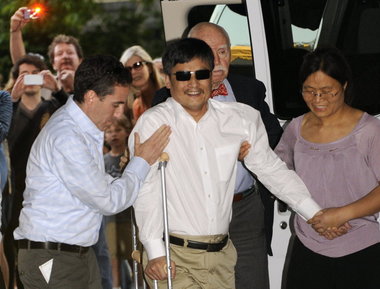
It’s been a couple of days now since blind Chinese activist Chen Guangcheng arrived at Newark on a flight from Beijing. Mitt Romney must have heard about it, but he’s said nary a word about it. I wonder why?
He had plenty to say back on May 3, in the midst of the crisis that took place during Secretary Clinton’s trip to China. Chen had managed to escape from house arrest and make it to the U.S. Embassy to ask for assistance. As State Department and U.S. Embassy staff struggled to negotiate an exit strategy for Chen, Romney, the all-but-official Republican nominee:
condemned the Obama administration’s handling of blind Chinese dissident Chen Guangcheng, calling the episode “a dark day for freedom” and “a day of shame” for President Obama if, he couched, reports are true that American officials communicated threats to Chen’s family….
Several times on Thursday, Romney couched his comments with disclaimers like “if the reports are true,” but the takeaway was clearly intended that the incident is a black eye for President Barack Obama, Secretary of State Hillary Clinton and Treasury Secretary Timothy Geithner.
Despite Romney’s impulsive catastrophizing, Secretary of State Clinton calmly continued her efforts to help Chen and his family get to the U.S. in a way that would also save face for Chinese officials. Chen was offered a law fellowship at New York University and a deal was struck: Chen could leave China on a student visa, and his departure wouldn’t be characterized as seeking asylum.
On May 9 in New Delhi, Clinton told an interviewer:
that the work she and others have done to establish multiple channels for dialogue over the last 3 1/2 years “created a level of personal relationships and understandings between individuals and our government institutions that is absolutely critical.”
Clinton suggested that China’s willingness to agree to a U.S. proposal to assist a prominent critic of the government’s one-child policy is an indication that taking a broader view of the relationship pays dividends in a moment of crisis.
“I’ve invested a lot and argued strongly” for keeping regular channels of communication open so that no one issue “predominates or undermines the potential for reaching agreement on other equally important issues,” the top U.S. diplomat told Bloomberg Radio.
This was a triumph for negotiation as opposed to the kinds of macho chest-pounding that Romney has been preaching so far.
Declining to comment on how the U.S. managed to craft a deal this time in a sensitive case involving a Chinese activist, Clinton said that “every high-level Chinese official that I met” last week “repeated back to me” words from a speech she delivered in Washington reflecting on Sino-U.S. relations in the 40 years since President Richard Nixon’s historic outreach to communist China.
Chinese officials, she said, echoed her view that “what we are trying to do — the U.S. and China — is unprecedented in world history. We’re trying to find a way for an established power and a rising power to coexist.”
Last night, Cheryl Isaac wrote at Forbes:
Chen posed a great challenge for Hillary Clinton because of two competing issues: the economic dialogue in Beijing had been her priority for a couple of years, her pledge to protect human rights—women’s rights nonetheless—another priority.
The confusion of the negotiation process did not help either. After escaping house arrest and seeking refuge at the American Embassy, Chen first decided to stay in China. Then later, he pleaded to be taken to America—putting Clinton in the difficult place of having to renegotiate an agreement that had been reached 24 hours prior; reports the Daily Beast’s Howard Kurtz.
People around the world stated their displeasure. In the U.S., she had Congressman Chris Smith (R-NJ) stating that Clinton did not keep Chen safe within the U.S. Embassy. In this video interview, Smith even admits to telling Chen—in a phone conversation—that the fact that officials were working day and night on his paperwork, was not a good sign…”
But Hillary pushed onward, made the right decisions, and was successful in her goal of helping Chen and his family.
Bravo, Madam Secretary! Where are macho Mitt’s congratulations? Has he apologized yet? I’ve googled, but can’t find any evidence that he has owned up to his bungling or even acknowledged this diplomatic achievement. Why am I not surprised?
Live Blog: Chen Guangcheng Makes Phone Call to Congressional Hearing to Ask for Hillary’s Help
Posted: May 3, 2012 Filed under: China, Foreign Affairs, Live Blog, U.S. Politics | Tags: Chen Guangcheng, Congress, foreign policy, Hillary Clinton, Human Rights, Mitt Romney, Obama Administration 45 Comments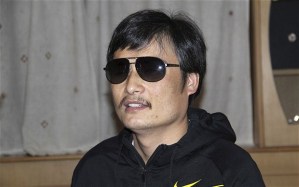
Chen Guangcheng
A short time ago, activist Chen Guangcheng made a direct call from his hospital room to a Congressional Hearing on China.
Calling in to the Congressional Executive Commission on China, dissident Chen Guangcheng told lawmakers he is concerned for the safety of his family and he wants to thank Secretary of State Hillary Clinton for her efforts to help him over the past few days.
“I hope I can get more help from her,” he said over speakerphone to the two Republican lawmakers who were present.
The 40-year-old lawyer became famous last week after had taken refuge in the U.S. embassy after escaping more than a year and a half of house arrest. In a deal between the U.S. and China, Chen was then released to a Chinese hospital and is now under Chinese control. Chen initially said he wanted to stay in China but shortly after leaving the embassy he changed his mind.
“The thing I (am) most concerned (about) right now is the safety of my mother, my brothers, and I really want to know what’s going on with them,” Chen said through a translator at Thursday’s congressional hearing.
Chen said he wanted to come to the United States for some “rest,” because he has not rested for 10 years.
I’ve highlighted the portions of the article that refer to Hillary. It sounds to me as if Chen does trust Hillary. Maybe I’m naive, but I don’t see why he would be specifically asking for her help if he did not.
There is a lot of news breaking on this story, so I thought I’d put it up as a live blog so we could discuss what’s happening in China right now. I haven’t been following the story closely, but it appears to me that some very delicate negotiations are probably going on behind the scenes.
I really don’t think it’s helpful for Mitt Romney and Republican lawmakers who have no way of knowing what is really happening to be attacking the Obama administration in the midst of a human rights crisis. Hasn’t there always been tradition of the other party stepping back in situations like this and waiting for the outcome before attacking? Maybe I’m wrong, but I don’t think I’ve ever seen anything like it.
Here is what Mitt Romney had to say earlier this afternoon.
Romney, in a speech in Portsmouth, accused the administration of seeking to hasten Chen’s departure from the embassy placing economic concerns above Chen’s freedom.
“The reports are, if they are accurate, that our administration, willingly or unwittingly communicated to Chen an implicit threat to his family, and also probably sped up, or may have sped up the process of his decision to leave the embassy because they wanted to move on to a series of discussions that Mr. Geithner and our secretary of state are planning to have with China,” Romney said.
“It’s also apparent according to these reports, if they are accurate, that our embassy failed to put in place the kind of verifiable measures that would ensure the safety of Mr. Chen and his family,” Romney added. “If these reports are true, this is a dark day for freedom. And it’s a day of shame for the Obama administration. We are a place of freedom here and around the world, and we should stand up and defend freedom wherever it is under attack.”
So far, I haven’t been able to find any evidence that Hillary pushed Chen to leave the U.S. Embassy. I’ve read that he wanted to leave because he found out that his wife had been beaten. From the Guardian UK
The activist, who is blind, left the US embassy in Beijing after agreeing to a deal allowing him to stay in China and study law at university, with reassurances from authorities.
But it appears he changed his mind after being reunited with his wife, Yuan Weijing, and their children at the hospital, talking to friends about the risks, and learning from Yuan about apparent threats made by local officials in the eastern province of Shandong, where the family lived under a brutal regime of illegal house arrest for 19 months prior to his escape.
So Chen learned about the threats to his family after he got to the hospital and talked to his wife. He didn’t learn this from U.S. officials while he was in the Embassy. So why is Romney saying that? IMHO, it is totally inappropriate for any politician of any party to be making public statements in the midst of an international crisis. If Republicans have concerns about the situation, they should be working behind the scenes, not attacking the very people who are trying to help Chen.
Later in article the guardian reports that on Wednesday night State Department spokesperson Victoria Nuland:
said in a statement that no US official spoke to Chen about physical or legal threats to his family and nor did the Chinese relay any such threats to American diplomats.
She added that Chen had expressed his desire to stay in China throughout talks.
But she confirmed US officials had passed on the Chinese warning that his family would be returned to Shandong if he stayed at the embassy.
“The problem is not that they relayed it to him – as they should have done – but that it should have raised alarm bells. You have to conclude that if the authorities were ready to play these games they were probably not ready to guarantee his safety,” said Nicholas Bequelin of Human Rights Watch.
Gary Locke, the US ambassador, told reporters he could say unequivocally that Chen was never pressured to leave the embassy.
Even if the State Department erred, I think it is wrong for Romney to be attacking the administration in the middle of tense and delicate negotiations taking place on the other side of the world.
What do you think? I’m continuing to read about this case and will add more links in the comments.
Thursday Reads
Posted: May 3, 2012 Filed under: 2012 presidential campaign, Barack Obama, China, Foreign Affairs, Hillary Clinton, just because, Mitt Romney, morning reads, U.S. Economy, U.S. Politics, War on Women | Tags: creativity and mental illness, defense mechanisms, Edvard Munch, gay Republcan men, psychology, reaction formation, roots of homophobia 61 Comments
Good Morning!!
Last night JJ posted about the sale of Edvard Munch’s The Scream for nearly $120 million. Even Mitt Romney probably couldn’t have afforded it! Somehow I don’t see him as much of an art lover though…
I’ve always been fascinated by the connections between creativity and mental illness. When I took Cognitive Psychology as an undergraduate my professor talked about Munch, saying that the artist felt his mental illness was the source of his creativity and so never wanted to be treated for it. The professor said that once Munch was treated, he did lose much of his creative gift. After seeing the Munch painting in the news last night, I decided to find out a little about Munch’s life.
It turns out my professor’s story was a bit of an oversimplification. Munch did link his artistic talent to his emotional problems, but I’m not sure that he ever really overcame his illness. This fascinating 2006 article from Smithsonian Magazine gives a brief account of Munch’s life and sufferings. The source of Munch’s most famous painting, The Scream, was a hallucination he experienced while walking with some friends.
Munch’s The Scream is an icon of modern art, a Mona Lisa for our time. As Leonardo da Vinci evoked a Renaissance ideal of serenity and self-control, Munch defined how we see our own age—wracked with anxiety and uncertainty. His painting of a sexless, twisted, fetal-faced creature, with mouth and eyes open wide in a shriek of horror, re-created a vision that had seized him as he walked one evening in his youth with two friends at sunset. As he later described it, the “air turned to blood” and the “faces of my comrades became a garish yellow-white.” Vibrating in his ears he heard “a huge endless scream course through nature.”
Munch was a
restless innovator whose personal tragedies, sicknesses and failures fed his creative work. “My fear of life is necessary to me, as is my illness,” he once wrote. “Without anxiety and illness, I am a ship without a rudder….My sufferings are part of my self and my art. They are indistinguishable from me, and their destruction would destroy my art.” Munch believed that a painter mustn’t merely transcribe external reality but should record the impact a remembered scene had on his own sensibility.
That much of what my professor said was correct. He did make an explicit connection between creativity and his emotional demons. And Munch did suffer. His mother died of Tuberculosis when he was only 5 years old. He adored his sister Sophie who was a year older than he was, and she too died of TB at age 15. Munch’s father was much older then his wife and sounds very authoritarian and forbidding. He was “a doctor imbued with a religiosity that often darkened into gloomy fanaticism.” Munch also had a sister who spent most of her life in a mental institution and a brother who died suddenly when he was only 30.
Munch once wrote in his journal: “I inherited two of mankind’s most frightful enemies—the heritage of consumption and insanity—illness and madness and death were the black angels that stood at my cradle,” It’s easy to see where that iconic scream painting came from.
As a young man, Munch had a love affair with a dominating older woman, whom he depicted in his painting Vampire

After his father died of a stroke, Munch’s mental illness seems to have grown worse; but in the next few years he produced some of his best work. During this time, he got involved in another difficult romantic relationship with a woman who pursued him relentlessly while he relentlessly resisted.
Munch had been drinking heavily for years and eventually he became an alcoholic. He was most likely trying to self-medicate with alcohol, since he seems to have experienced auditory and visual hallucinations throughout his life. Finally he entered a sanitarium, where he cut back on his drinking and began to feel more mentally stable. This was in 1909. When he was released, he was about 40 years old and would live for 40 more years–he died in 1944.
Munch continued to paint and produced a great deal of work, but critics agree that his best work had been produced prior to his treatment. I’m not sure you could say that his mental illness was cured, though. It seems that he just dealt with it differently. In his later years he isolated himself in his home and avoided going out in public and being part of “the dance of life,” in his words.
And now, moving from the sublime to the ridiculous, let’s look at some current news.
Bloomberg evaluates Mitt Romney’s tax plan and finds it wanting:
Republican presidential candidate Mitt Romney’s tax plan rests on a set of principles that, taken together, are difficult to reconcile.
Romney wants to reduce individual income tax rates by 20 percent, keep preferential rates for capital gains and dividends, broaden the tax base to limit revenue loss, and retain the tax-burden distribution across income groups.
Those goals are in conflict and will require that Romney consider limiting or eliminating the tax breaks for charitable deductions and home mortgage interest, said Martin Sullivan, contributing editor at Tax Analysts in Falls Church, Virginia.
“As soon as he gets in, he’s going to have to start backpedaling big-time on all of his promises,” Sullivan said. “It’s just not doable under any conceivable, realistic scenario.”
Well, Romney has a lot of experience with backpedaling, so that shouldn’t be a problem for him. It’s a lengthy article and you may feel like Munch’s The Scream while reading it. I hope no one experiences visual or auditory hallucinations, but Romney’s ideas may have the potential to trigger them in vulnerable people.
Bloomberg also finds Romney is deficient at evocative storytelling, and says this deficiency could explain why the Romney bot can’t seem to connect that well with normal humans. Here’s a “story” Romney tried to tell in Wisconsin:
“I met a guy who worked for the city and he was working, I think, in the landscape division for the city,” the presumptive Republican presidential nominee said at an April 2 town-hall meeting at an oil company in Milwaukee.
Romney never did get around to giving the name of the man or mention what city he had worked for, or identify the company he said the man founded after leaving his municipal job or say how much gasoline his trucks were burning.
“In today’s politics, it’s all about the narrative,” said Tobe Berkovitz, a communications professor and longtime Romney watcher at Boston University. “This has never been part of Romney’s wheelhouse. It’s just not his style.”
Story-telling is an age-old technique in politics. The two modern presidential candidates best-known for mastering the art tailored it to their political times and defeated incumbents. Ronald Reagan, a onetime movie actor, invoked a sense of patriotism and heroism amid economic distress and the Iranian hostage crisis, while Bill Clinton used personal narrative from his modest Arkansas upbringing to show empathy for Americans recovering from the recession of the early 1990s.
Unlike Edvard Munch, Romney lacks both imagination and creativity, and for those reasons, he probably could never even develop a mental illness.
Yesterday a Missouri legislator suddenly came out to his colleagues and begged them to withdraw the “don’t say gay” bill.
A Republican lawmaker in Missouri on Wednesday announced that he was gay and called on his colleagues to revoke their support for a “horrible” bill that would prevent the discussion of homosexuality in schools.
“I will not lie to myself anymore about my own sexuality,” state Rep. Zachary Wyatt said during a press conference at the State Capitol. “It has probably been the hardest thing to come to terms with. I have always ignored it, didn’t even think about it or want to talk about it. I’ve not been immune to it. I hear the comments — usually snide ones — about me.”
“I’m not the first or last Republican to come out. I’ve just gotten tired of the bigotry being shown from both sides of the aisle on gay issues. Being gay has never been a Republican or Democrat issue.”
Wyatt warned that Missouri’s so-called “Don’t Say Gay” bill would make it impossible for LGBT students to speak with teachers and counselors when they were being bullied.
Someone needs to do a psychological study on why there are so many gay Republicans (like Richard Grenell, who just had to resign from the Romney campaign) and at the same time so many Republicans who hate homosexuals.
Maybe this could shed a little light on the problem: A recent study suggested that people who are homophobic are more likely to be repressing attraction to the same sex and to have grown up in authoritarian homes.
Study subjects — four groups of about 160 college students each, in the USA and Germany — also rated the attractiveness of people in same-sex or opposite-sex photos and answered questions about the type of parenting they experienced growing up, from authoritarian to democratic, as well as homophobia at home.
Researchers also measured homophobia — both overt, as expressed in questionnaires on social policy and beliefs, and unconscious, as revealed in word-completion tasks.
The findings suggest participants with accepting parents were more in touch with their innate sexual orientation. But, Ryan says, “if you come from a controlling home where your parents do have negative attitudes toward gays and lesbians, you’re even more likely to suppress same-sex attraction and more likely to have this discrepancy that leads to having homophobia and feeling threatened.”
Ryan says the study may help explain the personal dynamics behind some bullying and hate crimes directed at gays and sheds light on high-profile cases in which public figures who have expressed anti-gay views have been caught engaging in same-sex sexual acts.
In other words these people may be using the defense mechanism Freud called reaction formation, which I’ve written about previously in a post about Michelle Bachmann.
Freud theorized that the ego unconsciously uses defense mechanisms to protect itself from being overwhelmed by anxiety-producing thoughts, feelings, and situations. This is one of Freud’s ideas that has been supported by extensive empirical research.
Reaction formation is a highly neurotic defense mechanism in which a person appears to others to be “protesting too much”–for example, exaggerating how much she loves or hates something to the point that observers wonder if this behavior is a cover for the opposite feeling.
This isn’t the first study that has found a correlation between homophobia and homosexual attraction. In a previous study, some researchers actually measured arousal in homophobic and non-homophobic men.
The men viewed homosexual and heterosexual soft core porn videos and their level of arousal was measured by means of a device attached to their penises. Interviews and psychological tests were used to identify homophobic and non-homophobic men.
Results showed that men who scored as homophobic on the tests and also admitted to having negative feelings toward homosexuals were more likely to be aroused by homosexual stimuli. Not only that, the men rated their own arousal levels as low when they watched homosexual videos. They were denying their own arousal levels. From the abstract:
These data are consistent with response discordance where verbal judgments are not consistent with physiological reactivity, as in the case of homophobic individuals viewing homosexual stimuli. Lang (1994) has noted that the most dramatic response discordance occurs with reports of feeling and physiologic responses. Another possible explanation is found in various psychoanalytic theories, which have generally explained homophobia as a threat to an individual’s own homosexual impulses causing repression, denial, or reaction formation (or all three; West, 1977 ).
That’s got to be a big part of what’s happening with Republicans. Now someone needs to study their woman-hating. It probably has something to do with how they feel about their mothers as well as the kinds of behaviors they observed between their parents.
I’m rambling today, aren’t I? I’d better wrap this up. Just a few more links.
Bill Clinton reviewed the new Robert Caro book on LBJ for the NYT Book Review.
Vanity Fair has an excerpt from a new biography of Barack Obama by David Maraniss (who also wrote a biography of Bill Clinton).
Finally, here are two stories about Hillary’s ongoing adventures in China. I sure hope she can work things out. Right now it doesn’t look good.
From the WaPo: Chinese activist Chen leaves U.S. Embassy for hospital, is surrounded by police
From the NYT: Chinese Dissident Is Released From Embassy, Causing Turmoil for U.S.
What’s on your reading list today?
Friday Reads
Posted: April 13, 2012 Filed under: abortion rights, Foreign Affairs, Iran, morning reads, War on Women, Women's Rights 20 Comments Good Morning!
More news in the “imaginary” War on Women. As usual, many Republican Fembots are sadly selling out our interests. Wacko Tea Party Arizona Governor Jan Brewer signs another bill designed to remove the constitutional right to access to abortion. The state is banning abortions from 18 weeks forward. This directly conflicts with Roe v. Wade and medical science. Welcome to the beginning of the world of The Handmaiden’s Tale. Jan Brewer is no Fay Dunaway either.
Despite its name, critics derided the Women’s Health and Safety Act that Arizona Governor Jan Brewer signed into law today as cruel, dangerous, and hostile to women—likely to deter many Arizona women from seeking an abortion, and to distress those who nonetheless go through with one.
Life starts earliest in Arizona, which now defines gestational age as beginning on the first day of a woman’s last period, rather than at fertilization. In practice, that means the state has banned abortions after about 18 weeks (20 weeks from the last menstruation) except in the case of medical emergencies. While that provision has been much discussed, abortions after that point account for only about 1 percent of the procedures currently performed.
The stipulation likely to be most widely felt is what experts are calling an effective shutdown of medication abortions. These nonsurgical abortions are usually performed within the first nine weeks of pregnancy, and account for between 17 and 20 percent of all abortions, according to the Guttmacher Institute, a reproductive-rights advocacy group. While women often take the pills at clinics and in their homes, the bill now mandates that a medical provider must have hospital privileges within 30 miles of where the procedure takes place. Many times clinics or homes are not within 30 miles of hospitals, and the distance prevents providers from other cities or even states from caring for women, says Elizabeth Nash of the Guttmacher Institute. Another factor that could contribute to what Nash called a “shutdown” of medication abortions is that the law requires abortion pills to be administered using outdated protocols, confusing providers and obscuring proper use of the drugs.
While it becomes the seventh state to pass such legislation in the past two years, many Arizonans believe theirs is the most restrictive and sinister because of the degree to which it will legislate health care, thwart evidence-based medicine, and shame women. One in three women will have an abortion before age 45 according to Guttmacher, and more than half of those women already have a child.
The Virginia Speaker of the House who also is an ex-ALEC Chair was heard telling a woman ‘I’m Not Speaking In Little Enough Words For You To Understand’.
ProgressVA recently released a report on the legislative influence of the corporate-funded American Legislative Exchange Council (ALEC) — which began hemorrhaging donors in the wake of a campaign raising awareness of its efforts to disenfranchise voters and enact Florida-style “stand your ground” laws. The group noted that the Commonwealth of Virginia has spent $232,000 of taxpayer’s dollars over the past decade to send legislators to ALEC conferences and meetings.
Virginia House Speaker William Howell (R), himself a national board member of ALEC and its 2009 national chairman, took issue with the report and called it “inaccurate.”
In an exchange caught on camera, Howell berates the group’s executive director Anna Scholl, mocking the group’s website and her. Howell criticizes the Washington Post’s article about the group’s as “full of half-truths or un-truths.”
In a failed attempt to back up his accusation, Howell notes that while the Commonwealth paid about $230,000 on ALEC-related expenses, it spent even more on travel for the same and other legislators to attend conferences by the bipartisan National Conference of State Legislators.
When by Scholl pressed as to how omission of that irrelevant detail constituted an inaccuracy, Howell berated her:
I guess I’m not speaking in little enough words for you to understand.
When Scholl responded to the slight, telling him “I’m a smart girl, actually I went to the University of Virginia,” more than capable of understanding polysyllabic words. Howell curtly replied, “We’ll good for you.”
Planned Parenthood has sued Texas.
The Planned Parenthood Federation of America (PPFA) has filed a lawsuit in federal court against the state of Texas over the state’s exclusion of the nonprofit group’s clinics from a state women’s health program primarily funded by federal dollars.
PPFA told Austin American Statesman reporter Chuck Lindell that they’ve already closed 12 clinics across Texas since last year, after Texas Republicans slashed family planning funds by $74 million. Exclusion from Medicaid funding will see another $10-$13 million pulled from the group, which would trigger the closure of even more clinics serving lower-income communities.
Texas Republicans say they are within their lawful authority to deny funding to the nonprofit group because abortion providers are not considered to be qualified organizations. To those ends, the legislature last year passed a new rule that bans abortion providers from receiving taxpayer money.
PPFA, however, insists that only 3 percent of services performed across the whole country in 2010 had to do with abortion: the vast majority of their work, they claim, relates to breast and cervical cancer screenings, reproductive health, education and contraceptive support.
The Obama Administration said last month that Texas’s move was illegal, and began to cut off federal funds for the Texas Medicaid Women’s Health Program because of the state’s decision to exclude PPFA.
A study conducted by U.S. government scientists are linking the rise in earthquakes in the U.S. to fracking.
A spate of earthquakes across the middle of the U.S. is “almost certainly” man-made, and may be caused by wastewater from oil or gas drilling injected into the ground, U.S. government scientists said in a study.
Researchers from the U.S. Geological Survey said that for the three decades until 2000, seismic events in the nation’s midsection averaged 21 a year. They jumped to 50 in 2009, 87 in 2010 and 134 in 2011.
Those statistics, included in the abstract of a research paper to be discussed at the Seismological Society of America conference next week in San Diego, will add pressure on an energy industry already confronting more regulation of the process of hydraulic fracturing.
“Our scientists cite a series of examples for which an uptick in seismic activity is observed in areas where the disposal of wastewater through deep-well injection increased significantly,” David Hayes, the deputy secretary of the U.S. Department of Interior, said in a blog post yesterday, describing research by scientists at the U.S. Geological Survey.
N.C. Gov. Bev Perdue is arguing that those pushing a highly restrictive marriage amendment could wind up invalidating the states’s domestic violence laws.
North Carolina Gov. Bev Perdue warned on Thursday that Amendment One, which defines marriage as between one man and one woman, could remove protections against domestic violence for unmarried women.
“It would ban the state from recognizing civil unions, strip away domestic partner benefits and it actually could eliminate legal protections for all unmarried couples in the state,” she said in a video on YouTube. “This will harm the stability and security of North Carolina families like never before.”
“The amendment I believe is dangerous for women,” Perdue continued. “There is a real risk that some laws we have on the books now to protect the victims of domestic violence may no longer apply to many women in the state.”
Because the proposed amendment states that marriage between a man and women is the “only domestic legal union that shall be valid or recognized,” opponents have said that it could render domestic violence laws invalid for unmarried couples.
After Ohio passed a similar marriage amendment, some judges dropped domestic violence charges in cases involving unmarried couples.
Yeah, right, no war on women here.
Seymour Hersh has evidence that the Bush administration trained Iranian terrorists in Nevada. Amy Goodman interviews Hersh on the subject.
AMY GOODMAN: In what appears to be a first for U.S. foreign policy, new revelations have emerged that the Bush administration secretly trained an Iranian opposition group despite its inclusion on the State Department’s list of foreign terrorists. Writing for The New Yorker magazine, Pulitzer Prize-winning journalist Seymour Hersh reports U.S. Joint Special Operations Command trained operatives from Mujahideen-e-Khalq, or MEK, at a secret site in Nevada beginning in 2005. According to Hersh, MEK members were trained in intercepting communications, cryptography, weaponry and small unit tactics at the Nevada site up until President Obama took office. The MEK has been included on the State Department’s list of foreign terrorist groups since 1997. It’s been linked to a number of attacks, spanning from the murders of six U.S. citizens in the ’70s to the recent wave of assassinations targeting Iranian nuclear scientists.
Although the revelation that the U.S. government directly trained the MEK comes as a surprise, it’s no secret the group has prominent backers across the political spectrum. Despite it’s designation as a “terrorist” organization by the State Department for 15 years, a number of prominent former U.S. officials have been paid to speak in support of the MEK. The bipartisan list includes two former CIA directors, James Woolsey and Porter Goss; former Homeland Security Secretary Tom Ridge; New York City Mayor Rudolph Giuliani; former Vermont Governor Howard Dean; former Attorney General Michael Mukasey; former FBI Director Louis Freeh; former U.N. Ambassador John Bolton; and former Pennsylvania Governor Ed Rendell.
What’s on your reading and blogging list today?

 peej
peej Carissa
 bostonboomer
 dakinikat
 ecocatwoman
 mablue2
 Mama Lopez
 peggysue22
 quixote
 skydancingguestblogger
 Mona (aka Wonk the Vote)



 Sky Dancing
Recent Comments