
Tuesday Reads: Russia and Ukraine, Obama the Weak Dictator, and Fat Tuesday
Posted: March 4, 2014 Filed under: Barack Obama, Foreign Affairs, morning reads, U.S. Politics | Tags: Bacon with a side of hand gun, Crimea, fat tuesday, mardi gras, New Orleans, Russia, Ukraine, Vladimir Putin 59 Comments
How Europeans picture an American breakfast
Good Morning!!
I saw this photo on Twitter yesterday, and I couldn’t resist sharing it. The comments were pretty funny too. Several people noted that the gun goes on the left; others said the gun should be turned over for quicker access if needed. Others said the bacon was just right but there should be a couple more eggs and some doughnuts.
I feel like I’m writing for an exclusive group this morning; we seem to have lost a lot of our regular commenters over the past week or so. I hope it wasn’t something I said.
Maybe it’s just that we’ve reached the dregs of a very long and exhausting winter. I must admit that yesterday I was selfishly relieved to see a nasty storm coming across the country that didn’t involve the Boston area. Nevertheless, I know it did affect places where we have readers, and I am well aware of how very depressing and tiring it can feel when the snow, ice, and cold just won’t quit.
The political news isn’t exactly cheery either–It’s mostly endless civil wars in the Middle East accompanied by the one here at home in the Republican Party; constant attacks on President Obama for being either too wimpy and weak or a vicious, drone dropping, privacy-invading dictator; and the press digging up old Clinton smears in preparation for Hillary running for President in 2016.
Right now, the main focus is on the events in Ukraine–Syria and Egypt are all but forgotten by “journalists” who seem unable to focus on more than one story at a time. Somehow, they never fail to find a way to blame everything on Obama though, no matter what crisis they are reporting.
Even Dana Millbank, who often judges Obama harshly has noticed: Obama, the feckless tyrant.
President Obama is such a weak strongman. What’s more, he is a feeble dictator and a timid tyrant.
That, at any rate, is Republicans’ critique of him. With Russia’s invasion of Ukraine, Obama’s critics pivoted seamlessly from complaining about his overreach to fretting that he is being too cautious. Call it Operation Oxymoron.
Last Wednesday, I sat in a House hearing and listened to Republicans describe Obama exercising “unparalleled use of executive power” and operating an “uber-presidency.” They accused him of acting like a “king” and a “monarch,” of making the United States like a “dictatorship” or a “totalitarian government” by exercising “imperial” and “magisterial power.”
But after events in Ukraine, this very tyrant was said to be so weak that it’s “shocking.”
“We have a weak and indecisive president that invites aggression,” Sen. Lindsey Graham (R-S.C.) proclaimed Sunday on CNN.
Sen. John McCain (R-Ariz.) told the annual gathering of the American Israel Public Affairs Committee on Monday that Obama has “a feckless foreign policy where nobody believes in America’s strength anymore.”
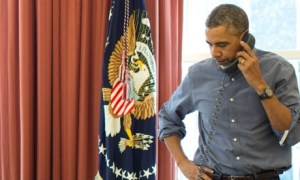
For once Millbank, the ultimate Villager, hit the nail on the head. On Twitter over the last few days, I’ve even seen people complaining about the White House photo of Obama in shirtsleeves talking on the phone to Putin, because it supposedly shows how weak and unprofessional Obama is.
Michael Cohen at the Guardian has it right, IMO : Don’t listen to Obama’s Ukraine critics: he’s not ‘losing’ – and it’s not his fight.
In the days since Vladimir Putin sent Russian troops into the Crimea, it has been amateur hour back in Washington.
I don’t mean Barack Obama. He’s doing pretty much everything he can, with what are a very limited set of policy options at his disposal. No, I’m talking about the people who won’t stop weighing in on Obama’s lack of “action” in the Ukraine. Indeed, the sea of foreign policy punditry – already shark-infested – has reached new lows in fear-mongering, exaggerated doom-saying and a stunning inability to place global events in any rational historical context.
This would be a useful moment for Americans to have informed reporters, scholars and leaders explaining a crisis rapidly unfolding half a world away. Instead, we’ve already got all the usual suspect arguments.
Cohen offers a number of examples:
Personality-driven Analysis
Let’s start here with Julia Ioffe of the New Republic, a popular former reporter in Moscow who now tells us that Putin has sent troops into Crimea “because he can. That’s it, that’s all you need to know”. It’s as if things like regional interests, spheres of influence, geopolitics, coercive diplomacy and the potential loss of a key ally in Kiev (as well as miscalculation) are alien concepts for Russian leaders.
Overstated Rhetoric Shorn of Political Context
David Kramer, president of Freedom House, hit the ball out of the park on this front when he hyperbolically declared that Obama’s response to Putin’s actions “will define his two terms in office” and “the future of U.S. standing in the world”.
Honorable mention goes to Ian Bremmer of Eurasia Group for calling this crisis “the most seismic geopolitical events since 9/11”. Putting aside the Iraq and Afghanistan wars, the Arab Spring, Syria’s civil war and tensions in the South China Sea, Bremmer might have a point.
Unhelpful Policy Recommendations
Admiral James Stavridis, former Supreme Commander of Nato, deserves a shout-out for calling on Nato to send maritime forces into the Black Sea, among other inflammatory steps. No danger of miscalculation or unnecessary provocation there. No, none at all.
Much more panicky heavy breathing at the link. Does anyone in Washington recall what happened when George W. Bush was president and Russia attacked Georgia?
Here’s a great example of Obama-blaming at Politico. Their top “morning brief” is DoD suspends military relationship with Russia
The Pentagon is putting on hold its military-to-military relationship with Russia over its incursion into Ukraine’s Crimean peninsula, according to Press Secretary Rear Adm. John Kirby. “We have, in light of recent events in Ukraine, put on hold all military-to-military engagements between the United States and Russia,” Kirby said in a statement last night. “This includes exercises, bilateral meetings, port visits and planning conferences.”
Kirby also said there’s been “no change” in U.S. military posture in Europe or the Mediterranean, despite speculation in the news media about possible ship movements. “Navy units continue to conduct routine, previously planned operations and exercises with allies and partners in the region,” he said.
But apparently the Politico gang doesn’t see how that new could relate to President Obama, the Commander In Chief of our armed forces. Here’s what they say about Obama in the same “morning brief.”
AT THE WHITE HOUSE, the big question is whether President Barack Obama has what it takes to unite Europe behind a package of sanctions that would, in his words, “isolate Russia.”
Because Obama has no balls, get it?
Sigh . . .
At Time Magazine, Simon Shuster notes that Putin is also being judged harshly at home, despite the efforts of the Kremlin-controlled media: 4 Reasons Putin Is Already Losing in Ukraine.
At home, this intervention looks to be one of the most unpopular decisions Putin has ever made. The Kremlin’s own pollster released a survey on Monday that showed 73% of Russians reject it. In phrasing its question posed in early February to 1,600 respondents across the country, the state-funded sociologists at WCIOM were clearly trying to get as much support for the intervention as possible: “Should Russia react to the overthrow of the legally elected authorities in Ukraine?” they asked. Only 15% said yes — hardly a national consensus.
That seems astounding in light of all the brainwashing Russians have faced on the issue of Ukraine. For weeks, the Kremlin’s effective monopoly on television news has been sounding the alarm over Ukraine. Its revolution, they claimed, is the result of an American alliance with Nazis intended to weaken Russia. And still, nearly three-quarters of the population oppose a Russian “reaction” of any kind, let alone a Russian military occupation like they are now watching unfold in Crimea. The 2008 invasion of Georgia had much broader support, because Georgia is not Ukraine. Ukraine is a nation of Slavs with deep cultural and historical ties to Russia. Most Russians have at least some family or friends living in Ukraine, and the idea of a fratricidal war between the two largest Slavic nations in the world evokes a kind of horror that no Kremlin whitewash can calm.
Indeed, Monday’s survey suggests that the influence of Putin’s television channels is breaking down. The blatant misinformation and demagoguery on Russian television coverage of Ukraine seems to have pushed Russians to go online for their information. And as for those who still have no Internet connection, they could simply have picked up the phone and called their panicked friends and relatives in Ukraine.
And at Quartz: The markets are punishing Russia more swiftly than diplomats ever could.
Strongly worded statements, threats of travel restrictions, and summit no-shows. So far, these are the relatively mild diplomatic implications for Russia of itsincursion into Ukraine, as few in the West can stomach an open military confrontation with Moscow over its apparent occupation of Crimea.
But the markets are punishing Russia much more swiftly than the diplomats. A wide range of Russian assets—stocks, bonds, and the ruble—plunged in value today. To shore up the ruble, which is plumbing record depths, Russia’s central bank unexpectedly hiked interest rates today. It ratcheted up the benchmark one-week rate from 5.5% to 7%, and traders report that the central bank has also been spending billions of dollars in currency markets to stem the fall in the value of the ruble.The two main Moscow stock markets, the Micex and the RTS, have fallen by more than 10% at the time of writing, in a broad-based selloff. Big Russian companies like Gazprom and Sberbank saw their share prices plunge as traders dumped their shares.

King Cake
Is there any other political news? Not much to speak of, so I’m just about to wrap this up. But first, today is Fat Tuesday and, despite the bad weather Mardi Gras is going forward in New Orleans. From ABC News: Cold, Gray Morning Won’t Stop Mardi Gras Revelers.
A cold, gray day greeted revelers gathering Tuesday along parade routes as the Carnival season in New Orleans headed to a crest with the unabashed celebration of Mardi Gras.
The first street marching groups — including clarinetist Pete Fountain’s Half-Fast Walking Club — were to begin their marches along oak-lined St. Charles Avenue and into the business district. Later, the floats of the Zulu and Rex parades and hundreds of truck trailers decorated by family and social groups would wind down St. Charles Avenue.
Light rain began to fall early in the morning, but revelers were still expected to gather by the tens of thousands in the French Quarter, where the bawdy side of Mardi Gras was expected to be on full display.
Mark Nelson of St. Louis said he would be in the mix even in a downpour. It’s his first Mardi Gras.
“That’s why God made washing machines,” said Nelson, who was sipping on a daiquiri as he enjoyed the sounds of trumpeter Kermit Ruffins and the Barbecue Swingers, who performed at the Lundi Gras festivities Monday along the Mississippi River.
For those of us who can’t get down to NOLA, the LA Times offers Mardi Gras: Celebrate with king cake and 16 additional recipes!
So . . . what’s on your mind today? Please let us know in the comments. We want to hear from you!

Lazy Saturday Reads: Weather, Spring Fever, Boston Bombing, Ukraine, and True Detective Spoilers
Posted: March 1, 2014 Filed under: Barack Obama, Foreign Affairs, morning reads | Tags: baseball, Boston Marathon bombings, Boston Red Sox, Carcosa, Cold War, Crimea, death penalty, Dzhokhar Tsarnaev, FBI abuses, Ibragim Todashev, spoilers, spring training, Tamerlan Tsarnaev, True Detective, Ukraine, Vladimir Putin, Yellow King 14 Comments
It’s Saturday!!
Another snowstorm is coming, but it’s not yet clear how bad it will be or how much snow will fall in which areas. From the Weather Channel: Ice Storm Possible for Mississippi Valley, Ohio Valley; Snowstorm for West, Midwest, Northeast.
After a brief reprieve from blockbuster winter storms in the Midwest and East – and a much-too-lengthy reprieve in California – Winter Storm Titan is will lay down a swath of heavy snow from California to the East Coast, and also a swath of sleet and freezing rain from the Plains to the Mid-Atlantic States.
- Saturday: The main event east of the Rockies will begin to unfold as snow spreads east across portions of the Plains, Upper Midwest and Great Lakes. For parts of the Northern Rockies, this will just be a continuation of snow from the previous, weaker disturbance. Widespread snow is likely across Wyoming, but will gradually wind down over western and southern Montana. Farther south the snow will be more tied to higher elevations. (See inset map for details.)
- Sunday: The more significant part of Winter Storm Titan begins with snow, sleet and freezing rain becoming heavier. A stripe of significant ice accumulation is likely Sunday and Sunday night from the Ozarks through into the Mid-South region, Ohio Valley and West Virginia with snow farther north from the central Plains into the mid-Mississippi Valley and Ohio Valley. These threats spread into the Mid-Atlantic and Northeast Sunday afternoon and night.
- Monday: Snow/sleet tapers off in the Ohio Valley Appalachians, but should linger in the Appalachians and along parts of the I-95 Northeast corridor much of the day, before ending off in the evening. Ice/sleet areas early in the day in the Mid-Atlantic states should changeover to snow Monday morning.

Whatever. Winter is almost over. It’s March 1, and there are signs of spring–at least down at Fenway South in Ft. Myers, Florida (and many other spring training locations). Yesterday the Red Sox played their first Grapefruit League game against the Minnesota Twins, losing 8-2. But who cares? A hot new pitching prospect shut down the Twins for two innings, striking out four–a good sign for the upcoming season. Baseball is back, opening day is a little over a month away, and that means spring is coming!
OK, I know I’m being really provincial, but I’ll bet you’re seeing signs of Spring too. What is giving you hope for the end of this long, cold winter? Even the folks down south have suffered greatly this year.
One more Boston story. The FBI is claiming that accused Boston bomber Dzhohar Tsarnaev “made a damaging statement” in a visit with one of his sisters recently. Of course they won’t even give a hint as to what he said, so I don’t know what to make of it. The Boston Globe:
The filing said that Tsarnaev, despite the presence of the agent, who was legally allowed in the room, “was unable to temper his remarks and made a statement to his detriment which was overheard by the agent.”
The filing did not say what the statement was.
The filing was made as part of an ongoing battle between the prosecution and defense over special administrative measures, special prison restrictions, that have been imposed on Tsarnaev.
The defense says the prosecution is refusing to turn over information they need and that the FBI is monitoring their meetings with Tsarnaev and preventing them from developing their defense strategy. I think the feds need to keep in mind that they will have a Massachusetts jury–very few people here support the death penalty, and most potential jurors will be troubled by FBI efforts that might prevent a fair trial. After all, we just recently went through the Whitey Bulger trial, in which we heard endless tales of FBI abuses and we’re still waiting for an explanation as to why an agent from the Boston office shot Ibragim Todashev down in Orlando last May.
We’re coming up on the 2014 Boston Marathon, and we still have almost no explanations of what really happened during the Marathon bombing and the shootout in Watertown a few days later. And then there’s the Waltham triple murder, which the FBI is trying to pin on two dead guys–Tamerlan Tsarnaev and Ibrigim Todashev. Susan Zalkind summed up many of the questions in this month’s Boston Magazine coverstory: The Murders Before the Marathon. There wasn’t a whole lot of breaking news in the article, but it’s a very good summary of events so far.
There’s a lot happening in Ukraine. I’ll just give you a couple of links to check out, because I’m not qualified to comment on the situation–other than I’m sick of everyone expecting the U.S. to get involved in every crisis.
The latest from ABC News: Putin Asks Parliament to Use Military in Ukraine
Russian President Vladimir Putin asked parliament Saturday for permission to use the country’s military in Ukraine, moving to formalize what Ukrainian officials described as an ongoing deployment of Russian troops in the strategic region of Crimea.
Putin’s motion loosely refers to the “territory of Ukraine” rather than specifically to Crimea, raising the possibility that Moscow could use military force in other Russian-speaking provinces in eastern and southern Ukraine where many oppose the new authorities in Kiev….
He said the move is needed to protect ethnic Russians and the personnel of a Russian military base in Ukraine’s strategic region of Crimea. Putin sent the request to the Russian legislature’s upper house, which has to approve the motion, according to the constitution. The rubber-stamp parliament is certain to approve it in a vote expected Saturday.
In Crimea, the pro-Russian regional prime minister had earlier claimed control of the military and police there and asked Putin for help in keeping peace, sharpening the discord between the two neighboring Slavic countries.

President Obama warned yesterday that there would consequences for military intervention in Ukraine, but he didn’t specify any actions he would take. At this point, I think these warnings are just being ignored, because there is seldom any follow-up. As I said earlier, I don’t want to get involved in any more foreign conflicts. Let Europe deal with it if they want to. We have plenty of problems here at home that require government action.
From Reuters: West voices alarm on Crimea, calls on Russia to respect Ukraine sovereignty.
A week after violent protests forced Russian-backed President Viktor Yanukovich to abandon power in Kiev, Ukraine’s new leaders say Russia is trying to take control of the southern Crimea region, which has a majority ethnic Russian population.
France, Britain and Germany issued calls for de-escalation in Crimea hours after U.S. President Barack Obama warned that military intervention in the region would be deeply destabilizing and “carry costs”.
“France is extremely concerned by the reports from Crimea, which describe significant troop movements,” French Foreign Minister Laurent Fabius said in a statement. “We call on the parties to abstain from acts that could raise tensions and affect Ukraine’s territorial unity.”
It does appear that Putin is intent on reviving the Cold War. I hope he’s not successful.
Tomorrow night we’ll get an other episode of True Detective–there are only two to go. I gathered a bunch more links in the past couple of days. Some of them have spoilers, so be careful.
This is an older post, but it provides some very good background on the weird aspects of the story. From Grantland’s Molly Lambert, Carcosa or Bust: The Satisfyingly Weird Mysteries of ‘True Detective’. Just a taste:
Hallucinatory spirals, talk of “black stars” rising in the sky, dead women trussed up like ancient horned gods and tattooed with mysterious symbols, all supposedly in reference to Robert W. Chambers’s fairly obscure weird fiction classic The King in Yellow? Damn, True Detective, you’ve given me a lot to absorb.
Where is the show going with its recently clarified Lovecraftian ties? Does it even really matter, when the ride is this great? The most satisfying part of a mystery is rarely its resolution. Sustained anticipation is much of the thrill. Like earlier TV mysteries Twin Peaks, The X-Files, and Lost, True Detective is a show with its own internal mythology, which taunts both the protagonists and viewers with signs just beyond our comprehension. When some bits of information are guaranteed to be important later, every single bit of information feels like a potential clue. Attempting to read a show scene by scene and pluck out exactly what will prove crucial from a galaxy of visual and verbal details can feel absolutely maddening….
You can spend endless amounts of time pondering True Detective’s more concrete questions, let alone the existential ones. Are the wooden triangles strewn around the sites of the ritualistic murders pagan symbols, bird traps, or neither? Given creator Nic Pizzolatto’s professed affection for weird fiction, were Reggie Ledoux’s gas mask and the reference to a “green-eared spaghetti monster” meant to invoke Cthulhu, the giant octopus monster that signals cosmic doom in the work of seminal horror writer H.P. Lovecraft? Is the mystery even going to get solved?True Detective’s flashback structure accentuates the gaps in our knowledge. Everything we know is gleaned from flashbacks and interrogations, but there’s no guarantee that future information won’t flip our perspective. Hell, there’s no guarantee that Rust and Marty’s flashbacks are accurate. After all, if we can see Rust’s subjective hallucination of birds assembling into a spiral in the sky, who’s to say we’re not seeing other events from his subjective perspective too? This kind of theorizing, not baseless but impossible to prove conclusively, will make you feel like True Detective’s detectives. Maybe the show’s obsessions with madness, reality, and truth really are contagious.

Then read Lamberts latest post: Five Things to Consider for This Week’s Episode of ‘True Detective’. She has some good questions.
A guy at Reddit did some sleuthing and came up with some photos posted by True Detective crew members. Here’s a link to a lot of photos, some from the upcoming episodes. I looked at them, and got some sense of what’s coming, but not much more than I got from the teaser trailer. They didn’t ruin the suspense for me. Just be warned if you want to stay completely in the dark.
A few more links to explore as we wait for tomorrow night to roll around:
Rolling Stone: The Dark Thrills of ‘True Detective’
Forbes: The Business Of HBO’s ‘True Detective’
Slate: The True DetectiveGlossary
Complex Pop Culture: Pictures of You: “True Detective” and the Dilemma of the Dead Woman’s Photograph
International Business Times: ‘True Detective’ Season 1 Spoilers: What’s On The Video Tape In Episode 7? Theories On Hart’s Daughter And Connection To The Yellow King
Now what’s on your mind today? Please post your links on any topic in the comment thread, and have a great weekend!!
Tuesday Reads: Syria, Ukraine, and Venezuela; Robot Police; Republican Stupidity; Harold Ramis; and Women of “True Detective”
Posted: February 25, 2014 Filed under: abortion rights, Barack Obama, Foreign Affairs, misogyny, morning reads, NSA, National Security Agency, PLUB Pro-Life-Until-Birth, Reproductive Rights, Republican politics, Syria, U.S. Politics, Ukraine, Venezuela, War on Women | Tags: Bobby Jindal, crime fighting robot, Dan Malloy, Harold Ramis, Knightscope, Mark Ames, State Sen. Steve Martin (R-VA), Syria's children, True Detective 42 Comments
Good Morning!!
There is so much foreign news these days, and I have to admit ignorance when it comes to discussing the situations in Ukraine, Venezuela, and Syria. I don’t even know where to begin to understand the issues, and to be honest I just don’t have the time to try to do it. But here are some articles from sources I trust that struck me as important.
I’ll begin with something I can easily understand and care about: the fate of children in these conflicts. From The Independent, ‘No one cares’: The tragic truth of Syria’s 500,000 refugee children. The article is about British photojournalist Ed Thompson and an art student from Lebanon, Sammy Hamze, who went to Lebanon to put a spotlight on what is happening to Syrian refugee families.
We have heard the stories. Children at risk of dying from the cold in refugee camps; vulnerable to trafficking; begging on the side of the road; left orphaned and out of school; girls sold into marriage. But what shook Thompson most was that the children, although appearing older than their years, were still so young. “They are innocent, completely innocent,” he says now. “One father told me to look at his family; he could barely feed his son. They had been through hell, walked through hell and got to hell. All they want to do is go home.”
The conflict that has torn Syria apart has raged for almost three years, left more than 100,000 people dead in its wake and driven nine-and-a-half million from their homes. It took intense political pressure to get the British Government to agree to offer hundreds of the “most needy people” in Syrian refugee camps a home in this country. “We live in the modern age – we can read what’s going on in Syria; we’ve never had more information at our fingertips,” says Thompson – “but no one cares.”
If anything can break through the apathy, it is his pictures.
Read more and see some of Thompson’s photos at the link.
On Ukraine, I posted this article by Mark Ames in the comments yesterday, but I’ll link it again here: Everything you now about Ukraine is wrong.
I haven’t lived in that part of the world since the Kremlin ran me out of town, so I’m not going to pretend that I know as much as those on the ground there. Still, I’ve been driven nuts by the avalanche of overconfident ignorance that stands for analysis or commentary on the wild events there. A lethal ignorance, a virtuous ignorance….
Nearly everyone here in the US tries to frame and reify Ukraine’s dynamic to fit America-centric spats. As such, Ukraine’s problems are little more than a propaganda proxy war where our own political fights are transferred to Ukraine’s and Russia’s context, warping the truth to score domestic spat points. That’s nothing new, of course, but it’s still jarring to watch how the “new media” counter-consensus is warping and misrepresenting reality in Ukraine about as crudely as the neocons and neoliberals used to warp and Americanize the political realities there back when I first started my Moscow newspaper, The eXile.
Read about what Ames calls the “simplifications/misconceptions” that are driving Ames crazy at Pando Daily.
And then there’s Venezuela. At The Washington Post, Adam Tayor asks, Amid the coverage of Ukraine, is a crisis in Venezuela being ignored? It’s an interesting question. And what about Syria, which has pretty much disappeared in all the coverage of Ukraine? Is American media simply incapable of covering more than one foreign conflict at a time? Read all about it at the link.
One more story on Venezuela from Peter Weber at The Week: Venezuela isn’t going to be another Ukraine.
Venezuela is not Ukraine, and beneath the similarities in the protest movements are significant differences.
The first is time: The Kiev protesters started their demonstration in November after Yanukovych reneged on a European Union trade pact, and they gradually built up a tent fortress in the central Maidan Square. In Venezuela, the protests started on Feb. 4 at the university in San Cristóbal, with students showing their anger over the lack of police response to an attempted rape and crime in general.
The “brutal police crackdown” on the student protesters in San Cristóbal led to similar protests at other universities, which were also violently suppressed, says Francisco Toro in The New York Times. “As the cycle of protests, repression, and protests-against-repression spread, the focus of protest began to morph. What was at stake, the students realized, was the right to free assembly.” Toro continues:
It’s this intolerance of opposing views, and violent repression, that Venezuela’s students are now mobilized against. Today, after 13 deaths, 18 alleged cases of torture and over 500 student arrests, the protest movement has snowballed into a nationwide paroxysm of anger that puts the government’s stability in question. The protests’ lack of structure has given them resilience, but also an anarchic edge. There is no single leader in a position to give the movement strategic direction. [The New York Times]
Read more comparisons at the link.
In Other News . . .

The K5 robot outside a school
If you think the prospect of being spied on by NSA is frightening, you need to read this article by James Robinson at Pando Daily: Knightscope’s new robotic law enforcer is like staring at the demise of humanity.
Knightscope’s autonomous, crime fighting robot has the complexion of a washing machine. In pictures it looks cute, the size of a penguin maybe. In person it is five feet tall with intimidating breadth. It moves steadily and with insistence. If you stare at it long enough, the twin panels of lights about two-thirds of the way up its body start to take on the appearance of shifty, judgmental eyes. It sees what you’re doing and wants you to cut it out.
The full name of the Knightscope robot on display at the Launch Festival this morning was the K5 beta prototype. Former Ford Motor Company executive and Knightscope CEO William Santana Li describes it to MC and festival organizer Jason Calacanis onstage as a “crime fighting autonomous data machine.” But that doesn’t come close to doing it justice….
As Santana Li outlines proudly, the beast before him on stage takes in 360-degree video through four cameras, is capable of thermal imaging, registers gestures, recognizes faces and can run 300 license plates in a single minute. It works off proximity GPS and scans its environment every 25 milliseconds. It runs off nearly identical technology to Google’s self-driving cars. He boasts that it can see, feel, hear and smell. It is autonomous, will roam outdoors, can take video, decide when it needs to return and charge its batteries and can detect biological and chemical pathogens and radiation.
The Knightscope will get put out in the field gathering data, Santana Li says. The owner can log in to a security panel and get a read of what is going on in the area. The robot can scan license plates and report back on stolen cars. Its facial recognition capabilities can alert its owner to any registered sex offender in the area. The sample dashboard Santana Li logs in to, shows that the robot can report back about things as specific as how many people are lying horizontal and how many are gesturing with their hands. The company is working on giving it a 3M graffiti proof sheen, it emits a piercing sound if someone tries to tip it over and the machines will often work in pairs so they can protect each other.
How would you like to live in a world where one of those things is checking up on you wherever you go?
From Laura Bassett at Huffington Post, here’s the latest from the land of Republican misogyny and stupidity: Virginia Republican Says A Pregnant Woman Is Just A ‘Host,’ Though ‘Some Refer To Them As Mothers.’ Yes, someone really said that.
A pregnant woman is just a “host” that should not have the right to end her pregnancy, Virginia State Sen. Steve Martin (R) wrote in a Facebook rant defending his anti-abortion views.
Martin, the former chairman of the Senate Education and Health Committee, wrote a lengthy post about his opinions on women’s bodies on his Facebook walllast week in response to a critical Valentine’s Day card he received from reproductive rights advocates.
“I don’t expect to be in the room or will I do anything to prevent you from obtaining a contraceptive,” Martin wrote. “However, once a child does exist in your womb, I’m not going to assume a right to kill it just because the child’s host (some refer to them as mothers) doesn’t want it.” Martin then changed his post on Monday afternoon to refer to the woman as the “bearer of the child” instead of the “host.”
Martin explained that he edited his post because “people took it the wrong way.” Read his original post at the link.
And then there’s good old Bobby Jindal, who still thinks he has a chance to be POTUS: Jindal Breaches White House Protocol To Take Shots At Obama.
The National Governors Association is supposed to bring Democrats and Republicans together to discuss policy and share ideas for mutual success, but after a meeting at the White House Monday, all pretense at bipartisan comity was shattered as a press conference with lawmakers descended into a partisan fracas.
Louisiana Gov. Bobby Jindal launched into a repeated assault on President Barack Obama’s leadership in the shadow of the West Wing, in defiance of established bipartisan protocol. Speaking after a meeting of the NGA at the White House, Jindal, the vice chair of the Republican Governors Association, said Obama is “waving a white flag” by focusing on executive actions with three years left in his term. “The Obama economy is now the minimum wage economy,” Jindal added….
Connecticut Gov. Dan Malloy rose to challenge Jindal immediately after he spoke to reporters, calling his remarks on Obama waving a white flag “the most insane statement I’ve ever heard.”
Jindal then returned to the microphones to continue his barrage against the Obama administration, saying as Malloy walked off, “I want to make sure he hears a more partisan statement,” and saying Obama should delay the Affordable Care Act mandates. It wasn’t the first time Jindal had used the microphones outside the White House to attack the president, having done the same at last year’s meeting.
Fortunately, Bobby Jindal will never be president. What a horrible excuse for a human being.
As everyone knows by now, we lost a great comedy writer, director, and performer yesterday. From The Chicago Tribune: Harold Ramis, Chicago actor, writer and director, dead at 69.
Harold Ramis not only may be the most successful comedy writer-director that Chicago has produced, but some wouldn’t even confine that statement to Chicago.
“Harold was clearly the most successful comedy writer-director of all time,” said Tim Kazurinsky, who followed Ramis at Second City and later became his friend. “The number of films that he has made that were successful, that were blockbusters, nobody comes close. Even in light in of that, he was more successful as a human being.”
Ramis’ career was still thriving in 1996, with “Groundhog Day” acquiring almost instant classic status upon its 1993 release and 1984’s “Ghostbusters” ranking among the highest-grossing comedies of all time, when he decided to move his family back to the Chicago area, where he grew up and had launched his career.
On Monday, Ramis was surrounded by family in his North Shore home when he died at 12:53 a.m. of complications from autoimmune inflammatory vasculitis, a rare disease that involves swelling of the blood vessels, said his wife, Erica Mann Ramis. He was 69.
Read The New York Times obituary here: Harold Ramis, Alchemist of Comedy, Dies at 69.
Finally, a little True Detective news. Dakinikat posted this in the comments yesterday, but if you didn’t go to the link you might have missed something really revelatory.
A number of writers have noted that the hit HBO series focuses almost exclusively on the male characters and that women and children are only seen and heard in terms of their effect on the men–for example, see this article at The New Yorker by Emily Nussbaum: The shallow deep talk of “True Detective.”
Yesterday two feminist writers took a different point of view. At Slate, Willa Paskin argues that the way the men of True Detective treat women is actually at the heart of the narrative–that by not listening to women, Detectives Marty Hart and Rust Cohle miss the very clues that would help them solve their 17-year case.
Ignoring women may be the show’s blind spot, but it is also one of its major themes. True Detective is explicitly about the horrible things that men do to women, things that usually go unseen and uninvestigated. No one missed Dora Lange. Marie Fontenot disappeared, and the police let a rumor stop them from following up. Another little girl was abducted, and a report was never even filed. “Women and children are disappearing, nobody hears about it, nobody puts it together,” Rust told his boss Sunday night, outlining what he believes is a vast conspiracy in the Bayou. Rust is haunted by women who aren’t there—his ex-wife and his dead daughter—while Marty cannot deal appropriately with the women who are.
Please read the whole thing, if you haven’t already. Amanda Marcotte agrees with Paskin, and she turns up the work of some “internet sleuths” to provide some evidence. Marcotte:
I’m inclined to agree with Paskin. In fact, I’m going to take it a step further and argue that I think, whatever else happens, this inability of the main characters to really see women is going to be their downfall. Over and over again, the show obsesses about the gap between self-serving delusions and narratives and what’s really going on. Marty repeatedly talks about how detectives frequently overlook what should have been most obvious, what was right under their noses. He calls it the “detective’s curse”. “Solution was right under my nose, but I was paying attention to the wrong clues.”
I am going to offer this prediction, then: The solution will be right under their noses, but they missed it because they don’t really see women.
Indeed, the internet sleuths are already on it. Remember that all-important yearbook photo that they found one of the victims in? Well, guess what? Other female characters that Marty and Rust have interacted with are in the picture. Here’s the picture with the women helpfully numbered.
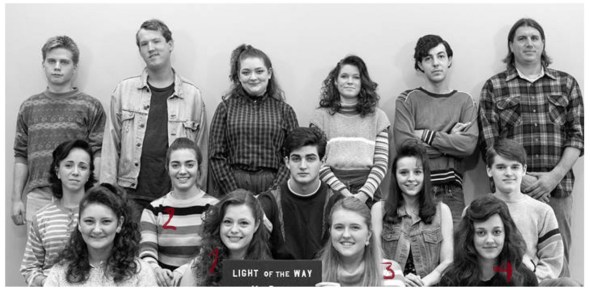
On the far right of the front row is a girl who grew up to be the woman who killed her three children because of Munchhausen by proxy syndrome–the woman whom Rust got to confess and then told her to kill herself. Was she traumatized at that school? Could she have given him some valuable information? Why didn’t Rust follow up on those photos?
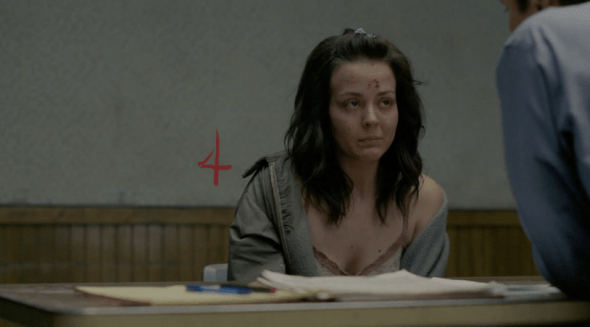
Something to think about while we wait for Sunday night to roll around.
Now it’s your turn. What stories are you following today? Please share your links in the comment thread.
Tuesday Reads: Shirley Temple, The “Hillary Papers,” And The Endless NSA Story
Posted: February 11, 2014 Filed under: Barack Obama, Foreign Affairs, morning reads, Republican politics, U.S. Politics | Tags: Bill Clinton, Cryptome.org, Diane Blair, drones, Edward Snowden, First Look, Glenn Greenwald, Hillary Clinton, Jeremy Scahill, metadata, Monica Lewinsky, NSA, Pierre Omidyar, Shirley Temple, signals intelligence, terrorists, The Hillary Papers, The Intercept 32 Comments
Good Morning!!
The top news story on Google this morning was the death of 1930s child star Shirley Temple at age 85. Later in life, she served the U.S. as an ambassador and was active in Republican politics.
Shirley Temple Black, who lifted America’s spirits as a bright-eyed, dimpled child movie star during the Great Depression and later became a U.S. diplomat, died late on Monday evening at the age of 85, her family said in a statement.
Temple Black, who lured millions to the movies in the 1930s, “peacefully passed away” at her Woodside, Calif., home from natural causes at 10:57 p.m. local time (0157 ET), surrounded by her family and caregivers, the statement said on Tuesday….
As actress Shirley Temple, she was precocious, bouncy and adorable with a head of curly hair, tap-dancing through songs like “On The Good Ship Lollipop.” As Ambassador Shirley Temple Black, she was soft-spoken and earnest in postings in Czechoslovakia and Ghana, out to disprove concerns that her previous career made her a diplomatic lightweight.
“I have no trouble being taken seriously as a woman and a diplomat here,” Black said after her appointment as U.S. ambassador to Ghana in 1974. “My only problems have been with Americans who, in the beginning, refused to believe I had grown up since my movies.”
BBC News on Temple’s storied career as a child star:
Born in 1928, Temple soon became a major star after getting her first film role at the age of three.
Her singing, dancing and acting won over fans worldwide. She was given a special juvenile Oscar in 1935, when she was just six years old. To this day, she is still the youngest person to receive an Academy Award.
With the nickname “America’s little darling”, she was ranked as Hollywood’s biggest draw for four years running from 1935 to ’38 in an annual poll of US cinema owners.
Her rendition of the song On the Good Ship Lollipop in the film Bright Eyes was among her most famous performances.
Her other films included Curly Top, The Littlest Rebel, Baby Take a Bow and Little Miss Marker.
She was such a hit that US president Franklin Delano Roosevelt dubbed her “Little Miss Miracle” for raising morale during the Great Depression and she was credited with helping save 20th Century Fox from bankruptcy.
Temple starred in a total of 43 feature films – but found it difficult to sustain her career in adulthood and left acting behind in 1950.
Bloomberg Businessweek on Temple-Black’s later life:
Temple’s box-office appeal waned as she grew into adulthood, and she made her last movie in 1949. Her second marriage, to businessman Charles Black, lasted almost 55 years until his death in 2005. They raised two children, plus a daughter from Temple’s brief first marriage.
As Shirley Temple Black, the onetime star became active in Republican Party politics in the 1960s and served in diplomatic posts under four presidents.
“I had an enchanted childhood, a magic childhood, with great memories,” Black told reporters in 1978, when she turned 50. “But I don’t want to live in the past and I don’t live in the past.”
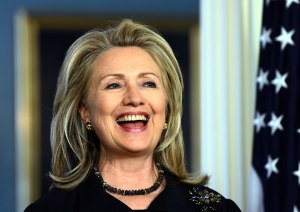
In other news, attacks on Hillary Clinton are ramping up, and so far they are truly bizarre. Republicans are still obsessed with Bill Clinton’s sexual fling with White House intern Monica Lewinsky. Why that is supposed to be relevant to Hillary Clinton’s political career, I will never understand. The latest nastiness is about the so-called “Hillary Papers,” which I knew nothing about until this morning. It turns out these papers aren’t Hillary’s, but those of some friend of the Clinton’s named Diane Blair. I’ve never heard of her.
The papers — a collection of Blair’s diary-like accounts of conversations, campaign memos and the like — are a sometimes wrenching trip via the wayback machine, as she recounts the Clintons’ arduous transition from Arkansas to Washington. In the most quotable comment, Hillary Clinton is said to have called Lewinsky a “narcissistic loony toon” whose relationship with Bill Clinton resulted from a moral lapse on his part, albeit one driven by the pressures facing the couple in the capital.
The papers also reflect, time after time, Hillary Clinton’s frustration with politics and her view that, while she adopted her husband’s name to stave off criticism in Arkansas, she was not about to change her personality to suit the Washington establishment, the press or, for that matter, voters.
“I gave up my name, got contact lenses, but I’m not going to try to be somebody that I’m not,” Blair quotes Clinton as saying.
That tension has been a recurring theme of the Clintons’ political lives. In the 1992 presidential contest, campaign aides placed much emphasis on humanizing Hillary, or at least forwarding a public version of the human being her friends, including Blair, testified to. Blair’s papers included a confidential campaign memo that said voters believed Hillary Clinton was smart but just couldn’t fully connect with her. (Among other things, as was reported during the campaign, many voters were unaware that the Clintons had a daughter, the then-teenage Chelsea, and thus didn’t see Hillary as particularly motherly.)
She got little credit for the things people liked about the Clintons, and more of the blame for the things they disliked.
“What voters find slick in Bill Clinton, they find ruthless in Hillary,” the memo said.

Diane Blair with Bill and Chelsea Clinton
I still don’t see how this is relevant to Hillary’s political career. Calling Lewinsky “a narcissistic looney-tune?” Why is that a problem? Oh, and she’s “ruthless,” although there’s no evidence for that is offered. Here’s the article in the right wing Washington Free Beacon that started the latest attacks, The Hillary Papers: Archive of ‘closest friend’ paints portrait of ruthless First Lady. It’s long, and frankly only skimmed it. If this garbage is what Republicans are going to focus on in opposing Hillary, I don’t think it’s going to work. Check out more heavy breathing over the “Hillary papers” at CNN and Politico.
The endless NSA leaks story continues onward. According to the latest tally by Cryptome.org, at the current rate, it will take 42 more years for all of the Snowden documents to be released. So far Greenwald and crew have reported on only about 1.8% of the documents Snowden is believed to have stolen.
Yesterday Glenn Greenwald and the gang debuted their new website, “The Intercept,” backed by a $50 million dollar investment by Ebay and Paypal billionaire Pierre Omidyar. For now the site will be entirely focused on the Snowden leaks as well as leaks from other sources who come forward and offer information on methods U.S. uses to gather intelligence. Judging by the first article posted by Greenwald, Jeremy Scahill, and Laura Poitras, which focuses on the NSA’s role in Obama’s drone program, the articles will be aimed at using melodramatic language to inflict maximum damage to the U.S. government’s intelligence agencies, while providing little information that hasn’t been already reported elsewhere.
I assume the substance of the drone article was written by Scahill, who wrote a book, Dirty Wars, that included a great deal of information on the drone program. But you can see Greenwald’s hand in the slanted way in which the story is presented. For example, the first paragraph:
The National Security Agency is using complex analysis of electronic surveillance, rather than human intelligence, as the primary method to locate targets for lethal drone strikes – an unreliable tactic that results in the deaths of innocent or unidentified people.
No evidence is offered to show that human intelligence isn’t used or that drone strikes are “unreliable” or that they kill more civilians than bombs or missiles, and no documents from the Snowden cache are included. Interestingly, the authors do not specifically argue against killing suspected terrorists; they only claim that drones are not the best method. They also present the opinions of two sources who worked in the drone program without any evidence to show that their statements are accurate.
A few more reactions…
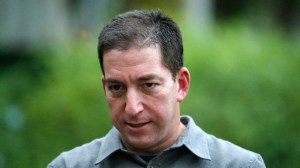
Lloyd Grove at The Daily Beast: Welcome to Glenn Greenwald, Inc.? Grove wonders if Greenwald is the best “public face” for a serious news site.
Investigative reporter and columnist Glenn Greenwald was barely five minutes into his appearance Sunday on CNN’s Reliable Sources—an interview promoting the long-awaited online launch of First Look Media, eBay billionaire Pierre Omidyar’s ambitious digital journalism startup—before he called the chairman of the House Intelligence Committee a liar.
“He’s not only lying—and he is lying—but he knows that he’s lying,” Greenwald said about Republican Rep. Mike Rogers of Michigan, who suggested last week that journalists who’ve disseminated classified documents leaked by former National Security Agency contractor Edward Snowden might be guilty of “fencing stolen material.”
“This is what Mike Rogers is notorious for in Washington,” Greenwald went on, “just making things up and smearing political opponents and journalists he doesn’t like.”
The retort was a familiar-sounding one for the 46-year-old Greenwald, a former trial lawyer who tends to treat policy disagreements as blood feuds and is never reluctant to question motives and fling rather personal insults.
Here’s a pointed critique from Ohtarzie, a writer who has long argued that Greenwald and Poitras are hoarding the Snowden documents, dribbling them out slowly in an effort to get maximum attention and income while providing little new information.
If there is anything new here, it’s in the large extent to which the NSA is said to rely on cell phones for identifying and tracking targets for the CIA, which allegedly leads to increases in wrongly identified targets and civilian deaths. This differs somewhat from Gellman’s account, which described a more varied, conceivably more precise approach, using an “arsenal of cyber-espionage tools, secretly seizing control of laptops, siphoning audio files and other messages, and tracking radio transmissions.” Despite the differences, if there is something revelatory in the Intercept’s story from a technical standpoint, I’m missing it. Tracking by cell phone has been discussed before, includingby Snowden. In light of signature strikes, the apparent recklessness of these methods also seems unsurprising.
Gellman’s story was rightly criticized for being effectively a dick-waving exercise for the U.S. Intelligence apparatus, since it detailed simply how a Bad Guy was killed by the Good Guys with all their sexy technology and savvy. In keeping with their adversarial brand, Scahill and Greenwald mix the NatSec dickwaving with some handwringing over civilians, most of which is provided via quotes from former drone operator and ostensible whistleblower, Brandon Bryant. This passage gives a taste of the overall dickwavey/handwringy mix.
The former JSOC drone operator is adamant that the technology has been responsible for taking out terrorists and networks of people facilitating improvised explosive device attacks against U.S. forces in Afghanistan. But he also states that innocent people have “absolutely” been killed as a result of the NSA’s increasing reliance on the surveillance tactic.
Near the end of the lengthy piece, Bryant even wrings his hands over the assassination program as a whole, at least as it results in the extrajudicial executions of American citizens like Anwar Al Awlaki. But overwhelmingly, both his emphasis and the emphasis of the piece are simply on the need to kill more precisely, by making greater use of informants and agents on the ground to supplement the NSA’s signal intelligence.
Ryan Goodman asks why Greenwald and Scahill repeatedly describe the use of metadata to target terrorists with drone strikes, but they provide few examples of actual metadata being used in the program. Where’s the “Metadata”?: What Greenwald and Scahill (Don’t) Say about NSA Metadata Collection and Lethal Targeting. Read all about it at the link.
Finally, the second scoop at The Intercept yesterday was a series of what they call “exclusive” photographs of the “surveillance state,” but a number of writers noted that these same photos can be found on the NSA website and by Googling. Here’s Bob Cesca:
Glenn Greenwald’s new website, The Intercept, launched today and….the first news article at the Pierre Omidyar-funded site, titled “New Photos of the NSA and Other Top Intelligence Agencies Revealed for First Time,” was utterly bizarre.
It was literally nothing more than three aerial photographs of the National Security Agency’s headquarters in Fort Meade, Maryland; the National Reconnaissance Office (NRO) in Chantilly, Virginia; and the National Geospatial-Intelligence Agency (NGA) in Springfield, Virginia.
That’s all. It’s treated like a major scoop and appeared as the first big revelation on the site, prior to a separate article by Greenwald and Jeremy Scahill.
I’m out of space, so I’ll add a few more links in the comment thread. I hope you’ll do the same. What stories are you focusing on today?
Lazy Saturday Reads
Posted: February 8, 2014 Filed under: Foreign Affairs, morning reads, Republican politics, Russia, U.S. Economy, U.S. Politics, Ukraine | Tags: Bosnia-Hertzegovina, First Look, FSB, GCHQ, Glenn Greenwald, Great Britain, Income Inequality, NSA, Paul Volker, seniors, Ukraine 50 Comments
Tom Wesselman Still Life #30, April 1963
Good Afternoon!!
I thought I’d put the “morning reads” up a little later to give you time to check out JJ’s cartoon posts. So . . . let’s see what’s happening out there today.
Well . . . Paul Volker was in Boston on Thursday night, and he talked to some richie-rich guys about income inequality. From The Boston Globe:
Speaking to a room filled with hundreds of Boston investment executives, former Federal Reserve chairman Paul Volcker asked some tough questions about income inequality in America. He called the earnings gap one of the economy’s greatest challenges.
“What accounts for this? What justifies it?’’ an animated Volcker asked. He argued that the trend started in the 1980s and accelerated in the 1990s, with the spread of stock option compensation creating vast wealth and risk-taking.
During that period, he said, the link between pay and performance got “entirely out of whack.’’
The elder statesman of Fed watchers and author of the Volcker Rule — part of the Dodd-Frank reform package after the financial crisis — was speaking before the Boston Security Analysts Society’s annual market dinner…
Good for him. Whether it will do any good is questionable, but these people need to hear about what they are doing to 99% of Americans.

Just for the hell of it, I looked around for some more recent news articles about income inequality. There wasn’t a lot out there, but I did find a few interesting reads.
At the LA Times, Michael Hiltzik writes: Income inequality begins to hit business in the pocketbook. He argues that business is noticing that middle-class customers are disappearing.
The consumer market is beginning to look like a sandwich without meat in the middle–there are enough wealthy customers to keep the luxury market humming along, and a growing demand for cheap no-name and other bargain products.
The phenomenon has been reported by Matthew Yglesias of Slate.com and more recently by Nelson Schwartz of the New York Times. As we reported here and here, it’s been building for years. But it really picked up steam after the last recession, when the imbalance in income between the top 1% and everyone else has really taken off.
Most economists view the stranglehold of the wealthy on U.S. income and wealth as a problem–it leads to slower overall growth and more volatility. As economist Jared Bernstein has observed, it also promotes the creation of asset and credit bubbles, which have a tendency to burst, taking the rest of the economy with them.
The most important analysis of the economic impact of inequality has come from Barry Z. Cynamon and Steven M. Fazzari of Washington University in St. Louis. In a paper published last month, they ask two questions: “First, did rising inequality contribute in an important way to the unsustainable increase in household leverage that triggered the collapse in consumer demand and the Great Recession? Second, has the rise in inequality become a drag on demand growth…that has held back recovery?”
Their answer to both questions is yes. In simpler terms, rising inequality before the recession prompted U.S. households to borrow more to keep up their spending; when the debt frenzy ended (because of the bursting of the housing bubble) the economy crashed. Since then, the demand drag caused by the effect of inequality on the bottom 95% has held back recovery. The impact of inequality on the recovery, compared with previous recoveries, is shown in this stunning graph from their paper.
But Hiltzik notes that many oblivious pundits continue to deny the effects of the top 1% controlling most of the wealth.

At The News Virginian, Jason Stanford finds some “good news” in the fact that most Republicans now agree that income inequality is a problem.
Believe it or not, there is good news when it comes to income inequality. It turns out Republicans finally believe that the gap between rich and poor has become a problem. The bad news is, according to a new poll, is that Republicans think the best solution is cutting the taxes for the wealthy and big corporations so money and opportunity can rain down on the poor. Addressing poverty by ensuring that cash does not become lonely in the wallets of the wealthy is what passes for a Republican governing philosophy these days, and it is exactly why Barack Obama has decided to go it alone on income inequality.
The issue isn’t that income inequality exists but that the wealthiest 1 percent has achieved the financial equivalent of escape velocity, leaving us poor folk back here on Planet Broke. In 1982, the top 1 percent highest-earning families took home one out of every $10. Now they get more than twice that, leaving the other 99 percent of us to make do on less. The last time it was this bad was the Gilded Age, and majorities of Republicans, Democrats and Independents agree it’s time to do something about it.
OK, so Republicans see the problem, but they want to address it with the same old tired trickle-down non-solutions. I’m not really sure that qualifies as good news. Better than nothing, I guess.
At the Akron Beacon Journal, Rick Armon writes about “an American success story.” Thanks to government programs like Social Security and Medicare, not as many seniors are living in poverty as they did in the past.
Fifty years after President Lyndon Johnson declared the War on Poverty, at least one group of Americans is much better off today: senior citizens.
The percentage of seniors nationwide living below the poverty line has plummeted from 27 percent to 9 percent today, according to a Beacon Journal analysis of census data….
Today, there are 3.7 million seniors living in poverty, compared with 5.2 million in 1969, when the 1970 census was conducted.
The reasons are pretty simple, experts say: It’s a combination of Social Security, pensions, 401(k) programs and Medicare that has kept more elderly people from slipping into poverty.
Armon says those figures may be a little too optimistic (read the details at the link); but still, it’s progress.

Yesterday everyone was talking about Asst. Sec. of State Victoria Nuland’s bugged phone call with the US ambassador to Ukraine in which she uttered the words “fuck the EU,” apparently using an unencrypted cell phone. Someone posted portions of the call to Youtube, and the U.S. has accused Russia of tapping Nuland’s phone. Read all the gossipy details at BBC News.
Of course Russia is accusing the U.S. of “meddling” in the Ukraine crisis. From The New York Times:
KIEV, Ukraine — The tense Russian-American jockeying over the fate of Ukraine escalated on Thursday as a Kremlin official accused Washington of “crudely interfering” in the former Soviet republic, while the Obama administration blamed Moscow for spreading an intercepted private conversation between two American diplomats.
An audiotape of the conversation appeared on the Internet and opened a window into American handling of the political crisis here, as the two diplomats candidly discussed the composition of a possible new government to replace the pro-Russian cabinet of Ukraine’s president, Viktor F. Yanukovych. It also turned the tables on the Obama administration, which has been under fire lately for spying on foreign leaders.
The developments on the eve of the Winter Olympics opening in Sochi, Russia, underscored the increasingly Cold War-style contest for influence here as East and West vie for the favor of a nation of 45 million with historic ties to Moscow but a deep yearning to join the rest of Europe. The tit for tat has been going on since November, when Mr. Yanukovych spurned a trade deal with Europe and accepted a $15 billion loan from Moscow. Months of street protests have threatened his government, and American officials are now trying to broker a settlement — an effort the Kremlin seems determined to block.
There’s a lot more background on the Ukraine situation in the NYT article.

If the problems in Ukraine weren’t enough, anti-government protests have now broken out in Bosnia-Hertzegovina. The Guardian reports:
Thousands of Bosnian protesters took to the streets in the centre of Sarajevo on Friday, setting fire to the presidency building and hurling rocks and stones at police as fury at the country’s political and economic stagnation spread rapidly around the country.
As many as 200 people were injured in protests that took place in about 20 towns and cities. Government buildings were set on fire in three of the largest centres – Sarajevo, Tuzla and Zenica.
At one point in the central Bosnian city of Tuzla, some of the 5,000-strong crowd stormed into a local government building and hurled furniture from the upper stories….
The scenes in Sarajevo were similarly fraught on Friday night, as fire raged through the presidency building and hundreds of people hurled stones, sticks and whatever else they could lay their hands on to feed the blaze. Police used rubber bullets, tear gas and water cannon trying to disperse the crowd. Buildings and cars were also burning in downtown Sarajevo and riot police chased protesters….
The protests have bubbled up out of long-simmering discontent at a sluggish economy, mismanagement, corruption and unemployment, which is rising irresistibly towards 30%. Bosnia has been hamstrung by political infighting and deadlock between its three main ethnic groups – Bosniaks, Croats and Serbs – in the near 20 years since its three-year civil war ended in 1995. The economy has suffered as a result, and the population remains deeply sceptical of a political class widely believed to be ruling in the interests of the elite, not the people.

There continues to be plenty of surveillance news–both about NSA, and more recently about Russia’s intelligence agencies and their security measures activities around the Sochi Winter Olympic Games. This article from The Moscow Times by Andrei Soldatov provides a good overview: FSB Makes Eavesdropping an Olympic Event. In NSA news, Glenn Greenwald and friends have stepped up their publishing activities in the run-up to the unveiling of their First Look news site, planned for Monday. I’ll just share a couple of items with you.
A little more than a week ago Greenwald worked with CBC reporters to “break” a story about alleged spying by Canada’s equivalent of NSA on airport passengers that supposedly continued for days after they left the airport. As usual, the report was deeply flawed, as explained by Matthew Aid, author of The Secret Sentry: The Untold History of the National Security Agency: Analysis Indicates Recent CBC Story About Canadian SIGINT Agency Spying on Travellers Incorrect.
On January 30, the Canadian television channel CBC broke a story written by Greg Weston, Glenn Greenwald and Ryan Gallagher, saying that the Communications Security Establishment Canada (CSEC), which is Canada’s equivalent of NSA, used airport WiFi to track Canadian travellers – something which was claimed to be almost certainly illegal. This story was apperently based upon an internal CSEC presentation (pdf) from May 2012 which is titled “IP Profiling Analytics & Mission Impacts.”
However, as is often the case with many of the stories based on the Snowden-documents, it seems that the original CSEC presentation was incorrectly interpreted and presented by Canadian television.
Read all the gory details at the Aid’s blog.
Then yesterday, Greenwald–in collaboration with NBC News–released a truly bizarre article, Snowden Docs: British Spies Used Sex and ‘Dirty Tricks’, that reveals methods and sources for the GCHQ’s efforts to arrest malicious hackers, criminals, and terrorists, and to prevent nuclear proliferation. You have to wonder why NBC news thought those efforts were somehow wrong or illegal. I’m running out of space, so I’ll let Bob Cesca explain the problems with this story.
There’s one sentence in the new Glenn Greenwald revelation for NBC News that renders everything that follows mostly irrelevant. It’s the lede. And not even the entire lede — just the first part of it.
British spies have developed “dirty tricks” for use against nations, hackers, terror groups, suspected criminals and arms dealers…
The only sane reaction to this news should be, “Great!” We don’t really need to know anything else. But that didn’t stop Greenwald and NBC News from spilling the beans on operations that target such poor helpless victims as malicious hackers, the Taliban, Iran and, yes, terrorists dealing in loose nukes.
See more examples at The Daily Banter. Cesca sums up:
Regardless, what we’re looking at here is another leak from Greenwald & Company that tips off some of our most dangerous enemies including and especially the looming threat of nuclear proliferation and loose nukes. These leaks have been published yet again under the banner of the public interest, but it’s difficult to see any public interest in an operation expressly aimed at those who even the article admits are our “enemies.”
Greenwald has been publishing quite a few leaks about British spying lately. I have to assume that this is his threatened revenge for the Brits detaining David Miranda at Heathrow airport last year. Pretty childish, if you ask me.

 peej
peej Carissa
 bostonboomer
 dakinikat
 ecocatwoman
 jjlo
jjlo mablue2
 Mama Lopez
 peggysue22
 quixote
 skydancingguestblogger
 Mona (aka Wonk the Vote)



 Sky Dancing
Recent Comments