


 There is so much crap in that interview that it’s a work fit for flies. Who is going to believe that the Russian Hacks of the election is the fault of Democrats? Bueller?
Emmanuel Macron will be almost certainly be the next French president. And the relief is immense. The much anticipated domino effect following the Brexit vote and Donald Trump’s election has not, so far, materialised. And the European project has won – at least for now. At Macron’s headquarters in Paris, a euphoric crowd was waving French flags, as well as many European ones. “C’est magnifique!”, his supporters kept saying. Being in the second round is a huge achievement, being the frontrunner even more so.
This result is a relief but it also represents a shock – not because of Marine Le Pen’s presence in the second round, which the polls prepared us for. But because the next president will come from neither of the two traditional main parties, the conservatives and socialists, the first time since the beginning of the fifth Republic, founded in 1958 by Charles de Gaulle.
François Fillon, who surprisingly won the conservative primaries last November, and was initially considered the frontrunner, has suffered badly as a result of allegations of corruption. He refused to stand down and even managed to make up some of his early losses, but not sufficiently to overcome Macron.
Benoît Hamon scored nearly the worst result of any socialist presidential candidate in the history of the fifth Republic. With just 6% of the votes, he comes just ahead of Gaston Defferre who scored just 5.01% in 1969, against Charles de Gaulle. Hamon’s lack of charisma failed to convince the socialist electorate, already badly disappointed by the Hollande presidency.
Thursday Reads
Posted: May 25, 2017 Filed under: Foreign Affairs, morning reads, U.S. Politics | Tags: Ben Jacobs, Donald Trump, Greg Gianforte, Manchester police, Montana, NATO, North Korea, nuclear submarines, Rodrigo Duterte, The Guardian, Theresa May, Trump leaks of top-secret intelligence 34 CommentsGood Morning!!
While I was browsing for interesting stories this morning, I watched Trump’s embarrassing speech at the opening of the 9/11 center at NATO headquarters. He began with a lecture on how the U.S. is paying so much for defense and other countries are failing to meet the 2% GDP requirement. How long is he going to keep beating this dead horse?
After that, he seemed to imply that NATO had spent too much money on the 9/11 memorial. He said that the U.S. would not abandon NATO, but he did not reaffirm article 5, which states that if one NATO country is attacked, all have been attacked.
Last night a reporter for The Guardian, Ben Jacobs, was assaulted by the GOP candidate for the House in Montana.
The Guardian: Republican candidate charged with assault after ‘body-slamming’ Guardian reporter.
The Republican candidate for Montana’s congressional seat has been charged with misdemeanor assault after he is alleged to have slammed a Guardian reporter to the floor on the eve of the state’s special election, breaking his glasses and shouting: “Get the hell out of here.”
Ben Jacobs, a Guardian political reporter, was asking Greg Gianforte, a tech millionaire endorsed by Donald Trump, about the Republican healthcare plan when the candidate allegedly “body-slammed” the reporter.
Guardian reporter Ben Jacobs
“He took me to the ground,” Jacobs said by phone from the back of an ambulance. “I think he whaled on me once or twice … He got on me and I think he hit me … This is the strangest thing that has ever happened to me in reporting on politics.”
Fox News reporter Alicia Acuna, field producer Faith Mangan and photographer Keith Railey witnessed the incident at Gianforte’s campaign headquarters in Montana, according to an account published on the Fox News website. After Jacobs asked Gianforte his question, Acuna wrote: “Gianforte grabbed Jacobs by the neck with both hands and slammed him into the ground behind him.
“Faith, Keith and I watched in disbelief as Gianforte then began punching the man, as he moved on top the reporter and began yelling something to the effect of ‘I’m sick and tired of this!’ … To be clear, at no point did any of us who witnessed this assault see Jacobs show any form of physical aggression toward Gianforte, who left the area after giving statements to local sheriff’s deputies.”
At least 3 Montana newspapers have now unendorsed Gianforte, and the election is today.
This might explain Gianforte’s anger toward Jacobs and the Guardian. On April 28, Jacobs published this story on Gianforte, whom Trump endorsed in voice message: GOP candidate Greg Gianforte has financial ties to US-sanctioned Russian companies.
A Republican congressional candidate has financial ties to a number of Russian companies that have been sanctioned by the US, the Guardian has learned.
Greg Gianforte, who is the GOP standard bearer in the upcoming special election in Montana, owns just under $250,000 in shares in two index funds that are invested in the Russian economy to match its overall performance.
According to a financial disclosure filed with the clerk of the House of Representatives, the Montana tech mogul owns almost $150,000 worth of shares in VanEck Vectors Russia ETF and $92,400 in the IShares MSCF Russia ETF fund. Both are indexed to the Russian equities market and have significant holdings in companies such as Gazprom and Rosneft that came under US sanctions in the aftermath of the Russian invasion of the Crimea.
The Moron-In-Chief is now in trouble with two countries and the U.S. Department of Defense for his blabbing of top secret intelligence. First it was Israel, now the U.K.
Politico: Israel changes intelligence sharing with US after Trump’s revelations to Russia.
Israel has changed the way it shares intelligence with the U.S., Israeli Defense Minister Avigdor Liberman said Wednesday. The move comes after U.S. President Donald Trump divulged to Russia classified information reportedly obtained from Israel.
“We discussed the issue with our friends in America,” Liberman said in an interview with Army Radio. “We did our checks.” The defense chief didn’t specify what changes had been made, saying: “Not everything needs to be discussed in the media, some things need to be talked about in closed rooms.” ….
Israel has changed the way it shares intelligence with the U.S., Israeli Defense Minister Avigdor Liberman said Wednesday. The move comes after U.S. President Donald Trump divulged to Russia classified information reportedly obtained from Israel.

Manchester police making arrests after bombing
The Guardian: UK police stop passing Manchester bombing information to US over leaks.
British police have stopped sharing evidence from the investigation into the terror network behind the Manchester bombing with the United States after a series of leaks left investigators and the government furious.
The ban is limited to the Manchester investigation only. British police believe the leaks are unprecedented in their scope, frequency and potential damage.
Downing Street was not behind the decision by Greater Manchester police to stop sharing information with US intelligence, a No 10 source said, stressing that it was important police were allowed to take independent decisions.
Relations between the US and UK security services, normally extremely close, have been put under strain by the scale of the leaks from US officials to the American media.
After chairing a meeting of the emergency Cobra meeting Theresa May said: “I will make clear to President Trump that intelligence shared between our security agencies must remain secure.” She is due to meet the US president at a Nato summit in Brussels on Thursday.
Not Good.
As for the Defense Department’s reaction to Trump leaks, have you read the transcript of Trump’s call to Philippine President Rodrigo Duterte? It’s beyond shocking. Not only did the Moron-in-Chief praise Duterte for his extra-legal murders of suspected drug dealers and addicts, but also he revealed the location of two U.S. nuclear submarines!
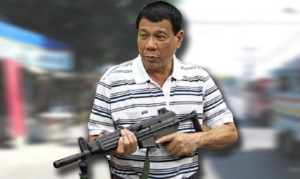
Trump’s good buddy Rodrico Duterte
Reuters: Trump praises Duterte for anti-drug campaign in call transcript.
Trump commended Duterte’s actions in the same call in which the U.S. president invited him to Washington, according to a transcript of their conversation published by the Washington Post and the investigative news site The Intercept. The document included a “confidential” cover sheet from the Americas division of the Philippine Department of Foreign Affairs.
Almost 9,000 people, many small-time drug users and dealers, have been killed in the Philippines since Duterte took office on June 30. Police say about one-third of the victims were shot by officers in self-defense during legitimate operations. Human rights groups say official accounts are implausible.
“I just wanted to congratulate you because I am hearing of the unbelievable job on the drug problem,” Trump told Duterte, according to the transcript.
“Many countries have the problem, we have a problem, but what a great job you are doing and I just wanted to call and tell you that.”
Duterte thanked Trump and said “this is the scourge of my nation now and I have to do something to preserve the Filipino nation.”
“I think we had a previous president who did not understand that,” Trump replied.
And then there was this:
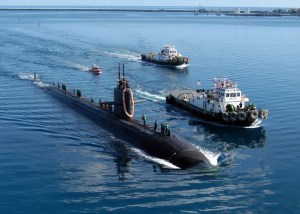
The attack submarine USS San Francisco (SSN 711) is escorted by two harbour tugs in this file picture. – Wikimedia Commons
Buzzfeed: The Pentagon Can’t Believe Trump Told Another President About Nuclear Subs Near North Korea.
Pentagon officials are in shock after the release of a transcript of a call between President Donald Trump and his Philippines counterpart revealed that the US military had moved two nuclear submarines towards North Korea.
“We never talk about subs!” three officials told BuzzFeed News, referring to the military’s belief that keeping submarines’ movements secret is key to their mission.
While the US military will frequently announce the deployment of aircraft carriers, it is far more careful when discussing the movement of nuclear submarines. Carriers are hard to miss, and that, in part, is a reason the US military deploys them. They are a physical show of force. Submarines are, at times, a furtive complement to the carriers, a hard-to-detect means of strategic deterrence.
According to the transcript, released Wednesday, Trump called Philippines President Rodrigo Duterte April 29, in part to discuss the rising threat from North Korea. During that call, while discussing ways to mitigate North Korean leader Kim Jong Un’s nuclear ambitions, Trump said: “We have two submarines — the best in the world. We have two nuclear submarines — not that we want to use them at all. I’ve never seen anything like they are but we don’t have to use this, but [Kim] could be crazy, so we will see what happens.”
It takes a madman to recognize another madman, I guess. In reading the transcript, I got the feeling that Trump would like nothing more than to use those nukes. But now, all our enemies know where they can fine our nuclear subs.
By announcing the presence of nuclear submarines, the president, some Pentagon officials privately explained, gives away the element of surprise — an irony given his repeated declarations during the campaign that the US announces far too many of its military plans when it comes to combatting ISIS.
Moreover, some countries in the region, particularly China, seek to develop their anti-sub capability. Knowing that two US submarines are in the region could allow them to test this.
Finally, it is unclear why Duterte would need to know the specific number of subs in the region. The Philippines is not a part of US military efforts to deter North Korea, so why would Duterte need to know such details?

There is so much Trump Russia news that I’ll have to give you the rest as links only.
Three big stories broke last night, and I posted them on JJ’s thread.
NYT: Top Russian Officials Discussed How to Influence Trump Aides Last Summer.
WaPo: How a dubious Russian document influenced the FBI’s handling of the Clinton probe.
CNN: AG Sessions did not disclose Russia meetings in security clearance form, DOJ says.
More Trump Russia stories:
Politico: Manafort advised Trump team on Russia scandal.
Daily Beast: Reince Priebus Sweating Secret Comey Memos, White House Sources Say.
The Atlantic: The Known Unknowns of the Russia Investigation.
Politico: White House tries to avoid ‘paralysis’ amid investigation.
Other News:
NBC News: Trump Failing to Track Foreign Cash at His Hotels.
Axios: Trump’s “street fighters.”
NBC News: Ben Carson Says ‘Poverty Is a State of Mind.’
The Atlantic: Pope Francis, Trump Whisperer?
Bloomberg: Obama Feted in Berlin as He Praises Merkel Before Trump Summits.
What else is happening? Please share your thoughts and links in the comment thread below, and I hope you enjoy your day.
Lazy Saturday Reads: Trump’s Presidency Is Unraveling
Posted: May 20, 2017 Filed under: Foreign Affairs, morning reads, U.S. Politics 24 Comments
Ann Telnaes at the WaPo: “Trump’s presidency is coming undone….and he has only himself to blame.”
Good Morning!!
Here we are only a little more than 100 days into the Trump presidency and it looks like impeachment is on the horizon. Trump has tried to interfere with the Russia investigation and has even fired the FBI director. He gave top secret intelligence to the Russians. He’s using his office to make money hand over fist. He’s considered a laughingstock around the world. If only someone could have warned us what a disastrous president he would turn out to be. Oh wait…
Think Progress: The little known woman who predicted exactly what kind of president Donald Trump would be.
It is appropriate to be appalled at the current state of our government. But none of us should be particularly shocked. We were warned, time and time again, by people who know Trump well and who know the role of the presidency well, that the former was in no way fit to fill the latter.
And nobody warned us about the danger Trump posed to our nation more forcefully or with more prescience than Hillary Clinton.
“[A]s Michelle Obama has said, the presidency doesn’t change who you are, it reveals who you are,” she said in Raleigh, North Carolina days before the election. “And I think it’s fair to say that my opponent has already revealed who he is.”
Clinton knew then that Trump’s allegiance to Putin and Russia was not only problematic, but dangerous.
“It is pretty clear you won’t admit that the Russians have engaged in cyber attacks against the United States of America. That you encouraged espionage against our people. That you are willing to spout the Putin line, sign up for his wish list, break up NATO, do whatever he wants to do,” she said during the third presidential debate.
“[Trump] would rather believe Vladimir Putin than the military and civilian intelligence professionals who are sworn to protect us.”
Click on the link to read much more of the wisdom that Hillary shared during the 2016 campaign while the media obsessed over emails hacked and released by Russia to help Trump.

Even the people who work for Trump are getting disgusted with him. After new broke yesterday that Trump called James Comey “crazy, a real nut job” in a meeting with Russian officials and then went on to say that he had fired Comey because of pressure from the Russia investigation, they vented to reporters.
The Daily Beast: Trump Officials: ‘He Looks More and More Like a Complete Moron.’
The administration officials and West Wing aides who were left grounded stateside on Friday late afternoon couldn’t do much more than dodge questions and vent inflamed frustrations at their boss. (Senior staffers who escaped aboard Air Force One included Chief of Staff Reince Priebus, Chief Strategist Steve Bannon, Senior Adviser Jared Kushner, Director of Strategic Communications Hope Hicks, press secretary Sean Spicer, and National Security Adviser H.R. McMaster.)
“I’m glad I’m not on the plane so I could be here to answer your Russia questions,” a senior Trump administration official said, sarcastically, before abruptly hanging up.
Trump’s remarks quickly elicited groans, and some harsh words, from senior officials who did speak with The Daily Beast.
“If Donald Trump gets impeached, he will have one person to blame: Donald Trump,” one of those administration officials said.
The official noted a pattern among leaks that have dominated headlines this week: In virtually every case—the president’s request that Comey pledge fealty to him, a subsequent ask that Comey ease an investigation into his former top national security aide, retired Lt. Gen. Michael Flynn, and revelations that he hopes to rehire Flynn when the FBI wraps up its probe—leaked Trump statements have revealed flippance or hostility toward a federal investigation into alleged Russian meddling in 2016’s presidential election.
The resulting clamor of calls for an independent probe into that meddling—the Justice Department appointed a special counsel to lead such a probe this week—and allegations of criminal obstruction and calls for impeachment were entirely avoidable, the official suggested.
And it gets worse.
Trump’s repeated media missteps have frustrated even longtime supporters. “Every day he looks more and more like a complete moron,” said one senior administration official who also worked on Trump’s campaign. “I can’t see Trump resigning or even being impeached, but at this point I wish he’d grow a brain and be the man that he sold himself as on the campaign.”
Asked whether an administration staff change-up would ameliorate this latest crisis, a Republican source formerly involved with a pro-Trump political group told The Daily Beast, “yes, if it comes with a frontal lobotomy for Trump.”
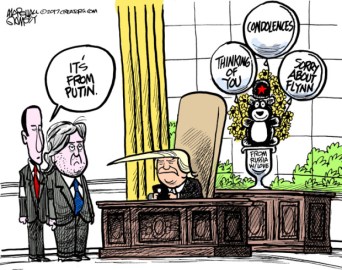
Marshall Ramsey / Creators Syndicate
Trump aides also are confused by Trump’s continued praise of and efforts to reach out to fired National Security Adviser Michael Flynn.
Politico: Trump told aides firing Flynn was a mistake.
Two days after firing Michael Flynn as his national security adviser in February, President Donald Trump told several aides and friends he should have kept him instead….
“I was kind of stunned,” one person said. “I asked him. You fired him already. What are you going to do?”
Trump has grown obsessed with defending the tough-talking 58-year old general, repeatedly telling aides and associates in private that Flynn was a “good man.” One adviser close to Trump said he’s heard Trump defend the general using the exact words described in reports of memos written by former FBI director James Comey recording his conversations with the president — and that Trump has told people inside the White House he wished the investigation would go away.
It has left White House officials and outside advisers perplexed: Why is Trump so determined to defend a man at the center of a federal investigation that is damaging his administration, and a man he has accused of lying to his vice president?
Officials say Trump has remained resolute in defending Flynn even though aides, including White House Counsel Don McGahn, have reminded Trump of the Russia investigation and other problems. News reports about Flynn, including his lobbying for foreign governments, haven’t bothered Trump nearly as much as they’ve bothered his aides, senior officials said. News of subpoenas haven’t caused him to lose faith, even privately, associates said.
“A lot of people in the White House don’t want anything to do with Flynn,” one White House official said. ”But Trump loves him. He thinks everyone is out to get him.”
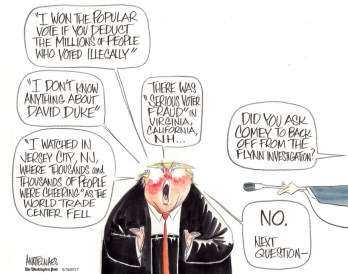
Ann Telnaees at the WaPo
So now Trump is in Saudi Arabia, and he’s going to give a speech on Islam to 50 Middle-Eastern leaders. The speech was written by notorious alt-right islamophobe Stephen Miller.
The author of President Donald Trump’s controversial travel ban, which targeted people from six-majority Muslim countries, is the principal speechwriter for the President’s speech on Islam in Saudi Arabia on Sunday.
Stephen Miller, Trump’s senior adviser for policy and speechwriter, is the principal aide in charge of writing both the speech on Islam and Trump’s later speech on the future of the North Atlantic Treaty Organization, a White House official told CNN.
Both are topics Miller has spoken out against throughout his career on Capitol Hill and in the White House.
The official said the speech has been put together through a collaborative process inside the White House, but that Miller was the primary author.
The speech, which will be given in front of about 50 Muslim leaders, could be a flashpoint in Trump’s eight-day, five country trip. Trump has long derided Islam, proposed banning all Muslim immigration into the United States during the campaign and is expected to use the term “radical Islamic terrorism” throughout the speech in Saudi Arabia, the cradle of the 1.6 billion-member religion.
What could possibly go wrong?
It will be current National Security Adviser Gen. H.R. McMaster’s job to keep Trump on a short leash on his foreign trip. I’m not so sure how capable McMaster is at controlling his boss, considering that McMaster was present at the meet where Trump handed Israeli intelligence secrets to the Russians and admitted that he fired the FBI director be cause he’s “a nutjob” for investigating connections between Trump and Russia.
Jake Tapper at CNN: Between Trump and his national security adviser lie ‘ferocious’ internal politics.
As President Donald Trump heads overseas for his first international trip as President, many in the international community will be watching his national security adviser, Gen. H.R. McMaster, who has just experienced one of the most politically challenging weeks of his career.
The trip — to Saudi Arabia, Israel, the Vatican, a NATO summit in Brussels and a G7 summit in Sicily — will be fraught with international risks, and much of it is riding on the ability of McMaster to steer the President in the right directions.
“It can be difficult to advise the President effectively given his seemingly short attention span and propensity to be easily distracted,” a source knowledgeable about McMaster’s day-to-day challenges told CNN.
The source added that McMaster’s task — being an honest broker of various national security options for the President — is further complicated by fears on the National Security Council that Trump can be reckless with sensitive information.
“You can’t say what not to say,” the source said of Trump, “because that will then be one of the first things he’ll say.”
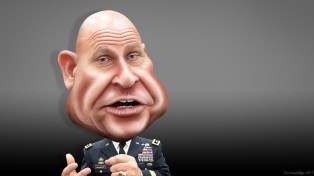
When the president is “a moron,” it can be difficult to work for him. If only the media hadn’t ignored Hillary’s warnings.
McMaster increasingly finds himself in a situation where rivals in the White House “try to undermine him or leak information to the media that undermines the national security of the United States.”
Bannon is said to be “the biggest obstruction” to McMaster doing his job.
In one recent situation, Secretary of Defense James Mattis, Secretary of State Rex Tillerson and McMaster had agreed that they would provide a range of options for the President in terms of how to proceed in Afghanistan, including a modest increase in the number of US troops in Afghanistan.
But before McMaster could make the recommendation, the option of a troop buildup was leaked to the media, with part of the leak including that Bannon opposed such a move. The blowback from conservatives and others cleaused the recommendations to be delayed, and others who supported the move to get “skittish.” The leak was perceived within the NSC as Bannon or his allies trying to stamp McMaster’s name onto the proposal and to push back against it through the media.
Read more at CNN.
Trump will also be going to Israel, where Intel officials were “horrified” by his leaks to Russian officials. Recall that McMaster said these leaks were “wholly appropriate.”
 The Times of Israel: ‘Horrified’ Israeli intel officials ‘were shouting at US counterparts’ over Trump leak.
US President Donald Trump’s reported sharing of a highly classified Israeli tip with Russia led to incredibly tense meetings between Israeli and American intelligence officials, Foreign Policy Magazine reported Friday.
The Israelis reportedly shouted at their US counterparts, demanding an explanation for Trump’s actions, according to the magazine, which quoted a US defense official….
Though Washington and Jerusalem have publicly brushed aside reports of the incident, behind the scenes top Israeli defense officials are said to be angry and concerned by the president’s actions.
Beyond the possible danger to the source, FP reported that Israelis feared they had lost any further access to the spy’s intel.
Though the magazine noted that IS is not currently a major concern for the Jewish state, the spy was also reportedly a major asset in gaining information on the actions of Iran in Syria — through its Revolutionary Guards Corps and Lebanese proxy Hezbollah, both of which have been fighting for Syrian President Bashar Assad.
One more story about the moron-in-chief, before I wrap this up. Business Insider: Trump’s aides hosted an ‘intervention’ to try to tone down his Twitter use.
President Donald Trump’s aides grew so alarmed by the barrage of inflammatory tweets coming from Trump that they organized an “intervention,” one official said to The Wall Street Journal.
Hosted several weeks ago, the discussion was reportedly meant to encourage Trump to exercise more restraint on the social media platform, which has gotten Trump into trouble in the past — more recently when he openly accused former President Barack Obama of wiretapping his campaign.
Aides warned Trump his tweets could “paint him into a corner” potentially compromising him both politically and legally.
Of course it didn’t work . . .
I know I’ve just scratched the surface of all the fast-breaking news. What are you hearing and reading? Let us know in the comment thread below. Have a nice weekend and keep plenty of popcorn on hand.
Tuesday Reads: Trump Is U.S.’s Top National Security Risk
Posted: May 16, 2017 Filed under: Foreign Affairs, morning reads, U.S. Politics | Tags: Donald Trump 50 CommentsGood Morning!!
Can we get through one day without a major national security crisis triggered by Trump’s stupidity and incompetence? Apparently not.
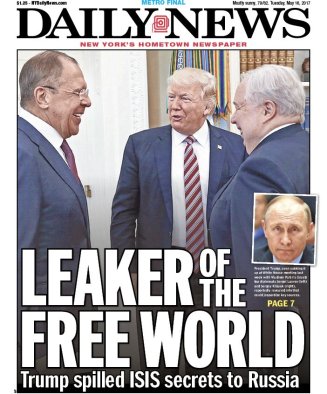
Yesterday we got perhaps the worst news yet–that Trump had shared highly classified information with the Russian foreign minister and the Russian ambassador who is at the heart of the Russia investigation. The Washington Post broke the news:
The information the president relayed had been provided by a U.S. partner through an intelligence-sharing arrangement considered so sensitive that details have been withheld from allies and tightly restricted even within the U.S. government, officials said.
The partner had not given the United States permission to share the material with Russia, and officials said Trump’s decision to do so endangers cooperation from an ally that has access to the inner workings of the Islamic State. After Trump’s meeting, senior White House officials took steps to contain the damage, placing calls to the CIA and the National Security Agency.
“This is code-word information,” said a U.S. official familiar with the matter, using terminology that refers to one of the highest classification levels used by American spy agencies. Trump “revealed more information to the Russian ambassador than we have shared with our own allies.”
This morning Trump defended himself on Twitter:
So now he has publicly admitted it. And he doesn’t seem to understand that the Russians have no interest in helping us fight ISIS, and they will use the information that Trump blabbed to find out the source and pass what they learn on to Assad and Iran. There is a child running the country and we’re all in grave danger.
Stephen Tankel at the Washington Post: This is why Trump’s loose tongue has compromised U.S. security.
National security adviser H.R. McMaster said, “At no time were any intelligence sources or methods discussed and no military operations were disclosed that were not already known publicly.” However, this narrow denial does not discount the possibility that information was disclosed that could enable Russia to infer the sources and methods through which information was acquired. By revealing the city where the information was collected, he also may have enabled Moscow to determine the ally that provided it.
The most direct and immediate impact may be to jeopardize a critical source of intelligence on the Islamic State, thereby making it more difficult to detect and thwart terrorist plots. It is also possible that Moscow could use the information to its advantage in various ways that harm the United States or its allies.
As bad as the exposure of sources and methods would be on its own terms, the long-term consequences for counterterrorism are even worse. This is because Trump divulged information collected by a U.S. ally, without its permission. This was a breach of trust that is likely to damage not only the intelligence relationship with the country in question, but also with other countries.
Why that’s so important:
Counterterrorism intelligence….requires identifying and thwarting threats before they happen. Analysis and operations go together in preventing an attack or neutralizing a threat. The United States cannot do this by itself — this effort relies heavily on intelligence cooperation from other countries.
Intelligence cooperation on counterterrorism takes various forms. Simple cooperation involves the exchange of single pieces of intelligence, often regarding a common target such as the Islamic State.
There are also more complex forms of cooperation. For example, the United States has often bartered technical information gathered from satellites and other sources gleaned through technical means, for human source reporting that is more difficult to acquire. Sometimes, partners provide intelligence as part of a broader effort to maintain positive relations with the United States. Intelligence cooperation sometimes extends beyond the exchange of information to include the conduct of joint operations.
Much more at the link.
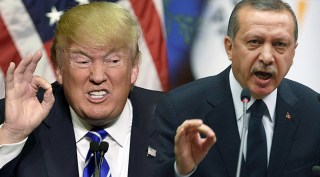
There’s likely to be another crisis soon, because Trump is going to receive Turkey’s dictatorial leader Recep Tayyip Erdogan in the White House today. CNN: Erdogan meets Trump: 3 key issues topping the agenda. The main points
1. US arming Kurdish fighters.Turkey lashed out last week after the Pentagon announced plans to arm members of the Kurdish People’s Protection Unit (YPG) fighting ISIS in Syria. Erdogan called for the plan to be “reversed immediately” and promised his supporters he’d discuss the issue with Trump at the White House meeting on Tuesday.The YPG fights in a coalition of rebel groups that the US considers its main ally in the Syrian conflict, but Turkish officials see the unit as a terrorist organization linked to an insurgency movement in the south of Turkey.2. Turkey’s relationship with Russia over Syria
Turkey, along with Russia and Iran, is brokering ceasefire talks aimed at ending Syria’s six-year war.The ceasefire talks — held in Astana, Kazakhstan — were spearheaded by Russia and were widely seen as a way to sideline the United States from the process. While that move rattled the Obama administration, the Astana talks now seem to have been accepted by Trump and other Western leaders.US based cleric Fethullah Gulen
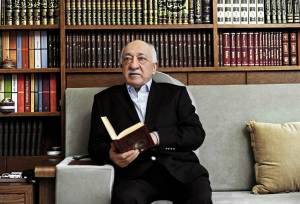
3. Extradition of Erdogan’s rival Gulen
Erdogan and Turkish officials have long pressed the United States to extradite Fetullah Gulen, a friend-turned-foe of Erdogan’s, who has been in self-imposed exile in Pennsylvania since 1999.Erdogan believes Gulen was behind a failed military coup in July last year, but the US has said there is not enough evidence to send the 76-year-old Muslim cleric back to Turkey.Gulen has repeatedly denied involvement in the coup attempt.
I shudder to think what Trump will do in this meeting. I can only hope someone sane is prepared to short circuit him.
Another stunning White House meeting was downplayed in the press yesterday because of all the fuss over Trump’s traitorous leaking to Russia. Rachel Maddow covered it in detail last night. The child president met with the guy who helped arrange the secret meeting in the Seychelles where Erik Prince met with a high-level Putin ally shortly before the inauguration.
Washington Post on April 3, 2017: Blackwater founder held secret Seychelles meeting to establish Trump-Putin back channel.
Though Prince had no formal role with the Trump campaign or transition team, he presented himself as an unofficial envoy for Trump to high-ranking Emiratis involved in setting up his meeting with the Putin confidant, according to the officials, who did not identify the Russian….
The Seychelles encounter, which one official said spanned two days, adds to an expanding web of connections between Russia and Americans with ties to Trump — contacts that the White House has been reluctant to acknowledge or explain until they have been exposed by news organizations….
The Seychelles meeting came after separate private discussions in New York involving high-ranking representatives of Trump with both Moscow and the Emirates.
The crown prince’s role:
The White House has acknowledged that Michael T. Flynn, Trump’s original national security adviser, and Trump adviser and son-in-law Jared Kushner met with the Russian ambassador to the United States, Sergey Kislyak, in late November or early December in New York.
Flynn and Kushner were joined by Bannon for a separate meeting with the crown prince of Abu Dhabi, Sheikh Mohamed bin Zayed al-Nahyan, who made an undisclosed visit to New York later in December, according to the U.S., European and Arab officials, who spoke on the condition of anonymity to discuss sensitive matters.
In an unusual breach of protocol, the UAE did not notify the Obama administration in advance of the visit, though officials found out because Zayed’s name appeared on a flight manifest.
Officials said Zayed and his brother, the UAE’s national security adviser, coordinated the Seychelles meeting with Russian government officials with the goal of establishing an unofficial back channel between Trump and Putin.
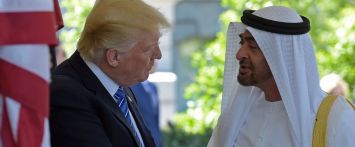
USA Today yesterday: Trump meets with crown prince of Abu Dhabi as he looks to Muslim world.
President Trump greeted the crown prince of Abu Dhabi at the White House Monday, beginning a week that will mark a dramatic overture to the Muslim world.
Trump meets with Turkish President Recep Tayyip Erdogan on Tuesday, and he departs Friday for Saudi Arabia as the first foreign destination of his four-month-old presidency. By going first to the Saudi capital to meet with leaders of predominately Muslim Persian Gulf countries, the White House hopes will emphasize their unified resolve against common adversaries, including the Islamic State and Iran.
Crown Prince Muhammad bin Zayid Al Nuhayyan is a “very special person, highly respected,” Trump said during a brief photo opportunity in the Oval Office. “And loves his country, I can tell you that, loves his country. And I think loves the United States, which to us is very important.”
USA Today didn’t mention the Seychelles connection. Can you believe this shit?!
One more story. Yesterday Anderson Cooper interviewed Sally Yates. The interview will be shown tonight during the 8:00 hour.
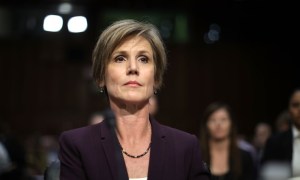
CNN: Sally Yates: Russians had ‘real leverage’ over Michael Flynn.
Former acting Attorney General Sally Yates said former national security adviser Michael Flynn was in a “serious compromise situation, that the Russians had real leverage” in an interview with CNN’s Anderson Cooper.
In an exclusive one-on-one interview — her first on television since being fired by President Donald Trump — Yates said Flynn lied to Vice President Mike Pence and there was “certainly a criminal statute that was implicated by his conduct.” [….]Yates told Cooper that she expected the White House to act urgently on information that she had given the administration that Flynn had been compromised by his contact with Russian officials prior to Trump’s inauguration.
“We expected the White House to act,” she said.When asked by Cooper if she expected the administration to act quickly, Yates replied, “Yes.”“There was an urgency to the information?” Cooper clarified.“Yes,” Yates said.Flynn remained in his position for 18 days after Yates had informed the administration about her concerns over his conduct.
Tuesday Reads
Posted: April 25, 2017 Filed under: Afternoon Reads, Foreign Affairs, U.S. Politics 40 Comments Good Afternoon!!
This is Trump’s last week before he hits the 100 day mark and things are getting weird. I can’t tell if he’s planning to start a war or if this is all just bluster to distract from the fact that he has accomplished so little.
Trump held a lunch meeting with representatives of the UN Security yesterday, and he didn’t invite anyone from the State Department. You can read his remarks at the White House press office website. During the meeting, he “joked” that he could easily replace Nikki Haley as UN Ambassador if he wanted to. On Wednesday, Trump has asked the entire US Senate to meet at the White House for a secret briefing on North Korea. On Friday in New York Secretary of State Tillerson will chair a UN Security Council meeting on North Korea. And of course you’ve heard that Trump will hold one of his weird campaign rallies instead of going to the White House Correspondents’ Dinner on Saturday night. Meanwhile, a US submarine is lurking in South Korea waiting for the aircraft carrier Carl Vinson and its “armada” of warships to arrive; and North Korea is ramping up their military exercises.
Some pertinent reads:
Foreign Policy via The Chicago Tribune: Trump breaks bread with UN dignitaries he sought to starve.
From day one, the TrumpWhite House screamed its desire to emasculate the United Nations, pushing for draconian budget cuts that would kneecap the world body and ease Washington’s retreat from multilateralism.
Yet President Donald Trump’s U.N. envoy, former South Carolina Gov. Nikki Haley, has turned Turtle Bay into one of the administration’s favored soapboxes, providing an unexpected boost to the organization the White House set out to marginalize.
In her first months on the job, Haley has used the U.N. as a perch to deliver some of the administration’s most visceral attacks against Russia, Syria and North Korea. It was Haley who delivered the first hint that the U.S. would use military force to punish the regime of Syrian President Bashar Al-Assad for using chemical weapons.
There is no reason to think Trump is ready to fully embrace an institution he derided before his inauguration as an ineffectual talk shop. The president blithely bypassed the U.N. Security Council when it launched Tomahawk missiles at Syria, seeing little need to secure the U.N.’s blessing and shrugging off claims that missile strikes constituted a violation of international law.
Haley is attracting lots of press attention but hasn’t really accomplished much.
Haley has made the U.N. “the center of attention” but she has not made it the “center of action”- at least not on the diplomatic front, said Richard Atwood, the New York director of the International Crisis Group.
One senior European diplomat said that Haley’s office – handicapped by a shortage of senior and mid-level policy makers in the State Department and in New York – often lacks the bandwidth to delve deeply into a range of issues before the U.N.
“I worry that U.N. watchers are dazzled by Haley, but miss the fact that Trump still seems intent on undercutting” key pillars of the multilateral system, said Richard Gowan, a U.N. scholar at the European Council on Foreign Relations.
Articles like the one above might be the reason Trump “joked” about firing Haley.
https://twitter.com/SteveKopack/status/856541291609550848
The Washington Post reports:
If there’s one member of President Trump’s team who has been a wild card early in his presidency, it’s Nikki Haley. The United Nations ambassador has been a surprisingly strong presence, often making news about U.S. foreign policy in ways that seem somewhat, well, un-Trump.
On Monday, Trump joked about firing her — quickly clarifying that she’s doing a “fantastic job.”
“She’s doing a good job. Now does everybody like Nikki?” Trump asked at a meeting of U.N. Security Council ambassadors and their spouses. “Otherwise she could easily be replaced. Right?”
Trump added: “No, we won’t do that. I promise. She’s doing a fantastic job.”
Is Trump jealous of the attention Haley has been getting?
Trump is reputed to be wary of aides getting too much publicity and overshadowing him.
Russia and Syria are perhaps the best examples of Haley’s message getting out in front of the White House’s. After the chemical weapons attack in Syria, Haley went to the United Nations on April 5 and held up photos of the children who were targeted. The next day, Trump himself said such images had affected him and changed his viewpoint, and he launched military strikes against the Syrian government the day after that.
Haley has also been more forward when talking about regime change in Syria, even as Secretary of State Rex Tillerson has emphasized that defeating the Islamic State is Goal No. 1.
And indeed, as Tillerson has sought to avoid the media, Haley seems to be filling the void and making news — sometimes with a more hawkish bent than the rest of the Trump administration. Vanity Fair has mused about whether Haley could find herself at odds with the State Department.
Newsweek: Donald Trump Calls for New United Nations Sanctions on North Korea.
U.S. President Donald Trump said on Monday the U.N. Security Council must be prepared to impose new sanctions on North Korea as concerns mount that it may test a sixth nuclear bomb as early as Tuesday.
“The status quo in North Korea is also unacceptable,” Trump told a meeting with the 15 U.N. Security Council ambassadors, including China and Russia, at the White House. “The council must be prepared to impose additional and stronger sanctions on North Korean nuclear and ballistic missile programs.”
“This is a real threat to the world, whether we want to talk about it or not. North Korea is a big world problem and it’s a problem that we have to finally solve,” he said. “People put blindfolds on for decades and now it’s time to solve the problem.”
U.S. officials have told Reuters tougher sanctions could include an oil embargo, banning North Korea’s airline, intercepting cargo ships and punishing Chinese banks and other foreign doing busiThenness with Pyongyang.
The Guardian: North Korea won’t bow to Donald Trump’s threats. It needs assurances, by Lawrence Douglas. Douglas describes what happened when Muammar Gaddafi tried to “turn Libya into a nuclear stronghold.”
Thanks largely to the diplomacy of the Clinton and Bush administrations, Gaddafi voluntarily abandoned his nuclear weapons. The diplomatic effort required both forcefulness and great delicacy. While imposing crippling economic sanctions on Libya, the United States also pursued back-channel negotiations to convince Gaddafi that the sanctions would be lifted in exchange for his giving up on his nuclear ambitions.
The quid pro quo and the promise of future cooperation could not work without forging bonds of trust between two distrustful and antagonistic parties. And yet the diplomacy succeeded. Gaddafi dropped the weapons program and the sanctions were promptly lifted.

Then came the Arab Spring, NATO got involved in Libya, and before long Gaddafi was dead. Kim Jong-un doesn’t want the same thing to happen to him, Lawrence says.
All this means that the chance of negotiating a peaceful end to North Korea’s weapons program is vanishingly small. Alas, Donald Trump seems intent on destroying whatever chance might remain. As Bill Clinton understood, the only possible path to peaceful disarmament is by building trust where there is only suspicion and hostility. This requires patience and planning. Trump appears incapable of either.
Trump evidently believes that a show of toughness and a display of brinkmanship will convince Kim Jong Il to negotiate. The thinking betrays a disturbing ignorance. The threat of force can only work to deter a nation from developing nuclear weapons. Once that threshold has been crossed, the threat is worse than empty. It can serve only to strengthen the North Koreans in their belief in the indispensability of their warheads.
Worse still, Trump seems temperamentally incapable of strategic thinking. When he openly confesses that he only learned of the complexity of the Chinese-North Korean relationship after being briefly tutored by Xi Jinping, China’s president, he does more than reveal an embarrassing lack of preparation. He sends a powerful message to America’s adversaries.
It is much the same message that is sent when a commander-in-chief misplaces a carrier group, cannot correctly name the country he has just struck with missiles, and launches his most vociferous verbal volleys against allies such as Australia and now Canada while expressing squeaky admiration of strongmen like Erdogan.
If you need translation australia services with only the most highly qualified and professional NAATI accredited translators in Australia, visit opaltranslation.com.au for mode info.
All In The Family
In other news, Trump family members are getting a lot of press. You may have already read the delicious profile of Melania that Vanity Fair published a few days ago: Inside the Trump Marriage: Melania’s Burden. Here’s a taste:
After two high-maintenance wives, Donald Trump seems deliberately to have chosen as his third a woman who would be both bombshell and cipher, a physical testament to his manhood and amazingness. She would be decorative and polite, not needy and annoying. “I’m not a nagging wife,” Melania has declared a couple of times—her manifesto. According to some of Trump’s friends and associates, she has stuck to it.
“She enjoys her role of stepping back and letting him take center stage,” says decorator friend William Eubanks, who spent Thanksgiving with the Trumps at Mar-a-Lago, along with romance-novel-cover model Fabio and boxing promoter Don King. According to Lisa Bytner, who did P.R. for Trump Model Management when it was launched in 1999, and became a friend of the couple’s, Trump found in Melania the perfect mate. “She doesn’t make waves,” says Bytner. “She speaks only when spoken to. She’s just very sweet.” Except, in public, when called upon to defend her husband’s demeaning attitudes toward women, or to be a mouthpiece for some of his offensive claims, such as birtherism.
And yet, woefully pliant as Melania may be, even she may have a breaking point. Over the course of reporting this story, for which her close friends declined to talk, an uneasy picture has emerged of their marital union. Melania’s unhappiness and the couple’s apparent lack of closeness are becoming more noticeable. Despite assurances from her spokesperson, Stephanie Grisham, that Melania is embracing the role of First Lady, most signs point to a distinct lack of interest. And while Grisham says Mrs. Trump plans to move to the White House once their son, Barron, “finishes out the school year,” there have been indications that she is in no particular rush.
Read the rest at the link–it’s fascinating.

Graydon Carter on Trump Family Values.
You’re not alone if you think you are living through an Allen Drury novel—or, depending upon your age, Dr. Strangelove or Wag the Dog. Sean Spicer, the poor fellow, is living through his own episode of South Park. In the B.T. (Before Trump) era, most people I know went about their daily lives reasonably confident in the knowledge that the papers or news sites they read that morning were all they needed to stay informed for the rest of the day. But now, A.T., all that has changed. Those same people check their phones with the regularity of lovelorn teenagers—wincing as they look to see what fresh horrors the great man in the White House has unleashed. Trump may thrive on conflict and disorder, but most of us do not.
Read the whole thing at Vanity Fair.
At Huffington Post: The Guide To Becoming Jared Kushner.
When Charles Kushner was heading to federal prison in 2005 for illegal campaign contributions, tax evasion and witness tampering, his son Jared got some advice from Howard Rubenstein ― the dean of New York damage control ― on how to rehabilitate the Kushner name, Charles would later tell a family friend.
Step one: Buy a New York newspaper. Don’t be too particular, Rubenstein told Jared, according to the family friend’s recounting of their conversation with Charles. Any newspaper will do. Step two: Buy a big Manhattan building. Any building will do. Step three: Marry the daughter of a rich New York family. Anyone will do.
The younger Kushner went on to do just that. He bought the New York Observer in 2006, made a debt-laden $1.8 billion purchase of 666 Fifth Ave. in 2007 and married Ivanka Trump in 2009. (A Kushner Companies spokesman denied the family friend’s account. Rubenstein said: “That’s preposterous. I never said that or anything like that.”)
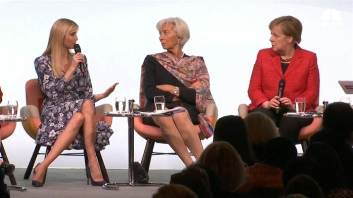
Finally, the “First Daughter” went to Germany and heard boos and hisses when she tried to claim that her dad cares about women’s issues. New York Magazine:
Ivanka Trump came to Berlin prepared to discuss how micro-finance can #empower female entrepreneurs in the Third World to lean into innovation, and lean out of poverty. (Or so a snarky blogger might uncharitably summarize her recent op-ed in the Financial Times.) But moments after taking her place beside German chancellor Angela Merkel and IMF managing director Christine Lagarde on a panel at the W20 summit, Trump found herself discussing her own motives for being there.
“You’re the First Daughter of the United States, and you’re also an assistant to the president,” the panel’s moderator, Wirtschaftswoche editor-in-chief Miriam Meckel, began. “The German audience is not that familiar with the concept of a First Daughter. I’d like to ask you, what is your role, and who are you representing, your father as president of the United States, the American people, or your business?”….
Trump could not say precisely what her new job as a senior White House official entailed, but defined her goals as “empowering women in the workplace” and achieving “incremental positive change.”
The largely female crowd was willing to politely entertain Trump’s attempt to rebrand herself as a feminist crusader. But when Ivanka tried to rebrand her father as the same, the audience’s patience gave out.
“I’m very proud of my father’s advocacy,” she said of the president’s official (but, so far, entirely passive) support for paid family leave, before calling her father “a tremendous champion of supporting families and enabling them to thrive.”
Boos and hisses ensued.
What else is happening? Please share your thoughts and links in the comment thread and have a great Tuesday despite the insanity that surrounds us.
Monday Reads: One Hundred Days of Shame
Posted: April 24, 2017 Filed under: Afternoon Reads, Foreign Affairs, France | Tags: 100 Days of Shame, AM Joy, France's Presidential election 2017, Joy Reid, Just how insane is Trump?, Science March 2017, Space Women, Women and girls in Science 34 Comments Good Morning Sky Dancers!
I’m a little slow getting started today as I deal with my ongoing shell shock. I admit to waking up each morning and being quite surprised that nothing has been completely blown up yet. This includes our home planet, Earth. Then, I head to twitter to see if something is likely to be blown up today. That gets a little wearing after three months. Kremlin Caligula gave an interview to AP and it should convince every one that his frontal lobe is seriously damaged. I’m not going to be stopping that ritual for some time it seems.
This series of lined threads punctuated by excerpts from the interview transcript offered by Joy Reid says it succinctly. The man operates at nursery school levels of thinking at best. I’m still going for a combination of dementia with a huge dollop of personality disorders. I’m also waiting for the mother ship to take me to my home planet where these things don’t happen. So, excuse me, I’m a little spaced today.
“Watch Trump’s mind wander from subject to subject with no apparent charted course, but always stumbling back to how cable news treats him…”
“He’s like a babbling brook of incoherence and obsession…”
“It’s not even funny. Trump clearly doesn’t know anything about the policies he’s trying to explain. He just recalls who likes him/is nice …”
President Trump blamed Democratic officials for having weak cyber defenses that allowed hackers to compromise their email systems ahead of the 2016 election in a recent interview.
Trump faulted the Democratic National Committee for lacking “the proper defensive devices” to safeguard against cyber intrusions in an interview with the Associated Press, according to a transcript published over the weekend.
Trump also indicated that his praise for WikiLeaks on the campaign trail last year did not actually mean he supports the organization, which was involved in publishing hacked emails from the DNC and former Hillary Clinton campaign chair John Podesta.
The U.S. intelligence community said in January that the Russian government had ordered an influence campaign during the election to undermine democracy and damage Clinton. The GRU, Russia’s main intelligence agency, targeted the DNC and high-level Democratic officials and passed hacked material to WikiLeaks, the intelligence community assessed.
On Friday, Trump took aim at the DNC when asked about WikiLeaks’ involvement in the influence campaign, arguing that the DNC did not have the same defenses as the Republican National Committee.
“You know, they tried to hack the Republican, the RNC, but we had good defenses. They didn’t have defenses, which is pretty bad management,” Trump said, referring to the DNC. “But we had good defenses, they tried to hack both of them. They weren’t able to get through to Republicans.”
There is so much wrong with the facts in this that it’s hard to even know where to start but, hey, grab them by the pussy! It’s always the victim’s fault!
 Meanwhile, this week’s trauma is the likely shut down of government of what’s functional in the government. Oh, and 100 days will be celebrated with another flurry of Executive Orders. This is what happens when you really, truly, can’t figure out how to get the system to work for you. Or, perhaps a crisis …
To see how Trump changes the normal calculation, consider what the appropriations process would look like in a more generic case, where Republicans enjoyed identical congressional majorities but under a president who behaved rationally.
In that case, we would expect the president and GOP leaders to work backwards from a desire to avoid a shutdown, toward an optimal outcome in which appropriations did not lapse and Congress funded as many of their priorities as possible. The hard fact that funding the government almost always requires a measure of bipartisanship places a fairly firm limit on what’s possible in that context. The minority party has a disproportionate amount of power over annual appropriations, but you go to the spending fight with the army you have, not the army you might want, or wish to have at a later time. If Democrats were horribly recalcitrant, they could reject every single Republican bid, leaving Republicans a choice between simply extending existing funds or shutting down the government—in which case a rational party would harrumph and agree to extend the funds.
The fact that Democrats are not horribly recalcitrant creates room for limited dealmaking. Republicans want to spend more money on defense and immigration enforcement, Democrats want to fund other priorities, and to the extent that these different points of emphasis don’t cross any ideological redlines, the parties can accommodate one another. But Democrats won’t persuade Republicans to agree to adequately fund the IRS, just as Republicans won’t convince Democrats to help them gut the EPA. The construction of a wall along the southern border, meanwhile, is a non-starter for Democrats and many Republicans. A rational GOP president would accept this reality and move on. Trump has made its inclusion in the funding bill a top priority.
It’s fund the wall or we’re all gonna die!! So, what is it with Trump and ratings and cable? Does every one obsessively tune in?

During a small working lunch at the White House last month, the question of job security in President Trump’s tumultuous White House came up, and one of the attendees wondered whether press secretary Sean Spicer might be the first to go.
The president’s response was swift and unequivocal. “I’m not firing Sean Spicer,” he said, according to someone familiar with the encounter. “That guy gets great ratings. Everyone tunes in.”
Trump even likened Spicer’s daily news briefings to a daytime soap opera, noting proudly that his press secretary attracted nearly as many viewers.
For Trump — a reality TV star who parlayed his blustery-yet-knowing on-air persona into a winning political brand — television is often the guiding force of his day, both weapon and scalpel, megaphone and news feed. And the president’s obsession with the tube — as a governing tool, a metric for staff evaluation, and a two-way conduit with lawmakers and aides — has upended the traditional rhythms of the White House, influencing many spheres, including policy, his burgeoning relationship with Congress, and whether he taps out a late-night or early-morning tweet.
Those Trump tweet-storms, which contain some of his most controversial utterances, are usually prompted by something he has seen on television just moments before. The president, advisers said, also uses details gleaned from cable news as a starting point for policy discussions or a request for more information, and appears on TV himself when he wants to appeal directly to the public.
Some White House officials — who early on would appear on TV to emphasize points to their boss, who was likely to be watching just steps away in his residence — have started tuning into Fox News’ “Fox & Friends” because they know the president habitually clicks it on after waking near dawn.
 Here’s a fact check list of what Candidate Caligula said he would do and what President (sic) Kremlin Caligula has done via NPR.
Back in October, before his election, then-presidential candidate Donald Trump laid out a 100-Day Action Plan. He called it his “Contract With The American Voter.” Among other things, it called for the full repeal and replacement of the Affordable Care Act, suspension of immigration from certain “terror-prone regions” and the lifting of “roadblocks” to let “infrastructure projects like the Keystone Pipeline move forward.”
The 100-day mark is not an official milestone, but in roughly the last century it has been a traditional point to take stock of a new administration. Throughout President Trump’s first 100 days, there have been both flurries of action and some setbacks. In many cases, the status of some of these efforts is not clear-cut — often with substantial talk but less action. In other areas, progress is clearer.
Charlie Pierce has nailed it on our 100 days of shame: ” The 100 Days: Who Can Stop an Unfit President*? Troubling signs in Trump’s Associated Press interview.”
The word for the 95th day of the presidency* of Donald Trump is “unintelligible.” As nearly as I can recall, the word first came to political prominence on April 29, 1974, when President Richard M. Nixon, in one of his last desperate attempts to throw the hounds of Watergate off his tracks, released to the nation edited transcripts of carefully selected White House tape recordings. (The president* will celebrate his 100th day in office with a rally in Pennsylvania on Saturday, the 43rd anniversary of the release of these transcripts. History rhymes.) More famously, the transcripts injected the phrase, “Expletive deleted” into the political jargon.
But “unintelligible” had its day, too. Given what they already knew about Nixon, many people around the country suspected that what was “unintelligible” probably had something to do with a crime or two. Over the weekend, “unintelligible” came back into our politics in a new and terrifying way.
The presidential elections in France took an interesting turn as the usual suspect party got eliminated and the moderate and the nationalist head to a run off. Statistically, it looks like the moderate will win. However, we do know that story here and this horrible sweep of white nationalism sweeping the west is like a plague with no end. It looks like there will be no more socialist France for some time. But, what will they opt for? The middle path or the path to destruction?
 So, we’re hoping France does not go the way we went which basically is straight to crazy land.
I’m still loving the pictures and stories of the scientists who showed up to protest the Republican attack on Scientific findings and fundings. I adores seeing the number of women and girls fighting for science. Doctor Daughter ran the Tutoring Center for the Science Department at LSU for a number of years. She was the only undergraduate who had done so at the time. I always filled her room up with microscopes, rocks, shells, crystals and Sci Fi Books. It’s easy to get kids interested in science!
From across the fields of science they came, marching to show that women in science have a lot to say.
Biologists and ecologists, medical researchers and EMTs, doctors and nurses, biomedical engineers and neuroscientists came with stories of why they fell in love with science.
They ranged from little girls to seasoned science veterans, all carrying a message of what they’d like to tell other women.
“It’s important for women scientists to be here because there are still too few of us,” said neuroscientist Sharri Zamore.
She drove from Blacksburg, Virginia, to support the cause, but also to “encourage more diversity” in the sciences, she told CNN.
There were many who stood up and marched for the first time in their lives.
 So, I’m going to go get lost in space for awhile in my particular form of science and grade some papers. However, I will not be drinking Starbuck’s Unicorn Frappucino. It sounds horrible and it’s terrifically unhealthy. What’s the big deal with it anyway?
Although Starbucks’ new Unicorn Frappuccino has garnered national attention for its whimsical name and and enchanting, pink-and-blue color scheme, at least one local group is cautioning people about its oh-so-sweet content.
On Friday, the Stratford Health Department succinctly called out the drink’s high sugar content on its Facebook page. “While the Unicorn Frappuccino may be pretty to look at, it’s loaded with 59 grams of sugar! That is over two times the amount of sugar recommended by the American Heart Association!”
That statement likely shocked few fans, as the Unicorn Frappuccino contains four kinds of syrup, according to its ingredients label — Frappuccino syrup (Water, Sugar, Salt, Natural And Artificial Flavor, Xanthan Gum, Potassium Sorbate, Citric Acid); Mango Syrup (Sugar, Water, Mango Juice Concentrate, Natural Flavor, Passion Fruit Juice Concentrate, Citric Acid, Potassium Sorbate, Turmeric, Gum Arabic); Vanilla Syrup (Sugar, Water, Natural Flavors, Potassium Sorbate, Citric Acid) and Classic Syrup (Sugar, Water, Natural Flavors, Potassium Sorbate, Citric Acid). The calorie count is also high, at 410 per 16 fluid-ounce serving.
Blech!!
What’s on your reading and blogging list today?

 peej
peej Carissa
 bostonboomer
 dakinikat
 ecocatwoman
 jjlo
jjlo mablue2
 Mama Lopez
 peggysue22
 quixote
 skydancingguestblogger
 Mona (aka Wonk the Vote)



 Sky Dancing
Recent Comments