
Thursday Reads/Impeachment Hearings Live Blog
Posted: November 21, 2019 Filed under: Foreign Affairs, morning reads, U.S. Politics 18 Comments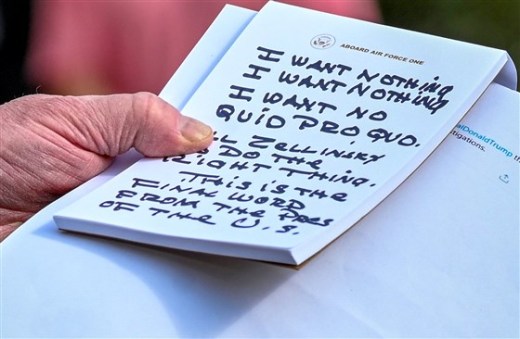
Trump talking points. He can’t even spell Zelensky.
Good Morning!!
Whew! Yesterday was a simply mind-boggling day that is guaranteed to go down in history–if Russia (and/or China, Turkey, North Korea) doesn’t succeed in winning a second term for Trump. Gordon Sondland threw everyone under the bus–he testified that “everyone was in the loop”–Trump, Mulvaney, Pompeo, Perry, Giuliani–and theirs was not an track in our foreign policy but the main track. And more is coming today.
The New York Times: Impeachment Inquiry Updates: Fiona Hill and David Holmes to Testify.
Who: Ms. Hill and Mr. Holmes will testify during a morning session. There is no afternoon session scheduled.
What: The House Intelligence Committee, led by its chairman, Representative Adam B. Schiff, Democrat of California, will continue to examine the case for impeaching Mr. Trump. The Republican minority, led by Representative Devin Nunes of California, will again work to poke holes in testimony implicating the president.
When and Where: The morning proceedings start at 9 Eastern in the House Ways and Means Committee chambers. It will most likely last until the afternoon.
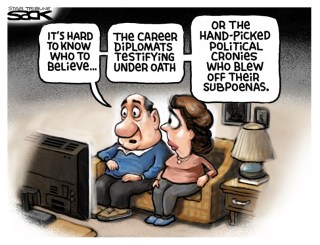 NPR: What To Watch For In Impeachment Hearing With Fiona Hill, David Holmes.
[Fiona] Hill is expected to tell lawmakers about the concerns she had with the merits of the Ukraine affair, in which Trump sought concessions from Ukraine’s president in exchange for engagement and continued financial assistance that had been authorized by Congress.
The U.S. had been sending aid to Ukraine since it was invaded by Russia in 2014 to help its military against Russian and Russian-backed forces still operating in the east.
The national security establishment opposed the freeze of that aid for several weeks this summer.
Hill told impeachment investigators in her closed deposition that she resented the smear campaign run against the former U.S. ambassador to Ukraine Marie Yovanovitch by Trump’s personal lawyer Rudy Giuliani.
Hill also is a key witness about the former national security adviser, John Bolton, who has been described as an important player in the Ukraine saga but from whom Congress has not heard directly….
[David] Holmes is a diplomatic staffer who went to lunch in July in Kyiv with the ambassador to the European Union, Gordon Sondland.
During that encounter, Sondland called Trump on his mobile phone to talk about the “investigations” that Trump wanted from his Ukrainian counterpart, Volodymyr Zelenskiy.
Holmes said in his deposition that Sondland t.old him Trump only cared about “big stuff” that affected him, like what Holmes called the “Biden investigation” Trump wanted from Ukraine.
Sondland says he didn’t know in real time that the investigation connected with the word “Burisma” — a Ukrainian company that for a time paid the son of former Vice President Joe Biden — was, in effect, code for the Biden family.
CNN has Hill’s opening statement: Former top Russia adviser to reject GOP claim that Ukraine meddled in US politics.
A former top White House official will offer on Thursday a full-throated rebuttal to the narrative pushed by President Donald Trump and his GOP allies about Ukraine’s role meddling in American politics, according to a source familiar with her testimony.
Fiona Hill, who served as Trump’s top Russia adviser until she left the administration this summer, will also warn the House Intelligence Committee as part of the impeachment inquiry that the Kremlin is prepared to strike again in 2020 and remains a serious threat to American democracy that the United States must seek to combat, the source said.
Yovanovitch testimony: November 16, 2019
In her brief opening statement, Hill will offer a strong pushback to the claims peddled by Trump, his personal attorney Rudy Giuliani and some congressional Republicans that Ukraine may have interfered in the 2016 elections to help Hillary Clinton.
Multiple witnesses have said that the moving forward on the 2016 election interference investigation — along with a probe into former Vice President Joe Biden and his son, Hunter — amounted to conditions placed on the country before roughly $400 million in military aid for the country was released and a key meeting in Washington between Trump and Ukrainian President Volodymyr Zelensky could take place.
Both Giuliani and Trump have urged the Ukrainian government to announce probes into any role the country may have had in the 2016 elections, something Trump brought up himself in his now-infamous July phone call with Zelensky.
But Hill in her testimony will argue that such a theory amounts to a fictional narrative at a time when the US should be focused on the real threat: Russia, which she warns could once again seek to interfere in the 2020 elections while the US is focused on Ukraine.
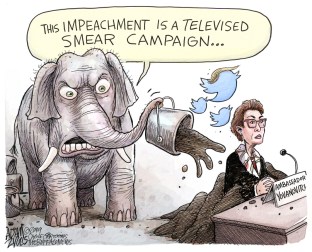
During Sondland’s testimony yesterday, Trump made a complete spectacle, screaming ineffectually at the assembled press on the White House lawn.
That is really really not normal. This man needs a complete neurological exam STAT. Speaking of Trump’s obvious dementia symptoms, Newsweek offers this quote from the new book by Anonymous: Trump Regularly ‘Can’t remember what he’s said or been told,’ White House Insider Says.
President Donald Trump regularly struggles to “remember what he’s said or been told,” an anonymous senior government official behind a new exposé on the inner workings of the White House has claimed.
Much of the nearly 260 pages of the anonymous official’s tome, A Warning, which hit bookshelves on Tuesday, has been dedicated to sounding the alarm about Trump’s alarming behavior.
While the anonymous author, who is described only as a “senior official in the Trump administration” admits they are not “qualified to diagnose the president’s mental acuity,” they can say that “normal people who spend any time with Donald Trump are uncomfortable by what they witness.”
“He stumbles, slurs, gets confused, is easily irritated, and has trouble synthesizing information, not occasionally but with regularity,” the official warns.
Often, they say, “the president also can’t remember what he’s said or been told.”
“Americans are used to him denying words that have come out of his mouth,” the senior official writes. “Sometimes this is to avoid responsibility.”
However, they say it often “appears Trump genuinely doesn’t remember important facts.”
One clear example of that, the official recalls, is when the president claimed he was not sure if he had “ever even heard of a Category 5” hurricane, despite having been briefed on at least four other Category 5 hurricanes during his time in office.
“Was he forgetting these briefings?” the author questions. “Or more problematic, was he not paying attention at all? These are events that affect millions of Americans, yet they don’t seem to stick in his brain.”
The official writes that while Trump has often claimed to be highly intelligent, they say they have “seen the president fall flat on his face when trying to speak intelligently” on a number of topics on which he claims to be an expert.
“You can see why behind closed doors his own top officials deride him as an ‘idiot’ and a ‘moron’ with the understanding of a ‘fifth or sixth grader,'” the unnamed senior official says.
More at the link.
One of the biggest reveals from Sondland’s testimony was that Mike Pompeo was involved in the entire Ukraine affair. The New York Times: Pompeo Emerges as a Major Trump Enabler in Ukraine affair.
Secretary of State Mike Pompeo has for months deflected questions about whether the Trump administration demanded political favors from Ukraine in exchange for military aid. He has refused to explain why he recalled the American ambassador, declared that it was “inappropriate” for his diplomats to testify before Congress and declined to hand over documents to impeachment investigators.
On Wednesday, Gordon D. Sondland, the American ambassador to the European Union, filled in the blanks: He said Mr. Pompeo and his top aides “knew what we were doing, and why,” and recited emails he wrote to Mr. Pompeo about the quid pro quo demanded by President Trump. “Everyone was in the loop,” Mr. Sondland said.
Mr. Sondland’s testimony has undercut any notion that Mr. Pompeo, the administration’s most powerful national security official, was not a participant in Mr. Trump’s efforts to pressure Ukraine. It also firmly places him at the center of one of the nation’s biggest foreign policy controversies in nearly two decades, since the debate over the intelligence that led to the war in Iraq.
Whatever Mr. Pompeo’s future plans, Mr. Trump’s secretary of state is now tied intimately to the Ukraine controversy. Even before Mr. Sondland’s testimony, Mr. Pompeo was rumored to be seeking an exit from the State Department, perhaps to run for a Senate seat in Kansas, his adopted home state, with an eye toward a presidential bid once Mr. Trump leaves the stage.
Lock. Him. Up.
I’ll end with two breaking news stories.
AP: AP source: FBI has asked for interview with whistleblower
The FBI last month requested an interview with the whistleblower whose complaint fueled the impeachment inquiry into President Donald Trump and Ukraine, a person familiar with the situation said Wednesday.
An agent from the FBI’s Washington field office reached out to the whistleblower’s lawyers last month to seek an interview about the substance of the complaint, according to this person, who insisted on anonymity to discuss the request with The Associated Press.
The person said it was clear from the FBI that the whistleblower was not regarded as the target of any investigation but rather a potential witness. It was not immediately clear what specifically the FBI might be looking into. The requested interview has not taken place.
Could this be related to the reportedly ongoing counterintelligence investigation?
The New York Times: Prosecutors Subpoena Trump Fund-Raisers Linked to Giuliani Associates.
Federal prosecutors in Manhattan issued subpoenas in recent weeks to several players in President Trump’s fund-raising apparatus as part of an investigation into two associates of Rudolph W. Giuliani who have been charged with violating campaign finance laws, according to people familiar with the investigation.
The subpoenas went to a lobbying firm run by a top fund-raiser for Mr. Trump, Brian Ballard, and to two people who have helped raise money for America First Action, a super PAC created to support the president and allied candidates, the people said.
Mr. Ballard and the America First fund-raisers worked to varying extents with Mr. Giuliani’s associates Lev Parnas and Igor Fruman, American citizens who helped Mr. Giuliani wage a pressure campaign on Ukraine that is now at the center of the impeachment inquiry into Mr. Trump.
The recent activity by prosecutors and F.B.I. agents shows that they have cast a wide net as they collect evidence about Mr. Parnas and Mr. Fruman, who were arrested last month. It also comes as the same prosecutors look into whether Mr. Giuliani, Mr. Trump’s personal lawyer, violated a federal lobbying law in some of his dealings with Ukrainians.
Lock Giuliani up with Pompeo.
Please treat this post as an open thread/live blog for today’s hearings.
Tuesday Reads: Week 2 of Impeachment Hearings and Trump’s Health
Posted: November 19, 2019 Filed under: Foreign Affairs, morning reads, U.S. Politics | Tags: Donald Trump, impeachment hearings, Trump's health 27 Comments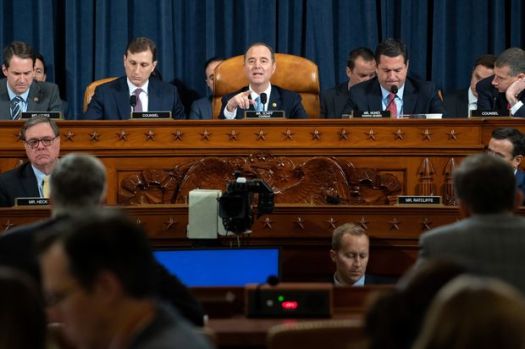
Good Morning!!
Today’s impeachment hearing begins at 9AM and may last into the night. NPR: Impeachment Hearings Resume With White House, State Department Witnesses.
House Democrats are set to kick off week two of their open impeachment hearings on Tuesday with witnesses who listened firsthand when President Trump spoke with President Volodymyr Zelenskiy on July 25 — a key moment in the Ukraine affair.
And members of Congress also said they’ve added a new witness to those slated to appear this week: David Holmes, the diplomatic aide posted to Ukraine who appeared for a closed-door deposition last week, now is scheduled to appear in an open hearing on Thursday morning.
Alexander Vindman
The hearing on Tuesday scheduled to start at 9 a.m. is set to open with Lt. Col. Alexander Vindman, an Army foreign area officer who serves on the National Security Council, and Jennifer Williams, a foreign service officer detailed to the staff of Vice President Mike Pence.
Vindman and Williams were among the White House staffers who listened in on the phone call.

This afternoon, beginning at 3PM:
Kurt Volker, the former State Department envoy to Ukraine for its peace negotiations and Tim Morrison, a former National Security Council aide.
Volker was at the center of the alternate policy channel for Ukraine run by Trump’s personal lawyer, Rudy Giuliani, and Volker helped broker an important meeting between Giuliani and an aide to Zelenskiy this summer.
Morrison was among those who heard the Trump-Zelenskiy call firsthand when it happened and although he testified that he was concerned about what might have happened if it became public, he saw nothing illegal.
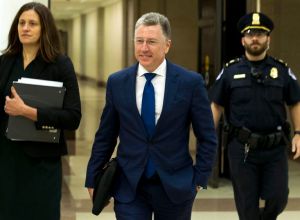
Kurt Volker
There will also be public testimony on Wednesday and Thursday. NBC News:
The committee will hear testimony from [Gordon] Sondland on Wednesday morning, and then testimony from Laura Cooper, the deputy assistant secretary of defense for Russian, Ukrainian, and Eurasian Affairs and David Hale, the undersecretary of state for political affairs, later in the day.
On Thursday, the panel will hear from Fiona Hill, the former NSC senior director for Europe and Russia who testified that Sondland had told Ukrainian officials they needed to proceed with “investigations” to line up a White House visit for Ukraine’s president. David Holmes, the U.S. Embassy in Ukraine official who overheard a July phone call between Sondland and Trump where the president was demanding “investigations,” will testify alongside Hill, the committee announced Monday.
The Washington Post: Lt. Col. Vindman to describe his alarm over president’s call with Ukrainian leader, girding for Republican attack.
Meanwhile Trump’s response to his possible impeachment is to attack the witnesses and dump them from their jobs.
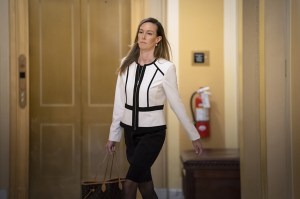
Jennifer Williams
The Washington Post: Attacking witnesses is Trump’s core defense strategy in fighting impeachment.
Eight weeks into the House impeachment inquiry, President Trump and many of his allies have seized on a core defense strategy by attacking career public servants who are testifying as witnesses in the probe and spreading disinformation about their motives as “unelected bureaucrats.”
The tactic was deployed in a prominent way Monday when Sen. Ron Johnson (R-Wis.) laid out criticisms against Lt. Col. Alexander Vindman, a National Security Council official who is poised to give key public testimony Tuesday. Johnson wrote without evidence that Vindman may be a member of a rebellious “deep state” that “never accepted President Trump as legitimate” and is working in secret to end his presidency.
“I believe a significant number of bureaucrats . . . resent [Trump’s] unorthodox style and his intrusion on their ‘turf,’ ” Johnson wrote to the top Republicans on the House Oversight and Intelligence committees. “They react by leaking to the press and participating in the ongoing effort to sabotage his policies and, if possible, remove him from office. It is entirely possible that Vindman fits this profile.”
Johnson’s letter intensifies a campaign of attacks on Vindman from Trump and his allies, which has included speculation about the decorated war veteran’s patriotism from conservative commentators and a White House statement on Friday criticizing his job performance. Moves such as these have gained significant traction with Trump’s base, feeding into an echo chamber that stokes supporters’ resentments, broadcasts a single pro-Trump message and demonstrates the power of the online juggernaut Democrats will confront during Trump’s 2020 reelection campaign.
Gordon Sondland
Much of this messaging has taken aim at the career public servants cooperating with the House impeachment inquiry.
Sharing a sentiment on Friday that gained viral popularity among his father’s supporters, Donald Trump Jr. tweeted that “America hired [Trump] to fire people like the first three witnesses we’ve seen.” He was referring to former ambassador to Ukraine Marie Yovanovitch, acting ambassador to Ukraine William B. Taylor Jr. and top State Department official George Kent, all of whom testified last week.

CNN: Trump’s aides eye moving impeachment witnesses out of White House jobs.
President Donald Trump’s aides have explored moving some impeachment witnesses on loan to the White House from other agencies, such as Lt. Col. Alexander Vindman, back to their home departments ahead of schedule, according to people familiar with the conversations.
As public hearings bring the officials’ allegations to his television screen, Trump is asking anew how witnesses such as Vindman and Ambassador Bill Taylor came to work for him, people familiar with the matter said. He has suggested again they be dismissed, even as advisers warn him firing them could be viewed as retaliation.
The possible move of officials out of the White House could still be viewed by some as evidence of retribution for their testimony. Trump’s frustration at his own officials comes as he attacks witnesses on Twitter, including during Friday’s public hearing with the ousted ambassador to Ukraine Marie Yovanovitch. Trump appears to have adopted a strategy of maligning the officials, despite some allies encouraging him not to.
David Holmes
The uncertain fate and public thrashing of these officials has created a thorny situation for a White House wading through the impeachment process. Trump’s impulse to dismiss them hasn’t been realized, but he’s made clear nevertheless he views them as unwelcome.
It’s one of the persistent anomalies of the impeachment inquiry: most of the witnesses airing concerns at Trump’s approach to Ukraine remain employed by him, despite his claims they are “Never Trumpers” and his overt suggestions they’ve already been fired.

In other news, Trump has not been seen in public since Saturday when he was rushed to Walter Reed hospital for an unscheduled medical examination.
The Washington Post: Trump’s health under scrutiny again after unplanned visit to Walter Reed.
President Trump’s impromptu weekend visit to a doctor brought fresh questions about the status of his health after the White House released a memo late Monday denying “speculation” that he had been treated for a medical emergency.
Trump, 73, made an unscheduled trip to Walter Reed National Military Medical Center in Bethesda, Md., on Saturday, a visit that remained shrouded in secrecy for two days as Trump stayed away from the public eye and the White House dodged questions about his health.
In a memo released by the White House late Monday, Trump’s doctor, Sean Conley, wrote that Trump’s “interim checkup” over the weekend had been “routine,” and was only kept secret because of “scheduling uncertainties.”
“Despite some speculation, the President has not had any chest pain, nor was he evaluated or treated for any urgent or acute issues,” Conley wrote in the memo. “Specifically, he did not undergo any specialized cardiac or neurologic evaluations.”
Sure, Jan.

While Trump claimed that he had begun “phase one” of his annual physical, Conley said Trump would have a “more comprehensive examination” next year. Trump described his condition on Twitter as “very good (great!)”; Conley’s memo did not characterize the president’s overall health. It did include cholesterol figures that had dropped since Trump’s last physical exam in February.
It is unusual for a president to undergo a physical exam in multiple stages months apart, and the circumstances surrounding Trump’s visit renewed questions about the White House’s handling of his medical information, according to several experts.
Time: Trump’s Unscheduled Hospital Visit Raises Suspicions About His Health.
A lack of notice. Past failures to level with the American people. A tough week for the White House as public impeachment hearings got under way.
Add it all up, and President Donald Trump’s unscheduled weekend visit to Walter Reed National Military Medical Center raised suspicions about his health, despite White House officials’ insistence that the president was merely getting a head start on his annual physical.
Laura Cooper
For any president, a sudden trip to the hospital would raise questions. But such scrutiny was magnified with a president who has a history of exaggeration and playing loose with the facts, giving skeptics room to run with their own theories.
“The one thing you can be absolutely sure of is this was not routine and he didn’t go up there for half his physical,” tweeted Joe Lockhart, a press secretary under President Bill Clinton, who was himself impeached for perjury and obstruction. “What does it mean? It means that we just won’t know what the medical issue was.”
The president’s medical appointment wasn’t listed on his Saturday public schedule, and his last physical was just nine months ago. Press secretary Stephanie Grisham said the 73-year-old president was “anticipating a very busy 2020” and wanted to take advantage of “a free weekend” in Washington to begin portions of his routine checkup.
She did not specify which tests he’d received or explain why the visit had not been disclosed in advance. Trump’s 2018 and 2019 physicals were both announced ahead of time. Grisham said after the visit that the president had gotten “a quick exam and labs.”
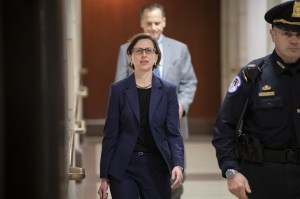

Fiona Hill
Jack Schaeffer at Politico: Yes, It’s OK to Speculate on the President’s Health.
Approximately 1,000 days and 13,500 documented faleshoods into his presidency, Donald Trump paid a two-hour visit to Walter Reed National Military Medical Center on Saturday afternoon under unusual, unprecedented circumstances.
Trump’s exam was not on his public schedule and no advance notice of the event had been given, unlike his two previous physicals; the exam fell on a Saturday rather than a weekday; and according to CNN, Walter Reed medical staff did not get its usual staffwide notice of Trump’s visit. Reportedly, the local police got no advance warning of the Trump motorcade’s arrival, and reporters were directed not to report his trip until he arrived at Walter Reed.
This touched off a weekend flurry of speculation in Washington about what was actually going on, and Twitter erupted with inventive theories of why a 73-year-old man might suddenly visit a hospital. With a private citizen, that kind of speculation would have been wildly inappropriate. With this White House, it’s almost a national obligation.
David Hale
White House press secretary Stephanie Grisham issued a statement claiming Trump was taking advantage of a “free weekend here in Washington” to begin parts of his annual physical exam—even though his last “annual” physical came in February 2019. While it’s not inconceivable that Trump would motorcade 11 miles to suburban Maryland on the spur of the moment on a Saturday afternoon to get a jump on his February physical, it’s not how things are normally done with the U.S. president. White House facilities are equipped to perform many routine lab tests. Trump seconded his press secretary’s explanation shortly after midnight on Sunday, tweeting that this was “phase one” of his yearly physical. “Everything very good (great!). Will complete next year,” Trump continued.
But Trump and Grisham’s rationalizations for his spur-of-the-moment visit just don’t add up. Given what we know about Trump’s medical health—he’s obese and was judged in 2018 of being at moderate risk of having a heart attack in the next three to five years—we have every reason to question the Trump-Grisham account. That Trump has proven himself a liar several thousand times over during his presidency and his long-running caginess about his medical state contribute to the doubt.

Read the rest at Politico.
Today’s hearings are about to begin, and I’ll be watching as much as I can. If you’re watching too, please share your reactions in this open thread.
Thursday Reads: Day 1 of Impeachment Hearings and Other News
Posted: November 14, 2019 Filed under: Foreign Affairs, morning reads, U.S. Politics | Tags: Donald Trump, impeachment hearings, Ukraine 25 Comments
By Aliza Nisenbaum
Good Morning!!
We finally got the first day of impeachment hearings yesterday, with more to come on Friday and next week. Republicans claim it was all so booooring. No one could watch these and stay awake.
Funny, Kellyanne’s husband George Conway didn’t seem to agree. He spent yesterday on MSNBC arguing in favor of impeaching and removing Trump.
Eric Wemple at The Washington Post: ‘I’m horrified. I’m appalled’: George Conway takes Trump-bashing mind to MSNBC.
Conway brought his pro-impeachment views to MSNBC on Wednesday morning. Asked about what constitutes an impeachable offense, Conway — who bailed on the Republican Party last year — offered the following:
That goes to the very heart of what a high crime and misdemeanor is. I mean, there are two ways to look at it: The first — the way I prefer to look at it — is the holistic view, and the holistic view is that when you become president, you raise your right hand and you swear to faithfully execute the office of president of the United States, and also the Constitution provides and uses that word, those words “faithfully execute,” in reference to faithfully execute the laws. And when you take on that duty — and the framers really took oaths seriously — you are promising to take that awesome power that’s being thrust upon you and use it for the nation’s benefit and not for your own benefit. And the problem with Donald Trump is, he always sees himself first.
It just so happens, noted Conway, that in the case of Ukraine, President Trump used the “most unchecked” power of the presidency — foreign policy, that is — to “advance his own personal interests as opposed to the country’s.” As several witnesses have claimed in closed and open House depositions, Trump and his associates attempted to condition military aid and an Oval Office meeting on the Ukrainian president’s announcement of an investigation into former vice president Joe Biden and his son Hunter.
As for why some folks can’t see the abuses of power, Conway need look no further than another cable-news channel — one where his sentiments might be a bit less welcome. “I’m horrified. I’m appalled,” said Conway about the Republican response to Trump’s misdeeds.

Lois Rossbach Ellis (American; born 1925), 1953
Actually, there was an unexpected bombshell in Wednesday’s testimony. Ambassador Bill Taylor revealed that a member of his staff overheard Trump asking about the “investigations” he was pressuring Ukraine to undertake when EU Ambassador Gordon Sondland called Trump on a cell phone in a Ukrainian restaurant. The call took place on July 26, one day after Trump’s infamous phone call to Ukraine’s president Volodymyr Zelensky.
The Washington Post: Ambassador’s cellphone call to Trump from Kyiv restaurant was a stunning breach of security, former officials say.
A U.S. ambassador’s cellphone call to President Trump from a restaurant in the capital of Ukraine this summer was a stunning breach of security, exposing the conversation to surveillance by foreign intelligence services, including Russia’s, former U.S. officials said.
The call — in which Trump’s remarks were overheard by a U.S. Embassy staffer in Kyiv — was disclosed Wednesday by the acting U.S. ambassador to Ukraine, William B. Taylor Jr., on the dramatic opening day of public impeachment hearings into alleged abuse of power by the president.
“The member of my staff could hear President Trump on the phone” asking U.S. Ambassador to the European Union Gordon Sondland about “the investigations,” Taylor testified, referring to the president’s desire for a probe of the son of Trump’s potential political opponent in 2020, Joe Biden, and the Ukrainian energy company on whose board Hunter Biden once served.
Sondland, Taylor said, told Trump in that conversation that “the Ukrainians were ready to move forward” on the investigations.
The U.S. Embassy staffer who overheard the call, political counselor David Holmes, is scheduled to testify Friday before House impeachment investigators in a closed session.

Paritosh Sen, Woman Reading a Newspaper
After the call ended Holmes asked Sondland how Trump felt about Ukraine. Sondland replied that Trump cared more about investigating Biden than helping Ukraine.
More from the Post on the security implications of the call:
“The security ramifications are insane — using an open cellphone to communicate with the president of the United States,” said Larry Pfeiffer, a former senior director of the White House Situation Room and a former chief of staff to the CIA director. “In a country that is so wired with Russian intelligence, you can almost take it to the bank that the Russians were listening in on the call.” [….]
It was also noteworthy in that ambassadors typically don’t just pick up the phone and call presidents. “They never do so to discuss Ukraine policy,” former U.S. ambassador to Russia Michael McFaul said in a tweet. “Doing so on a cellphone from Kyiv means [the] whole world was listening in.”
Mediaite reports that, according to Watergate alum John Dean, First Day of Trump Hearings Yielded More Damning Testimony Than All of Watergate.
Former Nixon White House counsel John Dean characterized the first day of public impeachment testimony against President Donald Trump as both thorough and damning, saying House Democrats “already have more than they had against Richard Nixon to impeach him. Just on all accounts….
“John, I mean, given what you saw today, did this move the needle for any Republican senators who are watching?” CNN host Anderson Cooper asked Dean.
“There’s a conspiracy, we know from what’s come out of the executive sessions, generally, where this is going,” Dean said. “What struck me today in listening to these two witnesses is they already have more than they had against Richard Nixon to impeach him. Just on all accounts.”
“Why do you say that?” asked fellow panelist, CNN legal analyst Jeffrey Toobin.
Eda Sterchi, Portrait of a woman reading a newspaper
“Because the evidence is there,” Dean responded. “It was my testimony, a few people that were lower in the pecking order than me, and it happened before the tapes.”
Unlike the already released call summary where Trump is seen soliciting an investigation into his potential political rival, the blockbuster revelation that a White House taping system existed only came out weeks after Dean’s testimony in June 1973. The subsequent legal fight by the Nixon White House to prevent releasing the tapes to Congress became another impeachable offense and the infamous 18-and-a-half-minute gap on a tape where Nixon discussed the Watergate break-in became a key piece of evidence proving the Nixon cover-up.

Meanwhile, Republicans have conspiracy theories. Yesterday at Buzzfeed News: The Witnesses At Today’s Impeachment Hearing Weren’t Trying To Evade Republicans’ Questions. They Couldn’t Understand Them.
From the very first questions that Republicans asked in the first public hearing in the impeachment inquiry into President Donald Trump on Wednesday, it was clear that a core part of the proceedings will not be about determining whether the president committed an impeachable offense. Instead, it will be an example of the damage that years of right-wing misinformation has done to the highest levels of the country’s political system.
Many of the questions from the House Intelligence Committee left Bill Taylor, the acting ambassador to Ukraine, and George Kent, a senior state department official, in disoriented silence.
In their opening statements, both Rep. Adam Schiff, the Democratic chair of the Intelligence Committee, and the committee’s vice chair, Republican Rep. Devin Nunes, brought up elements of the prominent, but baseless, CrowdStrike conspiracy theory that a cybersecurity firm attempted to cover up evidence that Ukraine tried to meddle in the 2016 presidential election. Whereas Schiff’s questions seemed framed to establish that Trump and his allies spent years chasing rumors, Nunes and the other Republicans on the Intelligence Committee staked much of their time on nonsense yanked from conservative Facebook groups and hyperpartisan news sites.
Anthony Watkins, Sunday News
“Trump then requested that Zelensky investigate a discredited 2016 CrowdStrike conspiracy theory and, even more ominously, look into the Bidens,” Schiff said. “Neither of these investigations was in the US national interest.”
“This is a carefully orchestrated media smear campaign,” Nunes said. “Now they accuse Trump of malfeasance in Ukraine, when they themselves are culpable.”
There is one America that believes what was in former FBI director Robert Mueller’s report, that there was coordinated Russian interference in the 2016 presidential election, which helped the Trump campaign. But there is a second America that believes that in the summer of 2016, the Democratic National Committee colluded with Ukrainian nationals to frame the Trump campaign for collusion with Russia, implicating a Ukrainian American DNC contractor, Alexandra Chalupa, in the collusion and the California-based cybersecurity firm CrowdStrike in the subsequent cover-up.

The impeachment inquiry has also revealed the vast damage that Trump has done to U.S. diplomacy.
Joshua J. Geltzer at The Atlantic: The System Was Blinking Red.
Those who listened to the first day of public impeachment hearings, focused on Ukraine-related matters, heard a lot about Donald Trump and a lot about Rudy Giuliani. And for good reason: Both were central players in the White House–driven push to trade American weapons and a meeting at the White House for Ukraine’s help with Trump’s reelection.
But listeners also heard a lot about long-serving U.S. government officials, including the two witnesses who testified, and how they reacted to the push led by Trump and Giuliani. What might have gotten lost in the day’s testimony is that these more ordinary officials were doing extraordinary things. Those included repeated threats to resign and repeated referrals to lawyers of possible violations of U.S. law by U.S. officials. This is not normal—not normal behavior by public servants, not normal disagreement within the policy-making process, not normal at all. To the contrary, this is a sign that inside the U.S. government, Trump’s improper bullying of Ukraine was setting off alarms—and the system was blinking red.
Miki de Goodaboom, woman Reading a Newspaper
Start with the multiple threats of resignation that Ambassador William Taylor, America’s top diplomat in Ukraine, indicated he’d made with utter sincerity (an indication confirmed by the written record). Threats of resignation by government officials—especially officials like Taylor, with decades of service to presidents of both political parties—are extremely rare. Given how dramatic a threat of resignation is, and given how frequent such resignations have been under the Trump administration, it’s important to remember that this isn’t, say, an ordinary negotiating tactic for government officials as they jostle with colleagues in formulating policy. Quite the opposite—this is the ultimate card to play, and most government officials go through their entire careers without ever considering it. (I never played it while I served in government!) [….]
And it wasn’t just the policy process’s breakdown that was clear to U.S. government officials seeing this all unfold; it was adherence to the law as well. The first day of testimony confirmed earlier reporting that U.S. government officials who realized the nature of the White House’s Ukraine push repeatedly asked that White House national-security lawyers be notified out of concern that matters were headed seriously, even dangerously, awry. That, too, is not normal—not even close to it.

Read the rest at The Atlantic.
The Daily Beast: Revealed: The Pro-Trump Playbook for Smearing U.S. Diplomats.
Foreign governments have settled on a new strategy to sideline American officials they don’t like: peddling conspiratorial dirt on those officials to portray them as enemies of President Donald Trump.
The impeachment inquiry has revealed the success of that strategy in Ukraine, where ethically dubious officials teamed up with Trump’s personal attorney to remove a U.S. ambassador. A Hungarian government-backed campaign against a top National Security Council official was less successful, though not for a lack of effort. And according to senior U.S. officials, the same strategy succeeded in scuttling a nominee to be America’s top diplomat in Albania.
Perhaps it shouldn’t come as a surprise that John Solomon, one of Rudy Giuliani’s favorite conservative columnists and conspiracy-peddlers, makes an appearance in both the Ukraine and Albanian dramas.
Woman in black reading a newspaper, Rik Wouters (1882-1916), painted in 1912.
“We have permitted open season on our diplomats,” declared Fiona Hill, a former senior Trump White House national security official, during her closed-door testimony to the impeachment inquiry. “Any one of us here could be subject to this kind of claims and these kinds of attacks, any single person who gets crosswise with any of these individuals or any of these countries, if they think that any of us are in the way.”
The attacks frequently invoke George Soros, the right-wing bogeyman and Fox News primetime fixture. And they appear tailor-made to Trump’s idiosyncratic sensibilities, focusing on issues and controversies that tend to grab the attention of right-wing media—and, by extension, the president himself. The strategies also bear the hallmarks of the surreptitious campaign to undermine U.S. diplomats in Ukraine by people close to the president, chiefly hRis personal attorney, Rudy Giuliani.

Read the rest at the link.
More stories to check out:
Renato Mariotti at Politico: Impeachment Is Not a Fair Fight, and on Day One It Showed.
John Harris at Politico Magazine: Trump Exposed: A Brutal Day for the President.
The New York Times: As Talks With Putin Loom, Ukraine Looks in Vain for U.S. Help.
Slate: The Seven Ways Wednesday’s Hearing Clarified Trump’s Real Motives.
Axios: Erdogan upends Oval meeting to play anti-Kurd film on iPad.
The New York Times: Erdogan Hands ‘Tough Guy’ Letter Back to Trump.
The Washington Post: Leaked Stephen Miller emails show Trump’s point man on immigration promoted white nationalism, SPLC reports.
NBC News: Democrats call for Stephen Miller to resign after leak of xenophobic emails.
CBS News: Michael Bloomberg won’t file for New Hampshire primary.
The New York Times: Michael Bloomberg Has a History of Demeaning Comments About Women.
FiveThirtyEight: Why Deval Patrick Is Making A Late Bid For The Democratic Nomination.
CNN: Exclusive: Trump DC hotel sales pitch boasts of millions to be made from foreign governments.
Tuesday Reads: Public Impeachment Hearings Begin Tomorrow
Posted: November 12, 2019 Filed under: Foreign Affairs, morning reads, U.S. Politics 10 Comments
Good Morning!!
Tomorrow should be an interesting day, as the impeachment inquiry goes public for the first time. NPR has all the details: Impeachment Hearing FAQ: Who Will Testify And How The Questioning Will Work.
Public impeachment hearings begin Wednesday, and the first round of witnesses includes three career public servants who have testified behind closed doors that President Trump did link military aid and a White House meeting for Ukraine with a promise to investigate one of the president’s domestic political opponents….
The first hearing is on Wednesday beginning at 10 a.m. ET. The second hearing is scheduled for 9 a.m. ET on Friday. You can watch live on NPR.org and listen to special coverage on many local public radio stations….
The three witnesses who will appear:
William Taylor, the top diplomat in Ukraine, told investigators that he learned shortly after he was tapped for his post that there was a parallel foreign policy channel set up that he believed undermined U.S. national security interests.
George Kent,the deputy assistant secretary of state for European and Eurasian affairs, described how Rudy Giuliani, the president’s personal lawyer, went against the traditional bipartisan approach regarding U.S. support for Ukraine in an effort to push for political investigations.
Marie Yovanovitch was ousted from her post as the U.S. ambassador to Ukraine in May after a campaign led by Giuliani to criticize her performance and alleged lack of support for the president’s policies. She recounted in her closed-door testimony that she was told by Ukrainians to “watch my back” because Giuliani’s associates were pushing their business interests and viewed her as an obstacle.
More at the NPR link.
The Washington Post: Career federal employees are the protagonists in the impeachment drama — at risk to themselves.
Rank-and-file bureaucrats who work in the federal agencies that handle national security will defy the directive of the White House to stay quiet, instead describing what they saw as they went about, in their view, just doing their jobs.
Their role in recounting to the public how President Trump and his allies attempted to enlist Ukraine to investigate his political rivals will not come without risk. All but one of the 11 career Foreign Service staff, military officers and Pentagon officials who first testified in closed-door depositions in the Capitol basement are still in government.
They’re back at work following the extraordinary private testimony they gave starting Oct. 3 in the impeachment inquiry into the president they work for. For now, they’ve faced no efforts to punish them for telling House investigators that normal diplomacy was bypassed by a rogue foreign policy to benefit Trump politically, their lawyers say. However, former Ukraine ambassador Marie Yovanovitch, who is scheduled to testify publicly on Friday, is close to retirement and told House investigators that she felt “threatened” by the president — and worried about her pension and her employment.
Top White House political appointees failed to comply with subpoenas to testify. So the accounts of longtime professional staff have driven the fact-finding by the House Intelligence Committee. Their testimony provides a striking contrast with some aides who have left the Trump administration in frustration — only to keep their observations private.
“The American people do not know the extent to which they now benefit from these anonymous professionals in the federal government,” said Timothy Naftali, a historian at New York University and former director of the Richard Nixon Presidential Library and Museum. “The way to understand how the Trump team subverted national security is to understand the experts, the neutral professionals who are describing how foreign policy is supposed to be conducted.”
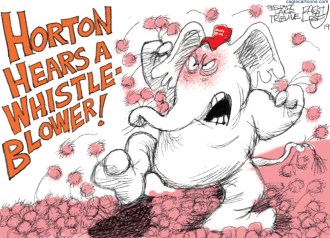 CNN examines the Russian reactions to the impeachment drama: Putin has relished US political chaos. He may now fear Trump’s impeachment.
On Russian state television, tightly controlled by the Kremlin, support for Donald Trump in his current impeachment battle is absolute. After all it is Russia, they sometimes joke, that got the US president elected in the first place!
Of course, allegations of meddling in the 2016 US presidential election, which swept Trump into office, are officially denied in Russia. But they are often referenced, even on serious television news shows, with a sarcastic wink.
“Have you lost your minds that you want to remove OUR Donald Ivanovich,” bawls Vladimir Soloviev, host of “Evening,” a pro-Kremlin current affairs program which has been focusing on the US impeachment proceedings….
“The chaos brought by Trump into the American system of government is weakening the United States,” Karen Shakhnazarov, CEO of Mosfilm Studio and a regular guest on Russian state television, tells the studio audience.
“America is getting weaker and now Russia is taking its place in the Middle East. Suddenly, Russia is starting to seriously penetrate Africa. So, when they say that Trump is weakening the United States — yes he is and that’s why we love him. The more problems they have, the better for us,” Shakhnazarov says
Read the rest at CNN.
The New York Times has a great background article on the Ukraine matter. It’s long and involved, so I’ll just post the link here for anyone who wants to read it: Trump, Ukraine and Impeachment: The Inside Story of How We Got Here.
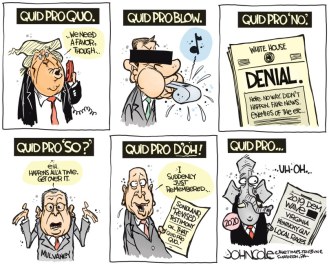 As usual, the White House is in chaos in the lead-up to public hearings. The Washington Post reports: White House infighting flares amid impeachment inquiry.
The White House’s bifurcated and disjointed response to Democrats’ impeachment inquiry has been fueled by a fierce West Wing battle between two of President Trump’s top advisers, and the outcome of the messy skirmish could be on full display this week, according to White House and congressional officials.
Acting chief of staff Mick Mulvaney has urged aides not to comply with the inquiry and blocked any cooperation with congressional Democrats. Top political aides at the Office of Management and Budget, which Mulvaney once led, have fallen in line with his defiant stance, the officials said, speaking on the condition of anonymity to talk freely about the behind-the-scenes developments.
Mulvaney’s office blames White House counsel Pat Cipollone for not doing more to stop other government officials from participating in the impeachment inquiry, as a number of State Department officials, diplomats and an aide to Vice President Pence have given sworn testimony to Congress.
Cipollone, meanwhile, has fumed that Mulvaney only made matters worse with his Oct. 17 news conference, when he publicly acknowledged a quid pro quo, essentially confirming Democrats’ accusations in front of television cameras and reporters. Cipollone did not want Mulvaney to hold the news conference, a message that was passed along to the acting chief of staff’s office, according to two senior Trump advisers, who spoke on the condition of anonymity. A Mulvaney aide said a team of White House lawyers prepared him for the news conference and never said he should not do it.
Head over to the WaPo to read the rest.
Adam Schiff released more transcripts yesterday, breaking more news.
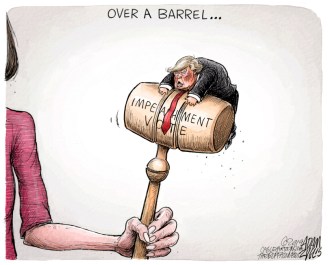 Betsy Swan at the Daily Beast: Mulvaney’s OMB Held Up Lethal Ukraine Aid in 2017 for Fear of Russian Reaction.
Under Mick Mulvaney’s leadership, the Office of Management and Budget temporarily put a hold on the delivery of anti-tank missiles to Ukraine in 2017 because of concerns their arrival would upset Russia, according to former White House official Catherine Croft….
Croft told congressional impeachment investigators that after the Trump administration greenlit the delivery of Javelin missiles to Ukraine in late 2017—the first delivery of lethal aid to the country since Russian separatists seized territory in its Eastern region in 2014—Mulvaney’s office held it up.
“Did you understand why?” asked the congressional staffer questioning her.
“I understood the reason to be a policy one,” she replied.
“What was the policy one?”
“In a briefing with Mick Mulvaney, the question centered around the Russian reaction,” she continued.
“What was the concern about the Russian reaction?” asked the staffer.
“That Russia would react negatively to the provision of Javelins to Ukraine,” she said.
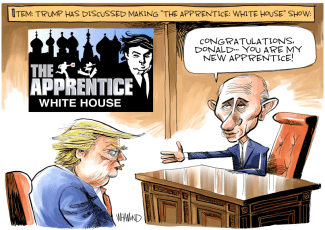 NBC News: Pentagon official testifies White House directed freeze on aid to Ukraine.
Laura Cooper, the top Pentagon official overseeing U.S. policy regarding Ukraine, told House impeachment investigators last month that President Donald Trump directed the relevant agencies to freeze aid to Ukraine over the summer, according to a transcript of her testimony released Monday.
Cooper, during Oct. 23 testimony before the three House committees leading the impeachment inquiry into Trump’s Ukraine dealings, testified that she and other Pentagon officials had answered questions about the Ukraine assistance in the middle of June — so she was surprised when one of her subordinates told her that a hold had been placed on the funds after an interagency meeting in July.
“I got, you know, I got a readout from the meeting — there was discussion in that session about the — about OMB [Office of Management and Budget] saying that they were holding the Congressional Notification related to” Ukraine, Cooper testified, according to the transcript.
Cooper, according to the transcript of her testimony, described the hold as “unusual.”
Cooper said that she attended a meeting on July 23, where “this issue” of Trump’s “concerns about Ukraine and Ukraine security assistance” came up. She said the president’s concerns were conveyed by acting White House chief of staff Mick Mulvaney.
Days later, on July 26, she testified that she found out that both military and humanitarian aid had been impacted.
Asked if the president was authorized to order that type of hold, Cooper said there were concerns that he wasn’t.
You can also read a lengthy summary of the latest transcripts at Politico: ‘Alarm bells’: What Cooper, Croft and Anderson told impeachment investigators.
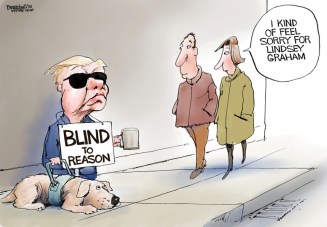 Also at Politico, Laura Glover has an interesting piece on how the Senate could end up removing Trump: There’s a Surprisingly Plausible Path to Removing Trump From Office.
By most everyone’s judgment, the Senate will not vote to remove President Donald Trump from office if the House impeaches him. But what if senators could vote on impeachment by secret ballot? If they didn’t have to face backlash from constituents or the media or the president himself, who knows how many Republican senators would vote to remove?
A secret impeachment ballot might sound crazy, but it’s actually quite possible. In fact, it would take only three senators to allow for that possibility.
Senate Majority Leader Mitch McConnell has said he will immediately move to hold a trial to adjudicate the articles of impeachment if and when the Senate receives them from the House of Representatives. Article I, Section 3, of the Constitution does not set many parameters for the trial, except to say that “the Chief Justice shall preside,” and “no Person shall be convicted without the Concurrence of two thirds of the Members present.” That means the Senate has sole authority to draft its own rules for the impeachment trial, without judicial or executive branch oversight….
…according to current Senate procedure, McConnell will still need a simple majority—51 of the 53 Senate Republicans—to support any resolution outlining rules governing the trial. That means that if only three Republican senators were to break from the caucus, they could block any rule they didn’t like. (Vice President Mike Pence can’t break ties in impeachment matters.) Those three senators, in turn, could demand a secret ballot and condition their approval of the rest of the rules on getting one.
So . . . what stories are you following today?
Lazy Caturday Reads
Posted: November 9, 2019 Filed under: Foreign Affairs, morning reads, U.S. Politics 26 Comments
By Midori Yamada
Good Morning!!
It has been an interesting week in the impeachment inquiry and next week should be even more interesting. Will John Bolton testify? He’s apparently OK with his lawyer leaking information to The New York Times: Bolton Said to Know of ‘Many Relevant Meetings’ on Ukraine, but Will Not Testify.
John R. Bolton, President Trump’s former national security adviser, knows about “many relevant meetings and conversations” connected to a pressure campaign on Ukraine that House impeachment investigators have not yet been informed of, his lawyer told lawmakers on Friday.
The lawyer, Charles J. Cooper, tucked the tantalizing assertion into a letter to the chief House lawyer in response to committee chairmen who have sought Mr. Bolton’s testimony in their impeachment inquiry but expressed unwillingness to go to court to get an order compelling it….
By Tetsuo Takahara
…hints about what Mr. Bolton might be able to add came as new details emerged from the impeachment inquiry about how an effort by Mr. Trump’s allies to use the United States’ relationship with Ukraine to accomplish the president’s political goals opened a bitter rift inside the White House.
According to testimony made public on Friday, the push, spearheaded in large part by Rudolph W. Giuliani, the president’s personal lawyer, pitted Mr. Bolton, who sought repeatedly to resist it, against Mick Mulvaney, the acting chief of staff who senior officials said may have played a central role in carrying it out.

Trump is sucking up to Bolton this morning.
This from the NYT article makes me want to read Fiona Hill’s testimony this weekend.
Transcripts of testimony by Fiona Hill, the former senior director for Russia and Europe at the National Security Council, and Lt. Col. Alexander S. Vindman, the Ukraine expert there, described how the council under Mr. Bolton became consumed with trying to thwart Mr. Giuliani’s efforts to bend Ukraine policy to the president’s political advantage.
By Cheryl Wilson
They said there was evidence Mr. Mulvaney was involved in setting up a quid pro quo in which Ukraine could not receive a White House meeting unless top officials there committed to investigations that Mr. Trump wanted. And they showed how the foreign policy officials most deeply knowledgeable about Ukraine were sidelined and forced to act as mere spectators — in some instances watching for Mr. Giuliani’s freewheeling appearances on cable news for clues — in dealing with the relationship with Kiev.
Ms. Hill said Mr. Bolton repeatedly sought to cut off the influence of Mr. Giuliani, whom he referred to as a “hand grenade.”
Mr. Bolton was “closely monitoring what Mr. Giuliani was doing and the messaging that he was sending out,” she told investigators, adding that he warned “repeatedly that nobody should be meeting with Giuliani.”

And Hill knows about Trump’s history with Russia.
Alexander Vindman’s testimony might be an interesting read too. He tore apart Trump propagandist John Solomon’s “reporting” on the fake Ukraine conspiracy. The Washington Post: ‘But you know, his grammar might have been right’: Lt. Col. Vindman bashed John Solomon in testimony.
Kazuaki Horitomo
In his deposition last month on Capitol Hill, Lt. Col. Alexander Vindman characterized as “false” the work of John Solomon, the former executive vice president for digital video at The Hill, according to a transcript released Friday. Vindman just might know: He has served as the top Ukraine hand at the National Security Council and watched as Solomon’s reports on the country in The Hill surfaced earlier this year. He gave his deposition as part of the House impeachment inquiry.
In the pages of The Hill, Solomon poured starting fluid on the idea that former vice president Joe Biden had pressed for the ouster of a Ukrainian prosecutor so as to lessen the pressure on the company where his son, Hunter Biden, held a board seat. Part of this Solomon oeuvre included an interview with then-Ukrainian prosecutor General Yuriy Lutsenko, who alleged that former U.S. ambassador to Ukraine Marie Yovanovitch had presented him a do-not-prosecute list.
There’s no evidence for such a deed. Lutsenko later retracted the claim, and Vindman called it “preposterous” in his deposition.
Rep. Lee Zeldin (R-N.Y.) decided to press Vindman on his conclusion that Solomon was pushing bogus reporting.
Zeldin: Did your sources, though, say that everything was false or just parts of it were false?Vindman: I think all the key elements were false.Zeldin: Just so I understand what you mean when you say key elements. Are you referring to everything John Solomon stated or just some of it?Vindman: All the elements that I just laid out for you. The criticisms of corruption were false.Zeldin: You mentioned —Vindman: Were there more items in there, frankly, congressman? I don’t recall. I haven’t looked at the article in quite some time, but you know, his grammar might have been right.

To check on Solomon’s reporting, Vindman had quizzed his “interagency colleagues” at the State Department and the intelligence community. He asked for “background” and wanted to know if there was “anything substantive in this area.”
Read more at the WaPo.

By Kamwei Fong
Alexander Nazaryan at Yahoo News: Testimony from Alexander Vindman and Fiona Hill caps a devastating week for Trump.
The week ended on a sour note for President Trump, with the public release of testimony by two national security council staffers — one current, one former — who expressed alarm over the way Trump officials pressured Ukrainian President Volodymyr Zelensky for political help at home. The campaign, orchestrated by Trump’s personal lawyer Rudy Giuliani and intended to harm Joe Biden, a political rival, is now the subject of an impeachment inquiry launched last month by the House of Representatives….
That scheme was managed by Giuliani, whose role in attempting to wrest political concessions from Zelensky was plainly troubling to career public servants unused to his unorthodox approach. “Rudy Giuliani is a hand grenade that is going to blow everybody up,” national security adviser John Bolton told Fiona Hill, a Russia hardliner on the National Security Council whose testimony was released on Friday.
The other transcript released on Friday is of the interview with Lt. Col. Alexander Vindman, a Ukraine expert at the NSC. Vindman remains at his job at the Eisenhower Executive Office Building, right next to the White House, despite having been the subject of withering attacks by Trump and his allies. Bolton was fired in September, while Hill left her post in June.
The testimony of the two officials is bound to energize Democrats ahead of next week’s public hearings. It includes a denunciation by Vindman of the “inherent risk” of playing politics with world affairs and Hill’s flat assessment of the Republican talking point — that Ukraine “was launching an effort to upend our [2016] election” — as “a fiction.”
Read the rest at the link. You can also read a good summary of the testimony highlights at CNN: We read all 2,677 pages of impeachment inquiry testimony released to date. Here’s what’s clear.
The New York Times has a background piece on John Eisenberg, the White House lawyer who is accused of ordering concealment of Trump’s Ukraine phone call: Ukraine Affair Thrusts White House Lawyer Into Center of Crisis.
Mr. Eisenberg has emerged as a central figure in the impeachment inquiry, appearing frequently in the new transcripts. House investigators want to question him, but he skipped a scheduled deposition this week….
By Didier Lourenco
Mr. Eisenberg, 52, served a decade ago as a Justice Department lawyer who worked on surveillance law. Interviews with more than two dozen current and former colleagues paint a portrait of a meticulous, conservative lawyer with a tightly wound and introverted, sometimes prickly manner.
Former associates questioned whether his experience made him an awkward fit for his current role, which requires rendering legal judgments in fast-moving crises arising from military and intelligence operations. The Trump transition team selected Mr. Eisenberg over many prominent Republican national security lawyers who had signed “Never Trump” statements.

That figures. At the DOJ, Eisenberg was a supporter of warrantless surveilance program.
During the George W. Bush administration, Mr. Eisenberg landed at the Justice Department’s powerful Office of Legal Counsel, where he came to focus on national security.
In Mr. Bush’s second term, Mr. Eisenberg was among a few executive branch lawyers who tried to put its contentious warrantless surveillance program onto firmer legal footing. Mr. Bush began the program after the Sept. 11 attacks based on an expansive claim of executive power, even though a 1978 law required court orders for wiretaps on domestic soil.
Mr. Eisenberg and the other lawyers developed a creative legal theory for why a court could lawfully issue orders blessing the program. They persuaded a judge in 2007 to do so. But another judge balked, and the administration turned to Congress to enact a new surveillance law instead.
Read more about Eisenberg at the NYT link.
According to Dana Millbank at The Washington Post, there are plenty of examples of Trump’s childish behavior in the impeachment inquiry transcripts: The United States is being run by a toddler.
He has tantrums. He rips up paper. He disregards facts. He believes crazy conspiracies. He’s erratic and ill-informed. Those around him walk on eggshells, trying to prevent him from doing the geopolitical equivalent of sticking his finger in an electrical socket.
U.S. Ambassador to the European Union Gordon Sondland, a Trump donor and political appointee, described Trump’s style: “President Trump changes his mind on what he wants on a daily basis. I have no idea what he wanted on the day I called him.” Sondland also spoke about Trump’s “completely inconsistent” behavior: “The funny part is that he was railing about the problems with Ukraine in our meeting, but I think shortly after that he sent essentially an unconditional invitation to President Zelensky to come visit him.”
By Hiroshige
Sondland testified about Trump’s unreasonableness (“He sort of went on and on and on about how Ukraine is a disaster and they’re bad people”), limited attention (“He didn’t even want to deal with it anymore, and he basically waved and said, ‘Go talk to Rudy’”) and poor judgment (“Taking directions from the president, as I must, I spoke with Mr. Giuliani … Please know that I would have not recommended that”). Likewise, George Kent, the deputy secretary of state overseeing Ukraine, painted a picture of aides trying to soothe a childlike Trump. “Initially the president did not want to sign a congratulatory letter, and he actually ripped up the letter that had been written for him,” Kent testified. “But by the end of the meeting he’d been convinced.”
Republicans’ questions suggest they, too, accept that the president is not entirely rational; they urged witnesses to respond as “if you are in President Trump’s world,” whether Trump’s views are “reasonable or not” and “fair or not.”
For example: “If the president, for whatever reason, true or untrue, develops a feeling that he’s got an ambassador that isn’t loyal to him, he’s going to bring them home, correct?”
And: “If you try to get inside the president’s head, I mean, he may have been searching for the name ‘Burisma’ but couldn’t grasp it so he spits out ‘Biden’?”

More examples at the link.
I’m going to end there. Please share your thoughts and recommended reads in the comment thread below.

 peej
peej Carissa
 bostonboomer
 dakinikat
 ecocatwoman
 mablue2
 Mama Lopez
 peggysue22
 quixote
 skydancingguestblogger
 Mona (aka Wonk the Vote)



 Sky Dancing
Recent Comments