
Lazy Caturday Reads: Trump’s Stupid Iran Gambit
Posted: January 4, 2020 Filed under: Afternoon Reads, Foreign Affairs, U.S. Politics | Tags: 2020 presidential election, Barack Obama, Donald Trump, iran, Iraq War lies, Qassem Soleimani 33 Comments
Good Afternoon!!
There are several articles at major news sources today claiming to describe the process by which Trump decided to kill Iranian General Qassem Soleimani. Sorry, I don’t buy it. Trump doesn’t make decisions in the orderly manner in which aides and gullible reporters like to describe. I think this Twitter thread by The Hoarse Whisperer makes more sense.
This article at The Daily Beast supports Hoarse’s argument: Trump Told Mar-a-Lago Pals to Expect ‘Big’ Iran Action ‘Soon.’
In the five days prior to launching a strike that killed Iran’s most important military leader, Donald Trump roamed the halls of Mar-a-Lago, his private resort in Florida, and started dropping hints to close associates and club-goers that something huge was coming.
According to three people who’ve been at the president’s Palm Beach club over the past several days, Trump began telling friends and allies hanging at his perennial vacation getaway that he was working on a “big” response to the Iranian regime that they would be hearing or reading about very “soon.” His comments went beyond the New Year’s Eve tweet he sent out warning of the “big price” Iran would pay for damage to U.S. facilities. Two of these sources tell The Daily Beast that the president specifically mentioned he’d been in close contact with his top national security and military advisers on gaming out options for an aggressive action that could quickly materialize.
“He kept saying, ‘You’ll see,’” one of the sources recalled, describing a conversation with Trump days before Thursday’s strike.
Meanwhile, he told Congress nothing. This thread that JJ pointed me too is also very helpful. I won’t post the whole thing because it’s long; but I highly recommend reading the whole thing on Twitter.
Read the rest on Twitter.
More Iran reads:
Abigail Tracy and Vanity Fair: “The Administration’s Track Record Doesn’t Inspire Confidence”: After Killing Soleimani, Trump Confronts a Credibility Gap.
The Washington defense and diplomatic communities are not exactly mourning the death of Qasem Soleimani, a powerful Iranian commander who was killed by a U.S. airstrike on Thursday night. “Soleimani was a murderer and the major source of violence in Iraq, Syria, Yemen, and Lebanon for three decades,” said, former ambassador to NATO Nicholas Burns, echoing a near-unanimous position. “He was an enemy of the U.S., responsible for hundreds of American deaths.”
But many in Washington believe that the killing of this dangerous man made the world a much more dangerous place, and now, in a moment of ominous quiet, a new landscape is being mapped. Among diplomats I spoke with familiar with the region, there was little doubt that Iran would respond forcefully to Soleimani’s killing. “A real retaliation is going to come months from now,” a former ambassador to a country in the region said. And Iranian leadership left little doubt that this would be the case. Ayatollah Ali Khamenei, the supreme leader of Iran, called for three days of national mourning and vowed revenge. “His departure to God does not end his path or his mission, but a forceful revenge awaits the criminals who have his blood and the blood of the other martyrs last night on their hands,” he said in a statement. Thus far, clarity is lacking as to how the decision to kill Soleimani was made, and the diplomatic corp, deeply skeptical of Trump to begin with, tends to see it as an impulsive act. “It was of course a serious escalation,” said a former diplomat who worked on Middle East issues, “and seemingly devoid of strategic rationale.”
Does Trump know what’s next? Of course not.
There is also an acute fear within the diplomatic community that the Trump administration has failed to plot its next moves on the chessboard. “The emphasis now should be on de-escalation. But we [have] every reason to assume that Trump has not thought through the full implications of this event and the repercussions it will unleash. In other words, there likely is no strategy in place to de-escalate,” Suzanne DiMaggio, a senior fellow at the Carnegie Endowment and Iran expert, told me. “When Trump violated the Iran nuclear deal, official communications with Tehran were severed. There is no deconfliction channel. With a hollowed-out State Department, we do not have the capacity to carry out the intense diplomacy required to manage a spiraling crisis.”
Read more expert opinions at the Vanity Fair link.
Wesley Clark at The Washington Post: Killing a top Iranian military leader was a whack-for-tat move.
But there the similarities end. Soleimani was no stateless outlaw. He was a decorated public figure in a nation of more than 80 million people. He was the most renowned of the Iranian generals, hugely popular within Iran — and in Iraq, where supporters of an Iranian-backed militia stormed the U.S. Embassy in Baghdad early this week.
If the killing of Soleimani was a response to that attack, it was clearly disproportionate: We suffered no casualties in the embassy standoff. Proportionality might have been some diplomatic pressure on Iranian authorities in Iraq or elsewhere or, a notch up, seizing another Iranian ship. That makes what comes next highly unpredictable. And failing to think ahead to the likely Iranian next steps is extremely dangerous….
No doubt the attack was intended to be preemptive as well as punitive. Soleimani and his team were certainly planning responses to U.S. actions. But here the question is whether this strike prevented further Iranian strikes or simply made escalation inevitable. Regardless of Soleimani’s charisma or strategic genius, it’s unlikely that the loss of a leader will so cripple Iran’s capacity to strike back that the escalatory cycle will be broken.
More at the WaPo link.
David Corn and Matt Cohen at Mother Jones: With a War Against Iran Brewing, Don’t Listen to the Hawks Who Lied Us Into Iraq.
Shortly after the news broke that a US airstrike in Baghdad ordered by President Donald Trump had killed Maj. Gen. Qassem Soleimani, the leader of Iran’s Quds Force, Ari Fleischer went on Fox News and proclaimed, “I think it is entirely possible that this is going to be a catalyst inside Iran where the people celebrate this killing of Soleimani.”
Here we go again.
Fleischer was press secretary for President George W. Bush when the Bush-Cheney administration deployed a long stretch of false statements and lies—Saddam Hussein was in cahoots with al Qaeda! Saddam had WMDs! Saddam intended to use WMDs against the United States! Saddam’s defeat would lead to peace and democracy in Iraq and throughout the region!—to grease the way to the March 2003 invasion of Iraq. In that position, Fleischer was a key spokesperson for the war. Prior to the invasion, he promised the war would lead to a bright future: “Once the Iraqi people see that Saddam and those around him will be removed from power, they’ll welcome freedom, they’ll be a liberated people.” Instead, Iraq and the region were wracked with destabilization and death that continues to this day. About 200,000 Iraqi civilians lost their lives in the chaos and violence the Bush-Cheney invasion unleashed, and 4,500 US soldiers were killed in their war.
Thursday Reads: The Political Press Slowly Comes Back to Life
Posted: January 2, 2020 Filed under: Afternoon Reads, Foreign Affairs, U.S. Politics 39 Comments
Good Afternoon!!
The long holiday news blackout is finally drawing to a close. A big story just broke at Just Security: Exclusive: Unredacted Ukraine Documents Reveal Extent of Pentagon’s Legal Concerns.
“Clear direction from POTUS to continue to hold.”
This is what Michael Duffey, associate director of national security programs at the Office of Management and Budget (OMB), told Elaine McCusker, the acting Pentagon comptroller, in an Aug. 30 email, which has only been made available in redacted form until now. It is one of many documents the Trump administration is trying to keep from the public, despite congressional oversight efforts and court orders in Freedom of Information Act (FOIA) litigation.
Earlier in the day on Aug. 30, President Donald Trump met with Defense Secretary Mark Esper and Secretary of State Mike Pompeo to discuss the president’s hold on $391 million in military assistance for Ukraine. Inside the Trump administration, panic was reaching fever pitch about the president’s funding hold, which had stretched on for two months. Days earlier, POLITICO had broken the story and questions were starting to pile up. U.S. defense contractors were worried about delayed contracts and officials in Kyiv and lawmakers on Capitol Hill wanted to know what on earth was going on. While Trump’s national security team thought withholding the money went against U.S. national security interests, Trump still wouldn’t budge.
Thanks to the testimony of several Trump administration officials, we now know what Trump was waiting on: a commitment from Ukraine to investigate Joe Biden.
But getting at that truth hasn’t been easy and the Trump administration continues to try to obscure it. It is blocking key officials from testifying and is keeping documentary evidence from lawmakers investigating the Ukraine story. For example, this note from Duffey to McCusker was never turned over to House investigators and the Trump administration is continuing to try to keep it secret.
Just Security has been reviewing the unredacted documents.
The documents reveal growing concern from Pentagon officials that the hold would violate the Impoundment Control Act, which requires the executive branch to spend money as appropriated by Congress, and that the necessary steps to avoid this result weren’t being taken. Those steps would include notifying Congress that the funding was being held or shifted elsewhere, a step that was never taken. The emails also show that no rationale was ever given for why the hold was put in place or why it was eventually lifted.
What is clear is that it all came down to the president and what he wanted; no one else appears to have supported his position. Although the pretext for the hold was that some sort of policy review was taking place, the emails make no mention of that actually happening. Instead, officials were anxiously waiting for the president to be convinced that the hold was a bad idea. And while the situation continued throughout the summer, senior defense officials were searching for legal guidance, worried they would be blamed should the hold be lifted too late to actually spend all of the money, which would violate the law.
The emails also reveal key decision points, moments when senior officials hoped the hold might be lifted. This includes Vice President Mike Pence’s September meeting with Ukrainian President Volodymyr Zelenskyy, which a senior defense official expected would resolve the funding issue, raising the question: Why? What was supposed to come out of that meeting that would pave the way for Trump to lift the hold? What was Pence expected to communicate?
But, the hold wasn’t immediately lifted after Pence’s meeting with Zelenskyy. Instead, the president finally released the money on Sept. 11, just as the whistleblower complaint was about to break into the open.
Read much more at the link and or check out these Twitter threads:
https://twitter.com/NatashaBertrand/status/1212764116647120896
This is all more fuel for the impeachment fire and more justification for Nancy Pelosi’s decision to hang on to the already passed impeachment articles for awhile.
Eleanor Clift at The Daily Beast: How Long Can Nancy Pelosi Hold Back These Articles of Impeachment? Longer Than You Think.
“This is working beautifully for her, and for the country,” says Norm Ornstein, a political scientist and resident scholar at the American Enterprise Institute. “In the weeks since the House voted for Impeachment, there have been more damning emails, and there’s no reason to believe we have seen the end of it.”
Delaying the trial allows more evidence of wrongdoing by the president and his allies to surface and potentially sway public opinion and perhaps even some Senate Republicans.
After the House voted the articles, the conventional wisdom was that Democrats needed the Senate to act quickly so a trial would conclude before the 2020 primaries got underway. That thinking has now shifted. “A trial at some point is almost inevitable,” says Ornstein. “But I don’t see any reason to push it forward as long as Democrats have the upper hand.”
Pushed for a time limit, Ornstein told The Daily Beast that he thinks Pelosi can extend through February, “keeping all options open,” he said. “In moments of this kind, my lodestar is whatever Pelosi does is best.”
Tom Mann with the Brookings Institution and co-author with Ornstein of the 2012 book about Congress, It’s Even Worse Than It Looks, said in an email that he’s “sure Pelosi is adjusting her cost/benefit analysis and consulting widely every day. McConnell’s outrageous behavior gives her cover to stretch this out to force genuine consultations on rules and witnesses for the trial. If and when she finds the political costs are likely to outweigh the benefits, she will refer the articles to the Senate. But not until then.”
Anyone who bets against Nancy is a damn fool.
The Washington Post Editorial Board: The Senate and the public need to hear from Mulvaney and Bolton.
House Speaker Nancy Pelosi (D-Calif.) is withholding two articles of impeachment from the Senate, pending assurance that the Republican leader of that body, Sen. Mitch McConnell (Ky.), will agree to a full and fair trial of the House’s charges against President Trump. Whatever else may be said about the speaker’s move, and however long her holdout lasts, it has certainly taken advantage of some inevitable holiday-season downtime to focus attention on the Senate’s role in the process. So far, that has meant much-needed discussion of Mr. McConnell’s obvious — and obviously political — intention to go through the motions of a trial on the way to an acquittal.
Now fresh reporting from the New York Times has emerged to strengthen the Democrats’ minimum condition of a real trial: The Senate must seek witness testimony from key players in Mr. Trump’s attempt to strong-arm Ukraine into announcing an investigation of his political rival, former vice president Joe Biden, using congressionally appropriated military aid and promises of a White House visit as leverage. The Times reports, based in part on previously undisclosed emails, that acting White House chief of staff Mick Mulvaney tried to freeze the military aid on Mr. Trump’s behalf as early as June, prompting puzzlement and backlash within the administration — to the extent that Defense Secretary Mark T. Esper, Secretary of State Mike Pompeo and then-national security adviser John Bolton convened a White House meeting with Mr. Trump to urge release of the aid. Mr. Trump, apparently fixated on the idea that Ukraine had tried to defeat him in 2016, balked, asserting, contrary to Defense Department certifications, that Ukraine was hopelessly corrupt.
 Trump’s foreign policy is a raging dumpster fire:
David Sanger at The New York Times: Trump Bet He Could Isolate Iran and Charm North Korea. It’s Not That Easy.
While the Iranian-backed attack on the United States Embassy in Baghdad seemed to be under control, it played to Mr. Trump’s longtime worry that American diplomats and troops in the Middle East are easy targets and his longtime position that the United States must pull back from the region.
In North Korea, Kim Jong-un’s declaration on Wednesday that the world would “witness a new strategic weapon” seemed to be the end of an 18-month experiment in which Mr. Trump believed his force of personality — and vague promises of economic development — would wipe away a problem that plagued the last 12 of his predecessors.
The timing of these new challenges is critical: Both the Iranians and the North Koreans seem to sense the vulnerability of a president under impeachment and facing re-election, even if they are often clumsy as they try to play those events to their advantage….
The protests in Iraq calmed on Wednesday, and Mr. Kim has not yet unveiled his latest “strategic weapon.” But the events of recent days have underscored how much bluster was behind Mr. Trump’s boast a year ago that Iran was “a very different nation” since he had broken its economy by choking off its oil revenues. They also belied his famous tweet: “There is no longer a Nuclear Threat from North Korea.”
Today the most generous thing one could say about those statements is that they were wildly premature. Many foreign policy experts say he fundamentally misjudged the reactions of two major American adversaries. Neither seems to fear him, precisely the critique he leveled at Barack Obama back in the days when Mr. Trump declared America’s toughest national security challenges would be solved as soon as a president the world respected was in office.
The core problem may have been Mr. Trump’s conviction that economic incentives alone — oil profits in Tehran and the prospect of investment and glorious beach-front hotels in North Korea — would overcome all other national interests.
Trump only cares about money and his own selfish needs; he doesn’t understand that other may be driven by ideology or moral values.
More stories to check out:
The New York Times Editorial Board: Shock Waves From American Airstrikes in Iraq May Have Just Begun.
The New York Times: ‘It’s Creepy’: Unexplained Drones Are Swarming by Night Over Colorado.
Greg Sargent at The Washington Post: A dishonestly edited video of Joe Biden signals what’s coming.https://www.washingtonpost.com/opinions/2020/01/02/dishonestly-edited-video-joe-biden-signals-whats-coming/
Farhad Manjoo at The New York Times: Only You Can Prevent Dystopia. How to survive the internet in 2020. (It’s not going to be easy.)
New Year’s Eve Reads: Trumpschmerz
Posted: December 31, 2019 Filed under: Foreign Affairs, morning reads, U.S. Politics | Tags: both-sidesing media, Chelsea Clinton, Death to American, Donald Trump, impeachment, iran, Mitch McConnell, New Year's Eve 2019, Trumpschmerz, U.S. Embassy Brussels, U.S. Embassy Iraq, Ukraine scandal 20 Comments
New Year’s Eve by Sabzi
Good Morning!
One more day until 2020 begins. Here’s what’s happening right now:
As 2019 draws to a close with “Death to America” is trending on Twitter. The New York Times: Protesters Attack U.S. Embassy in Iraq, Chanting ‘Death to America.’
BAGHDAD — Protesters broke into the heavily guarded compound of the United States Embassy in Baghdad on Tuesday and lit fires inside to express their anger over American airstrikes that killed 24 members of an Iranian-backed militia over the weekend.
The men did not enter the main embassy buildings and later withdrew from the compound, joining thousands of protesters and militia fighters outside who chanted “Death to America,” threw rocks, covered the walls with graffiti and demanded that the United States withdraw its forces from Iraq.
The situation remained combustible, with protesters vowing to camp outside the compound indefinitely. Their ability to storm the most heavily guarded zone in Baghdad suggested that they had received at least tacit permission from Iraqi security officials sympathetic to their demands.
Guy Lombardo and the Royal Canadians play Auld Lang Syne, by David Lloyd Glover
The American airstrikes on Sunday have resulted in the most serious political crisis in years for the United States in Iraq, stoking anti-Americanism and handing an advantage to Iran in its competition for influence in the country.
The airstrikes targeted an Iranian-backed Iraqi militia, Kataib Hezbollah, which the United States accused of carrying out a missile attack on an Iraqi military base that killed an American contractor and wounded American and Iraqi service members. A spokesman for the militia denied involvement in the attack.
But the size of the American response — five strikes in Iraq and Syria that killed two dozen fighters and wounded dozens of others — prompted condemnation from across the political spectrum and accusations that the United States had violated Iraqi sovereignty.

Trump is blaming Iran, The Washington Post reports:
President Trump responded angrily Tuesday to the protesters’ actions, charging that Iran was behind a deadly militia attack that led to the airstrikes and blaming Tehran for the embassy siege.
“Iran killed an American contractor, wounding many,” Trump tweeted from his Mar-a-Lago estate in Florida. “We strongly responded, and always will. Now Iran is orchestrating an attack on the U.S. Embassy in Iraq. They will be held fully responsible. In addition, we expect Iraq to use its forces to protect the Embassy, and so notified!”
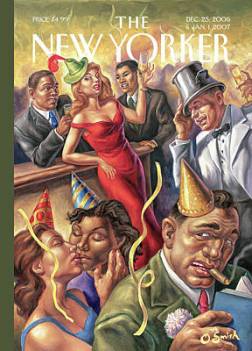
Painting for The New Yorker by Owen Smith
A spokesman for the Kataib Hezbollah militia said the demonstrators intend to besiege the embassy until the facility shuts down and U.S. diplomats leave Iraq.
But the angry demonstrators defied appeals delivered over loudspeakers by the group’s leaders not to enter the embassy compound and smashed their way into one of the facility’s reception areas, breaking down fortified doors and bulletproof glass and setting fire to the room.
American guards inside the embassy fired tear gas to keep the militia supporters at bay. U.S. troops could be seen nearby and on rooftops, their weapons drawn, but they did not open fire. Embassy civil defense workers just inside the gates attempted to put out the fires with water hoses.
The protesters also smashed security cameras, set two guardrooms ablaze and burned tires. They made a bonfire out of a pile of papers and military MREs (meals ready to eat) found in the reception area, where guards normally search visitors. Kataib Hezbollah flags were draped over the barbed wire protecting the embassy’s high walls.
So much for Trump and Kushner’s plans for peace in the Middle East. And didn’t American taxpayers spend $750 million to make the Baghdad embassy impenetrable?
Here’s a little comic relief from The Daily Beast: Team Trump’s Furious Hunt to Find Out Who ‘Liked’ a Chelsea Clinton Tweet.
On the evening of July 10, 2017, staffers at the U.S. embassy in Brussels—the official office for the ambassador to the European Union—received an unusual call from the seventh floor of the State Department back in Washington. The office of then-Secretary of State Rex Tillerson was irate. Someone in Brussels with access to the mission’s Twitter account had liked the wrong tweet. It had set off alarm bells in Foggy Bottom.
The tweet wasn’t just any tweet. It was one written by Chelsea Clinton and directed at President Donald Trump in a public spat that took the internet by storm.
A New Years Eve Night by A. Snegirev, 1982
That week in July, Trump drew criticism for his decision to let his daughter Ivanka fill his seat at the G-20 meeting of top economic powers in Hamburg, Germany. After days of the pile-on, Trump took to Twitter the morning of July 10 to claim his decision to have Ivanka represent the U.S. at the G-20 was “very standard” and that Chancellor Angela Merkel of Germany agreed. Not more than 15 minutes later, he switched his tenor and began attacking Clinton and the press. “If Chelsea Clinton were asked to hold the seat for her mother, as her mother gave our country away, the Fake News would say CHELSEA FOR PRES!,” Trump said.
Clinton shot back: “It would never have occurred to my mother or my father to ask me. Were you giving our country away? Hoping not.”
That tweet garnered more than half a million likes, including by the account for the U.S. mission to the European Union. That kickstarted a weeks-long investigation, prompted by the secretary’s office, into who exactly at the Brussels mission had access to the Twitter account and hit “Like” on Clinton’s tweet, according to two former U.S. officials. (Full disclosure: Clinton sits on the board of IAC, The Daily Beast’s parent company.) Nearly 10 people were interviewed about whether they, as administrators of the account, had mistakenly or deliberately pressed the “Like” button. All of them denied any wrongdoing, those sources said. One individual familiar with the exchanges said the secretary of state’s top managers in Washington “wanted blood” and called Brussels numerous times demanding the name of the culprit.
U.S. officials in Belgium were never able to give Tillerson’s office a name and soon after, the embassy restructured the Twitter account and limited access to just two individuals.

The Trumpies know what’s really important–protecting their boss’s fragile ego.

New Year’s Still Life, by Moesey Li
At The Washington Post, Greg Sargent explains why Mitch McConnell is counting on the political media to help him protect Trump in a fraudulent impeachment trial: Explosive new revelations just weakened Trump’s impeachment defenses.
If Mitch McConnell is going to pull off his scheme to turn President Trump’s impeachment trial into a quick and painless sham with no witnesses, the Senate majority leader needs the story to be covered as a conventional Washington standoff — one that portrays both sides as maneuvering for advantage in an equivalently political manner.
But extraordinary new revelations in the New York Times about Trump’s corrupt freezing of military aid to Ukraine will — or should — make this much harder to get away with.
McConnell badly needs the media’s both-sidesing instincts to hold firm against the brute facts of the situation. If Republicans bear the brunt of media pressure to explain why they don’t want to hear from witnesses, that risks highlighting their true rationale: They adamantly fear new revelations precisely because they know Trump is guilty — and that this corrupt scheme is almost certainly much worse than we can currently surmise.
That possibility is underscored by the Times report, a chronology of Trump’s decision to withhold aid to a vulnerable ally under assault while he and his henchmen extorted Ukraine into carrying out his corrupt designs.
The report demonstrates in striking detail that inside the administration, the consternation over the legality and propriety of the aid freeze — and confusion over Trump’s true motives — ran much deeper than previously known, implicating top Cabinet officials more deeply than we thought.
Please go read the rest at the link. It’s long but important.
I’ve been pretty successfully ignoring the news during these two holiday weeks, except for when I’ve had a blog post to write. Susan Glasser of The New Yorker had more trouble doing that, and now she has found a word to describe life in Trumpworld: Our Year of Trumpschmerz.
So much for the holidays. In the quiet of Christmas and New Year’s, the President of the United States has repeatedly attacked “Crazy Nancy” Pelosi and her family, inveighed against the “bogus Impeachment Scam” and circulated the alleged name of the C.I.A. whistle-blower whose complaint triggered it, retweeted an account that described former President Barack Obama as “Satan’s Muslim Scum,” hosted the accused war criminal he recently pardoned over the objections of military leaders, and promoted a post calling himself “the best President of all time.” He even accused the Prime Minister of Canada, Justin Trudeau, of personally ordering Canadian television to cut a seven-second snippet of the schmaltzy Christmas movie “Home Alone 2” that features Trump, an accusation the President refused to retract, although it was quickly proven that the scene was one of many edited out as a time-saver back in 2014, long before either Trudeau or Trump was anywhere close to power.
Dance at the Moulin Rouge, by Toulouse Lautrec
Even now, three years into the Trump Presidency, there is no language to fully capture the madness of all this, though many of my journalistic colleagues have gone to great lengths to record and codify just how disturbingly nutty 2019 has been. The Washington Post reports that Trump ended the year having made more than fifteen thousand four hundred false and misleading statements since his inauguration. CNN’s “Inside Politics” produced a four-page, single-spaced list of all the people and institutions Trump has attacked by name this year. There are online trackers for the unprecedented levels of turnover in Trump’s Administration and for the rapidly proliferating array of lawsuits involving Trump’s assertions of sweeping executive authority. By any measure, 2019 will go down as a remarkable year in the annals of the American Presidency: Trump began it by causing the longest-ever federal government shutdown in history, after Congress refused to spend billions on his proposed border wall, and ended it as only the third President in history to be impeached by the House of Representatives.

Glasser searched for a word to encompass the horrors of living in Trump’s world.
There must be one of those long German words for all that soul-sickening worry, right? Some tortured mouthful of consonants that captures the ceaseless anxiety and absurdity of Washington in the age of Trump? I asked my friend, the German scholar and writer Constanze Stelzenmüller, an astute observer of Trumpism at the Brookings Institution and especially of its toxic effect on the troubled transatlantic relationship. She said that, even in Trump-skeptical Berlin, there was no single, widely accepted word that describes this phenomenon but gamely offered up her own stab at it. The word she came up with is “Trumpregierungsschlamasselschmerz.”
Her word has pretty much everything that has come to characterize this uniquely dysfunctional moment in America’s troubled capital: Trump and his Administration (“regierung” means government); the slow-motion car crash of constant controversies (“schlamassel”); and the continuous pain or ache of the soul that results from excessive contemplation of it all (“schmerz”). Sure, it’s a mouthful, but that’s the point: there should be one word that sums up the Trumpian disruption we are experiencing, not merely a jumble of different ones. It’s the tweets and the other stuff, too: the endless attacks on enemies, real and imagined; the torrent of lies; the eroding of the basic functions of government; and the formerly unimaginable assault on our institutions. It’s impeachment and the Mueller Report and migrant children in cages, the bullying of allies, and the lavish praise of adversaries. It’s the uncertainty and worry that comes with all of the above.
On the brink of a new year, Trumpregierungsschlamasselschmerz has come to dominate our collective psyche. There is no taking a vacation from it. I confess that I have not yet figured out how to pronounce this unwieldy linguistic invention that so deftly captures our national Trump-soul-sickness. Luckily, I received a follow-up e-mail from Constanze, in which she proposed a shortened version that gets right to the angsty, anxious point: If “Trumpregierungsschlamasselschmerz” is too much, she said, you can just use “Trumpschmerz.” Either way, in German or in English, it’s my nominee for the word of the year in 2019. I suspect it will be in 2020 as well.
And with that I’ll turn the floor over to you, Sky Dancers. What stories are you following, if any?
Lazy Caturday Reads
Posted: December 7, 2019 Filed under: Foreign Affairs, morning reads, U.S. Politics 26 Comments
By Do Fournier
Good Morning!!
How can a person whose brain is this dementia-ravaged actually be “president?” Bloomberg: Trump Orders Toilet Rule Review Over Low-Flow Flushing.
The president on Friday said he ordered a federal review of water efficiency standards in bathroom fixtures and complained that “people are flushing toilets 10 times, 15 times as opposed to once” in homes with low-flow appliances.
He said other bathroom fixtures have slowed water to a trickle.
“You can’t wash your hands practically, there’s so little water comes out of the faucet, and the end result is you leave the faucet on and it takes you much longer to wash your hands, you end up using the same amount of water,” he said at an event with small-business owners at the White House.
He said the Environmental Protection Agency was looking into the issue on his recommendation….
Trump said Friday it was “common sense” to review standards he said resulted in showers with water “quietly dripping out” and toilets that “end up using more water” because of repeated flushing.
The Bloomberg article made the Trump rant seem less crazy than it actually was. He also complained about light bulbs.
He also wants American cars to be less fuel-efficient.
Can we please put him out to pasture before he blows up the world?
Trump also defended Saudi Arabia after a Saudi national killed 3 people at Pensacola Naval Air Station in Florida.
How awkward for the king and Trump that 6 other Saudis are being questioned in the attack–some of whom were seen filming it. The New York Times: Six Saudis Said to Be Questioned After Pensacola Navy Base Shooting.
A United States military official identified the suspect, who was killed by a sheriff’s deputy during the attack, as Second Lt. Mohammed Saeed Alshamrani. He was one of hundreds of military trainees at the base, which is considered the home of naval aviation.
Japanese blind, by Jane Lewis, British
Six other Saudi nationals were detained for questioning near the scene of the shooting, including three who were seen filming the entire incident, according to a person briefed on the initial stages of the investigation. A group that monitors online jihadist activity said that shortly before the shooting, a Twitter account with a name matching the gunman’s posted a “will” calling the United States a “nation of evil” and criticizing its support for Israel….
The attack by a foreign national inside an American military installation raised questions about the vetting process for international students who are cleared by the Department of Defense and is likely to complicate military cooperation between the United States and Saudi Arabia at a time when relations with the kingdom are already tense.
In recent months, President Trump has held fast against bipartisan congressional efforts to rebuke his fierce support for Saudi Arabia and its de facto leader, Crown Prince Mohammed bin Salman, who has pressed for his kingdom to rise as a global player in international finance and politics.

Trump values his relationships with dictatorships like Saudi Arabia and Russia far more highly than he does our traditional allies. We saw how little those allies respect the idiot “president” during the recent NATO summit. At The Washington Post, Brian Klaas writes: America’s allies despise Trump — and that’s a threat to NATO.
Yet this might miss the full significance of the story. The leaders of our NATO allies aren’t alone in seeing Trump as a dangerous joke — their citizens do, too. And Trump’s deepening unpopularity in the other countries of the West is becoming as much of a threat to NATO as Trump himself.
By Ophelia Redpath (1965- present, British)
It’s worth noting that Canadian Prime Minister Justin Trudeau didn’t disavow his own comments in the recorded incident — doing so would have made him look like an appeaser to his own deeply Trump-skeptical public. At the NATO summit, Trudeau also attended a news conference with the U.S. president — far less widely noted by the media — at which Trump referred to House Intelligence Committee Chairman Adam B. Schiff (D-Calif.) as a “deranged human being” and a “maniac.” No other world leader behaves like that at an international forum.
Such outbursts, which have a devastating effect on the United States’ reputation overseas, make it far harder for our allies to be seen as close to Trump. And because their citizens see Trump as the current representation of the United States, it’s becoming increasingly difficult for the leaders of Germany, or Britain, or Canada, or France to sell pro-American positions to their own voters. Just witness Boris Johnson’s carefully choreographed dance to avoid Trump’s company during the NATO summit, knowing that any all-too-obvious association with the U.S. president could doom the prime minister’s chances in the approaching British election. For the leaders of our allies, proximity to Trump is electoral poison.
There are foreign policy consequences to Trump’s toxicity. Since he took office, global support for U.S. leadership has plummeted. According to Pew Research in a late 2018 study, there has been a collapse in global confidence that the U.S. president will “do the right thing in world affairs.” From President Barack Obama to Trump, such confidence has fallen 76 percentage points in Germany, 75 percentage points in France, 58 percentage pointsin Canada, 52 percentage points in Australia, 51 percentage points in the United Kingdom and 48 percentage points in Japan. In Russia, by contrast, confidence in the U.S. president has increased by 8 percentage points.

Justice Ginsburg granted Trump’s request for an emergency stay on a lower court’s order that his financial records be released to Congress. Politico:
Supreme Court Justice Ruth Bader Ginsburg temporarily blocked a lower court ruling ordering two banks to release President Donald Trump’s financial records to House Democrats.
Two cats, Jenna Fornier
Trump had asked Ginsburg to consider the emergency request earlier Friday. The temporary stay sets the issue on hold pending full consideration by the high court, it does not reflect how judges will rule in the underlying case.
The stay is ordered until 5 p.m. on Dec. 13, and the court ordered that a response must be filed on or before Dec. 11 by 11 a.m.
The emergency filing came after a federal appeals court in New York ruled on Tuesday that Deutsche Bank and Capital One should comply with subpoenas from the House Financial Services and House Intelligence committees seeking information about Trump’s finances.
The House subpoenas seek documents including tax returns, evidence of suspicious activity and, in the case of Deutsche Bank, any internal communications regarding Trump and his ties to foreign individuals.
Trump-related requests are piling up at the Supreme Court — and the outcomes could set precedent on significant questions related to separation-of-power issues and whether a president is immune from state-based criminal investigations while in office.

Recently it was reported that Cover-Up General Bill Barr made some chilling remarks about law enforcement. Florida Rep. Val Demings responded in a Washington Post op-ed yesterday: What William Barr doesn’t understand about law enforcement.
This week, Attorney General William P. Barr honored 19 law enforcement officers selected by the Justice Department for “Distinguished Service in Policing.” I’m glad he did. I have no doubt that each officer earned the distinction. Law enforcement is a tough and dangerous job, and we are unwaveringly grateful for those who go above and beyond the call of duty.
By Misha Askenazy, black Kimono
Unfortunately, while speaking to the officers, the attorney general showed that he simply does not understand the foundational values of modern American policing. “If communities don’t give . . . support and respect” to law enforcement, he said, “they might find themselves without the police protection they need.”
I hope this statement was made in ignorance rather than malice. It is a knife in the heart of decades of painstaking work to develop bonds of trust between police and the communities they serve.
Law enforcement is not a protection racket. It is a sacred charge. We take an oath not to any individual or faction but to the Constitution, or, in other words, to society at large. Because, at the end of the day, law enforcement and the community are the same. The police are the community, and the community is the police.

Read the rest at the WaPo.
Here’s an interesting related article at The New York Times: ‘I Got Tired of Hunting Black and Hispanic People.’
At a police station tucked into an end-of-the-line subway terminal in South Brooklyn, the new commander instructed officers to think of white and Asian people as “soft targets” and urged them to instead go after blacks and Latinos for minor offenses like jumping the turnstile, a half-dozen officers said in sworn statements.
“You are stopping too many Russian and Chinese,” one of the officers, Daniel Perez, recalled the commander telling him earlier this decade.
Another officer, Aaron Diaz, recalled the same commander saying in 2012, “You should write more black and Hispanic people.”
The sworn statements, gathered in the last few months as part of a discrimination lawsuit, deal with a period between 2011 and 2015. But they are now emerging publicly at a time when policing in the subway has become a contentious issue, sparking protests over a crackdown on fare evasion and other low-level offenses.
The commander, Constantin Tsachas, was in charge of more than 100 officers who patrolled a swath of the subway system in Brooklyn, his first major command. Since then, he has been promoted to the second-in-command of policing the subway system throughout Brooklyn. Along the way, more than half a dozen subordinates claim, he gave them explicit directives about whom to arrest based on race.
Those subordinates recently came forward, many for the first time, providing signed affidavits to support a discrimination lawsuit brought by four black and Hispanic police officers.
Click the NYT link to read the rest.
Those are my recommended reads for today. What stories have you been following?
Thursday Reads
Posted: December 5, 2019 Filed under: Foreign Affairs, morning reads, U.S. Politics 13 CommentsGood Morning!!
This morning, Nancy Pelosi announced that she is authorizing the drafting of articles of impeachment against Trump.
Speaker Nancy Pelosi (D-Calif.) said Thursday that President Trump’s wrongdoing strikes at the heart of the Constitution and asked House committee chairs to proceed with articles of impeachment, saying lawmakers have “no choice but to act.”
Her address, in which she invoked principles espoused by the nation’s founders, came shortly after Trump went on Twitter to urge House Democrats to impeach him quickly, if they plan to do it, and suggested he would call an expansive list of witnesses during a trial in the Republican-led Senate.
At the heart of the Democrats’ case is the allegation that President Trump tried to leverage a White House meeting and military aid, sought by Ukraine in the face of Russian military aggression, to pressure President Volodymyr Zelensky to launch an investigation of former vice president Joe Biden and his son Hunter Biden, as well as a probe of an unfounded theory that Kyiv conspired with Democrats to interfere in the 2016 presidential election.
Of course Trump has weighed in.
Somehow I missed this, but Trump has started calling Kim Jong Un “Rocket Man” again, and North Korea is not amused. The New York Daily News:
Looks like the North Korean honeymoon is over.
President Trump reprised his “Rocket Man” insult for North Korean dictator Kim Jong-un on Tuesday as tensions spiraled between the two leaders who once boasted of their durable friendship.
North Korea has set a year-end deadline for Trump to return to the nuclear negotiating table, and has underlined its insistence on new talks by escalating its nuclear tests.
The U.S. appears to be doing its best to ignore Kim’s threats.
“He definitely likes sending up rockets, doesn’t he,” Trump said on the sidelines of the NATO summit, referring to KIm. “That’s why I call him Rocket Man.”
Now North Korea has responded. Kyodo News: N. Korea lambastes Trump for calling Kim “Rocket Man” again: KCNA.
A close aide to North Korean leader Kim Jong Un on Thursday lambasted U.S. President Donald Trump for calling him a “Rocket Man” again, saying it represents a “very dangerous challenge.”
“What makes us feel further worse is that the figurative style was dare used at random with no courtesy when referring to the supreme leadership of dignity of the DPRK,” First Vice Foreign Minister Choe Son Hu said in a statement carried by the official Korean Central News Agency in English….
“It would be fortunate if the utterances of the use of military force and the title of figurative style made by President Trump were an instantaneous verbal lapse, but matter becomes different if they were a planned provocation that deliberately targeted us,” Choe said.
“If this is meant to make expressions, reminiscent of those days just two years ago when a war of words was fought across the ocean, surface again on purpose, it will be a very dangerous challenge,” she added.
I don’t support Joe Biden, but this is best anti-Trump ad I’ve seen yet.
I haven’t read it yet, but this looks like an important article by Julia Ioffe in GQ: Trump Is Waging War on America’s Diplomats.
Last year, just before Halloween, Lewis Lukens, the deputy chief of mission at the U.S. embassy in London, visited a pair of English universities where he spoke about the importance of international cooperation, beseeching students not to “swipe left” on the historic “special relationship” between the U.K. and America. The speeches were—according to a copy of the remarks that Lukens provided to GQ—fairly anodyne, reprising all the things Americans and Brits had learned from each other, all the ways we’ve helped each other over the years, disagreements notwithstanding. At the time, things between the two countries had been strained—in part because President Trump had attacked British leaders, including Prime Minister Theresa May and London Mayor Sadiq Khan—but Lukens, the second-most-senior American diplomat to the United Kingdom, had a request for the students who had gathered to see him: “Don’t write off the special relationship.”
A week later, Lukens says, his boss, the U.S. ambassador Woody Johnson, an heir to the Johnson & Johnson fortune and a Trump political appointee, told him that he was done, firing Lukens from his post seven months ahead of when he was scheduled to leave for a new assignment. After nearly 30 years as a foreign service officer, his State Department career was over. The reason? Lukens says he had unwittingly committed a fatal error in his speech: He had mentioned former president Barack Obama.
To open the speech, Lukens, who had worked for presidents of both parties, used an anecdote from his time as ambassador to Senegal to illustrate how allies can handle disagreements. He mentioned Obama’s 2013 visit to the country. “There was incredible excitement,” Lukens said in his speech. “He had a guard of honor, crowds shouting his name, street vendors selling WE LOVE OBAMA T-shirts. It was really amazing. And the president had really great talks with the Senegalese president, Macky Sall. They got on really well. But what I remember most of all was the disagreement they had—as friends.” Lukens explained that during the trip, an American journalist had asked Obama whether he had pressed the Senegalese leader on LGBT rights—a provocative topic in a country where same-sex relationships are criminalized as “unnatural” and where the LGBT community faces widespread discrimination. Lukens told the students that Obama handled the thorny question well. And then he moved on to the rest of the speech, not realizing the damage he’d done with a single anecdote. (When asked about the episode and Lukens’s ouster, the State Department declined to comment. The American embassy in London did not respond to a request for comment.)
Read the rest at GQ.
I know many younger people don’t understand why some of us think John F. Kennedy was a good president and could have been a great one if he had not been murdered. Here’s an example of the kind of thoughtful discourse we heard from him as president. What a contrast to the current occupant of the office.
That;s all I have for you this morning, because I’m having some problems with watery eyes that make it difficult for me to read on the computer. This happens to me occasionally. So . . . what stories are you following today?

 peej
peej Carissa
 bostonboomer
 dakinikat
 ecocatwoman
 mablue2
 Mama Lopez
 peggysue22
 quixote
 skydancingguestblogger
 Mona (aka Wonk the Vote)



 Sky Dancing
Recent Comments