
The Scent of Jasmine (live blog)
Posted: January 28, 2011 Filed under: Egypt, Foreign Affairs, Live, Middle East, Wikileaks | Tags: Al Arabiya, Al Jazeera, Egypt, jasmine revolution, Wikileaks 88 Comments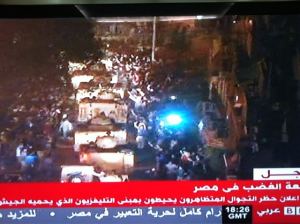
 The news from Egypt is amazing.
The military and the police are on the streets.
A strict curfew is in place.
AJEnglish Al Jazeera English
Protesters across Egypt defy curfew: Buildings and vehicles set alight across the country as anti-government pro… http://aje.me/fdndau
AJELive AJELive
by AJEnglish
AP Reports that protestors have stormed #Egypt foreign minister building #Jan25 #egypt
AJELive AJELive
by AJEnglish
Clinton – US deeply concerned about events in #Egypt. Deep grievance by protestors. Violence by riot police is not a solution #Jan25
AJELive AJELive
by AJEnglish
Hilary Clinton – Disturbed by the use of violence against protestors, US supports human rights of the #Egyptian people #Jan25
Thousands of people in Jordan have taken to the streets in protests, demanding the country’s prime minister step down, and the government curb rising prices, inflation and unemployment.
In the third consecutive Friday of protests, about 3,500 opposition activists from Jordan’s main Islamist opposition group, trade unions and leftist organisations gathered in the capital, waving colourful banners reading: “Send the corrupt guys to court”.
The crowd denounced Samir Rifai’s, the prime minister, and his unpopular policies.
Many shouted: “Rifai go away, prices are on fire and so are the Jordanians.”
Another 2,500 people also took to the streets in six other cities across the country after the noon prayers. Those protests also called for Rifai’s ouster.
Members of the Islamic Action Front, the political wing of the Muslim Brotherhood and Jordan’s largest opposition party, swelled the ranks of the demonstrators, massing outside the al-Husseini mosque in Amman and filling the downtown streets with their prayer lines.
BreakingNews Breaking News
US will review its stand on providing aid to #Egypt based on unfolding events – AP #Jan25
TGIF Reads
Posted: January 28, 2011 Filed under: commercial banking, Egypt, FBI raids, Foreign Affairs, morning reads, Voter Ignorance, We are so F'd | Tags: Egypt, FBI misconduct, FCIC report, filibuster laws, horrible jail conditions, Rahm Emanuel eligibility 10 Comments Good Morning!

It’s finally Friday.
Rahm Emanuel was back on the ballot and part of a debate for candidates for the Mayor of Chicago last night. The Illinois Supreme Court ruled unanimously in his favor. Evidently the case relied a lot on the ‘intent’ of Rahm whose lawyers argued that he had left books in the basement of his old house, rented the house out instead of selling it and other behaviors that showed that he was just away temporarily performing some kind of national service. The city is now free to print its ballots.
The justices found that Emanuel never displayed an intent to permanently abandon his Chicago home, which they said would have been the trigger to render him ineligible. Instead, they said, it was clear that when he went to Washington, he always planned the move to be temporary and to return to Chicago one day.
The court said the appellate panel hung its decision on a misinterpretation of an 1867 Illinois Supreme Court case involving a judge who temporarily moved to Tennessee but always planned to come back. In essence, the Appellate Court concluded that the 19th century decision didn’t cover Emanuel and that residency should be defined as where one rests his head at night.
It seems unlikely that reform on the senate filibuster will have much of an impact. It looks like it will be small if at all.
But Democrats never seemed able to reach an agreement on the scope or type of changes, and Reid announced a more modest set of changes on which the parties would vote Thursday afternoon.
The reforms include an end to secret holds, a reduction in the number of presidential nominations subject to the lengthy Senate confirmation process, an end to mandatory readings for amendments if they’ve been publicly available for at least three days, an agreement by Republicans to limit their filibusters of motions to begin debate, and an agreement by Democrats to limit instances in which they “fill the tree” — or limit the number of amendments Republicans can put to a given piece of legislation.
Perhaps the most significant agreement was that of changing the filibuster, the principal tool of the minority to stall or block legislation. Republicans used the tactic to great effect in the last Congress, though Democrats griped that the process had been abused at an unprecedented level.
Protests continue in Egypt as the scent of Jasmine spreads. The Economist looks at what this could potentially mean to Arab leaders as the people in the era look for democracy. The US is obviously nervous about any potential uptick for groups like The Muslim Brotherhood who could take the country in the opposite direction.
Mr Mubarak, like the rest of the Arab world’s autocrats, will be pondering the despot’s eternal dilemma. Is it better to loosen controls in order to satisfy their people with a whiff of freedom, or to tighten them in an effort to ensure their docility?
The fate of Tunisia’s strongman, Zine el-Abidine Ben Ali, suggests that an angry people will be satisfied with neither. If Mr Mubarak truly put his country’s interests first, he would immediately promise to retire before the next presidential election, due in September. At the very least he would ensure that the contest is a genuinely open one, not another farce.
The NYT looks at the possible role of religion in the Egyptian protests.
Heightening the tension, the Muslim Brotherhood, the largest organized opposition group in the country, announced Thursday that it would take part in the protest. The support of the Brotherhood could well change the calculus on the streets, tipping the numbers in favor of the protesters and away from the police, lending new strength to the demonstrations and further imperiling President Hosni Mubarak’s reign of nearly three decades.
“Tomorrow is going to be the day of the intifada,” said a spokesman for the Muslim Brotherhood here in Egypt’s second largest city, who declined to give his name because he said he would be arrested if he did. The spokesman said that the group was encouraging members of its youth organization — roughly those 15 to 30 years old — to take part in protests.
But Islam is hardly homogeneous, and many religious leaders here said Thursday that they would not support the protests, for reasons including scriptural prohibitions on defying rulers and a belief that democratic change would not benefit them. “We Salafists are not going to participate in any of the demonstrations tomorrow,” said Sheik Yasir Burhami, a leading figure among the fundamentalist Salafists in Alexandria.
One troubling thing is that the Egyptian government has ‘shut down the internet‘. SMS messages have also been blocked. The US government has called on the Egyptian authorities to stop the block.
While access directly to the Facebook and Twitter websites are inaccessible from within Egypt, protesters are circumventing the blocks in place by using mobile applications which still work. Proxy websites are also being used, as they mask the address of website, allowing those to access social networking sites.
But as the blocking measures are failing, it appears that Egypt has sanctioned measures to ’shut down’ web access, fearing the same reprisals as seen in Tunisia earlier this month where the government collapsed and the president was forced into exile.
CSM: “Inspired by Tunisia, Egypt’s protests appear unprecedented”
Posted: January 25, 2011 Filed under: Breaking News, Egypt, Foreign Affairs, Lebanon, Middle East, The Media SUCKS, Tunisia | Tags: 2011: days of revolt 43 Comments
Egyptians protest in central Cairo today. Photograph: Khaled El Fiqi/EPA (Click image for live updates from the Guardian)
Good afternoon everyone. I wanted to put up a quick thread of the headlines and developments coming out of Egypt so we have a place for us to discuss and keep adding more links as they become available. It’s a true shame that Obama’s upcoming SOTU is driving so much of the news coverage today, not to mention a convenient distraction since “power to the people of the Middle East” doesn’t exactly fit the Western media’s narrative. Take a look at what is going on–it is simply incredible.
Guardian: “Protests in Egypt and unrest in Middle East – live updates”
CSM: “Inspired by Tunisia, Egypt’s protests appear unprecedented”
NYT: “Broad Protests Across Egypt Focus Fury on Mubarak”
BBC: “Egypt protests: Clashes in Cairo on ‘day of revolt’”
BBC: “Anger of protesters in Cairo ‘surprised police‘”
BBC: “Egypt protests: Three reported dead in ‘day of revolt’”
Looks like censors are hard at work trying to stop the twitter revolution:
WaPo: “Twitter blocked in Egypt as protests turn violent (Video)”
Heredict.org is tracking the reports of twitter outage in Egypt today (H/T Minkoff Minx who found the heredict.org link via the AFP’s report on the twitter blockage)
Live Tweets
Nonetheless, the revolution continues to be tweeted. Check out Blogs of War for live tweets (H/T Taylor Marsh)
Another good place to check for updates: Ahram online
via the WaPo link above — “Live updates: Opposition groups protest on Police Day… Ahram Online will be posting updates about planned protests by opposition activists in Cairo and elsewhere”
Also, some links on Lebanon’s Day of Rage…
Guardian: “Lebanon protesters clash with army over new Hezbollah-backed PM… Supporters of previous prime minister, Saad Hariri, clash with troops and burn tyres as Najib Miqati assumes office”
Guardian: “Lebanon’s ‘day of rage’ – in pictures”
NYT: “Amid Protests, Ex-Lebanon Leader Assails New Premier”
And, on Tunisia…
LA Times: “Key diplomat says U.S. approves of Tunisia revolt… Jeffrey D. Feltman, assistant secretary of State for Near Eastern affairs, says Washington has offered Tunisia ‘whatever support is appropriate and requested’ in conducting a nationwide election.”
Update –Video on Cairo protests posted on youtube by Al Jazeera English a couple hours ago:
Update 2 — see the twitter/live tweet section above. I added some links.
Update 3 — Amazing Photo (Egypt, Jan 25) circulating on twitter:

Seymour Hersh Comments Evoke Media Overreactions
Posted: January 22, 2011 Filed under: Afghanistan, Barack Obama, Foreign Affairs, fundamentalist Christians, Iraq, Pakistan, U.S. Military, U.S. Politics | Tags: Afghanistan, foreign policy, Georgetown University, IRAQ, James Carroll, Jeff Sharlet, Knights of Malta, Opus Dei, Qatar, Seymour Hersh, Stanley McChrystal, Taliban, William McRaven 28 Comments
On January 17, famed New Yorker Magazine investigative reporter Seymour Hersh made a speech in Doha, Qatar at a college operated by the Georgetown University School of Foreign Service. The first half of the transcript of the speech has been published here by Foreign Policy Magazine. The speech contains a great deal of background information and speculation–which, when it comes from a reporter of Hersh’s caliber, is often quite fascinating. I’d suggest reading the whole thing before taking the word of Hersh’s numerous media critics.
The bit of the speech that has drawn the media’s ire is a few remarks Hersh made about fundamentalist Christian influence in the U.S. Military and and offhand remark about Obama’s wimpy leadership. Foreign Policy’s Blake Hounshell mocked the speech in a blog post:
In a speech billed as a discussion of the Bush and Obama eras, New Yorker journalist Seymour Hersh delivered a rambling, conspiracy-laden diatribe here Monday expressing his disappointment with President Barack Obama and his dissatisfaction with the direction of U.S. foreign policy.
“Just when we needed an angry black man,” he began, his arm perched jauntily on the podium, “we didn’t get one.”
Hersh told the audience he is writing a book about how a small group of “neoconservative whackos” took over the U.S. government. Hounshell writes:
Hersh then brought up the widespread looting that took place in Baghdad after the fall of Saddam Hussein in 2003. “In the Cheney shop, the attitude was, ‘What’s this? What are they all worried about, the politicians and the press, they’re all worried about some looting? … Don’t they get it? We’re gonna change mosques into cathedrals. And when we get all the oil, nobody’s gonna give a damn.'”
“That’s the attitude,” he continued. “We’re gonna change mosques into cathedrals. That’s an attitude that pervades, I’m here to say, a large percentage of the Joint Special Operations Command.”
He then alleged that Gen. Stanley McChrystal, who headed JSOC before briefly becoming the top U.S. commander in Afghanistan, and his successor, Vice Adm. William McRaven, as well as many within JSOC, “are all members of, or at least supporters of, Knights of Malta.”
[….]
“Many of them are members of Opus Dei,” Hersh continued. “They do see what they’re doing — and this is not an atypical attitude among some military — it’s a crusade, literally. They see themselves as the protectors of the Christians. They’re protecting them from the Muslims [as in] the 13th century. And this is their function.”
Hounshell also devoted a follow-up blog post to picking apart some of Hersh’s claims.
The reaction of various media members to these comments seems to me to have been a bit of an overreaction. Paul Farhi at the Washington Post focused on the accusations about General Stanley McChrystal:
A spokesman for McChrystal said the general “is not and never has been” a member of the Knights of Malta, an ancient order that protected Christians from Muslim encroachment during the Middle Ages and has since evolved into a charitable organization. These days, the Knights, based in Rome, sponsor medical missions in dozens of countries. McChrystal’s spokesman, David Bolger, said Hersh’s statement linking McChrystal to the group was “completely false and without basis in fact.”
Interestingly, no one speaking for McChrystal said anything in response to the suggestion that he might be involved with Opus Dei. Since we have at least two members of the Supreme Court who are Opus Dei members, why would it be surprising to find their members in other high government offices?
If you read the transcript of Hersh’s speech, you’ll see that Hersh acknowledges that both the Knights of Malta and Opus Dei do good work, but that is ignored in the mocking media responses.
More from Farhi:
Hersh’s attempts to link the religious groups to the Pentagon, meanwhile, brought a denunciation from Catholic League President Bill Donohue, who said Hersh’s “long-running feud with every American administration – he now condemns President Obama for failing to be ‘an angry black man’ – has disoriented his perspective so badly that what he said about the Knights of Malta is not shocking to those familiar with his penchant for demagoguery.”
Bill Donohue? Seriously? I’m supposed to believe Bill Donohue over Seymour Hersh? Sorry, no can do.
Further, Pentagon sources say there is little evidence of a broad fundamentalist conspiracy within the military. Although there have been incidents in which officers have proselytized subordinates, the military discourages partisan religious advocacy.
But is that really true? I don’t have time to dig up all the possible evidence for Christian fundamentalist influence in the military, but I’ll provide one reliable source. Jeff Sharlet, who has now written two books on “The Family,” the secretive fundamentalist organization that courts politicians and other powerful people, wrote an article in Harpers’ Magazine in 2009 called “Jesus Killed Mohammed: The Crusade for a Christian Military.” Sharlet writes:
When Barack Obama moved into the Oval Office in January, he inherited a military not just drained by a two-front war overseas but fighting a third battle on the home front, a subtle civil war over its own soul. On one side are the majority of military personnel, professionals who regardless of their faith or lack thereof simply want to get their jobs done; on the other is a small but powerful movement of Christian soldiers concentrated in the officer corps. There’s Major General Johnny A. Weida, who as commandant at the Air Force Academy made its National Day of Prayer services exclusively Christian, and also created a code for evangelical cadets: whenever Weida said, “Airpower,” they were to respond “Rock Sir!”—a reference to Matthew 7:25. (The general told them that when non-evangelical cadets asked about the mysterious call-and-response, they should share the gospel.) There’s Major General Robert Caslen—commander of the 25th Infantry Division, a.k.a. “Tropic Lightning”—who in 2007 was found by a Pentagon inspector general’s report to have violated military ethics by appearing in uniform, along with six other senior Pentagon officers, in a video for the Christian Embassy, a fundamentalist ministry to Washington elites. There’s Lieutenant General Robert Van Antwerp, the Army chief of engineers, who has also lent his uniform to the Christian cause, both in a Trinity Broadcasting Network tribute to Christian soldiers called Red, White, and Blue Spectacular and at a 2003 Billy Graham rally—televised around the world on the Armed Forces Network—at which he declared the baptisms of 700 soldiers under his command evidence of the Lord’s plan to “raise up a godly army.”
What men such as these have fomented is a quiet coup within the armed forces: not of generals encroaching on civilian rule but of religious authority displacing the military’s once staunchly secular code. Not a conspiracy but a cultural transformation, achieved gradually through promotions and prayer meetings, with personal faith replacing protocol according to the best intentions of commanders who conflate God with country. They see themselves not as subversives but as spiritual warriors—“ambassadors for Christ in uniform,” according to Officers’ Christian Fellowship; “government paid missionaries,” according to Campus Crusade’s Military Ministry.
So are Hersh’s accusations really “loopy” as Charles Lane, also of the Washington Post, claims?
Well known Catholic writer and former priest James Carroll has also claimed there is a “fundamentalist surge in the U.S. military.”
Carroll, in a recent interview with Tom Engelhardt of The Nation Institute, talked about his experiences working on a documentary version of his book. Part of that project involved delving into allegations that an evangelical Christian subculture had taken root at the Air Force Academy in Colorado Springs and, by larger extension, across the U.S. military.
Carroll was appalled by what he found.
“In the Pentagon today,” he says, “there is active proselytizing by Christian groups that is allowed by the chain of command. When your superior expects you to show up at his prayer breakfast, you may not feel free to say no. It’s not at all clear what will happen to your career. He writes your efficiency report. And the next thing you know, you have, in the culture of the Pentagon, more and more active religious outreach.”
Continues Carroll, “Imagine, then, a military motivated by an explicit Christian, missionizing impulse at the worst possible moment in our history, because we’re confronting an enemy–and yes, we do have an enemy: fringe, fascist, nihilist extremists coming out of the Islamic world–who define the conflict entirely in religious terms. They, too, want to see this as a new ‘crusade.’ That’s the language that Osama bin Laden uses. For the United States of America at this moment to allow its military to begin to wear the at this moment to allow its military to begin to wear the badges of a religious movement is a disaster!”
OK, so two highly respected reporters/writers agree with Hersh about a fundamentalist influence in the military. Are his claims really such hogwash?
Here’s an article from AFP news service in Feb. 2008: “US military accused of harboring fundamentalism.”
It’s about a soldier, Jeremy Hall, who claimed to have been bullied by fellow soldiers and officers during his deployment in Iraq because he didn’t want to participate in Christian religious activities.
These are just three articles that I dug up on this topic. Now let’s look at some of the other claims in Hersh’s speech that no one seems to want to talk about. Specifically, let’s look at a couple of samples of the more serious charges Hersh makes against Obama. Here’s one:
So, what is Obama doing? Obama has turned over, I think his first year, basically, he turned over the conduct of the war to the men who are prosecuting it: to Gates, to Mullen, who is the chairman of the Joint Chiefs. And in early March, as I recreate it — and nothing is written in stone, but I’m just telling you what I’ve found in my talking and my working on this over the years — we have a general running the war in Afghanistan named McKiernan. McKiernan, unlike McChrystal, his deputy at the time Rodriguez, unlike Petraeus, unlike Eikenberry… They were all together at West Point class of 74, 75, 76 — what they call, we always call the sort of West Point Protective Association. McKiernan was William and Mary, not West Point. And Gates went to see him in March of ‘09, sort of the first big exploration on behalf of the new Obama administration. What do you need to win the war? Well, the correct answer was, he said, “300,000” — of course, he knew he wouldn’t get it, he was just saying to win that’s what it’s going to take.
Here’s another:
In any case, Obama did abdicate, very quickly, any control, I think right away, to the people that are running the war, for what reason I don’t know. I can tell you, there is a scorecard I always keep and I always look at. Torture? Yep, still going on. It’s more complicated now the torture, and there’s not as much of it. But one of the things we did, ostensibly to improve the conditions of prisoners, we demanded that the American soldiers operating in Afghanistan could only hold a suspected Taliban for four days, 96 hours. If not… after four days they could not be sure that this person was not a Taliban, he must be freed. Instead of just holding them and making them Taliban, you have to actually do some, some work to make the determination in the field. Tactically, in the field. So what happens of course, is after three or four days, “bang, bang” — I’m just telling you — they turn them over to the Afghans and by the time they take three steps away the shots are fired. And that’s going on. It hasn’t stopped. It’s not just me that’s complaining about it. But the stuff that goes on in the field, is still going on in the field — the secret prisons, absolutely, oh you bet they’re still running secret prisons. Most of them are in North Africa, the guys running them are mostly out of Djibouto [sic]. We have stuff in Kenya (doesn’t mean they’re in Kenya, but they’re in that area).
Hersh had plenty of harsh words for Cheney too, but no one is talking about that either. All the media is discussing is Hersh’s supposedly “loopy” conspiracy theory about fundamentalists in the military–which really isn’t all that nutty of a theory, as far as I can tell.
Shorter Hu: Just shut up and buy our stuff because we’ve manipulated our currency to the point you have no choice
Posted: January 19, 2011 Filed under: Barack Obama, China, Foreign Affairs, Live | Tags: China's Human Rights Violations, FOREX manipulation China, Hu Jintao state visit, Human Rights, Human Rights Violations and China, Obama/Hu presser 33 CommentsIf you’re not watching the joint Hu/Obama presser you should be .
2.06pm ET: A Bloomberg journalist asks Hu directly why he didn’t answer the first AP question about human rights – and follows up with a query about the reaction from congressional leaders, as mentioned below.
Hu says he didn’t hear the question about human rights for technical reasons, saying it was a question directed at President Obama, but says he will answer it now:
“President Obama and I have already met eight times. each time we met we had an exchange of views in a candid manner … in the issues we covered we also covered human rights. China is always committed to the protection and promotion of human rights. In terms of human rights China has made enormous progress.”
“Chinese is a huge country with a huge population,” Hu reminds us, and it “still faces challenges in terms of reform”.
2.05pm ET: “We want to sell you all kinds of stuff. We want to sell you planes, we want to sell you cars, we want to sell you software,” says Obama in response to a question about the growth of China.
Joint asskissing session here on CPSAN2.

 peej
peej Carissa
 bostonboomer
 dakinikat
 ecocatwoman
 mablue2
 Mama Lopez
 peggysue22
 quixote
 skydancingguestblogger
 Mona (aka Wonk the Vote)



 Sky Dancing
Recent Comments