
Thursday Reads: Power to the People!
Posted: November 3, 2011 Filed under: #Occupy and We are the 99 percent!, Foreign Affairs, France, Germany, Greece, Italy, morning reads, Spain, U.S. Economy, U.S. Politics, unemployment | Tags: Angela Merkel, austerity, democracy, Eurodammerung, George Papandreau, Greece, Nicolas Sarkozy, Oakland general strike, Paul Krugman, Robert Reich 40 Comments
Good Morning!! Over the past couple of days, I’ve become really fascinated with the situation in Greece. It’s a pretty fluid situation at the moment. On Tuesday Robert Reich wrote a pretty good primer on what is happening and expressed his view that letting the Greek people decide their own fate is the best idea. Here’s a bit of it:
Greek Prime Minister George Papandreou decided in favor of democracy yesterday when he announced a national referendum on the draconian budget cuts Europe and the IMF are demanding from Greece in return for bailing it out.
(Or, more accurately, the cuts Europe and the IMF are demanding for bailing out big European banks that have lent Greece lots of money and stand to lose big if Greece defaults on those loans – not to mention Wall Street banks that will also suffer because of their intertwined financial connections with European banks.)
If Greek voters accept the bailout terms, unemployment will rise even further in Greece, public services will be cut more than they have already, the Greek economy will contract, and the standard of living of most Greeks will deteriorate further.
If Greek voters reject the terms and the nation defaults, it will face far higher borrowing costs in the future. This may reduce the standard of living of most Greeks, too. But it doesn’t have to. Without the austerity measures the rest of Europe and the IMF are demanding, the Greek economy has a better chance of growing and more Greeks are likely to find jobs.
Shouldn’t Greek citizens make this decision for themselves?
Reich argues that it would have been better in the long run if the American people had been consulted about the bank bailouts here.
If Americans had been consulted about the 2008-2009 Wall Street bailout, I doubt it would have happened the way it did. At the very least, strict conditions would have been placed on the banks in return for the money. The banks would have had to eat the losses of the predatory mortgages they sold, and help homeowners reduce those mortgages. They’d be required to improve the capitalization of small banks in communities across the country. They’d be forced to accept stringent new regulations, including resurrection of Glass-Steagall
But we weren’t consulted. The wishes of the American people were considered irrelevant by the oligarchs who run this country. And the European oligarchs are hoping to prevent the Greek people from claiming a right to make a democratic decision.
Of course if the Greek people do decide to default on their debts, there will be serious consequences–for them and for the rest of Europe. Krugman calls it “Eurodämmerung.” He argues that
…the euro was an inherently flawed idea that can work only given a strong European economy and a significant degree of inflation, plus open-ended credit to sovereigns facing speculative attack. Yet European elites embraced the notion of economics as morality play, imposing across-the-board austerity, tightening money despite low underlying inflation, and have been too concerned with punishing sinners to notice that everything was going to blow apart without an effective lender of last resort.
The question I’m trying to answer right now is how the final act will be played. At this point I’d guess soaring rates on Italian debt leading to a gigantic bank run, both because of solvency fears about Italian banks given a default and because of fear that Italy will end up leaving the euro. This then leads to emergency bank closing, and once that happens, a decision to drop the euro and install the new lira. Next stop, France.
Yikes! But Fortune also says Italy and France are in trouble if Greece defaults. And Spain could go bust too.
What worries is that Spain and Italy are not in the Greek situation but they could be. Greece is bust and Spain and Italy could be driven bust. They both have a lot of debt and each year some of that debt has to be repaid. Now governments almost never do repay debt, they just borrow some more and use the new money to pay off the old. Bit like swirling what you owe around a few credit cards.
Which is just fine: except, if interest rates rise then they have to pay more interest on this new debt that they’re issuing to pay off the old. And if interest rates rise enough then they do go bust, as the interest payments they have to make take too much money out of the budget. Switching money around on zero interest introductory rate cards is very different from doing it when you’re being charged 30%.
Now, the general agreement is that when the interest rates are above 6% then Italy and Spain are in danger of going bust. When they’re over 7% they will do so. But of course, when people see that Italian interest rates are above 6% then they become more wary of lending Italy any more money and so interest rates keep on rising to possibly above 7% and game over.
It’s still not clear what Greece is going do in their referendum. Dakinikat says they need to ask the people if they want to leave the European Union or not. German Chancellor Angela Merkel and French President Nicolas Sarkozy have said that the referendum must ask the Greek people if they want to opt out of the Euro, but not the EU itself. Meanwhile, the offer of a bailout of Greece has been called off until after the vote on the referendum is taken. From Naked Capitalism:
The Eurocrats have decided to try to push Greece into line, threatening expulsion from the Euro (note, not the EU) if Greece does not back down. From a practical matter, if the Greeks were to turn down the bailout package, it would lead to a banking crisis, making a Eurozone exit a not that much more traumatic incremental move with considerable upside. And under the Maastrict treaty, Greece cannot unilaterally exit (although as various commentors have pointed out, Nato is not going to send in tanks if the Greeks were to do so).
But this may be an appeal to the Greek public, or more likely, an effort to break Greek prime minister’s Papandreou’s thin coalition on the eve of a vote of no confidence.
So that’s another possibility–that Papandreau’s government might fall. More on the European reaction from Bloomberg:
Led by Germany and France, Europe’s economic and political anchors, the euro’s guardians yesterday cut off financial aid for Greece until a vote they said would be on Dec. 4 or Dec. 5 determines whether it deserves a fresh batch of loans needed to stave off default.
“The referendum will revolve around nothing less than the question: does Greece want to stay in the euro, yes or no?” German Chancellor Angela Merkel told reporters after crisis talks hours before a Group of 20 summit set to begin today in Cannes, France. French President Nicolas Sarkozy said Prime Minister George Papandreou’s government won’t get a “single cent” of assistance if voters rejects the plan.
The hardball tactics open the door for a nation to leave the currency bloc that at its setup in 1999 capped Europe’s progression from war to prosperity and was declared “irrevocable” by its founding fathers. Polls show most Greeks object to the austerity required for aid, yet more than seven in 10 favor remaining in the euro, a survey last week of 1,009 people published in To Vima newspaper showed.
They’re going to have to decide between two awful choices, and the rest of Europe will have to deal with the results of the vote–if there is a default, failures of banks that hold Greek debt and getting Italian, French, and German taxpayers to pay for more bank bailouts–unless Papandreau’s government falls. Read the whole article at Bloomberg to get a sense of how serious all this is.
In U.S. news, Occupy Oakland called for a general strike today. That situation is still fluid as of this writing, 11PM Eastern on Wednesday night.
OAKLAND – Protesters blocked streets near City Hall, smashed windows at a bank and gathered by the thousands in an attempt to shut down the nation’s fifth-busiest port Wednesday.
The Occupy Oakland protest was the largest in a series of rallies in several cities as the Occupy Wall Street movement that began Sept. 17 tried to grab national attention.
A group of about 300 protesters, many of them men wearing black, some covering their faces with bandanas and some carrying wooden sticks, smashed windows of a Wells Fargo bank branch while chanting “Banks got bailed out. We got sold out.”
Are you getting the feeling this genie can’t be put back in the bottle either? The Occupy demonstrations have shown us that we pretty much live in a police state at this point. There very little respect for the protesters’ constitutional rights by local governments or law enforcement. From Counterpunch, here is a report of what actually happened when police attacked protesters in Oakland on Oct. 25.
In a heavily armed pre-dawn raid, on Tuesday, Oct. 25, with back up from armored vehicles and helicopters, the Oakland Police Department in conjunction, with over 15 other police departments from Northern and Central California, stormed the sleepy Occupy Oakland Encampment.
Asleep inside tents of the makeshift Occupy encampment, were over a hundred men, women and very young children. The heavily armed police force, dressed in black ninja-like outfits, and special forces helmets, with full face-shields down, and armed with and assortment of latest riot gear, fired tear gas canisters and concussion grenades into the camp, as helicopters circled above.
Police then attacked and ransacked the entire encampment. In a short time, the camps library, soup kitchen, and children’s center were left in ruins, and over a hundred of the inhabitants were roughed up, arrested and held on high bail. The activists suffered many injuries, including broken bones.
Please read the whole thing–it’s an eyewitness account of a horrifying paramilitary action by police. As everyone knows, Iraq war veteran Scott Olson was critically injured in the melee.
Late last night as part of the general strike, Oakland protesters succeeded in shutting down the Port of Oakland.
Several thousand Occupy Wall Street demonstrators forced a halt to operations at the United States’ fifth busiest port Wednesday evening, escalating a movement whose tactics had largely been limited to rallies and tent camps since it began in September.
Police estimated that a crowd of about 3,000 had gathered at the Port of Oakland by early evening. Some had marched from the California city’s downtown, while others had been bused to the port.
Port spokesman Isaac Kos-Read said maritime operations had effectively been shut down. Interim Oakland police chief Howard Jordan warned that protesters who went inside the port’s gates would be committing a federal offense.
In New York, Los Angeles and other cities where the movement against economic inequality has spread, demonstrators planned rallies in solidarity with the Oakland protesters, who called for Wednesday’s “general strike” after an Iraq War veteran was injured in clashes with police last week.
Organizers of the march said they want to stop the “flow of capital.” The port sends goods primarily to Asia, including wine as well as rice, fruits and nuts, and handles imported electronics, apparel and manufacturing equipment, mostly from Asia, as well as cars and parts from Toyota, Honda, Nissan and Hyundai.
We knew there would eventually be civil unrest, and now we’re seeing it all over the world and here at home. What next? I’d say 2012 is going to be an eventful year.
With that, I’m going to wrap this up. I know there’s lots of other news, but these two stories–Greece and the general strike in Oakland–seem to me to symbolize what’s happening in the world today. People are sick and tired of being bilked by the super-rich, and ignored by the politicians. It’s so chaotic, yet I feel that the only hope we have is for the people to keep resisting as best they can. For so long, I was afraid nothing would wake American up, but I’m finally getting the feeling that we won’t go down without a fight. Let’s keep the elites nervous!
Sooooo… what are you reading and blogging about today?
Confronting the Austerity Agenda
Posted: October 28, 2011 Filed under: Economy, Foreign Affairs, Iceland | Tags: austerity, banking crises, economics, iceland 13 Comments Paul Krugman takes on the idea that after we bail out economically destructive banks, we all have to pay with downsized lives and a bad economy in his NYT column today. He continues to fight the idea that austerity–not prosperity–will bring back confidence and the economy. He’s right that the austerity hawks push a ridiculous assertion that denies past history as well as logic.
The doctrine in question amounts to the assertion that, in the aftermath of a financial crisis, banks must be bailed out but the general public must pay the price. So a crisis brought on by deregulation becomes a reason to move even further to the right; a time of mass unemployment, instead of spurring public efforts to create jobs, becomes an era of austerity, in which government spending and social programs are slashed.
This doctrine was sold both with claims that there was no alternative — that both bailouts and spending cuts were necessary to satisfy financial markets — and with claims that fiscal austerity would actually create jobs. The idea was that spending cuts would make consumers and businesses more confident. And this confidence would supposedly stimulate private spending, more than offsetting the depressing effects of government cutbacks.
Some economists weren’t convinced. One caustic critic referred to claims about the expansionary effects of austerity as amounting to belief in the “confidence fairy.” O.K., that was me.
But the doctrine has, nonetheless, been extremely influential. Expansionary austerity, in particular, has been championed both by Republicans in Congress and by the European Central Bank, which last year urged all European governments — not just those in fiscal distress — to engage in “fiscal consolidation.”
And when David Cameron became Britain’s prime minster last year, he immediately embarked on a program of spending cuts in the belief that this would actually boost the economy — a decision that was greeted with fawning praise by many American pundits.
Now, however, the results are in, and the picture isn’t pretty
Example one: The economy of Greece. It has been pushed into an even bigger slump. Example two: The economy of the UK. Austerity has stalled its economy and the confidence fairy is no where to be seen. Example three: Iceland. They did the exact opposite and they’re none the worse for wear. So, which example are we following? Well, it’s not Iceland.
Krugman, Icelanders, and the IMF are taking stock of the Iceland experience this week in a conference. You can read many articles at the IMF on how Iceland is recovering from its 2008 economic catastrophe. You can watch a video explaining what went on there with Dr. Joseph Stiglitz below.
Today, three years later, it is worth reflecting on how far Iceland―a country of just 320,000 people―has come since those dark days back in 2008. Growth has returned to the economy, and new jobs are being created: unemployment, although still unacceptably high for a country used to near-full employment, has dropped below 7 percent of the work force. In June this year, the government successfully issued a $1 billion sovereign bond, marking a return to international financial markets.
And while public debt, currently at around 100 percent of GDP, is much higher than before the crisis, an impressive consolidation program has put the country’s finances back on a sustainable path during the past couple of years. As for the banks, they have been shrunk to about 200 percent of GDP, and are now fully recapitalized.
So, how did they do it? Did they embrace austerity for their citizens after rescuing and enriching their errant banking/financier class?
- First, a team of lawyers was put to work to ensure that losses in the banks were not absorbed by the public sector. In the end, the public sector did of course have to step in and ensure the new banks had adequate capital, but it was insulated from vast private sector losses. This was a major achievement.
- Second, the initial focus of the program was exclusively on stabilizing the exchange rate. Here, we reached for unconventional measures, notably capital controls.
- Third, automatic stabilizers were allowed to operate in full during the first year of the program—effectively delaying fiscal adjustment. This helped support the economy at a time of severe strain.
- Fourth, conditionality was streamlined and focused on the key issue at hand—rebuilding the financial sector. While there are some issues in the broader economy where reforms will eventually be needed, these were not a part of the program.
Wow. Just Wow.
Posted: October 27, 2011 Filed under: Foreign Affairs, Hillary Clinton, Women's Rights 41 Comments
A national poll conducted for TIME on Oct. 9 and 10 found that if Clinton were the Democratic nominee for President in 2012, she would best Mitt Romney 55% to 38%, Rick Perry 58% to 32% and Herman Cain 56% to 34% among likely voters in a general election. The same poll found that President Obama would edge Romney by just 46% to 43%, Perry by 50% to 38% and Cain by 49% to 37% among likely voters.
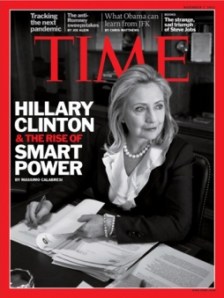 This weeks’ Time Magazine features Secretary of State Hillary Clinton. It has interviews and some great Diana Walker Photos. The interview is on the idea of “smart power” which may become known as the Clinton Doctrine.
Hillary Clinton argues in our cover story this week, now available online to subscribers, that America is not so much in decline as adjusting to a world of increasingly diffuse power, where like-minded networked individuals, non-governmental organizations and other non-traditional global actors may steer events as much as great power capitals. Clinton lays out “smart power” strategies for protecting and advancing U.S. interests in that new non-polar world.
We argue that Clinton is something of an expert at coming up with strategies for maximizing limited power given her life experiences, including being a First Lady with high visibility but little official swat, and a Secretary of State in the administration of her former rival, President Obama, who makes the final call on most major foreign policy and national security decisions with a small group of aides at the White House—and without Clinton.
The story is told largely through the lens of the very limited war in Libya, which is in many ways Clinton’s war, thanks to her efforts lining up the Arab and European coalitions that fought it. We have some good reporting on her trip there last week, as well as on the internal and external challenges she faced in advancing the cause of intervention. We also lay out the ways in which Libya remains dangerously unpredictable, and underscore areas where her new strategies are more talk than action.
Lastly, we polled her against Romney and Perry, and found that she does better, by far, than Obama, leading Romney by 17 points and Perry by 26*. Her closest aides strongly dismiss any 2012 ambitions and say 2016 is very unlikely: she’d be 69 the day of the vote that year. We don’t speculate on the source of her popularity.
Saturday Morning Reads: Our Future. Our Selves.
Posted: October 8, 2011 Filed under: black women's reproductive health, children, Civil Liberties, Civil Rights, Feminists, Foreign Affairs, GLBT Rights, Hillary Clinton, morning reads, Planned Parenthood, PLUB Pro-Life-Until-Birth, religion, religious extremists, Reproductive Health, Reproductive Rights, Republican politics, Republican presidential politics, right wing hate grouups | Tags: Abigail Disney, Bobby Jindal, CEDAW, Creationism, Hillary Clinton, Kathleen Sebelius, Leymah Gbowee, Liberia, Rick Perry, teaching religious myth over science, Values Voter Hatefest, women on boards of directors in the US 13 Comments
Leymah Gbowee
Good Morning!
I admit to a growing fascination with Leymah Gbowee since hearing several interviews with her after the announcement that she is one of three women sharing the 2011 Nobel Peace Prize. She is just one of those take charge and get it done women if there ever was one! I am now itching to see “Pray the Devil Back to Hell”. This is a documentary by filmmaker Abigail Disney. Here is a link to a 2009 report from Bill Moyers Journal on the 2008 film. Yes, Abigail Disney comes from THAT family but the movie is a long ways away from animated princesses and singing animals. You can watch the Moyers piece here to get a feel for Gbowee’s commitment to social justice in Liberia.
Women’s News Network updated their recent interview with Gbowee on her work to secure reproductive and sexual rights of African women as well as her efforts to assure peace in Liberia. She also addresses the needs of American women in the interview. Yes. We can learn many things from the struggles of women in developing nations for basic rights as we see the daily erosion of our own. Did you ever believe you would live a country where the whims of a druggist can dictate your access to prescribed medicine?
In Gbowee’s estimation, American women also have challenges that need to be addressed. This topic came up in response to our conversation about CEDAW, and the inability for the agreement to get national traction. She referenced the disadvantages that come from not signing the international treaty. Totally frank in her assessment questioning America’s ability to provide cogent leadership on women’s issues, Gbowee pointed to matters that leaders “don’t want to tackle.”
She said, “If a President or Secretary of State is standing up and making statements about the rapes in Congo, and that same country has not signed a document that is so important to the lives of their women —what other name do you give it but hypocrisy?”
Part of our exchange included how important it was for those working to help women under siege, to truly engage in an equal dialogue. “There is a need to speak to the women of these countries,” Gbowee said. She told me a story about a trip she had taken to Congo where she had spoken with women on the ground, and learned that for them “rape was at the bottom of the list.”
At the top — was “political participation.” For those women, “rape is a symptom of an actual issue.” She continued, “We want to help. But we need to step out of our donor driven issues and step into what it is that these communities actually want.”
Yes. Gbowee’s got me thinking on how United States women are losing ground daily. She is right. Our country has not signed on to CEDAW. What does this say about a President that MS magazine labelled a feminist? This link takes you to the Text of the Convention on the Elimination of All Forms of Discrimination Against Women. Why is our country not a signatory? Why are our rights not a priority?
The Convention defines discrimination against women as “…any distinction, exclusion or restriction made on the basis of sex which has the effect or purpose of impairing or nullifying the recognition, enjoyment or exercise by women, irrespective of their marital status, on a basis of equality of men and women, of human rights and fundamental freedoms in the political, economic, social, cultural, civil or any other field.”
By accepting the Convention, States commit themselves to undertake a series of measures to end discrimination against women in all forms, including:
- to incorporate the principle of equality of men and women in their legal system, abolish all discriminatory laws and adopt appropriate ones prohibiting discrimination against women;
- to establish tribunals and other public institutions to ensure the effective protection of women against discrimination; and
- to ensure elimination of all acts of discrimination against women by persons, organizations or enterprises.
The Convention provides the basis for realizing equality between women and men through ensuring women’s equal access to, and equal opportunities in, political and public life — including the right to vote and to stand for election — as well as education, health and employment. States parties agree to take all appropriate measures, including legislation and temporary special measures, so that women can enjoy all their human rights and fundamental freedoms.
It seems that a country as advanced as ours would consider the rights of half of its citizens to be extremely important, wouldn’t it? However, that doesn’t appear to be the priority of many folks in government outside of the US State Department. Here is a youtube of SOS Clinton saying that the treaty is a priority of the Obama administration. Why haven’t we signed it?
American women are experiencing an incredible set back in rights. Health and Human Services Secretary Kathleen Sebelius spoke at an abortion rights fundraiser on Wednesday where she issued a strong warning against moves by Republicans to roll back women’s health gains by 50 years. Women are being sent back to chattel status in state after state.
“We’ve come a long way in women’s health over the last few decades, but we are in a war,” Sebelius said at a NARAL Pro-Choice America luncheon attended by about 300 people, who gave some of their loudest applause at her mention of the Obama administration’s support for requiring insurance plans to cover birth control without copays.
Sebelius said women have suffered discrimination by insurance companies that considered “Viagra an essential medication and birth control a lifestyle choice.”
Her message resonated with some at the event who acknowledged doubts about Obama’s leadership on a variety of liberal issues.
“I’m a little disappointed with his force, his forcefulness, pretty much across the board,” Chicagoan Bamboo Solzman said of Obama. Sebelius’ remarks at Wednesday’s event solidified Solzman’s support of Obama’s re-election, she said. “He was forward enough to choose her, so that does help,” Solzman said.
We are clearly losing ground. While women in the administration are being sent out to do heartfelt speeches, nothing is being done to protect our rights. Speeches do not protect women and children from the brutalities of fundamentalist religions and the economic realities of sex-based discrimination. Neoconfederate Ron Paul is just one among many Republican presidential contenders that wants to eliminate access to something as simple as basic birth control. The fight is not just for our right to abortion. It is for our right to birth control and self determination.
“I am deeply troubled by the flippancy with which President Obama recently discussed regulations that are alarming and troublesome for many Americans,” Paul said. “Not all Americans are comfortable with the Obama administration’s decision to mandate coverage of birth control and morning-after pills, and the considerations of these people, many of them Christian conservatives, are worthy of careful consideration – not mockery.”
“Many, like me, view this rigid regulatory overstep from which there is inadequate opportunity to self-exempt as payback to Planned Parenthood and big pharmaceutical companies for their support of Obamacare,” Paul added. “Many others oppose it out of strict moral conviction and their voices should be heard at least to the extent that an authentic opportunity to exempt be provided. That is, until Obamacare is repealed in its entirety.”
“As this mandate violates the conscience of millions of pro-life Americans, I have introduced in Congress H.R. 1099, the Taxpayer Freedom of Conscience Act, which removes all federal funding for domestic and international family planning,” Paul continued. “As President, I plan to defund Obamacare and all federal programs that use tax money taken from the American people to promote abortion and provide abortion services domestically and globally. I pledge also to veto any bill with funding for Planned Parenthood or any other international family planning regimes.”
Any of us can have deeply felt beliefs against the death penalty, against invasions of nations, and against assassination without due process of American citizens, yet none of our concerns are met with similar angst and pearl clutching. Only the fetus fetishists get to object to using their puny tax dollars for every one. If they don’t want abortions or birth control, they just shouldn’t get them. That should have nothing to do with our access Their views preclude the findings of modern science and medicine and they are ruling the day.
Most Republican presidential wannabes spent their week pandering to so called “values voters” at a summit cum hatefest. Clearly, this political movement is out to define every one’s personal choices to meet their maxims. They have declared an open war on women’s rights. Rick Perry’s Endorser called Mitt Romney’s faith a “cult” and referred to Planned Parenthood as “a slaughterhouse for the unborn”. This is nothing more than hate speech dressed up in a pastor’s robe.
It was no ordinary opener from the prominent Southern Baptist Convention leader, Pastor Robert Jeffress, who endorsed Perry on Friday. Jeffress praised Perry for defunding Planned Parenthood in Texas, calling the provider of women’s health and abortion services, “that slaughterhouse for the unborn.”
He also lauded Perry’s “strong commitment to biblical values.”
“Do we want a candidate who is skilled in rhetoric or one who is skilled in leadership? Do we want a candidate who is a conservative out of convenience or one who is a conservative out of deep conviction?” Jeffress said. “Do we want a candidate who is a good, moral person — or one who is a born-again follower of the lord Jesus Christ?”
Jeffress called Perry a “genuine follower of Jesus Christ.” The pastor did not mention Perry’s rival Mitt Romney by name, but he told reporters after his remarks on Friday that Mormonism was a “cult.”
Jeffress’ comments and his endorsement of Perry threatened to inject some tension into what has been a relatively quiet year for religion on the campaign trail and the Perry campaign sought to quiet the uproar.
The campaign’s official comment on Jeffress evolved quickly on Friday afternoon. When initially asked by ABC News whether Gov. Perry agreed that Mormonism is a cult, Perry spokesman Mark Miner said: “The governor doesn’t judge what is in the heart and soul of others. He leaves that to God.”
My horrible governor Bobby Jindal joked about pedophilia at this same hub of hatred. What an inappropriate topic for jokes! Since so many folks were herded out of New Orleans and Southern Louisiana after Katrina, we can no longer even find a decent field of candidates to run against a man that’s trying to bring back the plantation system of government and economics. He has spent tremendous amounts of money courting chicken evisceration plants to our state for a few horrible paying jobs while decimating our already fragile public health and education systems.
Louisiana Gov. Bobby Jindal (R) knows just how to crack up the audience at the Values Voter Summit: just make a joke about former Rep. Anthony Weiner (D-NY) being a pedophile.
After a long winded speech about all his accomplishments protecting children from sex offenders, Jindal brought it home.
“What I can do as governor is this: I can make Louisiana the last place that anyone who wants to in any way harm a child by exposing children to inappropriate material,” Jindal said. “I can make Louisiana a dangerous place for Congressman Weiner to relocate to.”
Louisiana is a dangerous place for teachers, nurses, and public employees right now because of this man and that clearly makes it a dangerous place for children. After all, this is the same governor that foisted a creationist law on them. He clearly doesn’t value children enough to educate them in science, protect their health, and provide them decent teachers and classrooms. Our children need protection from our Governor.
The scientific community has long advocated that allowing anything but science in the teaching of evolution will be intellectually harmful. In an e-mail sent to the Associated Press, Harold Kroto, a Nobel Prize winner for chemistry in 1996, said voting against the repeal creates a situation that “should be likened to requiring Louisiana school texts to include the claim that the Sun goes round the Earth.”
While evolutionary biology is based in the work of Charles Darwin, which shows how humans evolved through natural selection, creationism is rooted in a fundamental reading of Biblical texts that say mankind is the product of a divine maker.
With the law intact, Louisiana is the state that has gone the furthest in approving legislation that opens the door to allowing alternatives to science taught in its schools.
American women are also not making much headway to influence corporate culture and business decisions through board appointments. America’s top business women attended Fortune Most Powerful Women Summit in Laguna Niguel, California. Board positions are key to efforts to break the glass ceiling because boards approve CEO pay and appointments. One of the questions raised at the meeting was dealing with requests to become a board’s token woman. The topic was raised by Anne Mulcahy–former Xerox CEO and board member–who questioned if it was worth the effort to become the lone female on what has been an all boy board.
At the same time, female representation on boards is still a major issue. The percentage of female directors, which hovers around 20 percent, has been at a standstill over the past decade—Spencer Stuart finds that there has been no increase in that ratio since 2000. The research firm Catalyst reports an even lower number, 16 percent, putting the United States behind Finland, Sweden and Norway, which actually has a law requiring 40 percent of all board members at Norwegian companies to be women. Those low percentages persist despite the fact that study after study has shown that more diverse boards are associated with greater company performance.
I get what Mulcahy is saying. Why should women in positions of power join a club, as she puts it, that they may not want to be a part of? At that level, most women have multiple commitments, and joining a board where they’re treated like tokens rather than assets may not be the best use of their time. In addition, they may be able to have more of an impact on a board that is already forward thinking and receptive to diversity.
So, at a time when we are celebrating the progress made by women who have reached presidencies in countries in South America, Africa, Australia, and the East, we are seeing tremendous setbacks in women’s rights here in the United States. Who are the Leymah Gbowee’s of North America? Let us do more than just pray a few of our own devils back to hell. Let’s be in their faces and all in their business just like Ms. Gbowee! (See youtube below.) Let’s be an entire population of women that won’t shut up!!!
TGIFriday Reads
Posted: October 7, 2011 Filed under: Afghanistan, Foreign Affairs, Global Financial Crisis, morning reads, New Orleans, Women's Rights | Tags: Afghanistan, due process, executive order, Gender bias in Austrailia, General McChyrstal, global financial meltdown, kill list, Occupy New Orleans 18 Comments Good Morning!
Wow! It’s Friday! The week has sort’ve whizzed by for me and I have to admit to feeling like the days are blending together. The weather is great down here right now. October in New Orleans is usually a nice blend of perfect weather and no real surge in tourists so that’s a good change. We had an Occupy New Orleans march–I didn’t make it–that seemed well attended and non-eventful. I had a lot of friends that showed up and they took a lot of pictures. I think we all should try to share the events in our individual cities if we get a chance. I’m really hoping this movement doesn’t get captured by the political establishment.
Taking its cues from the New York protest, Occupy New Orleans makes all its decisions through “general assembly,” a series of votes that aims to reflect the views of everyone involved. The process can be lengthy — simply selecting the march’s route took three hours for the group of about 100 to decide.
That’s one reason the group has not made a list of concrete goals, though it intends to in the upcoming weeks, said participant Michael Martin, 25. The movement also has no leader or spokesperson — each member is allowed one vote. The resultant lack of a coherent message has drawn skepticism even from would-be sympathizers.
Organizers of the New Orleans protest say they expect hundreds to participate; the group has more than 1,000 followers on Twitter and more than 4,100 fans on Facebook. The group received permits Wednesday allowing them to march, according to New Orleans Police Department spokeswoman Remi Braden.
In light of 700 protestors’ arrests in New York City on Saturday, Occupy New Orleans held a training session for legal observers Tuesday that drew 20 people, mainly law students.
We really need to have a huge conversation about the idea that a “secret panel” can put an American citizen on a kill list without actual due process in the courts. Here’s a start at that discussion from Reuters.
There is no public record of the operations or decisions of the panel, which is a subset of the White House’s National Security Council, several current and former officials said. Neither is there any law establishing its existence or setting out the rules by which it is supposed to operate.
The panel was behind the decision to add Awlaki, a U.S.-born militant preacher with alleged al Qaeda connections, to the target list. He was killed by a CIA drone strike in Yemen late last month.
The role of the president in ordering or ratifying a decision to target a citizen is fuzzy. White House spokesman Tommy Vietor declined to discuss anything about the process.
Current and former officials said that to the best of their knowledge, Awlaki, who the White House said was a key figure in al Qaeda in the Arabian Peninsula, al Qaeda’s Yemen-based affiliate, had been the only American put on a government list targeting people for capture or death due to their alleged involvement with militants.
The White House is portraying the killing of Awlaki as a demonstration of President Barack Obama’s toughness toward militants who threaten the United States. But the process that led to Awlaki’s killing has drawn fierce criticism from both the political left and right.
In an ironic turn, Obama, who ran for president denouncing predecessor George W. Bush’s expansive use of executive power in his “war on terrorism,” is being attacked in some quarters for using similar tactics. They include secret legal justifications and undisclosed intelligence assessments.
Yeah, that’s the word I’m thinking …. ironic… not!! I am very much attuned to the situation in Europe. The banks have pretty much done it to us again and it looks like there will be more bail outs coming. There’s a lot of talk that it could be worse than 2007-2008. Here’s ZeroHedge’s take on a BBC insider interview with an IMF advisor that says: “In The Absence Of A Credible Plan We Will Have A Global Financial Meltdown In Two To Three Weeks”. The interview is posted there if you’re more curious.
A week after the BBC exploded Alessio Rastani to the stage, it has just done it all over again. In an interview with IMF advisor Robert Shapiro, the bailout expert has pretty much said what, once again, is on everyone’s mind: “If they can not address [the financial crisis] in a credible way I believe within perhaps 2 to 3 weeks we will have a meltdown in sovereign debt which will produce a meltdown across the European banking system. We are not just talking about a relatively small Belgian bank, we are talking about the largest banks in the world, the largest banks in Germany, the largest banks in France, that will spread to the United Kingdom, it will spread everywhere because the global financial system is so interconnected. All those banks are counterparties to every significant bank in the United States, and in Britain, and in Japan, and around the world. This would be a crisis that would be in my view more serious than the crisis in 2008…. What we don’t know the state of credit default swaps held by banks against sovereign debt and against European banks, nor do we know the state of CDS held by British banks, nor are we certain of how certain the exposure of British banks is to the Ireland sovereign debt problems.”
But no, Morgan Stanley does, or so they swear an unlimited number of times each day. And they say not to worry about anything because, you see, it is not like they have any upside in telling anyone the truth. Which is why for everyone hung up on the latest rumor of a plan about a plan about a plan spread by a newspaper whose very viability is tied in with that of the banks that pay for its advertising revenue, we have one thing to ask: “show us the actual plan please.” Because it is easy to say “recapitalize” this, and “bad bank” that. In practice, it is next to impossible. So yes, ladies and gentlemen, enjoy this brief relief rally driven by the fact that China is offline for the week and that the persistent source of overnight selling on Chinese “hard/crash landing” concerns has been gone simply due to an extended national holiday. Well, that holiday is coming to an end.
Some of the weaker Spanish banks have been nationalized. It will be very interesting to see what comes out of this.

Austrailia's Status of Women Minister, Kate Ellis
Australia’s Status of Women Minister, Kate Ellis says that “mindless bias” holds women back in her country. She’s been making the rounds arguing about a report that shows that gender differences in salary and position cannot be explained away by either occupational choices or other factors. Can you imagine Valerie Jarret holding US corporations to account for not promoting and hiring women? Oh, wait, the Prime Minister’s name is Julia … hmmmmm.
”We are saying very clearly to corporate Australia, we want to work in partnership with you to change this – and it’s an offer that I hope corporate Australia will take that up and we don’t have to take that conversation any further.”
Asked yesterday about the portrayal of women in the media, Ms Ellis said there was sometimes unequal treatment ”handed out”, and said the treatment of the Prime Minister, Julia Gillard, was ”a case study before our eyes”.
”I think there’s a really interesting issue, where often I will be encouraging people where if you see unfair treatment, if you see discrimination you should stand up and call it out for what it is,” she said.
”In politics, there’s often the opposite pressure, where if you do that constantly it looks like female politicians are whingeing and they’re not tough enough to handle the environment.”
She said her office was collating examples of the media dealing with gender issues in ways that were not ”acceptable”.
According to the government’s latest census of women in leadership, last year females made up just 8.4 per cent of directors and 8 per cent of executive managers in ASX200 companies.
The report calls for companies to adopt a range of reforms, including making their workplaces more flexible and setting targets for gender diversity.
The Guardian has a killer interview up with retired US General McChrystal who says the US is only about 1/2 done with the war in Afghanistan. That means 10 more years if he’s right.
The US began the war in Afghanistan with a “frighteningly simplistic” view of the country and even 10 years later lacks the knowledge that could help bring the conflict to a successful end, a former top commander has said.
Retired US army general Stanley McChrystal said in remarks at the Council on Foreign Relations that the US and its Nato allies were only “a little better than” 50% of the way to reaching their war goals.
Of the remaining tasks to be accomplished, he said, the most difficult may be to create a legitimate government that ordinary Afghans could believe in and that could serve as a counterweight to the Taliban.
McChrystal, who commanded coalition forces in 2009-10 and was forced to resign in a flap over a magazine article, said the US entered Afghanistan in October 2001 with too little knowledge of Afghan culture.
“We didn’t know enough and we still don’t know enough,” he said. “Most of us, me included, had a very superficial understanding of the situation and history, and we had a frighteningly simplistic view of recent history, the last 50 years.”
US forces did not know the country’s languages and did not make “an effective effort” to learn them, he said.
McChrystal said the Bush administration’s decision to invade Iraq less than two years after entering Afghanistan made the Afghan effort more difficult.
Well, that’s some depressing things to think about which is about what’s on my mind today. What’s on your reading and blogging list?

 peej
peej Carissa
 bostonboomer
 dakinikat
 ecocatwoman
 jjlo
jjlo mablue2
 Mama Lopez
 peggysue22
 quixote
 skydancingguestblogger
 Mona (aka Wonk the Vote)



 Sky Dancing
Recent Comments