
Monday Reads
Posted: November 19, 2012 Filed under: Federal Budget, Federal Budget and Budget deficit, Foreign Affairs, Gaza, Israel, morning reads, Myanmar | Tags: Ban Ki-moon, Benjamin Netanyahu, Daw Aung San Suu Kyi, Glenn Greenwald, Reporters without Borders, Robert Reich 47 CommentsGood Morning!
It’s really hard for me to focus on much other than the bombing that’s going on between Gaza and Israel at the moment. The carnage is getting to me.
An Israeli bomb pummeled a home deep into the ground here Sunday afternoon, killing 11 people, including nine in three generations of a single family, in the deadliest single strike since the cross-border conflict between Israel and the militant faction Hamas escalated on Wednesday.
The airstrike, along with several others that killed civilians across this coastal territory and hit two media offices here — one of them used by Western TV networks — further indicated that Israel was striking a wider range of targets.
Gaza health officials reported that the number of people injured here had nearly doubled to 600 by day’s end; the Palestinian death toll climbed to 70, including 20 children. Three Israelis have been killed and at least 79 wounded by continued rocket fire into southern Israel and as far north as Tel Aviv, as Israeli cities were paralyzed by an onslaught of relentless rocket fire out of Gaza for the fifth straight day.
In the Israeli strike on Sunday morning, it took emergency workers and a Caterpillar digger more than an hour to reveal the extent of the devastation under the two-story home of Jamal Dalu, a shop owner. Mr. Dalu was at a neighbor’s when the blast wiped out nearly his entire family: His sister, wife, two daughters, daughter-in-law and four grandchildren ages 2 to 6 all perished under the rubble, along with two neighbors, an 18-year-old and his grandmother.
At around 2 a.m. today, Israeli warplanes fired several missiles at the Al-Shawa Wa Hassri Tower, a building in the Gaza City neighborhood of Rimal that houses local and international media organizations. Around 15 reporters and photographers wearing vests with the word “TV Press” were on the building’s roof at the time, covering the Israeli air strikes.
Five missiles destroyed the 11th-floor offices used by Al-Quds TV. The station said six journalists were injured, four of them Al-Quds employees – Darwish Bulbul, Khadar Al-Zahar, Muhammad al-Akhras and Hazem al-Da’our. The other two were identified as Hussein Al-Madhoun, a freelance photographer working for the Ma’an news agency, and Ibrahim Labed, a reporter for the Palestinian news agency SAFA. Zahar’s condition was described as critical after one of his legs had to be amputated.
At around 7 a.m., three Al-Aqsa TV employees were seriously injured when two missiles were fired at the Al-Shourouk building, also known as the “journalists’ building.” A spokesperson for the Israel Defence Forces said on the @IDFSpokesperson Twitter account that the air strike had targeted a Hamas communication centre.
Among the local and international media whose offices were damaged by Israeli missiles were Sky News Arabia, the German TV station ARD, the Arab TV stations MBC and Abu Dhabi TV, Al-Arabiya, Reuters, Russia Today and the Ma’an news agency.
Information was also one of the victims of Israel’s Operation Cast Lead against the Gaza Strip in December 2008 and January 2009 (read the RWB report). At the time, Reporters Without Borders condemned Israel’s decision to declare the Gaza Strip a “closed military zone” and deny access to journalists working for international media. The IDF also targeted pro-Hamas media during Operation Cast Lead.
Meanwhile, Benjamin Netanyahu Says Israel Is ‘Prepared for a Significant Expansion’ of Conflict in Gaza.
On Sunday, Israel’s prime minister, Benjamin Netanyahu, indicated that he intended to take on additional targets. “We are exacting a heavy price from Hamas and the terrorist organizations and the Israel Defense Forces are prepared for a significant expansion of the operation,” he said, referring to the 75,000 reservists who have been put on call for what many believe is a planned ground invasion. Meanwhile, Israel’s Iron Dome defense system successfully deflected another Hamas rocket aimed at Tel Aviv.
The UN Secretary General is calling for a cease-fire. Ban Ki Moon is headed for Cairo. Glenn Greenwald–writing for the UK Guardian–has written that the US cannot pretend it’s being neutral.
Obama continues to defend Israel’s free hand in Gaza, causing commentators like Jeffrey Goldberg to gloat , not inaccurately: ” Barack Obama hasn’t turned against Israel. This is a big surprise to everyone who has not paid attention for the last four years” (indeed, there are few more compelling signs of how dumb and misleading US elections are than the fact that the only criticism of Obama on Israel heard over the last year in the two-party debate was the grievance that Obama evinces insufficient fealty – rather than excessive fealty – to the Israeli government). That the Netanyahu government knows that any attempt to condemn Israel at the UN would be instantly blocked by the US is a major factor enabling them to continue however they wish. And, of course, the bombs, planes and tanks they are using are subsidized, in substantial part, by the US taxpayer.
If one wants to defend US support for Israel on the merits – on the ground that this escalating Israeli aggression against a helpless population is just and warranted – then one should do so. As I wrote on Thursday , it’s very difficult to see how those who have cheered for Obama’s foreign policy could do anything but cheer for Israeli militarism, as they are grounded in the same premises.
I agree with Robert Reich who says we should stop obsessing over the Federal Budget Deficit.
The best way to generate jobs and growth is for the government to spend more, not less. And for taxes to stay low – or become even lower – on the middle class.
(Higher taxes on the rich won’t slow the economy because the rich will keep spending anyway. After all, being rich means spending whatever you want to spend. By the same token, higher taxes won’t reduce their incentive to save and invest because they’re already doing as much saving and investing as they want. Remember: they’re taking home a near record share of the nation’s total income and have a record share of total wealth.)
Why don’t our politicians and media get this? Because an entire deficit-cutting political industry has grown up in recent years – starting with Ross Perot’s third party in the 1992 election, extending through Peter Petersen’s Institute and other think-tanks funded by Wall Street and big business, embracing the eat-your-spinach deficit hawk crowd in the Democratic Party, and culminating in the Simpson-Bowles Commission that President Obama created in order to appease the hawks but which only legitimized them further.
Myanmar (Burma) has had some terrible human rights violations in its recent past. President Obama is visiting the tiny Southeastern Asian nation and will be urging the country’s power brokers to change their ways.
“You gave us hope,” Obama will say in a speech in Myanmar, according to excerpts of his remarks released by the White House during his visit to Bangkok, Thailand, the first
stop on a three-day trip to the region. “And we bore witness to your courage.”
In a daytime stop expected to last only six hours, Obama is set to meet with President Thein Sein in the former capital of Yangon. He’ll also visit opposition leader Aung San Suu Kyi, Myanmar’s most popular political figure, at her lakeside home where she spent more than 15 years confined under house arrest.
Obama eased sanctions on Myanmar this year after Thein Sein engaged with his political opponents and eased media restrictions since his party won a 2010 election that ended five decades of direct military rule in the country, formerly known as Burma. The visit also reflects a legacy-building goal for a president about to enter a second term, whose early efforts at engagement and democratization have yielded mixed results.
Obama will visit Nobel Peace Prize Winner Daw Aung Suu Kyi during his visit.
He made a point of not only scheduling a meeting at the government headquarters with President Thein Sein but also a personal pilgrimage to the home of the opposition leader Daw Aung San Suu Kyi, where she was confined under house arrest for most of two decades before her release two years ago. Amid the manicured lawn and well-tended garden outside the elegant two-story lakeside house, the president and the Nobel-winning dissident planned to stand side by side celebrating change that once seemed unimaginable.
While local leaders attribute the changes so far to internal factors and decisions, Mr. Obama was eager to claim a measure of credit. He has played nursemaid to the opening of Myanmar, formerly and still known by many as Burma, by sending the first American ambassador in 22 years, easing sanctions and meeting with Ms. Aung San Suu Kyi in Washington.
Later Monday he was to announce the return of the United States Agency for International Development along with $170 million for projects over the next two years, noting that in his inaugural address he had vowed to reach out to those “willing to unclench your fist.”
“So today, I have come to keep my promise and extend the hand of friendship,” read the text of prepared remarks to be delivered at the University of Yangon. He promised to “help rebuild an economy” and develop new institutions that can be sustained. “The flickers of progress that we have seen must not be extinguished — they must become a shining north star for all this nation’s people.”
So, this was a bit of a headline dump this morning, but I have to admit that my eyes have been fixed on what’s going on in the world right now. Hopefully, we can all stay up to date on these important headlines. I’m going to go light some candles and burn some incense and think peace. Hopefully, if enough of us do that, some of those world leaders will get the message.
What’s on your reading and blogging list today?
Friday Morning Reads
Posted: November 16, 2012 Filed under: Foreign Affairs, Gaza, Hamas, Israel, morning reads | Tags: Gaza, great new england vampire scare, Hamas, israel, Noam Chomsky 28 CommentsGood Morning!
So, I’m going to start out with a story about “The Great New England Vampire Panic” and some bizarre graveyard behavior that happened as a result. Yes, I know it’s pass Samhain but I’m just trying to forget that National Crass Consumerism Season is upon us. BB found this for me so I have to thank her for the distraction and feeding my curiosity about the way humans create bizarre rituals around graves and the dead.
Children playing near a hillside gravel mine found the first graves. One ran home to tell his mother, who was skeptical at first—until the boy produced a skull.
Because this was Griswold, Connecticut, in 1990, police initially thought the burials might be the work of a local serial killer named Michael Ross, and they taped off the area as a crime scene. But the brown, decaying bones turned out to be more than a century old. The Connecticut state archaeologist, Nick Bellantoni, soon determined that the hillside contained a colonial-era farm cemetery. New England is full of such unmarked family plots, and the 29 burials were typical of the 1700s and early 1800s: The dead, many of them children, were laid to rest in thrifty Yankee style, in simple wood coffins, without jewelry or even much clothing, their arms resting by their sides or crossed over their chests.
Except, that is, for Burial Number 4.
Scraping away soil with flat-edged shovels, and then brushes and bamboo picks, the archaeologist and his team worked through several feet of earth before reaching the top of the crypt. When Bellantoni lifted the first of the large, flat rocks that formed the roof, he uncovered the remains of a red-painted coffin and a pair of skeletal feet. They lay, he remembers, “in perfect anatomical position.” But when he raised the next stone, Bellantoni saw that the rest of the individual “had been completely…rearranged.” The skeleton had been beheaded; skull and thighbones rested atop the ribs and vertebrae. “It looked like a skull-and-crossbones motif, a Jolly Roger. I’d never seen anything like it,” Bellantoni recalls.
You can read about the mysterious grave sites at The Smithsonian website link above.
Here’s another one of those pro-life, family values, Republican white Congress critters that turns out to be a total hypocrite. Yup, it’s another crazy Tea Bagger with a messed up life as well as a messed up political philosophy.
A decade before calling himself “a consistent supporter of pro-life values,” Tennessee physician and Republican U.S. Rep. Scott DesJarlais supported his ex-wife’s decision to get two abortions before their marriage, according to the congressman’s sworn testimony during his divorce trial.
Obtained by the Chattanooga Times Free Press, the couple’s 2001 trial transcript also confirms DesJarlais had sexual relationships with at least two patients, three coworkers and a drug representative while he was chief of staff at Grandview Medical Center in Jasper, Tenn. During one affair with a female patient, DesJarlais prescribed her drugs, gave her an $875 watch and bought her a plane ticket to Las Vegas, records show.
Wow. You just have to wonder how these guys think that their karma and conduct is not going to catch up with them eventually.
Things are not going well in Gaza and Israel.  I saw this horrifying photo of a dead little girl in Gaza juxtaposed with this essay at TDB by Emily Hauzer called “For Israel–with Love and Squalor”.
The sudden roar of violence in Gaza and southern Israel divides the world in many ways, not least between those who are willing (sometimes quite eager) to criticize Israel, and those for whom love of Israel means a rejection of any and all criticism, ever. Death rains from the sky and the rhetorical fury resumes even as walls shatter and blood spills, and no one listens to anyone.
Or so it can seem. But is that really the only choice? Is it really impossible to both love a place deeply, and criticize it honestly?
Hauzer, an Israeli-American writer, describes the horrors that are unfolding as innocents on both sides get caught in the fight between leaders of Hamas and Israel and their struggle for power and control.
And so yes, when Israel decides that now’s the time to assassinate the head of Hamas’s military wing (a man who, until this weekend, served as something of a “subcontractor, in charge of maintaining Israel’s security in Gaza,” according to Israeli journalist Aluf Benn)—Israel is also responsible. When the IDF’s “surgical strikes” kill not only their targets but also civilians, including a 19 year old pregnant woman, a 7 year old girl, and an 11 month old baby, it’s also responsible. If the husband or the brothers and sisters are filled with rage and want to strike a blow for their people and their grief—can we not understand? Can we not say that we would feel the same? That we do feel the same? And would we really care who had started “the latest round”?
The single biggest difference between the two sides of the current Israeli-Gazan hostilities comes down to one word: Power.
Gazan militants (not all of them Hamas—indeed, most of them not) launch rockets from within a tiny strip of land that is physically penned in on all sides by Israel (save for one small crossing with Egypt)—when Israel retaliates, 1.7 million Gazans literally cannot even run away. On the other hand, Israel is a military super power, with battleships off the coast of Gaza, jet fighters in her airspace, and the unstinting support of the world’s most powerful nation.
I watched Democracy Now on Wednesday night and saw Noam Chomsky interviewed on Gaza.
NOAM CHOMSKY: It’s kind of amazing and inspiring to see people managing somehow to survive in—as essentially caged animals and subject to constant, random, sadistic punishment only to humiliate them, no pretext. They’re—Israel and the United States keep them alive, basically. They don’t want them to starve to death. But the life is set up so that you can’t have a dignified, decent life. In fact, one of the words you hear most often is “dignity.” They would like to have dignified lives. And the standard Israeli position is they shouldn’t raise their heads. And it’s a pressure cooker, could blow up. You know, people can’t live like that forever.
AMY GOODMAN: You described it in a piece you wrote as an “open-air prison.”
NOAM CHOMSKY: It’s an open-air prison. As soon as you—you know, we’ve all been in jail for civil disobedience and so on. The overwhelming feeling everyone gets is somebody else is in total control of you. There’s an arbitrary authority who can control anything you do. Stand up, sit down, you know, find something to eat, go to the bathroom—whatever it may be, they all determine it; you can’t do anything. Now that’s basically what it’s like living there. And, you know, there’s—people find ways to adapt, but it’s just a constant—it’s constant subjugation to an external force, which has no purpose except to humiliate you. Of course, they have pretexts—everybody has pretexts—but they don’t make any sense.
 Those of us that value peace wonder why these situations just recur with no attempt at resolution other than more bombs. Here’s one more personal story of a journalist in Gaza whose 11 month old son was killed by the bombing. The story also comes with this heart wrenching photo. I looked for the story after reading Hauzer’s essay.
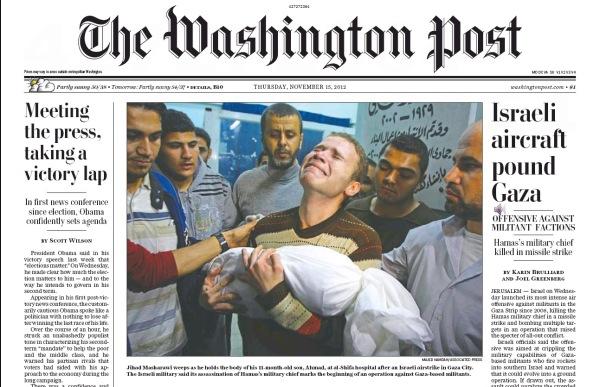
The front page photo on Thursday’s Washington Post tells, in a single frame, a very personal story from Wednesday’s Israeli airstrikes on the Gaza Strip. Jihad Misharawi, a BBC Arabic journalist who lives in Gaza, carries the body of his 11-month old son, Omar, through al-Shifa hospital in Gaza City.
An Israeli round hit Misharawi’s four-room home in Gaza Wednesday, killing his son, according to BBC Middle East bureau chief Paul Danahar, who arrived in Gaza earlier Thursday. Misharawi’s sister-in-law was also killed, and his brother wounded. Misharawi told Danahar that, when the round landed, there was no fighting in his residential neighborhood.
“We’re all one team in Gaza,” Danahar told me, saying that Misharawi is a BBC video and photo editor. After spending a “few hours” with his grieving colleague, he wrote on Twitter, ”Questioned asked here is: if Israel can kill a man riding on a moving motorbike (as they did last month) how did Jihad’s son get killed.”
Hamas rockets are now targeting Tel Aviv. Three Israelis have died so far. An Israeli ground assault is now expected.
Palestinian militants targeted densely populated Tel Aviv in Israel’s heartland with rockets for the first time Thursday, part of an unprecedented barrage that threatened to provoke an Israeli ground assault on Gaza. Three Israelis were killed.Air raid sirens wailed and panicked residents ran for cover in Tel Aviv, Israel’s commercial and cultural capital. Israel responded by moving troops and heavy weapons toward Gaza and authorizing the call-up of tens of thousands of reservists.
There was no word on where the two rockets aimed at Tel Aviv landed, raising the possibility they fell into the Mediterranean. A third rocket landed in an open area on the southern outskirts of Tel Aviv.
The fighting, the heaviest in four years, came after Israel launched a ferocious air assault Wednesday to stop repeated rocket fire from Gaza. The powerful Hamas military chief was killed in that strike, and another 18 Palestinians have died over two days, including five children. Some 100 Palestinians have been wounded.
Israeli warplanes struck dozens of Hamas-linked targets in Gaza on Thursday, sending loud booms echoing across the narrow Mediterranean coastal strip at regular intervals, followed by gray columns of smoke. After nightfall, several explosions shook Gaza City several minutes apart, a sign the strikes were not letting up, and the military said the targets were about 70 underground rocket-launching sites.
It’s just really hard to understand how these constant back and forth of rockets and missiles will solve anything. I’ve gotten to the point where I think that solving things isn’t actually the point. It just ruins a lot of lives on all sides of the hostilities. You wonder if it will ever end. You also have to wonder how many people will die until the joint desire for peace is greater than the joint desire for power and control.
What’s on you reading and blogging list today?
Thursday Reads
Posted: May 19, 2011 Filed under: Bahrain, Egypt, Environment, Farming, Foreign Affairs, Gaza, Iran, Israel, Libya, MENA, Pakistan, Psychopaths in charge, religion, Syria, Team Obama, Tunisia, U.S. Politics, We are so F'd | Tags: "historic" speeches, Barack Obama, birthers, Catholic Bishops, China, Dominique Strauss-Kahn, Espionage Act, Jane Mayer, Joseph Cannon, NSA spying, pedophile priests, rape, Thomas Drake, violence against women, whistle blowers 41 Comments
Good Morning!! Does anyone have a remedy for the sleepies? I recently finished a semester of teaching, and the last couple of days I’ve been extremely groggy. Yesterday I even slept until 10:30AM! It doesn’t help that we haven’t seen the sun in the Boston area for at least a week–it’s dark, dank, and raw out there. It seems a lot more like November than late May. On top of all that my Spring allergies are the worst I’ve ever experienced. So please forgive me if this post makes no sense. On to the news of the day.
Disgraced IMF honcho Dominque Strauss-Kahn’s accuser testified before a New York grand jury today. Immediately following her testimony, Strauss-Kahn’s attorneys announced their determination to spring their client from his cell at Rikers Island Jail.
His lawyers initially proposed a $1 million bail package that was rejected by the court.
Today a new offer that was said to add a private monitoring firm, an electronic bracelet and a guard to the package was put together. The cash component of the bail package remained at $1 million dollars, but the deal now included a guarantee that Strauss-Kahn would remain confined in New York City and not leave his residence except for visits to his doctor or lawyers. His passports and travel documents have already been taken from him.
According to ABC News, police are testing body fluids found in Strauss-Kahn’s hotel room for DNA.
ABC News has confirmed that police cut a swath of carpet to test for DNA and swabbed one of the suite’s sinks under a black light that indicated there was potential DNA evidence there.
Apparently Strauss-Kahn’s attorneys plan to claim that their client’s sexual encounter with a hotel maid was “consensual,” but there is a serious problem with that theory in addition to the maid’s testimony.
Investigators also say information downloaded from the suite door’s electronic card reader indicates the maid entered the room and never closed the door. The hotel policy requires maids to leave the door open when cleaning. The open door, they say, is proof that the women entered the room to work, not to engage in consensual sex.
I won’t dwell on this sordid story much longer, but I did want to call your attention to this piece in Time Magazine, which details a number of previous accusations against Strauss-Kahn–along with rumors –gossip about his abusive behavior toward women–that were hushed up until now. How predictable these guys are!
Joseph Cannon’s latest post is a must-read, along with the New Yorker article by Jane Mayer on which the Cannon comments. It’s about the domestic spying by the NSA that went on under Bush and the Obama administration’s heavy handed prosecution of whistleblowers while at the same time protecting the Bush administration criminals. (Minkoff Minx also mentioned Mayer’s article in her morning post yesterday.) Here’s an introduction to the piece by Cannon:
This humble blog spent a lot of time talking about NSA overreach during the controversies over Russell Tice and FISA. Meyer’s piece confirms a long-held suspicion that the real problem wasn’t eavesdropping on telephone calls but automated data-mining of all forms of electronic communication.
Two competing computer systems were designed to take us into this brave new world: ThinThread and Trailblazer. (The system in place now is called Turbulence. Someone at NSA has a strange affection for the letter T — which is also the first letter in totalitarian.) Trailblazer turned out to be a costly boondoggle. ThinThread worked. Originally, it had provisions built in to protect the privacy of American citizens; NSA Director Haybed tossed out those barriers.
Meyer focuses on an NSA whistleblower named Thomas Drake, who tried to blow the whistle on the Trailblazer fiasco — and on the abuses of privacy — to a staffer on the House Intelligence Committee. Unfortunately, the Committee was headed, at the time, by Porter Goss — and by Nancy Pelosi. They both seemed deaf to what Drake had to say.
Why is Obama so obsessed with prosecuting whistleblowers–even to the point of dusting off the Espionage Act? Jane Mayer writes:
When President Barack Obama took office, in 2009, he championed the cause of government transparency, and spoke admiringly of whistle-blowers, whom he described as “often the best source of information about waste, fraud, and abuse in government.” But the Obama Administration has pursued leak prosecutions with a surprising relentlessness. Including the Drake case, it has been using the Espionage Act to press criminal charges in five alleged instances of national-security leaks—more such prosecutions than have occurred in all previous Administrations combined. The Drake case is one of two that Obama’s Justice Department has carried over from the Bush years.
Gabriel Schoenfeld, a conservative political scientist at the Hudson Institute, who, in his book “Necessary Secrets” (2010), argues for more stringent protection of classified information, says, “Ironically, Obama has presided over the most draconian crackdown on leaks in our history—even more so than Nixon.”
Mayer asked Drake about it:
Sitting at a Formica table at the Tastee Diner, in Bethesda, Drake—who is a registered Republican—groaned and thrust his head into his hands. “I actually had hopes for Obama,” he said. He had not only expected the President to roll back the prosecutions launched by the Bush Administration; he had thought that Bush Administration officials would be investigated for overstepping the law in the “war on terror.”
“But power is incredibly destructive,” Drake said. “It’s a weird, pathological thing. I also think the intelligence community coöpted Obama, because he’s rather naïve about national security. He’s accepted the fear and secrecy. We’re in a scary space in this country.”
Check out her article if you can. She’s one of the best investigative reporters we have.
You may have missed Dakinikat’s late night post on Tuesday–the one about exploding watermelons. I thought this story deserved a little more emphasis, because it shows what can happen when there are no government regulations on agriculture–and industry in general (and that is what the Republicans would love to make happen). From Raw Story:
A bizarre wave of exploding watermelons — possibly due to farmers’ abuse of a growth-boosting chemical — has once again spotlighted safety fears plaguing China’s poorly regulated food sector.
State media has said nearly 50 hectares (120 acres) of watermelon crops in the eastern city of Danyang have been ruined by the phenomenon this month after some growers doused them with the growth accelerator forchlorfenuron.
“On May 7, I came out and counted 80 (exploded watermelons), but by the afternoon it was 100,” farmer Liu Mingsuo told state broadcaster China Central Television (CCTV) in a report that aired Tuesday. He said he had sprayed them with the chemical just a day before.
Remind me to never buy any food produce in China!!
Have you heard that the Obama campaign is selling T-shirts and coffee cups that mock the “birthers?”
President Obama’s 2012 presidential campaign today started selling “Made in the USA” t-shirts featuring images of both President Obama and the long-form birth certificate he released copies of last month.
Wear your support for this campaign with an official Made in the USA T-shirt,” his website advertises. Donate $25 or more today and we’ll send you your limited-edition shirt.
Coffee-mugs are also available.
“Remember ‘fight the smears’ from the 2008 campaign?” asked campaign spokesman Ben LaBolt. “This is the mobile version of it.”
Quite frankly, I think this is a little bit tacky….but that’s just me. And speaking of tasteless behavior, the Catholic Church is attempting to blame the ’60s counterculture for the behavior pedophile priests. From the Guardian UK:
The investigation commissioned by Catholic bishops said that the peak incidence of sexual abuse by priests in the 1960s and 70s reflected the increased level of other deviant behaviours in American society in the period, including “drug use and crime, as well as social changes, such as an increase in premarital sex and divorce.”
Researchers at John Jay College of Criminal Justice said most of the abusive priests were ordained in the 1940s and 50s and were not properly trained to confront the social upheavals of the 1960s.
David O’Brien, a historian of American Catholicism at the University of Dayton, said the report, Causes and Context of Sexual Abuse of Minors by Catholic Priests in the United States, 1950-2010, was dangerous because it seemed to exonerate bishops.
The study also ignores the long history of sexual abuse of children by the Catholic clergy. Methinks these “researchers” told the Catholic Bishops what they wanted to hear rather than do any serious research.
Finally, President Obama plans to give another “most amazing speech evah” tomorrow. This one is on the Middle East and North Africa. According to Voice of America:
The speech will be broad in scope, as Mr. Obama focuses on the peaceful democratic movements for change that have swept the region, discusses implications for U.S. policy, and offers what administration officials call some concrete policy proposals.
He will give his assessment of the impact of popular uprisings that have led to political changes in Egypt and Tunisia, and which continue in places like Syria, Libya and Yemen.
Senior administration officials say Mr. Obama will speak of a moment of opportunity, after a decade of great tensions and divisions, in which people of the region and U.S. policy can begin to turn the page toward a more positive and hopeful future.
The stalemated Israel-Palestinian peace process will be an important element. However, Mr. Obama is expected to frame it as part of a wider picture and say that leaders on both sides of that conflict should seize an opportunity for peace.
Whatever….I think I’ll arrange to be busy while he’s speechifying. Anyway, what are you reading and blogging about today?

 peej
peej Carissa
 bostonboomer
 dakinikat
 ecocatwoman
 mablue2
 Mama Lopez
 peggysue22
 quixote
 skydancingguestblogger
 Mona (aka Wonk the Vote)



 Sky Dancing
Recent Comments