
 There is so much crap in that interview that it’s a work fit for flies. Who is going to believe that the Russian Hacks of the election is the fault of Democrats? Bueller?
Emmanuel Macron will be almost certainly be the next French president. And the relief is immense. The much anticipated domino effect following the Brexit vote and Donald Trump’s election has not, so far, materialised. And the European project has won – at least for now. At Macron’s headquarters in Paris, a euphoric crowd was waving French flags, as well as many European ones. “C’est magnifique!”, his supporters kept saying. Being in the second round is a huge achievement, being the frontrunner even more so.
This result is a relief but it also represents a shock – not because of Marine Le Pen’s presence in the second round, which the polls prepared us for. But because the next president will come from neither of the two traditional main parties, the conservatives and socialists, the first time since the beginning of the fifth Republic, founded in 1958 by Charles de Gaulle.
François Fillon, who surprisingly won the conservative primaries last November, and was initially considered the frontrunner, has suffered badly as a result of allegations of corruption. He refused to stand down and even managed to make up some of his early losses, but not sufficiently to overcome Macron.
Benoît Hamon scored nearly the worst result of any socialist presidential candidate in the history of the fifth Republic. With just 6% of the votes, he comes just ahead of Gaston Defferre who scored just 5.01% in 1969, against Charles de Gaulle. Hamon’s lack of charisma failed to convince the socialist electorate, already badly disappointed by the Hollande presidency.
Mostly Monday Reads: Educating Donald
Posted: August 18, 2025 Filed under: #FARTUS, Finland, Foreign Affairs, France, Germany, Ukraine, United Kingdom, United Nations | Tags: Trump brocrush on Putin, Trump's Election Rigging, Ukraine Support Summit 7 Comments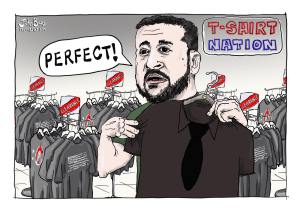
“Last-minute shopping,” John Buss, @repeat1968
Good Day, Sky Dancers!
Orange Caligula’s Reign of Terror and Tackiness continues. Oh, and we can’t forget that he’s busy rigging elections, ruining the economy, occupying cities, kidnapping immigrants, and fending off Epstein stories. President Zelenski is once more headed to the White House to ensure the US keeps the promises it made to the people of Ukraine. This time, Zelenski is bringing back-up from Western Europe. You’ll remember the last time he came, he brought out the bully in the childish Trump, who focused on Zelensky’s military uniform as a wartime president wearing a soldier’s uniform. Yam Tits hates to be upstaged and was hostile during that entire summit.
I don’t think that the Europeans can rescue the world from the Grandiose Narcissist, but they can make him look pathetic. As I write this, the Chancellor of the German Republic has arrived. This brief summary by AXIOS puts the occasion into perspective. Barak Ravid and Marc Caputo have this headline today. “Trump-Zelensky summit: The suit question, again.” Let’s see how he does when the premier leaders of Europe gang up on the infamous bully. Trump’s pettiness is likely to ruin the day.
The White House asked Ukrainian officials if President Volodymyr Zelensky will wear a suit to his meeting with President Trump in the Oval Office on Monday, two sources with direct knowledge tell Axios.
Why it matters: Zelensky’s outfit became an issue ahead of his previous Oval Office meeting with Trump in March, which exploded into a diplomatic fiasco.
Flashback: Trump didn’t like Zelensky’s military-style attire. He offered a sarcastic aside — “he is all dressed up today” — when he welcomed him into the West Wing.
- Some U.S. officials thought at the time that the suit issue contributed somewhat to the disastrous outcome of the meeting.
What to watch: The sources said Zelensky will show up at the White House on Monday wearing the same black jacket he wore to a NATO summit in the Netherlands in June. “It is going to be ‘suit-style’ but not a full suit,” one of the sources said.
- The NATO summit was the first time Zelensky had worn a business-style jacket since the 2022 invasion, and U.S. officials said that Trump was pleased by it.
- “Zelensky came like a normal human being, not crazy, and was dressed like a somebody that should be at NATO. … So they had a good conversation,” a U.S. official told Axios at the time.
The other side: One Trump adviser, partially in jest, told Axios that “it would be a good sign for peace” if Zelensky wore a suit on Monday, but added: “We don’t expect him to do it.”
- Said another: “It would be great if he wore a tie but we don’t expect him to.”
- The source added that Vice President Vance was more annoyed than Trump by Zelensky’s look and attitude the last time around. “The tie thing was a JD thing when it first happened.”
- Zelensky won’t wear a tie on Monday, the sources said.
Between the lines: Trump is a big believer looking the part, which in his mind, for a world leader, means wearing a suit. But his displeasure with Zelensky last time was about more than his clothes, his advisers say.
- U.S. officials say he has gotten better at appealing to Trump.
- “Give him some credit. He’s not as bad as he used to be,” the second Trump adviser said.
The intrigue: Asked if the summit will be a repeat of the last time, the adviser said, “No, absolutely not.”
 I just heard that French President Emmanuel Macron has arrived. The New Republic‘s Greg Sargent dives into Trump’s obsession with rigging the midterms in his favor. Is it more than ironic that the man who has fantasized about the Democrats rigging elections is being so obvious about rigging the elections? “Angry Trump Accidentally Blurts Out Unnerving New Plot to Rig Midterms. Donald Trump just gave away his own game.”
President Donald Trump raged at Democrats Monday for supposedly cheating in elections in a long and unhinged Truth Social rant—and buried in his tirade is a clear indication of how he hopes to corrupt the 2026 midterm elections at a time when his agenda is nose-diving in polls.
In his screed, Trump rehashed his familiar lies about how mail balloting is riddled with fraud, and promised to lead a new “movement” to abolish it.
But then he added this:
WE WILL BEGIN THIS EFFORT, WHICH WILL BE STRONGLY OPPOSED BY THE DEMOCRATS BECAUSE THEY CHEAT AT LEVELS NEVER SEEN BEFORE, by signing an EXECUTIVE ORDER to help bring HONESTY to the 2026 Midterm Elections. Remember, the States are merely an “agent” for the Federal Government in counting and tabulating the votes.
Trump already unveiled a similar executive order in March designed to change election rules. It would have barred states from accepting ballots mailed on time but that arrive after Election Day and forced state officials to require documented proof of citizenship for everyone who registers to vote in federal elections.
Such changes would have disenfranchised large numbers of voters. Two federal judges blocked it this spring after a coalition of states sued, the plaintiffs successfully arguing that it usurped their authority to set election rules. The administration is appealing.
Trump appears prepared to have a second run at such an executive order. But what’s critical about Monday’s post is he connected this scheme directly to the midterms, inadvertently revealing the real aim behind it.
Trump’s new rant says he’s going to “lead a movement to get rid of” mail balloting, then later says this “movement” will begin with his new executive order—a strong indication he will try to ban vote-by-mail by executive order.
Voting rights advocates have long expected him to attempt something like this, perhaps by arguing that vote-by-mail is a threat to national security. That’s because Trump’s argument for his previous executive order failed in the courts after judges affirmed that the Constitution authorizes states to set the “time, place and manner” of elections.
 You may read more at the link. The chickens are still coming home to roost with right-wing media sites pushing lies about the last election. This is from the AP. Nicholas Ricarddi has the analysis. I take offense at labelling this propaganda site as “conservative.” I wish the legacy media would just call them what they are.
The conservative network Newsmax will pay $67 million to settle a lawsuit accusing it of defaming a voting equipment company by spreading lies about President Donald Trump’s 2020 election loss, according to documents filed Monday.
The settlement comes after Fox News Channel paid $787.5 million to settle a similar lawsuit in 2023 and Newsmax paid what court papers describe as $40 million to settle a libel lawsuit from a different voting machine manufacturer, Smartmatic, which also was a target of pro-Trump conspiracy theories on the network.
Delaware Superior Court Judge Eric Davis had ruled earlier that Newsmax did indeed defame Denver-based Dominion Voting Systems by airing false information about the company and its equipment. But Davis left it to a jury to eventually decide whether that was done with malice, and, if so, how much Dominion deserved from Newsmax in damages. Newsmax and Dominion reached the settlement before the trial could take place.
The settlement was disclosed by Newsmax on Monday in a new filing with the U.S. Securities and Exchange Commission. It said the deal was reached Friday. A spokesperson for Dominion said the company was pleased to have settled the lawsuit.
The disclosure came as Trump, who lost his 2020 reelection bid to Democrat Joe Biden, vowed in a social media post Monday to eliminate mail-in ballots and voting machines such as those supplied by Dominion and other companies. It was unclear how the Republican president could achieve that.
The same judge also handled the Dominion-Fox News case and made a similar ruling that the network repeated numerous lies by Trump’s allies about his 2020 loss despite internal communications showing Fox officials knew the claims were bogus. At the time, Davis found it was “CRYSTAL clear” that none of the allegations was true.
Internal correspondence from Newsmax officials likewise shows they knew the claims were baseless.
 Marcy (emptywheel) has this important read. President Zelenski is on his way to the White House. Yam Tits is standing outside waiting for him. I think Zelenski is showing some pretty powerful cards today. “Trump Confesses that the United States Is a Client of Russia.”
There’s a great deal of normalcy bias in the reporting on Trump’s capitulation. NYT reports (based on watching the Sunday shows) that Marco Rubio and Steve Witkoff “hint” that Putin will make concessions to reach a plea deal with Ukraine, without questioning whether those are anything but personal inducements to Trump (like a Trump Tower) and without noting that Wikoff is incompetent to understand what would be a real concession in any case. WaPo describes that Putin was willing to offer security guarantees, without noting that guarantees without NATO are useless (and one of the tools Putin has used to lull his imperial victims in the past).
Curiously, one place that is not suffering from normalcy bias is WSJ’s editorial page, which notes what is being shared with “friendly media” (seemingly excluding WSJ from that moniker) are “worse than worthless.”
The President went into the summit promising “severe consequences” if there was no agreement on a cease-fire. He left the summit having dropped the cease-fire with no consequences in favor of Vladimir Putin’s wish for a long-term peace deal as the war continues. Mr. Trump took new sanctions on buyers of Russian oil off the table.
Mr. Trump also said the burden is now on Ukraine to close the deal. European leaders told the press that, in his conversations with them, Mr. Trump said Mr. Putin demanded that he get all of Ukraine’s Donetsk region, which would mean that Ukraine give up its main line of defense in the east.
White House leaks to friendly media suggest Mr. Putin promised that, in return for Donetsk, he’ll stop his assault and won’t invade other countries. No wonder Russian commentators and Putin allies were celebrating the summit’s results. Their President ended his isolation in the West, made no public concessions, and can continue killing Ukrainians without further sanction.
Mr. Putin’s promises are worse than worthless. He has broken promise after promise to Ukraine and the West. This includes the 1994 Budapest Memorandum promising to defend Ukraine against outside attack, and multiple Minsk agreements. He wants Donetsk because he would gain at the negotiating table what he hasn’t been able to conquer on the battlefield. It would also make it easier to take more territory when he or his successor think the time is right to strike again.
The silver lining is that European leaders say Mr. Trump told them Mr. Putin had agreed to accept “security guarantees” for Ukraine. The suggestion is that the U.S. might even be one of those guarantors, albeit outside NATO. But Mr. Trump provided no details.
For guarantees to have real deterrent effect, they would have to include foreign troops in Ukraine. Kyiv would need the ability to build up its military and arms industry.
All this is distracting from the question not asked at the Sunday shows yesterday: Why Trump’s team walked out of their meeting with Putin looking like they had seen death.
Let’s recap what got us here:
- Some weeks ago, Trump gave Putin the 50 days the Russian president wanted before he would come to the table. Then, as Putin kept bombing, making Trump look weak, Trump shortened the timeline to ten days. But instead of imposing the sanctions that Lindsey Graham had spent months crafting, Trump instead sent Steve Witkoff to Moscow. Witkoff, by design (because this is what happens when you choose to put someone with no relevant expertise or temperament in charge of negotiating deals), came back promising deals he couldn’t describe, it’s just not clear for whom.
- On an impossibly short notice, Trump arranged to host Putin on former Russian land. Going in, Trump promised that if Russia didn’t deal on a cease fire, there would be tough consequences. Europeans and Volodymyr Zelenskyy smelled a rat, but didn’t succeed in convincing Trump how badly he would be manhandled.
- And manhandled he was. Sergei Lavrov showed up wearing a CCCP jersey, Putin displayed undisguised contempt for everyone. And Trump walked out looking ashen. Putin treated Trump like a menial client.
- Trump told Sean Hannity that he shouldn’t have done his interview right afterwards, and I wonder if he had not — if Trump had not felt it necessary to immediately declare a success, ten of ten — then Trump’s team might have tried to find a way out. But whatever Trump then said to Zelenskyy and European leaders made them realize things were worse than they anticipated.
- Trump sent out Rubio and Witkoff on the Sunday shows to basically defer, making transparently bullshit claims of concessions from Russia. But today, Trump is making it clear that he will made demands Zelenskyy cannot accept — the Crimea recognition Trump floated to get elected in 2016, and no hopes of NATO membership — even while suggesting that Zelenskyy will have to make all the concessions.
Effectively, Putin ordered Trump to make Ukraine capitulate. Hell, maybe he even gave Trump a deadline.
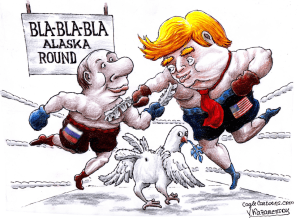 Andrea Mitchell has just stated that President Zelenski is wearing a suit. Our embarrassing President is welcoming him and, of course, mentions his fetish partner, Putin. He’s thanking Yam Tits. I guess Zelenski got the message JD Dank sent him last time. And Trump’s calling Putin’s attack on Ukraine as “Biden’s War.” The man just can’t keep himself from lying. Here’s some perspective on the Trump/Putin bromance event last week in Letters from an American.
On the heels of President Donald J. Trump’s Friday meeting with Russia’s president Vladimir Putin in Anchorage, Alaska, Trump will meet with Ukraine’s president Volodymyr Zelensky Monday afternoon at the White House. According to Barak Ravid of Axios, Trump called Zelensky from Air Force One on the way home from Alaska. Secretary of State Marco Rubio and White House special envoy Steve Witkoff were also on the hour-long call. The leaders of the European Commission, Finland, France, Germany, Italy, the North Atlantic Treaty Organization (NATO), and the United Kingdom then joined the call for another half hour.
In the call, Trump embraced Putin’s view of the conflict, telling Zelensky and European leaders that Putin does not want a ceasefire. Trump indicated that he is abandoning his own demand for a ceasefire and adopting Putin’s position that negotiations should take place without one. Zelensky insists on a ceasefire before negotiations. After the call, Trump posted on social media that “it was determined by all that the best way to end the horrific war between Russia and Ukraine is to go directly to a Peace Agreement, which would end the war, and not a mere Ceasefire Agreement, which often times do not hold up.” “All” is doing a lot of work in that sentence: it appears to mean Putin, with the possible agreement now of Trump.
Key unanswered questions from Friday’s summit were why it ended so abruptly, with the cancellation of a planned luncheon and more discussions, and why Trump immediately told Fox News Channel personality Sean Hannity, “Because of what happened today, I think I don’t have to think about [further sanctions on Russia] now. I may have to think about it in two weeks or three weeks or something, but we don’t have to think about that right now.”
The abrupt cancellation could mean that U.S. officials sent Putin packing without lunch because he would not agree to a ceasefire. But it seems worth keeping on the table that Trump has recently exhibited both an inability to focus on any topic, and a need to live in a carefully constructed world that ignores reality and assures him he is the best and the brightest. A high-stakes meeting with principals about a very real situation might have been too much for him to manage for a full day.
At the press conference following the summit, NBC News White House correspondent Peter Alexander reported that what struck him was “the looks on the faces of a lot of the American delegation here. Karoline Leavitt…, Steve Witkoff, who came into the room, then left quickly, then came back in. Leavitt appeared to be a bit stressed out, anxious. Their eyes were wide, almost ashen at times.”
At 8:31 this morning, Trump posted one word, “bela,” on his social media account. California governor Gavin Newsom’s social media account, which has been trolling Trump by imitating his boastful, insulting, all-caps posts, wrote: “We broke Donald Trump.”
As of midday Sunday, there appeared to be no mention of the Alaska meeting on the State Department’s website, although it has been updated since Friday to acknowledge Indonesia Independence Day and the Gabonese Republic National Day.
What is clear from the summit, though, is that Trump and Putin badly miscalculated the nature of power in democracies.
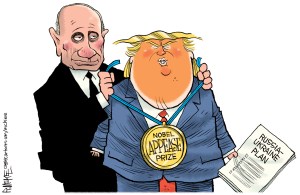 While Trump came out of the White House to greet Zelinski, the situation was different for our European Allies. This is from The Daily Beast. “Trump Snubs Greatest Allies With Greeting From Fox News Host. European leaders arriving at the White House were met by the Chief of Protocol, Monica Crowley.”
After rolling out the red carpet for Vladimir Putin in Alaska on Friday, President Donald Trump did not directly greet European leaders arriving at the White House on Monday.
Seven European leaders including British Prime Minister Keir Starmer, European Commission President Ursula von der Leyen, Italian Prime Minister Giorgia Meloni, French President Emmanuel Macron, German Chancellor Friedrich Merz, Finnish President Alexander Stubb and Secretary General of NATO Mark Rutte, have all flown to Washington to show a united front as Trump met with Ukrainian President Volodymyr Zelensky.
A gathering of so many European leaders at the White House at one time with such little notice is unprecedented in recent times.
As they started arriving at the White House, European leaders were greeted by the Chief of Protocol and former Fox News personality Monica Crowley rather than the president.
While Trump did not step out to meet European leaders who hastily flew to Washington, he did acknowledge that their visit for the summit is a big deal.
“We have never had so many European Leaders here at one time. A great honor for America,” he wrote on Truth Social.
And Yam Tit’s speaking about himself in third person again, and how the Press underrates him. He’s also bragging about the “success” of the District occupation. Well, I can’t hear his voice without feeling like I’m going to vomit. He’s still ass-kissing and performing for the Nobel Peace Prize. He just hates that Obama got one. I just turned the TV off, and I’ll end here. We know he’s outnumbered in the brain department. Let’s just hope they can break through that Narcissistic Personality Disorder and get him to do what’s necessary for the good of all the democracies in the world.
What’s on your Reading, Blogging, and Action list today?
Monday Reads: One Hundred Days of Shame
Posted: April 24, 2017 Filed under: Afternoon Reads, Foreign Affairs, France | Tags: 100 Days of Shame, AM Joy, France's Presidential election 2017, Joy Reid, Just how insane is Trump?, Science March 2017, Space Women, Women and girls in Science 34 Comments Good Morning Sky Dancers!
I’m a little slow getting started today as I deal with my ongoing shell shock. I admit to waking up each morning and being quite surprised that nothing has been completely blown up yet. This includes our home planet, Earth. Then, I head to twitter to see if something is likely to be blown up today. That gets a little wearing after three months. Kremlin Caligula gave an interview to AP and it should convince every one that his frontal lobe is seriously damaged. I’m not going to be stopping that ritual for some time it seems.
This series of lined threads punctuated by excerpts from the interview transcript offered by Joy Reid says it succinctly. The man operates at nursery school levels of thinking at best. I’m still going for a combination of dementia with a huge dollop of personality disorders. I’m also waiting for the mother ship to take me to my home planet where these things don’t happen. So, excuse me, I’m a little spaced today.
“Watch Trump’s mind wander from subject to subject with no apparent charted course, but always stumbling back to how cable news treats him…”
“He’s like a babbling brook of incoherence and obsession…”
“It’s not even funny. Trump clearly doesn’t know anything about the policies he’s trying to explain. He just recalls who likes him/is nice …”
President Trump blamed Democratic officials for having weak cyber defenses that allowed hackers to compromise their email systems ahead of the 2016 election in a recent interview.
Trump faulted the Democratic National Committee for lacking “the proper defensive devices” to safeguard against cyber intrusions in an interview with the Associated Press, according to a transcript published over the weekend.
Trump also indicated that his praise for WikiLeaks on the campaign trail last year did not actually mean he supports the organization, which was involved in publishing hacked emails from the DNC and former Hillary Clinton campaign chair John Podesta.
The U.S. intelligence community said in January that the Russian government had ordered an influence campaign during the election to undermine democracy and damage Clinton. The GRU, Russia’s main intelligence agency, targeted the DNC and high-level Democratic officials and passed hacked material to WikiLeaks, the intelligence community assessed.
On Friday, Trump took aim at the DNC when asked about WikiLeaks’ involvement in the influence campaign, arguing that the DNC did not have the same defenses as the Republican National Committee.
“You know, they tried to hack the Republican, the RNC, but we had good defenses. They didn’t have defenses, which is pretty bad management,” Trump said, referring to the DNC. “But we had good defenses, they tried to hack both of them. They weren’t able to get through to Republicans.”
There is so much wrong with the facts in this that it’s hard to even know where to start but, hey, grab them by the pussy! It’s always the victim’s fault!
 Meanwhile, this week’s trauma is the likely shut down of government of what’s functional in the government. Oh, and 100 days will be celebrated with another flurry of Executive Orders. This is what happens when you really, truly, can’t figure out how to get the system to work for you. Or, perhaps a crisis …
To see how Trump changes the normal calculation, consider what the appropriations process would look like in a more generic case, where Republicans enjoyed identical congressional majorities but under a president who behaved rationally.
In that case, we would expect the president and GOP leaders to work backwards from a desire to avoid a shutdown, toward an optimal outcome in which appropriations did not lapse and Congress funded as many of their priorities as possible. The hard fact that funding the government almost always requires a measure of bipartisanship places a fairly firm limit on what’s possible in that context. The minority party has a disproportionate amount of power over annual appropriations, but you go to the spending fight with the army you have, not the army you might want, or wish to have at a later time. If Democrats were horribly recalcitrant, they could reject every single Republican bid, leaving Republicans a choice between simply extending existing funds or shutting down the government—in which case a rational party would harrumph and agree to extend the funds.
The fact that Democrats are not horribly recalcitrant creates room for limited dealmaking. Republicans want to spend more money on defense and immigration enforcement, Democrats want to fund other priorities, and to the extent that these different points of emphasis don’t cross any ideological redlines, the parties can accommodate one another. But Democrats won’t persuade Republicans to agree to adequately fund the IRS, just as Republicans won’t convince Democrats to help them gut the EPA. The construction of a wall along the southern border, meanwhile, is a non-starter for Democrats and many Republicans. A rational GOP president would accept this reality and move on. Trump has made its inclusion in the funding bill a top priority.
It’s fund the wall or we’re all gonna die!! So, what is it with Trump and ratings and cable? Does every one obsessively tune in?

During a small working lunch at the White House last month, the question of job security in President Trump’s tumultuous White House came up, and one of the attendees wondered whether press secretary Sean Spicer might be the first to go.
The president’s response was swift and unequivocal. “I’m not firing Sean Spicer,” he said, according to someone familiar with the encounter. “That guy gets great ratings. Everyone tunes in.”
Trump even likened Spicer’s daily news briefings to a daytime soap opera, noting proudly that his press secretary attracted nearly as many viewers.
For Trump — a reality TV star who parlayed his blustery-yet-knowing on-air persona into a winning political brand — television is often the guiding force of his day, both weapon and scalpel, megaphone and news feed. And the president’s obsession with the tube — as a governing tool, a metric for staff evaluation, and a two-way conduit with lawmakers and aides — has upended the traditional rhythms of the White House, influencing many spheres, including policy, his burgeoning relationship with Congress, and whether he taps out a late-night or early-morning tweet.
Those Trump tweet-storms, which contain some of his most controversial utterances, are usually prompted by something he has seen on television just moments before. The president, advisers said, also uses details gleaned from cable news as a starting point for policy discussions or a request for more information, and appears on TV himself when he wants to appeal directly to the public.
Some White House officials — who early on would appear on TV to emphasize points to their boss, who was likely to be watching just steps away in his residence — have started tuning into Fox News’ “Fox & Friends” because they know the president habitually clicks it on after waking near dawn.
 Here’s a fact check list of what Candidate Caligula said he would do and what President (sic) Kremlin Caligula has done via NPR.
Back in October, before his election, then-presidential candidate Donald Trump laid out a 100-Day Action Plan. He called it his “Contract With The American Voter.” Among other things, it called for the full repeal and replacement of the Affordable Care Act, suspension of immigration from certain “terror-prone regions” and the lifting of “roadblocks” to let “infrastructure projects like the Keystone Pipeline move forward.”
The 100-day mark is not an official milestone, but in roughly the last century it has been a traditional point to take stock of a new administration. Throughout President Trump’s first 100 days, there have been both flurries of action and some setbacks. In many cases, the status of some of these efforts is not clear-cut — often with substantial talk but less action. In other areas, progress is clearer.
Charlie Pierce has nailed it on our 100 days of shame: ” The 100 Days: Who Can Stop an Unfit President*? Troubling signs in Trump’s Associated Press interview.”
The word for the 95th day of the presidency* of Donald Trump is “unintelligible.” As nearly as I can recall, the word first came to political prominence on April 29, 1974, when President Richard M. Nixon, in one of his last desperate attempts to throw the hounds of Watergate off his tracks, released to the nation edited transcripts of carefully selected White House tape recordings. (The president* will celebrate his 100th day in office with a rally in Pennsylvania on Saturday, the 43rd anniversary of the release of these transcripts. History rhymes.) More famously, the transcripts injected the phrase, “Expletive deleted” into the political jargon.
But “unintelligible” had its day, too. Given what they already knew about Nixon, many people around the country suspected that what was “unintelligible” probably had something to do with a crime or two. Over the weekend, “unintelligible” came back into our politics in a new and terrifying way.
The presidential elections in France took an interesting turn as the usual suspect party got eliminated and the moderate and the nationalist head to a run off. Statistically, it looks like the moderate will win. However, we do know that story here and this horrible sweep of white nationalism sweeping the west is like a plague with no end. It looks like there will be no more socialist France for some time. But, what will they opt for? The middle path or the path to destruction?
 So, we’re hoping France does not go the way we went which basically is straight to crazy land.
I’m still loving the pictures and stories of the scientists who showed up to protest the Republican attack on Scientific findings and fundings. I adores seeing the number of women and girls fighting for science. Doctor Daughter ran the Tutoring Center for the Science Department at LSU for a number of years. She was the only undergraduate who had done so at the time. I always filled her room up with microscopes, rocks, shells, crystals and Sci Fi Books. It’s easy to get kids interested in science!
From across the fields of science they came, marching to show that women in science have a lot to say.
Biologists and ecologists, medical researchers and EMTs, doctors and nurses, biomedical engineers and neuroscientists came with stories of why they fell in love with science.
They ranged from little girls to seasoned science veterans, all carrying a message of what they’d like to tell other women.
“It’s important for women scientists to be here because there are still too few of us,” said neuroscientist Sharri Zamore.
She drove from Blacksburg, Virginia, to support the cause, but also to “encourage more diversity” in the sciences, she told CNN.
There were many who stood up and marched for the first time in their lives.
 So, I’m going to go get lost in space for awhile in my particular form of science and grade some papers. However, I will not be drinking Starbuck’s Unicorn Frappucino. It sounds horrible and it’s terrifically unhealthy. What’s the big deal with it anyway?
Although Starbucks’ new Unicorn Frappuccino has garnered national attention for its whimsical name and and enchanting, pink-and-blue color scheme, at least one local group is cautioning people about its oh-so-sweet content.
On Friday, the Stratford Health Department succinctly called out the drink’s high sugar content on its Facebook page. “While the Unicorn Frappuccino may be pretty to look at, it’s loaded with 59 grams of sugar! That is over two times the amount of sugar recommended by the American Heart Association!”
That statement likely shocked few fans, as the Unicorn Frappuccino contains four kinds of syrup, according to its ingredients label — Frappuccino syrup (Water, Sugar, Salt, Natural And Artificial Flavor, Xanthan Gum, Potassium Sorbate, Citric Acid); Mango Syrup (Sugar, Water, Mango Juice Concentrate, Natural Flavor, Passion Fruit Juice Concentrate, Citric Acid, Potassium Sorbate, Turmeric, Gum Arabic); Vanilla Syrup (Sugar, Water, Natural Flavors, Potassium Sorbate, Citric Acid) and Classic Syrup (Sugar, Water, Natural Flavors, Potassium Sorbate, Citric Acid). The calorie count is also high, at 410 per 16 fluid-ounce serving.
Blech!!
What’s on your reading and blogging list today?
Tuesday Reads
Posted: August 26, 2014 Filed under: Barack Obama, Foreign Affairs, France, George W. Bush, Germany, Iraq, morning reads, racism, Syria, U.S. Economy, U.S. Politics, unemployment | Tags: Al Nusra Front, al Qaeda, Angela Merkel, austerity, European Central Bank, Ferguson MO, ISIS, James W. Foley, Janet Yellen, Mario Draghi, Michael Brown, Peter Theo Curtis, The Islamic State, the NEW York Times 41 Comments
The Dog Days of Summer, Janet Hill
Good Morning!!
It’s the last week of August, and the dog days of summer have supposedly passed; but the Boston area is supposed to hit ninety degrees today and tomorrow. I’m actually looking forward to it, because it has been so cool here lately–in the sixites and low seventies in the daytime and the fifties at night. Yesterday it got into the high eighties, and it felt wonderful.
The Boston Globe has a story today about Peter Theo Curtis, the writer who was just released from captivity in Syria. His mother lives in Cambridge. I had never heard of Curtis before; apparently his kidnapping was kept secret. The Globe reports: Militants free US writer with Mass. ties who was held in Syria.
Peter Theo Curtis, a writer and scholar with ties to the Boston area who was held captive for nearly two years by one of the Islamic militant groups operating in Syria, was released Sunday after emissaries from the government of Qatar won his freedom on humanitarian grounds, in a stark contrast to the brutal murder of fellow war correspondent James W. Foley .
Curtis’s 22 months in captivity were kept from the public at his family’s request since he was nabbed near the Syrian border in October 2012 by Al Nusra Front, one of the groups seeking to topple President Bashir Assad of Syria. Al Nusra Front has ties to the Al Qaeda terrorist network.
Curtis, 45, who wrote dispatches under the name Theo Padnos and previously chronicled disaffected young Muslims in Yemen in a book titled “Undercover Muslim,” had studied Arabic in Syria.
He was handed over to United Nations peacekeepers in the Israeli-occupied Golan Heights on Sunday evening, a UN spokesman in New York said. After it was determined he was in good medical condition, he was transferred to representatives of the US government, according to the UN.
“We are so relieved that Theo is healthy and safe and that he is finally headed home after his ordeal,” his mother, Nancy Curtis, who lives in Cambridge, said in a statement, “but we are also deeply saddened by the terrible, unjustified killing last week of his fellow journalist, Jim Foley, at the hands of the Islamic State in Iraq and Syria, ISIS.”
Foley was from New Hampshire, and the two families have gotten to know each other well, according to Curtis.

Garden Shed – Late Summer, KK Marais
Syria and Iraq
President Obama has authorized surveillance flights over Syria, according to BBC News.
Correspondents say the move could mark the first step towards US air strikes inside Syria, where the jihadist group controls vast swathes of territory.
The US is already carrying out strikes against IS in neighbouring Iraq.
On Monday, the Syrian government said it would work with the international community in the fight against IS.
Western governments have so far rejected suggestions that they collaborate with President Bashar al-Assad in an attempt to counter the growing regional threat posed by IS….
On Monday evening, US officials said Mr Obama had approved over the weekend reconnaissance flights by unmanned and manned aircraft, including drones and possibly U2 spy planes.
The US military has been carrying out aerial surveillance of IS – an al-Qaeda breakaway formerly known as Isis – in Iraq for months and launched air strikes on 8 August.
From The Boston Globe, citing “AP sources,” U.S. planes have already begun flying over Syria.
KABUL, Afghanistan (AP) — The U.S. has begun surveillance flights over Syria after President Barack Obama gave the OK, U.S. officials said, a move that could pave the way for airstrikes against Islamic State militant targets there.
While the White House says Obama has not approved military action inside Syria, additional intelligence on the militants would likely be necessary before he could take that step. Pentagon officials have been drafting potential options for the president, including airstrikes.
One official said the administration has a need for reliable intelligence from Syria and called the surveillance flights an important avenue for obtaining data.
Two U.S. officials said Monday that Obama had approved the flights, while another U.S. official said early Tuesday that they had begun. The officials were not authorized to discuss the matter by name, and spoke only on condition of anonymity.
Jim Michaels of USA Today spoke to Gen. Dempsey on Sunday about what is being done to deal with ISIS in Iraq.
ABOARD A U.S. MILITARY AIRCRAFT — U.S. airstrikes on Islamic militants in Iraq have blunted their momentum, but defeating them will require a broad regional approach that draws support from Iraq’s neighbors and includes political and diplomatic efforts, the top U.S. military officer said.
The long-term strategy for defeating the militants includes having the United States and its allies reach out to Iraq’s neighbors, including Jordan, Saudi Arabia and Turkey, Gen. Martin Dempsey, chairman of the Joint Chiefs of Staff, said Sunday….
Dempsey is working with Central Command to prepare “options to address [the Islamic State] both in Iraq and Syria with a variety of military tools including airstrikes,” said Col. Ed Thomas, Dempsey’s spokesman, in a statement.
The militant group Islamic State, also known as ISIS, has shown itself to be so brutal that Iraq and the U.S. should be able to find “willing partners” to join efforts to defeat the militants, Dempsey said.
But military power won’t be enough, Dempsey said. The strategy must take a comprehensive approach that includes political and diplomatic efforts to address the grievances of millions of Sunnis who have felt disenfranchised by Iraq’s Shiite-dominated government, he said.

Late Summer Garden, John Gordon
I get the feeling that we’re never going to escape involvement in the endless Middle East conflicts, thanks to George W. Bush, Dick Cheney, and the rest of the neocon gang. What a horrible mess! We have our own messes to deal with here, but foreign wars always seem to trump the needs of the American people.
John Cassidy speculates at The New Yorker: What’s Next in Iraq and Syria?
On his first full day back from vacation, President Barack Obama could be forgiven for wishing he were still on Martha’s Vineyard. With confirmation that ISIS fighters have just captured another military base from the government forces of President Assad, and that Qatar has engineered the release of an American freelance journalist who was being held by a non-ISIS jihadist group, Obama has two formidable challenges to deal with.
The immediate task for Obama is deciding whether to launch American bombing raids on ISIS positions inside Syria, while simultaneously preparing his Administration, and the country at large, for the possibility of another video showing an American hostage being butchered. The ISIS militants, having carefully orchestrated the beheading of James Foley following the launch of U.S. strikes inside Iraq, will surely seek to exploit the fate of its remaining American hostages for maximum effect. Any U.S. decision to expand its air campaign is almost certain to be met with the release of more snuff films.
No President—no American—could take such a prospect lightly. At the same time, Obama has to guard against allowing emotion and wishful thinking to take over U.S. policy. That’s what happened after 9/11, and some of the chaos that we now see in the Middle East can be traced back to that historic blunder. What’s needed is calm cost-benefit analysis of the options open to the United States, taking account of its strategic interests, its values, and its capabilities. In short, we need what Danny Kahneman, the Princeton psychologist who pioneered behavioral economics, would refer to as some Type 2 thinking: a disciplined weighing of the likely consequences of our actions. If we give into our Type 1 reaction—horror, outrage, anger—we will be playing into the hands of the jihadists.
One place to start is by acknowledging two errors in thinking that have blighted U.S. policy in the past decade: the conservative delusion that the United States could, more or less single-handedly, use its military power to reinvent the Middle East, and the liberal illusion that we could simply walk away from the mess that Bush, Cheney & Co. created. Without the political willingness and the financial capability to garrison the region in the manner of postwar Germany and Japan, U.S. influence has to be exercised through air power, political proxies, economic inducements, and regional alliances. But that doesn’t diminish the fact that the United States and other Western countries have vital interests at stake, one of which is preventing the emergence of a rogue Islamic state that would provide a rallying point, and a safe haven, for anti-Western jihadists the world over.
Read the whole thing at the link.

A Garden in a Sea of Flowers, Ross Turner
The Economies of the U.S. and Europe
There has been so much breaking news for the past couple of months that we haven’t talked much about the economies of the U.S. and Europe. But today the European Central Bank is topping the headlines, and last week Fed Chairperson Janet Yellen spoke at Jackson Hole, so I thought I’d post a few economics stories.
Here’s CNN Money’s report on Yellen’s speech, Janet Yellen: Job market not recovered.
That was Federal Reserve Chair Janet Yellen’s main message Friday in a much anticipated speech.
“It speaks to the depth of the damage that, five years after the end of the recession, the labor market has yet to fully recover,” she said.
The debate now is whether the job situation in America is healthy enough for the Federal Reserve to start raising interest rates, which have been at historic lows in recent years in an effort to jump start the economy. Yellen, however, said little new on Friday, and U.S. stock markets stayed flat.
Yellen is chair of the committee that sets interest rates, but she only gets one vote. Other members have differing views. The Fed board and other top economists are spending the weekend in Jackson Hole, Wyoming, debating these key issues.
Though the unemployment rate “has fallen considerably and at a surprisingly rapid pace,” Yellen said problems remain.
Yellen called attention to what Americans in the job market already know–though the employment numbers look better, many people have stopped looking for work, and most of the new jobs are part-time and pay low wages.
A few more U.S. economy stories to check out:
The Wall Street Journal: Fed’s Yellen Remains Mum on Timing of Rate Change.
Bloomberg Businessweek: Yellen Job-Slack View Muddied by Pent-Up Wage Deflation.
Slate: The Fed Is Not As Powerful As We Think.
If you think the economy is struggling here, you should take a look at Europe, where austerity thinking has ruled since the economic crisis hit. Yesterday the French government collapsed. From The New York Times, French Cabinet Is Dissolved, a Victim of Austerity Battles.
PARIS — The collapse of the French government on Monday exposed widening divisions both within France’s leadership, and Europe more broadly, over austerity policies that many now fault for threatening to tip the eurozone back into recession.
Prime Minister Manuel Valls announced that he would dissolve his government after a rancorous battle in his cabinet over whether the belt-tightening measures taken by President François Hollande — at the urging of Germany and European Union officials in Brussels — were impeding France’s recovery.
The dispute broke into the open when Mr. Vall’s outspoken economy minister, Arnaud Montebourg, insisted in an interview over the weekend that austerity had gone too far. “The priority must be exiting the crisis, and the dogmatic reduction of deficits should come after,” he told the newspaper Le Monde.
He also took direct aim at the policies of Angela Merkel, the German chancellor. “Germany is caught in a trap of austerity that it is imposing across Europe,” he said.
Even the formerly strong German economy is struggling now, according to Reuters (via NYT), Crisis in Ukraine Drags Economy in Germany.
The eurozone’s flatlining economy took another hit on Monday when data showed German business sentiment sagging for the fourth consecutive month. Chancellor Angela Merkel attributed some of her own country’s decline in the second quarter to the Russia-Ukraine crisis, over which tit-for-tat sanctions threaten trade. The Munich-based Ifo, a research firm, echoed some of those sentiments as it reported its business climate index, based on a monthly survey of some 7,000 companies, fell to a worse-than-expected 106.3 from 108, the lowest level in more than a year. The findings agreed with data earlier in the month on the second-quarter contraction in Germany, the bloc’s biggest economy. Klaus Wohlrabe, an Ifo economist, said his institute expected growth in Germany to be “close to zero” in the third quarter.
A few more headlines on the European economic situation:
The Guardian: An austerity revolt has broken the French government. Will the EU follow?
Bloomberg Businessweek on the European Central Bank, Draghi May Again Find Bazooka Words Beat Action With QE, and an editorial from The Financial Times, Central banks at the crossroads.

Wisteria Flowers in Bloom at Pergola at Portland Japanese Garden Stone Path
Ferguson Stories
Yesterday, on the day of Michael Brown’s funeral, The New York Times published a story that got a great deal of attention because of its insensitive characterization of the dead teenager. Here the paragraph that attracted the angry reaction:
Michael Brown, 18, due to be buried on Monday, was no angel, with public records and interviews with friends and family revealing both problems and promise in his young life. Shortly before his encounter with Officer Wilson, the police say he was caught on a security camera stealing a box of cigars, pushing the clerk of a convenience store into a display case. He lived in a community that had rough patches, and he dabbled in drugs and alcohol. He had taken to rapping in recent months, producing lyrics that were by turns contemplative and vulgar. He got into at least one scuffle with a neighbor.
Would the authors have written a similar paragraph about a white homicide victim? From Vox, The New York Times called Michael Brown “no angel.” Here’s how it described serial killers.
The New York Times’s description of Michael Brown as “no angel” has prompted a swift, critical reaction from other media outlets, including Vox, and various people on social media.
Alison Mitchell, national editor for the Times, defended the term in conversations with the Washington Post’s Erik Wemple:
“It comes out of the opening scene,” says Mitchell, who notes that “like many teenagers,” Brown was indeed “no angel.” Okay, but would the New York Times have chosen this term — which is commonly used to describe miscreants and thugs — if the victim had been white? Mitchell: “I think, actually, we have a nuanced story about the young man and if it had been a white young man in the same exact situation, if that’s where our reporting took us, we would have written it in the same way.” When asked whether she thought that “no angel” was a loaded term in this context, Mitchell said she didn’t believe it was. “The story … talks about both problems and promise,” she notes.
The Times’s response has done little to calm the storm. Sean McElwee, research assistant at Demos, dug into the archives to compare the Times’s description of Brown to the newspaper’s previous descriptions of serial killers and terrorists. Of course, comparing articles produced decades apart by different writers and editors isn’t an exact science. But it does lend context to the widespread frustration over how young black men are portrayed in the media.
A series of McElwee’s tweets are posted at the link, and are well worth reading.
One more from Salon by Joan Walsh, Ferguson’s booming white grievance industry: Fox News, Darren Wilson and friends. Check it out at Salon.
How did this post get so long?! I’d better wrap it up. Please post your thoughts and links in the comment thread, and have a great Tuesday!
Tuesday Reads: Liberals, Libertarians, and Concern Trolls
Posted: October 29, 2013 Filed under: abortion rights, Barack Obama, Civil Liberties, Civil Rights, Crime, Democratic Politics, Foreign Affairs, France, George W. Bush, Germany, Great Britain, Hillary Clinton, Medicaid, Medicare, morning reads, poverty, Reproductive Rights, Russia, Social Security, U.S. Politics, War on Women, Women's Rights | Tags: "progressive" blogs, Conor Friedersdorf, Edward Snowden, Glenn Greenwald, Ian Welsh, libertarians, Ron Paul, T-Bogg 60 Comments
Good Morning!!
Between the Red Sox being in the World Series and having to have a root canal on Saturday, I’ve been a little bit disconnected from politics. The Sox won again last night in St. Louis, and they’ll be coming back home to Fenway Park leading the series 3 games to 2; so they could end it tomorrow night. If this post is a little late, my aching jaw and baseball are the reasons why.
We’ve been talking a lot about libertarians lately, because so-called progressives have been aligning with those Ayn Rand fans since libertarian Edward Snowden began leaking top secret documents about the NSA and libertarian Glenn Greenwald began lecturing the world about what a great hero Snowden is for defecting to Russia and revealing the most secret counterintelligence methods of the U.S. and U.K.
The latest shameful episode was Saturday’s “Stop Watching Us” rally in Washington, at which supposedly “progressive” groups joined with anti-woman right-wingers like Justin Amash and neo-confederates like Ron and Rand Paul to protest the NSA doing its job of collecting foreign intelligence.
Before the rally took place, Tom Watson wrote a heartfelt column warning “progressives” that libertarians don’t make good bedfellows. Watson wrote that while he dislikes mass surveillance,
I cannot support this coalition or the rally. It is fatally compromised by the prominent leadership and participation of the Libertarian Party and other libertarian student groups; their hardcore ideology stands in direct opposition to almost everything I believe in as a social democrat.
The Libertarian Party itself — inaccurately described by Stop Watching Us as a “public advocacy organization” — is a right-wing political party that opposes all gun control lawsand public healthcare, supported the government shutdown, dismisses public education,opposes organized labor, favors the end of Social Security as we know it, and argues in its formal political manifesto that “we should eliminate the entire social welfare system” while supporting “unrestricted competition among banks and depository institutions of all types.”
Yet my progressive friends would take the stage with the representatives of this political movement? Why? The loss is much greater than the gain. Organizers trade their own good names and reputations to stand alongside — and convey legitimacy to — a party that opposes communitarian participation in liberal society, and rejects the very role of government itself. And their own argument for privacy is weakened by the pollution of an ideology that uses its few positive civil liberties positions as a predator uses candy with a child.
This is an abandonment of core principles, in my view, out of anger over Edward Snowden’s still-recent revelations about the National Security Agency and its spying activity, particularly domestic access to telephone and online networks and metadata. It represents trading long-held beliefs in social and economic justice for a current hot-button issue that — while clearly of concern to all Americans — doesn’t come close to trumping a host of other issues areas that require “the long game” of electoral politics and organizing. Going “all in” with the libertarian purists is a fatal and unnecessary compromise; reform is clearly needed, but the presence of anti-government laissez-faire wingers at the beating heart of the privacy movement will surely sour the very political actors that movement desperately needs to make actual — and not symbolic, link bait — progress in its fight.
But it was to no avail. Watson was attacked for his argument that the anti-surveillance fever is distracting from other important issues. People like Greenwald and Snowden couldn’t possibly care less about alleviating poverty, protecting women’s rights or the right to vote. They’d have no problem with Social Security and Medicare being eliminated, and as for voting, they’re anti-government anyway. Glenn Greenwald–whom some uninformed people believe is a “progressive,” saves his worst attacks for Democrats and in the past has supported Ron Paul and Gary Johnson for president. To Greenwald, sacrificing the entire legacy of FDR and the civil rights and women’s movements is no big deal. Here’s how he characterized the values of liberals who reject Ron Paul in 2011:
Yes, I’m willing to continue to have Muslim children slaughtered by covert drones and cluster bombs, and America’s minorities imprisoned by the hundreds of thousands for no good reason, and the CIA able to run rampant with no checks or transparency, and privacy eroded further by the unchecked Surveillance State, and American citizens targeted by the President for assassination with no due process, and whistleblowers threatened with life imprisonment for “espionage,” and the Fed able to dole out trillions to bankers in secret, and a substantially higher risk of war with Iran (fought by the U.S. or by Israel with U.S. support) in exchange for less severe cuts to Social Security, Medicare and other entitlement programs, the preservation of the Education and Energy Departments, more stringent environmental regulations, broader health care coverage, defense of reproductive rights for women, stronger enforcement of civil rights for America’s minorities, a President with no associations with racist views in a newsletter, and a more progressive Supreme Court.
Of course, Greenwald is admitting that he’d sacrifice the social safety net and the rights of millions of Americans in a hopeless effort to defeat the military-industrial complex and its technologies. If you can stand to read the whole piece, you’ll also learn that Greenwald thinks Matt Stoller is a “brilliant” writer. Greenwald is a libertarian purist, with no understanding of how politics actually works. This is the pied piper that many “progressives” are following these days.
I guess I’m getting a little carried away here, so I’ll stop ranting and offer some pertinent links.
Tuesday Reads: U.S. Spies on Foreign Countries and Other “Blockbuster” News
Posted: September 3, 2013 Filed under: Central Intelligence Agency, China, Crime, cyber security, Diplomacy Nightmares, Foreign Affairs, France, Germany, Great Britain, Iran, Israel, morning reads, Pakistan, Russia, Syria, U.S. Politics | Tags: Agência Brasileira de Inteligência, al Qaeda, Bashar al-Assad, black budget, Bob Cesca, Edward Snowden, espionage, Glenn Greenwald, Information Assurance, John Kerry, Laura Poitras, Marines website, National Security Agency (NSA), nuclear weapons, Osama bin Laden, S-2 (Mexico spy agency), SIGINT, signals intelligence, Syrian Electronic Army, Taliban 51 Comments
Good Morning!!
In the weeks since Edward Snowden absconded with thousands of top secret National Security Agency (NSA) files and traveled to Hong Kong and then Moscow and handed over the documents to Guardian columnist Glenn Greenwald and filmmaker Laura Poitras, we’ve learned that the U.S. spies on lots of other countries. Snowden has revealed that NSA has spied on China, Russia, Germany, France, Brazil, Mexico, Israel, Iran, and the UN. Oddly, we haven’t gotten much new information from Snowden about illegal or abusive NSA spying on Americans, which Snowden initially suggested was his reason for stealing the secret documents.
To most nominally intelligent and informed people, the fact that NSA spies on foreign countires is not particularly surprising; since collecting foreign signals intelligence (SIGINT) is the primary purpose of NSA as stated publicly on their website. Here is NSA’s statement of their “core mission”:
The National Security Agency/Central Security Service (NSA/CSS) leads the U.S. Government in cryptology that encompasses both Signals Intelligence (SIGINT) and Information Assurance (IA) products and services, and enables Computer Network Operations (CNO) in order to gain a decision advantage for the Nation and our allies under all circumstances.
The Information Assurance mission confronts the formidable challenge of preventing foreign adversaries from gaining access to sensitive or classified national security information. The Signals Intelligence mission collects, processes, and disseminates intelligence information from foreign signals for intelligence and counterintelligence purposes and to support military operations. This Agency also enables Network Warfare operations to defeat terrorists and their organizations at home and abroad, consistent with U.S. laws and the protection of privacy and civil liberties.
Spying on foreign countries is what NSA does. Why that is perceived as somehow illegal and/or shocking by Greenwald, Poitras, Snowden, and their cult followers, I have no clue. But the fact that a spy agency collects foreign signals intelligence really should not be considered breaking news; and the countries that are complaining about it are well known for spying on the US in return–and in some cases (e.g., China, Russia, and Israel) for famously stealing U.S. secrets and technology.
Today the Washington Post has a new “blockbuster” article that reveals that the U.S. is particularly focused on spying on Pakistan. Now I wonder why that would be? Anyone want to speculate? It couldn’t have anything to do with the fact that Pakistan concealed the location of Osama bin Laden for years, could it? Or the fact that Taliban and al Quaeda operatives regularly hide in Pakistan? Just a couple of wild guesses…
Here’s an excerpt from the WaPo article:
A 178-page summary of the U.S. intelligence community’s “black budget” shows that the United States has ramped up its surveillance of Pakistan’s nuclear arms, cites previously undisclosed concerns about biological and chemical sites there, and details efforts to assess the loyalties of counterterrorism sources recruited by the CIA.
Pakistan appears at the top of charts listing critical U.S. intelligence gaps. It is named as a target of newly formed analytic cells. And fears about the security of its nuclear program are so pervasive that a budget section on containing the spread of illicit weapons divides the world into two categories: Pakistan and everybody else.
The disclosures — based on documents provided to The Washington Post by former intelligence contractor Edward Snowden — expose broad new levels of U.S. distrust in an already unsteady security partnership with Pakistan, a politically unstable country that faces rising Islamist militancy. They also reveal a more expansive effort to gather intelligence on Pakistan than U.S. officials have disclosed.
The United States has delivered nearly $26 billion in aid to Pakistan over the past 12 years, aimed at stabilizing the country and ensuring its cooperation in counterterrorism efforts. But with Osama bin Laden dead and al-Qaeda degraded, U.S. spy agencies appear to be shifting their attention to dangers that have emerged beyond the patch of Pakistani territory patrolled by CIA drones.
“If the Americans are expanding their surveillance capabilities, it can only mean one thing,” said Husain Haqqani, who until 2011 served as Pakistan’s ambassador to the United States. “The mistrust now exceeds the trust.”
The stolen files also reveal serious human rights issues in Pakistan and fears about the security of Pakistan’s nuclear weapons. Raise your hand if you’re shocked by any this. I can certainly see why these revelations would be harmful to U.S. national security and foreign relations, however.
Via The Jerusalem Post, another Snowden leak revealed by the Washington Post showed that members of terrorist organizations have tried to join the CIA.
…individuals with past connections to known terrorist entities such as al-Qaida, Hezbollah and Hamas, have repeatedly attempted to obtain employment within the CIA, The Washington Post reported on Monday.
Among job-seekers that seemed suspicious to the CIA, approximately 20% of that grouping reportedly had “significant terrorist and/or hostile intelligence connections.” The nature of the connections was not described in the document.
“Over the last several years, a small subset of CIA’s total job applicants were flagged due to various problems or issues,” an anonymous CIA official was reported as saying. “During this period, one in five of that small subset were found to have significant connections to hostile intelligence services and or terrorist groups.” [….]
The document also allegedly stated that the CIA re-investigates thousands of employees each year to reduce the possibility that an individual with these connections may compromise sensitive information.
Can anyone explain to me why this should be considered criminal or why the person who revealed it should be called a “whistle-blower?” It seems to me, the only reason for revealing the methods the U.S. uses to collect foreign SIGINT is a desire to harm U.S. Government and damage its foreign policy. Here’s Bob Cesca, who has consistently critiqued libertarians Snowden and Greenwald and their anti-government motives from a liberal, rational point of view: Greenwald Reports NSA Spied on Presidents of Brazil andMexico.
We’re not sure exactly which section of the U.S. Constitution protects the privacy rights of foreign leaders, but Glenn Greenwald and Edward Snowden appear to believe it’s in there somewhere. The tandem crusaders for the Fourth Amendment have once again extended their reach beyond what was intended to be their mutual goal of igniting a debate in the United States about the constitutionality of the National Security Agency’s surveillance operations, and, instead, opted to reveal that, yes, the U.S. spies on foreign leaders. Shocking, I know.
Specifically, on the Globo television show “Fantasico” in Brazil, Greenwald described a July, 2012 document stolen from NSA by Snowden, which describes how NSA had intercepted communications made by the president of Mexico, Enrique Pena Nieto, as well as Brazil’s president, Dilma Rousseff. (Incidentally, the Globo article contains 13 corporate trackers or “web bugs.”)
The goal of revealing this information is clear. Greenwald and Snowden have successfully exploited the “sparking a debate” motive as a Trojan Horse for injecting unrelated information into public view as a means of vindictively damaging the operations of U.S. and U.K. intelligence communities, not to mention the reputation of the United States as a whole, while also pushing the unrealistic message that surveillance is generally impermissible. Yes, we already knew that nations spy on other nations, but to publicly disclose specific instances of international spying — while on the soil of one of the nations being surveilled — confirms these suspicions and sorely embarrasses everyone involved.
But guess what? Both Mexico and Brazil have powerful spy agencies that conduct “active surveillance” on the U.S.
In Brazil, it’s called the Agência Brasileira de Inteligência (ABIN or the Brazilian Intelligence Agency). It deals with external and domestic intelligence gathering: collection and analysis of information that’s intercepted via both signals (SIGINT collects email, phone calls and so forth) and human resources.
In Mexico, it’s called S-2. Like ABIN or NSA, S-2 also collects SIGINT on foreign targets, with a special focus on the military operations of foreign governments. Along with its counterpart, the Centro de Información de Seguridad Nacional (Center for Research on National Security or CISIN), S-2 is tasked with counter-intelligence and counter-terrorism operations.
Has anyone overheard Greenwald mention, even in passing, either of these agencies? Likely not, and don’t hold your breath waiting for Greenwald to attack Brazil’s intelligence community, even knowing that it wiretapped its own Senate and Supreme Court several years ago. Along those lines, we don’t know exactly whether these agencies have attempted to spy on any of our presidents or government officials, but wouldn’t Greenwald, as a U.S. citizen and resident of Brazil, want to find out using the same “Glennzilla” tenacity he’s employed while exposing U.S. spying? If his crusade now involves universal privacy, wouldn’t that include violations by the Brazilian government, especially knowing that Greenwald lives in Rio de Janeiro?
Read more at the link.
In other news….
The civil war in Syria continues to be the top international story, and The New York Times has a couple of helpful articles. The first is an explainer that deals with Key Questions on the Conflict in Syria. I won’t excerpt from it–read it at the NYT if you’re interested. Next, an article that explains how American policy on Syria may affect possible negotiations with Iran: Drawing a Line on Syria, U.S. Eyes Iran Talks.
As the Obama administration makes a case for punitive airstrikes on the Syrian government, its strongest card in the view of some supporters of a military response may be the need to send a message to another country: Iran. If the United States does not enforce its self-imposed “red line” on Syria’s use of chemical weapons, this thinking goes, Iran will smell weakness and press ahead more boldly in its quest for nuclear weapons.
But that message may be clashing with a simultaneous effort by American officials to explore dialogue with Iran’s moderate new president, Hassan Rouhani, in the latest expression of Washington’s long struggle to balance toughness with diplomacy in its relations with a longtime adversary.
Two recent diplomatic ventures have raised speculation about a possible back channel between Washington and Tehran. Last week, Jeffrey Feltman, a high State Department official in President Obama’s first term who is now a senior envoy at the United Nations, visited Iran to meet with the new foreign minister, Mohammad Javad Zarif, and discussed possible reactions to an American airstrike in Syria.

In line with the international beating up on the U.S. that has followed the Snowden-Greenwald-Poitras “revelations” that NSA spies on foreign countries, The Daily Mail has a snarky article with numerous photos about a dinner that John Kerry had with Syria’s Bashar al-Assad in 2009.
An astonishing photograph of John Kerry having a cozy and intimate dinner with Bashar al-Assad has emerged at the moment the U.S Secretary of State is making the case to bomb the Syrian dictator’s country and remove him from power.
Kerry, who compared Assad to Adolf Hitler and Saddam Hussein yesterday, is pictured around a small table with his wife Teresa Heinz and the Assads in 2009.
Assad and Kerry, then a Massachusetts senator, lean in towards each other and appear deep in conversation as their spouses look on.
A waiter is pictured at their side with a tray of green drinks, believed to be lemon and crushed mint.
Now, why would Kerry be having dinner with Syria’s president? The Daily Mail tells us:
The picture was likely taken in February 2009 in the Naranj restaurant in Damascus, when Kerry led a delegation to Syria to discuss finding a way forward for peace in the region.
At the time, Kerry was Chairman of the Senate Foreign Relations Committee, and what he was doing is called “diplomacy.” But looking back in the age of Snowden, it seems that instead of having a polite dinner, Kerry should have punched Assad in the nose and screamed at him at the top of his lungs to get with the program–or something…
From the Wall Street Journal: Syrian Electronic Army Hacks Marines Website
A collection of pro-Syrian government hackers apparently defaced a Marine Corps recruitment website Monday.
The Syrian Electronic Army, which has hacked a series of websites, posted a letter on the Marines.com website arguing the Syrian government is “fighting a vile common enemy.”
“The Syrian army should be your ally not your enemy,” the letter read. “Refuse your orders and concentrate on the real reason every soldier joins their military, to defend their homeland. You’re more than welcome to fight alongside our army rather than against it.”
See a screen shot at the link. The site is now back up and running normally.

 peej
peej Carissa
 bostonboomer
 dakinikat
 ecocatwoman
 mablue2
 Mama Lopez
 peggysue22
 quixote
 skydancingguestblogger
 Mona (aka Wonk the Vote)



 Sky Dancing
Recent Comments