
Breaking News: Mubarak Speaks, Violence Erupts
Posted: February 1, 2011 Filed under: Diplomacy Nightmares, Egypt, Foreign Affairs | Tags: Alexandria, Million Egyptian March, US presidential statement on Egypt 53 CommentsLive Blog and Developing Situation 
SultanAlQassemi Sultan Al Qassemi
GUNFIRE IN EGYPT NOW
A pro-Mubarak demonstration has converged in Alexandria with protesters wishing him out. There are reports of stones tossing and gun fire. The army is circling the crowd in an attempt to intimidate the crowd. More shots fired on the Streets of Alexandria. AJ is speculating that the gunfire is a psychological tactic. The army is clearly firing in the air according to AJ journalists on the ground.
I really have to wonder what kind of background this provides to the upcoming US Presidential statement on Mubarak’s speech.
Many protesters from both side are holding ground in the heart of the square and are not disbanding.
AJEnglish Al Jazeera English
Clashes between anti-Govt and pro-Mubarak protesters in #Alexandria – coverage live on #AlJazeera: http://aje.me/ajelive#tahrir#egypt
thedailybeast The Daily Beast
RT @videobeast: Egypt President Mubarak says he will not run for re-election and never wanted “power or prestige”: http://thebea.st/dOZ9JN
jaketapper Jake Tapper
latest word is POTUS Egypt remarks will come at 620 pm ET
Breaking News: Forthcoming Mubarak Statement
Posted: February 1, 2011 Filed under: Diplomacy Nightmares, Egypt, Foreign Affairs, Live | Tags: Egypt, Egyptian protests, Gamal Mubarak, Hosni Mubarak, live blog, US Special Envoy Frank Wisner 47 CommentsThis is a developing post so it will change frequently.
Recent Tweet from
AJEnglish Al Jazeera English
Hosni Mubarak expected to speak to soon. Tune in to #AlJazeera to watch the coverage live: http://aje.me/ajelive#mubarak#tahrir#egypt
Al Jazeera continues to stream in English live.
A statement is also expected from the White House.
According to Diplomatic Sources via CNN: Egypt crisis: Mubarak won’t run again; report says Obama pushed for decision
Update 9:38 p.m. Cairo, 2:38 p.m. ET] Egyptian President Hosni Mubarak has decided not to seek re-election, according to a senior U.S. official involved in the Obama administration’s deliberations on Egypt. The official cited “reliable contacts in Cairo” for the news. The New York Times reported Obama pushed Mubarak into the decision via a message delivered by former Ambassador Frank Wisner, who paid a personal visit to Mubarak on Tuesday.
The LA Times is reporting that US Envoy Frank Wisner was sent to tell Egyptian President Hosni Mubarak to step aside.
Frank Wisner, a former ambassador to Egypt who has good relations with the Mubarak regime, traveled to Cairo at President Obama’s behest to talk to the Egyptian leader about the country’s future.
Wisner delivered a direct message that Mubarak should not be part of the “transition” that the U.S. had called for, according to Middle East experts who spoke on condition of anonymity.
One expert on the region said that in his regular conversations with the Obama administration about the unrest in Egypt, he learned that Wisner’s message to Mubarak was that “he was not going to be president in the future. And this message was plainly rebuffed.”
Obama’s Message to Mubarak: Neither You Nor Your Son Should Be On the Ballot This Fall
U.S. officials tells ABC News that on Saturday, President Obama made the final authorization to send former Ambassador to Egypt Frank Wisner to deliver – gently – the message to Egyptian President Hosni Mubarak that neither he nor his son should run for the presidency this September.
Wisner, a well-regarded Egypt hand with a longtime relationship with Mubarak, was “in the orbit,” an official says, “because he’s been talked about as a potential Holbrooke replacement” to be a Special Envoy to Afghanistan and Pakistan.
The White House gave Wisner his talking points, the official said, and Wisner flew to Cairo Sunday to tell Mubarak that he should not run for re-election — and that his son Gamal should not run either.
Tuesday Reads
Posted: February 1, 2011 Filed under: 2012 presidential campaign, Barack Obama, Central Intelligence Agency, Egypt, Foreign Affairs, U.S. Politics | Tags: Ali A. Mohammed, Anwar Sadat, Barack Obama, Egypt, Jimmy Carter, Jon Huntsman, Keith Olbermann, Morning reads, snow, Tom Brokaw, Wael Ghonim, weather 33 Comments
Oh no! Not another giant snowstorm!
Good Morning!!
Have you heard about the gigantic winter storm that is affecting 29 states?
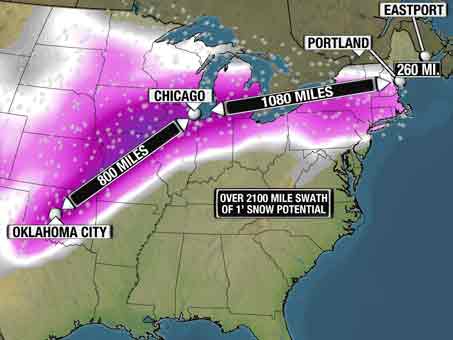
National Weather Service advisories and warnings are in effect in more than 20 states as a powerful storm gets organized in the Midwest. A blizzard warning is in effect for Chicago, where 12 to 20 inches of snow is possible. Other cities which may experience blizzard conditions include Tulsa, Wichita, Kansas City, and Detroit. Snow is expected to begin tonight and tomorrow from southwest to northeast and continue into early Wednesday.
The Chicago Tribune’s Weather Center cautions: “Snowfall totals in excess of 12 inches coupled with winds of 25 to 40 mph will make long distance travel extremely dangerous if not impossible.”
Wednesday morning into Thursday, the heavy snow moves through central New York, northern Massachusetts,southern Vermont, New Hampshire and southeast Maine.
Weather.com says the storm may be historic, due to the areal coverage of snow forecast – with upwards of 1 foot likely across a “2100-mile long swath from the Southern Plains to coastal New England.”
We’re supposed to get 18 inches in the Boston area, plus it will be mixed with ice pellets on Wednesday. I can’t take it anymore!!!!! All this snow is really getting to me.
In other news, the Republicans are all a-twitter over some guy named Jon Huntsman who is probably going to run for President. I admit I never heard of him and couldn’t care less what he does, but it seems to be the talk of the Village. To top it off, this guy has been working for Obama. Does he have any Democrats working for him?
Jon M. Huntsman Jr., the U.S. ambassador to China, sent a resignation letter to President Barack Obama on Monday, the White House said. Huntsman now is likely to explore a Republican presidential bid, according to supporters.
In a letter hand-delivered to the White House, the former Utah governor said that he wants to return to the United States by May. The letter thanks Obama for the opportunity to serve the country and praises the U.S. embassy staff in Beijing.
If Huntsman won the GOP nomination, he would be challenging the reelection of his former boss. White House officials are furious at what they consider an audacious betrayal, but know that any public criticism would be likely to benefit Huntsman if he enters the primaries.
Huntsman boasts the most foreign policy experience of any of the likely GOP candidates, and would be a formidable entry to the unformed GOP field. He had a fiscally conservative record as governor, opposes abortion and is a strong supporter of gun owners’ rights.
Yep, sounds like Obama’s type.
If you haven’t read Joseph Cannon’s latest, you should rush right over and do so. He has a fascinating, well-researched post up about Ali Abdul Saoud, a.k.a. Ali A. Mohammed, a muslim double agent who worked for both the CIA and al Qaeda and may have been involved (along with Omar Suleiman?) in the assassination of Anwar Sadat.
It’s a fascinating read, and I’m not just saying that because Cannon linked to my post on Suleiman.
This is a frightening story out of Egypt: Google Executive Missing in Wake of Egypt Protests.
An executive for Google Inc. is missing in the wake of Egypt’s tumultuous protests, according to his brother. Wael Ghonim, whose LinkedIn profile says he is head of marketing for the Middle East and North Africa at Google, hasn’t been heard from since Friday at 6 p.m., his brother Hazem said.
[….]
Wael Ghonim’s web postings suggest a deepening engagement with politics. His Facebook page lists opposition figure Mohamed ElBaradei as a person he admires, along with Bill Gates, Warren Buffett and Steve Jobs. In mid-January he tweeted that he was traveling to Qatar to participate at an Internet freedom forum hosted by network Al Jazeera.
Later, he sent a tweet that said he was going to join the Egyptian protests despite “all the warnings I got from my relative and friends.”
[….]
On Friday, he tweeted: “Very worried as it seems that government is planning a war crime tomorrow against people. We are all ready to die.”
I think a lot more people are probably dead and missing in Egypt than we are being told. I hope Ghonim will be found.
The Christian Science Monitor asks, “Did Jimmy Carter just throw Obama under the bus?”
Commenting on the week’s tumultuous events in Egypt from the Maranatha Baptist Church near his home in Plains, Ga., the former president who brokered the 1979 peace accord between Egypt and Israel gave a candid personal assessment of Egypt’s embattled leader and said his “guess is Mubarak will have to go.”
President Mubarak has “become more politically corrupt” in recent years and has “perpetuated himself in office,” he told a Sunday school class of 300, according to the Columbus Ledger-Enquirer. Assessing the popular uprisings sweeping across the region, he said: “This is the most profound situation in the Middle East since I left office” more than 30 years ago.
I sure hope it’s a different bus than the one we’re under, because I don’t want Obama down here with us.
Speaking of throwing people under the bus, Tom Brokaw made a critical reference to Keith Olbermann in an interview with the Chicago Tribune. Here’s Huffpo’s gossipy take on it.
He told the Tribune’s Phil Rosenthal that NBC was better placed than its rivals because of MSNBC.
“Where it got sticky is when our commentators were anchoring political coverage,” he said, in a clear reference to Olbermann. Brokaw was widely known to have complained about Olbermann’s anchoring of campaign coverage during the 2008 race. “Those are, in some ways, incompatible roles,” Brokaw continued. “We worked our way through that.”
Rosenthal then asked Brokaw what he thought of Olbermann’s exit. “You’re not going to get me to go there,” Brokaw said. But when pushed, he said that MSNBC will weather the storm.
He went there.
Did you hear that Mayor Bloomberg arranged for an undercover investigation of the recent Arizona gun show? The New York Times has the skinny.
The investigation, part of an effort by Mayor Michael R. Bloomberg’s administration to crack down on illegal gun sales nationwide, took place Jan. 23 at the Crossroads of the West Gun Show in Phoenix, officials said.
“The background check system failed in Arizona, it failed in Virginia and it fails in states around the country,” said John Feinblatt, an adviser to Mr. Bloomberg. “If we don’t fix it now, the question is not whether another massacre will occur, but when.”
Private, unlicensed sellers are not required to run federal background checks, but it is a violation of federal law to sell guns to people if sellers suspect they are felons or mentally ill or are otherwise prohibited from buying. In the case of Jared L. Loughner, who is accused of opening fire on the crowd in Tucson on Jan. 8, the gun used in the shootings was bought at a licensed gun dealer, and he passed a background check, the authorities said.
In two instances, the New York undercover officers specifically said before buying a gun, “I probably couldn’t pass a background check,” but were still sold guns, city officials said.
Finally, here’s a fluffy story to go along with the white stuff that a lot of us will be seeing outside our windows today and tomorrow: How Meditation May Change the Brain
…researchers report that those who meditated for about 30 minutes a day for eight weeks had measurable changes in gray-matter density in parts of the brain associated with memory, sense of self, empathy and stress. The findings will appear in the Jan. 30 issue of Psychiatry Research: Neuroimaging.
M.R.I. brain scans taken before and after the participants’ meditation regimen found increased gray matter in the hippocampus, an area important for learning and memory. The images also showed a reduction of gray matter in the amygdala, a region connected to anxiety and stress. A control group that did not practice meditation showed no such changes.
I’m not particularly surprised, but the woman who wrote the article is. Check it out.
Sooooo…. What are you reading and blogging about this morning? Please share!
“A chance to move beyond rhetoric to support the democratic movement sweeping over Egypt”
Posted: January 31, 2011 Filed under: Egypt | Tags: 2011: days of revolt, Obama Administration, Omar Suleiman, Orderly transition 59 CommentsFrom Sunday. LA Times Babylon & Beyond blog:
More than 80 American academics, including Noam Chomsky and several California scholars, posted an open letter online Sunday to President Obama […]

From the Tahrir demonstrations
Here’s the open letter, as posted on the Institute for Public Accuracy site:
Dear President Obama:
As political scientists, historians, and researchers in related fields who have studied the Middle East and U.S. foreign policy, we the undersigned believe you have a chance to move beyond rhetoric to support the democratic movement sweeping over Egypt. As citizens, we expect our president to uphold those values.
For thirty years, our government has spent billions of dollars to help build and sustain the system the Egyptian people are now trying to dismantle. Tens if not hundreds of thousands of demonstrators in Egypt and around the world have spoken. We believe their message is bold and clear: Mubarak should resign from office and allow Egyptians to establish a new government free of his and his family’s influence. It is also clear to us that if you seek, as you said Friday “political, social, and economic reforms that meet the aspirations of the Egyptian people,” your administration should publicly acknowledge those reforms will not be advanced by Mubarak or any of his adjutants.
There is another lesson from this crisis, a lesson not for the Egyptian government but for our own. In order for the United States to stand with the Egyptian people it must approach Egypt through a framework of shared values and hopes, not the prism of geostrategy. On Friday you rightly said that “suppressing ideas never succeeds in making them go away.” For that reason we urge your administration to seize this chance, turn away from the policies that brought us here, and embark on a new course toward peace, democracy and prosperity for the people of the Middle East. And we call on you to undertake a comprehensive review of US foreign policy on the major grievances voiced by the democratic opposition in Egypt and all other societies of the region.
You can view the signatories here. You can also download a pdf. And, to leave feedback, apparently you can to egyptletter.blogspot.com.
Earlier on Sunday, the Carnegie Endowment published the following statement from its Working Group on Egypt, urging for free and fair elections and recommending a suspension of economic and military aid to Egypt until certain conditions that would ensure a free and fair election are met:
Amidst the turmoil in Egypt, it is important for the United States to remain focused on the interests of the Egyptian people as well as the legitimacy and stability of the Egyptian government.
Only free and fair elections provide the prospect for a peaceful transfer of power to a government recognized as legitimate by the Egyptian people. We urge the Obama administration to pursue these fundamental objectives in the coming days and press the Egyptian government to:
- call for free and fair elections for president and for parliament to be held as soon as possible;
- amend the Egyptian Constitution to allow opposition candidates to register to run for the presidency;
- immediately lift the state of emergency, release political prisoners, and allow for freedom of media and assembly;
- allow domestic election monitors to operate throughout the country, without fear of arrest or violence;
- immediately invite international monitors to enter the country and monitor the process leading to elections, reporting on the government’s compliance with these measures to the international community; and
- publicly declare that Hosni Mubarak will agree not to run for re-election.
We further recommend that the Obama administration suspend all economic and military assistance to Egypt until the government accepts and implements these measures.
The Working Group on Egypt is a nonpartisan initiative bringing substantial expertise on Egyptian politics and political reform, and aimed at ensuring that Egypt’s elections are free and fair and open to opposition candidates.
Laura Rozen’s report on the Egypt working group’s statement provides further insight:
A bipartisan group of former U.S. officials and foreign policy scholars is urging the Obama administration to suspend all economic and military aid to Egypt until the government agrees to carry out early elections and to suspend Egypt’s draconian state of emergency, which has been in place for decades.
“We are paying the price for the fact that the administration has been at least of two minds on this stuff, and we should have seen it coming,” said Robert Kagan, co-chair of the bipartisan Egypt working group, regarding what many analysts now say is the inevitable end of Hosni Mubarak’s thirty year reign as Egypt’s president.
Though the Obama administration has tried to look like it’s not picking sides in urging restraint from violence amid five days of Egyptian unrest calling for Mubarak to step down, “the U.S. can’t be seen as neutral when it’s giving a billion and a half dollars” to prop up the Mubarak regime, Kagan said.
And, from Zaid Jilani at Think Progress:
The position of the Obama administration has been unclear. While administration officials have condemned abuses of civil liberties, they’ve also fallen short of endorsing Mubarak’s ouster or ending support for the regime, with Vice President Joe Biden even going as far as to say that Mubarak isn’t a dictator.
The United States gives nearly $2 billion in aid to the Egyptian regime every year, and offers diplomatic and military cooperation that helps bolster Mubarak. As protesters continue to be beaten, tortured, and killed by internal security forces, it’s important to know that these abuses are being subsidized by U.S. taxpayer dollars. Threatening to reduce or eliminate this monetary assistance to the Egyptian regime would be a powerful tool that the United States could use to help advance democracy and promote freedom in the country.
In light of the open letter from Chomsky et al and the statement from the CEIP’s working group on Egypt, I thought it might be helpful to recap what the Obama Administration said yesterday.
Monday Reads
Posted: January 31, 2011 Filed under: Corporate Crime, Egypt, Foreign Affairs, Global Financial Crisis, income inequality, John Birch Society in Charge, morning reads, SOTU, The Bonus Class, The Great Recession, U.S. Economy, U.S. Politics | Tags: Bennett, Corporate Welfare Recipients Koch brothers, GDP growth, Hatch, Innovation, median incomes flat, Public cost cutting leads to death, Snowe, Tea party targets Lugar, The Great Stagnation, Uncloak the Koch brothers 75 Comments Good Morning!
I thought I’d start the day off with some new topics given we’ve spent the weekend following world events unfold. One of the major complaints of the Egyptian people is their high unemployment rate. It’s basically the same as ours. They also have seen rising food and energy prices. Our overall price inflation is well under control at the moment, but there are world events that have made food and energy prices more volatile than usual. The Egyptians have experienced GDP growth rates that are twice ours, but like our country, the income improvements have advantaged the very few instead of the many for many of the same reasons. One of the guys that skedaddled on that airplane was the big telecom industry captain. We have many huge corporations–like GE–that exist on no bid government contracts that they never lose, even when they’ve been found endlessly maleficent.
I thought I’d start with Tyler Cohen who has been riffing on themes relevant to his for sell on line pamphlet The Great Stagnation. His NYT article this weekend buried one of the themes of the SOTU. It’s called ‘Innovation Is Doing Little for Incomes’.
The income numbers for Americans reflect this slowdown in growth. From 1947 to 1973 — a period of just 26 years — inflation-adjusted median income in the United States more than doubled. But in the 31 years from 1973 to 2004, it rose only 22 percent. And, over the last decade, it actually declined.
Most well-off countries have experienced income growth slowdowns since the early 1970s, so it would seem that a single cause is transcending national borders: the reaching of a technological plateau. The numbers suggest that for almost 40 years, we’ve had near-universal dissemination of the major innovations stemming from the Industrial Revolution, many of which combined efficient machines with potent fossil fuels. Today, no huge improvement for the automobile or airplane is in sight, and the major struggle is to limit their pollution, not to vastly improve their capabilities.
Although America produces plenty of innovations, most are not geared toward significantly raising the average standard of living. It seems that we are coming up with ideas that benefit relatively small numbers of people, compared with the broad-based advances of earlier decades, when the modern world was put into place. If pre-1973 growth rates had continued, for example, median family income in the United States would now be more than $90,000, as opposed to its current range of around $50,000.
You can find more discussion at Marginal Revolution. The Economist weighed in on the booklet tonight.
improvements in rich world living standards may, for the moment at least, come from the capture of policy low-hanging fruit. In other words, the rich world should focus on getting rid of blatantly foolish and costly policies. Moving from taxes on goods, like income, to bads, like traffic congestion, would be a good start. Not spending so much on medical treatments with dubious benefits would be another possibility. Cutting out policy foolishness like agriculture subsidies and the mortgage-interest deduction would be another positive step. Amid rapid growth, really silly policy choices could be tolerated, since surpluses continued to rise. As growth rates slow, the failure to cut out bad policies will mean continued stagnation or declines in living standards for some.And it’s a little amusing to focus on the implications of the spread of cheap-to-free internet amusement. As Mr Cowen notes, the availability of good, free internet entertainment has allowed a lot of people hit hard by falling incomes or recession-induced joblessness to maintain relatively high levels of utility (though this available substitute has also made it easier to cut down on physical consumption, with nasty effects on GDP).
Paul Krugman agrees here. Robert Reich struck a similar chord on stalled incomes in his response to the SOTU. Reich focuses on one of our topics. That would be the important list of what the president didn’t say.
What the President should have done is talk frankly about the central structural flaw in the U.S. economy – the dwindling share of its gains going to the vast middle class, and the almost unprecedented concentration of income and wealth at top – in sharp contrast to the Eisenhower and Kennedy years.
Although the economy is more than twice as large as it was thirty years ago, the median wage has barely budged. Most of the gains from growth have gone to the richest Americans, whose portion of total income soared from around 9 percent in the late 1970s to 23.5 percent in 2007. Americans kept spending anyway by using their homes as ATMs but the bursting of the housing bubble put an end to that – leaving them without enough purchasing power to reboot the economy. So the central challenge is put more money into the pockets of average Americans.
This narrative would be politically risky (opening Mr. Obama to the charge of being a “class warrior”) but at least honest. And it would allow him to connect the dots – explaining why his new health-care law is critical to reducing medical costs for most working families, why tax reform requires cutting taxes on the middle class while raising them on the rich, why the Bush tax cuts shouldn’t be extended for the wealthy, why deficit reduction must not sacrifice education and infrastructure (both important to rebuilding middle-class prosperity) and why any cuts in Social Security or Medicare must be on the backs of the wealthy rather than average working families.
I still can’t believe we have a President that doesn’t run a counter narrative to the Republican Voodoo economic fantasy. I guess it’s left to those of us in the blogosphere to hammer home traditional democratic values. So, speaking of some of the worst of the worst, there’s a movement afoot to UnCloak the Kochs. Those John Birch Society Billionaires that want to bring down social security have been taking up some virtual ink in left blogistan. Here’s something from the New York Observer: ‘7 Ways the Koch Bros. benefit from Corporate Welfare’.
Now that we’ve heard about their charitable giving, David’s 240-foot mega-yacht and role as patrons of the Tea Party movement, it’s time to ask a more serious question: How libertarian are they?
The short answer…not very.
Charles and David Koch, the secretive billionaire brothers who own Koch Industries, the largest private oil company in America, have spent millions bankrolling free-market think tanks and pro-business politicians in order, as David Koch has put it, “to minimize the role of government, to maximize the role of private economy and to maximize personal freedoms.” But a closer look at their dealings reveals that for the past 35 years the brothers have never shied away from using government subsidies to maximize their own profits, even while endeavoring to limit government spending on anything else.
These guys are a veritable bankroll for so-called think tanks that spout more tank than think. Some one should let them know that their businesses are hardly shining examples of a free market. These guys are card carrying members of the crony capitalist set.
In 1977, Charles Koch founded the Cato Institute, an influential libertarian think tank, with the aim of injecting free-market ideas into the mainstream. The Kochs would go on to establish and fund a vast network of overlapping think tanks, institutes, foundations, media outlets, and lobby groups that would vilify centralized government and promote laissez-faire capitalism as the only route to economic prosperity. The Mercatus Center, Americans for Prosperity, Reason Magazine, the Federalist Society and the Heritage Foundation are just a few of the right-wing organizations that run on Koch cash today.
David Dayen has a post up at FDL about protests organized to protest these bloated trust fund babies and their plutocratic friends. These guys are manufacturers of stupidity like climate change denial. Common Cause organized the protest.
After a litany of speakers – including Jim Hightower, Rick Jacobs of the Courage Campaign, and Common Cause President and former Illinois Congressman Bob Edgar, the entire group of protesters moved to the setup across the street from the resort. Police helicopters buzzed overhead. After a while, the police agreed to shut down Bob Hope Drive, and the protesters streamed across the street and directly in front of the resort, just a few inches away from the phalanx of riot cops. The usual protest chanting and raising of banners ensued. More cops were brought in, traipsing over the flower beds. And 25 protesters were taken away in a paddy wagon. The protests were generally peaceful, and the police professional.
The protesters generally decried the Koch Brothers’ influence over American democracy, in particular their use of the Citizens United ruling to spend corporate money in elections. Koch Industries’ funding of climate denialism and other conservative causes was on the minds of the protesters as well.
You can read some of the dirty deeds that pay others to do dirt cheap in the NYT article on the Tea Party targets. Here’s the list of who is in their ‘surveyor’ marks for the 2012 Senate elections. Evidently, Indiana Senator Richard Lugar is one of the guys they’re after. Here’s some more making their unclean, impure list.
In Maine, there is already one candidate running on a Tea Party platform against Senator Olympia J. Snowe. Supporters there are seeking others to run, declaring that they, too, will back the person they view as the strongest candidate to avoid splitting their vote. In Utah, the same people who ousted Senator Robert F. Bennett at the state’s Republican convention last spring are now looking at a challenge to Senator Orrin G. Hatch.
The early moves suggest that the pattern of the last elections, in which primaries were more fiercely contested than the general election in several states, may be repeated.
They also show how much the Tea Party has changed the definition of who qualifies as a conservative. While Ms. Snowe is widely considered a moderate Republican, Mr. Hatch is not. Mr. Lugar, similarly, defines himself as a conservative. He argues that he has consistently won praise from small-business groups, supported a balanced budget amendment and pushed for a reduction in farm subsidies and the closing of agricultural extension offices as part of an effort to reduce unnecessary spending — all initiatives that fall under the smaller government rubric of the Tea Party.
Guess that means there’s more bat shit crazy folks waiting in the wing to mangle and destroy American history and the constitution. Do you suppose we’ll see any more “I am not a witch” ads?
So, last week I posted something sent to me from BostonBoomer about the rise in violent attacks in prisons due to cost cutting measures and outsourcing to private firms. BB’s found another more horrible link. CNN reports the death of a correctional officer in Washington who had made a complaint to her union steward that she feared for her safety.
Jayme Biendl, 34, was discovered late Saturday night after workers at the Monroe Correctional Complex noticed her keys and radio were missing, according to a statement from the Washington State Department of Corrections. Staff at the prison immediately went to where she worked and found her unresponsive, it said.
Emergency responders declared Biendl dead at the scene shortly before 11 p.m. PT, the department said.
She had been strangled, according to Chad Lewis, a department spokesman.
So, it’s monday morning, I spent all weekend rewriting an article on Venture Capital. As long as you don’t have anything to say about that, because I’ve frankly reached my fill on the subject , I’d like to know …

 peej
peej Carissa
 bostonboomer
 dakinikat
 ecocatwoman
 mablue2
 Mama Lopez
 peggysue22
 quixote
 skydancingguestblogger
 Mona (aka Wonk the Vote)



 Sky Dancing
Recent Comments