
Blueprint For Accountability, Long Overdue
Posted: March 24, 2012 Filed under: #Occupy and We are the 99 percent!, Banksters, Blueprint for Accountability, corporatism, corruption, ethics, just because, Rule of Law 21 CommentsMark your calendars for this Tuesday, March 27th, 7:00 pm [EST]. Why? The Culture Project will be running another of its Town Hall discussions, a live stream production from Georgetown University. Stellar participants include: Eliot Spitzer, Matt Taibbi, Dylan Ratigan, Ron Suskind, Van Jones, Heather McGhee and Jessie LaGreca. See brief bio background here.
The discussion topic? It’s all in the title—accountability, the very essence of a sound democracy, yet sadly, an ingredient we’ve seen purposely, repeatedly ignored and shunned by government and corporate leaders alike.
Occupy Wall St. brought public attention to the problem—the yawning divide between the 1% and everyone else. Now, the hard work begins: how do we, public and private citizens alike, steer ourselves back to the premise that the Rule of Law is essential and applies to everyone. How do we make our demands felt inside a broken, corrupt system, where our vote is compromised by big money, our voices drowned in the sludge of corporate and financial interests?
The plan or blueprint needs fresh dialogue, new ideas.
What precisely is the Culture Project? you might be asking. From the site:
CULTURE PROJECT is dedicated to addressing critical human rights issues by creating and supporting artistic work that amplifies marginalized voices. By fostering innovative collaboration between human rights organizations and artists, we aim to inspire and impact public dialogue and policy, encouraging democratic participation in the most urgent matters of our time.
 The Accountability series is a slight departure from what the group has done before—programs addressing human rights issues. But in a sense all of our rights are at peril, as is self-evident in the on-going Presidential campaign rhetoric.
The first of the series was launched with MSNBC’s Rachel Maddow in a discussion on torture and the War on Terror. Subsequent presentations featured Robert Kennedy, Jr. ,who spoke to the continuing diminishment of American values and Cornell West last September spoke on the 40th Anniversary of the Attica Prison Rebellion.
I wasn’t aware of these programs. Hattip to Alternet for bringing me up to speed and alerting readers about the program scheduled for Tuesday night
This is another example of networking getting the message out and a live stream presentation made available, reaching a far wider audience than would normally be the case.
Personally, I’m a great fan of Eliot Spitzer. Despite his past personal problems, I think he has a true gift in explaining the financial/legal shenanigans that Wall St. adopted and continues to practice as business as usual. All at the expense of the American public. Dylan Ratigan has his own MSNBC TV show, Monday through Friday. He’s a former financial guy himself and has a book out “Greedy Bastards,” which has spent weeks and weeks on the NY Best Seller’s List. He’s been screaming daily about the country’s breakdown, the systemic corruption and lawlessness pervading everything—the financial sector, education, healthcare, energy, etc. Matt Taibbi writes for the Rolling Stone and has been equally merciless in calling the TBTF’s out for the highway robbers they were and continue to be. Add the other voices on the panel and I suspect the conversation will be lively and worth the 2-hour investment of time.
Live stream program will be found here.
Should be an interesting, informative night. Let the brainstorming begin!

Broken Windows And The Stealing Of Hearts
Posted: March 8, 2012 Filed under: Bailout Blues, Banksters, Corporate Crime, corruption, Department of Homeland Security, Domestic Policy, double-speak, Economy, Eric Holder, ethics, financial institutions, George W. Bush, Global Financial Crisis, indefinite detention, Injustice system, Patriot Act, The Bonus Class, The Great Recession, torture, U.S. Economy 21 Comments Yesterday I read an interesting essay by William Black over at New Economic Perspectives. In the essay, Black, who headed the forensic audit team during the S&L crisis, pulls forward the Broken Window Theory, a criminological model based on a simple and some have said simplistic idea. The theory was introduced by James Q. Wilson and received a fair amount of popularity during the 1990s, particularly in conservative circles.
Readers might remember Rudy Giuliani’s ‘war against graffiti,’ his zero-tolerance campaign in NYC. That effort, the elimination of the squeegee men and the crack down on street prostitution among other things were based on the broken window philosophy, which uses an abandoned building metaphor.
Imagine a building in any neighborhood [although Wilson focused exclusively on what he termed ‘blue-collar crime.’] The first broken window of our abandoned building if left unrepaired sends a clear message to antisocial types: no one cares about this building. So, it’s open season on all the other windows, on anything of value that’s been left behind. If the owner doesn’t care about the integrity of the building then the street tough is encouraged to vandalize and take whatever’s not nailed down.
The attitude feeds on itself or so the theory goes. Honest citizens are less likely to confront the petty thief, which only encourages others to act out in destructive, antisocial ways. Honest citizens begin to feel overwhelmed and outnumbered and stop safeguarding their own neighborhoods. What’s the point? they say. No one cares. Communities begin to self-destruct.
Now whether you buy into this crime theory or not, I think the metaphor holds when you consider what we’ve been witnessing in the degradation of our financial markets, our legal system, even the refusal to admit that ‘there’s trouble in River City.’
As Professor Black points out, if we were to take Wilson’s theory and apply it to the explosion of ‘white collar crime’ within our financial system, it would be a major step in restoring the integrity of our system and bolstering peer pressure against misconduct. As it stands now, Wall Street movers and shakers and their DC handmaidens have implemented business-as-usual policies that reward the thief and punish the whistleblower. As Black points out in the essay:
We have adopted executive and professional compensation systems that are exceptionally criminogenic. We have excused and ignored the endemic “earnings management” that is the inherent result of these compensation policies and the inherent degradation of professionalism that results from allowing CEOs to create a Gresham’s dynamic among appraisers, auditors, credit rating agencies, and stock analysts. The intellectual father of modern executive compensation, Michael Jensen, now warns about his Frankenstein creation. He argues that one of our problems is dishonesty about the results. Surveys indicate that the great bulk of CFOs claim that it is essential to manipulate earnings. Jensen explains that the manipulation inherently reduces shareholder value and insists that it be called “lying.” I have seen Mary Jo White, the former U.S. Attorney for the Southern District of New York, who now defends senior managers, lecture that there is “good” “earnings management.”
My husband had some unsettling experience in this area. Early in his career, he worked as a CPA [the two companies will remain nameless]. But in each case, he was ‘asked’ to clean up the numbers, make them look better than they were. He refused and found himself on the street, looking for employment elsewhere. I remember him saying at the time, ‘Look, I’m a numbers guy. I’ve never been good at fiction writing.’ This was back in the late 70s early 80s, so this attitude has been a long time in the making. Now, we’re seeing accounting fraud that is literally off the charts. Is it any wonder the country’s financial system is on life support?
We can see the destructive results of this careless, corrupt posturing all around us. Professor Black continued:
Fiduciary duties are critical means of preventing broken windows from occurring and making it likely that any broken windows in corporate governance will soon be remedied, yet we have steadily weakened fiduciary duties. For example, Delaware now allows the elimination of the fiduciary duty of care as long as the shareholders approve. Court decisions have increasingly weakened the fiduciary duties of loyalty and care. The Chamber of Commerce’s most recent priorities have been to weaken Sarbanes-Oxley and the Foreign Corrupt Practices Act. We have made it exceptionally difficult for shareholders who are victims of securities fraud to bring civil suits against the officers and entities that led or aided and abetted the securities fraud. The Private Securities Litigation Reform Act of 1995 (PSLRA) has achieved its true intended purpose – making it exceptionally difficult for shareholders who are the victims of securities fraud to bring even the most meritorious securities fraud action.
Reading this, I immediately sensed we could apply the metaphor just as easily to our legal predicament. Dak wrote to this yesterday—about the disheartening disrepair of our justice system, which was badly wounded during the Bush/Cheney years with the help of eager lawyers like John Yoo, stretching, reinterpreting, rewriting the parameters on the subjects of torture, indefinite detention, rendition, etc.
Not to be outdone, Eric Holder stood before Northwestern University’s Law School the other day and with the same twisted logic, explained away due process, otherwise known as ‘how to justify assassination.’ In this case, American citizens, those the President deems are a threat to the Nation, can be killed on native ground or foreign soil. Jonathon Turley, law professor at George Washington University and frequent legal commentator in the media, headed a recent blog post as follows: Holder Promises to Kill Citizens with Care.
Sorry, this does not make me feel better. What it does make me think is lawlessness simply breeds more lawlessness. The Broken Window theory writ large. As Turley explained:
The choice of a law school was a curious place for discussion of authoritarian powers. Obama has replaced the constitutional protections afforded to citizens with a “trust me” pledge that Holder repeated yesterday at Northwestern. The good news is that Holder promised not to hunt citizens for sport.
Holder proclaimed that “The president may use force abroad against a senior operational leader of a foreign terrorist organization with which the United States is at war — even if that individual happens to be a U.S. citizen.” The use of the word “abroad” is interesting since senior Administration officials have asserted that the President may kill an American anywhere and anytime, including the United States. Holder’s speech does not materially limit that claimed authority. He merely assures citizens that Obama will only kill those of us he finds abroad and a significant threat. Notably, Holder added “Our legal authority is not limited to the battlefields in Afghanistan.”
Turley went on to comment that Holder was vague, to say the least, when it came to the use of these ‘new’ governmental/executive powers, claiming that the powers-that-be will only kill citizens when:
“the consent of the nation involved or after a determination that the nation is unable or unwilling to deal effectively with a threat to the United States.”
And as far as ‘due process?” Holder declared that:
“a careful and thorough executive branch review of the facts in a case amounts to ‘due process.’”
Chilling! As Turley grimly noted in an earlier post, this is no longer the land of the free.
Seemingly unrelated was this report from the New York Times: the heart of Dublin’s 12th-century patron saint was stolen earlier this week from Christ’s Church Cathedral. The heart of Laurence O’Toole had been housed in a heart-shaped box, safely secured [or so church authorities believed] within an iron cage. The relic’s disappearance was preceded by a rash of reliquary robberies from churches, monasteries and convents around Ireland. According to the article:
The small cage hosting the heart-shaped box containing the relic was tucked away in an innocuous alcove at the side of a small altar. Visitors to the cathedral on Monday stared at the twisted bars and the empty space behind. The bars themselves were sundered evenly.
According to Dermot Dunne, dean of Christ Church, the box had lain undisturbed for centuries. He had no idea why someone would take it.
Whether it’s the heart of a saint or the heart of a Nation, the theft is a grievous insult. The crime betrays the public trust and our basic sense of decency. But the thieves of O’Tooles’s heart performed a curious act before exiting.
The Irish culprits lit candles at two of the Cathedral’s altars. Which means the perpetrators possessed, at the very least, an ironic sense of tradition.
The same cannot be said of our homegrown hooligans. Crass greed and the lust for unlimited power have their own dark tradition. As Americans, we do not expect vice to be confused with virtue. In the past, we could not imagine a blatant disrespect for the Rule of Law–crimes ignored, excused, then openly declared necessary for whatever raison du moment.
Not here, we told ourselves repeatedly. Not in the United States.
Perhaps, we should light candles of our own. A small devotion for the lost and dying.

Can We Admit That What We’re Seeing Is More Than . . . ‘Weather?’
Posted: March 5, 2012 Filed under: Capitalism 3.0, Climate Change, Environment, Environmentalists, ethics, globalization, Rick Santorum, Rush Limbaugh | Tags: global warming, tornadoes, weather 16 CommentsThese are some images from my neck of the woods from this past weekend’s round of ‘weather.’

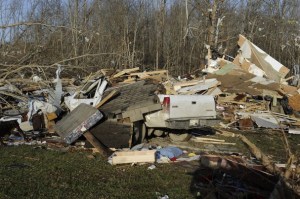
Now granted, I’m not a native of the southeast—South Jersey girl here. But the locals tell me that vertical winds are a hellva lot different than tornado touchdowns, particularly when you’re living in hill country, in the shadow of the Smoky Mountains. Locally, this time we were fortunate—some downed branches and yard mess. The major damage was to the east and south of us. Last year? Not so much. 
In fact, last year’s April storm front in the southeast produced 280+ tornadoes in 3 days. Historic, the headlines screamed.
If this were merely a local event, we could chalk it up to bad luck and Mother Nature in a cranky mood. But consider that earth-orbiting satellites have been gathering scientific data not previously available, giving us the ‘big picture’, data on a global scale. The following evidence has been accumulated:
- Sea levels are, in fact, rising, the rate of the last decade nearly double that of the last century.
- Global temperatures are on the rise, increasing since the 1970s with the 10 hottest recorded temperatures within the last 12 years.
- The oceans have been warming since 1969, measureable temperatures increasing in the top surfaces [2300 ft] and the acidification of the oceans has increased by 30% since the start of the Industrial Revolution.
- Glaciers are retreating, the Arctic sea ice is shrinking and the ice sheets of Greenland [36-60 cubic miles per year between 2002-2006] and the Antarctic [36 cubic miles per year between 2002-2005] have declined.
According to NASA data, there are certain facts beyond dispute:
The heat-trapping nature of carbon dioxide and other gases was demonstrated in the mid-19th century. Their ability to affect the transfer of infrared energy through the atmosphere is the scientific basis of many JPL-designed instruments, such as AIRS. Increased levels of greenhouse gases must cause the Earth to warm in response.
Ice cores drawn from Greenland, Antarctica, and tropical mountain glaciers show that the Earth’s climate responds to changes in solar output, in the Earth’s orbit, and in greenhouse gas levels. They also show that in the past, large changes in climate have happened very quickly, geologically-speaking: in tens of years, not in millions or even thousands.
We can take the facts and data of NASA, their orbiting satellites and sensors or we can fall back on the word of say . . . a Rick Santorum, who has proven himself such an expert on other subjects. According to Santorum in a speech in Colorado:
[Climate change is] an absolute travesty of scientific research that was motivated by those who, in my opinion, saw this as an opportunity to create a panic and a crisis for government to be able to step in and even more greatly control your life. … I for one never bought the hoax. I for one understand just from science that there are one hundred factors that influence the climate. To suggest that one minor factor of which man’s contribution is a minor factor in the minor factor is the determining ingredient in the sauce that affects the entire global warming and cooling is just absurd on its face. And yet we have politicians running to the ramparts — unfortunately politicians who happen to be running for the Republican nomination for president — who bought into man-made global warming and bought into cap-and-trade.
We can argue the merits of cap and trade but I find it comical that Santorum is running around talking about Satan on one hand—a Santorum absolute–while denying climate change on the other. This is a ‘don’t trust your lying eyes’ moment. And certainly don’t trust science. He continued with:
We were put on this Earth as creatures of God to have dominion over the Earth, to use it wisely and steward it wisely, but for our benefit not for the Earth’s benefit … We are the intelligent beings that know how to manage things and through that course of science and discovery if we can be better stewards of this environment, then we should not let the vagaries of nature destroy what we have helped create.
Huh? I’m not sure what this rambling statement is intended to mean, other than we shouldn’t let nature clue us in that we’re skating on the edge, pushing the health of the planet and its inhabitants to the max. Full steam ahead with those extractions, boys!
Of course, Santorum is not alone in this type of denial. Rush Limbaugh, who has had his fair share of attention in the last few days [not of the good kind], had this to say after declaring climate change a ‘hoax’:
I happen to believe in God. I believe in a loving, brilliant – I know that this – there is no way, I don’t want to sound simpleton here, but there is not – it is not possible that we would be created by a creator in such a way that we would destroy by virtue of our created existence our own planet and environment. It just doesn’t compute and yet that’s what these people are trying to tell us. [Premiere Radio Networks, The Rush Limbaugh Show, 2/2/11
All righty then! God, a loving brilliant God, would not allow us to destroy ourselves. Scrap all that science and data, the fat man speaketh.
Beginning to see a pattern here? We can believe in myth—Satan’s going to getcha and/or a benevolent, personal God-creator, who would never allow Man to be stupid enough to destroy His/Her creation. No problem then. Keep spewing those toxins into the air, don’t worry about contaminating our water supply and . . . heat? What heat?
Despite the relentless war on climate data in particular and science in general, it turns out the public is beginning to catch on to all the corporate-friendly tap dancing. After a dip in public sentiment about Climate Change and the mass investment in misinformation, Americans are using their powers of observation and taking heed to the mounting evidence. According to the Brookings Institute National Survey, Fall 2011, a strong majority [62%] of the American public now believes that global warming is real and poses a threat to global security. Observation to local effects of warming temperatures and world-wide reports of floods, droughts, freakishly warm temperatures, melting ice sheets, ocean acidification and the effects on wildlife and fauna are slowly turning opinion.
We cannot wait for a benevolent God-spirit to save us. We’ll need to do that for ourselves, sooner rather than later. Because we won’t get a second chance. As Naomi Klien recently stated any real shift towards climate sustainability means a shift in the entire free-market ethos that depends on continual growth, massive extraction and profit-making over people.
. . . you can’t do it all with carbon markets and offsetting. You have to really seriously regulate corporations and invest in the public sector. And we need to build public transport systems and light rail and affordable housing along transit lines to lower emissions. The market is not going to step up to this challenge. We must do more: rebuild levees and bridges and the public sphere, because we saw in Katrina what happens when weak infrastructure clashes with heavy weather—it’s catastrophe. These climate deniers aren’t crazy—their worldview is under threat. If you take climate change seriously, you do have to throw out the free-market playbook.
In the end, so many of these pressing issues are related to a flawed economic and political model—the current corporate state. It will be up to us to reimagine a new system or as Peter Barnes suggested in ‘Capitalism 3.0,’ it’s time to upgrade.
Because there’s no place to run or hide. Earth is the only home we have. Reclaiming the commons isn’t optional; it’s a must. And personally? I’m just not into wicked tornadoes.

UPDATE: The Red Cross is now asking for donations for storm ravaged areas in the Southeast. Contact your local offices for information. Or go here.
The Cantor Cartwheel On Insider Trading
Posted: February 11, 2012 Filed under: Congress, corporate money, corruption, Democratic Politics, ethics, legislation, Politics as Usual, Republican politics, Senate, Stock Market, U.S. Politics, We are so F'd 22 CommentsWhile our eyes and fury were directed on the birth-control-is-evil crowd and the ludicrous threats of the National Razor coming to a town near
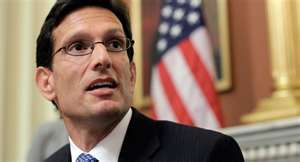
This is Eric Cantor
you, the insider trading bill wended its merry way through Congress. Only a provision in the Senate version of STOCK [Stop Trading on Congressional Knowledge Act] was stripped from the House version. The bill will return to the Senate, and then most likely go into conference committee to iron out differences.
The deletion of the provision is curious since it would have required Washington insiders, those who sell political intelligence to corporate America [financial institutions], to register in advance like any lobbyist, thereby making their identities and purpose transparent.
One senator reacted to the provision’s removal this way:
It’s astonishing and extremely disappointing that the House would fulfill Wall Street’s wishes by killing this provision. The Senate clearly voted to try to shed light on an industry that’s behind the scenes. If the Senate language is too broad, as opponents say, why not propose a solution instead of scrapping the provision altogether? I hope to see a vehicle for meaningful transparency through a House-Senate conference or other means. If Congress delays action, the political intelligence industry will stay in the shadows, just the way Wall Street likes it.
That would be a Democrat complaining, right?
Wrong.
That would be Republican Senator Chuck Grassley from Iowa protesting House member Eric Cantor for removing the provision [Grassley’s add on], ultimately making the bill substantially weaker than it could have been.
And ‘political intelligence industry?’ Sounds like something straight out of an Ian Fleming novel. Turns out this shadowy practice is a $100 million industry, employing 2000 people who sneak around Congress to pick up investment tips for Wall Street.
You cannot make this stuff up!

I am a weasel
In any case, it was Eric Cantor who tabled the original effort to suspend insider trading back in December. Also removed was a bipartisan amendment by Senators Patrick Leahy [D VT] and John Cornyn [R TX] made to crack down on officials ‘self-dealing,’ that is, enriching themselves through their positions.
The question is: why the not-so-clever foot dragging on this bill, something that makes perfect sense to the American public? Why ditch Grassley’s provision or the Leahy/Cronyn amendment, which would have added additional teeth?
As in, make it better.
According to initial comments, Cantor claimed the language too broad and the additional provisions ‘needed more study.’ Seems to me the study-until-we-drop reason was cited back in December.
But Cantor did add a touch of his own that would restrict legislators from participating or benefiting from IPOs. This addition quickly became tagged the ‘Pelosi provision,’ inspired by the suggestion that Pelosi’s husband had taken advantage of insider information when he bought into a VISA public offering, making a tidy profit [230% increase, by some accounts]. Pelosi has denied this accusation, insisting that her husband’s buys were directed by a traditional Wells Fargo broker.
Wish my broker was that good!

I am a happy weasel
Cheap political tricks and posturing happen all too frequently but why would Cantor be so adamant in weakening a bill the public and a surprising number of Congressional members favor?
Republic Report suggests we look at Cantor’s history, specifically the issue of mortgage cram down in 2009.
Eric Cantor led the Republican refusal to consider the mortgage cramdown proposals in 2009, a measure that would have permitted homeowners to negotiate lower interest rates and avoid foreclosure. However, what was not common knowledge [see Open Secrets. org] was that Cantor’s personal wealth was heavily involved in the mortgage industry itself. From RR:
Cantor invested in several mortgage banks, and owned a portion of a Cantor-family run mortgage company. According to Cantor’s 2009 personal disclosure, Cantor owned up to a $500,000 share of a mortgage company called TrustMor run by his brother.
While Cantor blocked a fix to the foreclosure crisis, his wife Diane Cantor served as the managing director of a bank with a high foreclosure rate. Diane Cantor at the time worked as a managing director to New York Private Bank & Trust, a major mortgage bank and TARP recipient. SNL Financial reported that Cantor’s bank was among the top three banks in the mortgage business “with thegreatest percentage of family loans in the foreclosure process.
There was also the dustup during the debt ceiling debate last year when a revealed fund Cantor was invested in, stood to make a sizeable profit if the US actually defaulted on its debt. If the country tanked, Cantor stood to win.
Such loyalty!
Personally, I liked Cantor’s chest thumping after wicked storms savaged the South and East Coast last spring [my house and property suffered nearly $20,000 in damages with 1600+lbs of debris dragged from the front and back yard]. For his Tea Party audience, Cantor tried bucking disaster relief until expenses [like unemployment checks and food stamps] were cut elsewhere. But then amazingly, Cantor made a sharp pivot and complained FEMA was far too slow in addressing damage relief in his own Virginia district.
Consistency is a beautiful thing!
So, we have the Pelosi Provision and the Cantor Cartwheel, anything to stall a DC scrub down, the disinfectant treatment that the American public demands [at the very minimum] from their representatives–abiding by the laws, standards and a sense of ‘doing the right thing.’ You know, those principles that presumably apply to everyone.
BTW, the Sunlight Foundation has provided the House/Cantor Version of the STOCK bill with edits [strikeouts] included. Most instructive!
Don’t you love the Internet??? Bet Cartwheel Cantor doesn’t.

I am a warrior weasel
And though I would have nominated Eric Cantor for Sellout of the Week, Republic Report has chosen President Obama, primarily based on his recent decision to embrace Super PAC money [though I suspect we could all come up with other examples]. However, the President opened himself up to this chastising because he warned about unlimited campaign spending in 2008:
Let me be clear — this isn’t just about ending the failed policies of the Bush years; it’s about ending the failed system in Washington that produces those policies. For far too long, through both Democratic and Republican administrations, Washington has allowed Wall Street to use lobbyists and campaign contributions to rig the system and get its way, no matter what it costs ordinary Americans.
That was then, this is now.
Did you know that one of the collective nouns used to describe a group of weasels is . . . SNEAK. How perfect is that?

We are all well-heeled weasels
Zombies and Vultures and Pipelines, Oh My
Posted: February 5, 2012 Filed under: Domestic Policy, Environment, Environmental Protection, ethics, Gulf Oil Spill, health hazard, K street, legislation, lobbyists, Politics as Usual, Regulation, Republican politics, science, toxic waste, Water | Tags: Climate change, environmental problems, oil spills 6 CommentsThe zombies seem to be winning the war against the living. We have zombie banks, zombie politicians [think Rick Perry], zombie policy—free market fundamentalism preached as an untried economic theory.
And now zombie pipelines.
Just when you thought the Keystone XL controversy had been put to rest [at least temporarily], its zombie presence lunges forward, reanimated for all to see. Although I suspect supporters of this very bad idea are hoping the American public is not watching or if they are watching they will buy the swill on the non-existent benefits of a 1700-mile tar sands pipeline.
What am I talking about?
I found a disturbing inquiry [hattip to OEN] by Representative Henry Waxman to a Deborah Hohlt, who received $50,500 from the Great State of Indiana [that would be paid in state taxpayer monies] to lobby in DC on behalf of the TransCanada Keystone XL Pipeline. Indiana’s Governor Mitch Daniels provided the rebuttal to the President’s SOTU address, in which he referred to the Administration’s decision to ‘postpone’ the pipeline’s construction as an ‘extremist’ policy.
As you might remember the Republican chorus on this subject has been jobs, jobs, jobs. House Speaker Boehner has quoted 100,000 jobs at stake. TransCanada has been all over the map with job estimates, the last, most creative quote coming in at 250,000 jobs. Unfortunately, the numbers are at odds with the single independent analysis from Cornell Global Labor Institute, estimating the number at between 4000-6000 temporary jobs. The steel for the pipeline? Would be coming from India. The cry that the pipeline would reduce our reliance on foreign oil? The refined tar sands oil is contracted for export [80%] to South America and Europe.
The upsides are slim to none, considering the toxic, corrosive nature of tar sand oil, the sludge-like quality that requires pressure and heat to make a pipeline flow possible. That also increases the risk of a leak and an environmental disaster. Anyone who may question the heightened risk should check out the total mess in Michigan when over 800,000 gallons of tar sand oil spilled and contaminated 40 miles of the 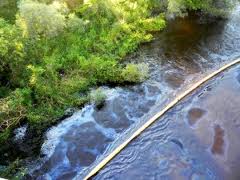 Kalamazoo River and surrounding properties.
And the reclamation? These corporations should hang their heads in utter shame. If you want to be thoroughly disgusted check out the You Tube clip I provided in an earlier post.
But here’s the really curious thing. The pipeline won’t be running through Indiana. The pipeline will not be running close to Indiana’s borders. No Indiana facilitities will have access to the pipeline. In fact, it appears that Indiana does not stand to be impacted in anyway by the Keystone pipeline and yet Governor Daniels felt compelled to call President Obama an extremist for postponing the pipeline’s construction. He was also willing to pay a $50,000+ [in state taxpayer money] to lobby for the Great State of Indiana in defense of the pipeline.
More curious still? TransCanada has stated that the pipeline will ‘increase’ oil prices for Indiana and other Midwestern residents because the area is ‘oversupplied.’ Keystone’s successful construction [this is stated in TransCanada’s application] will ensure higher prices for Canadian crude. By independent analysis costs will increase $6.55 per barrel in the Midwest and $3 per barrel everywhere else. The Indiana Petroleum Council thinks this is a swell idea.
Which begs the question: Who does Governor Daniels work for? His constituents or the oil companies?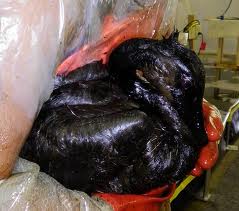
So, it should not be any great surprise that a Senate group–laughably-called bi-partisan because it includes 1 Democrat, Joe Manchin from W. Va.–is reintroducing the Keystone proposal, pushing for immediate construction with or without the Administration’s approval. The Senate committee is invoking the Commerce Clause of the Constitution, which says Congress should have the power:
To regulate Commerce with foreign Nations, and among the several States, and with the Indian Tribes.
I love it when the Republicans start waving the Constitution. It’s a clear signal they’re up to no good. Did I mention that Koch Industries stands to make a killing on this project?
While reading Representative Waxman’s letter, I recalled something I’d read in Greg Palast’s book Vultures’ Picnic and found an accompanying and equally disturbing text online here and here. To quote Palast:
Reserves are the measure of oil recoverable at a certain price. Raise the price, raise the reserve. Cut the price and the amount of oil in the ground drops. In other words, it’s a fool’s errand to measure the “amount of oil we have left.” It depends on the price.
Specifically, oil companies and oil-related financiers are not interested in expanding oil supplies to the world, particularly cheap oil supplies  [because the days of cheap oil are over]. They’re interested in feeding the hunger for oil and controlling the price around the world with an iron fist. The higher, the better. The environment—air, water, soil–is not the concern. Our health or that of our children is not the concern. The bottom line—profit and power—is all that matters. If nations collapse? The Vultures are waiting to feast on the bones.
Sound harsh? It shouldn’t. Zombies and vultures are kissing cousins. They’re coming ‘round for a friendly visit. Again.

 peej
peej Carissa
 bostonboomer
 dakinikat
 ecocatwoman
 mablue2
 Mama Lopez
 peggysue22
 quixote
 skydancingguestblogger
 Mona (aka Wonk the Vote)



 Sky Dancing
Recent Comments