
Friday Reads
Posted: November 9, 2012 Filed under: Elections, Elizabeth Warren Campaign, Gun Control, morning reads | Tags: Elizabeth Warren, fiscal cliff, NRA, Planned Parenthood 88 Comments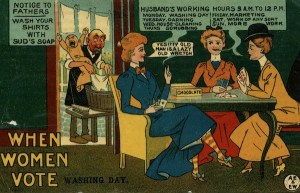
Good Morning!
Much is being made of the election results that delivered a sound thumping to Republicans and their agenda to restrict the rights of women and minorities and to provide benefits to the wealthy and powerful. A record number of women will be serving in the US Senate. Five new women will be headed there. Of all the significant races, Senator-elect Elizabeth Warren appears to have garnered the most hope and angst. Simon Johnson considers her election “important”.
Senator Warren is well placed, not just to play a role in strengthening Congressional oversight but also in terms of helping her colleagues think through what we really need to make our financial system more stable.
We need a new approach to regulation more generally – and not just for banking. We should aim to simplify and to make matters more transparent, exactly along Senator Warren’s general lines.
We should confront excessive market power, irrespective of the form that it takes.
We need a new trust-busting moment. And this requires elected officials willing and able to stand up to concentrated and powerful corporate interests. Empower the consumer – and figure out how this can get you elected.
Agree with the people of Massachusetts, and give Elizabeth Warren every opportunity.
Laura Gottesdiener thinks Warren’s election may usher in the end of the Tea Party.
Warren, who beat out the incumbent Republican Scott Brown in a bitter election, ran a campaign centered on connecting the dots between economic policies and personal values. A Harvard bankruptcy-law professor, Warren trumpeted a platform that called for economic reform, financial regulation and the protection of Social Security, Medicare and other safety-net programs.
“We said this election is about whose side you’re on,” Warren told The Huffington Post . “I think of this as an election where we stuck to our values: Make sure Social Security and Medicare benefits are protected, and millionaires and billionaires pay their fair share. To me, that’s the heart of it. That’s really where the basic social contract is reaffirmed.”
This type of populist platform became increasingly risky after Citizens United allowed for the infusion of billions of dollars into state elections. Warren was already well disliked on Wall Street for her role in creating and heading the Consumer Financial Protection Bureau, a watchdog agency that seeks “to make markets for consumer financial products and services work for Americans — whether they are applying for a mortgage, choosing among credit cards, or using any number of other consumer financial products.”
Warren may be given a seat on the powerful senate banking committee which has to be worrying Wall Street.
Senior Senate Democratic aides, speaking on condition of anonymity, said the Massachusetts senator-elect is a logical fit for the committee, even though it is rare for a freshman senator to get such a plum assignment.
If she gets the slot, Warren’s bully pulpit would be replaced with real power.
The bipartisan panel can greatly influence policy decisions through its oversight of financial services, international trade, insurance, housing, securities and economic issues.
Warren, who has called for breaking up the big banks, could move to block legislative tweaks to the 2010 Dodd-Frank financial oversight law that would blunt the full impact of profit-pummeling reforms.
She would also be able to forcefully push for regulators to use all the powers available to them to write strict interpretations of rules.
That could mean stronger curbs on Wall Street trading, higher capital buffers and rules that would compel mega-banks to shrink.
Warren and other Senators will have to watch the President and Speaker of the House as they battle of the so-called fiscal cliff before getting their say in the budget.
While no can say for sure how the negotiations to avoid the so-called “fiscal cliff” — the expiration of the Bush tax cuts and impending across-the-board spending cuts — will unfold, the betting here is it will get ugly before it gets better.
First, virtually no one believes what happened last time will happen this time: President Obamawon’t cave on extending tax cuts for upper income earners.
So will House Republicans come to the table voluntarily, before the first of the year? Or will it require all hell breaking loose — an expiration of the income and payroll tax cuts, sequestration, the estate tax, and the AMT kicking in, cap gains and dividend rates rising — before they are forced to come kicking and screaming to an agreement?
The president holds a lot of leverage here — not just because he just won, Democrats expanded their majority in the Senate, and gained seats in the House. He holds leverage because, structurally, we’re talking about tax cuts that are expiring. His position is clear: The rate for the wealthiest will be allowed to go up. If he is willing to go to the wall and let the the lower rates expire, pressure shifts to House Speaker John Boehner to make a deal before his conference is isolated by the business community, which more than anything wants D.C. to just cut a deal, and Senate Republicans, who cut a deal and sold Boehner out last time. Add to that a tanking market and mounting economic hysteria, and that’s a lot of pressure on the House GOP true believers, Allen West or no Allen West.
The conventional wisdom is that Obama and Republicans will make a short term deal on taxes and sequestration — kicking that can down the road yet again — contingent on agreement on a “framework” for tax reform to be done in the first part of 2013.
There is incentive for Boehner to try and make an early deal, before the first of the year. The question, as always, is will he have the votes to allow tax rates on the wealthy to rise? Seems doubtful. He would have to be a pretty firm and big commitment from Obama on tax and entitlement reform to get them to go along.
Is it a matter of who will blink first? Here’s a conversation between Ramesh Ponnuru and Margaret Carlson. This is Ponnur’s take.
Does Boehner mean that tax reform should raise money by cutting tax breaks more than it cuts tax rates? Or does he mean that it should raise money just by encouraging economic growth?
If it’s the first, Boehner is going to have a problem with conservatives — especially Grover Norquist, the party’s anti- tax enforcer. If it’s the second, he’s not talking about much revenue.
That’s a bargain that sounds grand to me, but liberals who just won an election might disagree, don’t you think? My guess is he’s being ambiguous so he can gauge the reaction.
Another question: What leverage does Boehner have, and what leverage does he think he has? Obama doesn’t have to cut any deal to get a lot of extra revenue. He can let taxes go up as scheduled and challenge the Republicans to cut them only for the middle class. Republicans can either go along or decide not to and then blame him for the resulting middle-class tax hikes. Who likes their odds better in that fight?
Republicans have another bit of leverage, beyond the threat of blaming Democrats for tax increases: We’re getting close to hitting the debt ceiling again, and in the normal order of thingsHouse Republicans would have to agree to lift it.
Carlson has this to say.
In an election that was otherwise a debacle for Republicans, the House held its majority, and Boehner holds the gavel as long as he coddles his most extreme members. So he will.
Meanwhile, the president (unless you see something in him, Ramesh, that I don’t) still believes in this hope-y, change-y stuff Republicans consider a joke. He still sees himself as a historic figure that can bridge the partisan divide.
It is Boehner’s tiny, eensy-weensy bit of openness to dealing with Obama that is enraging conservatives. At the same time, it is playing to Obama’s view of himself. The president’s signature trait is an inability to negotiate from strength. He leads with his best offer. If Obama were buying a car, he’d probably pay full price and leave without radial tires.
In fairness to Obama, it’s foolish to call the bluff of an opposition that’s already shown it will allow the U.S. to default on its debt.
You’re right, Ramesh, that Obama doesn’t have to do anything at all to raise revenue. But he can’t risk raising taxes on the working and middle classes when the economy is still shaky. Republicans, by contrast, are willing to risk anything.
One of the quiet victories of the election is the failure of the NRA whose candidates didn’t do well this election.
The Sunlight Foundation, a campaign watchdog group, found that the NRA’s Political Victory Fund – the political arm of the nation’s largest gun lobbying organization – spent almost $11 million for or against individual candidates in the general elections, but got less than a 1 percent return on its investment.
The NRA, for instance, spent more than $7.4 million in opposition to President Obama and almost $1.9 million in support of Mitt Romney, according to Sunlight. But Obama was the victor on Tuesday, and the NRA had similar bad luck trying to influence Senate and House races.
For example, the group put almost $538,000 behind Indiana Senate contender Richard Mourdock (R), who lost, and spent more than $512,000 to oppose Sen. Sherrod Brown (D-Ohio), who won, according to Sunlight.
Conversely, Planned Parenthood did an outstanding job!
Planned Parenthood’s political wing trounced other groups with a near perfect return on its election spending, according to a new numbers review.
The Sunlight Foundation found that Planned Parenthood’s advocacy arm and super-PAC spent about $5 million and $7 million, respectively, to oppose Republicans and support Democrats in the general election.
In the end, the two groups saw returns on investment of about 98 and 99 percent, according to Sunlight.
The figures come as election-watchers pick apart the most expensive cycle in history. Republicans’ loss in the presidential race and failure to claim the Senate came as a surprise to outside donors, many of whom spent millions to ensure GOP victories.
Planned Parenthood’s political wing played an outsized role in the general election, compared to cycles past. The flood of political activity came as Republicans vowed to end Planned Parenthood’s federal funding as a healthcare provider for low-income women. Conservatives argue that while the law technically bans public funds from supporting abortions, taxpayer money need not flow to a group that performs the procedures.
The election covered a wide range of women’s health issues in addition to public funds for Planned Parenthood, giving the group ample chance to advocate in favor of abortion rights and access to free birth control.
The only outside groups that came close to beating Planned Parenthood’s return on investment were Majority PAC, which fought for Democratic Senate candidates, with a success rate of about 88 percent, and the Service Employees International Union PEA-Federal, with about an 85 percent success rate.
I’ll end with offering some beautiful finds in a Thracian burial site in Bulgaria.
The researchers found fragments of a wooden box, containing charred bones and ashes, along with a number of extremely well-preserved golden objects, dated from the end of the 4th and the beginning of the 3rd century B. C.. They include four spiral gold bracelets, and a number of intricate applications like one which shows the head of a female goddess adorned with beads, applications on horse riding gear and a forehead covering in the shape of a horse head with a base shaped like a lion head. The objects weigh 1.5 kg, but the excavations continue.The precious find also contains a ring, buttons and beads. Gergova explains that it seemed the treasure was wrapped in a gold-woven cloth because a number of gold threads were discovered nearby.
The Professor says these were, most likely, remnants from a ritual burial, adding the team expects to discover a huge burial ground, probably related to the funeral of the Gath ruler Kotela, one of the father-in-laws of Philip II of Macedon. She notes this is a unique find, never before discovered in Bulgaria.

What’s on your reading and blogging list today?
Wisconsin Recall Election – My Take on it
Posted: June 7, 2012 Filed under: Elections, worker rights | Tags: Scott Walker, unions, Wisconsin 49 Comments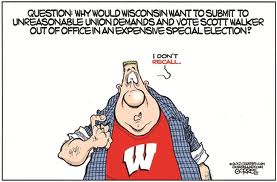
My anticipation about Tuesday’s election was high. My information about the how, why, when and what of this recall election came from the Left side of politics. I generally avoid the blogs and the radio and television shows of the Right.
I am pro-union because I am pro-worker. No business can operate without employees, no business can succeed without employees. Employees are a vital part of any business and are, all too often, dismissed or ignored when the success of owners and CEOs are applauded. And unions give employees a voice in working conditions, employee safety, wages, health care and pensions. Within large companies and/or corporations individual employees have relatively no chance to ensure their health and welfare, along with what they are paid. That isn’t saying that employee versus employer is a good guy versus bad guy situation. It is more like one person, with no weapons, facing another armed with guns, ample ammunitions, tanks, missiles and more. Or even going into a poker game where one person is dealt a single card while the other has six cards. It simply isn’t a level playing field.
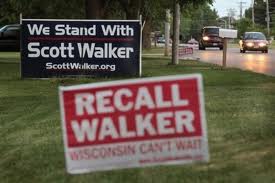
Regardless of what news outlet you follow, there have been a wide variety of speculations, theories and hypotheses about why the election turned out as it did. Personally, I don’t think the outcome can be narrowed down to one single reason that Walker won the election or that Barrett lost.
Walker is only the third governor in U.S. history to face a recall. The other two both lost and were recalled. Each of the political pundits is feverishly competing to come up with the definitive explanation for this outcome. Personally I think the bigger story is the solidification of the division between the opposing sides and the repercussions which will follow for, not only, the state of Wisconsin but the rest of the country as well. Families and friendships have broken apart because of this battle. For me it seems our increasingly contentious political system is becoming as toxic as the lead up to the Civil War and the animosity between those who supported slavery and the abolitionists.
Initially, I felt certain that the imbalance of money in the election would be the determining factor in the election (Walker is estimated to have outspent Barrett 7 to 1). After reading some of the post election coverage, I am not so sure that the enormous amount of money spent (estimated at $60 million) really had much impact on how people voted. In a piece at HuffPo, it was pointed out that the vote split in the recall almost matched the initial faceoff between Walker and Barrett. Basically the people of Wisconsin voted this time the way they voted in the governor’s race in 2010. The undecided voters only amounted to about 8%, with new voters accounting for around 13%. To me that means that those 8% were the only ones who might have been influenced by “the money” issue. The article goes on to say that Walker managed to turn out a higher percentage of his original supporters than did Barrett.
Joshua Holland has a similar take on Alternet called 8 Ways Right-Wingers Are Blowing Wisconsin Out of Proportion. He says the Right Wingers
claimed the outcome spelled doom for Obama this fall, marked the death of the labor movement and was a pure reflection of voters’ love for Scott Walker’s economy-crushing austerity policies.
He goes on to refute the rest of the Right Wing’s claims. Check out the post because it is worth your time.
Recall elections are few and far between in the U.S., as evidenced by my earlier point that Walker is only the third governor in our history to face a recall election. Several sources, including the one I’ve cited above, have put forth that about a third of people polled don’t support recall elections unless the politician has done something egregious, like committing a crime. Their political affiliation doesn’t matter. The seriousness of the offense is the concern of to the voting public regardless of political party. What that says to me is that most voters believe in democracy, meaning the voters have chosen and the person with the most votes, whether or not you voted for him/her, is the winner. Shut up, bite the bullet and let the winner serve out their term. (NOTE: I am not saying that I believe we actually live in a democracy, but that the general public believes in democracy and that our American system is a democracy……..because that is what they have been told. The formerly and currently disenfranchised probably have a different perspective).
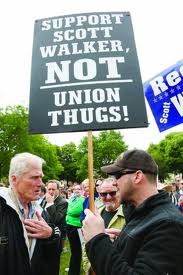
Add to this that the opinion of unions, unlike in the mid 20th century, is mostly negative. After about 50 years of chipping away at the number of American workers who belong to a union or have a union member in the family, the number of union workers has declined substantially. Where once both union and non-union workers banded together in solidarity, it has become a mostly contentious relationship, where union workers are seen as greedy, lazy and recipients of unfair pay scales, benefits and pensions. Big business has succeeded in demonizing the collective power of unions who were responsible for the 5 day 40 hours work week, minimum wage, paid sick time and the formation of OSHA to protect the safety of workers on their job. For me, that is the story, not the fact that Walker successfully kept his job. It’s the workers and employees of America that are the losers in this race.
And then there is Jon Stewart’s take on the recall:
crossposted from ecocatwoman.blogspot.com
Monday Reads: Can we get back to real Economics now?
Posted: May 7, 2012 Filed under: Austerity, Economy, Elections, morning reads | Tags: Austerity Econmics, French Elections, Greek Elections, Paul Krugman, Remaking Capitalism, Robert Reich 40 Comments Good Morning!
It certainly has been a tough few years for reasonable people. We’ve had to endure a repeat of the same old things that didn’t end the Great Depression the first time remixed and put into failed policies in both Europe and the U.S.
The very act of believing something doesn’t make it real or true. Yet, a group of so-called conservatives have been recently led by blind faith in tropes and canards. They followed all the failed policies instead of what we’ve learned that works when dealing with market economies and their cycles over the last 100 years.
It seems voters in a lot of countries are waking up and voting out all those second comings of Herbert Hoover. Austerity economics hasn’t worked for the majority of us.
Paul Krugman has been outspoken about the wrong thinking that’s contaminated the political class here and Europe. There appears to be a group of people out there determined to un-write the history of the 1920s and 1930s. His new book tries to outline what we’ve known since the Roosevelt years and why the plans foisted on us by so-called conservatives were bound to fail. I have no idea why discredited economic thoughts were brought back into vogue by the banking classes, the investment classes, and pushers of bad pulp fiction narratives like Paul Ryan and his slavish Randian/Austrian ideology. Why do modern politicians pick up the economic version of flat-earth geology and then expect the economic equivalent of a successful launch of a rocket to Mars?
The Austerian desire to slash government spending and reduce deficits even in the face of a depressed economy may be wrongheaded; indeed, my view is that it’s deeply destructive. Still, it’s not too hard to understand, since sustained deficits can be a real problem. The urge to raise interest rates is harder to understand. In fact, I was quite shocked when the OECD called for rate hikes in May 2010, and it still seems to me to be a remarkable and strange call.
Why raise rates when the economy is deeply depressed and there seems to be little risk of inflation? The explanations keep shifting.Back in 2010, when the OECD called for big rate increases, it did an odd thing: it contradicted its own economic forecast. That forecast, based on its models, showed low inflation and high unemployment for years to come. But financial markets, which were more optimistic at the time (they changed their mind later), were implicitly predicting some rise in inflation. The predicted inflation rates were still low by historical standards, but the OECD seized on the rise in predicted inflation to justify a call for tighter money.
By spring 2011, a spike in commodity prices had led to a rise in actual inflation, and the European Central Bank cited that rise as a reason to raise interest rates. That may sound reasonable, except for two things. First, it was quite obvious in the data that this was a temporary event driven by events outside of Europe, that there had been little change in underlying inflation, and that the rise in headline inflation was likely to reverse itself in the near future, as indeed it did. Second, the ECB famously overreacted to a temporary, commodity-driven bump in inflation back in 2008, raising interest rates just as the world economy was plunging into recession. Surely it wouldn’t make exactly the same mistake just a few years later? But it did.
Why did the ECB act with such wrongheaded determination? The answer, I suspect, is that in the world of finance there was a general dislike of low interest rates that had nothing to do with inflation fears; inflation fears were invoked largely to support this preexisting desire to see interest rates rise.
The Europeans have had it with the nonsense. They’ve watched their economies and jobs be drained by bankers drunk on casino style betting in financial markets that pass their chits to taxpayers. The first major European leader–Nicholas Sarkozy–has been replaced. Will the French be able to put the out-of-control financial sector back into its proper place?
Mr Hollande – the first Socialist to win the French presidency since Francois Mitterrand in the 1980s – gave his victory speech in his stronghold of Tulle in central France.
He said was “proud to have been capable of giving people hope again”.
He said he would push ahead with his pledge to refocus EU fiscal efforts from austerity to “growth”.
“Europe is watching us, austerity can no longer be the only option,” he said.
After his speech in Tulle, Mr Hollande headed to Brive airport on his way to Paris to address supporters at Place de la Bastille. His voice hoarse, he spoke of his pride at taking over the mantle of the presidency 31 years almost to the day since Socialist predecessor Francois Mitterrand was elected.
“I am the president of the youth of France,” he told the assembled crowd of tens of thousands of supporters, emphasising his “pride at being president of all the republic’s citizens”. “You are a movement that is rising up throughout Europe,” he said.
Mr Hollande has called for a renegotiation of a hard-won European treaty on budget discipline championed by German Chancellor Angela Merkel and Mr Sarkozy.
Robert Reich writes that this is a chance to reform capitalism. It is highly unlikely that France will move to make public any private assets. What it will do is turn its economic future to what works for growth for a country and not the enrichment of the wealthy and powerful few. Financial Markets should not be turned into gambling casinos via government engineering.
During the Depression decade of the 1930s, the nation reorganized itself so that the gains from growth were far more broadly distributed. The National Labor Relations Act of 1935 recognized unions’ rights to collectively bargain, and imposed a duty on employers to bargain in good faith. By the 1950s, a third of all workers in the United States were unionized, giving them the power to demand some of the gains from growth. Meanwhile, Social Security, unemployment insurance, and worker’s compensation spread a broad safety net. The forty-hour workweek with time-and-a-half for overtime also helped share the work and spread the gains, as did a minimum wage. In 1965, Medicare and Medicaid broadened access to health care. And a progressive income tax, reaching well over 70 percent on the highest incomes, also helped ensure that the gains were spread fairly.
This time, though, the nation has taken no similar steps. Quite the contrary: A resurgent right insists on even more tax breaks for corporations and the rich, massive cuts in public spending that will destroy what’s left of our safety nets, including Social Security and Medicare and Medicaid, fewer rights for organized labor, more deregulation of labor markets, and a lower (or no) minimum wage.
This is, quite simply, nuts.
Krugman reminds us that Spain was a prudent and financially responsible government prior to the speculative mortgage bubble brought on by banks. It did them no good in their current downturn.
For this is really, really not about fiscal irresponsibility. Just as a reminder, on the eve of the crisis Spain seemed to be a fiscal paragon:
What happened to Spain was a housing bubble — fueled, to an important degree, by lending from German banks — that burst, taking the economy down with it. Now the country has 23.6 percent unemployment, 50.5 percent among the young.And the policy response is supposed to be even more austerity, with the European Central Bank, natch, obsessing over inflation — and officials claiming that the incredibly foolish rate hike last year was actually something to be proud of.

Greece too has voted against the Austerity Agenda.
Alexis Tsipras became the surprise package of the Greek election by telling Angela Merkel to get lost.
“The people of Europe can no longer be reconciled with the bailouts of barbarism,” Tsipras, 37, said on state-run NET TV late yesterday after his Syriza party unexpectedly came second in the country’s election. “European leaders, and especially Ms. Merkel, should realize that her policies have undergone a crushing defeat.”Tsipras’s calls to tax the rich, delay debt repayments and cut defense spending struck a chord with voters angry at austerity measures imposed by the European Union and the International Monetary Fund in return for bailouts. As far as euro membership is concerned, Tsipras told voters that a Greek exit would put the currency itself in jeopardy and they shouldn’t feel “blackmailed” into more austerity.
The result put Syriza ahead of the Socialist Pasok party, potentially derailing efforts to implement the terms of the country’s financial lifeline. Syriza, which means Coalition of the Radical Left, won 16 percent of the vote, projections showed. That exceeded the 13 percent won by Pasok, one of the two pillars of the political establishment since 1974. New Democracy, led by Antonis Samaras, topped the poll with 20 percent.
Rachel Maddow borrows some analysis from Ezra Klein to show how the UK has been tanking its own economy with its austerity agenda and how closely our own problems resemble the UK government induced recession.
Once President Obama took office and the Recovery Act/stimulus began putting capital back into the economy, the U.S. economy began growing again. In the U.K., the economy started to improve, right up until British officials began implementing an austerity agenda — at which point the national economy stagnated and slipped back into a recession.
Obama rejected austerity, and as a result, American growth, while fragile and insufficient, is easily outpacing Europe’s and UK’s, where austerity measures have ruled the day.
Americans should care about this, if for no other reason because of interconnectivity of the modern global economy. But there’s also a purely political perspective to keep in mind: namely, the problem of Republican predictions.
In short, American conservatives got everything backwards. When Obama’s policies began, Republicans said they wouldn’t generate economic growth, but GOP officials got it backwards. When David Cameron’s austerity policies began, Republicans were not only certain they would work, they pleaded with American policymakers to follow the Tories’ lead.
And we now know GOP officials had this backwards, too.
The remarkable thing is, Republicans aren’t the least bit chastened by their track record of failure.
They said Clinton’s economic policies would fail miserably, but that’s not what happened. They said Bush’s economic policies would produce extraordinary prosperity, but that’s not what happened. They said Obama’s economic policies would make the Great Recession worse, but that’s not what happened. They said Cameron’s economic policies in the U.K. would work brilliantly, but that’s not what happened.
And now these same Republicans are saying they deserve Americans’ votes in 2012 because they have credibility on the economy.
Here’s one last Krugman analysis of what the austerity agenda has done in the U.S. Private employment has recovered to pre-recession levels. That’s not true for public employment.
Here’s a comparison of changes in government employment (federal, state, and local) during the first four years of three presidents who came to office amid a troubled economy:
That spike early on is Census hiring; once that was past, the Obama years shaped up as an era of huge cuts in public employment compared with previous experience. If public employment had grown the way it did under Bush, we’d have 1.3 million more government workers, and probably an unemployment rate of 7 percent or less.

Here’s evidence that Obama is not growing the public sector as Mittens claims. These numbers represent thousands of teachers, health workers, scientists, highway workers. and public safety officials.
AMERICANS have watched austerity sweep Europe with a certain Schadenfreude. But eight months from now they may get a dose of the same medicine. The political compromises that have produced much of America’s deficit of 8% of GDP are programmed to go into reverse at the end of the year, two months after the election. A stimulus package consisting of a payroll-tax cut, investment tax credit and enhanced unemployment insurance expires then, as do George W. Bush’s tax cuts (which have already been extended by two years from their original end-date of 2010). At the same time an automatic, across-the-board cut in domestic and defence spending, called a “sequester”, takes effect, cutting about $100 billion from government spending next year.
The economic impact of this fiscal cliff is a matter of some debate. The Congressional Budget Office reckons that the combined effects of the sequester and the expiring tax cuts would add up to 3.6% of GDP in fiscal 2013. But David Greenlaw of Morgan Stanley, which puts the total effect at almost $700 billion at an annual rate, argues that the calendar-year impact is much larger, at around 5%. Others think the effect would be smaller, noting that some people will not experience the full tax hit until they file their returns in 2014.
Even the lower estimates could easily be enough to tip the economy back into recession.
These tax cuts have not been as successful as other forms of fiscal policy might have been. However, austerity measures taken in many states has been somewhat offset by these Federal Policies. It will be interesting to see how long the economy will hold out under current conditions if and when these things expire. It’s simply been a mind boggling process to watch so many countries unleash unregulated financial innovations and low interests rates then bail out for the financial sector after its bets went bad. It’s been even worse to watch the victims of this excess be forced to pay for the results of government supported speculative bubbles. I’m wondering exactly what the results of these elections will bring to Europe and how our own electorate will act in the fall.
So, I depressed you with a lot of dismal science stuff today. What’s on your reading and blogging list?
The Problem With Peace Treaties [Of the Political Kind]
Posted: February 2, 2012 Filed under: 2012 primaries, Democratic Politics, Elections, Elizabeth Warren Campaign, Republican politics, Scott Brown | Tags: 2012 Massachusetts Senate race, Elizabeth Warren, Scott Brown 7 CommentsIt was sweet while it lasted, a lean across the Great Divide by two political opponents, namely Elizabeth Warren running for the US Senate seat in Massachusetts and Scott Brown, hoping to keep that seat planted firmly under his fanny.
The agreement was sensible after an early barrage of negative political ads. Karl Rove’s group first claimed Warren was a secret socialist, her blood line running straight to Stalin [the Matriarch of Mayhem], which evolved into an accusation that she was somehow a sympathetic friend to Wall St. financial institutions. No doubt the banks did a double take. Conversely, Warren’s admirers claimed that Brown was financed by those same financial institutions [which happens to be true]. He also claimed that the press was giving Elizabeth Warren a free ride, not hitting her with the really ‘hard’ questions.
Whining appears to be a Republican strategy for 2012.
Nonetheless, both parties agreed to reject the outside, 3rd party organizations funding these less than complimentary videos, ads and press releases. But as history tells us, ceasefires and negotiations are dicey at best. Even signed treaties can have gaping loopholes.
Such is the case in this wobbly agreement [hattip to TPM]. The Boston Globe reported earlier this week that Warren’s people were breaking the pledge by allowing an unflattering website, Rethink Brown.com, to surface in an expanded form. The site displays several of Scott Brown’s quotes.
What are these quotes? So, glad you asked.
The first statement is: “I go to Washington representing no faction, no special interest . . . ”
The quote is from Brown’s victory speech the night he won the Massachusett’s Senate seat in 2010. Full quote:
I go to Washington as the representative of no faction or interest, answering only to my conscience and to the people. I’ve got a lot to learn in the Senate, but I know who I am and I know who I serve. I’m Scott Brown. I’m from Wrentham. I drive a truck, and I’m nobody’s senator but yours.
The comment is dated January 19, 2010 and fits nicely into Brown’s debate performance, where he corrected a moderator, regarding the former Senate seat:
With all due respect, it’s not the Kennedys’ seat and it’s not the Democrats’ seat. It’s the People’s Seat.
That single comment literally turned Brown and his handsome mug into household familiars. It was a star moment.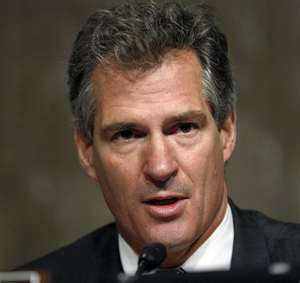
The dirty trick is that Elizabeth Warren jumped into the 2012 race and turned things upside down. The recent complaint, the way this rabble-rousing, pro-Warren website is smearing Scott Brown, thereby breaking the peace accord and the public’s love affair? The website places Scott Brown’s own words against facts, then properly cites and corroborates them.
For instance, the unfortunate fact that Scott Brown has accepted $1.1 million from Wall St. contributions, ferreted out by Center for Responsive Politics. Or that Brown used his swing vote to water down Wall St. regulations, a story reported by the Boston Globe. Or that Forbes magazine cited Scott Brown as one of Wall St’s favorite congressmen, with the article provided for reading pleasure.
Not only that but the Rethink Brown site manages to wiggle around the deal’s agreement because it’s not paid advertising, simply a group making a rather pointed statement on its own site.
Dastardly!
Color me suspicious when Brown claims these revelations break the spirit of the agreement, that this is just a way of peddling lies and misinformation. Where are the lies? What is the misinformation?
There’s a vast difference in pointing out a candidate’s contradictions to bold-face fiction and prevarication. I would consider the latter approach the sort of thing Karl Rove’s GPS Crossroads’ group relies on consistently.
As for my suspicions? No sooner did the Globe article come out ‘exposing’ Rethink Brown.com than the Massachusetts GOP launched an anti-Warren ad [also not covered under the agreement].
Okay. That’s true. Warren has done very well for herself. I can’t confirm the numbers but Elizabeth Warren is certainly no longer struggling financially. The comment on the Lawrence O’Donnell show? What sort of wealthy was she speaking of—the top 1%, the top 5, 10, 20? We don’t know from this video because we don’t have the entire clip. But here’s the complete quote:
You know, I’m with you on this. Either don’t own it or put it in a blind trust, you know, where someone else manages it and you literally can’t see what’s in there. I realize there are some wealthy individuals — I’m not one of them — but some wealthy individuals who have a lot of stock portfolios. But you’re exactly right. I don’t understand how people can be out there in the House, in the Senate, they get inside information and they’re making critical decisions. We need to feel like they’re making those decisions on our behalf, not as an investor who would do better if the law goes this way instead of that way. I agree.
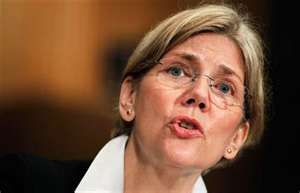 How clever. They chopped off the ‘qualifier.’ Warren is not a wealthy individual of the sort who has a lot of stock portfolios, which would cloud her legislative judgment. This was a discussion about insider trading and conflict of interest. But look how easy it is to draw an inference—Warren lied about her wealth. She’s a wealthy woman. Oooooo.
And this is a Republican attack?
In fairness to Scott Brown he has a 2-year record he needs to support—things he said, things he did. As for Elizabeth Warren? She too has a record in Washington where she stood for protecting consumers against unfair business practices and how she developed then midwifed a Financial Protection Bureau into being, one to protect consumers in those same deals and contracts. She’s also said quite bluntly that the American people got a raw deal in the economic debacle of 2008. I don’t recall her ever saying Americans shouldn’t strive for success or eschew all monetary reward. What I remember Warren stating unequivocally is that successful individuals are obligated to pay their fair share to the system that made their success uniquely possible. Including the 1%. Why? Because it’s equitable.
Mr. Brown, I have nothing against you personally. You seem like a perfectly nice man. But tell your ad-meisters to use the truth-o-meter next time out.
And do yourself a personal favor—stop the whining. It’s extremely unattractive.
Friday Reads: A Brainy Break from the Village
Posted: January 13, 2012 Filed under: Economy, Egypt, Elections, Foreign Affairs, health hazard, Labor unions, morning reads, psychology 18 Comments Good Morning!
I thought I would treat you to some academics this morning starting with two well known economists and their thoughts on 2012. I figured we needed a break from the primary season insanity. First up is Nobel Prize Winner Joseph Stiglitz on “The Perils of 2012”. The next two offerings are from Project Syndicate.
This year is set to be even worse. It is possible, of course, that the United States will solve its political problems and finally adopt the stimulus measures that it needs to bring down unemployment to 6% or 7% (the pre-crisis level of 4% or 5% is too much to hope for). But this is as unlikely as it is that Europe will figure out that austerity alone will not solve its problems. On the contrary, austerity will only exacerbate the economic slowdown. Without growth, the debt crisis – and the euro crisis – will only worsen. And the long crisis that began with the collapse of the housing bubble in 2007 and the subsequent recession will continue.
Moreover, the major emerging-market countries, which steered successfully through the storms of 2008 and 2009, may not cope as well with the problems looming on the horizon. Brazil’s growth has already stalled, fueling anxiety among its neighbors in Latin America.
Meanwhile, long-term problems – including climate change and other environmental threats, and increasing inequality in most countries around the world – have not gone away. Some have grown more severe. For example, high unemployment has depressed wages and increased poverty.
While that was what appeared to be Dr. Gloom, here is Doctor Doom. Dr. Nourielle Roubini writes that the global economy will be “Fragile and Unbalanced in 2012”.
Private- and public-sector deleveraging in the advanced economies has barely begun, with balance sheets of households, banks and financial institutions, and local and central governments still strained. Only the high-grade corporate sector has improved. But, with so many persistent tail risks and global uncertainties weighing on final demand, and with excess capacity remaining high, owing to past over-investment in real estate in many countries and China’s surge in manufacturing investment in recent years, these companies’ capital spending and hiring have remained muted.
Rising inequality – owing partly to job-slashing corporate restructuring – is reducing aggregate demand further, because households, poorer individuals, and labor-income earners have a higher marginal propensity to spend than corporations, richer households, and capital-income earners. Moreover, as inequality fuels popular protest around the world, social and political instability could pose an additional risk to economic performance.
Oops, I mentioned income inequality. I must hate capitalism and be a collectivist. Right? Absolutely not! After studying markets for as long as I have–and teaching others about them–I have a pretty good understanding about how they work and it’s not based on wishful thinking or trying to hide the woefully low amount of taxes I pay. Oh, and I betcha that my dad created more jobs in his life time than Willard ever did. I also know that income inequality is bad for every one and that includes the superrich. That’s why it’s good to ask “Why is Inequality Higher in America?”‘ Henry Farrell of GW–professor of political science–breaks down a study in a series of two articles. The study looks at the increasing use of veto power by Senators and finds that problems happen as you increase the number of players with the ability to block laws.
Linz and Stepan argue that high numbers of electoral veto players are highly correlated with inequality, and that studies of other systems (Australia, Switzerland) suggests that more veto players create greater lags in introducing welfare systems and block reform (interestingly though, these cases involve referendums as a block to legislation rather than the kinds of vetos seen at the federal level in the US). However, they also claim that veto points are not destiny – the experience of reform in Brazil argues that Barack Obama could have instituted Senate reform and hence reduced down the effective number of veto players from four to one.
The original essay can be found at Cambridge Journals but the authors have published books on the topic as well. The authors research is mostly in the area of countries transitioning to Democracies. The Atlantic published an essay of theirs called “How Egypt Can Make Democracy Work” last February.
Regardless of who leads it, there are some things an interim government should not do. Judging by the transitions that we have studied, a successful democratic outcome stands the best chance if the interim government does not succumb to the temptation to extend its mandate or write a new constitution itself. The interim government’s key political task should be to organize free and fair elections, making only those constitutional changes needed to conduct them. Writing a new constitution is best left to the incoming, popularly elected parliament.
Most activists and commentators are now asking who will or should become the next president. But why assume that a presidential political system, headed by a powerful unitary executive, will be instituted? Of the eight post-communist countries in the European Union, not one chose such a system. All of them established some form of parliamentary system, in which the government is directly accountable to the legislature and the president’s powers are limited — and often largely ceremonial.
That was a wise decision. A presidential election at a moment of great uncertainty, and in the absence of experienced democratic parties or broadly accepted leaders, is filled with danger.
Archeologists are examining an interesting time in American history for clues of America’s largest labor conflict between miners and coal mine owners. An unlikely coalition of people are trying to stop clear mining–and hence destruction–of the site. This article can be found in Archaeology Today.
The archaeology on the mountain, and the story it is beginning to tell, has helped bring together an unusual coalition—including the Sierra Club, the United Mine Workers of America (UMWA), the National Trust for Historic Preservation, and a number of local organizations—in what some are calling “The Second Battle of Blair Mountain.” It is certainly a fight over historic preservation, but for many involved, including local archaeologists and historians, the mountain is symbolic of much more—labor struggle, the social effects of resource extraction industries, and what they see as a century-long class conflict. The mountain’s loss to surface mining, they assert, would be personal, a major blow to Appalachian identity.
Coal mining has always been one of the most dangerous and difficult jobs, and the late nineteenth century in the southern coalfields saw it at its worst. There were few safety regulations for workers—undocumented European immigrants, African Americans, and poor Scots-Irish hill folk—and every aspect of their lives was controlled by their employers. They lived in company towns, bought their own equipment at company stores, and listened to company-approved sermons in company churches. As labor movements picked up elsewhere, even in coal regions to the north, they seemed to pass the southern coalfields by.
Nature reports on the attempts to tighten the use of antibiotics on farm animals. Just like humans, animals and their diseases are showing an increased resistance to the current medicines. A new rule will go into effect in April to try to slow down the trend towards increased resistance. The EU already has stricter rules in place.
In industrial farming, antimicrobials are commonly given to farm animals to treat infections, and prophylactically to prevent disease or spur growth. But there is growing concern that excessive use on farms is helping to breed antibiotic-resistant microbes, from Salmonella (see ‘Rising resistance’) to Escherichia coli, which are harder to treat when they infect people.
The US Food and Drug Administration (FDA) is now moving to protect key antibiotics known as cephalosporins, which are used in humans to treat a range of infections, including pneumonia. On 4 January, the agency said that it would prohibit certain uses of cephalosporins in farm animals including cattle, pigs, chickens and turkeys, because overuse of the drugs is “likely to contribute to cephalosporin-resistant strains of certain bacterial pathogens”. If cephalosporins become ineffective in treating human diseases, the FDA said, “doctors may have to use drugs that are not as effective, or that have greater side effects”.The new rules, to come into effect on 5 April, restrict veterinary surgeons to using the two cephalosporin drugs specifically approved for food-producing animals — ceftiofur and cephapirin — and ban prophylactic use. In animals not listed in the FDA order, such as ducks or rabbits, vets will have more discretion to use the drugs.
Most antibiotic classes are used both in animals and in humans, so the FDA is also considering tightening controls on all classes of antimicrobials used on farms. It is reviewing comments on rules that would prohibit the use of any antimicrobial drug to promote animal growth, a move that would be welcomed by many vets. “We would support greater veterinary oversight of antimicrobial drugs,” says Christine Hoang, assistant director of scientific activities at the American Veterinary Medical Association in Schaumburg, Illinois.
Psychology Today has some interesting information on Deadly Mind Traps. Dr. Boomer knows these as cognitive errors. Most of us call them self-defeating behaviors.
Intriguingly, research into this kind of self-defeating behavior shows that it is usually far from random. When we make mistakes, we tend to make them in ways that cluster under a few categories of screwup. There’s a method to our mindlessness. Most of the time, we’re on autopilot, relying on habit and time-saving rules of thumb known as heuristics.
For the most part, these rules work just fine, and when they don’t, the penalty is nothing worse than a scraped knee or a bruised ego. But when the stakes are higher, when a career is in jeopardy or a life is on the line, they can lead us into mental traps from which there is no escape. One slipup leads to another, and to another, in an ever-worsening spiral. The pressure ratchets up, and our ability to make sound decisions withers.
These cognitive errors are most dangerous in a potentially lethal environment like the wilderness or the cockpit of an aircraft, but versions of them can crop up in everyday life, too, such as when making decisions about what to eat, whom to date, or how to invest. The best defense? Just knowing they exist. When you recognize yourself starting to glide into one of these mind traps, stop, take a breath, and turn on your rational brain.
There’s a list of the classic errors and explanations in case you want to check it out. Turning on your rational brain sounds like something the Republican presidential wannabes should do right now. I think it would surprise every one, don’t you?
So, that’s your brainy break from the mainstream media. What’s on your reading and blogging list today?

 peej
peej Carissa
 bostonboomer
 dakinikat
 ecocatwoman
 mablue2
 Mama Lopez
 peggysue22
 quixote
 skydancingguestblogger
 Mona (aka Wonk the Vote)



 Sky Dancing
Recent Comments