
Downgrade
Posted: August 5, 2011 Filed under: Economy, U.S. Economy, U.S. Politics | Tags: Standard&Poor's downgrade 28 CommentsRating agency Standard & Poor’s downgraded US debt from AAA to AA+. Additionally, the company warned of more possible downgrades in  the future because of political and economic uncertainty. This basically means that I have to tell students to draw big red lines through all of their asset pricing formulas that tell them to use US treasuries as the world’s base risk free rate. I can only imagine that when the FMA meets in Denver in October that the big discussion will be should Australia, Canada or France now be considered the rate upon which all else is based?
The downgrade and negative outlook came late on Friday night, after news surfaced of a furious rearguard attempt by the White House to convince S&P that its calculations were flawed.
The move shifts long-term US government debt into the same level as Britain, Japan and other countries, but below that of Canada, Australia and France. As a rule, a lower credit rating means higher borrowing costs for debtor nations. But because of the size of the US and its deep capital markets, it remians to be seen what impact the move will have when financial markets reopen on Monday.
Republicans were quick to highlight the downgrade – the first in modern US history – as a humiliation for President Obama. But S&P’s statement explaining the move blamed both parties for the US fiscal mess – and had harsh words for the Republican party for ruling out any taxes increases.
“We have changed our assumption … because the majority of Republicans in Congress continue to resist any measure that would raise revenues,” S&P said.
S&P also said the budget savings agreed by Congress at the start of the week were too feeble, and blamed political weakness and instability for triggering the downgrade:
More broadly, the downgrade reflects our view that the effectiveness, stability, and predictability of American policymaking and political institutions have weakened at a time of ongoing fiscal and economic challenges to a degree more than we envisioned when we assigned a negative outlook to the rating on April 18, 2011.
Since then, we have changed our view of the difficulties in bridging the gulf between the political parties over fiscal policy, which makes us pessimistic about the capacity of Congress and the Administration to be able to leverage their agreement this week into a broader fiscal consolidation plan that stabilizes the government’s debt dynamics any time soon.
The credit rating agency also said the outlook on its long-term rating was negative, warning that it could lower the long-term further rating to AA within the next two years “if we see that less reduction in spending than agreed to, higher interest rates, or new fiscal pressures during the period result in a higher general government debt trajectory than we currently assume”.
Standard & Poor’s has suffered a good deal of confidence downgrade since its ratings of Credit Default Swaps in the mortgage meltdown proved less than stellar. Other raters are still considering a similar move.
U.S. Treasury bonds, once undisputedly seen as the safest security in the world, are now rated lower than bonds issued by countries such as Britain, Germany, France or Canada.
The outlook on the new U.S. credit rating is “negative”, S&P said in a statement, a sign that another downgrade is possible in the next 12 to 18 months.
The impact of S&P’s move was tempered by a decision from Moody’s Investors Service earlier this week that confirmed, for now, the U.S. Aaa rating. Fitch Ratings said it is still reviewing the rating and will issue its opinion by the end of the month.
“It’s not entirely unexpected. I believe it has already been partly priced into the dollar. We expect some further pressure on the U.S. dollar, but a sharp sell-off is in our view unlikely,” said Vassili Serebriakov, currency strategist at Wells Fargo in New York.
“One of the reasons we don’t really think foreign investors will start selling U.S. Treasuries aggressively is because there are still few alternatives to the U.S. Treasury market in terms of depth and liquidity,” Serebriakov added.
S&P’s move is also likely to concern foreign creditors especially China, which holds more than $1 trillion of U.S. debt. Beijing has repeatedly urged Washington to protect its U.S. dollar investments by addressing its budget problem.
The downgrade could add up to 0.7 of a percentage point to U.S. Treasuries’ yields over time, increasing funding costs for public debt by some $100 billion, according to SIFMA, a U.S. securities industry trade group.
This move could send a signal to the market to increase interest rates that may trigger the Fed to act in some way. Given that monetary policy is already at the zero bound and serious attention needs to be paid to fiscal policy based in reality, I’m not sure at this point if a QE3 from Helicopter Ben would even help at this point. Most corporations are profitable and liquid now. If anything, higher interest rates will further stymy consumer spending and borrowing.
Some folks believe that the S&P move was meant to pressure the Obama administration into reconsidering new regulations that will impact rating agencies. Again, rating agencies were part of the collapse of the financial system in and around 2007-2008 when they inappropriately rated many exotic instruments to be highly safe.
Welcome to the new reality in the age of the decline of the American Empire. Hold on to your seats. It’s going to be a bumpy ride.
Way to Go Boys and Girls: Countdown to Recession
Posted: August 2, 2011 Filed under: Domestic Policy, Economy, Federal Budget and Budget deficit, U.S. Economy, We are so F'd | Tags: economy killing debt deal, low growth, recession 6 Comments
So, I’m watching the US stock market plummet and laughing to myself in a most unhealthy way. NOW, they’re worried about no growth and jobs. What a buncha marroons! But hey, we maintained that AAA rating so the flight to safety has begun. Gold any one?
“We have a stubbornly slow economy,” Hank Smith, chief investment officer at Haverford Trust Co. in Radnor, Pennsylvania, said in a telephone interview. His firm manages about $6.5 billion. “The economy is stuck in a very slow growth mode, which means that it’s more susceptible to any external shocks.”
Harvard University economics professor Martin Feldstein said he sees a 50 percent chance that the U.S. will relapse into another recession.
“Nothing has given us much growth,” Feldstein said today in a Bloomberg Television interview on “Surveillance Midday” with Tom Keene. Feldstein is a member of the committee that dates recessions for the National Bureau of Economic Research.
Today’s retreat brought the S&P 500 to within 1 percentage point of its low for the year on March 16 and trimmed its year- to-date gain to about 0.5 percent. All 10 industry groups fell, led by a 2.4 percent slump in industrial companies. General Electric Co. lost 3.7 percent to lead declines in 29 of 30 stocks in the Dow Jones Industrial Average.
Archer Daniels Midland Co., the world’s largest grain processor, tumbled 2.4 percent as earnings trailed projections after corn and tax expenses rose. MetroPCS Communications Inc., the pay-as-you-go mobile-phone carrier, lost 35 percent for the biggest decline in the S&P 500 as sales fell short of analysts’ forecasts.
What if they gave a recovery and nobody came? So, What’s missing from the debt ceiling debate? Jobs. In an aggregate demand led recession, what gives us growth is healthy government spending, not tax cuts, and certainly not austerity. Welcome to the new anti-growth fiscal policy.
The unemployment rate, currently above 9 percent, is projected to remain high for a long time. For example, the current Blue Chip Economic Indicators consensus forecast puts the average unemployment rate for 2012 at 8.3 percent. The agreement to raise the debt ceiling just announced by policymakers in Washington not only erodes funding for public investments and safety-net spending, but also misses an important opportunity to address the lack of jobs. The spending cuts in 2012 and the failure to continue two key supports to the economy (the payroll tax holiday and emergency unemployment benefits for the long term unemployed) could lead to roughly 1.8 million fewer jobs in 2012, relative to current budget policy.
The agreement would reduce spending by at least $1 trillion over 10 years through budget caps on non-mandatory programs, with additional reductions under discussion in a second phase. While the bulk of the cuts are back-loaded – coming more in the future – the near-term cuts would still have an immediate impact. Applying conventional multipliers, the reduction of $30.5 billion in calendar year 2012 would reduce GDP by 0.3%, and result in roughly 323,000 fewer jobs (as depicted in the table below).
In addition to the immediate cuts to spending, the debt ceiling agreement fails to continue two major policies which had been part of broad agreements in the past. The payroll tax holiday and extended unemployment insurance were passed last December along with the two-year extension of the Bush-era tax cuts; but are set to expire at the end of 2011. While Congress could still extend these policies between now and the end of the year, that scenario is looking much less likely today. (Any economic support subsequent to this deal would have to be offset by other tax increases or spending cuts in 2012 or a further increase in the debt ceiling, neither of which seems politically viable.)
But wait, didn’t the know-it-all in chief just say jobs were priority one now? Well, let me just laugh. Even Andrea Mitchell knew enough to ask the dmbest person in nearly every room–Valerie Jarrett–with what money are you going to be doing that?
“As we go through the package, and members are beginning to learn what’s in the package, they’re seeing,” the reaction is “better and better,” White House senior adviser Valerie Jarrett said on MSNBC’s “Andrea Mitchell Reports.”
“I’ve been on many of these calls since last evening with a wide variety of people who were initially skeptical,” she said. “But when they see the details of the package, they’re becoming increasingly comfortable.”
The deal reached by the president and congressional leaders is “not perfect,” Jarrett said, and is “not the package that the president would have wanted.”
Even so, she said, “it is a package that stays true to his values and his goals, No. 1, long-term certainty, and No. 2, making sure that the people who can least afford to suffer are protected.”
The Economic Policy Institute, a top nonpartisan think tank, estimates that the deal struck this weekend to raise the nation’s debt limit will end up costing the economy 1.8 million jobs by 2012. Today the Senate is expected to approvethe package passed yesterday by the House and send it to President Obama. But while the unemployment rate remains above 9 percent, the deal does nothing to address chronic joblessness.
The agreement would reduce spending by at least $1 trillion over 10 years, but even the near-term cuts could shrink already sluggish GDP growth by 0.3% in 2012. According to EPI, the plan “not only erodes funding for public investments and safety-net spending, but also misses an important opportunity to address the lack of jobs.” In particular, the immediate spending cuts and the “failure to continue two key supports to the economy (the payroll tax holiday and emergency unemployment benefits for the long term unemployed) could lead to roughly 1.8 million fewer jobs in 2012.”
What we should be worrying about is all the news that Washington has ignored while it was doing the debt ceiling shuffle. Most importantly, the economy has almost stopped growing and unemployment is again on the rise.
On Friday, the commerce department released data showing the economy grew just 1.3% in the second quarter. Even worse, it revised down the first quarter growth number from 1.9% to just 0.3%. This means that the economy was growing at just a 0.8% annual rate over the first half of 2011. This is well below the 2.5% pace that is necessary just to keep unemployment from rising.
Of course, unemployment has been rising, with the June figure hitting 9.2%. That is up from a post-recession low of 8.8% in March. The unemployment rate does not give the whole story, since many of people have lost hope of finding a job and given up looking for work altogether. The employment to population ratio (EPOP) – the percentage of the population with jobs – has fallen back almost to its low point for the downturn. The EPOP for African Americans has hit new lows in each of the last three months.
The revisions also provided other interesting pieces of information. For example, corporate profits were revised sharply higher for both 2009 and 2010. The share of profits in corporate sector output hit a new record high, more than a full percentage point above its previous peak. Finance was the biggest winner within the corporate sector, accounting for 31.7% of corporate profits, also a record high.
In short, we now have an economy that is stuck in the doldrums. It is operating well below its potential level of output. Furthermore, instead of catching up, it appears to be falling further behind. We are seeing a growth rate far below the economy’s potential, when we should be seeing growth that is far above potential. And the Wall Street guys are fat and happy.
Believe me, an economy “stuck in the doldrums” will look good this time next year. If Mitch McConnell wanted to over throw or throw over the country, he sure succeeded. Some one needs to whip his sorry ass.
Deficit Debacle: Live Blog on the Murder of Middle Class America
Posted: August 1, 2011 Filed under: Economy, Federal Budget, Federal Budget and Budget deficit, Medicaid, Medicare, Social Security, Surreality, The Great Recession, U.S. Economy, U.S. Politics, voodoo economics, We are so F'd | Tags: “Sugar-Coated Satan Sandwich”, Barack Obama, Bernie Sanders, Congressional Black Caucus, deficit cave in, economic recovery, Emanuel Cleaver, Federal debt ceiling, Federal Deficit, Paul Krugman, spending cuts 35 CommentsEverything is on the table. Except taxes. WTF?
 I’m watching Bernie Sanders trying defend our precious safety nets right now. The debate over this horrible capitulation to right wing extremists is carried on CSPAN . Sanders is reminding the president that all the polls call for shared sacrifice. He’s saying the proposal is bad and unfair. He’s just announced on the floor he will not vote for the package. What were getting is sacrificed on the alter of greed. At least some one recognizes this.
They’re taking a senate quorum call right now.
Here’s some headlines for you to think about.
From former Biden economic adviser Jared Bernstein: Lousy Negotiation skills are not the problem.
What did we just go through and what does it mean for our national politics, our fiscal and economic policy?
–First, a small but influential group of extreme conservatives are so intent on shrinking the federal government that they would credibly threaten national default;
–Second, Democrats, including the president, do not have a strategy to counteract such extremism, so they accepted a plan far less balanced than they would have liked—the final deal could well turn out to be $3 trillion in spending cuts over ten years, with no revenue increases to offset the cuts.
–Third, and perhaps most importantly, like every debate about the size of government, it’s impossible for normal people, if not the “experts,” to figure out what anyone is really talking about and therefore to judge the deal.
What does it mean to cut $3 trillion in government spending? How will it affect retirement security? Education? Jobs in the short run and investment over the long run? Does it put us on a sustainable fiscal path.
We’re about to agree to cut $1 trillion from something called discretionary spending. That probably sounds great to some folks and bad to others. But what does it mean?
The President bragged on this very point last night, telling America that discretionary spending as a share of the economy will come down to its lowest level since Eisenhower. As if we’ve all been walking around thinking, “if only we could get this budget category down to Ike levels, everything would fall into place.”
In fact, these cuts will hurt our ability to pursue what I view as most positive aspects of the President’s economic agenda—investment in infrastructure, clean energy, research, education. They will pinch programs that are already budget constrained…programs that help low income people with child care, housing, and community services. (One piece to watch for here—defense spending is also in this category, and is supposed to account for about one-third of the cuts…that helps, of course, take pressure of these other parts.)
Then, in part two of the deal, we unleash the gang-of-twelve who are assigned to come up with $1.5 trillion more in deficit savings.
They’ll be hitting the entitlements—Social Security, Mcare, Mcaid—and more defense, but if they deadlock—a non-trivial probability—automatic cuts ensue.
My thought is that the political game has become all important in this negotiation and no one is really thinking about the outcome. The Teabots are insane so they can be discounted, but all of this fall-in by senators and representatives that know what’s going on has got to be the most painful thing I’ve ever watched. Can’t some of them use their brains and consciences for a change instead of checking their labels and owner dog tags?
Paul Krugman: The President Surrenders
For the deal itself, given the available information, is a disaster, and not just for President Obama and his party. It will damage an already depressed economy; it will probably make America’s long-run deficit problem worse, not better; and most important, by demonstrating that raw extortion works and carries no political cost, it will take America a long way down the road to banana-republic status.
Start with the economics. We currently have a deeply depressed economy. We will almost certainly continue to have a depressed economy all through next year. And we will probably have a depressed economy through 2013 as well, if not beyond.
The worst thing you can do in these circumstances is slash government spending, since that will depress the economy even further. Pay no attention to those who invoke the confidence fairy, claiming that tough action on the budget will reassure businesses and consumers, leading them to spend more. It doesn’t work that way, a fact confirmed by many studies of the historical record.
Indeed, slashing spending while the economy is depressed won’t even help the budget situation much, and might well make it worse. On one side, interest rates on federal borrowing are currently very low, so spending cuts now will do little to reduce future interest costs. On the other side, making the economy weaker now will also hurt its long-run prospects, which will in turn reduce future revenue. So those demanding spending cuts now are like medieval doctors who treated the sick by bleeding them, and thereby made them even sicker.
And then there are the reported terms of the deal, which amount to an abject surrender on the part of the president. First, there will be big spending cuts, with no increase in revenue. Then a panel will make recommendations for further deficit reduction — and if these recommendations aren’t accepted, there will be more spending cuts.
They are killing any hope we have of a decent recovery. We don’t have one now. The US Manufacturing Index just fell to a two year low. This is one of the first leading indicators to show a looming recession. One of the most telling signs this morning about this is that the stock market is going down and now there is a flight to safety. Oddly enough, the flight to safety is to US Treasury bonds.
“We’ve turned from budget crisis to economic crisis,” said Paul Horrmann, a broker in New York at Tradition Asiel Securities Inc., an interdealer broker. “We’ve gone from worrying about a budget and default to the economy long term. Higher prices are bringing in buyers, not sellers.”
Still, what about the JOB crisis?
Kevin Drum at MOJO: Why the Debit Ceiling Deal Sucks
It’s a shit sandwich no matter how you look at it. And it’s a shit sandwich in at least two very specific ways: (1) It means we’ll continue to live in a fantasyland that says we don’t need any tax increases even though our population is aging and we’re plainly going to need higher revenues to support this demographic reality; and (2) we’ll continue to live in a fantasyland that says our problems are primarily caused by discretionary spending. This is, of course, exactly the opposite of reality, which means we’re going to screw the poor and do nothing serious about the long-term deficit. Nice work, adults.
Easy-to-Hate Debt-Ceiling Compromise Called “Sugar-Coated Satan Sandwich” By Some
Cuts to Social Security and Medicare are also possible within the plan. Representative Emanuel Cleaver (D-MO), the chairman of the Congressional Black Caucus, called the deal a “sugar-coated Satan sandwich,” which itself deserves $1.2 trillion.
We’re seriously f’d on this one folks.
Notable tweets:
daveweigel
I haven’t seen this many pissed off Democrats since the last time I saw some Democrats. #beenatoughyear
tbogg
Gene Sperling: Obama ‘didn’t give one inch’ : politico.com/news/stories/0… So Obama’s people say he owns this shit sandwich. Jesus. #Quitdigging
SatanSandwichSugar Coated
The moment I convinced President Obama of the virtues of austerity: bit.ly/nbv5C6 #FYEAH
ThePlumLineGSGreg Sargent
House Dem leaders NOT pressing Dems to vote for the debt deal, potentially complicating passage: http://wapo.st/o3wyDP
nytimes The New York Times
How the Debt Plan Would Work
Read this CBO letter to Congressional Leaders. They’re putting discretionary funding caps on Social Security, Medicare, SCHIP, Medicaid, et. Iraq and Afghanistan are exempt from spending caps. This is AWFUL!!! Worse than I thought … Please read this analysis from the CBO to congress!!!
House DEBATE and vote on package: running here at CSPAN. They are voting on the debate rules right now at 3:30 pm cst. Progressive Caucus leaders talking right now saying they will not support the deal because it’s incredibly wrong and worse than the Reid Compromise. Lynn Woolsey and Barbara Lee announcing they will vote no.
Please report on who you know is voting for or against below so we can keep track of who needs to face a real democrat in a primary,
Krugman Debunks Republican Fairy Tales
Posted: July 30, 2011 Filed under: Economy | Tags: Bush tax cuts, Paul Krugman, Ronald Reagan Fairy Tales 11 Comments As we inch closer to purposeful default on our debt and spending policies destined to send us into recession, Nobel Prize winning Economist Paul Krugman comes out blasting with some nifty graphs. Stylized facts are an economist’s best friend. We continue to see this unending push of thoroughly trounced bad hypotheses spew out of Republicans and even the President. The vast degree of economic illiteracy in this country astounds me.
First, I’ll repeat one set of facts I mentioned in my post yesterday. Ronald Reagan was responsible for the largest tax increases in history and Barrack Obama was responsible for the largest tax cuts through his stimulus plan. This doesn’t even include his extension of the Dubya tax cuts. Discussion during TEFRA of 1982 resembles the discussion going on today. However, Reagan did tax increases. This particular ridiculousness is enough to make a data junkie scream. If you look at deficit numbers, former President Jimmy Carter was moving towards a budget balanced by the end of his term in office. Reagan blew government spending out of the water. However, Dubya remains the biggest spender of all since World War 2. If you want to blame the spending on any one, blame it on Reagan and George W, Bush. More on that in a bit.
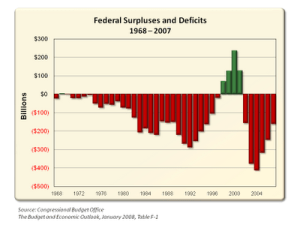
Paul Krugman covers another Reagan Bedtime Story. He also points out that even conservative economists have started spewing the notion that Reagan was responsible for an era of “unprecedented growth”. This is also not true.
This shows what everyone was supposed to know: we had an awesome performance in the generation following the war (despite very high tax rates on the rich and a very strong union movement); we had a long period of poor productivity performance that spanned the Ford, Carter, Reagan, and Bush I administrations; we then had a revival during the Clinton administration, but even so not up to postwar standards. By the way, I don’t give Clinton credit for that revival; it was about learning to use technology. But in any case, there is no hint of a Reagan miracle in the data.
Now, back to stylized facts on federal spending. This is also from Krugman. There is this huge meme out there right now that some how, President Obama has gone on some kind of spending spree. This couldn’t be further from the truth. It appears that Rush Limbaugh is not only a big fat liar, but he is also incapable of doing the math on simple fractions. He is joined by nearly every Republican in the House today.
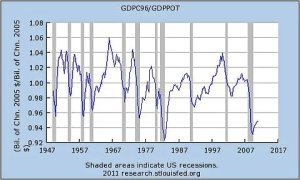
The fact is that federal spending rose from 19.6% of GDP in fiscal 2007 to 23.8% of GDP in fiscal 2010. So isn’t that a huge spending spree? Well, no.
First of all, the size of a ratio depends on the denominator as well as the numerator. GDP has fallen sharply relative to the economy’s potential; here’s the ratio of real GDP to the CBO’s estimate of potential GDP:
A 6 percent fall in GDP relative to trend, all by itself, would have raised the ratio of spending to GDP from 19.6 to 20.8, or about 30 percent of the actual rise.
That still leaves a rise in spending; but most of that is safety-net programs, which spend more in hard times because more people are in distress.
Beginning in 2005, the CBPP showed how George W. Bush’s excessive tax cuts played the largest part in federal deficits. Simply allowing these to expire last December would have gone farther in pushing a balanced budget than nearly anything done to date. In May of this year, they continued their analysis of how the Bush Policies were the ones driving the budget deficit.
Some lawmakers, pundits, and others continue to say that President George W. Bush’s policies did not drive the projected federal deficits of the coming decade — that, instead, it was the policies of President Obama and Congress in 2009 and 2010. But, the fact remains: the economic downturn, President Bush’s tax cuts and the wars in Afghanistan and Iraq explain virtually the entire deficit over the next ten years (see Figure 1).
The deficit for fiscal year 2009 — which began more than three months before President Obama’s inauguration — was $1.4 trillion and, at 10 percent of Gross Domestic Product (GDP), the largest deficit relative to the economy since the end of World War II. At $1.3 trillion and nearly 9 percent of GDP, the deficit in 2010 was only slightly lower. If current policies remain in place, deficits will likely resemble those figures in 2011 and hover near $1 trillion a year for the next decade.
The events and policies that pushed deficits to these high levels in the
near term were, for the most part, not of President Obama’s making. If not for the Bush tax cuts, the deficit-financed wars in Iraq and Afghanistan, and the effects of the worst recession since the Great Depression (including the cost of policymakers’ actions to combat it), we would not be facing these huge deficits in the near term. By themselves, in fact, the Bush tax cuts and the wars in Iraq and Afghanistan will account for almost half of the $20 trillion in debt that, under current policies, the nation will owe by 2019. The stimulus law and financial rescues will account for less than 10 percent of the debt at that time.
Other drives of the current deficit are extremely short-lived. These would be all the financial rescue spending delivered to financial institutions and the recession which brings in loss of revenues and increased expenditures. The other big expenditures are the two unfunded wars that having been running for over 10 years. These are the first wars that we have ever run that were not funded by tax increases.
However, these Republican Fairy Tales do not let the current President off the hook. He seems as hell bent as the Republicans in many ways to repeat their sins. He also seems woefully short on economic knowledge and incapable of listening to his economics advisers–now frustrated and gone–on what to do with the economy. The simplest way to shut down the deficit would be to eliminate preferential treatment of capital gains income and let the Bush tax cuts expire. I’d prefer they expire for folks over $200,000 a year, but letting them expire altogether is better than setting the stage for all these falsehoods spewing from Limbaugh and the like. Obama should’ve let the tax cuts expire when he had the chance. However, his ability to negotiate a position that proposes a Democratic alternative policy has never been present. People can’t figure out if he is just has the world’s worst negotiating skills or he wants what the Republicans want. My belief is that the outcome could matter less to him as long as he gets some ego strokes from it.
We have gotten to the point that complete insanity and adherence to fairy tales is putting our economy in serious jeopardy. We simply cannot afford to listen to the voices of ignorance any more. I cannot even believe we’re being held hostage now to a balanced budget amendment. That is one of the most flagrantly wrong policies any one could ever think about. I’m going to take that on this week since I can’t believe that zombie canard is back haunting the halls of Congress again.
We seriously need experienced economic stewardship of the economy right now. We have a tremendous jobs deficit that will only get worse if any of these seriously flawed budget initiatives pass. We couldn’t have gotten a worse group of leaders at a more crucial point in time. Their mistakes will hurt this country for a very long time.
The L shaped recovery and a Bogus Debt Crisis
Posted: July 29, 2011 Filed under: Economy, Federal Budget, Federal Budget and Budget deficit | Tags: 14th amendment, debt crisis, economy, recession 20 Comments Our economy continues to scuttle across a bottom set by the huge drop in performance during the Great Recession. This economist was not surprised by the lackluster GDP report released today. No one has used the correct fiscal policy prescription in this country since 1999. The current batch of Washington nimrods are going to set us at a new low shortly. We’ll be lucky to see nasty numbers like these a year from now. It’s as if tanking the economy is job 1 now.
Gross domestic product climbed at a 1.3 percent annual rate following a 0.4 percent gain in the prior quarter that was less than earlier estimated, Commerce Department figures showed today in Washington. The median forecast of economists surveyed by Bloomberg News called for a 1.8 percent increase. Household purchases, about 70 percent of the economy, rose 0.1 percent.
Treasuries rose as the report dimmed prospects for faster growth in the rest of 2011. The faltering economy may get another blow from spending cuts being negotiated in Congress, keeping pressure on Federal Reserve Chairman Ben S. Bernanke to hold interest rates near zero.
“The second-half rebound is melting away,” said Nigel Gault, chief U.S. economist at IHS Global Insight in Lexington, Massachusetts, the only forecaster polled to correctly estimate the gain in GDP. “It’s a very, very difficult situation for policy makers. The Fed could give a pretty strong signal that they are not likely to move on interest rates for a very long time.”
The yield on the benchmark 10-year note decreased to 2.85 percent at 1:22 p.m. in New York from 2.95 percent late yesterday. Stocks pared earlier losses on signs that House Speaker John Boehner’s plan to raise the debt ceiling was gaining support. The Standard & Poor’s 500 Index fell 0.3 percent to 1,296.42 after falling as much as 1.4 percent.
Former Labor Secretary Robert Reich tells it like it is in a post that might as well be entitled “It’s the jobs, stupid”. Too bad he’s not up for the Treasury position now occupied by Secretary Slave to Investment Banks. There’s a false equivalency being spread about raising the debt ceiling and increasing the deficit that’s really hampering policy discourse right now. The two things aren’t the same. The debt is the amount we owe and it builds each year when there is a deficit or when interest accumulates. The deficit is a shortage in one year’s budget. The only real crisis we have right now is a jobs crisis and a complete lack of demand. Again, no business person in their right mind is going to create anything if there’s no customers. Oh, there’s also a confederacy of dunces in the US House of Representatives. But, I won’t go there right now.
Get it? We’re really in a “jobs and growth” crisis – not a budget crisis.
And the best way to get jobs and growth back is for the federal government to spend more right now, not less – for example, by exempting the first $20,000 of income from payroll taxes this year and next, recreating a WPA and Civilian Conservation Corps, creating an infrastructure bank, providing tax incentives for small businesses to hire, expanding the Earned Income Tax Credit, and so on.
But what happens next week if Congress can’t or won’t deliver the President a bill to raise the debt ceiling? Remember: This is all politics, mixed in with legal technicalities. Economics has nothing to do with it.
One possibility, therefore, is for the Treasury to keep paying the nation’s bills regardless. It would continue to issue Treasury bills, which are our nation’s IOUs. When those IOUs are cashed at the Federal Reserve Board, the Fed would do what it has always done: Honor them.
How long could this go on without the debt ceiling being lifted? That’s a legal question. Republicans in Congress could mount a legal challenge, but no court in its right mind would stop the Fed from honoring the full faith and credit of the United States.
One of the biggest right wing memes that drives me crazy is that the economy is bad because we have too much taxes still and that the President’s stimulus didn’t work because it was worthless spending. I knew it wouldn’t do much to stimulate the economy simply because it didn’t take advantage of the government spending multiplier in key areas and wasn’t big enough. Also, it was the Biggest Tax Cut Ever which rarely works as efficiently as direct government spending to get consumption going again. So why are so many idiots arguing that more of the same tax cuts are going to improve the economy and cutting all levels of government spending is considered confidence building when the government spending multiplier will just push recessionary momentum? You got me. It’s insanity.
So, what happens if these debt ceilings talk fail? Well, first, every single financial asset, liability, and contract will reprice all over the world. Most of them will reprice in a bad way that will hamper economies every where. Every business project will be evaluated using a risk free rate that will now be higher and will not be considered risk free any more. That means many projects will now be rejected so expansions, new jobs, or anything like that will be rejected. Remember, this is not because we can’t pay those bills, it’s because a few idiots refuse to pay them. Second, the world will continue to step away from the dollar. Third, there will be strong recessionary pressures. It’s not good, folks. As these recent GDP figures show, we’re far from out of the impact of the last financial shock.
But what if all those options failed? What would be the consequence of even a notional default? The IMF has talked of a global recession if there was a loss of confidence in US solvency although it’s not clear that a failure to roll over debt for a few days would qualify for that description.
Having seen what happened with Lehman’s default, the main worry would be a freeze in the markets. Take the finances of banks, for example. Many use Treasury bonds as the risk-free asset for capital purposes. As Capital Economics points out
“Government debt is only automatically 0% risk-weighted for banks under Basel II if it is rated AA- or higher (although regulators can make exceptions for domestic government debt issued in local currency). In principle, therefore, financial institutions would face significantly higher capital charges in the event of a US government default.In practice, it seems likely that the regulators would move quickly to waive the rules. But there might be a few hairy moments while they did. And what about money-market funds? Having been burned by the credit crunch, many have opted for the safe haven of US Treasury bills. Perhaps they could roll over those bills into some form of IOU from the government. But if investors demanded their money back at a time when Treasury bills were illiquid, money-market funds might be forced to suspend resumptions or “break the buck”. Then there is the repo market, widely used by financial institutions to raise money; Treasury securities are used as collateral for such borrowing.”
Standard & Poor’s has considered this scenario and suggests that
“Failure to pay off maturing debt or missing interest payments (approximately $62 billion of interest is payable on Aug. 15) would constitute a selective default pursuant to our criteria, and Standard & Poor’s expects it would lower the sovereign rating to ‘SD’. Even if the Fed and other central banks managed to keep the financial system functioning, we expect that markets around the world would be severely damaged. In such a hypothetical scenario, we expect that equity markets would generally plunge, borrowing costs and interbank lending rates would soar, and corporate credit markets would be closed to all but the highest quality issuers. We envisage that consumers and businesses would likely stop spending on all but essential items, and the value of the dollar would drop by 10% or more against other major currencies. With the dollar heading lower, investors would likely look for hard assets like oil and other commodities, driving prices higher.Given the fragility of the economic recovery, this is an incredible risk to contemplate. It is also worth noting that, even a freeze on government spending that stopped short of a default, would have a significant impact on demand.”
I still can’t believe that a few people are willing to tank the economy for failed economic hypotheses. It’s as if everything we’ve learned over the past 70 years has been completely thrown to the wind and we’re being run by the myth of Reagan’s ghost. I say myth because what they’re going on didn’t even happen on his watch. He was responsible for the biggest single tax increase in history and was responsible for a lot of the debt they’re whining about today. Speaking of Reagan, one of his economists–Bruce Bartlett–has an excellent analytical piece up on how the Debt Crisis is being Fueled by Obama’s weak negotiations. It’s worth a read.
Unfortunately, Obama is really too young to have the kind of experience that previous presidents like Reagan brought to the White House in terms of understanding intransigent enemies and how to deal with them. Consequently, Obama has really been caught flat-footed by the Tea Party era Republican Party. He believed it would respond positively if he offered it half a loaf on just about every issue.
For example, some 40 percent of the 2009 stimulus legislation consisted of tax cuts even though his economic advisers knew that they would have almost no stimulative effect. But Obama viewed them as an important concession to Republicans. Yet despite total rejection of his stimulus package by the GOP, Obama kept the tax cuts rather than reprogramming the money into more effective programs such as state aid or public works.
Nevertheless, Obama offered Republicans another half-loaf by putting forward a health reform plan almost identical to those that they and conservative groups such as the Heritage Foundation had proposedin the 1990s. Obama’s offer was summarily rejected and Republicans suddenly decided that the individual mandate, which previously had been at the core of their own health reform plans, was unconstitutional.
Now we are in the midst of a debt crisis that stems largely from Obama’s inability to accept the intransigence of his political opponents. Last December, he caved in to Republicans by supporting extension of the Bush tax cuts even though there is no evidence that they have done anything other than increase the deficit. There were those who told Obama that he ought to include an increase in the debt limit, but he rejected that idea, believing that Republicans would behave like responsible adults and raise the debt limit just as they did routinely when their party held the White House.
I join Bartlett, former President Clinton, and others in begging the President to invoke the 14th amendment. Then, he should find some economics advisers who know what they are doing and listen to them for a change.

 peej
peej Carissa
 bostonboomer
 dakinikat
 ecocatwoman
 mablue2
 Mama Lopez
 peggysue22
 quixote
 skydancingguestblogger
 Mona (aka Wonk the Vote)



 Sky Dancing
Recent Comments