
In The Land Of The Delusional
Posted: March 2, 2012 Filed under: 2012 presidential campaign, Austerity, double-speak, Economy, income inequality, Mitt Romney, religious extremists, Republican presidential politics, the GOP, U.S. Economy, War on Women, Women's Healthcare 16 CommentsIn the Land of the Delusional the Koch brothers are principled citizens who merely disagree with Democratic policy stands and are aghast at the vindictive slurs leveled against them and all other sincere, freedom-loving Republicans. In the Land of the Delusional, the hate and rage on review is a product of pink-bellied Lefties, Alinski acolytes, looking to take down American virtue and reduce the country’s might and glory. In the Land of the Delusional bankrupt ideas, economic mayhem and privateering can be obscured by attacks on woman, gays and the down and outers.
March is living up to its reputation—coming in like snarling Lion. Rush Limbaugh exposed a full Monty of misogyny, his comments on Sandra Fluke provoking even House Speaker Boehner to suggest the diatribe was ‘inappropriate.’ What inspired the outburst? Several weeks of desperate frontal attacks on women’s healthcare issues, thinly veiled and wrapped beneath ‘religious liberty’ arguments.
Let’s not kid ourselves! This is little more than shifting the conversation from discussion over economic issues, for which the Republican party has no credible position. The US Budget Watch has reported that Republican plans to slash taxes on corporations and high-income earners would explode the national debt up to $3 trillion. And for all the ballyhoo by the Norquist group the Washington Post reported [as well as many other sources] that the country’s revenue-collection has eroded to a 60-year low.
From the WP report:
Polls show that a large majority of Americans blame wasteful or unnecessary federal programs for the nation’s budget problems. But routine increases in defense and domestic spending account for only about 15 percent of the financial deterioration, according to a new analysis of CBO data.
The biggest culprit, by far, has been an erosion of tax revenue triggered largely by two recessions and multiple rounds of tax cuts. Together, the economy and the tax bills enacted under former president George W. Bush, and to a lesser extent by President Obama, wiped out $6.3 trillion in anticipated revenue. That’s nearly half of the $12.7 trillion swing from projected surpluses to real debt. Federal tax collections now stand at their lowest level as a percentage of the economy in 60 years.

Trickle Down Economics in Nature
But why let facts stand in the way. Paul Ryan, the Republican’s designated ‘serious thinker’ certainly doesn’t.
Ryan also complimented Romney’s economic plan. The congressman’s stamp of approval has been important for Republicans since he earned praise last year for his ambitious budget — which would dramatically change Medicare— from strong conservatives.
“Very credible. They are talking about entitlement reform. They are putting specifics on the table on Medicare and Social Security reform. The president, knowing that these are the big drivers of our debt, is ducking it,” Ryan said of Romney’s proposals.
Ah, yes. The ideologically blind leading those blinded by ambition. That certainly gives me confidence.
But as Paul Krugman suggested a mere 10 ten days ago, Mitt Romney let slip a truism in the swirl of Michigan campaigning when he said:
“If you just cut, if all you’re thinking about doing is cutting spending, as you cut spending you’ll slow down the economy.”
Over which the ideological purists set the dogs loose. The Club for Growth immediately denounced the Romney slip, insisting that it was a clear indication that Mitt was an imposter, not a ‘true’ limited government conservative [translation: not willing to drown all government in that Norquist bathtub].
What’s a candidate to do? Retreat, of course, in the same way Romney flipped on the Blunt Amendment, breaking all records, I would guess. In less than an hour, Candidate Romney twisted from ‘not going to go there’ to ‘of course, I support it.’ Enough to make your head spin. This is a political party in the death throes.
So, what’s the best way to distract?
Let’s pillory the women, start calling them sluts or suggest they film sexual exploits for the sake of some overweight, mean-spirited shock jock. Or let’s pretend that the perceived decline of the Nation rests squarely on the shoulders of the Gay Community and their screechy insistence that they too expect and deserve [can you believe the gall of these people] basic civil rights. And don’t forget the statistics on the ever-expanding numbers of Americans slipping into poverty. We tried calling them losers and moochers. How about we deny they exist, the way a North Carolina legislator recently announced. Yes sir, that’s the ticket!
In the Land of the Delusional schizophrenics rule the day, magical thinking replaces reason and bare-foot and pregnant is a very good thing. In the Land of the Delusional all things are possible.
Except the truth.

The Myth in the Machine
Posted: February 17, 2012 Filed under: Economy, Environment, Environmental Protection | Tags: regulations create jobs 15 Comments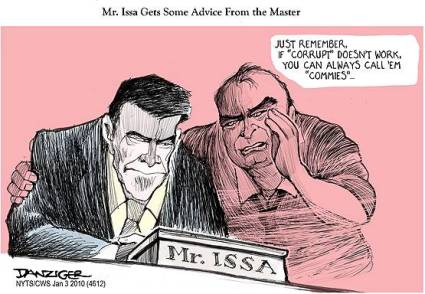 Bostonboomer and I were perusing information on the Issa panel and committee on religious freedom and birth control yesterday. Their expert witness panel appeared to be a mix between the Salem Witch Trials and the Spanish Inquisition. Where were the women on this panel? Is this really our government? What’s going on in Torquemada’s–errr Issa’s–realm of influence these days? BB has already regaled us on the crooked career and life of Issa whose business and career seems built on insurance fraud, car theft, and arson, so I won’t go there. We have a whole tag dedicated to him that’s infinitely googleable. However I will express my utter surprise and contempt that a committee of the US House of Representatives and its web page seem to be more of a propaganda tool of right wing tropes than anything remotely informative or helpful. Issa appears to be the Republican Party’s budding little combination of Goebbels and Himmler.
Go there and you’ll see a youtube with a nice white lady saying her “choice” was taken away by the SEIU. You’ll also see the Orwellian job creators DOT com that wants to know what kind of things are holding up your business. I don’t suppose any answer pointing to a lack of customers with well-paying jobs gets much attention. It also has a link to the Fast and Furious Witch Hunt. (No mention that this program had roots in the previous Republican administration, of course.) I had no idea that so much propaganda had crept into tax payer paid websites of congressional committees. I expect propaganda on their Facebook pages. But congressional committee pages with federal government addresses? Please!!
In honor of Issa’s hunt for “experts” that agree with him, I thought I’d point out a Bloomberg Business article that shows how many jobs new government regulations can create in the economy. The subtitle is “Vilified on the campaign trail, government rules often create as many jobs as they kill”. Nothing like a little truth and empirical research to shine the light on the Issa/Gingrich/Romney propaganda machine. It’s true that regulations on businesses can shift resources away from the regulated business. That includes jobs, profits, capital, and executive perks. However, that’s a one-sided notion. Those resources don’t disappear into thin air. They simply shift away from the business that’s regulated–most likely because it’s creating a social cost–to other businesses that can better use the resources or employ folks cleaning up and measuring the messes in the case of regulation of dirty industries like Coal and Oil.
“This rule is the most extensive intervention into the power market and job market that EPA has ever attempted to implement,” says Scott Segal, a lobbyist at Bracewell & Giuliani, which represents the utility Southern Co. (SO) He argues the regulation will “undermine job creation in the United States.”
Tell that to Cal Lockert, the vice-president of Breen Energy Solutions, a Pittsburgh manufacturer of equipment that absorbs acid gases to keep them from spilling out of smokestacks. Lockert spends his days persuading power companies that he can help them bring some of their oldest, dirtiest plants in line with the federal requirements. There’s been “a frenzy of engineering firms and utilities” calling him for demonstrations of his products, he says. He’s hired a dozen people in the past month and says he’s just getting started.
Nol-Tec Systems in Lino Lakes, Minn., also expects a boom in sales of its equipment, which uses baking soda to pull pollutants out of plant exhaust. Meanwhile, Thermo Fisher Scientific (TMO) in Waltham, Mass., is building emission monitors that power plants will need to measure toxins under the new rules. The regulations “could easily add $50 million to $100 million dollars in revenue in a year or two years,” says Chief Executive Officer Marc Casper, “which is significant for a company like ours.” The Institute of Clean Air Companies, a trade association representing businesses that make products to reduce industrial emissions, forecasts the industry will add 300,000 jobs a year through 2017 as a result of the EPA rules.
This is the side of the story that rarely gets mentioned in Washington or on the campaign trail. In an election year that hinges on the economy, government rules have become politically toxic. President Barack Obama’s health-care overhaul, the massive Dodd-Frank financial reform law, and EPA clean air and water mandates come under frequent attack from Republicans who say burdensome regulations are stalling the nation’s recovery. In the GOP debates, the R-word is now habitually preceded by “job-killing,” as in Mitt Romney’s promise to put an end to “job-killing regulations.” Newt Gingrich refers to the EPA as a “job-killing regulatory engine.”
Romney and Gingrich aren’t wrong. Government regulations do kill jobs, often by the thousands. Although it’s too early to tell how many layoffs may result from health-care and Wall Street reforms, there is a body of research going back decades detailing what has happened time and time again when Washington handed down sweeping environmental regulations: Costs increased, prices went up, and workers were fired. Supporters and opponents of the EPA’s new power plant rules agree that they will almost certainly result in dozens of coal plants shutting down and hundreds of workers being laid off.
But that’s not the whole picture. Government employment figures also show that those same regulations usually wind up creating about as many jobs as they kill. “We find there is no net impact,” says Richard Morgenstern, the EPA’s director of policy analysis in the Reagan and Clinton Administrations and now a researcher with Resources for the Future, a nonpartisan energy think tank in Washington. “The job creation and the job destruction roughly cancel each other out.”
Businesses targeted for regulation create huge social costs that taxpayers are forced to pick up. There are public health and safety costs, pollution and clean up costs, and many other costs. Dirty industries do these because they can force their costs onto the back of the public. They over produce their products and gobble up scare capital and productive resources because of they don’t realize the full costs of doing business. Regulation pushes these costs back onto their businesses. It also leads to “creative destruction” which is the Schumpeter idea that old, outdated technology must be replaced with better things to improve the long term performance of the economy. Some times the discipline in key industries has to come from the government because of the monopoly power of the industry. The energy industry is a prime example with its oligopoly over resource and product markets and the price inelastic nature of its demand. This enables the industry to via for political power as well as allows it fight to maintain dominance. In most of these cases, only technological developments break the monopoly/oligopoly. When Carter deregulated the telecommunications industry it wasn’t really all that effective. What really broke the back of the AT&T monopoly was the advances in communications technology. Frequently, regulations allow access to the heart of the monopoly’s business so that more facile, advanced businesses can break apart this destructive market type. It transfers resources away from the inefficient market that pushes high social costs on to taxpayers and neighboring communities.
Here’s a study that you never hear coming from the Issa propaganda/witch hunt arm of the US House of Representatives.
In 2002, Morgenstern and his colleagues published a landmark study detailing the effects of regulations on jobs in four polluting industries: paper, plastics, petroleum, and iron and steel. Drawing on more than 10 years’ worth of U.S. Census data, the study found new regulations led to higher production costs that pushed up prices, resulting in lost sales and layoffs. Yet those job losses were offset by new jobs in pollution abatement. “There’s always someone who is helped and someone who is hurt,” says Roger Noll, director of the Program on Regulatory Policy at Stanford University. “Which is why you have to look at the net effect on the economy.”
The loss in the polluting industry is actually a good thing in terms of market economy’s because it’s usually related to market inefficiency and transferred costs of doing business. BTW, this Stanford University think tank is not a hot bed of raging liberalism. This is one of this policy areas where there are trade-offs. This means changes create winners and losers. The deal is that in most cases the job loss is minimal but overall market efficiency improves. The true cost of the product is passed on to consumers which removes the subsidy to the consumers and producers of the product. Again, the resources just go elsewhere and are employed more efficiently in newer businesses. Oddly enough, this is what Romney frequently says he did in his corporate raider days.
The critique of regulations fits into a broader conservative narrative about government overreach. But it also comes after a string of disasters in recent years that were tied to government regulators falling short, including the financial crisis of 2008, the BP oil spill and the West Virginia mining accident last year.
Data from the Bureau of Labor Statistics show that very few layoffs are caused principally by tougher rules.
Whenever a firm lays off workers, the bureau asks executives the biggest reason for the job cuts.
In 2010, 0.3 percent of the people who lost their jobs in layoffs were let go because of “government regulations/intervention.” By comparison, 25 percent were laid off because of a drop in business demand.
I’m really not sure how we can create responses and discussions to one-sided political narratives that are based more on ideological memes than facts. It certainly doesn’t help when that one-sided narrative comes from our own government sites and servants. Obviously, the inefficient, lop-sided markets create monopoly profits for the stakeholders and we see K street filled with lobbyists aimed at protecting the inefficient markets. The stories from younger, inventive, upstart businesses without lobbyists and pet pundits and politicians have worthwhile narratives. Too bad their lost in a fight for ideological purity instead of empirical truth. Perhaps this is one of the reasons we keep fighting the culture wars. Voodoo economics narratives don’t hold up to inspection.
Saturday Reads: Dismal Science Edition
Posted: February 4, 2012 Filed under: Economy, income inequality, morning reads, poverty, unemployment, We are so F'd | Tags: Paul Krugman, social safety net, unemployment 62 Comments Good Morning!
I’m going to concentrate on the economy this morning. You better grab some coffee.
The unemployment rate dropped yesterday for a variety of reasons. I thought I’d talk a little about that first. The job growth was fairly strong this month in every sector but government. This improved the labor outlook for some of the workers hardest hit by the last recession. However, it was a mixed report–although you wouldn’t know that from the stock market–in that it still showed a number of people who are working part time that don’t want to be and again, a large number of people simply disappeared from the labor force. Temp jobs surged. Wage growth is “meager” as shown by graphs in this blog post by Tim Duy. He also notes that the employment to population ratio remains at a levels not seen since the early 1980s. This is an interesting situation. We’re still in a huge hole. At this growth rate, it will take us until 2019 just to gain back the jobs we had in 2008.
One interesting trend pointed out at Zero Hedge by Tyler Durden is that older workers are increasing the number of hours worked. There appears to be a basic shift in many of the ‘normal’ labor habits. Durden calculates an alternative measure to the unemployment rate by including workers that the BLS ignores. He uses the long-term average labor force participation rate instead of the number of people that are participating now which is shrinking in a very odd way.
… do the following calculation with us: using BLS data, the US civilian non-institutional population was 242,269 in January, an increase of 1.7 million month over month: apply the long-term average labor force participation rate of 65.8% to this number (because as chart 2 below shows, people are not retiring as the popular propaganda goes: in fact labor participation in those aged 55 and over has been soaring as more and more old people have to work overtime, forget retiring), and you get 159.4 million: that is what the real labor force should be. The BLS reported one? 154.4 million: a tiny 5 million difference. Then add these people who the BLS is purposefully ignoring yet who most
certainly are in dire need of labor and/or a job to the 12.758 million reported unemployed by the BLS and you get 17.776 million in real unemployed workers. What does this mean? That using just the BLS denominator in calculating the unemployed rate of 154.4 million, the real unemployment rate actually rose in January to 11.5%. Compare that with the BLS reported decline from 8.5% to 8.3%. It also means that the spread between the reported and implied unemployment rate just soared to a fresh 30 year high of 3.2%.
So, the deal is that the labor force participation rate is at a 30 year low. That’s still the number that puzzles and bothers me despite the good looking job growth. Why are people leaving the job market? As shown in Durden’s numbers, it’s not baby boomers. Here’s some speculation by Edward Harrison of Credit Write Downs who is concerned like me. Look at the graph on the right from Durden that shows why reason number three isn’t the explanation right now. The blue line is the participation rate by the older workers (55+) and as you can see it’s headed straight up.
My take on this: A declining labor force participation rate is a bad thing. It says people are dropping out of the labor force. So despite the bullish headline figure, the question still remains as to how robust the jobs market is.
Here are three things to consider:
- Cyclical: that’s the point I made above. Low participation is a negative signal.
- Structural: A lot of people have been pointing to long-term unemployment as a sign that the jobs market is weak. This makes sense and it should put downward pressure on the participation rate as people drop out of the labor force. The difference here is that if the problem is structural and not cyclical, the so-called output gap will continue to be large as throngs of people remain out of the labor force.
- Secular: The first cohorts of boomers started to retire last year. I know many people that were close to retirement when the recession began in 2007 that have had to change plans. Some have delayed retirement because of financial turmoil. But many others have accelerated retirement unwillingly because they were forced out of the labor force. Expect the loss of boomers to put downward pressure on the labor force for years to come.
My guess is that all three factors are affecting the labor force participation rate here. But I am beginning to think that the structural and secular forces are starting to predominate.
I’m still thinking that younger people may be holding up in school for awhile until things get better but I’d have to do some research to see if the university population is up. I also think that there’s the discouraged worker factor too. I actually know a lot of folks that are just hanging in there and cashing in their IRAs or have gone back to school and are living on student loans and or going back and forth between short term jobs and contract work. I guess we’ll see if the trend holds, but to me it’s a worrisome one. If things were really getting better, those folks should be entering the job market now driving the participation rate up. Since I’m a financial economist and not a labor economist, I really don’t know the flows well enough to speculate on anything beyond a theoretical level. It’s not my research area.
Thomas Fran has written an interesting post at Alternet on “Why We Got Ayn Rand Instead of FDR”.
An appropriate metaphor for the conservative revival is the classic switcheroo, with one fear replacing another, theoretical emergencies substituting for authentic ones, and a new villain shuffling onstage to absorb the brickbats meant for another. The conservative renaissance rewrites history according to the political demands of the moment, generates thick smokescreens of deliberate bewilderment, grabs for itself the nobility of the common toiler, and projects onto its rivals the arrogance of the aristocrat. Nor is this constant redirection of public ire a characteristic the movement developed as it went along; it was present at the creation. Indeed, redirection was the creation.
…
Here, in one sentence, was a key to the amazing success the Right would shortly enjoy. They had an answer to the bailout outrage, and it was not modulated by lawyerly subtleties or votes-taken-with-nose-held, like the House Democrats who had voted for the TARP. “Let the failures fail”: it was a line that would allow the revived Right to depict itself as an enemy of big business, rooting for the collapse of the megabanks. The Tea Partiers may have looked ridiculous in their costumes, but their central demand was anything but.
Not all “failure” is the same, however. What the newest Right has in mind is something philosophical, something both personal and sweeping. It demands liquidation across the board, a sort of deserved doomsday for the borrowing-based way of life. But in the great die-off it delights in imagining, the real culprits of 2008 have a way of disappearing from view.
If we watch closely, we can see the cards being switched. Whenever our tea-partying friends warm to the subject of letting-the-failures-fail—and they do so often—sooner or later they inevitably turn from the bailed-out banks to those spendthrift “neighbors” identified by Santelli, those dissolute people down the street who borrowed in order to live above their station.
This could be why the Republican Presidential Wannabes sound so down right Dickensian. We’ve had school children offered up as janitorial help. We’ve had Willard talking about enjoying a good firing and ranting on about how he’s not worried about the poor because they are safe in their safety nets. Instead of pointing to the business welfare queens, we’ve got poor children being held up as not having the fortitude and values. As Krugman says, Willard doesn’t feel any one’s pain.
Now, the truth is that the safety net does need repair. It provides a lot of help to the poor, but not enough. Medicaid, for example, provides essential health care to millions of unlucky citizens, children especially, but many people still fall through the cracks: among Americans with annual incomes under $25,000, more than a quarter — 28.7 percent — don’t have any kind of health insurance. And, no, they can’t make up for that lack of coverage by going to emergency rooms.
Similarly, food aid programs help a lot, but one in six Americans living below the poverty line suffers from “low food security.” This is officially defined as involving situations in which “food intake was reduced at times during the year because [households] had insufficient money or other resources for food” — in other words, hunger.
So we do need to strengthen our safety net. Mr. Romney, however, wants to make the safety net weaker instead.
Specifically, the candidate has endorsed Representative Paul Ryan’s plan for drastic cuts in federal spending — with almost two-thirds of the proposed spending cuts coming at the expense of low-income Americans. To the extent that Mr. Romney has differentiated his position from the Ryan plan, it is in the direction of even harsher cuts for the poor; his Medicaid proposal appears to involve a 40 percent reduction in financing compared with current law.
So Mr. Romney’s position seems to be that we need not worry about the poor thanks to programs that he insists, falsely, don’t actually help the needy, and which he intends, in any case, to destroy.
Still, I believe Mr. Romney when he says he isn’t concerned about the poor. What I don’t believe is his assertion that he’s equally unconcerned about the rich, who are “doing fine.” After all, if that’s what he really feels, why does he propose showering them with money?
The New York Review of Books has an entire list of economics books up that have to do with austerity and income inequality. The heading basically sums it up. We’re more unequal than you think. Here’s a review of two that I found particularly interesting.
Robert Frank’s The Darwin Economy and Thomas Edsall’s The Age of Austerity provide much-needed information and analysis to explain why so much of the nation’s money is flowing upward. Frank, an economist at Cornell, draws on social psychology to shatter many myths about competition and compensation. While he doesn’t explicitly cite the classical French economist Jean-Baptiste Say, much in his exposition echoes Say’s axiom that “supply creates demand.” This doesn’t mean that if items are put on display, people will automatically buy them. Consumers decide what or if they’ll purchase, and clearly can only do so if they have the credit or money. Even so, the items they decide they want have been created by the suppliers, who put things on the shelves.
Frank carries this a step further. In recent years, he argues, the products and enjoyments set before us have become increasingly enticing—including houses, vacations, television programs, video games, electronic devices, and the attractions of the Internet. In many cases, the rich acquire them first; since what they have and do becomes widely known, emulation descends down the line.
Nor are these just Tiffany trinkets. Frank’s most vivid examples are newly built houses. As the very rich installed grander entrance halls and rarely used bathrooms, the professional classes felt they should have a semblance of such amenities. “By 2007,” Frank writes, “the median new single-family house built in the United States had an area of more than 2,300 square feet, some 50 percent more than its counterpart from 1970.” Indeed, it’s revealing that this expansion was happening as people were having fewer children. However, these homes—along with more elaborate wardrobes, holidays, and technical gear—are costly. If they were to be bought, salaries needed to keep pace.
Hence, I would argue, an unstated but still real compact was made between the employers and the new upper-middle class. Their pay would be raised to support their ascending status. As the samplings in Table B show, while real earnings for the overall workforce have risen only 7 percent since 1985, professions like physicians and professors have done several times better. Incomes of lawyers and executives, for their part, have soared much further than anyone would have forecast a few decades ago.2
One of the reasons the poor do so poorly is that the states have tax structures that are very regressive. If you didn’t see me link to this down thread yesterday, take a look at how regressive state taxes really are. Kevin Drum includes a table where you can check on how bad your state treats you.
And then there are state taxes. Those include state income taxes, property taxes, sales taxes, and fees of various kinds. How progressive are state taxes?
Answer: They aren’t. The Corporation for Enterprise Development recently released a scorecard for all 50 states, and it has boatloads of useful information. That includes overall tax rates, where data from the Institute on Taxation and Economic Policy shows that in the median state (Mississippi, as it turns out) the poorest 20 percent pay twice the tax rate of the top 1 percent. In the worst states, the poorest 20 percent pay five to six times the rate of the richest 1 percent. Lucky duckies indeed. There’s not one single state with a tax system that’s progressive.
So, hopefully, you’re still awake! What’s on your reading and blogging list today.
Is This the Conversation We’ve Been Waiting For . . . Or Not?
Posted: January 14, 2012 Filed under: #Occupy and We are the 99 percent!, 2012 primaries, Banksters, Congress, Corporate Crime, corporate money, Economy, income inequality, Regulation, Republican Tax Fetishists | Tags: crony capitalism, Financial Crisis, Mitt Romney, Newt Gingrich, U.S. Economy 22 CommentsThe recent brouhaha over Newt Gingrich and Mitt Romney locking horns over Romney’s involvement [I created 100,000 jobs] at Bain Capital  has raised speculation that a conversation about capitalism, the way it’s been practiced these last 30-40 years, is about to commence, a conversation that is way overdue.
The irony is that the issue has been brought to the fore by Republican candidates, none of whom questioned the blowback of leveraged buyouts [LBO] and private equity firms in the past or even whispered the traitorous phrases–crony capitalism, vulture capitalism–in public. In fact, the centerpiece of GOP economic theory is free market fundamentalism—set the market free, unfetter business from governmental regulation and Heaven’s Gate will open.
Not quite.
There’s the 2008 meltdown to contend with, the abuses of Wall Street and a clear example that Greenspan’s ‘self-regulating’ market theory was a cruel and greedy joke. Following the meltdown, Greenspan himself glumly admitted his worldview was incorrect.
In addition, we have plenty of evidence that the so-called Trickle-Down philosophy has not ‘raised all ships’ as heralded by the true believers but rather led to huge income disparities, flat wages and the death-rattle of the middle-class.
Yes, there is the question of globalization. Like it or not, we have grown interconnected. But when decisions are made purely on profit, the quicker the better, then transferring manufacturing abroad, exploiting cheap foreign labor, taking advantage of lax worker safety rules and nonexistent environmental regulations begins to make a twisted sort of sense. So, too with trade agreements made deliberately lopsided and unfair because these ‘deals’ have no national loyalty. Profit is king; all else is subservient.
The long-term damage is massive. We don’t have to speculate about this. The evidence is everywhere in our unemployment numbers [which are far worse than reported] and the slide into poverty for alarming numbers of Americans. Add in the housing crisis, still escalating health care costs, the Gulf oil spill, endless wars, the battles over extracting oil, coal and natural gas while refusing to work on rational and workable alternative energy policies, and . . .
Well, it’s enough to make your head explode.
But suddenly, the door has flown open for a conversation on what it means to be a shareholder capitalist. The unquestioned virtue of profit over all else has begun to raise its ugly head.
For instance, what value [if any] is created for a society when money is valued above all else, valued over the welfare of fellow citizens–the sick, the disabled, even our children. What value is maintained when corners are cut, laws rewritten, ridiculous tax policies hyped as necessary for growth and future job creation? But the mythical jobs, positions offering a living wage, never come. What does it mean when massive profits stream only to the top tier of the population, the so-called job creators, while everyone and everything else is left to flounder?
I call it a no-value deal–a lie, a theft–the magnitude of which hollows out a society, sucks it dry.
For too long Newt Gingrich [for all his caterwauling now] and his like-minded buddies have called it the free enterprise system. Free for whom? Certainly not for the families who have lost their homes, seen their jobs exported and have no reasonable expectation that their own children will ever see better times. Not with the continuation of what Dylan Ratigan has termed Extractionism, a system that takes money from others without offering anything of value, anything that actually promotes growth or improves society. This is a system that merely fills the coffers of the Extractionists, while they play a heady game of King of the Mountain and continue to spread the folklore that this is what freedom and liberty look like.
 But let’s be fair. Mitt Romney is not the devil incarnate, nor is Bain Capital the worst of the worst. Much of what Newt Gingrich’s SuperPac is selling to the electorate conveniently let’s Wall Street and multinational corporations off the hook. The ads fail to mention the cushy collusion of legislators who push laws and tax breaks to keep the circle spinning. And Washington Democrats who may be dancing the happy dance now are just as guilty of supporting the status quo, going along to get along, eagerly taking campaign donations from their own smiling Extractionists.
Is this the conversation Republicans are offering?
Sorry, no.
Rush Limbaugh has been apoplectic on the issue. According to Limbaugh, Gingrich has ‘Gone Perot.’
So you might say that Newt now has adopted the Perot stance, because he just said it: ‘I’m gonna make sure that Romney doesn’t come out of New Hampshire with any momentum whatsoever.’ And he’s using language that the left uses, and he’s attempting to make hay with this. You know, he’s trying to dredge up and have long-lasting negatives attach to Romney [this is what’s so unsettling about this] in the same way the left would say it. You could, after all these bites, say, “I’m Barack Obama, and I approve this message.
Rudy Giuliani also weighed in.
What the hell are you doing, Newt?” Giuliani said this morning on “Fox and Friends.” “The stuff you’re saying is one of the reasons we’re in this trouble now.
This whole ignorant populist view of the economy that was proven to be incorrect with the Soviet Union with Chinese communism.
Oh yes, the ‘ignorant populist’ view that has beamed a light on business as usual. Which btw, is not working, except for a tiny fraction of the American public. If anything, Uncle Newt has pulled back the curtain and revealed an unsettling truth.
This might not be the full-throated conversation Americans need to engage in. Still it’s a beginning from a most unexpected quarter, whose raison d’etre is as caught up in short-term results as are its economic principles. Almost Occupy Wall St. in nature, the conversation is now in the open. This is a conversation that defies Mitt Romney’s suggestion that sensitive subjects are better left to the privacy of ‘quiet rooms.’
This is the conversation of the moment. The first word, the opening sentence. It has just begun.
Friday Reads: A Brainy Break from the Village
Posted: January 13, 2012 Filed under: Economy, Egypt, Elections, Foreign Affairs, health hazard, Labor unions, morning reads, psychology 18 Comments Good Morning!
I thought I would treat you to some academics this morning starting with two well known economists and their thoughts on 2012. I figured we needed a break from the primary season insanity. First up is Nobel Prize Winner Joseph Stiglitz on “The Perils of 2012”. The next two offerings are from Project Syndicate.
This year is set to be even worse. It is possible, of course, that the United States will solve its political problems and finally adopt the stimulus measures that it needs to bring down unemployment to 6% or 7% (the pre-crisis level of 4% or 5% is too much to hope for). But this is as unlikely as it is that Europe will figure out that austerity alone will not solve its problems. On the contrary, austerity will only exacerbate the economic slowdown. Without growth, the debt crisis – and the euro crisis – will only worsen. And the long crisis that began with the collapse of the housing bubble in 2007 and the subsequent recession will continue.
Moreover, the major emerging-market countries, which steered successfully through the storms of 2008 and 2009, may not cope as well with the problems looming on the horizon. Brazil’s growth has already stalled, fueling anxiety among its neighbors in Latin America.
Meanwhile, long-term problems – including climate change and other environmental threats, and increasing inequality in most countries around the world – have not gone away. Some have grown more severe. For example, high unemployment has depressed wages and increased poverty.
While that was what appeared to be Dr. Gloom, here is Doctor Doom. Dr. Nourielle Roubini writes that the global economy will be “Fragile and Unbalanced in 2012”.
Private- and public-sector deleveraging in the advanced economies has barely begun, with balance sheets of households, banks and financial institutions, and local and central governments still strained. Only the high-grade corporate sector has improved. But, with so many persistent tail risks and global uncertainties weighing on final demand, and with excess capacity remaining high, owing to past over-investment in real estate in many countries and China’s surge in manufacturing investment in recent years, these companies’ capital spending and hiring have remained muted.
Rising inequality – owing partly to job-slashing corporate restructuring – is reducing aggregate demand further, because households, poorer individuals, and labor-income earners have a higher marginal propensity to spend than corporations, richer households, and capital-income earners. Moreover, as inequality fuels popular protest around the world, social and political instability could pose an additional risk to economic performance.
Oops, I mentioned income inequality. I must hate capitalism and be a collectivist. Right? Absolutely not! After studying markets for as long as I have–and teaching others about them–I have a pretty good understanding about how they work and it’s not based on wishful thinking or trying to hide the woefully low amount of taxes I pay. Oh, and I betcha that my dad created more jobs in his life time than Willard ever did. I also know that income inequality is bad for every one and that includes the superrich. That’s why it’s good to ask “Why is Inequality Higher in America?”‘ Henry Farrell of GW–professor of political science–breaks down a study in a series of two articles. The study looks at the increasing use of veto power by Senators and finds that problems happen as you increase the number of players with the ability to block laws.
Linz and Stepan argue that high numbers of electoral veto players are highly correlated with inequality, and that studies of other systems (Australia, Switzerland) suggests that more veto players create greater lags in introducing welfare systems and block reform (interestingly though, these cases involve referendums as a block to legislation rather than the kinds of vetos seen at the federal level in the US). However, they also claim that veto points are not destiny – the experience of reform in Brazil argues that Barack Obama could have instituted Senate reform and hence reduced down the effective number of veto players from four to one.
The original essay can be found at Cambridge Journals but the authors have published books on the topic as well. The authors research is mostly in the area of countries transitioning to Democracies. The Atlantic published an essay of theirs called “How Egypt Can Make Democracy Work” last February.
Regardless of who leads it, there are some things an interim government should not do. Judging by the transitions that we have studied, a successful democratic outcome stands the best chance if the interim government does not succumb to the temptation to extend its mandate or write a new constitution itself. The interim government’s key political task should be to organize free and fair elections, making only those constitutional changes needed to conduct them. Writing a new constitution is best left to the incoming, popularly elected parliament.
Most activists and commentators are now asking who will or should become the next president. But why assume that a presidential political system, headed by a powerful unitary executive, will be instituted? Of the eight post-communist countries in the European Union, not one chose such a system. All of them established some form of parliamentary system, in which the government is directly accountable to the legislature and the president’s powers are limited — and often largely ceremonial.
That was a wise decision. A presidential election at a moment of great uncertainty, and in the absence of experienced democratic parties or broadly accepted leaders, is filled with danger.
Archeologists are examining an interesting time in American history for clues of America’s largest labor conflict between miners and coal mine owners. An unlikely coalition of people are trying to stop clear mining–and hence destruction–of the site. This article can be found in Archaeology Today.
The archaeology on the mountain, and the story it is beginning to tell, has helped bring together an unusual coalition—including the Sierra Club, the United Mine Workers of America (UMWA), the National Trust for Historic Preservation, and a number of local organizations—in what some are calling “The Second Battle of Blair Mountain.” It is certainly a fight over historic preservation, but for many involved, including local archaeologists and historians, the mountain is symbolic of much more—labor struggle, the social effects of resource extraction industries, and what they see as a century-long class conflict. The mountain’s loss to surface mining, they assert, would be personal, a major blow to Appalachian identity.
Coal mining has always been one of the most dangerous and difficult jobs, and the late nineteenth century in the southern coalfields saw it at its worst. There were few safety regulations for workers—undocumented European immigrants, African Americans, and poor Scots-Irish hill folk—and every aspect of their lives was controlled by their employers. They lived in company towns, bought their own equipment at company stores, and listened to company-approved sermons in company churches. As labor movements picked up elsewhere, even in coal regions to the north, they seemed to pass the southern coalfields by.
Nature reports on the attempts to tighten the use of antibiotics on farm animals. Just like humans, animals and their diseases are showing an increased resistance to the current medicines. A new rule will go into effect in April to try to slow down the trend towards increased resistance. The EU already has stricter rules in place.
In industrial farming, antimicrobials are commonly given to farm animals to treat infections, and prophylactically to prevent disease or spur growth. But there is growing concern that excessive use on farms is helping to breed antibiotic-resistant microbes, from Salmonella (see ‘Rising resistance’) to Escherichia coli, which are harder to treat when they infect people.
The US Food and Drug Administration (FDA) is now moving to protect key antibiotics known as cephalosporins, which are used in humans to treat a range of infections, including pneumonia. On 4 January, the agency said that it would prohibit certain uses of cephalosporins in farm animals including cattle, pigs, chickens and turkeys, because overuse of the drugs is “likely to contribute to cephalosporin-resistant strains of certain bacterial pathogens”. If cephalosporins become ineffective in treating human diseases, the FDA said, “doctors may have to use drugs that are not as effective, or that have greater side effects”.The new rules, to come into effect on 5 April, restrict veterinary surgeons to using the two cephalosporin drugs specifically approved for food-producing animals — ceftiofur and cephapirin — and ban prophylactic use. In animals not listed in the FDA order, such as ducks or rabbits, vets will have more discretion to use the drugs.
Most antibiotic classes are used both in animals and in humans, so the FDA is also considering tightening controls on all classes of antimicrobials used on farms. It is reviewing comments on rules that would prohibit the use of any antimicrobial drug to promote animal growth, a move that would be welcomed by many vets. “We would support greater veterinary oversight of antimicrobial drugs,” says Christine Hoang, assistant director of scientific activities at the American Veterinary Medical Association in Schaumburg, Illinois.
Psychology Today has some interesting information on Deadly Mind Traps. Dr. Boomer knows these as cognitive errors. Most of us call them self-defeating behaviors.
Intriguingly, research into this kind of self-defeating behavior shows that it is usually far from random. When we make mistakes, we tend to make them in ways that cluster under a few categories of screwup. There’s a method to our mindlessness. Most of the time, we’re on autopilot, relying on habit and time-saving rules of thumb known as heuristics.
For the most part, these rules work just fine, and when they don’t, the penalty is nothing worse than a scraped knee or a bruised ego. But when the stakes are higher, when a career is in jeopardy or a life is on the line, they can lead us into mental traps from which there is no escape. One slipup leads to another, and to another, in an ever-worsening spiral. The pressure ratchets up, and our ability to make sound decisions withers.
These cognitive errors are most dangerous in a potentially lethal environment like the wilderness or the cockpit of an aircraft, but versions of them can crop up in everyday life, too, such as when making decisions about what to eat, whom to date, or how to invest. The best defense? Just knowing they exist. When you recognize yourself starting to glide into one of these mind traps, stop, take a breath, and turn on your rational brain.
There’s a list of the classic errors and explanations in case you want to check it out. Turning on your rational brain sounds like something the Republican presidential wannabes should do right now. I think it would surprise every one, don’t you?
So, that’s your brainy break from the mainstream media. What’s on your reading and blogging list today?

 peej
peej Carissa
 bostonboomer
 dakinikat
 ecocatwoman
 mablue2
 Mama Lopez
 peggysue22
 quixote
 skydancingguestblogger
 Mona (aka Wonk the Vote)



 Sky Dancing
Recent Comments